
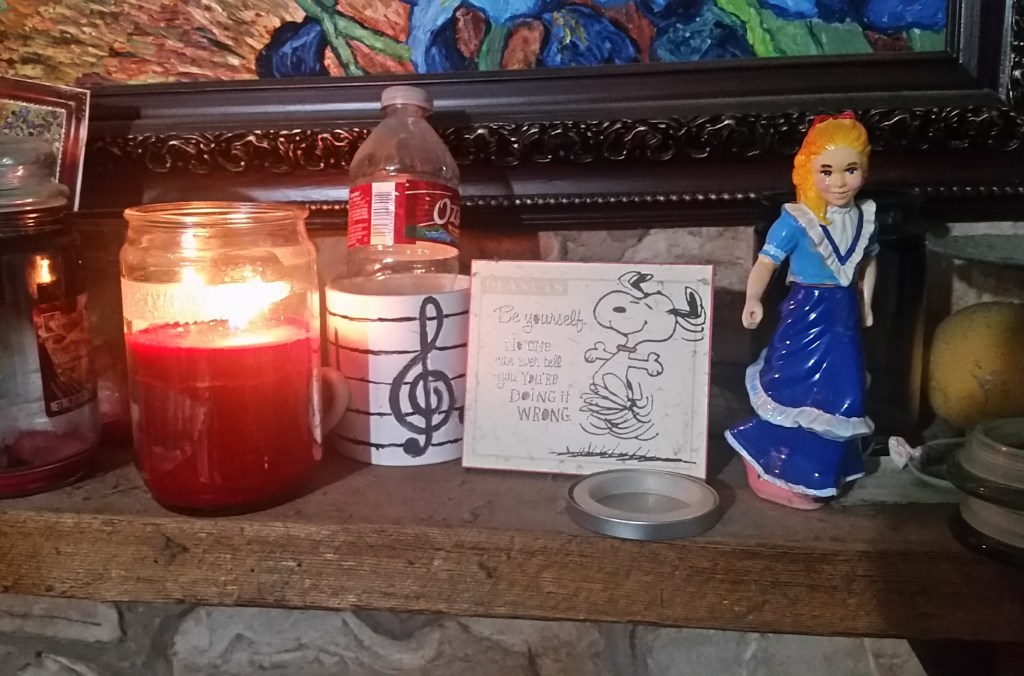
On the mantel
Of our home hearth
Sit the objects
That give life worth
A candle lighting
The dark of earth
A cup once painted
With paint and mirth
A Snoopy plaque
Announcing birth
And ceramic doll
Smiling o’er the hearth.
On the mantel
Of our home hearth
Sit the objects
That give life worth
A candle lighting
The dark of earth
A cup once painted
With paint and mirth
A Snoopy plaque
Announcing birth
And ceramic doll
Smiling o’er the hearth.
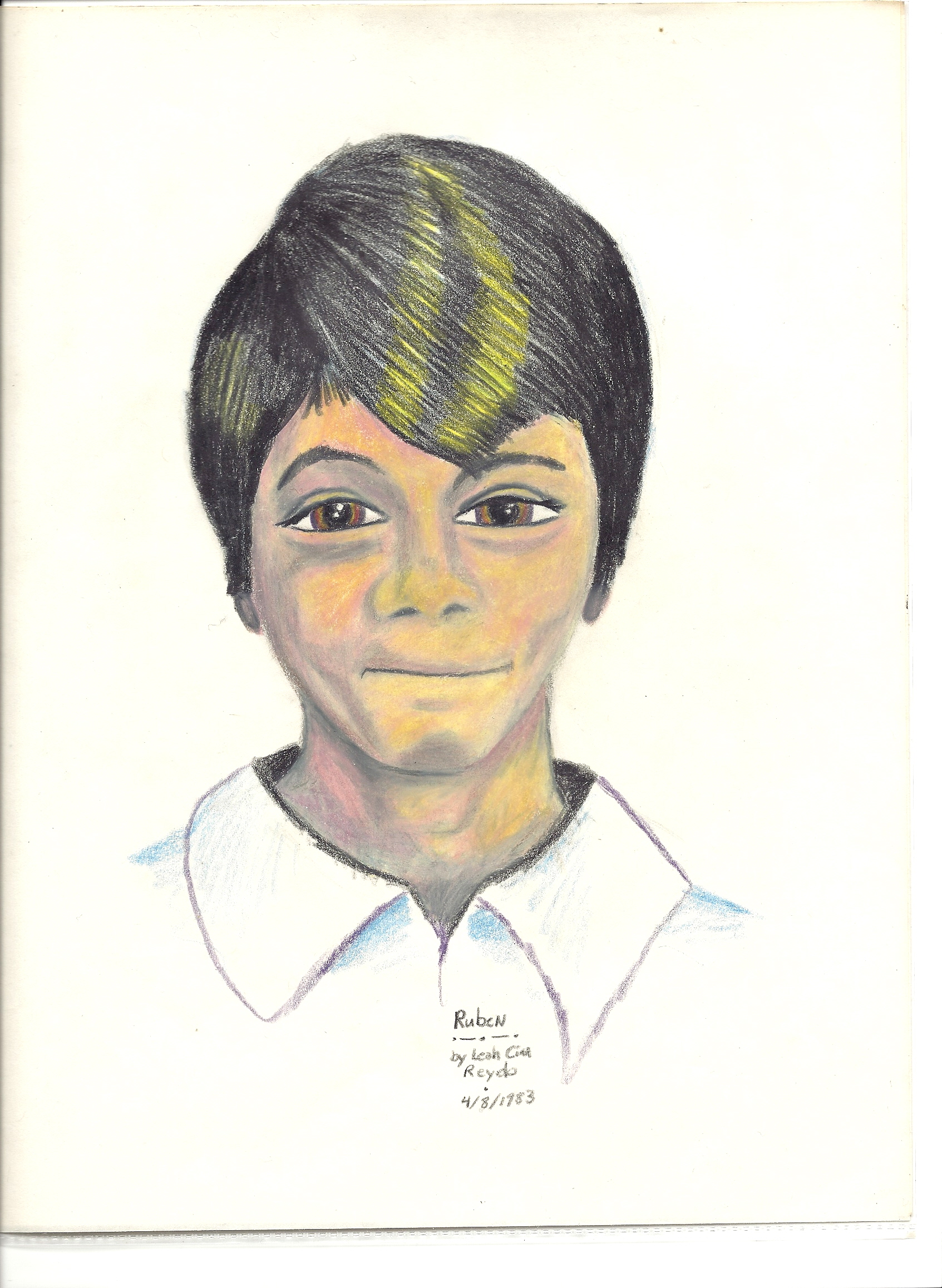
My biggest regret as a cartoonist and waster of art supplies is the fact that I am not the world’s best portrait artist. I can only rarely make a work of art look like a real person. Usually the subject has to to be a person I love or care deeply about. This 1983 picture of Ruben looks very like him to me, though he probably wouldn’t recognize himself here as the 8th grader who told me in the fall of 1981 that I was his favorite teacher. That admission on his part kept me from quitting and failing as a first year teacher overwhelmed by the challenges of a poor school district in deep South Texas.
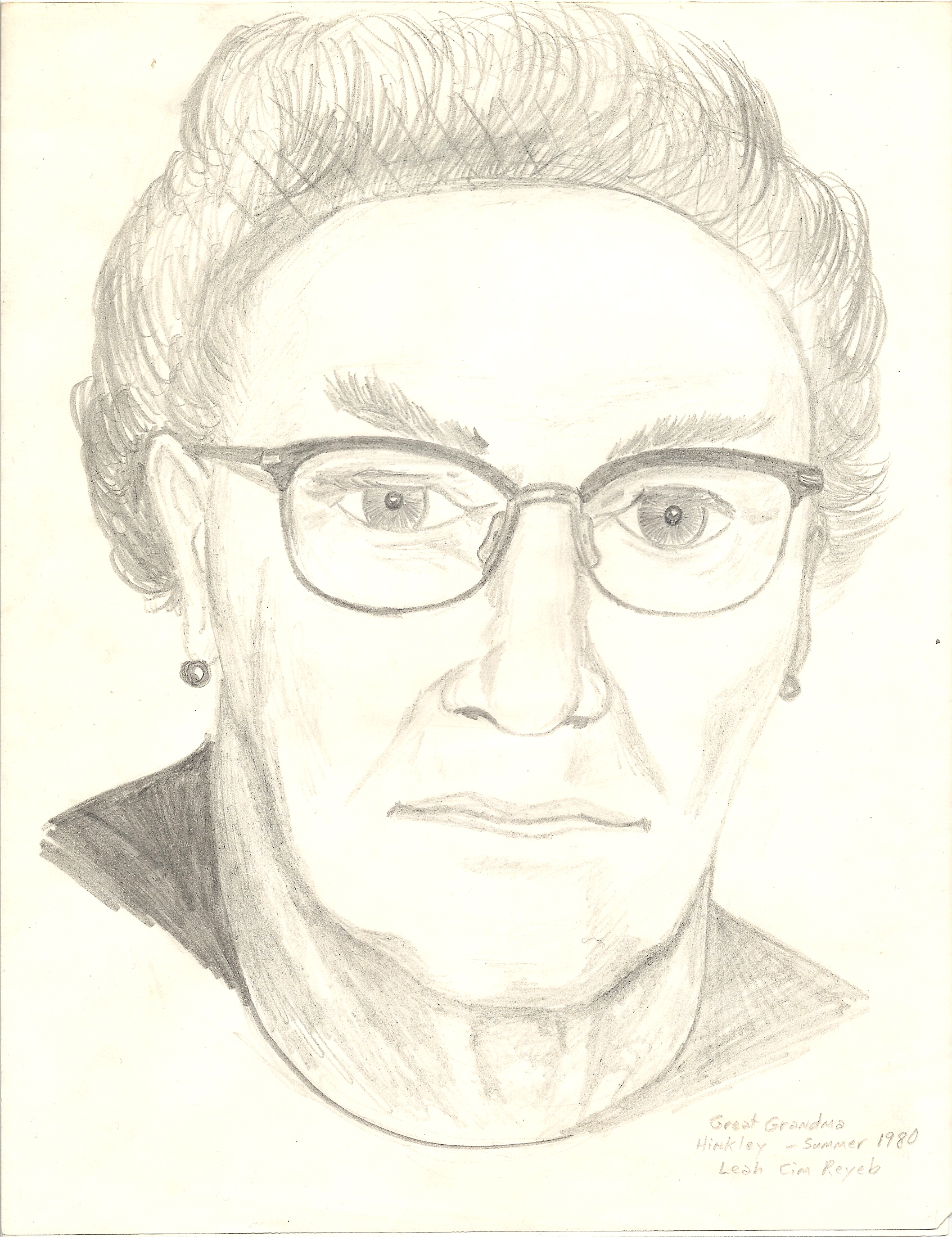
My Great Grandma Hinckley was really great.
My great grandmother on my mother’s side passed away as the 1970’s came to an end. I tried to immortalize her with a work of art. I drew the sketch above to make a painting of her. All my relatives were amazed at the picture. They loved it immensely. I gave the painting to my Grandma Aldrich, her second eldest daughter. And it got put away in a closet at the farmhouse. It made my grandma too sad to look at every day. So the actual painting is still in a closet in Iowa.
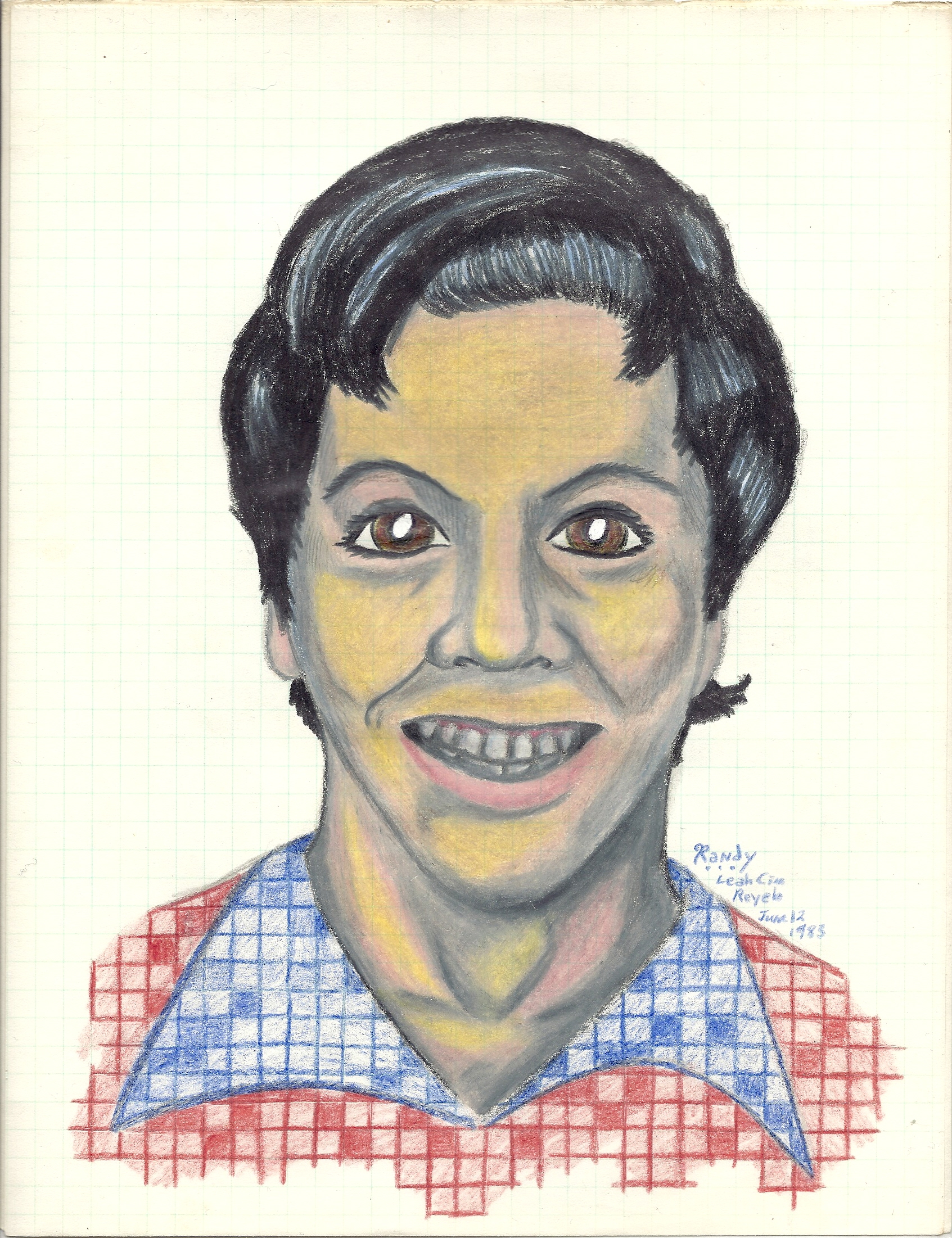
There were, of course, numerous students that made my life a living heck, especially during my early years as a teacher. But I was one of those unusual teachers (possibly insane teachers) who learned to love the bad kids. Love/hate relationships tend to endure in your memory almost as long as the loving ones. I was always able to pull the good out of certain kids… at least in portraits of them.
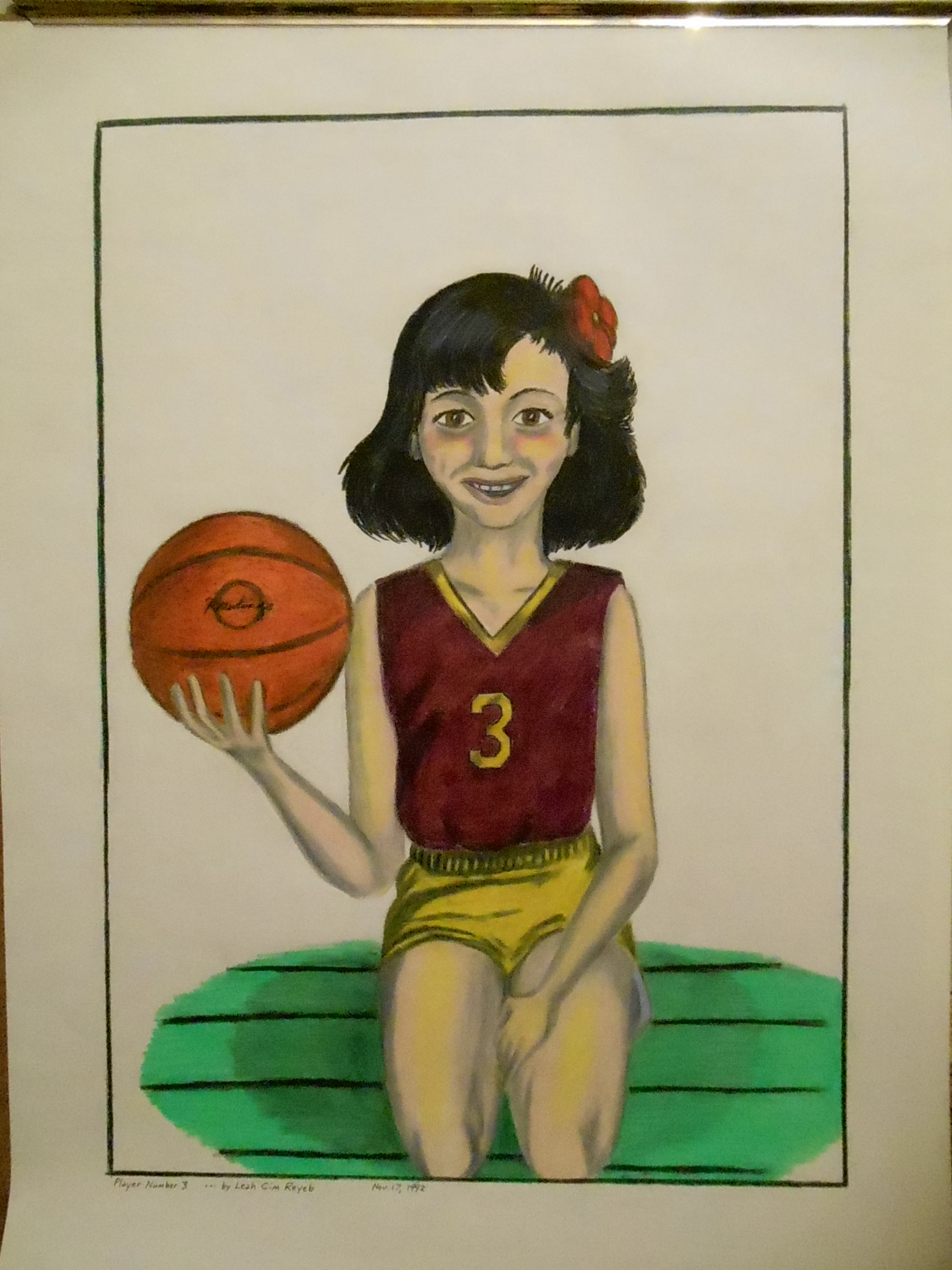
When kids pose for pictures, they are not usually patient enough to sit for a portrait artist. I learned early on to work from photographs, though it has the disadvantage of being only two-dimensional. Sometimes you have to cartoonify the subject to get the real essence of the person you are capturing in artiness.


But I can’t get to the point of this essay without acknowledging the fact that any artist who tries to make a portrait, is not a camera. The artist has to put down on paper or canvas what he sees in his own head. That means the work of art is filtered through the artist’s goofy brain and is transformed by all his quirks and abnormalities. Therefore any work of art, including a portrait that looks like its subject, is really a picture of the artist himself. So, I guess I owe you some self portraits to compare.


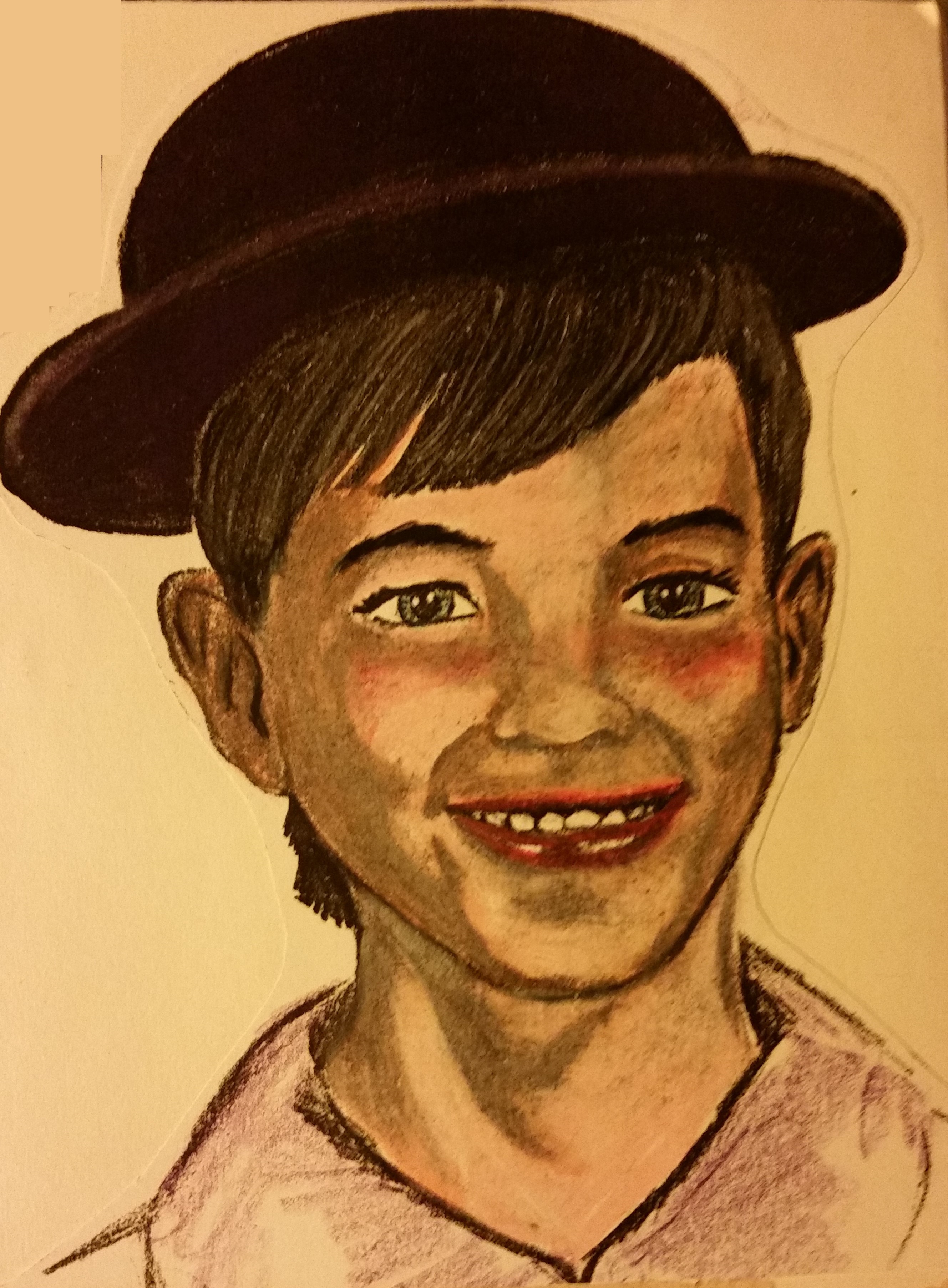
Yeah, that’s me at 10… so what?
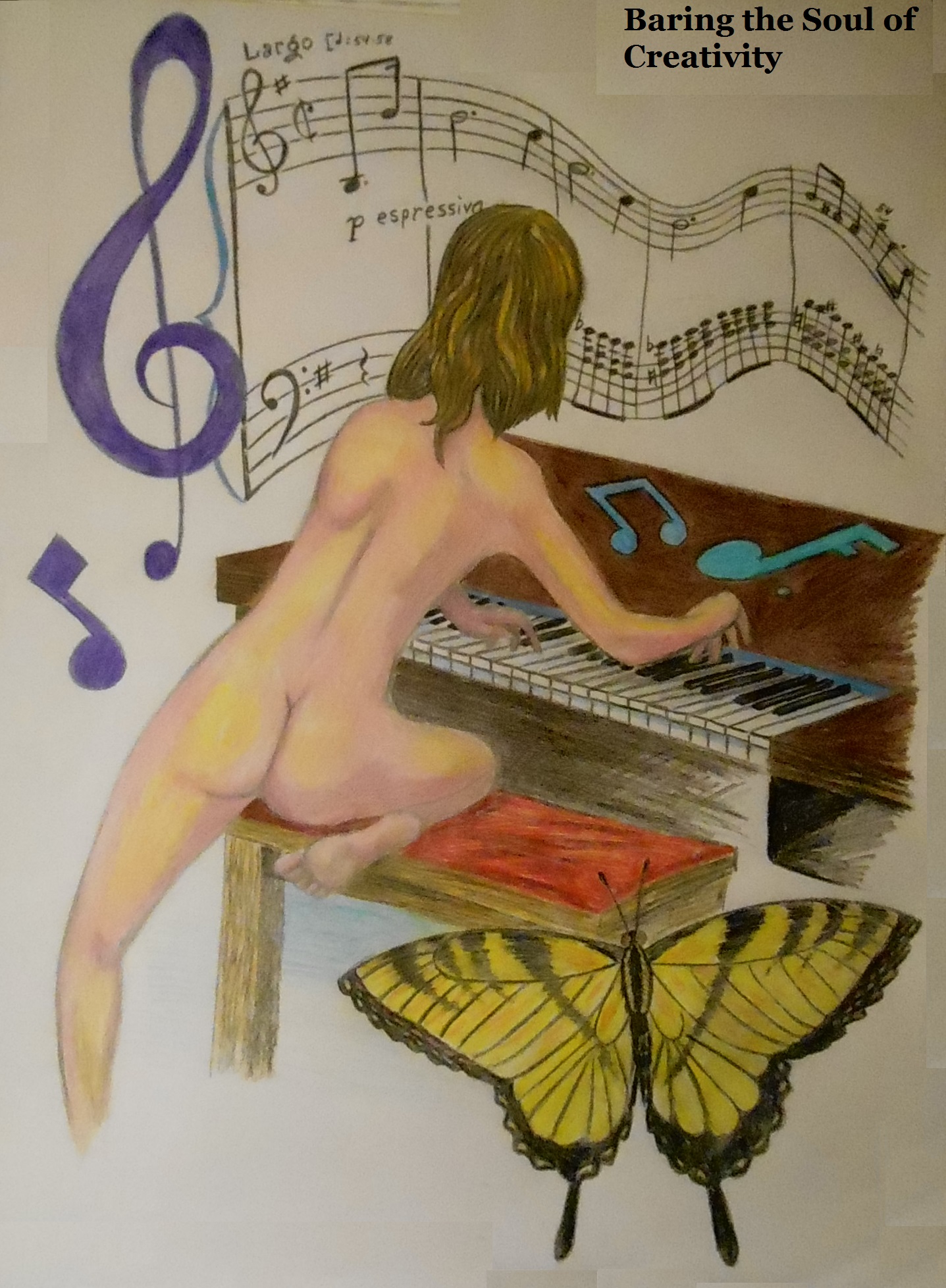
Being a writer is a life of music that happens only in your head. You hear voices constantly. They pulse rhythmically with insights and ideas that have to be written down and remembered. Otherwise, the music turns into clashing cymbals, dark and depressing. Monday, I wrote a deeply personal thank you to the Methodist minister who saved my life when I was a boy. I posted a YouTube music video by the acapella group Pentatonix with that essay in a vain attempt to give you an idea of the music in my head when I composed that very difficult piece to give myself a measure of peace.
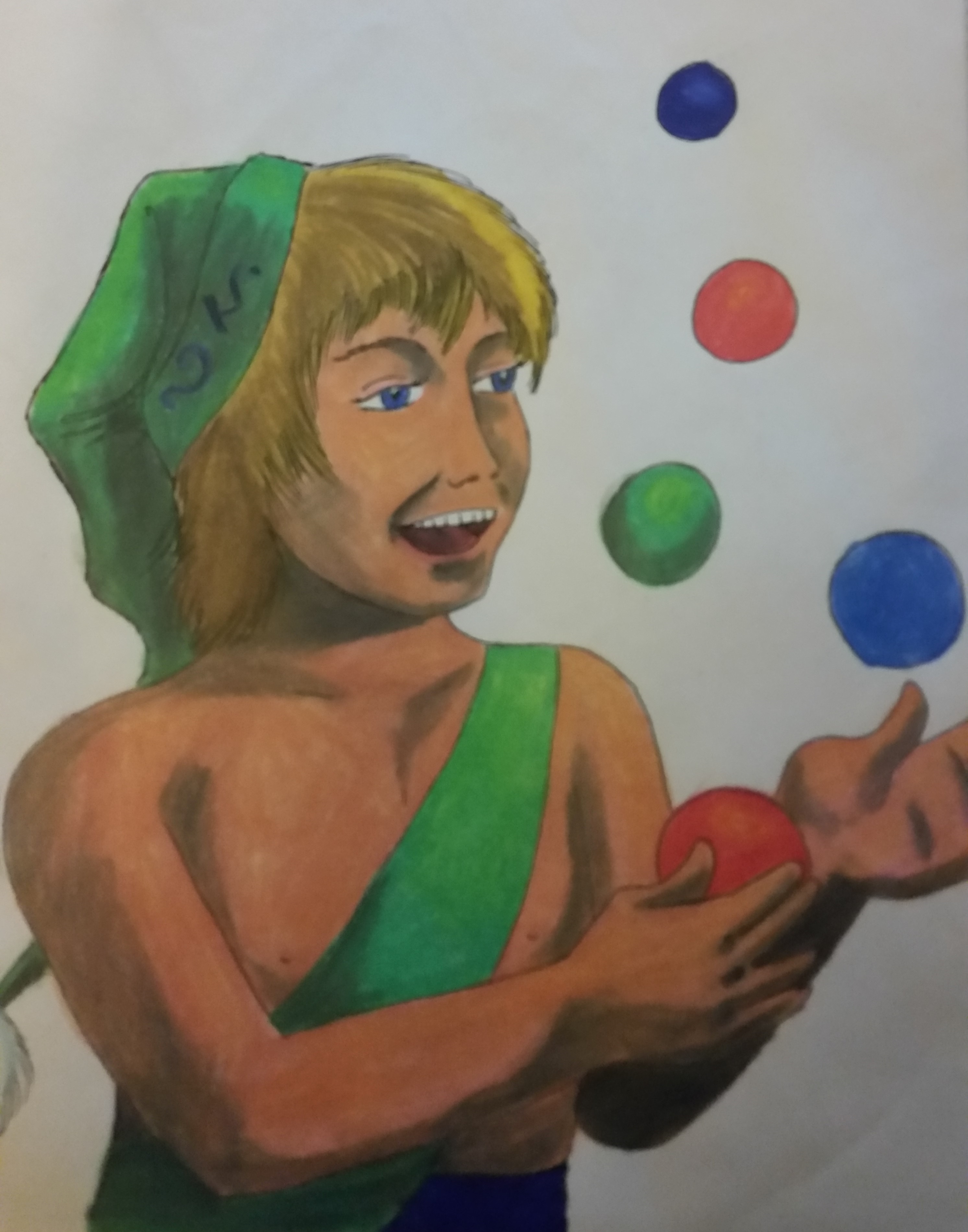
I realize that I am not writing poetry here. Poetry can so easily slip into melody and music because of rhythm and meter and rhyme. And yet, words to me are always about singing, about performing, about doing tricks with metaphor and meaning, rhythm, convoluted sentence structure, and other sneaky things that snake-oil salesman do to get you to think what you are hearing is precisely what you needed to hear. The Sonata of Silence… did you notice the alliteration of the silvery letter “S” in that title? The beat of the syllables? Da-daah-da a da-da? The way a mere suggestion of music can bring symphonic sounds to your ear of imagination as you read? The way a simple metaphor, writing is music, can be wrapped into an essay like a single refrain in a symphonic piece?
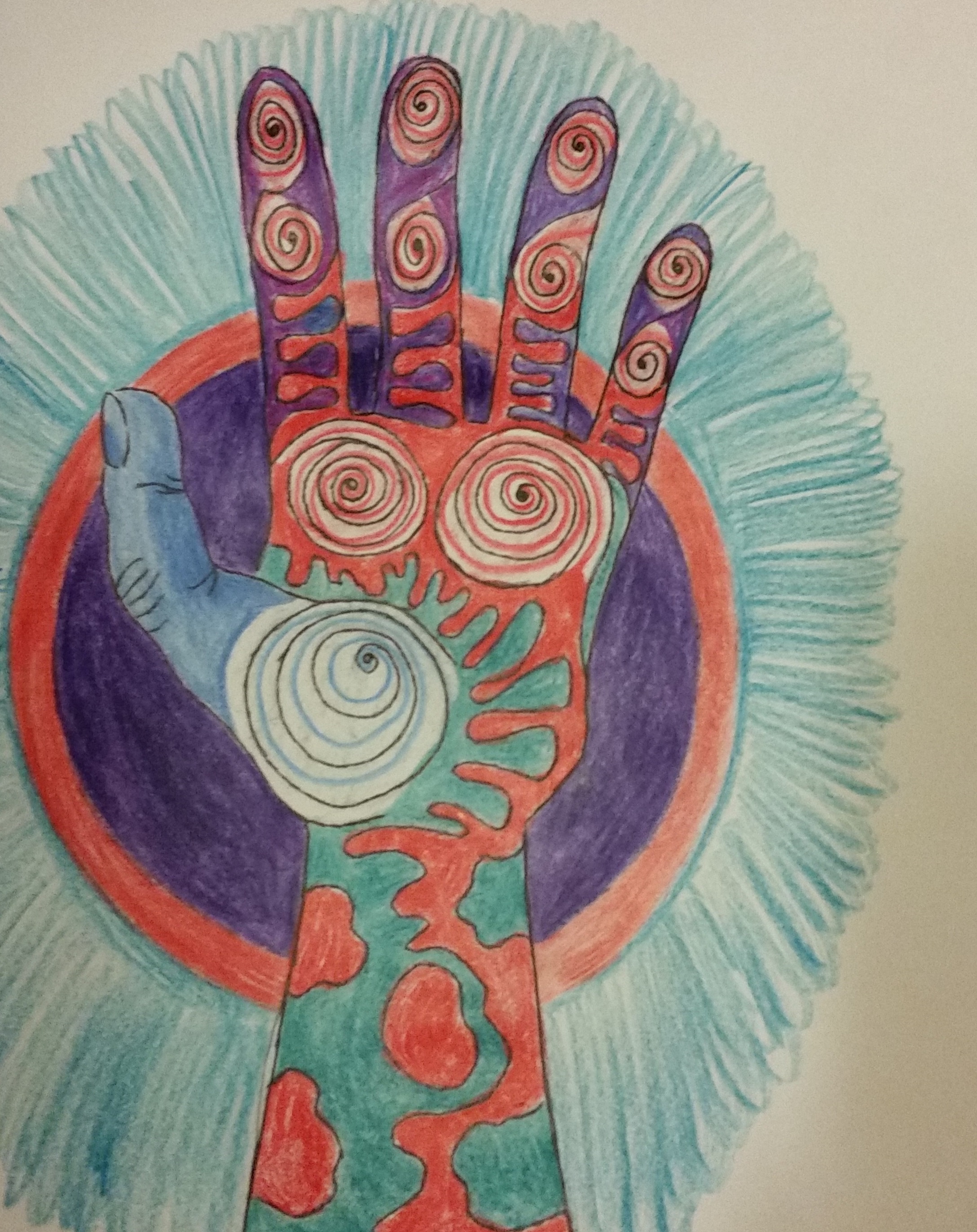
A sonata is a musical exercise in three or four movements that is basically instrumental in nature. You may have noticed that the movements are loosely defined here by the accompanying pictures, of which there are three. And it is silent only in the way that the instruments I am using themselves make no noise in the physical world. The only sounds as I type these words are the hum of an old air conditioner and the whirr of my electric fan. Yet my mind is filled with crescendos of violins and cellos, bold brass, and soft woodwinds. The voice saying these words aloud only in my head is me. Not the me you hear when I talk or the me I can hear on recordings of my own voice, but rather the me that I always hear from the inside. And the voice is not so much “saying” as “singing”.
Writing makes music. The writer can hear it. The reader can too. And whether I croon it to make you cry, or trill it to make you laugh, I am playing the instrument. And so, the final notes of the sonata are these. Be happy. Be well. And listen for the music.
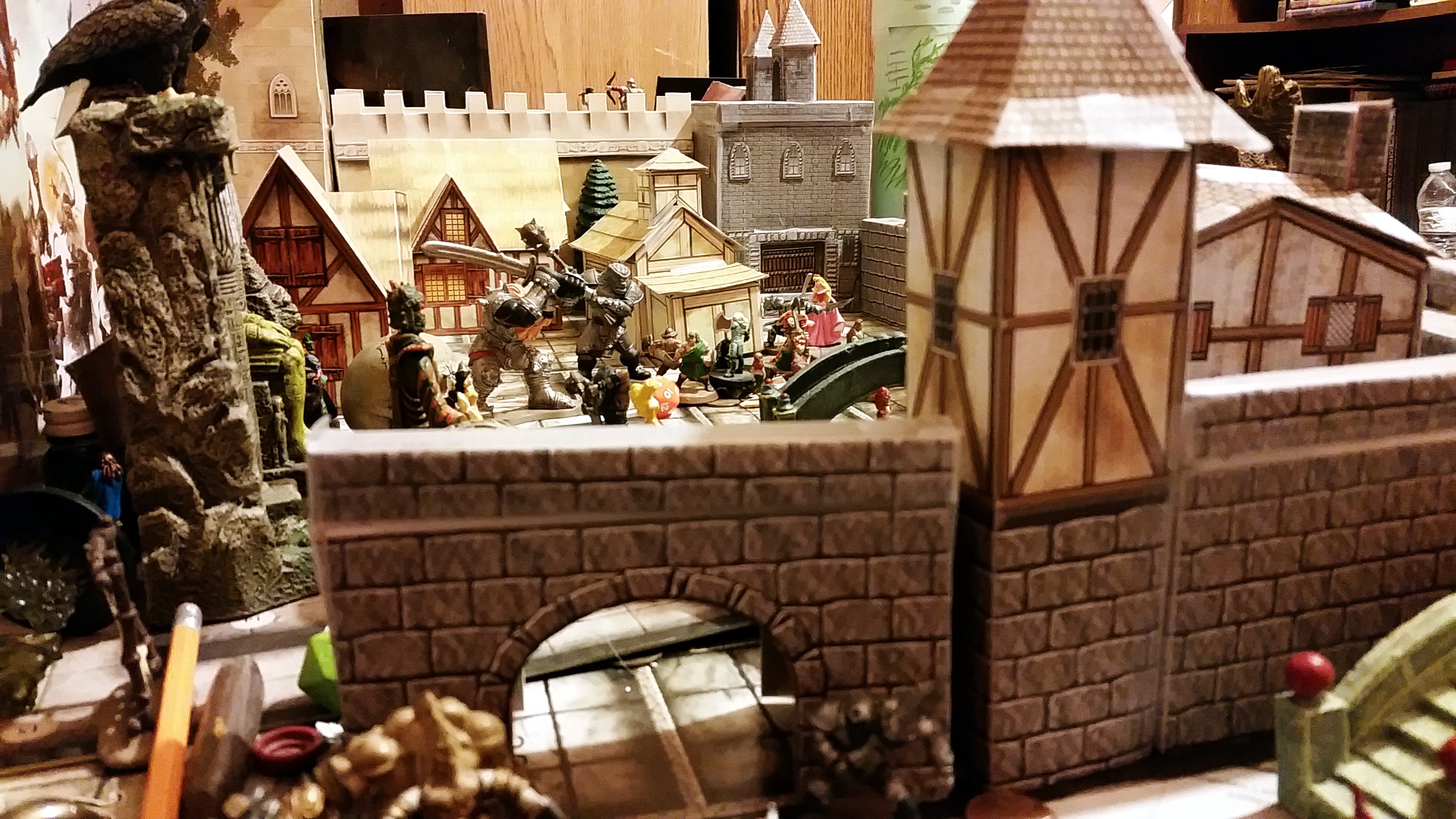
I believe I warned you last Saturday that I had a lot more stupid stuff to share about Non-Player Characters in D & D. I probably let it slip that I really like playing all the weird parts and the monsters about to be slaughtered. I intend to share more of those strange characters today, so you can get a real sense of why my D & D games get so out of control and my children are turning into sword-wielding sociopaths.
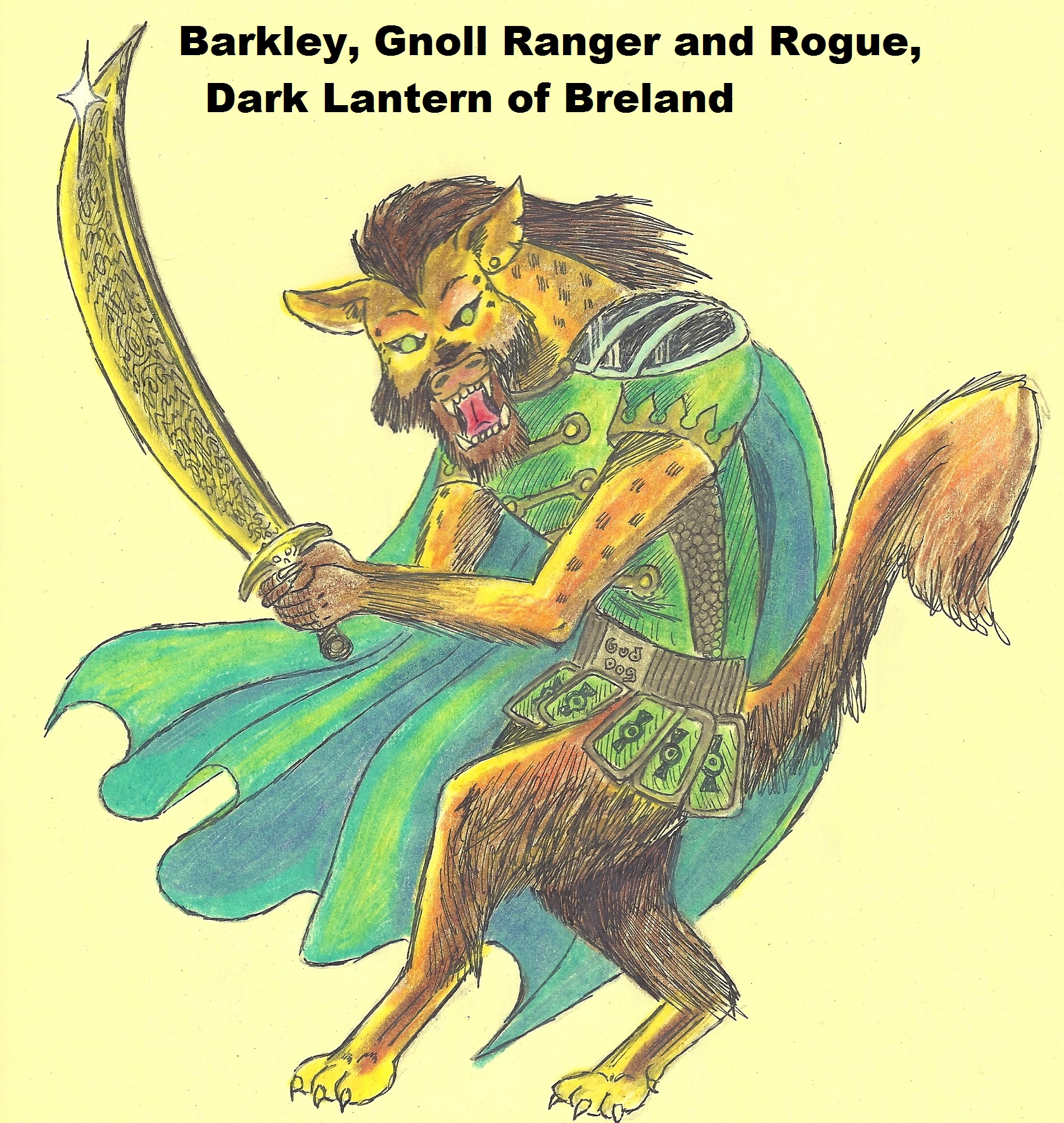
Barkley is not exactly the family dog. He’s a gnoll. That means he’s a monstrous hyena-man who would be inclined to hate and eat humans were he not raised from puppyhood to gnollhood by a beautiful female elf cleric. He now hates the gnolls (and probably eats them) because in the first D & D adventure, his gnoll brothers tried to kill and eat his beloved elf mother. He traveled with the Player characters for about three adventures. And though they treated him like a dog, they came to rely on him in several tough battles. He proved his dog-like loyalty and learned some critical spy skills from them, so he became a Dark Lantern (a secret agent for the kingdom of Breland) and began a life of hunting and killing evil gnolls.
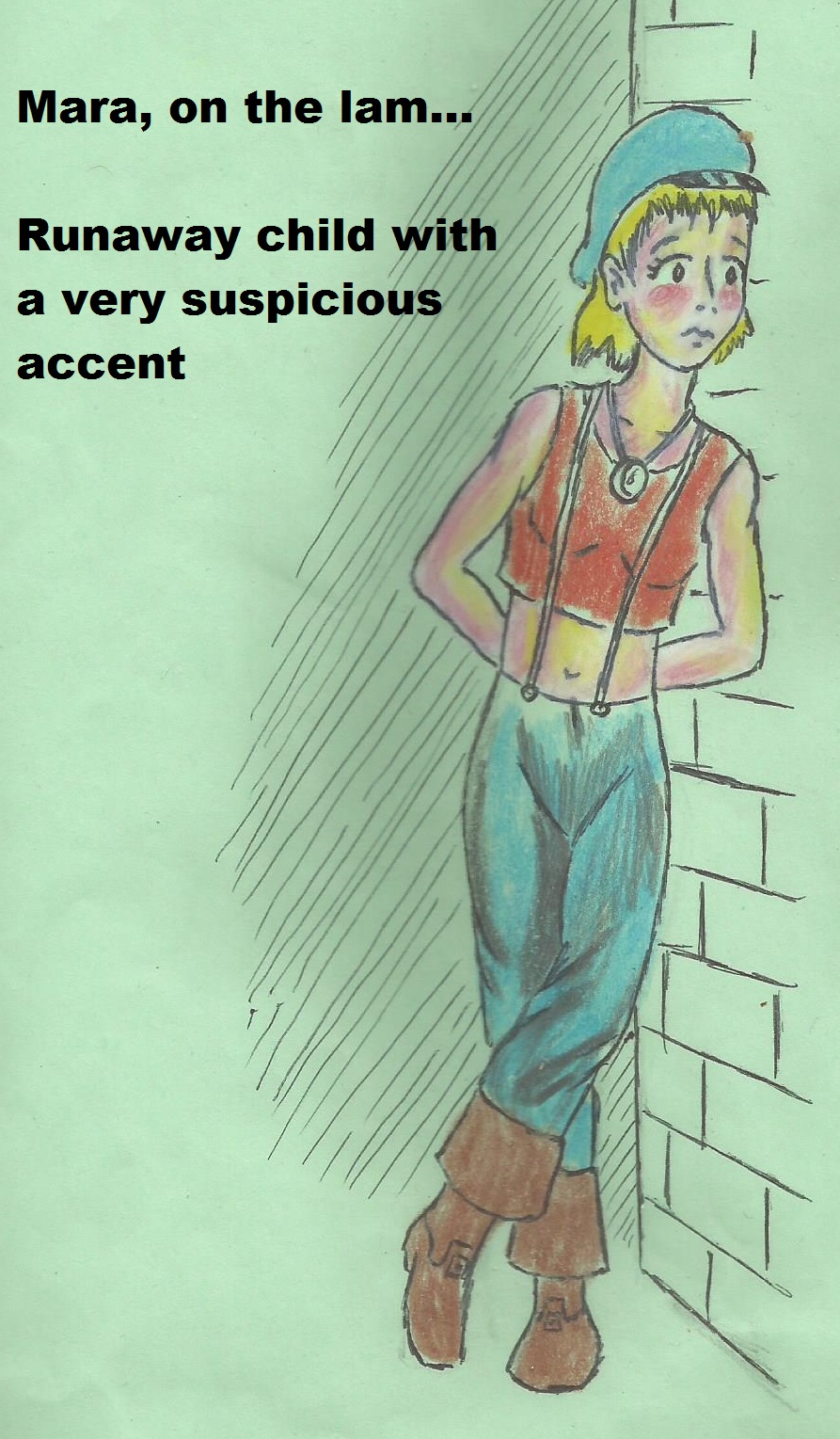
Mysterious Mara was one of the few civilian survivors when the weretigers attacked the lightning rail train with the player characters aboard it. She tagged along because she would not have survived otherwise. She has never revealed her true identity, and it’s a real mind-blower related to the royal court of Aundair, but the player characters have been too busy with other things to look into the mystery. In fact, she is what the D & D manuals call an “adventure hook” because following up on her essential mysteriousness would’ve led them into the middle of a kingdom-crashing conflict. In the meantime, they have been feeding her, teaching her to make use of her natural acrobatic skills, and generally befriending her, not realizing she is the reason so many enemies of Aundair have been tracking and attacking them.
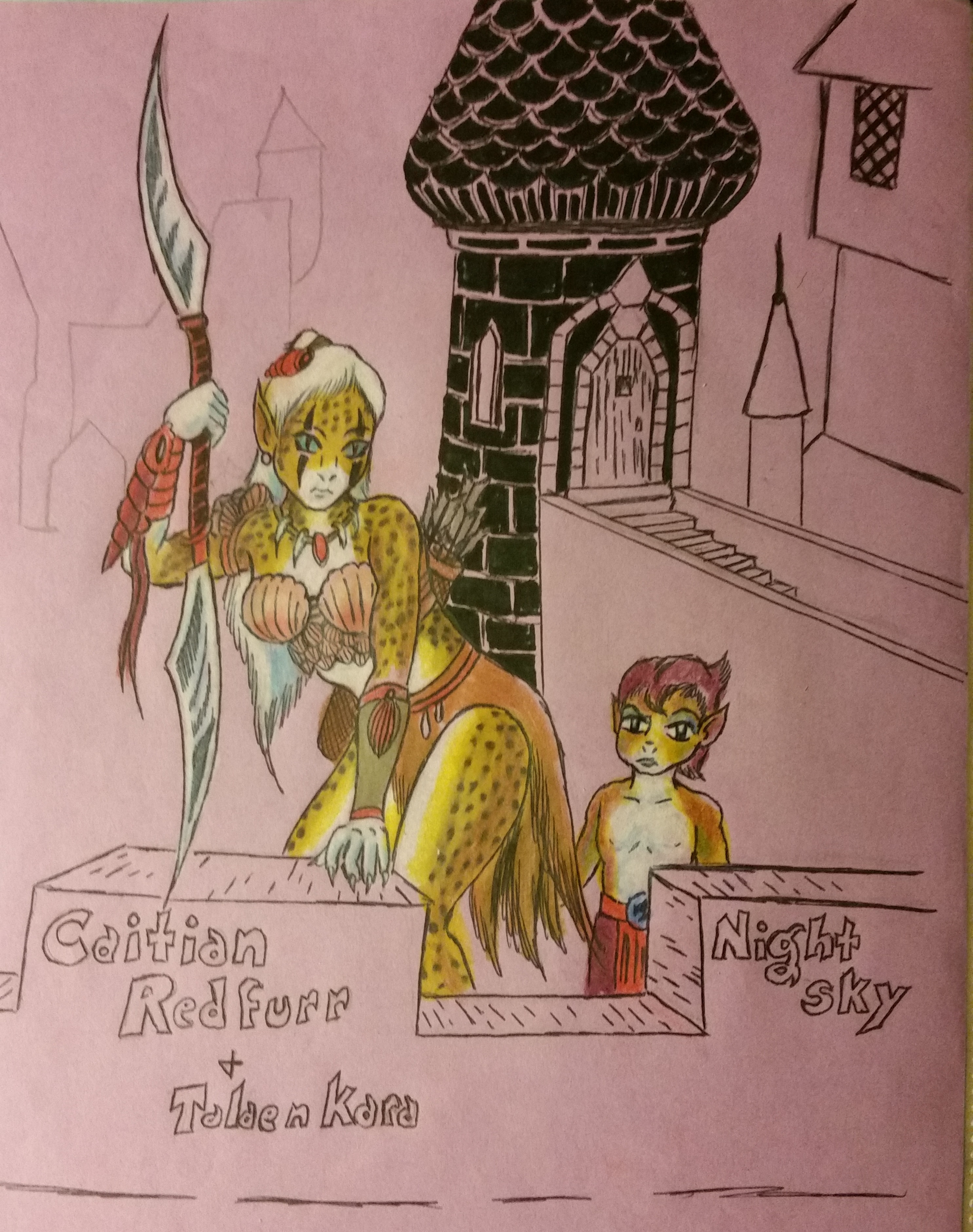
Caitian Redfurr is a shifter, one of those half-men with the abilities of a cheetah, able to run like a rocket and use speed to best her foes. She has been a part of the campaign since just after Barkley joined. Her son, Night Sky, is the son of a former Dark Lantern leader whose ghostly presence now inhabits Fate’s head. She has used her skills with a sword, and her skills with a bow, and her skills with Talaen Kara, the intelligent double-bladed weapon, to save their fat from goblin cookfires on numerous occasions. The players are fond of her and trust her as basically an added member of the family.
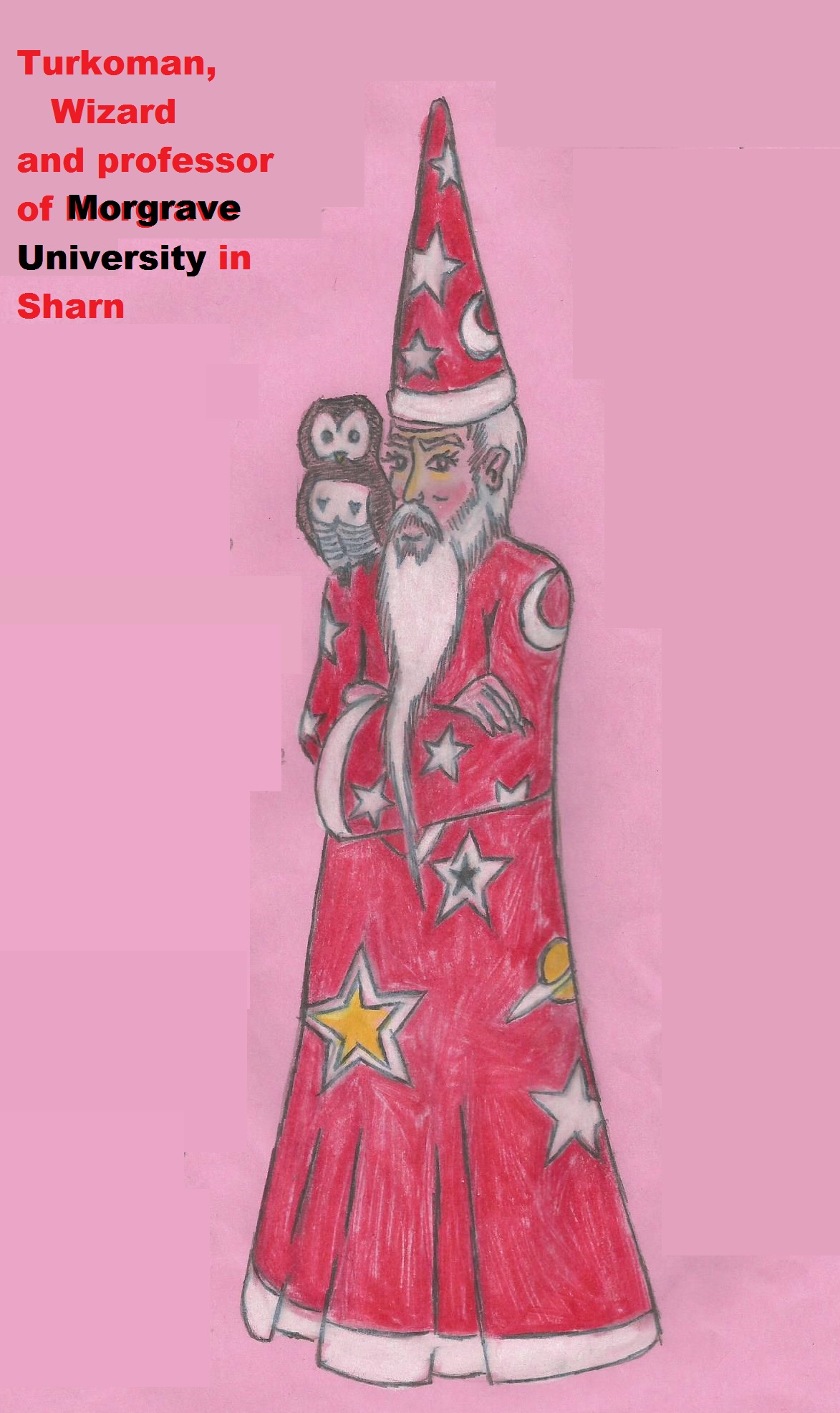
Finally for this Saturday, I mentioned Turkoman last week. He is what is called a “patron” in D & D NPC-terms. He’s the man with the expertise when a beloved character is cursed with frogs hopping out of their ears or is turned completely to stone by a gorgon’s kiss. He also provides necessary magic items, spells, enchantments, and critical advice that can help bring an adventure to a conclusion. When needed, he can even lend a hand in the actual adventure, giving the characters a chance to overcome difficult odds and find adventures that they would not otherwise have access to.
So, once again I have passed my word limit and must draw to a close with so much more to tell. Even if you are bored stiff by D & D nerd-ism, I intend to inflict more upon you in the future. So be warned, be wary, and watch out for curses that make frogs hop out of your ears.
Filed under Dungeons and Dragons, foolishness, humor, making cardboard castles, Paffooney
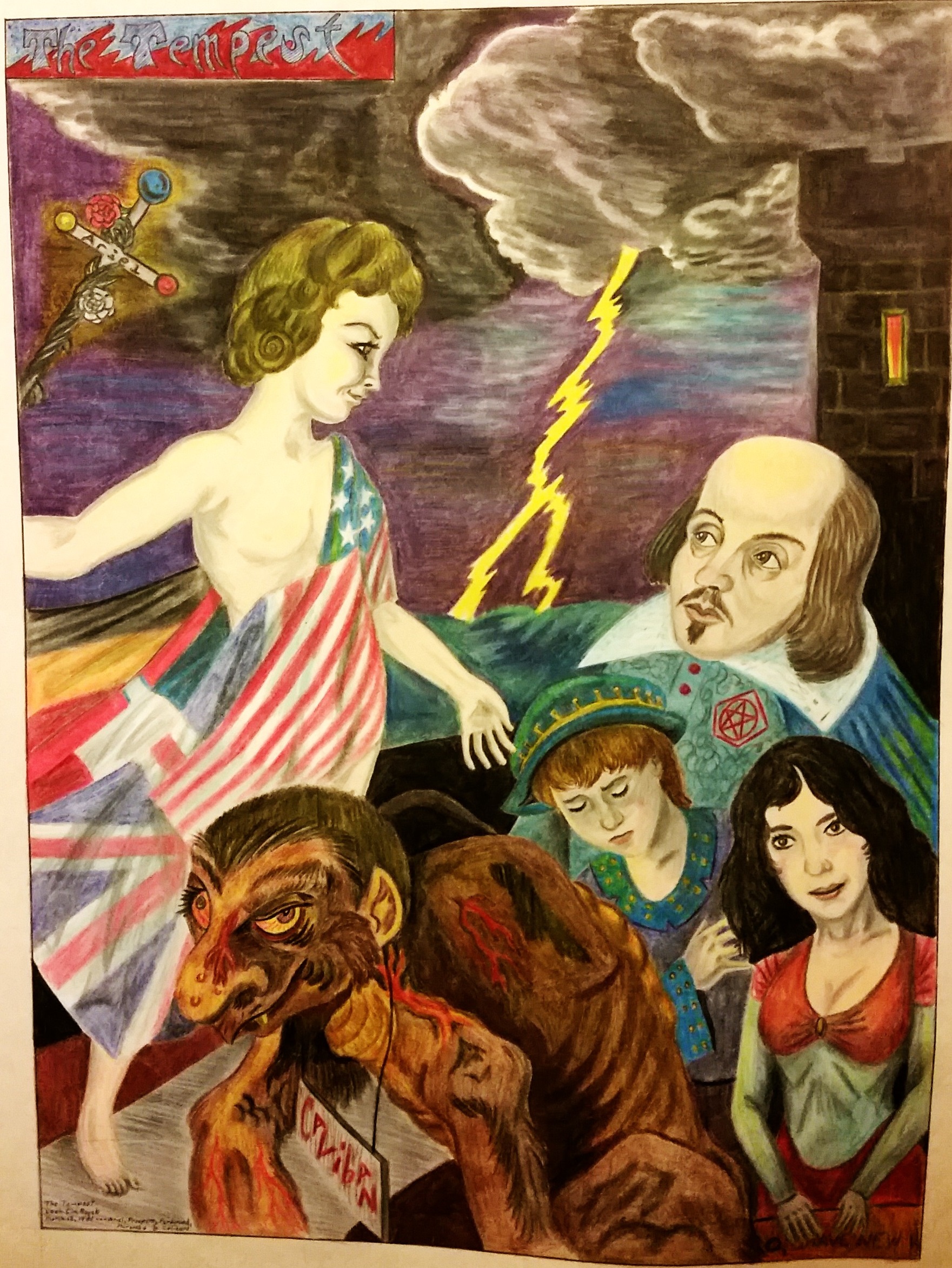
I am, unfortunately, a dedicated conspiracy theorist. No, not the braying, unintelligent kind like Alex Jones who has an unhinged and hidden agenda. More the Indiana Jones kind, seeking the truth no matter where it leads, but always relying on research, science, and creative methods of re-framing the facts in order to reveal truths that other people don’t see even when the answers are right in front of them.
An example of this is my firm belief that everything we think we know about the man known as William Shakespeare is based on an ages-old deception and is basically an unrevealed lie.
Of course, I am not the only literature-obsessed kook who has ever taken up this notion of someone else having written the great works of Shakespeare. I share the opinion with Ralph Waldo Emerson, Nathaniel Hawthorn, Walt Whitman, Prime Minister Benjamin Disraeli, Charles Dickens, Actor Derek Jacobi, and the great Mark Twain (also not the writer’s real name) .
The biggest question that I can see when looking at the man we pretend is the actual author of the plays, is why doesn’t this man look like an author? As brought out in the video, the only example we have of the author’s own handwriting are six signatures from legal documents, three of which come from his last will and testament. And if the name is really William Shakespeare, then the Stratford man misspelled his own name. He wrote it as Shakspere or Shaksper. And the handwriting is atrocious, nothing like the carefully practice signature I sometimes put on my own handwritten work. How does that happen? I have seen signatures by many other authors, both famous and obscure, and nowhere do I see such careless script as what is allegedly the signature of the greatest and most acclaimed writer who ever lived.
The accepted life story of Shaksper doesn’t bear up under scrutiny either. In spite of being a wealthy businessman and mayor, his father can be seen to be provably illiterate, relying on associates and underlings to write the paperwork involved in his business and mayoral rule. There is no proof in the form of enrollment lists or written record of Shaksper having ever enrolled at or attended the school that supposedly taught Stratfordian youths to read and write. His wife and children and grandchildren were also provably illiterate. What other writer has such a lack of effect on his own family?
And Shaksper’s will details everything he owned and left to others at his death. Nowhere is there a mention of plays, manuscripts, poetry, or even books. The greatest author who ever lived owned no books at all? He was provably wealthy enough to buy books, and public libraries did not exist back then. How then did he demonstrate such knowledge of Ovid’s Metamorphosis, as well as the functioning of royal courts both in England and abroad? How did he get so many details right about places in Italy and Europe which he had never visited or seen with his own eyes? Something is definitely missing.
It is true that everything mentioned is merely circumstantial evidence. And yet, if all circumstantial evidence leans in only one direction, then isn’t the conclusion probably sound?
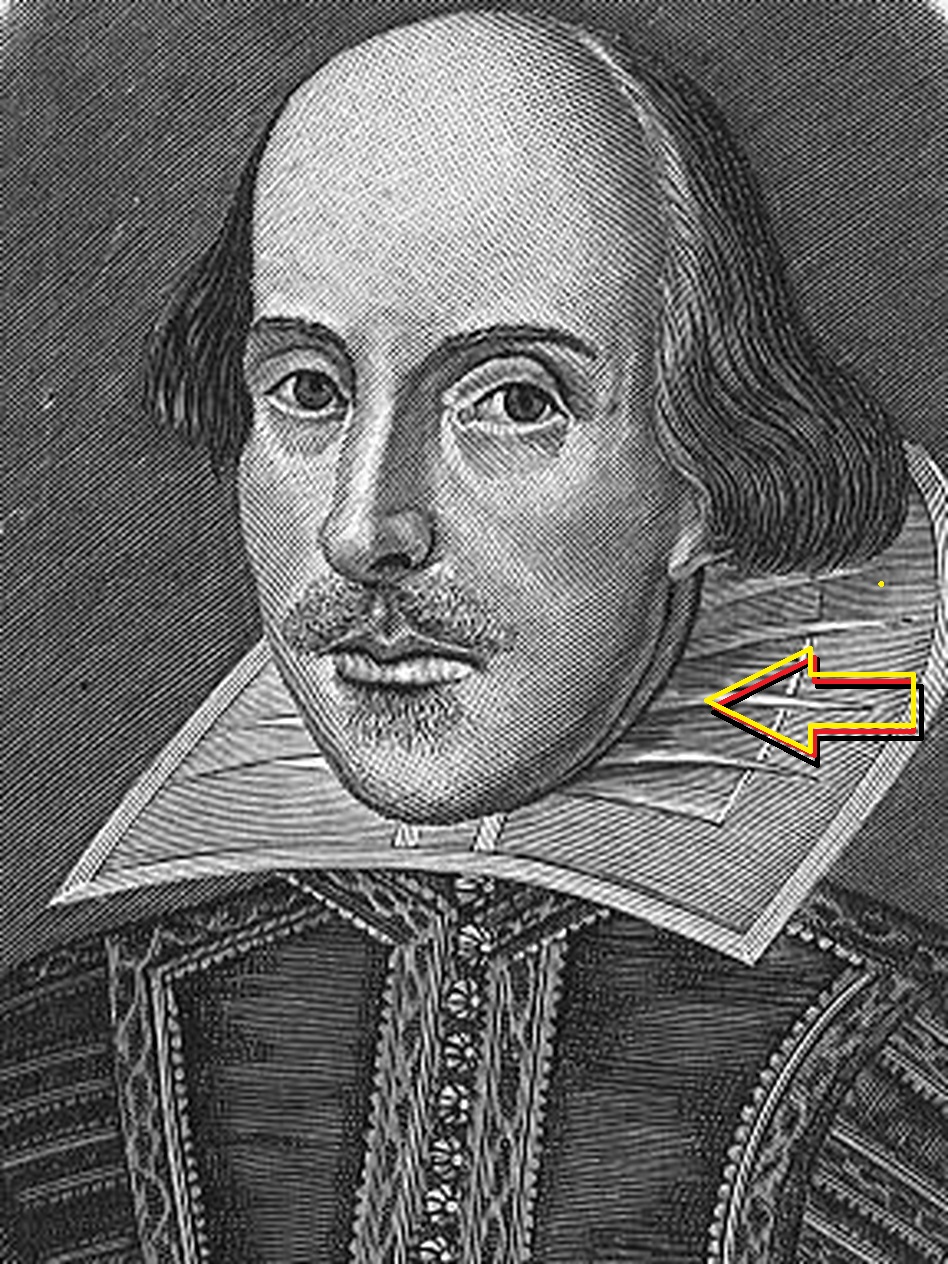
But if Shaksper, the Stratford man, did not write the masterful literary works he has been given credit for, then who did? And why did he let the credit go to someone else?
Ah, I am betting you are beginning to smell a multi-part essay brewing. I mean to tell you who I think is under the mask, who it was I believe actually wrote under the pen name of William Shakespeare.
The question before me now is, “What do you know, and how do you know it for certain?”
Well, I really don’t know anything. How do I know that I don’t know anything? Well, Socrates always told everyone who would listen that he didn’t know anything for certain, and he is obviously much smarter than I am. So, being super-stupid by comparison, I don’t even know as much as Socrates.
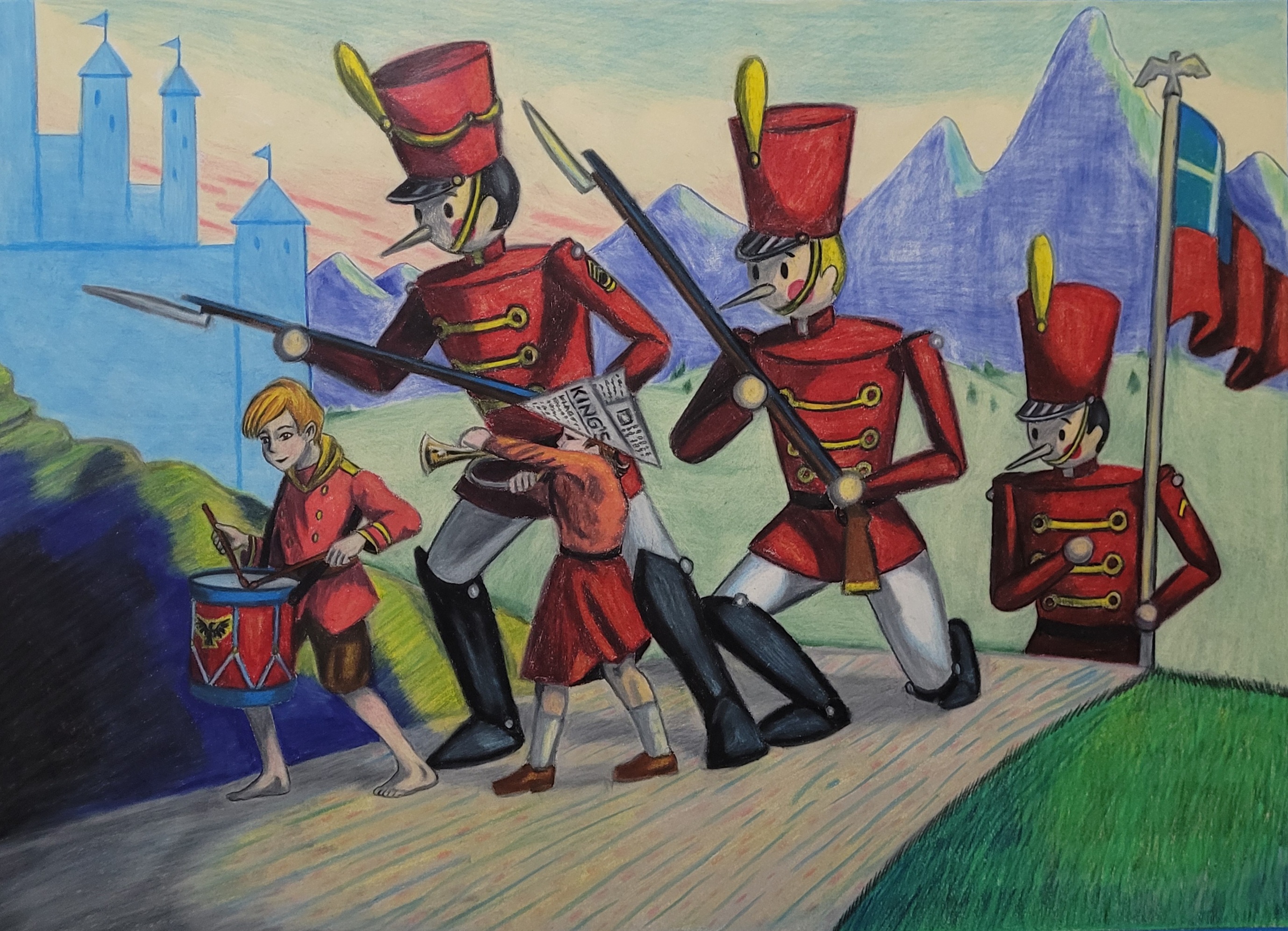
So, like Socrates, I need to ask questions. But who will I ask? I can look at the picture above for answers, and I can ask you, the reader, the questions.
The picture is one of the most favorite ones I have ever drawn. By that I mean it is one of the pictures I drew with colored pencils that I like the best. It is, therefore, basically a self portrait of things inside my silly head.
Do the soldiers look familiar to you? If they do, it is probably because, like me, you have seen the soldiers from Disney’s Babes in Toyland. Hopefully they are just generic enough that Disney wont sue me for modeling this fantasy on something I saw in their copyrighted movie. I didn’t intentionally copy anything, and I have never knowingly made a single dime off of this picture. So, they don’t need to sue me, right?
Okay, those weren’t Socratic questions. They were leading and focused questions. So, let’s start the Socratic stuff.
Do you see anything in the picture that is innocent and childlike? Could this be illustrating a childish fear of the darkness? Did you notice the darkness they are marching towards on the left of the picture? Could this also be showing a progression towards maturity? Are the children and the soldiers not approaching that darkness… whatever it might be? Are they not getting more prepared to face the darkness as they get closer to it? The weapon pointed straight at the darkness is the bugle. Does the bugle, being an instrument for announcing something in combat, not have some symbolic meaning here? Does the darkness they are approaching not represent something like death? Does the boy with the drum suggest how we might deal with the darkneness in our own too-near future?
So, did you learn anything from this post?
I am asking because…
…I don’t really know anything.
Filed under artwork, Paffooney, philosophy
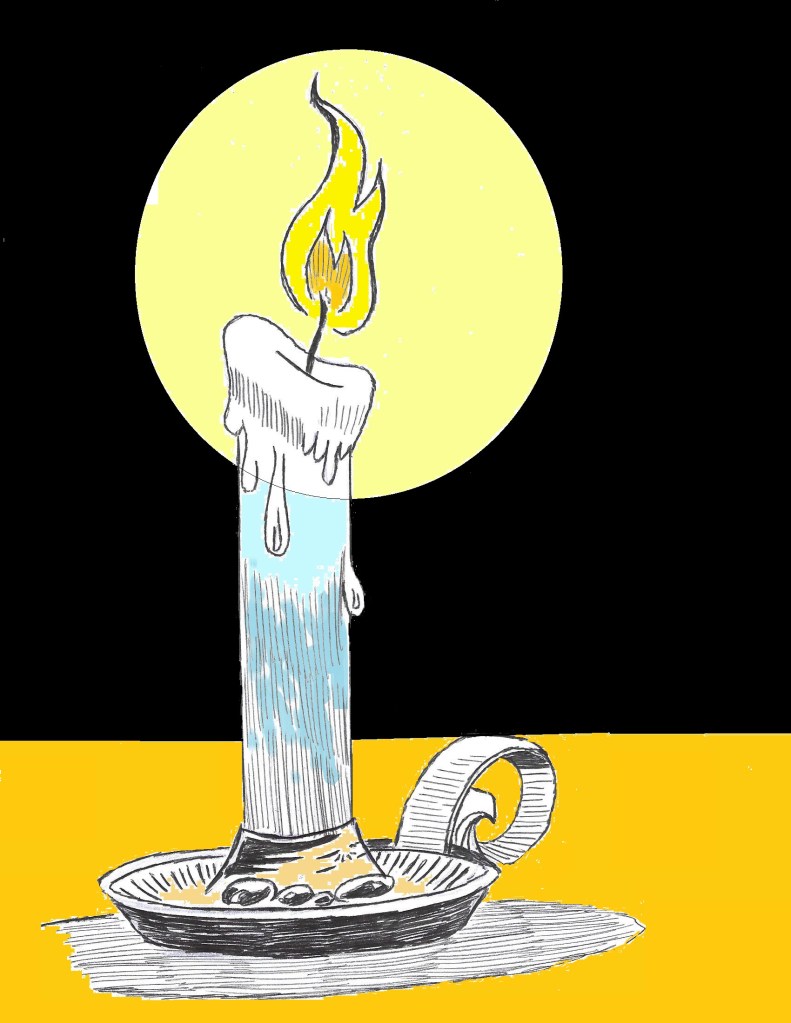
No tomorrow is guaranteed.
Even today is not a sure thing.
Every new dawn is a gift.
It might be the last day on Earth for me.
It might be the start of a new adventure.
We shall see what we shall see.
And all we can do is…
… Let it be.
Filed under artwork, Paffooney, philosophy
Yes, there is very definitely a possibility that there is more than one me.
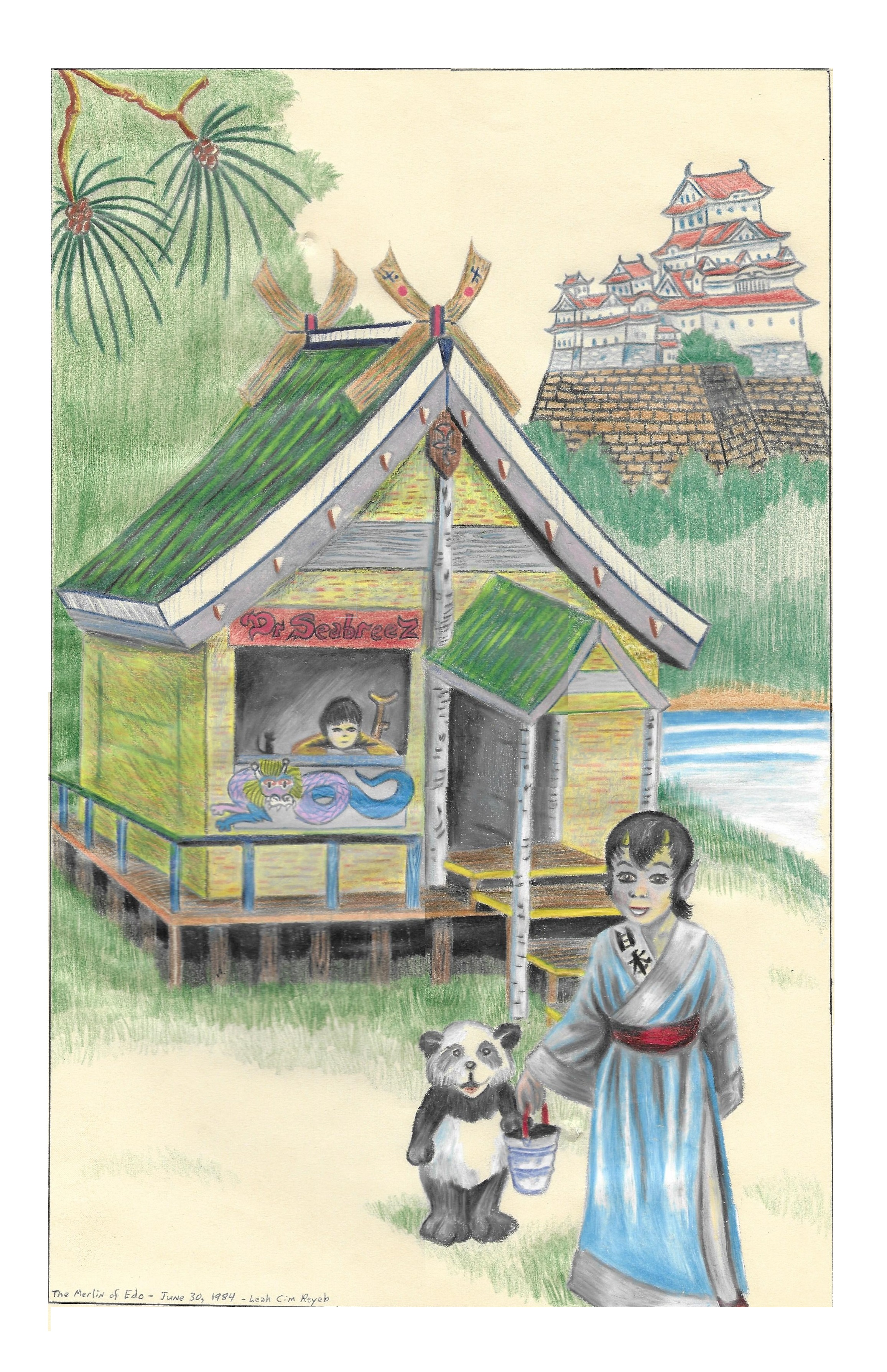
If you look carefully at the colored pencil drawing above, you will see that it is titled “The Wizard of Edo” and signed by someone called Leah Cim Reyeb. A sinister sounding Asian name, you think? I told college friends that my research uncovered the fact that he was an Etruscan artist who started his art career more than two thousand years ago in a cave in France. But, of course, if you are clever enough to read the name backward, you get, “beyeR miC haeL”. So, that stupid Etruscan cave artist is actually me.
It turns out that it is a conceit about signing my name as an artist that I stole from an old episode of The Dick Van Dyke Show and have used for well over two decades through college and my teaching career.
And of course, the cartoonist me is Mickey. Mickey also writes this blog. Mickey is the humorist identity that I use to write all my published novels and blog posts since I published the novel Catch a Falling Star.
Michael Beyer is the truest form of my secret identity. That was my teacher name. It was often simplified by students to simply “Mr. B”. I was known by that secret identity for 31 years.
Even more sinister are my various fictional identities occurring in my art and my fiction. You see one of them in this Paffooney. The name Dr. Seabreez appears in Catch a Falling Star as the Engineer who makes a steam engine train fly into space in the 1890’s with alien technology. He appears again in The Bicycle-Wheel Genius as a time-traveler.
The young writer in the novel Superchicken, Branch Macmillan, is also me. As is the English teacher Lawrance “Rance” Kellogg used in multiple novels.
So, disturbing as it may be to realize, there is more than one name and identity that signifies me. But if you are a writer of fiction, a cartoonist, an artist, or a poet, you will probably understand this idea better. And you may even have more than one you too.
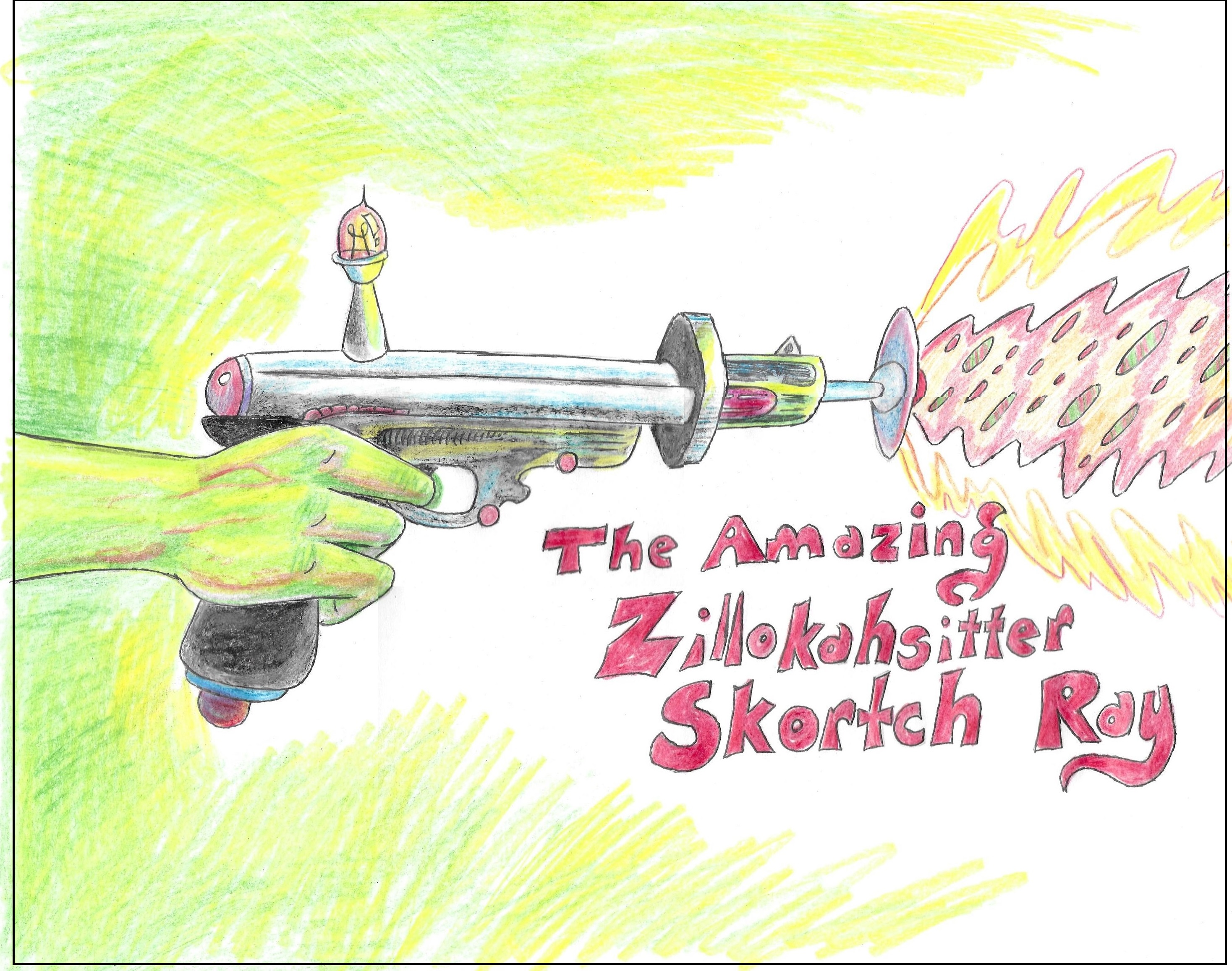
You are probably not going to believe this, but there are certain things you simply cannot safely sell on E-Bay. My first good novel, Catch a Falling Star, took years to write. The research, interviews with survivors, fighting off remaining alien invaders left behind when the Telleron invasion failed, and clean-up of sites and inconvenient witnesses took at least from 1990 to 2012. And then, as part of my marketing-by-blogging strategy for the book, I took a box of leftover skortch pistols and listed them for sale on E-Bay. They turned out to be a very popular item. It took the first skortch ray almost a year to sell for a measly five dollars. It was bought by a woman with a very annoying husband. She apparently bought the item as a joke, thinking it would not actually work as a molecular disintegration weapon. But after she surprised her husband with it and then posted the surprising results on Facebook, I quickly sold out the rest of the 26 pistols in the box and made almost $800. I am told by concerned investigative reporters that crotchety old men, ugly wives, and particularly Dennis-the-Menace-like kids were disappearing all across the Midwest. I also learned that one skortch ray pistol came into the hands of a Republican political operative before the election in 2016. That fact may have accounted for the disappearances of large numbers of registered Democrats in both Michigan and Pennsylvania in the weeks before the election.
I wanted to inform you that I may have done something stupid on E-Bay. Therefore I am re-posting the drawing I did of Studpopper the Telleron demonstrating the firing of an example skortch pistol created by Zillokahsitter Industries on Telleri Prime with Sylvani technology. If you should see one of these in the hands of a spouse that thinks you are grumpy too much of the time, I would suggest an almost instantaneous program of self-improvement. And if you see one in the hands of someone in a red MAGA baseball cap, immediately put on your own red hat and say something inordinately stupid so they will assume you are one of them, and hope they skortch themselves by accident before they get around to skortching you.
Sorry about that. I should’ve thought this whole thing through more carefully beforehand.
Filed under aliens, humor, NOVEL WRITING, Paffooney


How It Should Be… According to Mickey
My bicycle was red. It was red and looked just like the ones that Captain Kangaroo had in his commercials that we watched on a black-and-white TV every day before we walked or rode our bicycle to school, across town a whole long seven blocks away. After school I could ride it out a whole mile and a half to Jack’s farm with Bobby and Richard and Mark the preacher’s kid to go skinny dipping in the cold creek in Jack’s South pasture. Jack was younger than any of us except Bobby. And it was a golden age.
Spiderman comic books and Avengers comic books cost twelve cents to own, but they were forbidden. And as much as we sneaked them and passed them around until they fell apart, usually in Bobby’s hands, we never knew that Dr. Wertham had gone to Congress to make our parents believe that comic books would make us gay and violent. He was a psychiatrist who wrote a book, so even if you didn’t believe him, you had to worry about such things.
I believed in Santa Claus until 1967. And after I found out, I only despaired a tiny little bit, because I began to understand you have to grow up. And adults can lie to you, even if they don’t do it to be mean. And the world is a hard place. And the golden age ended in November of 1963 when JFK was assassinated.
In June of 1968 I rode my bicycle out to the Bingham Park woods, Once there, I took off all my clothes and put them in the bicycle basket, and then I rode up and down the walking paths through the trees with nothing between me and God but my skin. I had a serious think about how life should be. All the while I was terrified that someone might see me. I was naked and vulnerable. A mere two years before that I had been sexually assaulted and was terrified of older boys, especially when I was naked and vulnerable. But I was a fan of the St. Louis Cardinals and Bob Gibson. They were repeated World Series winners. And they beat the Yankees in the series in 1964. And more important than that, cardinals were the little red songbirds who never flew away when the winter came. You don’t give up in the face of hardship. You face the trouble. No matter how deep the snow may pile up.
And in 1969, the first man to walk on the moon showed that a Star Trek world was in reach of mankind. Star Trek was on every afternoon after school. I watched a lot of those episodes at Verner’s house on his family’s black-and-white TV. The Klingons were always bested or beaten because the crew of the Enterprise outsmarted them. You can solve the problems of the universe with science. I know this because of all the times Mr. Spock proved it to me not just by telling me so, but by showing me how you do it. And what you can achieve is greatly enhanced if you work together like Spock and Kirk and Bones… and sometimes Scotty always did.
So, what is the way it should be? What did Mickey decide while naked in the forest like a Dakota Sioux shaman on a spirit-quest?
JFK’s 108th birthday was on May 29th. Dr. Wertham has been dead for 44 years. Bob Gibson was 85 when he passed away in October of 2020. Captain Kirk turned 94 in March of this year.
The Golden age is long gone. There is no single set of rules that can clearly establish how it should be now. But I like those ideas of how it should be that I established for myself while naked on a Schwinn Spitfire in a forest long ago.
1 Comment
Filed under autobiography, cardinals, comic book heroes, commentary, humor, inspiration, oldies, Paffooney, philosophy
Tagged as art, books, fear, fiction, golden-age, movies, nakedness, poetry, reading, Star Trek, writing