Category Archives: humor

Homely Art – Amos Sewell

Still being under the weather and filled with sinus head-pain, I decided to go back to a subject I love so much that the post will simply write itself.  You know I love Norman Rockwell and his art, and I fervently believe that kind of mass media oil-painting does not put him in a lesser category than Rembrandt or Michelangelo or Raphael or any other painter with a ninja turtle namesake.   He is a genius, and though he is not a realist in so many ways, his work is more truthful than practically any other kind of painting.  If you are taken by surprise and didn’t know I had this passionate obsession, maybe you should go back and look at this post;   Norman Rockwell

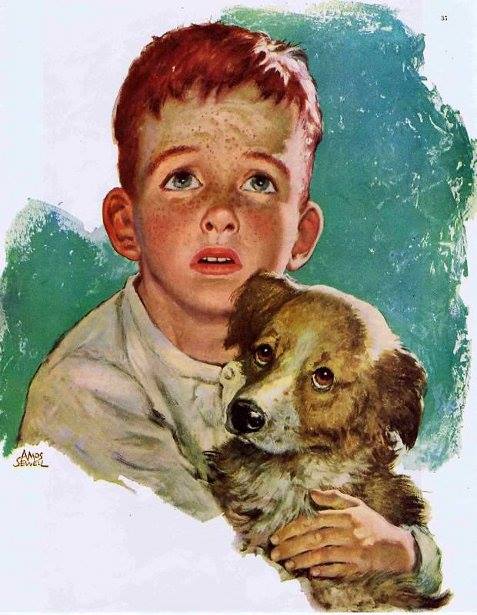
Now that I got that out of my system, here is another Saturday Evening Post artist that is often confused with Rockwell.  His name is Amos Sewell.
11873526_1032725256739973_4919654303824590046_n

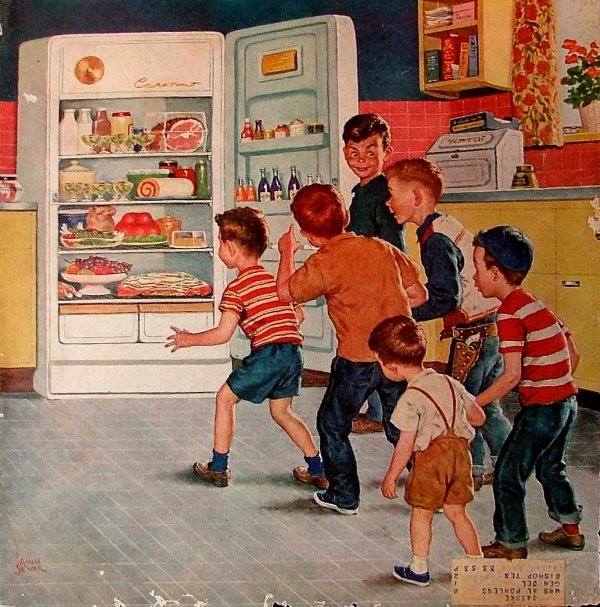
Sewell was an amateur tennis player who was talented enough to win tournaments.  He was an employee of Wells Fargo who was headed towards anything but an art career until he decided to make a leap of faith in 1930.  He started as an illustrator for Street and Smith pulp fiction, and soon caught the notice of the big-time magazine markets for his art.  He published art for Saturday Evening Post,   Country Gentlemen Magazine, and Women’s Day.
11855684_1032724350073397_6985701137057034931_n

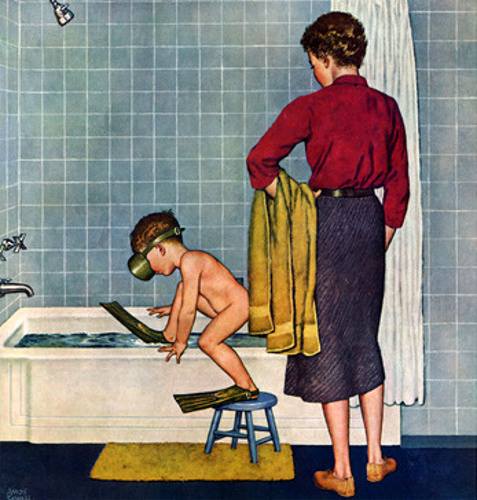
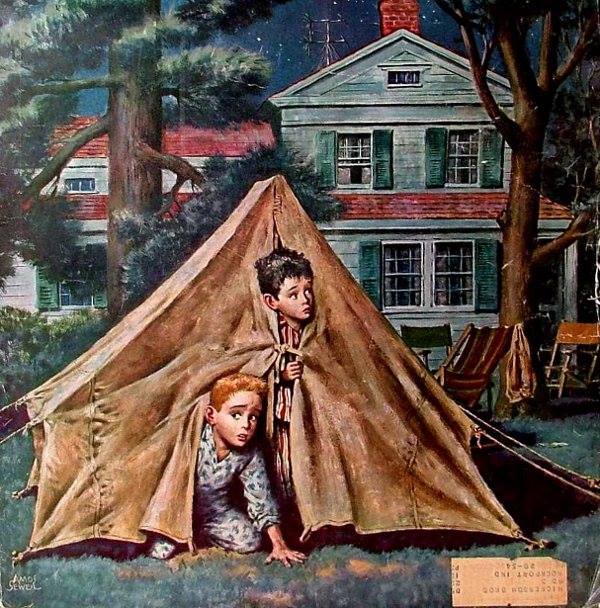
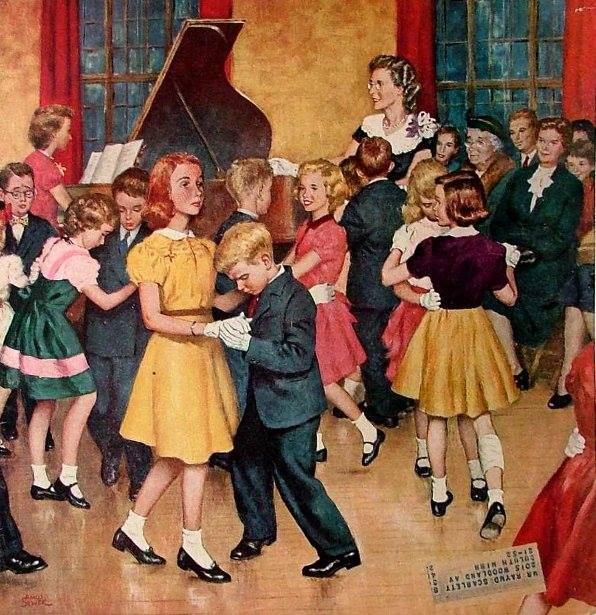
Like Rockwell, he was able to find the funny in everyday scenes, like the dance party to the right.  That young man at center stage is trying so hard not to step on the feet of the red-headed girl, that you want to laugh, but can’t because it’s obvious how embarrassed he would be, and the charm of the picture leads you to shun the thought of interrupting.  The scene is so real the boy would hear you laughing as you looked at the Post cover.
11870904_1032728563406309_3782150834774591970_n

11866457_1032728726739626_9033099913708919775_n

11889619_1032728970072935_2637789351554720524_n

More expert on this kind of art than I am is the Facebook site that I first got turned on to Sewell by.  Children in Art History

They can also be found on WordPress.  Children in Art History (WordPress)
9500708_72dpi_nocallout-150x185

11889413_1032724710073361_2181902444339379253_n

There is no doubt that Amos Sewell belongs in the same pantheon of artists as Norman Rockwell, Thomas Kinkade, or Paul Detlafsen.  They are all artists who achieve in their work exactly what I have always striven for.  I want to be able to hold the mirror up to our world the way they did.  I want to capture both the fantasy and the reality in the subject of everyday family life.  I also want to share this work with you because I cannot stand the idea that such artistic ambrosia could one day be forgotten in archives where no one ever looks at it and feels the message in their heart.


Leave a comment

Filed under art criticism, homely art, humor

Spokes-Dog

20150603_112214.jpg

At breakfast I cooked smokies, small-sized fried sausages.  Jade, our family dog got up to the table with the rest of us.

“I can eat twenty of those!” Jade said.

“No you can’t,” I said.  “You are a dog and eat from a bowl on the floor.  I didn’t even set a plate on the table for you.  This is not dog food.”

“Dad?  Did you see these coupons for Taco Bell on the table?” said the Princess.

“Oh, you mean, the Taco Bueno ads?  Remember what the last trip to that other place gave us?”

“Oh, yeah.  That was a horrible day spent in the bathroom,” she answered.

“The next time you go to Taco Bell, take me! ” said the dog.  “I loved the taco meat I found on the table last time you made the mistake of leaving some there.”

“Well, I do know that Taco Bell is universally loved by dogs.”

“How do you know that?” asked the Princess.

“Don’t you remember the Taco Bell dog?  Or were you too young when he was popular?”

“I think I was too young.”

“Look him up on the internet.”

“Oh, yeah!  I kinda remember that.  He was a talking dog, just like Jade.”

“Yes, but I think he mostly spoke Spanish.”

“He’s handsome!” said Jade.  “But look, he’s on television with very short fur… he’s naked!  That would be very embarrassing.”

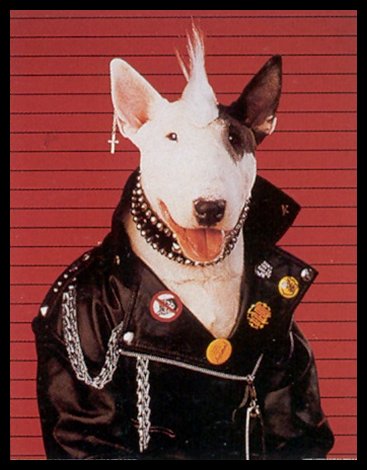
“Yeah, when it comes to TV spokes-dogs, you’d probably prefer Spuds Mackenzie.  He had more style.”

polishpartyspud

“I never heard of him,” said the Princess.

“Well, he was before you were born.  He was the Budweiser spokes-dog.”

“Did he talk too?”

“Just party language.  He was always chilling by the pool with beautiful human girls.”

“Let me see more of him!” demanded Jade.

spudsmackenzieandbudlightandladies

“Wow!” said Jade.  “A dog who drinks beer and plays guitar!  I think I’m in love!”

“That was so long ago, though,” I said.  “He is probably dead by now.  The average life span of a dog is only about ten years at the most.”

“Oh, now I am depressed,” said Jade.  “And you know the only cure for that is to give me some of the breakfast sausages!”

So, as I gave a dog a sausage, I was deeply regretting the whole talking dog thing.


Leave a comment

Filed under family, family dog, goofiness, humor, strange and wonderful ideas about life

Making Portraits

scan0005

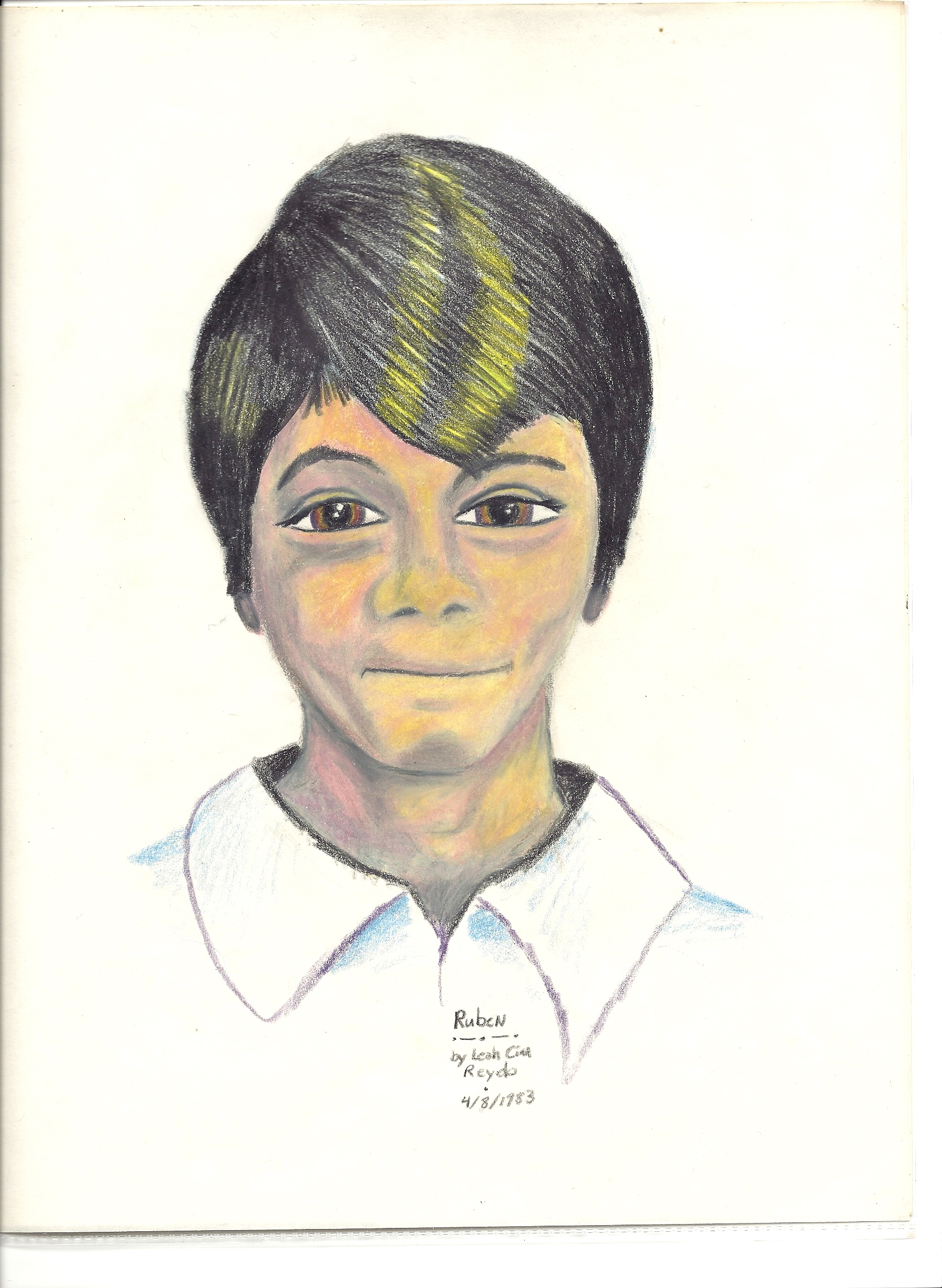
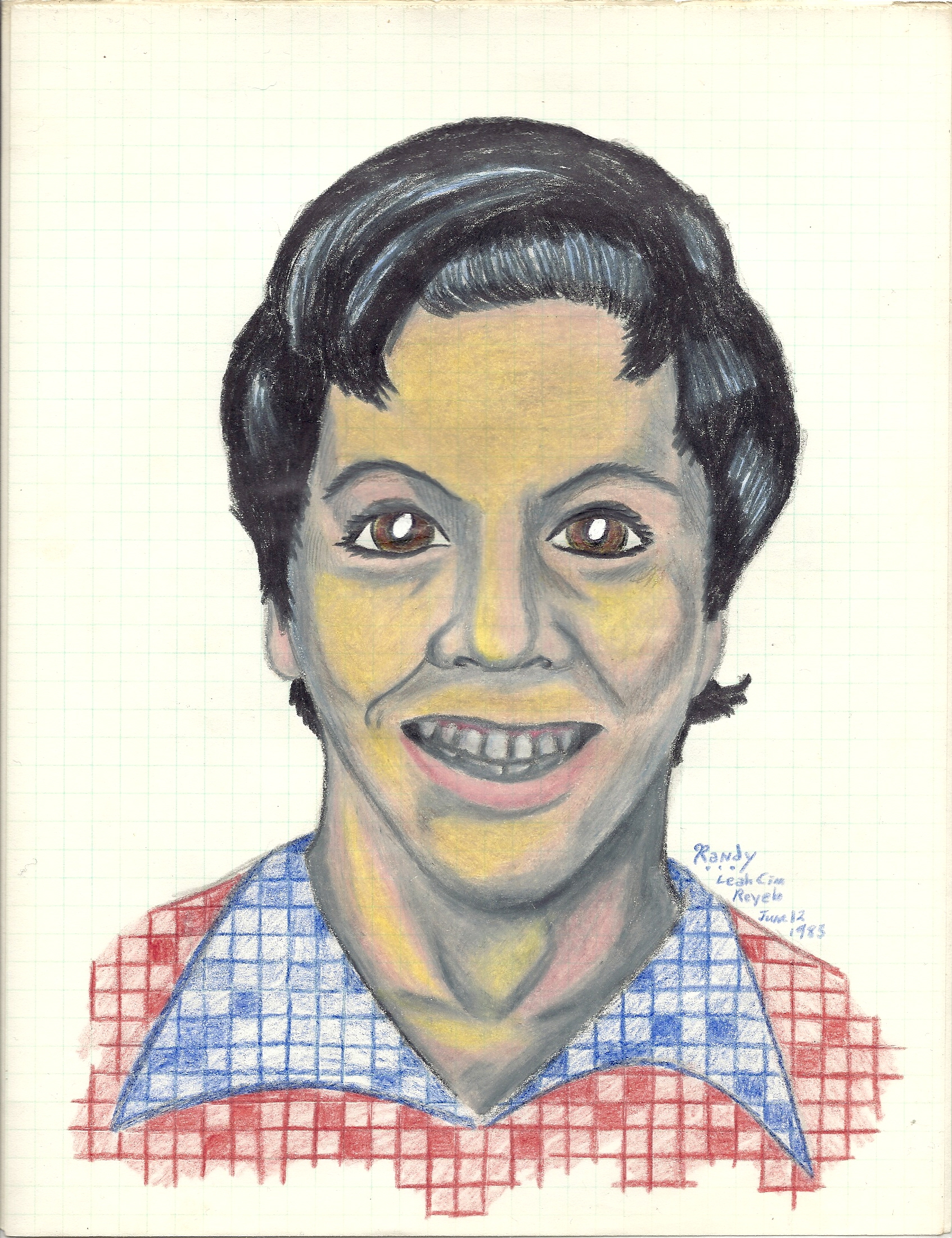
My biggest regret as a cartoonist and waster of art supplies is the fact that I am not the world’s best portrait artist.  I can only rarely make a work of art look like a real person.  Usually the subject has to to be a person I love or care deeply about.  This 1983 picture of Ruben looks very like him to me, though he probably wouldn’t recognize himself here as the 8th grader who told me in the fall of 1981 that I was his favorite teacher.  That admission on his part kept me from quitting and failing as a first year teacher overwhelmed by the challenges of a poor school district in deep South Texas.

scan0006

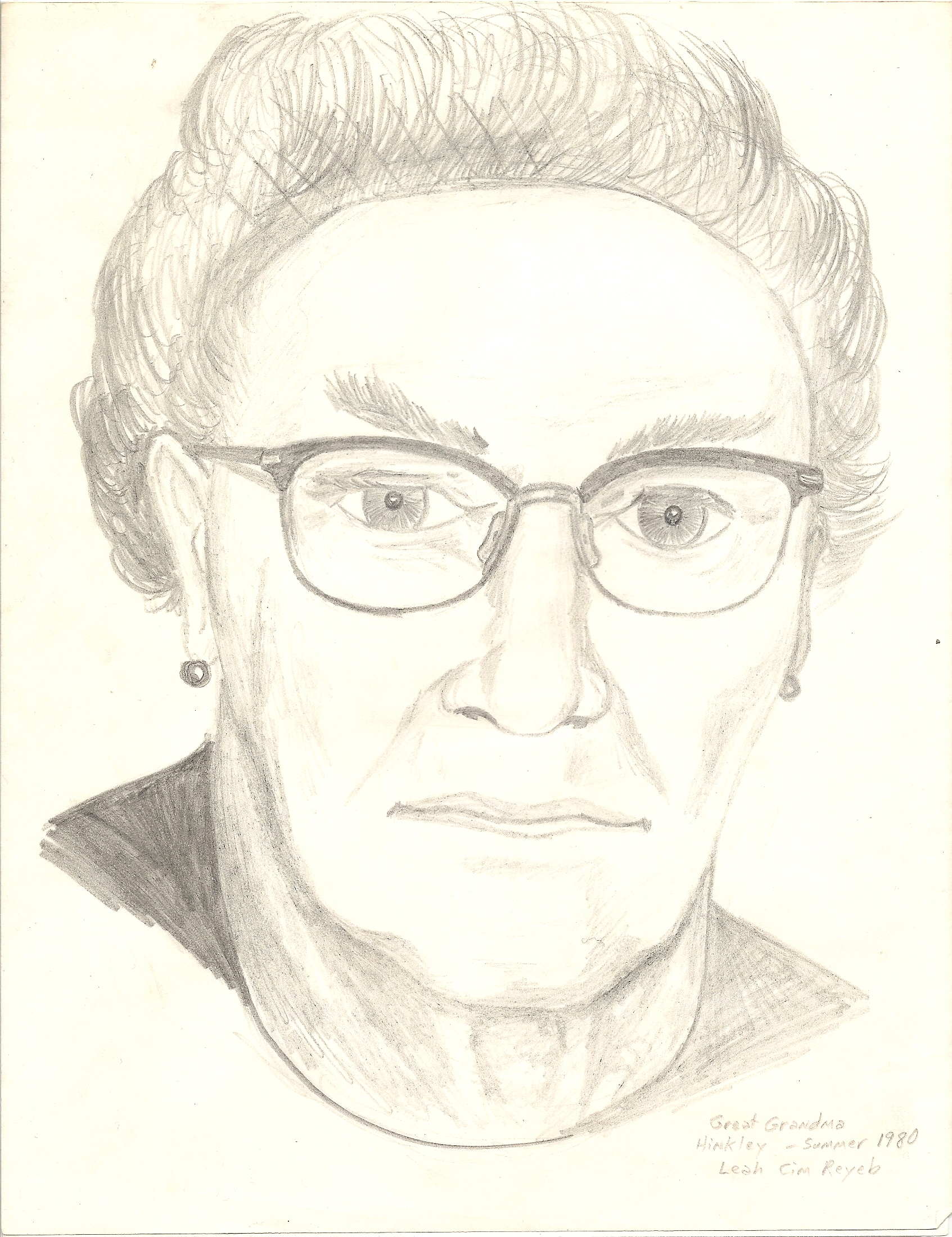
My Great Grandma Hinckley was really great.

My great grandmother on my mother’s side passed away as the 1970’s came to an end.  I tried to immortalize her with a work of art.  I drew the sketch above to make a painting of her.  All my relatives were amazed at the picture.  They loved it immensely.  I gave the painting to my Grandma Aldrich, her second eldest daughter.  And it got put away in a closet at the farmhouse.  It made my grandma too sad to look at every day.  So the actual painting is still in a closet in Iowa.
scan0007

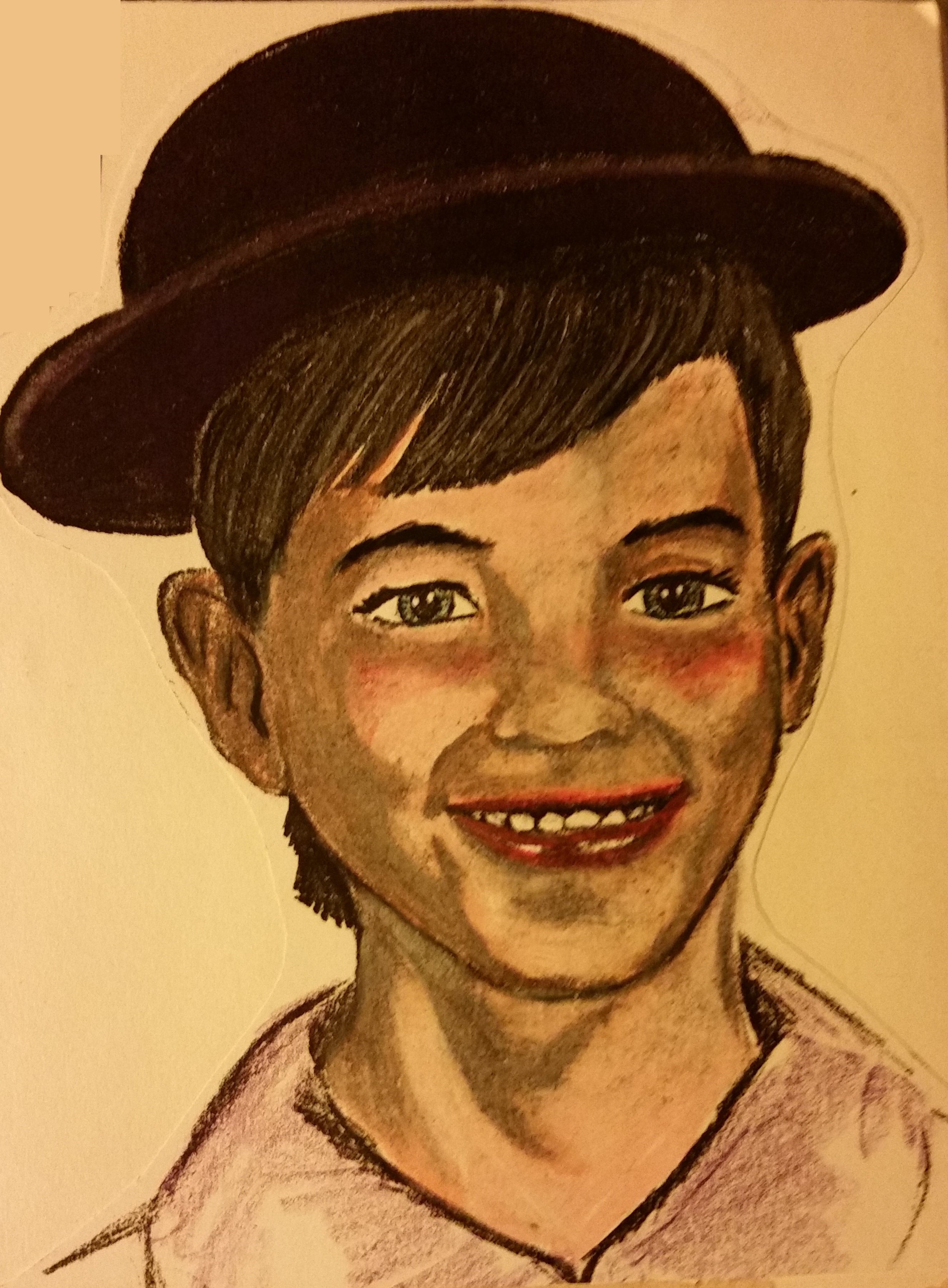
There were, of course, numerous students that made my life a living heck, especially during my early years as a teacher.  But I was one of those unusual teachers (possibly insane teachers) who learned to love the bad kids.  Love/hate relationships tend to endure in your memory almost as long as the loving ones.  I was always able to pull the good out of certain kids… at least in portraits of them.

dscn4715

When kids pose for pictures, they are not usually patient enough to sit for a portrait artist.  I learned early on to work from photographs, though it has the disadvantage of being only two-dimensional.  Sometimes you have to cartoonify the subject to get the real essence of the person you are capturing in artiness.

But I can’t get to the point of this essay without acknowledging the fact that any artist who tries to make a portrait, is not a camera.  The artist has to put down on paper or canvas what he sees in his own head.  That means the work of art is filtered through the artist’s goofy brain and is transformed by all his quirks and abnormalities.  Therefore any work of art, including a portrait that looks like its subject, is really a picture of the artist himself.  So, I guess I owe you some self portraits to compare.

20160424_180408

Yeah, that’s me at 10… so what?

Leave a comment

Filed under art criticism, artwork, autobiography, humor, kids, Paffooney, self portrait, strange and wonderful ideas about life

How It Should Be… According to Mickey

A 1951 Schwinn Spitfire like mine in 1963 when the world was golden.

My bicycle was red. It was red and looked just like the ones that Captain Kangaroo had in his commercials that we watched on a black-and-white TV every day before we walked or rode our bicycle to school, across town a whole long seven blocks away. After school I could ride it out a whole mile and a half to Jack’s farm with Bobby and Richard and Mark the preacher’s kid to go skinny dipping in the cold creek in Jack’s South pasture. Jack was younger than any of us except Bobby. And it was a golden age.

Spiderman comic books and Avengers comic books cost twelve cents to own, but they were forbidden. And as much as we sneaked them and passed them around until they fell apart, usually in Bobby’s hands, we never knew that Dr. Wertham had gone to Congress to make our parents believe that comic books would make us gay and violent. He was a psychiatrist who wrote a book, so even if you didn’t believe him, you had to worry about such things.

I believed in Santa Claus until 1967. And after I found out, I only despaired a tiny little bit, because I began to understand you have to grow up. And adults can lie to you, even if they don’t do it to be mean. And the world is a hard place. And the golden age ended in November of 1963 when JFK was assassinated.

In June of 1968 I rode my bicycle out to the Bingham Park woods, Once there, I took off all my clothes and put them in the bicycle basket, and then I rode up and down the walking paths through the trees with nothing between me and God but my skin. I had a serious think about how life should be. All the while I was terrified that someone might see me. I was naked and vulnerable. A mere two years before that I had been sexually assaulted and was terrified of older boys, especially when I was naked and vulnerable. But I was a fan of the St. Louis Cardinals and Bob Gibson. They were repeated World Series winners. And they beat the Yankees in the series in 1964. And more important than that, cardinals were the little red songbirds who never flew away when the winter came. You don’t give up in the face of hardship. You face the trouble. No matter how deep the snow may pile up.

And in 1969, the first man to walk on the moon showed that a Star Trek world was in reach of mankind. Star Trek was on every afternoon after school. I watched a lot of those episodes at Verner’s house on his family’s black-and-white TV. The Klingons were always bested or beaten because the crew of the Enterprise outsmarted them. You can solve the problems of the universe with science. I know this because of all the times Mr. Spock proved it to me not just by telling me so, but by showing me how you do it. And what you can achieve is greatly enhanced if you work together like Spock and Kirk and Bones… and sometimes Scotty always did.

So, what is the way it should be? What did Mickey decide while naked in the forest like a Dakota Sioux shaman on a spirit-quest?

JFK’s 108th birthday was on May 29th. Dr. Wertham has been dead for 44 years. Bob Gibson was 85 when he passed away in October of 2020. Captain Kirk turned 94 in March of this year.

The Golden age is long gone. There is no single set of rules that can clearly establish how it should be now. But I like those ideas of how it should be that I established for myself while naked on a Schwinn Spitfire in a forest long ago.

1 Comment

Filed under autobiography, cardinals, comic book heroes, commentary, humor, inspiration, oldies, Paffooney, philosophy

More NPC Nonsense

C360_2017-04-29-09-18-08-619
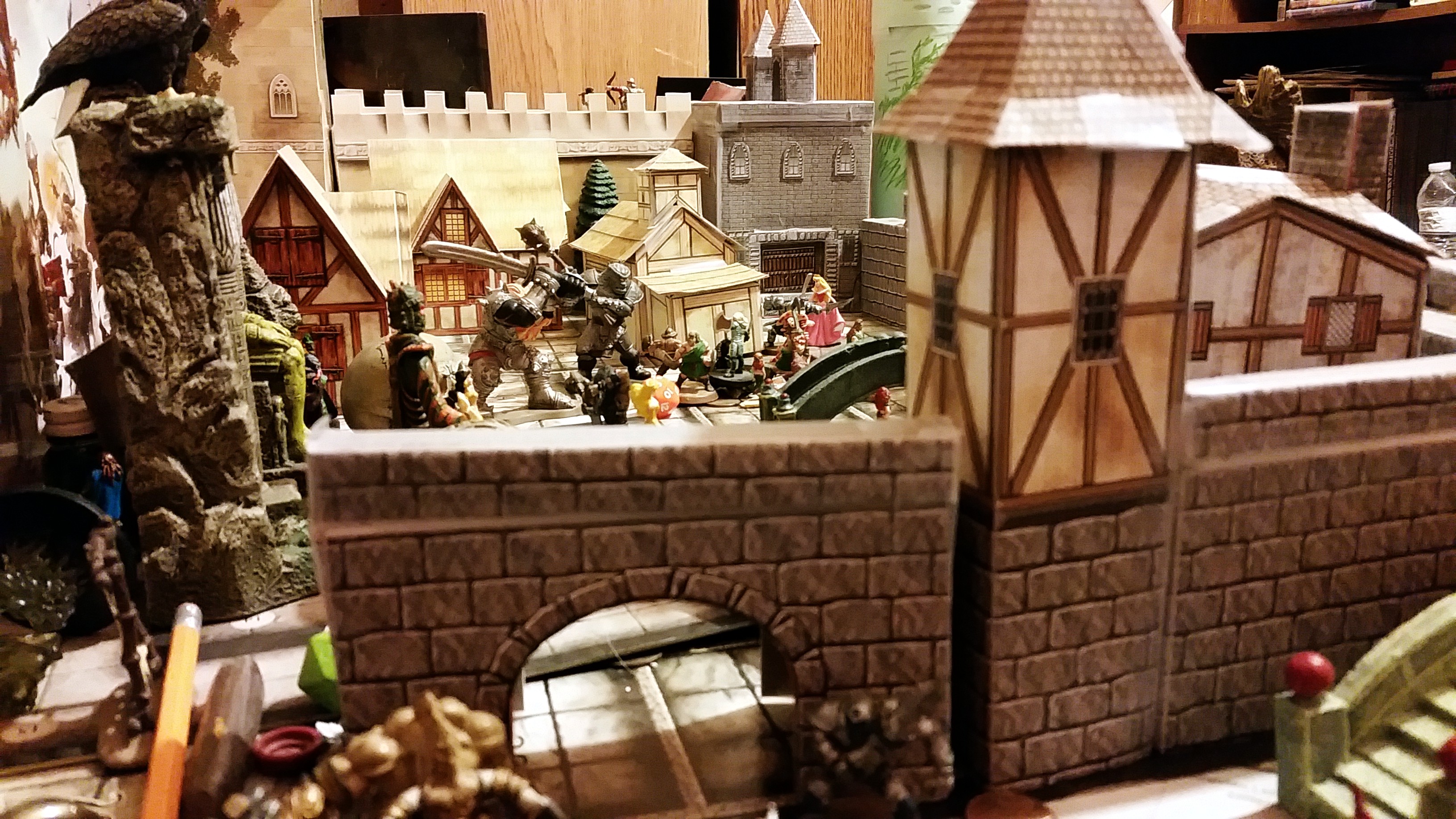
A view of the D & D table in my library.

I believe I warned you last Saturday that I had a lot more stupid stuff to share about Non-Player Characters in D & D.  I probably let it slip that I really like playing all the weird parts and the monsters about to be slaughtered.  I intend to share more of those strange characters today, so you can get a real sense of why my D & D games get so out of control and my children are turning into sword-wielding sociopaths.

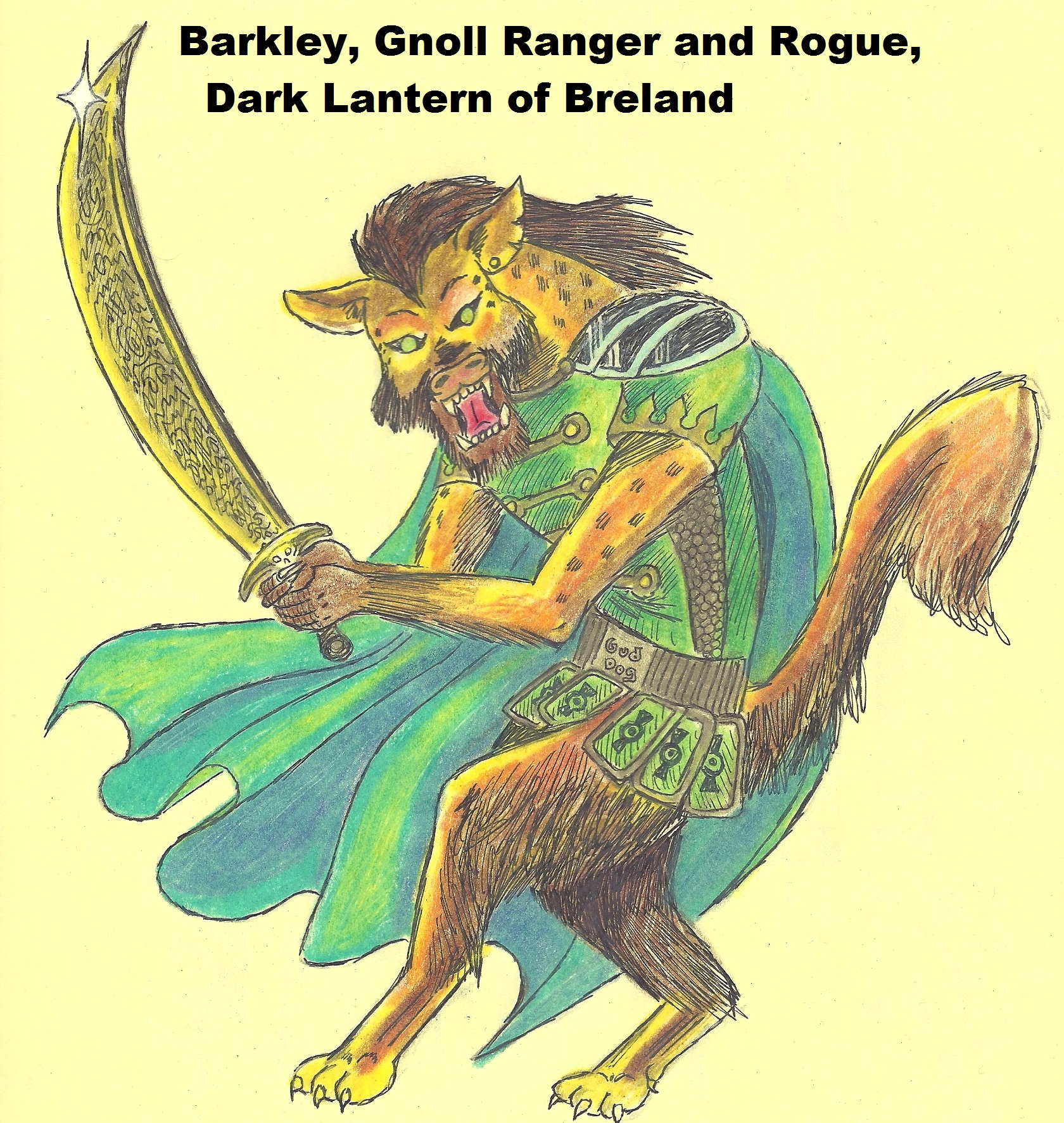
Barkley 1

Barkley is not exactly the family dog.  He’s a gnoll.  That means he’s a monstrous hyena-man who would be inclined to hate and eat humans were he not raised from puppyhood to gnollhood by a beautiful female elf cleric.  He now hates the gnolls (and probably eats them) because in the first D & D adventure, his gnoll brothers tried to kill and eat his beloved elf mother.  He traveled with the Player characters for about three adventures.  And though they treated him like a dog, they came to rely on him in several tough battles.  He proved his dog-like loyalty and learned some critical spy skills from them, so he became a Dark Lantern (a secret agent for the kingdom of Breland) and began a life of hunting and killing evil gnolls.

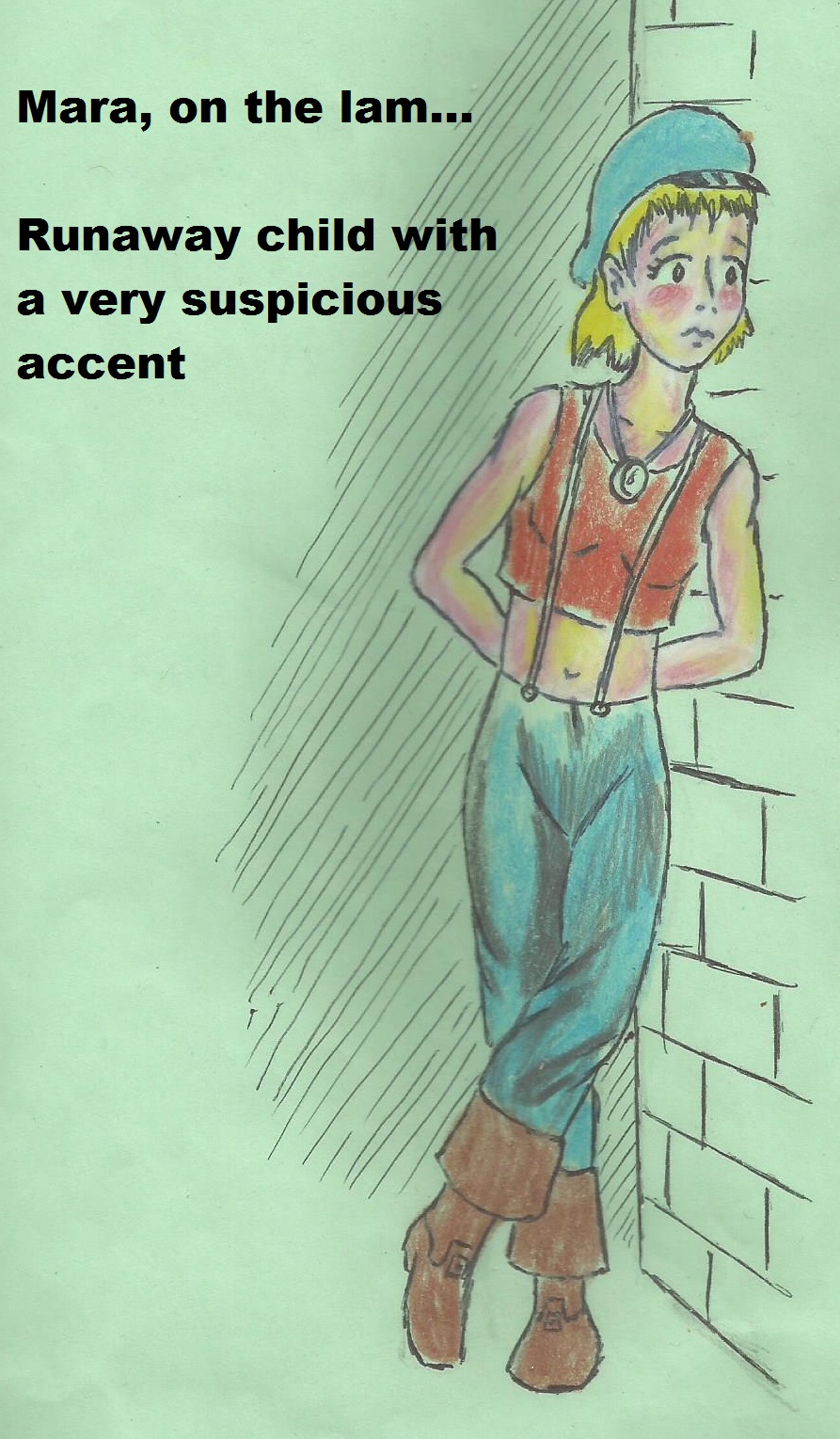
Scan66

Mysterious Mara was one of the few civilian survivors when the weretigers attacked the lightning rail train with the player characters aboard it.  She tagged along because she would not have survived otherwise.  She has never revealed her true identity, and it’s a real mind-blower related to the royal court of Aundair, but the player characters have been too busy with other things to look into the mystery.  In fact, she is what the D & D manuals call an “adventure hook” because following up on her essential mysteriousness would’ve led them into the middle of a kingdom-crashing conflict.  In the meantime, they have been feeding her, teaching her to make use of her natural acrobatic skills, and generally befriending her, not realizing she is the reason so many enemies of Aundair have been tracking and attacking them.

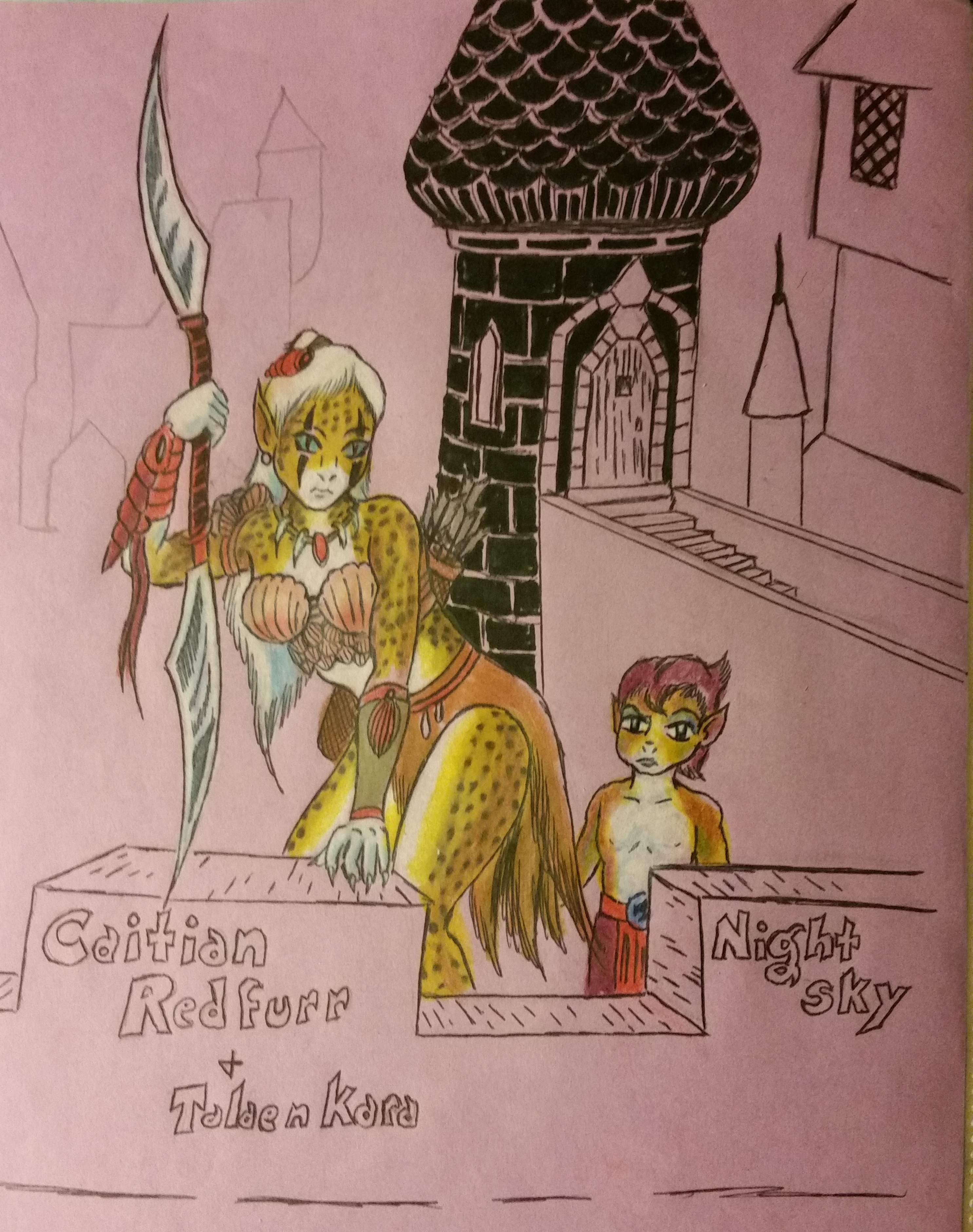
20160530_144544

Caitian Redfurr is a shifter, one of those half-men with the abilities of a cheetah, able to run like a rocket and use speed to best her foes.  She has been a part of the campaign since just after Barkley joined.  Her son, Night Sky, is the son of a former Dark Lantern leader whose ghostly presence now inhabits Fate’s head.  She has used her skills with a sword, and her skills with a bow, and her skills with Talaen Kara, the intelligent double-bladed weapon, to save their fat from goblin cookfires on numerous occasions.  The players are fond of her and trust her as basically an added member of the family.

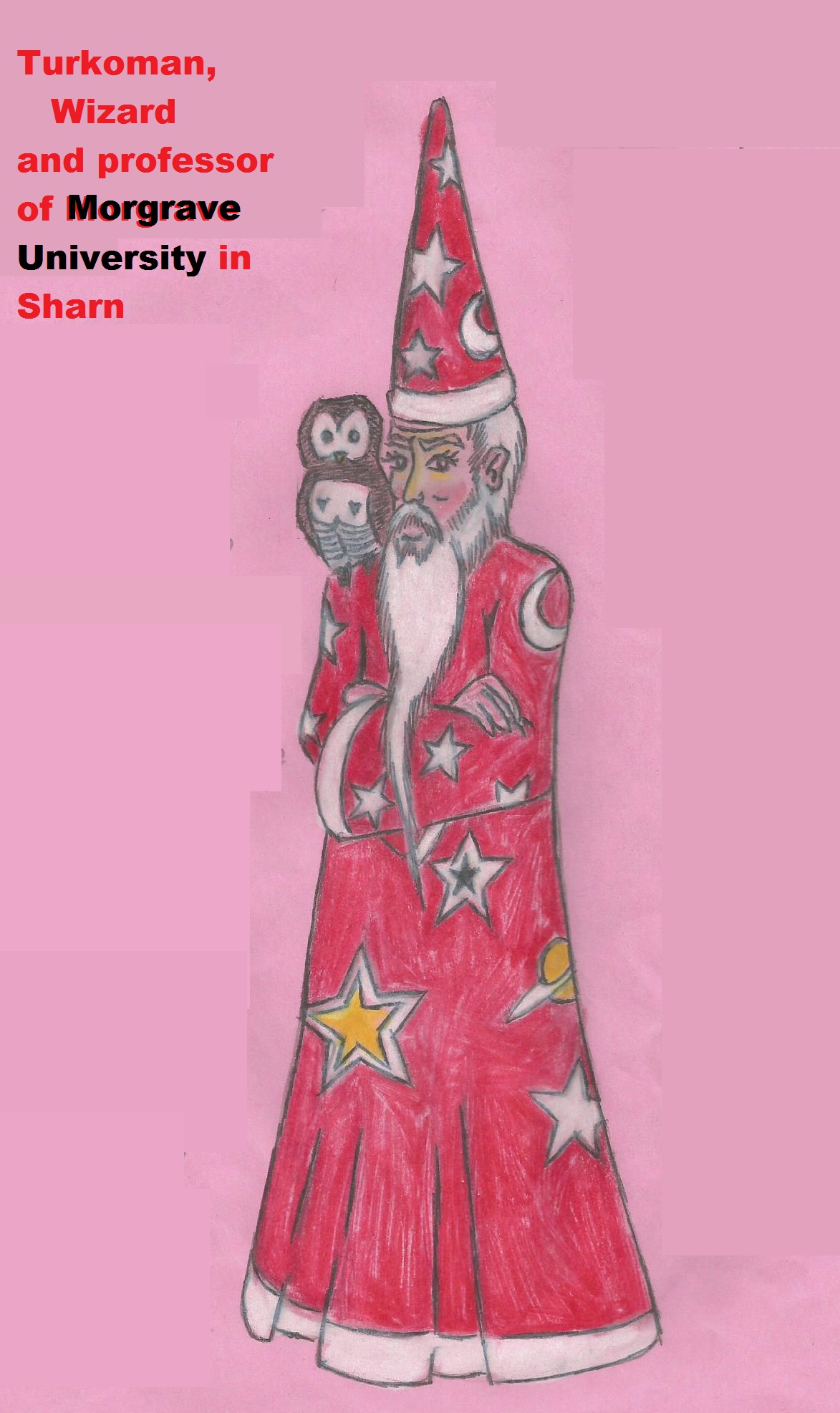
Scan61

Finally for this Saturday, I mentioned Turkoman last week.  He is what is called a “patron” in D & D NPC-terms.  He’s the man with the expertise when a beloved character is cursed with frogs hopping out of their ears or is turned completely to stone by a gorgon’s kiss.  He also provides necessary magic items, spells, enchantments, and critical advice that can help bring an adventure to a conclusion.  When needed, he can even lend a hand in the actual adventure, giving the characters a chance to overcome difficult odds and find adventures that they would not otherwise have access to.

So, once again I have passed my word limit and must draw to a close with so much more to tell.  Even if you are bored stiff by D & D nerd-ism, I intend to inflict more upon you in the future.  So be warned, be wary, and watch out for curses that make frogs hop out of your ears.

Leave a comment

Filed under Dungeons and Dragons, foolishness, humor, making cardboard castles, Paffooney

A Little Bit .Gif-fy… Not Goofy

Sometimes life gets a bit tough when you are old and diabetic and grumpy all the time… and your kids are still teenagers… and you have to spend four hours a day driving them to two different schools in two different Dallas suburbs… and it rains one day and swelters you in Texas heat the next… and the drive home occurs during rush hour… and you just can’t think beyond loud thoughts like; “Why does that stop light turn red right before I get there?” and “Why can’t somebody teach teenagers how to drive in a high school parking lot?!” and “Why is the sun so bright and in my eyes going BOTH DIRECTIONS?!?” and “Why is the worst driver in Texas always the one right in front of me?!?!!!”

And then you realize, you can’t think any more to make a decent post for your blog.  You are dead tired and out of ideas, though still able to type… even though you are apparently dead according to this sentence.  So what do you post?  You need some chocolate and iced tea for your brain.  And you decide it is better to come out of the closet for being .gif-goofy and collecting .gif’s.  You heard right.  I mean .gif’s.  I am not talking about peanut butter.  And I didn’t misspell goofs.  I mean those crazy moving things on the internet where the motion is repetitive and the promotion of the motion is mindless.  Yes, those moving-picture things called .gif’s.

Like this one;

download

Rainbow Dash is really going after that guitar riff in this guitar-riff .gif!  And I didn’t steal this from Deviantart.  I stole it from somebody else who stole it from Deviantart.
And then I have an audience for her solo;

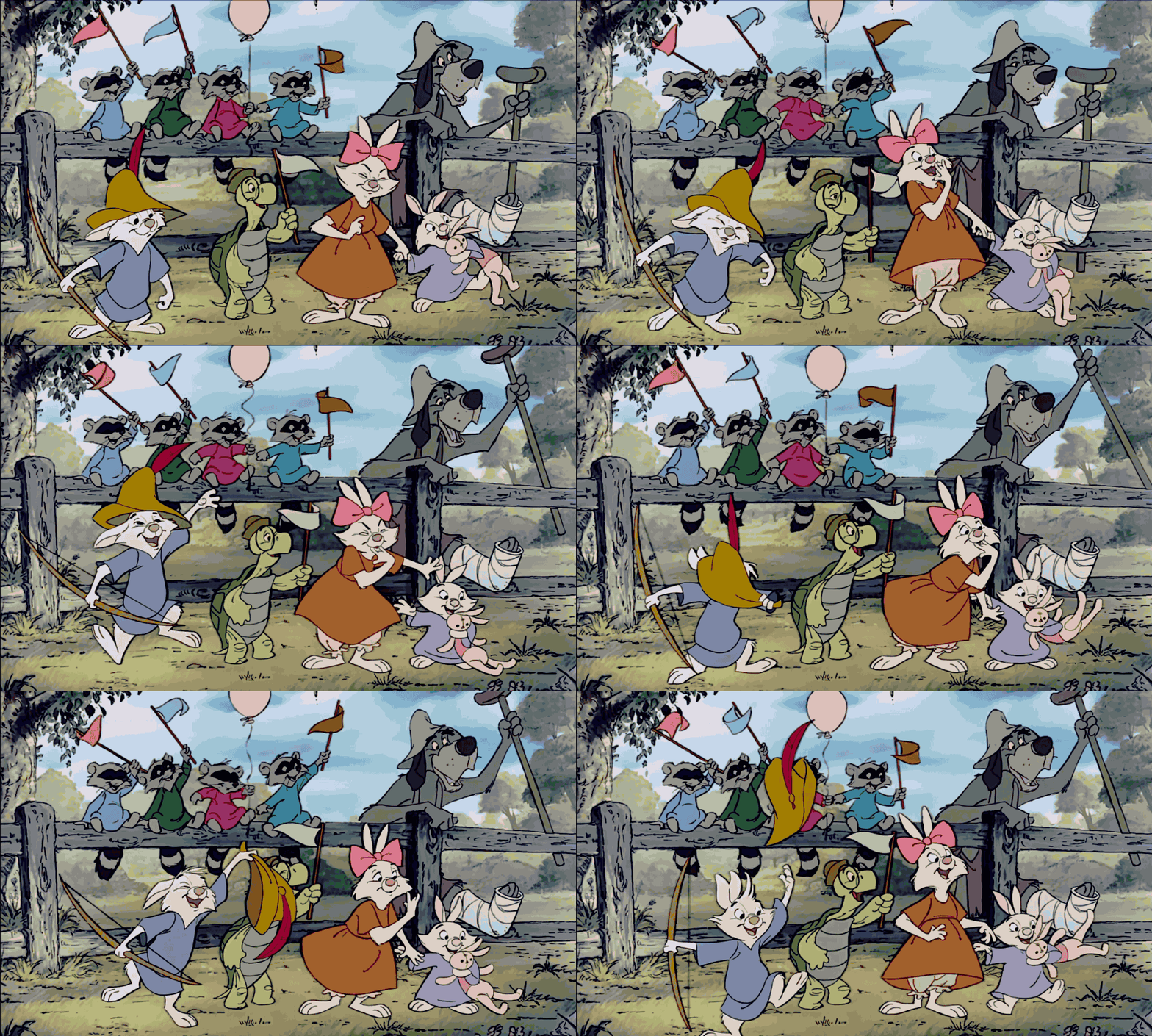
robin-hood-celebration

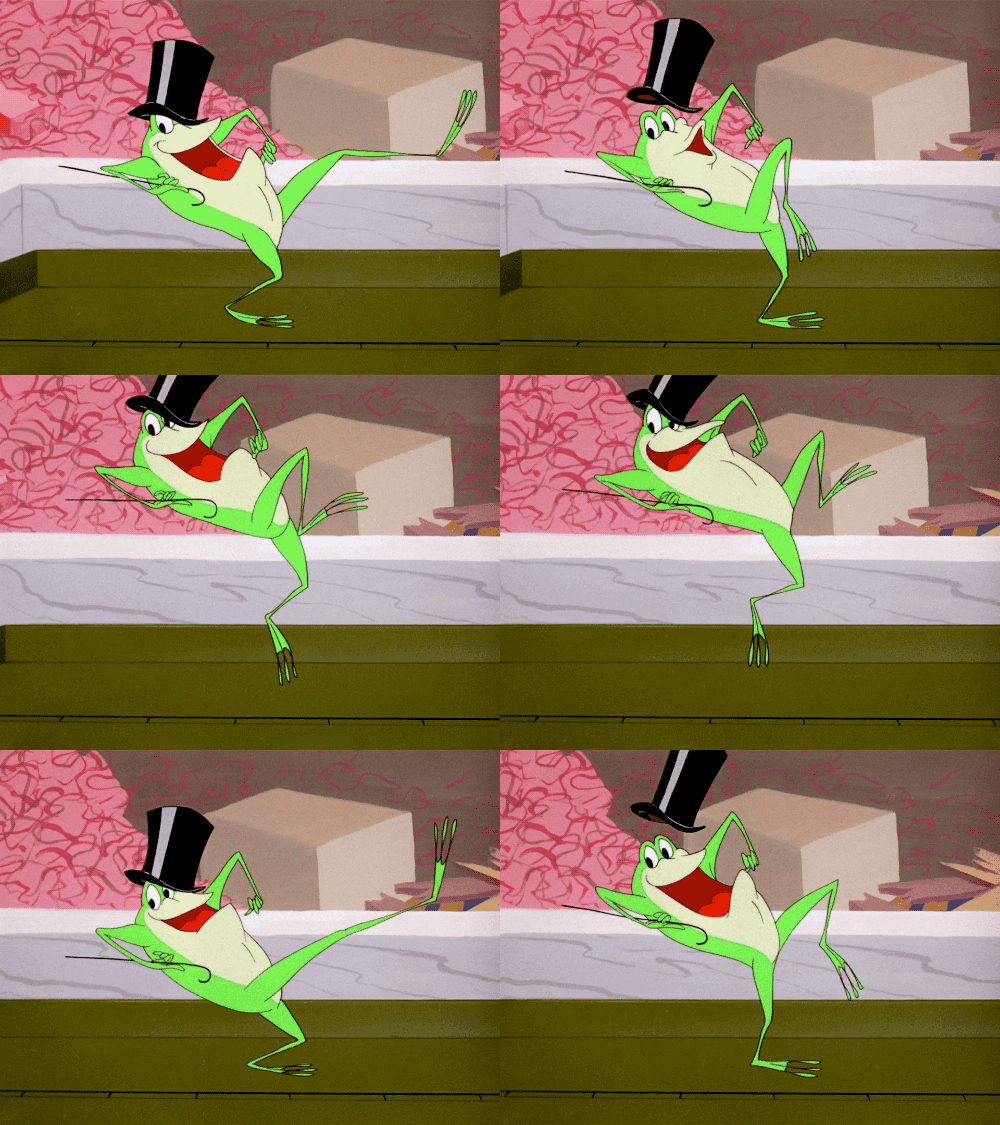
And these .gif’s make me happy.  Happy like a frog;
tumblr_nalzhwJcx11s2wio8o1_500

And why do these minor miracles of motion make me happy?  I don’t know.  But they do.

And I must not be the only one.  Somebody went to a great deal of work to create some of these:

fulldance

And one might wonder if it is an evil thing to be happy about being .gif-goofy.  But in my experience, they only fascinate the eyes for a short while and alter my mood in goofy, weird ways.


So now that I’m all goofed up, let me end with one more.

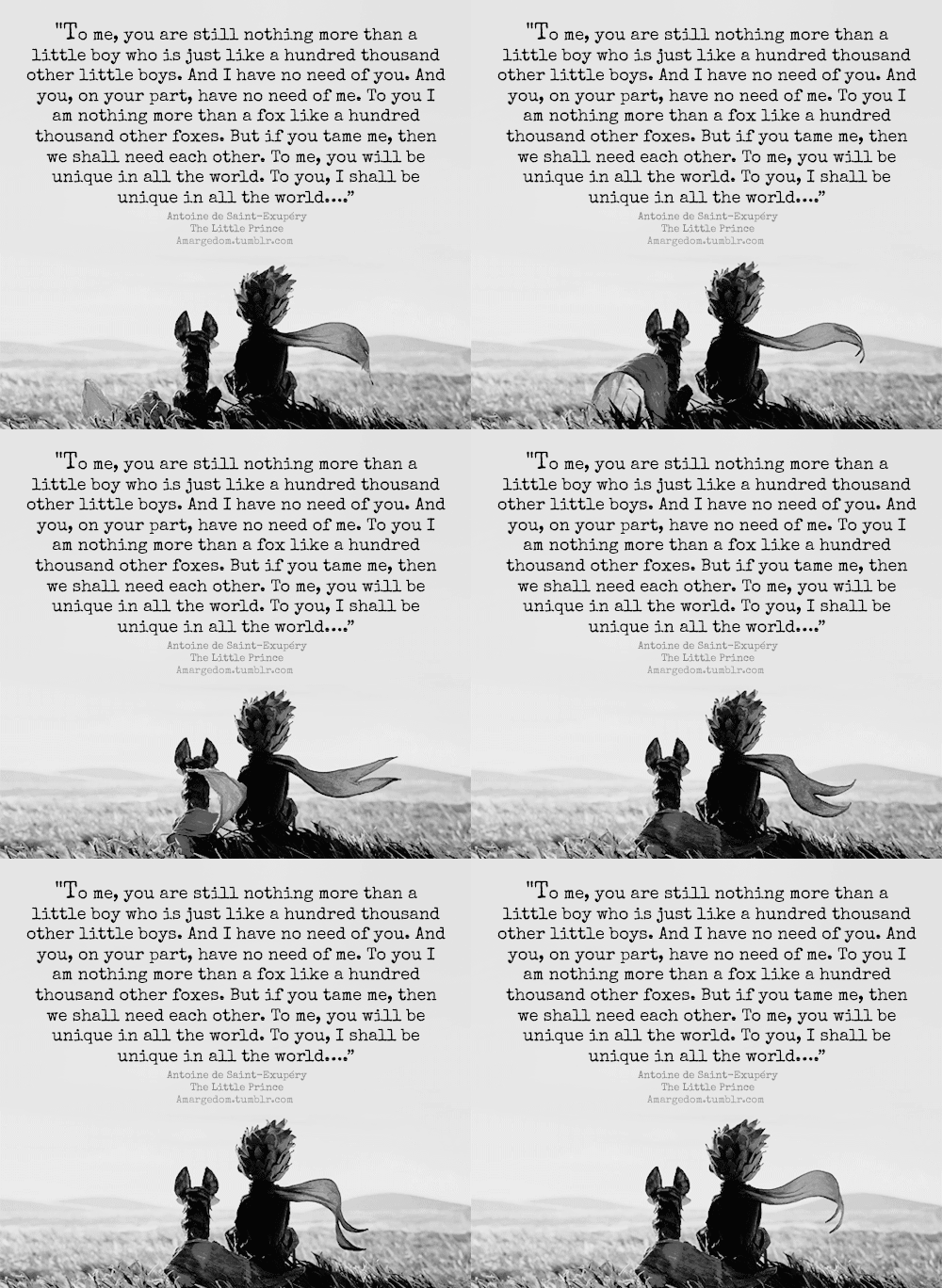
2972da5d3eb623582852db74ddc9327e

So, now, these .gif’s have tamed me, and I am unique in all the world.

Leave a comment

Filed under artwork, humor, memes, strange and wonderful ideas about life

Oxfordian Rationalizations

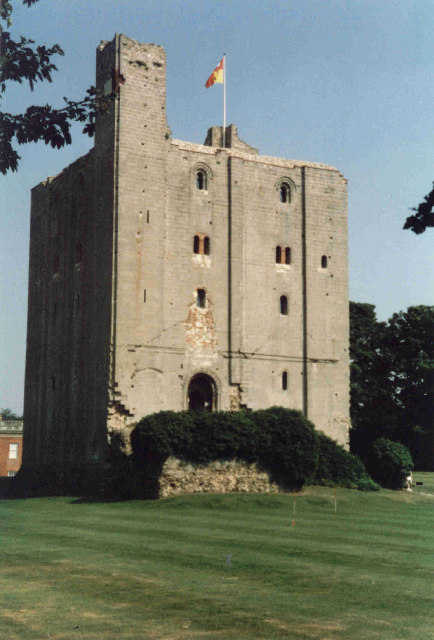
Yes, I am, perhaps, a bit of a fool for believing Edward de Vere, the 17th Earl of Oxford, is the writer behind the works of William Shakespeare.  How do you prove something is true when it is so obvious that someone worked really hard to keep it a secret for all this time?  Is it a betrayal of the man to go against his apparent wishes and try to out him for his incredible secret?  It is hard for me to judge.  After all, I know I am a fool.

But even if he is not Shakespeare, and just sits at the apex of a mountain of coincidences, I am fascinated by the historical character of Edward de Vere.

the_keep_at_castle_hedingham_-_geograph-org-uk_-_30510
The keep at Hedingham Castle, the de Vere family seat in Essex (photo by David Phillips)

He was born the only son of John de Vere, the 16th Earl of Oxford, and heir to the second oldest title among English nobility.  His father stood by Elizabeth when she was under house arrest under the reign of Bloody Mary, and went with her as a court favorite to the throne of England when she survived the ordeal.  So naturally Edward was a favorite of Elizabeth’s since childhood.  Later stories would suggest he became the Queen’s secret lover, but the rumors of the Virgin Queen’s harlotry were most likely the invention of Philip of Spain and other nobility in Catholic Europe who plotted endlessly against her because she chose to adopt her father’s protestant Anglican religion instead of returning England to Catholicism like her half-sister Mary before her.  Elizabeth’s personal integrity may not have been perfect. Still, the love she bore for young Edward was probably not the improper kind that the movie Anonymous, directed by Roland Emmerich, suggested.

But even though de Vere was born lucky, I would not say he was particularly lucky in life.  He was only twelve when his father (though having completed his will) died.  The result being that he was made ward to Queen Elizabeth herself.  She was not exactly the foster-mother type, however.  She sent the boy to be raised in the home of her Secretary of State and chief adviser, William Cecil (later made Lord Baron Burghley).  Meanwhile, Elizabeth took possession of some of his estates in payment for the wardship and bestowed them on Robert Dudley (her childhood friend and probable one true love, though he was married to someone else).  Young Edward was a difficult student.  His tutor, the famous scholar Laurence Nowell, resigned in frustration, probably because the boy was too bright and far-reaching for the antiquarian scholar to deal with, possibly himself being a bit dumber than advertised.   Edward quickly developed a reputation for love poetry at Elizabeth’s royal court.  He was a gifted, though somewhat conflicted, prodigy.

cecilwilliam1bburghley04
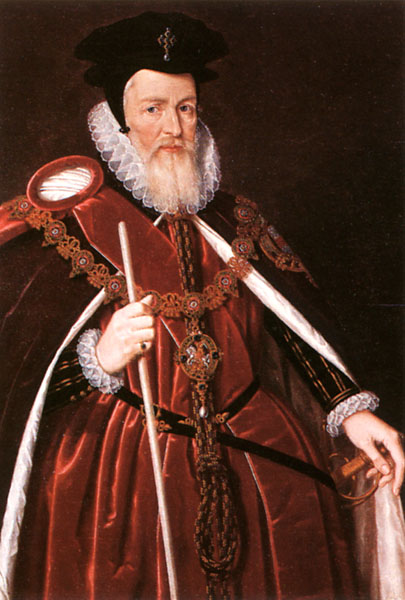
William Cecil, 1st Baron Burghley

And here is what I find most fascinating about his life story.  As you reread it, keeping the works of Shakespeare in mind, you begin to see Shakespeare’s source material coming to life.  Edward would end up marrying Cecil’s young daughter Anne, so that Lord Burghley was not only a man who raised him, but also his father-in-law.  But marrying off your offspring to nobility was an accepted manner of social climbing, and Cecil wasn’t entirely sure he couldn’t do better for his daughter.  And the meddlesome, lecturing, and self-righteous nature of the man comes out in Shakespearean characters like Polonius in Hamlet who spies upon the suicidal prince because he fears the effect Hamlet’s love for his daughter Ophelia might have on her reputation, causing him to spout all manner of cliches and stuffy, self-important advice.

cecil
Robert Cecil, Lord Salisbury

Cecil’s son Robert, the hunchbacked boy who grows up to take over his father’s office as adviser to both Elizabeth and James I, is a crafty statesman and plotter who is the undoing of the Earl of Essex in a real-life plot against the throne of Elizabeth.  It is hard not to read about his real-life exploits without seeing the connections to Iago in Othello and the conniving hunchback Richard III.

So, once again I have overshot my target length in this essay because I get so wound up in the details of my discoveries.  There are numerous things written and published about the connections between de Vere and the Bard himself.  I have only begun to scratch the surface in this telling of it.  But I am just a fool with a humor blog.  If it interests you at all, I encourage you to go to as many of the available sources as you can possibly Google.  I haven’t yet finished doing that myself.  And I do hope I haven’t told anything here that makes Shakespeare turn over in his grave (if, indeed, a grave could ever really hold him.)

Leave a comment

Filed under artists I admire, conspiracy theory, foolishness, humor, strange and wonderful ideas about life, William Shakespeare

The Oxford Obfuscation

queen-elizabeth-i

If you are going to entertain a completely absurd notion like, “Shakespeare wasn’t really written by Shakespeare”, then you have to have some knowledge of the times and the context within which such a profoundly counter-intuitive thing could possibly be true.  And it also helps to understand more precisely what the “writing of Shakespeare” actually means.  Now, I know it is not particularly fair to confuse you, dear reader, right before I try to dazzle you with my complicated and over-thunk lackwit conspiracy theory, but that is, after all, what obfuscation actually means.

The plays, sonnets, and other poetry of William Shakespeare reveal the mind of a genius.  Whoever wrote the works has to be a complicated man living a complicated life.  He has to be a sensitive, empathetic, highly intelligent, observant, and troubled man.  You don’t write the dark and deeply troubled suicidal tragedy of Hamlet without ever having thought of taking your own life.  You cannot portray the madness of King Lear without ever having experienced the turmoil of the mind that threatens to tear your soul apart.  And you don’t write about the complexities of love found in As You Like It or Romeo and Juliet without ever having experienced the massive thunderstorms of the mind that go along with falling in love.  And we are talking true love, not necessarily the domestic love you have for the wife you are stuck with.   You see what I did just there?  I put you into the head of the writer, and started you thinking like you yourself are Shakespeare.  As goofy a mental gymnastic exercise as that is, bear with me and keep thinking it.

At the time of Shakespeare’s ascendancy as the Bard Laureate of English Literature, England was not a safe place to be either a noble or a playwright.  Queen Elizabeth’s mother had her head cut off for bad politics even though she was married to the King of England at the time.  Lady Jane Gray, one of Elizabeth’s predecessors, lost her head when she was no more than a sixteen-year-old girl.  During Elizabeth’s reign, one of her court favorites, Robert Devereaux, Earl of Essex, attempted to seize the queen herself after a riot fomented by a performance of Shakespeare’s play, Richard II, at which eleven of Essex’s noble supporters were said to be present stirring up the emotions of the crowd.  It was a near thing for the writer of the play (about the life of a king whose reign ended in controversy about succession and which led eventually to the War of the Roses) to escape without also being caught up in the rebellion’s failure and round of executions that separated Essex from his head.  Elizabeth banned numbers of plays with religious or political content, bans that never seemed to touch the writer of Shakespeare’s plays, even when they touched on political themes.  You didn’t have to rebel against the Queen to lose your head either.  Elizabeth was trying to reinstate Anglican Protestantism against the critical tides of Catholic Europe.  You could be banished, put to death, or impressed  by force into the English Navy for being suspected of ideas that were too Catholic.  And witchcraft, or consulting with witches, as Macbeth depicts, earned you a nice warm fire in the public square to cleanse your immortal soul.

edwarddevereattribmarcusgheeraerts
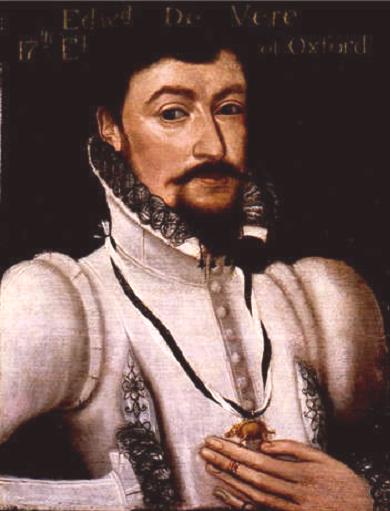
Edward de Vere, 17th Earl of Oxford

So, if one were to be both a playwright and a nobleman, known to and beloved by Queen Elizabeth, might there not be good reason to write under a pseudonym?  And numerous people who write about Edward de Vere mention the fact that he wrote poetry and plays, and the plays were very popular.  Some scraps of poetry by the Earl of Oxford still exist, but whatever happened to the manuscripts of his plays?  It is a conspiracy theory so delicious, that I have to take at least one more bite.  (You understand, I try to stick to a 500-word target for these posts, and even this 600+ is really too long.  So that means there has to be an Earl of Oxford Part II at least.)

Leave a comment

Filed under conspiracy theory, foolishness, humor, politics, William Shakespeare

Shakespeare is NOT Bacon

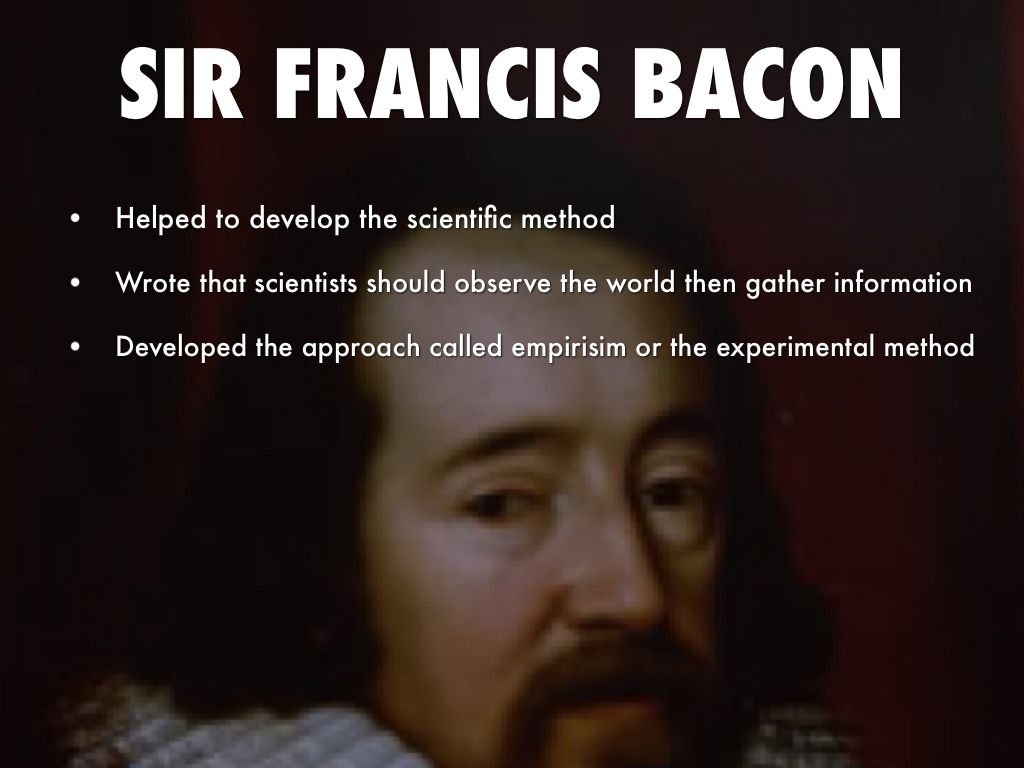
3475b987-6c5d-4699-ba5d-e6008559028f

(The graphic above should say “Empiricism,” not “Empirism.”  Ir is a typo.

Yes, Sir Francis Bacon is at least as interesting and obscure as William Shakespeare.  But let me assure you, I can confidently state, “Shakespeare is NOT Bacon!”  He is not eggs either… or any other breakfast food.  Sir Francis Bacon was the breakfast, the first meal in the great Elizabethan banquet of literature, poetry, and culture.  And William Shakespeare is a more important main course, the royal dinner, as it were.  But it has to be acknowledged that Bacon was essential to the very existence of William Shakespeare.  Breakfast always comes before dinner.

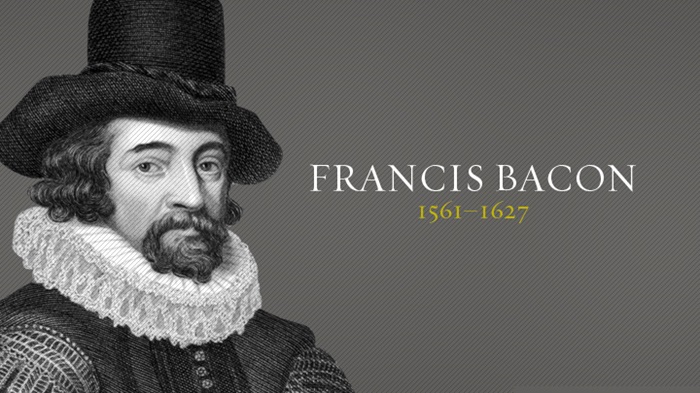
t2ec16dhjgoffvtvhuebslhohksvg-60_35

In 1845 a female author by the name of Delia Bacon (nothing suspicious about that coincidence, by the way) put forward an idea that William Shakespeare’s plays were actually written by a group of men under the leadership of Sir Francis Bacon.  She thought the group intended to inculcate into English culture an advanced system of politics and philosophy which they themselves could not take credit for publicly.  She would later write a book in 1857 called The Philosophy of the Plays of Shakspere Unfolded which advanced the notion that the plays were written for Baconian purposes beyond mere theatrical entertainment.  Numerous people, including the American poet Ralph Waldo Emerson supported her in her quest to find proof, sending her to England to research the crazy conspiracy theories she founded by noting ciphers in the plays, and in the essays of Bacon, that led her to believe all she had to do was dig up the gravestone of Shaksper in the chapel at Stratford to find written proof in Bacon’s own hand that he was, in fact, the author or primary motivator of the plays of William Shakespeare.  She spent one cold and creepy night in the chapel, just her and her spade and her crow bar, along with the bones of the Stratford guy, trying to work up the courage to do a bit of grave-robbing… and failing.    It is a good story, but very poor archaeology.  She was denounced by the literary historians and establishment figures who supported the Stratford guy.  They said her scholarship was sloppy, her cipher analysis goofy and unfounded, and her conclusions more questionable than a pig in theatrical make-up.  (My words, not theirs.  English critic George Henry Townsend was entirely too stuffy and boring to simply be quoted here.)

francis-bacon-quotes-francis-bacon-quotes

Now, I, of course, strongly disagree with the Bacon lady.  As I said in the very title, “Shakespeare is NOT Bacon.”  But I do think there was merit in sniffing out old Frankie’s scent and fingerprints on the whole Shakespeare/Shaksper thing.  The Stratford guy was not Shakespeare either.  When he died in 1616 there was no public outcry at the loss of England’s most popular poet and playwright.  Even King James who was Shakespeare’s number one fan and constant audience member, didn’t mourn the passing of the actor/theater-owner/businessman from Stratford.

Francis Bacon, on the other hand, was a powerful intellect, educated in the ways of science, the law, and government in the Elizabethan age.  Bacon gathered other men of powerful intellect and accomplishment at Gray’s Inn to hold debates about things philosophical and things scientifical.  It is not unreasonable to imagine that the man who really wrote the plays attributed to Shakespeare sat at that table and participated in those debates.  And Sir Frankie had good reason to keep lots of this business a secret.  There exists evidence that though he was apparently happily married to a fourteen-year-old girl, he did a little bit of swaying toward the other gender too, a thing not too popular with the average Anglican Englishman.  He also dabbled a bit in the occult (think witches in Macbeth sort of thing).   And his essays indicate a strong correlation to the philosophies and ideals of the German Rosicrucian Movement.  In 1593 during a Roman Catholic plot against Queen Elizabeth, Frankie managed to take a position on the investigation that totally offended the old virgin queen.  He was on the outs with Liz for the rest of her difficult and anger-management-challenged life.  He did rise to prominence under her successor, James I, but never-the-less managed to die amidst total ruin and scandal.  There is a lot in Frankie’s life to indicate that he had a direct influence on the content of Shakespeare’s plays.  Some of the characters in the plays may actually be, at least in part, based on Frankie himself.  But  this guy never hung out with the Stratford guy that anyone knows of.

So, if Shakespeare is NOT Bacon, or eggs either… and the Stratford guy isn’t Shakespeare, then who is?  Come on!  You knew I had a lot more to say about this crazy conspiracy thing, right?

67489

Leave a comment

Filed under conspiracy theory, education, foolishness, goofy thoughts, humor, philosophy, strange and wonderful ideas about life, William Shakespeare

The Man From Stratford-upon-Avon

c360_2017-01-13-19-11-50-170

I am, unfortunately, a dedicated conspiracy theorist.  No, not the braying, unintelligent kind like Alex Jones who has an unhinged and hidden agenda.  More the Indiana Jones kind, seeking the truth no matter where it leads, but always relying on research, science, and creative methods of re-framing the facts in order to reveal truths that other people don’t see even when the answers are right in front of them.

An example of this is my firm belief that everything we think we know about the man known as William Shakespeare is based on an ages-old deception and is basically an unrevealed lie.

Of course, I am not the only literature-obsessed kook who has ever taken up this notion of someone else having written the great works of Shakespeare.  I share the opinion with Ralph Waldo Emerson, Nathaniel Hawthorn, Walt Whitman, Prime Minister Benjamin Disraeli, Charles Dickens, Actor Derek Jacobi, and the great Mark Twain (also not the writer’s real name) .

slide_2-1
It is very possible the standard details of the life of William Shakespeare have been fudged just a bit… or maybe quite a lot.

The biggest question that I can see when looking at the man we pretend is the actual author of the plays, is why doesn’t this man look like an author?  As brought out in the video, the only example we have of the author’s own handwriting are six signatures from legal documents, three of which come from his last will and testament.  And if the name is really William Shakespeare, then the Stratford man misspelled his own name.  He wrote it as Shakspere or Shaksper.  And the handwriting is atrocious, nothing like the carefully practice signature I sometimes put on my own handwritten work.  How does that happen?  I have seen signatures by many other authors, both famous and obscure, and nowhere do I see such careless script as what is allegedly the signature of the greatest and most acclaimed writer who ever lived.

The accepted life story of Shaksper doesn’t bear up under scrutiny either.  In spite of being a wealthy businessman and mayor, his father can be seen to be provably illiterate, relying on associates and underlings to write the paperwork involved in his business and mayoral rule.  There is no proof in the form of enrollment lists or written record of Shaksper having ever enrolled at or attended the school that supposedly taught Stratfordian youths to read and write.  His wife and children and grandchildren were also provably illiterate.  What other writer has such a lack of effect on his own family?

And Shaksper’s will details everything he owned and left to others at his death.  Nowhere is there a mention of plays, manuscripts, poetry, or even books.  The greatest author who ever lived owned no books at all?  He was provably wealthy enough to buy books, and public libraries did not exist back then.  How then did he demonstrate such knowledge of Ovid’s Metamorphosis, as well as the functioning of royal courts both in England and abroad?  How did he get so many details right about places in Italy and Europe which he had never visited or seen with his own eyes?  Something is definitely missing.

It is true that everything mentioned is merely circumstantial evidence.  And yet, if all circumstantial evidence leans in only one direction, then isn’t the conclusion probably sound?

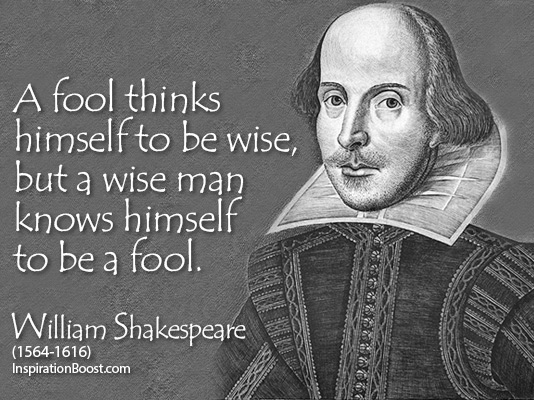
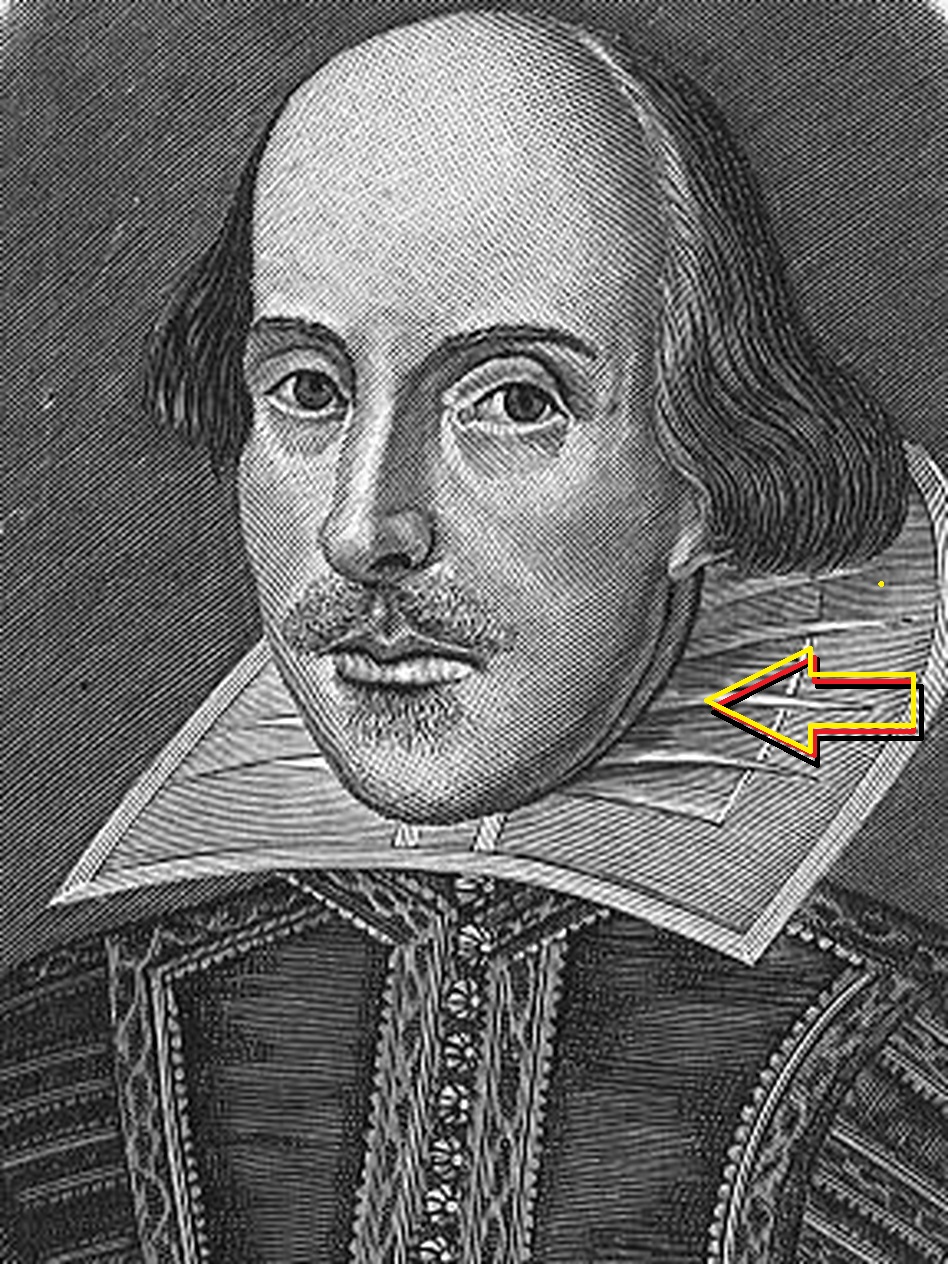
shakespeare
Do you not see the lines of the mask in this portrait?

But if Shaksper, the Stratford man, did not write the masterful literary works he has been given credit for, then who did?  And why did he let the credit go to someone else?

Ah, I am betting you are beginning to smell a multi-part essay brewing.  I mean to tell you who I think is under the mask, who it was I believe actually wrote under the pen name of William Shakespeare.


Leave a comment

Filed under conspiracy theory, goofy thoughts, humor, Paffooney, strange and wonderful ideas about life, William Shakespeare