In Dungeons and Dragons games you are trying to bring characters to imaginary life by getting into their deformed, powerful, or magic-filled heads and walking around in a very dangerous imaginary world. You have to be them. You have to think like them and talk like them. You have to love what they love, decide what they do, and live and die for them. They become real people to you. Well… as real as imaginary people can ever become.
But there are actually two distinct types of characters.
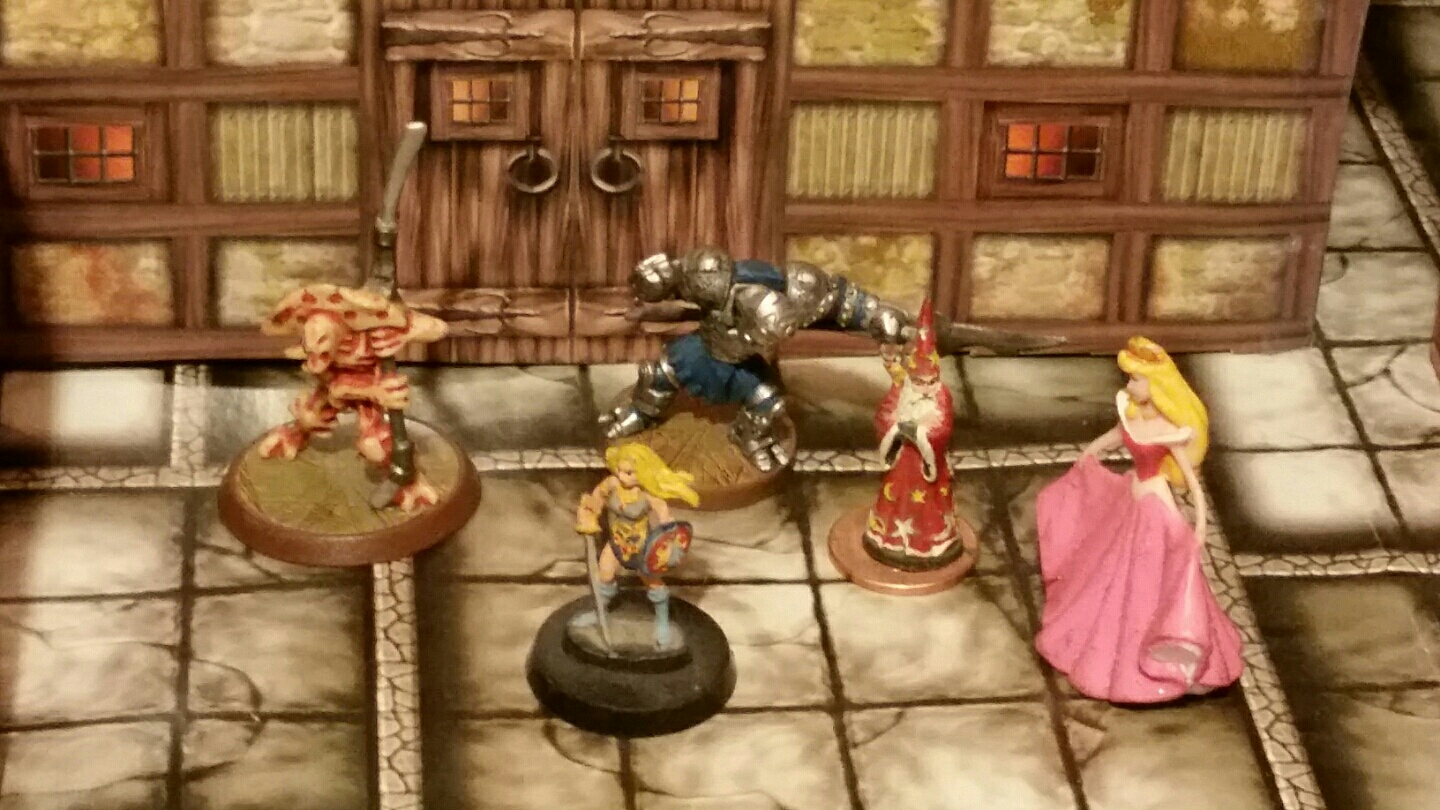
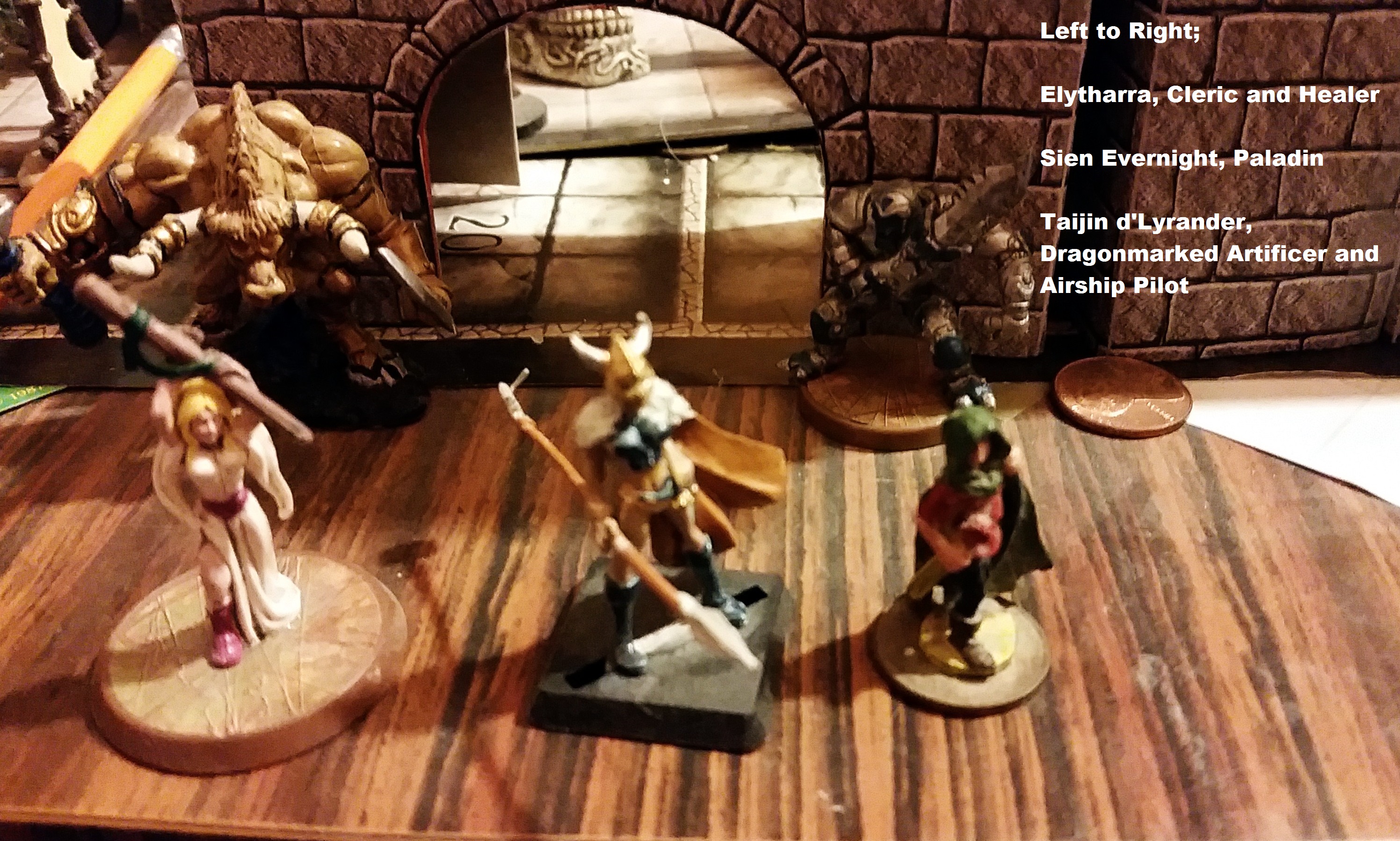
These, remember, are the Player Characters. My two sons and my daughter provide them with their persona, personality, and personhood. They are the primary actors in the stage play in the theater of the mind which is D & D.
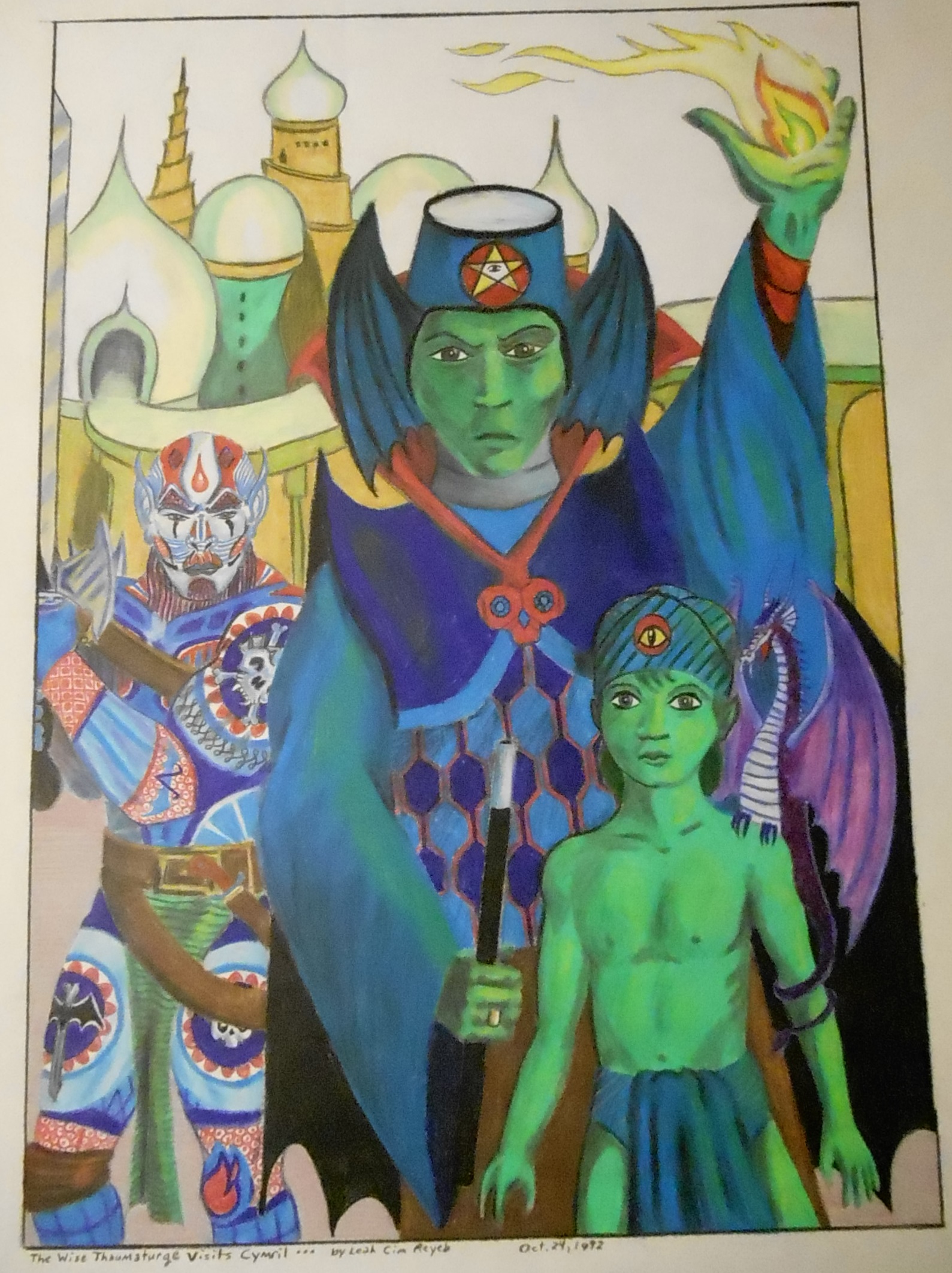
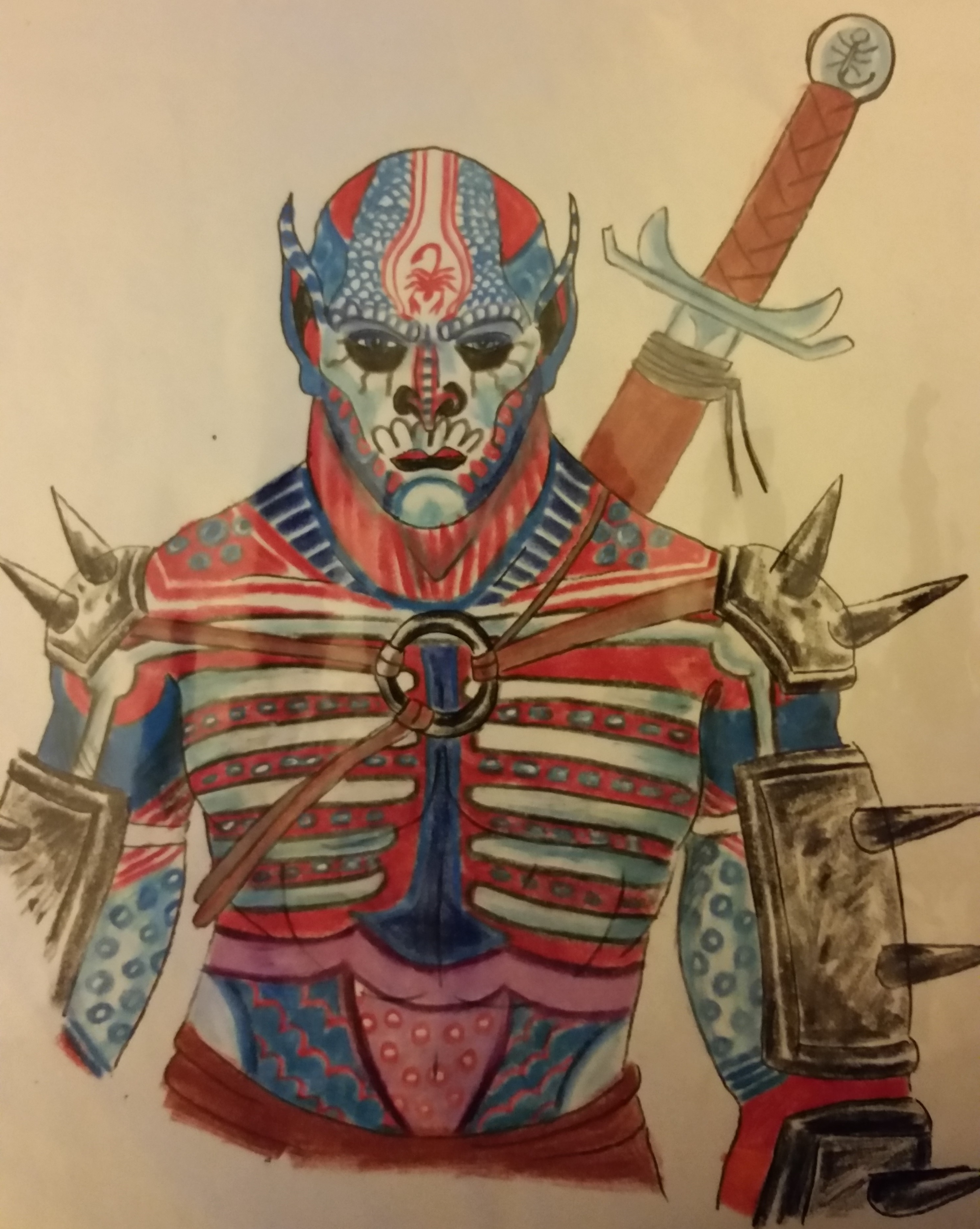
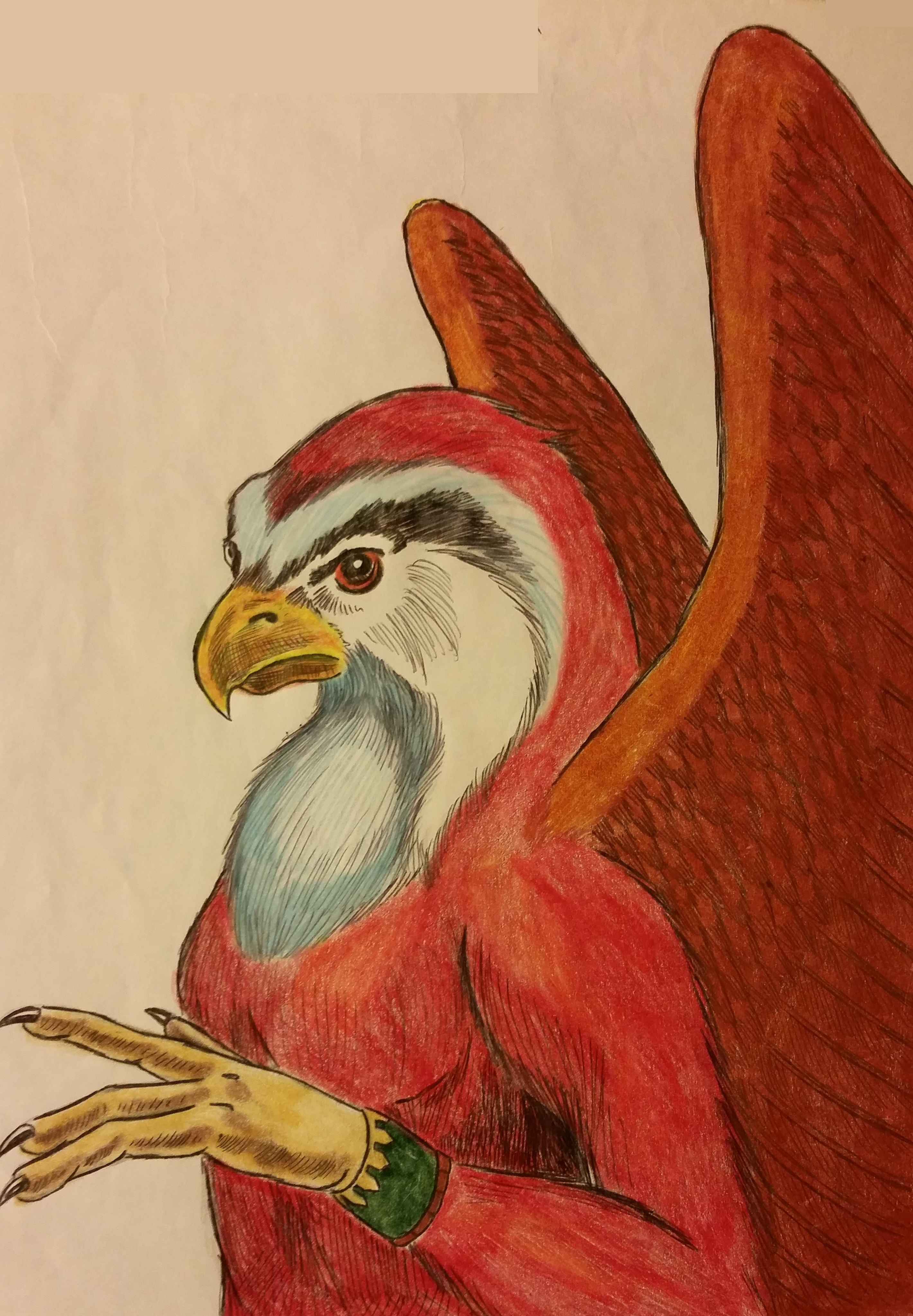
But there are other characters too. In fact, a whole complex magical world full of other characters. And as the Dungeon Master, I am the one who steps into their weird and wacky imaginary skins to walk around and be them at least until the Player Characters decide to fireball them, abandon them to hungry trolls, or bonk them on the top of their little horned heads. I get to inhabit an entire zoo of strange and wonderful creatures and people.
Besides the fact that these Non-Player Characters can easily lead you to develop multiple personality disorder, they are useful in telling the story in many different ways. Some are friendly characters that may even become trusted travel companions for the Player Characters.
D & D has a battle system based on controlling the outcomes of the roll of the dice with complex math and gained experience. In simpler terms, there is a lot of bloody whacking with swords and axes that has to take place. You need characters like that both to help you whack your enemies and to be the enemies you get to whack. There is a certain joy to solving your problems with mindless whacking with a sword. And yet, the story is helped when the sword-whackers begin to develop personalities.
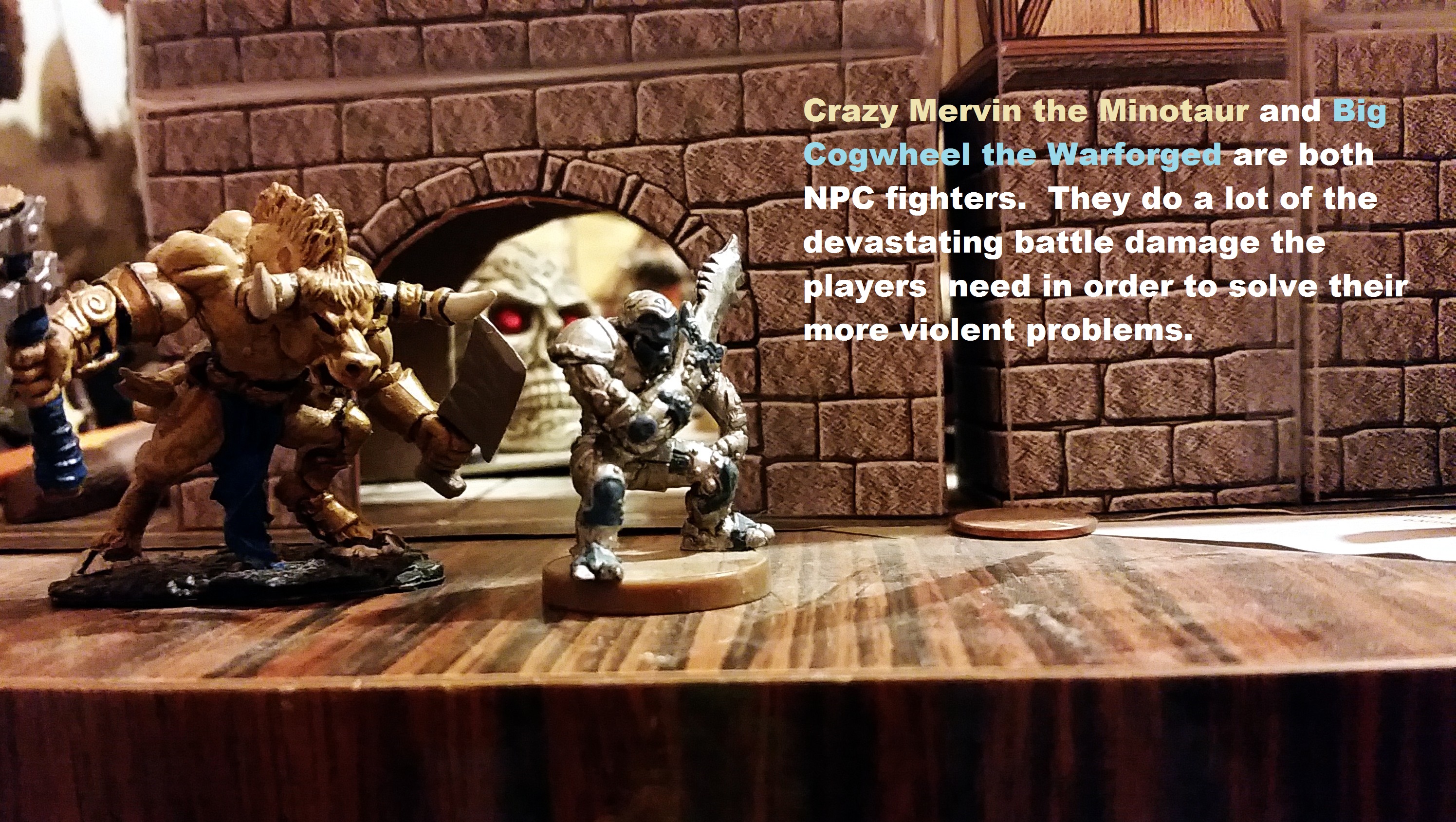
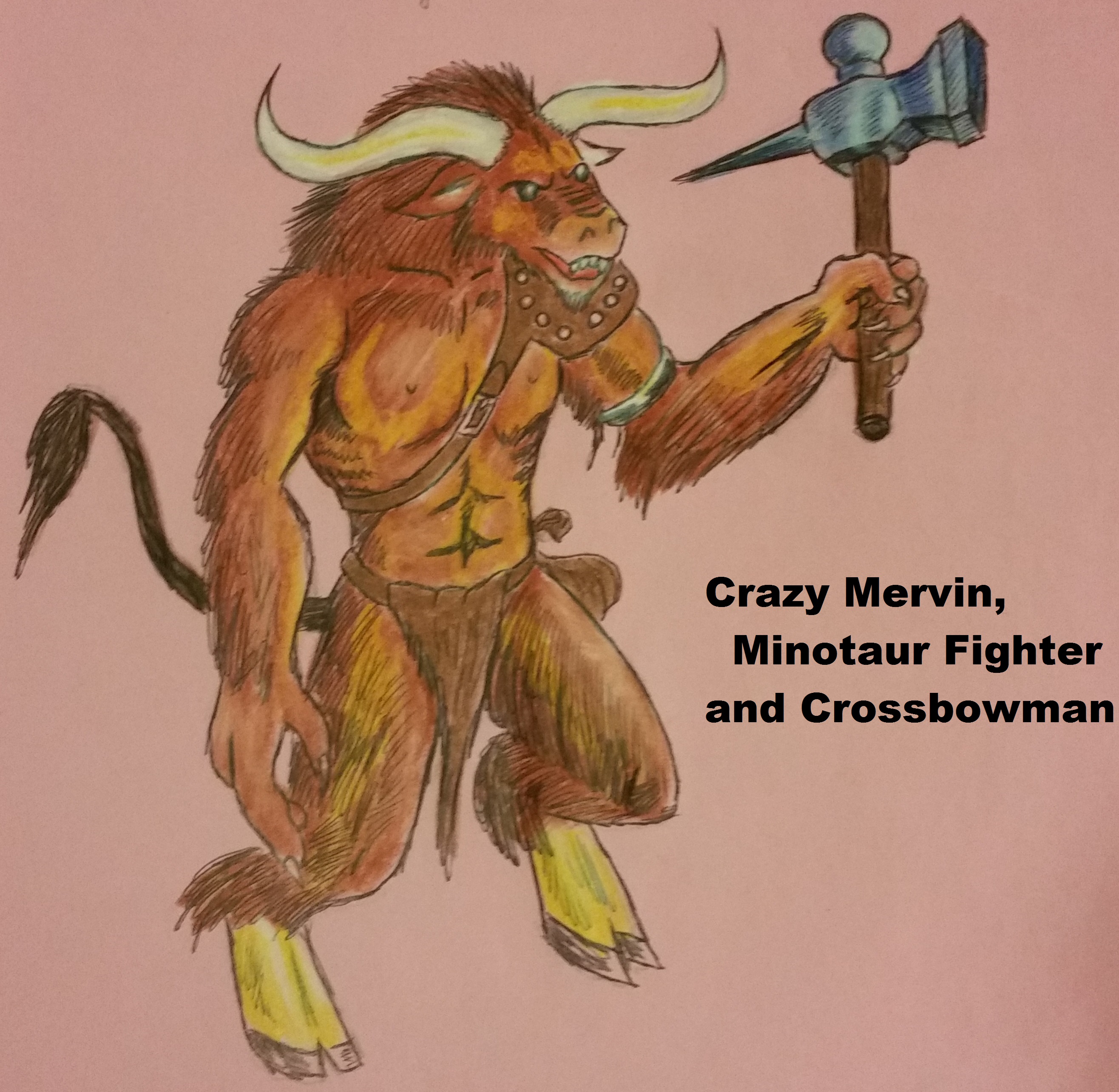
Crazy Mervin, for example, began life as a whackable monster that could easily have been murdered by the Player Characters in passing while they were battling the evil shape-changing Emerald Claw leader, Brother Garrow.
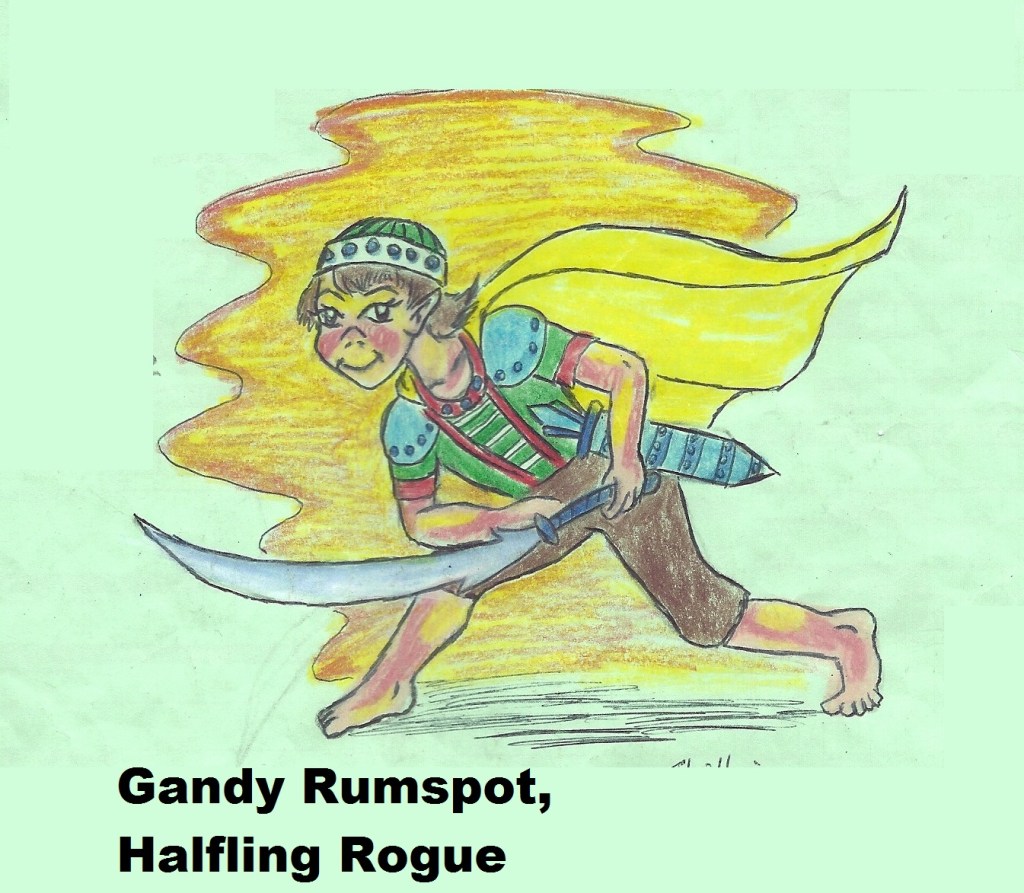
But Gandy befriended him and turned him from the evil side by feeding him and sparing him when it really counted. He became a massively powerful ax-whacker for good because Gandy got on his good side. And stupid creatures like Mervin possess simple loyalties. He helped the players escape the Dark Continent of Xendrick with their lives and is now relied upon heavily to help with combat. He was one of the leaders of the charge on the gate when the Players conquered the enthralled Castle Evernight.
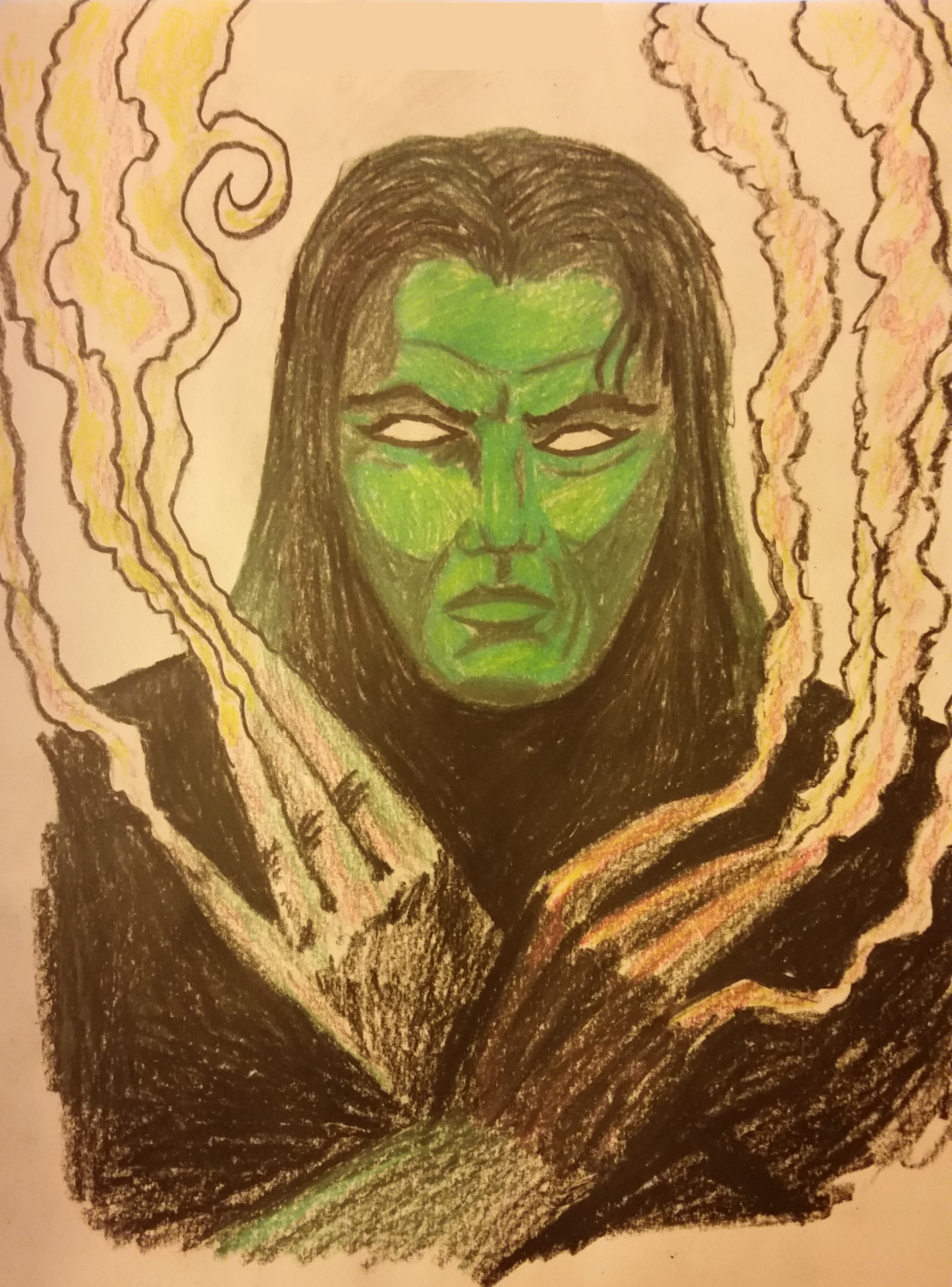
Not every NPC is a whackable monster, however. In the early stages of the campaign the Players needed a magic-user who could read magic writing, use detection spells and shielding spells and magic missiles, and eventually lob fireballs on the bigger problems… like dragons.
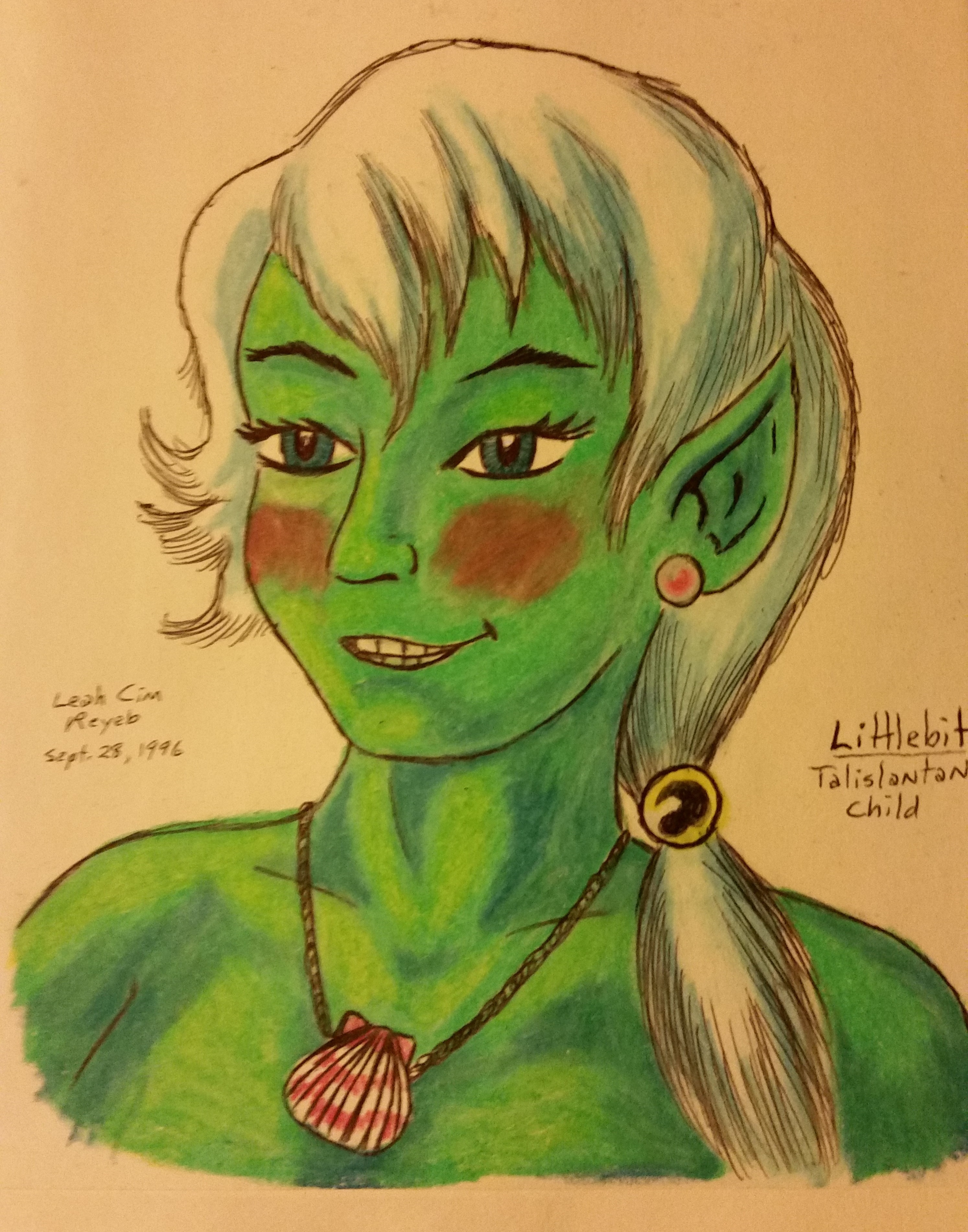
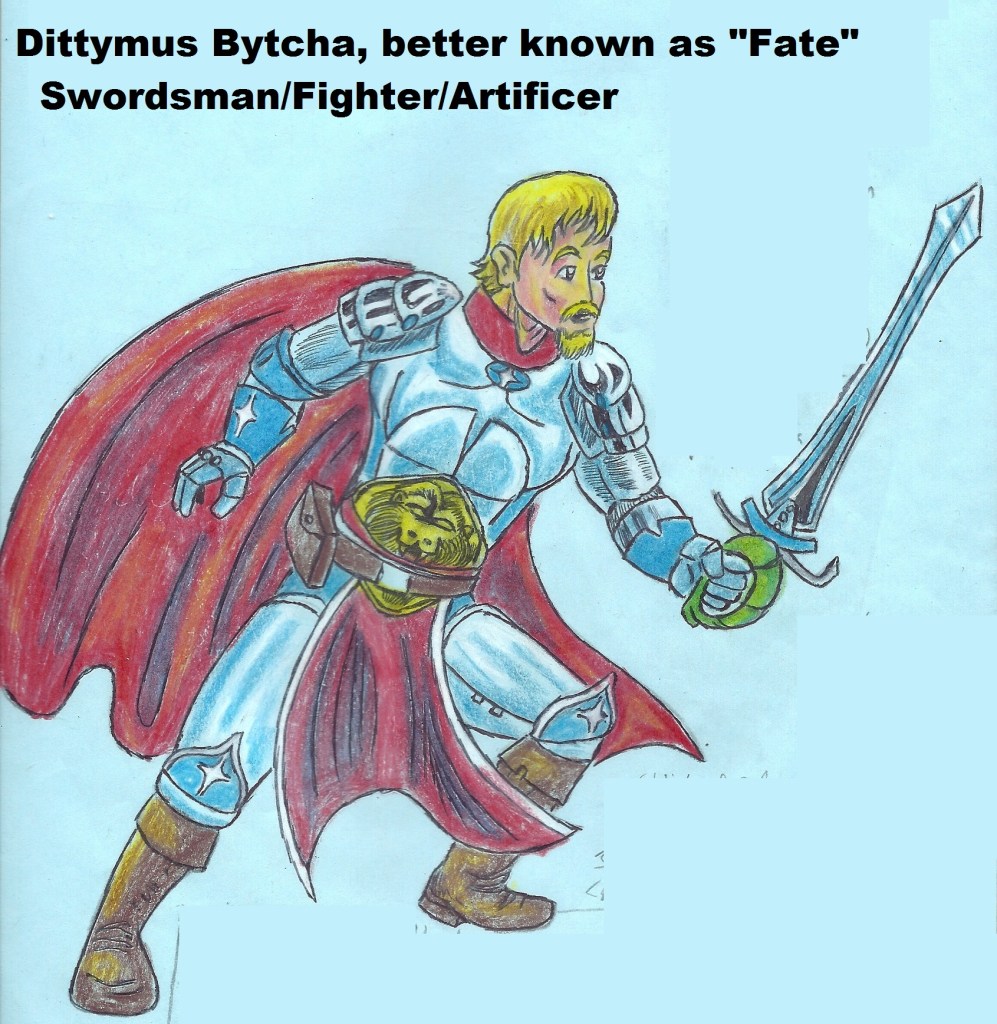
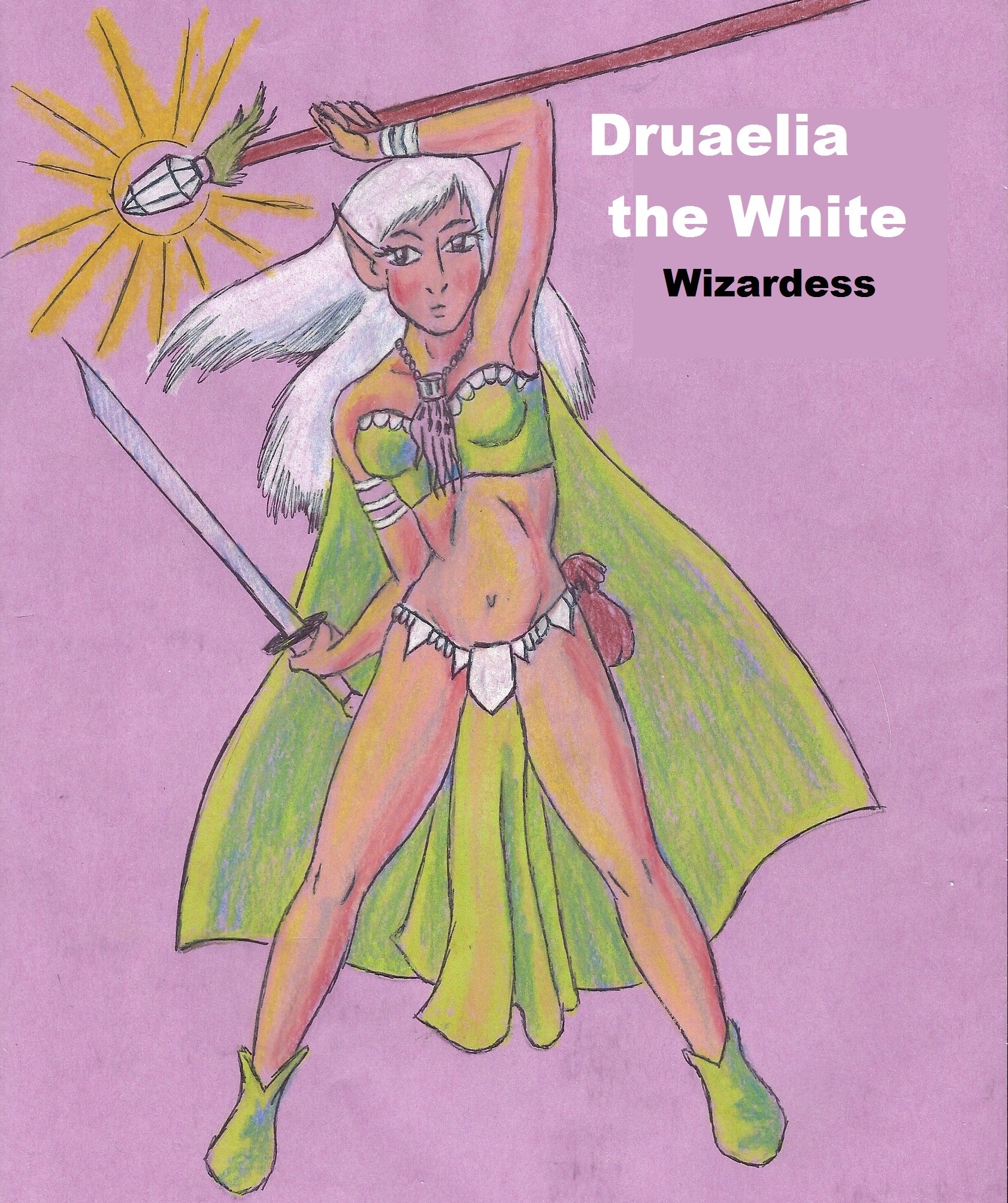
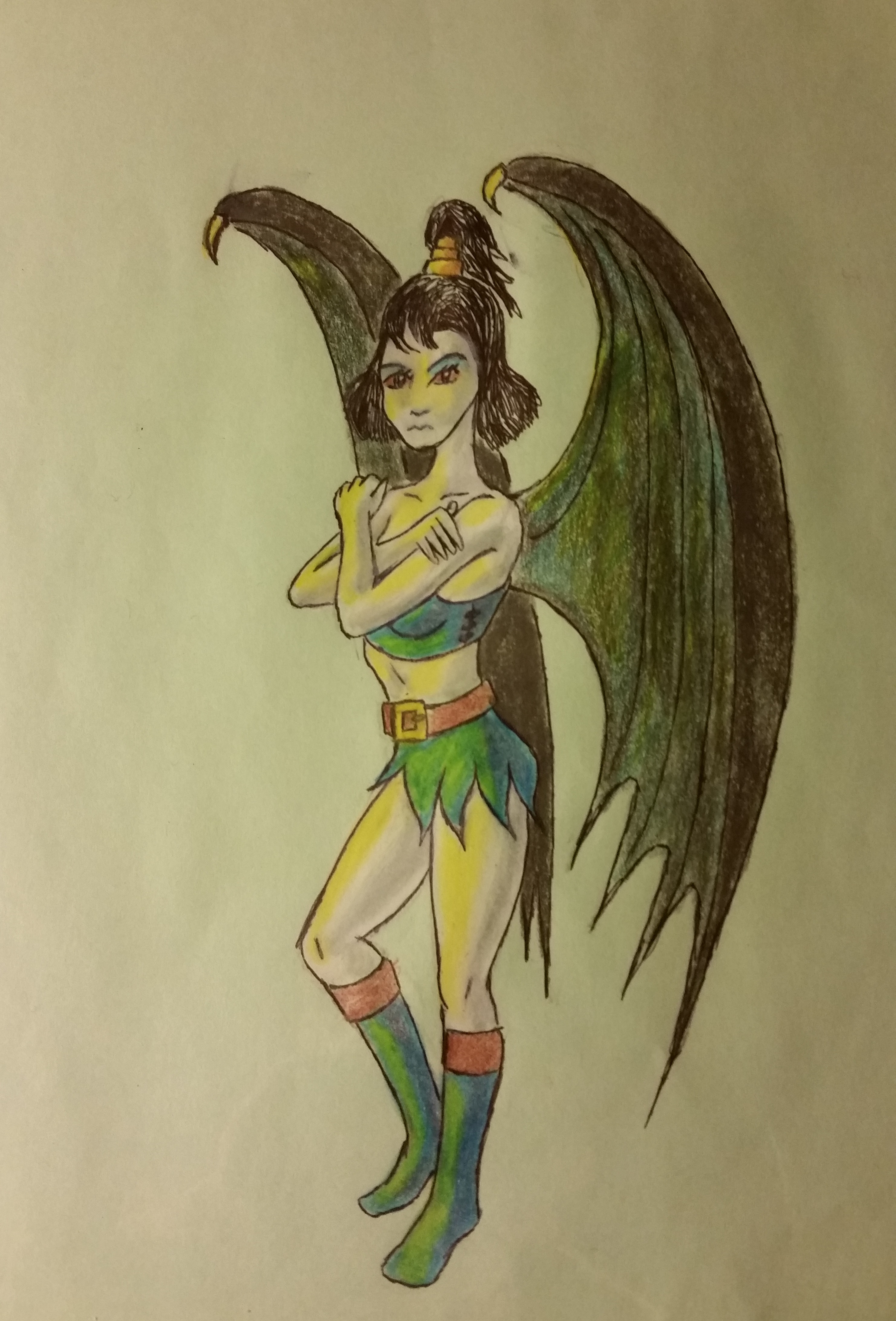
Druaelia was the wizard I chose to give the group of heroes to fulfill these magical tasks. Every D & D campaign requires wizarding somewhere along the way. And Dru was a complex character from the start. Her fire spells often went awry. When Fate used a magic flaming crossbow bolt to sink a ship he was defending, killing the good guys right along with the bad guys, it was with a magic crossbow bolt crafted by Druaelia. Her fire spells went nuclear-bad more than once. She had to learn along the way that her magical abilities tended more towards ice and snow than fire. She learned to become a powerful wielder of cold powers. And while she was comfortable in a bikini-like dress that drove the boys wild because she grew to love the cold, she didn’t particularly like the attentions of men and male creatures that went along with that. More than one random bandit or bad guy learned the hard way not leer at Dru. There are just certain parts of the anatomy you really don’t want frozen.
The Player Characters will need all sorts of help along the way, through travels and adventures and dangerous situations. They will meet and need to make use of many different people and creatures. And as Dungeon Master I try hard to make the stories lean more towards solving the problems of the story with means other than mere whacking with swords. Sometimes that need for help from others can even lead you into more trouble.
But as I am now nearing the 800 word mark on a 500 word essay, I will have to draw it all to a close. There is a lot more to say about NPC’s from our game. They are all me and probably are proof of impending insanity. But maybe I will tell you about that the next time we sit down together at the D & D table.
In the early 90’s, a fellow teacher became acutely aware of the effect the role-playing games I was playing at home after school had on the cognitive abilities of the fatherless boys I was constantly entertaining. She suggested that maybe, if it was working at home with a few students and former students, it could also work in the classroom with all students.
This, of course, was a daunting classroom activity to carry out, but enough of a creative challenge to my story telling abilities that I simply had to try.
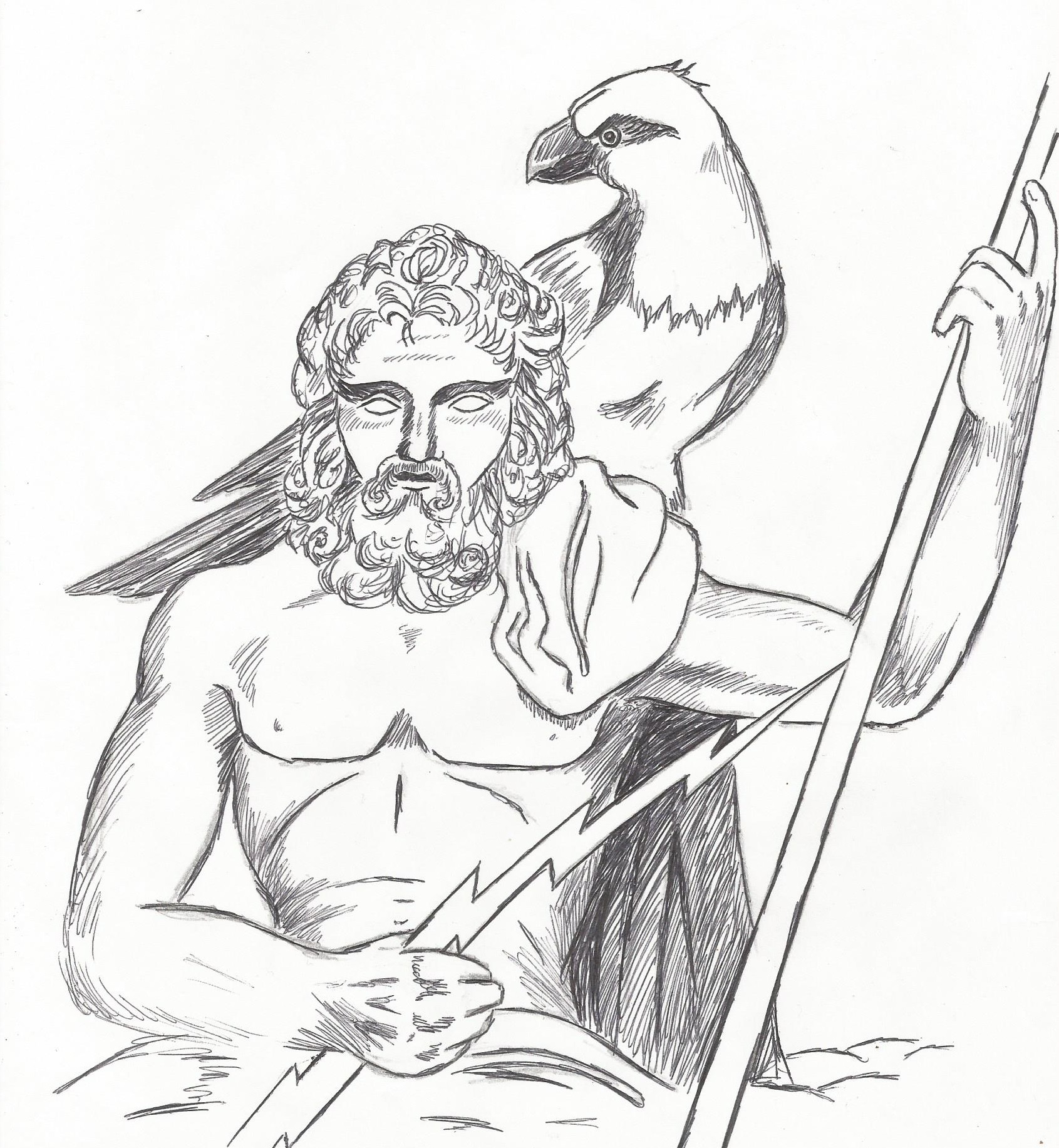
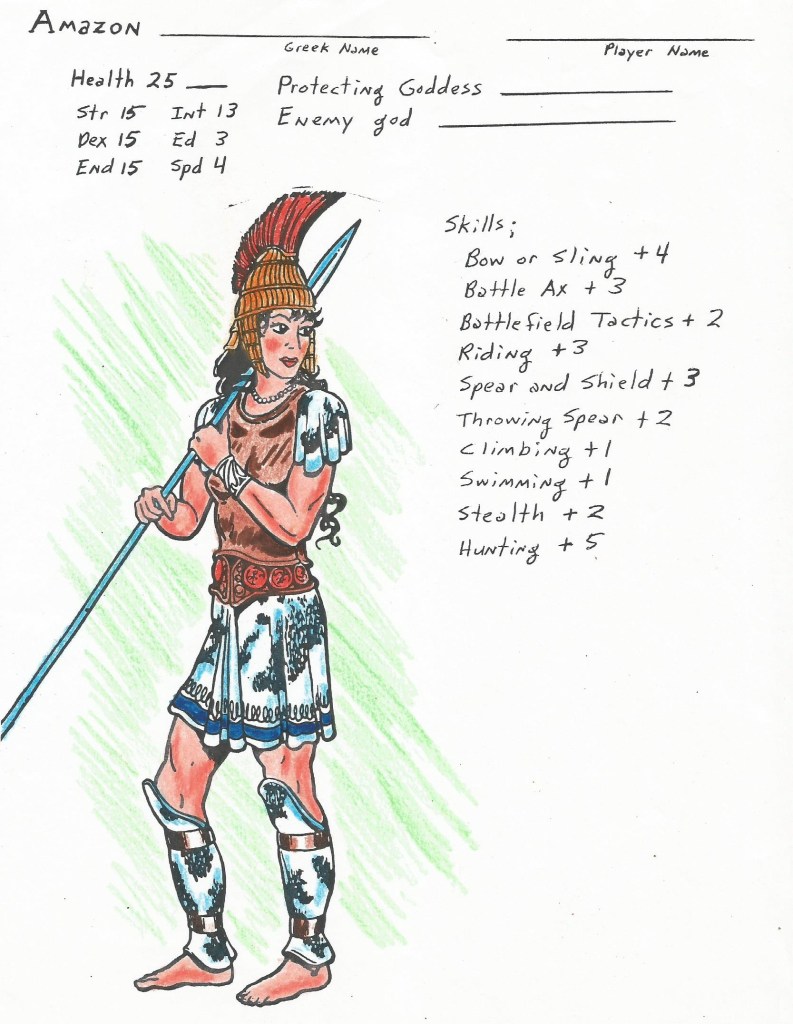
I began with a cheap RPG book about adventuring D&D style with characters from Greek Myth. This was an opportunity not only to play adventure games, but to teach a little bit about history and a lot about mythology.
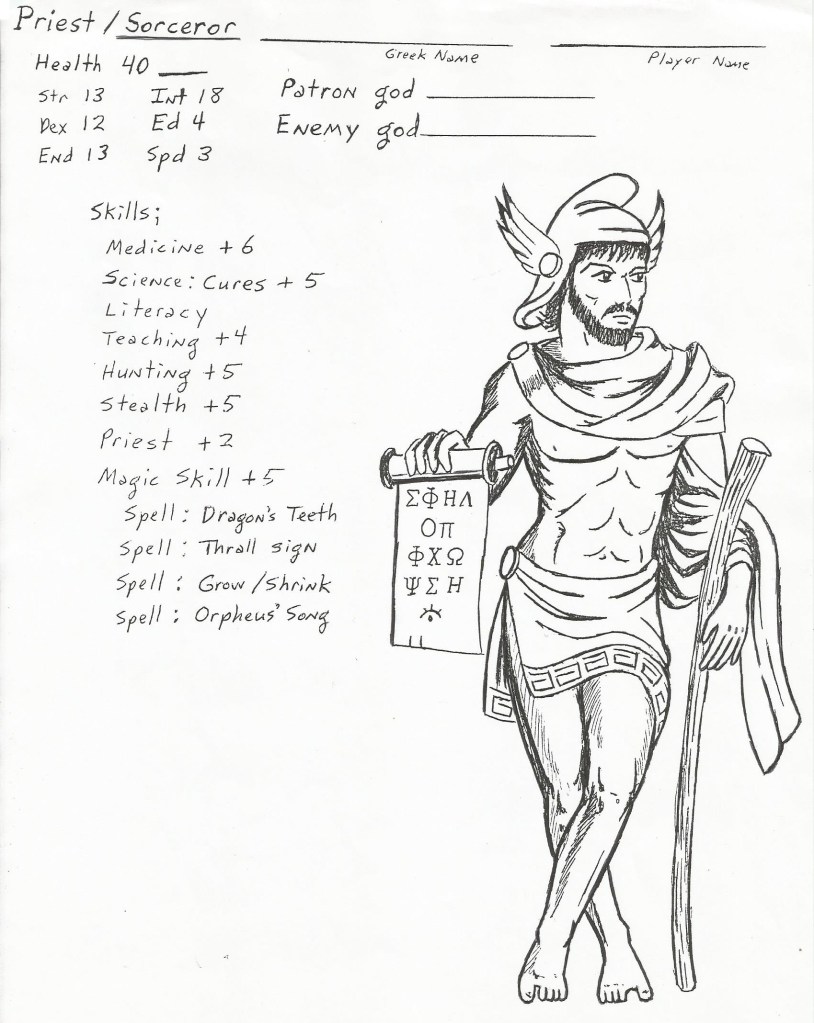
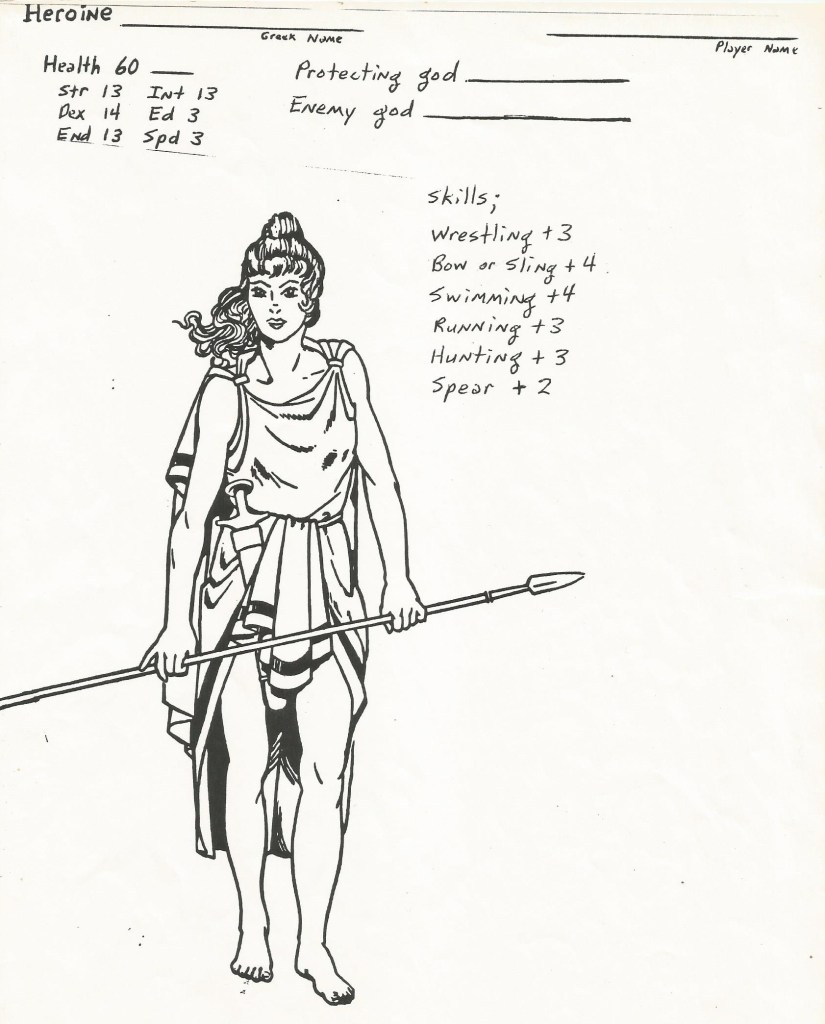
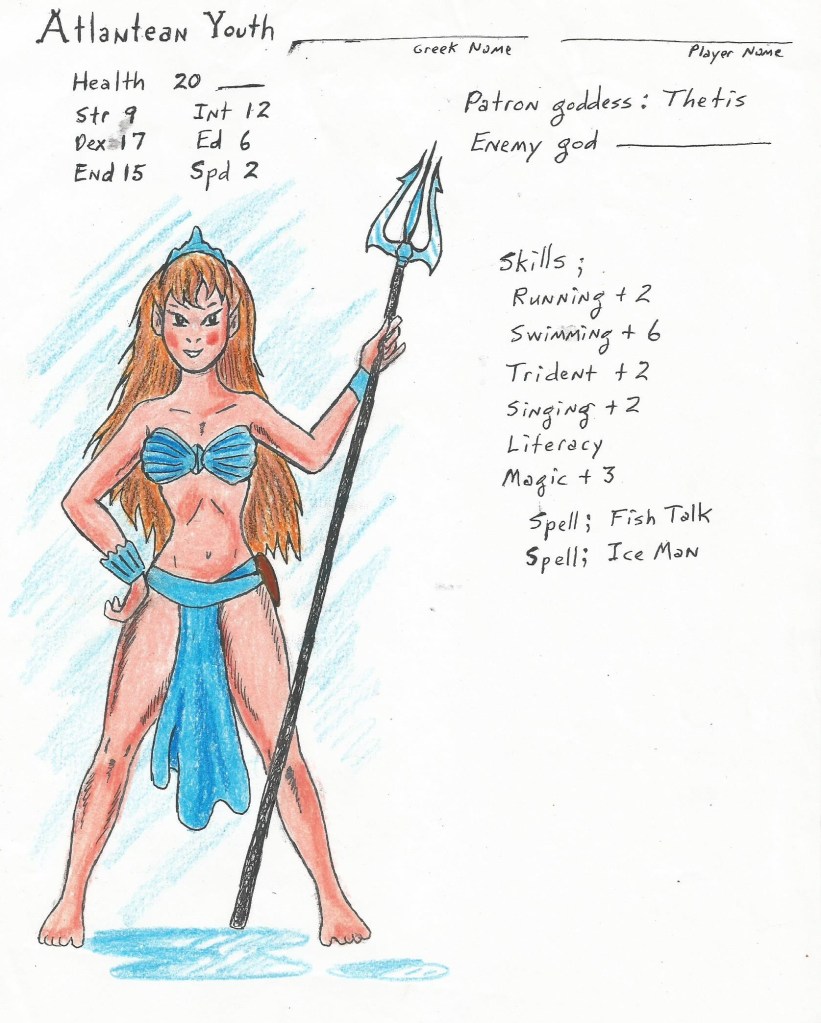
So I created generic character sheets using my own personal copier, my own copy paper, and my own overhead projector plastic overlays.
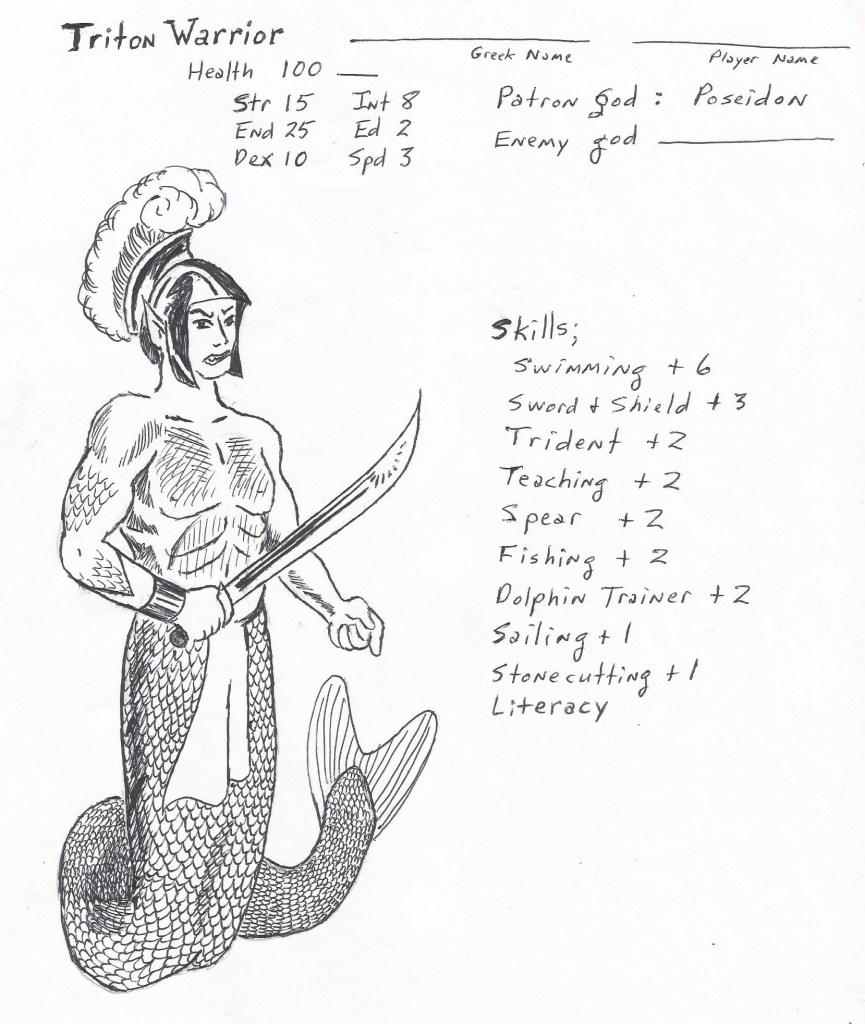
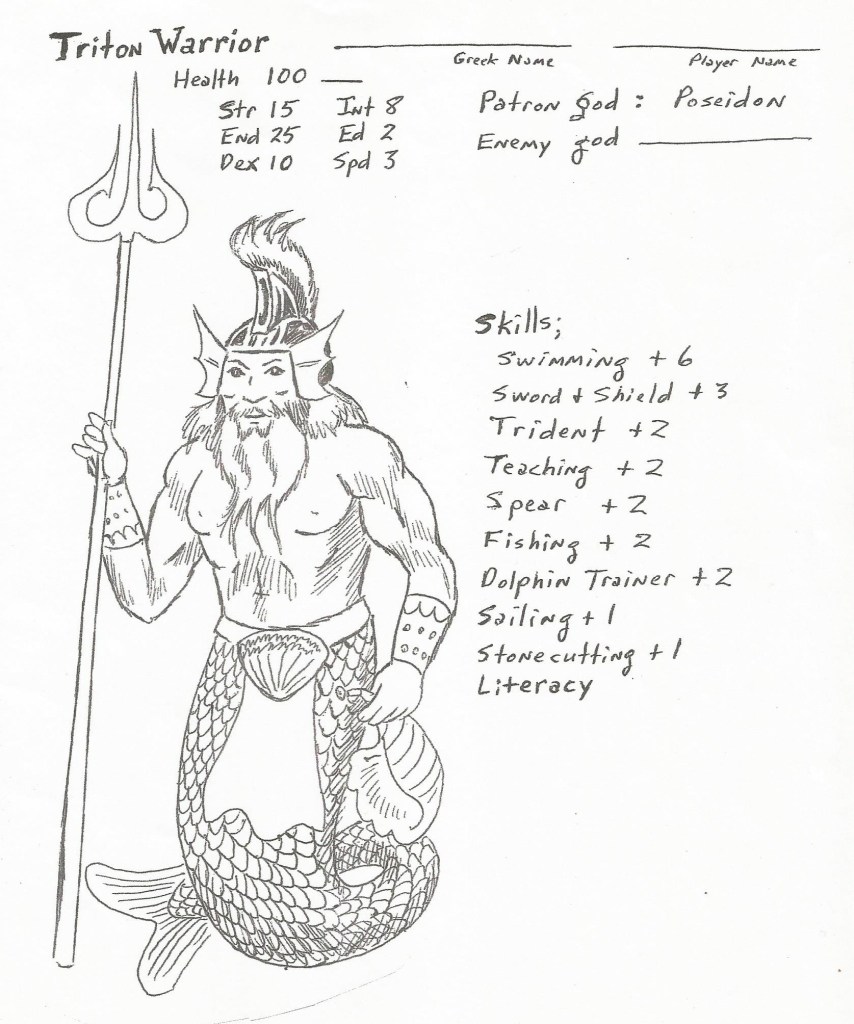
I created adventures that could be conducted on the overhead with dice, and each kid had their own set of skills and useful items. We conducted Olympic games and included mythological creatures like Tritons and Centaurs as player characters. We learned about the city of Olympia, the city of Argos, the city of Corinth, Athens, Sparta, and even Atlantis.
I let students draw their character from a hat on strips of paper that contained a boy option and a girl option. I even let students trade for the character they wanted, and we learned negotiating skills along with problem-solving skills.
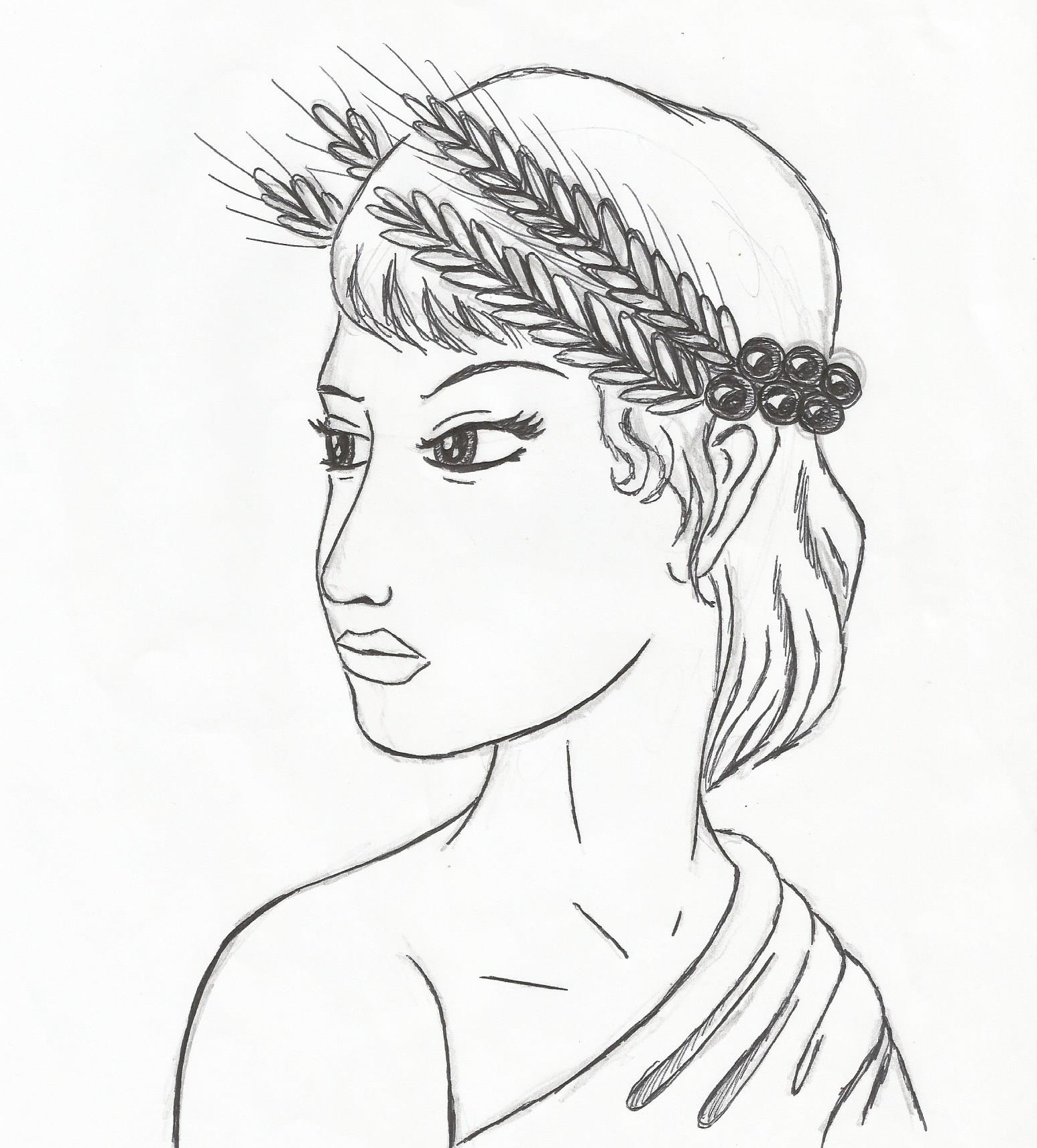
Demeter, goddess of fertility (which you can’t say in a junior high classroom, so goddess of crops and farming)
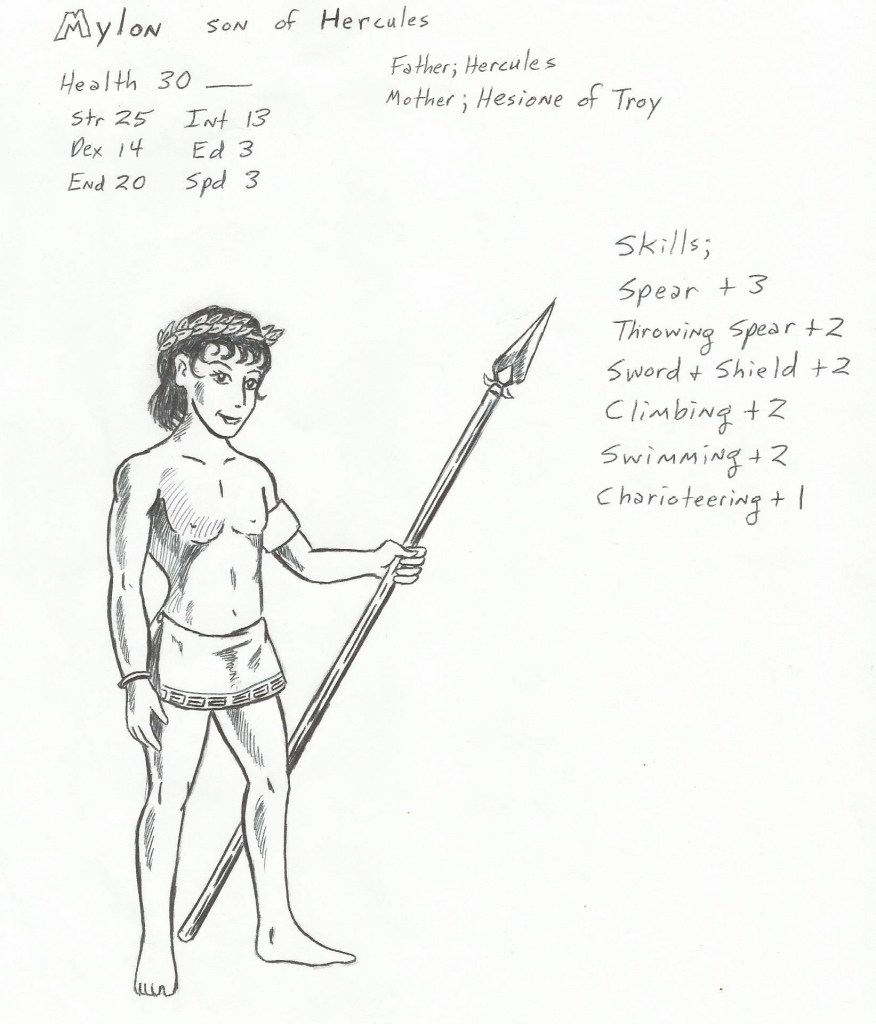
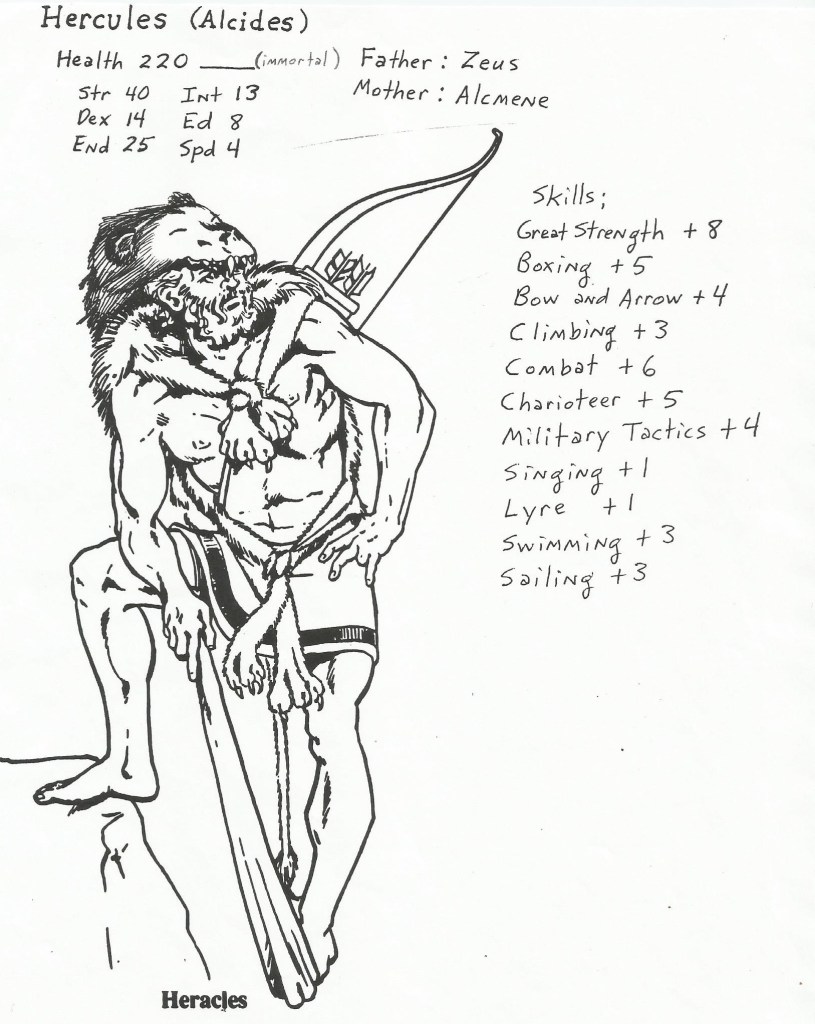
Most of the stories were driven by a kidnapping where the beautiful daughter of one of the players was kidnapped immediately after the Olympic medals were awarded. The villain would take her to his evil island base, and the players would have to work together to buy or steal a boat. Gods and goddesses could be called on to intervene, and sometimes they actually did. Another storyline began with the sack of Troy, during which the players either murder or witness the death of a young Trojan boy who just happens to be Heracles’ son.
That story took the players on a quest of penance to visit the underworld and retrieve the boy in the same way that Orpheus tried to rescue his lady love, Eurydice. Potentially, Heracles would even join the quest himself if none of the player characters were the actual killer. And, of course, all sorts of encounters with monsters would ensue.
I ended up using about as many of my personal resources as a storyteller and a cartoonist to create those adventures as I had available. But I had students tell me that the week of classroom time spent playing that problem-solving myth game was one of the most memorable learning experiences they ever had. I never tried it with a high school class, only middle school, and then mostly with 7th graders. But I think the experiment was very successful from about 1992 to 2004, and it taught me even more about teaching than it ever taught them about mythology.
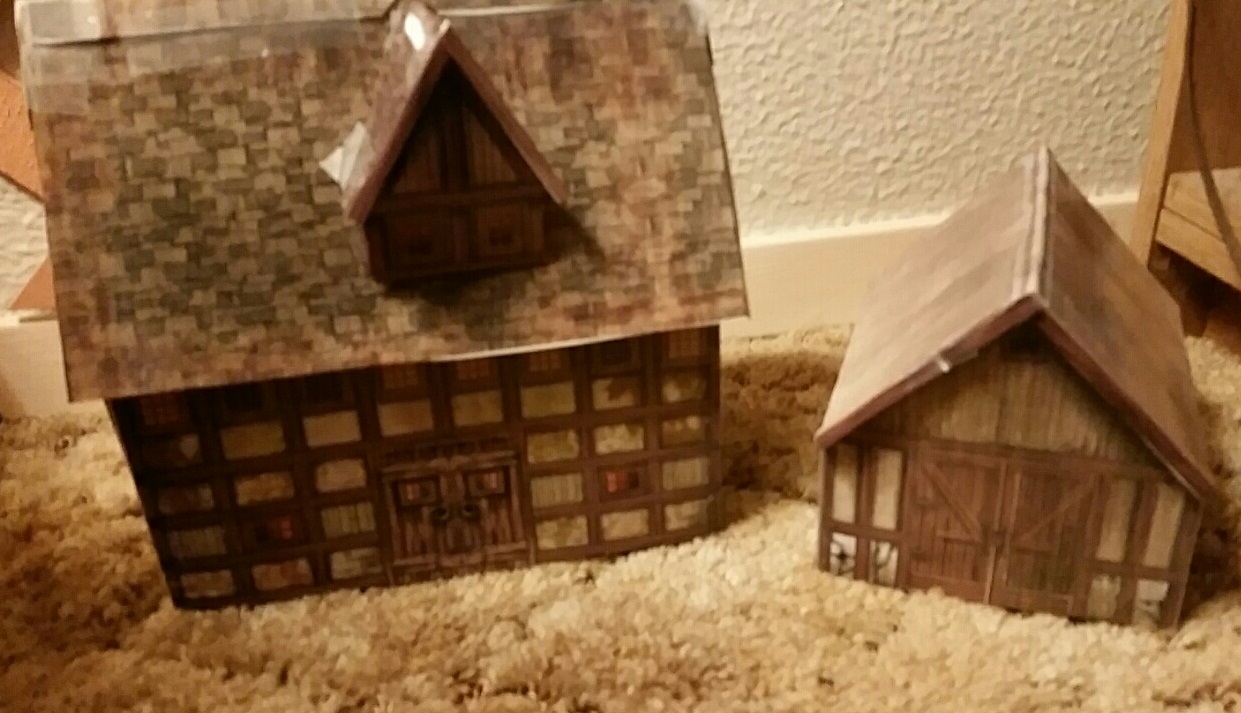
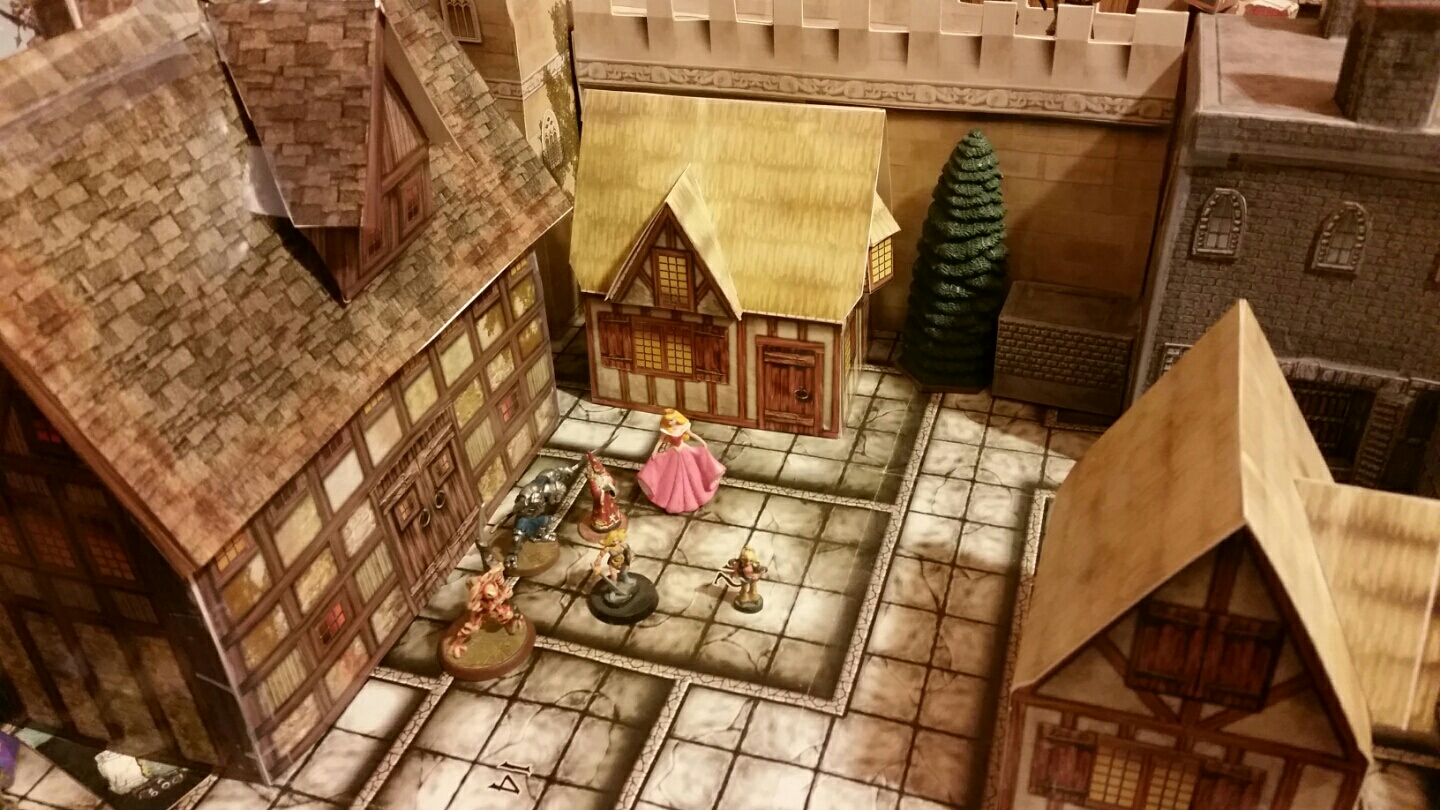
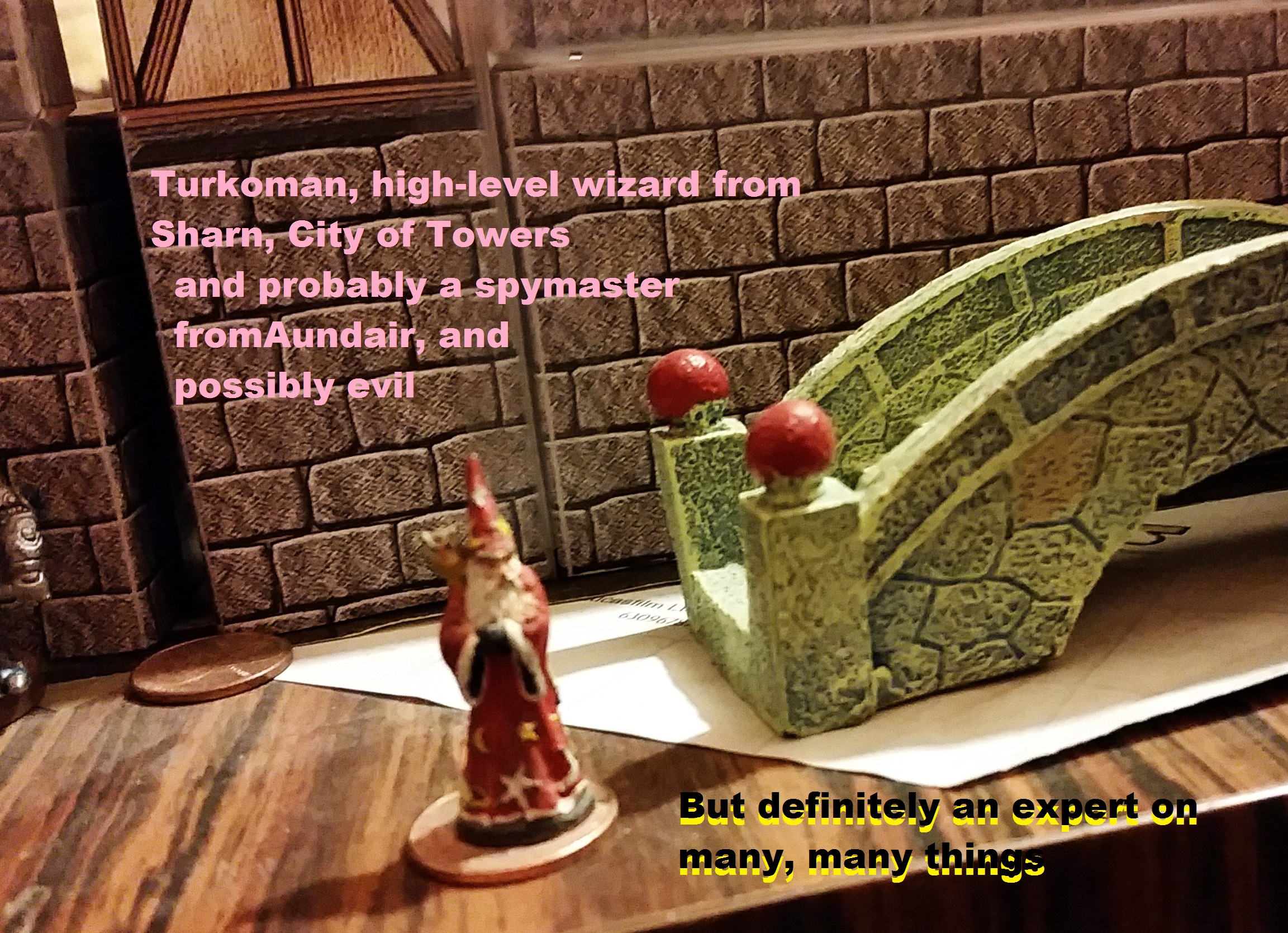
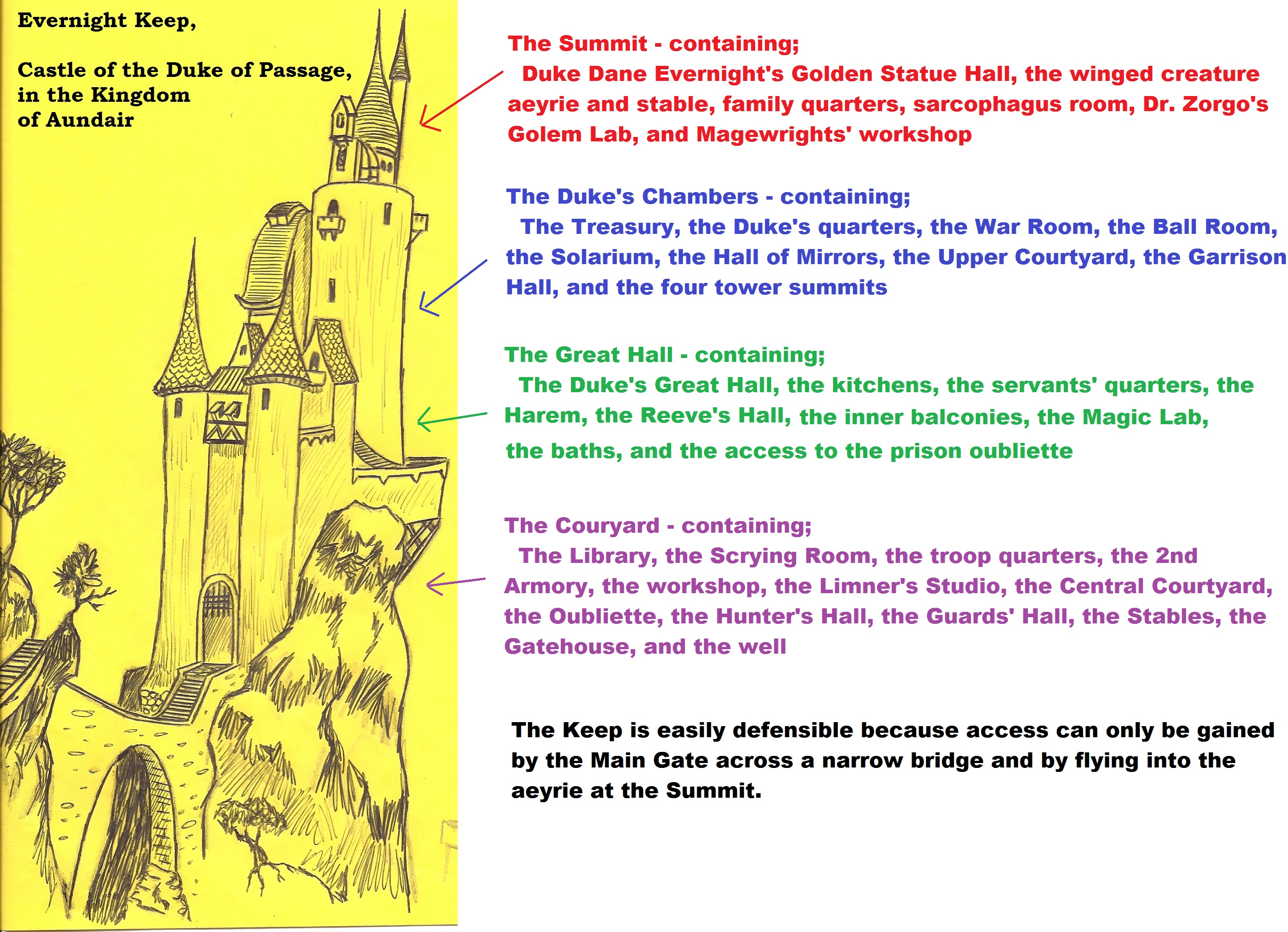
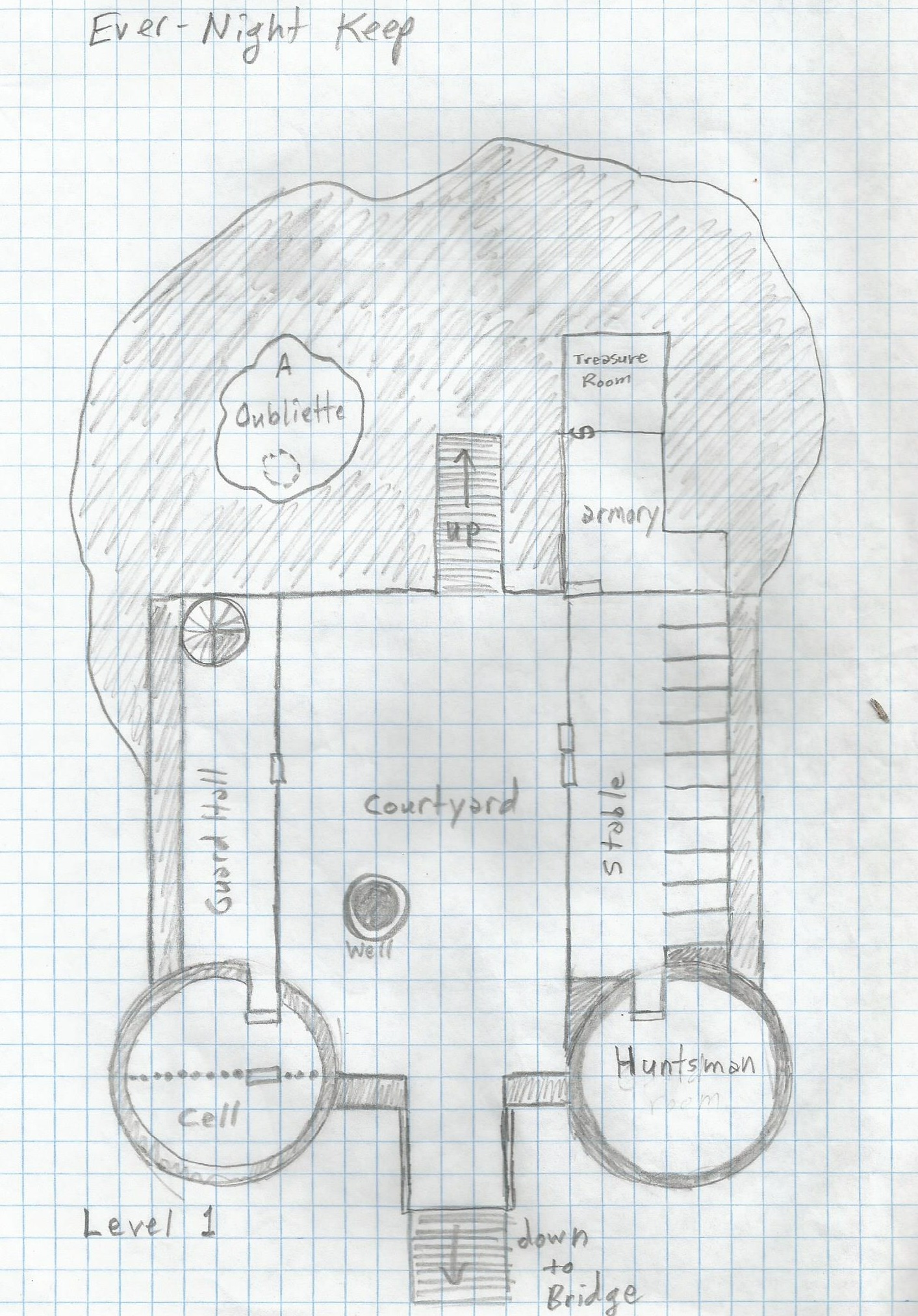
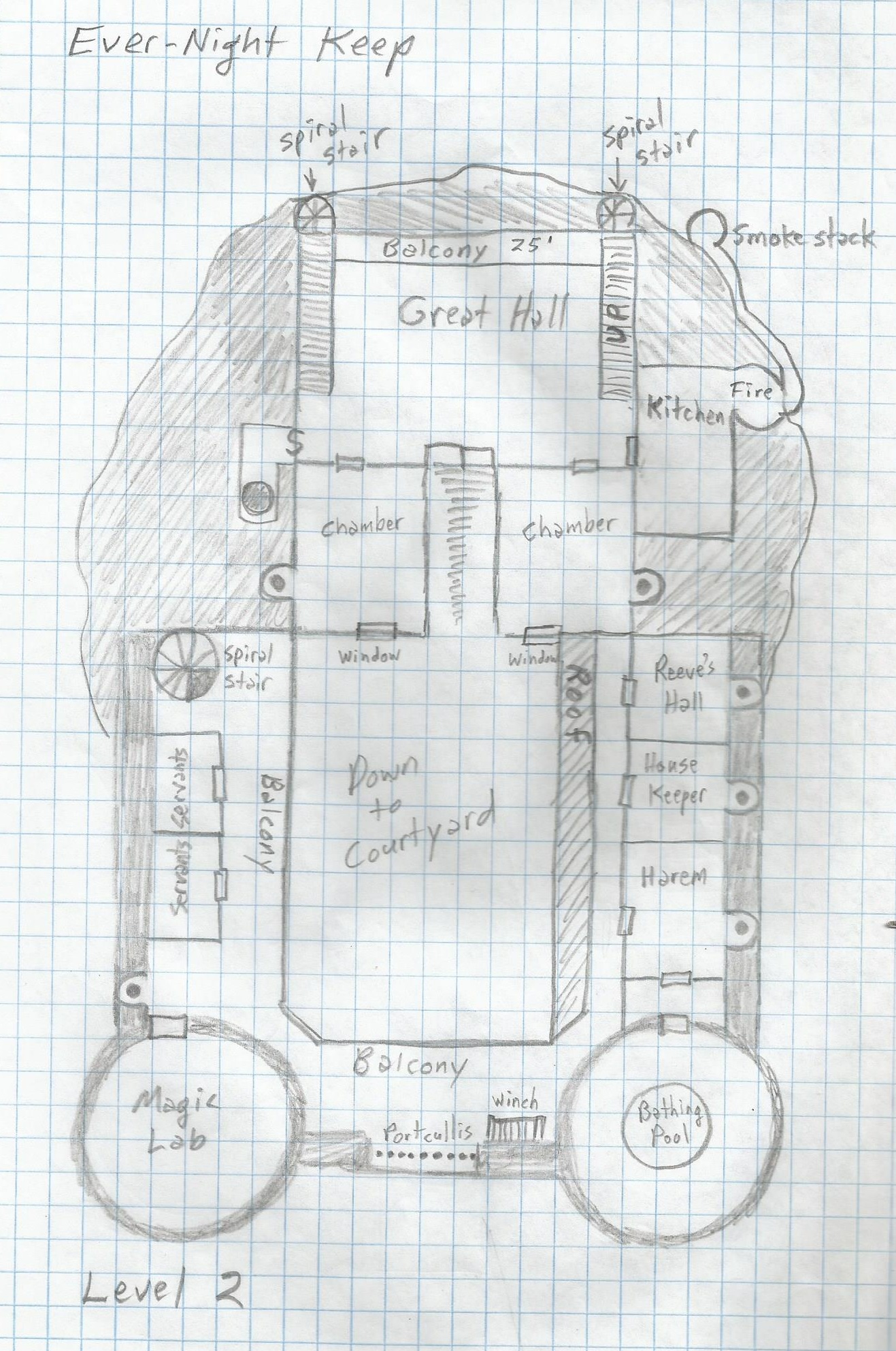
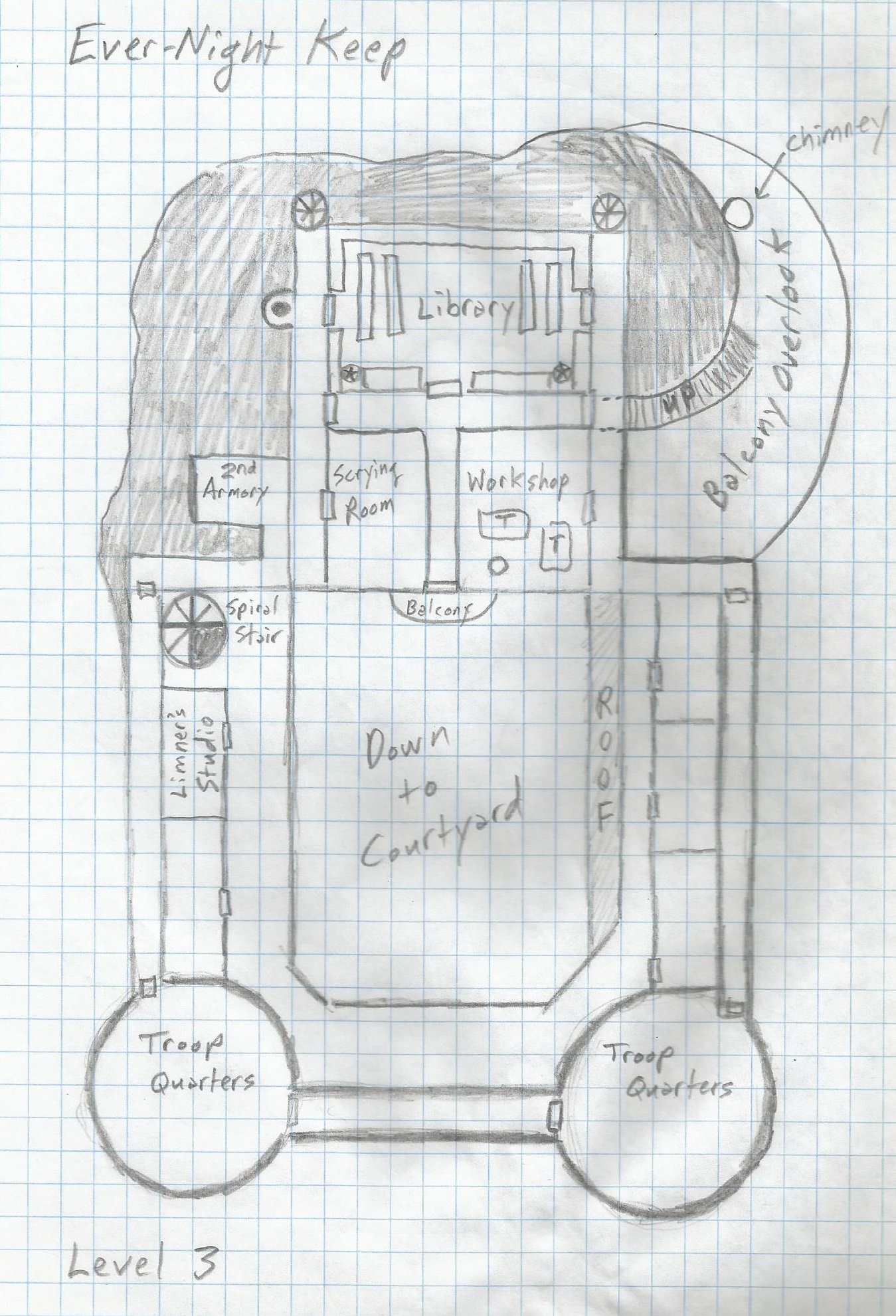
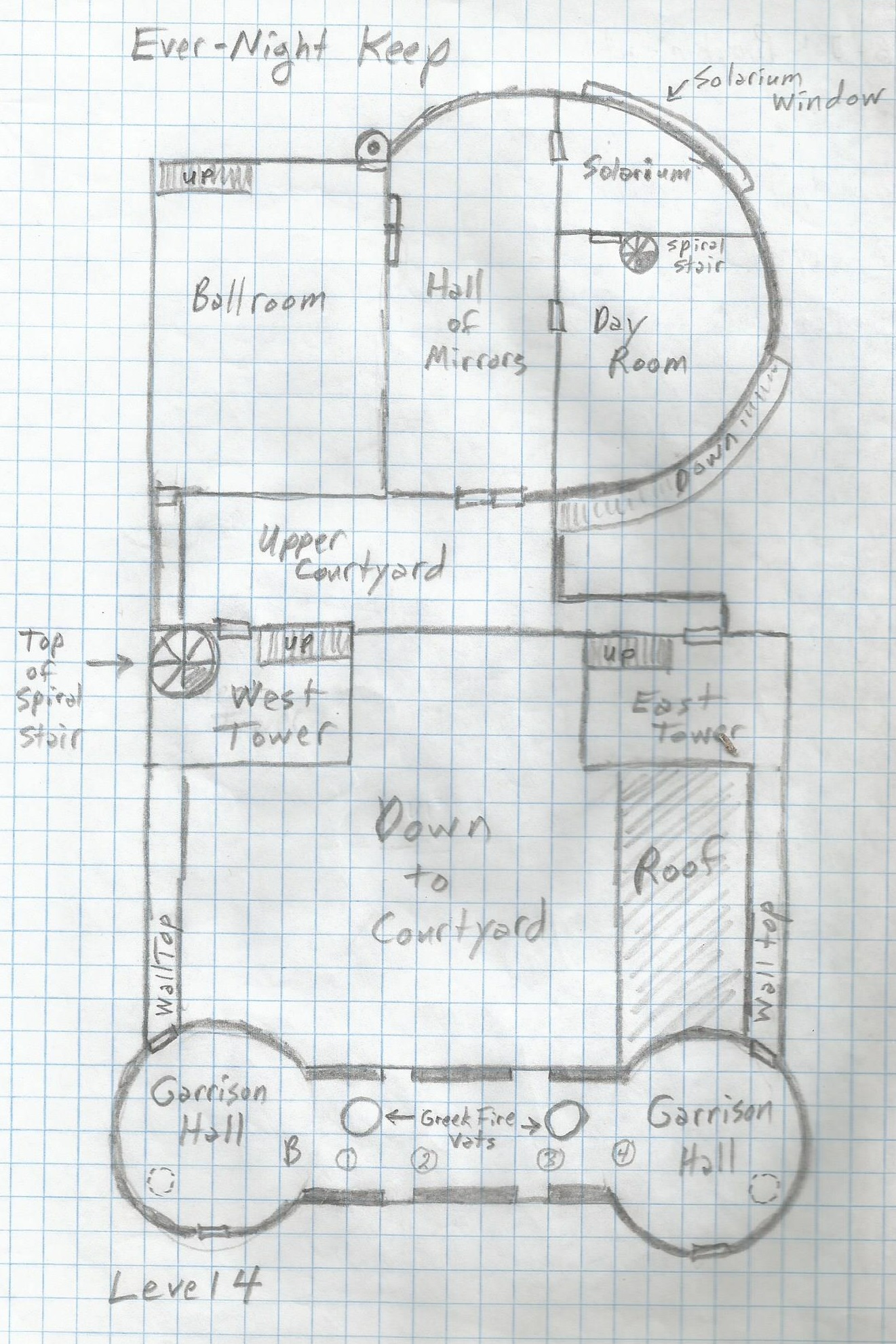
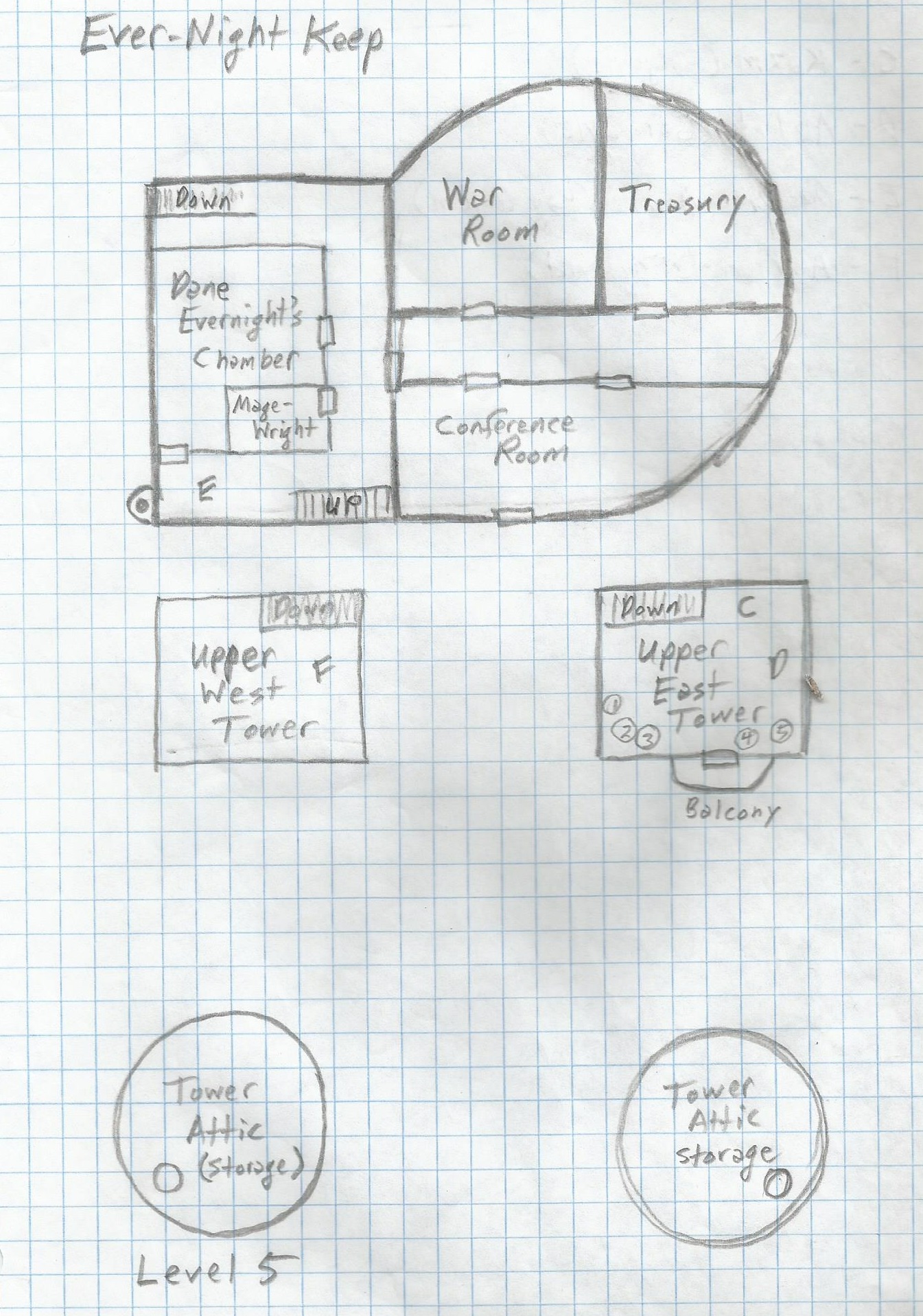
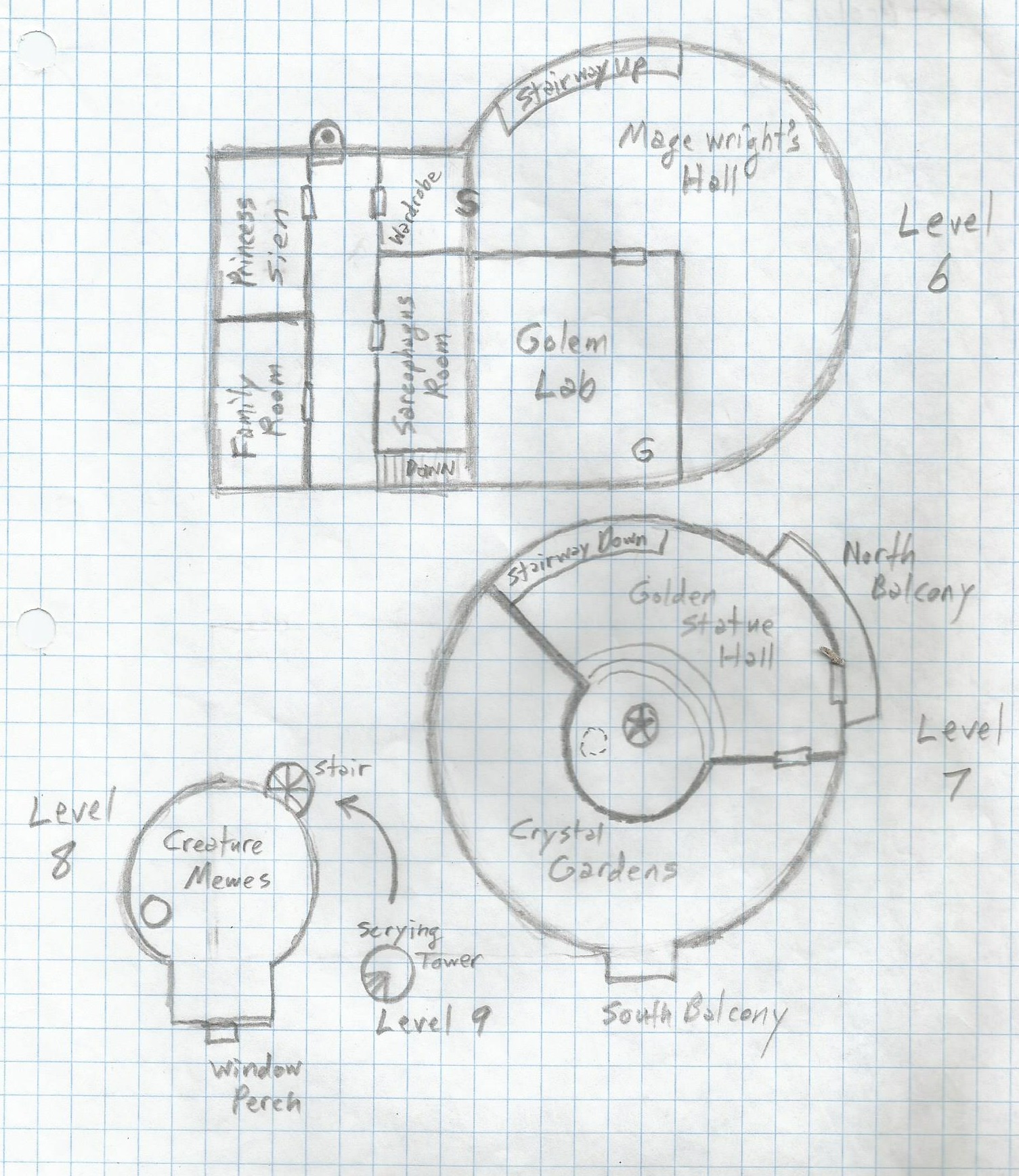
Part of being a dungeon master is the responsibility for creating the dungeon. Now I do intend to fully explain the events of the siege of Castle Evernight in a future Saturday D&D post, but today I want to show you my dungeon setting, the Keep of the Duke of Passage, Dane Evernight. This is me thinking like an insane architect to build a tall, spindly castle that no real-life king or duke would ever try to live in. But insane as it was, it had to be drawn to scale and the inner workings had to be mapped out on grid paper where every little square represented a space of 5 feet by 5 feet.
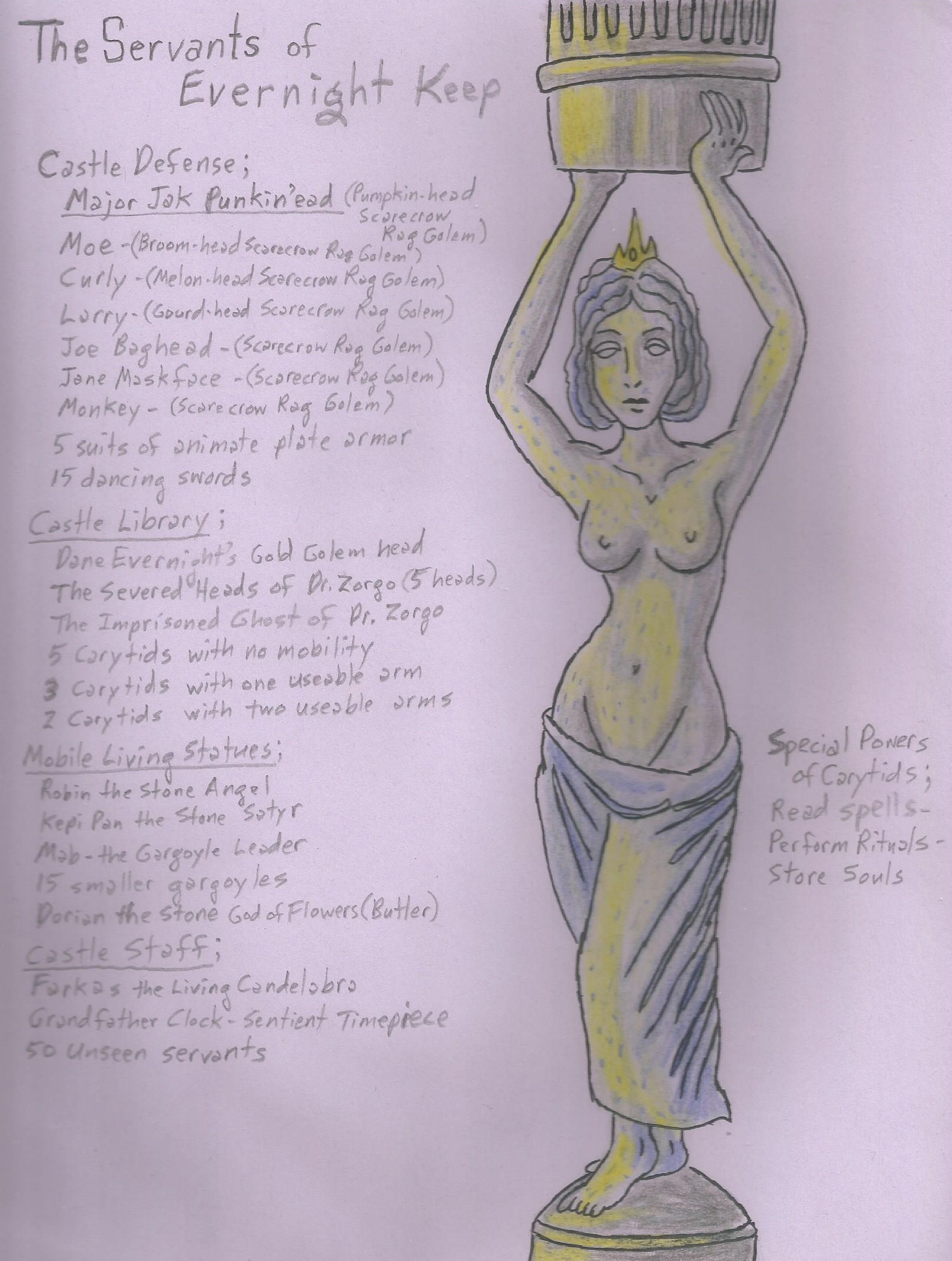
Level one shows the areas you would enter coming in through the front gate. Colored-in areas represent the solid stone from which this castle is built as well as the rock spire it was precariously perched upon. The usual dungeon-master map symbols apply. The little empty rectangle thingy blocking passageways and interrupting walls is to be interpreted as a door. You can also see that to visit on horseback requires your trusty steed to be able to climb stairs. So, unless you have a verily dexterous and unusual horse, you should probably ride in griffin-back or dragon-back.
Moving to Level 2 brings you to where the Duke’s Great Hall would receive you as a visitor. There are also places you would like to get to, especially if you are a teenage boy, like the harem and the bathing pool attached to the harem, and maybe the Magic Lab, but you will most likely not be allowed into those places. But you see the dark spots in the walls? Those are the garderobes. You probably will be allowed access there, because, when you gotta go, you gotta go, and that is the proper place to go. Medieval castles have primitive plumbing.
Level 3 is the level I would most want to see if I were touring this place myself. Not only is it the place that has the library in it, but it houses the limner’s studio, and the limner is the resident painter, picture-maker, and white-washer of fences and garderobes.
Level 4 contains the “Party Central” places that every highly social and only mildly psychotic nobleman seeks to spend his schmooze time. There’s a ballroom for dancing, a solarium for getting sunburn when you drink too much wizard’s ale and dance naked in the sunshine for too long, and a hall of mirrors for admiring the way the sunburn makes your behind glow bright red.
Level 5 is getting up to the top of the towers. In a vertical dungeon like this one, this should be nearing the adventure climax. That was not how it happened, however. I will tell you more about that in another post. This is where the belfry bats and the Duke’s treasures are stored.
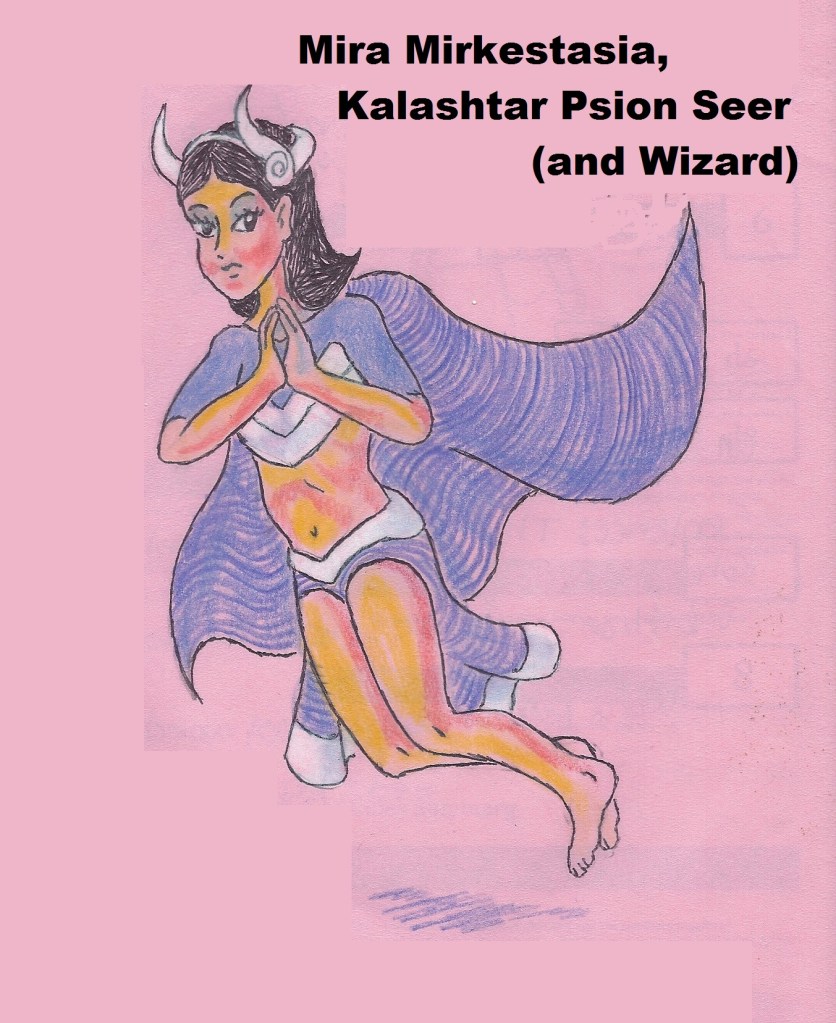
By the time you reach the Summit of the Keep, you are beginning to think that something is seriously and morbidly wrong with this Castle. This is where you will find the Evil Doctor Zorgo and the animated remains of Duke Dane Evernight. And golem labs next to sarcophagus rooms? Something has gone terribly wrong here. But don’t have nightmares about it, or anything. Rest assured that Gandy Rumspot and Mira the Kalashtar have already solved this problem or I wouldn’t be telling you about it. Dungeon masters, at least the good ones, never reveal a secret before the dice are rolled.
Playing Dungeons and Dragons in Texas during the ’80’s and ’90’s was basically a subversive act. The reason? Fundamentalist Christians actively stepped in and persecuted you for it. It was their sincere belief that a thing that had demons, devils, and dragons in it had to be from Satan. Satan, they reasoned, used a game like that to poison the imaginations of innocent children and turn them to the Dark Side of the Force. Or, rather, the Devil’s side of religion. They were terrified of subtle corruption of the mind, believing that certain patterns of words and ideas could turn goodness into evil. In other words, their religion advocated living in a bubble of non-association with certain words and ideas in order to superstitiously inoculate themselves against badness. They were, of course, not entirely wrong.
Kids playing the game will often develop the desire to play the Dark Side, to be an evil character, to commit evil acts and murder without the hindrance of conscience. That is the reason I wouldn’t let my own kids even consider playing Grand Theft Auto or similar murder, rape, and pillage sort of video games. It is, in fact, possible to desensitize yourself to violence and immoral behavior, and I have serious philosophical doubts whenever anyone tries to tell me that that can be a good thing. My Dungeons and Dragons games always contained a rarely spoken understanding that if you chose to play an evil character you were going to lose everything, because any adventure is solved and overcome by combating evil and siding with the forces of goodness. Paladins with their magical swords of ultimate sugary goodness are always stronger than evil wizards with their wimpy bat familiars and potions in the end.
But leaving out demons and devils was never truly an option. If you never face decisions between good and evil during playtime, what hope do you have of avoiding a life-altering mistake later in life when faced with evil for real. If you are going to make an evil choice, say for instance, committing an act of murder, isn’t it better to learn the consequences of such an act when the murder was killing an imaginary rival wizard for a magic staff you coveted than if you committed that murder in a fit of passion in real life? The fact that the rival wizard’s spirit takes up residence in the staff and finds a way to punish you every time you use it for the remainder of your adventuring life in the game may teach you something you can use when faced with the opportunity to steal for profit and get away with it to make a better decision about what to do.
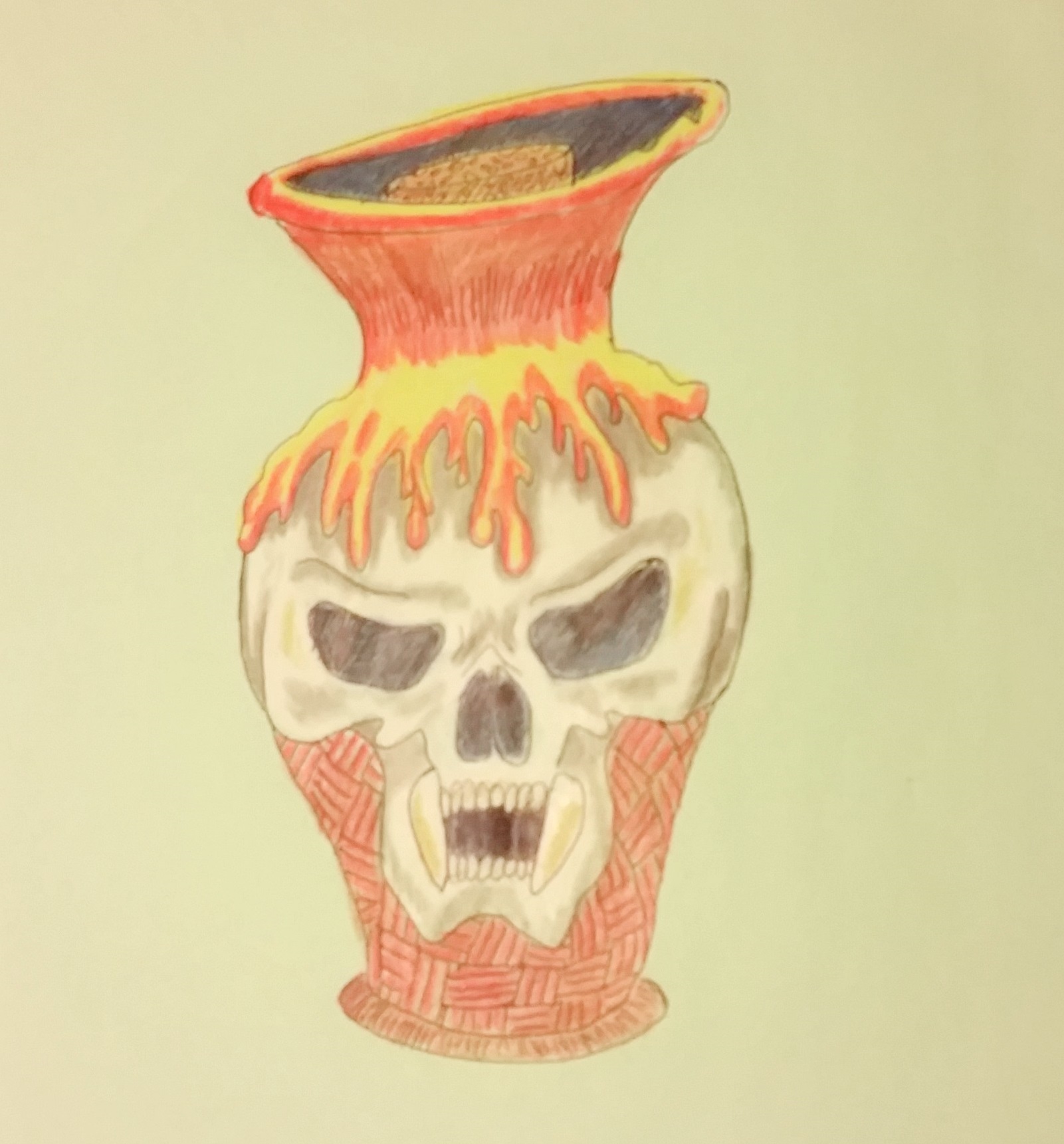
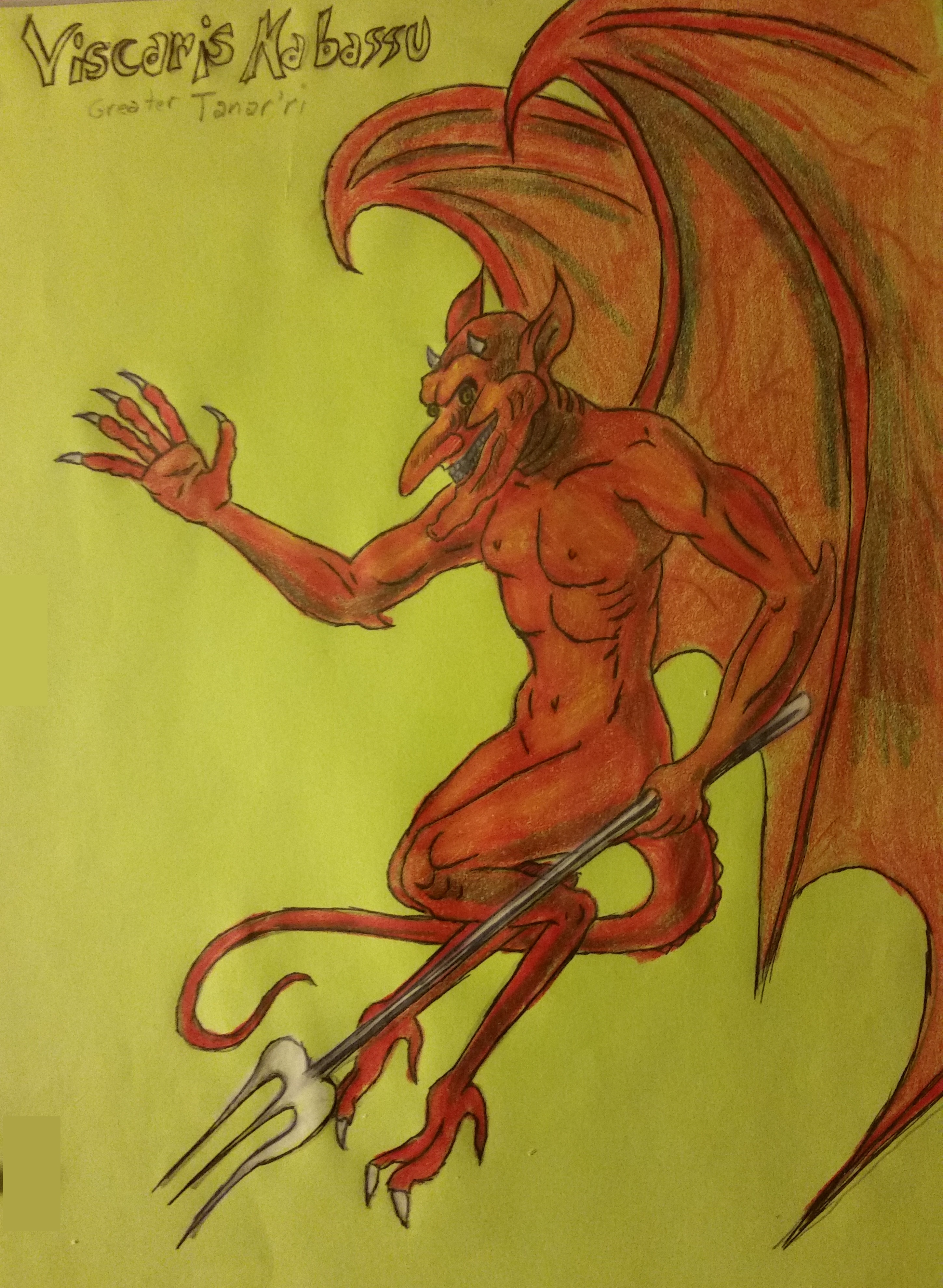
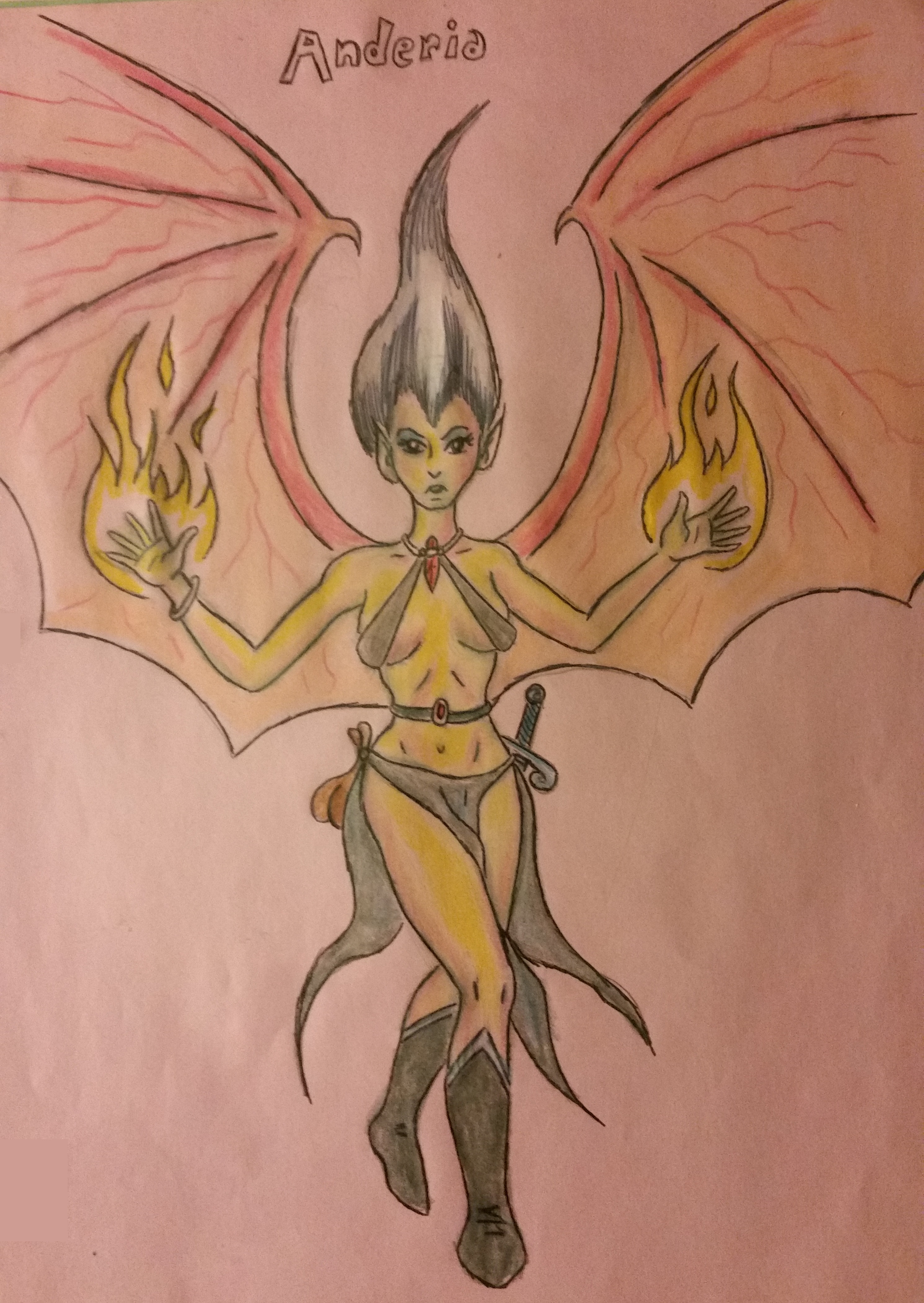
In the Tomb of Death adventure that the three demons illustrated in this post came from, the only solution was to find the weakness in the demon team. Estellia had been ill treated by the other two and deeply resented it. She resented it enough to tell the adventurers’ thief about the brass demon bottle that could be used to magically imprison the demons and then force them to do the bottle owner’s bidding. Viscarus had been using it to control the other two, so only his soul truly needed to be captured. The demon-hearts of the other two were already inside. That story taught several lessons. Manipulative evil can bite you in the neck even if you are the one wielding it. (If only Trump and his cronies had learned that about their own brass demon bottle.)
Evil people don’t see themselves as evil. Often they only see themselves as victims. And it is true in real life that there is goodness in even the most heartlessly evil people. You can find it, appeal to it, and possibly even reach the goodness in their hearts necessary to change them for the better.
I truly believe that those kids who over the years played my story-telling games were better, stronger, and more inherently good because they played my games and learned my lessons. I believe it is true even though there may have occasionally been demons and devils in the stories. And if I believe it strongly enough, it must be true. Isn’t that how faith is supposed to work?
For much of my role-playing-game lifetime, I did not play the actual Dungeons and Dragons game. I played with a lot of kids from my classes in the South Texas middle school where I spent the majority of my teacher-life. And while most of my players were Catholics, it was the Southern Baptists, including the county sheriff, who were intent on policing what kind of thought went on in the minds of the people in their town. D & D had demons and devils in it.
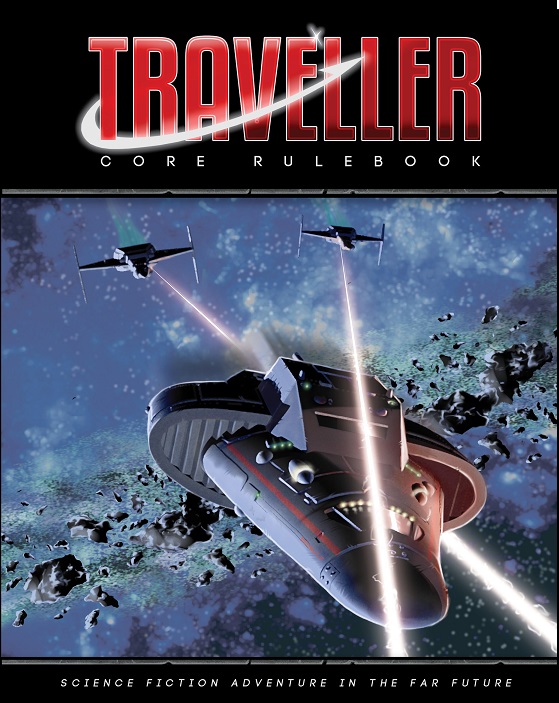
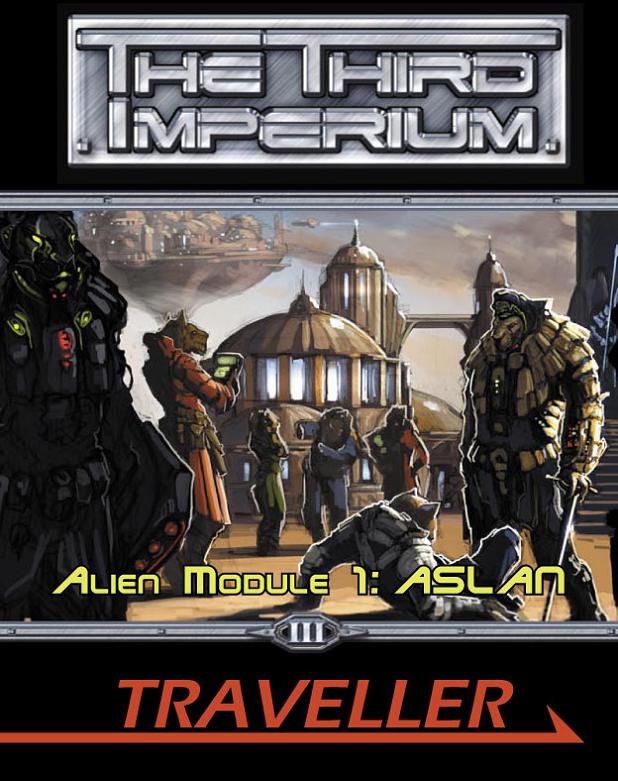
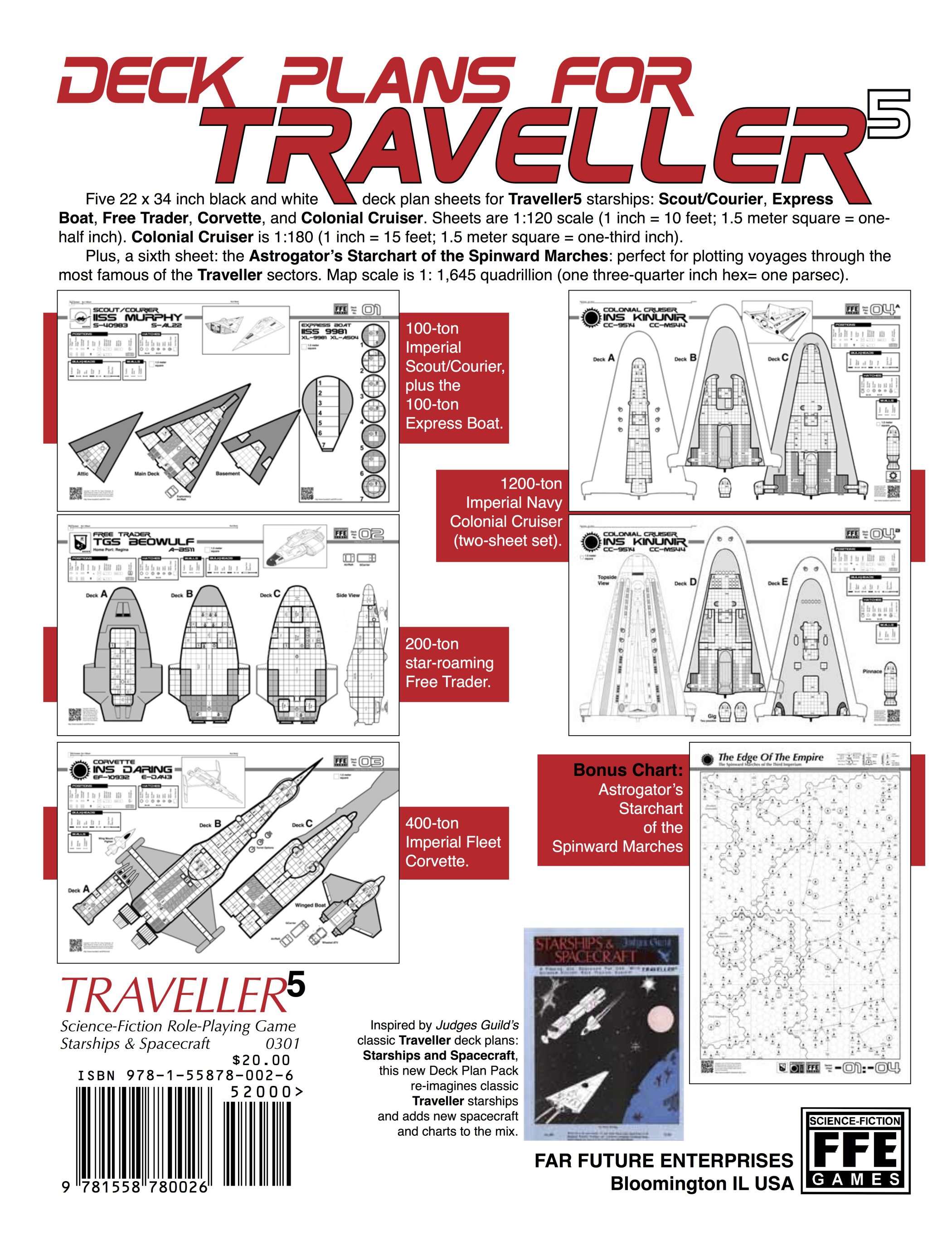
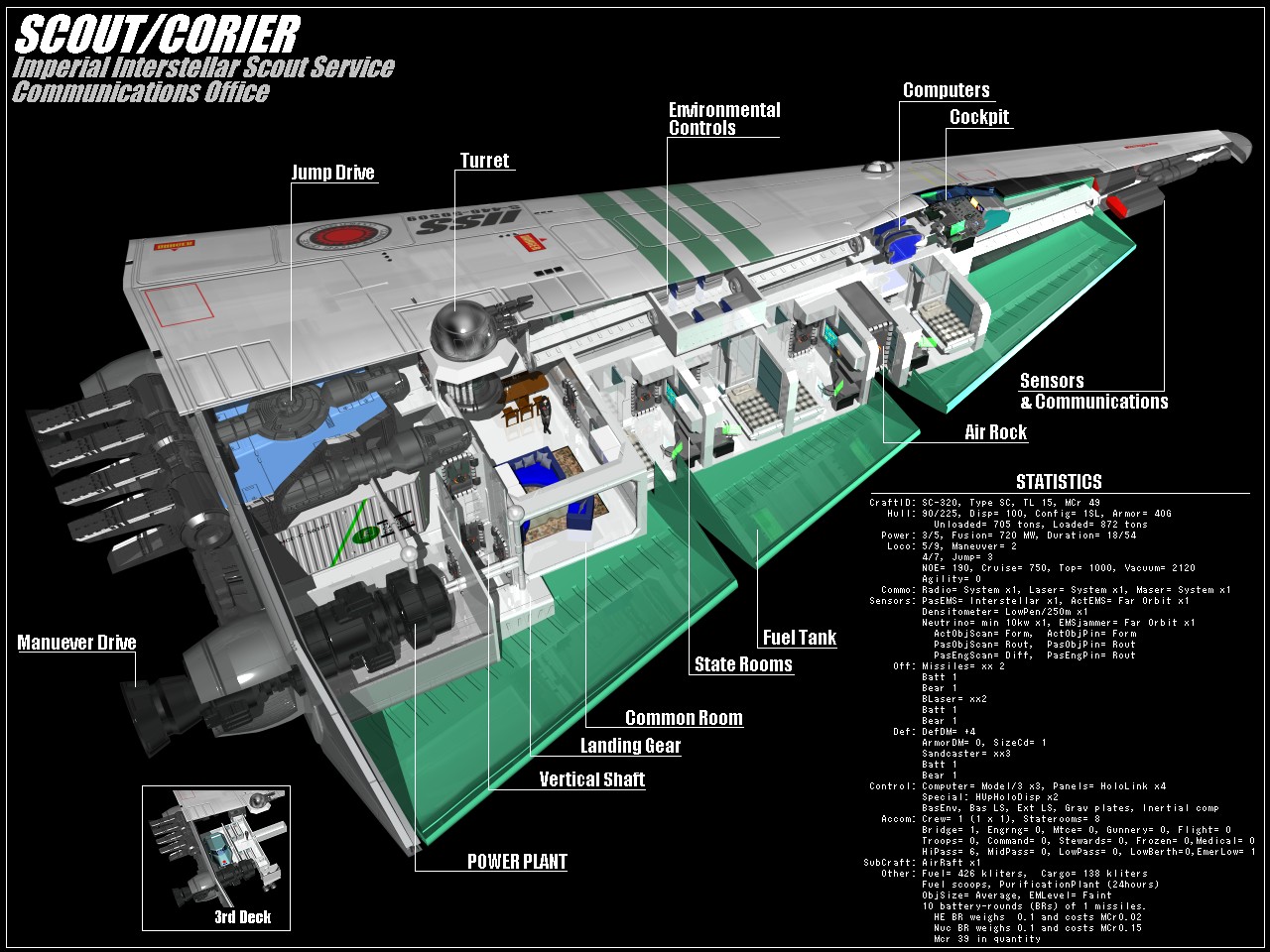
So, I had to make a significant shift in my story-telling games. The Baptist preacher’s son and the sheriff’s son were two of my most avid players. I also had the high school physics teacher’s son on my adventurers’ team. So, we turned wizards and warlocks into astrophysicists and mad scientists, rogues into space scouts, and knights into space knights. We started playing Traveller, a science fiction role-playing game.
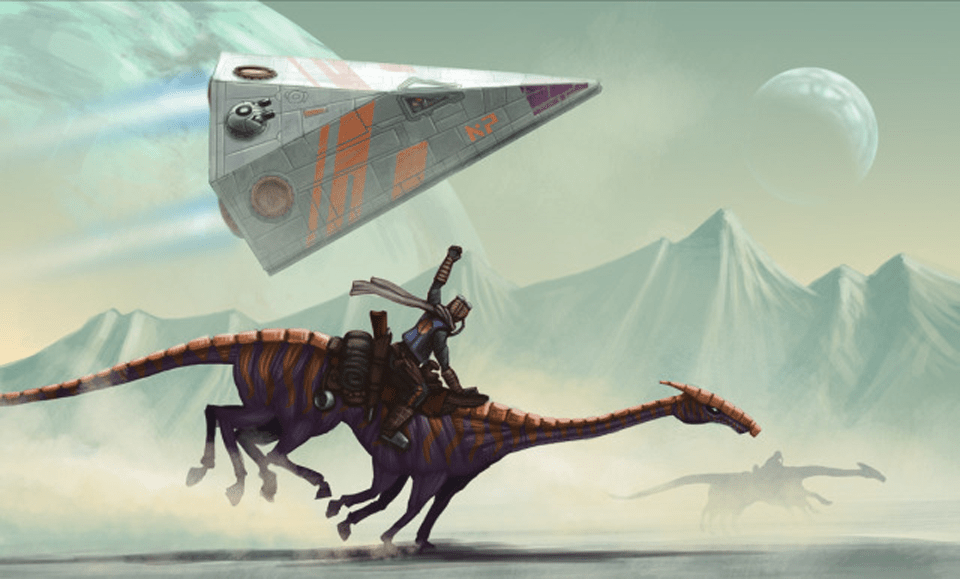
That is where the stories that eventually became Aeroquest came from. My players instantly took a liking to the game and star journeys into the unknown reaches of the Spinward Marches, a fictional region of the Orion Spur of the Sagittarius Spiral Arm of the Milky Way Galaxy (our actual address in space). Real science, astronomy, physics, and biology went into adventures that were easily as swashbuckling and exciting as Star Wars, Star Trek, and every other sci-fi show we stole ideas from.
The stars were the limit with a simple gaming system that required only a set of six sided dice and lots and lots of graph paper… and plenty of imagination for fuel.
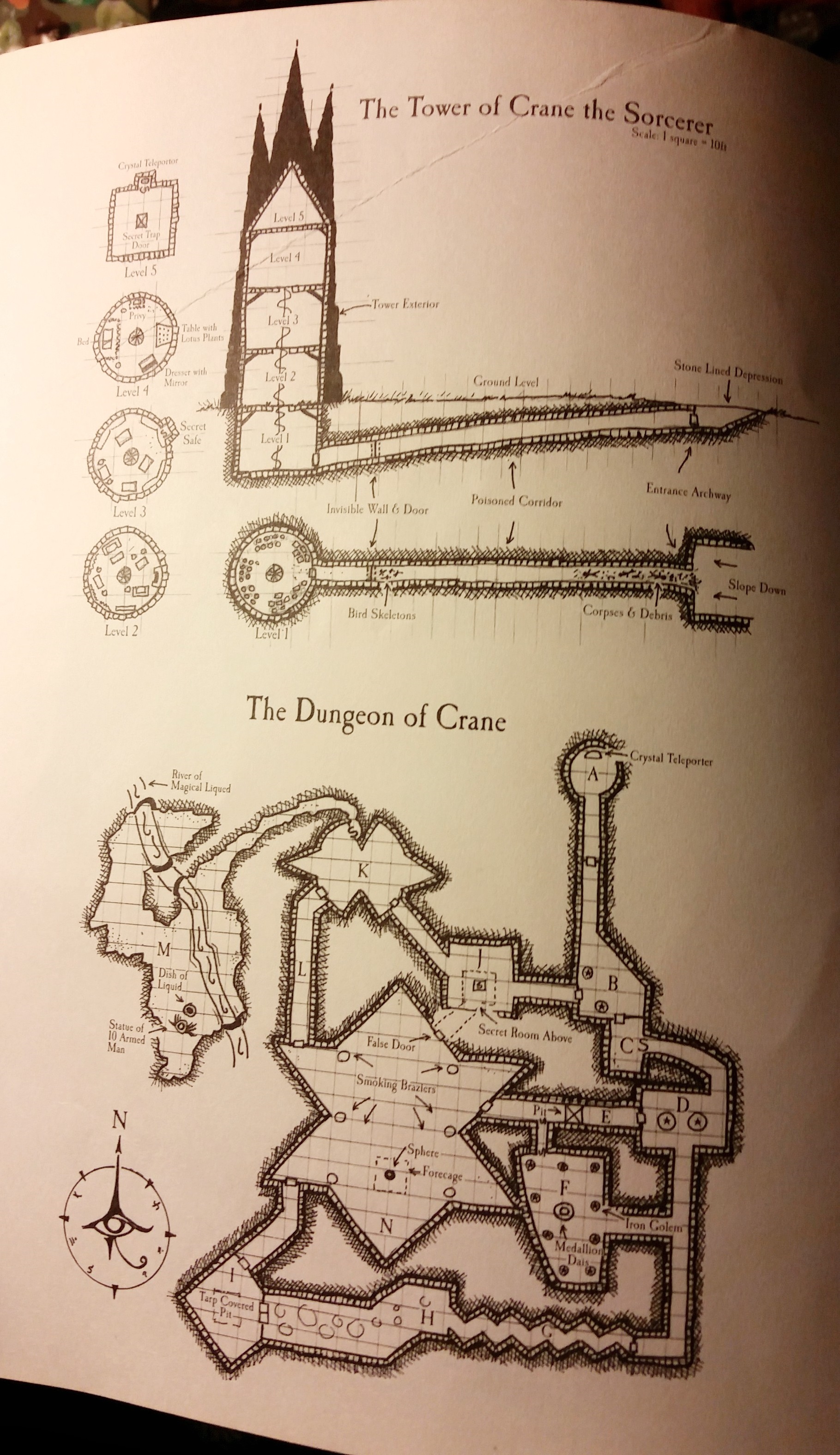
In the mysterious continent of Xendrick, the adventuring party came across a very old abandoned tower. The only way into the tower was a long sloping tunnel that turned out to be trapped and filled with a deadly poison and the numerous corpses of the previous adventuring parties. Of course, if you are a D & D adventurer, such a tunnel is not going to scare you off. It is going to irresistibly pull you in.
After nearly dying on three different attempts to get through the tunnel, Gandy Rumspot, the halfling rogue and thief, realized that it was a poison gas in the tunnel. So he sent Big Cogwheel, the warforged artificial man who didn’t need to actually breathe air, to use his natural immunity to poison to go down and open the tricky invisible door and gain access to the tower.
Voila! On to further tricks and traps. At one point, exploding skeleton warriors animated by necromantic trap spells nearly killed Cog the warforged (by rolling a twenty on an attack roll) and required a miraculous magical repair by Gandy to save him. That left the big metal man with a permanent irrational fear of skeletons.
Along the way, they encountered and had to overcome a bound female demon who had been imprisoned in the tower to keep watch over the property. She was the slave of the Wizard Crane, builder of the tower long ago, who had then gone abroad and died in his semi-noble quest to slay a devil. She told the adventurers a great deal about her former master and her imprisonment, monologuing as villains will before killing and eating the adventurers. She overdid it, though, accidentally revealing the presence in the room of the devil jar that enslaved her, and even more stupidly, revealing how to activate the jar to physically seal her inside like a genii in a lamp.
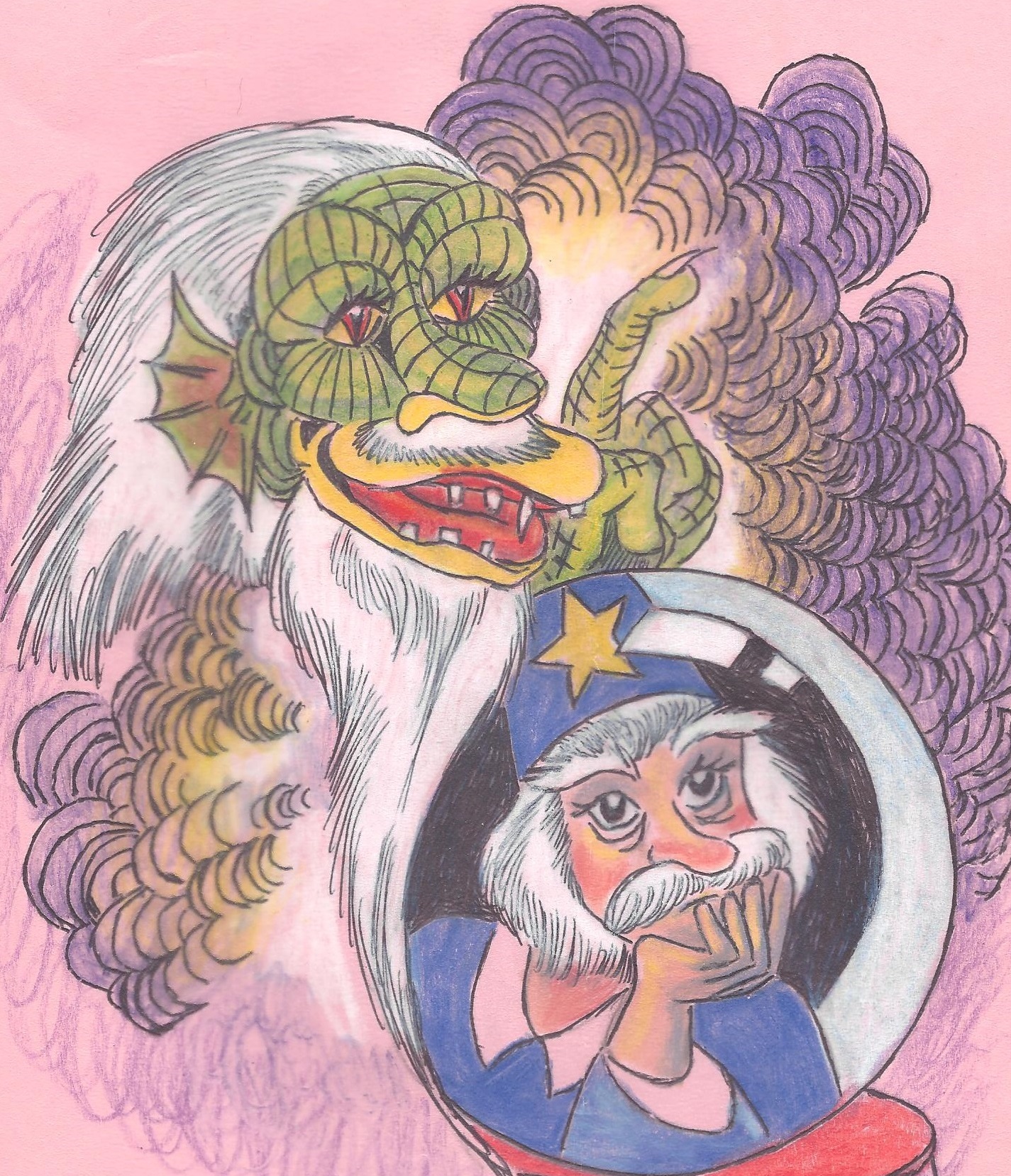
Finally, they found the teleport room in the top of the tower which zapped them to the dungeon under the earth where Crane’s ultimate treasure was kept. It turned out to be a crystal ball which contained all the knowledge, memories, and experiences of Crane himself. In fact, Crane’s entire life up to the point where he left on his fatal adventure took the form of Crane’s imprisoned self, longing to have someone to talk to again after hundreds of years of loneliness. This proved to be a great boon to the magic users in the party, especially the half-elven wizardess Drualia. So that adventure left the adventuring team with more than a mere heap of experience points. It also gained them a crystal ball with an imprisoned sorcerer in it to talk too much and complain too much and teach them exotic and dangerous magic spells.
Like any three-session D & D adventure, this one was probably a lot more entertaining to play than it was to retell, but there it is, complete with the secrets that kept my players thinking about them for more than three weeks.
I am planning to re-watch all eight hours of Netflix’s Stranger Things. I can’t help it. I really seriously love that show. And the reason is the kids in the series. Yes, it was set in the 80’s, a decade I long to return to, but I wasn’t a kid myself in the 80’s. That was my first decade as a teacher. The thing is… I taught each and every one of the kids in that series. I admit, they had different names and lived in different bodies, but they were the same faces, the same personalities.
And it is not so much the characters the kids inhabit in the show, though they were obviously cast as themselves. It is the real-life screwiness that Jimmy Fallon brings out with the silly string that I recognize.
Finn Wolfhard’s character, Michael, is basically me. The dreamer determined to make the fantastic become true. And when they played Dungeons and Dragons in the basement, he was the Dungeon Master. That was me. The teller of the stories, the maker of the meaning. He’s the one who creates the Demogorgon adventure that eerily comes to life. He is also the one who finds and befriends the mysterious Eleven. He is the driving force that leads them all to the inevitable conclusion of the adventure.
And while I never met anyone quite like the mysterious Eleven, Millie Bobby Brown is definitely no stranger to me. She is bubbly, outgoing, and utterly charming. She can channel Nikki Minaj. I must’ve taught at least five different versions of Millie in three different schools when I was a teacher.
She makes the weird and otherworldly character of Eleven become believable through the sheer force of a natural talent for empathy and understanding. She is a highly intelligent girl with a knack for making things work.
I have also taught about four different incarnations of the Dustin character’s actor, Gaten Matarazzo. The goofy but courageous kid with a broad sense of humor and a focus on food is a very common type of junior high kid. And while he isn’t usually a leader in the classroom, he’s the one you turn to when you need help getting the group to choose the right path.
I swear to you, I know all these kids, even though I have never met them. You see, when you are a teacher for long enough, everyone in the world comes in through your door. You have to get to know them and learn to at least like them if not love them. You do the thing for long enough, and you learn that there are a limited number of different faces and personalities that God distributes over time and circumstance to many different people. It is possible to get to know nearly all of them. And there are no Stranger Things than kids.
I need a quick and cold post for today, so I will turn to the ice wizards of Talislanta.
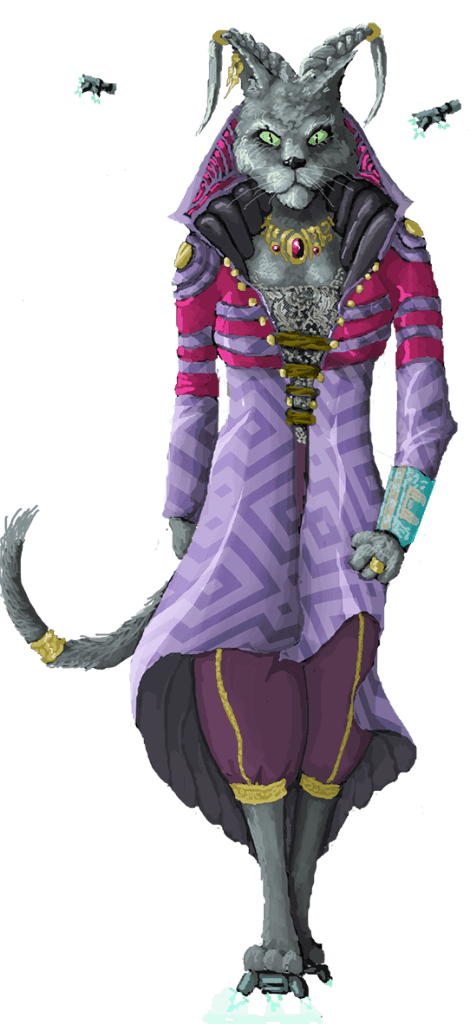
Viktor, the ice-alchemist, and his son Zoran-viktor are Mirin, a sort of ice-elves who live in the frozen ice-world of the far north. Viktor’s people are cold-resistant enough to wear bikinis in freezing weather (but smart enough not to). So Viktor managed to become the Mirins’ most powerful user of the magic of chemistry by developing hot stuff. In the picture he is brewing a bit of the really, really hot explodie stuff that melts a Mirin bad guy.
Juan Ruy, the Mirin prince, built many ice castles out of his magical substance known as iron-ice. It was far harder to pierce than steel and impossible to melt with fires less hot than dragon’s breath. With it he built frozen castles vertically to the highest heights. And they still stand, primarily because I haven’t played that particular D & D game for more than two decades.
But this is what I love most about the Dungeons and Dragons game. It is a never-ending game played in worlds of shared imagination where every person at the table adds something to the story. It is interactive, and it retains the unique twists and turns created by the players. I created the scenario. The player behind the character Juan Ruy created the idea of iron-ice that completely changed the story.