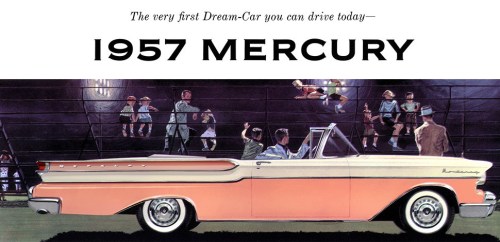
Yes, she was a real car. My dad bought her in the 60’s as a used car. But she was a hardtop, not a convertible. She was the car he drove to work every day in Belmond. We called it the “Pink and White Pumpkin”, my sisters and I, referring to the pumpkin in Cinderella which the fairy godmother changes into a coach. But it would only later become the car of my dreams.
You see, she was killed in the Belmond Tornado of 1966. Her windows were all broken out and her frame was twisted. So the pictures of her, though they look exactly like my memories of her, minus the rust spots, are not actual pictures of the car in question. Our next door neighbor, Stan the Truck Man, was a mechanic always on the lookout for salvage parts. He took her apart piece by piece while she sat in our driveway. We continued to sit in her and play in her until all that was left was the bare frame. My friend Werner told me for the first time about the facts of life and where babies really came from in the back seat while she was being gradually dismantled. Of course, I was nine at the time and didn’t really believe him. How could that grossness actually be true?
But she still lives, that old dream car… She is the reason that I objectify my imagination as a ship with pink sails. My daydreams, my creative fantasies, and those long, lingering plays in the theater of my imagination as I am drifting off to sleep all start in the three-masted sailing ship with pink sails. And that dream image was born from the Pink and White Pumpkin. I have sailed in her to many an exotic place… even other planets. And when I die, she will take me home again.
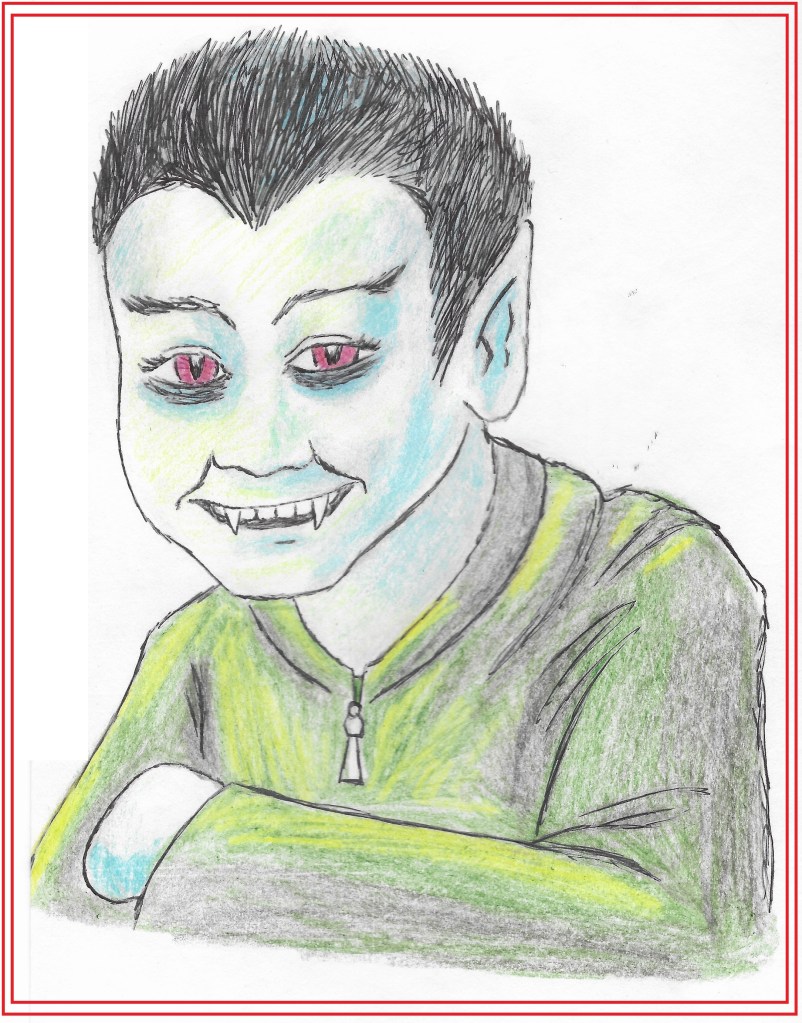
Teachers like me often say, “There are no bad kids.”
And, boy! Are we ever wrong when we say something as dumb as that.
To be fair, when teachers like me say something like that, a clueless liberal-minded comment that reveals fatal levels of idealism, morality, and even faith in God, we are really saying that there is a way to reach every kid and make a difference for them… if only we are given the tools, the time, and a decent amount of incentive. To go in front of a hostile audience five, six, or seven times a day, up to thirty of them in a classroom made for twenty, and teach them something worth learning requires an unquestioning belief in miracles and a foolish notion that somehow goodness and light always win out. And often they do. But exceptions prove the rule… And the need for rules. Because there are some very bad kids in this world.
The first hour of the first day of my very first year as a gringo teacher in a mostly Spanish-speaking junior high school in deep South Texas contained two eighth-grade boys who would die violently from gunshots.
Osvaldo “Ocho” Sotello put a gun in his own mouth and pulled the trigger after finally getting released from prison after serving five years of a sentence for armed robbery. He was guilty of that crime and many others he was never caught doing. But he was put in prison at eighteen, and repeatedly raped by other members of the Mexican Mafia because he had given himself teardrop tattoos by his right eye and had never killed anyone to earn that gang sign.
And Lorenzo “El Loco Talan” Marquez would die in a hail of bullets from the guns of rival drug dealers on the streets of Encinal, Texas. His family watched in horror as it happened. Neither of the names I gave those boys in this essay are their real names. But the gang names are real. And their life outcomes are real. And I even had to teach the son of El Talan when he reached eighth grade.
Both of those boys are proof of the idea that there really are bad kids out there. Evil kids even. But those two boys were both sixteen in the eighth grade because they failed seventh grade twice and had been “placed” in the eighth grade especially to welcome me into the jolly world of classroom management and discipline. Those were tough kids. They refused to do anything I asked of them.
They were disrespectful to me in both Spanish and English. And I am grateful for their tutoring of me in a wide range of profanity and swear words in Spanish. At one point, walking them back to class from another campus after lunch, El Talan picked up a metal fence post and was going to use it on me like a club because I tried to hurry them up and interfered with their plans to ditch afternoon classes.
Some kids are bad kids because they have been mishandled, mistreated, and misunderstood by all of their parents, relatives, teachers, coaches, and classmates before you even meet them for the first time. Their paths are already set in stone. Fossilized footprints made rock-hard-certain a million years before they should’ve been set in stone. I had no chance to make any improvements to them.
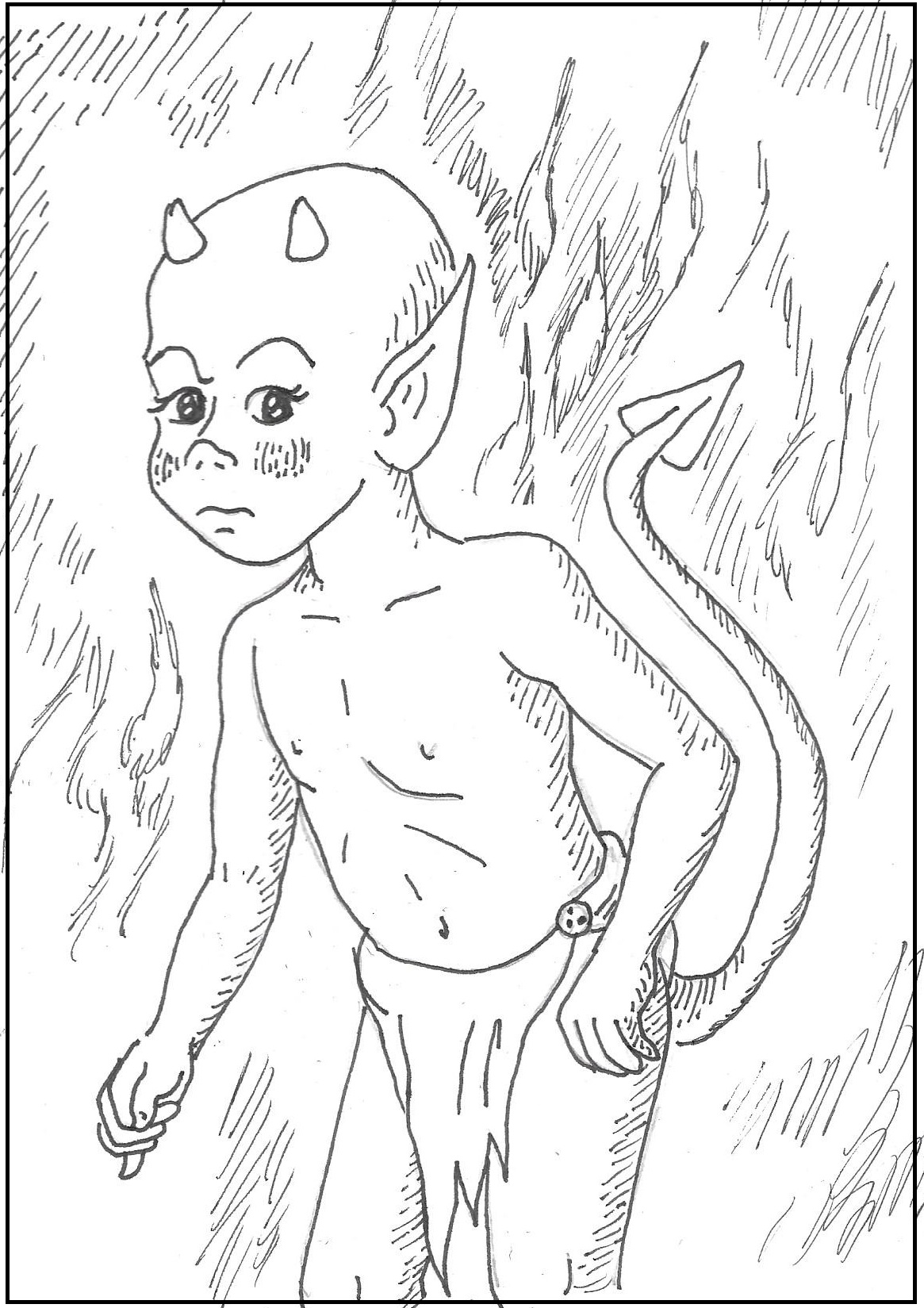
Another bad kid I had my very first year of teaching was not really named Alonzo Angel Diablo (but certainly should’ve been named that.)
Alonzo was the older cousin of a kid in that class, Fernando, whom I really liked and tried hard to help through two years in the eighth grade. But Alonzo was definitely too old and set in his criminal ways to be reached. Alonzo’s problem was that he was a gay young man living in a Catholic/Hispanic culture that actively persecuted gays. His own family had disowned him and treated him like a criminal. So, he was one. I had to get him expelled from school by reporting him for threatening the life of another student. Prior to that incident, the boy had harassed me at the Halloween Carnival (a fund-raising event that the Baptist Church later made us rename the Harvest Festival.) He forced Fernando to sexually proposition me, and when I rebuffed that nonsense, he offered to do it himself. It would lead to a later discussion in which he revealed to me his sexual orientation and asked me for forgiveness. He was relentlessly bad. But he later contacted me as an adult and thanked me for being his teacher. I never taught him anything, but it was important to him to show me that he had a job and had achieved adulthood without further violence or jail time. If he’s still making his way in this world more honestly than he did before, I am happy for him. But It was all his own doing. I could do nothing for him as a teacher.
There very definitely are bad kids. But they are not all irredeemable. And I know conservatives and Old School types would prefer that we just throw all of them in jail to rot forever. I, however, like to think there is still room in this world for stupid liberal notions of making kids less bad through education, patience, and the Grace of God.
This foolish essay about berries that mean love to me is only partly inspired by the Beatles song, “Strawberry Fields Forever.” That’s because, of course, their song was only about meditating. In the lyrics they take you to the “Strawberry Fields where nothing is real… but it’s nothing to get hung up about…” They are talking about a blissful place of no worries where we all need to go. And then staying there forever.
This, of course, I could never do. Worrying about the future is tattooed on my behavioral imperatives in the dark part of my stupid old brain. And while I often found that place of no worries, and lingered there for a bit, I found you could never really get anything done if you stayed in that state of strawberry fields forever.
But don’t get me wrong, strawberries are a critical part of every healthy mental diet.
You see, my meditations on strawberries when I was a child of eight, nine, and ten centered on the strawberry patch at Great Grandma Hinckley’s place.
She was, as I incorrectly recall, slightly older than Jesus when I was that age. By that I mean, though she seemed museum-quality ancient to me, I had derived wisdom about life, love, and laughter from her before Sunday School taught me any of those things said in Jesus’s words.
And I was given the task of mowing her lawn in the little plot of land surrounding her little, tiny house in the Northern part of Rowan where I also lived and grew and celebrated Christmas and Halloween and Easter and the 4th of July. And though I was doing it because she was so old, I never even once thought she was too old and frail to do it herself. Grandma Hinckley’s willpower was a force of nature that could even quell tornados… well, I thought so anyway when I was eight. And she gave me a dollar every time I did the lawnmowing.
But there were other things she wanted done, and other things she wanted to teach me. There was the garden out back with the strawberry patch next to it. She wanted me to help with keeping the weeds and the saw grass and the creeping Charlie from overrunning the strawberries and choking them to death. (Creeping Charlie wasn’t an evil neighbor, by the way. He was a little round-leafed weed that grew so profusely that it prevented other plants from getting any sunlight on their own leaves, causing a withering, yellowing death by sunlight deprivation. I took my trowel to them and treated them like murderers. I showed them no mercy.)
And Grandma always reminded me not to be selfish and eat the very berries I was tending in the garden. She taught me that eating green strawberries (which are actually more yellow than green, but you know what I mean) was bad because they could give you a belly ache, a fact that that I proved to myself more than once (because eight-year-olds are stupid and learn slowly.) She also taught me that it is better to wait until you have enough strawberries to make a pie, or better yet, strawberry shortcake with whipped cream. She taught me that delayed gratification was more rewarding in the long run than being greedy in the short run and spoiling everything for everybody.
She always gave me a few of the ripe strawberries every time I helped her with them, even if I had eaten a few in the garden without permission. Strawberries were the fruit of true love. I know this because it says so in the strawberry picture. Even though I probably never figured out what true love really means.
My Great Grandma Nellie Hinckley was the foundation stone that my mother’s side of the family was built on. She was the rock that held us steadily in place during the thunderstorms, and the matriarch of the entire clan of Hinckleys and Aldriches and Beyers and other cousins by the dozens and grandchildren and great grandchildren and even great great grandchildren. I painted the picture of her in 1980 when she passed away. I gave it to my Grandma Aldrich, her second-eldest daughter. It spent three decades in Grandma’s upstairs closet because looking at it made Grandma too sad to be so long without her. The great grandchild in the picture with her is now a grandmother herself (though no one who has seen this picture knows who it is supposed to be because I painted her solely from memory and got it all wrong.) But Grandma Hinckley taught me what true love means. And true love has everything to do with how you go about taking care of the strawberry patch.
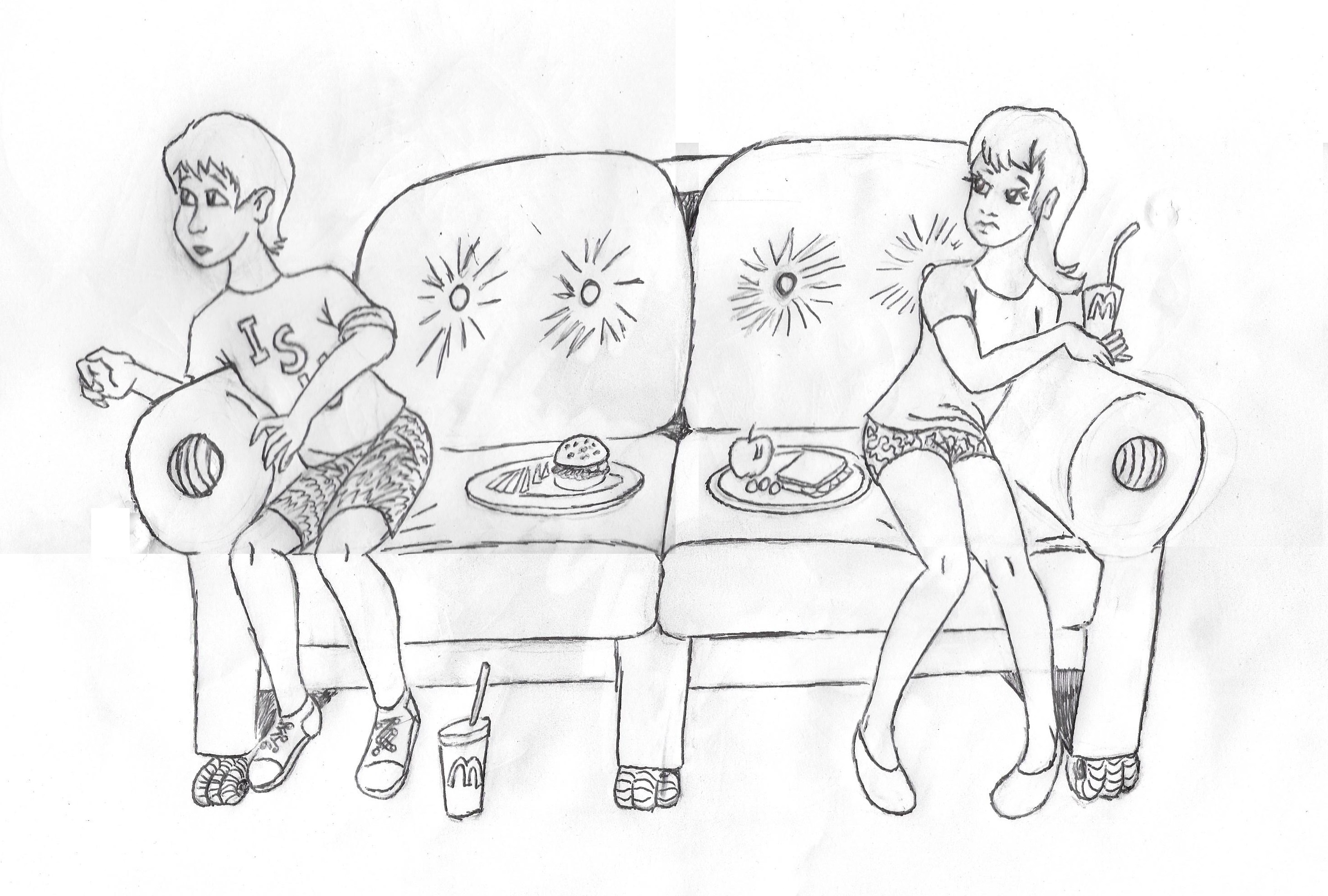
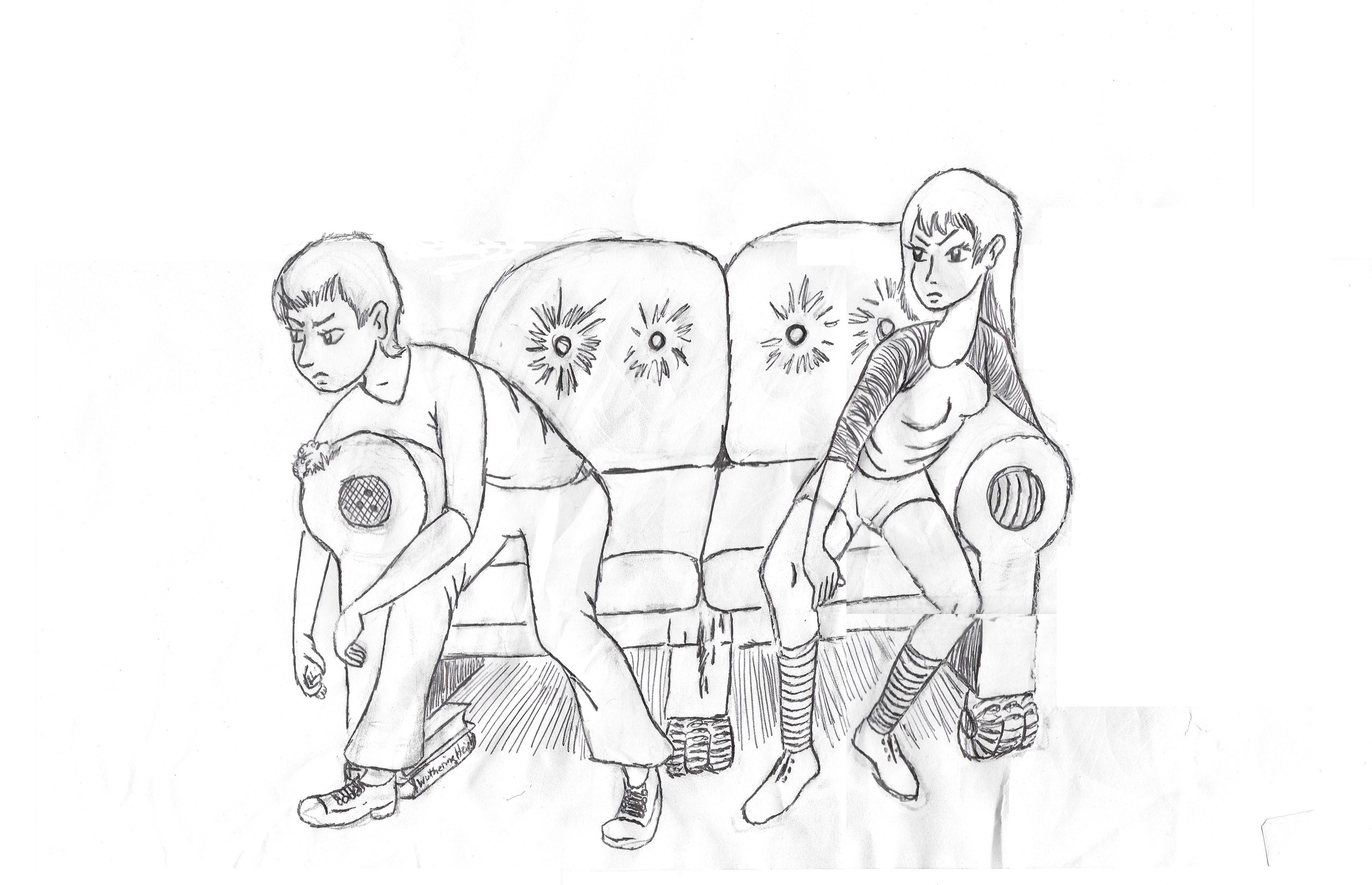
This is a story about an innocuous piece of furniture in Great Aunt Minnie Efram’s house. It was a little brown loveseat with carved wooden monster feet.
As the story begins, the little loveseat was sitting in the parlor in front of the small black and white television. During the monthly Efram family card party, the love seat was the only place for the two of them to spend the evening. But he was ten and he hated girls. He had a reputation with the guys at school as a girl hater, and he couldn’t have it known that he was sitting on a loveseat with Uncle Henry’s stepdaughter, the one the guys all said they had seen eating her own boogers.
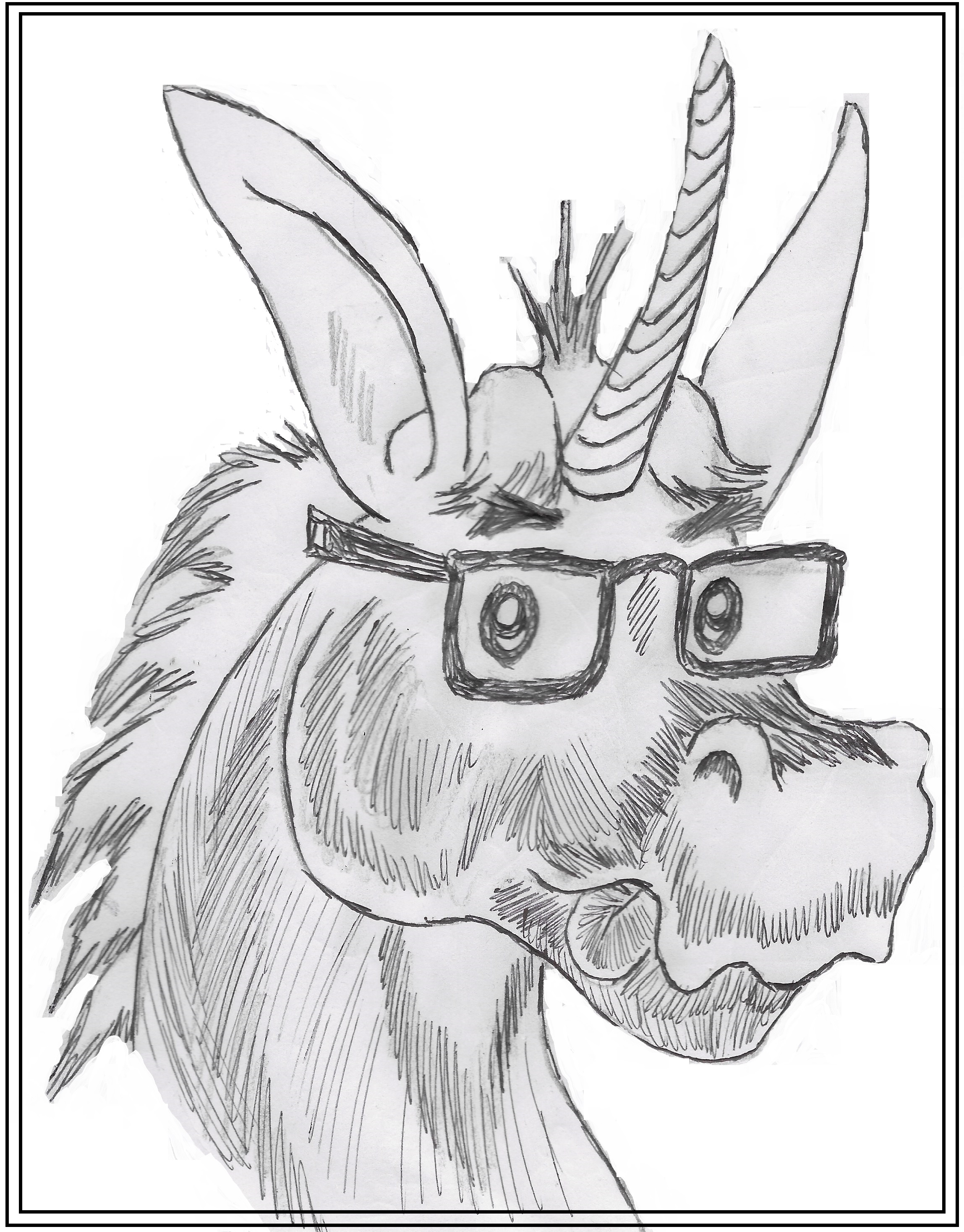
She was also ten, and in his class at school. She liked to watch him more than any of the other boys. But she didn’t know why. She liked unicorns and the color pink, but she also kinda liked the way boys looked at her when she wore shorts. And she liked seeing him in PE class at school, wearing shorts. He was athletic and often won games in PE.
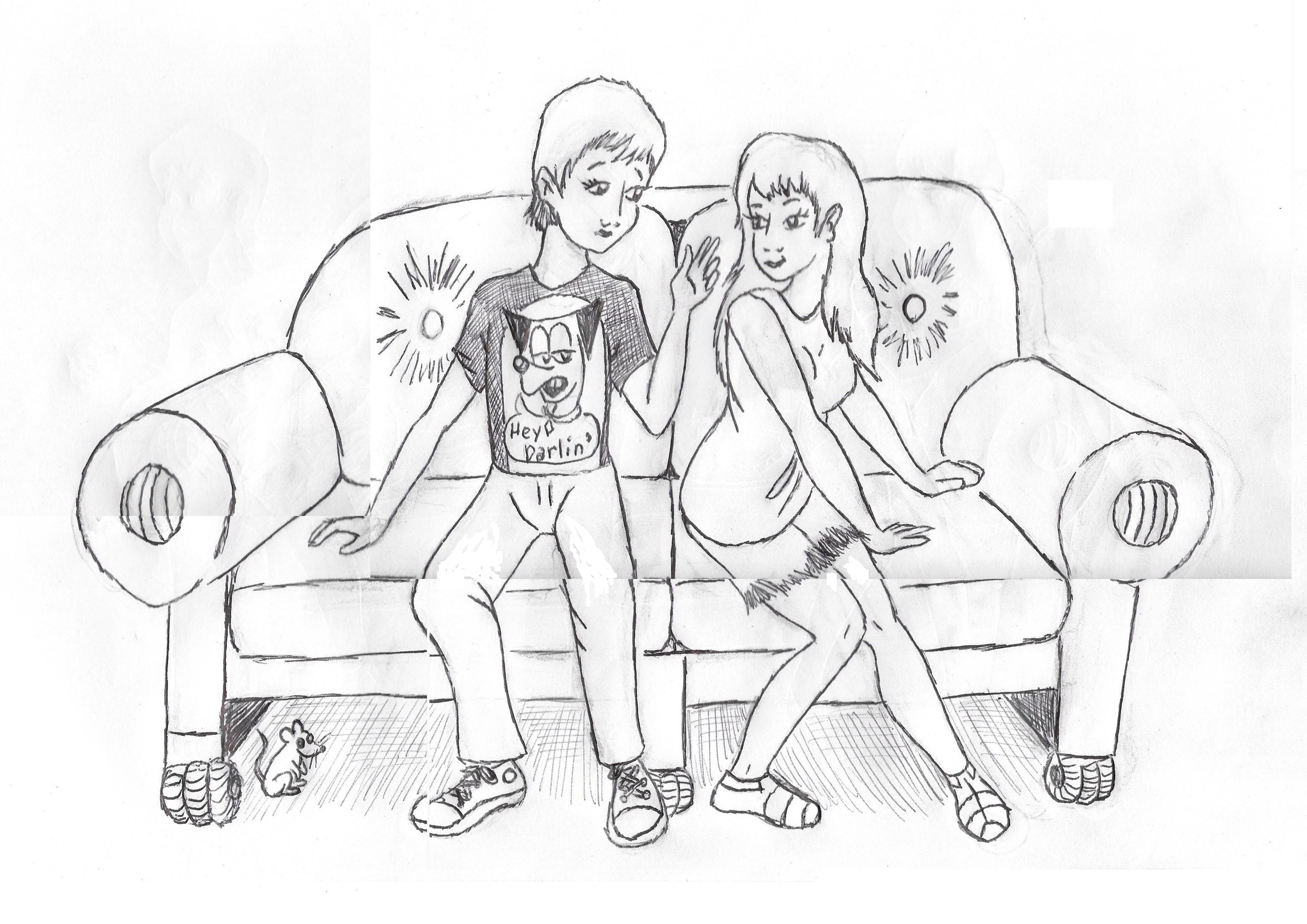
After two years of monthly card parties happening during at least three different months every year at Aunt Minnie’s place, he had discovered that girls didn’t actually smell bad, and this one actually listened when he talked about playing football, and how it made him feel when he scored the seventy-five-yard touchdown. In fact, the more he talked about football, and the closer they sat to each other, the better she seemed to smell. He liked that smell.
She liked that he didn’t only pay attention to her at the card parties anymore. He actually said, “Hi” in public. And she liked his smile, even when he got braces. He let her pick the shows they watched on the old black and white television while seated on the loveseat. She actually worked up the nerve to tell him that she had told Jane at school to ask him if he liked her, and stupid Jane had completely forgotten to ask him, or maybe Jane was just too chicken to ask him and used the excuse that she forgot.
He said that if she liked him, he liked her. But if she didn’t, he didn’t either. “Like” her, he meant. Which he did because she did.
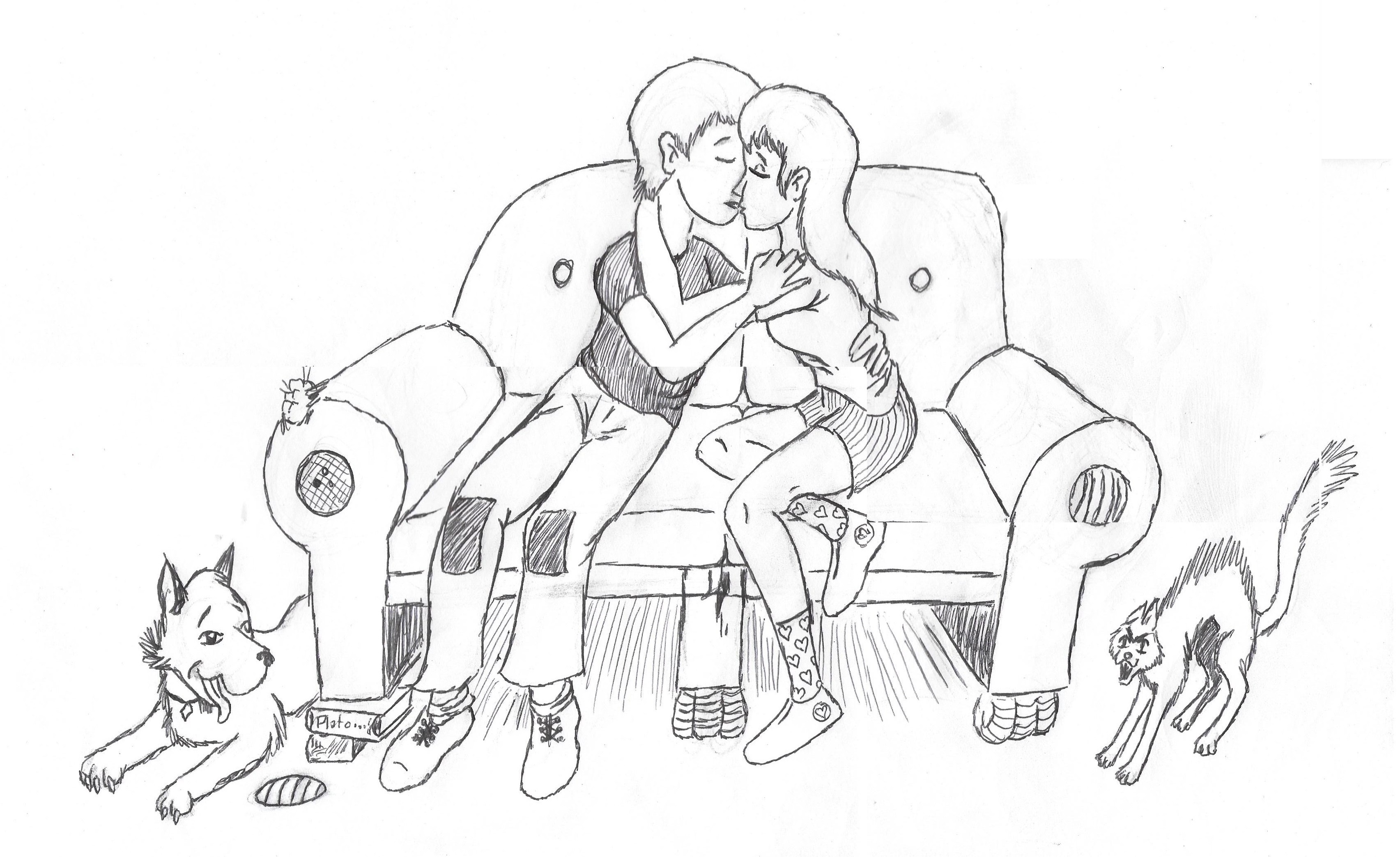
After two more years and six more card parties worth of scootching behinds closer together on the old loveseat, something different had happened. And it was about time too. Aunt Minnie had bought a puppy, and that not only was a bad thing for the seven cats that lived with old Minnie, but it was hard on the loveseat too. One of the little couch’s monster feet was lost, and the numerous instances of terrified cat claws digging in were beginning to have an effect on the upholstery. And that danged dog wizzled everywhere. The loveseat had one purpose in life, and it didn’t want to give in to wear and tear before achieving that purpose.
But the very next year brought disaster. He apparently told the members of the freshman football team that something had happened on that old love seat that really hadn’t happened. The football team was impressed because they all thought she was pretty hot stuff, and he was generally thought of as a lame-o dweeb. She heard about it from Jane who heard about it from Nanette’s boyfriend who was on the team. And she got mad. How dare he say something like that when it wasn’t true?
In January of that year, Aunt Minnie passed away in her sleep. The loveseat was sold at auction to a farmer who liked to do re-upholstery as a hobby. It got re-done in red velvet and leather with wheels replacing the wooden monster feet and sold to a car dealer in Des Moines who placed it in the lobby show-room for customers to sit on.
But the story has a happy ending. She would later make his locker room lie into the truth on Prom Night (fortunately with protection) and then went on to marry him when they both were sophomores in college. Of course, it wasn’t always, “They lived happily ever after,” because they didn’t. They got divorced once and got re-married shortly after… to each other. They had three kids. And the loveseat didn’t ever learn any of that. Because it was a loveseat. You didn’t really think loveseats could know anything, did you?
Anita Jones is a character in several of my books, but she also represents a girl from my own childhood who was as much of a regret for me as she was for poor old Charlie Brown.
Anita Jones, of course, is not her real name. You can’t even look at the picture and tell by what she looks like who I am secretly portraying. But the thing is, she was definitely real to me. And I would still be horrified to have her find out how I really felt about her.
She was not my first crush. I mooned over the beautiful Alicia Stewart (also not a real name) from second grade through sixth grade. But Anita was always right there. Often right behind me and to my left whenever I turned around on the playground. Not looking me in the eye, but probably looking at me until I began to turn. I know I looked at her whenever she wore dresses or shorts. She had beautiful peach-colored legs.
There was a time when, in Music class, the boys were forced to ask a girl to be a dance partner in the square dancing lessons that Miss Malik was giving us. My best friend Mark had asked Alicia to dance with him, so my number one choice was already taken. And when it was my turn, Anita looked at me with those wonderful brown eyes and heart-shaped face. And I… was too embarrassed to pick her. Then everyone would know how I really felt about her. So, I picked my cousin instead. My heart was lodged in my left shoe for three days after the look I saw on her face. Not my cousin’s face. The brown eyes and heart shape.
Then later, when I was on the high school bus to Belmond, Mickey Schmidt (we never called him Michael because I was Michael) made a joke that embarrassed me.
“Have you ever been caught masturbating in the bathtub?”
“No,” I told him, in disgust. Anita was in the seat across the aisle listening.
“It’s a good place to do it in, then, ain’t it.”
I turned as red as any maple leaf ever managed in late fall. She was smiling at me.
“I would’ve liked to have seen that,” she said. “I bet you even have a lot of hair down there.”
I would’ve laughed if I hadn’t been so embarrassed that my head might’ve caught fire.
But thinking about that humiliating moment on the bus later, I realized that she had actually been brave enough to admit she was thinking about my genitals. I had never asked her on a date or sat beside her in Art Class as I should have. My life might’ve been very different if I had. Even if I had asked her to dance.
But somewhere in the Multiverse, a parallel me is probably married to a parallel Anita. And I bless them for what might’ve been. At least, it’s lovely to think so now.
Rowan, Iowa… Not the place I was born, but the place where I got to be a stupid kid, and have the lessons of the good and god-fearing life hammered into my head hard enough to make a dent and make it stay with me for more than half a century. I got to go to grade school there. I learned to read there, especially in Miss Mennenga’s third and fourth grade class. Especially in that old copy of Treasure Island with the N.C, Wyeth illustrations in it, the one Grandma Aldrich kept in the upstairs closet in their farm house. I got to see my first naked girl there. I learned a lot of things about sex from my friends there, and none of them were true. I played 4-H softball there, and made a game-saving catch in center field… in the same game where my cousin Bob hit the game-winning home run. But those were things kids did everywhere. It didn’t make me special. There was no real magic in it.
Being a farm-kid’s kid taught me the importance of doing your chores, every day and on time. If you didn’t do them, animals could get sick, animals could die, crops could be spoiled, the chickens could get angry and petulant and peck your hands when you tried to get the eggs. Cows could get grumpy and kick the milk bucket. Cats could vow revenge if you didn’t direct a spray or two at their little faces as they lined up to watch you milk the cows. And you never knew for sure what a vengeful cat might do to you later, as cats were evil. They might jump on the keyboard during your piano recital. They might knock the turkey stuffing bowl off the top of the dryer when Mom and Grandma and several aunts were cooking Thanksgiving Dinner. And I know old black Midnight did that on purpose because he got to snatch some off the floor before it could be reached by angry aunts with brooms and dustpans. And all of it was your fault if it all led back to not doing your chores, and not doing them exactly right.
But, even though we learned responsibility and work ethic from our chores, that was not the real home-town magic either. I wasn’t technically a real farm kid. Sure, I picked up the eggs in the chicken house at Grandpa and Grandma Aldrich’s farm more than once. And I did, in fact, help with milking machines and even milking cows by hand and squirting cats in the faces at Uncle Donny’s farm. I walked beans, going up and down the rows to pull and chop weeds out of the bean fields at Uncle Larry’s farm. I drove a tractor at Great Uncle Alvin’s farm. But I didn’t have to do any of those things every single day. My mother and my father both grew up on farms. But we lived in town. So, my work ethic was probably worth only a quarter of what the work ethic of any of my friends in school was truly worth. I was a bum kid by comparison. Gary G. and Kevin K, both real farm kids and older than me, explained this to me one day behind the gymnasium with specific examples and fists.
Being a farm kid helped to forge my character. But that was really all about working hard, and nothing really to do with magic.
I truly believe the real magic to be found in Rowan, Iowa, my home town, was the fact that it was boring. It was a sleepy little town, that never had any real event… well, except maybe for a couple of monster blizzards in the 60’s and 70’s, and the Bicentennial parade and tractor pull on Main Street in 1976, and a couple of costume contests in the 1960’s held in the Fire Station where I had really worked hard on the costumes, a scarecrow one year, and an ogre the next, where I almost won a prize. But nothing that changed history or made Rowan the center of everything.
And therein lies the magic. I had to look at everything closely to find the things and strategies that would take me to the great things and places where I wanted to end up. I learned to wish upon a star from Disney movies. I learned about beauty of body and soul from the girls that I grew up with, most of them related. And I invented fantastical stories with the vivid imagination I discovered lurking in my own stupid head. I embarrassed Alicia Stewart by telling everyone that I could prove she was a Martian princess, kidnapped and brought to Earth by space pirates that only I knew how to defeat. And I learned to say funny things and make people laugh… but in ways that didn’t get me sent to the principal’s office in school. Yes, it was the magic of my own imagination. And boring Iowa farm towns made more people with magic in them than just me. John Wayne was one. Johnny Carson was one also. And have you heard of Elijah Wood? Or the painter Grant Wood? Or the actress Cloris Leachman?
Yep. We were such stuff as dreams were made on in small towns in Iowa. And that is real magic.
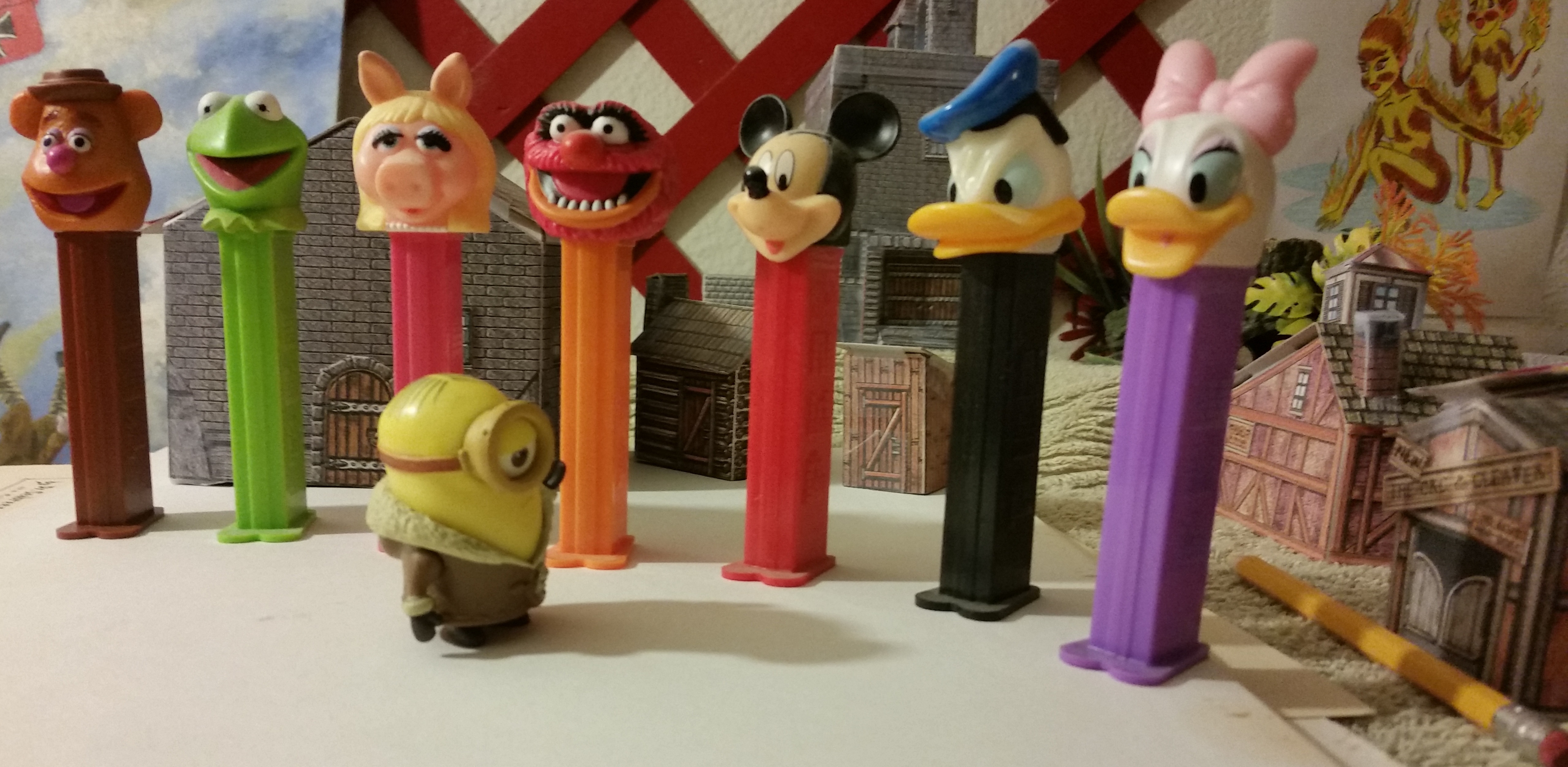
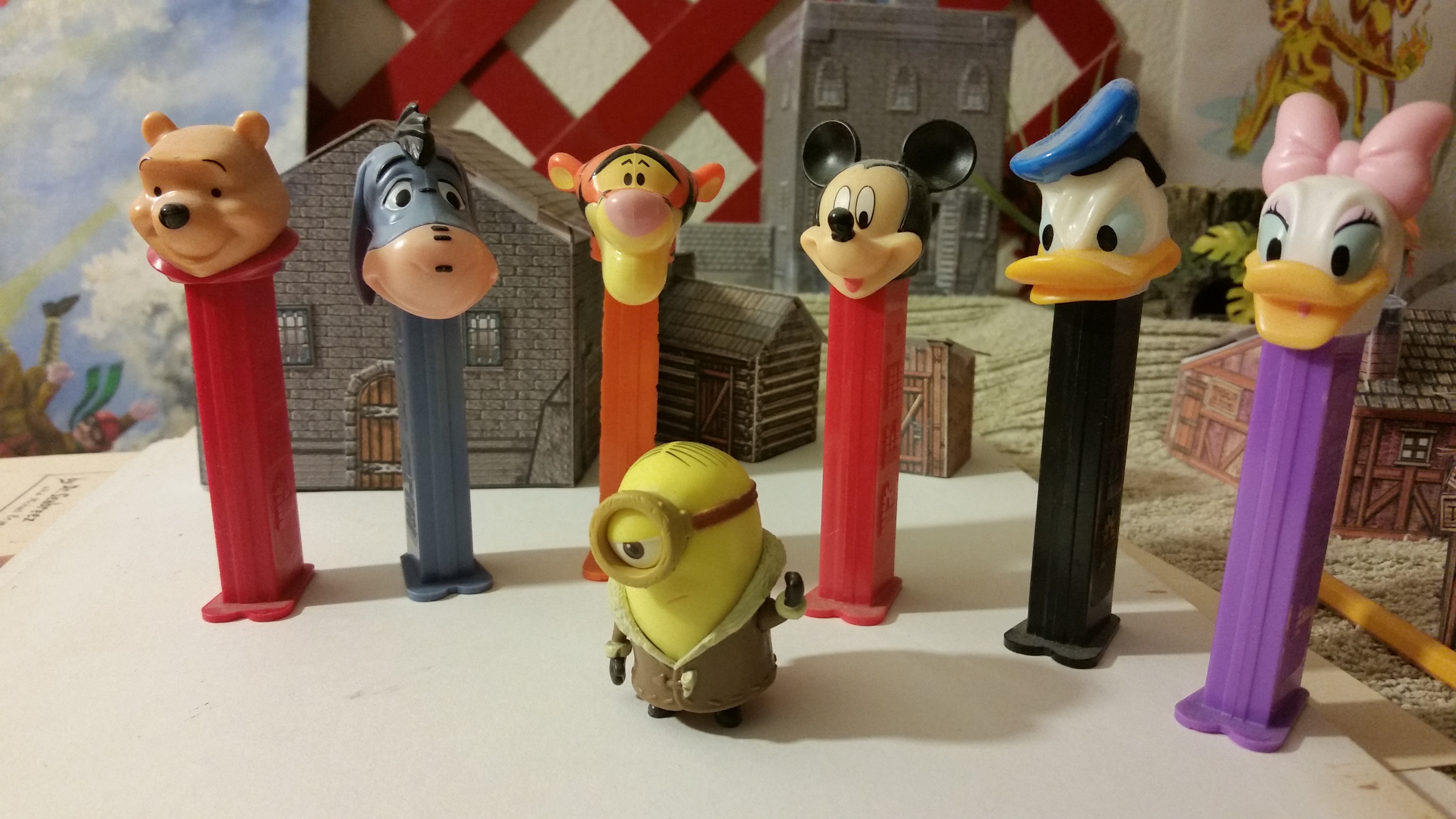
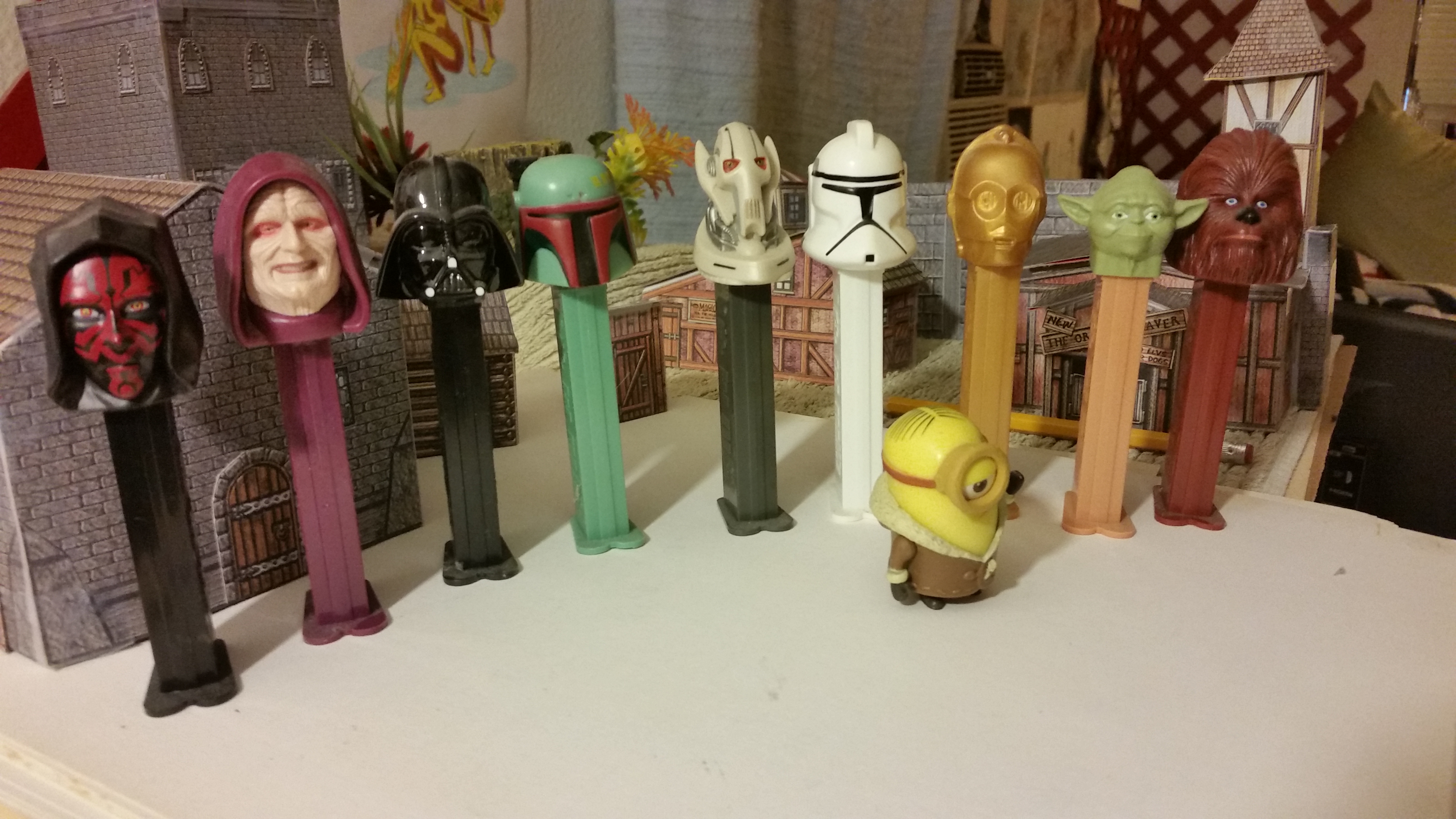
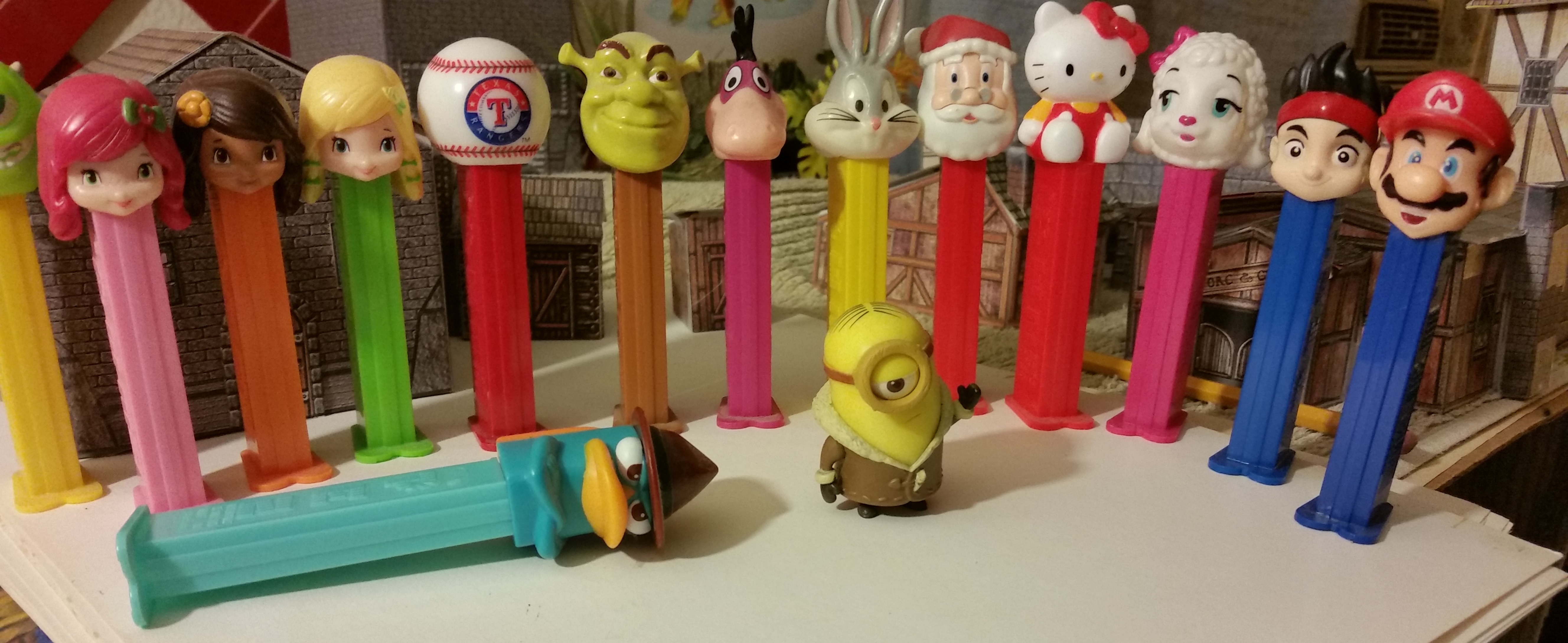
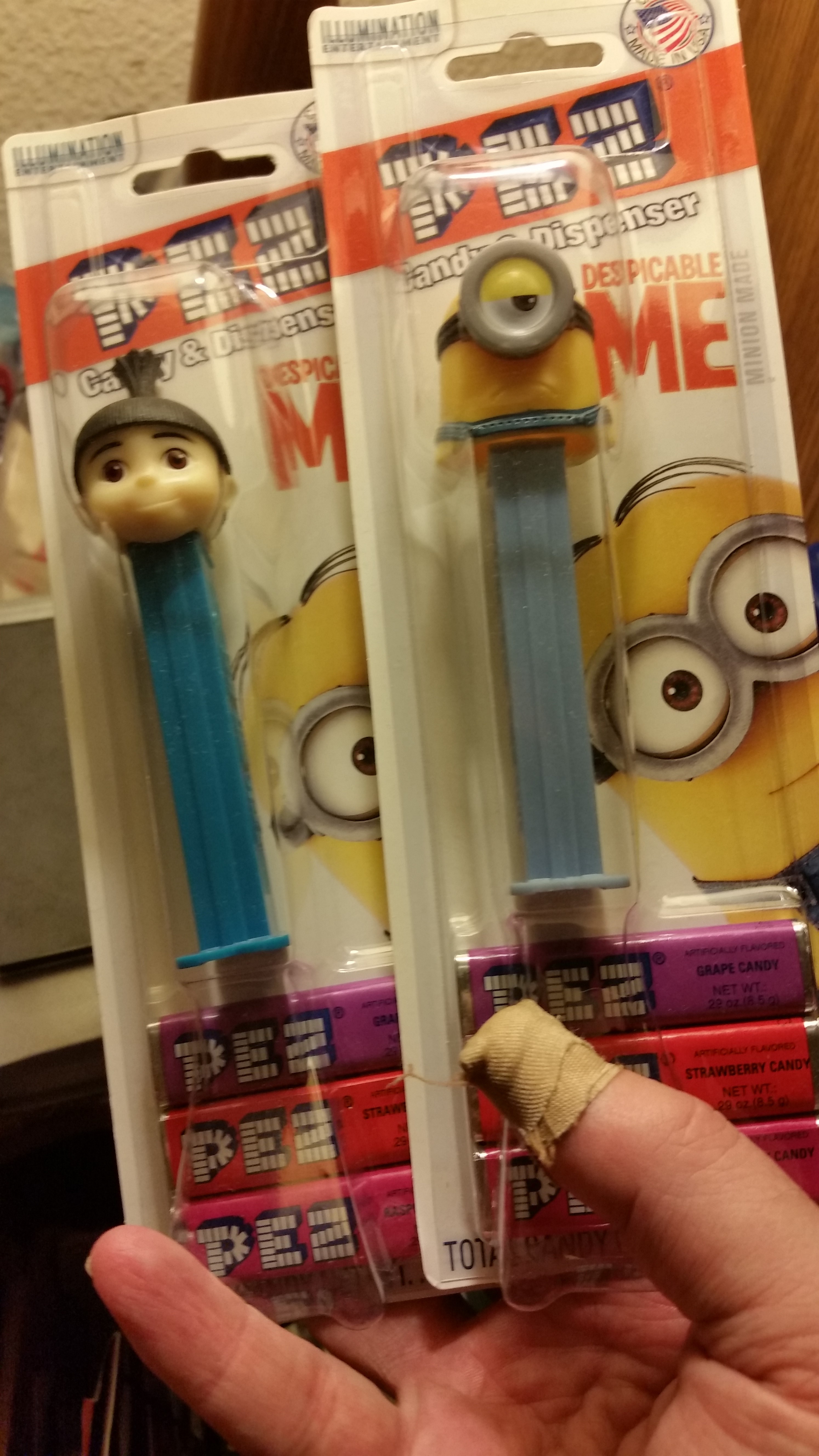
In 1927 in the mythical land of Austria, where they seem to know how to make candy… a condensed form of peppermint was created in a lozenge form and then placed into a plastic toy dispenser. The spells that were cast to make this magical item probably had nothing to do with toad warts and bat wings and eye of newt. It has more to do with Mickey Mouse, then Katzenjammer Kids, and Marvel Super Heroes. I have been caught under the spells of a PEZ fixation since childhood. I remember begging for a Bugs Bunny dispenser in Merle Hay Mall in Des Moines when I was probably six years old. My parents wisely said no hundreds of times when I was a kid. Who wanted to spend a nickel on a penny’s worth of candy? Just for a Pez dispenser. If they ever caved to my begging, even once, I don’t still have the dispenser. But now I am supposedly a responsible adult. I have money. Well, I used to have money before I spent it on collecting PEZ dispensers. I can’t even eat the the stupid candy. I have diabetes. So I feed the candy to my kids and risk giving them diabetes.
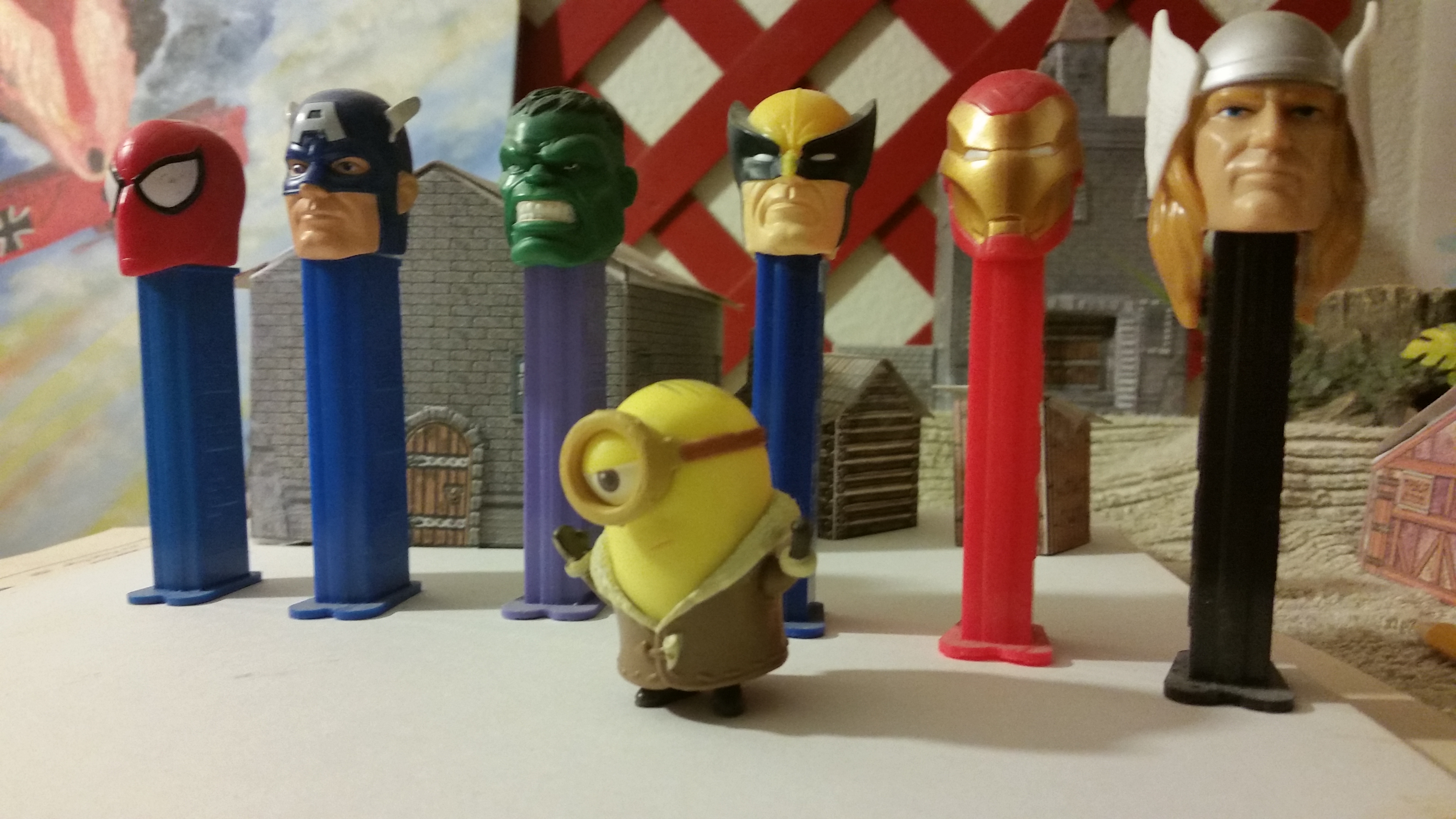
Here, my minion Stuart is showing off my Avengers collection. It took him nearly thirty minutes to line these six dispensers up so that they were all standing at once. The Hulk kept falling on him repeatedly.
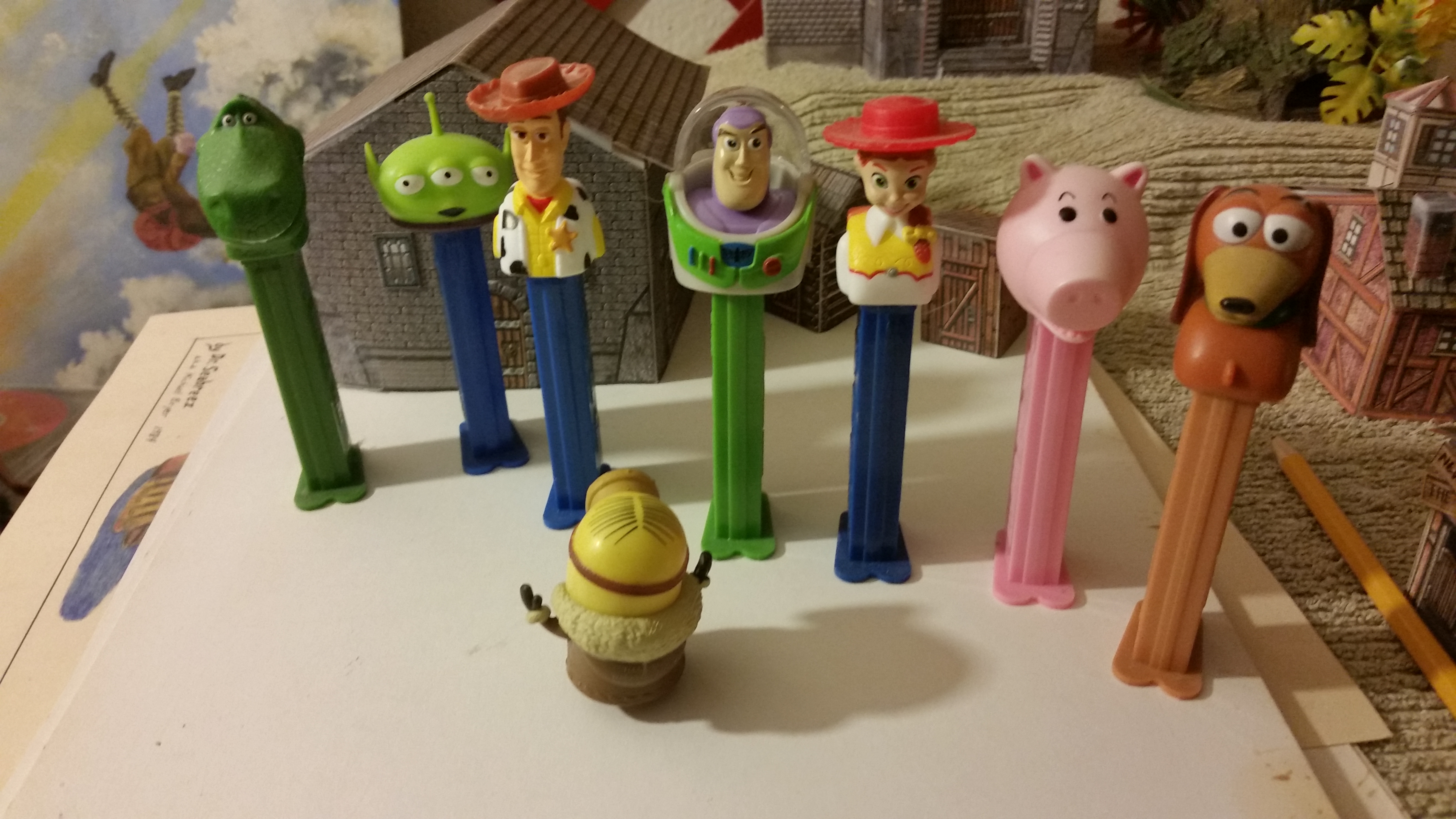
I am proud of my Toy Story collection. I had to go to some lengths to find some of these (particularly Slinky Dog and Rex).
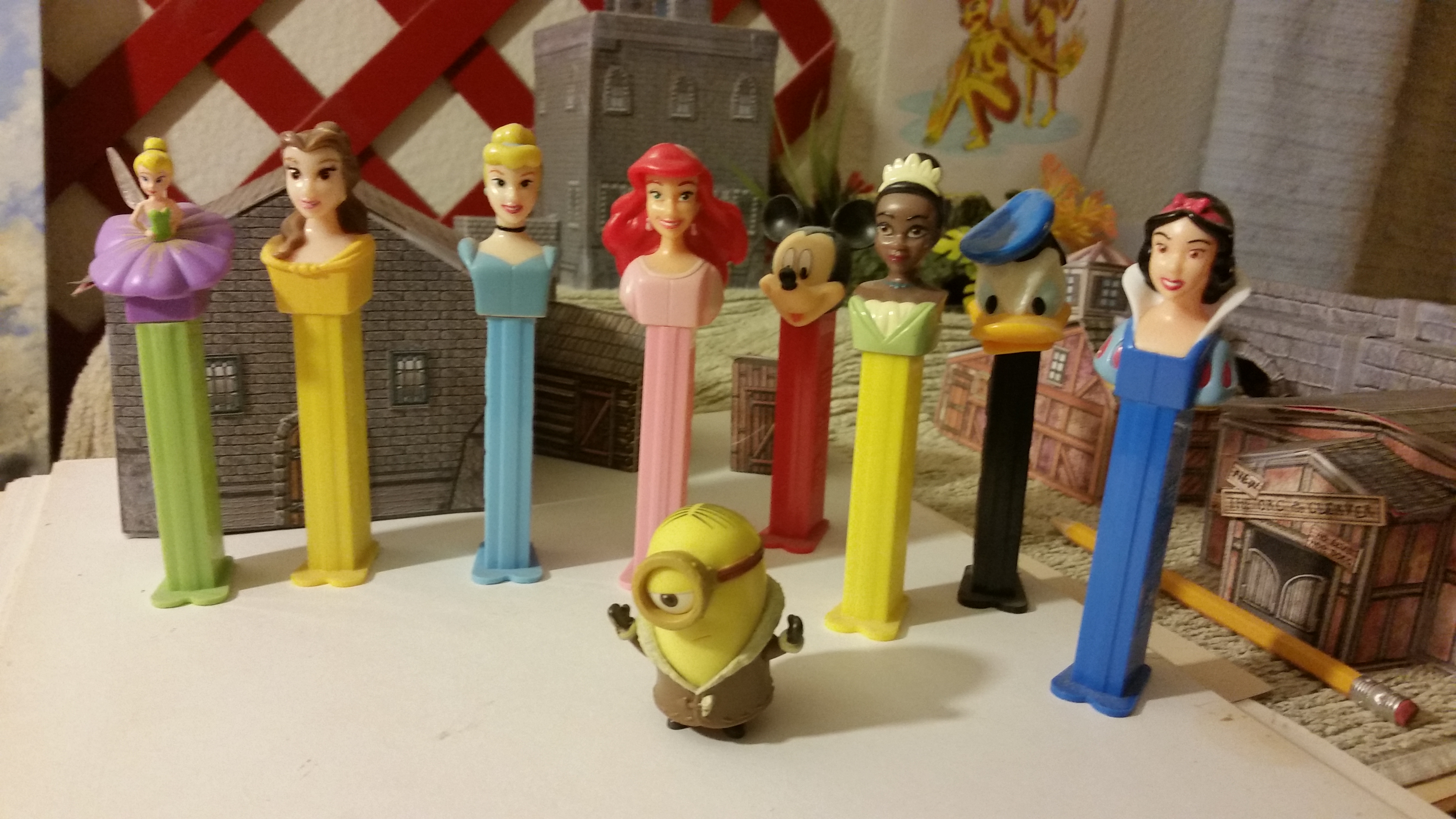
Disney Princesses were easy. Both at Walmart and Toys R Us they were all grouped together on the Disney hooks.
The Muppets were also grouped together with the Disney Pez.
Winnie the Pooh is Disney, too. I got some of these on discount at Toys R Us. I still need Piglet and Owl… and Christopher Robin. I don’t have an unbroken Minnie Mouse either. I had small children when I first started collecting these, and now I have fat children and a lot of empty Pez dispensers.
My Star Wars collection seems to be evil Pez dispensers and Yoda.
And poor Stuart is getting tired of standing up Pez dispensers, so I will end here without having shown you all of my PEZ dispensers. Besides, I have reason to keep the newest dispensers a secret from my minion.
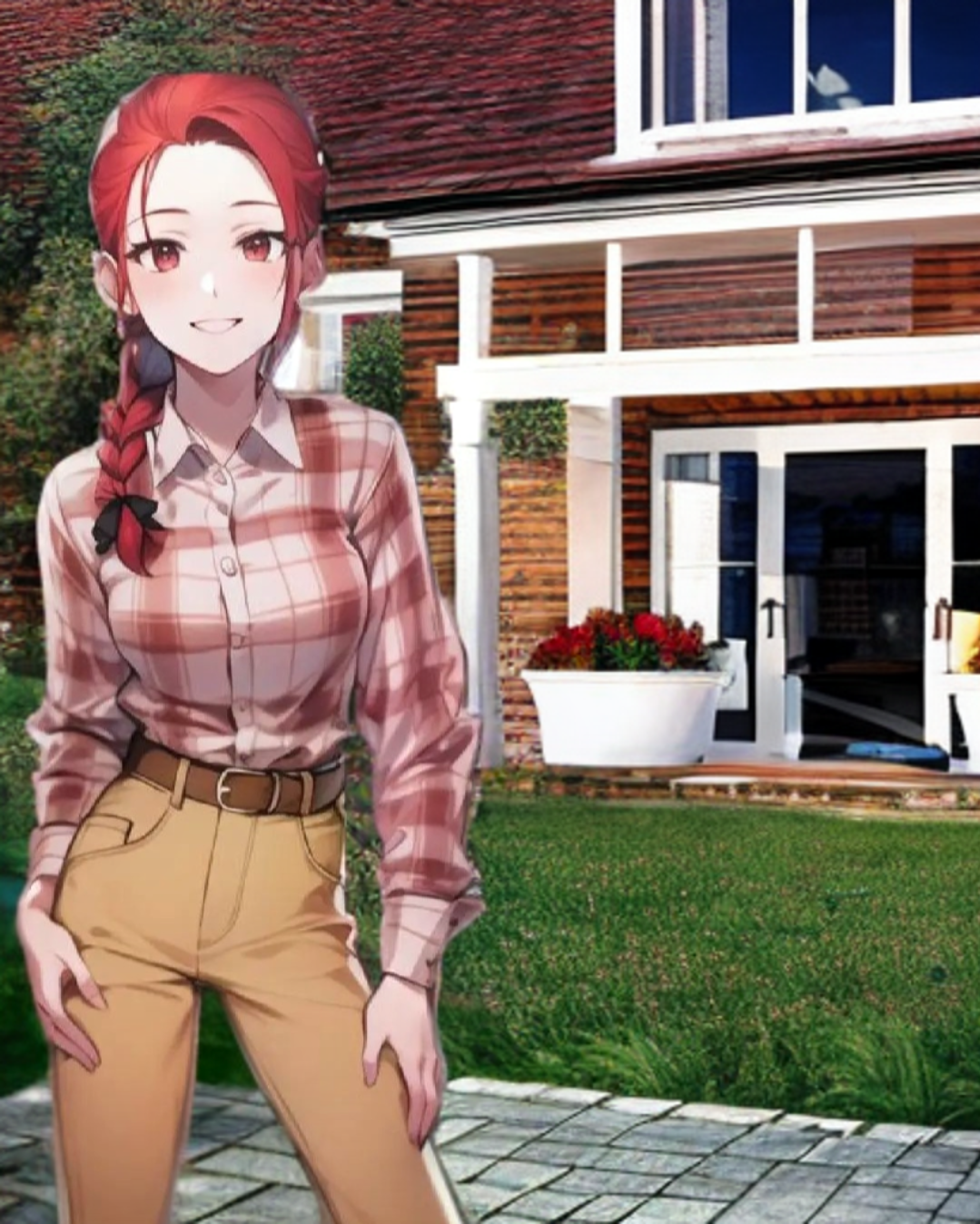
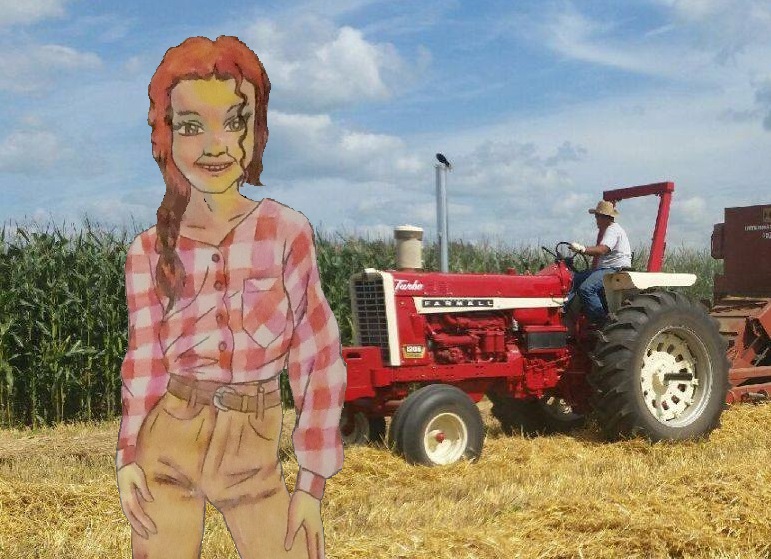
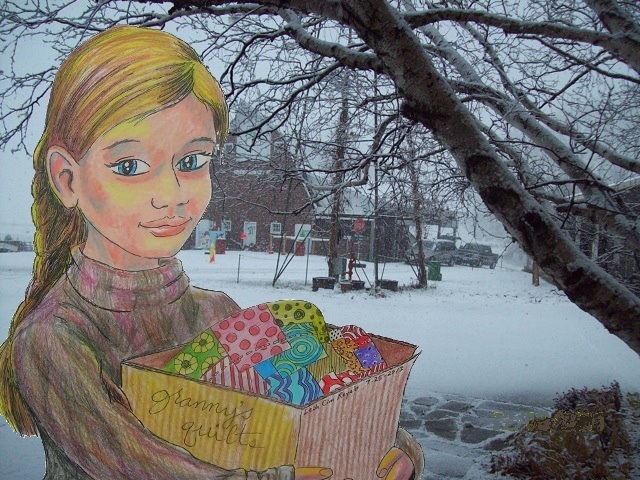
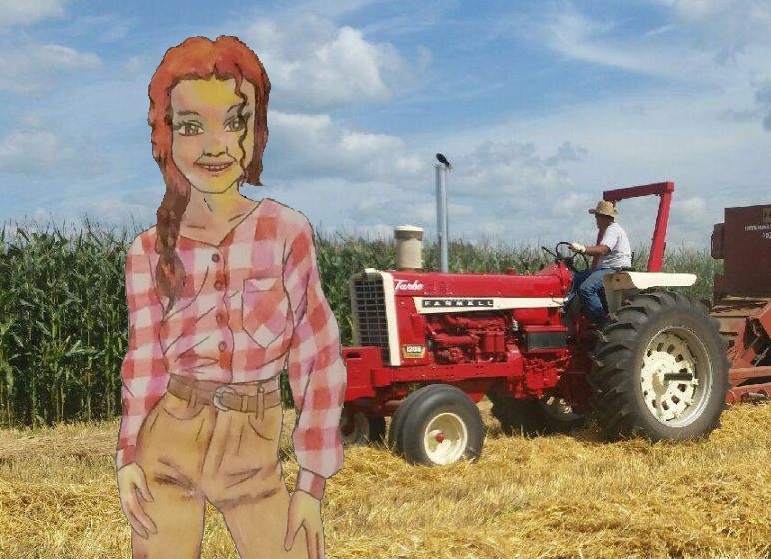
Farmgirl is adapted from a picture borrowed from the Belmond Area Arts Council.
I was born in Mason City, Iowa (the original River City of Meredith Wilson’s Broadway musical, The Music Man). But my parents didn’t hold with no big-city Ioway sort of life, so we eventually moved to my mother’s hometown, Rowan, Iowa. It was roughly about 275 people (if you count the squirrels… which a lot of the townsfolk were… qualified squirrels). My two maternal uncles and my grandparents were busy maintaining the family farm there, and though I lived in town because Dad was an accountant for a seed corn company instead of the farmer he grew up as… I got more than my fair share of farming-type opportunities. You know the stuff… shoveling pig poo… cow poo too… I got to help feed the chickens (and get chased by roosters, and get pecked by hens when we checked their nests for eggs, and watch the rooster rodeos as revenge for all the chasings… because roosters don’t lay eggs and the only thing they are really good for in an egg farming setting is lopping their heads off, and watching them flop around like rodeo bulls with no heads for fifteen minutes until they finally figured out they were dead, then plucking ’em and watching Grandma Aldrich cook ’em). I got to drive a tractor, although they didn’t trust me to do more than the simplest of tractor-driving jobs like pulling the hay rake. I got to shovel chicken poo out of the hen house and out of the brooder house. (Notice how a lot of the world of the lowly farm boy centers somehow on poo?) It was a rustic rural life reminiscent of Norman Rockwell… although he depicted mostly town life and not as much of the fields and animal pens (and poo) that are central to Iowegian farm culture.
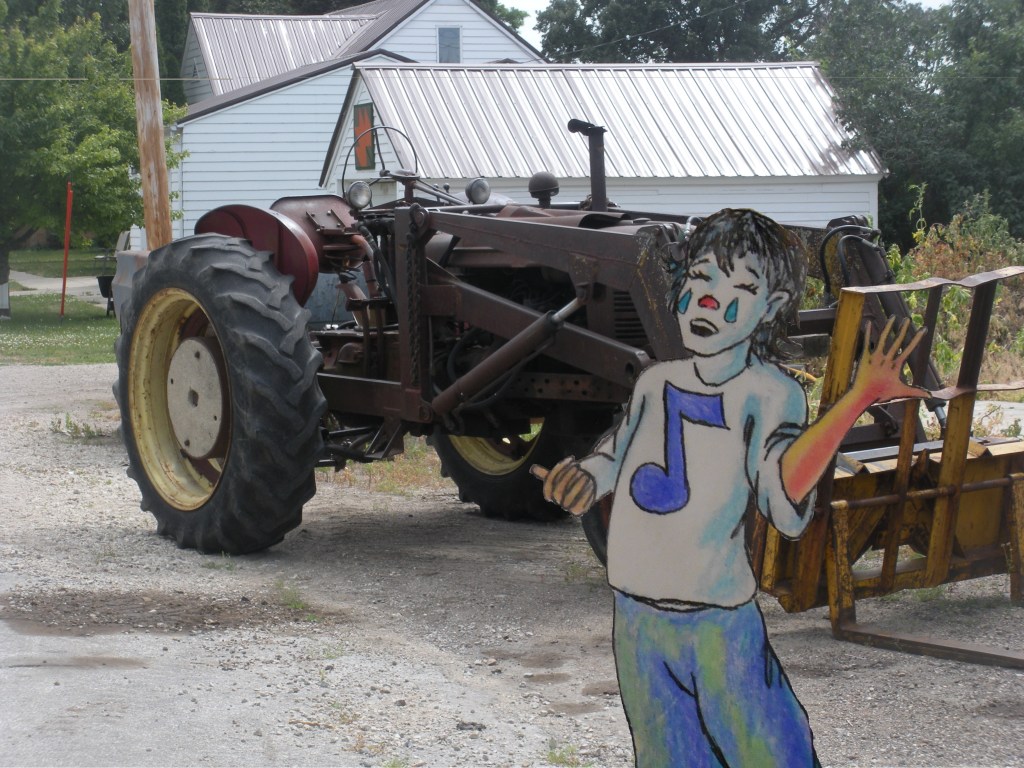
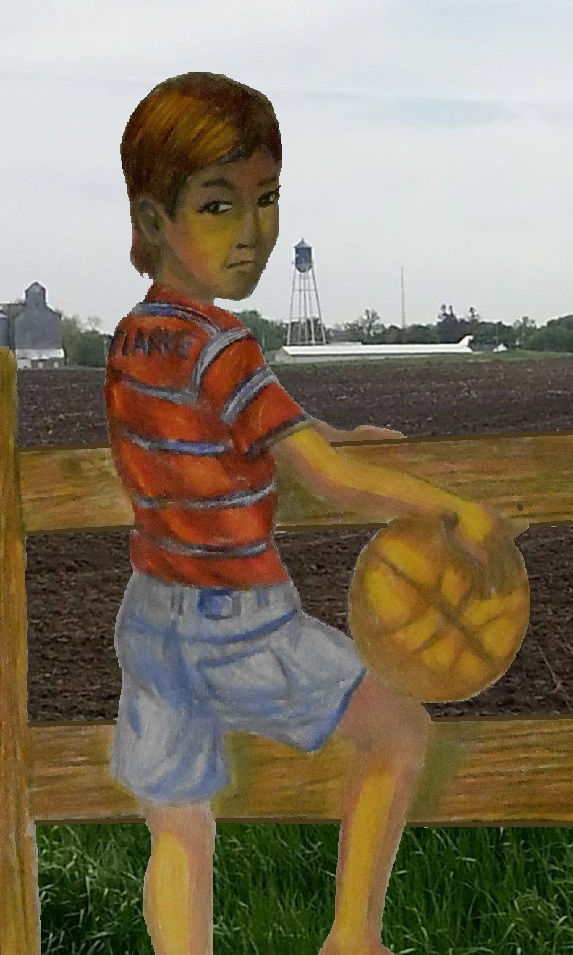
Brent Clarke is a me character in my stories… but also one of my farm boy friends.
Growing up a farm boy has a few advantages to go along with the many drawbacks. First off, you learn young where babies come from. Piglets and calves and puppies and kittens are not born in secret. And it doesn’t take much spying out on farm life to learn how those baby animals are made either. There is ample opportunity to learn what you are not supposed to learn at a young age from farm girls too… but we were gentlemen… and extremely embarrassed by the fact that baby people are made in the same grisly, awful way that baby animals are out in the barn.
You also learn to be somewhat self-sufficient. I learned how to tend a garden. I learned how to fix a flat. I learned how to repair a roof and build a rabbit pen. Hammer, pliers, screwdriver, saw… I learned to use them all and make stuff. Crude stuff, sure… smashed-finger-with-hammer-stuff too. I made a bookshelf in shop class that had a bit of Michael blood built into it. But I learned things that boys should know, and really don’t anymore.
So, I guess I am claiming that because I am an Iowa boy… a farm boy… and despite my many shortcomings and short-changings, my life has been good and worthwhile… being a farm boy is good. And one of the greatest shames of the modern world is this… There just aren’t many farm boys anymore.
I have to come to terms with not having much longer on this Earth. And things go wrong more than they go right because I am old, have had arthritis for fifty years, and am losing my eyesight. I dropped my meal in the bowl I was using to make it this evening. I had to settle for a toasted cheese sandwich. I have to give up my library and a lot of my doll collection to move to Iowa, a move that was delayed at least two months by my heamrt problem. There is war with Iran to ponder, which may kill us before the climate-change weather does. WWIII? I am feeling doomed in any case.
On the good side, I got my novella done and published… finally. But Amazon has changed rules again on the paperback. I can’t publish in paperback until it reaches 72 pages. I still have to figure that out.
However, the essential fact is that I have achieved my life’s purpose. 25 books published. The authorities worry about male teachers hugging students. Republicans holler about “groomers.” I never offered a hug or asked for a hug in 31 years as a teacher. But they hugged me well over a hundred times. Both boys and girls. Because they wanted to, or needed to. That is proof you made a difference in the classroom.
I do still feel like crying anytime I remember the kids who hugged me that are now dead by their own hands, dead by alcohol or drugs, or institutionalized for poor life choices. There is more than one in each category. But they are the exceptions, not the rule.
My family is all still alive and healthy, no simple task that. My wife is still teaching. My three kids are now all functioning adults.
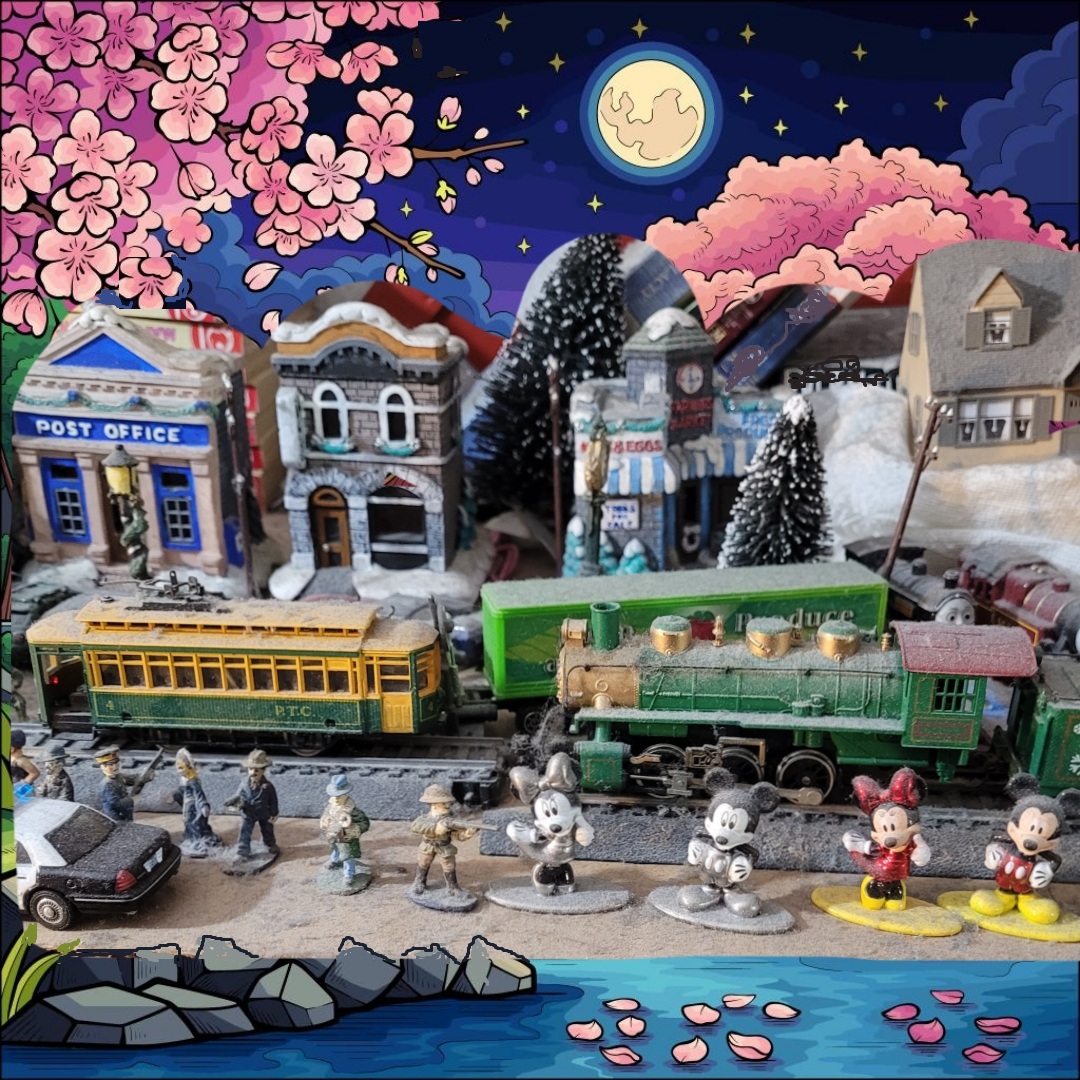
So, there are sad times now in Toonerville, the place Mickey lives in his own stupid head. But that’s okay. The universe is unfolding as it should.
After years of being stored away, I discovered that my mother had hidden a hoard of my old artworks in the upstairs closet in Grandma Aldrich’s house (now my parents’ house).
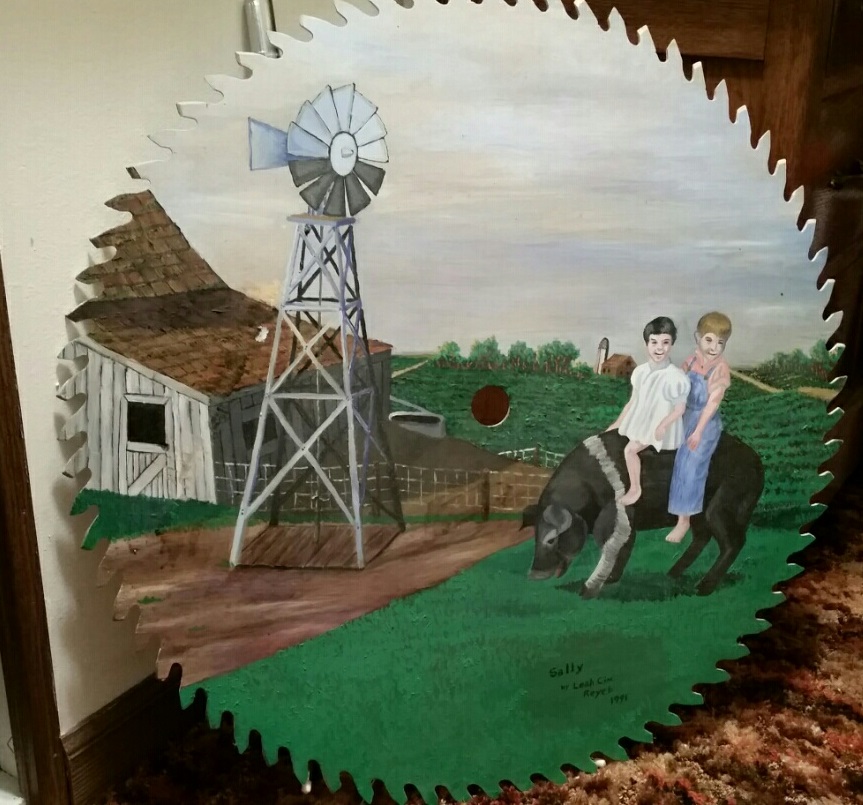
This oil painting was done on an old saw blade at the request of my Grandpa Aldrich. He wanted a farm painting on it, like the one he’d seen in a restaurant during a fishing trip in Minnesota. I chose as the subject Sally the pig. Sally was a hairlip piglet that had to be bottle fed and raised in a box by the stove until later in life she became a favorite pet. Believe it or not, pigs are smarter than the family dog. She became a pig you could ride. And Grandma had taken a precious old photo of my mother and Uncle Larry riding the pig. I used that photo to make this painting. It was also the painting I wanted to find on this trip to Iowa. Searching for it led to finding all the others.
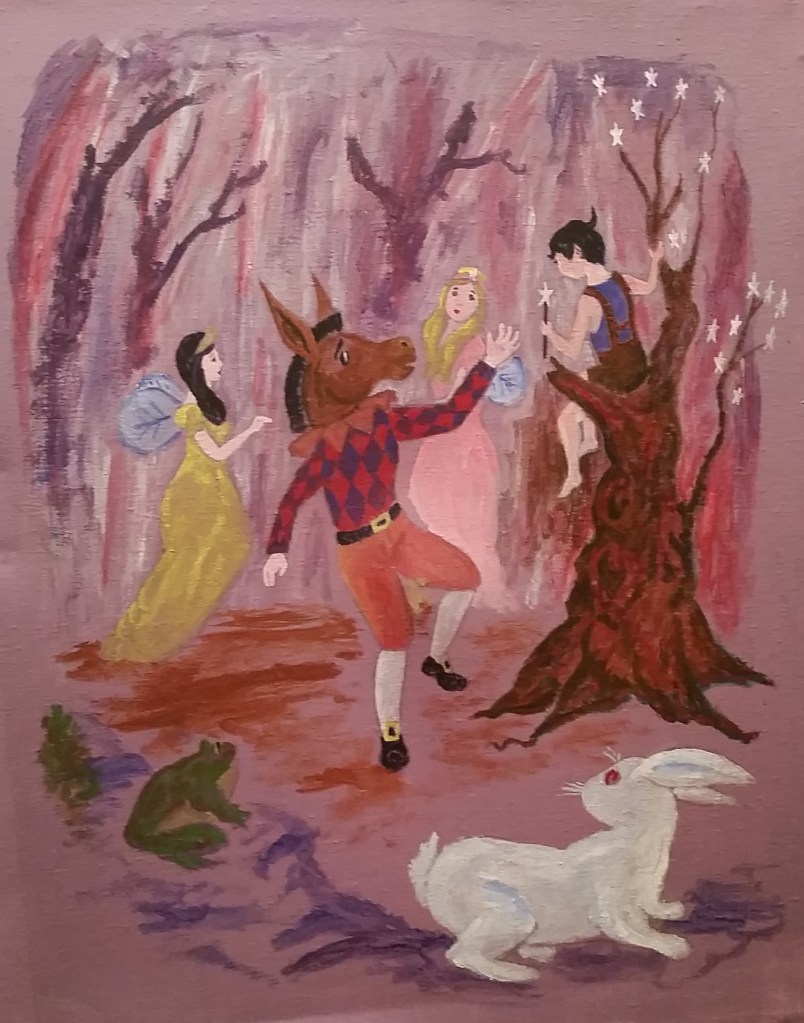
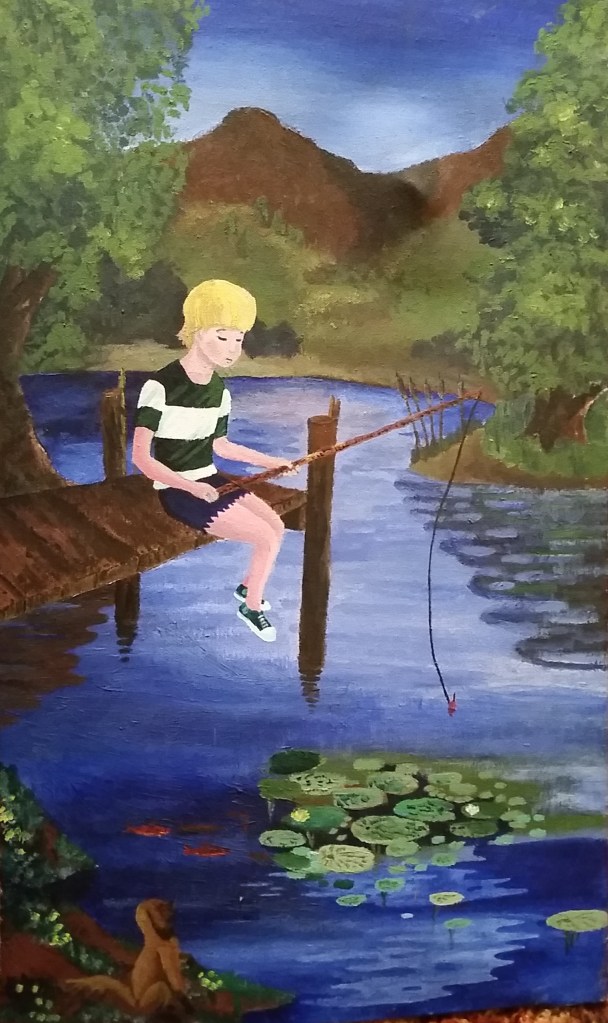
These two are among the earliest paintings I did. They were both done on canvases that I stretched over the frame myself in high school art class. The purple one is a scene from Shakespeare’s Midsummer Night’s Dream. The blue one doesn’t have a title, but you can see what it is. It is an ancient shibboleth water monster lurking under a dock, fishing for young boys to eat.
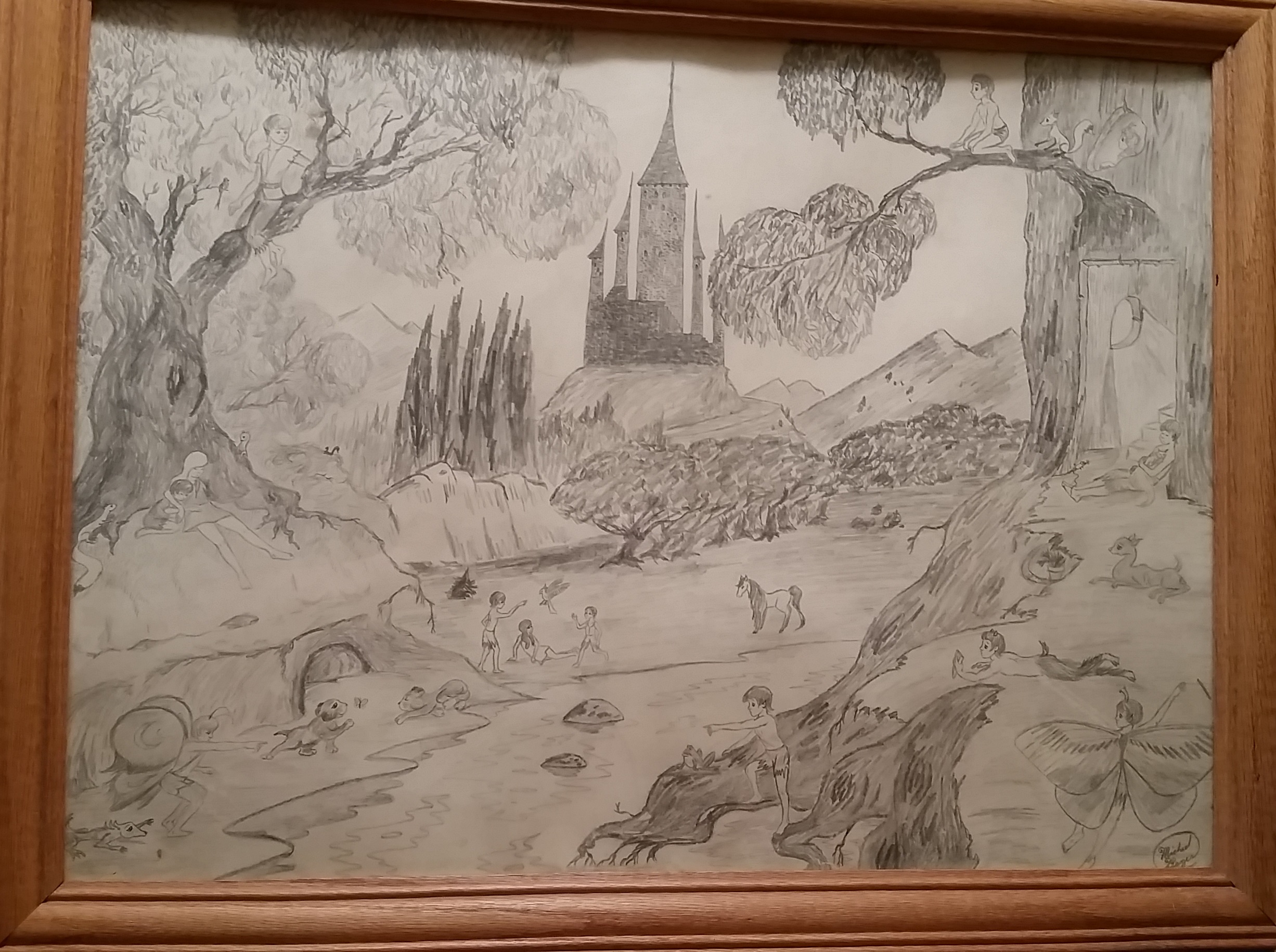
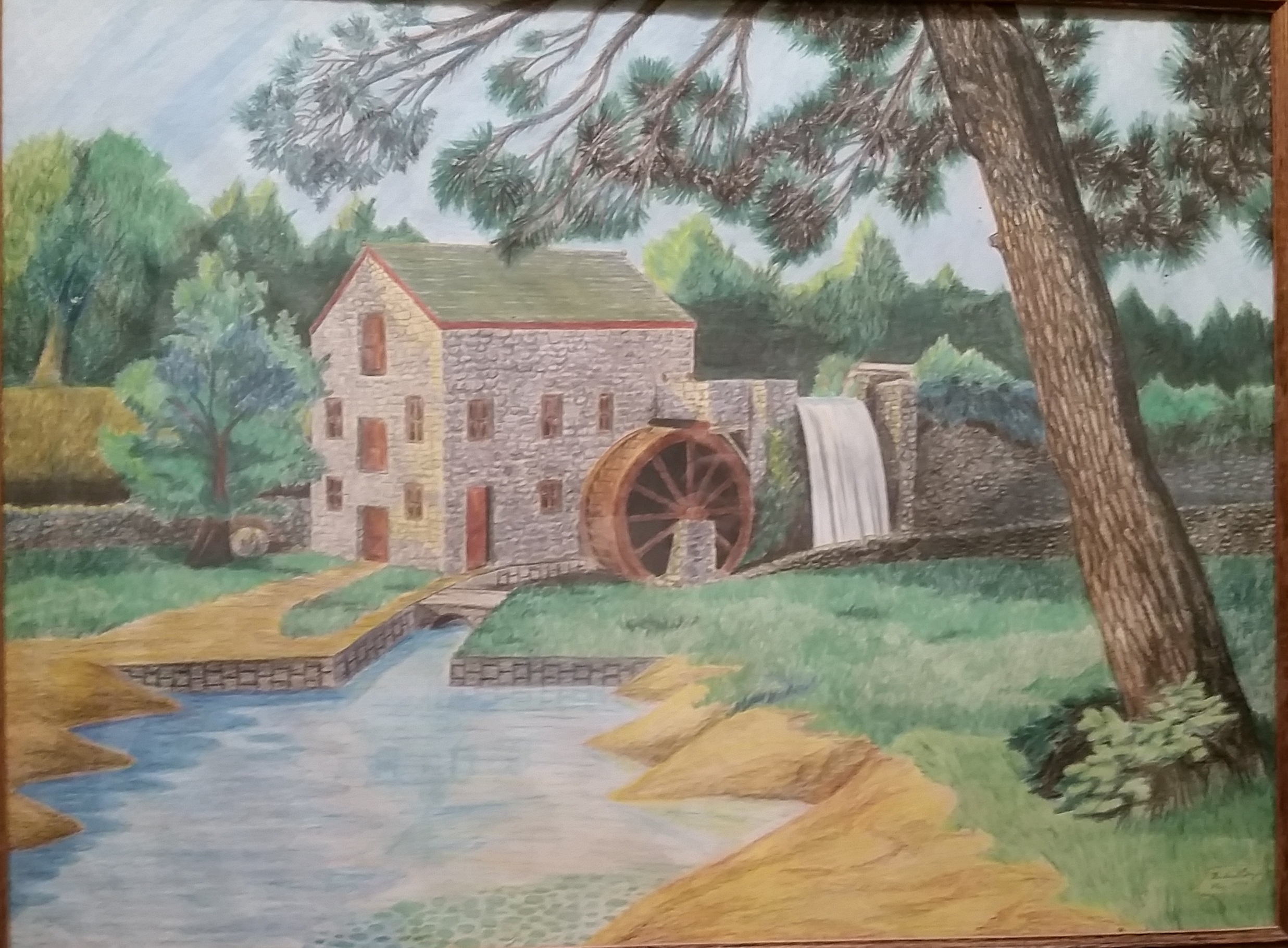
This drawing was done on the front porch in the house in Rowan. It would be years before mom framed it. It is another example of what I could do as a high school kid. In fact, I composed it from art-class sketches I did my senior year in school.
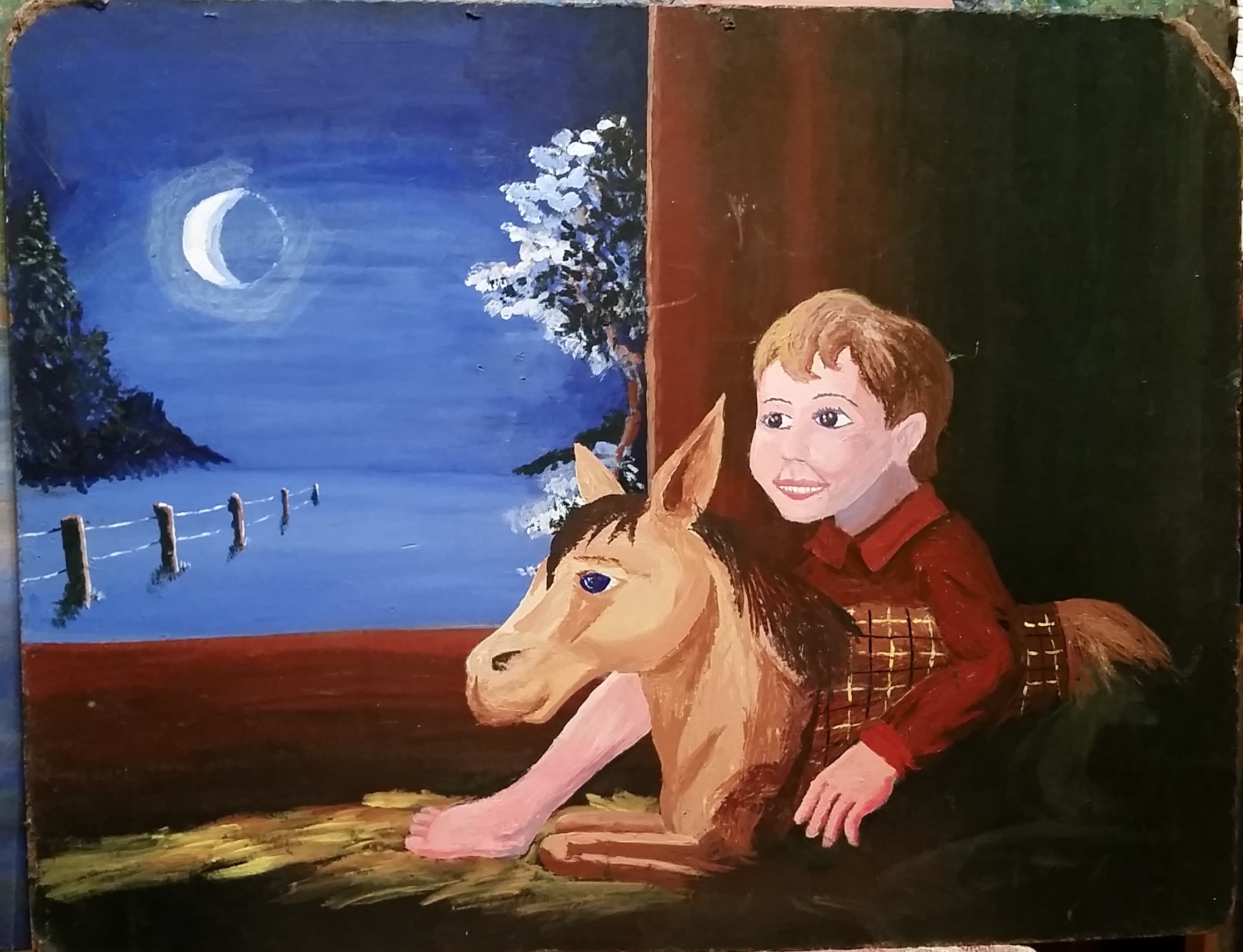
The Boy in the Barn was painted on the remains of an old chalkboard that my sisters, brother, and I had used in grade school.
Grandma Aldrich asked for this picture to hang over the sofa in the farmhouse living room. It stayed there for many years.
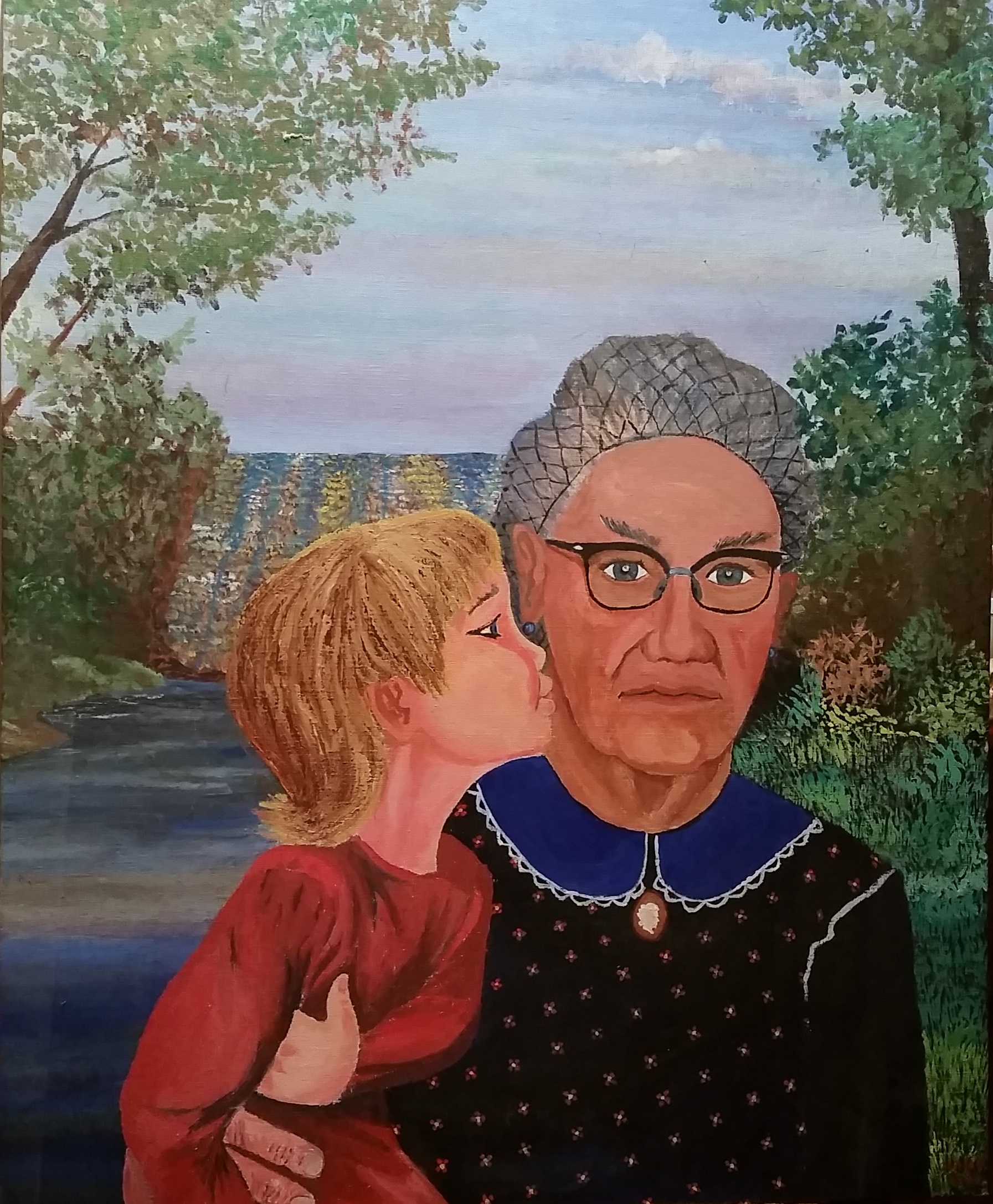
Great Grandma Hinckley passed away in 1980. I created this portrait from a combination of photos and memory. It was too good. It was never hung anywhere because it always made her daughter, my Grandma Aldrich, tear up.
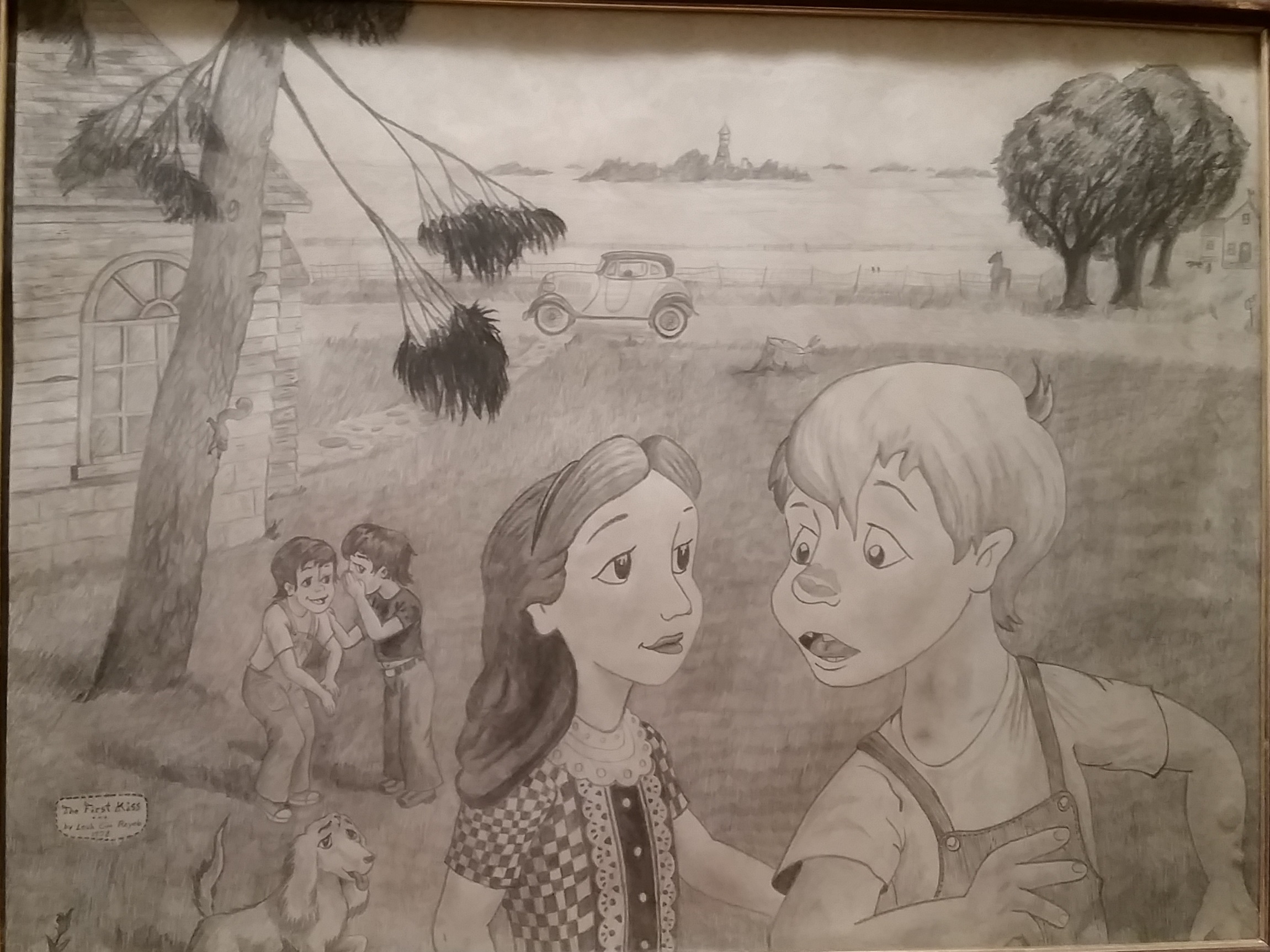
This pencil drawing won a blue ribbon at the Wright County Fair in the late 70’s.
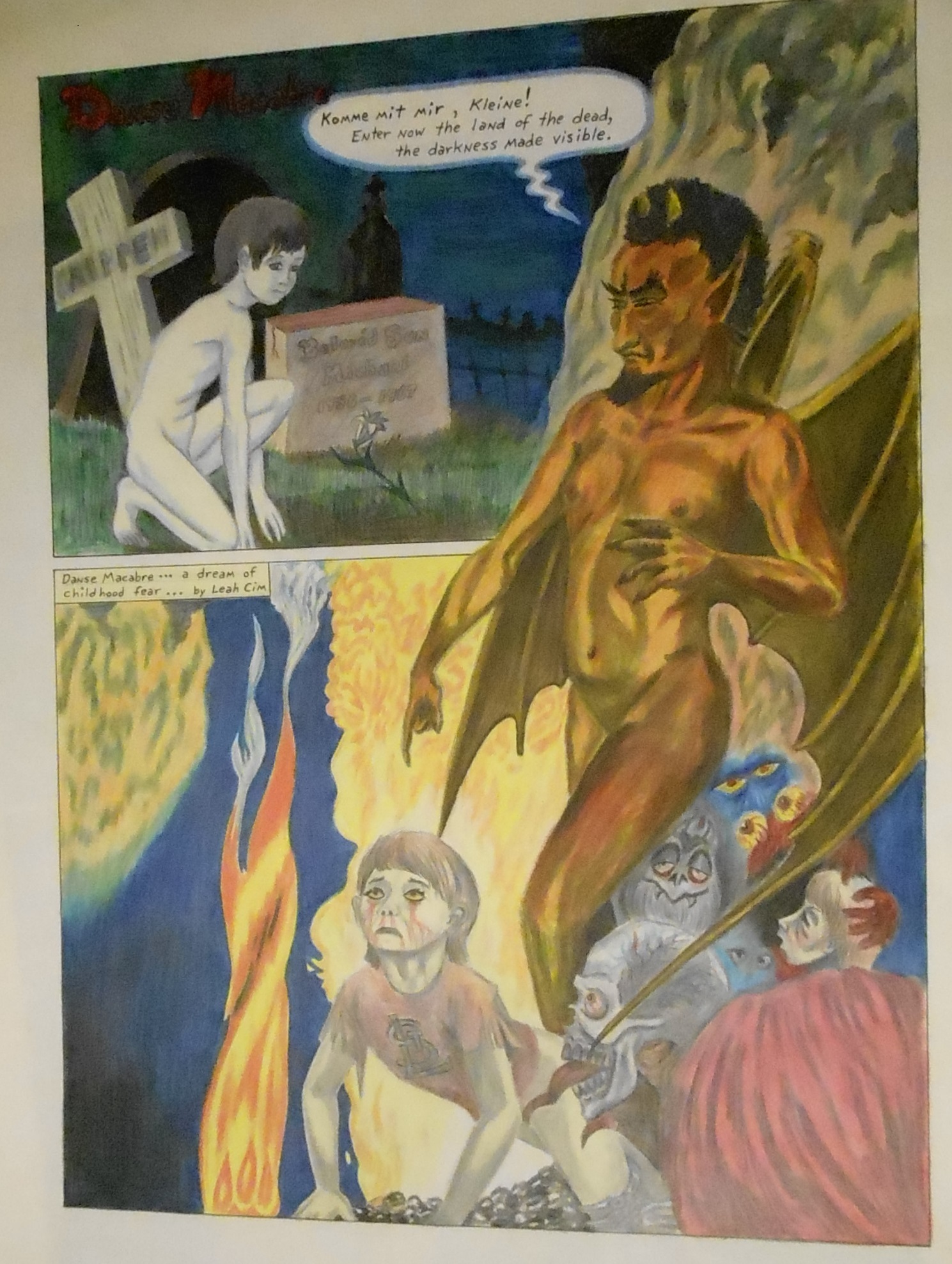
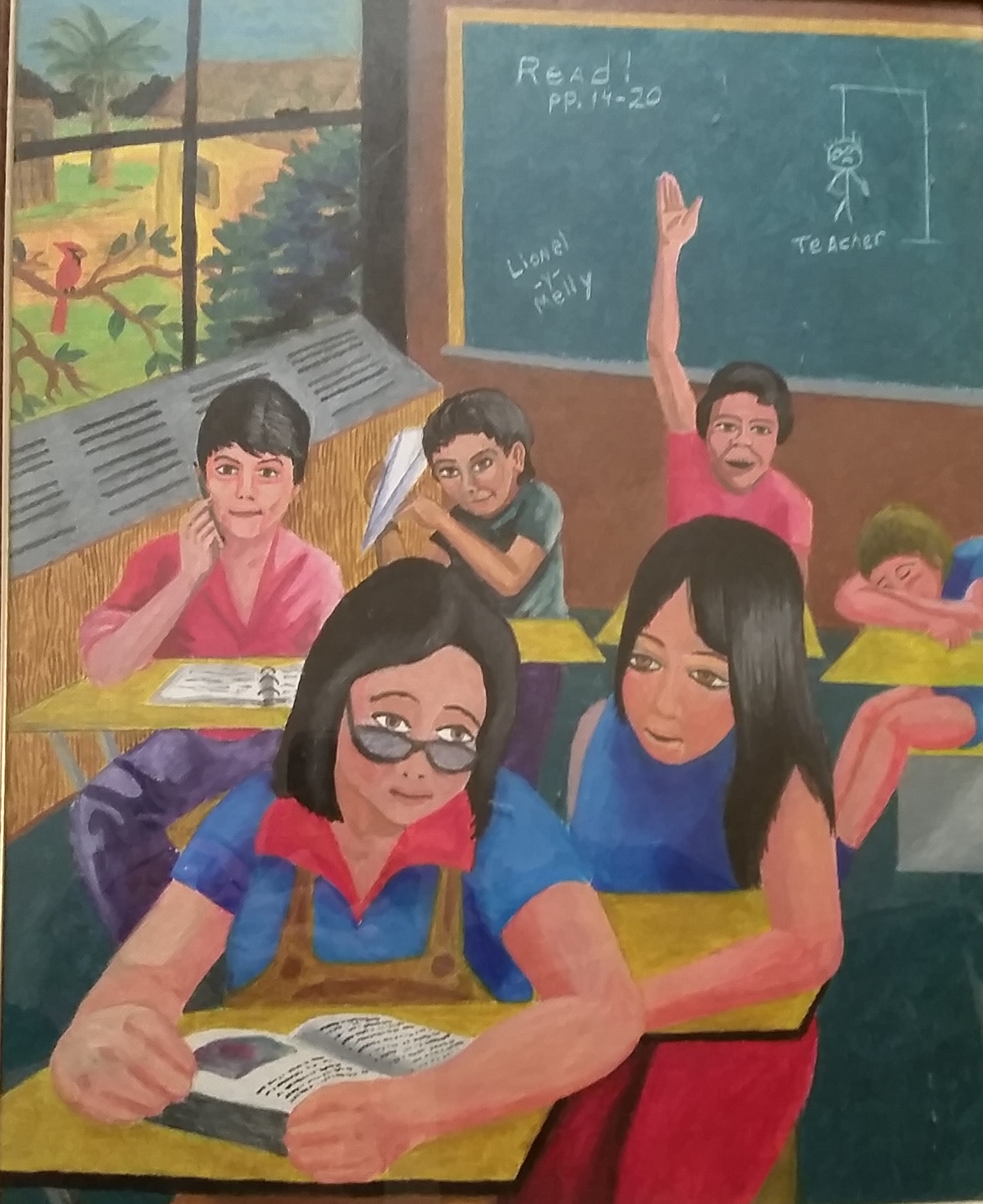
This picture is called First Years are Hard Years. It was painted in 1982 after my first year of teaching at the junior high school in Cotulla, Texas. I painted mostly the good kids. The girl on the lower right would later go on to become a teacher for our school district. I can’t claim to be the one who inspired her, but she did make straight A’s in my class.
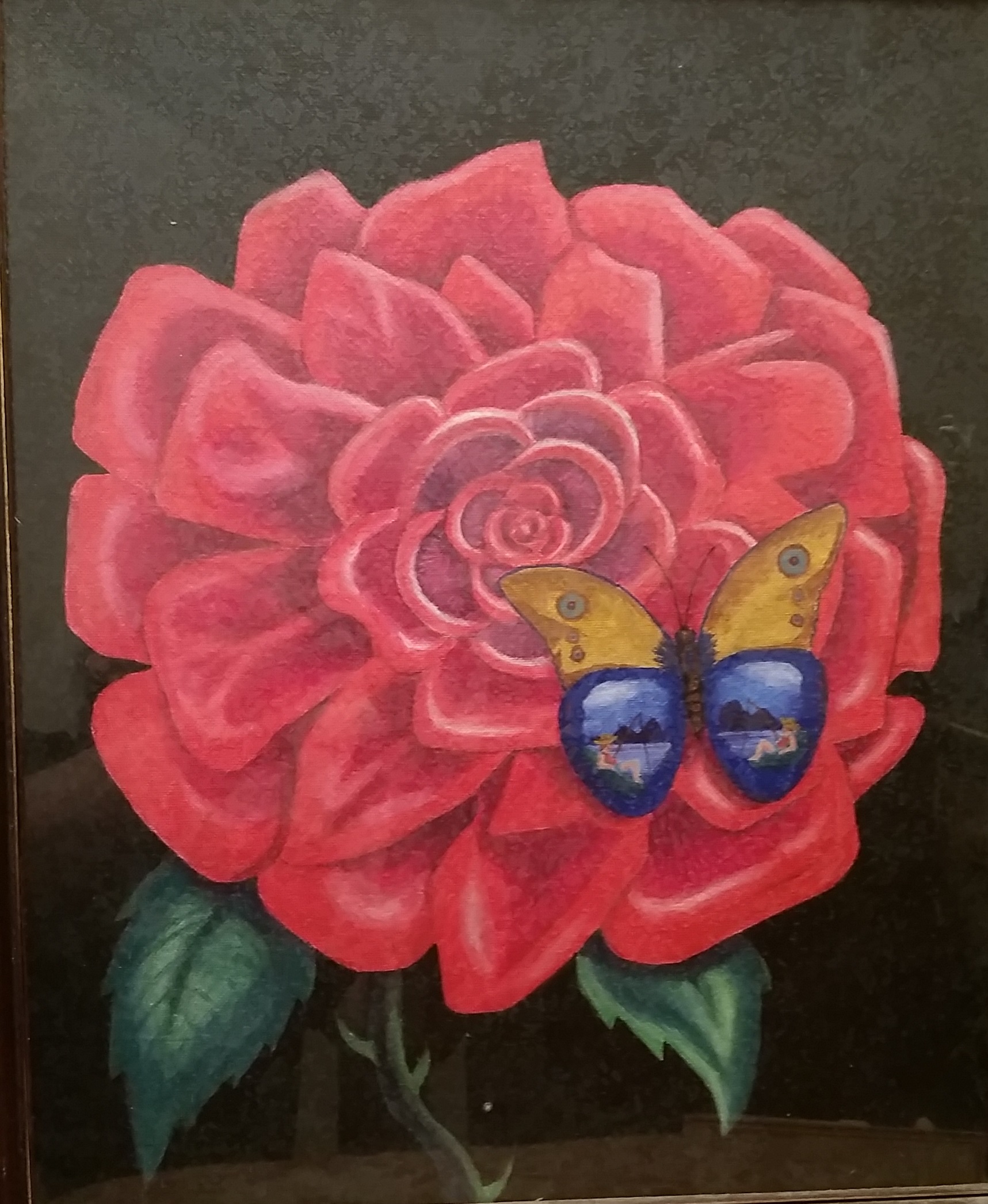
This is called Beauty. It is done in oil crayon on canvas. I did it for my mother to hang in the hallway in the house in Taylor, Texas.
So, it turns out, I unearthed art treasures by searching for the one painting.





Strawberry Fields
This foolish essay about berries that mean love to me is only partly inspired by the Beatles song, “Strawberry Fields Forever.” That’s because, of course, their song was only about meditating. In the lyrics they take you to the “Strawberry Fields where nothing is real… but it’s nothing to get hung up about…” They are talking about a blissful place of no worries where we all need to go. And then staying there forever.
This, of course, I could never do. Worrying about the future is tattooed on my behavioral imperatives in the dark part of my stupid old brain. And while I often found that place of no worries, and lingered there for a bit, I found you could never really get anything done if you stayed in that state of strawberry fields forever.
But don’t get me wrong, strawberries are a critical part of every healthy mental diet.
You see, my meditations on strawberries when I was a child of eight, nine, and ten centered on the strawberry patch at Great Grandma Hinckley’s place.
She was, as I incorrectly recall, slightly older than Jesus when I was that age. By that I mean, though she seemed museum-quality ancient to me, I had derived wisdom about life, love, and laughter from her before Sunday School taught me any of those things said in Jesus’s words.
And I was given the task of mowing her lawn in the little plot of land surrounding her little, tiny house in the Northern part of Rowan where I also lived and grew and celebrated Christmas and Halloween and Easter and the 4th of July. And though I was doing it because she was so old, I never even once thought she was too old and frail to do it herself. Grandma Hinckley’s willpower was a force of nature that could even quell tornados… well, I thought so anyway when I was eight. And she gave me a dollar every time I did the lawnmowing.
But there were other things she wanted done, and other things she wanted to teach me. There was the garden out back with the strawberry patch next to it. She wanted me to help with keeping the weeds and the saw grass and the creeping Charlie from overrunning the strawberries and choking them to death. (Creeping Charlie wasn’t an evil neighbor, by the way. He was a little round-leafed weed that grew so profusely that it prevented other plants from getting any sunlight on their own leaves, causing a withering, yellowing death by sunlight deprivation. I took my trowel to them and treated them like murderers. I showed them no mercy.)
And Grandma always reminded me not to be selfish and eat the very berries I was tending in the garden. She taught me that eating green strawberries (which are actually more yellow than green, but you know what I mean) was bad because they could give you a belly ache, a fact that that I proved to myself more than once (because eight-year-olds are stupid and learn slowly.) She also taught me that it is better to wait until you have enough strawberries to make a pie, or better yet, strawberry shortcake with whipped cream. She taught me that delayed gratification was more rewarding in the long run than being greedy in the short run and spoiling everything for everybody.
She always gave me a few of the ripe strawberries every time I helped her with them, even if I had eaten a few in the garden without permission. Strawberries were the fruit of true love. I know this because it says so in the strawberry picture. Even though I probably never figured out what true love really means.
My Great Grandma Nellie Hinckley was the foundation stone that my mother’s side of the family was built on. She was the rock that held us steadily in place during the thunderstorms, and the matriarch of the entire clan of Hinckleys and Aldriches and Beyers and other cousins by the dozens and grandchildren and great grandchildren and even great great grandchildren. I painted the picture of her in 1980 when she passed away. I gave it to my Grandma Aldrich, her second-eldest daughter. It spent three decades in Grandma’s upstairs closet because looking at it made Grandma too sad to be so long without her. The great grandchild in the picture with her is now a grandmother herself (though no one who has seen this picture knows who it is supposed to be because I painted her solely from memory and got it all wrong.) But Grandma Hinckley taught me what true love means. And true love has everything to do with how you go about taking care of the strawberry patch.
Leave a comment
Filed under artwork, autobiography, commentary, family, health, humor, mental health, Paffooney, philosophy, strange and wonderful ideas about life
Tagged as family, life, love, memories, writing