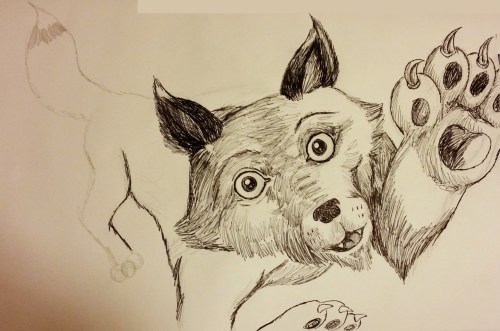
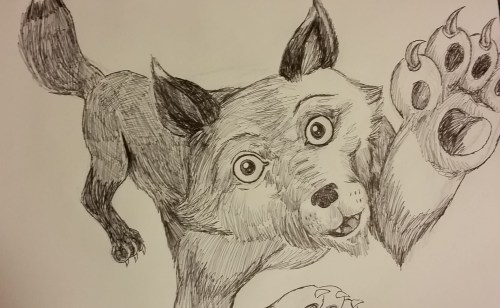
While watching Netflix yesterday afternoon, a retirement activity that becomes the majority of my social life when the diabetes demons are eating me, I started doodling a fox. It was a pencil doodle at first. And I was not drawing from life. I was drawing the fox in my head. I suspect it was the fox from Antoine de Saint Exupery’s masterwork, The Little Prince.
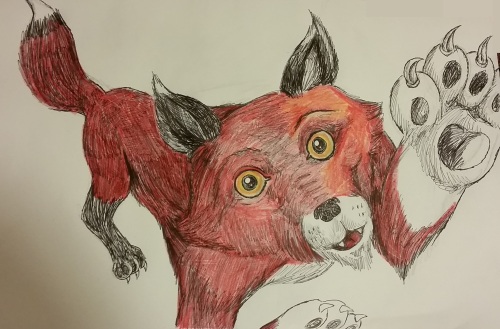
Yes, that fox. The wise one that knows about taming little princes, and loving them, and being reminded of them in the color of wheat fields. I began to need that fox as my doodle pen uncovered him on the blank page. There he was. Surprised to see me. Either he was leaping towards me in the picture, or falling down on me from the sky above. I don’t know which. But I realized I had to tame him by drawing him and making him as real as ever an imaginary fox could ever be. You will notice he does not look like a real fox. I did not draw him from a photograph, but from the cartoon eye in my mind where all Paffoonies come from. And this was to be a profound Paffooney… a buffoony cartoony looney Paffooney. It simply had to be, because that is precisely what I always doodle-do.
And so he was a fox. He was my doodlefox. I had tamed him. And then I had to give him color. And, of course, the color had to be orange-red.
And so, there is my fox. Like the Little Prince’s fox he could tell me, “What is essential is invisible to the eye. It is only with the heart that we can see rightly.” And I put him in a post with lyrical and somewhat goofy words to give you a sense of what he means to me, in the same way one might explain what the thrill of the heart feels like when a butterfly’s wing brushes against the back of your hand. Yes, to share the unknowable knowledge and the unfeelable feeling of a doodlefox. A demonstration of precisely what a Paffooney is.
Nobody who wants to be a writer gets by with just writing and never reading anything by anybody else. It is too easy to devolve into some kind of human mushroom that way, thinking only thoughts a mushroom could think, all fungus-like and having no chlorophyll of their own. You never learn to decode other people and other people’s thinking if you don’t read other people’s thoughts crystallized in writing.
And not every other writer is Robert Frost. Or even Jack Frost who thinks he’s Gene Kelly. There has to be some interpretation, some digging for understanding. What did that writer mean when she said political correctness was like a tongue disease? And what does it mean when a commenting troll calls me a nekkid poofter? Is that how he spells “exceptional genius”? I think it is. Trolls are not smart.
I know people have to make an effort to understand me. When I write, I am writing under the delusion that I can produce literary quality off the top of my head. In fact, I can barely produce hair off the top of my head, and it is gray when I do it. See what I did there? It is the kind of joke a surrealist makes, pretending the idiomatic expression you use is to be taken literally when it doesn’t literally make sense. That kind of nonsense is what my readers have to put up with, and probably also the reason why most of them just look at the pictures. If you have to think too hard when you read, your brain could over-heat and your hair could catch fire. I like that kind of purple paisley prose that folds back in on itself and makes you think in curlicues. But most people don’t. Most people don’t have fire-proof hair like I do.
Of course, there is the opposite problem too. Some writers are not hard to understand at all. They only use simple sentences. They only use ideas that lots of other people have used before. You don’t have to think about what they write. You only need to react. They are the reasons that words like “trite”, “hackneyed”, “boring”, and “cliche” exist in English. But simple, boring writing isn’t written by stupid people. Hemingway is like that. Pared down to the basics. No frills. Yet able to yield complex thoughts, insights, and relationships.
Sometimes, it doesn’t even take a word to make the point. For instance, why, in the picture, is Fluttershy trying to drink out of the toilet in the dollhouse bathroom? For that matter, why does a doll house even need a bathroom? Applejack doesn’t even fit in that yellow bathtub. I know. I tried to stuff her in there for this picture. And, as you read this, doesn’t this paragraph tell you a lot about me that you probably didn’t even want to know?
When I am reading the writing of others, I am looking for a cornucopia of things. I want to not only understand their ideas, I want to detect the limping footprints across the murder scene of their paragraphs and come to know the deeper things about them as well. I spent years decoding and trying to understand the writing of preliterate kids in my middle school English classes in order to be able to teach them to write better. And I learned that no writer is a bad writer as long as they are using readable words. I also learned that very few writers are James Joyce or Marcel Proust. Thank God for that! And given enough time I can read anything by anybody and learn something from it. I read a lot. And it may not always make me a better writer to read it, but it always has value. It is always worth doing.
This post is a movie review for Thor : Ragnarok, though I don’t really plan on talking about the movie very much. It was an excellent comic book movie in the same tongue-in-cheek comedy tradition as Guardians of the Galaxy. It made me laugh and made me cheer. It was the best of that kind of movie. But it wasn’t the most important thing that happened that night.
You see, I spent the weekend in the hospital thinking I had suffered a heart attack during the Thanksgiving holiday. I thought I was facing surgery at the very least. I knew I might have had an appointment to play chess with the Grim Reaper. It is a lot to worry about and drain all the fun out of life.
Well, one of the things that happened that day, Tuesday, my first full day out of the hospital and, hopefully, out of the woods over heart attacks, was that I received my new replacement bank card because my old one had a worn out, malfunctioning chip in it. So, I took my three kids to the movie at the cheapest place we could find. I tried to run my bank card for the payment, and it was summarily declined. I had activated it previously during the day, and there was plenty of money in the account compared to the price, but it just wouldn’t take. So I had to call Wells Fargo to find out whatever the new reason was for them to hate me. It turned out that it had already been activated, but a glitch had caused it to decline the charge. While I was talking to the girl from the Wells Fargo help desk, the lady who had gotten her and her husband’s tickets right before us put four tickets to the movie in my hand.
The middle-aged black couple had lingered by the ticket stand before going in to their movie just long enough to see a sad-looking old man with raggedy author’s beard and long Gandalf hair get turned down by the cheap-cinema ticket-taking teenager because the old coot’s one and only bank card was declined. They were moved to take matters into their own hands and paid for our tickets themselves.
That, you see, was the gift from my title. Not so much that we got our movie tickets for free, but that the world still works that way. There are still good people with empathetic and golden hearts willing to step in and do things to make the world a little bit better place. The gift they gave me was the reassurance that, as bad and black as the world full of fascists that we have come to live in has become, it still has goodness and fellow feeling in it. People are still moved to pay things forward and make good on the promise to “love one another”. I did not have a chance to thank them properly. I was on the phone with Wells Fargo girl when it happened. The only thing that couple got out of their good deed was thank-yous from my children and the knowledge that they had done something wonderful. I plan to pay it forward as soon as I have the opportunity. Not out of guilt or obligation, but because I need to be able to feel that feeling too at some point.
I do have one further gift to offer the world.
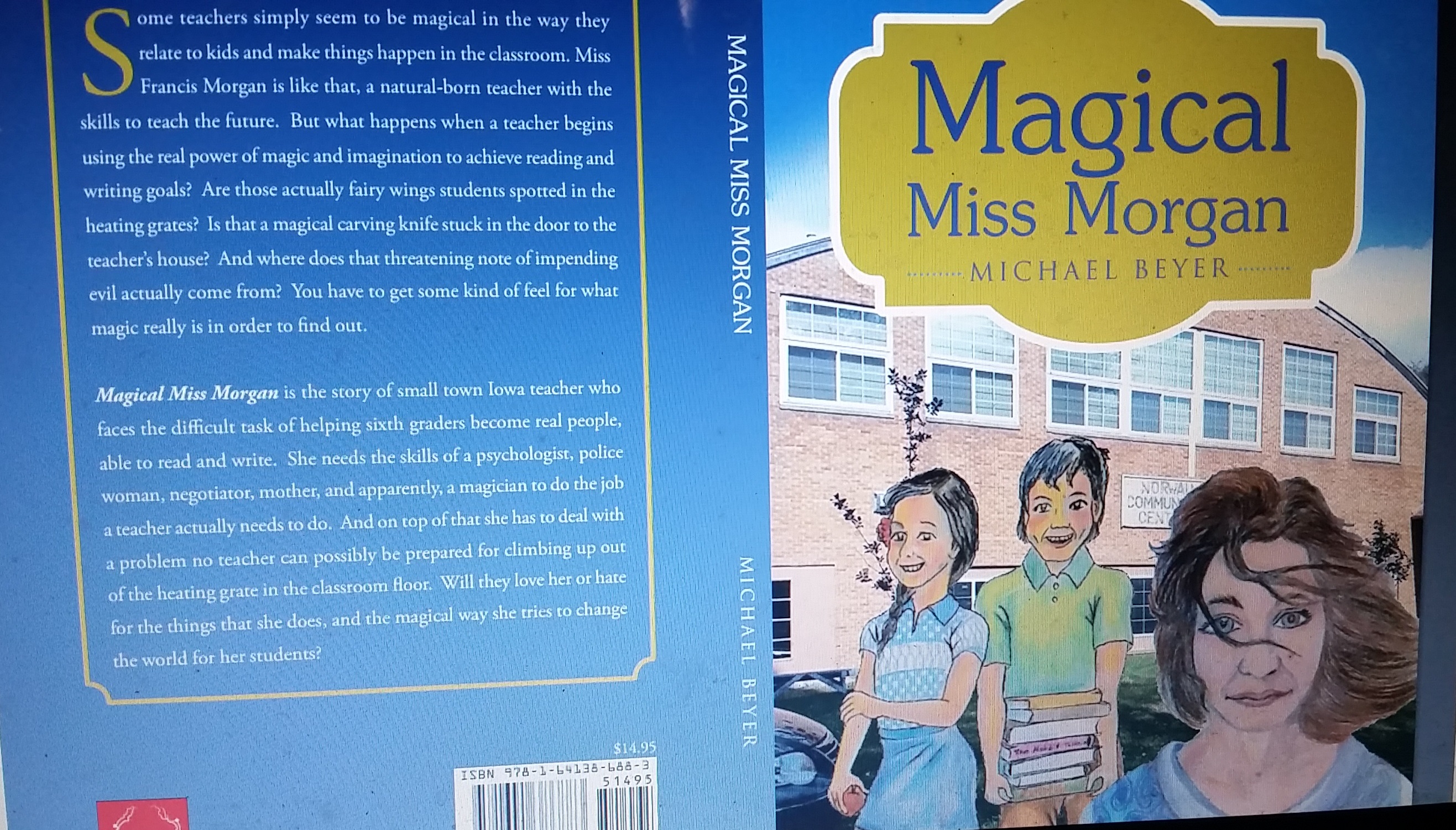
After we got home from the movie, I opened an email that contained the cover proof for my novel, Magical Miss Morgan. Soon I will have that in print also if I can keep Page Publishing from messing it up at the last moments before printing. It is a novel about what a good teacher is and does. It is the second best thing I have ever written.
Sometimes the gifts that you most desperately need come in unexpected fashion.
Teachers like me often say, “There are no bad kids.”
And, boy! Are we ever wrong when we say something as dumb as that.
To be fair, when teachers like me say something like that, a clueless liberal-minded comment that reveals fatal levels of idealism, morality, and even faith in God, we are really saying that there is a way to reach every kid and make a difference for them… if only we are given the tools, the time, and a decent amount of incentive. To go in front of a hostile audience five, six, or seven times a day, up to thirty of them in a classroom made for twenty, and teach them something worth learning requires an unquestioning belief in miracles and a foolish notion that somehow goodness and light always win out. And often they do. But exceptions prove the rule… And the need for rules. Because there are some very bad kids in this world.
The first hour of the first day of my very first year as a gringo teacher in a mostly Spanish-speaking junior high school in deep South Texas contained two eighth-grade boys who would die violently from gunshots.
Osvaldo “Ocho” Sotello put a gun in his own mouth and pulled the trigger after finally getting released from prison after serving five years of a sentence for armed robbery. He was guilty of that crime and many others he was never caught doing. But he was put in prison at eighteen, and repeatedly raped by other members of the Mexican Mafia because he had given himself teardrop tattoos by his right eye and had never killed anyone to earn that gang sign.
And Lorenzo “El Loco Talan” Marquez would die in a hail of bullets from the guns of rival drug dealers on the streets of Encinal, Texas. His family watched in horror as it happened. Neither of the names I gave those boys in this essay are their real names. But the gang names are real. And their life outcomes are real. And I even had to teach the son of El Talan when he reached eighth grade.
Both of those boys are proof of the idea that there really are bad kids out there. Evil kids even. But those two boys were both sixteen in the eighth grade because they failed seventh grade twice and had been “placed” in the eighth grade especially to welcome me into the jolly world of classroom management and discipline. Those were tough kids. They refused to do anything I asked of them.
They were disrespectful to me in both Spanish and English. And I am grateful for their tutoring of me in a wide range of profanity and swear words in Spanish. At one point, walking them back to class from another campus after lunch, El Talan picked up a metal fence post and was going to use it on me like a club because I tried to hurry them up and interfered with their plans to ditch afternoon classes.
Some kids are bad kids because they have been mishandled, mistreated, and misunderstood by all of their parents, relatives, teachers, coaches, and classmates before you even meet them for the first time. Their paths are already set in stone. Fossilized footprints made rock-hard-certain a million years before they should’ve been set in stone. I had no chance to make any improvements to them.
Another bad kid I had my very first year of teaching was not really named Alonzo Angel Diablo (but certainly should’ve been named that.)
Alonzo was the older cousin of a kid in that class, Fernando, whom I really liked and tried hard to help through two years in the eighth grade. But Alonzo was definitely too old and set in his criminal ways to be reached. Alonzo’s problem was that he was a gay young man living in a Catholic/Hispanic culture that actively persecuted gays. His own family had disowned him and treated him like a criminal. So, he was one. I had to get him expelled from school by reporting him for threatening the life of another student. Prior to that incident, the boy had harassed me at the Halloween Carnival (a fund-raising event that the Baptist Church later made us rename the Harvest Festival.) He forced Fernando to sexually proposition me, and when I rebuffed that nonsense, he offered to do it himself. It would lead to a later discussion in which he revealed to me his sexual orientation and asked me for forgiveness. He was relentlessly bad. But he later contacted me as an adult and thanked me for being his teacher. I never taught him anything, but it was important to him to show me that he had a job and had achieved adulthood without further violence or jail time. If he’s still making his way in this world more honestly than he did before, I am happy for him. But It was all his own doing. I could do nothing for him as a teacher.
There very definitely are bad kids. But they are not all irredeemable. And I know conservatives and Old School types would prefer that we just throw all of them in jail to rot forever. I, however, like to think there is still room in this world for stupid liberal notions of making kids less bad through education, patience, and the Grace of God.
He sat down to write something for the day. He rolled a fresh sheet of typing paper into the typewriter. Then he sat back to look at it. It was a totally horrifying stretch of cold, blank nothingness. There was nothing there. It left him feeling completely and hopelessly alone.
How do you connect with that person who is going to pick up and read the final copy of this thing once it is finished? His brain hurt thinking about it.
He knew that he needed to get started. And he wanted to start with something colorful.
So, he typed a word; RED.
“Well, that’s a start, at least…” he said, talking foolishly to the inanimate typewriter. “But what do I really mean by saying RED?”
Well, of course, red means emotional things, anger, love, shed blood, tomato sauce on Chicago-style pizza…
…But how do you make an actual idea out of that? It needs to be stretched some and pulled a lot. Bent out of shape, maybe even smashed by a hammer.
The typewriter became concerned and alarmed at the mention of the hammer.
But the writer was only thinking about the hammer. And the typewriter didn’t read minds. Heck, it wasn’t even electric yet. It was a typewriter that the writer’s grandmother bought in the 1940s. And writer loved it because it reminded him of her. And it reminded him of her letting him type his very first story on it when he was six years old. He wrote a story about a skeleton chasing a dog. And when the skeleton caught up to the dog, the dog ate him. Because he was bones. It was a short story. Very short. Less than a page. Because grandma only had one page of typing paper left on her desk.
And the story wasn’t red. So, why was he even thinking about it now?
Well, it was read. By his grandmother. And she laughed.
And he hadn’t thought about it until right now. But it was the moment he knew he wanted to be a writer some day.
And, so… Right now… This very moment… He realized… The real story is ready to begin,
How do you foretell the future? Simply put, you don’t. But if you approach each new day, each new week, or each new set of circumstances without a plan and a rough idea of the near future, you are even more of a hopeless fool than Mickey is.
While it is true that a crystal-ball connection to the future would be really handy for figuring out what to do next with our little lives, it is also provably true that crystal balls, Ouija boards, and divining rods don’t actually work. Statistically even the best users of these fortune-telling devices are no better at foretelling the future than are well-informed guessers.
Ghosts are not provably real. You cannot actually talk to them. Not even in a graveyard at midnight with a dead cat to throw at the devil.
Oh, and that reminds me, the devil is not provably real either.
But I admit to talking to the dead.
My Grandma Beyer was one of the wisest people I knew in my childhood. She advised my Dad who was her son. She was a guide for the Beyer side of the family. And I talk to her a lot when I have a tough decision to make.
In 2017 I irrationally made a commitment to write for a nudist website. The article assigned was to go to a nudist park or resort and write about my first-time experience there. Of course, getting my wife to go along with her RV camper was out of the question. She was a Jehovah’s Witness in good standing then, and was sure that nakedness in a group was a terrible sin. But I had known nudists back in the 1980s when a previous girlfriend’s sister was living in a clothing-optional apartment complex in Austin, Texas. We visited there a number of weekends. I never actually stayed there or got nude while visiting. I saw naked people there, male, female, and children. And after my eyes popped out on the first visit, I picked them up, put them back in, and learned a lot about nudists while at the same time turning down all invitations… which I could do because my parents were living nearby, and I could stay with them and keep all my clothes on. But the nudist website assignment weighed heavily on me. Grandma Beyer had been the one that threatened to spank me before I was supposed to take a bath at her house because I wanted to run around the house naked rather than get in the tub with my sister. I was five at the time, not in high school… honest. So, she was the one I consulted when it came time to decide if I would actually go to a nudist park and be naked in front of other people just because I had made a commitment to a writing assignment.
Of course, she had been among the no-longer-living for fifteen years when I asked her about it.
The thing is, however, that I knew my grandmother well enough to know what she would say as I basically discussed it with her memory rather than her ghost. I even saw what facial expressions she used as she explained that it was more important to keep my word than it was to be a little bit embarrassed. And besides, it was not like I was going to an orgy or anything. Nudists are merely ordinary people who are dedicated to the belief that getting your vitamin D directly from the sun without any clothes between you and nature was good for you.
So, I made the visit, got naked, and wrote the article, as well as articles on this blog that were used on other nudist websites as well. It is how I came to be a member of the nudist writing community on Twitter. And that has helped me promote my books whether there were nudists in them or not.
Even with consulting a Ouija Board you are not really talking to ghosts. You get an answer from somebody with their fingers on the piece of plastic that picks the letters and is accessing their unconscious mind, or even their conscious mind if they are a bit of a dershenbugle (a word which doesn’t mean anything at all, just like the answer they picked.)
I often use a coin-flip to make decisions, adding an element of total chance to the decision I am making. (I admit, that’s how the decision to accept the writing assignment from the nudist blog was made.) If either answer to the question being asked is acceptable, but one causes a bit of anxiety, I flip a coin. Not just one coin. I throw three. Yes is three heads. No is three tails. Ten straight no decisions is indication not to decide at that time. In truth, this only works for me because it forces me to take an arbitrary amount of time to think about the decision. And often, I toss three heads when I have already decided to say no. And then I go with no.
So, divining the future is silly superstition, and I don’t do superstition. But that is not to say I don’t try to divine the obstacles ahead and prepare for them. And what looks like Mickey being an idiot about consulting coins or other signs, is really only Mickey being only slightly an idiot as he makes up his own danged mind.
Here I am making progress with the new picture project. I have had to rethink details on the fly as my arthritic hands make flubs in ink. Unlike on the computer, I had to fudge a new crook to the elbow and push a flower’s edge under the nearby flub instead of over the top.
This fast and furious edit for possibilities to redirect the problem was created with the AI Mirror that suggested possible changes to the finished project.
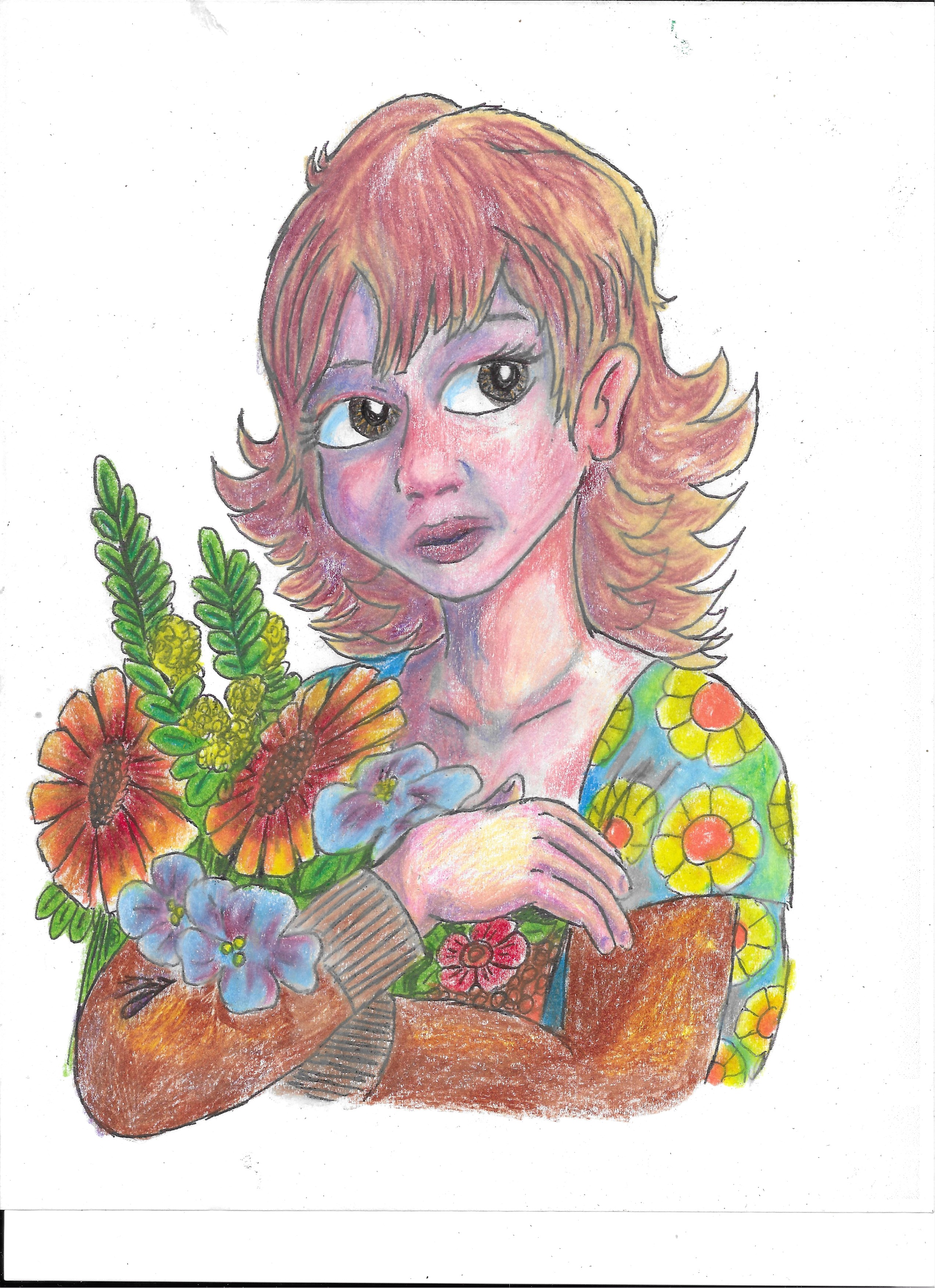
Here is my finished colored-pencil drawing. This is the best I can do with my hands and my color blind eyes. It’s not that bad. Still, I can now use the AI program that will obviously one day become a Terminator android murder-bot to sort out the crappy stuff and make it better.
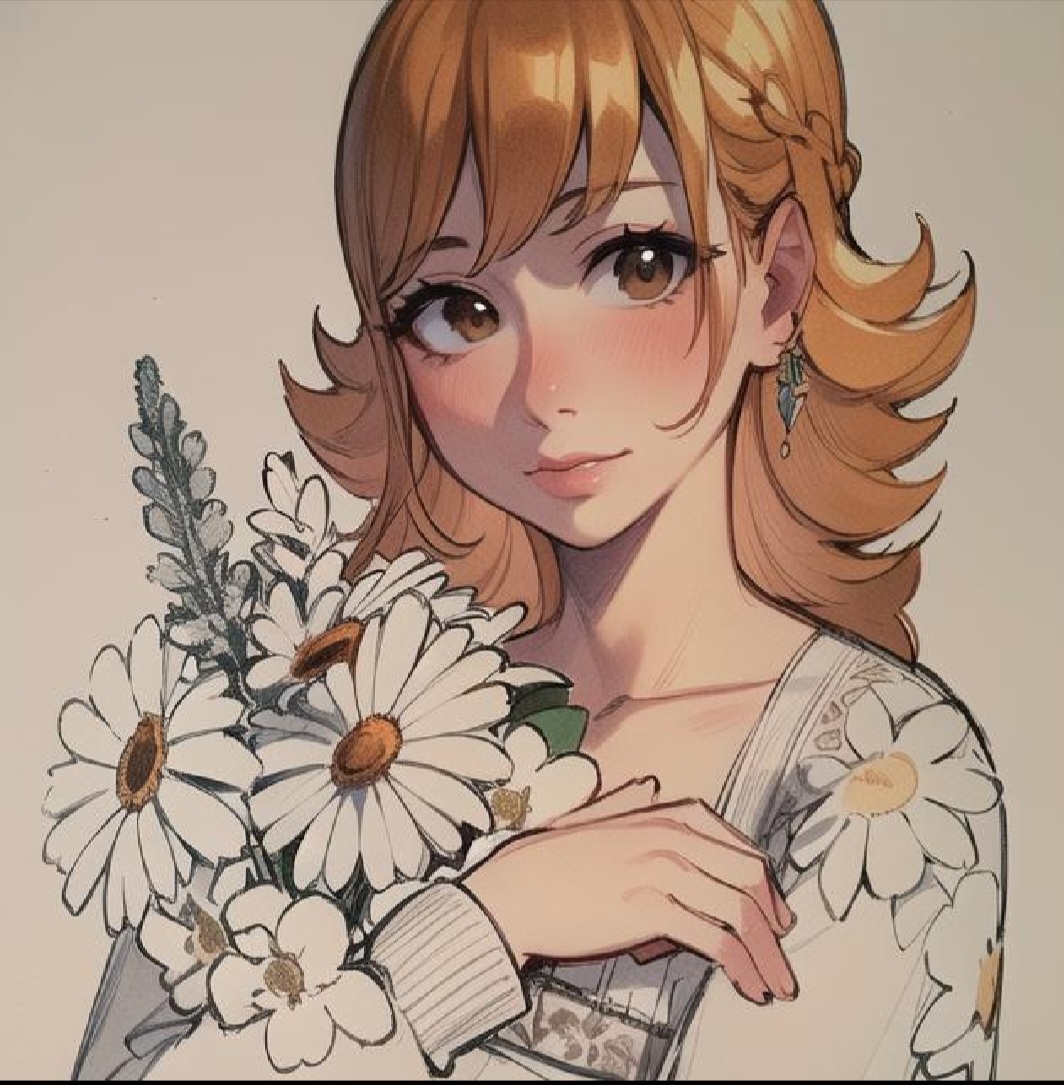
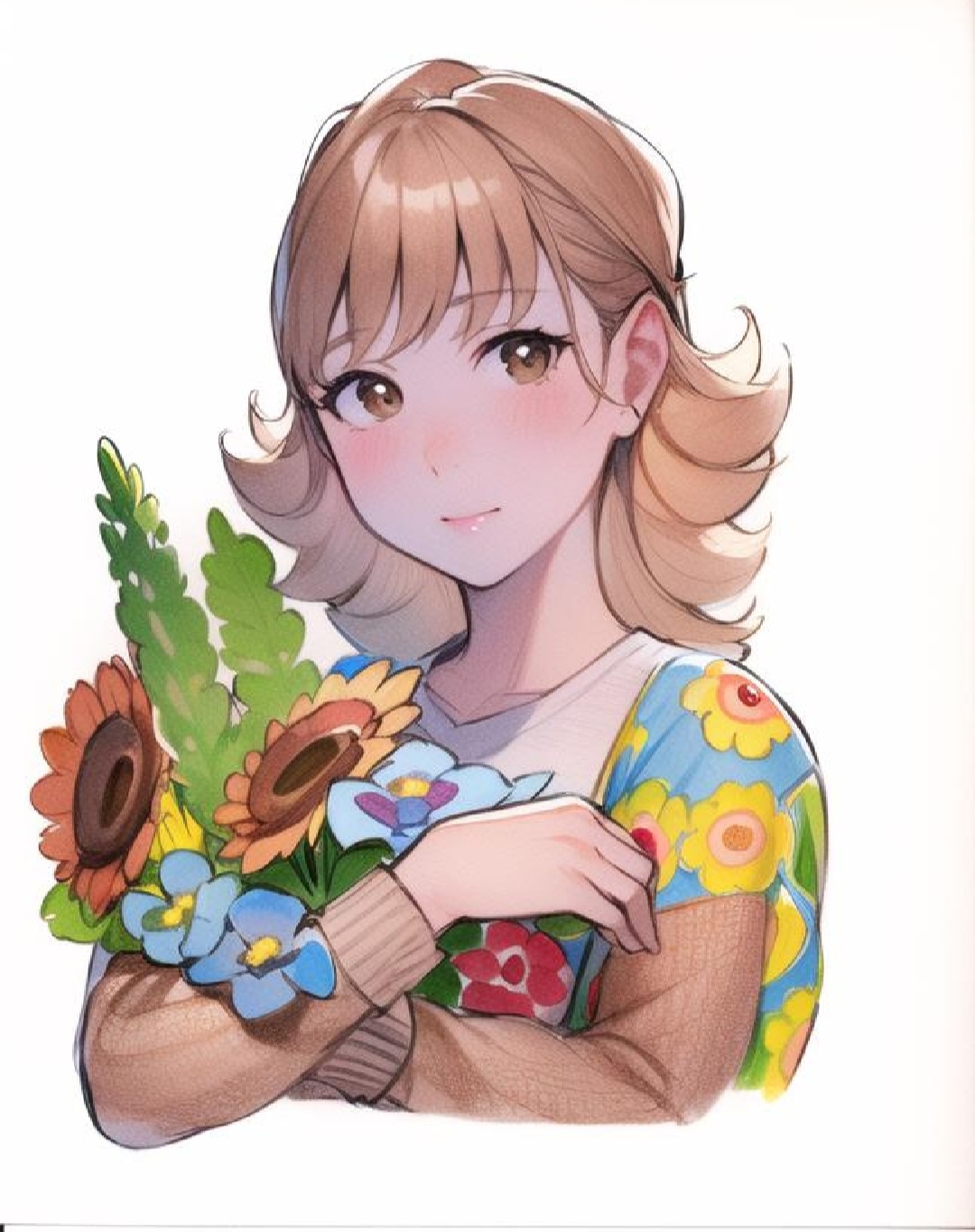
Still not perfect. It tried to turn my black-eyed susans into sunflowers. But I like the highlights and the back lighting on the hair.
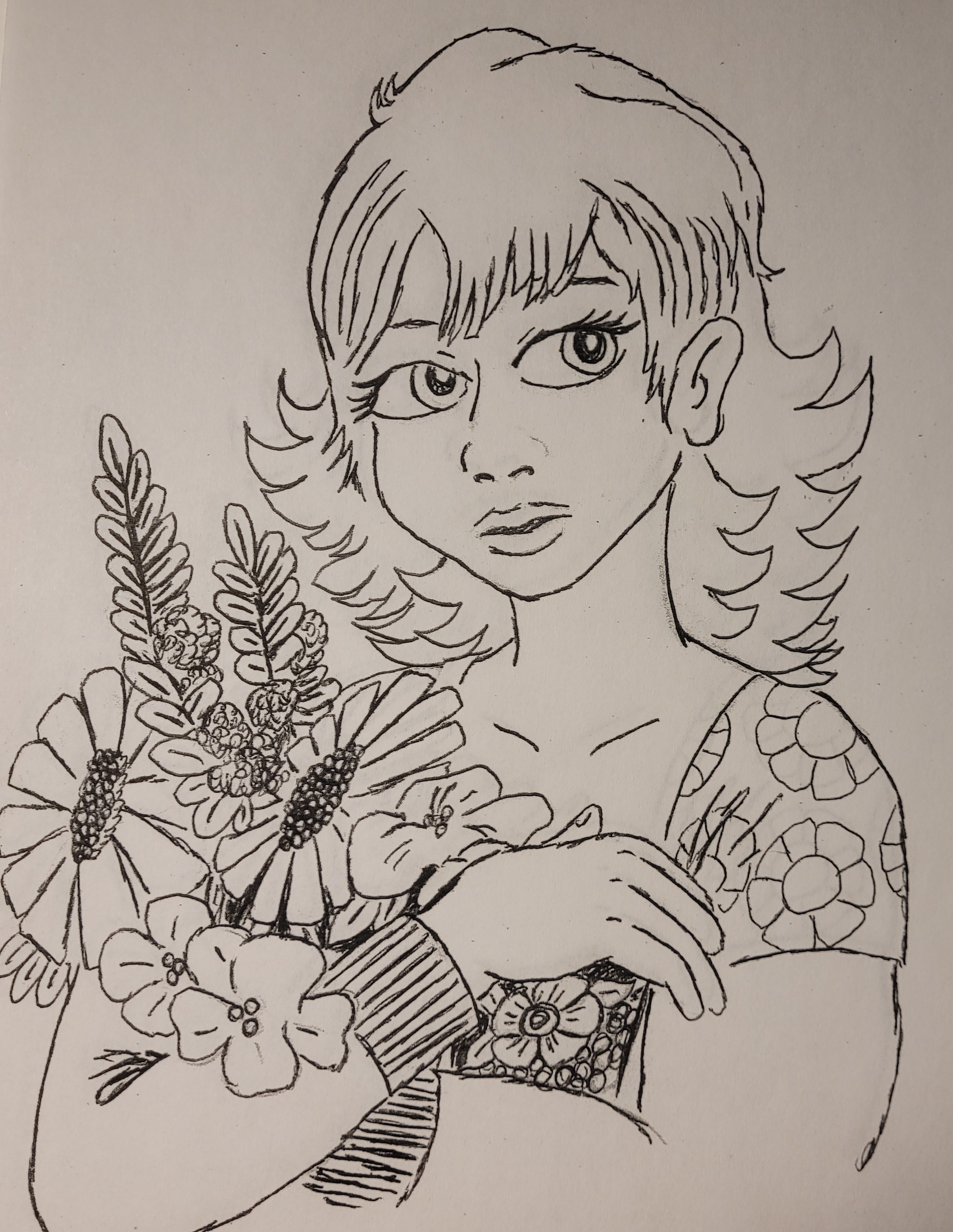
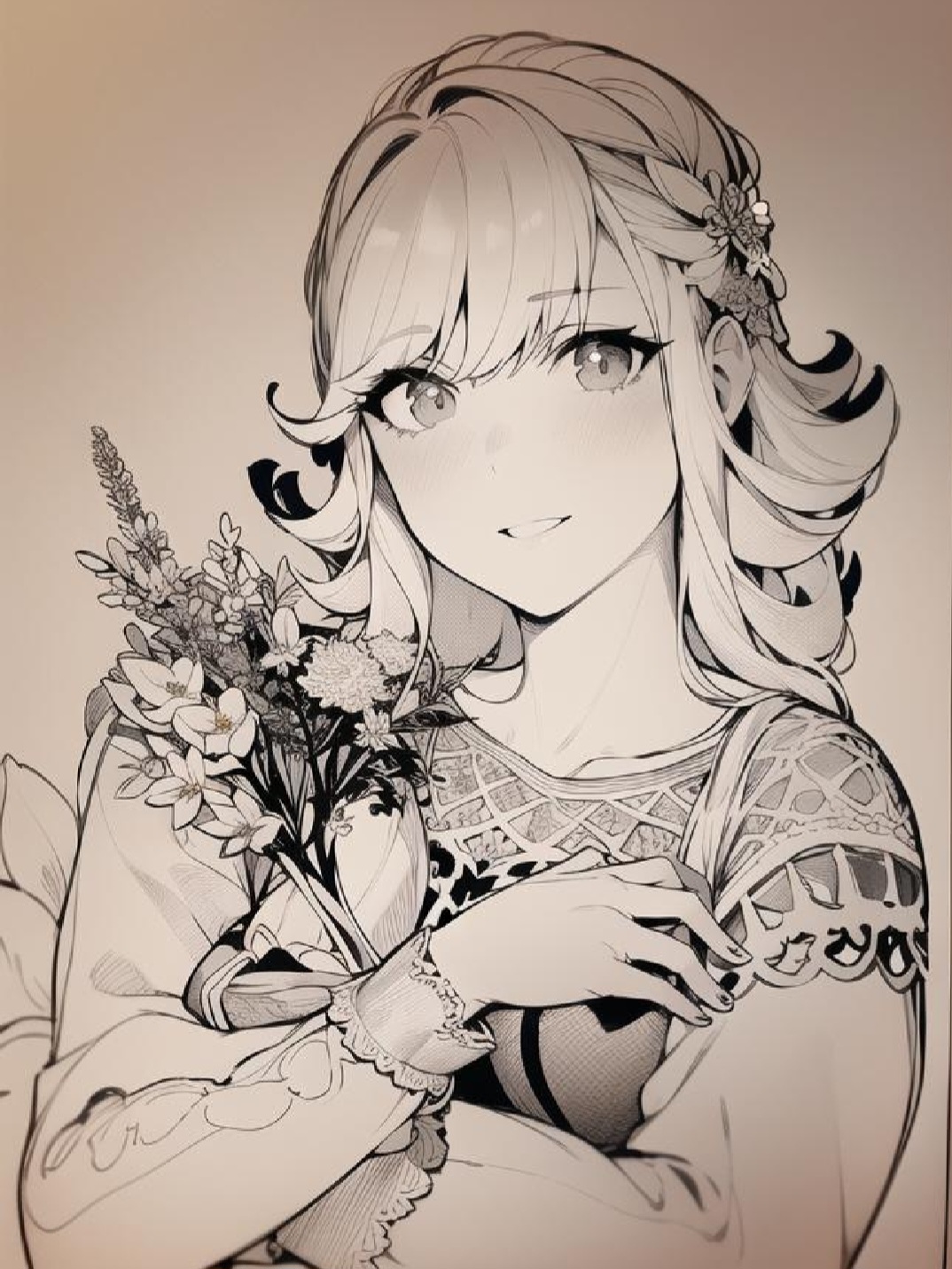
Here is the pen and ink drawing that is my latest work in progress. I drew it first in pencil as a structural sketch with details penciled on top of it. I then inked the best lines and then took the excess pencil marks away with an eraser. I haven’t scanned it yet. What you see here is a photo of the drawing with my phone camera, hence the gray color rather than white. I will put the colored pencil on it next and show you the result when done. I will then turn it into something digital by putting the scan into my phone to use the digital art app and the AI editor.
This is some playing around with the photo of the pen and ink copy messed on with the digital art tools and the AI editor (which tends to give my drawing an even more Manga look than it had originally.)
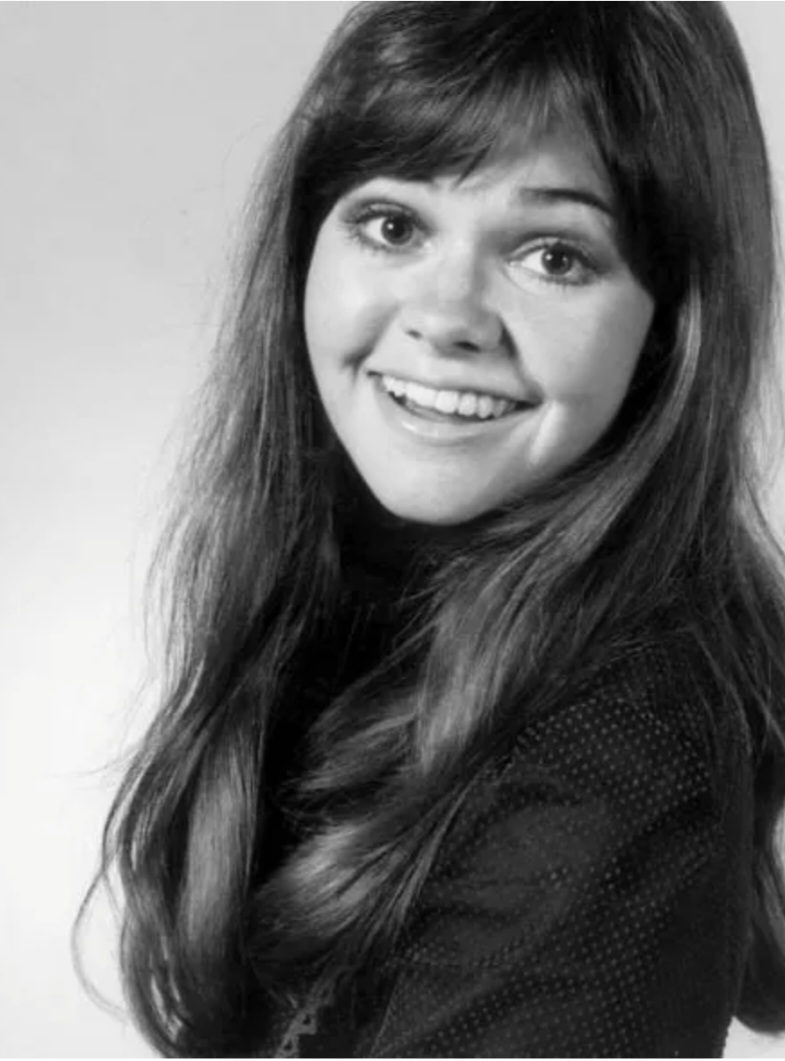
This is the photo of Sally Field I used for the previous practice.
This is the result of loading it into my digital art app and tracing over it with my electronic stylus on my touchscreen phone. I know it doesn’t look like her. I couldn’t get the eyes to look right, and I settled for the smiling eyes that my AI editor gave me.
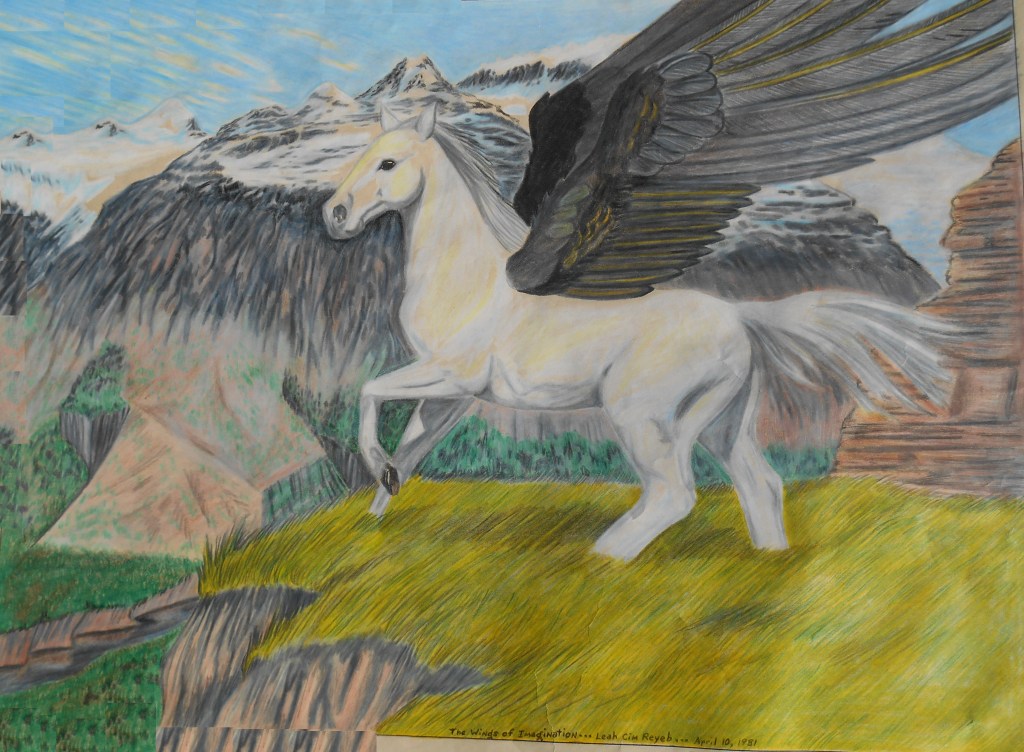
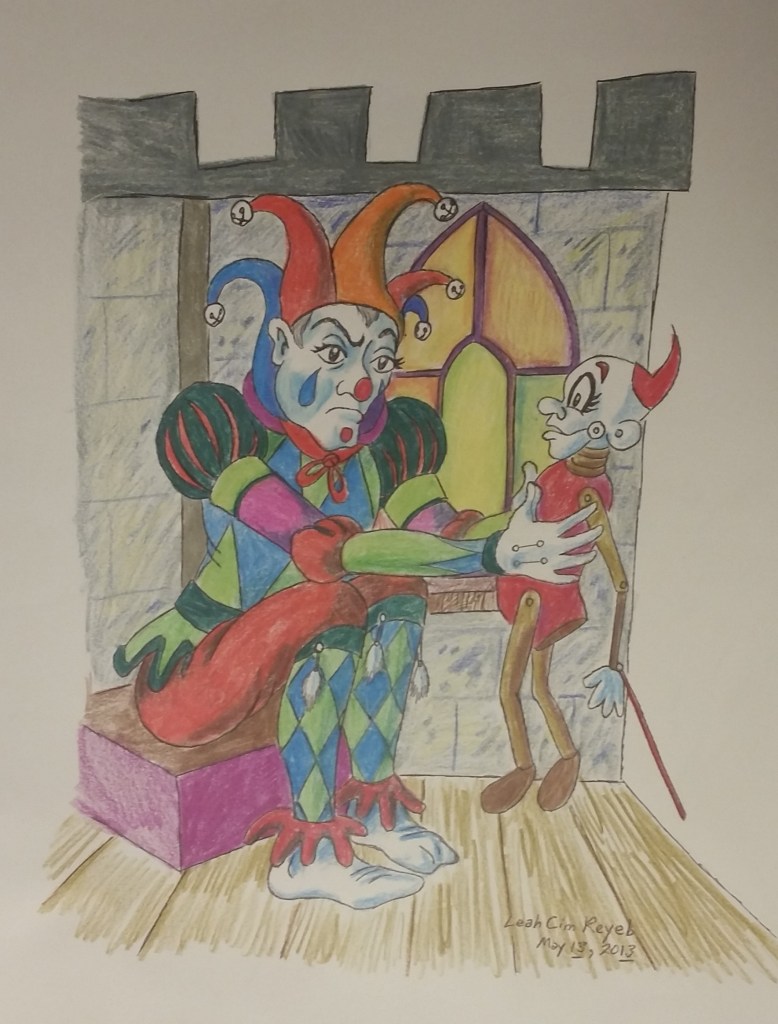
I do draw some pictures from models, photos, or other illustrations… but fantastical things that you can’t find a model for are what occur most often in my stupid head.
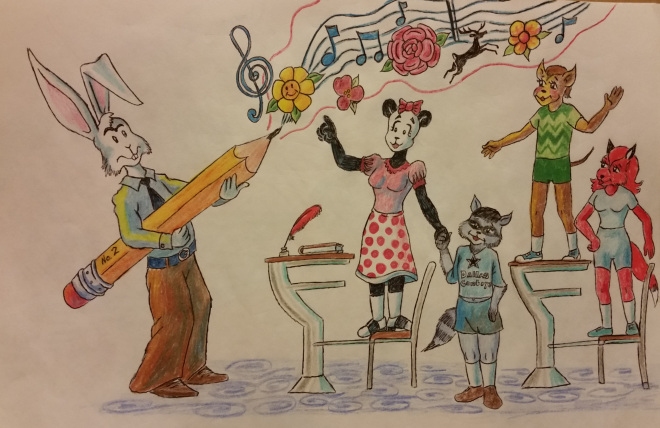
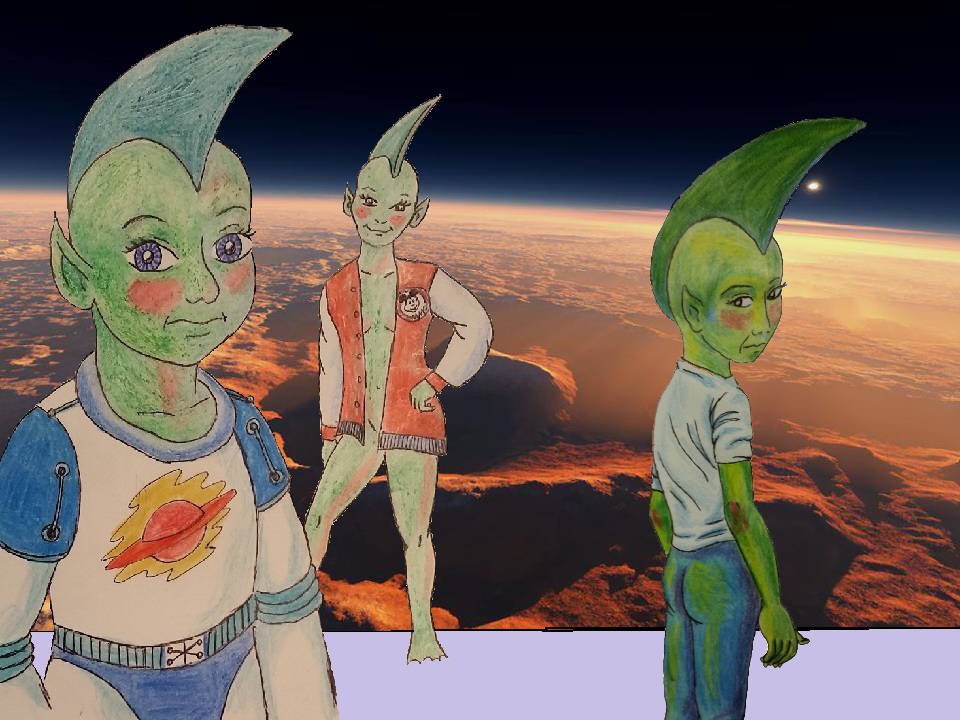
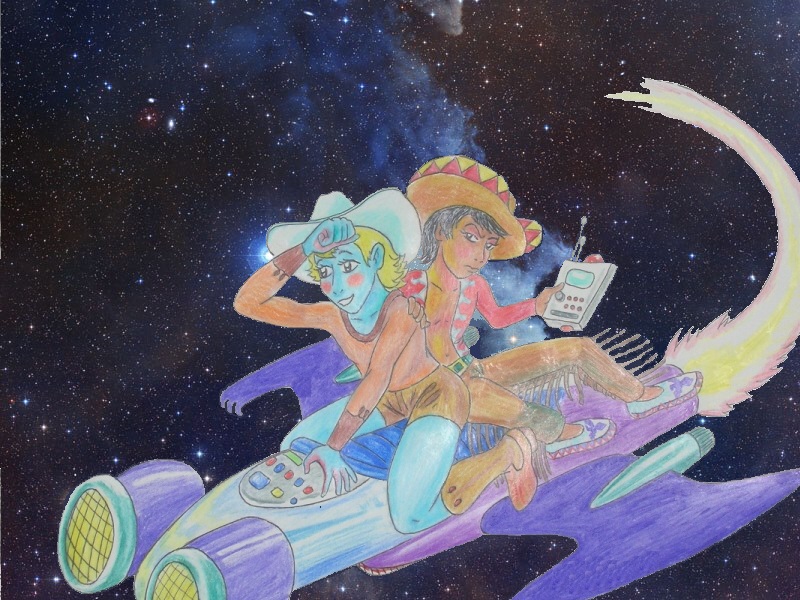
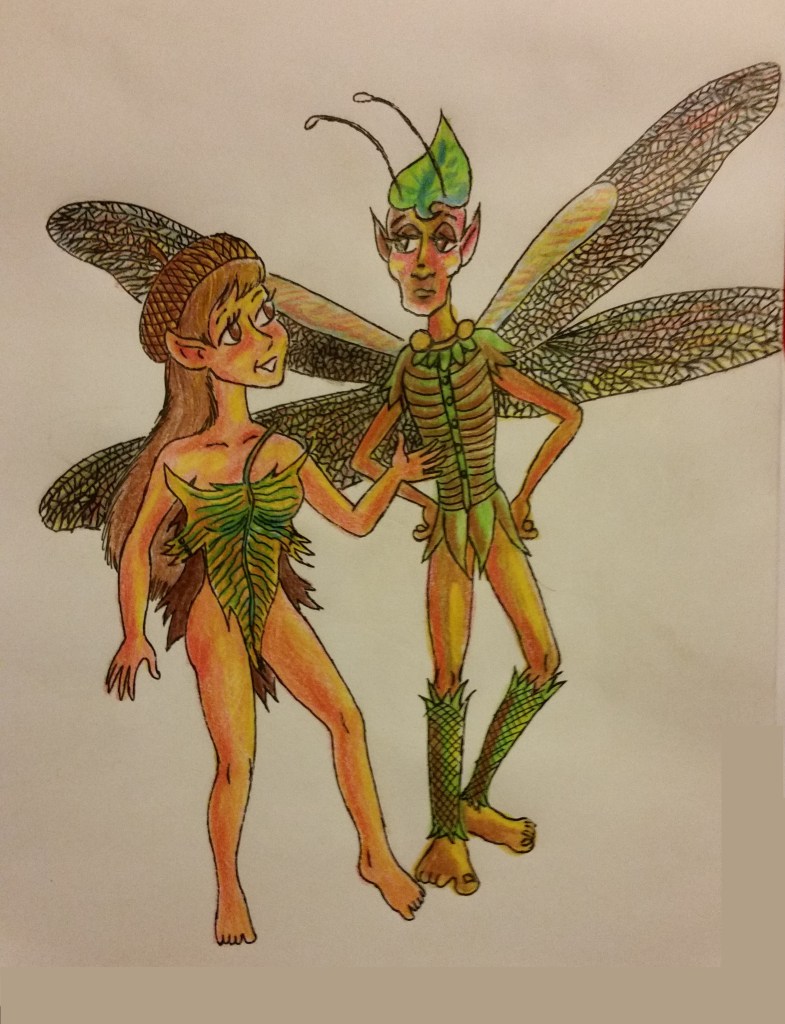
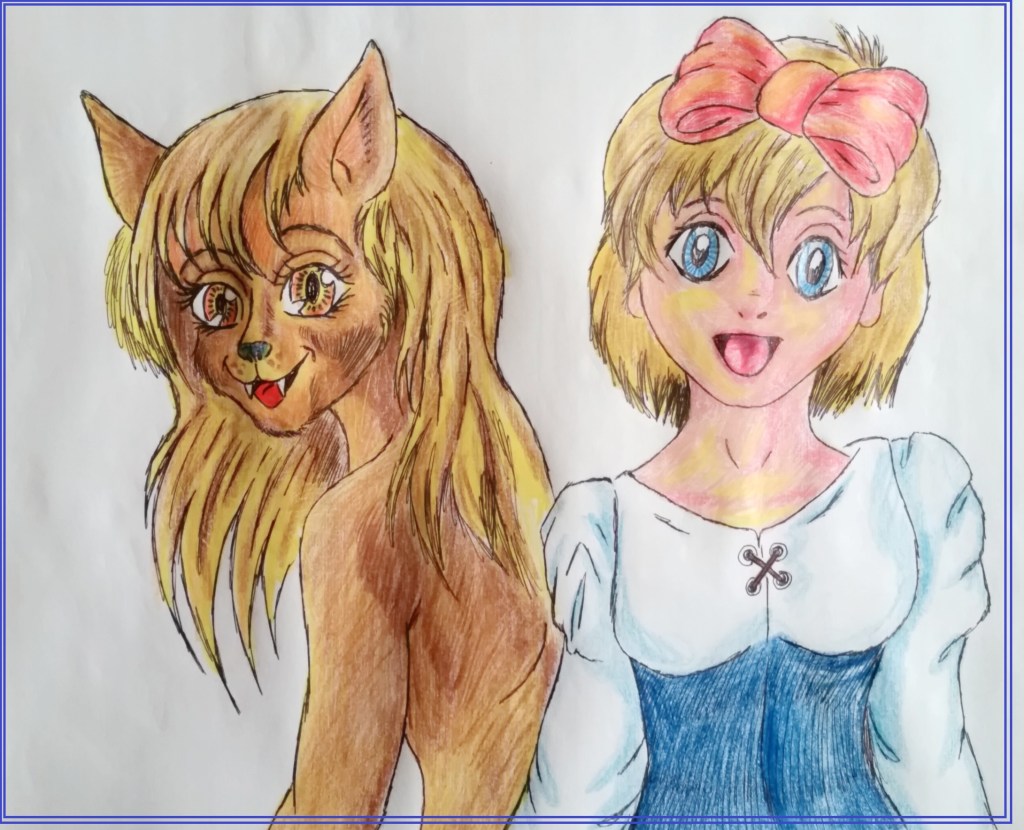
I was back in a classroom yesterday as a sub. 6th graders. It did look an awful lot like this, but I was holding another teacher’s giant pencil. This is the ski-jump on Valwood Parkway in Farmer’s Branch. I merely changed the railroad tracks into a stream.I taught all three of these kids when they were thirteen, but one in ’81, one in ’92, and one in ’94. Oh, and not on Mars.No models were used in this picture, though I did know several blue children.Done without a model, unless you believe 3″ tall fairies are a real thing.No werewolf girls posed topless for this picture.This classroom photo was entirely in my stupid old head, not in a school gymnasium full of snow.Even the mountains in the background were drawn directly from my mind’s eye.A lot of what I draw is merely emotional flim-floogery and provides a look inside of me that makes a portrait of me drawn even more naked and vulnerable than if I drew myself nude.
This foolish essay about berries that mean love to me is only partly inspired by the Beatles song, “Strawberry Fields Forever.” That’s because, of course, their song was only about meditating. In the lyrics they take you to the “Strawberry Fields where nothing is real… but it’s nothing to get hung up about…” They are talking about a blissful place of no worries where we all need to go. And then staying there forever.
This, of course, I could never do. Worrying about the future is tattooed on my behavioral imperatives in the dark part of my stupid old brain. And while I often found that place of no worries, and lingered there for a bit, I found you could never really get anything done if you stayed in that state of strawberry fields forever.
But don’t get me wrong, strawberries are a critical part of every healthy mental diet.
You see, my meditations on strawberries when I was a child of eight, nine, and ten centered on the strawberry patch at Great Grandma Hinckley’s place.
She was, as I incorrectly recall, slightly older than Jesus when I was that age. By that I mean, though she seemed museum-quality ancient to me, I had derived wisdom about life, love, and laughter from her before Sunday School taught me any of those things said in Jesus’s words.
And I was given the task of mowing her lawn in the little plot of land surrounding her little, tiny house in the Northern part of Rowan where I also lived and grew and celebrated Christmas and Halloween and Easter and the 4th of July. And though I was doing it because she was so old, I never even once thought she was too old and frail to do it herself. Grandma Hinckley’s willpower was a force of nature that could even quell tornados… well, I thought so anyway when I was eight. And she gave me a dollar every time I did the lawnmowing.
But there were other things she wanted done, and other things she wanted to teach me. There was the garden out back with the strawberry patch next to it. She wanted me to help with keeping the weeds and the saw grass and the creeping Charlie from overrunning the strawberries and choking them to death. (Creeping Charlie wasn’t an evil neighbor, by the way. He was a little round-leafed weed that grew so profusely that it prevented other plants from getting any sunlight on their own leaves, causing a withering, yellowing death by sunlight deprivation. I took my trowel to them and treated them like murderers. I showed them no mercy.)
And Grandma always reminded me not to be selfish and eat the very berries I was tending in the garden. She taught me that eating green strawberries (which are actually more yellow than green, but you know what I mean) was bad because they could give you a belly ache, a fact that that I proved to myself more than once (because eight-year-olds are stupid and learn slowly.) She also taught me that it is better to wait until you have enough strawberries to make a pie, or better yet, strawberry shortcake with whipped cream. She taught me that delayed gratification was more rewarding in the long run than being greedy in the short run and spoiling everything for everybody.
She always gave me a few of the ripe strawberries every time I helped her with them, even if I had eaten a few in the garden without permission. Strawberries were the fruit of true love. I know this because it says so in the strawberry picture. Even though I probably never figured out what true love really means.
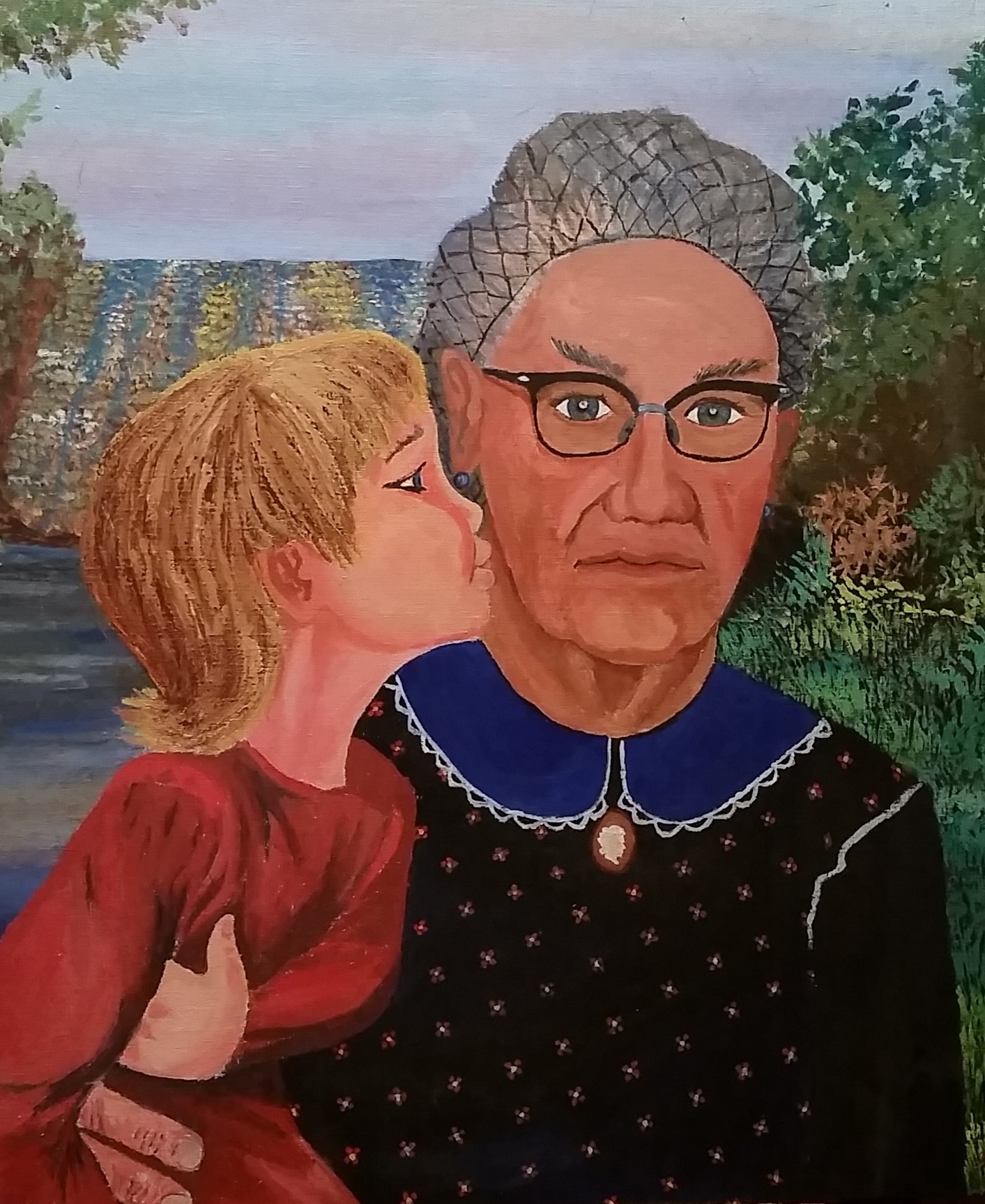
My Great Grandma Nellie Hinckley was the foundation stone that my mother’s side of the family was built on. She was the rock that held us steadily in place during the thunderstorms, and the matriarch of the entire clan of Hinckleys and Aldriches and Beyers and other cousins by the dozens and grandchildren and great grandchildren and even great great grandchildren. I painted the picture of her in 1980 when she passed away. I gave it to my Grandma Aldrich, her second-eldest daughter. It spent three decades in Grandma’s upstairs closet because looking at it made Grandma too sad to be so long without her. The great grandchild in the picture with her is now a grandmother herself (though no one who has seen this picture knows who it is supposed to be because I painted her solely from memory and got it all wrong.) But Grandma Hinckley taught me what true love means. And true love has everything to do with how you go about taking care of the strawberry patch.
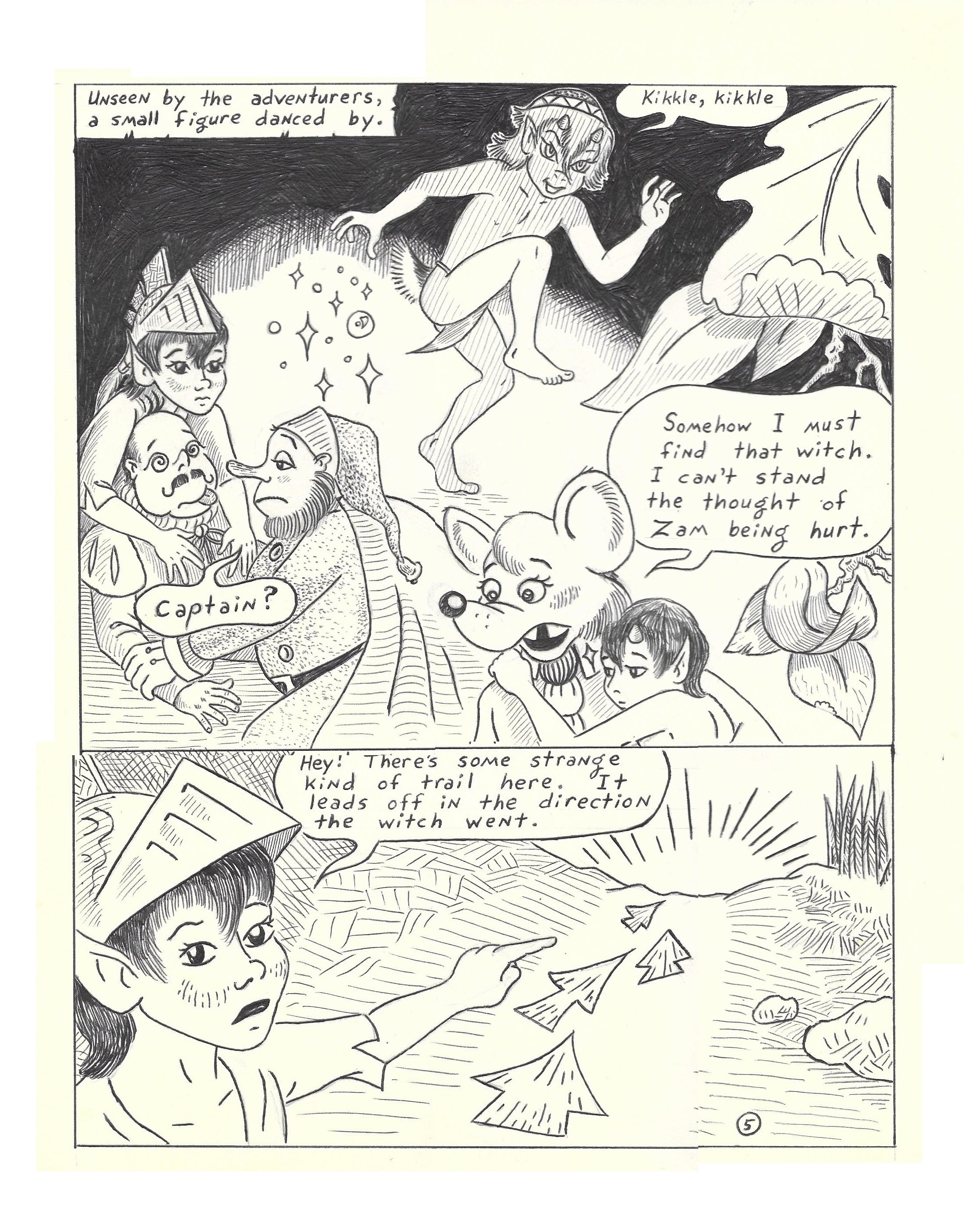
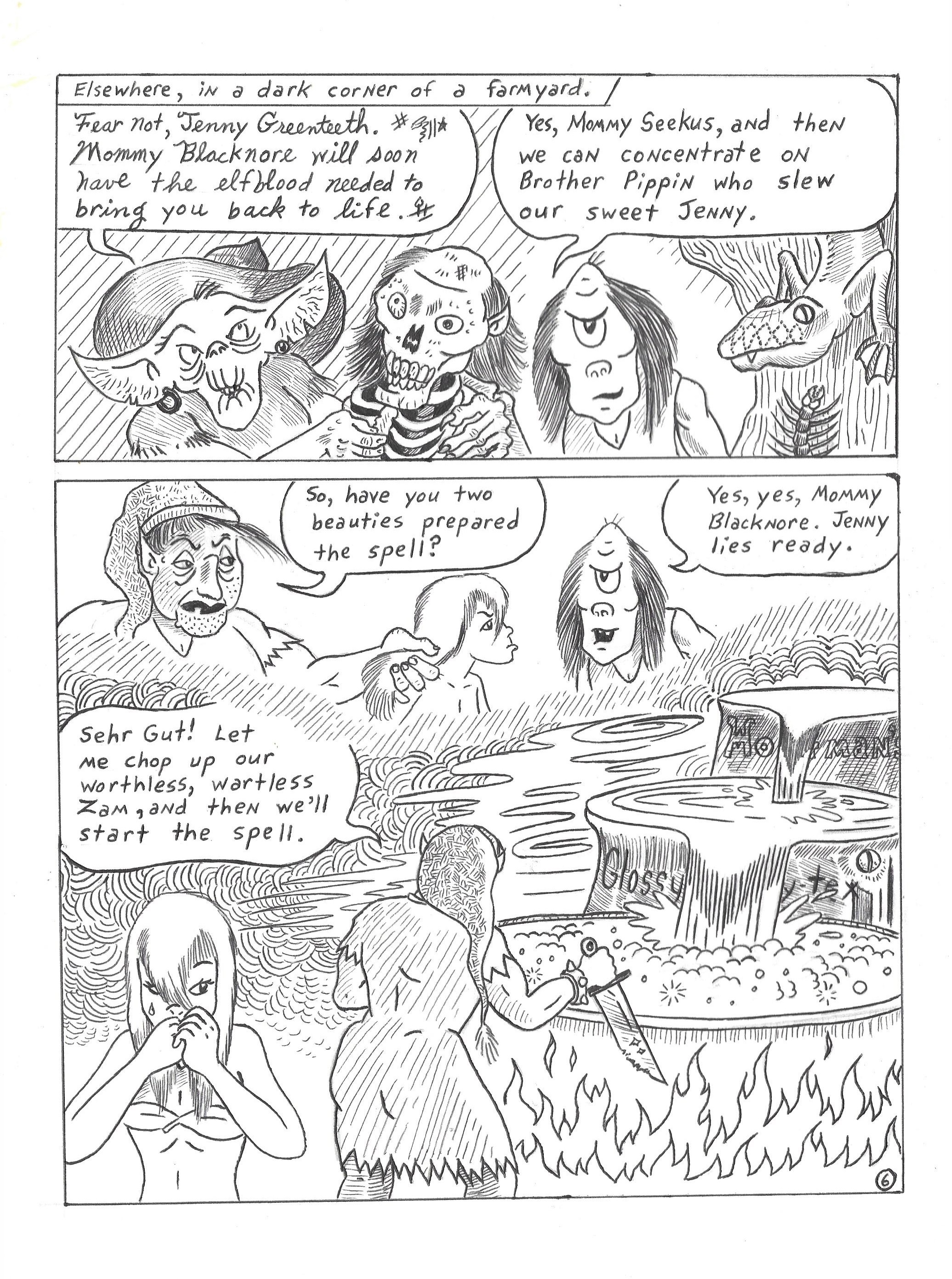
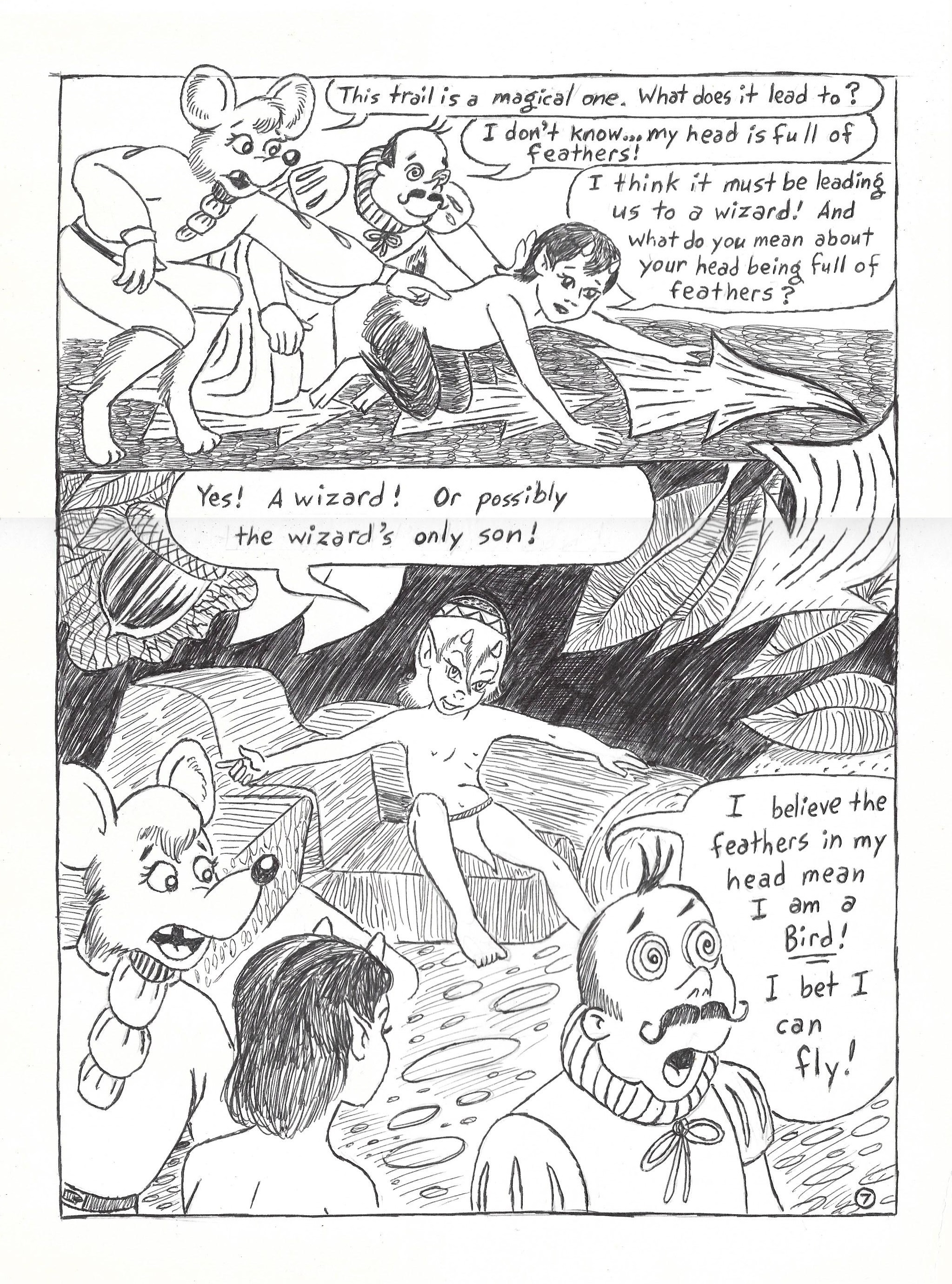
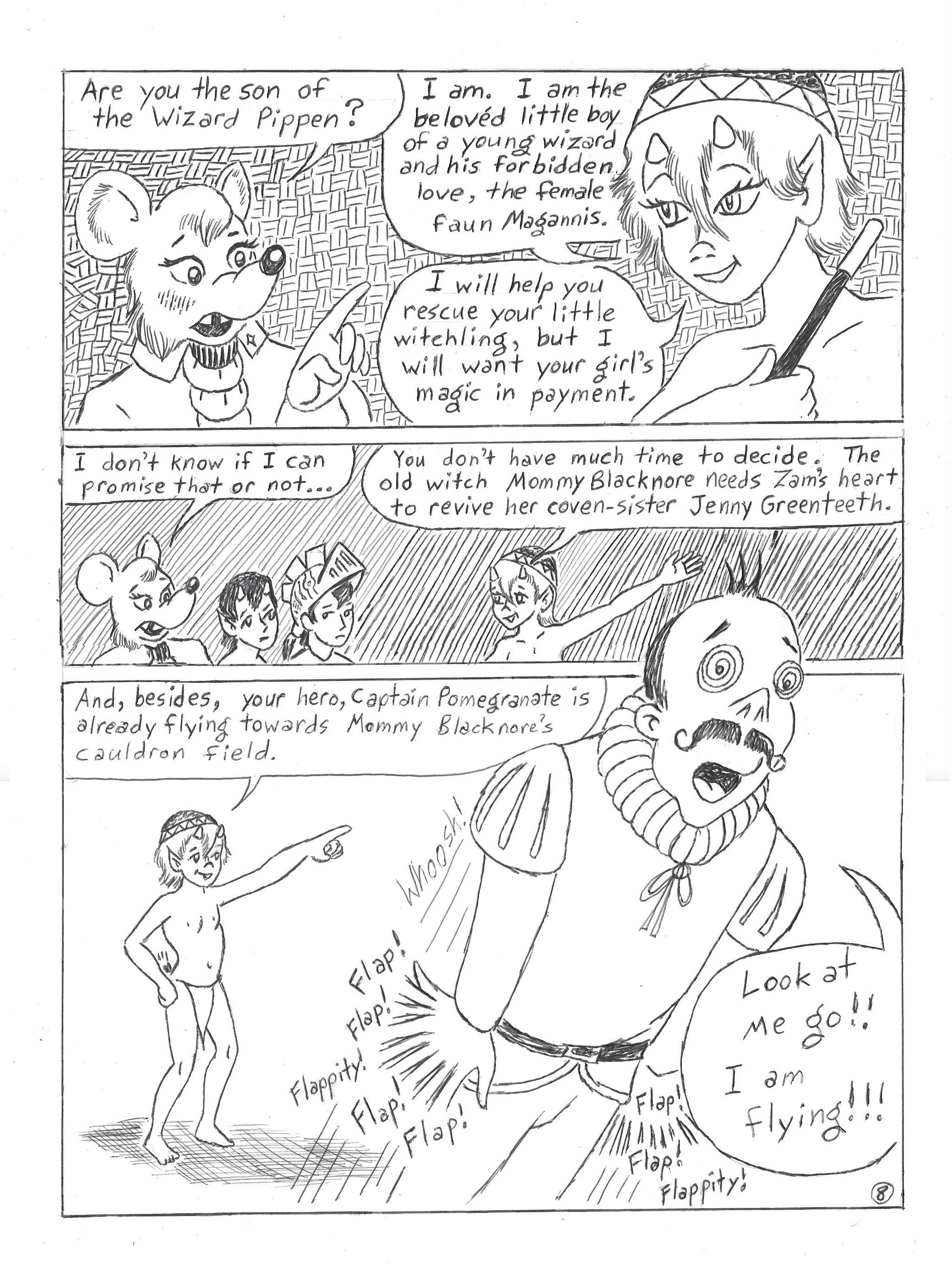
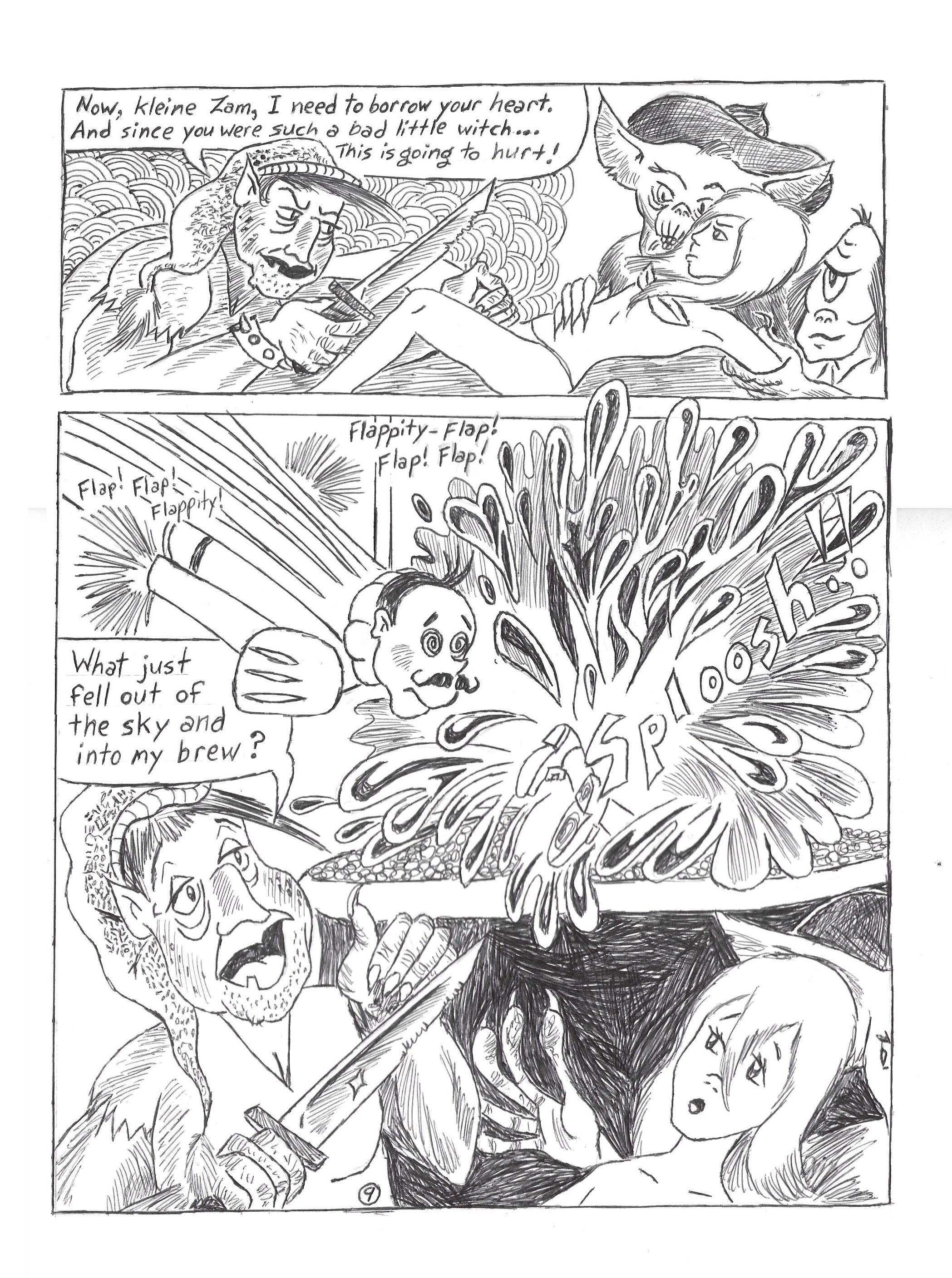
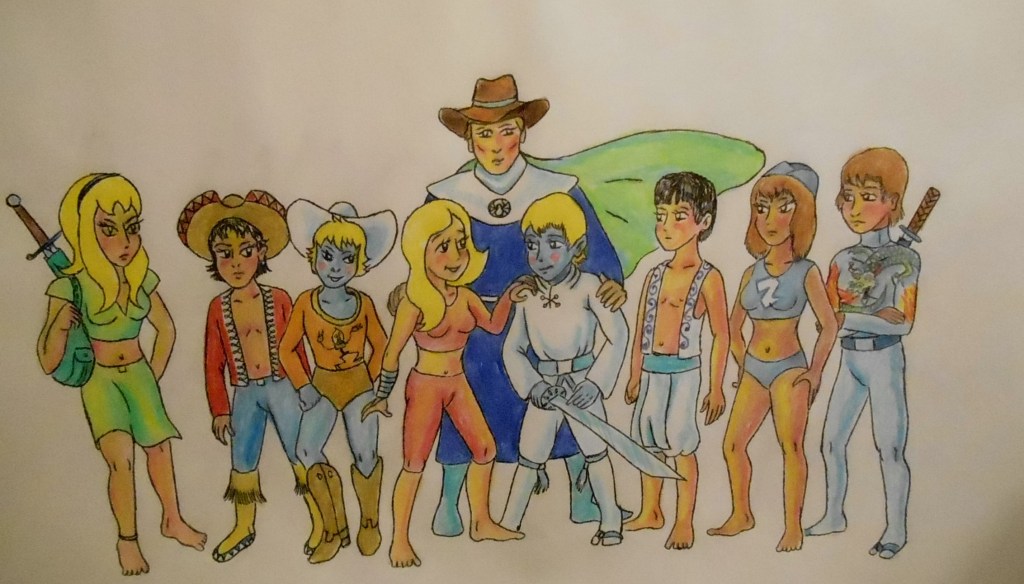
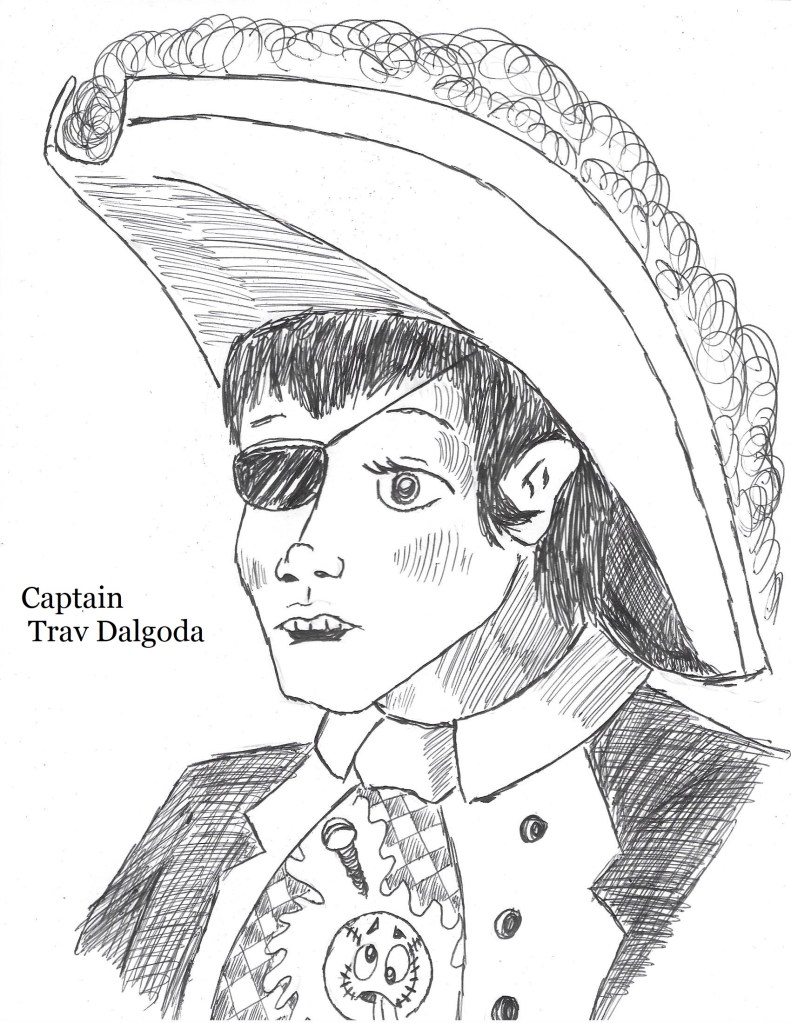
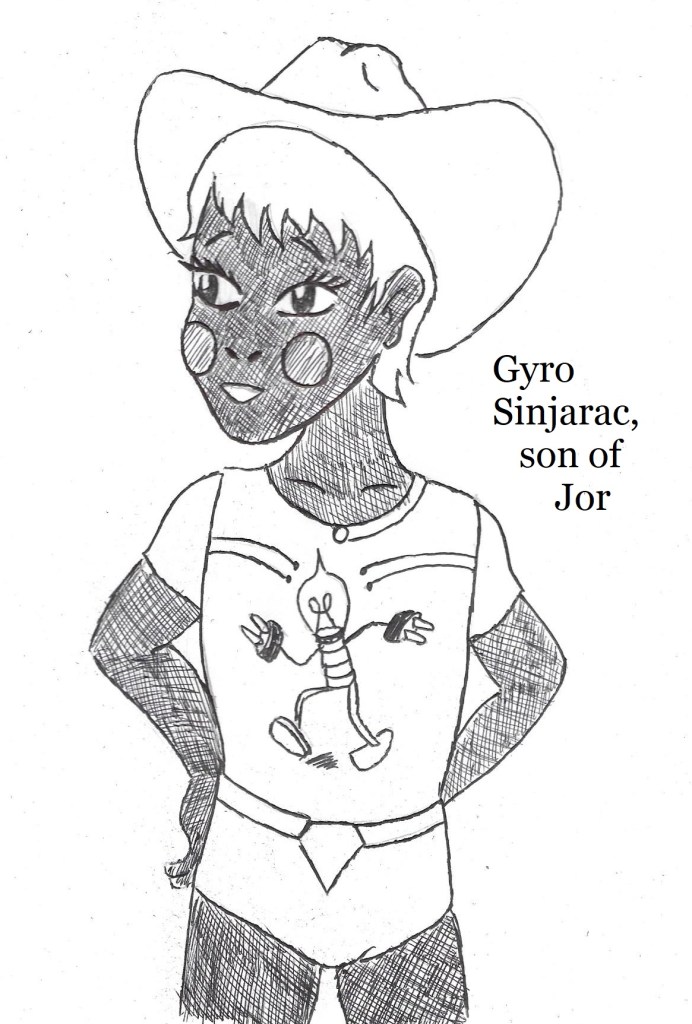
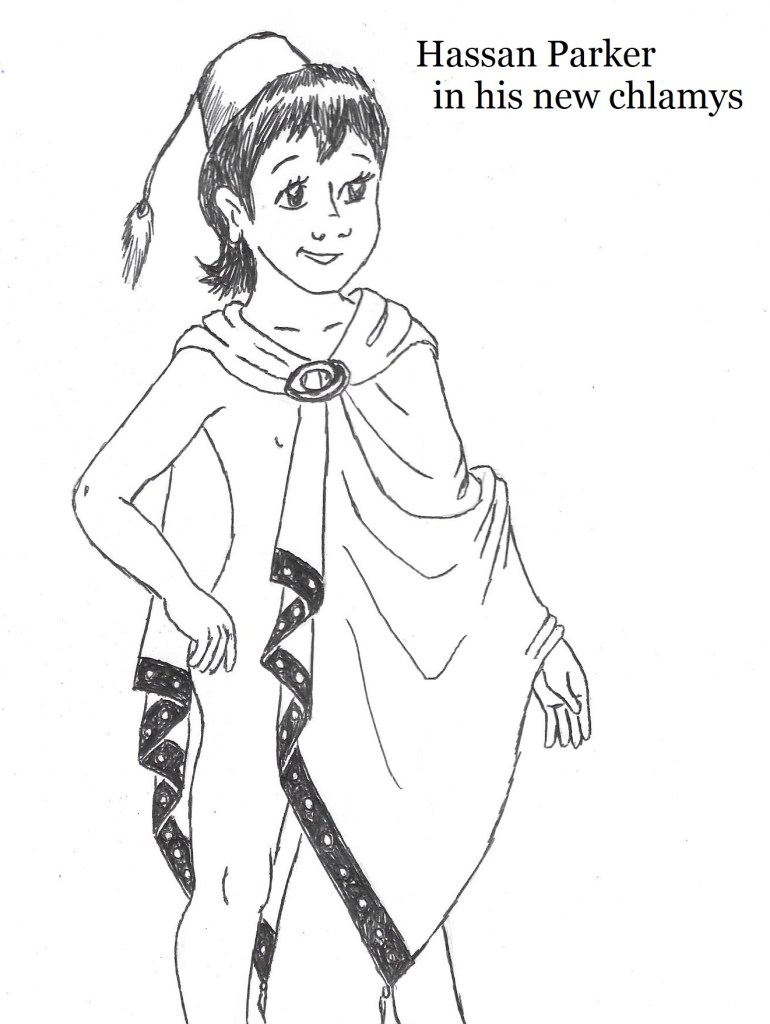
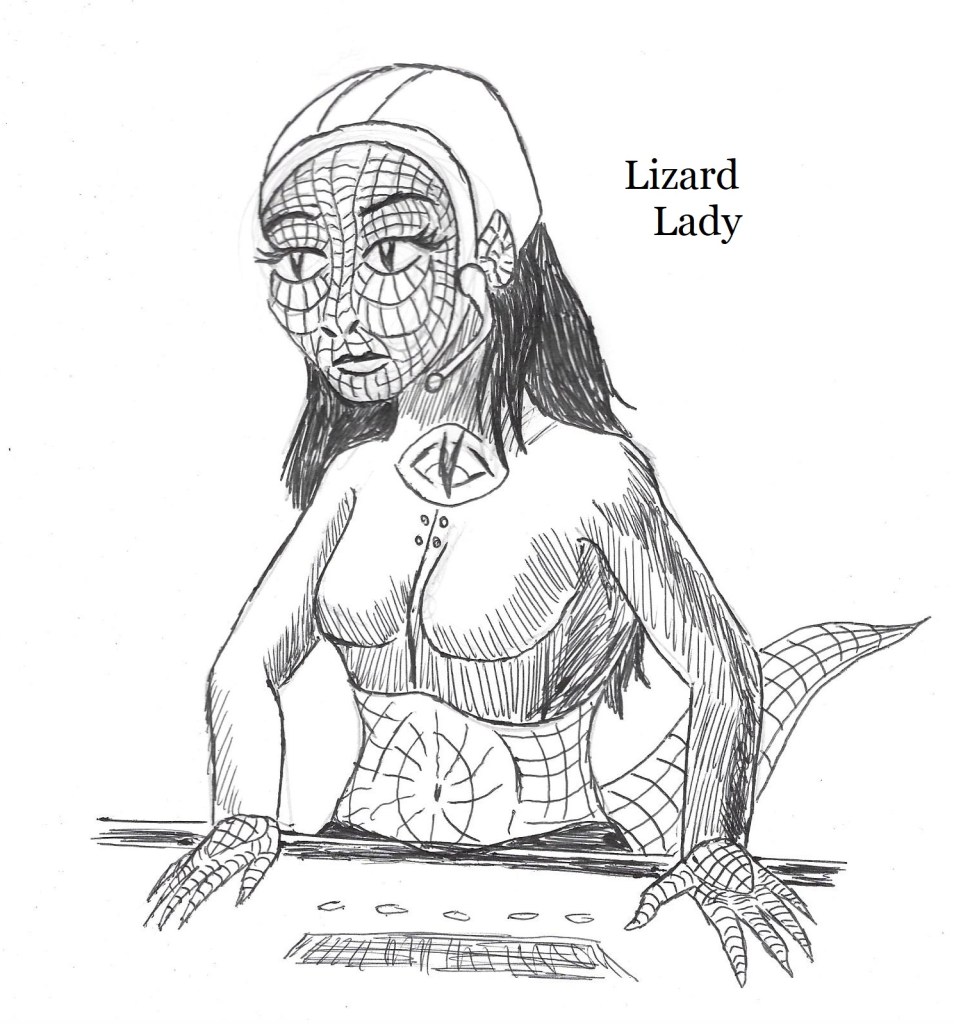
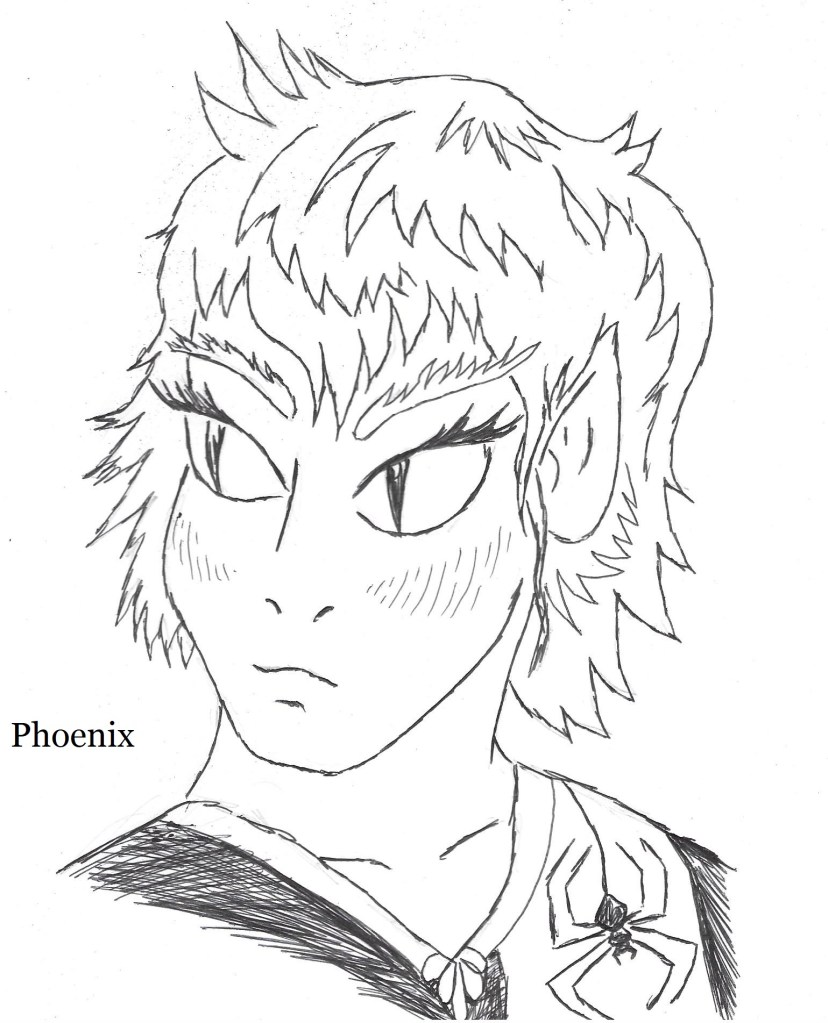
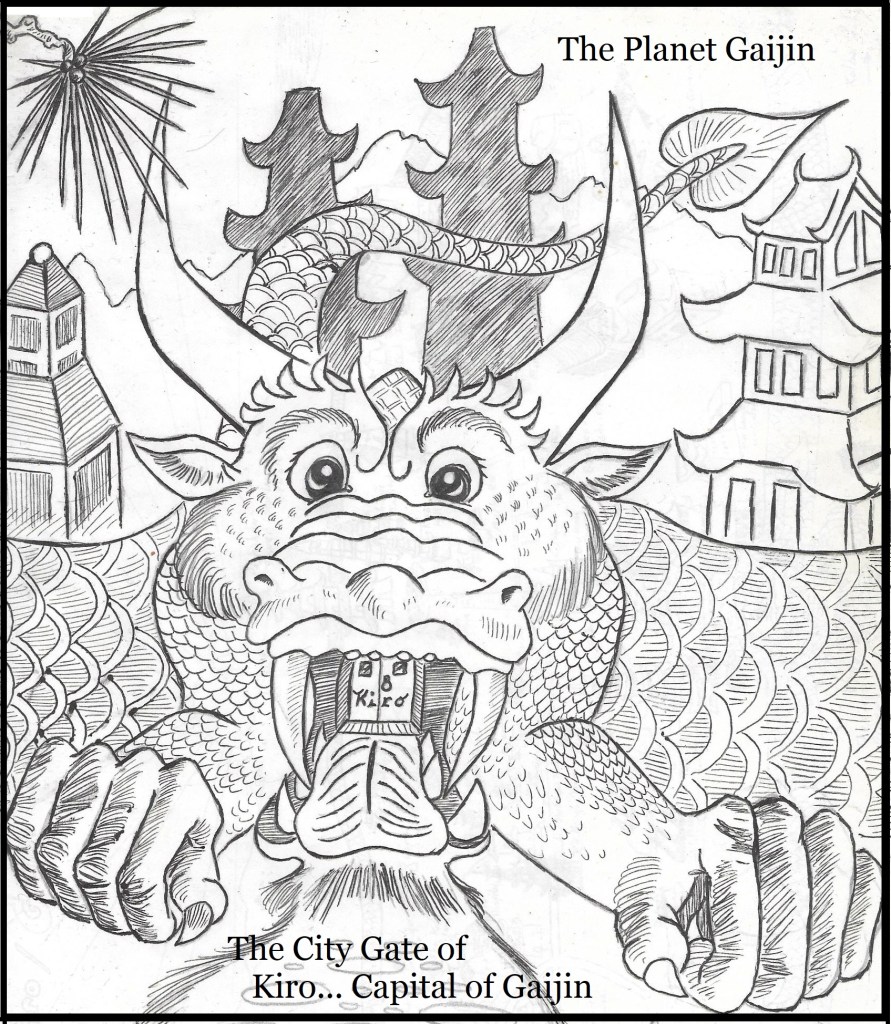
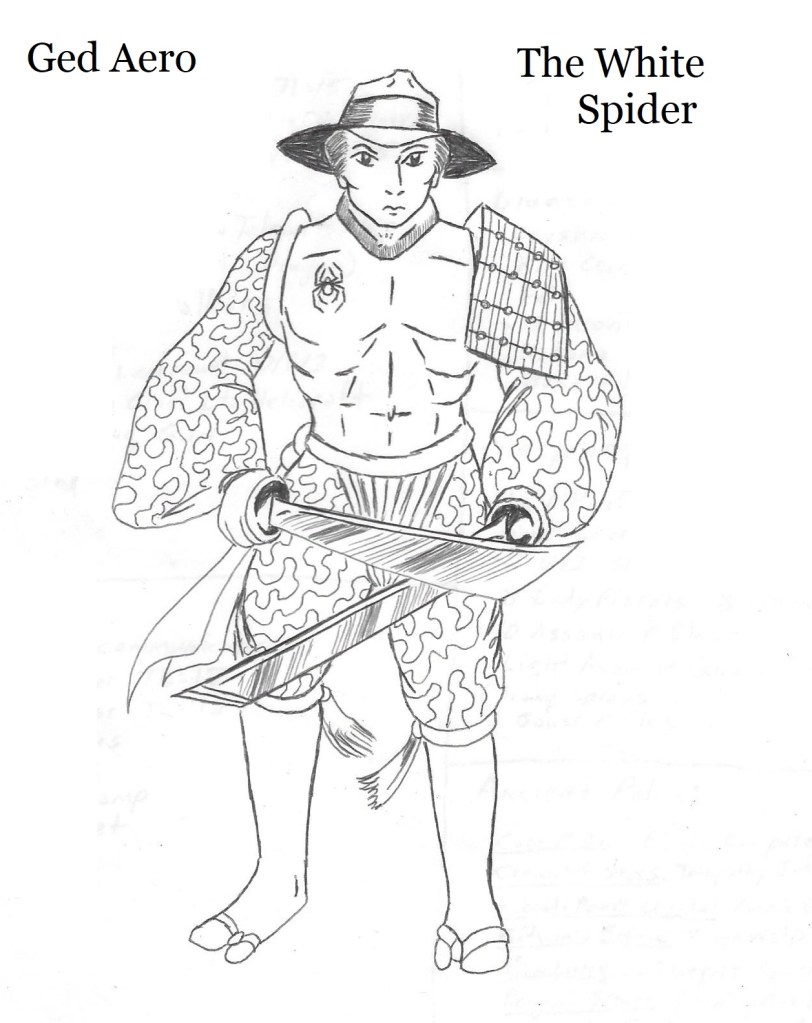
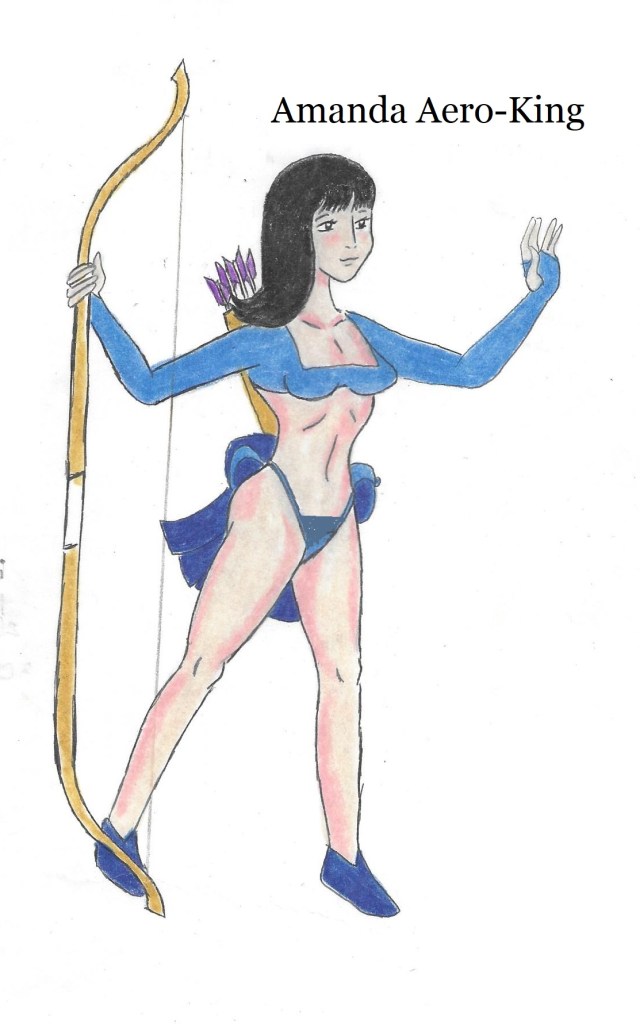
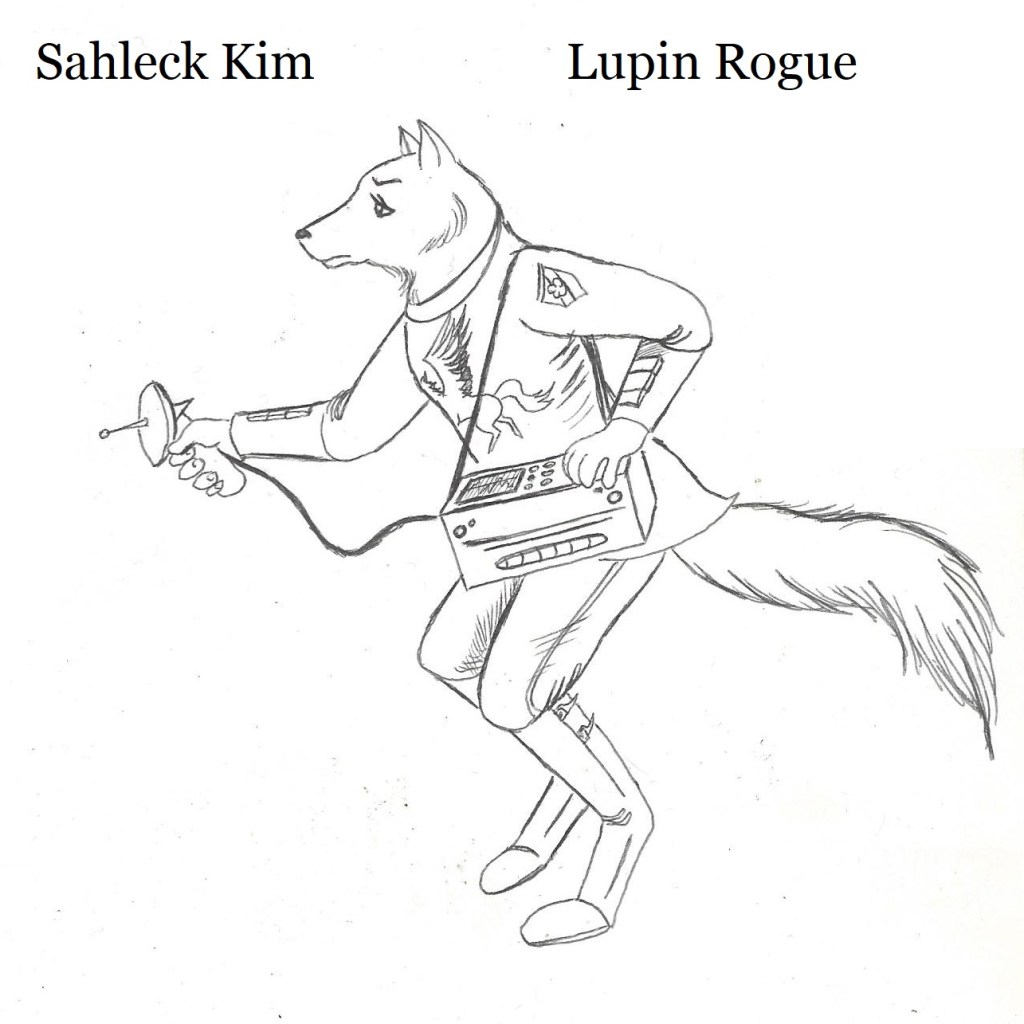
I am nearing the completion of the rewrite of part two of AeroQuest. Part of that is getting all the illustrations I want to include done. So, here are a few more that I have been working on.
For those who might be wondering, AeroQuest 1 and AeroQuest 2 are comic science fiction, and I have chosen to rewrite them with lots of illustrations since it is a work of fiction that I might’ve done as a graphic novel if only I didn’t have arthritis in my hands.
As I am editing and rewriting my first published novel to turn it into a novel series of at least four books, I have been enjoying rounding up and editing old artwork to illustrate it. I have been taking advantage of the fact that you can, after a fashion, plug illustrations into the manuscript and have it come through as acceptably good in the final Amazon publication.
The story comes from adventure logs of a space-fantasy role-playing game called Traveller. I played the game with small handfuls of high school kids whose player characters are now the main characters of the story (after modifications and considerable censorship.
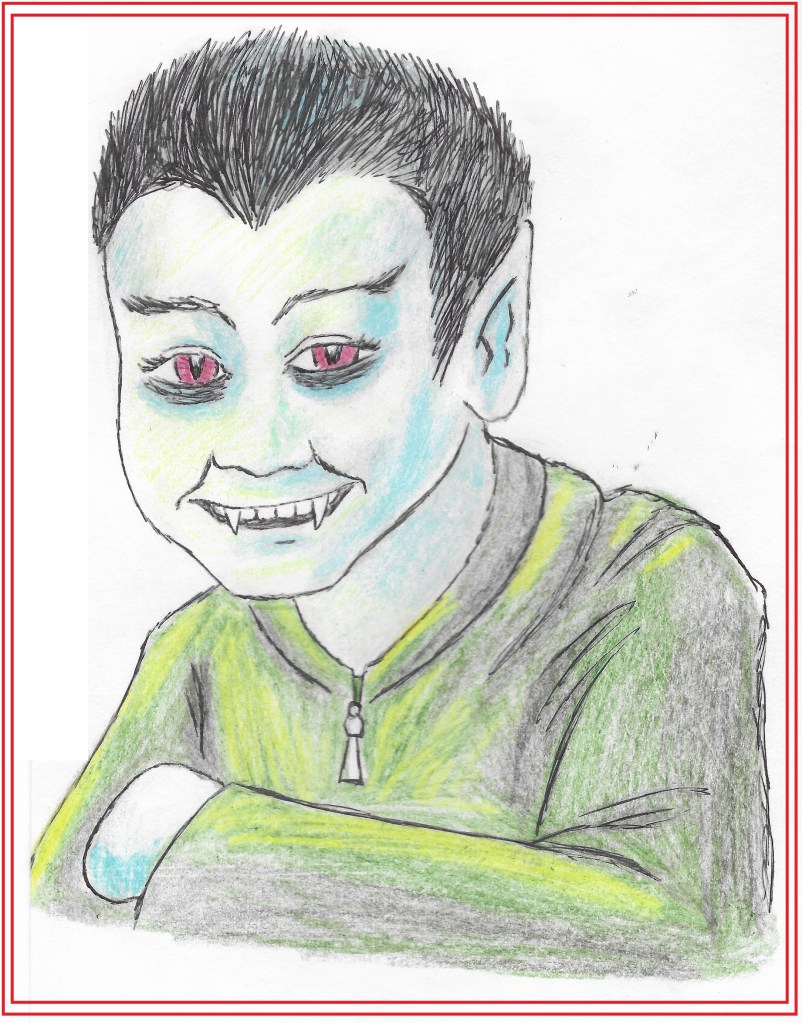
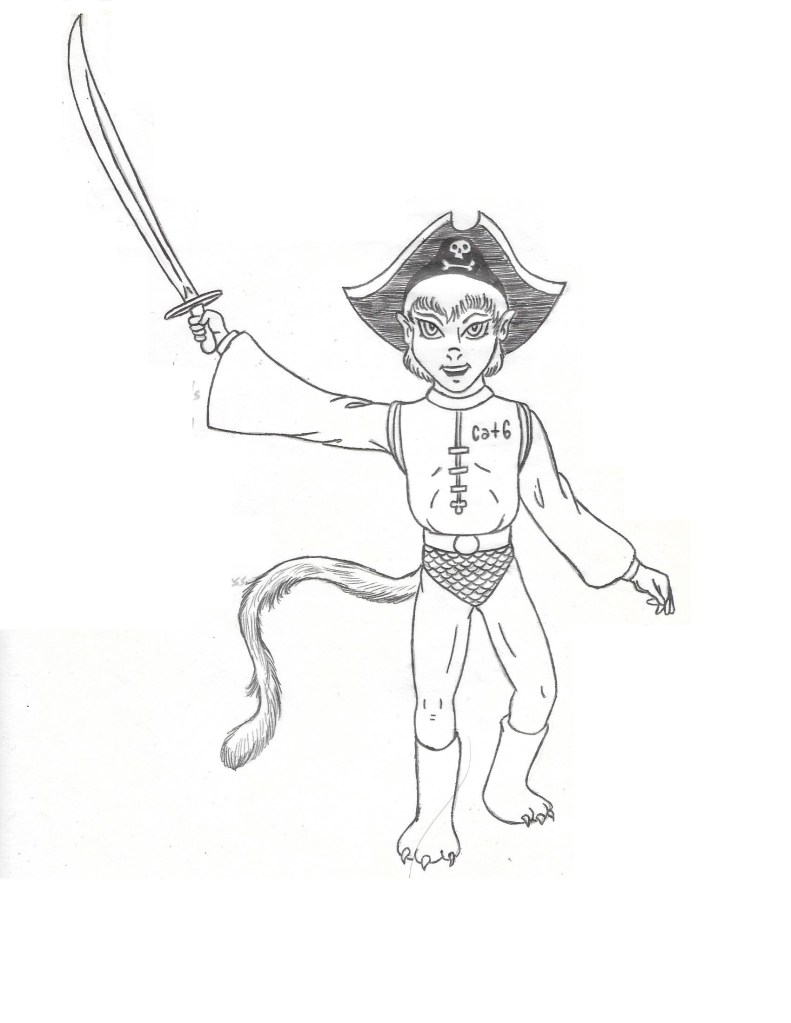
The illustrations, a lot of them, are drawings of the characters that I did in pen and ink back in the 1980’s.
We went through multiple generations of player characters, some of whom were practically immortal, and others that died horrible deaths after a few episodes.
Most of the acting in the RPG was done for humor’s sake, and so my Sci-Fi tale turns out to be more of comedy than anything else.
Amanda is Ged’s daughter, though the player was not related to Ged’s player.
Rescuing the novel from the sorry state it was in from being an awkward first attempt at publishing done with a publisher that later had to be sued and put on trial for fraud has been an interesting and rewarding experience. These stories will never be among my best works, but they were definitely a learning experience. And rewriting them is a learning experience itself, living the story all over again with significant changes.
The places are the same, but as a satire, they had to be re-named in many instances, as the planet names and their make-up were copied from other books and movies. But they were rewritten by the players themselves as everything was turned into comedy and farce. Hence, the planet Mongo ruled by Emperor Ming, became the planet Mingo ruled by Emperor Mong. These are obvious references that are re-named in ways that give us a laugh or a wince.
..
”
”
”
”
”
I doubt it is obvious by just looking at these drawings, but by reducing their size, the line drawings are improved to a high degree.
Illustrating AeroQuest has been fun. Maybe, at some point, it will even prove profitable. But ultimately, it is definitely a thing worth doing.













Reading Other Writers
Nobody who wants to be a writer gets by with just writing and never reading anything by anybody else. It is too easy to devolve into some kind of human mushroom that way, thinking only thoughts a mushroom could think, all fungus-like and having no chlorophyll of their own. You never learn to decode other people and other people’s thinking if you don’t read other people’s thoughts crystallized in writing.
And not every other writer is Robert Frost. Or even Jack Frost who thinks he’s Gene Kelly. There has to be some interpretation, some digging for understanding. What did that writer mean when she said political correctness was like a tongue disease? And what does it mean when a commenting troll calls me a nekkid poofter? Is that how he spells “exceptional genius”? I think it is. Trolls are not smart.
I know people have to make an effort to understand me. When I write, I am writing under the delusion that I can produce literary quality off the top of my head. In fact, I can barely produce hair off the top of my head, and it is gray when I do it. See what I did there? It is the kind of joke a surrealist makes, pretending the idiomatic expression you use is to be taken literally when it doesn’t literally make sense. That kind of nonsense is what my readers have to put up with, and probably also the reason why most of them just look at the pictures. If you have to think too hard when you read, your brain could over-heat and your hair could catch fire. I like that kind of purple paisley prose that folds back in on itself and makes you think in curlicues. But most people don’t. Most people don’t have fire-proof hair like I do.
Sometimes, it doesn’t even take a word to make the point. For instance, why, in the picture, is Fluttershy trying to drink out of the toilet in the dollhouse bathroom? For that matter, why does a doll house even need a bathroom? Applejack doesn’t even fit in that yellow bathtub. I know. I tried to stuff her in there for this picture. And, as you read this, doesn’t this paragraph tell you a lot about me that you probably didn’t even want to know?
When I am reading the writing of others, I am looking for a cornucopia of things. I want to not only understand their ideas, I want to detect the limping footprints across the murder scene of their paragraphs and come to know the deeper things about them as well. I spent years decoding and trying to understand the writing of preliterate kids in my middle school English classes in order to be able to teach them to write better. And I learned that no writer is a bad writer as long as they are using readable words. I also learned that very few writers are James Joyce or Marcel Proust. Thank God for that! And given enough time I can read anything by anybody and learn something from it. I read a lot. And it may not always make me a better writer to read it, but it always has value. It is always worth doing.
1 Comment
Filed under commentary, education, goofy thoughts, humor, irony, photo paffoonies, photos, reading, strange and wonderful ideas about life, surrealism, teaching, wordplay, writing, writing teacher
Tagged as creative-writing, reading for writing, writing, writing advice, writing-community, writing-tips