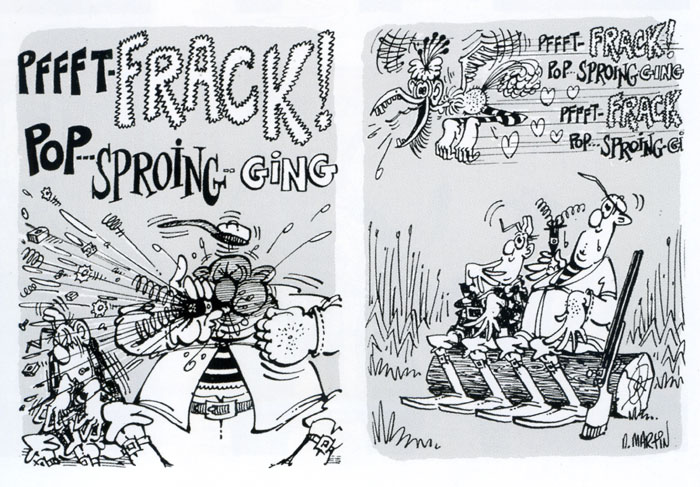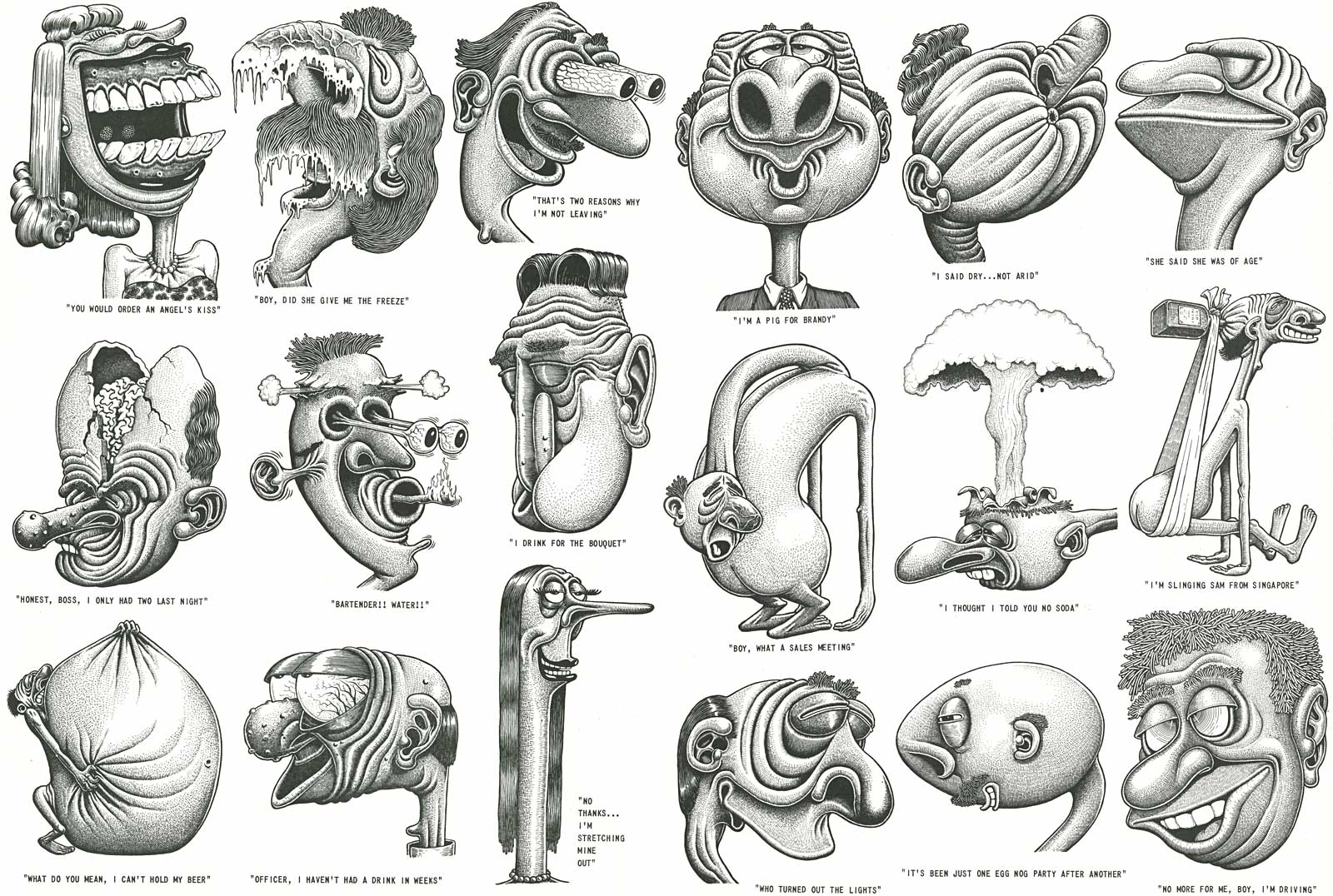
Lena the Hyena appeared in Al Capp’s comic strip Li’l Abner in 1946.
Basil Wolverton (1909 to 1978) became famous as a cartoonist by winning a contest. He submitted the picture of Lena to Al Capp’s newspaper strip to answer the question of what Lena, who had been appearing for weeks in Li’l Abner underneath a black square with an editor’s warning printed on it that she was just too ugly to be revealed, actually looked like. Capp ran the contest to depict Lena and selected Wolverton’s drawing from among 500,000 entries. I think Capp got it right when he chose this to be the world’s ugliest woman.
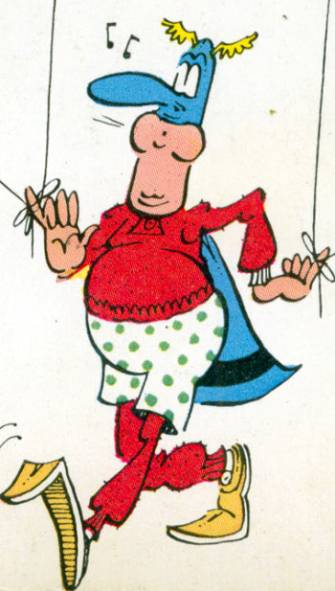
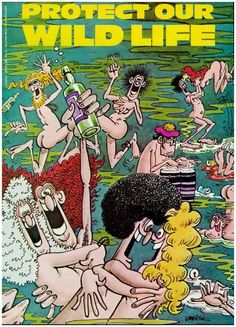
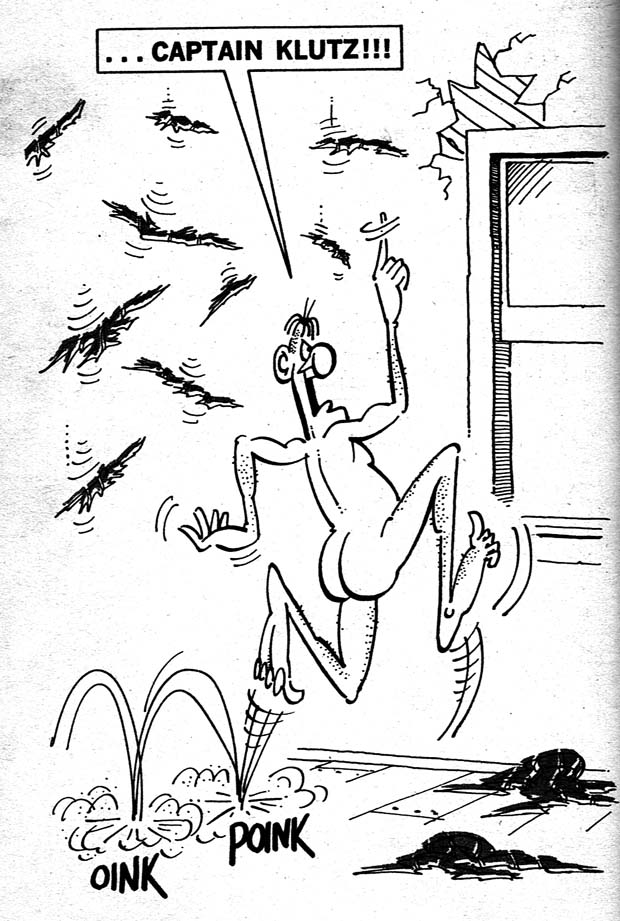
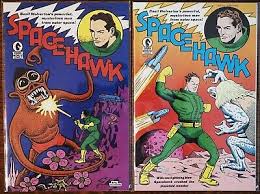
Wolverton had done comics before this one amazingly ugly picture. He did Spacehawk for Target Comics up to 1942, and he did a comic series called Powerhouse Pepper for Timely Comics (which is the company that became Marvel after the 1940’s.) But Lena not only brought him fame, it really started him down the path of his intensely detailed “spaghetti and meatballs” style of rather ugly comic art.

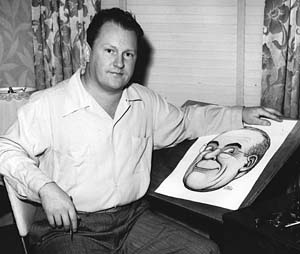
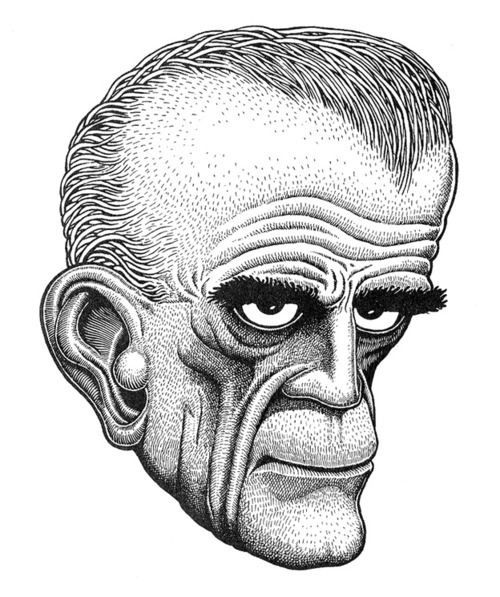
He used millions of little dots and lines to create art that would really soak up the printer’s ink supply and gave his artwork a uniquely “pointillistic” look.
Recognize these as portraits of Presidents and politicians?
Here’s Wolverton’s portrait of Bing Crosby.
And here’s monster movie monarch, Boris Karloff.
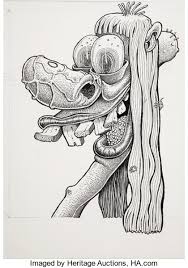
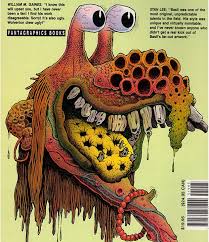
But what really made Wolverton’s unique artwork popular and lucrative was his uniquely twisted and downright ugly portraits.
ugh! wotta beauty!
Ain’t this one… um… unique?
He would go on to be featured in Mad Magazine, Cracked, Panic Magazine, and Topp’s trading card series of Ugly Posters. He managed to do work that reached amazing levels of monstrously ugly humorous mastery of pen and ink drawings.
For years Basil made me laugh. But there’s no denying it… Basil masterfully drew really, really ugly artwork.
It seems sometimes, in a Judaeo-Christian society, that we are a constantly being scrutinized by a rather harsh all-knowing God who rewards getting the faith-words accurately correct, to the letter, and the faith-based actions perfect, without a single mistake. And He punishes missteps of word or deed with pain and suffering and the potential of an eternity in Sheol or Hell. And that is a tough God to live with. He is like a teacher who uses his or her God-like powers to reward or punish to lead his students all down an exacting, narrow path to a destination that does not have room for everyone when they arrive.


It doesn’t take long in childhood for a highly intelligent person to realize before childhood is over that this cosmology is actually a load of horse pucky. It didn’t even take long for somebody as semi-stupid as me.
What I like about listening on YouTube to Alan Watts’s wisdom is that he gives us an alternative way of seeing the universe and ourselves. This he can offer through his studies of Eastern and Buddhist philosophies. Everything appealing in John Lennon’s signature song, “Imagine,” comes from Lennon’s love of listening to Alan Watts’ lectures. He is obviously a wise guy.
Alan Watts teaches us the pathways that lead to finding yourself, who you truly are, and how you fit into the universe as a whole. When Carl Sagan says that we are all made of star-stuff, he is not only telling us what is literally true, as the elements our bodies were formed from were literally made in the nuclear forges at the centers of stars that later exploded in nova bursts to scatter the elements across the skies of everywhere. He is also telling us that what Alan Watts says is metaphorically true, that everything in the universe is part of the same thing and we are all one in this way.
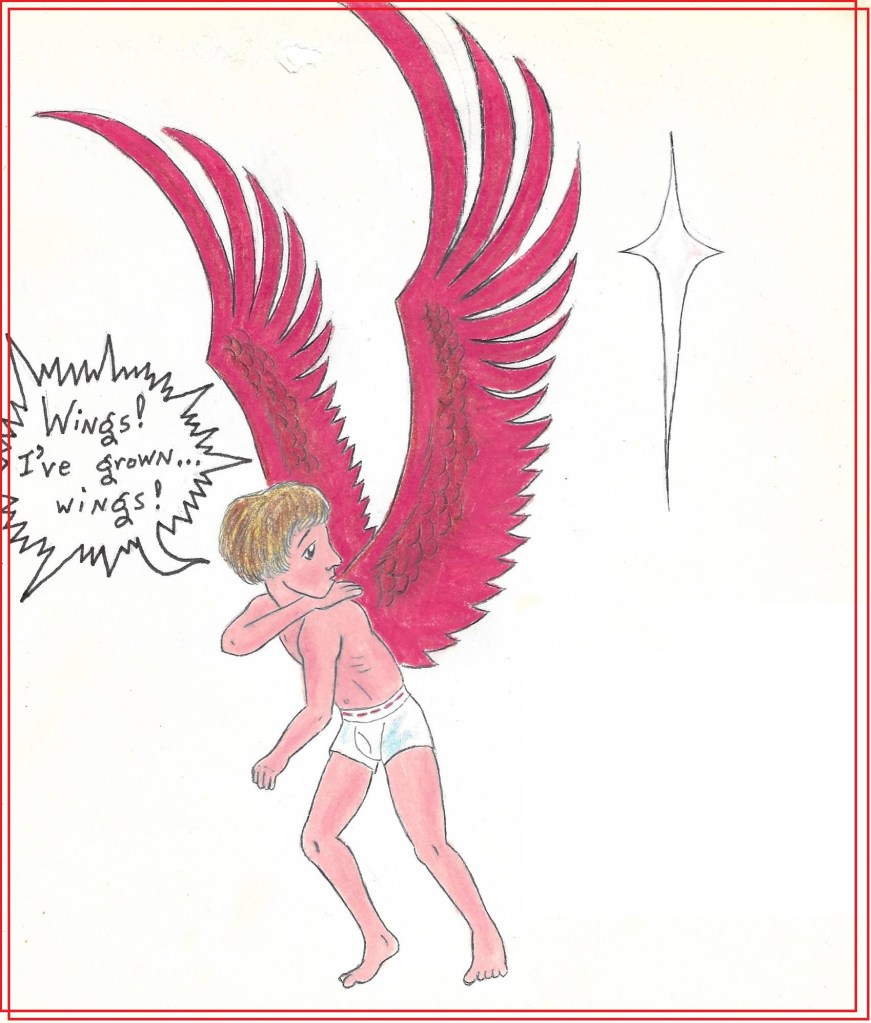
There is plenty to worry about in my little life. I could easily drop dead at any time from any one of my six incurable diseases or even the return of the skin cancer I beat in 1983. I suffer from the consequences of disease daily, as I have for many years now. My sins are many. I broke my promise the other day to never show you the horrors of my naked body on this blog. I constantly eat the wrong thing and continue to do things that I know are bad for the environment and the health of my body. I am prejudiced against racists, stupidity, and the actions of dedicated Trump-lovers. In many ways I deserve God’s wrath and brutal correction. I have come to truly believe that climate change is going to end life on Earth. I am horrible.
But I have learned from Alan Watts that all of those concerns mean nothing. I don’t believe in Heaven or an afterlife. But I do not fear death. I am one with the universe. And the universe goes on even if I do not. And I will always be a part of it, even after I am no longer alive. The universe has a mind and is intelligent And I take part in that because one small part of that intelligence is me, and lives in my head.
There is comfort to be found in the words of Alan Watts. And living in pain as I do, I really need that comfort most of the time. That is why I have attempted to share a bit of that comfort with you.
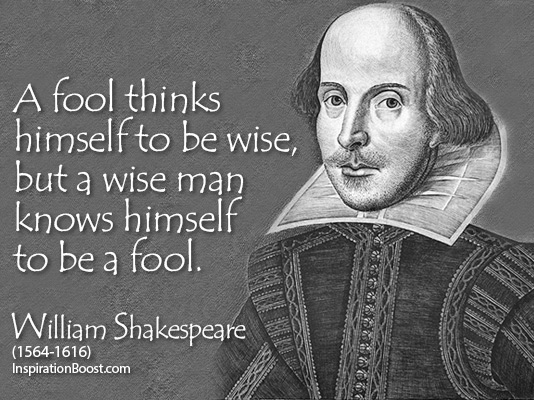
Yes, I am, perhaps, a bit of a fool for believing Edward de Vere, the 17th Earl of Oxford, is the writer behind the works of William Shakespeare. How do you prove something is true when it is so obvious that someone worked really hard to keep it a secret for all this time? Is it a betrayal of the man to go against his apparent wishes and try to out him for his incredible secret? It is hard for me to judge. After all, I know I am a fool.
But even if he is not Shakespeare, and just sits at the apex of a mountain of coincidences, I am fascinated by the historical character of Edward de Vere.
The keep at Hedingham Castle, the de Vere family seat in Essex (photo by David Phillips)
He was born the only son of John de Vere, the 16th Earl of Oxford, and heir to the second oldest title among English nobility. His father stood by Elizabeth when she was under house arrest under the reign of Bloody Mary, and went with her as a court favorite to the throne of England when she survived the ordeal. So naturally Edward was a favorite of Elizabeth’s since childhood. Later stories would suggest he became the Queen’s secret lover, but the rumors of the Virgin Queen’s harlotry were most likely the invention of Philip of Spain and other nobility in Catholic Europe who plotted endlessly against her because she chose to adopt her father’s protestant Anglican religion instead of returning England to Catholicism like her half-sister Mary before her. Elizabeth’s personal integrity may not have been perfect. Still, the love she bore for young Edward was probably not the improper kind that the movie Anonymous, directed by Roland Emmerich, suggested.
But even though de Vere was born lucky, I would not say he was particularly lucky in life. He was only twelve when his father (though having completed his will) died. The result being that he was made ward to Queen Elizabeth herself. She was not exactly the foster-mother type, however. She sent the boy to be raised in the home of her Secretary of State and chief adviser, William Cecil (later made Lord Baron Burghley). Meanwhile, Elizabeth took possession of some of his estates in payment for the wardship and bestowed them on Robert Dudley (her childhood friend and probable one true love, though he was married to someone else). Young Edward was a difficult student. His tutor, the famous scholar Laurence Nowell, resigned in frustration, probably because the boy was too bright and far-reaching for the antiquarian scholar to deal with, possibly himself being a bit dumber than advertised. Edward quickly developed a reputation for love poetry at Elizabeth’s royal court. He was a gifted, though somewhat conflicted, prodigy.
William Cecil, 1st Baron Burghley
And here is what I find most fascinating about his life story. As you reread it, keeping the works of Shakespeare in mind, you begin to see Shakespeare’s source material coming to life. Edward would end up marrying Cecil’s young daughter Anne, so that Lord Burghley was not only a man who raised him, but also his father-in-law. But marrying off your offspring to nobility was an accepted manner of social climbing, and Cecil wasn’t entirely sure he couldn’t do better for his daughter. And the meddlesome, lecturing, and self-righteous nature of the man comes out in Shakespearean characters like Polonius in Hamlet who spies upon the suicidal prince because he fears the effect Hamlet’s love for his daughter Ophelia might have on her reputation, causing him to spout all manner of cliches and stuffy, self-important advice.
Robert Cecil, Lord Salisbury
Cecil’s son Robert, the hunchbacked boy who grows up to take over his father’s office as adviser to both Elizabeth and James I, is a crafty statesman and plotter who is the undoing of the Earl of Essex in a real-life plot against the throne of Elizabeth. It is hard not to read about his real-life exploits without seeing the connections to Iago in Othello and the conniving hunchback Richard III.
So, once again I have overshot my target length in this essay because I get so wound up in the details of my discoveries. There are numerous things written and published about the connections between de Vere and the Bard himself. I have only begun to scratch the surface in this telling of it. But I am just a fool with a humor blog. If it interests you at all, I encourage you to go to as many of the available sources as you can possibly Google. I haven’t yet finished doing that myself. And I do hope I haven’t told anything here that makes Shakespeare turn over in his grave (if, indeed, a grave could ever really hold him.)
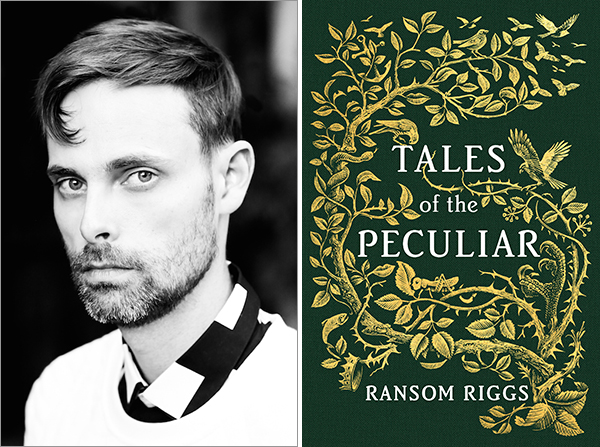
The gentleman writer pictured above is a successful creator of innovative and engaging fiction. As a 1979 vintage, he was still a toddler when I began my teaching career in 1981. Like John Green, another author I admire who was only a small child when I began teaching, he cut his writer’s teeth by writing for Mental Floss the humor-centric publisher of puzzles, facts, and trivia. While I do, in fact, envy his success, I do not in any way take it lightly. He is a capable, highly-intelligent story-teller whose books I have grown to dearly love.
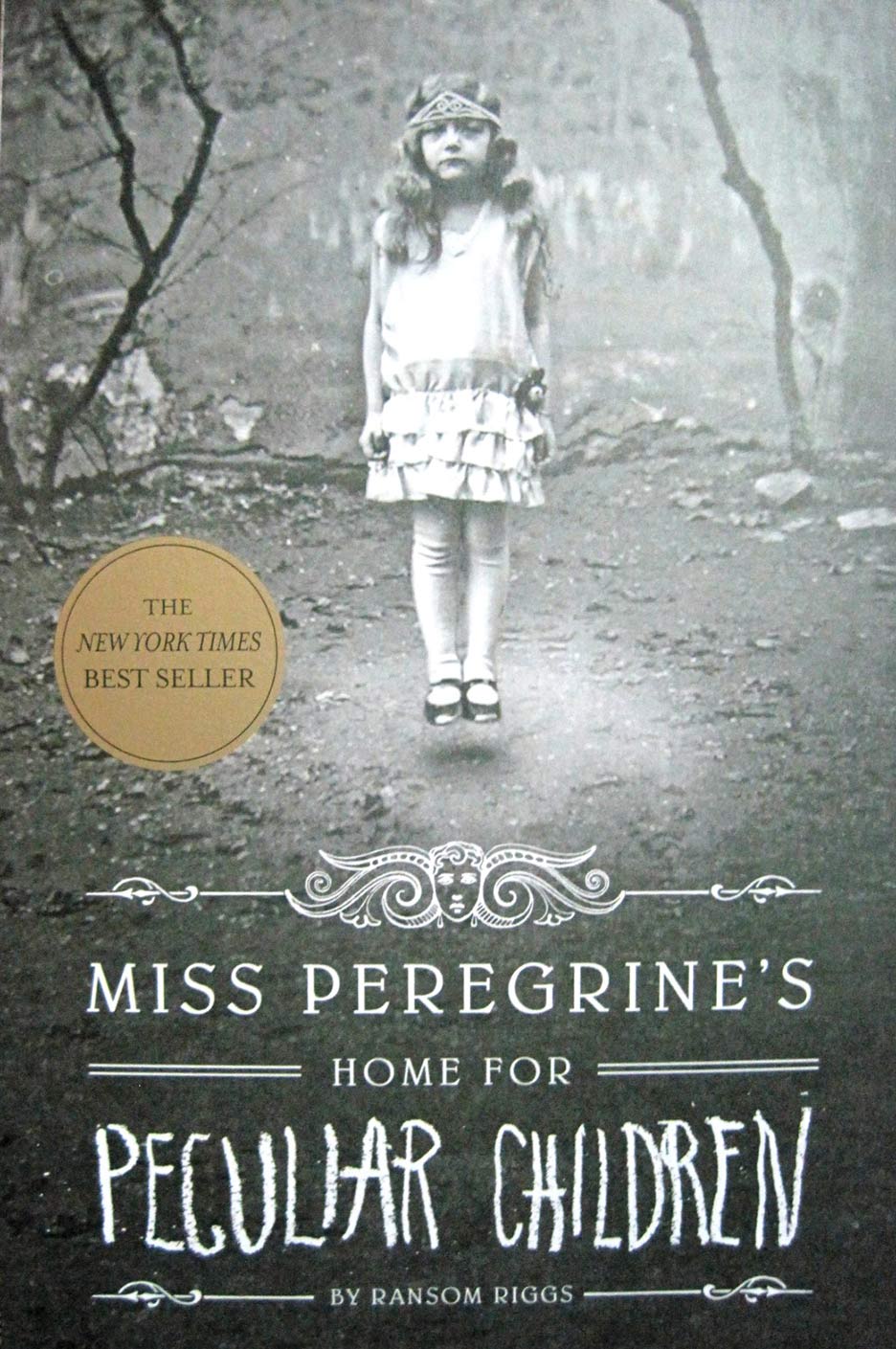
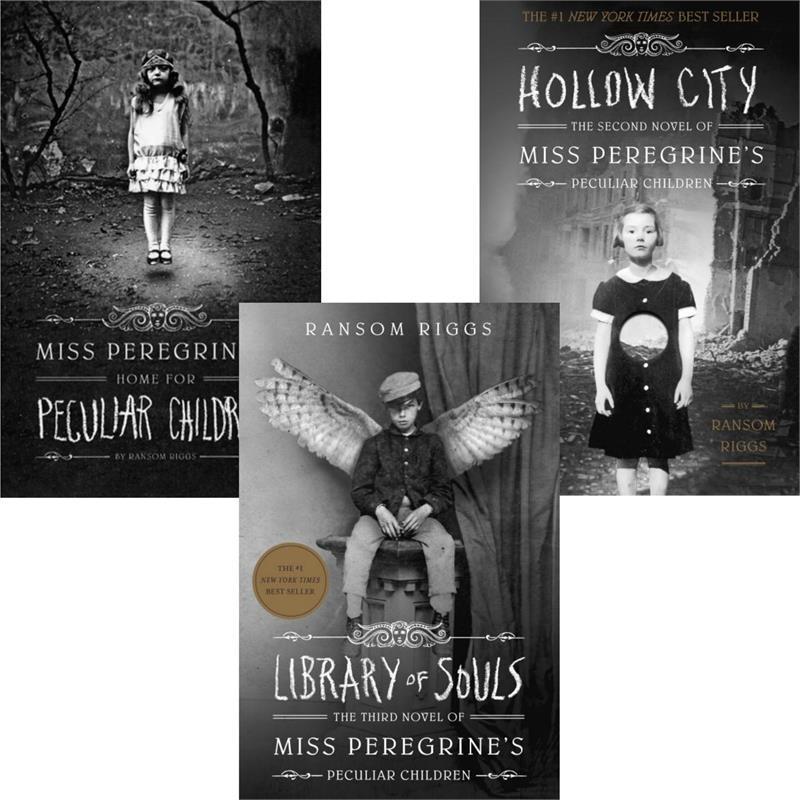
The first book in the peculiar series, also the first book I snagged at Half-Price Books and then devoured in a week (I bought a second copy to read after foolishly eating the first), is the peculiar tome pictured above. In these stories, the peculiar author presents numerous old black-and-white photographs from the days when stereopticons stood in for televisions because the so-called boob-tubes hadn’t had the decency to be invented yet. Most of these photos are bizarre in some way like the one used on his first cover. And the pictures become the story. The girl on the cover of Miss Peregrine’s Home for Peculiar Children becomes Olive, a young girl whose peculiar power is to float in the air. In fact, she has to wear lead shoes to keep from floating off into the sky.
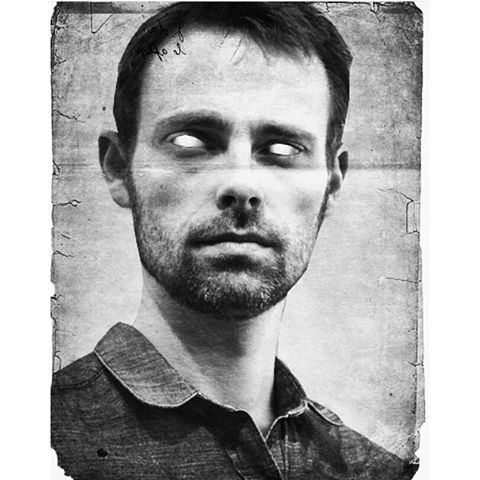
Ransom Riggs as a wight, the vampire-like villains of the series of peculiar books.
Peculiars are menaced by, and have to be protected from wights, former peculiars who eat the souls of their own kind to become white-eyed powerful villains who wish to rule and eat all peculiar people.
The peculiar children have to be protected by creatures called Ymbrynes, women who were originally peculiar birds that found they could turn into human women, and not only that, could loop time in ways that provided pockets of protection from those who would persecute them where time never passed.
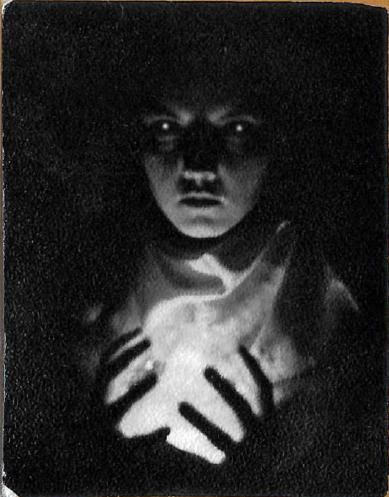
Emma, a peculiar girl who can generate fire from her bare hands.
The protagonist-narrator of the entire trilogy is Jacob Portman, a Florida boy who learns that he has inherited a one-of-a-kind peculiar power from his grandfather (turning it into a two-of–kind thing). And when his grandfather is killed by wights, he learns of a place he must go to take his grandfather’s former place guarding Miss Peregrine’s troop of peculiat children, including Emma, pictured here, (a hot chick in more than one way).
I will not tell you any more of the story of the trilogy. I hate to spoil anything from another author’s work. I found that the discovery of every delicious detail and oddity along the way was the tastiest feature of the fiction. (I do have to break that bad habit of eating books. Gustatory learning, my peculiar ability and my curse.) I will, rather, merely recommend that you discover the peculiar charms of these peculiar books for yourself. (And try not to discover them by eating them. Books have too much fiber and too little protein to be used like that.)
One work of comic strip art stands alone as having earned the artist, Winsor McCay, a full-fledged exhibition at the Metropolitan Museum of Art in New York City. Little Nemo in Slumberland is a one-of-a-kind achievement in fantasy art.
Winsor McCay lived from his birth in Michigan in 1869 to his finale in Brooklyn in 1934. In that time he created volumes full of his fine-art pages of full-page color newspaper cartoons, most in the four-color process.
The New Year’s page 1909
As a boy, he pursued art from very early on, before he was twenty creating paintings turned into advertising and circus posters. He spent his early manhood doing amazingly detailed half-page political cartoons built around the editorials of Arthur Brisbane, He then became a staff artist for the Cincinnati Times Star Newspaper, illustrating fires, accidents, meetings, and notable events. He worked in the newspaper business with American artists like Winslow Homer and Frederick Remington who also developed their art skills through newspaper illustration. He moved into newspaper comics with numerous series strips that included Dreams of the Rarebit Fiend and Little Nemo in Slumberland. And he followed that massive amount of work up by becoming the “Father of the Animated Cartoon” with Gertie the Dinosaur, with whom he toured the US giving public performances as illustrated in the silent film below;
The truly amazing thing about his great volume of work was the intricate detail of every single panel and page. It represents a fantastic amount of work hours poured into the creation of art with an intense love of drawing. You can see in the many pages of Little Nemo how great he was as a draftsman, doing architectural renderings that rivaled any gifted architect. His fantasy artwork rendered the totally unbelievable and the creatively absurd in ways that made them completely believable.
I bought my copy of Nostalgia Press’s Little Nemo collection in the middle 70’s and have studied it more than the Bible in the intervening years. Winsor McCay taught me many art tricks and design flourishes that I still copy and steal to this very day.
No amount of negative criticism could ever change my faith in the talents of McCay. But since I have never seen a harsh word written against him, I have to think that problem will never come up.
My only regret is that the wonders of Winsor McCay, being over a hundred years old, will not be appreciated by a more modern generation to whom these glorious cartoon artworks are not generally available.
Yes, David Mitchell is a very smart man… a very smart English man. (That isn’t to say that his genius is any less genius than an American Genius. Just that he is a genius who also happens to be English)
And I, of course, don’t mean this David Mitchell either, though this David Mitchell is also a genius and also from England. I have to tell you, though I have always loved British humor, this particular tongue of silver fascinates me enough to make me binge on hoards of old episodes of “Would I Lie to You?” from the BBC on YouTube. He’s a quick-wit, Brit-wit, smooth-talking bit-wit who can make you laugh even when he’s playing a thick-wit… which he is certainly not. Continue reading →
There is a place so like the place where my heart and mind were born that I feel as if I have always lived there. That place is a cartoon panel that ran in newspapers throughout the country from 1913 to 1955 (a year before I was born in Mason City, Iowa). It was called Toonerville Folks and was centered around the famous Toonerville Trolley.
Fontaine Fox was born near Louisville Kentucky in 1884. Louisville, of course is one of the two cities that claims to be the inspiration for Toonerville. Apparently the old Brook Street Line Trolley in Louisville was always run-down, operating on balls of twine and bailing wire for repair parts. The people of Pelham, New York, however, point to a trolley ride Fox took in 1909 on Pelham’s rickety little trolley car with a highly enterprising and gossip-dealing old reprobate for a conductor. No matter which it was, Fox’s cartoon mastery took over and created Toonerville, where you find the famous trolley that “meets all trains”.
I didn’t learn of the comic strip’s existence until I was in college, but once I found it (yes, I am the type of idiot who researches old comics in university libraries), I couldn’t get enough of it. Characters like the Conductor, the Powerful (physically) Katrinka, and the terrible-tempered Mr. Bang can charm the neck hair off of any Midwestern farm-town boy who is too stupid to regret being born in the boring old rural Midwest.
I fancied myself to be just like the infamous Mickey (himself) McGuire. After all, we have the same first name… and I always lick any bully or boob who wants to put up a fight (at least in my daydreams).
So, this is my tribute to the cartoonist who probably did more to warp my personality and make me funny (well, at least easy to laugh at! ) than any other influence. All of the cartoons in this post can be credited to Fontaine Fox. And all the people in them can be blamed on Toonerville, the town I used to live in, though I never really knew it until far too late.
I was predisposed to like this movie from the outset. After all… Spielbergh… Roald Dahl… a musical score by John Williams… almost Robin Williams as the BFG! But I don’t like this movie after all. I LOVE it!!!
I am easily stunned by gorgeous settings, CGI magic, and artistically done visuals. I am easily captivated by cute and gifted young actresses like the one who plays Sophie, Ruby Barnhill. And I am especially won over by the smiling face of the BFG himself. He reminds me so clearly of my Great Grandpa Raymond (who was no less a magical being in my life than the BFG is in Sophie’s).
The fact that the BFG’s job in Giant Land is the capturing, bottling, mixing, and gifting of dreams is the most winning feature of all. And he uses it in the epic plan to overcome the bestial, cannibalistic, (and possibly Trump supporters) other, bigger giants. He is a metaphor for the story-teller himself… enduring hardships and harrowing adventures to capture, package, and deliver the stories that are so important to life and people’s ultimate happiness. It is true for Roald Dahl, the darkly silly genius who wrote the story. It is also true for Steven Spielberg, the craft-master and movie-maker who put it on film. It is true also for the magician of movie music, John Williams. I hope, someday, it will also be true for me.
So many things about this movie are the epitome of the best movie-theater experiences. I do not understand how it could’ve done so poorly in the box office. I believe it will become one of those beloved and much-watched DVDs like Spielberg’s previous fairy-tale masterpiece, Hook, did. I pray that it won’t simply become an overlooked asterisk in the history of cinema. It is too good of a movie experience for that.
If there is a Church of Sacred Landscapes then Bob Ross is its Jesus Christ. That is not a sacrilegious statement of bizarre cult-mindedness. Painting is a religion that has its tenets. And Bob Ross explained to us the will of God on his painting show on PBS. All the illustrations used in this post come from the Facebook page Joy of Painting with Bob Ross. All the wisdom comes from things the Master said on the show.
Bob Ross was the prophet of the paintbrush. He would present us with a lightly prepared canvas at the beginning of the show and then proceed on camera to take his brush and palette knife, and all his paints, and create a piece of the world before our very eyes. And he was not Picasso or Van Gogh or even Norman Rockwell. He was not a talented artist, but rather a very practiced one who knew all the tricks and shortcuts to sofa painting, the art of knocking out scene after scene after scene. He could make his little piece of the world in only half an hour, and he made it obvious how we could do the same. His work was not gallery quality… but his teachings were Jesus-worthy.
His work was natural, flowing, and realistic in the random complexity it presented. He took standard paintbrush strokes and pallet knife tricks and made them dance across the canvas to make happy little trees.
His painting methods presented us with a philosophy of life and a method of dealing with whatever mistakes we might make.
And of course, any good religion must take into account the existence of evil.
Bob Ross tells us that evil is necessary as a contrast to what is good and what is true. We need the dark. But we don’t have to embrace it. Bob’s paintings were never about the dark bits. He always gravitated towards the light.
Of course, sometimes you have to beat back the darkness. A good artist takes care of his tools.
Bob Ross admonishes us to look and to learn and love what we see. The man radiated a calm, gentle nature that makes him a natural leader. His simple, countrified wisdom resonates because we need calm and pastoral peace in our lives. It is one of the main reasons mankind needs religion.
So I definitely think we ought to consider building a Bob-Rossian Church of the Sacred Landscapes. We have our prophet. The man has passed away, yet he is risen to paint again endlessly on YouTube.
And if you are willing to try… Bob Ross will smile upon you.
This post is about writer doubt. And Stephen King. Do those two things go together? If they don’t then Mickey is an awful writer and does not know how to do what he does. It would mean Mickey is icky.
I used to think Stephen King was a totally over-rated writer. Back in the early eighties I read Carrie, King’s first novel, and got halfway throughFirestarter, and had to give up. Partly because the book was overdue at the library, and also because I found the books mechanical and somewhat joyless in the writing. I thought he suffered greatly in comparison to writers I was in love with at the time like Ray Bradbury and Thomas Mann. I began to tell others that King was somewhat icky.
But King was obviously also somewhat successful. He began to get his books made into movies and people who don’t read discovered the evil genius of a man who tells stories to scare them and laces them with a bit of real humanity, real human feeling, and love.
I saw it first in Stand by Me. That movie, starring young Wil Wheaton as the Steven King autobiographical character, really touched my heart and really made for me a deep psyche-to-psyche connection to somebody who wasn’t just a filmmaker, but somebody who was, at heart, a real human being, a real story-teller.
Now, the psyche I was connecting to may very well have been Rob Reiner, a gifted story-teller and film-maker. But it wasn’t the only King movie that reached me. The television mini-series made from It touched a lot more than just the fear centers of my brain as well. And people whose opinions I respect began telling me that the books The Dark Tower Trilogy and Misery were also amazing pieces of literature.
So I picked up a copy of Hearts in Atlantis at Half-Price Books and began reading a Stephen King novel for the first time since the 80’s. MY HOLY GOD! King is not a little bit icky. He is so NOT ICKY that it makes Mickey sicky to have ever thought King was even a little bit icky! Here is a writer who loves to write. He whirls through pages with the writer’s equivalent of ballet moves, pirouettes of prose, grand jetés of character building, and thematic arabesque penchées on every side of the stage. I love what I have discovered in a writer I thought was somewhat icky. Growth and power, passion and precision, a real love of both the words and the story. He may not know what he is doing. But I know. And I love it.
And so, while I have been editing the first novel I ever wrote, Superchicken, to make it ready for self-publishing, I have begun to ask myself the self-critical question, “Is Mickey really icky when he writes?” My first novel is full of winces and blunders and head-banging wonders that make me want to throw the whole thing out. But I can’t throw it out. It is the baby in the first bathwater that I ever drew from the tap. The answer to the questions of Micky ickiness have yet to be determined, and not by me. I guess I have to leave it up to you.
Dancing With Alan Watts
It seems sometimes, in a Judaeo-Christian society, that we are a constantly being scrutinized by a rather harsh all-knowing God who rewards getting the faith-words accurately correct, to the letter, and the faith-based actions perfect, without a single mistake. And He punishes missteps of word or deed with pain and suffering and the potential of an eternity in Sheol or Hell. And that is a tough God to live with. He is like a teacher who uses his or her God-like powers to reward or punish to lead his students all down an exacting, narrow path to a destination that does not have room for everyone when they arrive.
It doesn’t take long in childhood for a highly intelligent person to realize before childhood is over that this cosmology is actually a load of horse pucky. It didn’t even take long for somebody as semi-stupid as me.
What I like about listening on YouTube to Alan Watts’s wisdom is that he gives us an alternative way of seeing the universe and ourselves. This he can offer through his studies of Eastern and Buddhist philosophies. Everything appealing in John Lennon’s signature song, “Imagine,” comes from Lennon’s love of listening to Alan Watts’ lectures. He is obviously a wise guy.
Alan Watts teaches us the pathways that lead to finding yourself, who you truly are, and how you fit into the universe as a whole. When Carl Sagan says that we are all made of star-stuff, he is not only telling us what is literally true, as the elements our bodies were formed from were literally made in the nuclear forges at the centers of stars that later exploded in nova bursts to scatter the elements across the skies of everywhere. He is also telling us that what Alan Watts says is metaphorically true, that everything in the universe is part of the same thing and we are all one in this way.
There is plenty to worry about in my little life. I could easily drop dead at any time from any one of my six incurable diseases or even the return of the skin cancer I beat in 1983. I suffer from the consequences of disease daily, as I have for many years now. My sins are many. I broke my promise the other day to never show you the horrors of my naked body on this blog. I constantly eat the wrong thing and continue to do things that I know are bad for the environment and the health of my body. I am prejudiced against racists, stupidity, and the actions of dedicated Trump-lovers. In many ways I deserve God’s wrath and brutal correction. I have come to truly believe that climate change is going to end life on Earth. I am horrible.
But I have learned from Alan Watts that all of those concerns mean nothing. I don’t believe in Heaven or an afterlife. But I do not fear death. I am one with the universe. And the universe goes on even if I do not. And I will always be a part of it, even after I am no longer alive. The universe has a mind and is intelligent And I take part in that because one small part of that intelligence is me, and lives in my head.
There is comfort to be found in the words of Alan Watts. And living in pain as I do, I really need that comfort most of the time. That is why I have attempted to share a bit of that comfort with you.
Leave a comment
Filed under artists I admire, commentary, feeling sorry for myself, finding love, foolishness, healing, health, humor, Paffooney, philosophy
Tagged as Alan Watts, consciousness, life, meditation, mindfulness, philosophy, spirituality