
Still being under the weather and filled with sinus head-pain, I decided to go back to a subject I love so much that the post will simply write itself. You know I love Norman Rockwell and his art, and I fervently believe that kind of mass media oil-painting does not put him in a lesser category than Rembrandt or Michelangelo or Raphael or any other painter with a ninja turtle namesake. He is a genius, and though he is not a realist in so many ways, his work is more truthful than practically any other kind of painting. If you are taken by surprise and didn’t know I had this passionate obsession, maybe you should go back and look at this post; Norman Rockwell
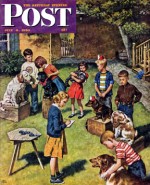
Now that I got that out of my system, here is another Saturday Evening Post artist that is often confused with Rockwell. His name is Amos Sewell.
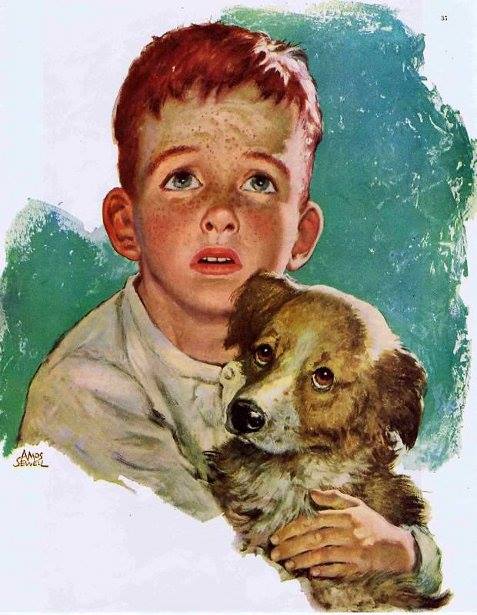
Sewell was an amateur tennis player who was talented enough to win tournaments. He was an employee of Wells Fargo who was headed towards anything but an art career until he decided to make a leap of faith in 1930. He started as an illustrator for Street and Smith pulp fiction, and soon caught the notice of the big-time magazine markets for his art. He published art for Saturday Evening Post, Country Gentlemen Magazine, and Women’s Day.
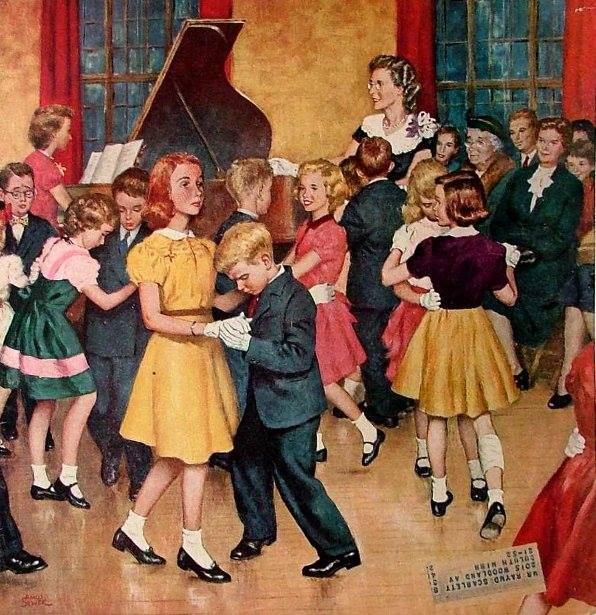
Like Rockwell, he was able to find the funny in everyday scenes, like the dance party to the right. That young man at center stage is trying so hard not to step on the feet of the red-headed girl, that you want to laugh, but can’t because it’s obvious how embarrassed he would be, and the charm of the picture leads you to shun the thought of interrupting. The scene is so real the boy would hear you laughing as you looked at the Post cover.
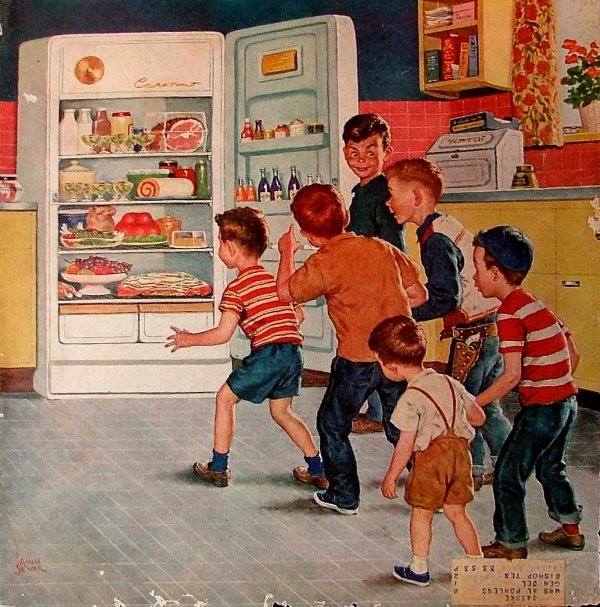

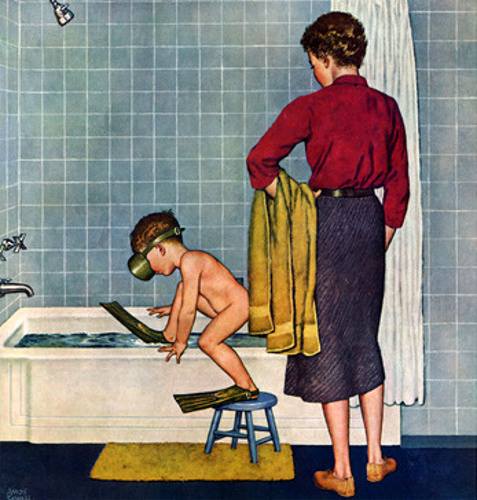
More expert on this kind of art than I am is the Facebook site that I first got turned on to Sewell by. Children in Art History
They can also be found on WordPress. Children in Art History (WordPress)
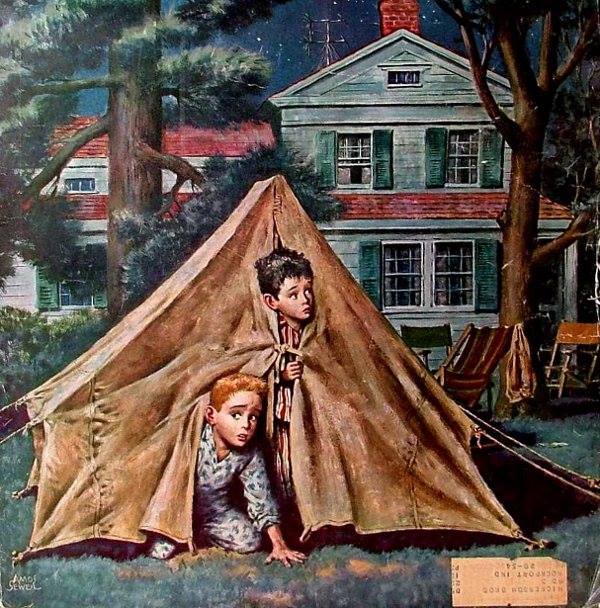
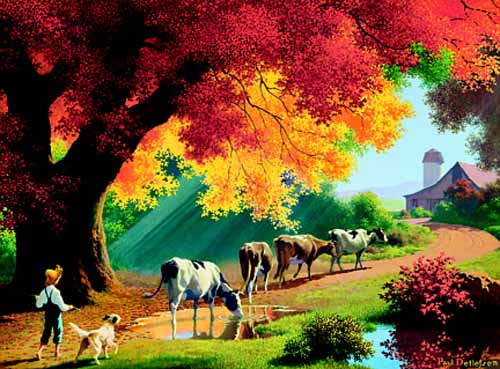
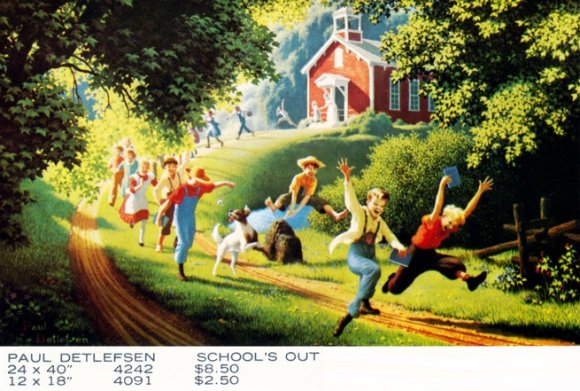
There is no doubt that Amos Sewell belongs in the same pantheon of artists as Norman Rockwell, Thomas Kinkade, or Paul Detlafsen. They are all artists who achieve in their work exactly what I have always striven for. I want to be able to hold the mirror up to our world the way they did. I want to capture both the fantasy and the reality in the subject of everyday family life. I also want to share this work with you because I cannot stand the idea that such artistic ambrosia could one day be forgotten in archives where no one ever looks at it and feels the message in their heart.
















Sunday with Salvador
Today I am waxing on about the wonderful, mad, mad, mad genius of surrealist art, Salvador Dali. He was born in 1904 and died in 1989. And that’s really about all that I want to tell you about the physical parameters of his boundlessly creative life. He was alive in this world until I was already thirty-three. So, I got to see him on television and watch video biographies of him and his incredible artwork. Ones that included interviews. And if I get into his public persona, that will eat up the rest of his essay. Instead, I need to talk about his art, and how it modifies and magnifies what I am meant to be.
His most famous painting is the one that most clearly burned the image of melting clocks into our collective memory. He claimed, and others pretend to see it too, that it is a reaction to Einstein’s Theory of Relativity. But when I look at it with the melting mask of Dali himself in the center, I see the artist’s perception of time in the spaces within which creativity moves. Time melts and has no meaning when you are painting and writing from an endless roiling flow of new ideas and notions. Time becomes as irrelevant in that context as the ants on the pocket-watch or the dead tree from which one deflated clock-skin hangs, There is no past or future, only the creative now.
And in that creative now, the artist sees himself. But if you look too closely, the self vanishes into the picture, the currently considered, fascinating work of art.
You see the boy with the hoop and wearing a sailor suit? That symbol, he always claimed, was his lost brother, the one who died before he was born. The one whose death made his parents decide to have another child. Without that brother, Salvador would probably never have existed at all.
And do you see the disappearing bust of Voltaire? Or when you look closely at the slave market in the background, is it simply no longer there? Things that disappear… things that become other things… tricks of perception, the fooling of the viewer’s eye… These are what the artist actually wants you to see. Not the well-portrayed physical reality, but the ghost of the shadow of an idea that’s hard to define.
And then there is the idea of war. Two world wars that took place in the prime of his painterly life.
Life does crazy things to the sensitive, suffering artist, and it shows in his work if not in his public personality.
And consider the artist’s notion of birth and life and death. Narcissus suffers for the sin of love of himself. He becomes petrified with age, a narcissus flower growing from his head, now an egg, the symbol of birth and rebirth.
And here is an exploded portrait of his beloved wife Gala.
All the elements float eternally in the air.
And you can see inside each thing.
Inside the home is the wife and mother.
Inside the mother is the child.
Inside the child is the loaf of bread that keeps him alive.
Does the bread, then, stand in for God himself?
Dali and his work is not simple. It is deeply, incongruously complex. But that is surrealism. That is how it works. Without getting into other complex symbols and such Dali-esque puzzles like burning giraffes, eggs, and Venus De Milo with bureau drawers in her torso, that is how Salvador spends his Sunday with me. An artist beyond time and space, long dead, but still speaking to me. And teaching me beautiful, untold things and stories of things.
Leave a comment
Filed under art criticism, artists I admire, artwork, autobiography, commentary, surrealism
Tagged as art, dali, painting, Salvador Dali, surrealism