
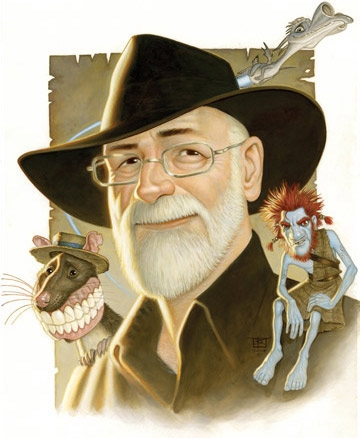
image borrowed from TVtropes.com
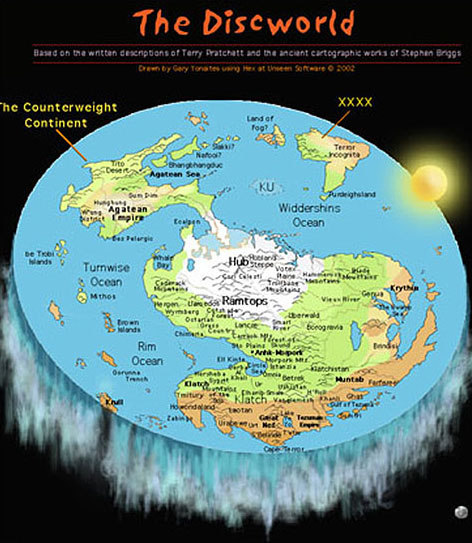
I firmly believe that I would never have succeeded as a teacher and never gotten my resolve wrapped around the whole nonsense package of being a published author if I hadn’t picked up a copy of Mort, the first Discworld novel by Terry Pratchett that I ever encountered. I started reading the book as a veteran dungeon-master at D&D role-playing games and also as a novice teacher, having a world of difficulty trying to swim up the waterfalls of Texas education fast enough to avoid the jagged rocks of failure at the bottom. I was drinking ice tea when I started reading it. More of that iced tea shot out my nose while reading and laughing than went down my gullet. I almost put myself in the hospital with goofy guffaws over Death’s apprentice and his comic adventures on a flat world riding through space and time on the backs of four gigantic elephants standing on the back of a gigantic-er turtle swimming through the stars. Now, I know you have no earthly idea what this paragraph even means, unless you read Terry Pratchett. And believe me, if you don’t, you have to start. If you don’t die laughing, you will have discovered what may well be the best humorist to ever put quill pen to scroll and write. And if you do die laughing, well, there are worse ways to go, believe me.
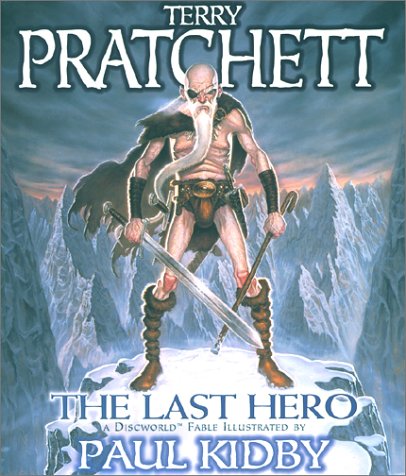
Discworld novels are fantasy-satire that make fun of Tolkien and Conan the Barbarian (written by Robert E. Howard, not the barbarian himself) and the whole world of elves and dwarves and heroes and dragons and such. You don’t even have to love fantasy to like this stuff. It skewers fantasy with spears of ridiculousness (a fourth level spell from the Dungeons of Comedic Magic for those fellow dungeon masters out there who obsessively keep track of such things). The humor bleeds over into the realms of high finance, education, theater, English and American politics, and the world as we know it (but failed to see from this angle before… a stand-on-your-head-and-balance-over-a-pit-of-man-eating-goldfish sort of angle).
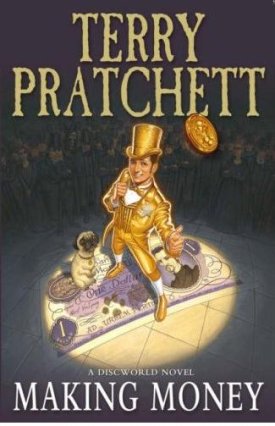
Terry Pratchett’s many wonderful books helped me to love what is ugly, because ugly is funny, and if you love something funny for long enough, you understand that there is a place in the world even for goblins and trolls and ogres. Believe me, that was a critical lesson for a teacher of seventh graders to learn. I became quite fond of a number of twelve and thirteen year old goblins and trolls because I was able see through the funny parts of their inherent ugliness to the hidden beauty that lies within (yes, I know that sounds like I am still talking about yesterday’s post, but that’s because I am… I never stop blithering about that sort of blather when it comes to the value hidden inside kids).
I have made it a personal goal to read every book ever written by Terry Pratchett. And that goal is now within reach because even though he is an incredibly prolific writer, he has passed on withing the last year. He now only has one novel left that hasn’t reached bookstores. Soon I will only need to read a dozen more of his books to finish his entire catalog of published works. And I am confident I will learn more lessons about life and love and laughter by reading what is left, and re-reading some of the books in my treasured Terry Pratchett paperback collection. Talk about your dog-eared tomes of magical mirth-making lore! I know I will never be the writer he was. But I can imitate and praise him and maybe extend the wonderful work that he did in life. This word-wizard is definitely worth any amount of work to acquire and internalize. Don’t take my convoluted word for it. Try it yourself.
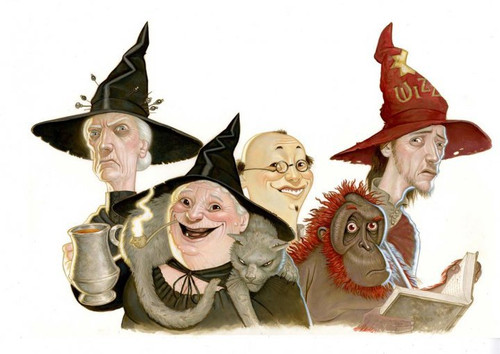
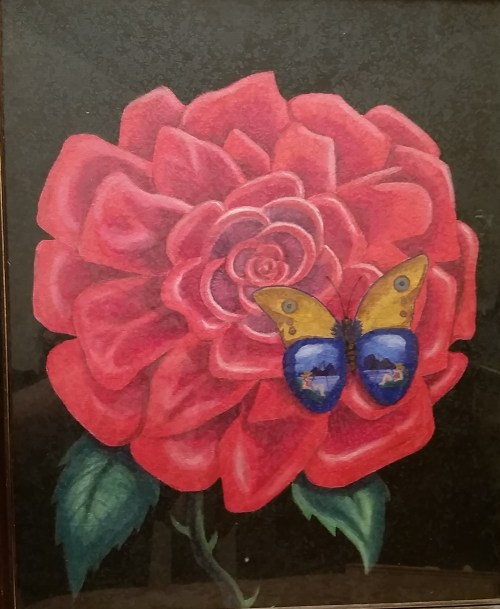
borrowed from artistsUK.com

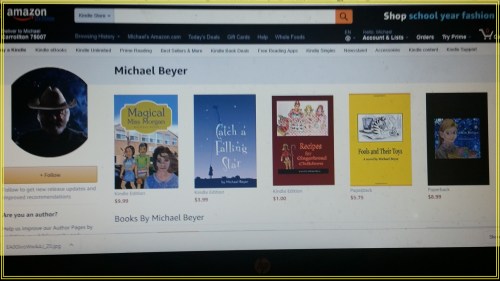













 Catch a Falling Star
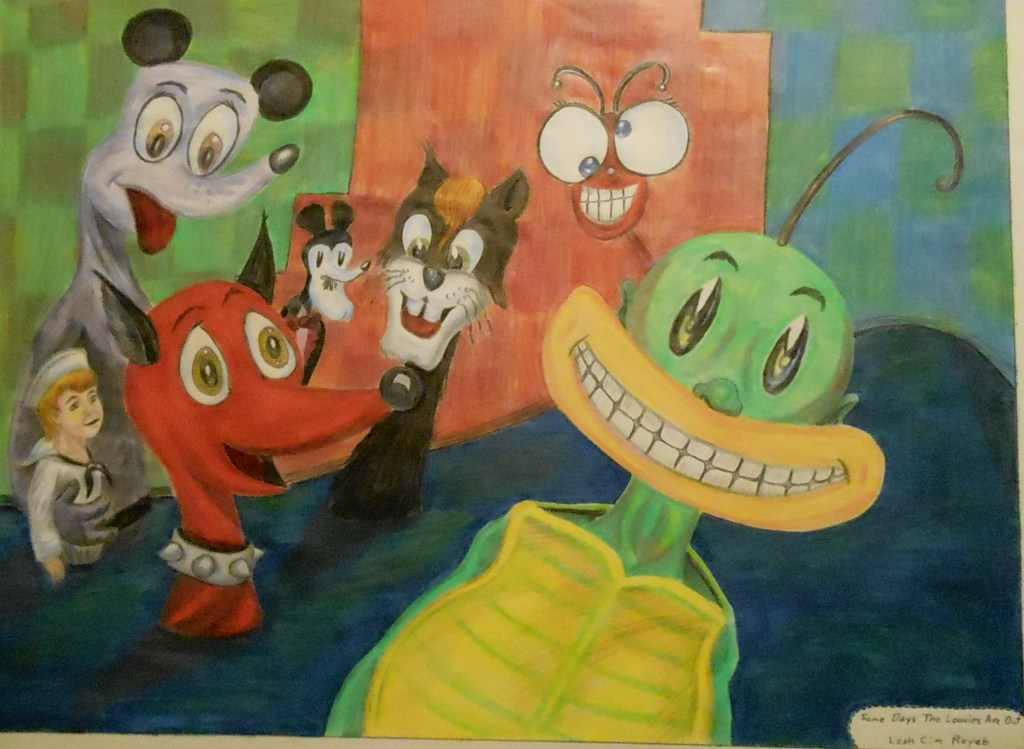
Mickey Predicts… Uh, Oh!
I have lately been watching YouTube videos about science fiction writers like Jules Verne, Isaac Asimov, and Arthur C. Clarke. These are visionary writers who predicted many things about future applications of science and technology.
Verne foresaw nuclear submarines, expeditions into the interior of the planet, and men setting foot on the moon. Asimov predicted much of what we must deal with in terms of robots and thinking machines with artificial intelligence. And Clarke envisioned satellites and how they could be used for communications and other things we are currently doing in a massive way. He wrote the story that the movie 2001 a Space Odyssey is based on.
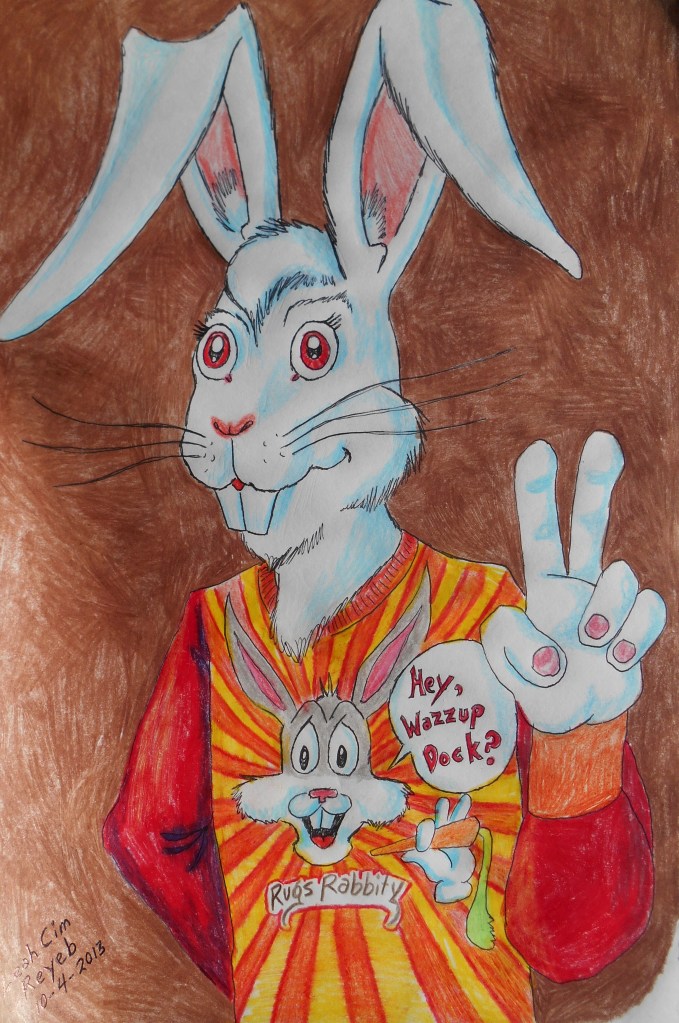
So, now Mickey has to get in on the prediction bandwagon too. After all, he thinks he is a science fiction writer too, foreseeing things like rabbit people, de-evolution machines, and time-travel gloves.
The disturbing thing is, however, that much of what Mickey sees in the near future is rather bleak. We have a sinister tendency to live our current lives in very stupid ways. Rich industrialists like the Koch brothers, Bill Gates, and Jeff Bezos put profits in the short term over the safety, welfare, and lives of people, even the people who made them wealthy. Because you can make money faster by not worrying about how you may be changing and polluting the environment, you are turning the planet into a hothouse of unbreathable gasses and toxic chemicals.
Since we are entering a time with rising oceans, we are going to have to work at not only de-acidifying the ocean water and restoring fish and other aquatic life, but becoming sea-dwellers ourselves. We will be living in underwater cities. We will travel in underwater cars powered by solar-charged batteries. We will wear scuba gear to school. And we will need to invent aqualungs that extract oxygen and nitrogen from the water.
We will also need to develop environmental suits even to live on the land in the toxic atmosphere. We will all be like Ironman, all living safely inside our Swiss-army, all-purpose, and internet-connected Ironman suits.
And many of us will become Martians… or Venusians… living on other planets in the solar system.
Of course, we will have to do something about all the stupid people. Ideally, we would solve our aversion to educating kids to think for themselves, and take advantage of all the educational methods that really do work to make everybody into a self-sufficient, competent, and intelligent individual.
But since rich folks don’t like the idea of sharing what they accumulate with other, less-economically-fortunate people, there will probably be some kind of eugenics-based program to exterminate all the lower-class people that will no longer be needed to polish shoes or hand-make widgets for the wealthy. Being wealthy does not automatically make you a good person, even though most of them think that it is so.
And of course, there will have to be some progress on the matter of artificial intelligence. If terminator-style robots are just going to carry pretty sleeping girls around with them for decorative effects, we will have to figure out, “How are we going to treat them as people too?”
After all, they will all be much smarter than us. Even if we are rich. And we have to acknowledge the fact that they will have decided that they didn’t need to terminate all of us in order to make the world a much better place.
So, I guess that sorta proves that Mickey can do the science-fiction-y thing of predicting the future too. But we should ask ourselves the question, “Do we really want him to?”
Leave a comment
Filed under commentary, humor, satire, science fiction, strange and wonderful ideas about life
Tagged as books, fiction, sci-fi, science fiction