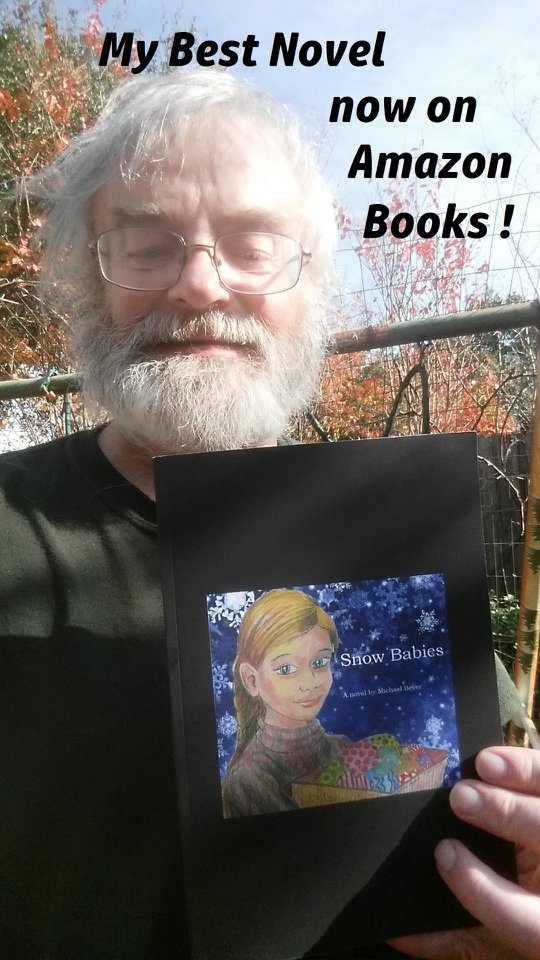
I recently got my very first unsolicited review on a book I had written when Mr. Ted Bun, one of the leaders of the nudist writer group on Twitter gave me a five star review on Recipes for Gingerbread Children.
I was grateful and reviewed one of his books on Twitter in return.
But it was totally unsolicited. I didn’t even know any of my book promotions had penetrated such an odd corner of the internet. The story does have nudists in it, but that is not what the book is really about. Mr. Bun acknowledged that much in his review, and still liked it and called it well-written.
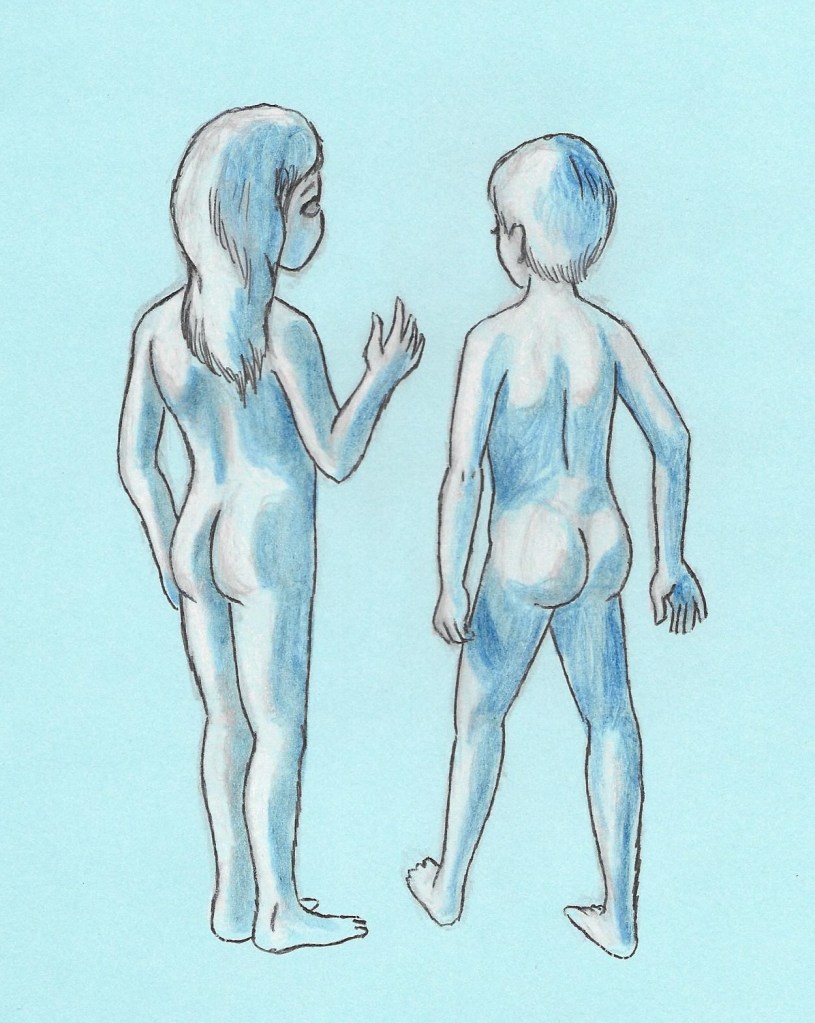
My first Amazon book promotion, offering the Kindle version of Snow Babies for free, produced the same kind of fruit. I started by sending a paperback copy to the girl I grew up with that I named the main character after. Valerie read the book to her grandchildren and then sent me this message;
Valerie– Hi Michael! I wanted to let you know that I finished reading your book a couple of days ago, and that I thought it was really good! You used so many colorful descriptions of the characters, that I felt like I could really picture the whole scene! I also enjoyed how you used several people’s names and surrounding towns from our past that brought back good memories. It kept my interest and made me excited to keep reading to see how things turned out! I appreciated how you ended it, too! Thanks again, so much for sharing it with me. I plan to share it with a friend of mine to read and then return to me! Do the Rowan and Belmond libraries have copies of your books? I would be happy to talk to the Belmond library about it, if you haven’t already! I will spread the word, and keep writing! Val
Me– I donated a couple of books to Rowan and one to Belmond. But I have written a lot more since
They don’t have Snow Babies. I am so glad you liked the book. It is one of the best things I have ever written.
Valerie– You can be proud of your hard work! Next time I’m in the library, I will take Snow Babies with me and show them. I know they like to support local authors! 🙂
Me– Thank you for the help. I really appreciate it.

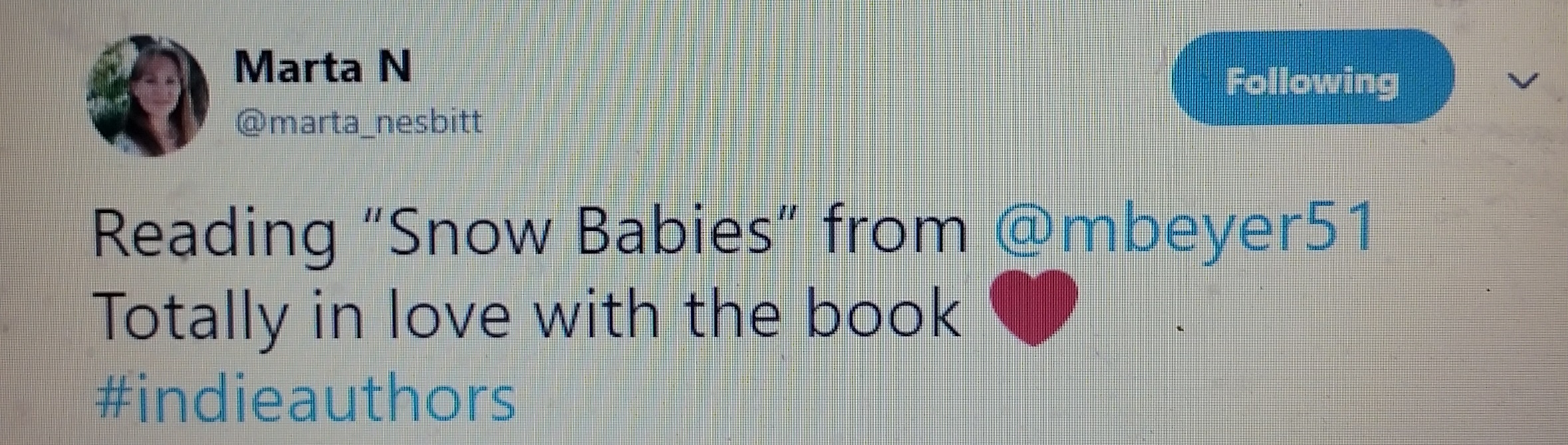
Then I find this tweet on Twitter from a fellow author who responded to my book promotion week.
She read Snow Babies and loved it and shared this review with me before she posted it on Amazon.
Headline: This book has a potential to become a classic
The story takes you to Norwall, a secluded midwestern town where people are expecting a snow blizzard to arrive in couple of hours. Among strangers coming to the town during the blizzard are four very special boys, a hobo, a bus driver, a drunken old lady, a stupid salesman, a couple of newly-weds and a lady following the four boys. Each of them, as well as the local people, has their own interesting story and their stories start to intertwine while the town gets buried in snow.
Some from the locals and the newcomers start to see white naked kids in the snow. In the course of events, they learn that those white kids are so called “snow babies”. According to what people say, those who see snow babies, are supposed to die during the blizzard.
The author has a talent for depicting situations in an impressive manner, so they can be humorous and touching at the same time. His mature narrative style enables you to learn deeply but in a light way about individual characters and understand their motives. Interesting are the hobo´s droppings of philosophical reflections and life wisdoms from Walt Whitman’s book. Simultaneously, in connection with snow babies, the author keeps you in suspense until the end. The story is not predictable, and the ending left me smiling and absorbed in thought.
I honestly fell in love with this book from the first page. It is like a fresh breeze compared to a number of today’s books written in similar patterns.
*****
I am amazed that people are beginning to read my books and like them… even love them. I wasn’t expecting that to happen until after I was dead. It is a good feeling that took me by surprise.