
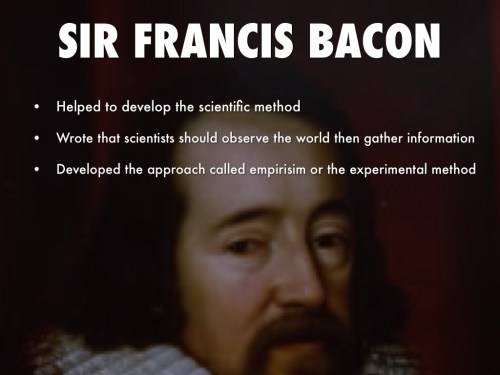
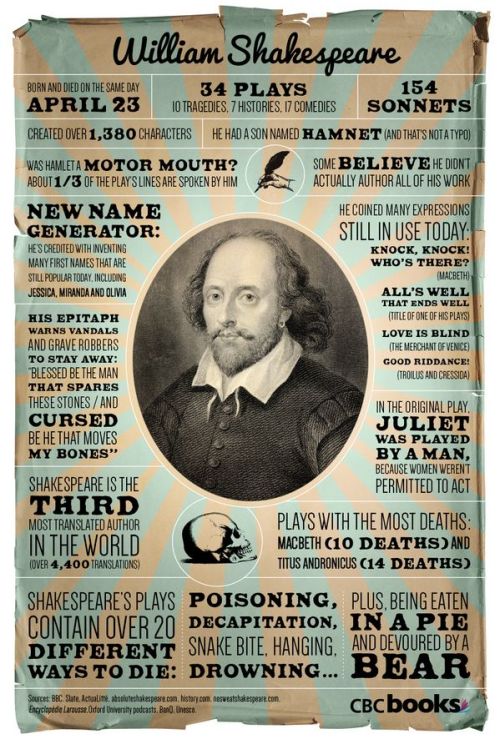
(The graphic above should say “Empiricism,” not “Empirism.” Ir is a typo.
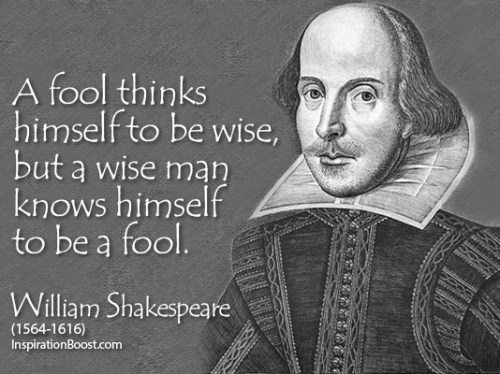
Yes, Sir Francis Bacon is at least as interesting and obscure as William Shakespeare. But let me assure you, I can confidently state, “Shakespeare is NOT Bacon!” He is not eggs either… or any other breakfast food. Sir Francis Bacon was the breakfast, the first meal in the great Elizabethan banquet of literature, poetry, and culture. And William Shakespeare is a more important main course, the royal dinner, as it were. But it has to be acknowledged that Bacon was essential to the very existence of William Shakespeare. Breakfast always comes before dinner.
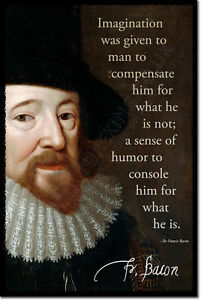
In 1845 a female author by the name of Delia Bacon (nothing suspicious about that coincidence, by the way) put forward an idea that William Shakespeare’s plays were actually written by a group of men under the leadership of Sir Francis Bacon. She thought the group intended to inculcate into English culture an advanced system of politics and philosophy which they themselves could not take credit for publicly. She would later write a book in 1857 called The Philosophy of the Plays of Shakspere Unfolded which advanced the notion that the plays were written for Baconian purposes beyond mere theatrical entertainment. Numerous people, including the American poet Ralph Waldo Emerson supported her in her quest to find proof, sending her to England to research the crazy conspiracy theories she founded by noting ciphers in the plays, and in the essays of Bacon, that led her to believe all she had to do was dig up the gravestone of Shaksper in the chapel at Stratford to find written proof in Bacon’s own hand that he was, in fact, the author or primary motivator of the plays of William Shakespeare. She spent one cold and creepy night in the chapel, just her and her spade and her crow bar, along with the bones of the Stratford guy, trying to work up the courage to do a bit of grave-robbing… and failing. It is a good story, but very poor archaeology. She was denounced by the literary historians and establishment figures who supported the Stratford guy. They said her scholarship was sloppy, her cipher analysis goofy and unfounded, and her conclusions more questionable than a pig in theatrical make-up. (My words, not theirs. English critic George Henry Townsend was entirely too stuffy and boring to simply be quoted here.)
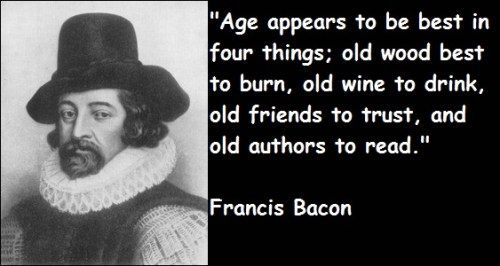
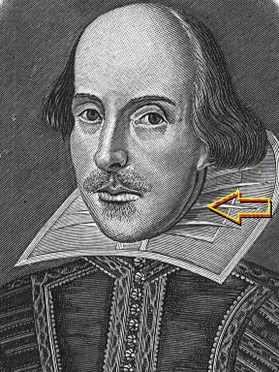
Now, I, of course, strongly disagree with the Bacon lady. As I said in the very title, “Shakespeare is NOT Bacon.” But I do think there was merit in sniffing out old Frankie’s scent and fingerprints on the whole Shakespeare/Shaksper thing. The Stratford guy was not Shakespeare either. When he died in 1616 there was no public outcry at the loss of England’s most popular poet and playwright. Even King James who was Shakespeare’s number one fan and constant audience member, didn’t mourn the passing of the actor/theater-owner/businessman from Stratford.
Francis Bacon, on the other hand, was a powerful intellect, educated in the ways of science, the law, and government in the Elizabethan age. Bacon gathered other men of powerful intellect and accomplishment at Gray’s Inn to hold debates about things philosophical and things scientifical. It is not unreasonable to imagine that the man who really wrote the plays attributed to Shakespeare sat at that table and participated in those debates. And Sir Frankie had good reason to keep lots of this business a secret. There exists evidence that though he was apparently happily married to a fourteen-year-old girl, he did a little bit of swaying toward the other gender too, a thing not too popular with the average Anglican Englishman. He also dabbled a bit in the occult (think witches in Macbeth sort of thing). And his essays indicate a strong correlation to the philosophies and ideals of the German Rosicrucian Movement. In 1593 during a Roman Catholic plot against Queen Elizabeth, Frankie managed to take a position on the investigation that totally offended the old virgin queen. He was on the outs with Liz for the rest of her difficult and anger-management-challenged life. He did rise to prominence under her successor, James I, but never-the-less managed to die amidst total ruin and scandal. There is a lot in Frankie’s life to indicate that he had a direct influence on the content of Shakespeare’s plays. Some of the characters in the plays may actually be, at least in part, based on Frankie himself. But this guy never hung out with the Stratford guy that anyone knows of.
So, if Shakespeare is NOT Bacon, or eggs either… and the Stratford guy isn’t Shakespeare, then who is? Come on! You knew I had a lot more to say about this crazy conspiracy thing, right?
 Catch a Falling Star
Naked Innocence
To be clear, I will have to write a post called Naked Experience to go with this post. It is a William Blake style of thing. You know, that English Romantic Poet guy who was into drawing naked people even more than me? The writer of Songs of Innocence and Experience? You know, this stuff;
Well, maybe you don’t know. But Blake gave the world the metaphor of the innocent lamb and the tyger of experience (tyger is his spelling, not mine, and it didn’t blow up the spell checker, even though it made the thing unhappy with me again). There is a certain something I have learned about nakedness that I mean to innocently convey. I learned it from anatomy drawing class and spending time with nudists. Naked is not evil. Naked is not pornography. Nakedness, itself, is a very good thing.
At this point the avid clothing-wearers among you are probably saying to yourself, “This guy is nuts! If God had wanted us to be nude, then we wouldn’t have been born with clothes on.” And I must admit, I cannot argue with logic like that.
But on a more serious note, I believe nudity is a fundamentally essential part of the nature of art. After all, pictures of naked people are a central part of what people have been drawing since they first started etching them with charcoal on cavern walls. And all art, including this blog, is about the human experience. What it means to be human. What it feels like to be alive on this Earth and able to feel.
And there is nothing sinister and immoral in drawing nudes to portray that fact. I am trying to show metaphorically the music of existence, the pace, the symmetry, the musical score… It isn’t focused on the private bits, what some call the naughty parts, even when those things are present in the picture. “How dare that naughty Mickey show the naked back end of that butterfly! It ought to have pants on at least!” Yes, I am making a mockery of that outrage itself. I am not a pornographer. These pictures were not created to engender any prurient interests. These pictures are part of Blake’s lamb. They will not bite you. Though blue-nosed people who wish to control what others think may very well bite me for daring to say so.
I have posted a lot of writing and artwork on this blog that I held for the longest time to be completely private and personal. I hardly ever showed any of it to anybody before I posted it here. But I am old. I no longer have secrets. I am capable of telling you everything even though I have never met most of you in real life. And I have no shame. I have become comfortable with emotional and intellectual nudity. And when I am dead, the body I have kept hidden from the world for so long will be no more. It’s just a thought. It’s a naked thought. And it is completely innocent.
Leave a comment
Filed under artists I admire, artwork, commentary, humor, nudes, Paffooney, strange and wonderful ideas about life
Tagged as art, literature, nudes, poetry, William Blake