
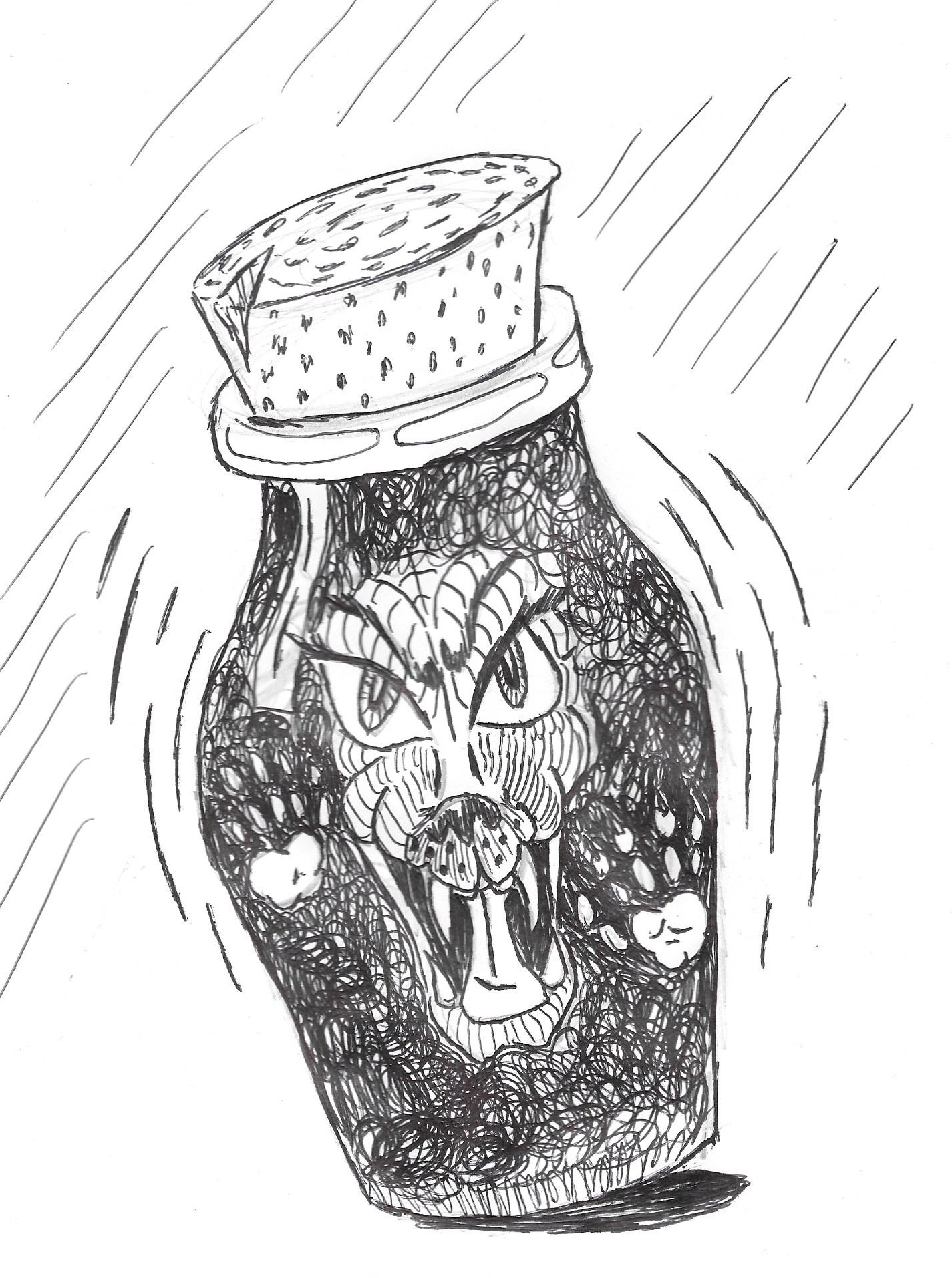
I gave you a list of places where my ideas for fiction come from, and in the end, I failed to explain the thing about the bottle imp. Yes, I do get ideas from the bottle imp. He’s an angry blue boggart with limited spell powers. But he’s also more than 700 years old and has only been trapped in the bottle since 1805. So, he has about 500 years of magical life experience to draw from and answer my idea questions. Admittedly it would be more helpful if he were a smarter imp. His name is Bruce, and his IQ in human terms would only be about 75. But, then, I don’t have to worry about misfired magic. If I asked him to, “Make me a hamburger,” he wouldn’t immediately change me into a fried, ground-beef patty because he is not smart enough to do that high of a level of magic spell.
But he is just barely intelligent enough to tell me a truthful answer if I asked him a question like, “What would happen if I put an alligator’s egg in a robin’s nest as a joke, and the robin family decided it was their own weird-looking egg and then tried to hatch it?” The answer would be truthful according to his vast knowledge of swamp pranks. And it would also be funny because he’s too dumb to know better. In fact, he told me about a mother robin who worked so diligently at hatching an alligator egg that a baby alligator was hatched. She convinced it that it was actually a bird. And when it came time for the baby birds to learn to fly, the baby alligator couldn’t do it… until she talked it into flapping madly with all four legs. Then, a mother’s love and faith in her child got an alligator airborne.
Yeah, that hasn’t proved to be a very useful story idea. I put it into a story I was writing during my seven years in high school, and then lost the manuscript. (I was a teacher, not a hard-to-graduate student.) But it was proof that you can get your writing ideas from a bottle imp.
So, if you decide to use bottle imps as an idea source for fiction, the next step is to find and acquire the right sort of bottle imp. I got mine from Smellbone, the rat-faced necromancer. I bought it for an American quarter and three Canadian loonies more than a dozen years ago. I found it at his Arcana and Horse-Radish Burger Emporium in Montreal. But I am not sure how that information helps you. Smellbone died in a firey magical-transformation accident involving an angry Wall-Street financier and a dill pickle. The whole Emporium went to cinders in an hour.
If you are going to try to capture the bottle imp yourself, which I strongly do not recommend, you are going to need a magical spell-resistant butterfly net, a solid glass jar, bottle, or brass urn. A garlic-soaked cork to fit the bottle. A spell scroll ready to cast containing at least one fairy-shrink spell. And an extremely limited amount of time to actually think about what you are doing.
Now I have told you how I get writing ideas from a bottle imp. Aren’t you glad I did not include this idea in the post about where ideas come from? After all, I am a fiction writer. I get my jollies from telling lies in story form. And bottle imps, especially angry blue bottle imps named Bruce, or Charlie, or Bill, are more trouble than they are worth. They can curse you with magical spells of infinite silliness and undercut your serious nature for a lifetime.



 Catch a Falling Star
The Alchemist by Paulo Coelho
Some books come along telling a story that has to be taken seriously in ways that don’t make sense in any normal way. The Alchemist is one of those books.
What is an alchemist, after all?
An alchemist uses the medieval forms of the art of chemistry to transmute things, one thing becoming another thing.
Coelho in this book is himself an alchemist of ideas. He uses this book to transmute one idea into another until he digs deep enough into the pile of ideas to finally transmute words into wisdom.
There is a great deal of wisdom in this book, and I can actually share some of it here without spoiling the story.
Here are a few gemstones of wisdom from the Alchemist’s treasure chest;
“It’s the possibility of having a dream come true that makes life interesting…” (p.13)
“It’s the simple things in life that are the most extraordinary; only wise men are able to understand them.” (p.17)
“All things are one. And, when you want something, all the universe conspires in helping you to achieve it.” (p.24)
“And when he had gone only a short distance, he realized that, while they were erecting the stall, one of them had spoken Arabic and the other Spanish. And they had understood each other perfectly well. There must be a language that doesn’t depend on words, the boy thought.” (p.45)
All of these quotes from the book, as you can see, come from the first third of the book. There are many more treasures to be found in this book. I should not share them with you here. Just as the main character of the story learns, you have to do the work for yourself. But this book is not only an enjoyable read, but a map for how you can execute your own journey towards your “Personal Legend”. In fact, you may find that the book tells you not only how to go about making a dream come true, but, if you are already on that journey successfully, it tells you what things you are already doing right.
Leave a comment
Filed under book reports, book review, commentary, good books, magic, strange and wonderful ideas about life, wisdom, wizards
Tagged as book review, books, fantasy, fiction, magical books, mystical books, reading, the Alchemist by Paulo Coelho