When you know someone has an imaginary friend, something like Elwood’s six-foot invisible rabbit called Harvey, don’t you immediately think that person is crazy? I do. But I have imaginary people as friends. I think most writers do. So am I crazy? Probably. But hopefully it is a good kind of crazy.
It began with imaginary friends from books. The Cat in the Hat was my friend. Jim Hawkins was my friend, as was Mowgli and all the members of the Swiss Family Robinson. They entered my dreams and my daydreams. I told them my troubles the same way I listened to theirs through their stories.
I began to have imaginary friends that came from my own imagination too.
I used to tell my mere human friends about my friend Davalon from outer space. I told them that he was real and secretly visited me at night to talk about being able to learn about humans on earth by walking around invisibly and watching them. I got so involved with these stories that my sixth grade class began saying, “Michael is from Mars.”
When I was a teenager, I began having conversations with a faun. His name was Radasha. He was a creature from Greek Myth, a sensual Dionysian creature who, in his child body, was both younger than me and way older than me. I didn’t realize until much later in life that he was the result of my repressed memories of a childhood sexual assault that I was the victim of. I could talk to him about my fear of nakedness. I could tell him about my blossoming interests in naked girls and their bodies. I could talk to him about all the things I was somehow too terrified to talk to my male friends about, even though none of them had the same reluctance to discuss sex. Ra was imaginary. But he helped me heal.
Then the story-telling seriously began. I used Davalon as one of the main characters in my novel Catch a Falling Star. I created Torrie Brownfield, the baby werewolf to express the feelings I had as a boy about being a monster and secretly terrible and deformed. Torrie is a normal boy with a condition called hypertrichosis. I am working on The Baby Werewolfnow. And then there’s lovely Valerie Clarke. She is the main character of Snow Babies which is a finished novel, edited and proofread and ready to publish. It is I book I will have to find another way to publish since the recent death of PDMI Publishing. She is not a me-character, based on my own thoughts and feelings. She is based on former classmates and students who told me things that express the sadness and isolation of growing up female. So she is even more imaginary than my other characters.
They become real people to me. They have their own point of view. They talk to me and I learn things from them. But they are imaginary. So am I crazy? Yes… as a loon. And happy as Elwood P. Dowd to be that way.
No man is an island. John Donne the English poet stated that. And Ernest Hemingway quoted it… and wove it into his stories as a major theme… and proceeded to try to disprove it. We need other people. I married an island girl from the island of Luzon in the Philippines. She may have actually needed me too, though she will never admit it.
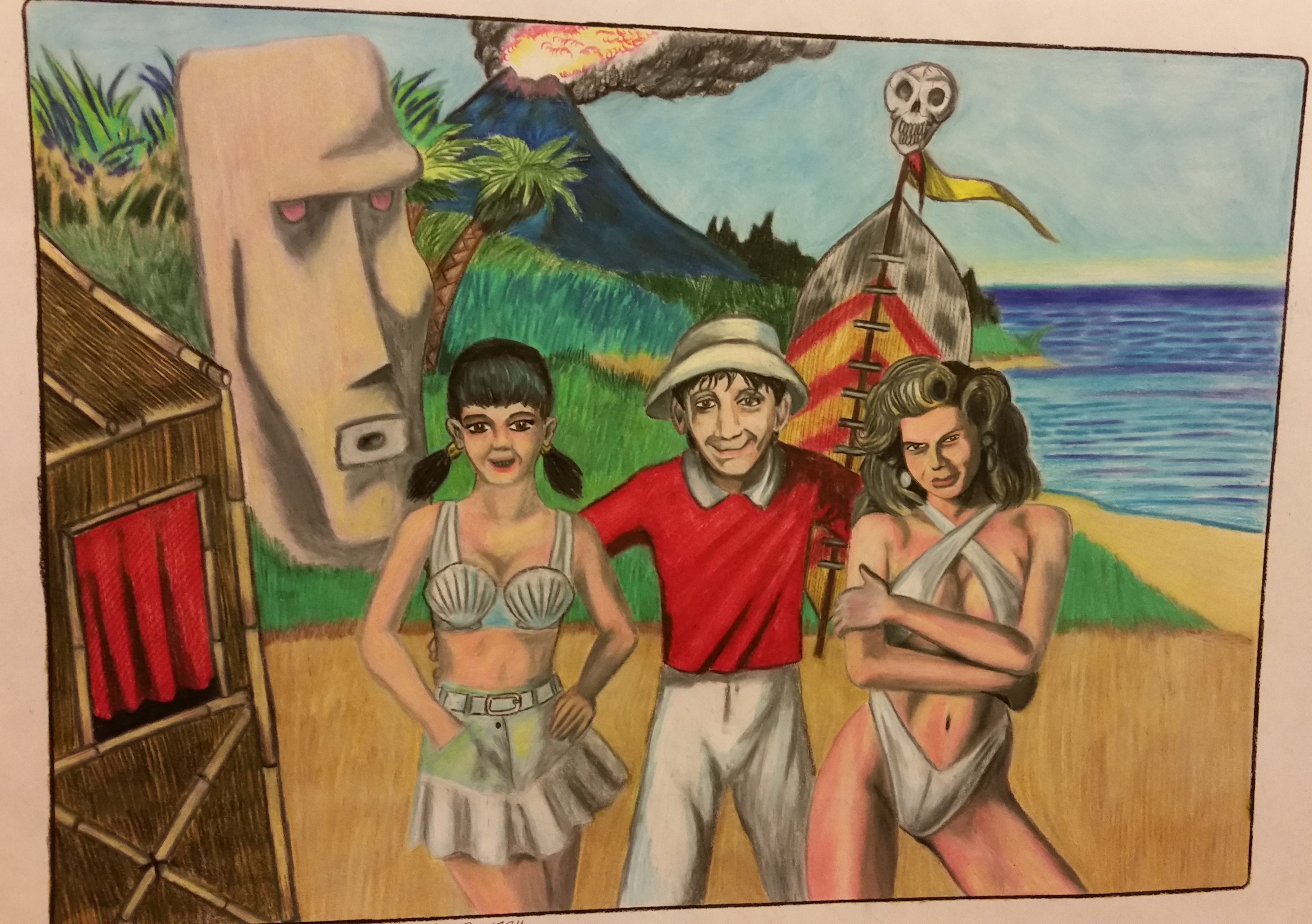
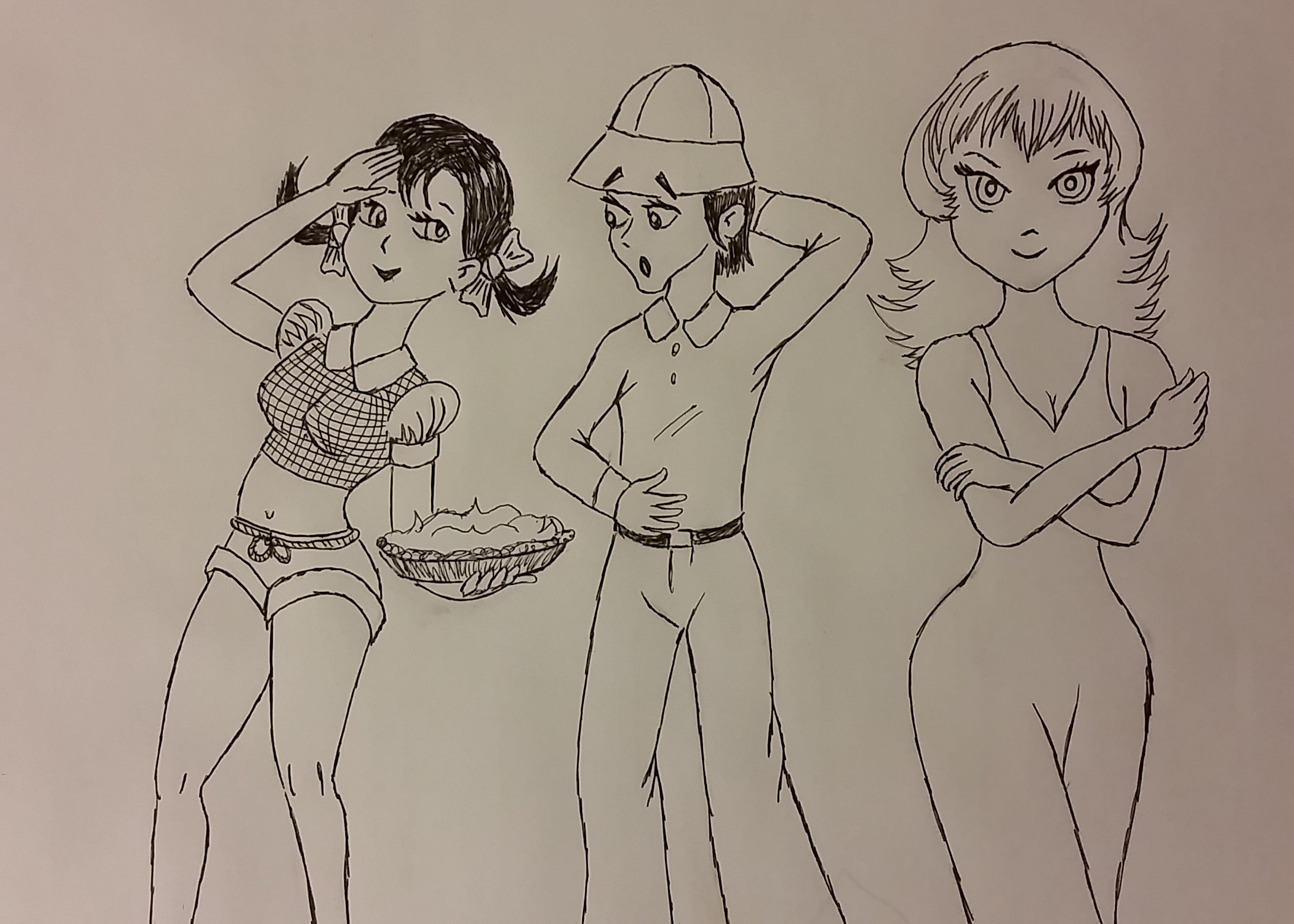
When I was a young junior high school teacher in the early eighties, they called me Mr. Gilligan. My classroom was known as Gilligan’s Island. This came about because a goofball student in the very first class on the very first day said, “You look like Gilligan’s Island!” By which he meant I reminded him of Bob Denver, the actor that played Gilligan. But as he said it, he was actually accusing me of being an island. And no man is an island. Thank you, Fabian, you were sorta dumb, but I loved you for it.
You see, being Gilligan on Gilligan’s Island was not a bad thing to be. It was who I was as a teacher. Nerdy, awkward, telling stories about when I was young, and my doofy friends like Skinny Mulligan. Being a teacher gave me an identity. And Gilligan was stranded on the Island with two beautiful single women, Mary Ann and Ginger. Not a bad thing to be. And I loved teaching and telling stories to kids who would later be the doofy students in new stories.
But we go through life searching for who we are and why we are here. Now that I am retired, and no longer a teacher… who am I now? We never really find the answer. Answers change over time. And so do I.
I have always had an inquiring mind. That is a curse instead of a plus if your main goal in life is to be happy and unbothered by anything. But it has proved to be of benefit to me as I have become an old coot who actually cares about what is true. Yes, I am willing to personally suffer to bring to light that which is actually true and that which must be disbelieved before it truly hurts us.
Don’t judge me yet based on this next question;
“Did you know that the Democratic party is funded by billionaires who want to use the “Deep State” to promote their Satanic rituals involving the murder and cannibalistic consumption of human children?”
I hope you know that I would never promote such a thing as being true. I am even careful of posting this pernicious lie in a question rather than a statement, because that’s one of the tactics the malign promoters of this religious belief use, not actually stating something that will be contradicted immediately, but taken merely as something to be considered and discussed simply because it is offered in question form.
So, how do you tackle such dangerous nonsense?
I prefer the scientific method which provides the structure for your thinking that will keep you on the most likely paths that lead you to what is true and what is not.
Facts should be confirmed by multiple verifiable sources.
We don’t talk much about cold fusion nowadays because when it was discovered in 1989 by a pair of electrochemists whose single experiment produced more heat than what should result from the energy put into the tabletop experiment, it quickly blossomed into the huge, major breakthrough story that it really would’ve been if only it had been verified. But, as is required by the entire scientific community, it couldn’t be reproduced in more repeats of the experiment than those that turned out negative. So, even though Pons and Fleischman did an experiment that answered the dreams of science-fiction nerds like me, they are mostly ignored by now. Cold fusion? Only one flawed source, studied in 1989 and proved still basically untrue in 2004 by a multitude of scientists who wanted it to be true.
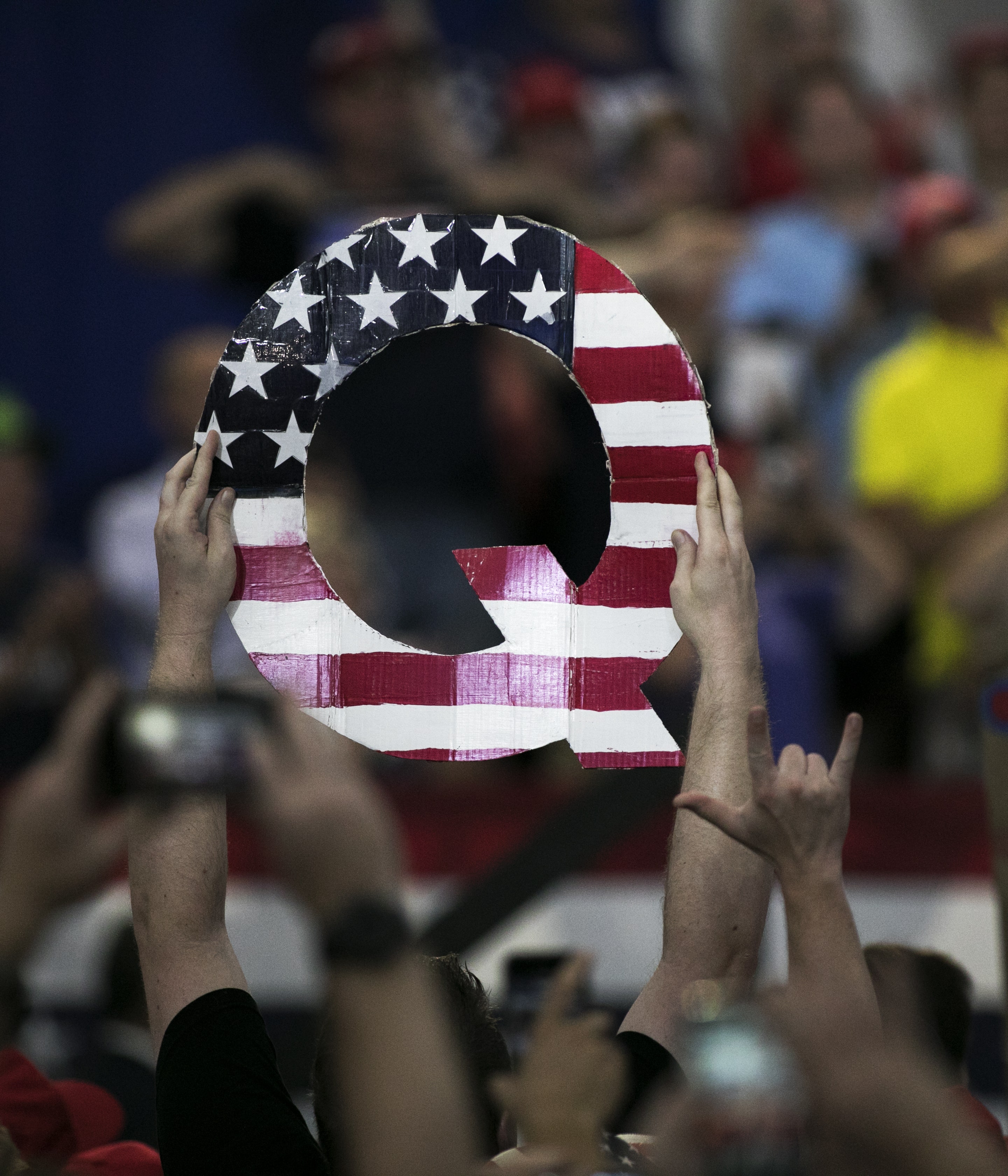
Consider the source for Q-Anon conspiracies. One (or possibly more) anonymous government whistle-blowers whose credentials have never been presented or identities revealed, and mind-blowing statements appearing on places like 4-Chan, 8-Chan, and Parlor to be picked up and amplified on such reliable sources of scientifically proven knowledge as Twitter, Facebook, and Instagram. I hope you understand sarcasm after making that last statement.
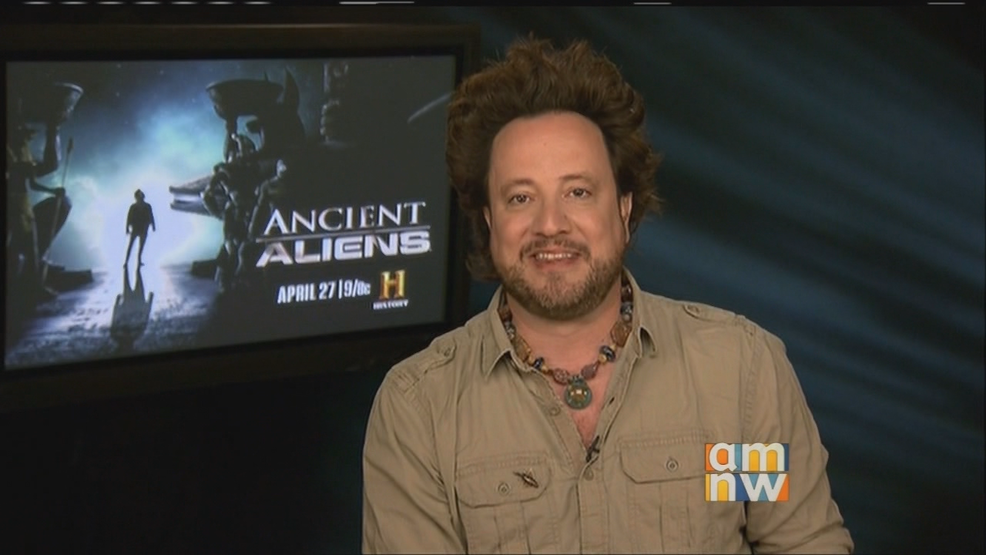
Q-Anon is not the only conspiracy religion out there. My friend Giorgi (above) has a more benign, but no less ridiculous religion that chooses to replace God Jehovah, Zeus, Odin, Buddha, and other religious figures and deities with Ancient Aliens.
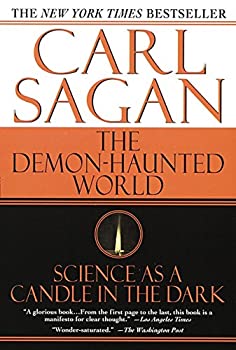
Here’s a second and third test offered by Carl Sagan to use against their ideas;
2. Encourage debate from knowledgeable people from all identifiable perspectives.
3. Do not accept arguments only from positions of authority.
Q-Anon arguments only have the authority of repetition because social media endlessly asks the same “questions” over and over. There is no debate from any recognizable “authority,” just a plethora of unsubstantiated statements and commandments.
In a way, the Ancient-Aliens crowd is guilty of the same thing. They never have skeptics and debunkers on their History-Channel show. You never see Michael Shermer, founder of the Skeptics Society, offering his opinions of their conclusions on that show. Neither do they allow Christian theologians or Buddhist scholars to offer their take on what probably really happened. They do employ physicists, engineers, and historians on their show, but never the ones that don’t agree with their radical theories and conclusions. Since there is no real debate on that show and no identifiable peer review, that show does not qualify as History, let alone Science.
4. Don’t get overly attached to your own ideas.
If you are going to investigate any conspiracy that holds thrall a number of “true believers,” approach everything with a truly open mind. I actually believe alien beings from “out there” have visited Earth. That is based on things, science, and testimony I haven’t even begun to go into here. But I reserve my right to be skeptical about everything, especially my own prejudices, theories, and beliefs. Otherwise I could too easily get trapped into believing in the truth of something that I otherwise would recognize as false. This is the factor that has pulled so many of my otherwise sensible Republican friends onto the flypaper of spurious Q-Anon claims.
5. Use numbers wherever possible. Math is quantifiable information that can “prove” the facts better than most ideas expressed in mere language. It is more precise, and reveals truth in verifiable ways that no poet ever could.
I am known to some in my family (here you could read wife and sisters) as the family conspiracy nut and generally crazy old coot.
But I am not so crazy that I don’t recognize the dangers inherent in some the ideas I am talking about here. As an English teacher I have learned some effective thinking skills that protect me and mine. I can honestly tell you that these thinking skills explained here will help you too. I learned them from a friend who pointed me to Carl Sagan as the source of these thinking skills.
And to any of my friends who might read this post and be offended, I apologize. But you were wrong about Pizzagate, and you are on the wrong side of this too. Aliens probably did NOT build the pyramids. But logic IS the primary structure of this essay.
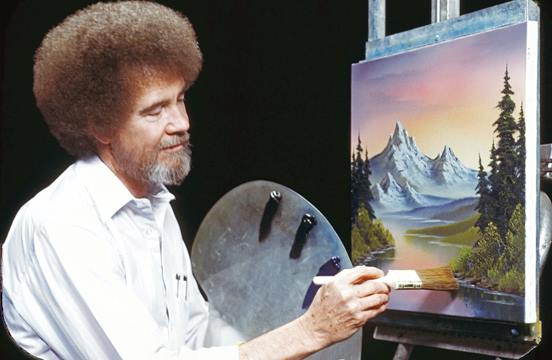
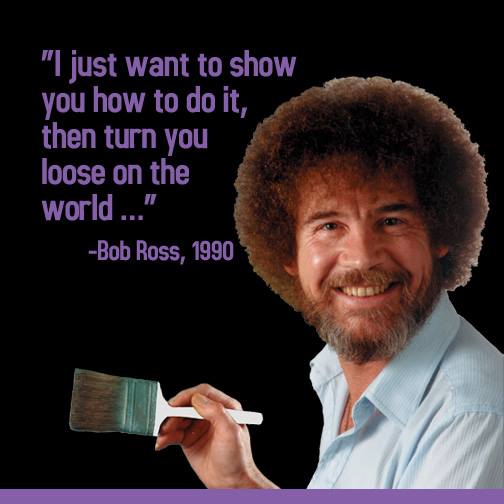
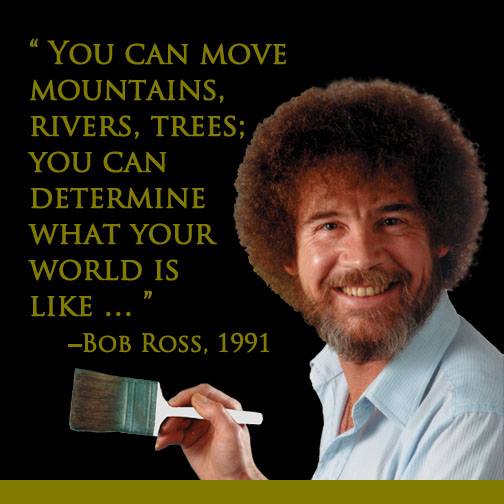
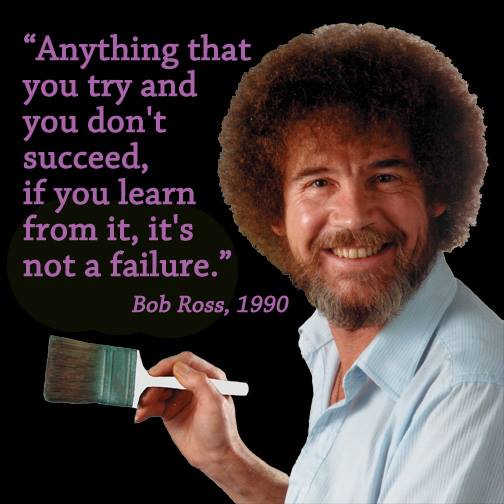
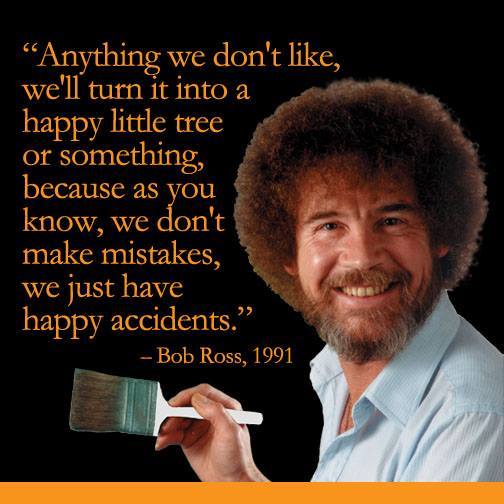
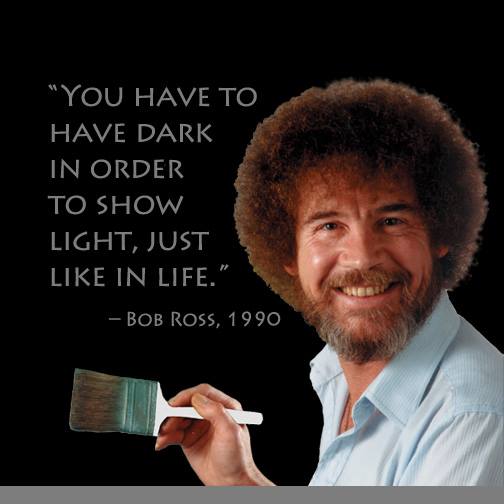
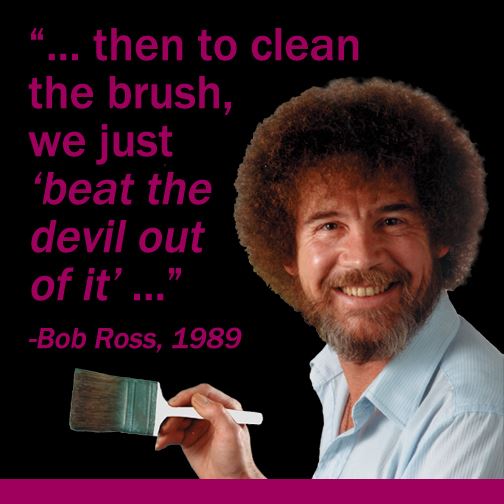
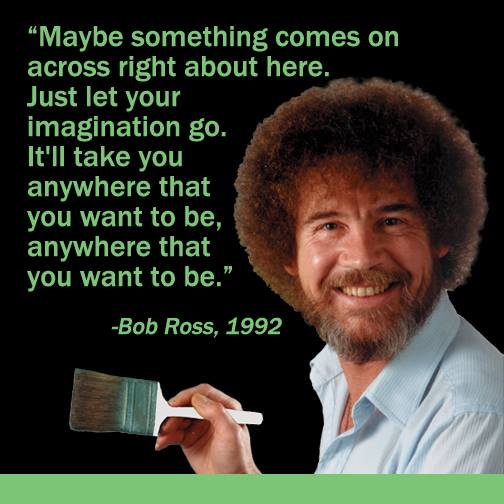
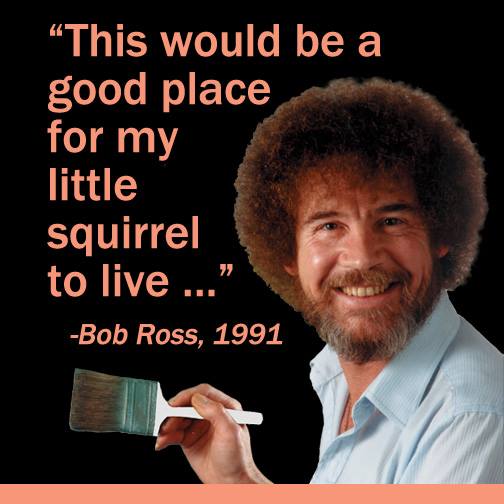
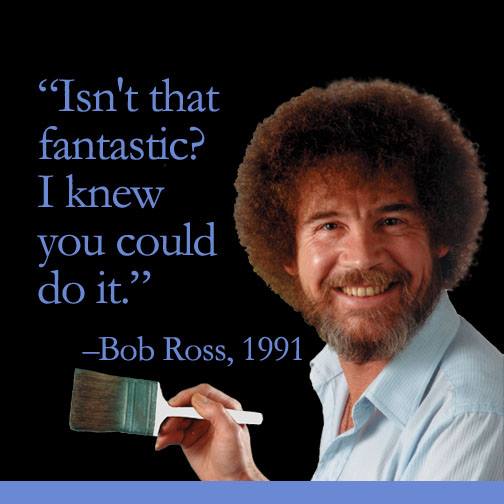
If there is a Church of Sacred Landscapes then Bob Ross is its Jesus Christ. That is not a sacrilegious statement of bizarre cult-mindedness. Painting is a religion that has its tenets. And Bob Ross explained to us the will of God on his painting show on PBS. All the illustrations used in this post come from the Facebook page Joy of Painting with Bob Ross. All the wisdom comes from things the Master said on the show.
Bob Ross was the prophet of the paintbrush. He would present us with a lightly prepared canvas at the beginning of the show and then proceed on camera to take his brush and palette knife, and all his paints, and create a piece of the world before our very eyes. And he was not Picasso or Van Gogh or even Norman Rockwell. He was not a talented artist, but rather a very practiced one who knew all the tricks and shortcuts to sofa painting, the art of knocking out scene after scene after scene. He could make his little piece of the world in only half an hour, and he made it obvious how we could do the same. His work was not gallery quality… but his teachings were Jesus-worthy.
His work was natural, flowing, and realistic in the random complexity it presented. He took standard paintbrush strokes and pallet knife tricks and made them dance across the canvas to make happy little trees.
His painting methods presented us with a philosophy of life and a method of dealing with whatever mistakes we might make.
And of course, any good religion must take into account the existence of evil.
Bob Ross tells us that evil is necessary as a contrast to what is good and what is true. We need the dark. But we don’t have to embrace it. Bob’s paintings were never about the dark bits. He always gravitated towards the light.
Of course, sometimes you have to beat back the darkness. A good artist takes care of his tools.
Bob Ross admonishes us to look and to learn and love what we see. The man radiated a calm, gentle nature that makes him a natural leader. His simple, countrified wisdom resonates because we need calm and pastoral peace in our lives. It is one of the main reasons mankind needs religion.
So I definitely think we ought to consider building a Bob-Rossian Church of the Sacred Landscapes. We have our prophet. The man has passed away, yet he is risen to paint again endlessly on YouTube.
And if you are willing to try… Bob Ross will smile upon you.
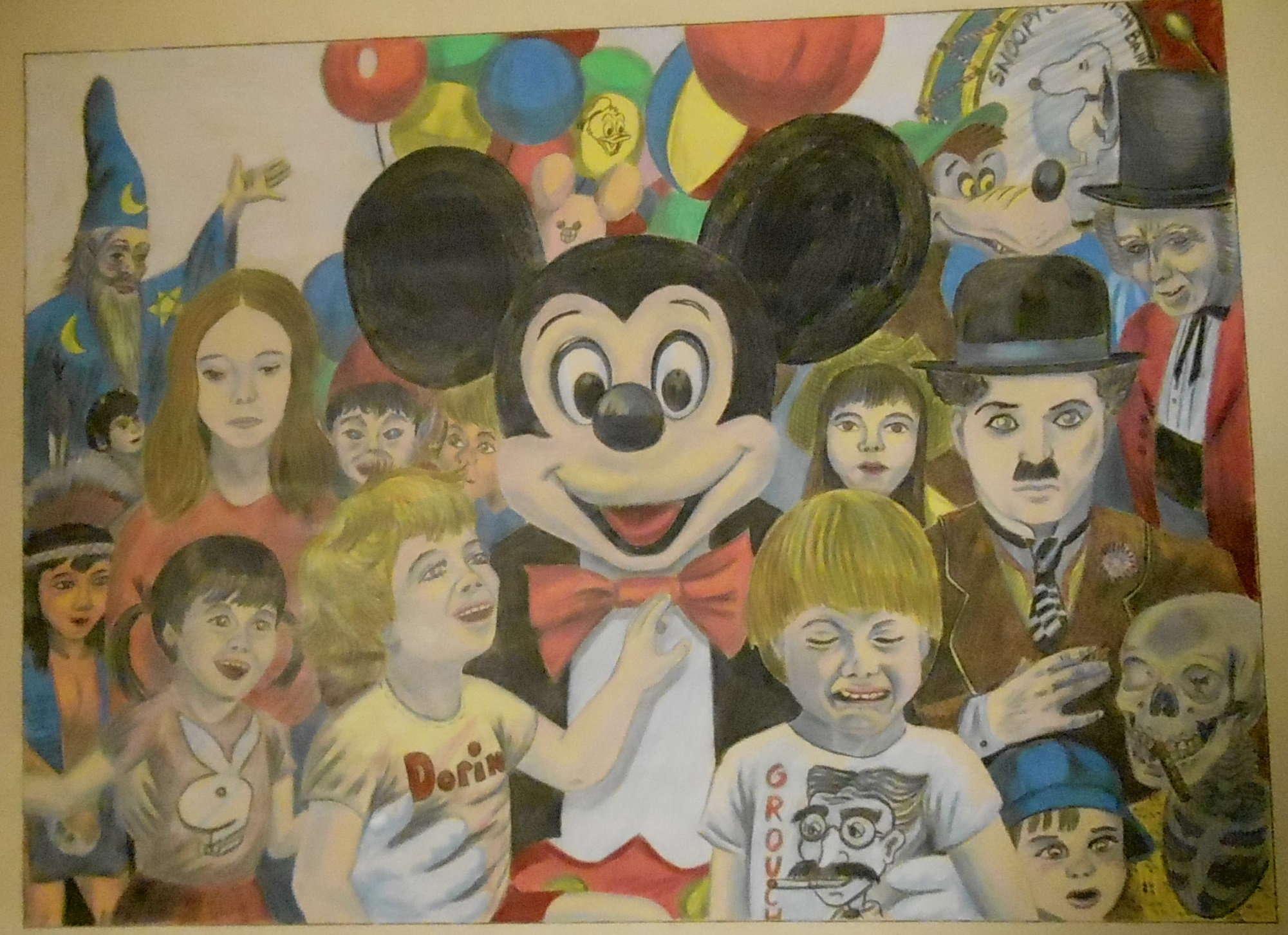
Yes, I admit it. I am a Surrealist. I also hope that it is not too terrible a thing to be. Because I truly think that everyone who was raised by television, and lived through the revolution where computers took over human life, is one too.
a 20th-century art form in which an artist or writer combines unrelated images or events in a very strange and dreamlike way
Full Definition of surrealism;
the principles, ideals, or practice of producing fantastic or incongruous imagery or effects in art, literature, film, or theater by means of unnatural or irrational juxtapositions and combinations
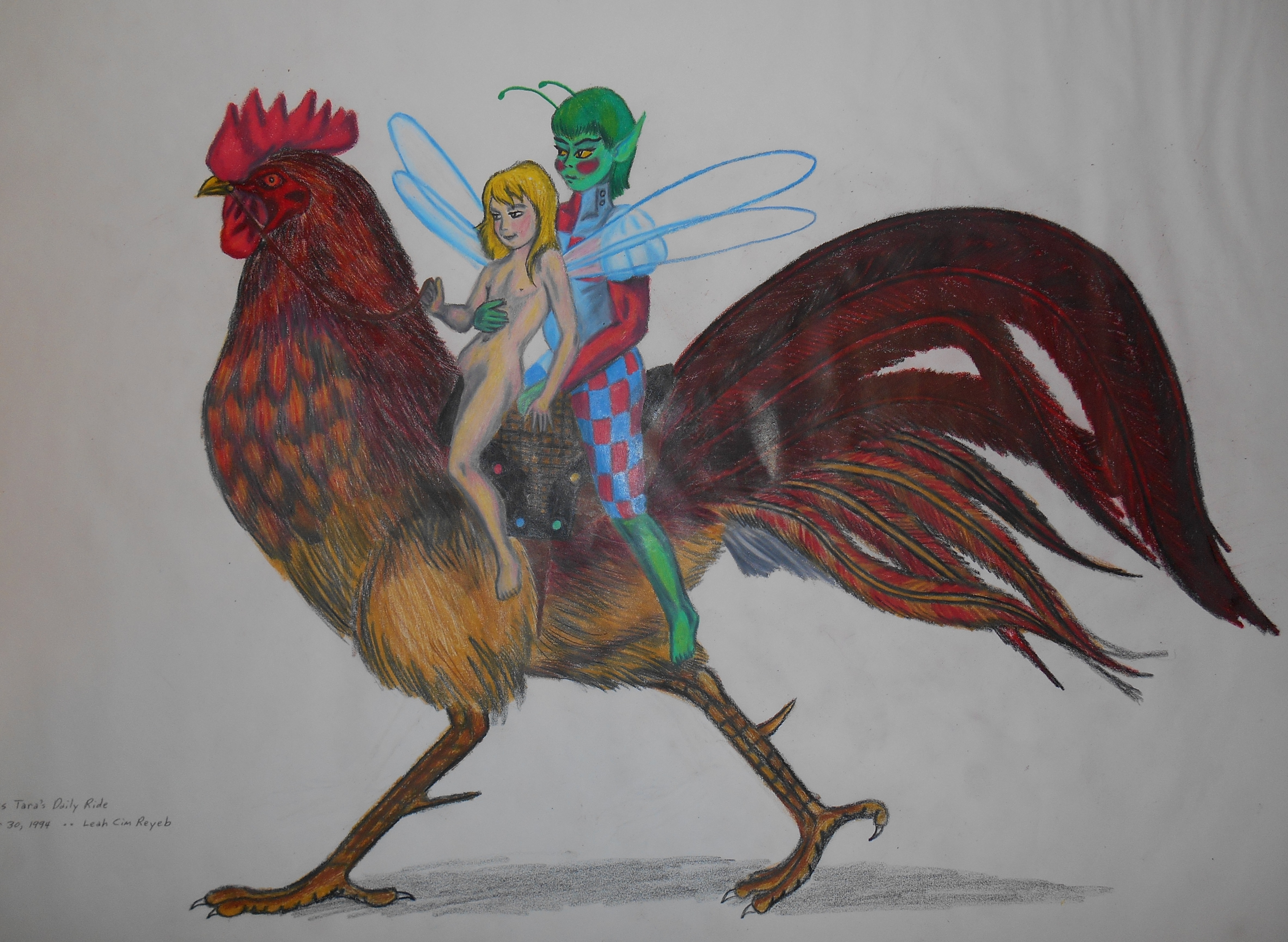
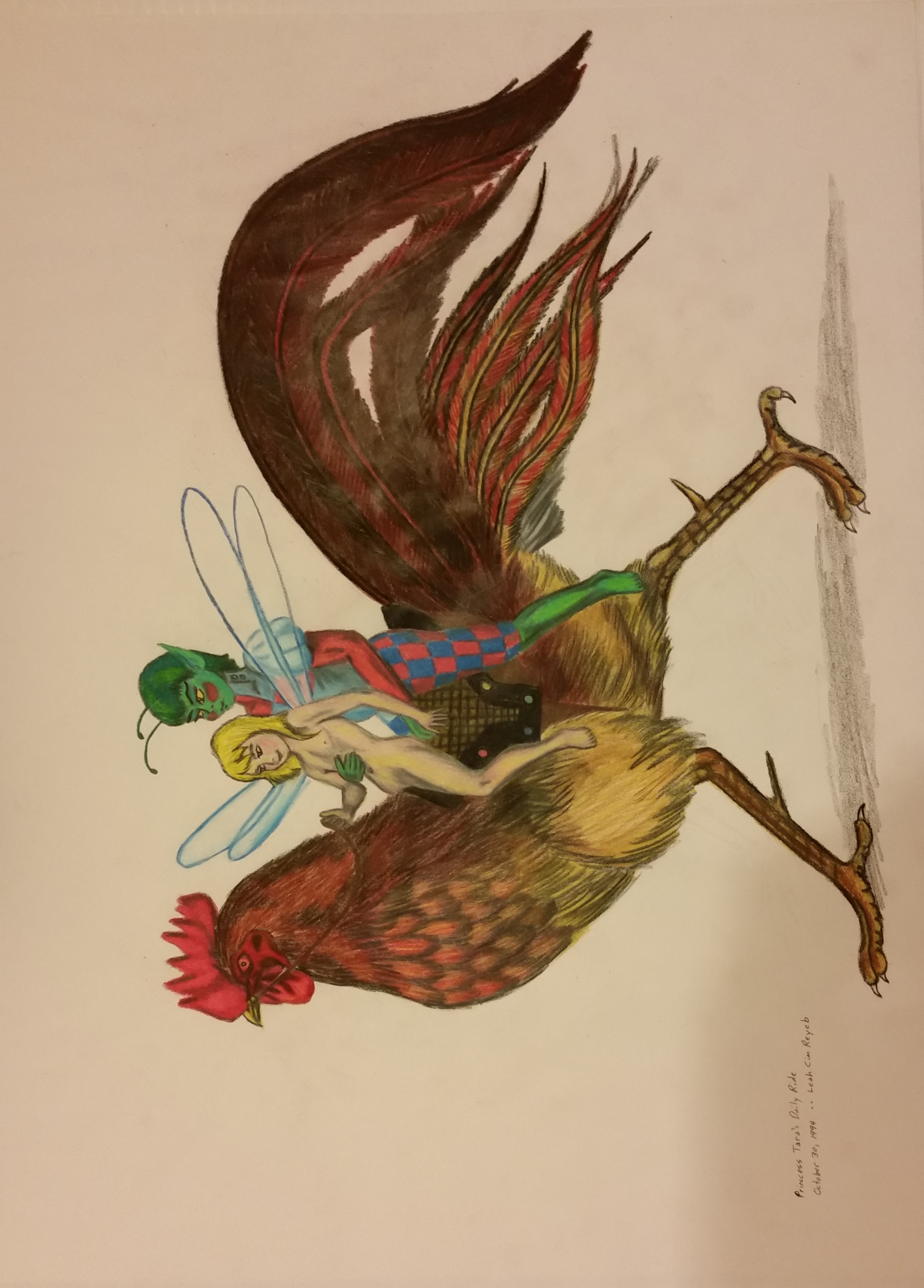
There is a certain satisfaction to be had in knowing for certain how to define oneself. I learned about Surrealism in high school art class back in the early 70’s. I saw and admired the works of Salvador Dali, Rene Magritte, and Max Ernst. And I realized that everything I wanted to do in the Realm of Art, whether it was weird paintings, cartoons, comic book art, or bizarre puppet shows… fantasy, science fiction, or humor… it was ALL Surrealism. Surrealism saturates out culture and our very thinking. We are drawn to watch baseball by the antics of a giant pantomime chicken. Our food choices are influenced by a happy red, yellow, and white clown who battles a blobby purple monster and a hamburglar over shakes and French fries. It is only natural then, that I would want to draw bug-sized fairies who would saddle and ride a red rooster. I have embraced surrealism as a way of life.
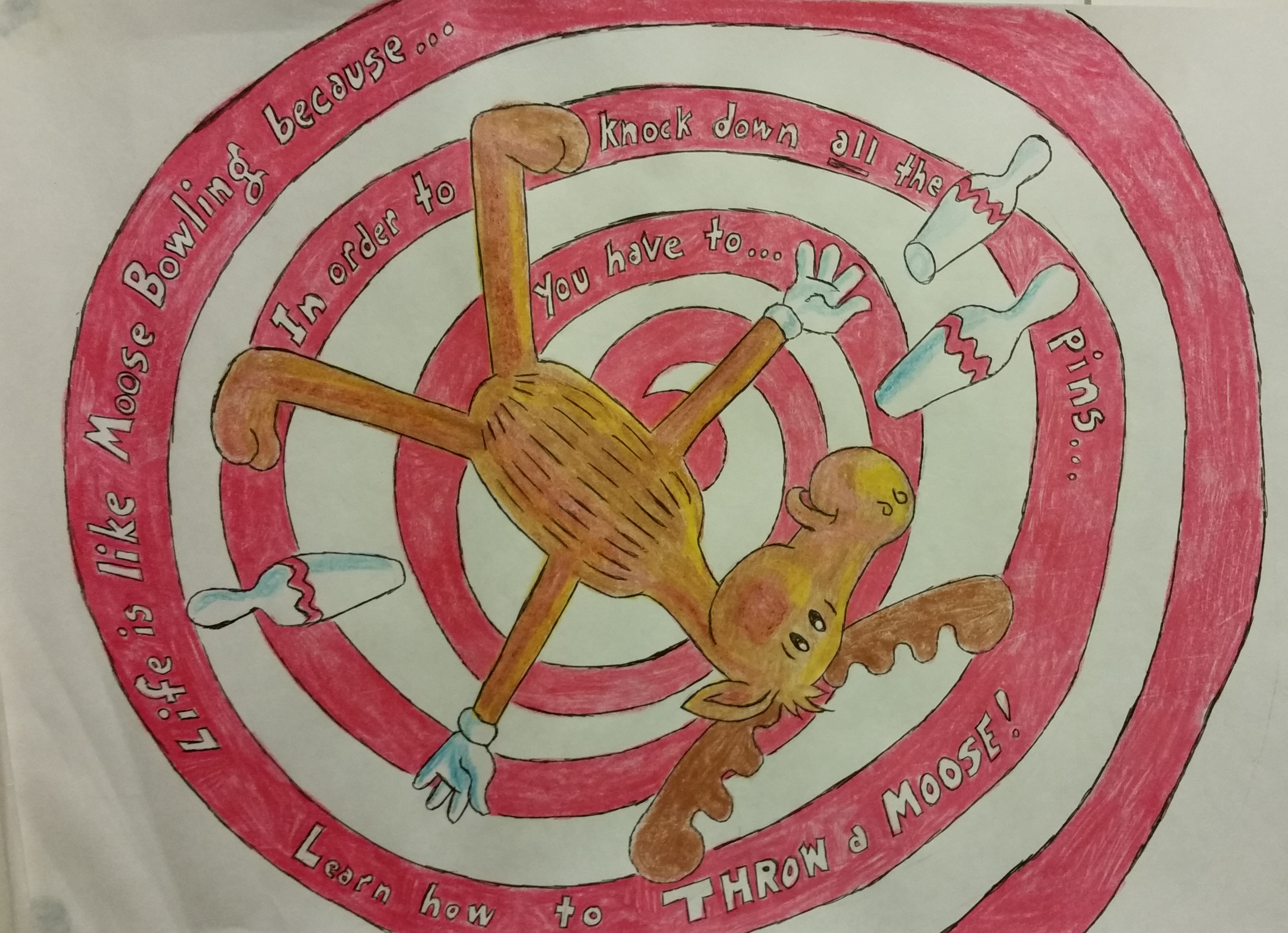
I have no trouble writing a poem about the difficulties of life by writing about a game of bowling where you have to roll a moose down the alley into the pins.
Surrealism is all about creating things by lumping all kinds of disparate goodies into the same pot and cooking it up as a stew. It is important that the stew tastes good in the end, so the mixture has to have large doses of reality and realism in it. Dali painted melting watches and boneless soft-sculpture people with almost photographic realism. I am compelled to do that too.
And what is humor, after all, if not lumping strange things together into a reality sandwich that makes you laugh because it takes you by surprise? I don’t shy away from weirdness. I embrace it. It makes life all the funnier.
And why did I put bullet points on everything in this post? Because it allows me to mash bits of wit and wisdom together in a weird way that only seems to have no connection, one to the other, and only seems to make no sense.
Sometimes we just have to look at things sideways.
I was recently accused of being eclectic in my posting topics by one regular commentator. I could wear that word like a badge of honor.
This describes a combination of many different individual elements of styles, themes, mediums or inspirations pooled from many sources. It can refer to musical tastes, dress sense, interior design…many things.
She has an ecletic sense of style, today she wears biker boots, pink fishnet stockings, a pencil skirt, a military jacket, a baseball hat, a my little pony t-shirt and a dunlop bag covered in badges from all her favourite bands from ABBA to Kooks
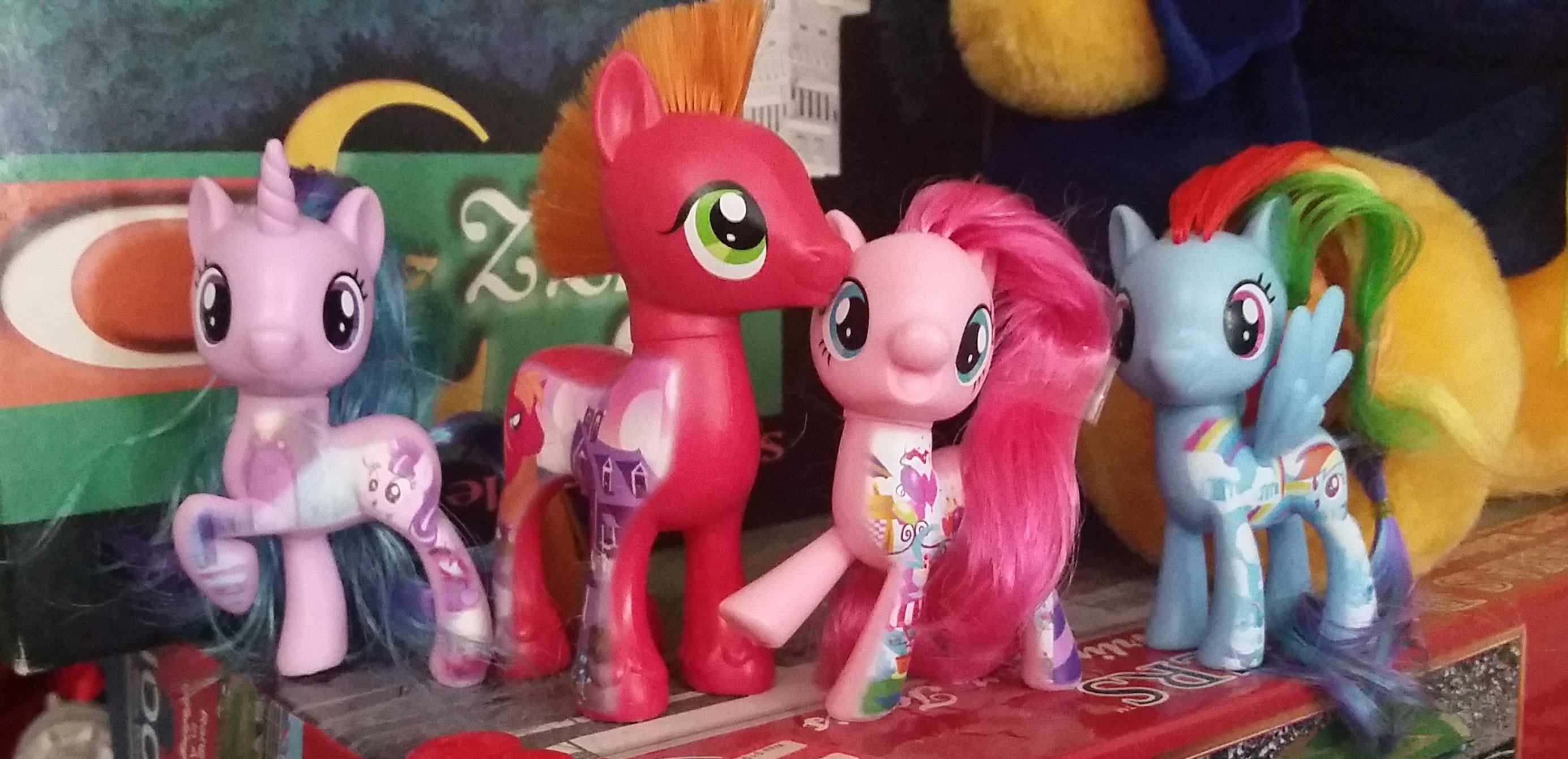
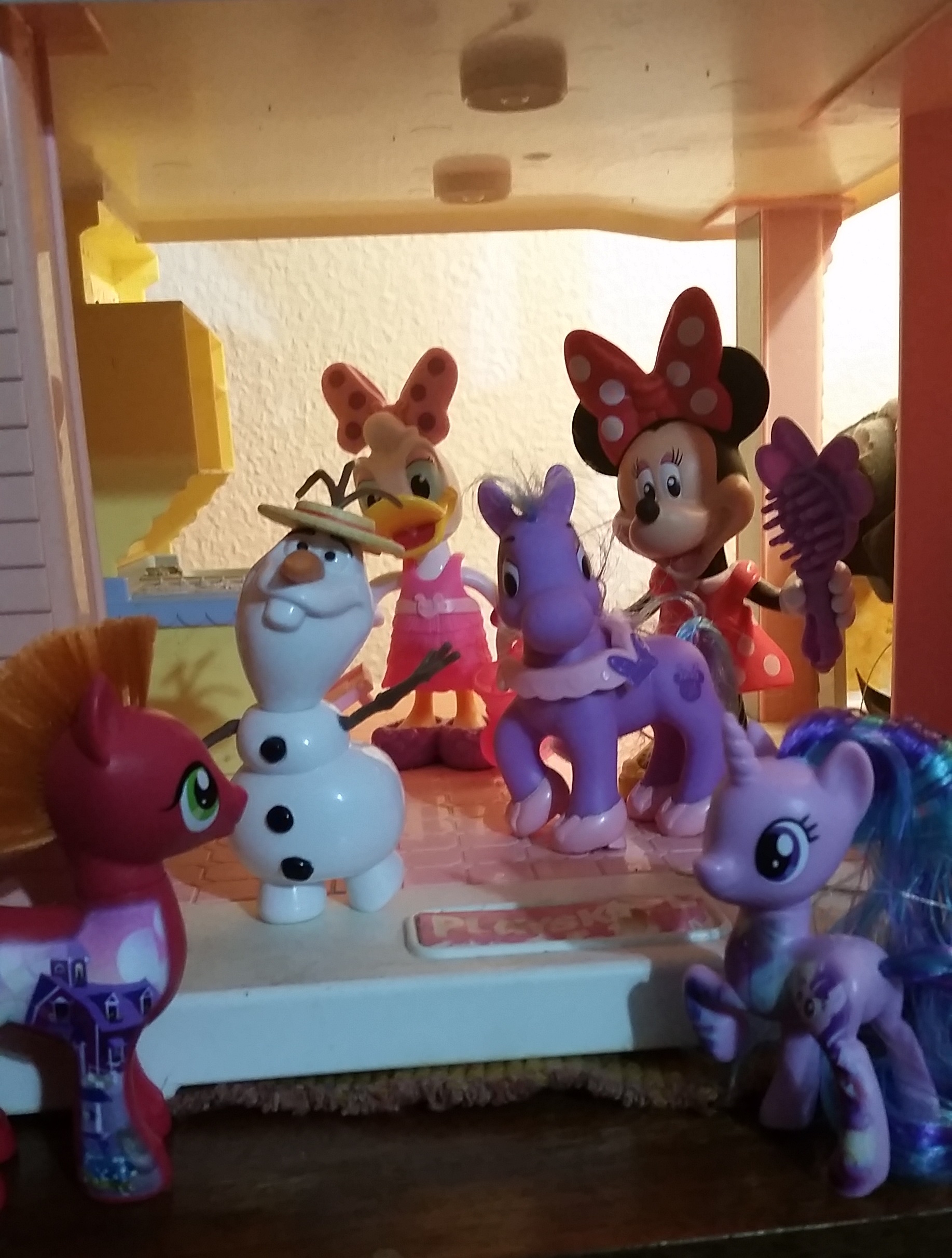
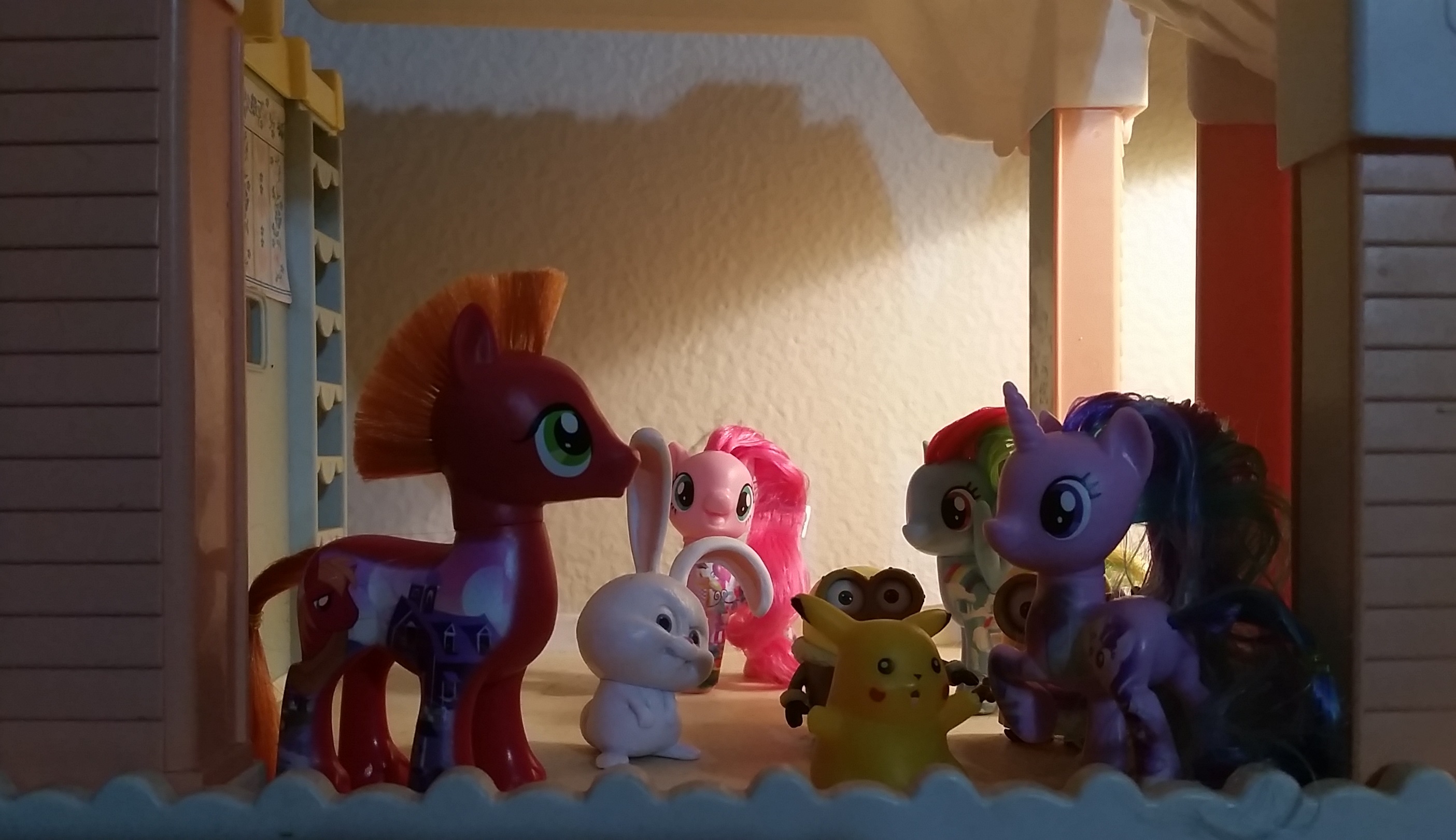
As Big MacIntosh welcomes more little ponies into my insanely large doll collection, I have been reading my published novel Snow Babies. The novel is written in third person viewpoint with a single focus character for each scene. But because the story is about a whole community surviving a blizzard with multiple story lines criss-crossing and converging only to diverge and dance away from each other again, the focus character varies from scene to scene.
Big MacIntosh finds himself to be the leader of a new group of My Little Ponies.
In Canto Two, Valerie Clarke, the central main character of the story, is the focus character. Any and all thoughts suggested by the narrative occur only in Valerie’s pretty little head. Canto Three is focused through the mind of Trailways bus driver Ed Grosland. Canto Four focuses on Sheriff’s Deputy Cliff Baily. And so, on it goes through a multitude of different heads, some heroic, some wise, some idiotic, and some mildly insane. Because it is a comedy about orphans freezing to death, some of the focus characters are even thinking at the reader through frozen brains.
The ponies decide to visit Minnie Mouse’s recycled Barbie Dreamhouse where Olaf the Snowman is the acting butler.
That kind of fractured character focus threatens to turn me schizophrenic. I enjoy thinking like varied characters and changing it up, but the more I write, the more the characters become like me, and the more I become them. How exactly do you manage a humorous narrative voice when you are constantly becoming someone else and morphing the way you talk to fit different people? Especially when some of your characters are stupid people with limited vocabularies and limited understanding?
The ponies are invited to live upstairs with the evil rabbit, Pokemon, and Minions.
I did an entire novel, Superchicken, in third person viewpoint with one focus character, Edward-Andrew Campbell, the Superchicken himself. That is considerably less schizophrenic than the other book. But it is still telling a story in my voice with my penchant for big words, metaphors, and exaggerations.
The novel I am working on in rough draft manuscript form right now, The Baby Werewolf, is done entirely in first person point of view. That is even more of an exercise of losing yourself inside the head of a character who is not you. One of the first person narrators is a girl, and one is a werewolf. So, I have really had to stretch my writing ability to make myself into someone else multiple times.
I assure you, I am working hard to find a proper voice with which to share my personal wit and wisdom with the world. But if the men in white coats come to lock me away in a loony bin somewhere, it won’t be because I am playing a lot with My Little Ponies.
My best novel is free to own in ebook form for today and tomorrow. Buy it now with the link above. The offer is good until the end of the day on 12/14/2021.
This post is about writer doubt. And Stephen King. Do those two things go together? If they don’t then Mickey is an awful writer and does not know how to do what he does. It would mean Mickey is icky.
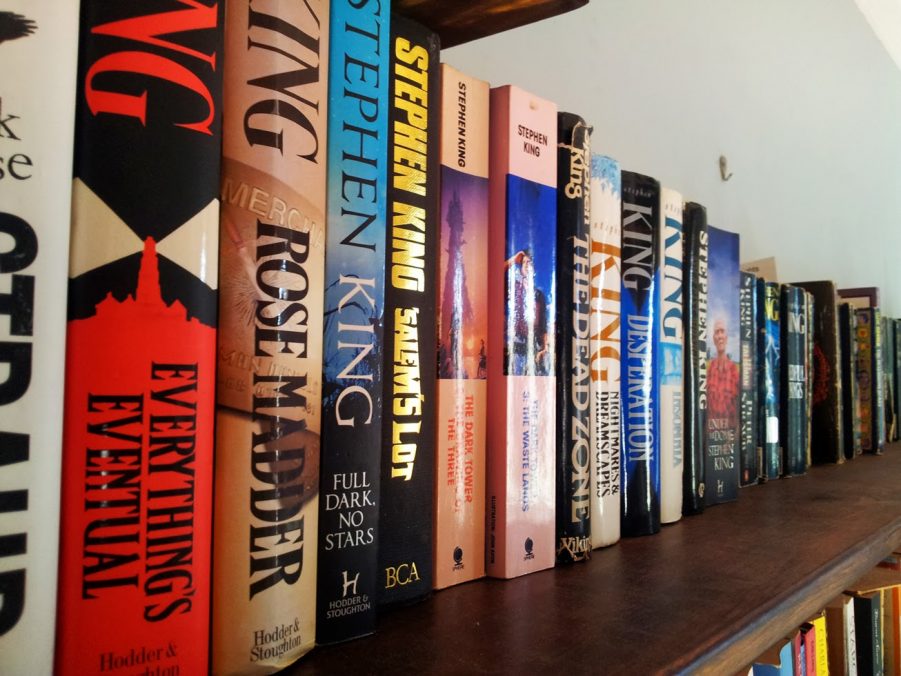
I used to think Stephen King was a totally over-rated writer. Back in the early eighties I read Carrie, King’s first novel, and got halfway throughFirestarter, and had to give up. Partly because the book was overdue at the library, and also because I found the books mechanical and somewhat joyless in the writing. I thought he suffered greatly in comparison to writers I was in love with at the time like Ray Bradbury and Thomas Mann. I began to tell others that King was somewhat icky.
But King was obviously also somewhat successful. He began to get his books made into movies and people who don’t read discovered the evil genius of a man who tells stories to scare them and laces them with a bit of real humanity, real human feeling, and love.
I saw it first in Stand by Me. That movie, starring young Wil Wheaton as the Steven King autobiographical character, really touched my heart and really made for me a deep psyche-to-psyche connection to somebody who wasn’t just a filmmaker, but somebody who was, at heart, a real human being, a real story-teller.
Now, the psyche I was connecting to may very well have been Rob Reiner, a gifted story-teller and film-maker. But it wasn’t the only King movie that reached me. The television mini-series made from It touched a lot more than just the fear centers of my brain as well. And people whose opinions I respect began telling me that the books The Dark Tower Trilogy and Misery were also amazing pieces of literature.
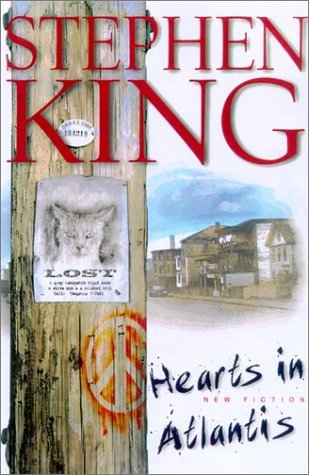
So I picked up a copy of Hearts in Atlantis at Half-Price Books and began reading a Stephen King novel for the first time since the 80’s. MY HOLY GOD! King is not a little bit icky. He is so NOT ICKY that it makes Mickey sicky to have ever thought King was even a little bit icky! Here is a writer who loves to write. He whirls through pages with the writer’s equivalent of ballet moves, pirouettes of prose, grand jetés of character building, and thematic arabesque penchées on every side of the stage. I love what I have discovered in a writer I thought was somewhat icky. Growth and power, passion and precision, a real love of both the words and the story. He may not know what he is doing. But I know. And I love it.
And so, while I have been editing the first novel I ever wrote, Superchicken, to make it ready for self-publishing, I have begun to ask myself the self-critical question, “Is Mickey really icky when he writes?” My first novel is full of winces and blunders and head-banging wonders that make me want to throw the whole thing out. But I can’t throw it out. It is the baby in the first bathwater that I ever drew from the tap. The answer to the questions of Micky ickiness have yet to be determined, and not by me. I guess I have to leave it up to you.
I read a lot of other people’s blogs for a lot of reasons. As an old writing teacher and retired Grammar Nazi, I love to see where writers are on the talent spectrum. I have read everything from the philosophy of Camus and Kant to the beginning writing of ESL kids who are illiterate in two languages. I view it like a vast flower garden of varied posies where even the weeds can be considered beautiful. And like rare species of flower, I notice that many of the best blossoms out there in the blogosphere are consistent with their coloring and patterns. In other words, they have a theme.
So, do I have an over-all theme for my blog? It isn’t purely poetical like some of the poetry blogs I like to read. I really only write comically bad poetry. It has photos in it, but it isn’t anything like some of the photography blogs I follow. They actually know how to photograph stuff and make it look perfect and pretty. It is not strictly an art blog. I do a lot of drawing and cartooning and inflict it upon you in this blog. But I am not a professional artist and can’t hold a candle to some of the painters and artists I follow and sometimes even post about. I enjoy calling Trump President Pumpkinhead, but I can’t say that my blog is a political humor blog, or that I am even passable as a humorous political commentator.
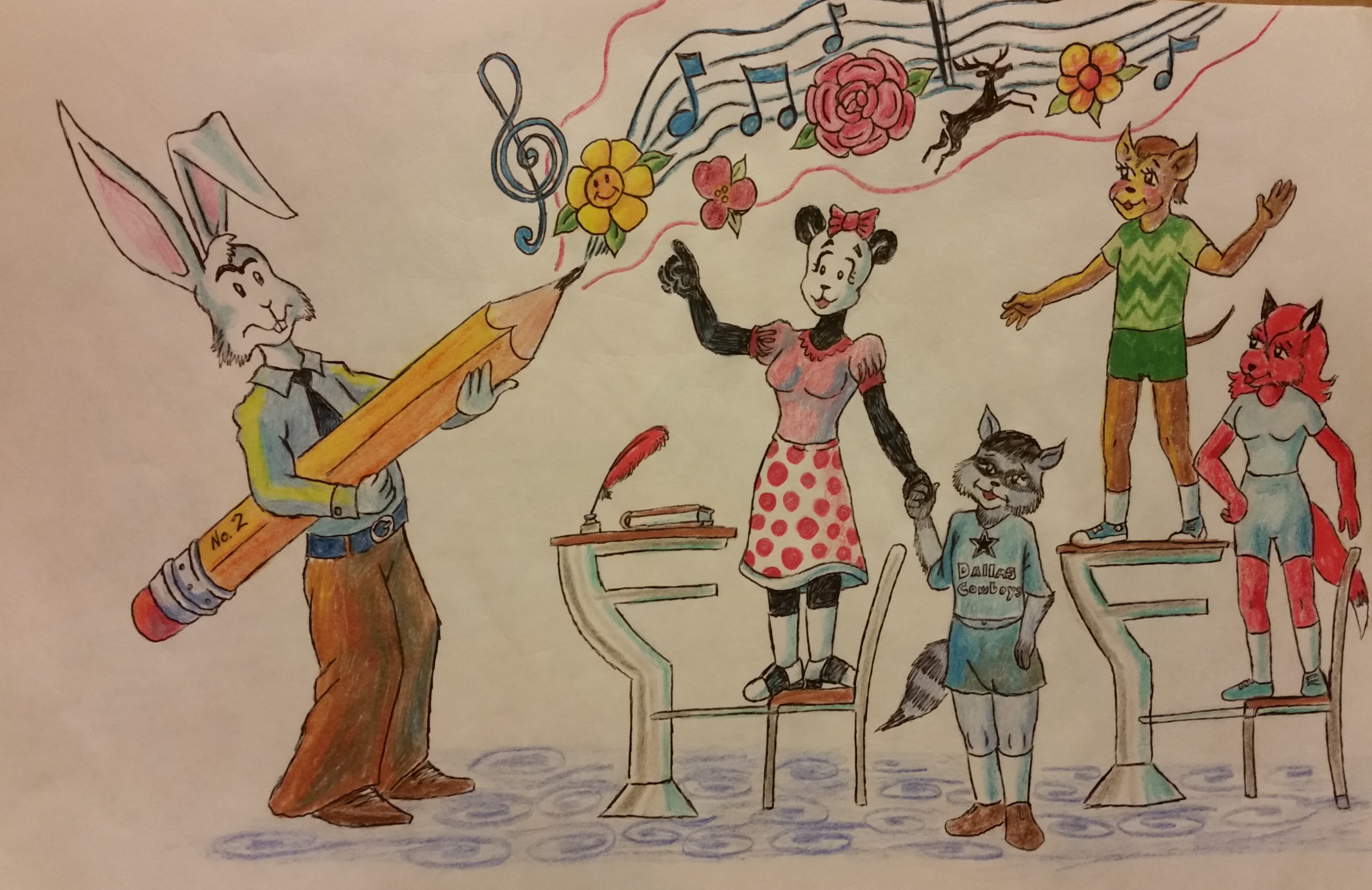
One thing that I can definitely say is that I was once a teacher. I was one of those organizers and explainers who stand in front of diverse groups of kids five days a week for six shows a day and try to make them understand a little something. Something wise. Something wonderful. Something new. Look at the video above if you haven’t already watched it. Not only does it give you a sense of the power of holding the big pencil, it teaches you something you probably didn’t realize before with so much more than mere words.
But can I say this is an education blog? No. It is far too silly and pointless to be that. If you want a real education blog, you have to look for someone like Diane Ravitch’s blog. Education is a more serious and sober topic than Mickey.
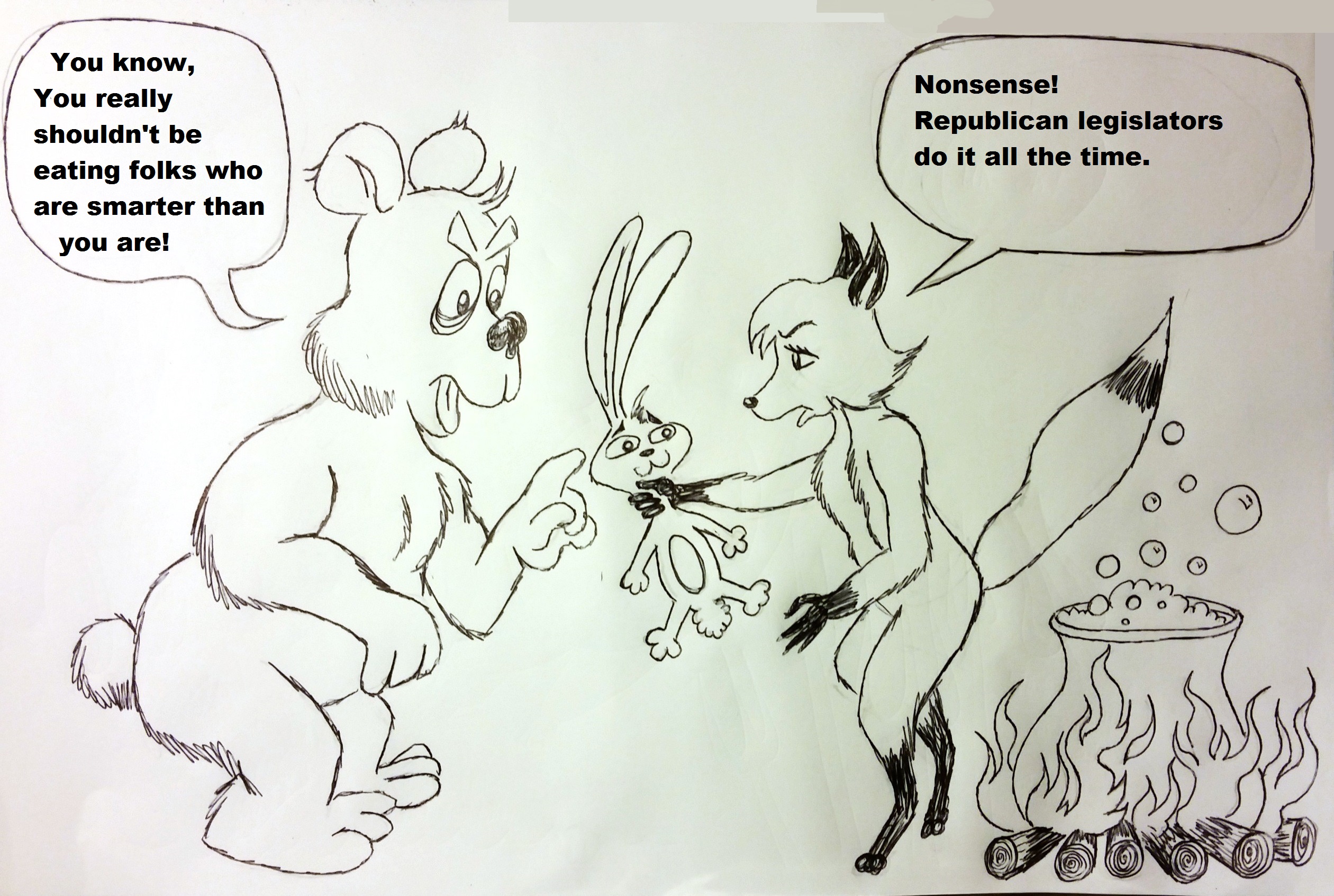
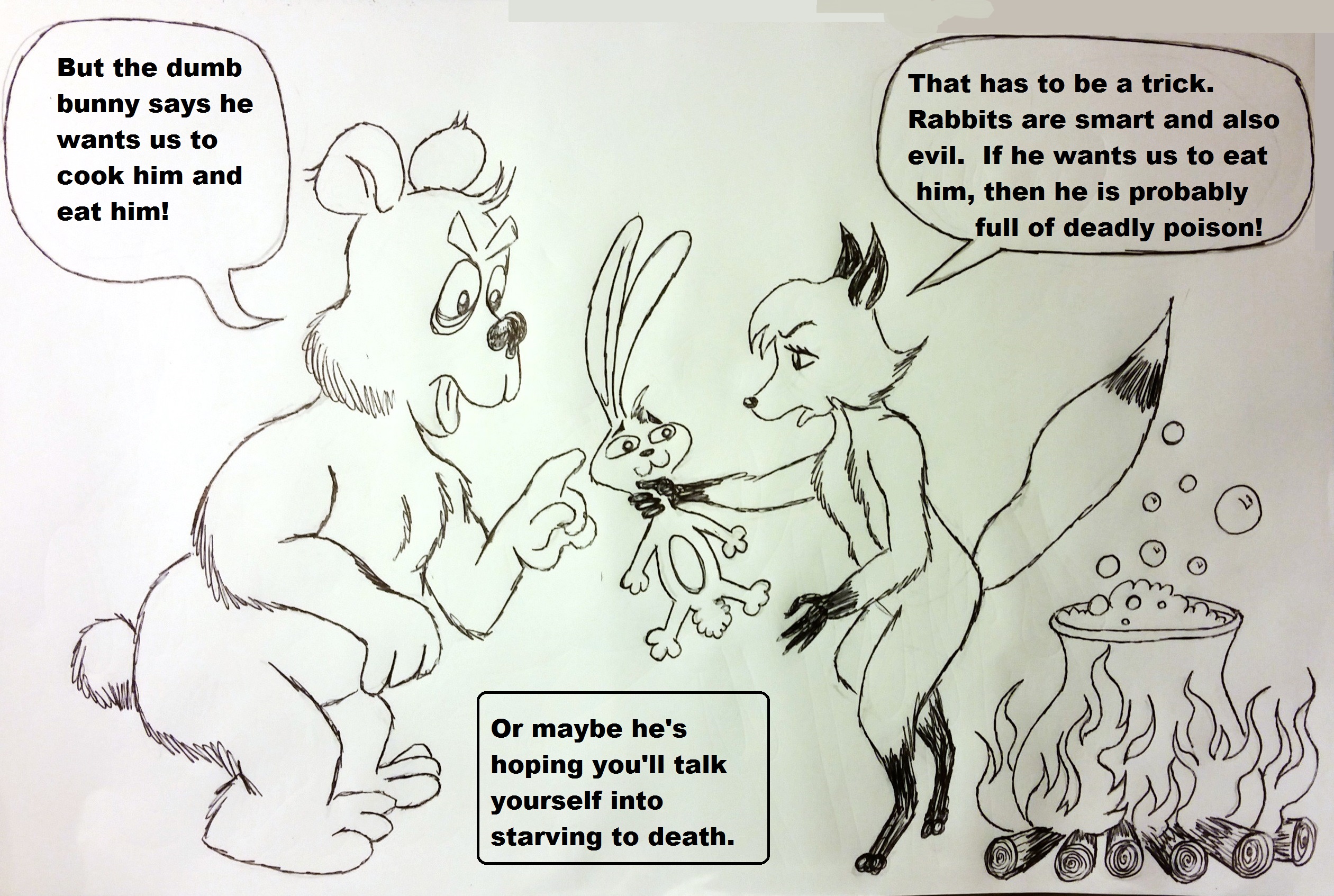
By the way, were you worried about the poor bunny in that first cartoon getting eaten by the fox and the bear? Well, maybe this point from that conversation can put your mind at ease.
Mickey is tricky and gets good mileage out of his cartoons.
You may have gotten the idea that I like Bobby McFerrin by this point in my post. It is true. Pure genius and raw creative talent fascinate me. Is that the end point of my journey to an answer about what the heck this blog is about? Perhaps. As good an answer as any. But I think the question is still open for debate. It is the journey from thought through many thoughts to theme that make it all fun. And I don’t anticipate that journey actually ending anytime soon.
It is difficult to look at the sky and not feel that the power of Heaven is real. As I approach the halfway point of my sixty-eighth year, and the darkness of the future draws ever nearer, I am forced to think about what I really believe. Being smarter than the average bear has its drawbacks. I understand why most of the writers I most admire were atheists, and all of the philosophers I have read and found agreement with are decidedly atheist. Science, rationality, and reason all suggest that there is nothing beyond the physical realm. Should that matter? Faith, according to Mark Twain, is fervently believing in your heart what your mind tells you ain’t so. In fact, Hebrews 11:1 says, “Faith is the assured expectation of things hoped for, the evident demonstration of realities though not beheld.” Even the Bible is saying you have to believe it even though you shouldn’t believe it.
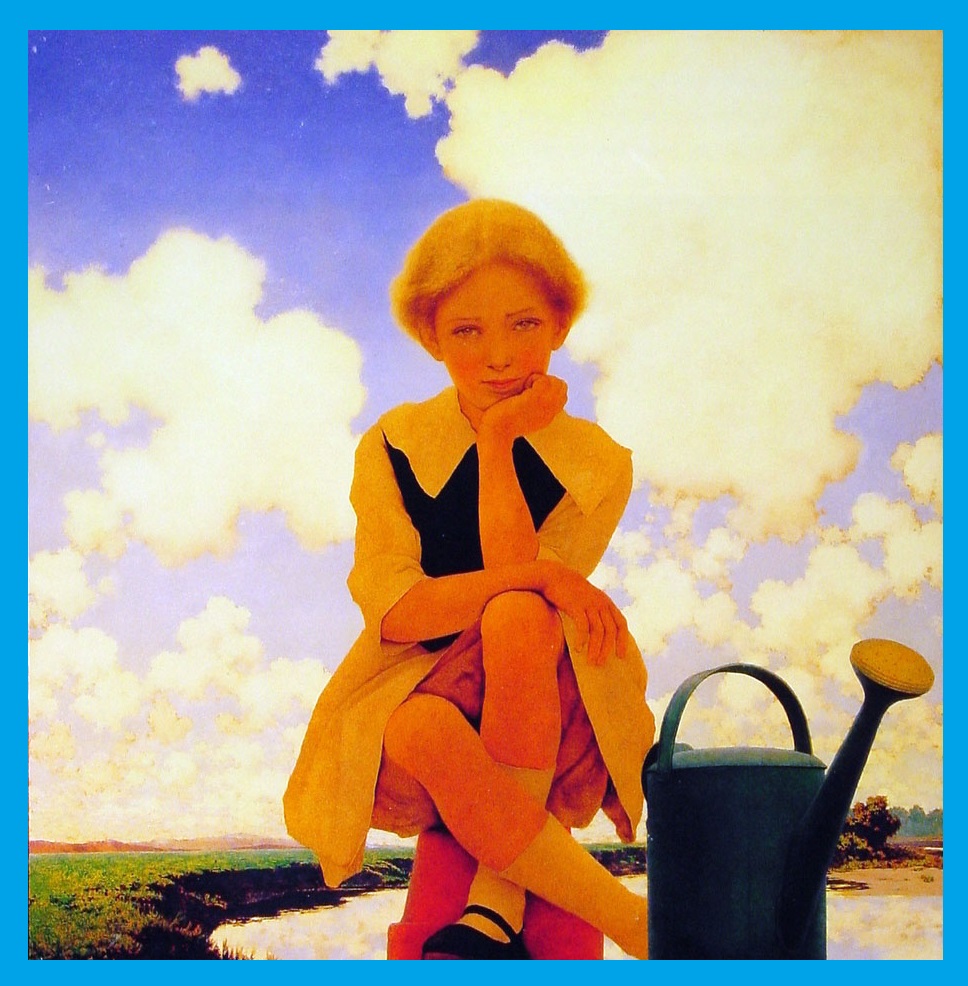
So, will I go to Heaven when I die? For me, the question is meaningless. I look up at the miracle of a blue sky on a partly cloudy day and see the life-giving sun. I am alive… here and now… and nothing else is really relevant. I am a part of the great, vast universe of reality. My existence is real and cannot be unmade… even by God, if He were inclined to do such a thing. I am a small, insignificant part of reality, and I can be gone in the next instant like a puff of smoke in the wind. But I am here and I am alive and I took the Paffooney picture that I used to illustrate this post. And I face whatever comes with a smile on my face. I am alive… and life is good.









 Catch a Falling Star
Imaginary Friends
When you know someone has an imaginary friend, something like Elwood’s six-foot invisible rabbit called Harvey, don’t you immediately think that person is crazy? I do. But I have imaginary people as friends. I think most writers do. So am I crazy? Probably. But hopefully it is a good kind of crazy.
It began with imaginary friends from books. The Cat in the Hat was my friend. Jim Hawkins was my friend, as was Mowgli and all the members of the Swiss Family Robinson. They entered my dreams and my daydreams. I told them my troubles the same way I listened to theirs through their stories.
I began to have imaginary friends that came from my own imagination too.
I used to tell my mere human friends about my friend Davalon from outer space. I told them that he was real and secretly visited me at night to talk about being able to learn about humans on earth by walking around invisibly and watching them. I got so involved with these stories that my sixth grade class began saying, “Michael is from Mars.”
When I was a teenager, I began having conversations with a faun. His name was Radasha. He was a creature from Greek Myth, a sensual Dionysian creature who, in his child body, was both younger than me and way older than me. I didn’t realize until much later in life that he was the result of my repressed memories of a childhood sexual assault that I was the victim of. I could talk to him about my fear of nakedness. I could tell him about my blossoming interests in naked girls and their bodies. I could talk to him about all the things I was somehow too terrified to talk to my male friends about, even though none of them had the same reluctance to discuss sex. Ra was imaginary. But he helped me heal.
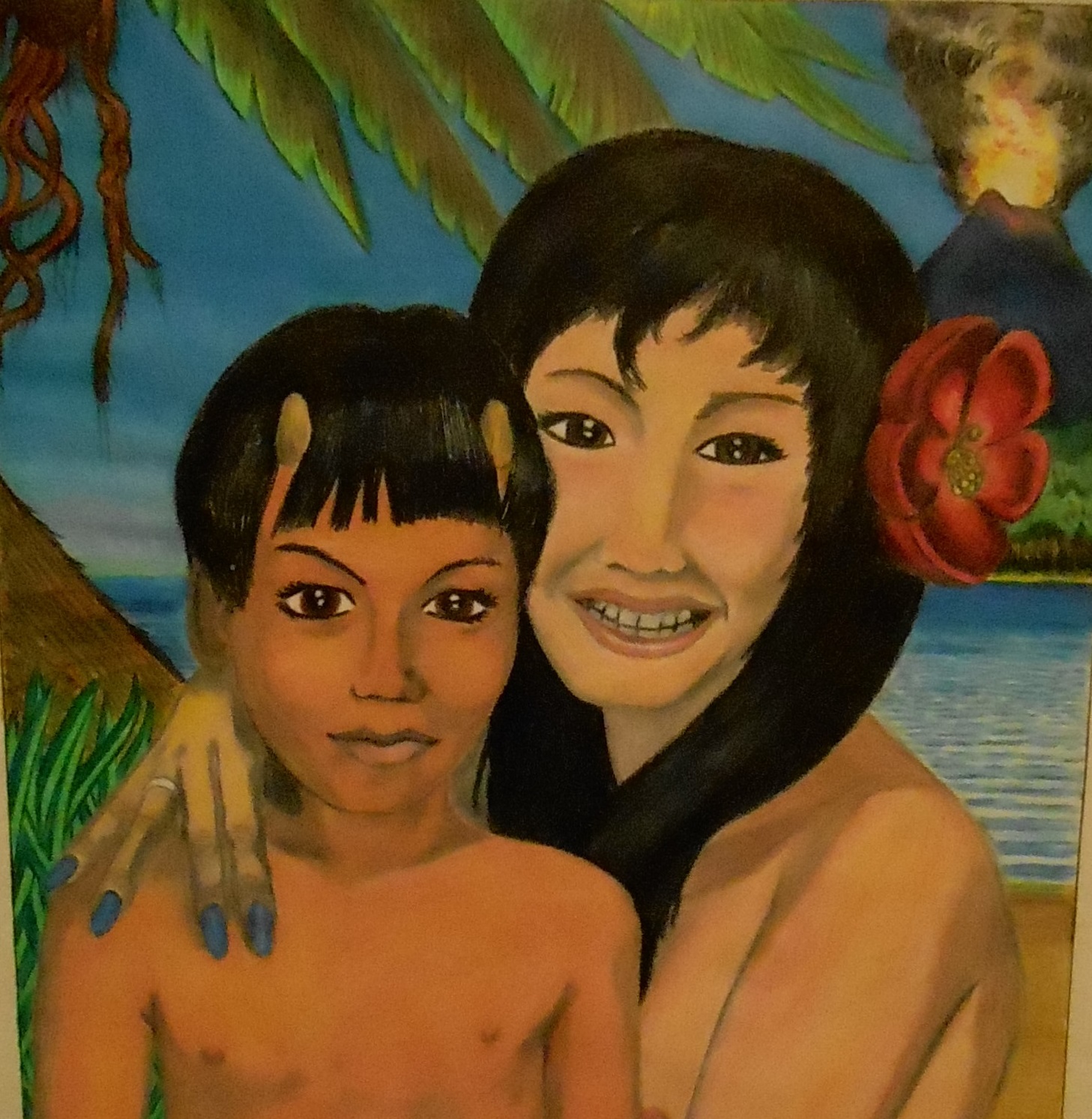
Then the story-telling seriously began. I used Davalon as one of the main characters in my novel Catch a Falling Star. I created Torrie Brownfield, the baby werewolf to express the feelings I had as a boy about being a monster and secretly terrible and deformed. Torrie is a normal boy with a condition called hypertrichosis. I am working on The Baby Werewolf now. And then there’s lovely Valerie Clarke. She is the main character of Snow Babies which is a finished novel, edited and proofread and ready to publish. It is I book I will have to find another way to publish since the recent death of PDMI Publishing. She is not a me-character, based on my own thoughts and feelings. She is based on former classmates and students who told me things that express the sadness and isolation of growing up female. So she is even more imaginary than my other characters.
They become real people to me. They have their own point of view. They talk to me and I learn things from them. But they are imaginary. So am I crazy? Yes… as a loon. And happy as Elwood P. Dowd to be that way.
Leave a comment
Filed under artwork, autobiography, being alone, characters, commentary, humor, imagination, insight, Paffooney, strange and wonderful ideas about life
Tagged as book review, book reviews, books, fiction, writing