
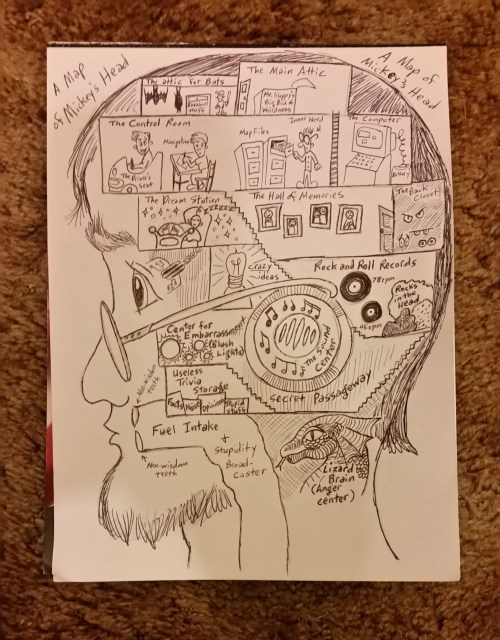
One really weird thing that teachers do is think about thinking. I mean, how can a person actually teach someone else how to think and how to learn if they don’t themselves understand the underlying processes? Now that I have retired from teaching and spend all my time feeling sorry for myself, I thought I would try thinking about thinking one more time at least. Hey, just because I am retired, it doesn’t mean I can’t still do some of the weird things I used to do as a teacher, right?
This time I made a map to aid me in my quest to follow the twists and turns of how Mickey thinks and how Mickey learns. Don’t worry, though. I didn’t actually cut Mickey’s head in half to be able to make this map. I used the magical tool of imagination. Some folks might call it story-telling… or bald-face lying.
Now, a brain surgeon would be concerned that my brain maps out in boxes. He would identify it as a seriously deformed brain. It is not supposed to be all rectangular spaces and stairs. It probably indicates a severe medical need for corrective surgery… or possibly complete amputation. But we are not going to concern ourselves with trying to save Mickey from himself right now. That is far too complex a topic to tackle in a 500-word daily post. We are just discussing the basics of operation.
You see the three little guys in the control room? They are an indication that not only did I steal an idea from the Disney/Pixar Movie Inside Out, but I apparently have too few guys doing the job up there compared to the movie version. (It probably makes sense though that a young girl like the one in the movie has a much more sensible configuration in her brain than someone who was a middle school teacher for 24 years. Seriously, that job can do a bit of damage.) The three little guys are not actually Moe, Curly, and Larry, though that wouldn’t be far from descriptive accuracy. They are Impulsive Ignatz, currently in the driver’s seat (or else I wouldn’t be writing this), Proper Percy the Planner, and Pompositous Felixian Checkerbob, the fact-checker and perfectionist (also labeled the inner nerd… I am told not everyone has one of these). They are the three little guys that run around in frantic circles in my head trying to deal with a constant flow of input and output, trying to make sense of everything, and routinely failing miserably.
I shouldn’t forget the other two little guys in my head, Sleepytime Tim in the Dream Center, and little Batty up in the attic. I have no earthly idea how either of them function, or what in the heck they are supposed to do. But there they are. The other three run up and down stairs all day, locating magic mushrooms and random knowledge in the many file cabinets, record collections, book stacks, and odd greasy containers that are stored all around in the many nooks and crannies of Mickey’s mind. They collect stuff through the eyes and ears, and it is also their responsibility to chuck things out through the stupidity broadcaster at various inopportune times. It is also a good idea for them to avoid the lizard brain of the limbic system in the basement. It is easily angered and might eat them.
So now you should be able to fully understand how Mickey thinks. (Or not… a qualifier I was forced to put in by Checkerbob.)













 “The fool’s mother constantly puts a sign on his bedroom door that says, Clean your room! So he has to do it every day before he can do anything else. One day he decided he didn’t want to clean his room that day, and he made a sign himself. It said, Don’t put any signs on this door! He put it on his bedroom door. But then he read what it said and had to take it down again.”
 Catch a Falling Star
The Alchemist by Paulo Coelho
Some books come along telling a story that has to be taken seriously in ways that don’t make sense in any normal way. The Alchemist is one of those books.
What is an alchemist, after all?
An alchemist uses the medieval forms of the art of chemistry to transmute things, one thing becoming another thing.
Coelho in this book is himself an alchemist of ideas. He uses this book to transmute one idea into another until he digs deep enough into the pile of ideas to finally transmute words into wisdom.
There is a great deal of wisdom in this book, and I can actually share some of it here without spoiling the story.
Here are a few gemstones of wisdom from the Alchemist’s treasure chest;
“It’s the possibility of having a dream come true that makes life interesting…” (p.13)
“It’s the simple things in life that are the most extraordinary; only wise men are able to understand them.” (p.17)
“All things are one. And, when you want something, all the universe conspires in helping you to achieve it.” (p.24)
“And when he had gone only a short distance, he realized that, while they were erecting the stall, one of them had spoken Arabic and the other Spanish. And they had understood each other perfectly well. There must be a language that doesn’t depend on words, the boy thought.” (p.45)
All of these quotes from the book, as you can see, come from the first third of the book. There are many more treasures to be found in this book. I should not share them with you here. Just as the main character of the story learns, you have to do the work for yourself. But this book is not only an enjoyable read, but a map for how you can execute your own journey towards your “Personal Legend”. In fact, you may find that the book tells you not only how to go about making a dream come true, but, if you are already on that journey successfully, it tells you what things you are already doing right.
Leave a comment
Filed under book reports, book review, commentary, good books, magic, strange and wonderful ideas about life, wisdom, wizards
Tagged as book review, books, fantasy, fiction, magical books, mystical books, reading, the Alchemist by Paulo Coelho