
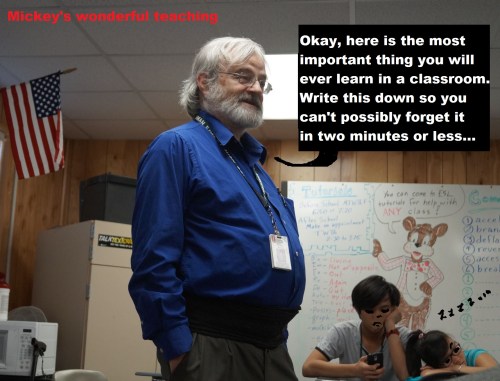
When I was still alive and still teaching, maximizing and managing time was an incredibly important part of the day. You had to activate learners with an attention step, a lesson focus that grabbed them. Usually that had to follow a warm-up, something you got them to do as soon as you had smiled at them at the doorway, offered to shake their hand, and then pulled them into the classroom to do some work for you. fifteen minutes at the start of the class to rev up mental engines and get the gears turning… shake out the rust and the cobwebs that accumulate the instant the final bell rang in the previous class. I timed that part of class down to the second with my pocket watch… or phone in later years. Then, once the engines started, the focus is in place, you introduce the learning objective. Never more than ten minutes… timed to the second… you give the explanation, the road map of the day ahead, the instruction. Then for the next ten to fifteen minutes you let them discover stuff. In groups, with a partner, teacher to class, student to class, or (rarely) individually, they must apply what you pointed out and figure something out. It could be complicated, but probably it was simple. All answers are welcome and accepted… because all answers will be evaluated and you learn more from wrong answers than you do from correct guesses. Evaluation comes in the five to ten minutes at the end when you evaluate. “What have I learned today?” You try your hardest to pin something new to the mental note-board hanging on the brain walls of each and every student. Depending on how much or how few minutes you are given before the final bell kills the lesson for the day, you have to put the big pink ribbon on it. That tightly-wound lesson cycle goes on all day, repeated as many times as you have classes. In that time you have to be teacher, policeman, friend, devil’s advocate, entertainer, counselor, psychotherapist, chief explainer, and sometimes God. And you time it to the second by your pocket watch.
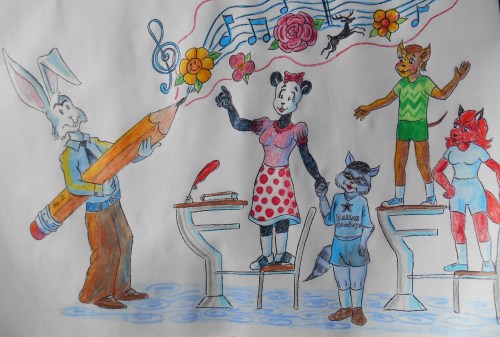
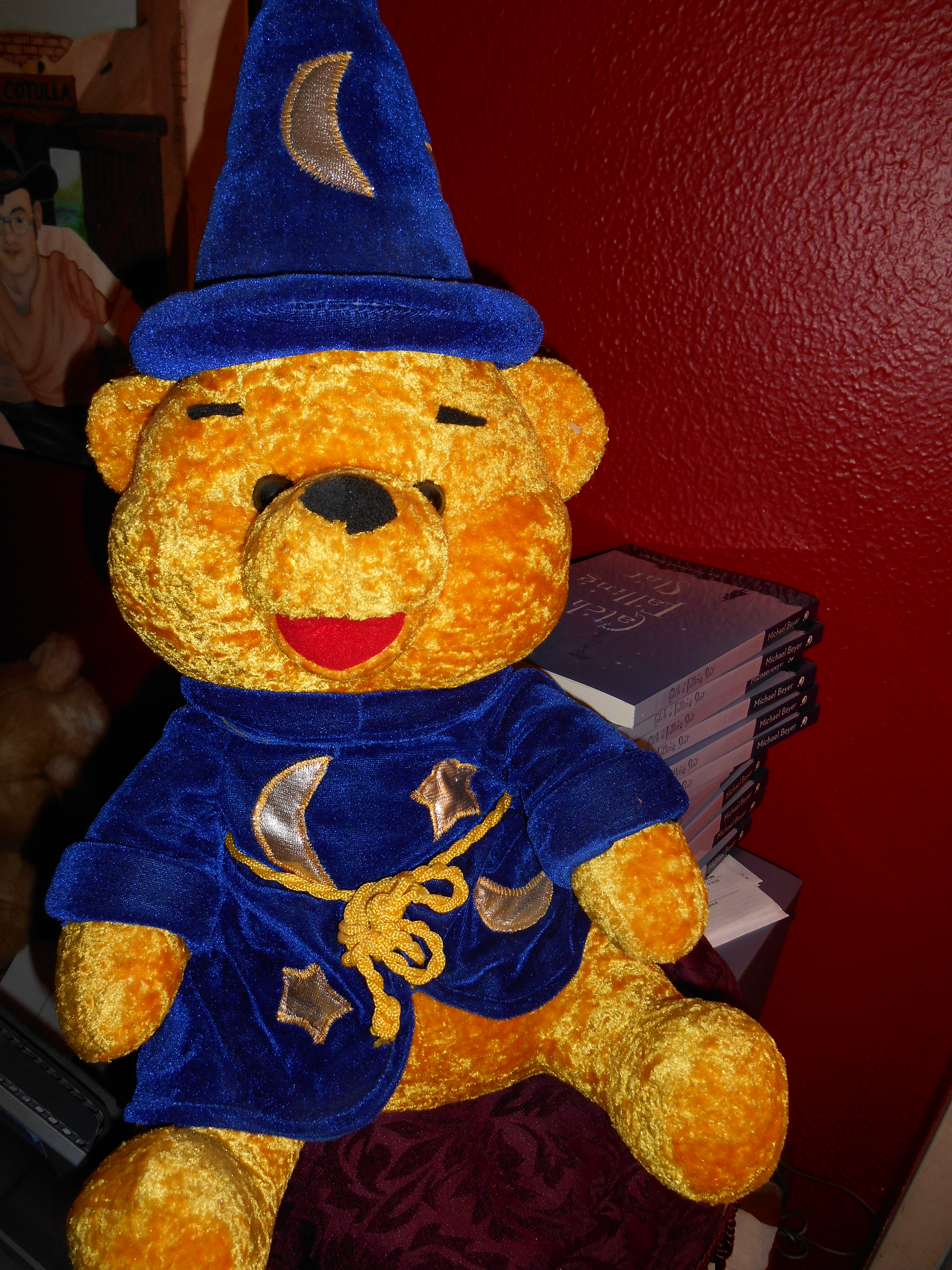
I miss being the rabbit holding the BIG PENCIL. Now that I am retired, I am no longer on the clock… no longer subject to careful time management. My pocket watch is broken and lying in a box somewhere in my library. I live now in non-consecutive time periods of sleep and illness and writing and playing with dolls. I have entered a second childhood now. Not really a simple one because of diabetes and arthritis and COPD and psoriasis and all the other wonderful things that old age makes possible. But a childhood free of school politics and mandates from the school board and from the State. A childhood where I can once again dream and imagine and create and play. That’s what this post is if you haven’t already figured it out. I am playing with words and ideas. They are my toys. Toys like this one;

This, of course, is Tim, the turtleboy of irony, holding his magic flatiron that he uses for ironing out irony. He is flattening it out now with a cartoony Paffooney and wickedly waggled words. Ironically, I have often taught students to write just like this, making connections between words and pictures and ideas through free association and fast-writing. Have you learned anything from today’s retired-teacher post? If you did, it is ironic, because you were never meant to from the start.




 .
.


 Catch a Falling Star
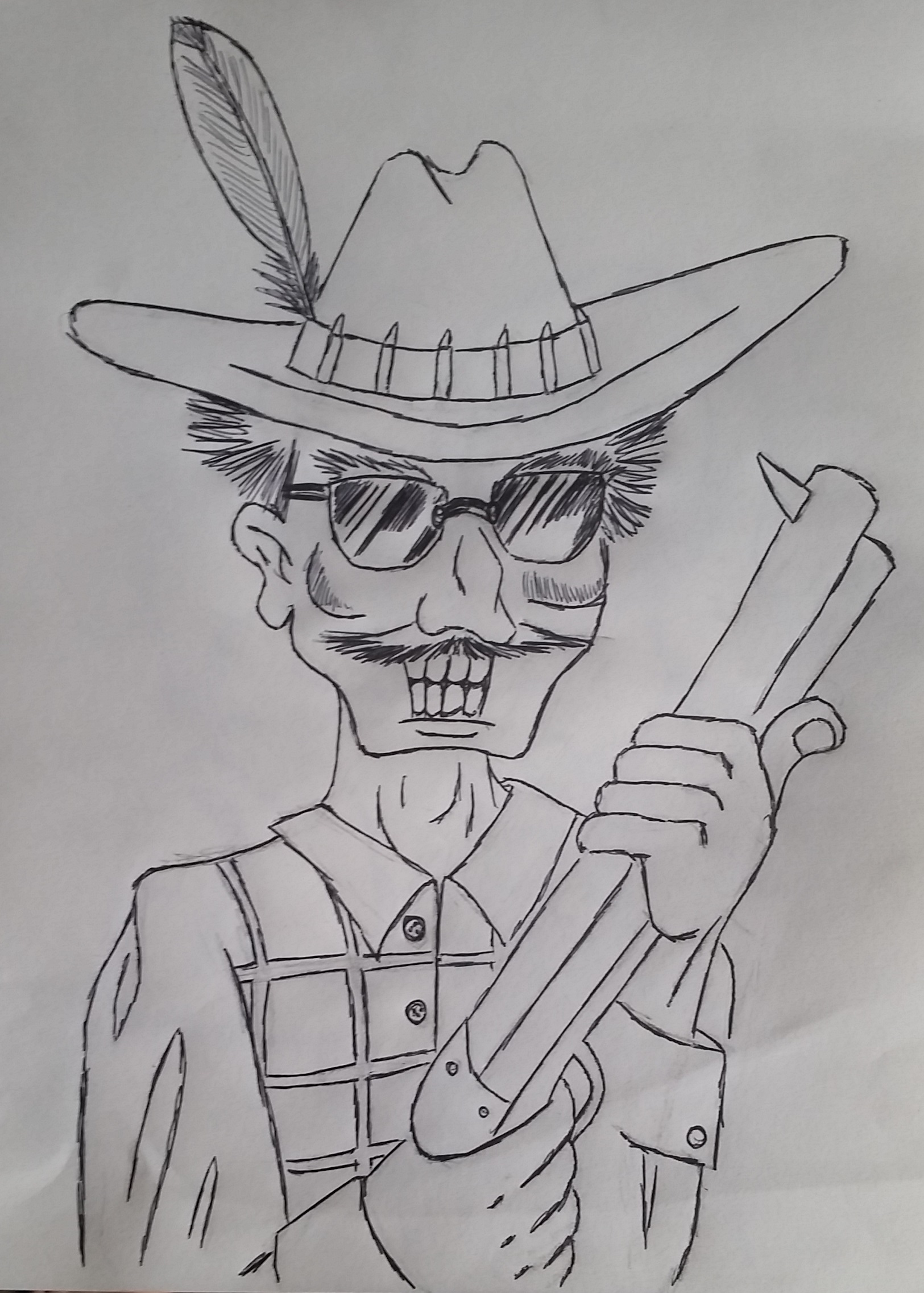
The Cowboy Code
When I was a boy playing cowboys and Indians with cap pistols and rubber tomahawks, we all knew that cowboys had a code. The guy in the white hat always shoots straight. He knows right from wrong. He only shoots the bad guy. He even shoots the gun out of the bad guy’s hand if he can. Westerns are about right and wrong, good and bad, and the unyieldingly good knights of plains.
And boys believe what they see on TV and in the movie theaters. People who make television shows never lie, do they? In fact, Wyatt Earp was based on a real guy who really lived and really shot the bad guys at the gosh-darn real OK Corral.
Daniel Boone was a real guy too. He faced the opening up of new lands full of deadly dangers. And when Fess Parker played him in 1964, wearing Davy Crockett’s coonskin hat, he walked the earth like a guardian angel, making everyone safe by the end of the episode. He even knew which Indians were good and which were bad. Mingo was always on Daniel’s side. And when they spoke to each other about the dangers they faced, it was never about killing the people they feared. It was about doing what is was right, about helping the community at Boonesboro to survive. Being encouraging… looking forward to a more settled future created by following the cowboy frontier code.
So, I am left wondering what ever happened to the cowboy code? I listen to Republican presidential candidates talking about dipping bullets in pig’s blood to kill Muslims, and building walls against Mexican immigrants, and why our right to carry assault rifles is sacred, and I wonder what happened. Didn’t they experience the same education from the television versions of the Great American Mythology? Didn’t they learn the code too?
I am old enough now to know that cap guns are not real guns and you cannot solve problems by shooting somebody. But that was never the point of the cowboy code. We need straight-shooters again in our lives, not to shoot people, but to tell the unvarnished truth. We need wise people who can tell who are the good Indians and who are the bad We need them to shoot the weapons out of the bad guys’ hands. And I know that’s asking for leaders to be larger than life and be more perfect than a man can actually be. But Daniel Boone was a real man. Myths and legends start with a fundamental truth.
Leave a comment
Filed under autobiography, commentary, cowboys, humor, insight, philosophy, politics, Uncategorized
Tagged as arizona, autobiography, childhood beliefs, cowboy code, Daniel Boone, fiction, guns, humor, politics, Red Ryder, Roy Rogers, satire, writing, Wyatt Earp