I remember when Scooby Doo, Where Are You? premiered on Saturday Morning Cartoons in 1969. I was thirteen and in the 7th grade. I had been six during the Cuban Missile Crisis of 1962, seven when Kennedy was assassinated in 1963, ten when I was sexually assaulted in 1966, and still twelve when Neil Armstrong walked on the Moon in the Summer of 1969. I was obsessed with monsters, horror comics, 20,000 Leagues Under the Sea, and the Pirates threatening Jim Hawkins in Treasure Island. I knew what fear was. And I was mad to find ways to combat the monsters I feared.
Don’t get me wrong. I was under no illusions that Fred, Daphne, Velma, Norville “Shaggy” Rogers and Scooby Doo were the answer to all my fears as viable heroes and heroines. They were goofballs, all of them, based on the characters I vaguely remembered from The Many Loves of Dobie Gillis. I was aware that Shaggy was just Maynard Krebs in cartoon form (the hippie character portrayed by Gilligan’s Island actor Bob Denver.)
One of the critical things about the show for me was the fact that there was a rational explanation for the monsters. They were men in masks, special effects and projector tricks, or remote-controlled mechanical things.
And the way you overcame them and saved the day was by having Shaggy and Scooby act as bait, cause the traps to get sprung at the wrong time, and then fall on the villains, trapping them under the butt of the talking dog.
Villains and horror could be overcome by laughing at them. They were more likely to be clowns than carnivores. And even if they were carnivores, the teeth were not real.
There was a universal truth in that. Danger and horror and fear were easier to handle when you could laugh in spite of those things.
And to top it all off, those meddling kids and their stupid talking dog were with me my whole life. Those cartoons got remade and spun off so many times that my kids learned to love them as much as I did. And those four meddling kids and that talking dog are still making new stories even now.
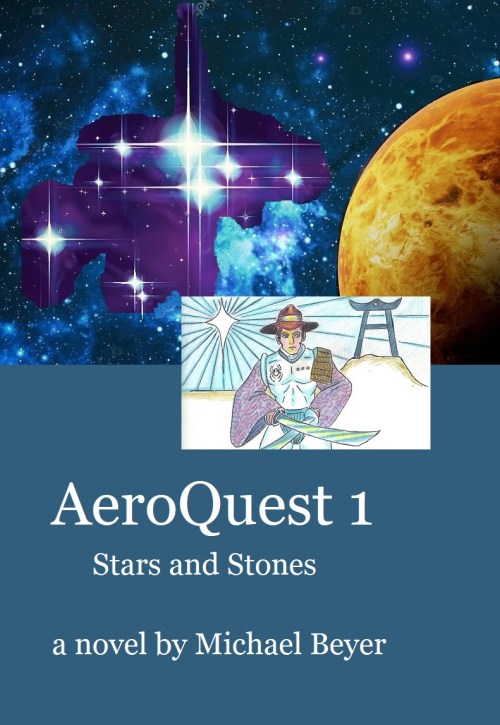
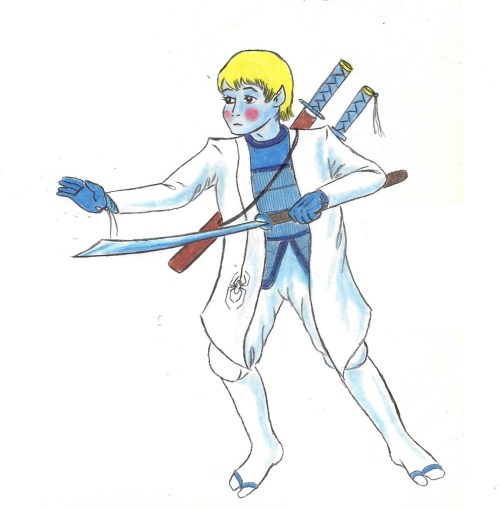
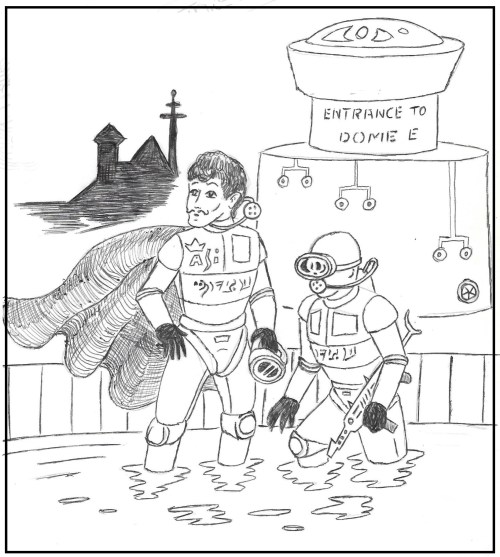
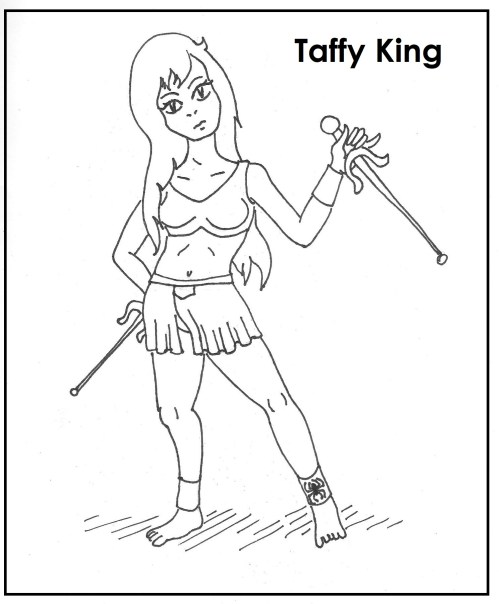
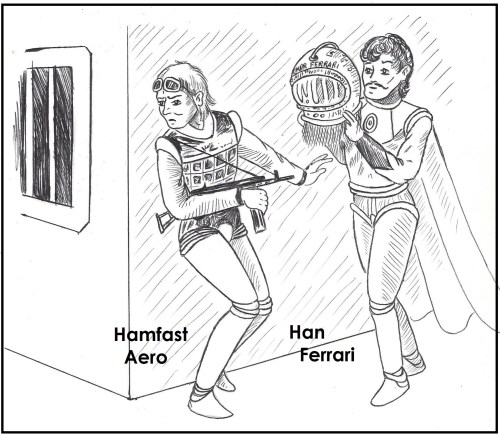
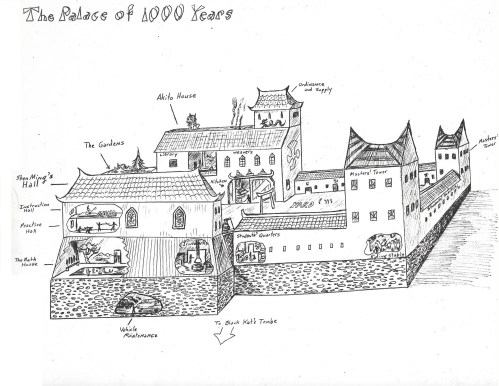
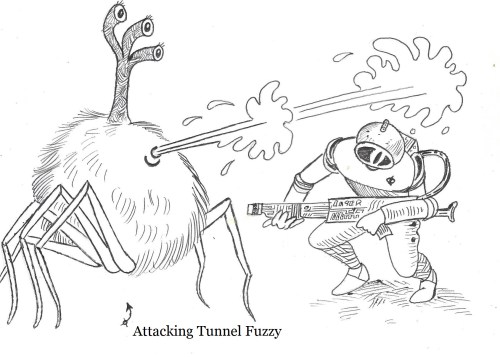
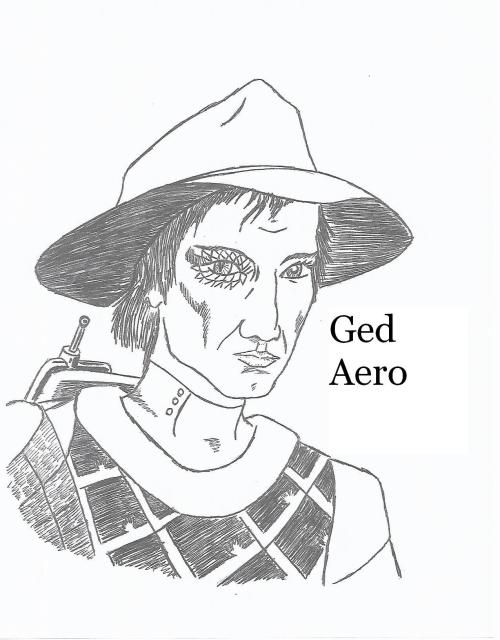
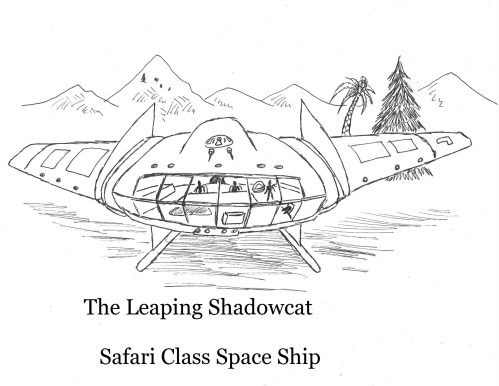
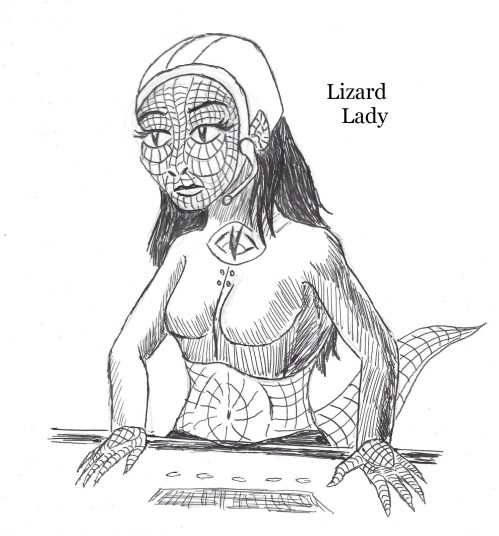
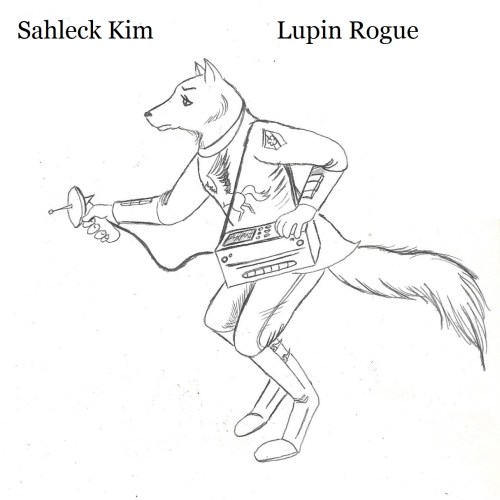
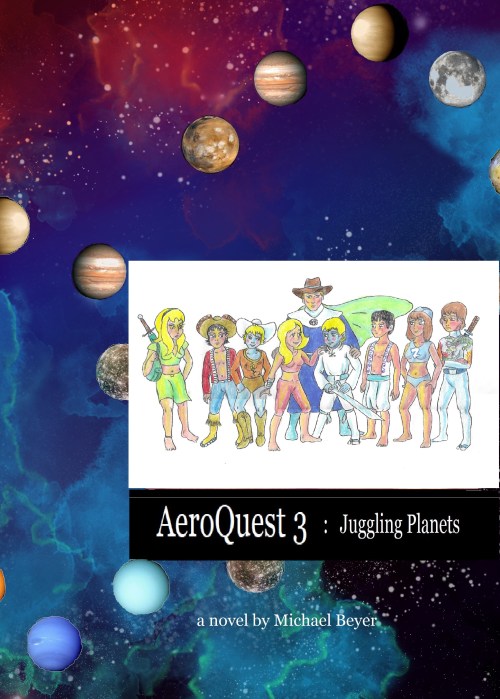
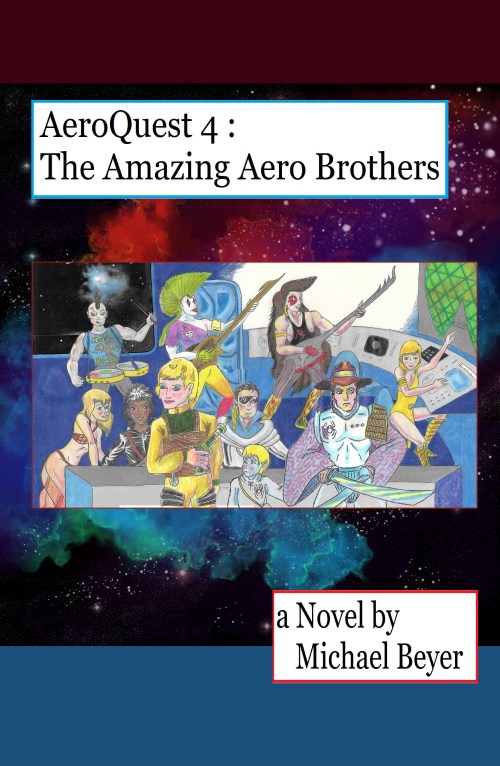
These are the pieces of art and illustrations that are going into the re-writing project of my novel Aeroquest.
I decided to totally rework the novel and illustrate it more fully because it was always supposed to be a science-fiction satire and parody that was more cartoonish than literary.
It is a story about a teacher conquering a space empire. It arose from a science-fiction role-playing game that filled my days in the 1980’s and early 90’s.
It parodies Star Wars, Star Trek, Flash Gordon, Buck Rodgers, Dune, and much more besides. And it includes many of my own wacky inventions about what the future might hold in store.
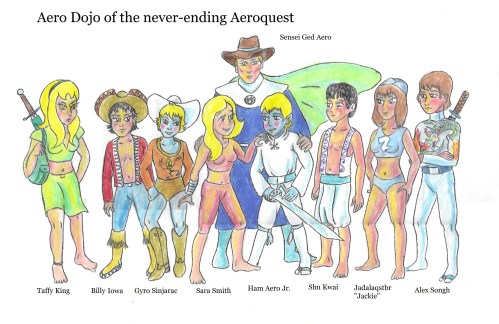
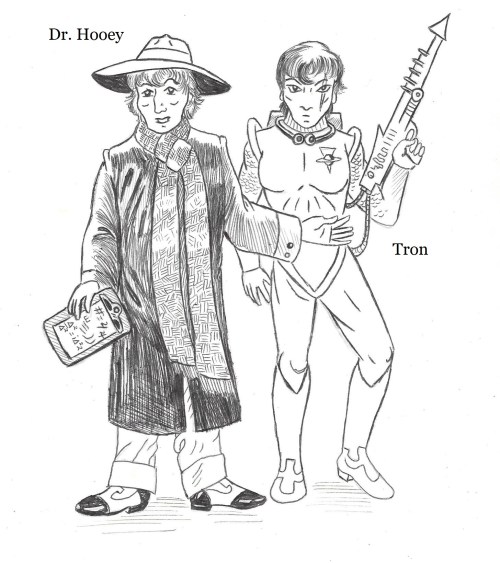
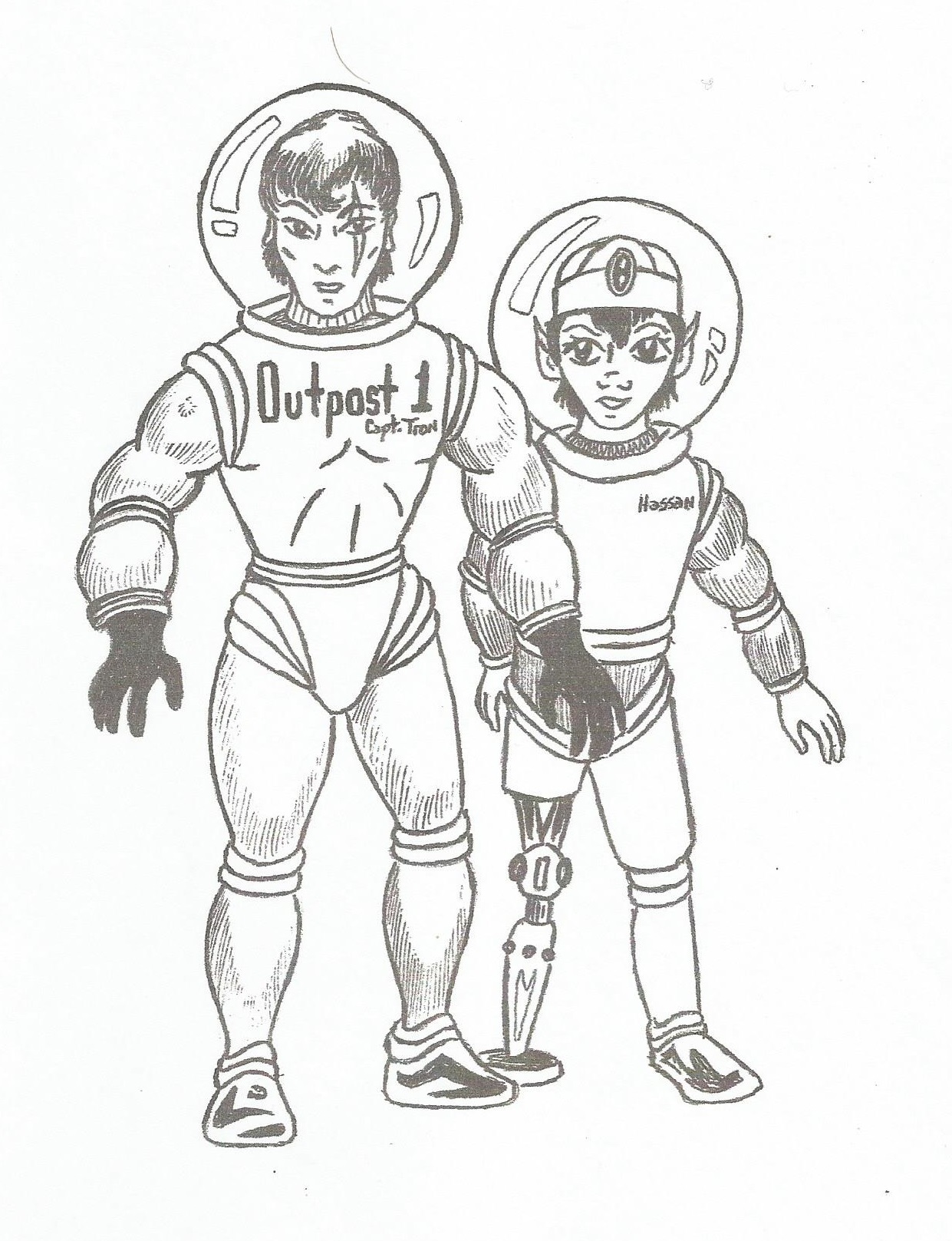
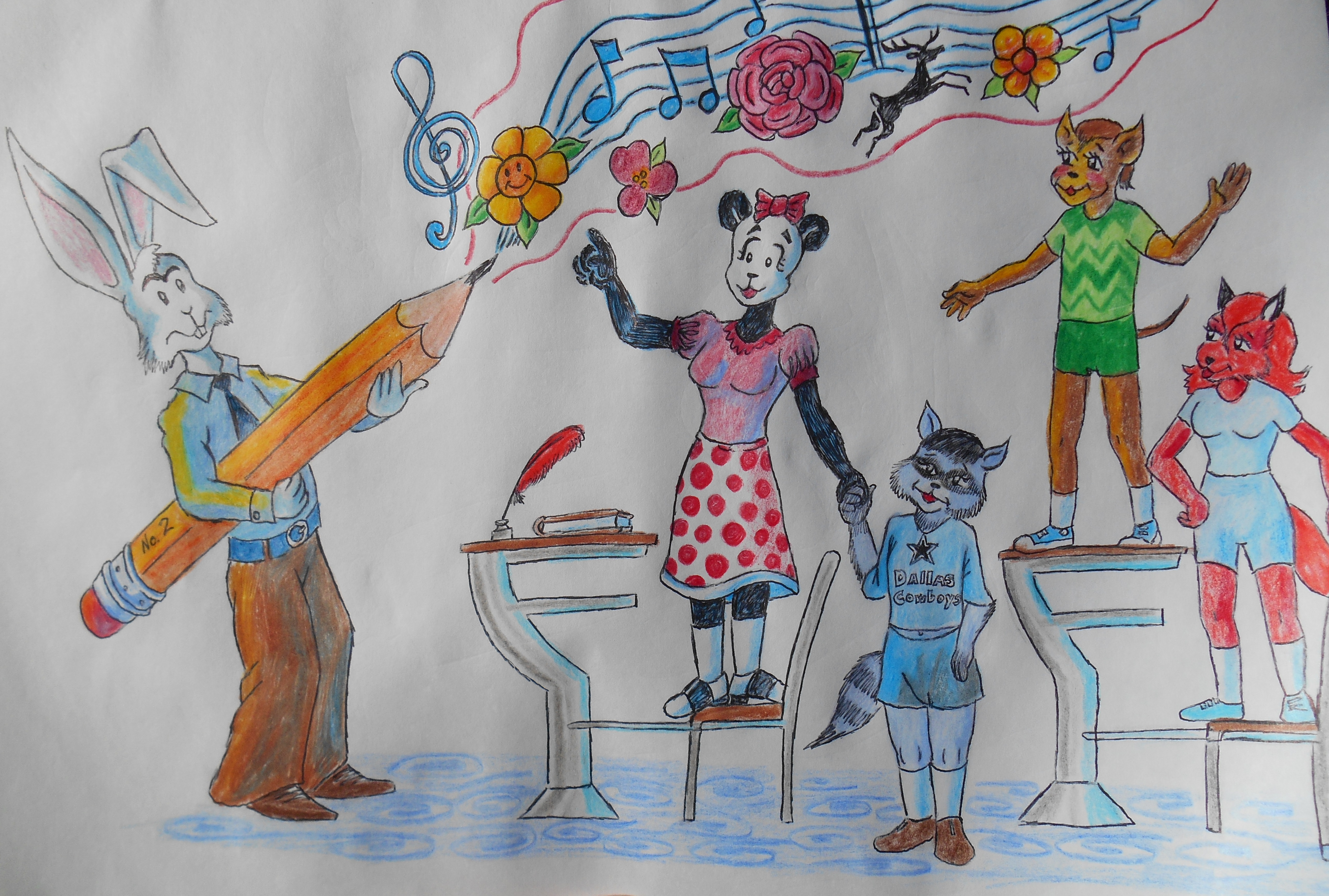
Here is the original teacher in space and some of his first class of students.
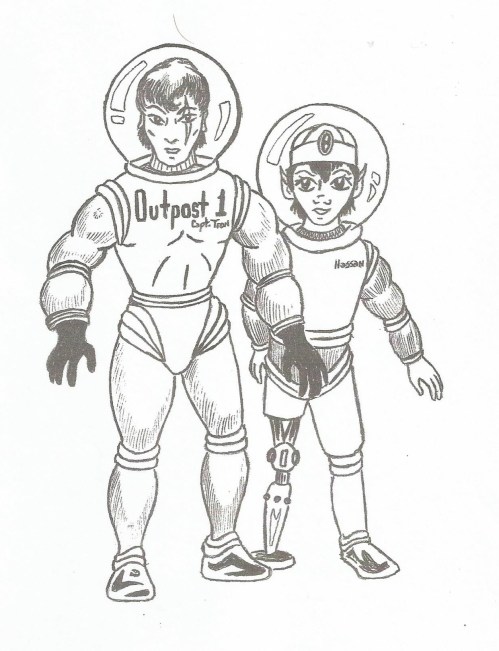
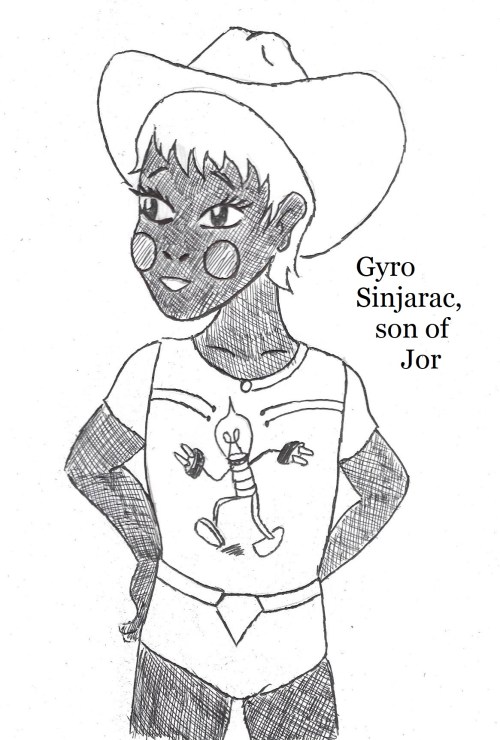
Many of the main characters are based on the actual role-playing characters made up by the boys and young men who played the game with me. Many had to be re-named, however, because, like Tron Blastarr above, they often had movie-character names.
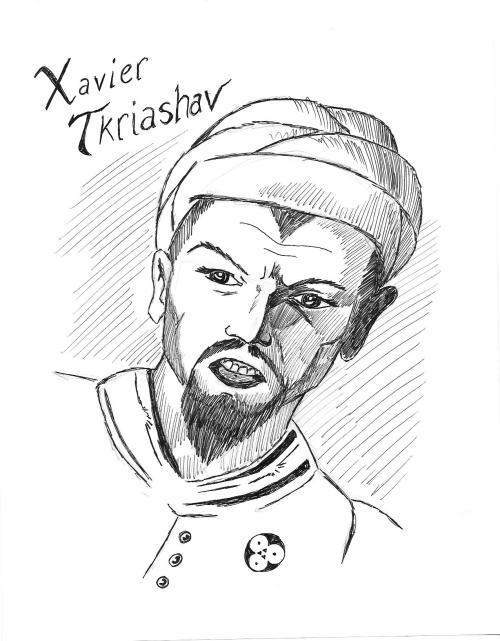
This important character was a parody of Professor X of the X-men, from the comic books and well before the movies.
It was a simple matter to give him psionic powers and transfer him into outer space. Oh, and get him out of the wheel chair too.
The character’s creator was the son of the local high school science teacher.
Ninja powers were a thing with teenage boys in the 80’s.
Combat is an important part of the role-playing game.
We became well-versed on weapons and tactics… and how to manipulate the rolls of the dice… by cheating if necessary.
How else do heroes overcome impossible odds?
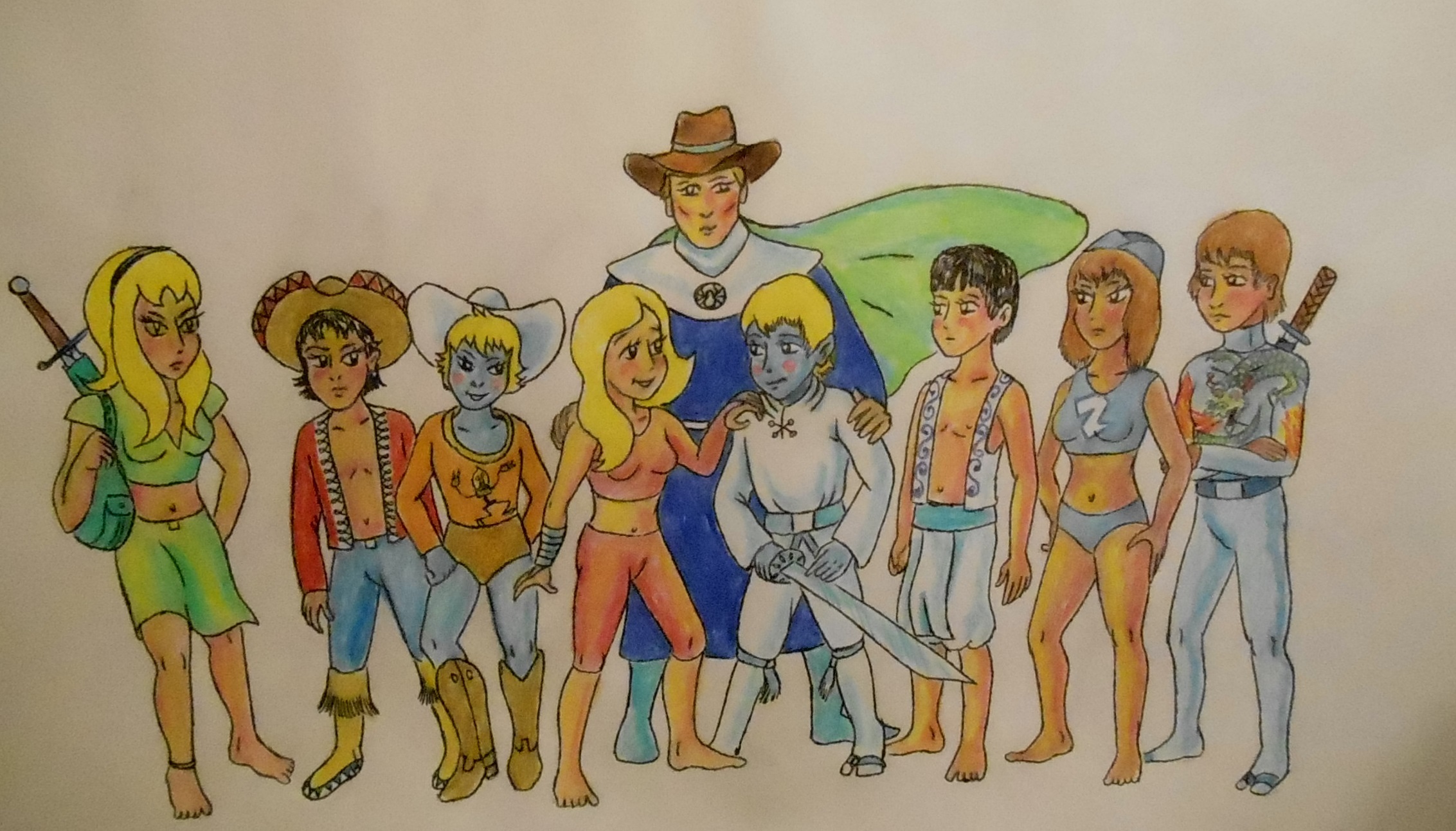
Two more player characters that play a critical role in the novels.
Again with the parody characters that came from player-character ideas stolen from TV and the movies.
Aliens are necessary to this kind of story.
I am near to completing this third novel in the series.
The Nebulon aliens, though very human-like, are blue of skin. That is not easy to depict in a black-and-white drawing.
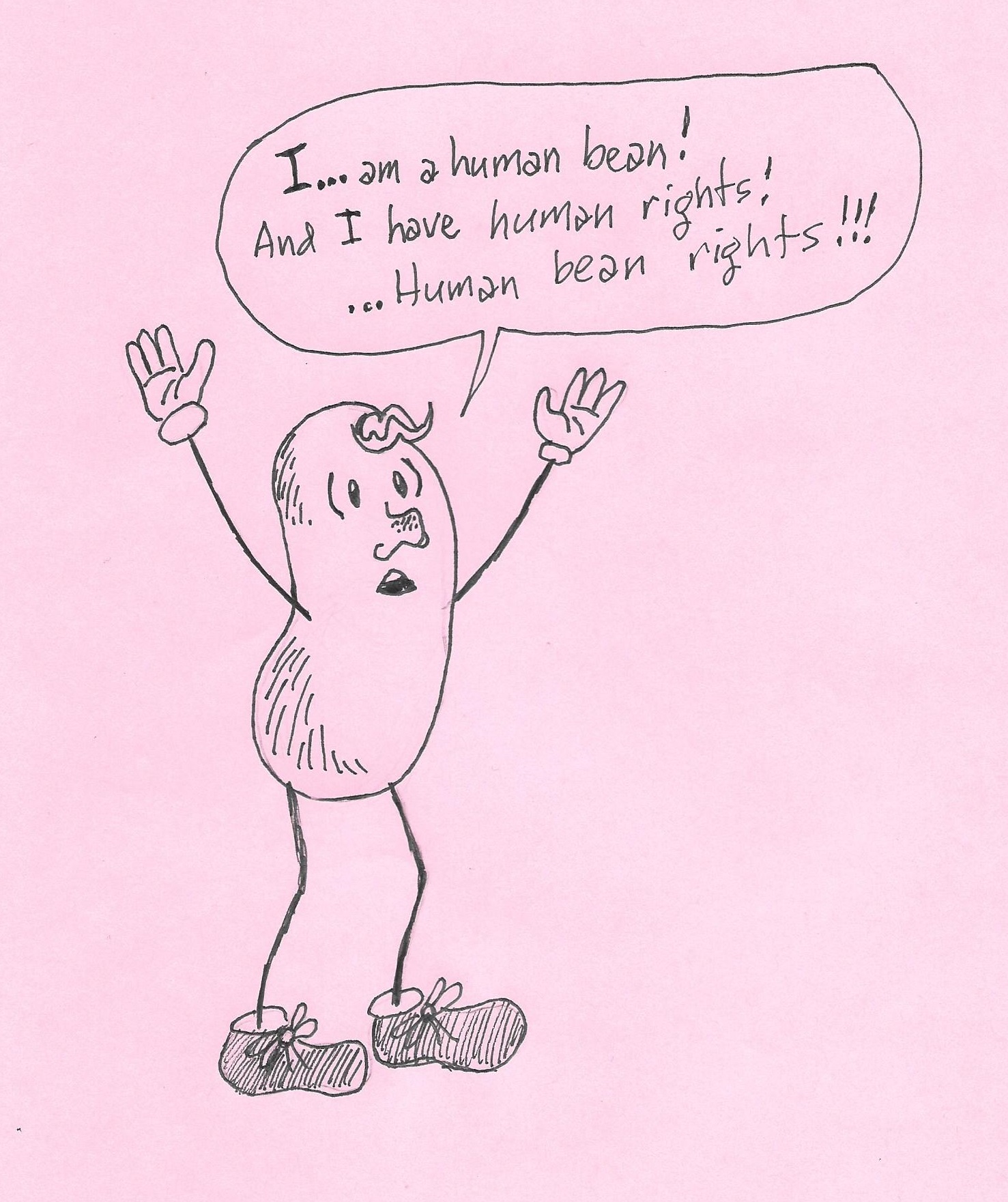
People are not really vegetables… even though I have seen IQ scores as a teacher that might say otherwise. But I often use the pun of calling them Human Beans.
Your basic human bean.
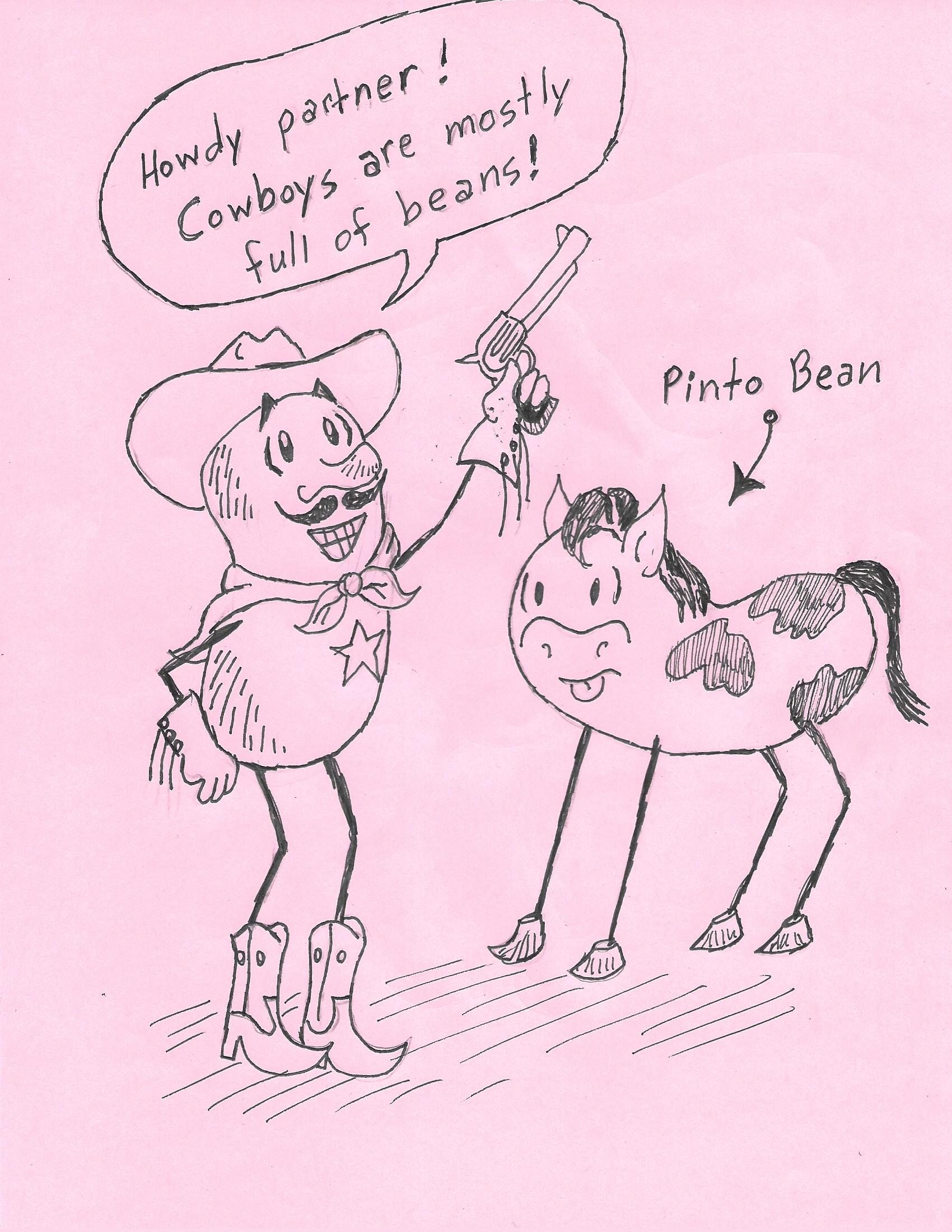
Western style beans
Of course, being a Texan means having a healthy appreciation for beans as a staple food. Cowboys used to live off of beans and beef jerky, and if Louis L’Amour is to be believed, they even made tea from mesquite beans. That makes your average cowboy made up of over 50 per cent beans. Of course the rest of him is mostly gas caused by the beans in his diet, whether it comes out as a fart or as a Texas tall tale… And yes, I admit it, I get a lot of my writing ideas from eating beans.
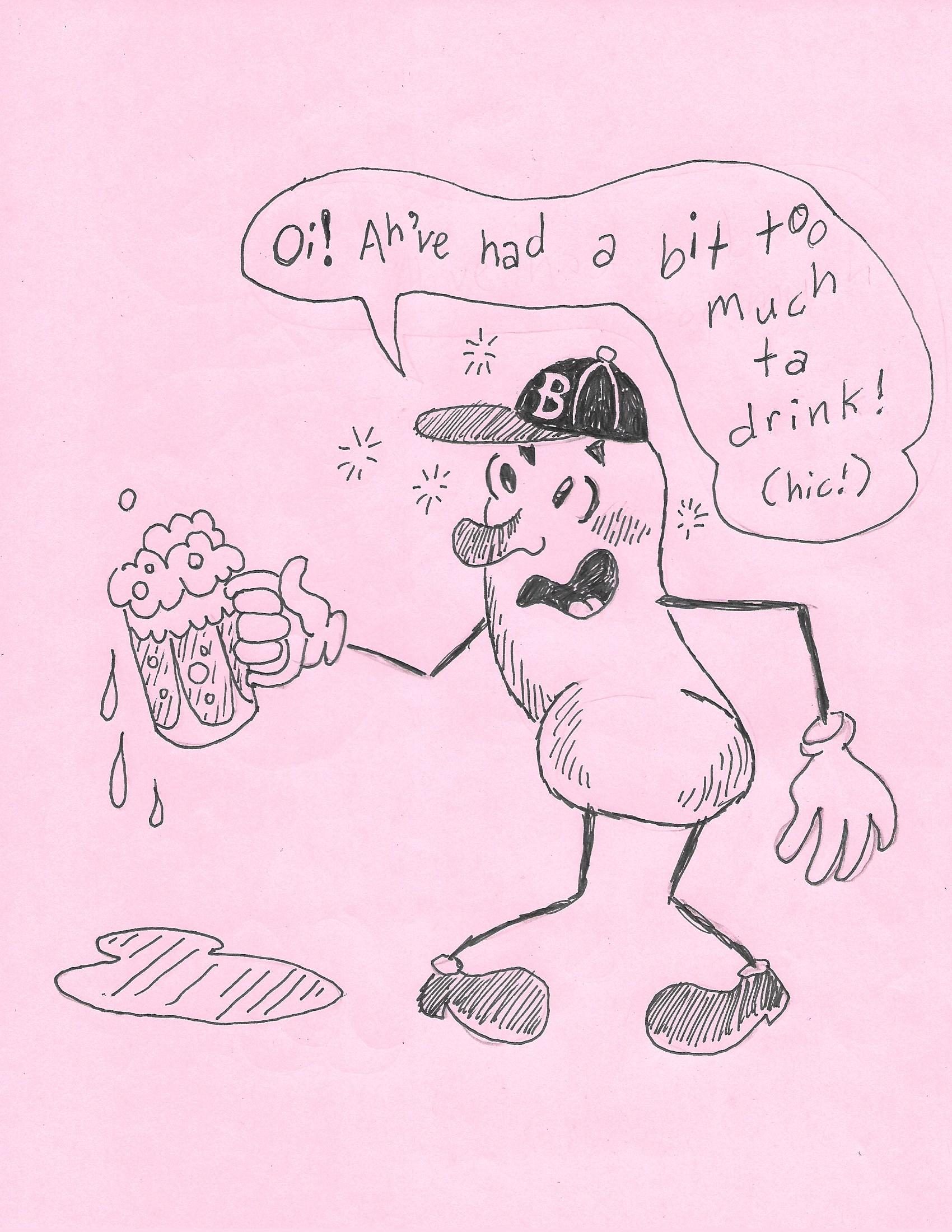
A Boston baked bean
We must also be aware that Texas has no corner on the beans market. We all know Boston baked beans by reputation. They, like the ever-hapless Cubs, had a habit of never winning the World Series. And now, in the last two decades, it has actually been difficult for the other teams to keep them from winning it all. But we shouldn’t mix up beans with baseball metaphors. Baseball is like life. Full of long and boring parts punctuated by intense moments of hitting, scoring, committing errors, and player versus player individual drama. And concession stand food! Beans, however, can taste good in chili draped over the ballpark hot dogs which cost more than a restaurant meal at most reasonable restaurants. And I promise you, you will never hit a home run over the fence by hitting it with a bean.
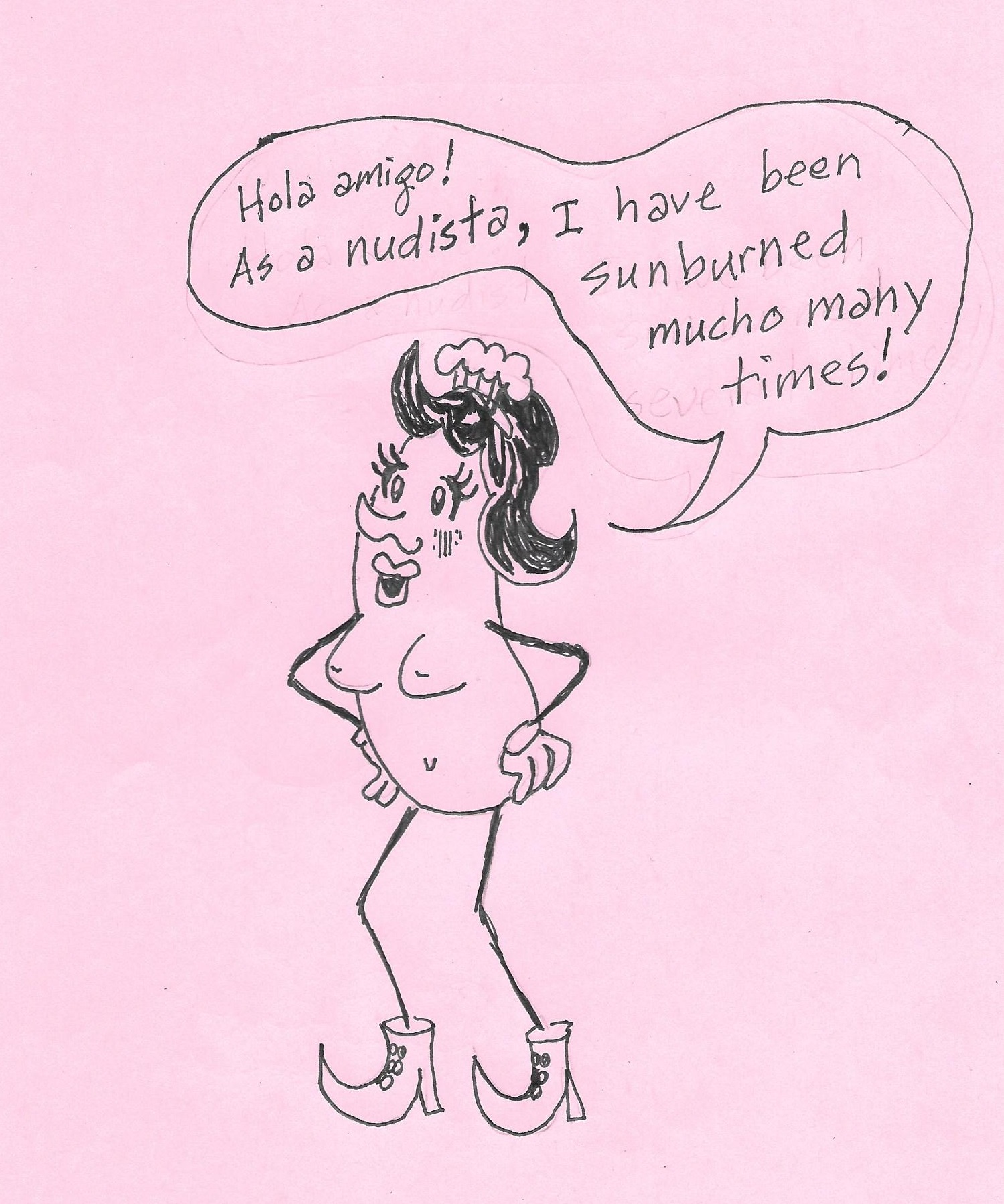
A Mexican style re-fried bean
And I wish to point out that this last human bean is not a racist cartoon. Beans are not part of the human race. They only have legs in cartoons and would come in last even when racing a snail. And all beans are created equal in the sight of God. Kidney beans, butter beans, navy beans, string beans… all beans are just beans, no matter what the color of their skin is, and no matter how they add flavor to a casserole. All beans are just in it to live life the best they can, and if that’s not enough… they can be planted as seeds to raise the next generation of human beans.
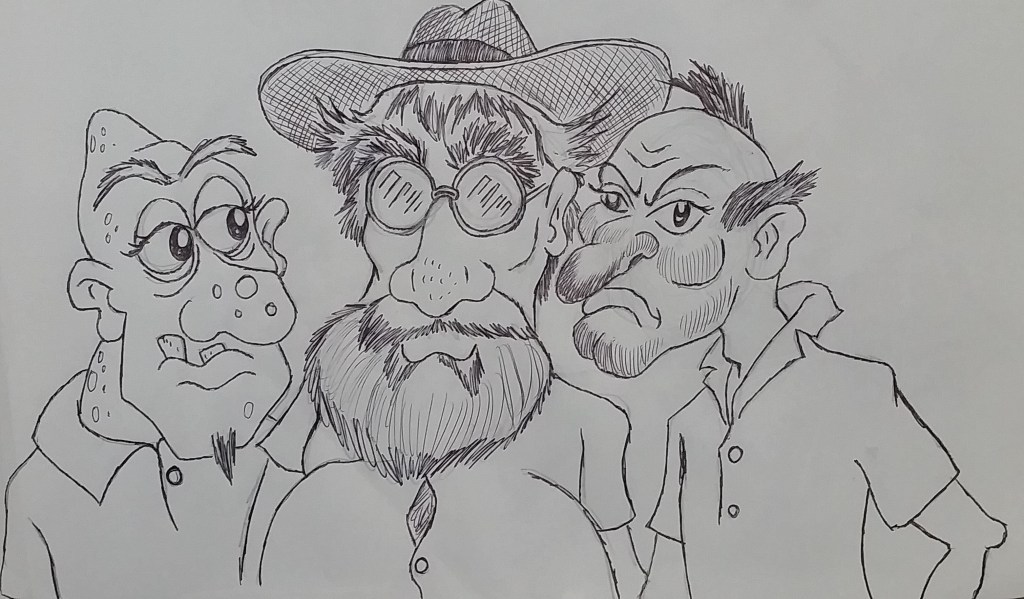
Suppose being grumpy was a super power, and we could, as a grumpy old brotherhood of geezers, coots, and conservative uncles, could change things just by complaining about them.
No woman would ever leave a toilet seat down again. The Dunkin’ Donuts on Frankford Road would magically reopen and never run out of donuts again. And liver spots and wrinkles would suddenly be attractive to beautiful young women whether they were linked to fortunes or not.
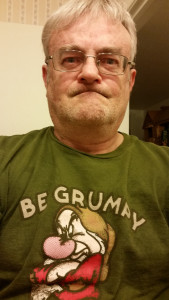
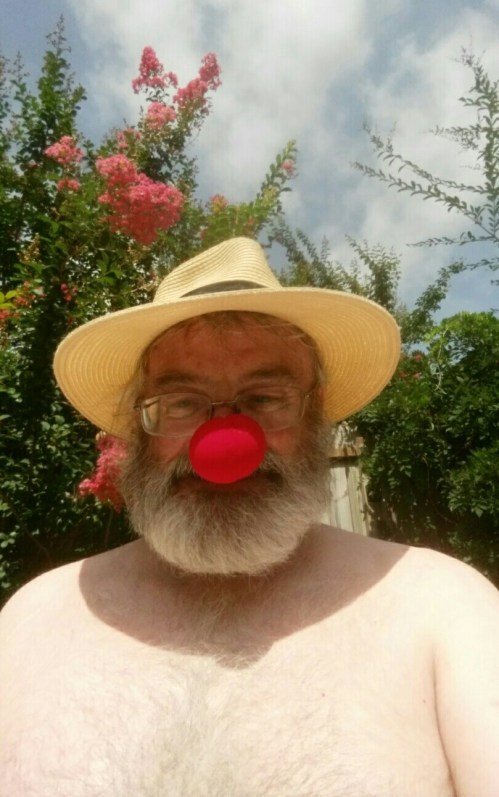
But what if, in order to make better use of this unexplainable super power, we start telling old coots like the fool in the picture that they have to prove they will use this super power only for good, or we will raise their taxes? Or we would forbid them from ever eating bacon again? Either of those things would definitely motivate them.
Of course, the biggest problem with geezers, old coots, and conservative uncles that no one wants to sit next to at Thanksgiving is that they don’t generally get smarter and nicer with age. It is probably not wise to give them a super power that can alter reality. Yes, they are generally quite literally mean-spirited and unqualifiably dumb. And it isn’t really a matter of whether they could ever actually have a super power like that. The real problem is that they already have it. They proved it in 2016 when they elected a gigantic orange-faced Pillsbury Doughboy with mental flatulence to lead our government. And it wasn’t the dumb part that did it. It was the literally mean part. Trump is a walking, talking old coot-complaint given to us by mean old men to tell us, “We are unhappy geezers, coots, and conservative uncles who would rather blow up the government than lift a single tax dollar (especially from a rich dude) to try and fix it”.
What we truly need to do is harness a bit of that grumpy-old-man complaining power, a truly misunderstood and misused super power, to tackle problems like making public schools better, cleaning the environment, and electing smarter leaders (not the stupid ones who actually represent the majority of us). But of course, we will first have to turn off the spigots in the brewery of prejudice and ignorance that is Fox News, and brand all the greedy and stupid people with a red letter “R” for Trumpian Republican. That way, knowing who to vote for to make things better will become easier to the point that even us geezers, old coots, and conservative uncles can do it right.
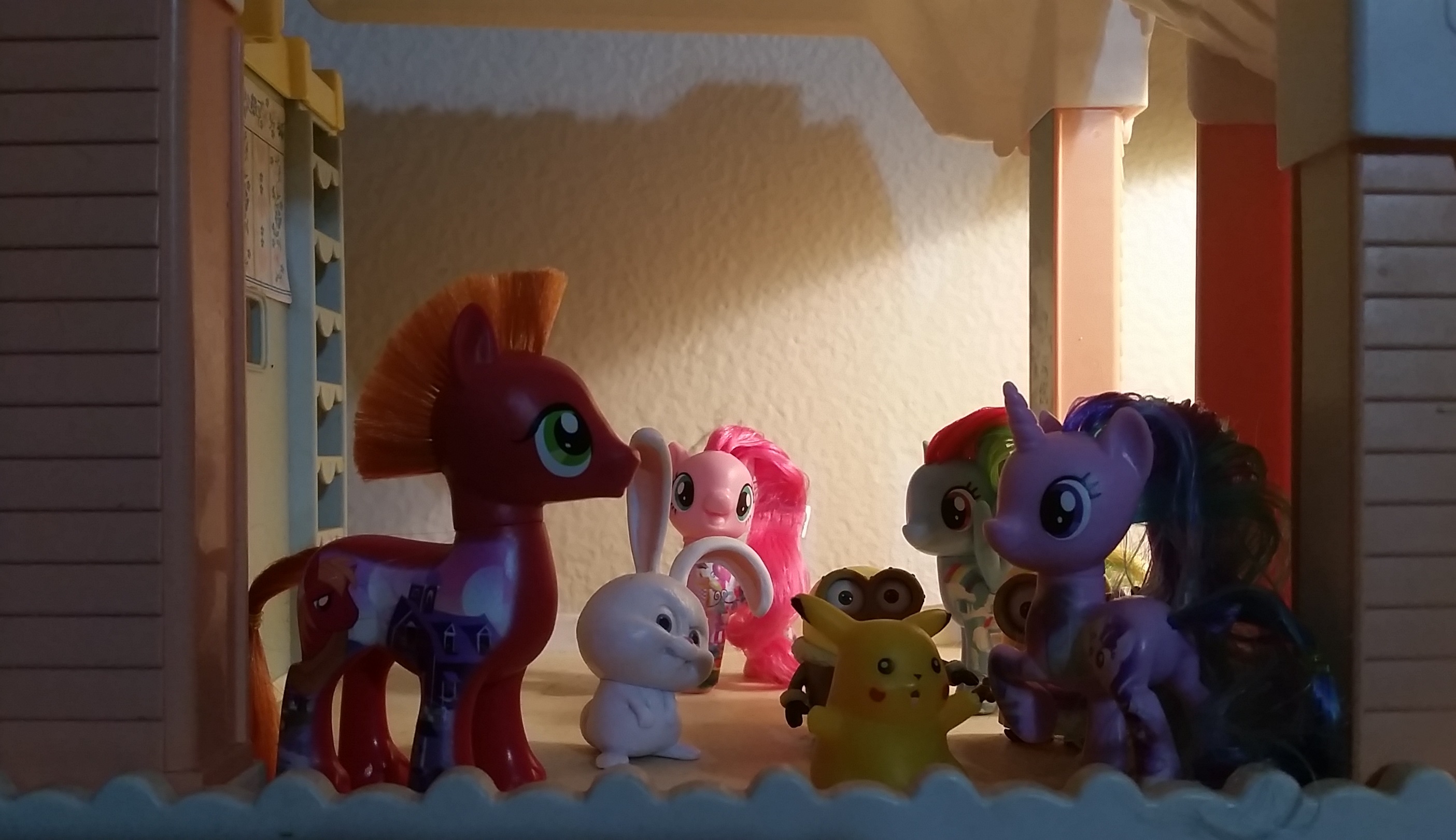
As Big MacIntosh welcomes more little ponies into my insanely large doll collection, I have been reading my published novel Snow Babies. The novel is written in third person viewpoint with a single focus character for each scene. But because the story is about a whole community surviving a blizzard with multiple story lines criss-crossing and converging only to diverge and dance away from each other again, the focus character varies from scene to scene.
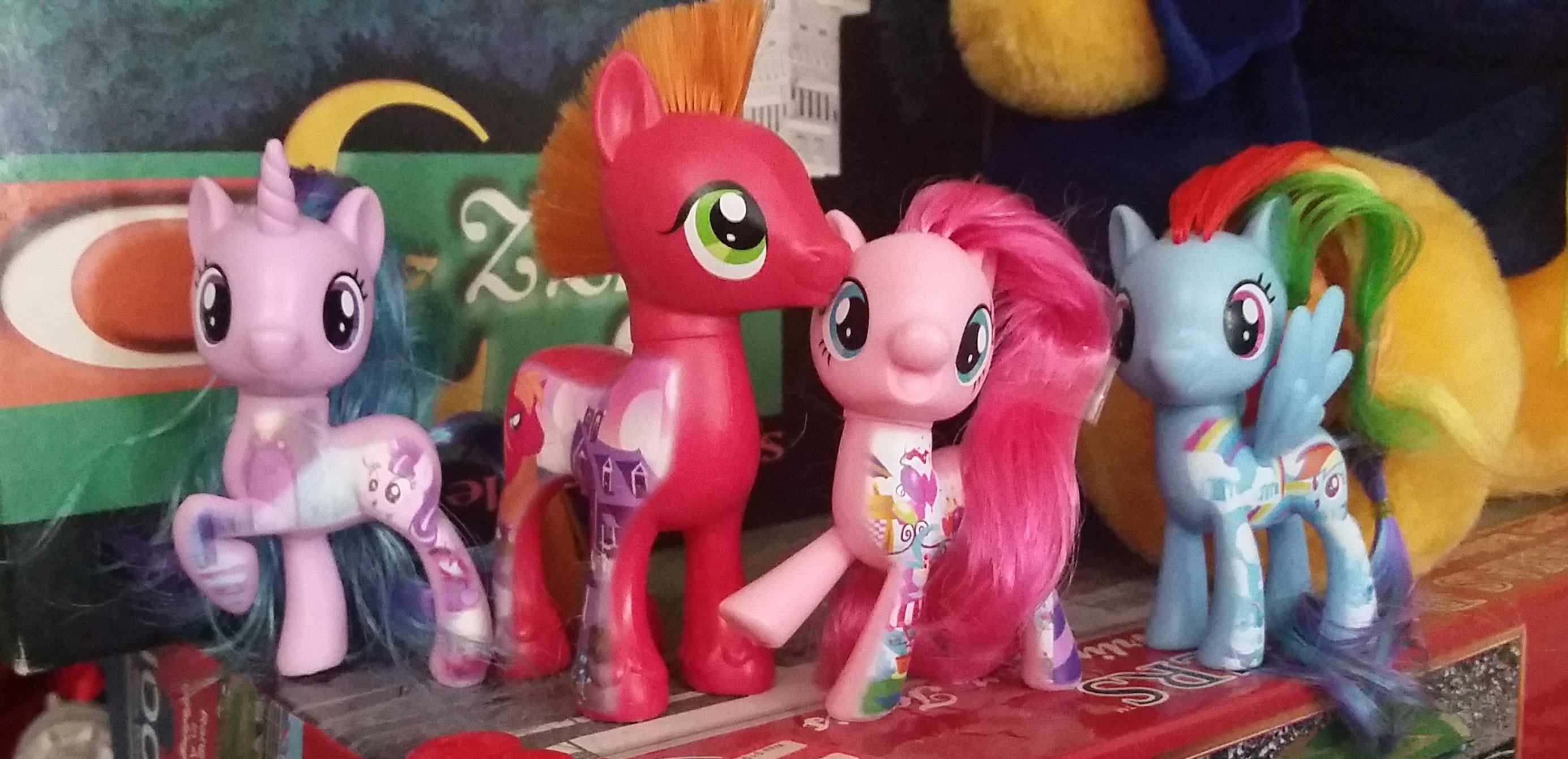
Big MacIntosh finds himself to be the leader of a new group of My Little Ponies.
In Canto Two, Valerie Clarke, the central main character of the story, is the focus character. Any and all thoughts suggested by the narrative occur only in Valerie’s pretty little head. Canto Three is focused through the mind of Trailways bus driver Ed Grosland. Canto Four focuses on Sheriff’s Deputy Cliff Baily. And so, on it goes through a multitude of different heads, some heroic, some wise, some idiotic, and some mildly insane. Because it is a comedy about orphans freezing to death, some of the focus characters are even thinking at the reader through frozen brains.
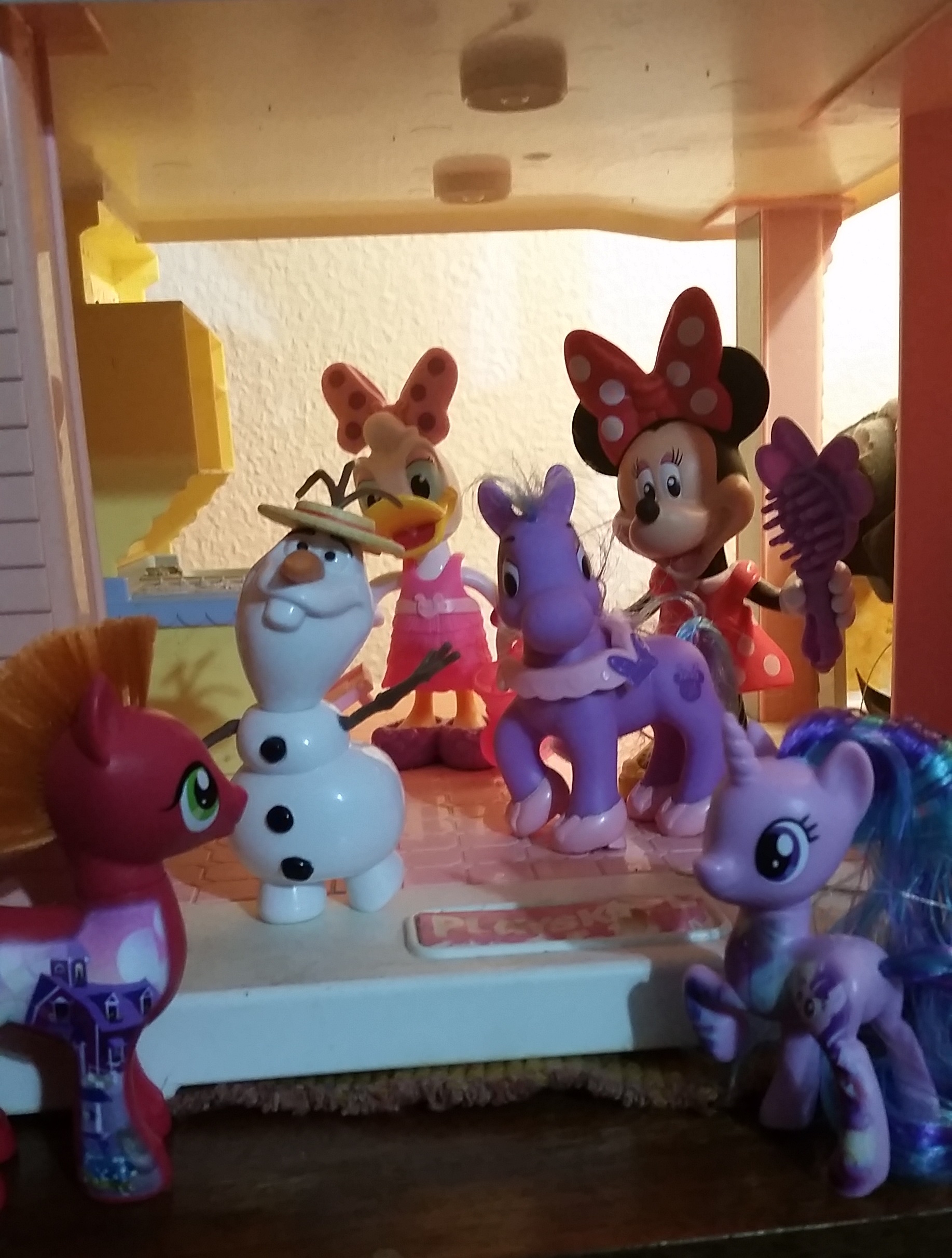
The ponies decide to visit Minnie Mouse’s recycled Barbie Dreamhouse where Olaf the Snowman is the acting butler.
That kind of fractured character focus threatens to turn me schizophrenic. I enjoy thinking like varied characters and changing it up, but the more I write, the more the characters become like me, and the more I become them. How exactly do you manage a humorous narrative voice when you are constantly becoming someone else and morphing the way you talk to fit different people? Especially when some of your characters are stupid people with limited vocabularies and limited understanding?
The ponies are invited to live upstairs with the evil rabbit, Pokemon, and Minions.
I did an entire novel, Superchicken, in third person viewpoint with one focus character, Edward-Andrew Campbell, the Superchicken himself. That is considerably less schizophrenic than the other book. But it is still telling a story in my voice with my penchant for big words, metaphors, and exaggerations.
The novel I am working on in rough draft manuscript form right now, The Baby Werewolf, is done entirely in first person point of view. That is even more of an exercise of losing yourself inside the head of a character who is not you. One of the first person narrators is a girl, and one is a werewolf. So, I have really had to stretch my writing ability to make myself into someone else multiple times.
I assure you, I am working hard to find a proper voice with which to share my personal wit and wisdom with the world. But if the men in white coats come to lock me away in a loony bin somewhere, it won’t be because I am playing a lot with My Little Ponies.
My best novel is free to own in ebook form for today and tomorrow. Buy it now with the link above. The offer is good until the end of the day on 12/14/2021.
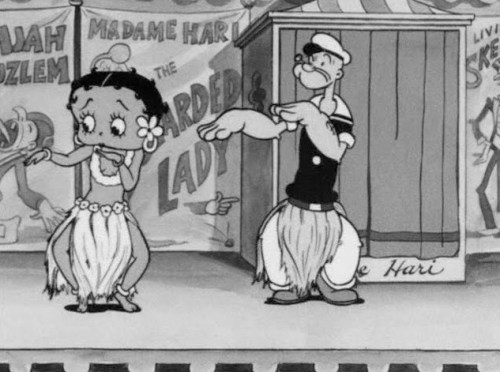
If you are as goofy and cartoon-obsessed as me, you may remember that Popeye the sailor was known for the catchphrase, “I yam what I yam”. And if you do remember that, it will not surprise you that, when told a yam is another name for sweet potato, Popeye was furious. “It cannot be!” he argued. “I would not say I sweet potato what I sweet potato! That’s ridicumess!”
Well he has a point.
But I would like to talk today about the things that I sweet potato, and why I sweet potato those things.
First of all, I yam a humorist.
I yam this thing not because I am funny. You may think I yam funny because I say really goofy things for no apparent reason, and then keep on talking long enough to convince you that I did have a point to make, but my brain leans so far to the left that I am hardly right about anything.
And I make bad puns a lot.
You see, I have to use humor constantly to deal with all the hard things in life, because being too serious in the face of the world’s basic uncaring cruelty only leads to depression and taking a beating from life. In fact, I can think of any number of situations in my past where I avoided a beating only because I made a joke that made the bully laugh.
So, being a humorist is a survival tactic. Humor keeps you alive.
You see someone like me has to face all the pain and heartache and cruelty the world has to offer by using humor. The real reason is that, when faced with a bad situation, if the humor gland can’t empty itself of all the jokes it produces, it will begin to swell. The humor gland is located either in the brain or maybe in the behind (I am not medically qualified to tell you which it really is), and it can only swell to a certain point, and then it will explode. This is very bad thing for you, if you survive it, and certainly unpleasant for anybody nearby.
But the joke, properly launched at the target, will make somebody laugh, even if it is only the humorist himself. And laughter is the best medicine. Unless it kills you. You have to be careful not to die laughing. The angels will be offended, and the demons will all laugh too.
But I yam not only a humorist. I yam also a teacher.
I began to realize that I might be a teacher when, in graduate school to get a remedial master’s degree to help with the fact that plain English majors all starve to death, I discovered I had a talent for explaining things in simple terms. And then, immediately afterwards, I discovered I had an even greater talent for being ignored while the people I was explaining to made the mistakes they wouldn’t have made if only they had listened to me, before they failed spectacularly, and then realized how the solution I had explained would’ve made them succeed instead. There is apparently no better way to learn an important lesson.
Teaching is, of course, a pretty cool job. You tend to have the summers off. And you get paid for summer because they split the amount of money you earn for the year (which considering what a babysitter makes on average per child and per hour is far too little for the hours you put in) into twelve monthly pittances.
Of course you are expected to have a university degree (although no teacher college in the world can teach you what you really need to know in order to face that many little monsters… err, darlings… every day) and preferably some grad school, and a certification to teach in your chosen subject, and an additional certification if you are going to teach more than one subject (and ESL and Speech and Journalism, all of which I was expected to teach, are separate certifications) and you have to take hours of additional training every single year, and you have to get re-certified every five years, and… Well, you have to be basically smarter and much better-educated than Bill Gates… But the school janitor will probably be making more money per month than you do.
Anyway, it’s a job you just gotta love. I yam a teacher.
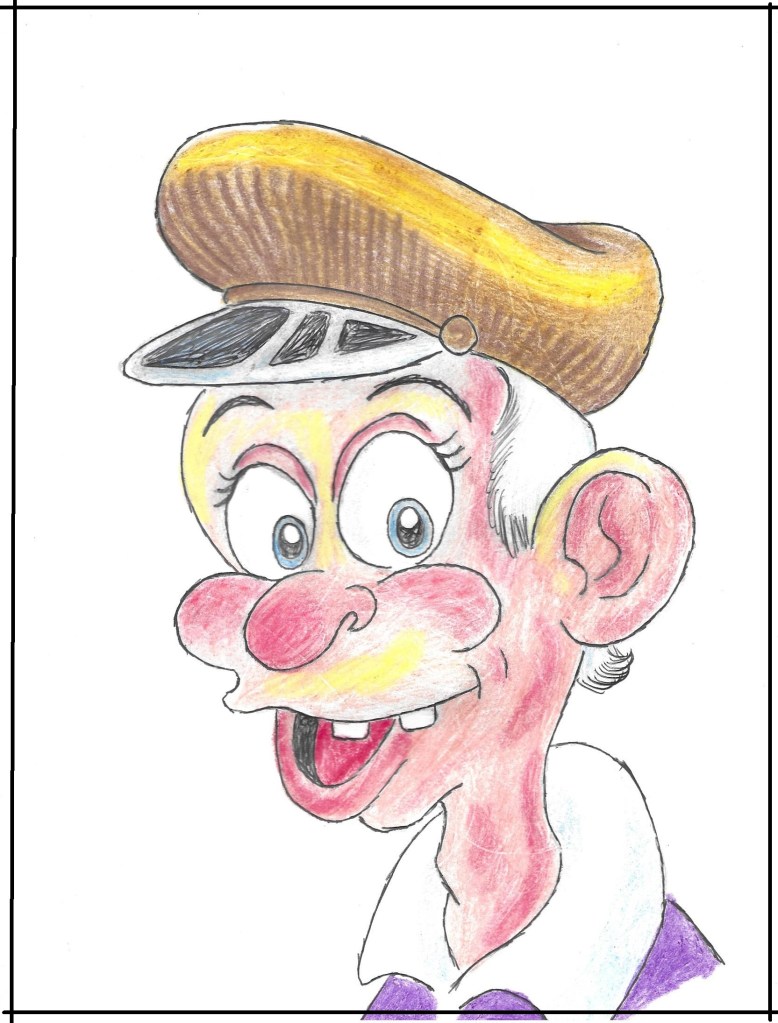
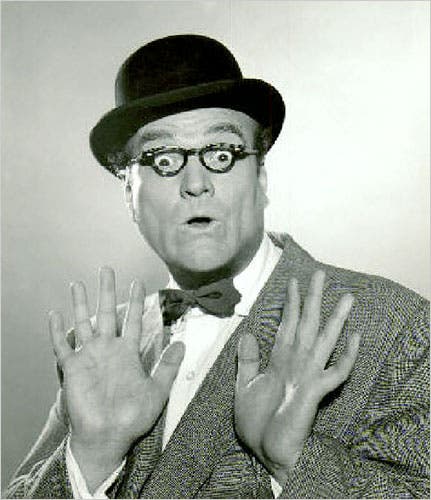
And really, there are a whole lotta yams in my basket yet that I could tell you about. I yam a Red Skelton fan. I yam sometimes a nudist (when I don’t have to put on clothes to keep myself from scratching all my psoriasis-plagued skin off). I yam also an artist (of the type known as a cartoonist). I yam pig-headed sometimes, and I yam Grumpy sometimes (so I go from being Porky to one of the Seven Dwarfs.) I yam a lotta things. And my sweet-potato basket is large.
But I can’t talk about all of my yams today. Too many yams are bad for my diabetes.
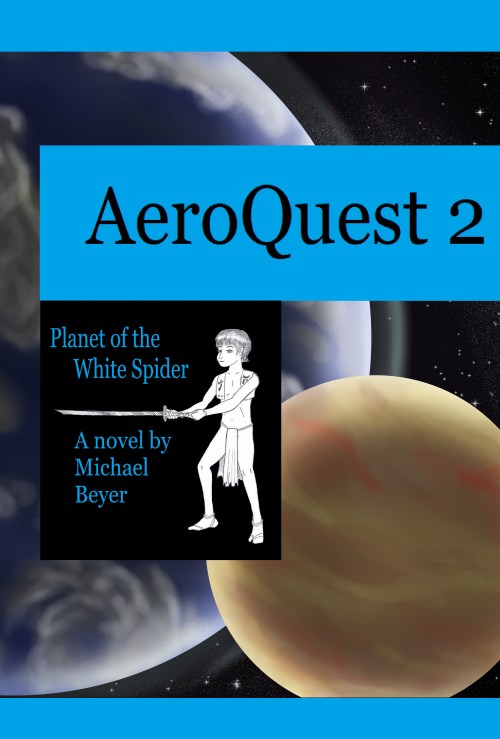
But here’s one last yam. I yam a storyteller. The book is the first in my series of AeroQuest books. It is a science fiction story with a humorous bent. And I mean, it is seriously bent in some places.
So, click on the link and get yourself a copy. It’s funny. And I will save the other sweet potatoes for another day.
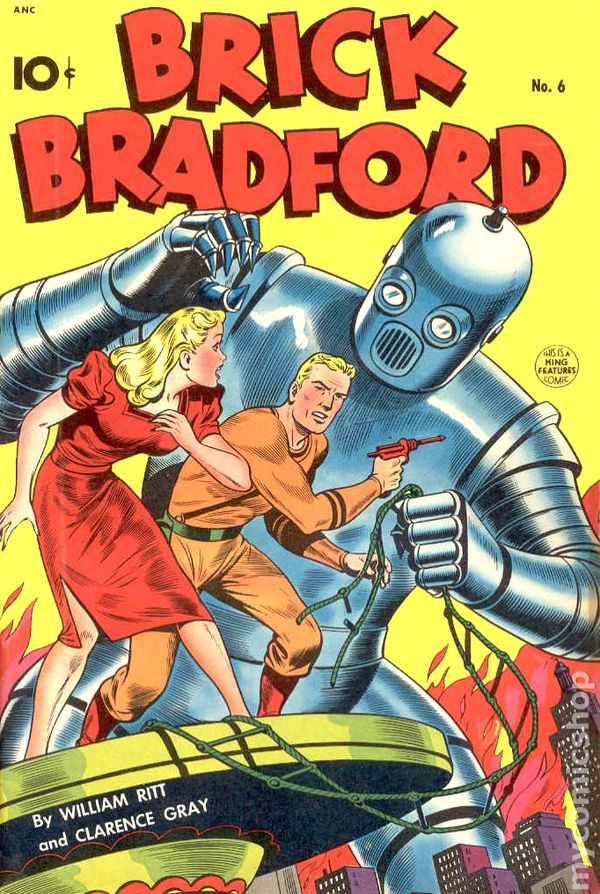
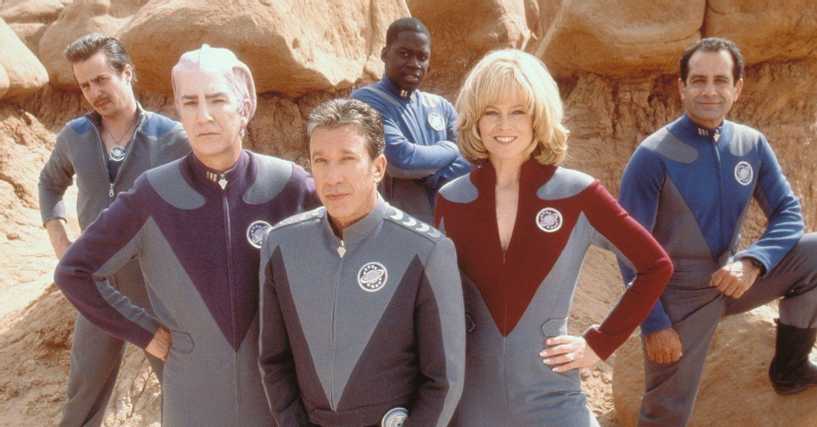
I have always cherished science fiction. Not just Jules Verne, Isaac Asimov, and Arthur C. Clarke. Not just Star Trek and Star Wars. But all of it. Buck Rodgers, Flash Gordon, Brick Bradford, Galaxy Quest, Mars Attacks, and E.T.
Space is important to me. I feel like all of mankind will be a failure as a species if they don’t start moving out amongst the stars.
It’s not just that I am ensorcelled by the magical adventures that space-travel stories mixed with a romantic view of facing existential danger with a smile and a ray-gun can provide.
I watched with wide 12-year-old eyes when Neil Armstrong stepped onto the surface of the moon for the very first time.
That was all the way back in 1969!
I am disappointed that my George-Jetson expectations of life in 2023 have not even remotely been met.
Sure, computers are great. But where are the flying cars? The fishbowl helmets for walking on the Moon? Personal jetpacks to get to school and back?
It isn’t the dreamers, it’s the doers that have let me down.
And I know we could well run the risk of meeting something out there that might want to eat us.
But are we truly alive anymore if we are afraid to risk death in the face of Space Exploration and Discovery? We are not immortal. We need to achieve things that outlast us to justify our existence.
So, come on, people! Let’s make the world over again and start building cities on Mars.
Let’s start building what we have dreamt of rather than hiding from what we fear!
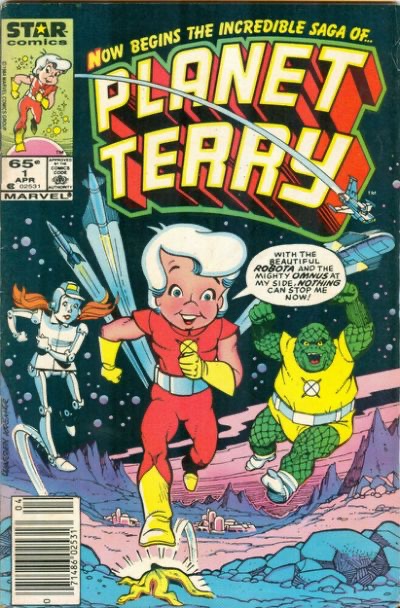
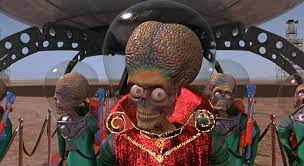
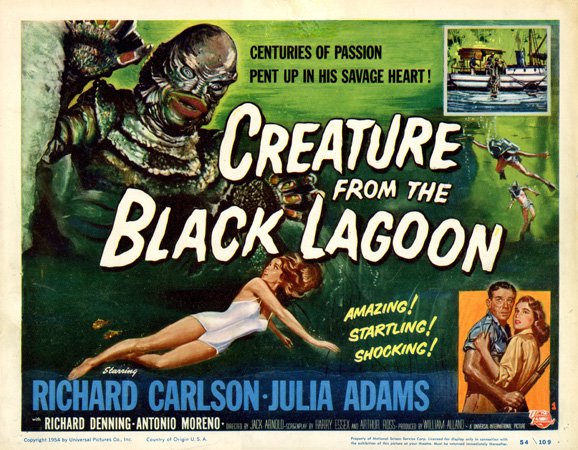
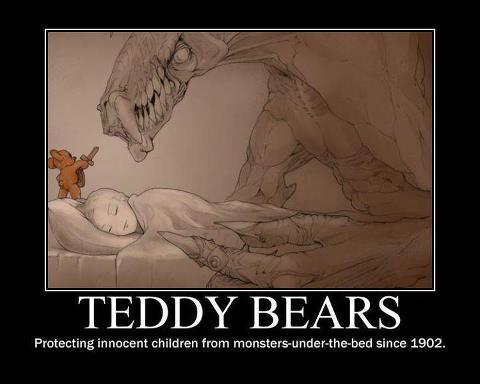
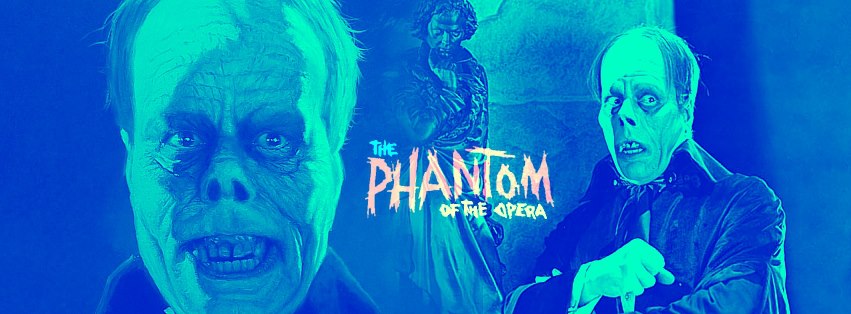
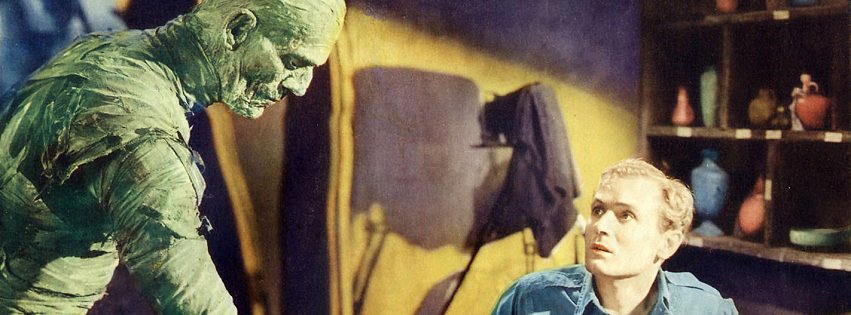
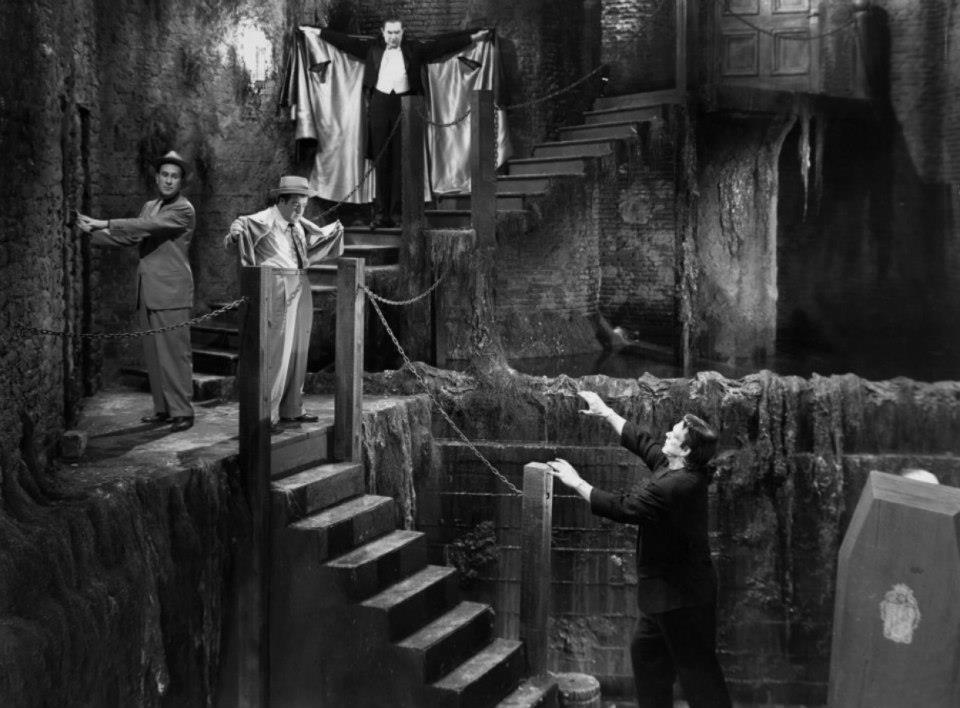
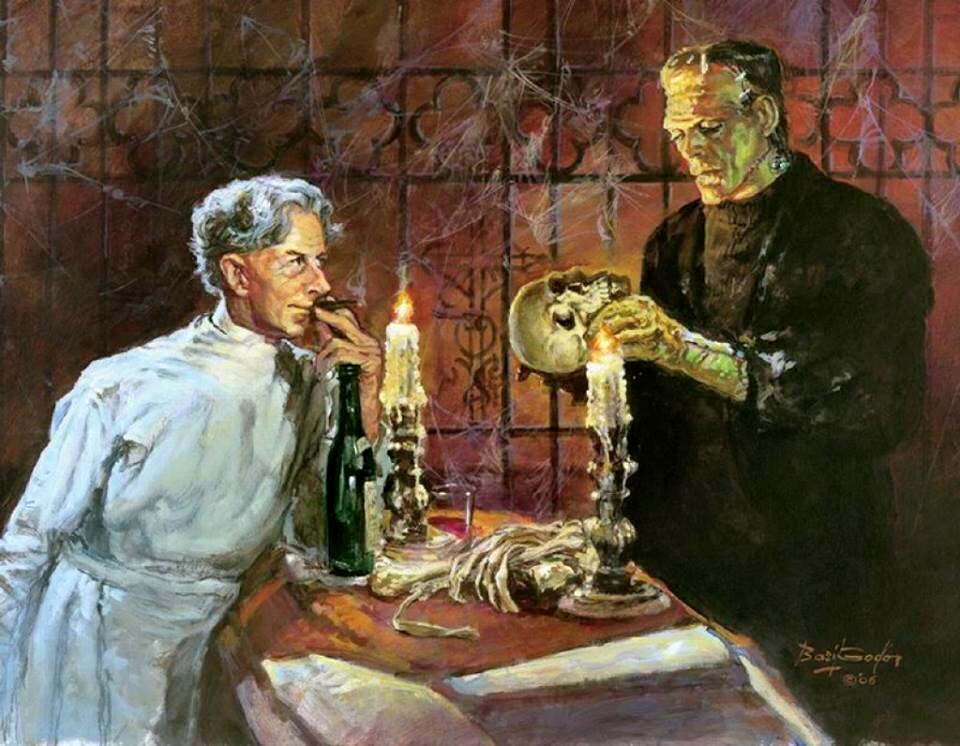
Here are images from the Monster Movie collection I keep as an obsessive-compulsive hoarding disorder style of thing. I thought I would present them as a collage since I am lazy today and want to save words for my novel project.
The scary thing is that people like me obsess about such nonsense, and collect so many silly, fantastic pictures of stuff and nonsense.
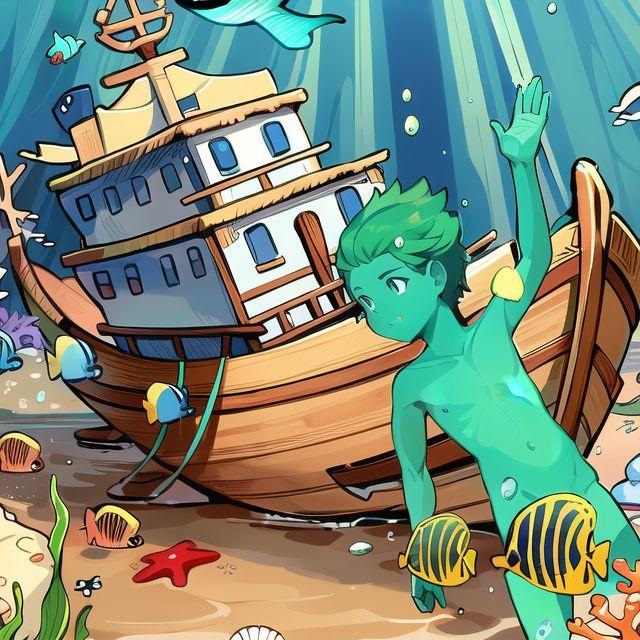
I survived my prostate surgery last week. Today I got a reprieve from the tyranny of wearing a catheter. Life remains, and I have more time to look at the fishes.
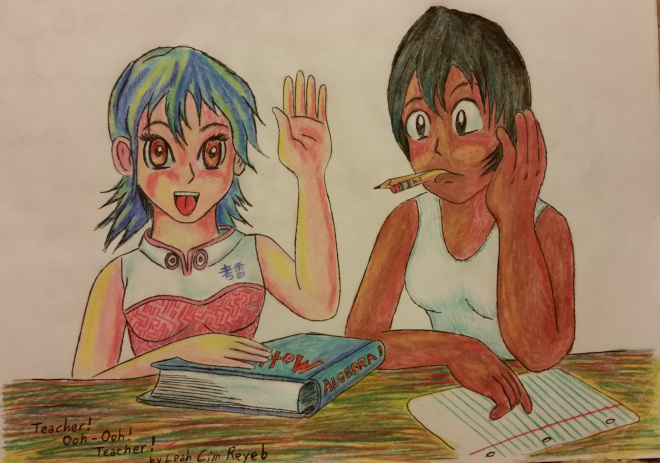
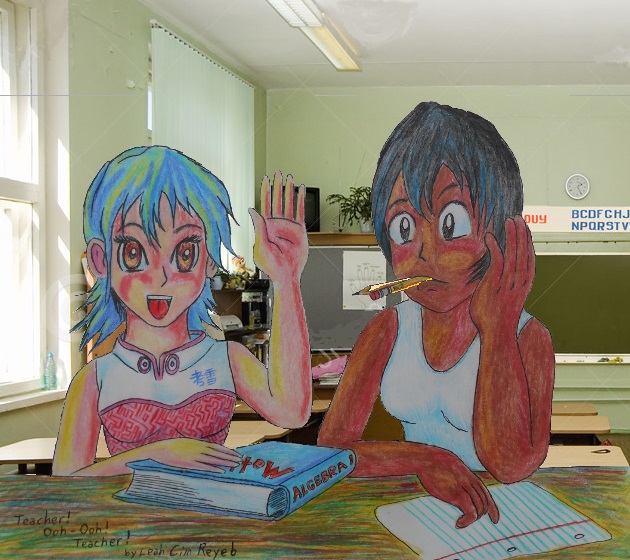
Back in the 1980’s I was given the gift of teaching the Chapter I program students in English. This was done because Mrs. Soulwhipple was not only a veteran English teacher, but also the superintendent’s wife. She was the one gifted with all the star kids, the A & B students, the ones that would be identified as the proper kids to put into our nascent Gifted and Talented Program. That meant that I would get all the kids that were C, D, & F in most of their classes, the losers, the Special Edwards, the learning disabled, the hyper rocketeers of classroom comedy, and the trouble makers. And I was given this gift because, not only was I not a principal’s or superintendent’s wife, but I actually learned how to do it and became good at it. How did I do that, you might ask? I cheated. I snooped into the Gifted and Talented teacher training, learned how to differentiate instruction for the super-nerd brain, and then used the stolen information to write curriculum and design activities for all my little deadheads (and they didn’t even know who the Grateful Dead were, so that’s obviously not what I meant). I treated the little buggers like they were all GT students. Voila! If you tell a kid they are talented, smart, and worthy of accelerated instruction… the little fools believe it, and that is what they become.
Even the goofy teacher is capable of believing the opposite of what is obvious and starts treating them like super-nerds because he actually believes it. I soon had kids that couldn’t read, but were proud of their abstract problem-solving skills. I had kids that could enhance the learning of others with their drawing skills, their singing ability, and their sense of what is right and what is wrong. I had them doing things that made them not only better students for me, but in all their classes. And I did not keep the methods to my madness a secret, either. I got so good at coercing other teachers to try new ideas and methods that I got roped into presenting some of the in-service training that all Texas teachers are required by law to do. And unlike so many other boring sessions we all sat through, I presented things I was doing in the actual classroom that other teachers could also use with success. The other teachers tried my activities and sometimes made them work better than I did.
Yes, I know this all sounds like bragging. And I guess it probably is. But it worked. My kids kept getting better on the standardized tests and the State tests that Texas education loves so much. And Mrs. Soulwhipple was still the superintendent’s wife, but she did not stay a teacher forever. She eventually went to a new school district with her husband. And guess who they started thinking of when the question of who would be the next teacher for the nerd classes was considered. That’s right, little ol’ Reluctant Rabbit… that goofy man who drew pictures on the board and made kids read like a reading-fiend… me.
So, a new era began in Cotulla. In addition to still getting to teach all the deadheads (because they weren’t going to trust those precious children to anyone else, naturally), I began teaching at least one edition of Mr. B’s famous Nerd Class every school year. We actually assigned long novels and great pieces of literature for the kids to read and discuss and study in depth. Novels like To Kill a Mockingbird by Harper Lee and Across Five Aprils by Irene Hunt were read. We began talking about “big ideas”, “connections to the wider world”, and how “things always change”. We began taking on ideas like making our world better and how to help our community. Kids began to think they were learning things that were important. We did special units on Exploring Our Solar System, The World of Mark Twain, Finding the Titanic, and The Tragedy of Native American History. And we spent as much as a third of the year on each. I am myself cursed with a high IQ and a very disturbing amount of intelligence. I am the deepest living stockpile of useless facts and trivia that most of my students would ever meet in their lifetimes. And even I was challenged by some of the learning we took on. That’s the kind of thing that makes a teaching career fun. It kept me teaching and meeting new students and new challenges long after my health issues made it a little less than sensible to keep going. And if I manage to tell you a few Nerd Class stories in the near future, then at least you stand a chance of knowing a little bit about what-the-heck I am talking about. So be prepared for the worst. I am retired now, and have plenty of time for long-winded stories about being a teacher.













Why We Doo
I remember when Scooby Doo, Where Are You? premiered on Saturday Morning Cartoons in 1969. I was thirteen and in the 7th grade. I had been six during the Cuban Missile Crisis of 1962, seven when Kennedy was assassinated in 1963, ten when I was sexually assaulted in 1966, and still twelve when Neil Armstrong walked on the Moon in the Summer of 1969. I was obsessed with monsters, horror comics, 20,000 Leagues Under the Sea, and the Pirates threatening Jim Hawkins in Treasure Island. I knew what fear was. And I was mad to find ways to combat the monsters I feared.
Don’t get me wrong. I was under no illusions that Fred, Daphne, Velma, Norville “Shaggy” Rogers and Scooby Doo were the answer to all my fears as viable heroes and heroines. They were goofballs, all of them, based on the characters I vaguely remembered from The Many Loves of Dobie Gillis. I was aware that Shaggy was just Maynard Krebs in cartoon form (the hippie character portrayed by Gilligan’s Island actor Bob Denver.)
One of the critical things about the show for me was the fact that there was a rational explanation for the monsters. They were men in masks, special effects and projector tricks, or remote-controlled mechanical things.
And the way you overcame them and saved the day was by having Shaggy and Scooby act as bait, cause the traps to get sprung at the wrong time, and then fall on the villains, trapping them under the butt of the talking dog.
Villains and horror could be overcome by laughing at them. They were more likely to be clowns than carnivores. And even if they were carnivores, the teeth were not real.
There was a universal truth in that. Danger and horror and fear were easier to handle when you could laugh in spite of those things.
And to top it all off, those meddling kids and their stupid talking dog were with me my whole life. Those cartoons got remade and spun off so many times that my kids learned to love them as much as I did. And those four meddling kids and that talking dog are still making new stories even now.
And that is why we do the Doo!
Leave a comment
Filed under autobiography, cartoon review, cartoons, commentary, humor, monsters, Uncategorized
Tagged as books, hanna-barbera, horror, movies, Netflix, review, reviews, Scooby Doo, writing