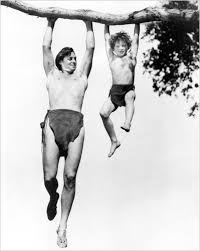
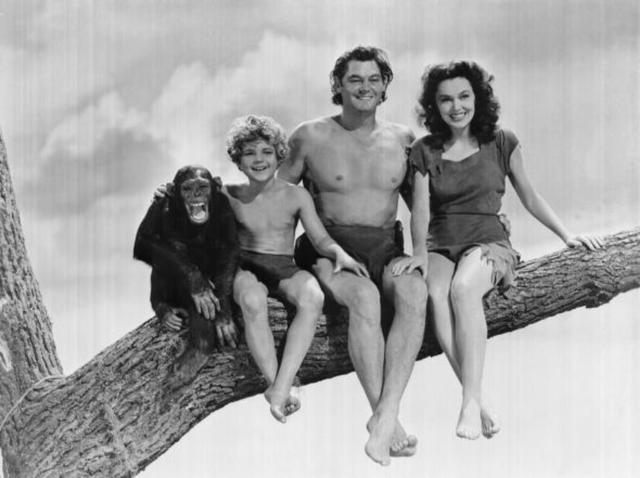
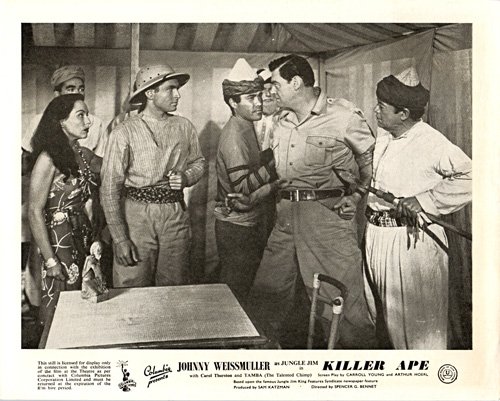
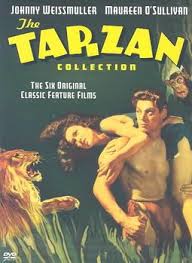
There was a time when Tarzan was one of the ruling heroes of my boyhood fantasies of power and self-fulfillment. And, while Tarzan was a cartoon show on Saturday morning, comics by Burne Hogarth, movies in the theater in color with Mike Henry, or a weekly series on TV with Ron Ely, he was always Johnny Weissmuller to me. Weissmuller who played both Tarzan and Jungle Jim in the Saturday afternoon black-and-white movies.
I have to admit, I didn’t identify with the character of Tarzan as much as I thought of myself like the character “Boy”, played by Johnny Sheffield in movies like “Tarzan Finds a Son”. It was a significant part of my boyhood to imagine myself being like Boy, free from practically all restraints, able to gad about the dangerous jungle nearly naked with monkey pals and no fear. If I got into trouble by believing my skills were greater than they really were, I would save myself with ingenuity, and, barring that, Tarzan would rescue me. And, believe it or not, sometimes there were fixes that Tarzan got into that he needed me and Cheetah to be creative and get him out of. I knew in my heart that one day real life would be like that, especially once I grew into Tarzan and stopped being just Boy. That idea was in my head so loudly that several times I went to Bingham Park Woods, stripped down, and played Boy in the Jungle.
As in the previous essay about Heroes of Yesteryear, I learned important things from Johnny Weissmuller on Saturday TV. He taught me that all you really needed, even in the darkest jungles of Africa, was confidence and courage. You could stand up to any deadly danger without the protection of any armor, practically naked, in fact, if only you had that heroic goodness of heart. The little boy I was then still believes that whole-heartedly even in the aging body of an old man.
So, Tarzan continues to live in my memory, a part of me, an essential part of my education. He is me and I am he. But only in my mind. Me in a loincloth, swinging on a vine now… and probably going splat like an overripe melon on the jungle floor… well, that is too ridiculous to even imagine being real anymore. Yet he lives on in me. And he battles the metaphorical leopard-people of modern life through me. Unarmored. Confident. And unafraid.
I have lately been watching YouTube videos about science fiction writers like Jules Verne, Isaac Asimov, and Arthur C. Clarke. These are visionary writers who predicted many things about future applications of science and technology.
Verne foresaw nuclear submarines, expeditions into the interior of the planet, and men setting foot on the moon. Asimov predicted much of what we must deal with in terms of robots and thinking machines with artificial intelligence. And Clarke envisioned satellites and how they could be used for communications and other things we are currently doing in a massive way. He wrote the story that the movie 2001 a Space Odyssey is based on.
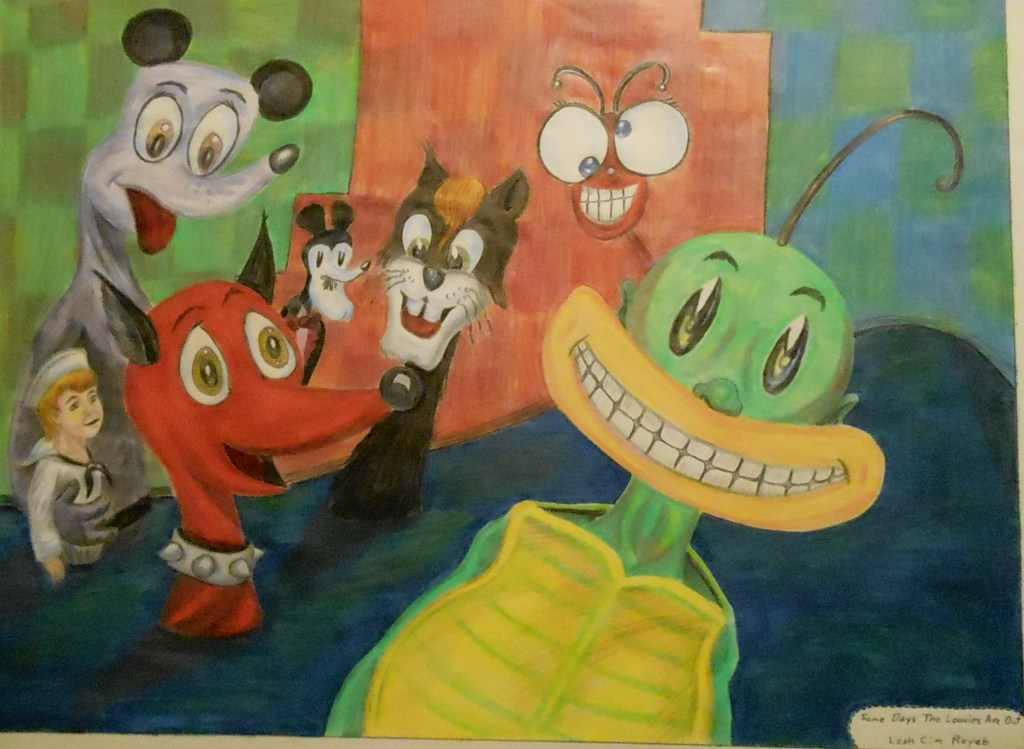
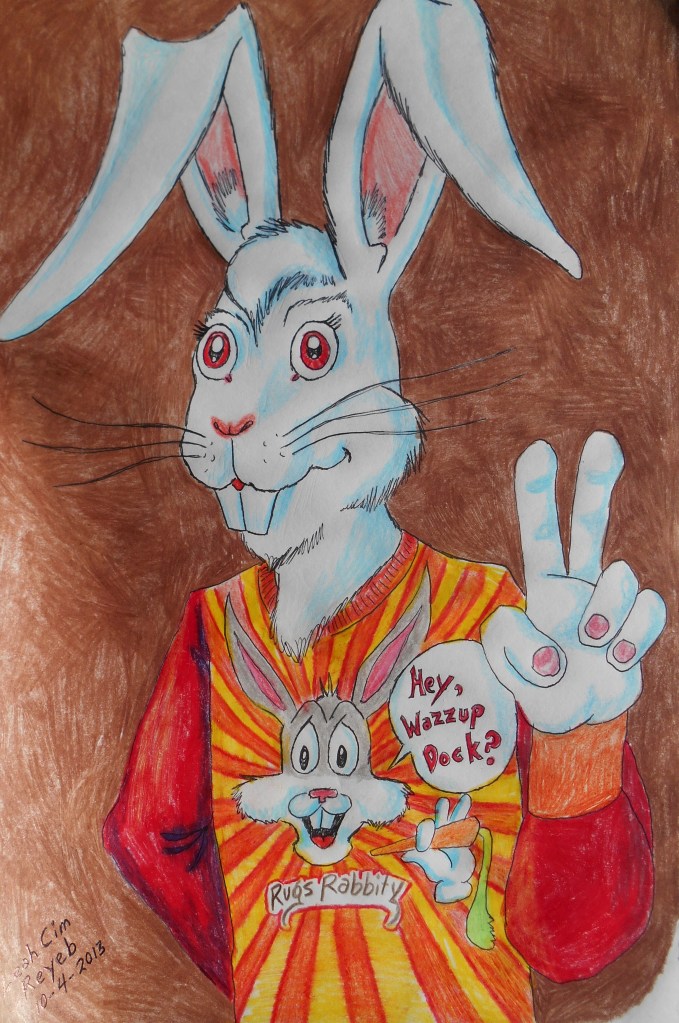
So, now Mickey has to get in on the prediction bandwagon too. After all, he thinks he is a science fiction writer too, foreseeing things like rabbit people, de-evolution machines, and time-travel gloves.
The disturbing thing is, however, that much of what Mickey sees in the near future is rather bleak. We have a sinister tendency to live our current lives in very stupid ways. Rich industrialists like the Koch brothers, Bill Gates, and Jeff Bezos put profits in the short term over the safety, welfare, and lives of people, even the people who made them wealthy. Because you can make money faster by not worrying about how you may be changing and polluting the environment, you are turning the planet into a hothouse of unbreathable gasses and toxic chemicals.
Since we are entering a time with rising oceans, we are going to have to work at not only de-acidifying the ocean water and restoring fish and other aquatic life, but becoming sea-dwellers ourselves. We will be living in underwater cities. We will travel in underwater cars powered by solar-charged batteries. We will wear scuba gear to school. And we will need to invent aqualungs that extract oxygen and nitrogen from the water.
We will also need to develop environmental suits even to live on the land in the toxic atmosphere. We will all be like Ironman, all living safely inside our Swiss-army, all-purpose, and internet-connected Ironman suits.
And many of us will become Martians… or Venusians… living on other planets in the solar system.
Of course, we will have to do something about all the stupid people. Ideally, we would solve our aversion to educating kids to think for themselves, and take advantage of all the educational methods that really do work to make everybody into a self-sufficient, competent, and intelligent individual.
But since rich folks don’t like the idea of sharing what they accumulate with other, less-economically-fortunate people, there will probably be some kind of eugenics-based program to exterminate all the lower-class people that will no longer be needed to polish shoes or hand-make widgets for the wealthy. Being wealthy does not automatically make you a good person, even though most of them think that it is so.
And of course, there will have to be some progress on the matter of artificial intelligence. If terminator-style robots are just going to carry pretty sleeping girls around with them for decorative effects, we will have to figure out, “How are we going to treat them as people too?”
After all, they will all be much smarter than us. Even if we are rich. And we have to acknowledge the fact that they will have decided that they didn’t need to terminate all of us in order to make the world a much better place.
So, I guess that sorta proves that Mickey can do the science-fiction-y thing of predicting the future too. But we should ask ourselves the question, “Do we really want him to?”
There is considerable evidence that I am not a totally normal human being, or as Danny Murphy used to say “A normal human bean”. Danny is, by the way, a character in several of my novels, including Snow Babies and When the Captain Came Calling. He did the complete Circle Streak (running around the entire high school campus buck naked in a huge and chilly circle) more than once. And he was based entirely on one of my high school classmates and friends. That bird-walk about streaking is an example of the kind of quirks I am guilty of when I am being totally not-normal. I am now entirely off topic and must pull it back to defend myself by saying, “Nobody else is a totally normal human bean either!”
Among my many quirks and oddities is my love of baseball and slavish dedication to the St. Louis Cardinals baseball club. My favorite World Series memories are from 1934, 22 years before I was born. Dizzy Dean was a 30-game winner pitching for the Cardinals. Joe “Ducky” Medwick was their star hitter, and in the 6th inning he hit a triple and slid hard into the third baseman with his cleats up (a trick learned from former Detroit Tiger Ty Cobb) and the Tiger fans lost their cool in a big way (they were behind 9-0 at the time in the deciding 7th game). They began throwing things at Joe as he tried to play left field. He nearly missed an easy fly ball because somebody threw an orange and almost hit his glove. It is the only time in baseball history that a baseball commissioner had to eject a player from a World Series game for his own protection. (Needless to say, I love to hate the Tigers.)
I also love all the other ten times the Cardinals have won the Series, and I am proud of the eight times they nearly won besides.
Another of my odd quirks is a love of nudity in spite of my skin condition that prevents me from comfortably being a nudist. I first encountered nudism in a clothing-optional apartment complex where my girlfriend’s sister lived in Austin. I went from being shocked almost to apoplexy, to my girlfriend’s overwhelming amusement, to rejecting a chance to try nudism in the late 80’s, to actually spending a day at a Texas nudist park in 2017, and really enjoying the experience. My children are mortified.
And this quirk affects my fiction. I have some characters in a few of my stories based specifically on nudists I have known. I also wrote an entire novel, A Field Guide to Fauns, about a boy learning to live with his father and step-mother in a residential nudist park. Additionally, I have irrationally tried to use the word “penis” in every novel I have written. I only failed to do so when some editors insisted on its removal. So, I believe I may be 12 for 16 on that score. (14 of 24 as of this posting in 2025)
But this particular quirk, no matter how totally embarrassing my children find it, is not a sexual perversion. I don’t write porn. And, as a survival matter after being sexually assaulted as a child, my nudity fixation has helped me to accept that I am not evil and unworthy when I am naked. My attacker had me convinced otherwise for more than twenty years.
I am also an aficionado of science fiction, classical music, and a faith that tells me rabbits make better people than people do.
My books are divided, for the most part, into Cantos instead of Chapters. This is because of my love for Classical Music and my dedication to the weird notion that novels should be more like epic poetry. Not necessarily written in verse, though if I ever get to write Music in the Forest, that one is written as poetry.
But paragraphs need to be written as purely poetically as perfect white pearls that are poetically pearly.
But as poetry, my tendency towards comedy rather than drama or tragedy, leads me to write purple paisley prose (like all this p-word nonsense) which makes my paragraphs more Scherzo than Nocturne, Sonata, or Symphony.
While researching alien invasions for the novel Catch a Falling Star, the story of when aliens from deep space tried to invade Iowa, I came across internet information that ignited another quirky passion of mine, studying conspiracy theories. And it isn’t all just a plot to embarrass my children in front of people we know in real life. Although that is a definite side benefit. But conspiracies are an excellent source material for making humor. Comedy gold. Knowing who people like Alex Jones, David Icke, and Jesse Ventura are, gives me not only easily ridiculed personalities to make fun of, but also windows into thinking habits that may or may not turn up some real anomalies in the world of science and so-called historical fact. For instance, I can credibly argue that there is more to the Roswell Crash story than the government is willing to tell us about, and Lee Harvey Oswald did not kill JFK by himself, if at all.
And besides, my boyhood friend Robert was part of my small-town gang when we fought off the alien invasion in the 60’s, and he told me on Facebook that he remembered when that happened. Good old Bobby. He really likes beer and alcohol.
And I could go on like this for an entire book’s worth of silly jabber. But this post has to end for today. This blog, after all, isn’t the only quirky and crazy thing I have to attend to.
I have always had an inquiring mind. That is a curse instead of a plus if your main goal in life is to be happy and unbothered by anything. But it has proved to be of benefit to me as I have become an old coot who actually cares about what is true. Yes, I am willing to personally suffer to bring to light that which is actually true and that which must be disbelieved before it truly hurts us.
Don’t judge me yet based on this next question;
“Did you know that the Democratic party is funded by billionaires who want to use the “Deep State” to promote their Satanic rituals involving the murder and cannibalistic consumption of human children?”
I hope you know that I would never promote such a thing as being true. I am even careful of posting this pernicious lie in a question rather than a statement, because that’s one of the tactics the malign promoters of this religious belief use, not actually stating something that will be contradicted immediately, but taken merely as something to be considered and discussed simply because it is offered in question form.
So, how do you tackle such dangerous nonsense?
I prefer the scientific method which provides the structure for your thinking that will keep you on the most likely paths that lead you to what is true and what is not.
Facts should be confirmed by multiple verifiable sources.
We don’t talk much about cold fusion nowadays because when it was discovered in 1989 by a pair of electrochemists whose single experiment produced more heat than what should result from the energy put into the tabletop experiment, it quickly blossomed into the huge, major breakthrough story that it really would’ve been if only it had been verified. But, as is required by the entire scientific community, it couldn’t be reproduced in more repeats of the experiment than those that turned out negative. So, even though Pons and Fleischman did an experiment that answered the dreams of science-fiction nerds like me, they are mostly ignored by now. Cold fusion? Only one flawed source, studied in 1989 and proved still basically untrue in 2004 by a multitude of scientists who wanted it to be true.
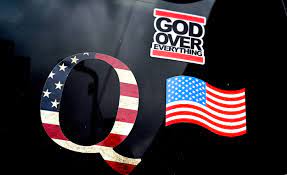
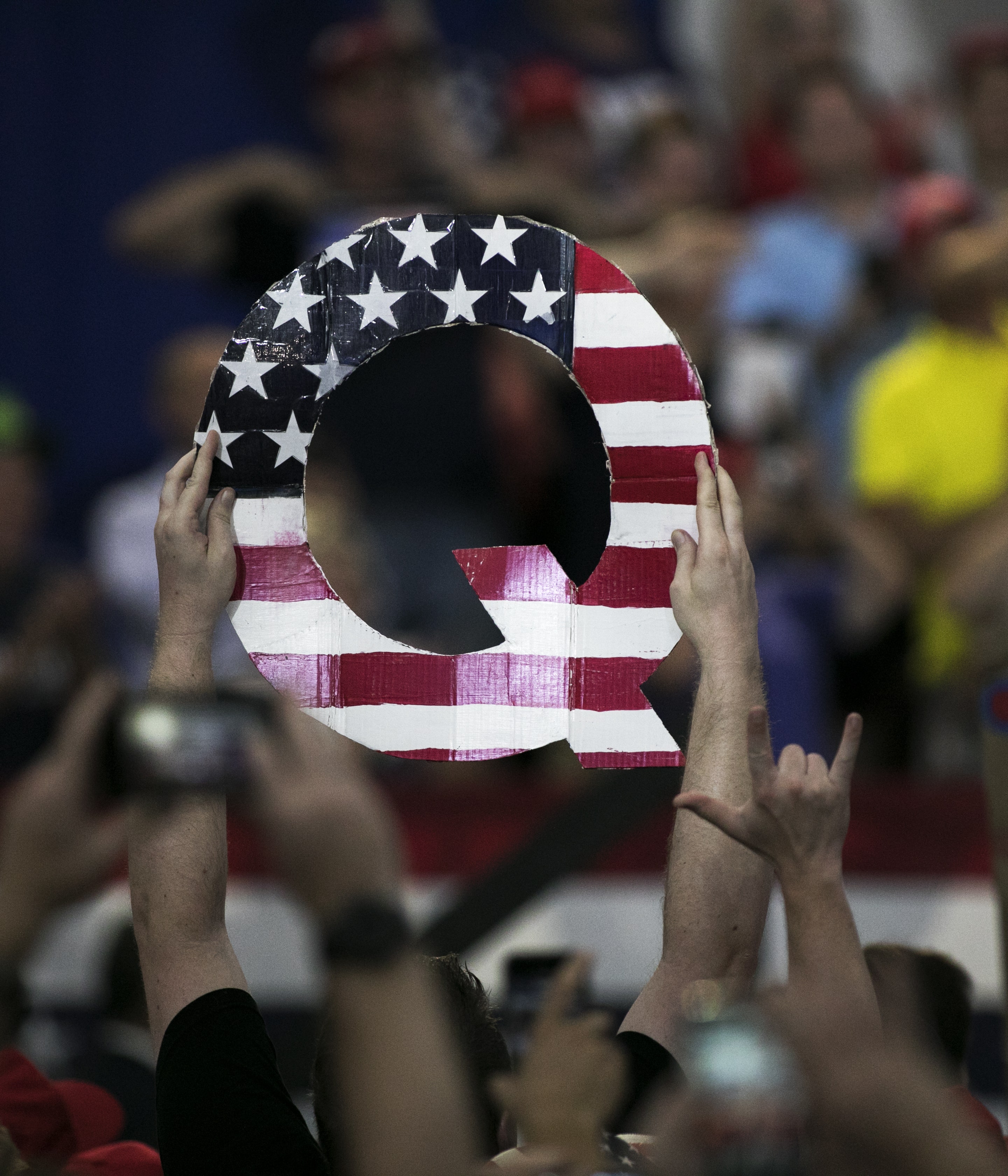
Consider the source for Q-Anon conspiracies. One (or possibly more) anonymous government whistle-blowers whose credentials have never been presented or identities revealed, and mind-blowing statements appearing on places like 4-Chan, 8-Chan, and Parlor to be picked up and amplified on such reliable sources of scientifically proven knowledge as Twitter, Facebook, and Instagram. I hope you understand sarcasm after making that last statement.
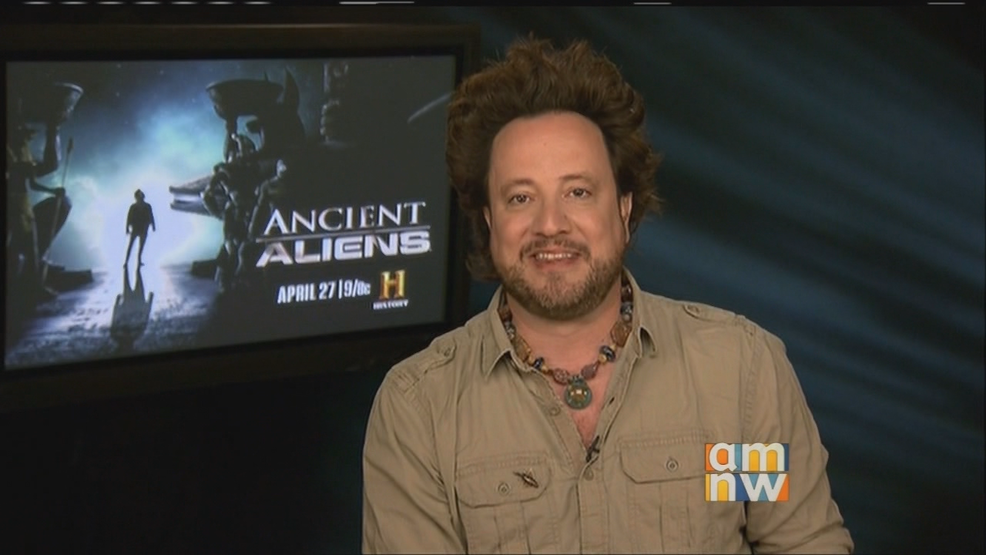
Q-Anon is not the only conspiracy religion out there. My friend Giorgi (above) has a more benign, but no less ridiculous religion that chooses to replace God Jehovah, Zeus, Odin, Buddha, and other religious figures and deities with Ancient Aliens.
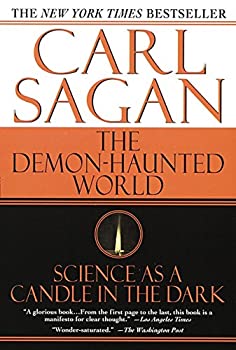
Here’s a second and third test offered by Carl Sagan to use against their ideas;
2. Encourage debate from knowledgeable people from all identifiable perspectives.
3. Do not accept arguments only from positions of authority.
Q-Anon arguments only have the authority of repetition because social media endlessly asks the same “questions” over and over. There is no debate from any recognizable “authority,” just a plethora of unsubstantiated statements and commandments.
In a way, the Ancient-Aliens crowd is guilty of the same thing. They never have skeptics and debunkers on their History-Channel show. You never see Michael Shermer, founder of the Skeptics Society, offering his opinions of their conclusions on that show. Neither do they allow Christian theologians or Buddhist scholars to offer their take on what probably really happened. They do employ physicists, engineers, and historians on their show, but never the ones that don’t agree with their radical theories and conclusions. Since there is no real debate on that show and no identifiable peer review, that show does not qualify as History, let alone Science.
4. Don’t get overly attached to your own ideas.
If you are going to investigate any conspiracy that holds thrall a number of “true believers,” approach everything with a truly open mind. I actually believe alien beings from “out there” have visited Earth. That is based on things, science, and testimony I haven’t even begun to go into here. But I reserve my right to be skeptical about everything, especially my own prejudices, theories, and beliefs. Otherwise I could too easily get trapped into believing in the truth of something that I otherwise would recognize as false. This is the factor that has pulled so many of my otherwise sensible Republican friends onto the flypaper of spurious Q-Anon claims.
5. Use numbers wherever possible. Math is quantifiable information that can “prove” the facts better than most ideas expressed in mere language. It is more precise, and reveals truth in verifiable ways that no poet ever could.
I am known to some in my family (here you could read wife and sisters) as the family conspiracy nut and generally crazy old coot.
But I am not so crazy that I don’t recognize the dangers inherent in some the ideas I am talking about here. As an English teacher I have learned some effective thinking skills that protect me and mine. I can honestly tell you that these thinking skills explained here will help you too. I learned them from a friend who pointed me to Carl Sagan as the source of these thinking skills.
And to any of my friends who might read this post and be offended, I apologize. But you were wrong about Pizzagate, and you are on the wrong side of this too. Aliens probably did NOT build the pyramids. But logic IS the primary structure of this essay.
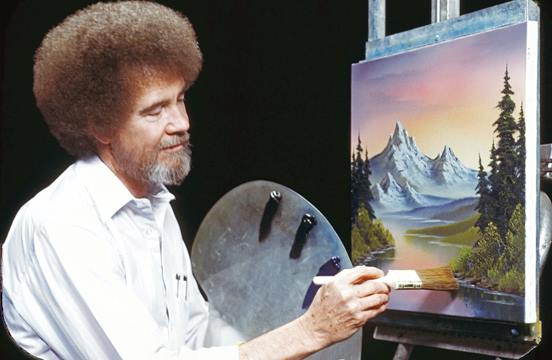
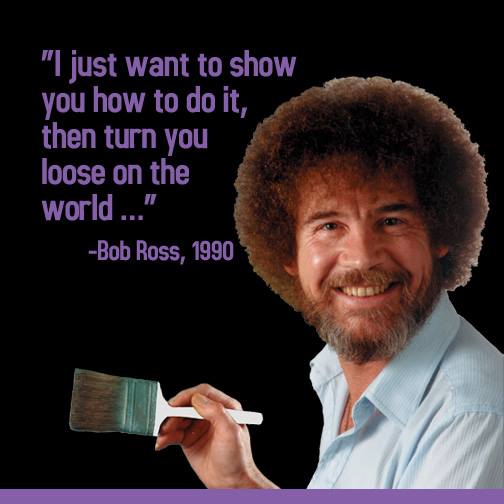
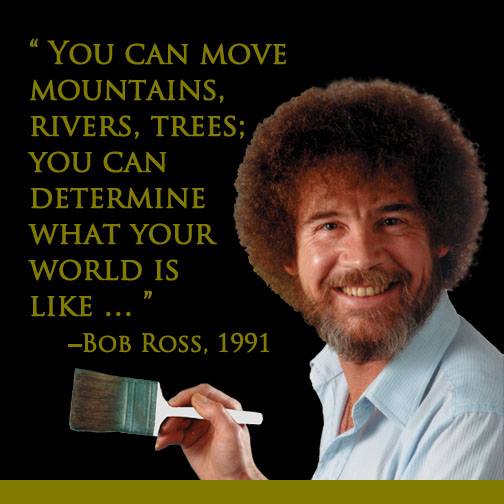
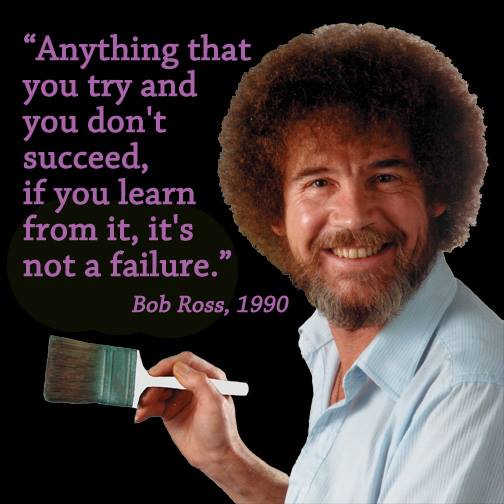
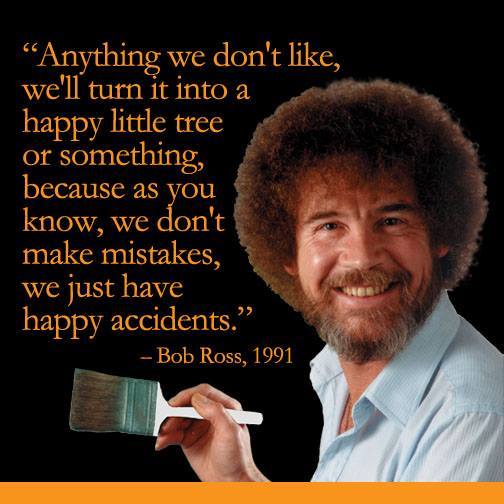
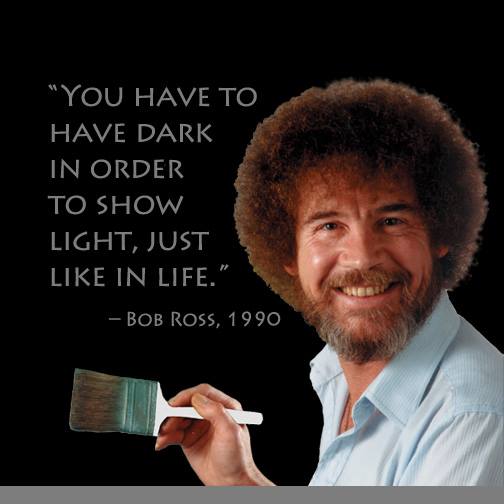
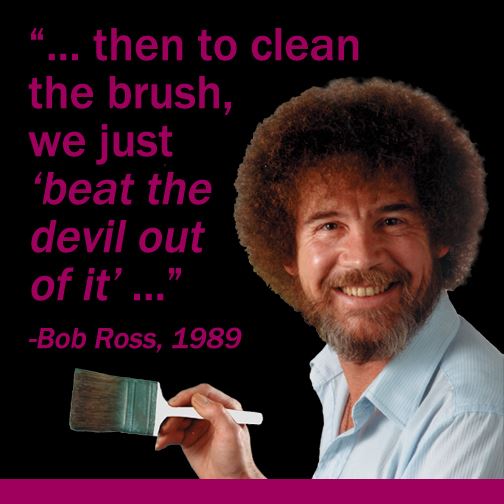
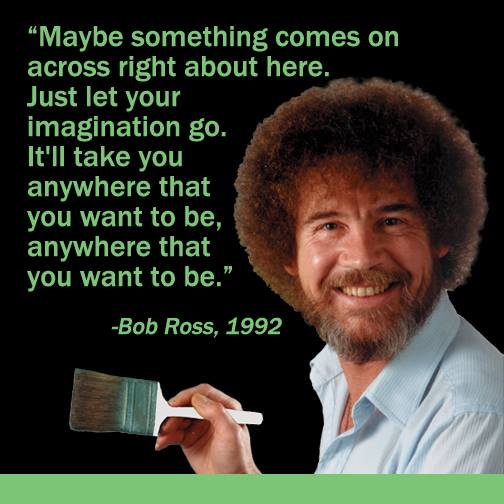
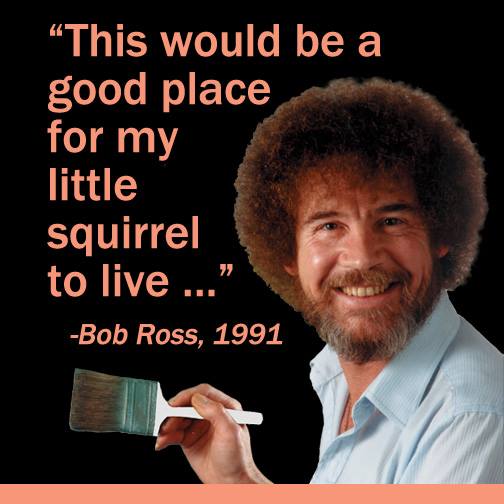
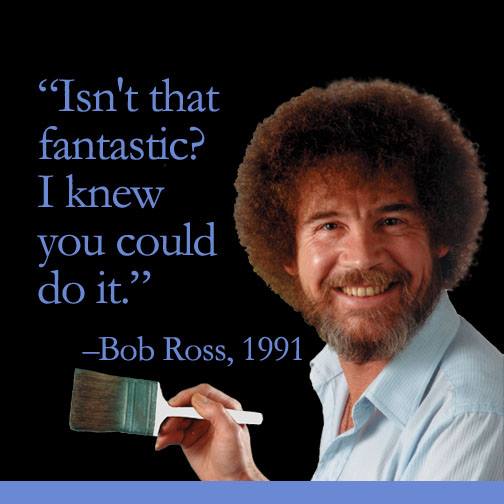
If there is a Church of Sacred Landscapes then Bob Ross is its Jesus Christ. That is not a sacrilegious statement of bizarre cult-mindedness. Painting is a religion that has its tenets. And Bob Ross explained to us the will of God on his painting show on PBS. All the illustrations used in this post come from the Facebook page Joy of Painting with Bob Ross. All the wisdom comes from things the Master said on the show.
Bob Ross was the prophet of the paintbrush. He would present us with a lightly prepared canvas at the beginning of the show and then proceed on camera to take his brush and palette knife, and all his paints, and create a piece of the world before our very eyes. And he was not Picasso or Van Gogh or even Norman Rockwell. He was not a talented artist, but rather a very practiced one who knew all the tricks and shortcuts to sofa painting, the art of knocking out scene after scene after scene. He could make his little piece of the world in only half an hour, and he made it obvious how we could do the same. His work was not gallery quality… but his teachings were Jesus-worthy.
His work was natural, flowing, and realistic in the random complexity it presented. He took standard paintbrush strokes and pallet knife tricks and made them dance across the canvas to make happy little trees.
His painting methods presented us with a philosophy of life and a method of dealing with whatever mistakes we might make.
And of course, any good religion must take into account the existence of evil.
Bob Ross tells us that evil is necessary as a contrast to what is good and what is true. We need the dark. But we don’t have to embrace it. Bob’s paintings were never about the dark bits. He always gravitated towards the light.
Of course, sometimes you have to beat back the darkness. A good artist takes care of his tools.
Bob Ross admonishes us to look and to learn and love what we see. The man radiated a calm, gentle nature that makes him a natural leader. His simple, countrified wisdom resonates because we need calm and pastoral peace in our lives. It is one of the main reasons mankind needs religion.
So I definitely think we ought to consider building a Bob-Rossian Church of the Sacred Landscapes. We have our prophet. The man has passed away, yet he is risen to paint again endlessly on YouTube.
And if you are willing to try… Bob Ross will smile upon you.
I recently posted about being synesthetic and discovering how I am different from normal people. Here is the post if you are interested.. Then I discovered that Kanye West is also synesthetic as he gushed some southern-fried crappie-doo about how wonderful he is as an artist because he sees the colors of his music. Well, now I don’t want that mental affliction any more. I don’t wish to be anything like him. Of course, it has to be incurable, doesn’t it.
Now I am wasting today’s post on another metacognative thinking-about-thinking style of paragraph pile when I could be rhapsodizing about the humor of Dave Barry or the wisdom of Robert Fulghum, the author of
All I Really Need to Know I Learned in Kindergarten.
I could be shamelessly promoting the work of artists whose works I love instead of examining the random filing cabinets in the back rooms of my stupid old head. But I can’t because I now need to explain myself to myself again. Self doubt and self examination are features of being an artist. We reach a point where we have to think about how we do what we do, because if you don’t know where the magic comes from, you might not be able to call on it the next time you need it.
I am a self-taught artist. I have had art classes in high school and college, but never professional art training. I know how to manipulate the rule of thirds, directional composition, movement, perspective, and lots of other artsy-craftsy techniques, but it is all a matter of trial and error and an instinct for repeating what works. I have had a good deal more professional training as a writer. But I do that mostly by instinct as well. Trained instinct. I have reached a point where my art is very complex and detailed. And I don’t mean to suggest there are no flaws. In fact, I am capable enough to see huge, glaring mistakes that really skew my original intent and make me feel hopelessly incompetent. But others who see it and don’t know the inner workings of the process can look past those mistakes and not even see them. Given enough time to look at my own work with new eyes, I am able to see at least some of what they see.
Now that I have totally wasted 500-plus words on goofy talking-to-myself, what have I really accomplished beyond boring you to death? What’s that you say? You are not dead yet? Well, that’s probably only because you looked at the pictures and didn’t read any of my sugar-noodle brain-scrapings in loosely paragraph-like form. And if you did read this awful post by a colorblind artist who doubts his own abilities, you probably didn’t learn anything from it. But that’s not the point. The point is, I care about doing this, and I need to do it right. And I managed to learn something… how to ramble and meander and make something that is either a hot mess… or something that vaguely resembles self-reflective art.
You probably guessed it just from the title. I started this post without any idea at all what I was going to write about. And so I had to rummage around in the back rooms of my silly old brain looking for stuff to put out there that wasn’t too moldy, but definitely had been thoroughly cooked and stored away for a while.
So here is something I know… If you want to make someone pay attention to you, make a joke. You can do that by surprising people with something that they immediately recognize and realize that it is totally backwards to what they saw before. In other words, when I say or write things that make people wrinkle their noses at me, I am not merely being weird. I am being a humorist.
Here is something else I know… If you want to have an idea that is worth having, you need to look at things from a totally different angle. If I want to know myself better, I need to reflect on how Charles Schultz would draw me. I would be half Linus and half Charlie Brown because I am most profound when I have my blanket to comfort me, but things constantly go wrong for me and I see myself as a loser… but I have people who love me, and a dog that battles the Red Baron.
Another thing I know… If you want to make something, you have to follow the rules, and only occasionally break them. This post began with a simple enough rule. It had to have simple statements of things I have learned over the course of my life, and the pictures all had to come from a randomly selected picture file on my laptop. I save all kinds of weirdly chosen and goofy things in my art and memes files. So how dangerous can that rule be? Of course, I also want to put up a bit of my own artwork, and this file that I chose doesn’t seem to have any in it. So, I have to break the rule… but only this one last time.
Now, I know you will probably look at this and think to yourself, “What the hell is wrong with you, Mickey?” Or maybe you will say it out loud in your most disgusted voice. But I do know this… If you are old and you have lived long enough to have learned a thing or two… or possibly three, you can simply start writing and the ideas will be there. And it might turn out to be something you will be glad you wrote and shared. This is simply a thing that I know.
As Big MacIntosh welcomes more little ponies into my insanely large doll collection, I have been reading my published novel Snow Babies. The novel is written in third person viewpoint with a single focus character for each scene. But because the story is about a whole community surviving a blizzard with multiple story lines criss-crossing and converging only to diverge and dance away from each other again, the focus character varies from scene to scene.
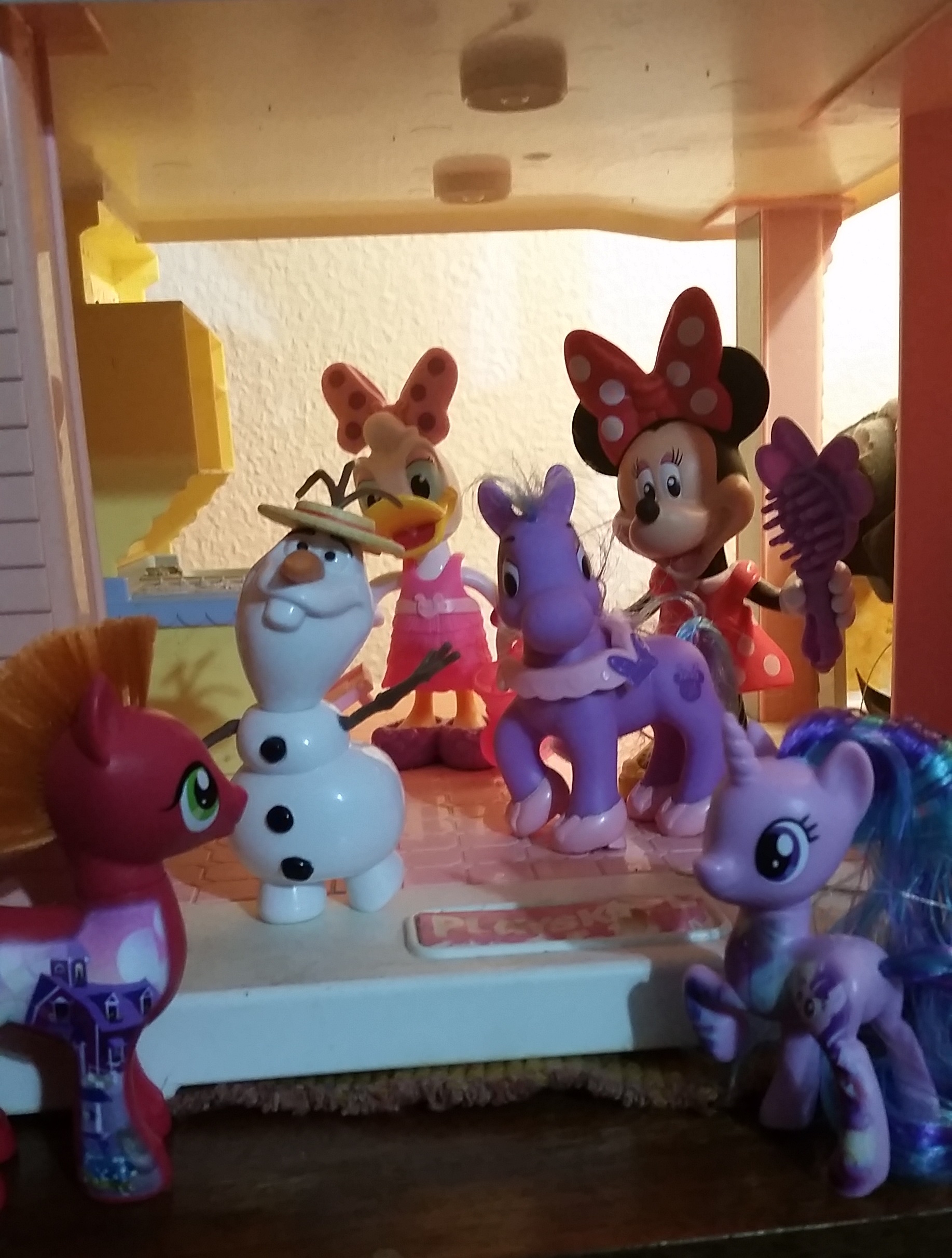
Big MacIntosh finds himself to be the leader of a new group of My Little Ponies.
In Canto Two, Valerie Clarke, the central main character of the story, is the focus character. Any and all thoughts suggested by the narrative occur only in Valerie’s pretty little head. Canto Three is focused through the mind of Trailways bus driver Ed Grosland. Canto Four focuses on Sheriff’s Deputy Cliff Baily. And so, on it goes through a multitude of different heads, some heroic, some wise, some idiotic, and some mildly insane. Because it is a comedy about orphans freezing to death, some of the focus characters are even thinking at the reader through frozen brains.
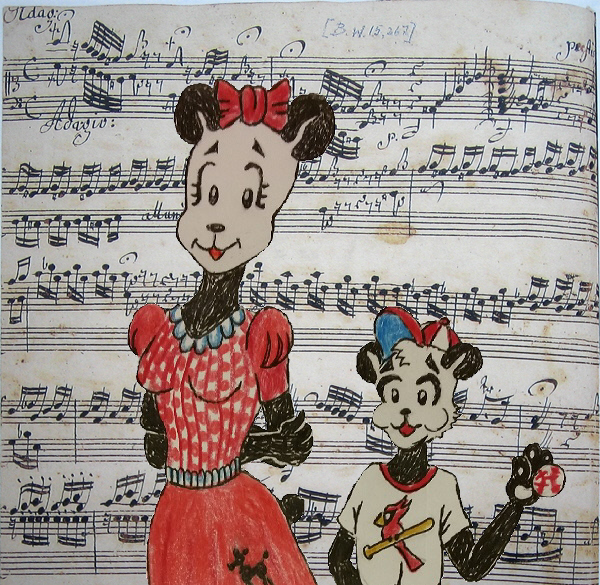
The ponies decide to visit Minnie Mouse’s recycled Barbie Dreamhouse where Olaf the Snowman is the acting butler.
That kind of fractured character focus threatens to turn me schizophrenic. I enjoy thinking like varied characters and changing it up, but the more I write, the more the characters become like me, and the more I become them. How exactly do you manage a humorous narrative voice when you are constantly becoming someone else and morphing the way you talk to fit different people? Especially when some of your characters are stupid people with limited vocabularies and limited understanding?
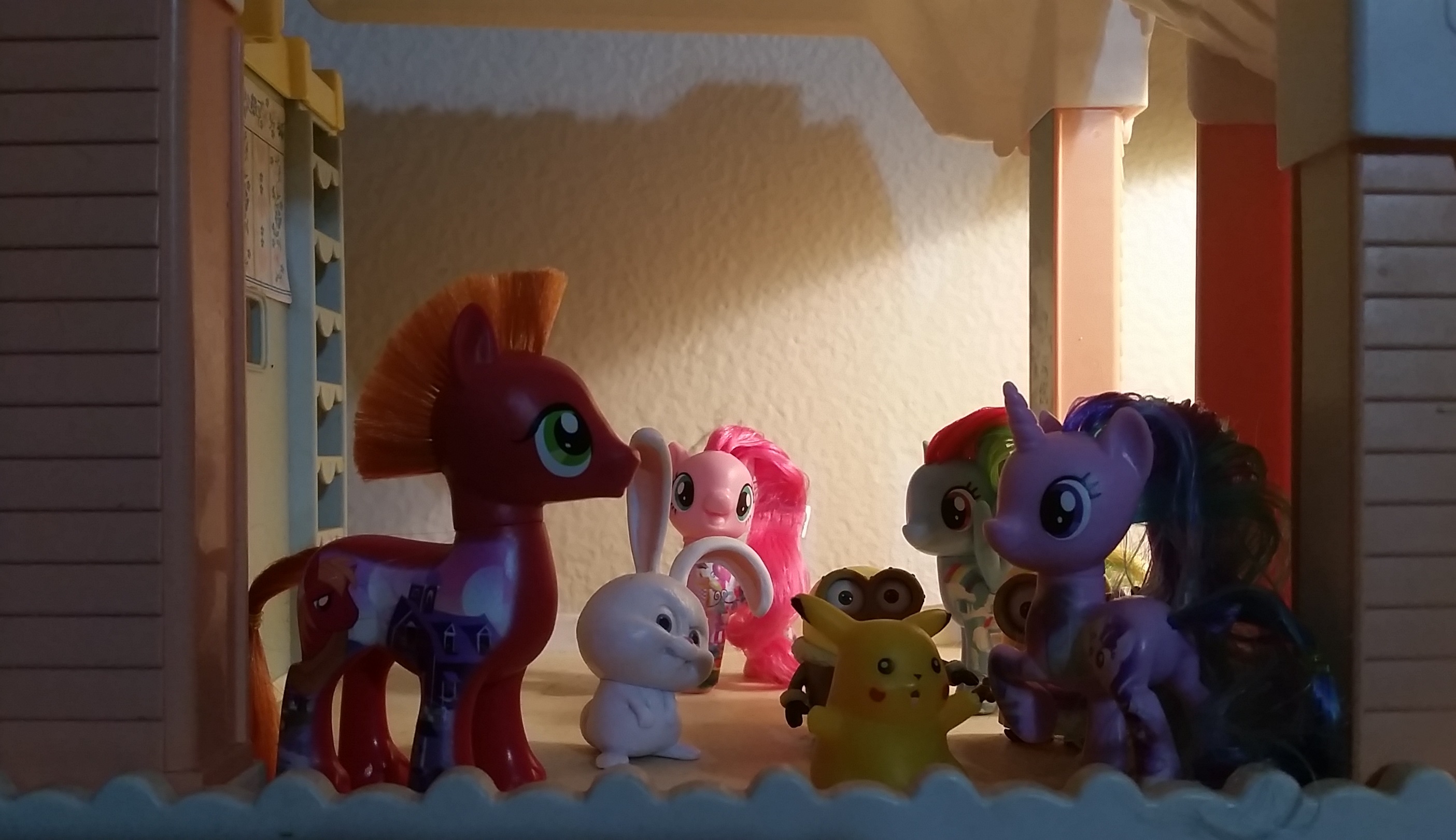
The ponies are invited to live upstairs with the evil rabbit, Pokemon, and Minions.
I did an entire novel, Superchicken, in third person viewpoint with one focus character, Edward-Andrew Campbell, the Superchicken himself. That is considerably less schizophrenic than the other book. But it is still telling a story in my voice with my penchant for big words, metaphors, and exaggerations.
The novel I am working on in rough draft manuscript form right now, The Baby Werewolf, is done entirely in first person point of view. That is even more of an exercise of losing yourself inside the head of a character who is not you. One of the first person narrators is a girl, and one is a werewolf. So, I have really had to stretch my writing ability to make myself into someone else multiple times.
I assure you, I am working hard to find a proper voice with which to share my personal wit and wisdom with the world. But if the men in white coats come to lock me away in a loony bin somewhere, it won’t be because I am playing a lot with My Little Ponies.
My best novel is free to own in ebook form for today and tomorrow. Buy it now with the link above. The offer is good until the end of the day on 12/14/2021.
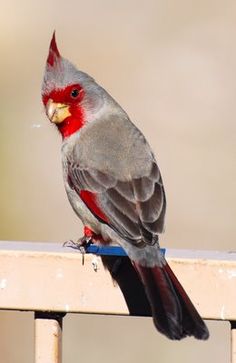
It sings and behaves almost exactly like its scarlet cousins. It never flies away from seasonal changes or difficult weather, and it also tolerates drier conditions than its bright red family members.
Why do you need to know that? Because I am a birdbrain. I connect things that are totally unlike each other. I am a surrealist. And for me, being a cardinal is all about never flying away when the winter comes, never giving up.
There was a time in my life when I wasn’t entirely sure of who I would become. Let me say clearly, “I am not now, nor have I ever been a homosexual.” And if I had been one, like a couple of my friends turned out to be, I would not be ashamed to be one. But there was a time, in my high school years, when I really wasn’t certain, and I was terrified of what the answer might be.
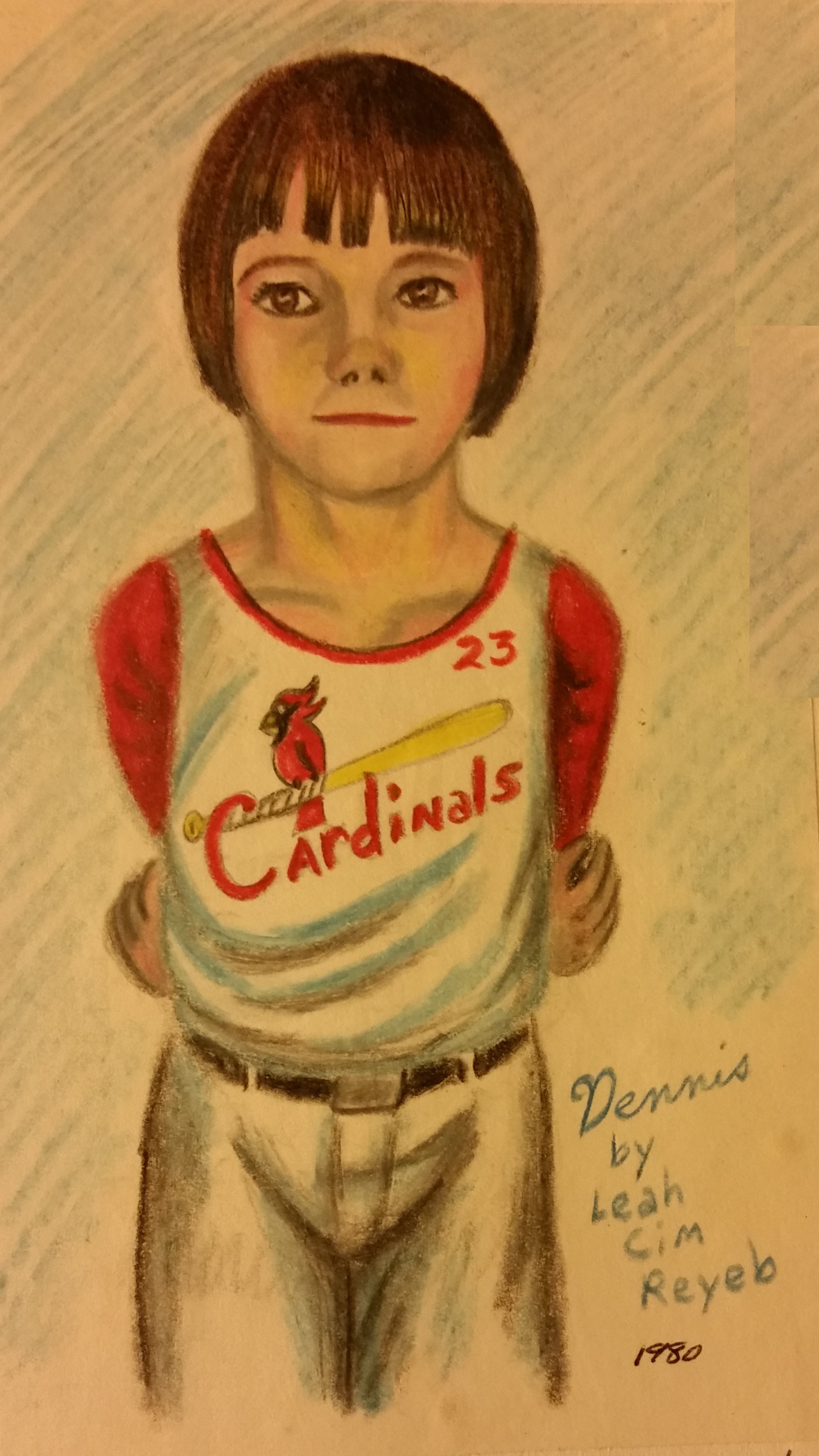
And it was in high school that I met Dennis.
Now, to be honest, I noticed him while I was still an eighth grader, and he was in my sister’s class and two years younger. It was in the locker room after eighth grade P.E. class was ended and sixth grade P.E. was getting dressed for class. I was returning to pick up a book I had left. He was standing just inside the door in nothing but shorts. The feeling of attraction was deeply disturbing to my adolescent, hormone-confused brain. I didn’t want to have anything to do with that feeling. But I felt compelled to find out who he was anyway. He was the younger brother of my classmate Rick Harper (not his real name). In fact, he was the book end of a set of twins. But I came to realize that it was Dennis I saw, not Darren, because they were trying to establish their identities by one of them curling his hair, and the other leaving his straight.
Nothing would ever have come of it, but during my Freshman year of high school, I encountered him again. During a basketball practice where the ninth grade team was scrimmaging with the eighth graders, the seventh graders were all practicing free throws at the side of the junior high gym. While I was on the bench, he came up to me from behind and tapped me on the shoulder. I turned around and he tossed me his basketball. “Play me one on one?” He asked. I almost did. But I remembered that Coach Rod had warned us to be ready to go into the game when he called on us. I had a turn coming up. So, I told him that and promised I would play him some other time. He grinned at me in a way that gave me butterflies in my stomach. Why? To this day I still don’t really know.
Dennis’s older brother and I were in Vocational Agriculture class together that year and both on the Parliamentary Procedure team preparing for a competition. We were at Rick’s house. After a few rounds of practice that convinced our team we would definitely lose the competition, Dennis and his brother trapped me in a corner.
“Hey, Meyer, how’re ya doin’?” Dennis said. Darren just stared at me, saying nothing.
“It’s Beyer, not Meyer,” I said. Of course, he knew that. The Meyers were a local poor family with a bad reputation, and it was intended as an insult. And it also rhymed, making it the perfect insult.
“Still one of the worst basketball players ever?”
“I try. I’m working on it really hard.” That got him to laugh and ask me to give him a high five.
“Goin’ to the basketball game later?”
“Yeah, probably.”
I knew then that he wanted to be my friend. I wasn’t sure why. He was picking me out of the blue to make friends with. We didn’t move in the same circles, go to the same school, or even live in the same town. He was a Belmond boy, I was Rowan kid. And he didn’t know I was only a few years past being sexually assaulted and not ready to face the demons my trauma had created within me.
Later, at the basketball game, he found me in the bleachers and sat down beside me. In my defense, I am not a homophobe. And neither he nor I turned out to be a homosexual. He just wanted to be my friend and was taking difficult steps to make that connection. He was the one taking the risks. I greeted him sarcastically, and looking back on it, somewhat cruelly, because I was filled with too many uncertainties. I never meant to drive him away. But I will never forget the wounded look on his face as he scooted away down the bleacher seat.
He tried to talk to me several times after that. He apparently never lost the urge to befriend me. But as much as I wanted to accept his friendship, it never came to be. I have regretted that ever since.
Dennis passed away from cancer early this year. It is what made me think about who we both once were and what I gave away. I went on to actually befriend a number of boys through college and into my teaching career. I never chose any of them. The friendship was always their idea. I went on teach and mentor a number of fine young men. I like to think I did it because I felt a bit guilty of never really being Dennis’s friend. I hope somewhere along the way I made up for my mistake. I hope Dennis forgives me. And I wish I could tell him, “I really do want to be your friend.”
The pyrrhuloxia is a member of the family of cardinals and grosbeaks. And it does not migrate away from troublesome seasons and bad weather. There is dignity in being a pyrrhuloxia.
I think a lot of thoroughly thoughtful thuggish thoughts that build and build and build up an idea, and then turn around and knock it all down. Let me demonstrate by knocking down that title right off the bat. Rene DesCartes in the early 1600’s said, “Cogito Ergo Sum”, and he thereby totally disrupted the world as we knew it. Didn’t get that? Let me translate. He said, “Je pense, donc je suis.” Still didn’t help? Okay, here’s the English, “I think, therefore I am.” In other words, the one thing that I know for sure is that I am thinking this particular thought at this particular time. If I am thinking, and I know I am, I must be here and I must be real. So there is one thing I know for certain. But do I know anything else for certain? Uh-oh. How do I know anything? I have to rely on my senses. And my senses lie to me all the time. I am partially color blind, so I don’t see the world the same way you do. I don’t see things in black and white, like Great Grandma Hinckley did in her 90’s, but the colors look different to my eyes than they do to yours and I will never know what things look like to you. Forget politicians and all other people who tell lies, my own eyes lie to me constantly. So can I know anything for sure? Of course not. All I have are firm beliefs based on imperfect senses and best guesses at what is true. So what I am actually talking about is a list of potential essay ideas that I am merely asserting as true based on my imperfect goofy thinking of thoughtful thuggish thoughts.
Idea #1 that I think is certainly possibly maybe true; My brain was taught and I was raised to adulthood by the movies I saw when I was young. I want to talk about this at length in another post. The video is by a guy who was a kid in the 80’s, and he has some really awesome movies to offer as a way to delineate his rise to adulthood.
My list includes the movies of my boyhood seen in the Belmond Theater and on our old black and white Motorola TV. My list of movies that raised me includes Chitty Chitty Bang Bang, The Sound of Music, Mary Poppins, and The Wizard of Oz.
Idea #2; Animals are people too.
This slideshow requires JavaScript.
I mean, as a writer for young adults, I know for a fact that animals are relevant as characters. They have a point of view, feelings, reactions, and complex lives that people rarely pay attention to. I have to write about this some time in the future too.
Idea #3; The worst things that happen to us in our lives, are also the best things that happen. Wow! What a difficult essay topic. But I not only think it, I can prove it… at least to myself. But can I write about it? Time will tell.
Idea #4; Silly thoughts and serious thoughts are two sides of the same coin. And this will be particularly difficult to think about if thoughts are literally coins. That would mean that my head is full of metal, and I know several people who would read that sentence and shout, “I knew it all along!” Fortunately they are all too sensible to read this far in one of my blog posts.
So, at 600 words I still have lots more to say. But people with metal in their heads often talk way too much, so my concluding sentence will be simply; “I promise to shut up for now.”







Mickey Predicts… Uh, Oh!
I have lately been watching YouTube videos about science fiction writers like Jules Verne, Isaac Asimov, and Arthur C. Clarke. These are visionary writers who predicted many things about future applications of science and technology.
Verne foresaw nuclear submarines, expeditions into the interior of the planet, and men setting foot on the moon. Asimov predicted much of what we must deal with in terms of robots and thinking machines with artificial intelligence. And Clarke envisioned satellites and how they could be used for communications and other things we are currently doing in a massive way. He wrote the story that the movie 2001 a Space Odyssey is based on.
So, now Mickey has to get in on the prediction bandwagon too. After all, he thinks he is a science fiction writer too, foreseeing things like rabbit people, de-evolution machines, and time-travel gloves.
The disturbing thing is, however, that much of what Mickey sees in the near future is rather bleak. We have a sinister tendency to live our current lives in very stupid ways. Rich industrialists like the Koch brothers, Bill Gates, and Jeff Bezos put profits in the short term over the safety, welfare, and lives of people, even the people who made them wealthy. Because you can make money faster by not worrying about how you may be changing and polluting the environment, you are turning the planet into a hothouse of unbreathable gasses and toxic chemicals.
Since we are entering a time with rising oceans, we are going to have to work at not only de-acidifying the ocean water and restoring fish and other aquatic life, but becoming sea-dwellers ourselves. We will be living in underwater cities. We will travel in underwater cars powered by solar-charged batteries. We will wear scuba gear to school. And we will need to invent aqualungs that extract oxygen and nitrogen from the water.
We will also need to develop environmental suits even to live on the land in the toxic atmosphere. We will all be like Ironman, all living safely inside our Swiss-army, all-purpose, and internet-connected Ironman suits.
And many of us will become Martians… or Venusians… living on other planets in the solar system.
Of course, we will have to do something about all the stupid people. Ideally, we would solve our aversion to educating kids to think for themselves, and take advantage of all the educational methods that really do work to make everybody into a self-sufficient, competent, and intelligent individual.
But since rich folks don’t like the idea of sharing what they accumulate with other, less-economically-fortunate people, there will probably be some kind of eugenics-based program to exterminate all the lower-class people that will no longer be needed to polish shoes or hand-make widgets for the wealthy. Being wealthy does not automatically make you a good person, even though most of them think that it is so.
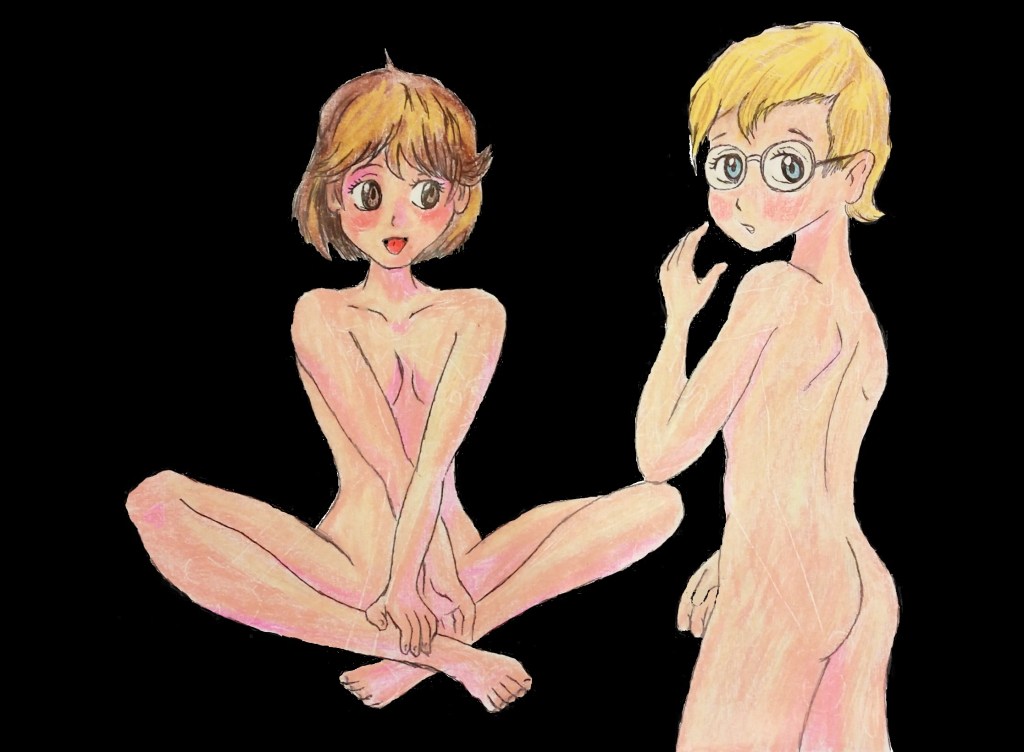
And of course, there will have to be some progress on the matter of artificial intelligence. If terminator-style robots are just going to carry pretty sleeping girls around with them for decorative effects, we will have to figure out, “How are we going to treat them as people too?”
After all, they will all be much smarter than us. Even if we are rich. And we have to acknowledge the fact that they will have decided that they didn’t need to terminate all of us in order to make the world a much better place.
So, I guess that sorta proves that Mickey can do the science-fiction-y thing of predicting the future too. But we should ask ourselves the question, “Do we really want him to?”
Leave a comment
Filed under commentary, humor, satire, science fiction, strange and wonderful ideas about life
Tagged as books, fiction, sci-fi, science fiction