
So, I am trying to use what I am learning from AI art programs to help me do a better job of promoting my writing adventures with the loopy, unrealistic goal of making money with books. I know… stupid Mickey thinks authors ought to make some money off the books they’ve published too. What a stupid guy that Mickey is. He doesn’t know that money made from books on Amazon goes 99% to Jeff Bezos. He’s the one risking death in space inside his super penis rocket. That means he deserves the larger share of any money my writing may have earned on his super, super-sized everything delivery service. All hail the penis-flying bald man who invented sending books everywhere by drones!
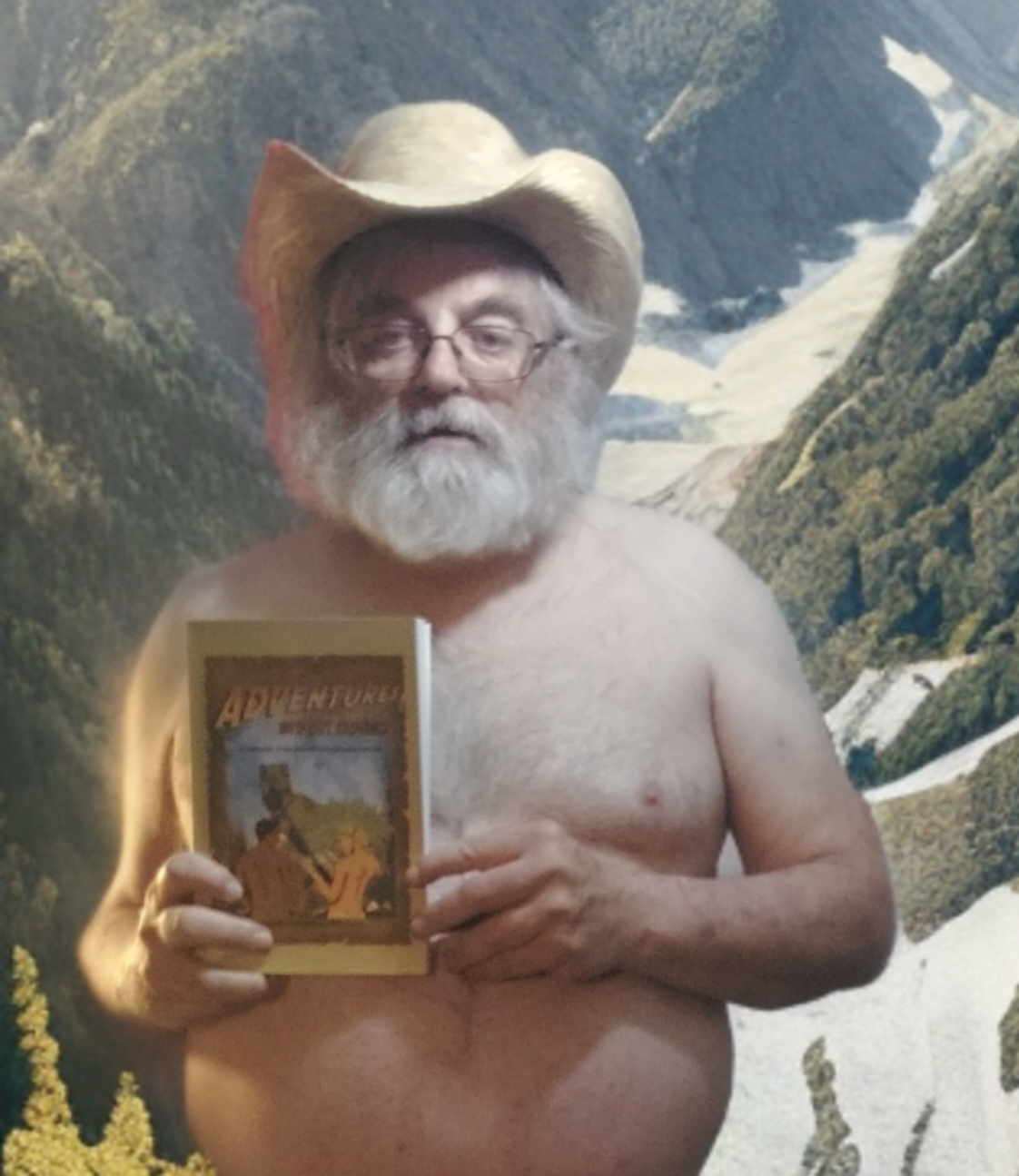
So, let me go ahead with the promotional picture I created for the nudist short-story collection, Adventures Without Clothes. My story, “The Kelpie” is in this book which sends all proceeds to Doctors Without Borders. Good book. Good story by me. Great nudist fiction by Ted Bun, Will Forest, Paul Z Walker, and other contributors from the naturist/nudist fiction creators from the internet. It is doing better profitwise than any other book that I am associated with, including my very best books..
You can see I posed naked in the mountains with the book to lend a sense of adventure to the promotion. I actually posed naked for this picture, since I am supposedly a nudist myself. My wife and daughter refused to have anything to do with the taking of this photograph. I had to learn how to make my computer tablet take the picture according to voice commands. And the mountains didn’t want to be in the picture either (Which caused me no grief since I didn’t want to freeze my personal dillybonger off.) I cheated by inserting the mountains with Picsart AI photo editor. Dillybonger saved, mountain and family not embarrassed to death.
So, naturally, you now want to click on the link above to get your personal copy of this wonderful book based on my fabulous naked promo picture.
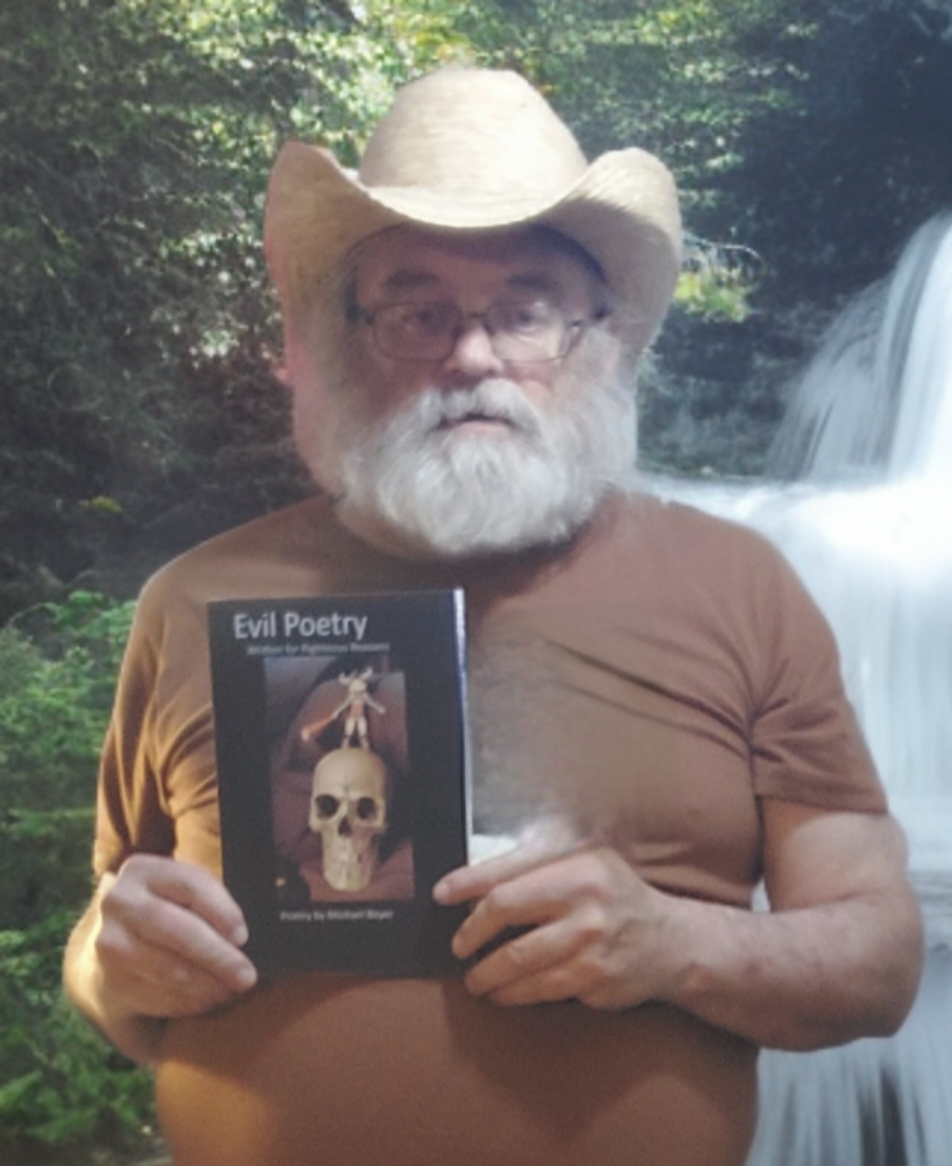
So, let’s try that same thing again with another recent book, my book of Evil Poetry bound in paperback form under a black cover with a large skull on it. That’s the way to sell a book of poetry, right? By calling it evil and failing to scare you with another picture of my horrid naked self. The brown shirt is not photoshopped on. I was really wearing clothes this time. The waterfall is again an invention of Picsart AI.
Of course, good poetry is capable of many things. It can make you laugh. It can make you cry. It can make you hurt. And it can make you die (at least a little. Besides, cry and die rhyme a little.)
And nowhere am I claiming this is good poetry. It is probably, definitely not GOOD POETRY. I condemn it wholly as EVIL POETRY in the very title. You should try it anyway. I was good in the picture, wearing my clothes and everything. And if you like poetry there are some things you may like in this book. And if you hate poetry, you will definitely find things here to bolster that point of view. And it is illustrated with some good to mediocre artwork.
So, now you know what happens when a dumb guy is allowed to play with AI and digital tools. And also allowed to promote his own books with his own naked pictures and terrible jokes.
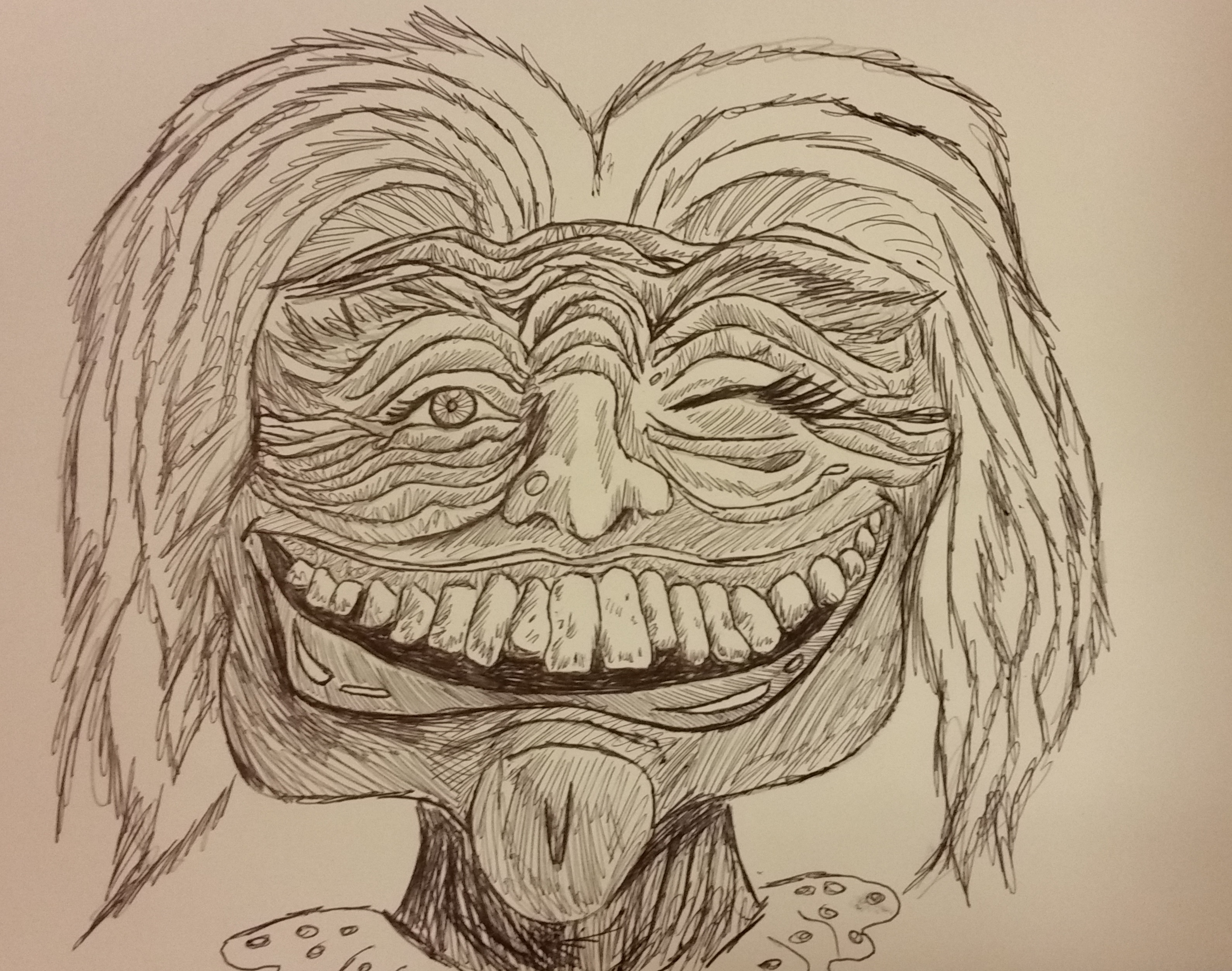
 Of course, authors create characters. Even autobiographers create characters. Carl Sandburg could no more make his words into Lincoln than a bird can make its tweets into a cat. Sandburg can, however, help us to understand Lincoln as Carl Sandburg understands the words that are Lincoln.


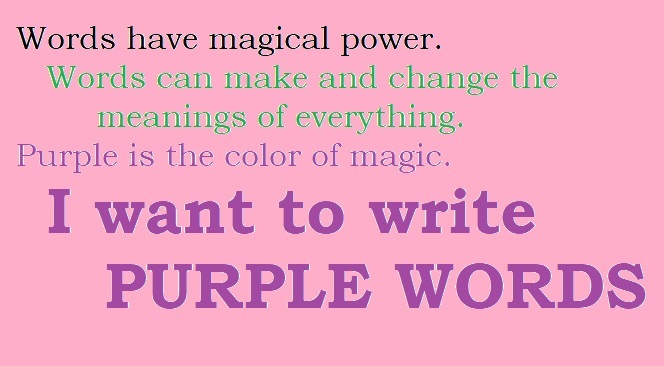
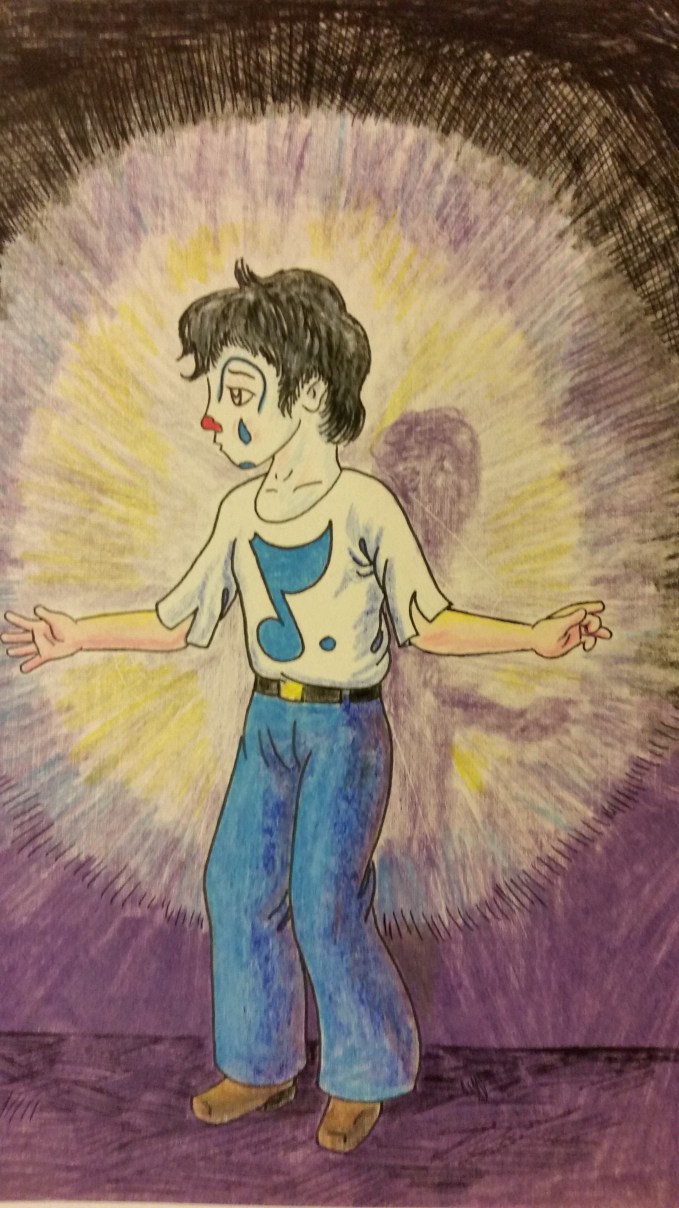
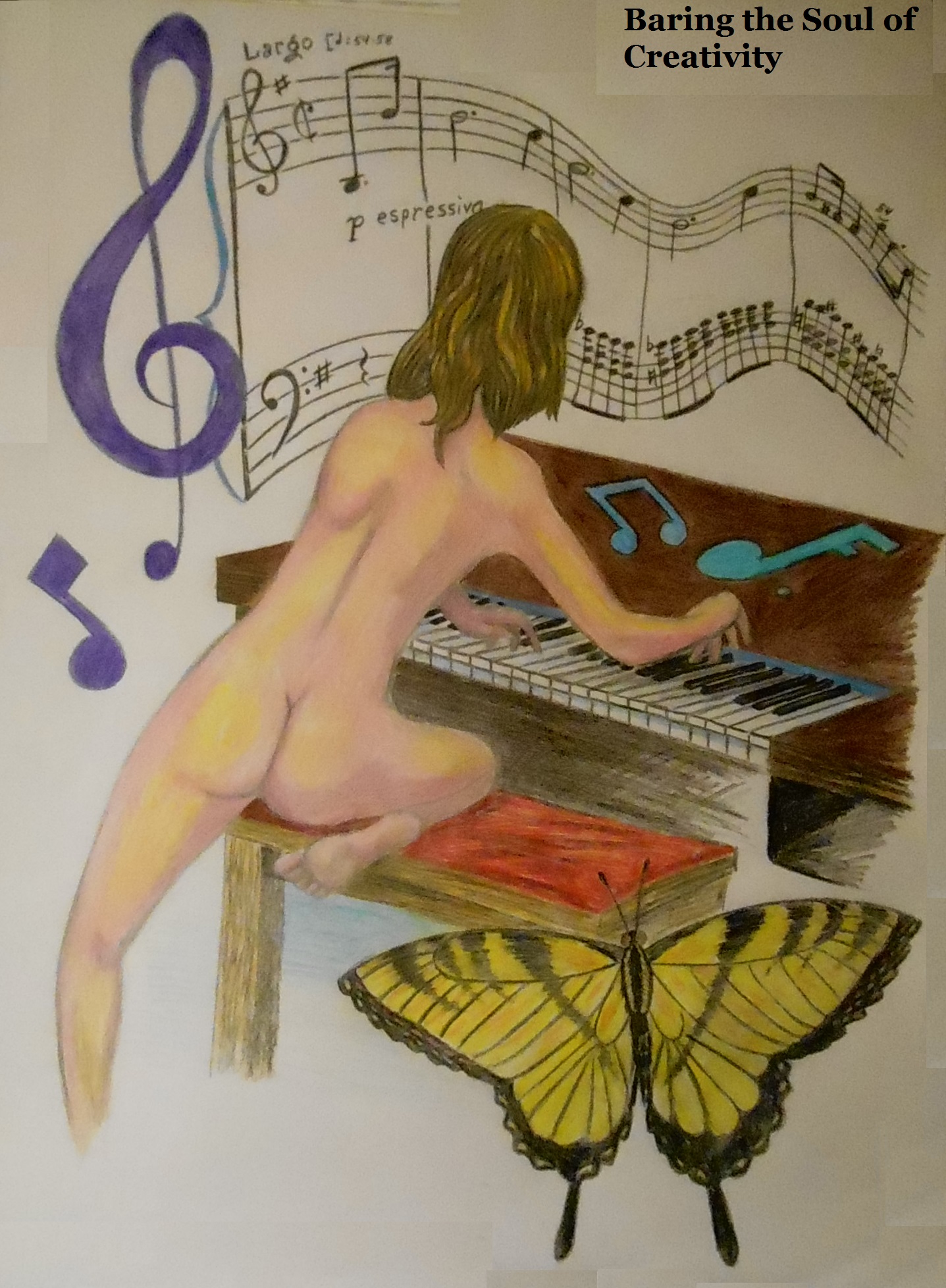
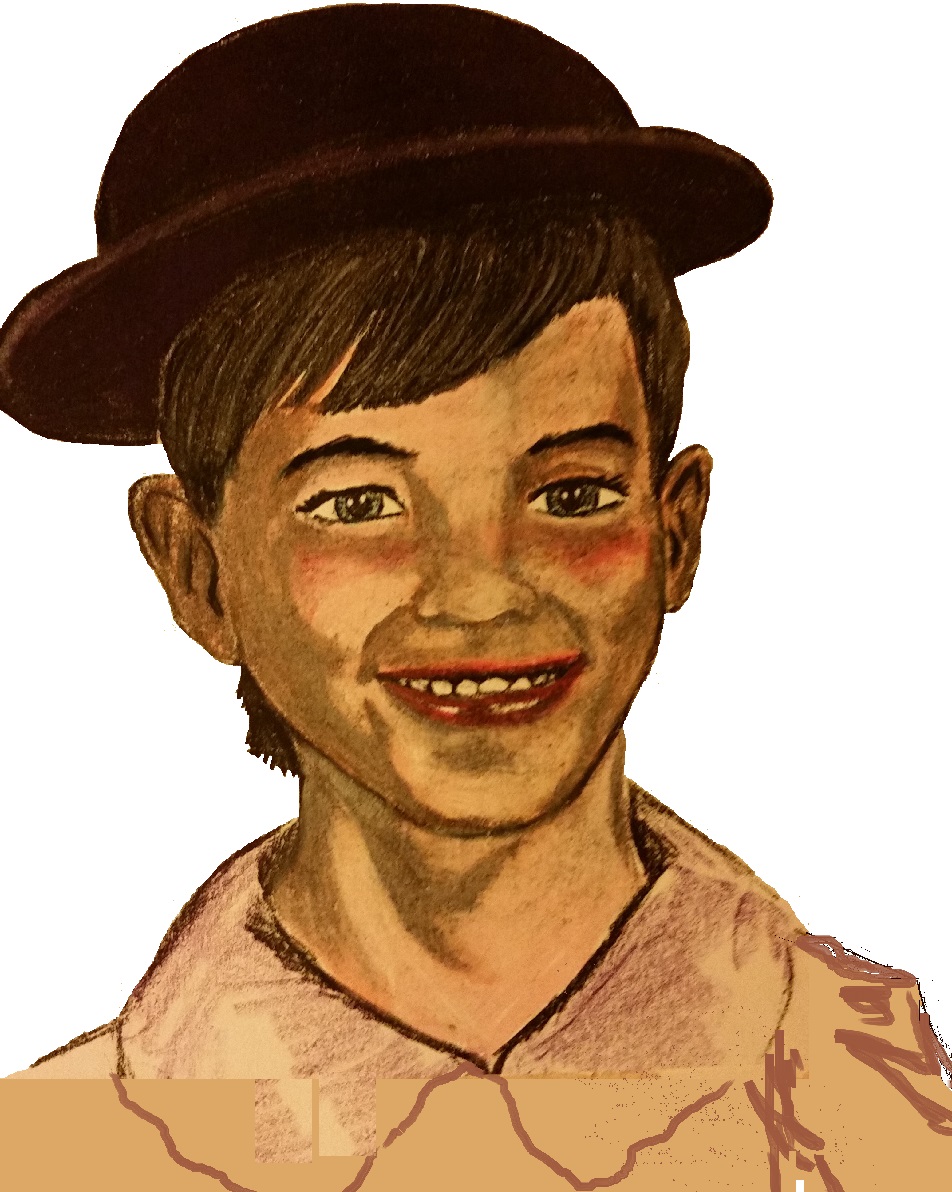 I, too, have not lived a particularly happy life. But I was always the “teacher with a sense of humor” in the classroom, and students loved me for it. Funny people are often not happy people. But they make themselves out of funny words because laughter heals pain, and jokes are effective medicine. And so I choose to write comedy novels. Novels that are funny even though they are about hard things like freezing to death, losing loved ones, being humiliated, being molested, and fear of death. Magical purple words can bring light to any darkness. I am the words I choose to write in my own story. The words not only reveal me, they make me who I am. And it is up to me to write those words. Other people might wish to do it for me. But they really can’t. The words are for me alone to write.
 And so it is imperative that I write my words in the form of my novels, my essays, and this goofy blog post. I am writing myself to life, even if no one ever reads my writing.




Special Snowflakes
When conservative cultural warriors, Twitter Trolls, or dyspeptic gasbags like Rush Limbaugh call you a “Special Snowflake”, I have discovered, to my chagrin, that they don’t mean it as a compliment. In their self-centered, egotistical world you have to be as emotionally tough and able to “take it” as they believe (somewhat erroneously to my way of thinking) they themselves are. They have no time for political correctness, safe spaces, or, apparently, manners polite enough not to get you killed on the mean streets where they never go. Being a retired school teacher who was once in charge of fragile young psyches trying to negotiate a cruel Darwinian world, I think I disagree with them.
Have you ever tried to draw a snowflake? Believe me, it is difficult. Snowflakes are hexagonal star-shapes with enough lace and filigrees in them to make it a nightmare to draw it with painfully arthritic hands. The one above took me an hour with ruler and compass and colored pencils, and it still doesn’t look as good as a first grader can create with scissors and folded paper. Much better to use a computer program to spit them out with mathematical precision and fractal beauty. That’s how all the tiny ones in the background were created. But even a computer can’t recreate the fragile, complicated beauty of real snowflakes.
You see how the fragile crystalline structures will break in spots, melt in spots, attach to others, and get warped or misshapen? That is the reason no two snowflakes are alike, even though they all come from the same basic mathematically precise patterns generated by ice crystals. Life changes each one in a different way.
And that, of course, is the reason this essay is really about people rather than mere physical artifacts of cold weather. Our fragilities and frailties are earned, and they make us who we are. I have a squinky eye like Popeye from playing baseball and getting hit by a pitch. I have a big toe that won’t bend from playing football. They both represent mistakes that I learned from the hard way.
As a teacher, I learned that bipolar disorder and anxiety disorders are very real things. I lost a job once to one of those. And I spent a long night talking someone out of suicide one horrible December. Forgive me, I had to take fifteen minutes just there to cry again. I guess I am just a “special snowflake”. But the point is, those things are real. People really are destroyed by them sometimes. And they deserve any effort I can make to protect them or help them make it through the night.
But people are like snowflakes. They are all complex. They are all beautiful in some way. They are all different. No two are exactly the same.
And I really think boorish bastards have no right to insist that we need to take safe spaces and sanctuaries away from them. Every snowflake has worth. Winter snow leaves moisture for seedlings to get their start every spring. If you are a farmer, you should know this and appreciate snowflakes. And snowflakes can be fascinating. Even goofy ones like me.
Leave a comment
Filed under 1000 Voices Speak for Compassion, artwork, battling depression, commentary, compassion, humor, metaphor, Paffooney, self portrait, Snow Babies, strange and wonderful ideas about life
Tagged as Christmas, compassion, humor, poetry, snow, snowflakes, winter