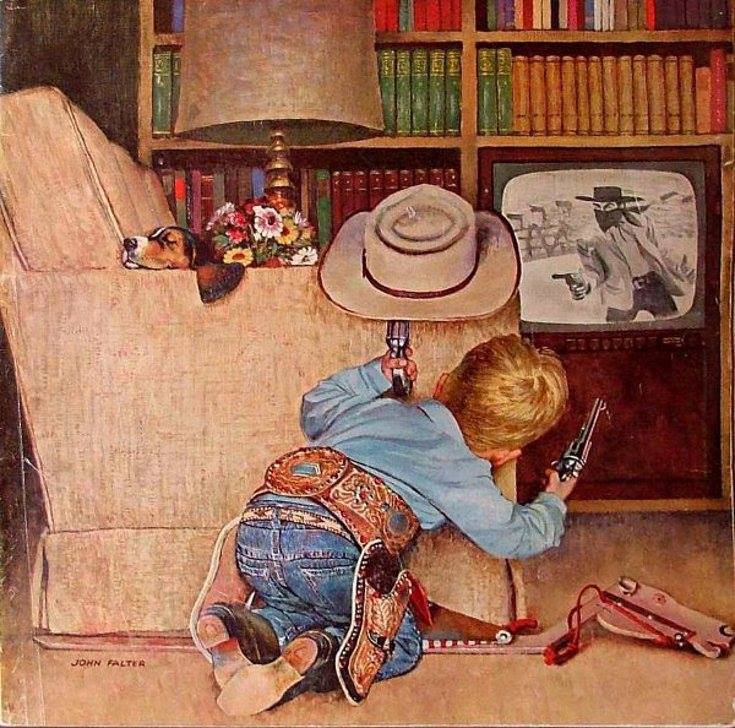
Grandpa and Grandma Aldrich lived on the family farm outside of town, a little more than two miles from the tiny farm town of Rowan, Iowa. I walked it more than once. It was faster to walk the railroad tracks between the two places. About a mile and three quarters as the crow flies… three hours as the boy investigates the critters in the weeds, throws rocks at dragonflies, and listens to the birdsong along the way. But the point is, my maternal grandparents lived close enough to have a profound influence on my young life. Much of what they loved became what I love. And every Saturday night, they loved to watch the Lawrence Welk Show. And that show had highlights that we longed to see again and again… on a show that never really went into reruns. We lived to see Jo Ann Castle play the old rinky-tink piano, Bobby and Cissy doing a dance routine, and most of all… the lovely Lennon Sisters.
I always wanted to be the things they wished me to be in the song “May You Always”. I wanted to “walk in sunshine” and “live with laughter”. They presented a world of possibilities all clean and good and wholesome. As a young boy who hated girls, I had a secret crush on Janet Lennon who was the youngest, though a decade older than me, and on Peggy Lennon, the one with the exotic Asian eyes. They sang to me and spoke directly to my heart.
You have to believe in something when you are young. The world can present you with so many dark and hurtful experiences that you simply have to have something to hang onto and keep you from being blighted and crippled by the pain. For me, it often came in the form of a lovely and simple lyric sung by the lovely Lennon Sisters. When you are faced with hard choices… especially in those dark moments when you think about ending it all because it is all just too much to bear, the things stored in those special pockets of your heart are the only things that can save you. For me, one of those things will always be the music of the Lennon Sisters… especially when watched on the old black-and-white TV in the farmhouse where my grandparents lived and helped raise me every Saturday night in the 1960s.
Yes, this is another in a series of reviews from the Uncritical Critic where I gush endlessly and almost mindlessly about movies, TV, books, and other sorts of stories that I love. And just like other reviews that I have done, writing mainly to myself, this will probably bore you to the point of having to sandpaper your tush just to stay conscious through it. But I do, in fact, have a social conscience. I do care about things moral and ethical. That’s why I’m not going to talk about this Annie;
I want to talk about this one;
I am not sure how any of my white, conservative friends can work up such an angry fizzyblackengrrr about the remake of the musical using black actors as the principles. I am not saying I don’t see color and I don’t notice the changes in the basic story to make it fit a more different-race-friendly cultural magnetism. I am saying I love the changes.
Quvenzhane Wallis is one of those little girls that, if she were actually an orphan, would be adopted in record time. She sings, dances, and exudes a personal charisma to a degree that is not only perfect for this particular musical, but is not an act. It is obviously her real, perky, upbeat self. I would adopt her instantly even though I don’t have the finances, energy, or good health necessary to make that kind of commitment any more. And the changes made to the songs, setting, and themes of the basic story I think are not only brilliant, but so very appropriate to our times. The story of an orphan connecting to a lonely, power-hungry billionaire is transformed by the idea of finding the best way to connect the family that you not only want, but desperately need. The Daddy Warbucks character, played brilliantly by Jamie Foxx, is able to realize his connection to his own lost father as he transforms himself into the father figure that Annie needs. Songs are added and dialogue is changed in ways to bring out these complex themes of love and need. It is a very different story from the one found in the Aileen Quinn/Carol Burnett film of the 1980’s. And it is a story that needs to be told.
“You are never fully dressed without a smile!” is an important theme for any person of color, or any outsider in our American society today. The troubles and strife related to race tension, violence, and the American struggle to rid itself of racism are best faced with a kind of confident optimism that this musical was always intended to be a vehicle for.
It is a statement about the basic goodness of human beings. This version of the musical even redeems the vile Miss Hannigan, leaving her at the end with a change of heart and a Hispanic boyfriend. So, I really think that anyone who has a problem with this remake of a beloved musical made by Jay-Z, Will and Jada Pinkett Smith ought to examine the real reasons they feel troubled by it. I think they really ought to let go of all baggage, especially the alligator-skin bags of racism, and just immerse themselves in this wonderful movie full of singy and dancy stuff.
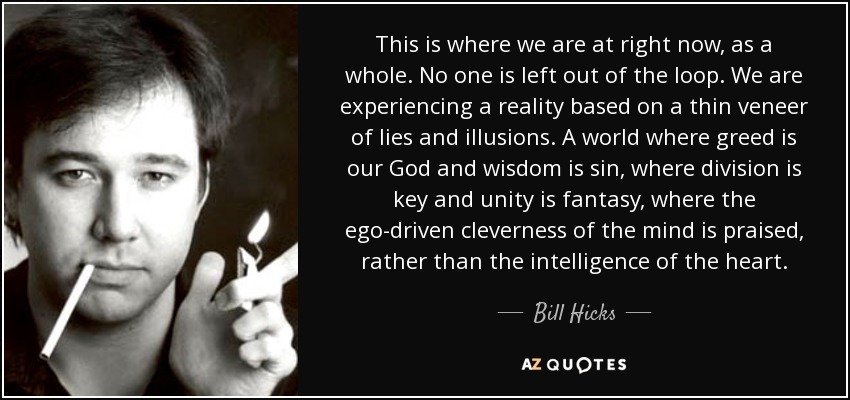
There was a time when you could turn on the TV news and listen to what you were fairly confident was actually news. Walter Cronkite on CBS always seemed to really “Tell it like it is.” He never seemed to put a spin on anything. No one doubted anything he said when he reported space missions from NASA or the assassination of JFK. You never had to wonder, “What is Cronkite’s real agenda?” His agenda was always to tell me the news of the day.
The question of politics and ideas was always one of, “Which flavor tastes best in my own personal opinion?” Because I was weirdly and excessively smart as a kid, I often listened to some of the smartest people accessible to a black-and-white RCA television set.
William F. Buckley Jr. and Gore Vidal were both identifiably smarter than me. I loved to listen to them argue. They were equally matched. They respected each other’s intellect, but they hated each other with a passion. Buckley was a Fascist-leaning conservative ball of hatred with a giant ego. Vidal was a self-contradictory Commie-pinko bastard child of liberal chaos with an equally giant ego. I never agreed with either of them on anything, but their debates taught me so much about life and politics that I became a dyed-in-the-wool moderate because of them. They were the key evidence backing up the theory that you needed two sides in the political argument to hammer out good ideas of solid worth. And, though I didn’t trust either side of the argument fully, I always trusted that both were basing their ideas on facts.
When I was young I identified as a Republican like my father, and thought George Will was a reasonable opinion-leader. After all, a man who loves baseball can’t be a bad guy.
Then along came Richard Nixon and the faith-shaking lies of Watergate. The media began to be cast as the villain as they continued to show the violence and horrors of Vietnam on TV and tell us about campus unrest and the terrible outcomes of things like the Kent State Massacre. The President suggested routinely that the media was not using facts as much as it was using opinions to turn people away from the Nixon administration’s answer to the problems of life in the USA. I tried to continue believing in the Republican president right up until he resigned and flew away in that helicopter with his metaphorical tail between his legs (I am trying to suggest he was a cowardly dog, not that I want to make a lewd joke about poor Dick Nixon… or is that Little Dick Nixon, the man who let me down?)
And then along comes Ronald Reagan, the man acting as a “Great President” because he was a veteran actor and knew how to play the part. And with him came Fox News.
Roger Ailes, a former adviser to Nixon, got together with media mogul Rupert Murdoch, a man who would commit any crime necessary to sell more newspapers, and created a news channel that would pump out conservative-leaning propaganda that would leave Joseph Goebbels envious. I make it a rule to only listen to them and their views on anything when I feel the need to get one-foot-hopping, fire-spitting mad about something. So, since, I am a relatively happy person in spite of a long, hard life, you can understand why I almost never watch Fox News. They are truly skilled at making me mad and unhappy. And I suspect they do the same for everyone. They deal in outrage more than well-thought-out ideas.
News media came under a cloud that obscured the border between facts and partisan opinions. And conservatives seemed to have a monopoly on the shouty-pouty angry news. So, I began to wonder where to turn for a well-reasoned and possibly more liberal discussion of what was politically and ethically real. I found it in the most surprising of places.
I turned to the “Excuse me, this is the news” crews on Comedy Central where Jon Stewart and Stephen Colbert were busy remaking news reporting as a form of comedy entertainment. It is hard work to take real news and turn it into go-for-the-chuckles statements of fact that make you go, “Hmm, that’s right, isn’t it?” Stewart and Colbert consistently examine how other news organizations hurl, vomit forth, and spin the news, and by so doing, they help you examine the sources, get at the truth, and find the dissonance in the songs everyone else is singing. And these are very smart men. As I said, the intellectual work they do is very difficult, harder than merely telling it like it is. I know because I have tried to do the same myself. And is it really “fake news”? It seems to me like it is carefully filtered news, with the poisons of propaganda either surgically removed, or neutralized with antidotes of reason and understanding.
So, Mickey listens to comedians to get his news. Is that where you expected this article to end up? If not, where do you get your news?
He was one of my all-time favorite students. I know I say that about an awful lot of kids. I can’t help it. Once you get to know them well enough to teach them anything, you tend to be hooked for life. They are your kid. You are their teacher. And that means almost as much as if they were born to you.
I first got to know Johnny on one frightful morning in September of 1984. He was a tiny, frail little seventh-grade boy sitting in the second seat of the second row. And as I was trying to get them to read a short story in the literature book, he kept nodding off, falling asleep. Sleeping is not an effective reading strategy. Three times I tried to wake him up and get him on task. He could have told me then, but he was painfully shy, and the only word I had heard from him was, “Here,” spoken during roll call. So, the fourth time I took him outside the classroom door to ask him what was wrong. He was deathly pale.
“What’s wrong? What do we need to do to make it better?”
He looked towards the boys’ restroom. “I gotta go…”
I told him to go, then followed him down to the restroom because I knew it was something serious. Serious enough to leave my class unattended. But they were deathly quiet, because unlike me, they knew what was wrong. I found him throwing up in the trash can. He told me he was sick in a barely audible voice.
Immediately I went to the office and told the secretary that he was ill.
“They have juice for him in the refrigerator in the ESL room,” Ms. Lawler said. “I’m sorry we haven’t gotten the nurse’s list out to teachers yet. He’s got juvenile diabetes.”
Whoa! I didn’t know much about diabetes then, but I did know it was too deadly of a thing to allow myself not to know everything I needed to know. At the time the school nurse had to take care of all four campuses in the school district, and she was only at the Junior High on Thursdays.
Thankfully, over time, not only did I learn more about handling that disease, but medical science did too. When I would later develop adult-onset diabetes in 2000, treatment for diabetics would become much more effective, rendering the disease far less destructive.
As for Johnny himself, he became a part of the small group of housing-project kids who would come to my apartment on Saturdays, and sometimes after school to hang out, use my computer, and play table-top role-playing games. I made a special effort to engage Johnny in conversations about a little of everything. He was a very bright boy when he felt well. I got to know his seriously diabetic mother too. And his older sister would later become a nurse at the local doctor’s office, so I got to know her as well. Johnny didn’t have a father at the time, which also applied to each of the other boys from the project, except for the Camacho brothers whose father was a seriously depressed Vietnam veteran. I suppose that’s why Johnny became like a son to me, one of five boys who at the time treated me like a second father. I taught him. I entertained him. And occasionally I cooked for him.
One of my two girlfriends at the time that I was mentoring Johnny liked to give him sugar-free candy. She got so accustomed to always having some available at her place that she actually got hooked on it herself.
In school Johnny opened up the way a cactus flower blooms when it gets a little rain. He began to talk to other kids a lot. He made himself into a group leader, and he even went out for high school football. Truthfully, I was amazed by him on the football field. He played defensive back. And he played like a star. I watched him intercept the ball about three times and run it back the other way. The coaches soon felt about him the same way I did. He was part of their family too.
And it turns out that being physically fit practically cures juvenile diabetes.
He got stronger and healthier with each season. He gave me the football portrait not because I had anything to do with his success, but because he loved me. I have hugged that boy three times in my lifetime, and each time is a cherished memory that I hope to carry with me to Xibalba, the Mayan Land of the Dead.
When I developed diabetes myself, Johnny’s older sister kept track of my wellness charts herself. Johnny’s family was experienced with handling diabetes, and they looked after me like a member of their family.
The last time I saw Johnny it was in the hallway at school. It was only a year before I left Cotulla for good. He had come especially to see me. I didn’t even recognize him at first because I hadn’t seen him for a decade. I wanted to talk to him and catch up. But I had to pick up my eldest son that day from second grade as he had been ill. I was not feeling well myself. So, I asked for a rain check. He still had that beautiful smile. And he didn’t tell me that that was the only chance he had to see me before leaving town again. It broke my heart when they told me that later.
But I see him again now as I tell you the story of Sugar-Free Johnny. He was probably the sweetest kid I ever taught. He will always be a part of my story. And apparently I am part of his story too.
No man is an island. John Donne the English poet stated that. And Ernest Hemingway quoted it… and wove it into his stories as a major theme… and proceeded to try to disprove it. We need other people. I married an island girl from the island of Luzon in the Philippines. She may have actually needed me too, though she will never admit it.
When I was a young junior high school teacher in the early eighties, they called me Mr. Gilligan. My classroom was known as Gilligan’s Island. This came about because a goofball student in the very first class on the very first day said, “You look like Gilligan’s Island!” By which he meant I reminded him of Bob Denver, the actor that played Gilligan. But as he said it, he was actually accusing me of being an island. And no man is an island. Thank you, Fabian, you were sorta dumb, but I loved you for it.
You see, being Gilligan on Gilligan’s Island was not a bad thing to be. It was who I was as a teacher. Nerdy, awkward, telling stories about when I was young, and my doofy friends like Skinny Mulligan. Being a teacher gave me an identity. And Gilligan was stranded on the Island with two beautiful single women, Mary Ann and Ginger. Not a bad thing to be. And I loved teaching and telling stories to kids who would later be the doofy students in new stories.
But we go through life searching for who we are and why we are here. Now that I am retired, and no longer a teacher… who am I now? We never really find the answer. Answers change over time. And so do I.
I was a boy back when the milk man still came around in his blue-and-white panel truck delivering bottles of milk with Elsie the Cow on them. I don’t remember clearly because I was only 4 years old back when I first became aware of being a boy in this world instead of being something else living somewhere else.
There were many things I didn’t know or understand back then. But one thing I did know was that I loved Elsie the Cow. And why would a farm boy love a cartoon cow? There were many not-so-sensible reasons.
For one thing, Elsie the Cow reminded me of June Lockhart, Lassie’s mom, and the mom from Lost in Space.
Lassie’s Mom, June Lockhart
It may be that June Lockhart’s eyes reminded me of Elsie’s, being large, soulful eyes with long black eyelashes. It may be that she starred in a TV commercial for Borden’s milk in which Elsie winked at me at the end of the commercial.
Or maybe it was because Elsie had calves and was a mom. And June Lockhart was Lassie’s mom and the mom of Will Robinson, so I associated both of them with my mom, and thus with each other.
Elsie gave you milk to drink and always took care of you that way. Milk was good for you, after all. My own mom was a registered nurse. So they were alike in that way, too.
And she was constantly defending you against the bulls in your life. She stood up to Elmer to protect her daughter more than once. Of course, her son was usually guilty of whatever he was accused of, but she still loved him and kept Elmer from making his “hamburger” threats a reality.
And you can see in numerous ad illustrations that Elsie’s family were basically nudists. Although she often wore an apron, she was bare otherwise. And though her daughter often wore skirts and her son wore shorts, Elmer was always naked. And that didn’t surprise me, because no cow I knew from the farm wore clothes either. From very early in my life I was always fascinated by nakedness, and I would’ve become a nudist as a youngster if it hadn’t been soundly discouraged by family and society in general.
Proof that Elsie’s family lived the nude life.
Puppets from a Borden’s commercial
So there are many reasons why I have always loved Elsie the Cow. And it all boils down to the love of drinking milk and that appealing cartoon character who constantly asks you to drink more.
Let’s begin with some stupid advice. I don’t have time to write a lot today because the Princess is ill and must go see the doctor in Plano. So the advice is; Set aside time for writing and always allow plenty of time for it. You will probably notice already that I am giving you advice that I am not taking myself this morning. So don’t follow that advice. It is stupid advice. I have given it to creative writing classes for years and thought I meant it. But looking back on real life, I realize, it has never been true for me. My best ideas, my best writing, always seem to come in the middle of the pressure-cooker of daily struggle and strife. I have battled serious illness for most of my adult life. I have the luck of a man who tried to avoid letting a black cat cross his path by crashing his bicycle at the top of a hill covered in clover with only three leaves each and then rolling down the hill, under a ladder, and crashing into a doorpost which knocks the horseshoe off the top. The horseshoe lands on my stupid head with the “U” facing downward so the luck all drains out. Bad things happen to me all the time. But it makes for good writing. Tell me you didn’t at least smile at the picture I just painted in your mind. You might’ve even been unable to suppress a chuckle. I am under time pressure and misfortune pressure and the need to rearrange my entire daily schedule. So it is the perfect time to write.
This essay, however, is about bad advice. And I am a perfect person to rely on as a resource for bad advice. I am full of it. Of course, I mean I am full of bad advice, not that other thing we think of when someone tells me I am “Full of it!” So here’s another bit of writing advice that is probably completely wrong and a bad idea to take without a grain of salt, or at least a doctor’s prescription. You should stop bird-walking in your essay and get to the damn point!
I know a lot about the subject of depression. When I was a teenager, I came very close to suicide. I experienced tidal waves of self-loathing and black-enveloping blankets of depression for reasons that I didn’t understand until I realized later in life that it all came from being a child-victim of sexual assault. Somehow I muddled through and managed to self-medicate with journal writing and fantasy-fixations, thus avoiding a potentially serious alcohol or drug problem. This is connected to my main idea, despite the fact that I am obviously not following the no bird-walking advice. You see, with depression, Bad advice can kill you. Seriously, people want to tell you to just, “Get over it! Stop moping about and get on with life. It isn’t real. You are just being lazy.”
I have been on the inside of depression and I know for a fact that not taking it seriously can be deadly. In fact, I have faced suicidal depression not only in myself, but in several former students and even my own children. I have spent time in emergency rooms, mental hospitals, and therapists offices when I wasn’t myself the depression sufferer. One of my high school classmates and one of my former students lost their battles and now are no longer among the living. (Sorry, have to take a moment for tears again.) But I learned how to help a depression sufferer. You have to talk to them and make them listen at least to the part where you say, “I have been through this myself. Don’t give in to it. You can survive if you fight back. And whatever you have to do, I will be right here for you. You can talk to me about anything. I will listen. And I won’t try to give you any advice.” Of course, after you say that to them, you do not leave them alone. You stay by them and protect them from themselves, or make sure somebody that will do the same for them stays with them. So far, that last bit of advice has worked for me. But the fight can be life-long. And it is a critical battle.
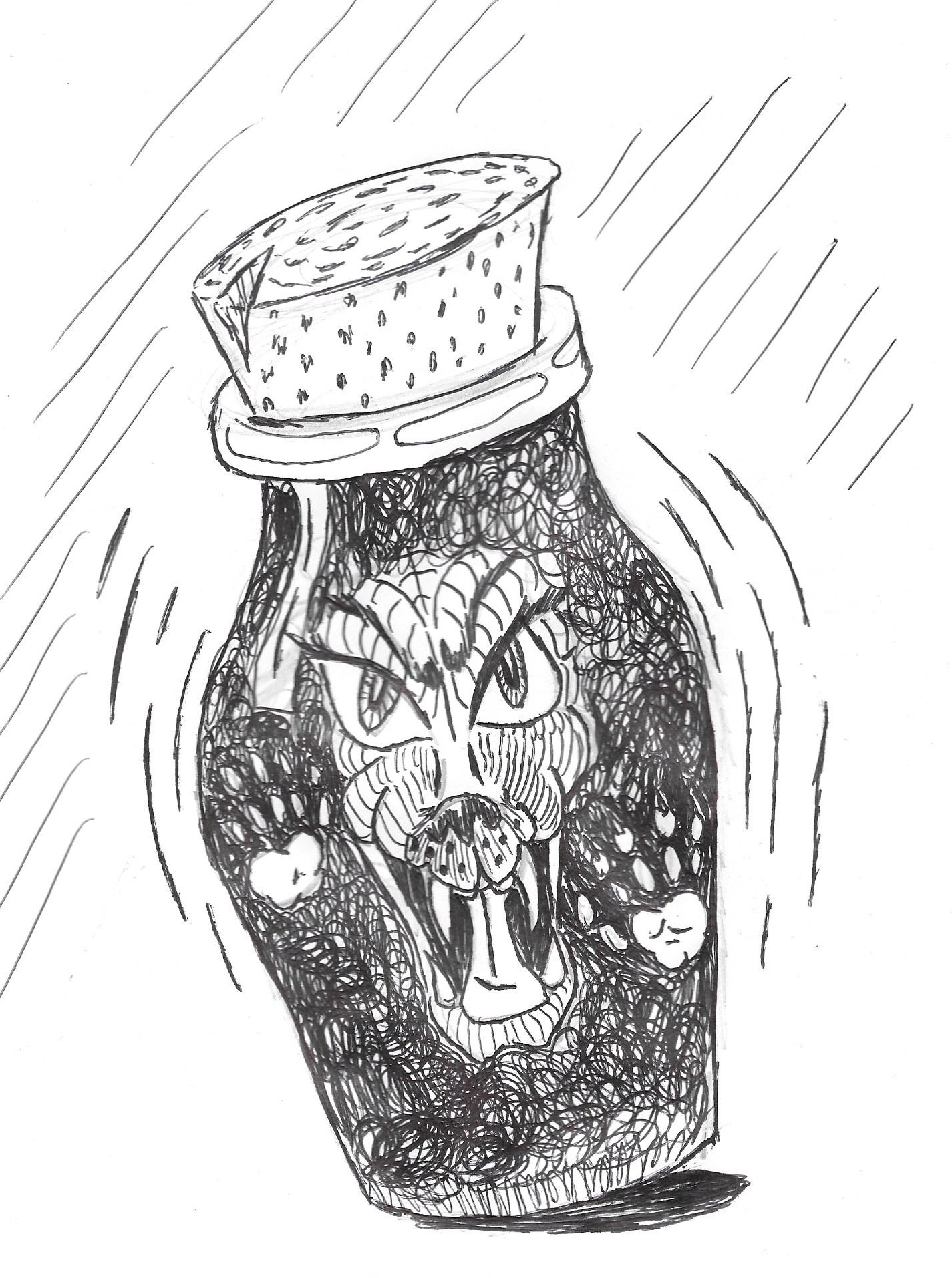
So taking advice from others is always an adventure. Red pill? Green pill? Poison pill? Which will you take? I can’t decide for you. Any advice I give you would probably just be stupid advice. You have to weigh the evidence and decide for yourself. What does this stupid essay even mean? Isn’t it just a pile of stupid advice? A concluding paragraph should tell you the answer if it can. But, I fear, there is no answer this time.
If you are wondering, “How in the Heck can Mickey write nonsense like that essay he wrote yesterday?”, then please be aware that Mickey is pondering that same question.
Seriously, why would a writer publish personal thoughts and allude to personal tragedies? Especially when they are about things that once upon a time nearly killed him? (Please note that when Mickey starts a sentence with “Seriously” it is probably about to lead to a joke, the same way as when Trump says, “Believe me” we should assume he is telling a lie and knows it.)
The answer is simply, writers write stuff. They have to. If they didn’t, they wouldn’t be writers.
It is really not something to do to earn fame and fortune. Fame and fortune happen to rare individuals like J. K. Rowling and Steven King… and even Stephanie Meyer, to prove that it is totally random and not based on actual writing talent… except for sometimes.
You write to get your head right about bad things that happen in life. You find that factor in Mark Twain whose infant son died, as well as most of the rest of his family, before him, forcing him to face survivor’s guilt and the notion that life is random and death does not come for you based on any kind of merit system. Charles Dickens wrote about the foibles of his father, on whom he based the David Copperfieldcharacter Wilkins Micawber, a man who was overly optimistic and constantly landing in debtor’s prison because of it. He also wrote in his stories about the women he truly loved (who were not, it seems, his wife) one of whom died in his arms while yet a teenager. Dickens’ amused take on the innate foolishness of mankind gave him a chance to powerfully depict great tragedies both large (as in a Tale of Two Cities) and small (as in Oliver Twist). I wrote yesterday’s post based on the connection between the nudity I write about in novels and my own traumatic assault when I was only ten.
You write because you have wisdom, an inner personal truth, that you are convinced needs to be crystallized in words and written down on paper. It isn’t necessarily real truth. Lots of idiots write things and post them in newspapers, blogs, and even books. And it is often true that their inner personal truth is complete hogwash. (But, hey, at least the hogs are cleaner that way.) Still, your wisdom is your own, and it is true for you even if some idiot like Mickey reads it and thinks it is only fit for cleaning hogs.
And you truly do have to write. If I did not write my stupid, worthless novels, all the hundreds of characters in my head would get mad and start kicking the pillars that hold up the structures in my head. I do have structures in my head. My mind is organized in boxes that contain specifically sorted ideas and stories and notions. It is not a festering stew pot where everything is mixed together and either bubbling or boiling with hot places or coagulating in the cold corners. (That is how I picture Donald Trump’s mind. It is certainly not an empty desert like many people think, because deserts don’t explode all over Twitter early in the morning like the stew pot metaphor obviously would.)
And so, I have done it again. I have set down my 500+ words for today and made a complete fool of myself. And why do I do it? Because Mickey is a writer, and so, Mickey writes stuff.
“Mickey, why can’t you be more serious, the way smart people are?”
“Well, now, my dear, I think I take humor very seriously.”
“How can you say that? You never seem to be serious for more than a few seconds in a row.”
“I can say it in a high, squeaky, falsetto voice so I sound like Mickey Mouse.”
“You know that’s not what I mean.”
“I can also burp it… Well, maybe not so much since I was in junior high.”
“I distinctly remember getting in trouble in Mrs. Mennenga’s third grade class in school for pantomiming pulling my beating heart out of my chest and accidentally dropping it on the floor. She lectured me about being more studious. But I made Alicia sitting in the row beside me laugh. It was all worth it. And the teacher was right. I don’t remember anything from the lesson on adding fractions we were supposed to be doing. But I remember that laugh. It is one precious piece of the golden treasure I put in the treasure chest of memories I keep stored in my heart.”
“I always listened to the words Groucho Marx was saying, even though he said them awfully fast and sneaky-like. I listened to the words. Other characters didn’t seem to listen to him. He didn’t seem to listen to them. Yet, how could he respond like he did if he really wasn’t listening? In his answers were always golden bits of wisdom. Other people laughed at his jokes when the laugh track told them to. I laughed when I understood the wisdom.”
“Laughing is a way of showing understanding. Laughing is a way of making yourself feel good. Laughing is good for your brain and your heart and your soul. So, I want to laugh more. I need to laugh more. I love to laugh.”
These are volumes 3 & 4 of my daily journal that I have kept since the 1980s.
Writing every single day is something I have been doing since 1975, my senior year in high school. It is why I claim to be a writer, even though I have never made enough money at it to even begin to think of myself as a professional writer. I kept a journal/diary/series of notebooks that I filled with junk I wrote and doodles in the margins up until the mid-90s when I began to put all my noodling into computer files instead of notebooks. I have millions of words piled in piles of notebooks and filling my hard drive to the point of “insufficient memory” errors on my laptop. I am now 69 years old and have been writing every day for 51 years.
There are days in the past where I only wrote a word, or a sentence or two. But there were a lot of words besides the words in my journal. I started my first novel in college. I completed it the summer before my first teaching job in 1981. I put it the closet, never to be thought of again, except when I needed a good cringe and cry at how terrible a writer I once was. I have been starting, stopping, percolating, piecing together, and eventually completing novel projects ever since… each one goofier and more wit-wacky than the last. So I have a closet full of those too.
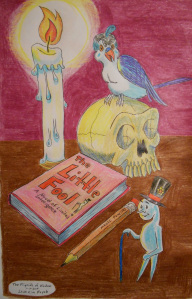
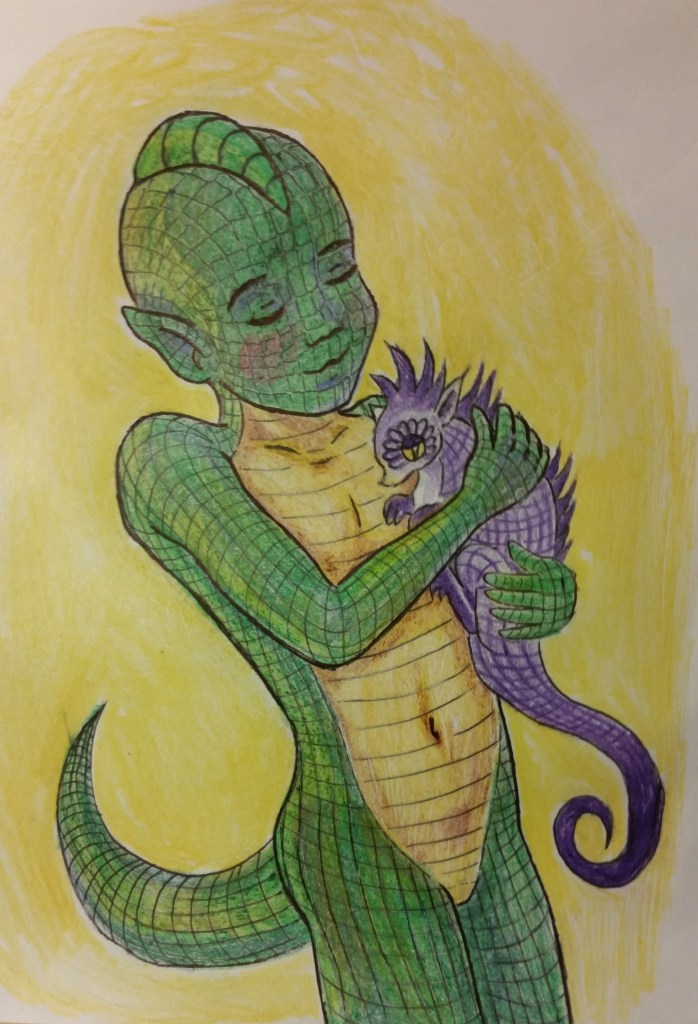
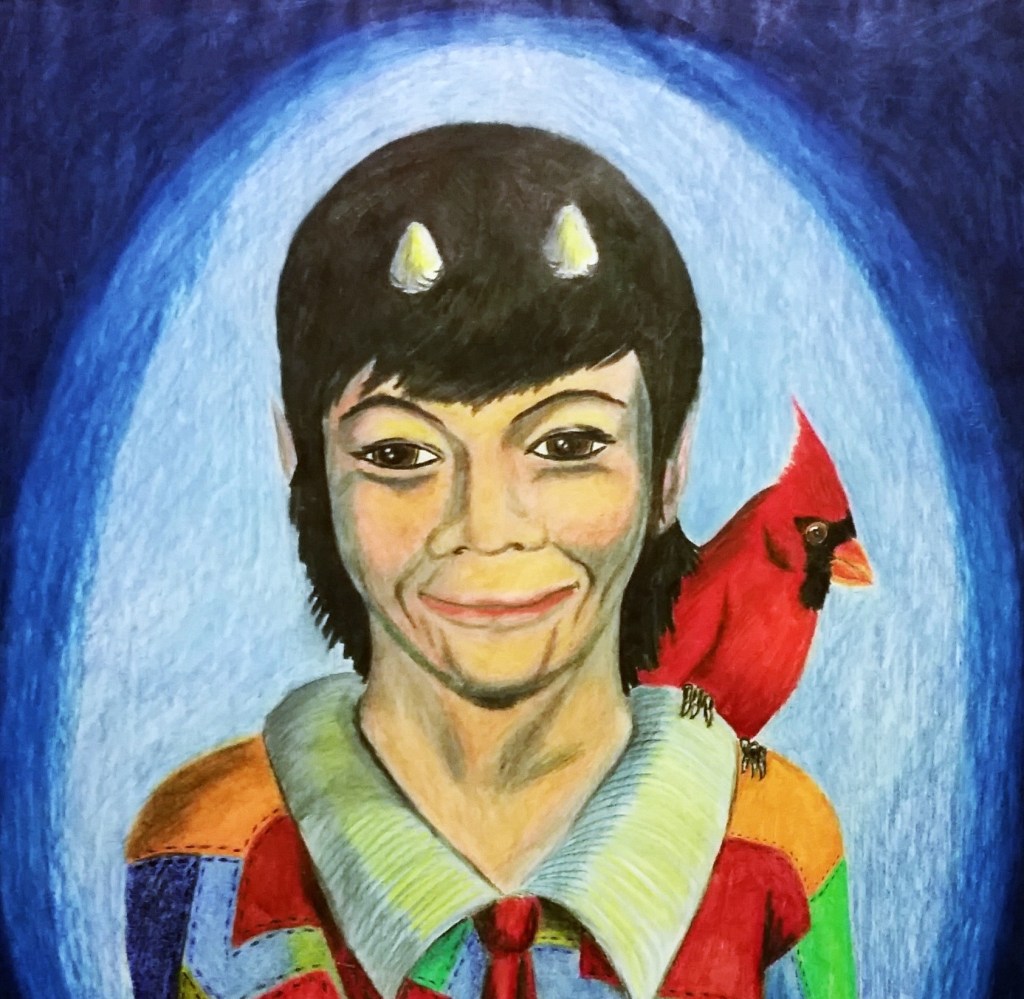
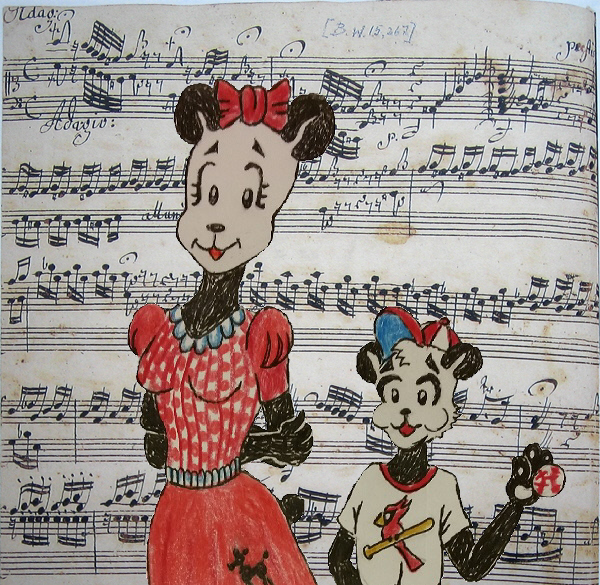
It would be wrong of me to suggest that my journals are only for words. As a cartoon-boy-wannabee I doodle everywhere in margins and corners and parts of pages. Sometimes the doodle is an afterthought. Sometimes it precedes the paragraph. Sometimes it is directly connected to the words and their meaning.
Sometimes the work of art is the main thing itself.
But always, the habit of writing down words and ideas every single day takes precedence over every other part of my day. That’s the main reason I am stupid enough to think of myself as a writer even though I don’t make a living by writing.
But I did put my words into my profession too. As a teacher of writing, I wrote with and to my students. I did that for 31 years as a classroom teacher, and two years as a substitute. I required them each to keep a daily journal (though they only got graded for the ones they wrote in class, and then only for reaching the amount of words assigned). We shared the writing aloud in class, making only positive comments. I wrote every assignment I gave them, including the journal entries. They got to see and hear what I could write, and it often inspired them or gave them a structure to hang their own ideas upon. And often they liked what I wrote and were surprised by it almost as much as I liked and was surprised by theirs. Being a writer was never a total waste of time and effort.
So am I telling you that if you want to be writer you have to write every day too? If I have to tell you that… you have totally missed the point.
Who Do You Listen To?
There was a time when you could turn on the TV news and listen to what you were fairly confident was actually news. Walter Cronkite on CBS always seemed to really “Tell it like it is.” He never seemed to put a spin on anything. No one doubted anything he said when he reported space missions from NASA or the assassination of JFK. You never had to wonder, “What is Cronkite’s real agenda?” His agenda was always to tell me the news of the day.
The question of politics and ideas was always one of, “Which flavor tastes best in my own personal opinion?” Because I was weirdly and excessively smart as a kid, I often listened to some of the smartest people accessible to a black-and-white RCA television set.
William F. Buckley Jr. and Gore Vidal were both identifiably smarter than me. I loved to listen to them argue. They were equally matched. They respected each other’s intellect, but they hated each other with a passion. Buckley was a Fascist-leaning conservative ball of hatred with a giant ego. Vidal was a self-contradictory Commie-pinko bastard child of liberal chaos with an equally giant ego. I never agreed with either of them on anything, but their debates taught me so much about life and politics that I became a dyed-in-the-wool moderate because of them. They were the key evidence backing up the theory that you needed two sides in the political argument to hammer out good ideas of solid worth. And, though I didn’t trust either side of the argument fully, I always trusted that both were basing their ideas on facts.
Then along came Richard Nixon and the faith-shaking lies of Watergate. The media began to be cast as the villain as they continued to show the violence and horrors of Vietnam on TV and tell us about campus unrest and the terrible outcomes of things like the Kent State Massacre. The President suggested routinely that the media was not using facts as much as it was using opinions to turn people away from the Nixon administration’s answer to the problems of life in the USA. I tried to continue believing in the Republican president right up until he resigned and flew away in that helicopter with his metaphorical tail between his legs (I am trying to suggest he was a cowardly dog, not that I want to make a lewd joke about poor Dick Nixon… or is that Little Dick Nixon, the man who let me down?)
And then along comes Ronald Reagan, the man acting as a “Great President” because he was a veteran actor and knew how to play the part. And with him came Fox News.
Roger Ailes, a former adviser to Nixon, got together with media mogul Rupert Murdoch, a man who would commit any crime necessary to sell more newspapers, and created a news channel that would pump out conservative-leaning propaganda that would leave Joseph Goebbels envious. I make it a rule to only listen to them and their views on anything when I feel the need to get one-foot-hopping, fire-spitting mad about something. So, since, I am a relatively happy person in spite of a long, hard life, you can understand why I almost never watch Fox News. They are truly skilled at making me mad and unhappy. And I suspect they do the same for everyone. They deal in outrage more than well-thought-out ideas.
News media came under a cloud that obscured the border between facts and partisan opinions. And conservatives seemed to have a monopoly on the shouty-pouty angry news. So, I began to wonder where to turn for a well-reasoned and possibly more liberal discussion of what was politically and ethically real. I found it in the most surprising of places.
I turned to the “Excuse me, this is the news” crews on Comedy Central where Jon Stewart and Stephen Colbert were busy remaking news reporting as a form of comedy entertainment. It is hard work to take real news and turn it into go-for-the-chuckles statements of fact that make you go, “Hmm, that’s right, isn’t it?” Stewart and Colbert consistently examine how other news organizations hurl, vomit forth, and spin the news, and by so doing, they help you examine the sources, get at the truth, and find the dissonance in the songs everyone else is singing. And these are very smart men. As I said, the intellectual work they do is very difficult, harder than merely telling it like it is. I know because I have tried to do the same myself. And is it really “fake news”? It seems to me like it is carefully filtered news, with the poisons of propaganda either surgically removed, or neutralized with antidotes of reason and understanding.
So, Mickey listens to comedians to get his news. Is that where you expected this article to end up? If not, where do you get your news?
Leave a comment
Filed under angry rant, commentary, conspiracy theory, humor, insight, politics, review of television, strange and wonderful ideas about life
Tagged as Donald Trump, history, News, news media, news reporting, politics, Trump, Walter Cronkite, writing