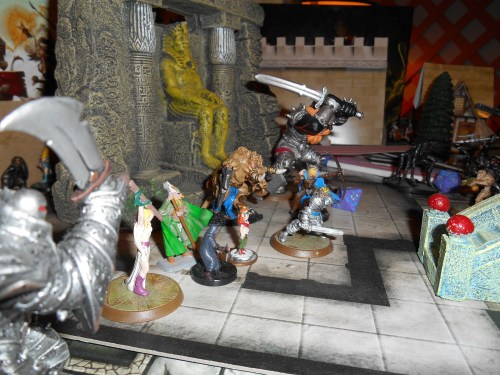
One of the most fascinating things about Dungeons and Dragons, the story-telling adventure game with sword battles controlled by dice rolls, is the characters. They are a creation by committee. You take a blank character sheet, roll six basic numbers by complex rules on dice, and then decide who that character is; paladin, rogue, magician, archer, swordsman, etc… what that character is; human, elf, dwarf, hobbit… I mean halfling, orc, gnome, or Minotaur… and then do the complicated math that those choices entail. But then you have to do the real work and give that character life in the form of hopes and dreams, likes and dislikes, personality quirks, and goals. They have to become collaborative characters for a play that won’t actually be written until the players perform it.
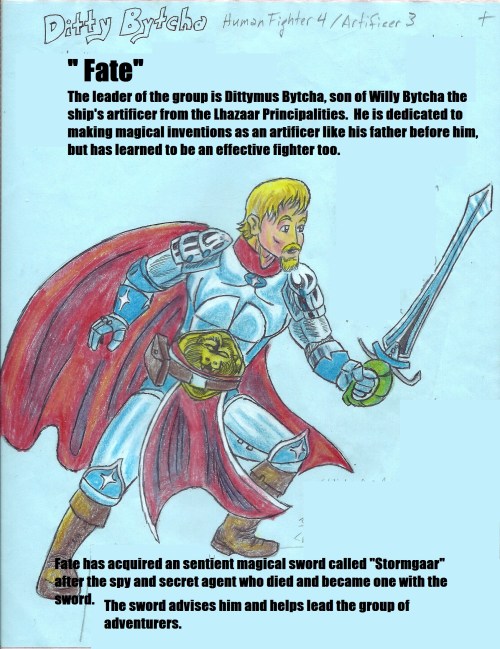
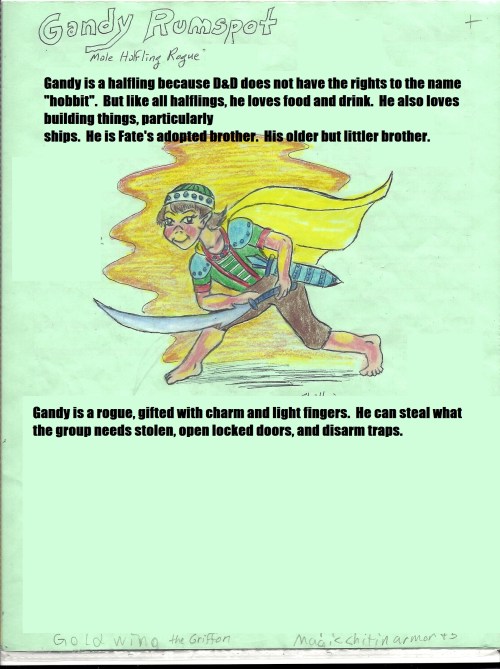
These, you may recall if you are nutty enough to read Mickian regular features, are my children’s player characters.
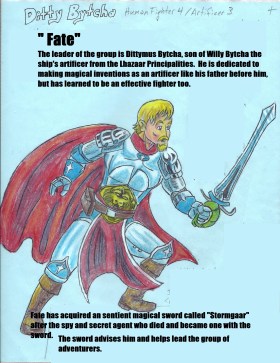 Ditty Bytcha who prefers to be called Fate is my number one son’s original character. He is a fighter wearing magic armor who loves to make things as an artificer (one who builds devices with magic). He eventually wants to cut his own arms off and replace them with mechanical ones. He is also quick to leap into the fray and is fairly deadly with his chosen weapons. He once made a crossbow that had explosive power enough to blast apart a ship and kill everyone on board, including the people he was trying to save. He is also a good leader and is always ready with a joke that can even make the Dungeon Master laugh.
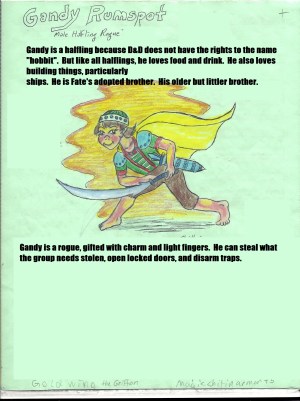
And number two son’s character, Gandy Rumspot, is a food-loving halfling that also likes making ships. No kidding, he likes being a shipwright and designing sailing vessels… and flying airships powered by captured air and fire elementals. He likes riding pteradactyl-back and firing crossbows at the evil enemies from the air. And he is good at making fun of other characters, even to the point of making some of them angry to the point of tantrums… especially his sister’s character.
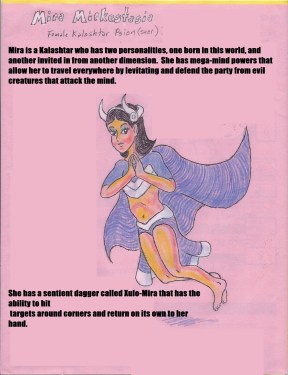
And, of course, my daughter the Princess’s character, Mira Mirkestasia is a telekinetic Kalashtar who floats everywhere instead of walking. She possesses an intelligent throwing knife that not only comes back to her hand after every throw, but seriously wants to kill Gandy for his sister-jokes. She protects the whole group from those like the evil Dr. Zorgo who threaten to take over your mind and put your brain inside a stone golem.
And, of course, three people is probably not enough to actually survive in magic-rich and dragon-filled Eberron. So additional characters are required to go on and actually survive dungeon-crawling adventures. These are known as NPC’s, Non-Player Characters. I will tell you more about them in another post, but here are the two most important ones;
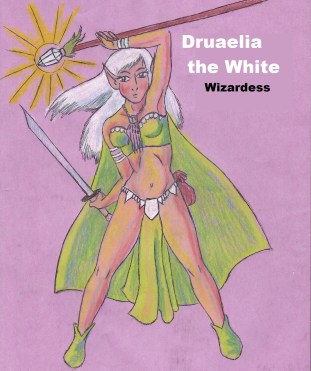
Druaelia is a female wizard whose familiar is the owl Temper. She was there for the very first level-one adventure killing rats and gnolls who were particularly weak and stupid. She started as a magic user looking to be the fireball expert. But her fire magic kept going astray (rolling a 2 or a 1 on a 20-sided dice is catastrophic failure and not a good thing to roll when fire is involved). And she eventually learned she was much better with ice and snow magic. She is naturally immune to cold and can wear bikinis in winter, a useful thing when more than half of your team is made up of adolescent boys.
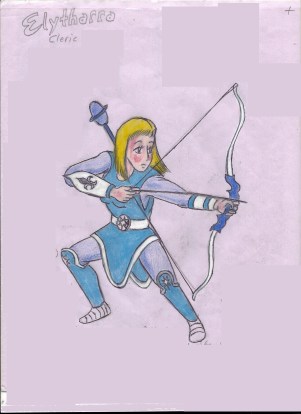
Elytharra, more commonly referred to as El, is the cleric and healer of the group. She is much more modest and devout, being a worshipper of the blue dragon Aureon, god of wisdom and magical knowledge. She is the one charged with learning how to heal boo-boos (and re-attach heads and raise the dead) because hunting for treasure in dragon caves is a dangerous business and dice rolls can make really bad things happen. She was also part of the very first adventure, and the rats almost ate her.
So the main reason we have enjoyed D&D adventures so much is the fact that the characters are so surprisingly real. We learn to care deeply what happens to them, and want them to prosper in the face of evil, no matter what comes. And the real secret behind them is… in truth they are really us.









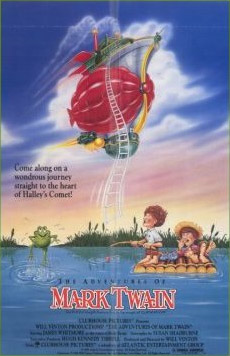 During my middle-school teaching years I also bought and read copies of The Prince and the Pauper, Roughing It, and Life on the Mississippi. I would later use a selection from Roughing It as part of a thematic unit on Mark Twain where I used Will Vinton’s glorious clay-mation movie, The Adventures of Mark Twain as a way to painlessly introduce my kids to the notion that Mark Twain was funny and complex and wise.


 The first big surprise came from Muck Lad. Muck Man chose the Friday showing at Valley View Mall because Muck Lad had to work both Saturday and Sunday and couldn’t attend otherwise. His job at the Asian Market making and serving boba tea is the most important factor in his life right now. He needs the money to buy a gaming computer. You know how important that is to a teenager in this day and age. But when the time came to go to the movie, as much as he really wanted to see it, his headache was too much to allow him to go. He needed to stay in the Muck Cave with Muck Dog and play RPG computer games instead.




 Catch a Falling Star
The Iron Fist
Comic books are not real life. They are better than real life. They allow you to go forward in your own story with the myth of the super power to bolster your courage. You can face your daily devils and demons secure in the knowledge that, while no one is perfect, we can all at least imagine holding firm to an ideal in spite of the trials we face… being true to a power and a goodness beyond ourselves… being a hero.
I have followed Iron Fist’s adventures since the 1970’s. It is true that I haven’t been as devoted to him and his heroics as I have been to Spiderman and the Avengers. But I love the idea of a good guy in white standing up to the bad guys in black and beating the poop out of them with a good heart and a bare fist, not resorting to guns and bombs and gratuitous killings. Danny Rand, the Iron Fist, has always been such a character to me. Noble because he does not intentionally kill the enemy, like Batman, Superman, Captain America and so many other favorite super heroes.
I admit it, this love-gush of a post is only happening because I finished binge-watching the new Iron Fist series on Netflix. I depend on Netflix now to deliver to me effortlessly what I used to endlessly hunt and scrabble for in the way of idea fuel and motivational electricity. And even though I am a notoriously uncritical critic, I have to say, it was not as heart-thumpingly good as either Daredevil or Luke Cage. But it brought an old friend to life in a way that I never before believed could happen. And I love the way it fit this puzzle piece into the overall jigsaw of the Marvel superhero stories on Netflix. It used characters like the ER nurse Claire and the villainous Madam Gao to connect plotlines in Daredevil and Luke Cage, and the evil but helpful lawyer character from Jessica Jones. Will I watch it again? Definitely. Will I need to draw Iron Fist for myself? Probably. But this is a hard experience to either explain or recapture. Television using comic book heroes, sometimes, at its best, makes life better than it really is.
Leave a comment
Filed under comic book heroes, commentary, heroes, humor, review of television, strange and wonderful ideas about life
Tagged as binge watching, comic book heroes, Iron Fist, Netflix, television