Last night I watched again Part I of Ken Burns’ Mark Twain. I think it reminds me of who I am as a writer. No, I am not being all big-head arrogant and full of myself. I devoured certain writers as a youth, consumed them whole. Charles Dickens was my first passion, followed by J.R.R. Tolkien, and then Mark Twain. Of all of them, Samuel Clemens is the most like me. He was from the Midwest, born and raised in Missouri along the Mississippi River. I am from the Midwest, born and raised in Iowa along the Iowa River. He endured hardship and tragedy as a youth, losing his little brother in a riverboat accident, and he dealt with it by humor. I endured a sexual assault from an older boy, and dealt with it by… well, you get the picture. We are alike, him and I. We both draw upon the place we grew up, the people we have known, and the events of our youth to create stories.
It is a pretty big responsibility to follow in his footsteps, and I will probably never live to see the success and the wealth that came to him. But I have a responsibility to the people I knew and the time that gave rise to me to tell their story. I need to build a network of stories that resonate the truth of existence that I have been witness to. A big responsibility… and I probably will not live up to it. But I have to try.
Being a writer is somewhat like being cursed. The words burn inside, needing to get out, needing to be heard. I have stories that need to be told, and they will be told, even if only to file away in the closet again. Like Mark Twain, I am good at feeling sorry for myself. And the Mickey part of me, the writer part of me, is just like Mark Twain, a writer persona, and not the real man himself. I am simply the container for something that has to exist and has to tell stories. It is not a bad thing to be. But the more I get to know it, the more I would not wish the destiny on others.
Forgive how sad and bunglingly boorish this post is. But sometimes there are thoughts I simply have to think. And as a writer, I am bound to write down the silly things that I think.
One really weird thing that teachers do is think about thinking. I mean, how can a person actually teach someone else how to think and how to learn if they don’t themselves understand the underlying processes? Now that I have retired from teaching and spend all my time feeling sorry for myself, I thought I would try thinking about thinking one more time at least. Hey, just because I am retired, it doesn’t mean I can’t still do some of the weird things I used to do as a teacher, right?
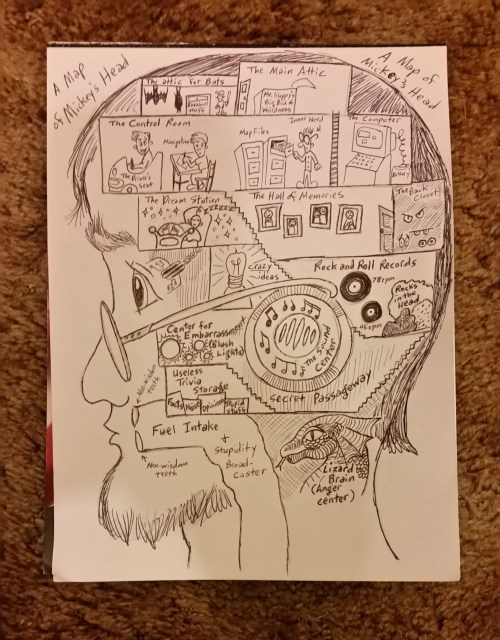
This time I made a map to aid me in my quest to follow the twists and turns of how Mickey thinks and how Mickey learns. Don’t worry, though. I didn’t actually cut Mickey’s head in half to be able to make this map. I used the magical tool of imagination. Some folks might call it story-telling… or bald-face lying.
Now, a brain surgeon would be concerned that my brain maps out in boxes. He would identify it as a seriously deformed brain. It is not supposed to be all rectangular spaces and stairs. It probably indicates a severe medical need for corrective surgery… or possibly complete amputation. But we are not going to concern ourselves with trying to save Mickey from himself right now. That is far too complex a topic to tackle in a 500-word daily post. We are just discussing the basics of operation.
You see the three little guys in the control room? They are an indication that not only did I steal an idea from the Disney/Pixar Movie Inside Out, but I apparently have too few guys doing the job up there compared to the movie version. (It probably makes sense though that a young girl like the one in the movie has a much more sensible configuration in her brain than someone who was a middle school teacher for 24 years. Seriously, that job can do a bit of damage.) The three little guys are not actually Moe, Curly, and Larry, though that wouldn’t be far from descriptive accuracy. They are Impulsive Ignatz, currently in the driver’s seat (or else I wouldn’t be writing this), Proper Percy the Planner, and Pompositous Felixian Checkerbob, the fact-checker and perfectionist (also labeled the inner nerd… I am told not everyone has one of these). They are the three little guys that run around in frantic circles in my head trying to deal with a constant flow of input and output, trying to make sense of everything, and routinely failing miserably.
I shouldn’t forget the other two little guys in my head, Sleepytime Tim in the Dream Center, and little Batty up in the attic. I have no earthly idea how either of them function, or what in the heck they are supposed to do. But there they are. The other three run up and down stairs all day, locating magic mushrooms and random knowledge in the many file cabinets, record collections, book stacks, and odd greasy containers that are stored all around in the many nooks and crannies of Mickey’s mind. They collect stuff through the eyes and ears, and it is also their responsibility to chuck things out through the stupidity broadcaster at various inopportune times. It is also a good idea for them to avoid the lizard brain of the limbic system in the basement. It is easily angered and might eat them.
So now you should be able to fully understand how Mickey thinks. (Or not… a qualifier I was forced to put in by Checkerbob.)
I respond to dreaming in ways that make sense in my stupid head, though the responses probably seem crazy to others.
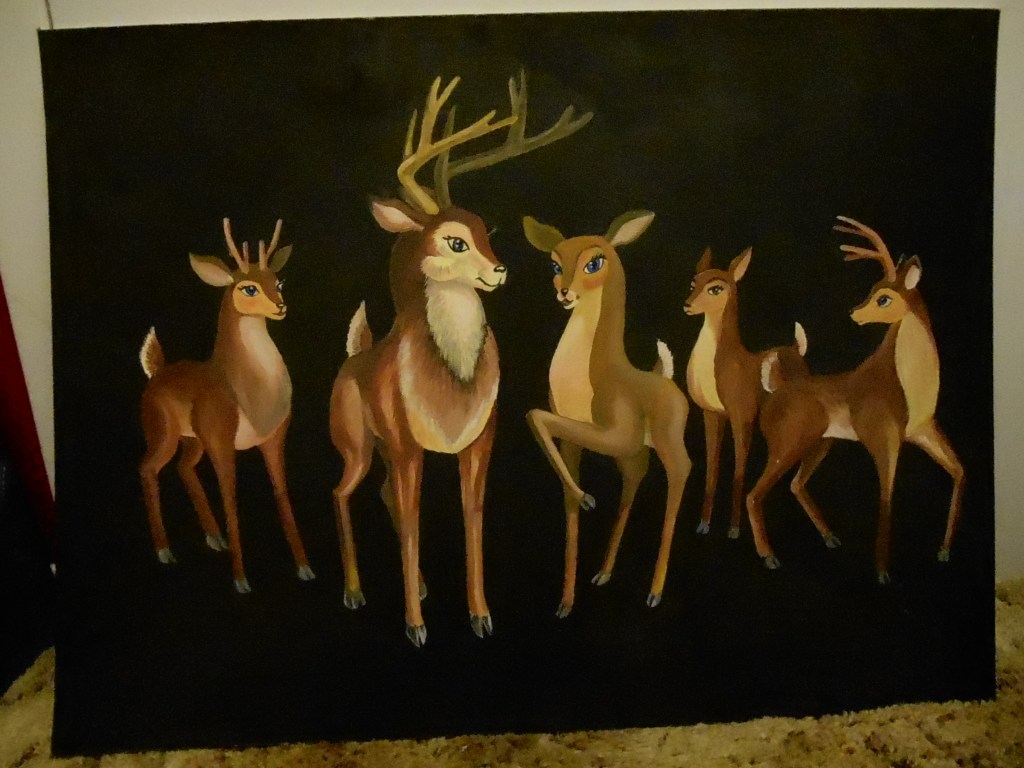
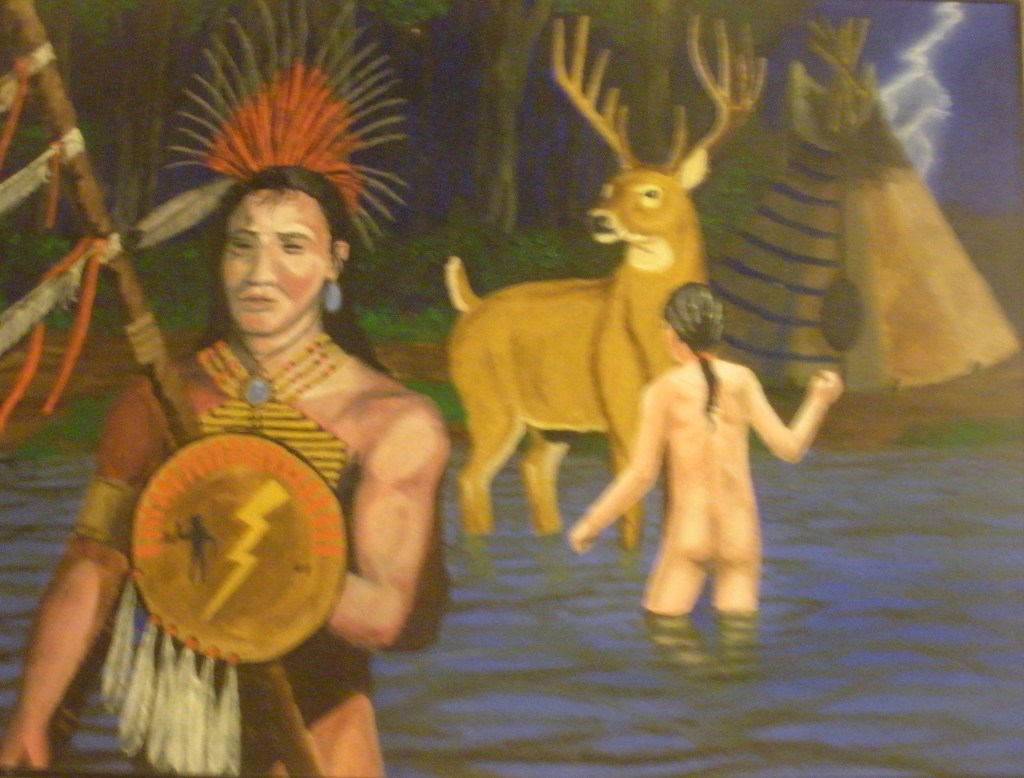
The picture above was painted in oils in the early 1990’s before I met my wife. It was in response to a Bambi dream that seemed to be about my family as a family of deer. This was not about my family from childhood. It was, at the time, about my family in the future. Somehow I got it right. Two boys and a girl. Together for 30 years next month.
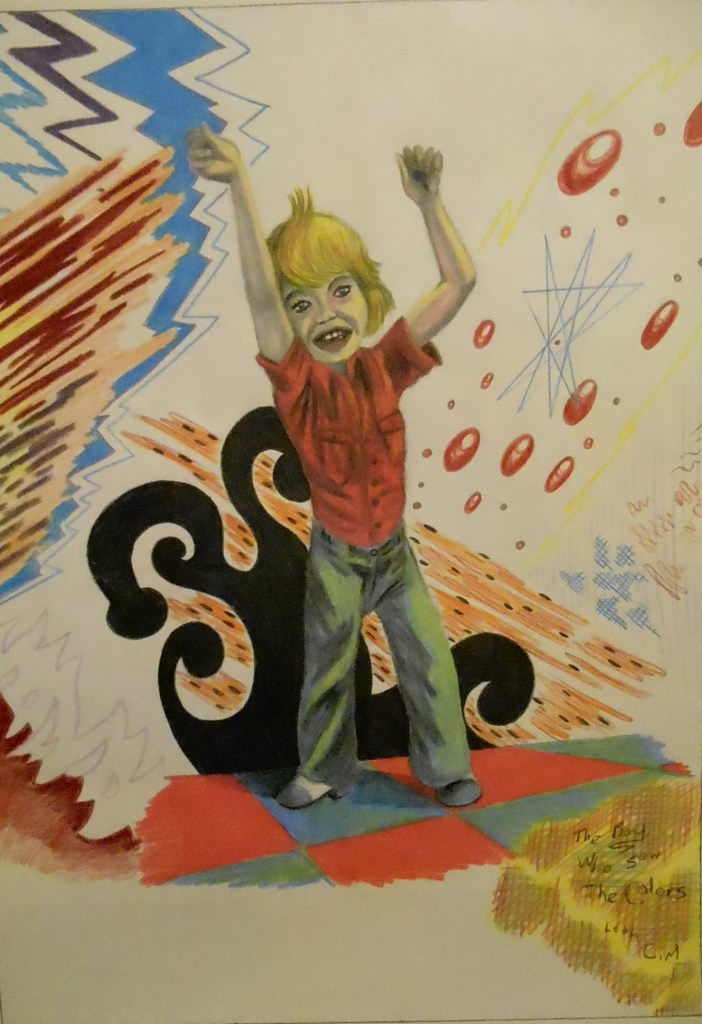
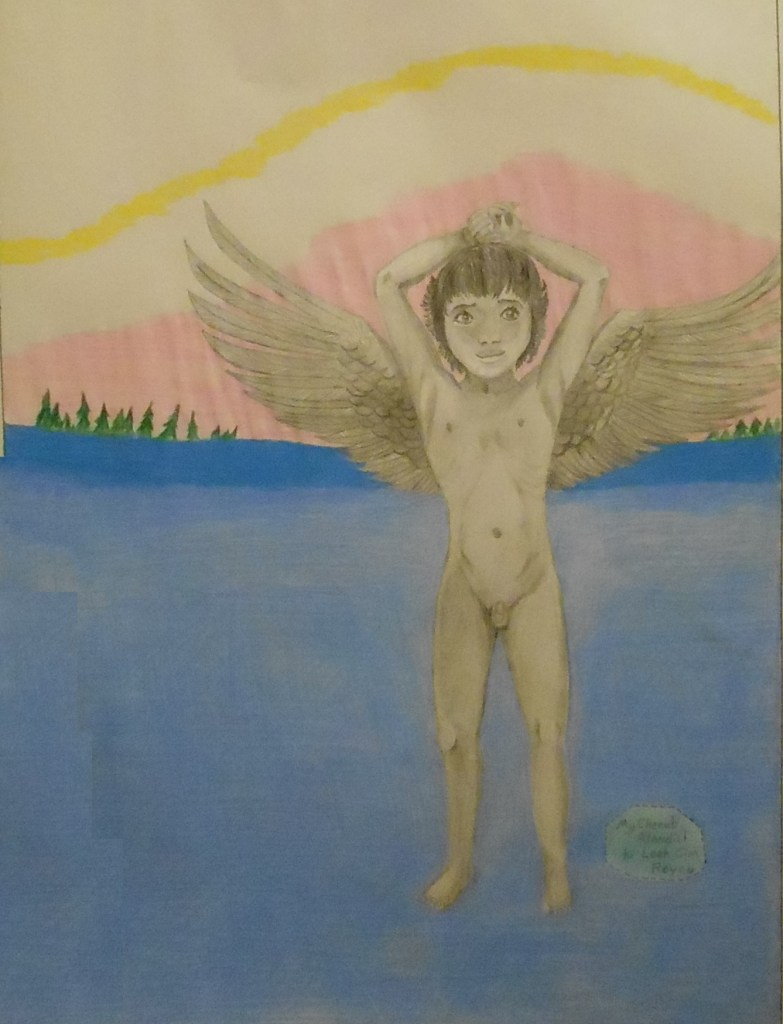
This picture is called, “The Boy Who Saw the Colors”,
Some pictures are dream images that can only be interpreted metaphorically. This one is about me being creative and artistical… or autistical as the case may be. It is also about being a synesthete with pronounced synesthesia.
This dream was a dream about being a Native American during a thunderstorm. It is called “the Magic-Man’s Daughter” because the Dakota Sioux tribe held the belief that dreams about lightning reveal you as a Shaman or Magic Man. Wakȟáŋ Tȟáŋka is the Lakotah word for “the Great Mystery”. That was a dream that sent me to the library to look things up.
I have dreams with clowns in them that are not nightmares. Here the clown known as Mr. Disney is encouraging me to sing sad songs.
I wrote an entire novel about that whopper of a dream.
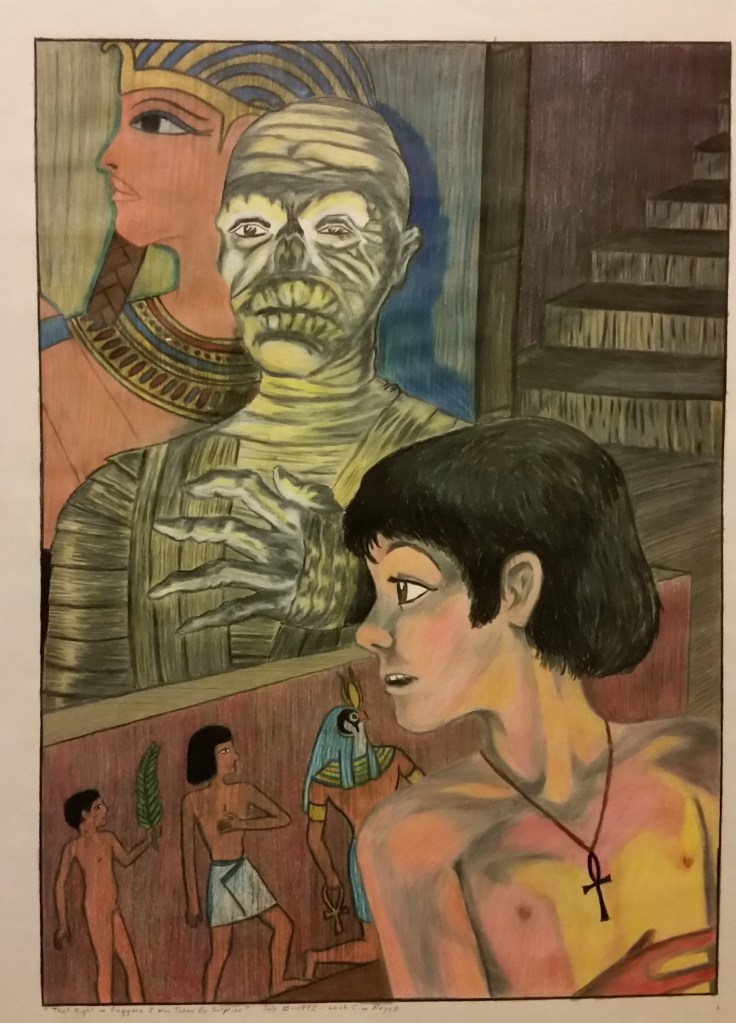
This dream had me trapped in a tomb with a Mummy who wouldn’t stay in his nice warm sarcophagus.
It is not uncommon to dream about death and mortality. More than once I have dreamed about my own death. None of them have yet proved prophetic, but you never know.
I dreamed about my eldest son 14 years before he was born.
I think dreams can be prophetic because they are not bound by our perceptions of time in the physical universe. You can look ahead in a dream to that which has not yet happened. You can also look backward into the past beyond the boundary of your own birth. I often think some of my most vivid dreams are about peering into past lives and a very different me.
I know I sound crazy when I talk about my dreams. But they are a significant source for my artwork and creative endeavors. And dreams have a logic that doesn’t work by the rules of the world we know. Rather, it is a world of wonder.
I have published my eighth novel in the last six years. (This is, of course, a re-post of an old essay.) Sure, it is through mostly self-publishing of novels that no one but me has ever read. Catch a Falling Star and Snow Babies both had a professional editor, one who had worked for Harcourt and one who worked for PDMI. Magical Miss Morgan has had a proofreader who made numerous stupid mistake errors that I had to change back to the original meticulously by hand. But all three of those novels won an award or were finalists in a young adult novel contest. I do have reason to believe I am a competent writer and better even than some who have achieved commercial success.
But what is the real reason that I am so intent on producing the maximum amount of creative work possible in this decade? Well, to be coldly objective, I am a diabetic who cannot currently afford insulin. I have been betrayed by the for-profit healthcare system that treats me as a source of unending profit. I am like a laying hen in the chicken house, giving my eggs of effort away to a farmer who means to eat my very children if time and circumstance allows. I am the victim of six incurable diseases and conditions that I got most likely as a result of exposure to toxic farm chemicals in the early 70’s. I am also a cancer survivor from a malignant melanoma in 1983, and for three years now I have not been able to get the preventative cancer tests I am supposed to be receiving every year for the rest of my life. My prostate could very well be cancerous as I write this. If that is so, it will kill me unawares, because I don’t even want to know about having a disease I can’t possibly afford to fight all over again.’
So, the basic reason I am going through the most productive and creative period of my entire life is because I have a great rage to create before I die and I could be dying as soon as tonight. All of the countless stories in my head clamoring to be written down before it is too late cry out to me desperately for my immediate attention.
I will, then, continue to write stories and draw cartoons and other Paffoonies for as long as I am still able, and possibly even afterward. I have, after all, threatened repeatedly to become a ghostwriter after I die. And, yes, I understand when you scream at my essay that that is not what a ghostwriter is. But if a woman can channel the ghost of Franz Schubert and finish his unfinished symphony…(https://en.wikipedia.org/wiki/Rosemary_Brown_(spiritualist))
—then I should also be able to tell my stories from beyond the grave. I have been percolating them in my head and writing and drawing them in whole or in part since 1974. I have too much time and too many daydreams wrapped up in them to let it all just evaporate into the ether. In summation, I am claiming stupidly that my novels, crack-brained and wacky as they are, are somehow destined to exist, either because of me or in spite of me. So just be happy that I write what I write, for there is an art to being Mickey, and I am the one artist and writer who is the best Mickey possible if truly there ever was a real Mickey.
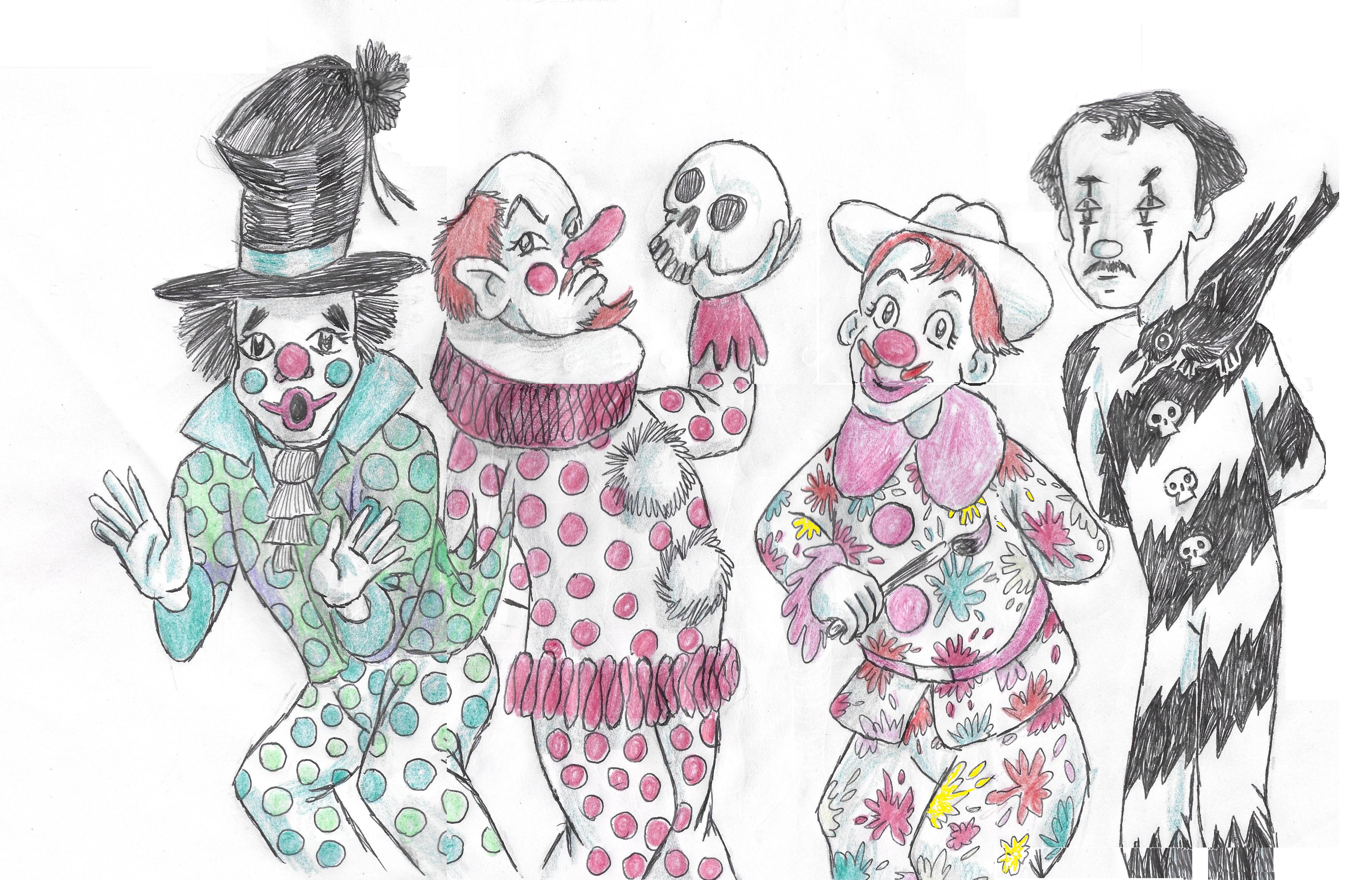
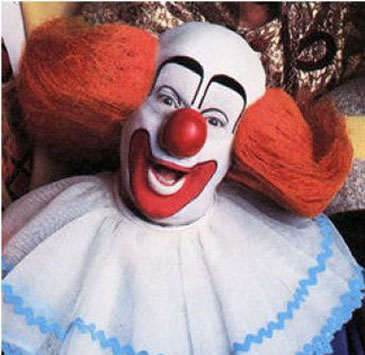
Charles Dickens, William Shakespeare, Walt Disney, and Edgar Allen Poe (the four clowns depicted above) all probably had times in their writing life when they didn’t really have anything to write about. Charles Dickens couldn’t think of anything but his time in the boot-black factory and the misery he felt as a child raised in poverty. So, what did he do? He created Wilkins Micawber as a stand-in for his ne’er-do-well father who always believed, “Something will presently turn up.” And he wrote the semi-autobiographical novel David Copperfield.
William Shakespeare didn’t actually write anything with his grade-school education and limited knowledge of the world. But when the Earl of Oxford who used his name as a nom de plume could think of nothing, he thought of ending it all, and the “To-be-or-not-to-be…” play, Hamlet, poured out of his quill pen onto paper.
And when Walt Disney rode the train in defeat, having lost his best comic character for cartoons, Oswald the Rabbit, to his old boss, he doodled a mouse and named him Mickey, even providing Mickey’s falsetto voice for decades on the silver screen. Oh, and claiming the rights to any further characters his studios produced… to this day.
Poe looked at the bust over his chamber door… and saw a raven. Instantly, NEVERMORE.
Now it’s Mickey’s turn to write about nothing, and try to live up to the nothing-masters’ artistic masterpieces of yore. For instance, the boy in the picture. I drew him from a nude model in a black-and-white photo. Nobody in class, not even the one who brought the picture, ever told me his name. And the class was forty-four years ago now. So, assuming the picture wasn’t old back then, the boy is now older than fifty-four, and possibly significantly older than that now. So it is a picture of a nude nobody in front of an abandoned house in the snow however-many years ago in a place that is probably nowhere now. And I won’t even mention the imaginary puzzle pieces floating through the air for nobody to put together. What’s that? I just mentioned them? What did I mention? They are really just nothing.
So, there is a time and a place for writing about everything. Even if that everything includes nothing… and that nothing is nowhere… and is about nobody.
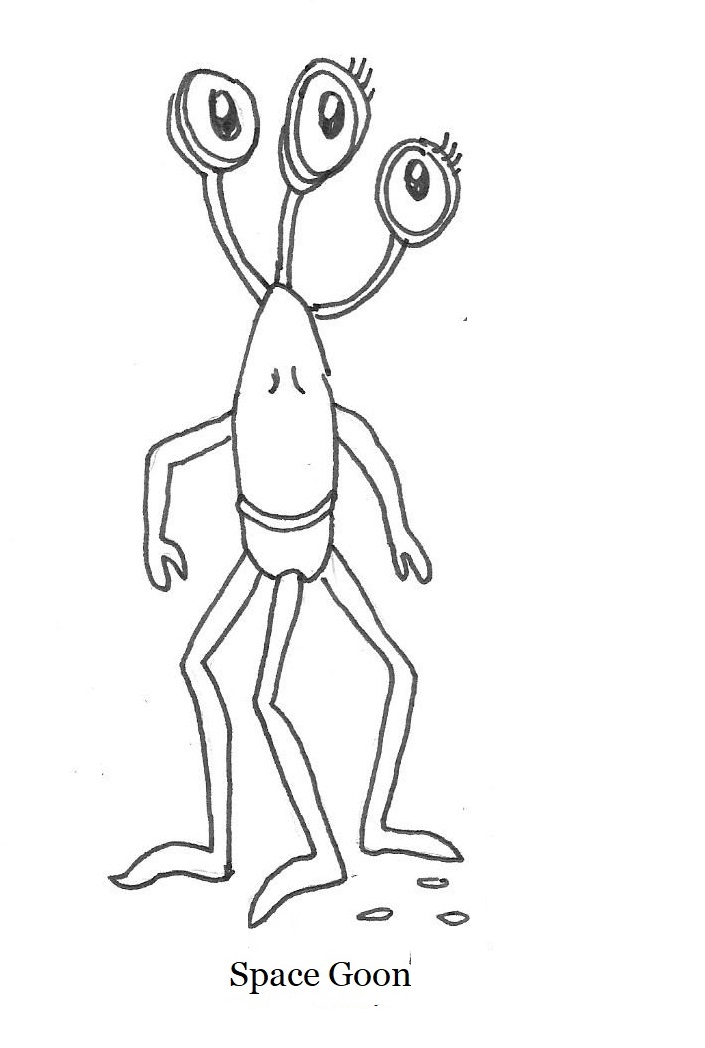
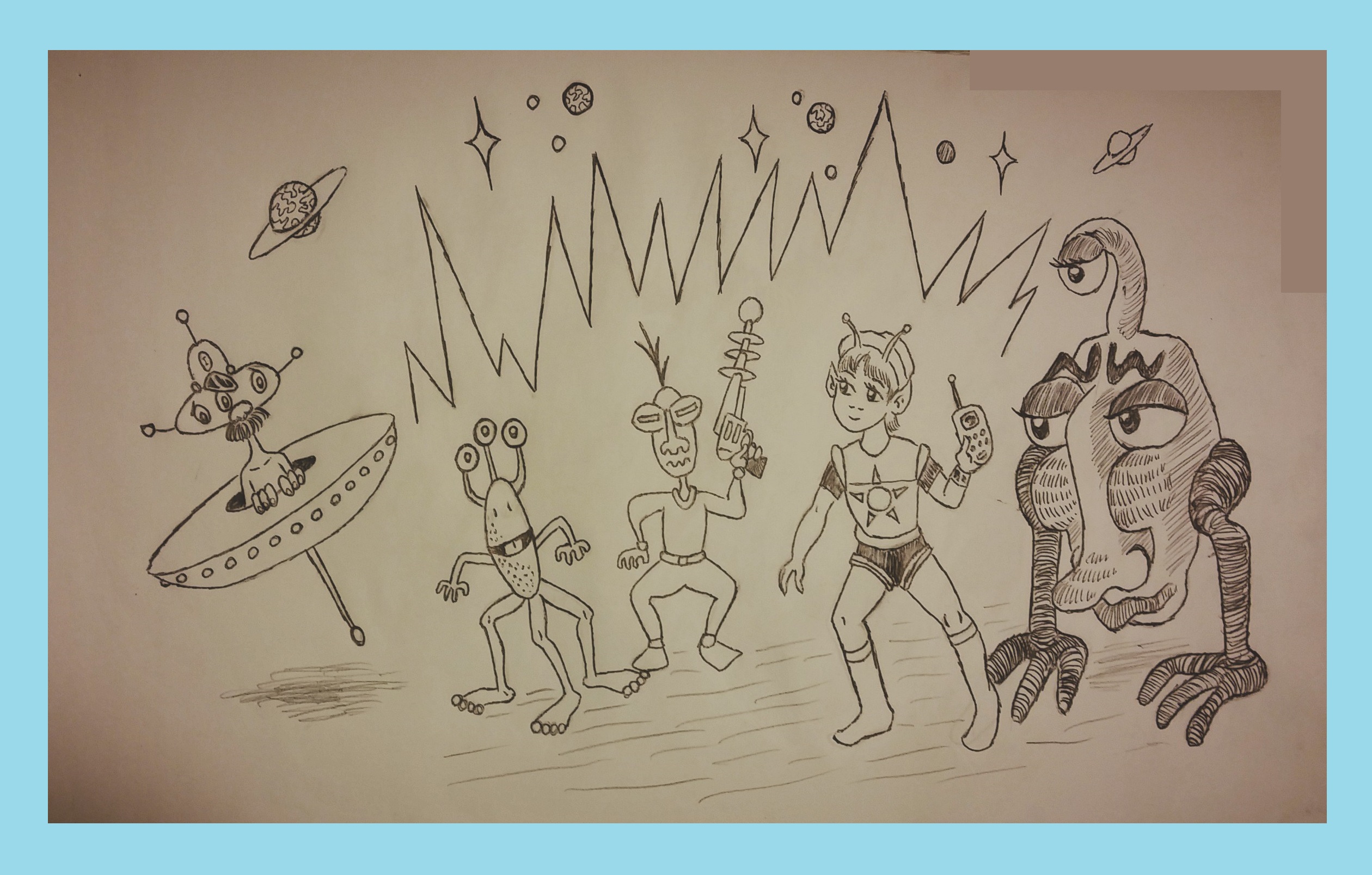
The Ixcanixian Cultural Ambassador from the Squeelix Sector of the Planet Ixcanix sent me an e-mail about his planet’s newest idea for a cultural exchange. He calls it the “Ixcanixian Spleegle Gorn Vorpaloop” which translates to the “Ixcanixian Interstellar Bad Poetry Challenge”. At least, it does if I am conjugating the verb “Vorpaloop” correctly. It is difficult because you have to drop the silent “y” before adding the “aloop” without causing it to explode. I know it is probably a very bad idea to present it here on this planet, but he talked me into it by promising to promote my novel Catch a Falling Star on his homeworld and at least two other planets in the Bugeye Federation.
Here are the rules for the alien poetry contest;
Entries can only come from planets in the Orion Spur of the Sagittarius Spiral Arm of the Milky Way Galaxy. (So, for you non-astronomers out there, we on Earth do qualify.)
All poets must be less intelligent than the Mud-Eaters of Paralaxos IV as they will be employed as judges of what poetry is truly bad. (Again, Earth qualifies as we have recently elected Trump and also allow Nigel Farage of Great Britain to continue to exist.)
Entries must not be so long that the total weight of letters exceed critical mass and form black holes in the intergalactic servers when uploaded.
Vogons need not apply. Their poetry is so bad, they would automatically win, causing the death of trillions of bad poetry readers in the galaxy.
Entries must not cause thermonuclear reactions with cesium.
Please refrain from confusing good poetry with bad poetry. The Vornloos of Talos XII are looking for poetry they can weaponize, and no one wants a poetry contest winner to suddenly create World Peace on Talos XII. That would be bad for the galaxy as a whole in ways that are very difficult to explain.
A sample of interstellar bad poetry is included here to inspire the kind of poetry we seek.
Ratzen Bargle’s Bisketoon (a love poem by Touperary Kloob, Poet Laureate of Antares VI)
Ratzen Bargle was a Doofus,
From the planet Rufus-Ploofiss,
And he had a lovely bride,
With a head not tall, but twice as wide.
She had three eyes and two were green.
She had the loveliest fleen you’ve ever seen.
And as they sat ‘neath a wayward moon,
He kissed his lovely bisketoon.
Immediately before naught was said,
She bit off his tiny three-eyed head.
And then she ate him bones and all
With sauce that really becomes the fall.
And so it is on Rufus-Ploofiss,
That males all die with one last roof-kiss.
Because they sit under wayward moons
With their lovely, hungry bisketoons.
Should you have the unfortunate urge to participate in this senseless and probably suicidal poetry contest, you are welcome to offer four-line poems in the comment section, or email longer poems to Mickey at mbeyer51@gmail.com. I will attempt to transmit the worst offers to the Ixcanixians as soon as I get my interstellar flooglebeeder transmitting again. I will also post winners in a future alien poetry blog.
I have been warned that prizes range from instant execution by the Lizard Lords of Galtorr Prime to a beat up copy of Mickey’s 2012 novel Catch a Falling Star. So, good luck with the bad poetry.
If you have the bad habit of reading this particular blog more than once, then you are probably aware that I used to be a public school teacher. Even worse, I used to be a middle school English teacher. Aagh! Seventh graders! It explains a lot about how life has warped my intelligence, personality, and world view. It also explains somewhat where I found such a fountain-like source for some of the worst jokes you ever heard.
Now, as to the question of why I have chosen in my retirement early-onset senility to become a humor-blogger… well, that is simply not something I can answer in one post… or even a thousand. But kids are the source of my goofball clown-brain joking around.
Kid-humor, you see, is stunted and warped in weird ways by the time period you are talking about. The eighties, nineties, two thousands, and the tens are all very different. And those are the various sets of students that I attempted to learn moose bowling from by teaching them English.
Still, there are certain universal constants.
Potty humor really kills. If you want to make a thirteen-year-old crack up with laughter, roll around on the floor, and maybe wet his or her pants, then you only need to work the “poop” word, or the “nickname for Richard” word, or the “Biblical word for donkey” word into the conversation. Of course the actual words, even though we all know what they actually are, are magical words. If you actually say them to kids in school as their teacher, those words can actually make you magically and permanently disappear from the front of the classroom. All kids are big fans of George Carlin and his seven words, even though most of them have never heard of him.
And violent humor is popular with kids from all decades. The most common punch line in the boys’ bathroom is, “… and then he kicked him in the Biblical word for donkey!” followed closely in second place by, “… and then she kicked him in the Biblical word for donkey!” I am told (for I don’t actually go in such scary places myself) that in the girls’ bathroom the most popular punch line is, “…so I kicked him right in the soccer balls, and he deserved it!” Why girls are apparently obsessed with soccer, I don’t know… or particularly care.
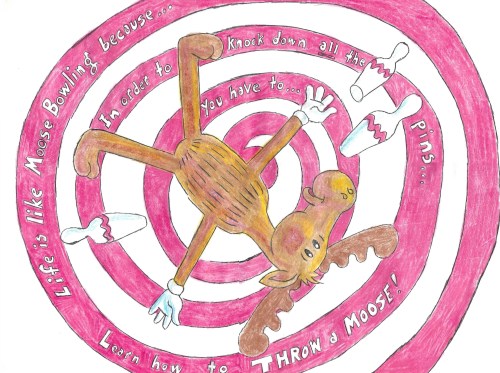
So my education in humor began with bad-word jokes, slapstick humor, put-downs, and rude noises coming from unfortunate places. Humor in the classroom is actually a metaphorical mine field laced with tiger traps, dead-falls that end with an anvil hitting you on the head, or being challenged to a life-or-death game of moose bowling. (Don’t know what moose bowling is? Moose bowling is a very difficult game that, in order to knock down all the pins and win, you have to learn to roll a moose down the alley.) Sounds like I spend too much time watching cartoons and playing video games, doesn’t it? Well, there’s more. And it gets worse from here. But I will spare you that until the next time I am foolish enough to try making excuses for my really bad jokes.
I am grateful for the fact that I have never killed anyone in my life so far. When I turned 18 in 1974, I signed up for the draft as was required by the law, and I received a draft number that had a high likelihood of being called up. I had to think about joining the Navy as my father did in the 1950s during the Korean Conflict. Or possibly resign myself to going to jail for refusing to be called up. I was a confirmed pacifist from early on in my life (a result of the trauma caused by being secretly a victim of a sexual assault at the age of ten.) So, I lucked out and the draft was suspended before the government would’ve decided to draft me in 1975.
I also did not ever cause the death of anyone by a traffic accident, household accident, or any other accidental way. As long as I am still driving, I have to use the caveat that I have not killed anyone yet.
I am also grateful for pessimism. I have been accused of being optimistic about many things. But I would argue it is a tactical advantage to be firmly pessimistic. I look at every possible outcome of any and all undertakings. I plan on things going wrong, including serious thought being given to how I will deal with huge roadblocks to my goals, concocting workable plans B, C, D, and even all the way to Z. Being a pessimist means you will not put all the Easter eggs in one basket, especially the basket the drunken Easter bunny plans on hiding at the bottom of the river in a bag full of stones. I am not deterred in my quests by the first, second, or third obstacle. I am willing to rent scuba equipment to deal with the drunken bunny thing. I do not get downhearted because I expected the worst to happen. And I deal with it for as long as it is possible. Persistence and preparedness are worth far more than luck and chance. And this is where I have to endure the inevitable claim that I am secretly an optimist. I confess. I do believe I can wear down and conquer anything. If that’s optimism, then I have to insist that I have renamed it the “Fruits of Pessimism.”
And I am also grateful for the chance to become a nudist, even though not until late in life because it represents a victory over the monster that abused me when I was ten. He left me with a lifelong fear of being naked in the presence of others, extreme difficulty with having a sex life, including self-harm to my private parts, a fear of becoming a homosexual or a child molester, and deep depression about all this stuff I felt I had to keep secret. My mother and father both died without knowing it happened. But my wife and children know. My sisters both know. And I was able to spend last Memorial Day weekend with nudists at the Bluebonnet Nudist Park. I am now liberated of all the things that once made me feel like a monster and made me hate myself. His ghost has no further power over me. And I am grateful.
I know I am probably the only person in the US grateful for these three things all at the same time. But I think the most important things to be grateful for in life are the things you have overcome, and the means you have for overcoming them.
If you plan to talk about Trump at Thanksgiving Dinner, Lorita is ordered to hit you with her stick.
“China is already dropping more of its planned importation of corn and beans from America, buying more from Brazil and a lot less from us. Why, you ask? Ouch! I didn’t say his name, Lorita! You didn’t have to hit me that hard!”
“Our family farm may be at risk. We lose income from renting the land to local farmers and we won’t have enough to pay down the loan we took to pay for buying out our brother. The Pumpkinhead has screwed us over with his stupid tariff plans.”
“Excuse me, who is this Pumpkinhead guy?”
“That’s what Uncle Mickey calls the former and future president, Lorita, dear.”
Whack!
“Ouch! I never actually said the name Trump, Lorita!”
Whack! Whack!
“Well, Michael, it was your idea.”
“Yeah… the back of my head is regretting it. I thought we gave that girl a hollow whacking stick.”
“She’s ‘been building arm strength by weaving together Christmas wreaths at Butch’s Christmas tree farm.”
“Oh. Well that’s wonderful that you have a job, Sweetie. But you don’t have to hit me so hard if I accidentally say Trump’s name.”
Whack! Whack! Whack!
“Why did you hit me three times?”
“It’s the third time you said his name.”
“Actually, Sweetie, he only said the name twice.”
Whack! Whack!
“Did I get it right that time?”
“Yes, Sweetie. But you have given me brain damage.”
“Shall I kiss it, Uncle Mickey?”
“Yes, please. That makes it better.”
Smooch!
Okay, I confess it. This is all made up for laughs because the Pumpkinhead has done enough to make me mad. In truth, we did not get to go to the farm in Iowa for Thanksgiving Dinner at my Sister Mary’s place. My daughter is sick and confined to the house with flu here in the Dallas suburbs. My wife is still in the Philippines burying her mother. And Lorita is entirely imaginary. But some day we will look back on the end of the world and have a fond laugh… and maybe a wistful cry.
Who is really qualified to judge people? The Bible says only God makes that judgment. But who tells us what God’s judgment actually is? Especially if Nietzsche is right about God being dead?
Prudes
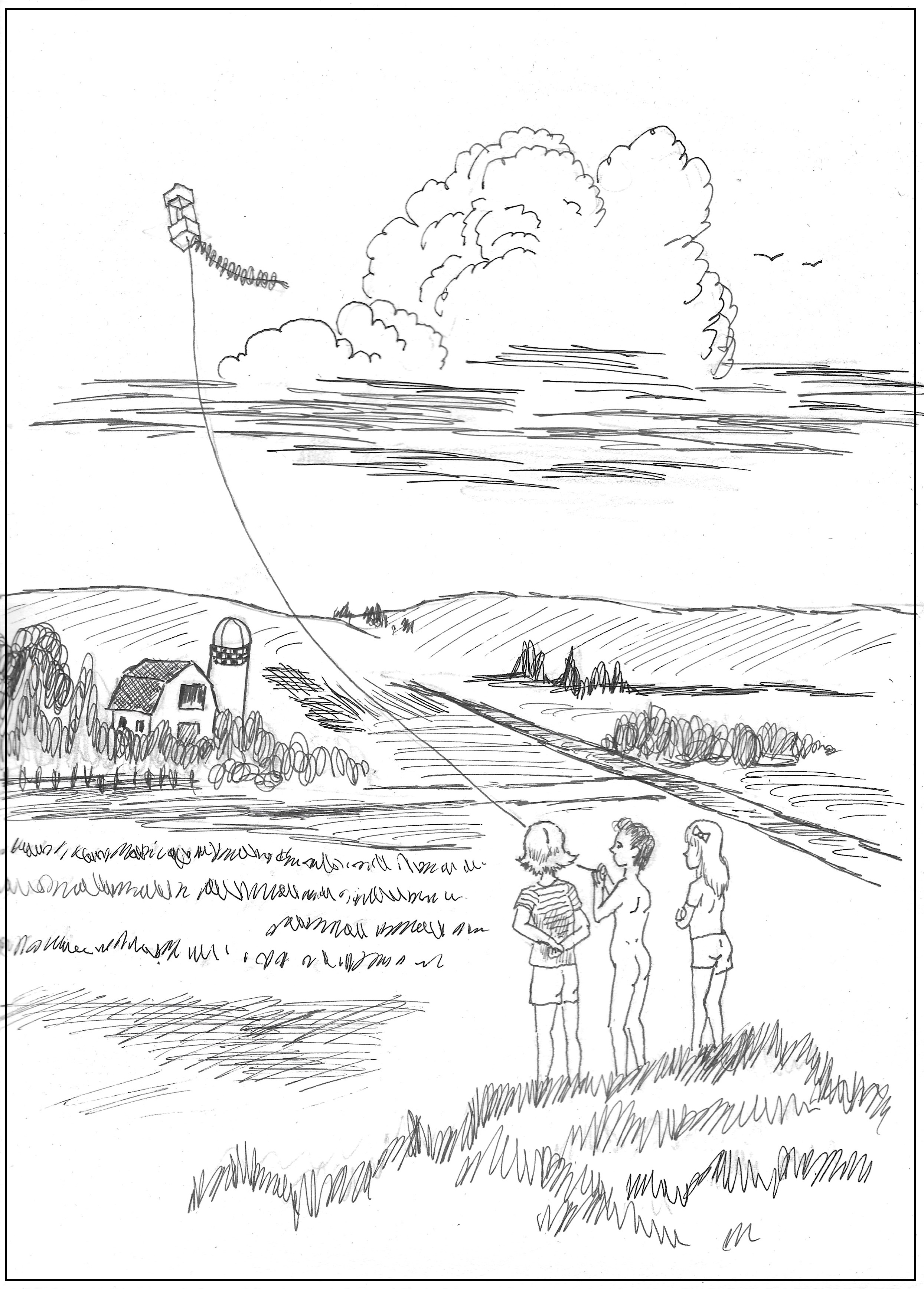
Not long ago I posted a short-short story about me wanting to see girls get naked while we were kite flying, and then, by verbal tricks backfiring, I ended up being the only one flying the kite while naked. I look back on that story now with laughter about my own personal foibles. But if I am completely honest, the church ladies with gray hair, wagging fingers, and tongues that are even waggier… Well, I am glad that the ones I knew as a boy are all now dead and can’t possibly read that story and shame me all over again.
And I know that I draw an awful lot of pictures and write an awful lot of stories that involve naked children. As a survivor of a traumatic sexual assault when I was ten (a thing that happened after the kite story was already in the past) there is a level of discomfort over recognizing that trend in myself. Not because I became a sexual predator of children. I clearly did not. I still am determined to prevent such things from happening in any way I can, though in retirement I no longer have access to children to talk with to find out about bad things that may be happening in their lives.
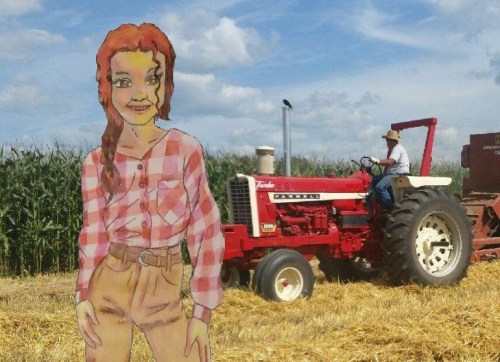
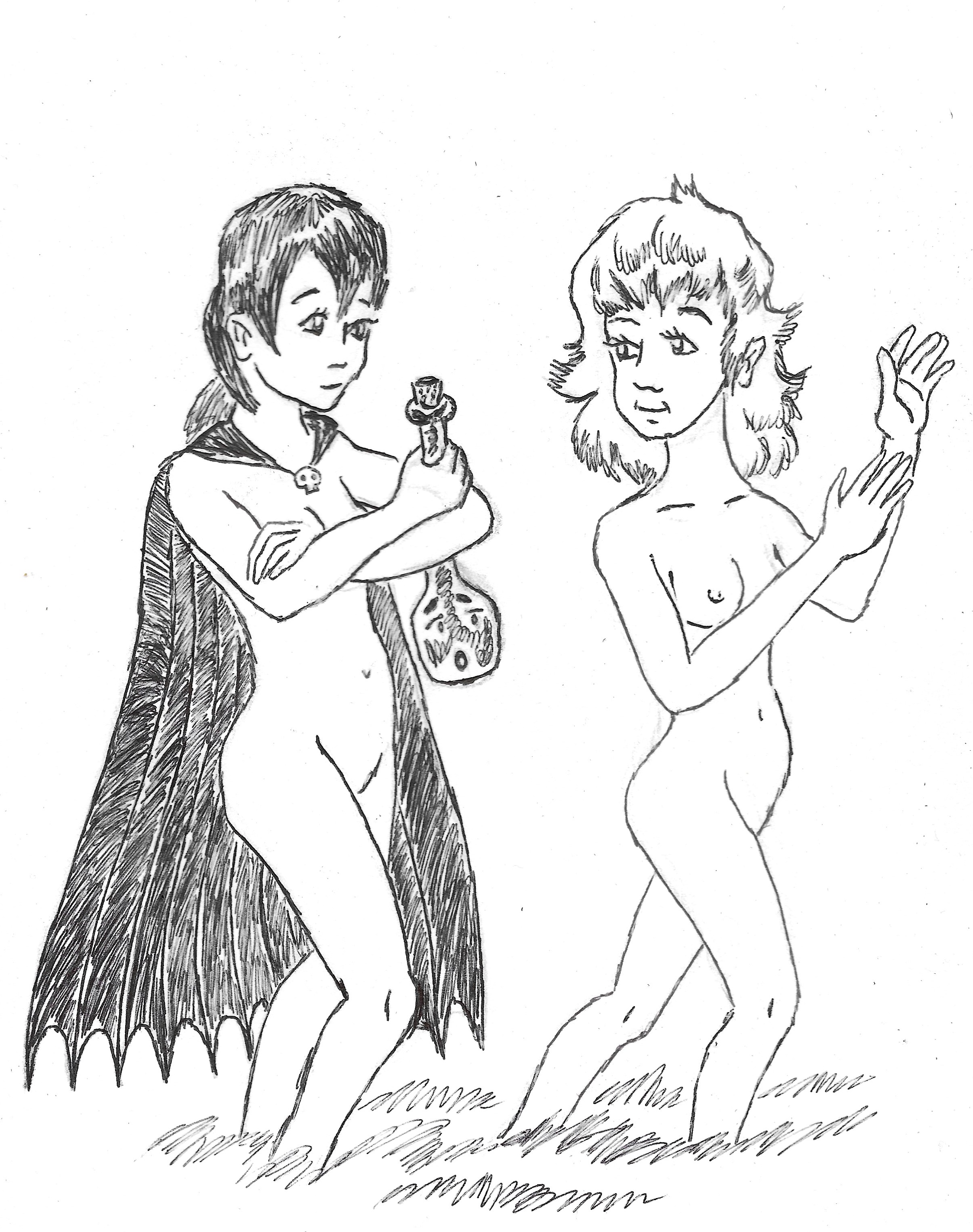
Derfentwinkle and Anneliese are in my current work in progress, and they are fairies both.
I write stories in which some kid characters are naked at times. Sometimes because of curiosity and developing sexuality, sometimes because of growing up in a nudist household, sometimes in their dreams, taking baths, and many other normal functions where clothing is optional. In The Baby Werewolf novel, I included a character who was trying to exploit a young nudist girl to make child pornography. He was the kind of predator I have always resolved to be against, and the book is intended to make readers aware of that kind of dangerous person and recognize where the opportunities to avoid such people lie.
And some of the nude young characters I create like the two fairy girls depicted in the illustration from The Necromancer’s Apprentice merely represent the liberating feeling you can get from embracing your own nude self, a thing my attacker deprived me of during childhood through trauma and fear.
I, as an adult human being, fully accept readers’ rights to be critical of my work and make prudish judgements about my writing. I don’t like that one critic of The Baby Werewolf who said things about my work being creepy for the wrong reasons (it is a horror story after all) and suggesting that maybe I as the author am bad and villainous instead of feeling that way about the villain of the story. It was fiction, not my personal life story. The villain character is not me.
But prudes being prudish and judgmental can do more damage than just hurting an author’s feelings.
I have had two students that I know of who were transexual.
One was raised a boy because he was born with a penis, but in grade school was discovered to have a womb and ovaries. I didn’t know such a condition existed until I saw an episode of Marcus Welby MD in the 70’s about a young boy who had to transition because he was actually a girl. The child in my class was from a poor Hispanic family that didn’t understand the problem and couldn’t really afford to deal with it. The prudes, judgemental as always, were not kind. This he/she hermaphrodite was forced to grow up as a flamboyantly gay male even though he was capable of physically changing into a woman who could conceive a child. I followed his development for as long as I was able. I did spend one long and awkward evening talking to him/her about his/her crush on me. I could’ve gotten the prude finger-wag over that strange conference too, if anybody had bothered to care about that poor child. I certainly wasn’t going to kiss him, and I had to send him home at the end of that discussion because of what he/she wanted from me. I suspect there were other men who took advantage of him/her. But I wasn’t close enough to help him in any real way. And I lost touch soon after he/she left my class. Based on that bizarre discussion we had, I have no confidence at all that the poor child is still alive. Nobody seemed to care about this child That is the most tragic of things teachers sometimes have to deal with.
The other trans student I had in class for a year was a girl as far as she was concerned. It was not a question open for debate. She was quiet and a good student. She only had a couple of friends, but they were good friends and stood by her. At the time she was in my middle school class, she already had breasts thanks to hormone therapy. By now she has probably transitioned by surgical means. Her life was a lot easier than the boy with ovaries. But prudes in Texas abound and provide a lot of sour fruit.
I personally find it offensive that anyone would deny either of these two people the use of whatever restroom was comfortable for them.
What gives the typical prude the right to pass judgement on anyone else’s behavior? Prudes can cause repression of natural behaviors for the benefit for no one but themselves. I find prudishness to be reprehensible. But the rub is… being judgemental about that makes me a prude too.
I try never to be judgemental. I would much rather accept everyone for who they are, or who they think they are, than rely on what I think they are. And I do listen when others judge me. I have changed things in my books and drawings because of observations by others. And I take everything seriously… especially comedy.









The Art of Being Mickey
I have published my eighth novel in the last six years. (This is, of course, a re-post of an old essay.) Sure, it is through mostly self-publishing of novels that no one but me has ever read. Catch a Falling Star and Snow Babies both had a professional editor, one who had worked for Harcourt and one who worked for PDMI. Magical Miss Morgan has had a proofreader who made numerous stupid mistake errors that I had to change back to the original meticulously by hand. But all three of those novels won an award or were finalists in a young adult novel contest. I do have reason to believe I am a competent writer and better even than some who have achieved commercial success.
But what is the real reason that I am so intent on producing the maximum amount of creative work possible in this decade? Well, to be coldly objective, I am a diabetic who cannot currently afford insulin. I have been betrayed by the for-profit healthcare system that treats me as a source of unending profit. I am like a laying hen in the chicken house, giving my eggs of effort away to a farmer who means to eat my very children if time and circumstance allows. I am the victim of six incurable diseases and conditions that I got most likely as a result of exposure to toxic farm chemicals in the early 70’s. I am also a cancer survivor from a malignant melanoma in 1983, and for three years now I have not been able to get the preventative cancer tests I am supposed to be receiving every year for the rest of my life. My prostate could very well be cancerous as I write this. If that is so, it will kill me unawares, because I don’t even want to know about having a disease I can’t possibly afford to fight all over again.’
So, the basic reason I am going through the most productive and creative period of my entire life is because I have a great rage to create before I die and I could be dying as soon as tonight. All of the countless stories in my head clamoring to be written down before it is too late cry out to me desperately for my immediate attention.
I will, then, continue to write stories and draw cartoons and other Paffoonies for as long as I am still able, and possibly even afterward. I have, after all, threatened repeatedly to become a ghostwriter after I die. And, yes, I understand when you scream at my essay that that is not what a ghostwriter is. But if a woman can channel the ghost of Franz Schubert and finish his unfinished symphony…(https://en.wikipedia.org/wiki/Rosemary_Brown_(spiritualist))
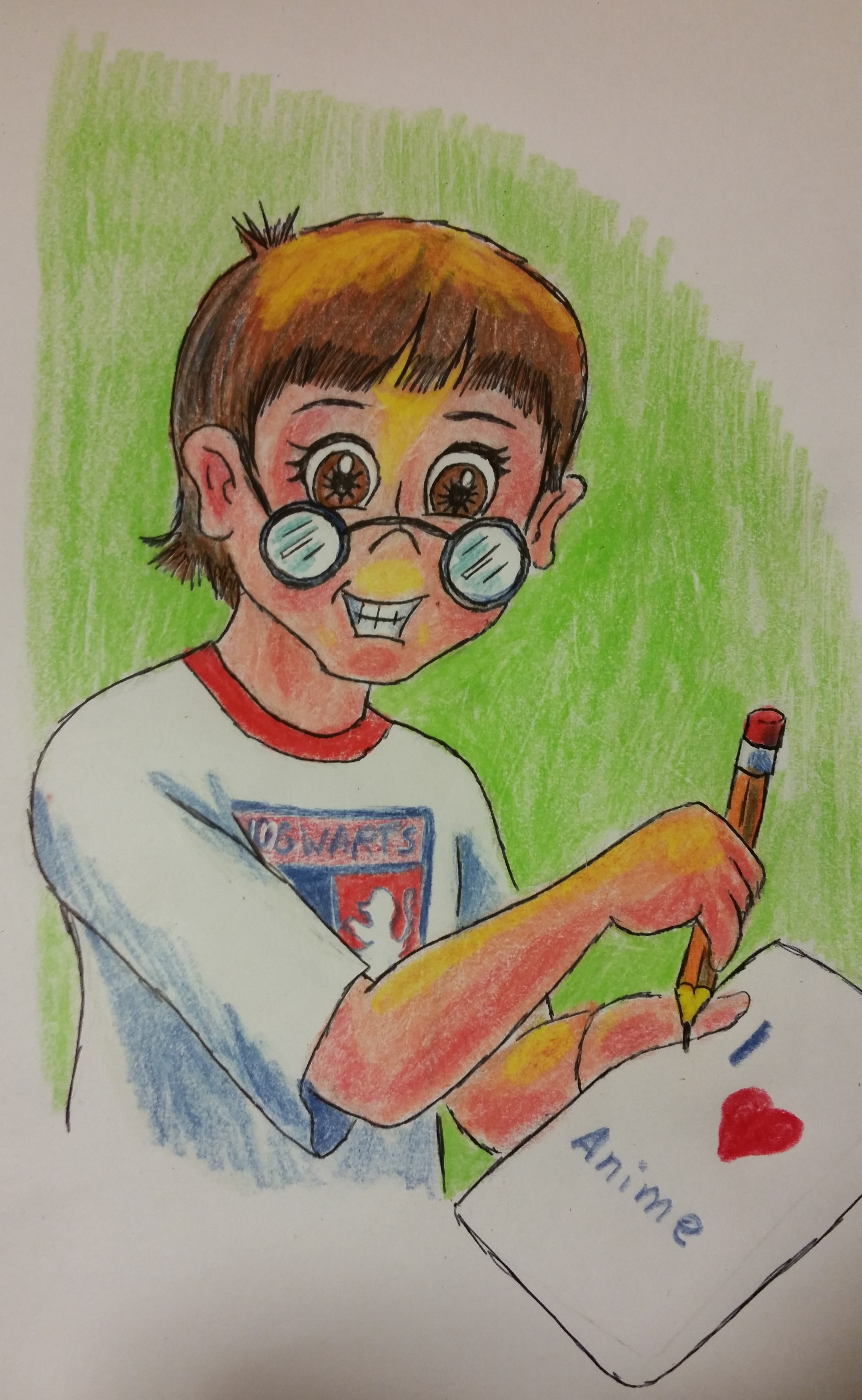
—then I should also be able to tell my stories from beyond the grave. I have been percolating them in my head and writing and drawing them in whole or in part since 1974. I have too much time and too many daydreams wrapped up in them to let it all just evaporate into the ether. In summation, I am claiming stupidly that my novels, crack-brained and wacky as they are, are somehow destined to exist, either because of me or in spite of me. So just be happy that I write what I write, for there is an art to being Mickey, and I am the one artist and writer who is the best Mickey possible if truly there ever was a real Mickey.
Leave a comment
Filed under battling depression, commentary, goofy thoughts, humor, novel writing, Paffooney
Tagged as book review, books, fiction, reading, thriller, writing