You see, I believe in God… but my God is a bit bigger than most people’s God. In fact, most of the people who come closest to what I believe are atheists. My God is all of existence, the good and the bad both. He is above my understanding, but it is my place to constantly try to reach for Him and know Him and, sometimes, even be Him. Things that are impossible to accomplish, and yet we all do it on a daily basis.
My God does not punish sin. My God does not reward faith. My God does not ask anything of me beyond being. But since I exist, and since I believe that love and beauty are good things, if I want the universe around me to manifest love and beauty, then I must make it so. I must live as a loving person and a singer of beautiful songs… even if I can only sing silently in words on a page.
However did someone as dopey as me come up with something as dopey as this? Let me tell you a story.
When I was ten, an older boy, a neighbor, trapped me, de-pants me, and abused me. It was not love in any way. It was sexualized torture. He made me feel pain. He took away my sense of well-being. He made me afraid to touch or be touched by others. He made me believe my own physical urges were a terrible thing that God would punish me for. I wet my pants in school more than once, because I feared the boys’ bathroom at school. I no longer tried so hard to make the other kids laugh. I sank into depression. And ultimately, I thought about ending myself in painful ways, ways I felt I deserved.
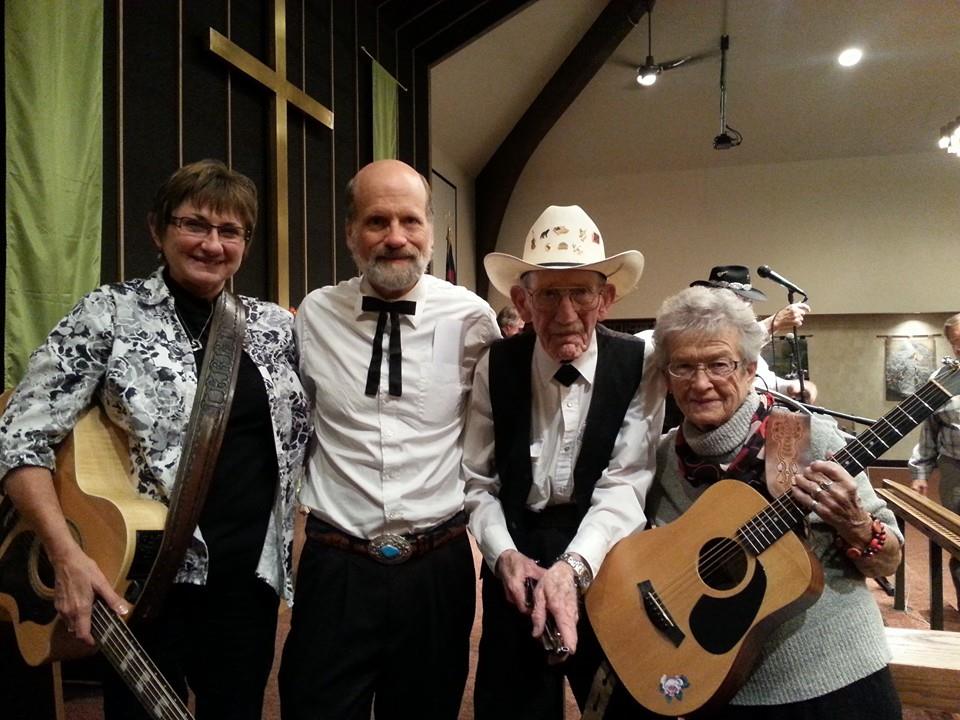
Reverend Aiken is the one in the cowboy hat. His son, Mark, was my childhood best friend.
But I was blessed. My best friend’s father was the minister of the Methodist Church and, eventually, both churches in our little town. And in the late 60’s, the Methodists decided to be very progressive on matters of human sexuality. When I was twelve, he taught all the kids in my age group about sex using a blackboard and a willingness to frankly discuss anything we needed to know. Of course, he never quite figured out what my terrible secret was, in fact, I couldn’t have told him about it if I wanted to, the memory was repressed and I couldn’t call it up until that day in college when it all came back to me at age 22. But he knew it was there. He is the one that taught me that faith in God is about love. It is not about punishment, especially not punishment for biological urges and physical needs. People need love, and should never be castigated or humiliated because they seek it. And he told me that I was not to blame for the acts of others. The notion of original sin, that we are all born despicable because Adam goofed, is nonsense. All people, even the bad ones, are God’s children and worthy of love. People can be redeemed from anything. And it is the job of worthy people to be the love that informs the universe. We must do good deeds and love, honor, and, most of all, render aid to others. Because that fills the universe with goodness and light.
Both the good Reverend Aiken and my abuser are dead now. I deeply love one, and I forgive the other. And it’s because that’s what God is… love and forgiveness. It has to be so.
Did you listen to that song from YouTube? If you made it this far through this rather difficult ramble without listening to it, I recommend you click on it and give it a try. It is about King David sinning with Bathsheba, and repenting his sin before God. And in the end, there was no punishment for him. So, I, too stand before the lord of song with nothing on my tongue but Hallelujah.
Being a writer is a life of music that happens only in your head. You hear voices constantly. They pulse rhythmically with insights and ideas that have to be written down and remembered. Otherwise the music turns clashing-cymbals dark and depressing. Monday I wrote a deeply personal thank you to the Methodist minister who saved my life when I was a boy. I posted a YouTube music video by the acapella group Pentatonix with that essay in a vain attempt to give you an idea of the music in my head when I composed that very difficult piece to give myself a measure of peace.
I realize that I am not writing poetry here. Poetry can so easily slip into melody and music because of rhythm and meter and rhyme. And yet, words to me are always about singing, about performing, about doing tricks with metaphor and meaning, rhythm, convoluted sentence structure, and other sneaky things that snake-oil salesman do to get you to think what you are hearing is precisely what you needed to hear. The Sonata of Silence… did you notice the alliteration of the silvery letter “S” in that title? The beat of the syllables? Da-daah-da a da-da? The way a mere suggestion of music can bring symphonic sounds to your ear of imagination as you read? The way a simple metaphor, writing is music, can be wrapped into an essay like a single refrain in a symphonic piece?
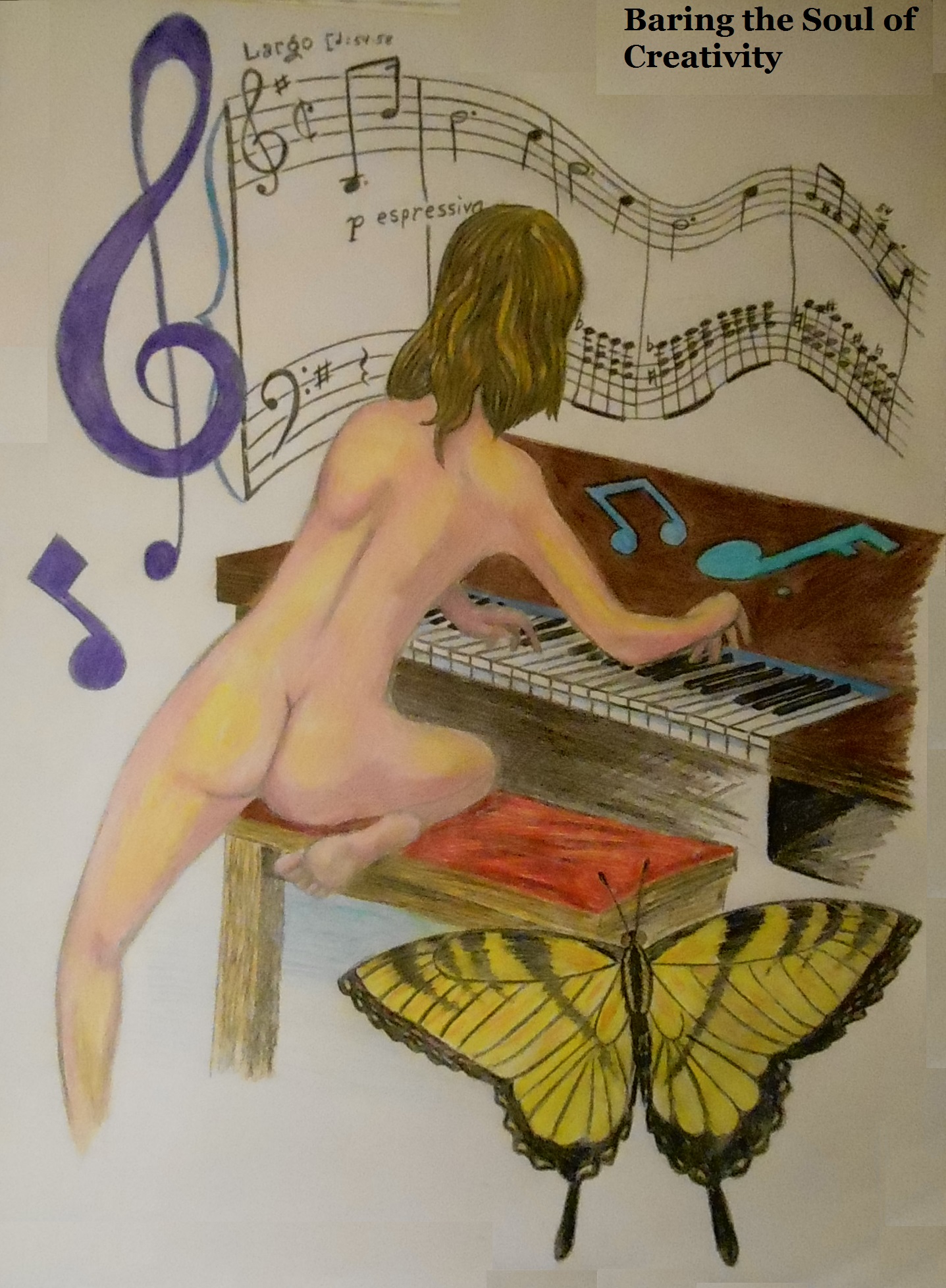
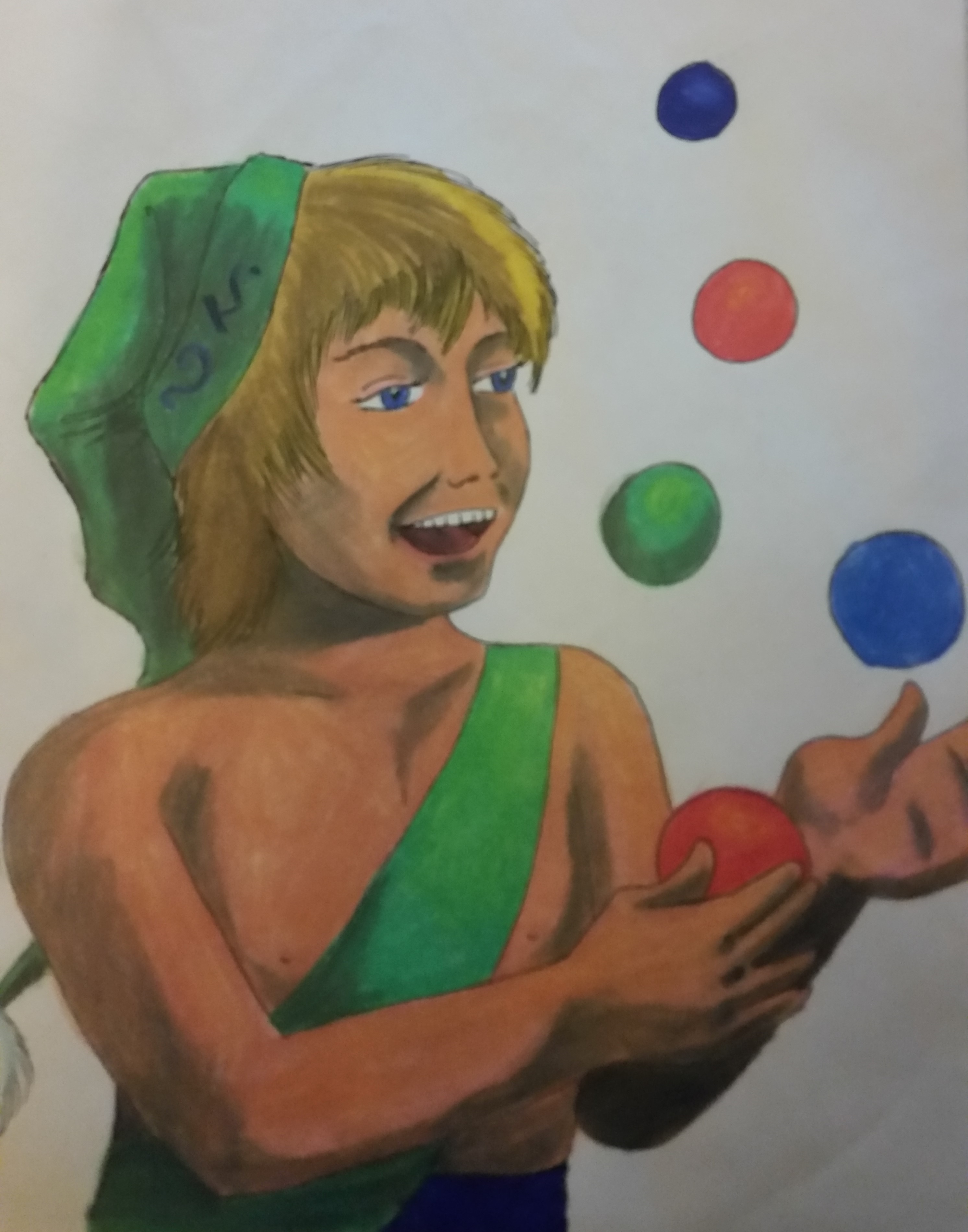
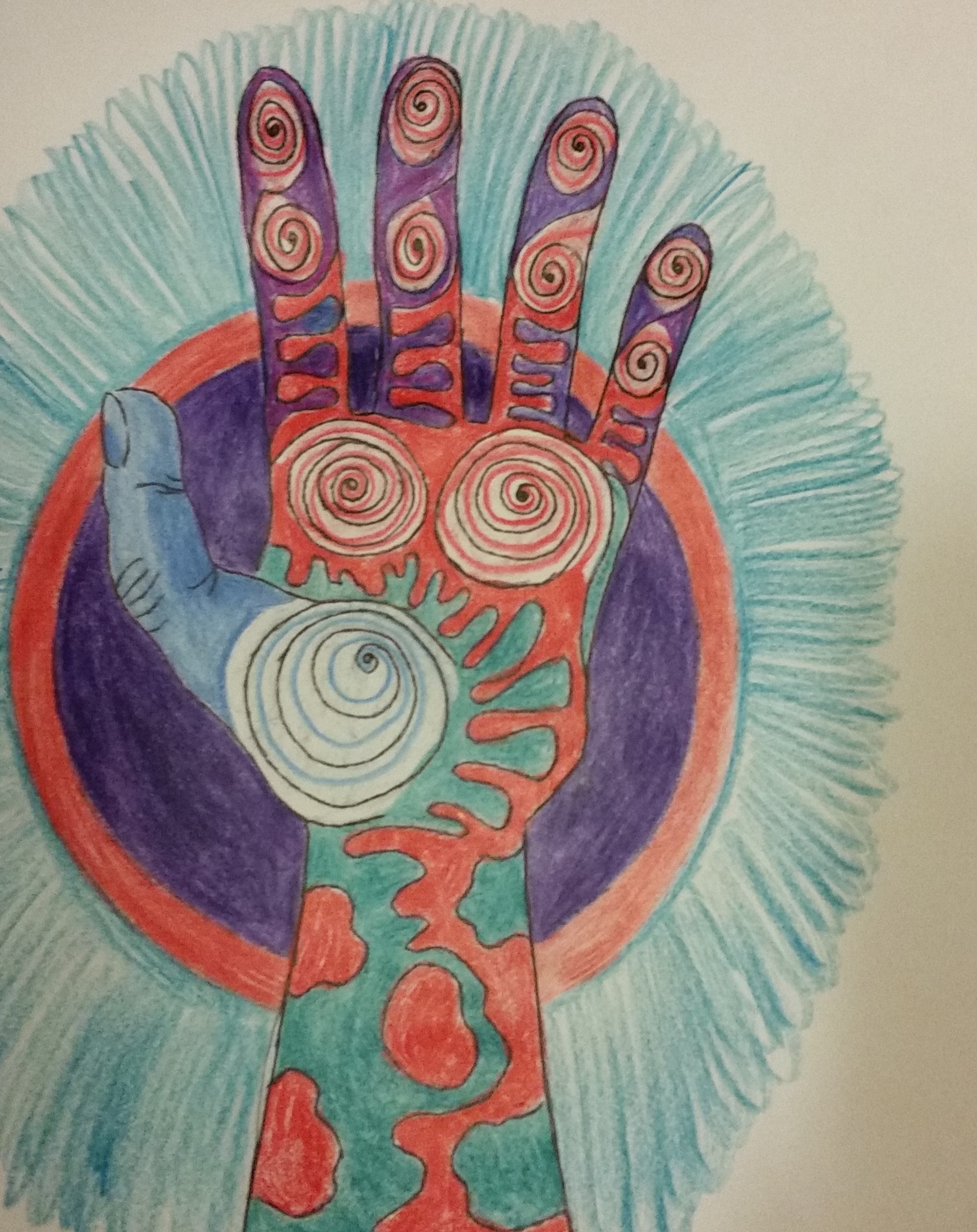
A sonata is a musical exercise in three or four movements that is basically instrumental in nature. You may have noticed that the movements are loosely defined here by the accompanying pictures, of which there are three. And it is silent only in the way that the instruments I am using themselves make no noise in the physical world. The only sounds as I type these words are the hum of an old air conditioner and the whirr of my electric fan. Yet my mind is filled with crescendos of violins and cellos, bold brass, and soft woodwinds. The voice saying these words aloud only in my head is me. Not the me you hear when I talk or the me I can hear on recordings of my own voice, but rather the me that I always hear from the inside. And the voice is not so much “saying” as “singing”.
Writing makes music. The writer can hear it. The reader can too. And whether I croon it to make you cry, or trill it to make you laugh, I am playing the instrument. And so, the final notes of the sonata are these. Be happy. Be well. And listen for the music.
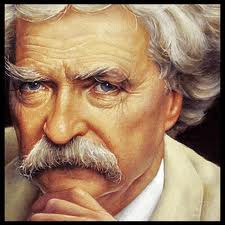
I wish to leave no doubt unturned like a stone that might have treasure hidden under it. I love the works of Samuel L. Clemens, better known as Mark Twain.
I have read and studied his writing for a lifetime, starting with The Adventures of Tom Sawyerwhich I read for myself in the seventh grade, after seeing the musical movie Tom Sawyer starring Johnny Whittaker as Tom. I caught a severe passion, more serious than a head-cold, for the wit and wisdom with which Twain crafted a story. It took me a while to acquire and read more… but I most definitely did. I took an American Literature course in college that featured Twain, and I read and analyzed The Adventures of Huckleberry Finn. I also bought a copy of Pudd’nhead Wilson which I would later devour in the same thoroughly literate and pretentious manner as I had Huck Finn. Copies of A Connecticut Yankee in King Arthur’s Court and The Mysterious Stranger were purchased at the same time, though I didn’t read them cover to cover until later during my years as a middle school English teacher. I should point out, however, that I read and re-read both of those, Connecticut Yankeewinning out by being read three times. As a teacher, I taught Tom Sawyer as an in-class novel assignment in the time when other teachers thought I was more-or-less crazy for trying to teach a 100-year-old book to mostly Hispanic non-readers. While the lunatic-inspired experiment was not a total success, it was not a total failure either. Some kids actually liked having me read parts of it aloud to them, and some borrowed copies of the book to reread it for themselves after we finished as a class.
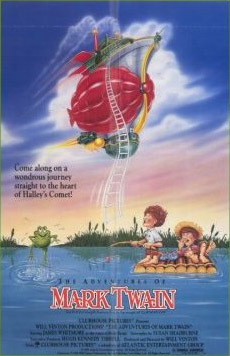
During my middle-school teaching years I also bought and read copies of The Prince and the Pauper, Roughing It, and Life on the Mississippi. I would later use a selection from Roughing It as part of a thematic unit on Mark Twain where I used Will Vinton’s glorious claymation movie, The Adventures of Mark Twain as a way to painlessly introduce my kids to the notion that Mark Twain was funny and complex and wise.
I have also read and used some of Twain’s most famous short fictions. “The Celebrated Jumping Frog of Calaveras County” and “The Man Who Corrupted Hadleyburg” are both masterpieces of Twain’s keen insight into the human psyche and the goofy and comic corruptions he finds there.
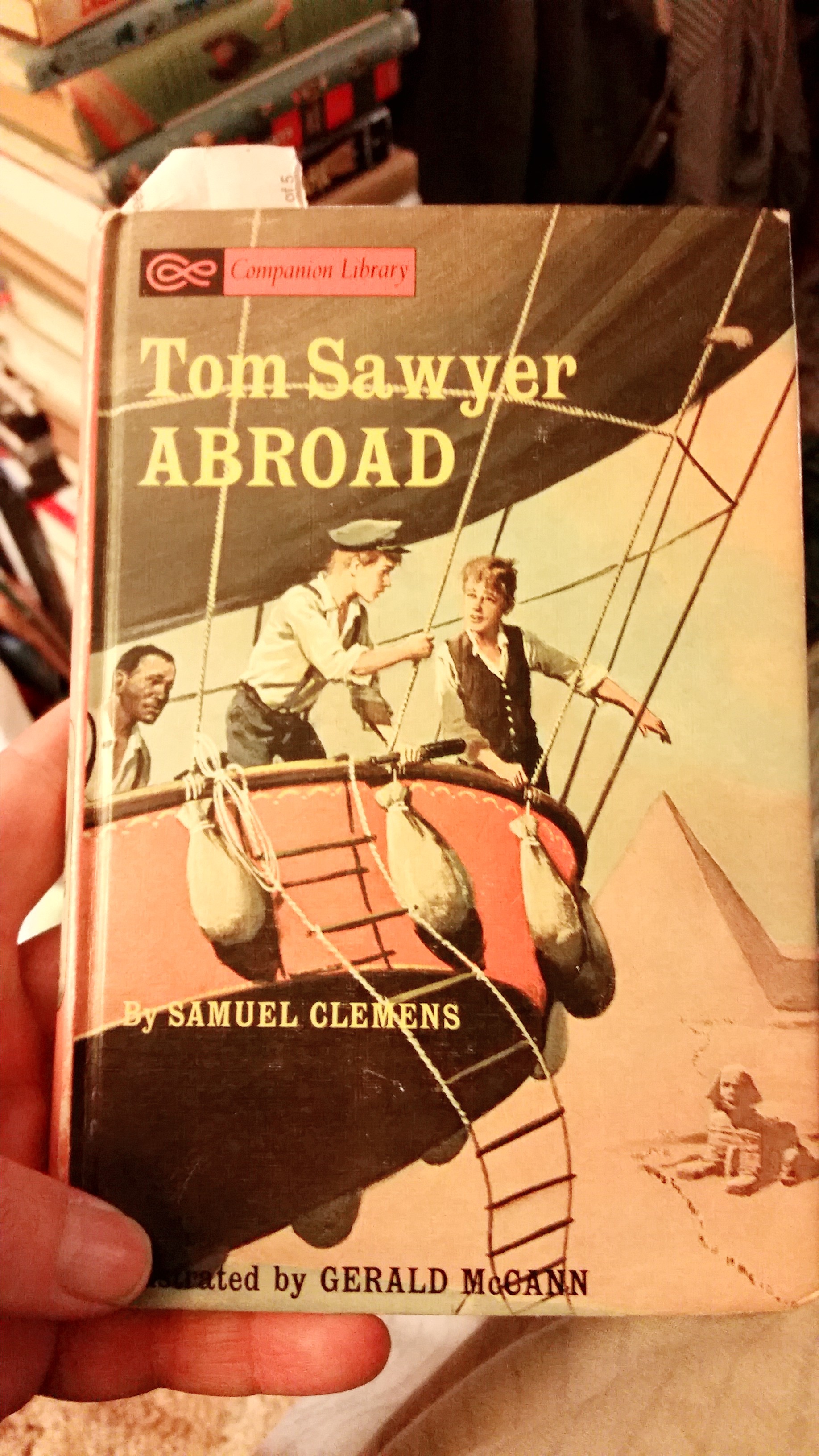
And now, retired old me has most recently read Tom Sawyer Abroad. And, though it is not one of his finest works, I still love it and am enthralled. I reviewed it and shared it with you a few days ago. But I will never be through with Mark Twain. Not only is there more of him to read, but he has truly been a lifelong friend.
As a writer, my goal is to create wisdom and new ideas and stuff that makes a reader feel happy, or sad, or angry, or even slightly insane. But thinking is hard when your head hurts and your body aches and your 68th birthday is just around the corner. (Yes, this Mickey is nearly 68, but can you believe that that Mickey is going to be 96 on the day after I turn 68?) Sometimes you just want to say, “Never mind that I wanted to post every single day for the past two years. Just curl up in a ball and go to sleep.” But there are ways to get something done even if your mind is full of the Sandman’s leavings and old, rotted dreams.
You can always get by with posting somebody else’s wisdom… somebody else’s thinking. You don’t have to work too hard to paste things together. After all, why else did you have to look at so many cut-and-paste essays over the years in middle school and high school as an English teacher?
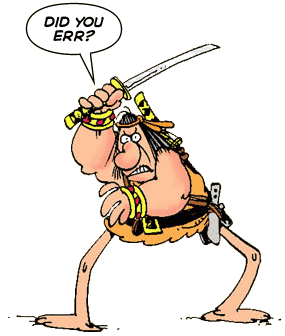
And you can rely on the work you have already done collecting computer files full of colorful crap and stuff you like enough to steal to complete your cut-and-paste scrapbook post. You don’t have to feel like you erred and are about to have your head cut off by an angry Groo.
And you know you can get a lot of cheap likes on Facebook with some of the stuff you have available to put in this post. You have been working at the “Be funny!” thing for a long time, and have gotten almost good enough at it to be funny on the fly. And when you’ve gotten more than halfway to the goal, you can rest a bit. Take a nap. Regenerate the crazy things in your head so you can do this all again another day.
And if you can have a laugh before you are finished, even if no one else in the world gets the joke… well, at least you will feel a little bit better yourself.
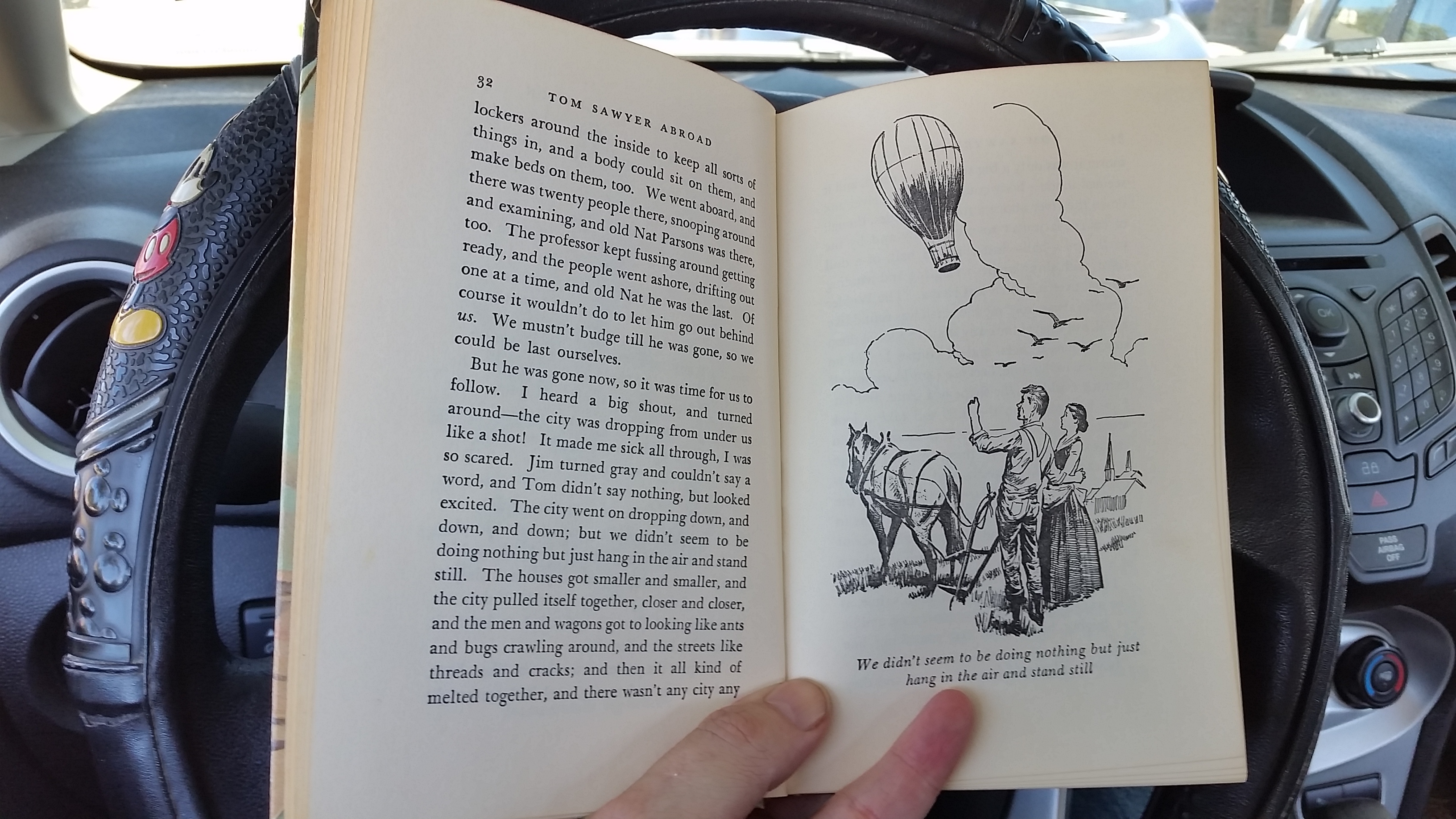
Yep, I read about being an “erronort” traveling in a balloon while sitting in a parking lot in my car.
Believe it or not, I read this entire 100+-year-old book in my car while waiting for my daughter and my son in school parking lots. What a perfectly ironic way to read a soaring imaginary adventure written by Mark Twain, which has been mostly forgotten by the American reading public.
My copy of this old book is a 1965 edition published for school libraries of a book written in 1894. It tells the story of how Tom and Huck and Jim steal a ride on a balloon at a town fair from a somewhat mentally unhinged professor of aeronautical science. The balloon, which has space-age travel capabilities due to the professor’s insane genius, takes them on an accidental voyage to Africa.
Of course, the insane professor intends to kill them all, because that’s what insane geniuses do after they prove how genius-y they really are. But as he tries to throw Tom into the Atlantic, he only manages to plunge himself through the sky and down to an unseen fate. The result being a great adventure for the three friends in the sands of the Sahara. They face man-eating lions, mummy-making sandstorms, and a chance to land on the head of the Sphinx.
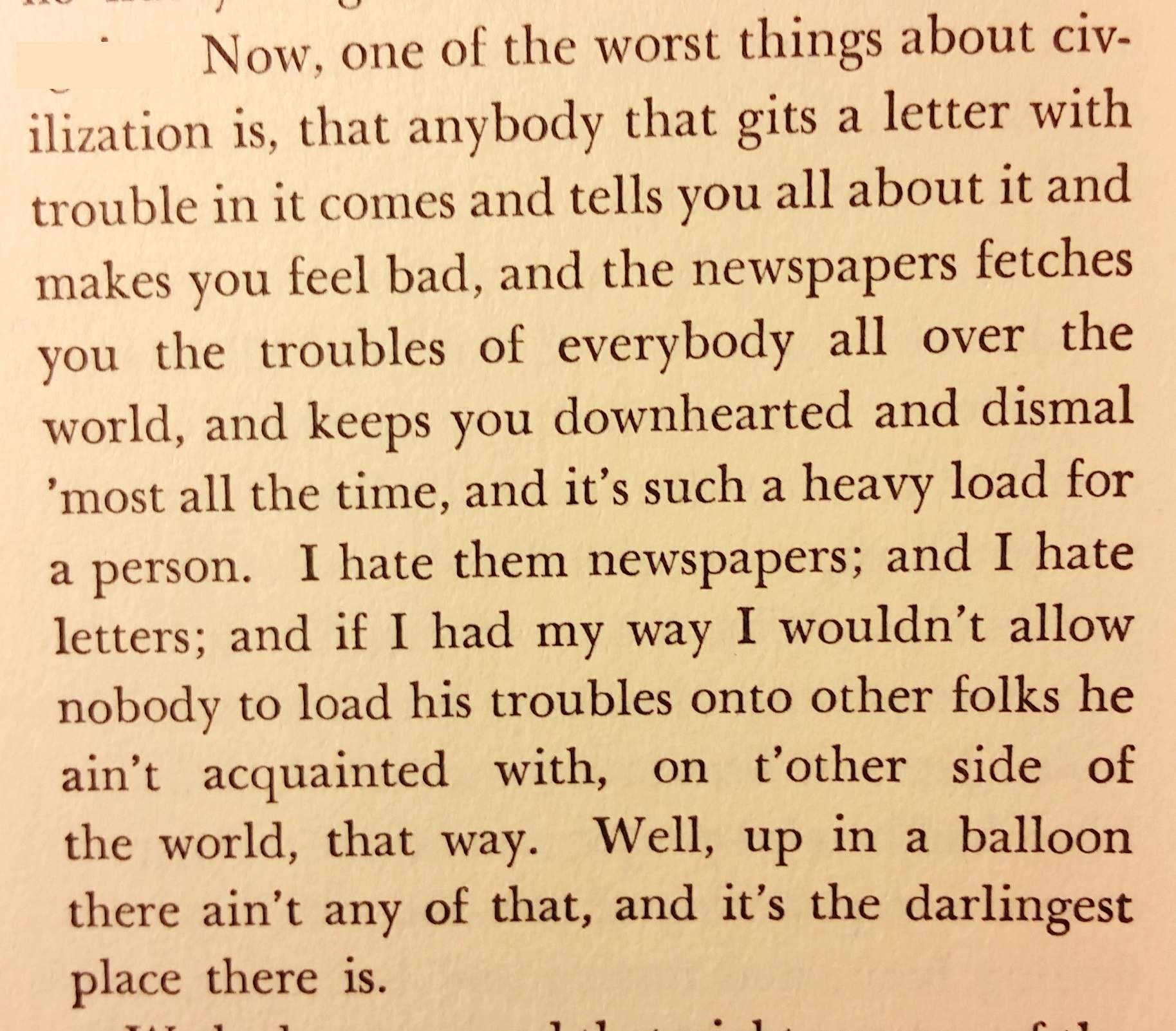
The entire purpose of this book is to demonstrate Twain’s ability to be a satirical stretcher of the truth, telling jokes and lies through the unreliable narrator’s voice of Huck Finn.
Here is a quoted passage from the book to fill up this review with words and maybe explain just a bit what Twain is really doing with this book;
Notice how I doubled my word count there without typing any of the words myself? Isn’t the modern age wonderful?
But there you have it. This book is about escaping every-day newspaper worries. In a time of Presidential Candidate Donald Trump, global warming, and renewed threats of thermonuclear boo-boos with Russia, this proved to be the perfect book to float away with on an imaginary balloon to Africa. And the book ends in a flash when Aunt Polly back in Hannibal wants Tom back in time for breakfast. I really needed to read this book when I picked it up to read it.
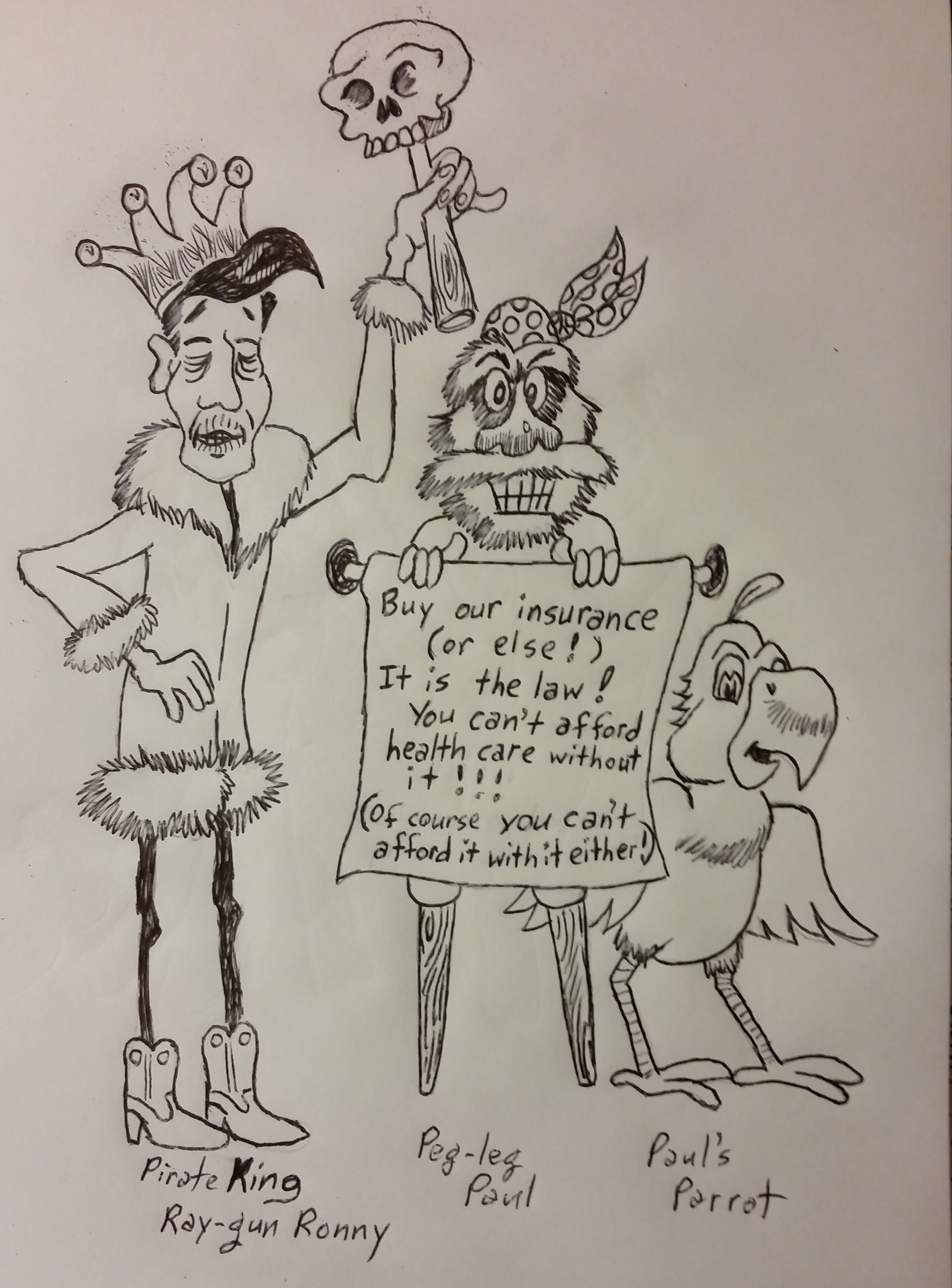
In the beginning, God made men naked and helpless. He made women naked and in charge. And then he tossed an apple to the women and said, “let there be evil and monsters and such.” So, naked people began to huddle together in caves to get out of the storm. They began to kill and eat other animals that didn’t eat them. They began to wear the fur of whatever they killed and ate. And then because Cain had a you-like-him-better-than-me fit, they began to kill (and hopefully not eat) each other.
So, the need for government came about as a matter of survival. Cavemen put their thick heads together and decided that some guys were bigger and tougher and got more girls than the rest. And some guys knew how to use their heads for something more than a place to keep their animal-skin hats. So, when all the heads were put together, the smartest ones realized that if they made weapons for the big guys to kill other guys with more efficiently, then the big guys could protect all of “us” and kill all of “them” and we would all be safer and live better lives. Of course, the big strong guys wanted to keep all the better girls and all the stuff they took from others, and they expected everyone they protected to give them more stuff. Thus, taxes were born. And when you had to count stuff and plan stuff and figure stuff out (like managing taxes and keeping track of who you need to hit because they haven’t paid) that task went to the scrawny guys with the big heads. And so, Kings were born. And queens were mostly the kings’ sisters, because, after all, the big guys still got all the best girls. And as time went on, we had kings and their big guys and all the other “common” people. But you couldn’t just kill (and hopefully not eat) all the “common” people, because they were useful too. You could put them to work so they could pay more taxes and make more stuff for you and it made your life better if you had a lot of them working for you. But some old king named Louie discovered you had to make the “common” people a little bit happy too because they outnumber you by a lot. Unfortunately for Louie, he didn’t discover this until they cut his head off… some argument about eating cake or something. So, some other smart guys with big heads got together and decided to make a new government. It was really still the old government. They just had the brilliant idea of re-naming everything and lying to the people. Now, instead of kings and their big guys who got all the good girls, you had “elected representatives” who were actually the kings of old. They just figured out how to lie to people and make them believe they worked for the “common man”. And the big guys were re-named the “Military Industrial Complex”, or maybe it’s the Illuminati. I’m not sure. And then there’s a Pope, and possibly some alien beings from Roswell, and… okay, maybe I need to save the rest for the Tinfoil Hat Club when we meet every Wednesday evening and plot how we are going to “wake up, sheeple” and take over the world. (Dues are fifty cents. We are meeting again on Sunday because we think the world ends next Tuesday… or something.)
I have told you repeatedly (if you are foolish enough to read more of my blog than is probably healthy for normal people) that I am a pessimist. Like Benjamin Franklin, I believe it is best to always prepare for the worst that can happen and actually expect it. With current gun laws in this nation, and the way corrupt politicians and businessmen continue to profit off the suffering of the rest of us, and people’s basic selfishness and cruelty to others in word, thought, and deed, we rarely get a glimpse of anything but the worst of human nature. We are never disappointed when we expect the worst to happen. And yet, since I am never taken by surprise by bad things, only by unexpected good things, all that is surprising is wonderful and made up of very good things. Human beings are capable of amazing goodness and works of wonder, not in spite of their many failings, but because of them. The miracle of life is how the lowly worm turns into a beautiful butterfly. How the tiny brown seed becomes the brightly colored blossom in a vast field of other flowers.
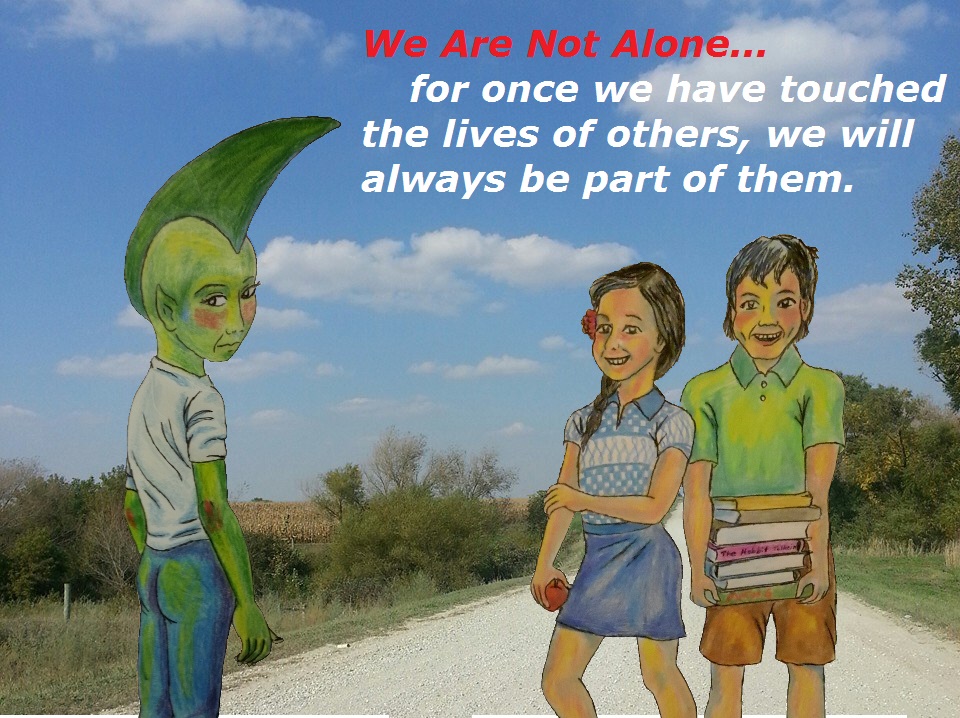
When I tell others that I believe that people are basically good and that I believe all students can learn, I often get an argument. Mass shooters like we had last week and wars and terrorists crop up by the multitudes in order to refute my belief. People who think I am an atheist tell me i’m being a hypocrite to think we should operate our lives around facts and proof and then hold a difficult-to-prove belief like this. Maybe it is an act of faith… but an act of faith that my theocratic friends call a belief in humanism, which they prefer to see as something from Satan. Well, I do believe in God. I just don’t believe in a god who waves a magic wand and intervenes. I believe that God Jehovah (or possibly Allah or the godhead or whatever you want to name Him) made us like the flower seed, meant to grow and transform, and to be winnowed like grain by the winds and rains of life experience. Not all flowers blossom. But more of them do when you water and weed and nurture them. And what is true for flowers is true for men and women. What can I say more about human beings to convince you that I am not wrong to be in awe of them… even the weedy ones? Probably nothing. If you are not open to such ideas, you haven’t read this far. But whether you read this far or not, I am fascinated by you, and will always want to know more. And I am not going to start a new church or something. I am merely going to continue to watch and to wonder.



 During my middle-school teaching years I also bought and read copies of The Prince and the Pauper, Roughing It, and Life on the Mississippi. I would later use a selection from Roughing It as part of a thematic unit on Mark Twain where I used Will Vinton’s glorious claymation movie, The Adventures of Mark Twain as a way to painlessly introduce my kids to the notion that Mark Twain was funny and complex and wise.






 Catch a Falling Star