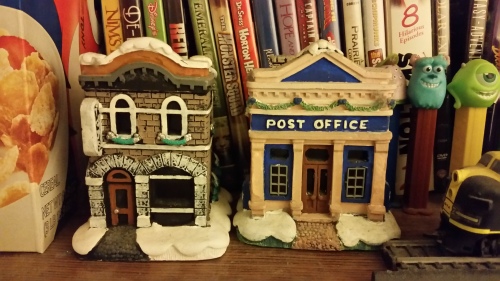
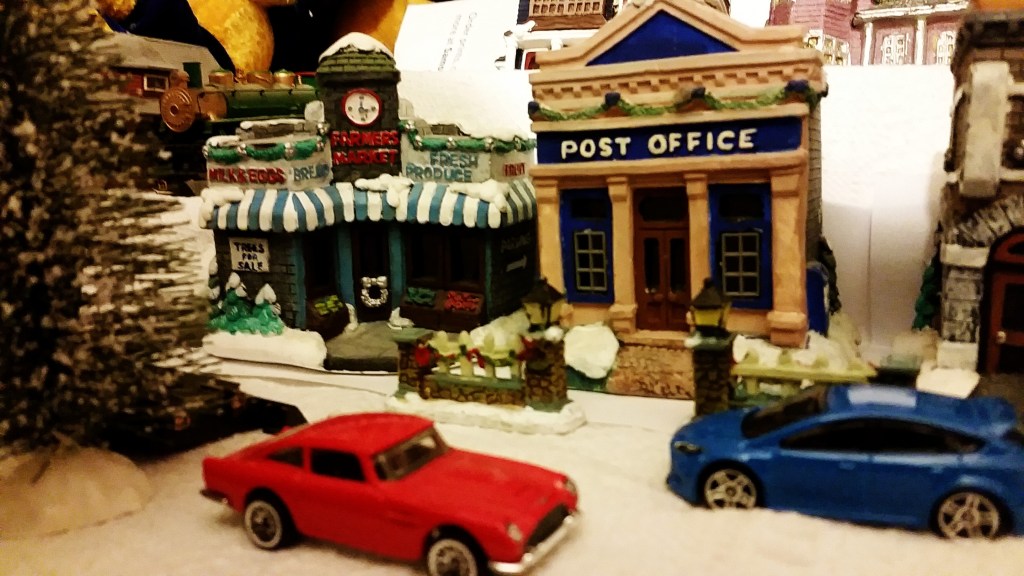
The Toonerville Post Office and Bert Buchanan’s Toy Store.
Toonerville is not only a wonderful cartoon place created by Fontaine Fox in the 1930’s, but the name of the town that inhabited my HO Train Layout when I lived in South Texas and had the Trolley actually running nearly on time. The train layout has not been restored to working condition for over a decade now. The buildings which I mostly built from kits or bought as plaster or ceramic sculptures and repainted have been sitting on bookshelves in all that time. I still have delusions of rebuilding the train set in the garage, but it is becoming increasingly less and less likely as time goes on and my working parts continue to stiffen up and stop working. So, what will I do with Toonerville?
Wilma Wortle waits on the station platform for her train at the Toonerville Train station. I built this kit in the 1970’s, hence the accumulations of dust bunnies.
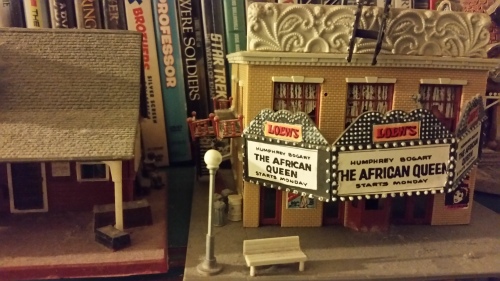
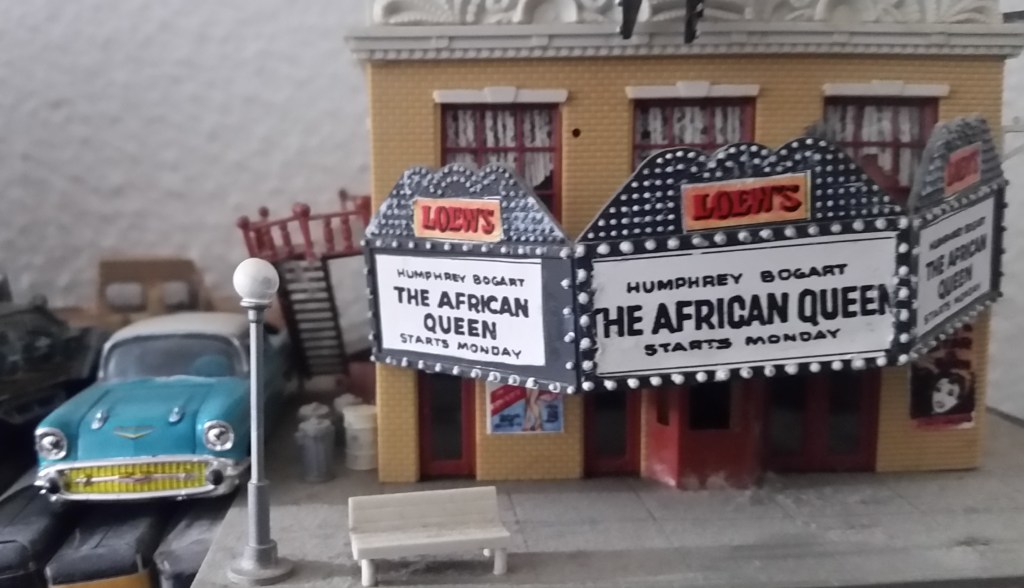
Loew’s Theater has been awaiting the start of The African Queen for more than twenty years.
Main Street Toonerville at 2:25 in the afternoon. Or is it three? The courthouse clock is often slow.
Grandma Wortle who controls all the money in the family likes to park her car near the eggplant house when she visit’s Al’s General Store.
But I may yet have found a way to put Toonerville back together through computer-assisted artsy craftsy endeavors.
A two-shot of Bill Freen’s house and Slappy Coogan’s place on the photo set to start production.
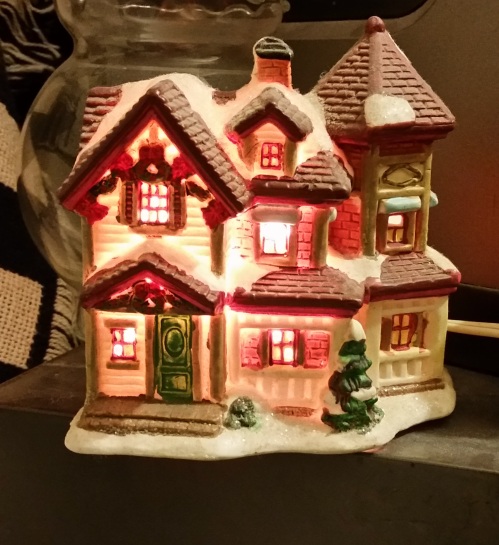
Bill Freen’s house lit up with newfangled electricical. (and I do believe that is the way Bill spells it all good and proper.)
Bill Freen’s house cut out in the paint program.
So I can make composite pictures of Toonerville with realistic photo-shopped backgrounds. Now, I know only goofy old artsy fartsy geeks like me get excited about doofy little things like this, but my flabber is completely gasted with the possibilities.
Bill Freen’s house at sunset… (but I don’t get why there’s snow on the roof when the grass is so green?)
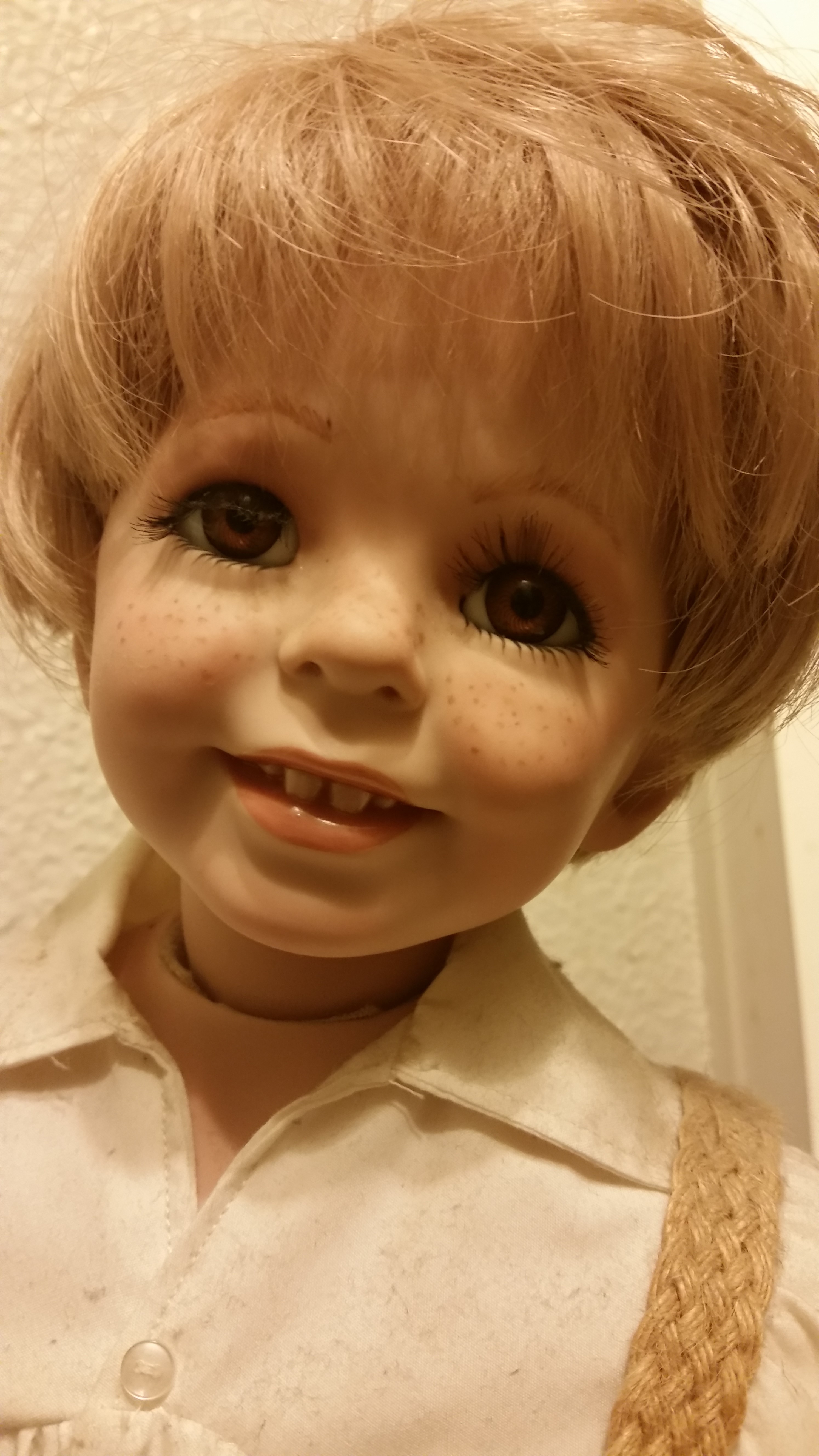
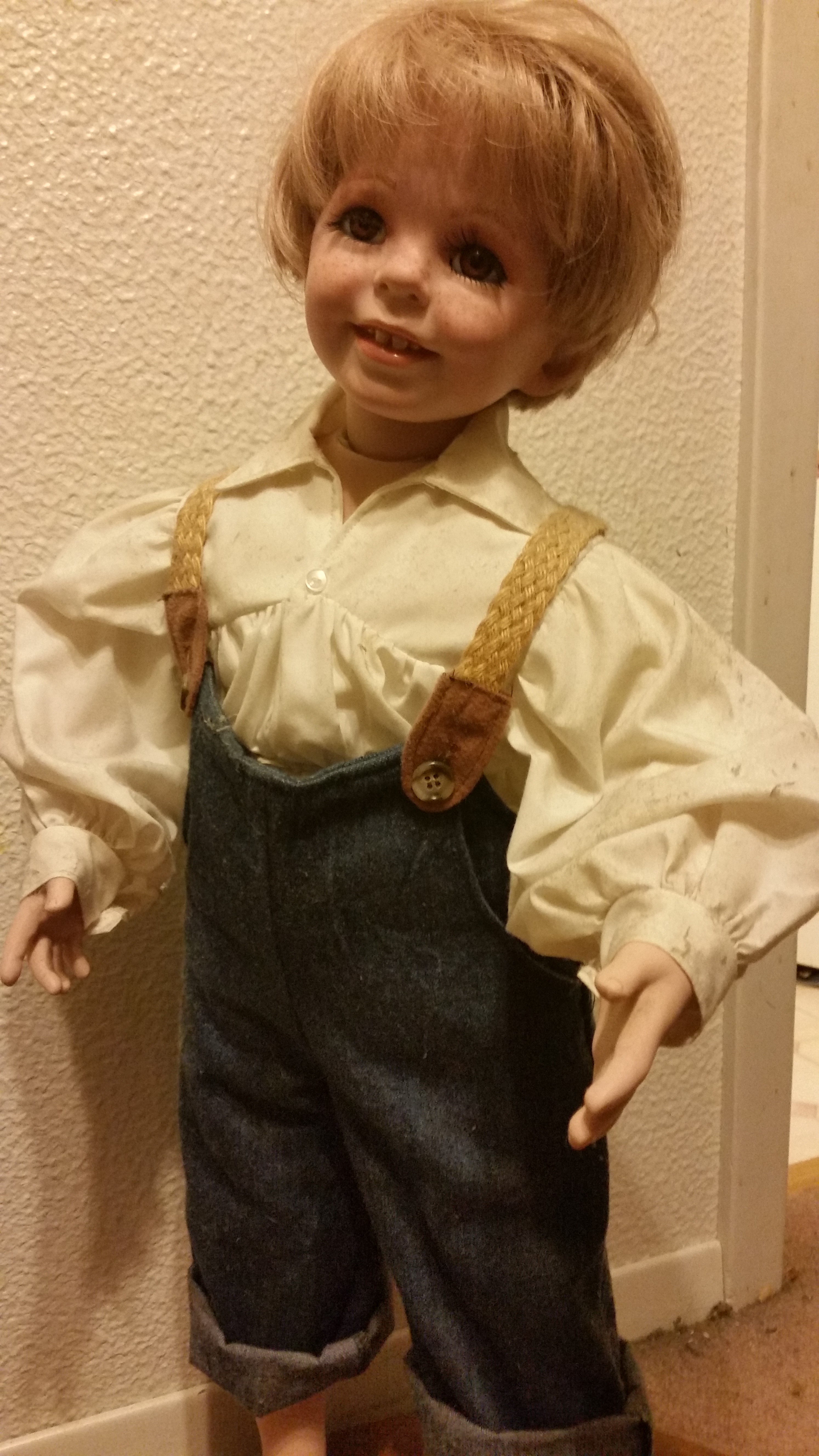
Tom Sawyer without the straw hat, as created by Lois Beyer
You may already know about my doll-collecting mania. You may have already called the mental health people to come take care of the problem, and they just haven’t arrived at my door yet with the white coat that has the extra long sleeves. But you may not know that my mother is a doll-maker and has something to do with my doll-collecting hoarding disorder.
In the early 1990’s my mother and I put our money together and bought a kiln while we were visiting my sister’s family out in California. It wasn’t the most expensive model, but it wasn’t the cheapest, either. We both had enough experience with ceramics that we didn’t want to buy a burning box that was merely going to blow our porcelain projects to kingdom come. Mother had doll-making friends in Texas who taught her about firing greenware and glazing and porcelain paint and all the other arcane stuff you have to know to make expensive hand-made dolls. Now, honestly, at the start we could’ve made some money at it selling to seriously ill doll collectors and other kooks, but we were not willing to part with our early art, and by the time we were ready to do more than just have an expensive hobby, everyone who would’ve paid money for the product was making their own. So dreams of commercial success were supplanted by the hobbyist’s mania that made more and more charming little things to occasionally display at the county fair.
The two dolls I have left to share on my blog from that era were both crafted by my mother. She lovingly fired the porcelain body parts, painted the faces by hand, and created the wardrobe on her Singer sewing machine. I made some dolls too, but never with the wondrous craft and care that made my mother’s dolls beyond compare.
Tom Sawyer was originally a boy doll who was supposed to be able to hold a model train in his hands. My mother had the pattern for the little engineer’s uniform and hat that she would use on another doll instead. He is named after the Tom Sawyer clothing pattern that my mother bought and sewed together to dress him in. He has a cloth and stuffing body underneath his clothes together with porcelain head, hands, and bare feet.
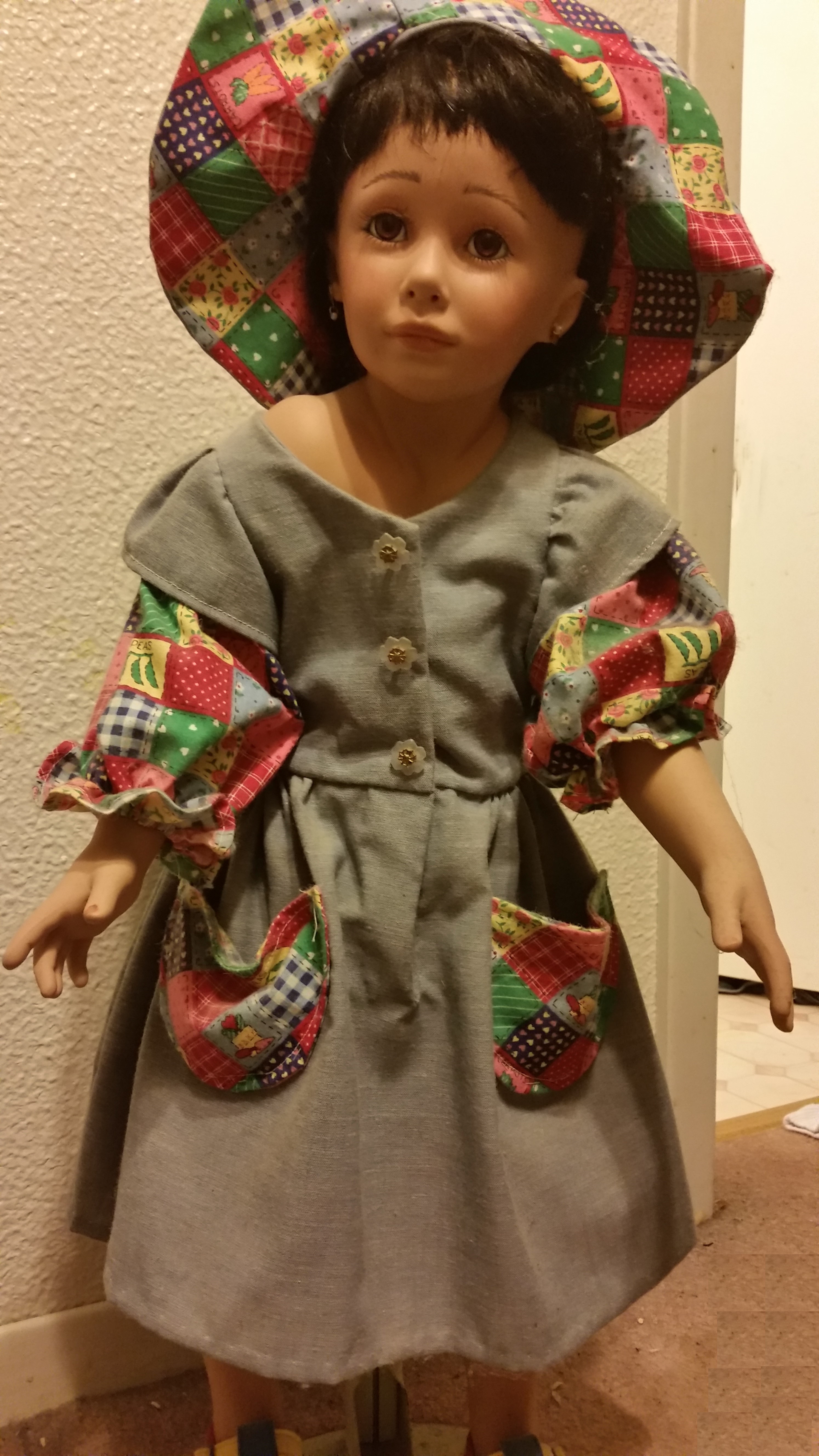
The other doll I have left to brag unctuously about is a doll named Nicole after the niece my wife and I have whom this doll bares a striking resemblance to. She displays a beautiful little girl’s sun dress with quilted accent colors that my mother sewed from scratch with the help of a pattern she was truly fond of and used more than once.
These dolls were gifts to my wife and I, presented shortly after my mother bought out my share of the kiln when she retired and moved back to the frosty land of the Iowegians. I haven’t kept them as thoroughly dusted and cobweb-free as they deserve because I have been a somewhat lazy and slovenly son… but I do love them almost as much as (and sometimes more depending on recent behavior) my own children. (After all, porcelain kids rarely make a mess, overspend allowances, or hog the television too much.)
If you have seen any of my numerous posts about dolls or old books or even, you guessed it, Pez dispensers, you know how badly I am gifted with hoarding disorder. You know the disease. Every old string-saving grandpa or scrap-booking maiden aunt you had as a kid had it. Piles and piles of useless and pointless things all neatly stacked and sorted somewhere in the house, or possibly garage… lurking like a monster of many pieces waiting to take over the whole house.
I can’t help it. Collections have to be completed. If you see it and you don’t already have it, you must possess it. Twenty-seven cents short of the full price with tax included? Go out to the car and dig in the cup holder. Oops! Can’t part with those particular State Quarters. Will they take that many pennies? Have to try.
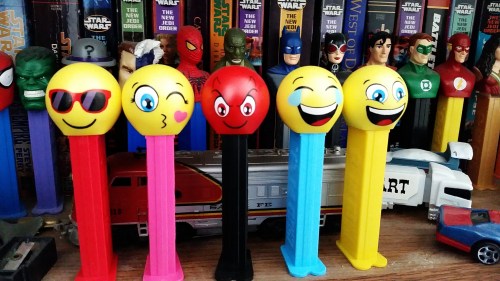
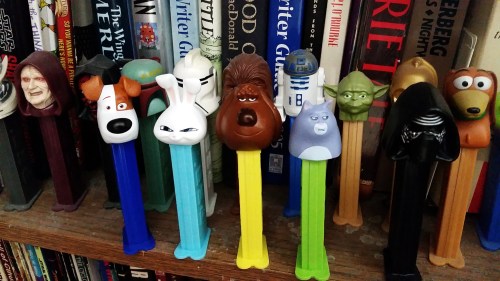
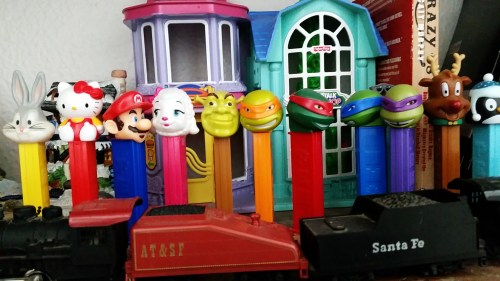
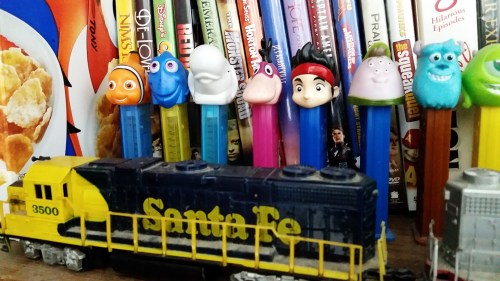
Lately I have been victimized by a combination of my disorder and the fact that Toys-R-Us is a convenient restroom stop on the rush-hour drive along I-35 to pick up the Princess at her high school in Carrollton, Texas and my son Henry at his school in Lewisville, Texas. It is a killer two hours and I need to go potty at the halfway point. And I can’t make my way to the restroom without passing the Pez dispenser display. And I can’t pass the Pez dispenser display without… well, you know.
What can I say? I’m diabetic. I have to visit the restroom frequently.
And they do look good on my bookshelves with a lot of the other junk I collect.
And not all of these are new, bought some time this school year. In fact, not most of them.
And they only cost a couple of dollars each.
And I do resist the urge to buy one once in a while… honest, I really do.
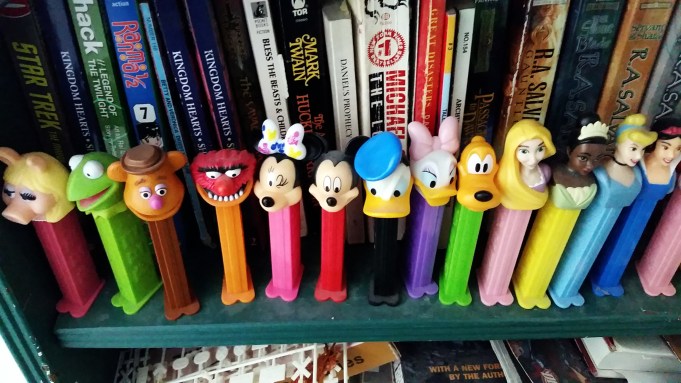
And see here? Only Minnie Mouse and Pluto on this shelf are new. And how could I leave this collection without Minnie and Pluto?
And it’s not like butterfly collecting, which I shamefully admit I did as a kid. You don’t kill and mount Pez dispensers. Although I admit, I really don’t know for sure how their factory works.
But I also have to admit, Pez dispensers aren’t the only thing that turns my collecting urge up to the highest possible settings.
So don’t hate me for hoarding. If you’re worried, all of these things are available in stores too. And I have worked on my photographicalizing skills a bit to share them with you. And who knows where these treasures will end up when I pass on to the cartoonist’s paint box in the sky? My daughter has vowed not to let them end up in a landfill somewhere. Somebody will play with them and love them when I’m finally done. MAYBE EVEN FUTURE GRANDCHILDREN. There is a possibility, you know… always a possibility.
Don’t get too excited. I searched every box, trunk, bag of tricks, safe, closet, and jelly bean jar that I have in my rusty old memory. I didn’t find much. In fact, the old saying is rather applicable, “The beginning of wisdom is recognizing just how much of a fool you really are.” The little pile of bottle caps and marshmallows that represent the sum total of my wisdom is infinitely tiny compared to the vast universe of things I will never know and never understand. I am a fool. I probably have no more wisdom than you do. But I have a different point of view. It comes from years worth of turning my ideas inside out, of wearing my mental underwear on the outside of my mental pants just to get a laugh, of stringing images and stupid-headed notions together in long pointless strings like this one.
Mason City, Iowa… where I was born. River City in the musical “The Music Man“.
One thing I can say with certainty, nothing makes you understand “home”, the place you grew up in and think of as where you come from, better than leaving it and going somewhere else. Federal Avenue in Mason City looks nothing now like it did when I was a boy in the 1960’s going shopping downtown and spending hours in department stores waiting for the ten minutes at the end in the toy section you were promised for being good. You have to look at the places and people of your youth through the lenses of history and distance and context and knowing now what you didn’t know then.
Grandpa Aldrich’s farm in Iowa is now Mom and Dad’s house. It has been in the family for over 100 years, a Century Farm.
The only thing that stays the same is that everything changes. If I look back at the arc of my life, growing up in Iowa with crazy story-telling skills inherited from Grandpa Aldrich, to going to Iowa State “Cow College” and studying English, to going to University of Iowa for a remedial teaching degree because English majors can’t get jobs reading books, to teaching in distant South Texas more than a thousand miles away, to learning all the classroom cuss words in Spanish the hard way, by being called that, to moving to Dallas/Fort Worth to get fired from one teaching job and taking another that involved teaching English to non-English speakers, to retiring and spending time writing foolish reflections like this one because I am old and mostly home-bound with ill health. I have come a long way from childhood to second childhood.
If “what doesn’t kill you makes you stronger” is really true, I should be Superman now. I look like I’ve seen a lot of Kryptonite, don’t I?
Six incurable diseases and being a cancer survivor since 1983 have left their marks upon me. Literally. Little pink bleedy spots all over me are the mark of psoriasis. The fuzzy-bad photo of me spares you some of the gory details. The point is, I guess, that life is both fleeting and fragile. If you never stop and think about what it all means then you are a fool. If you don’t try to understand it in terms of sentences and paragraphs with main ideas, you are an even bigger fool. You must write down the fruit of your examinations and ruminations. But if you reach a point that you are actually satisfied that you know what it all means, that makes you the biggest fool of all.
If I have any wisdom at all to share in this post about wisdom, it can be summed up like this;
Writing helps you with knowing, and knowing leads to wisdom. So take some time to write about what you know.
Writing every day makes you more coherent and easier to understand. Stringing pearls of wisdom into a necklace comes with practice.
Writing is worth doing. Everyone should do it. Even if you don’t think you can do it well.
You should read and understand other people’s wisdom too, as often as possible. You are not the only person in the world who knows stuff. And some of their stuff is better than your stuff.
The stuff you write can outlive you. So make the ghost of you that you leave behind as pretty as you can. Someone may love you for it. And you can never be sure who that someone will be.
So by now you are probably wondering, where is all that wisdom he promised us in the title? Look around carefully in this essay. If you don’t see it there, then you are probably right in thinking, just as I warned you about at the outset, “Gosh darn that Mickey! He is a really big fool.”
In Dungeons and Dragons games you are trying to bring characters to imaginary life by getting into their deformed, powerful, or magic-filled heads and walking around in a very dangerous imaginary world. You have to be them. You have to think like them and talk like them. You have to love what they love, decide what they do, and live and die for them. They become real people to you. Well… as real as imaginary people can ever become.
But there are actually two distinct types of characters.
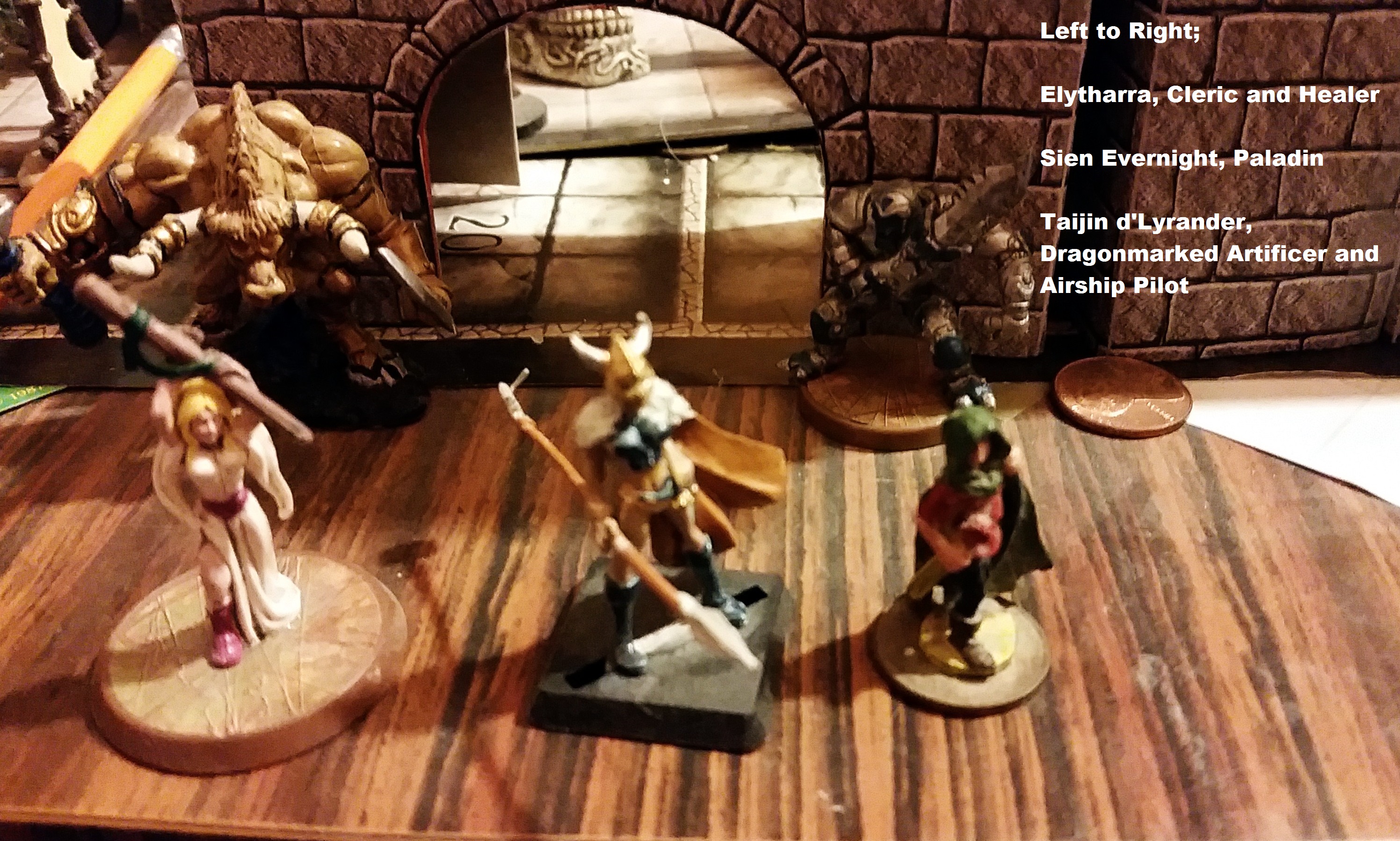
These, remember, are the Player Characters. My two sons and my daughter provide them with their persona, personality, and personhood. They are the primary actors in the stage play in the theater of the mind which is D & D.
But there are other characters too. In fact, a whole complex magical world full of other characters. And as the Dungeon Master, I am the one who steps into their weird and wacky imaginary skins to walk around and be them at least until the Player Characters decide to fireball them, abandon them to hungry trolls, or bonk them on the top of their little horned heads. I get to inhabit an entire zoo of strange and wonderful creatures and people.
Besides the fact that these Non-Player Characters can easily lead you to develop multiple personality disorder, they are useful in telling the story in many different ways. Some are friendly characters that may even become trusted travel companions for the Player Characters.
D & D has a battle system based on controlling the outcomes of the roll of the dice with complex math and gained experience. In simpler terms, there is a lot of bloody whacking with swords and axes that has to take place. You need characters like that both to help you whack your enemies and to be the enemies you get to whack. There is a certain joy to solving your problems with mindless whacking with a sword. And yet, the story is helped when the sword-whackers begin to develop personalities.
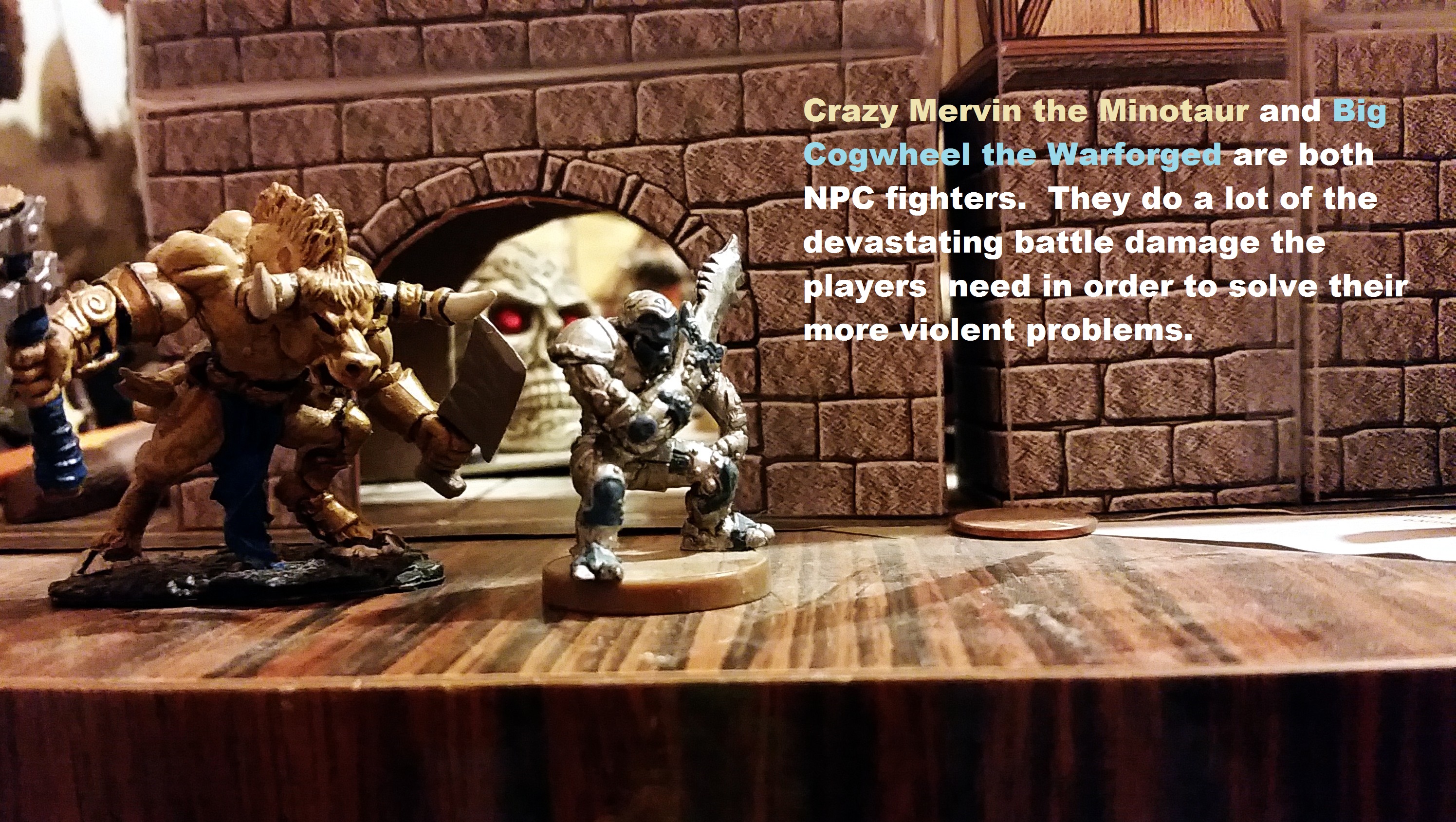
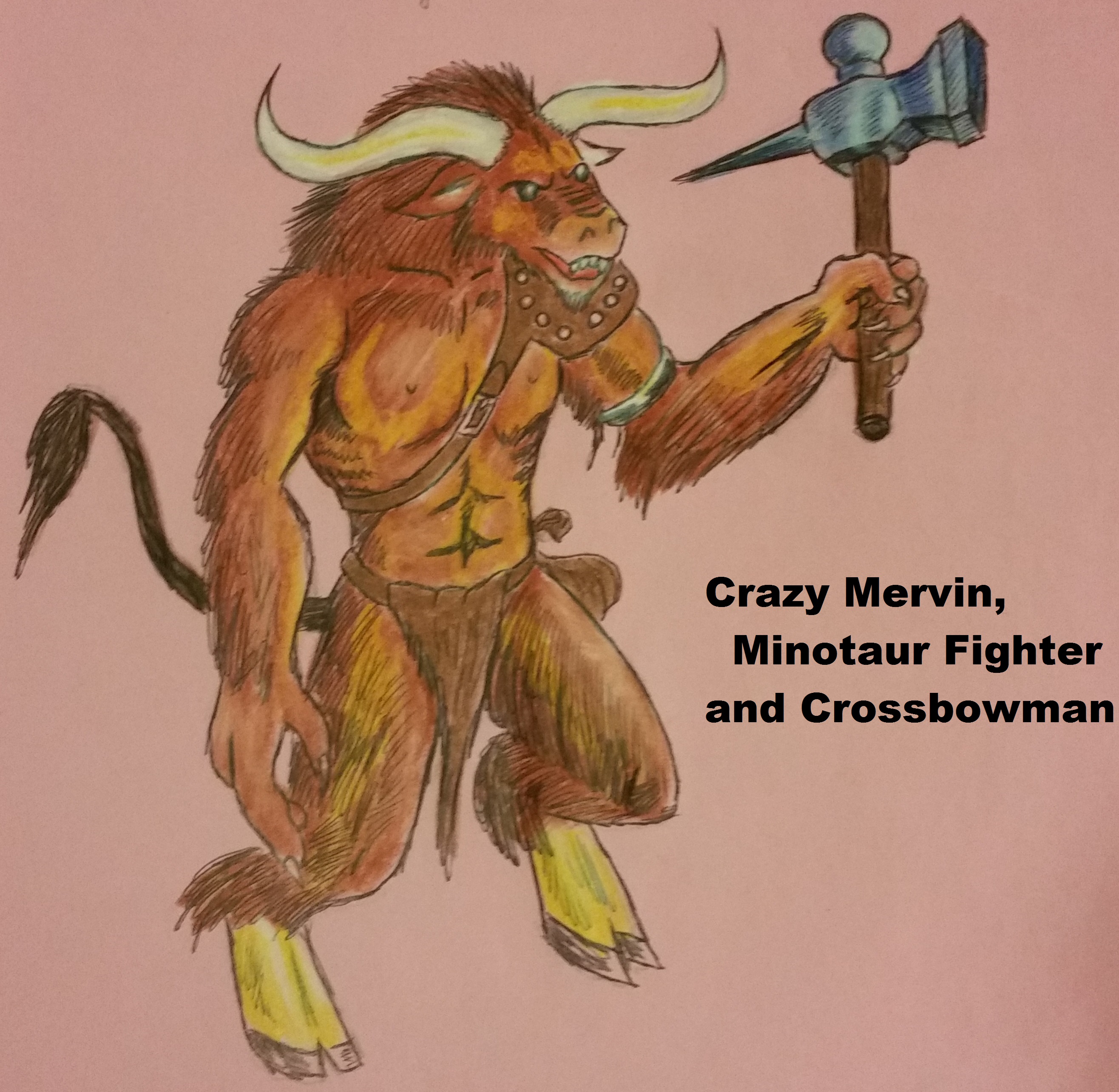
Crazy Mervin, for example, began life as a whackable monster that could easily have been murdered by the Player Characters in passing while they were battling the evil shape-changing Emerald Claw leader, Brother Garrow.
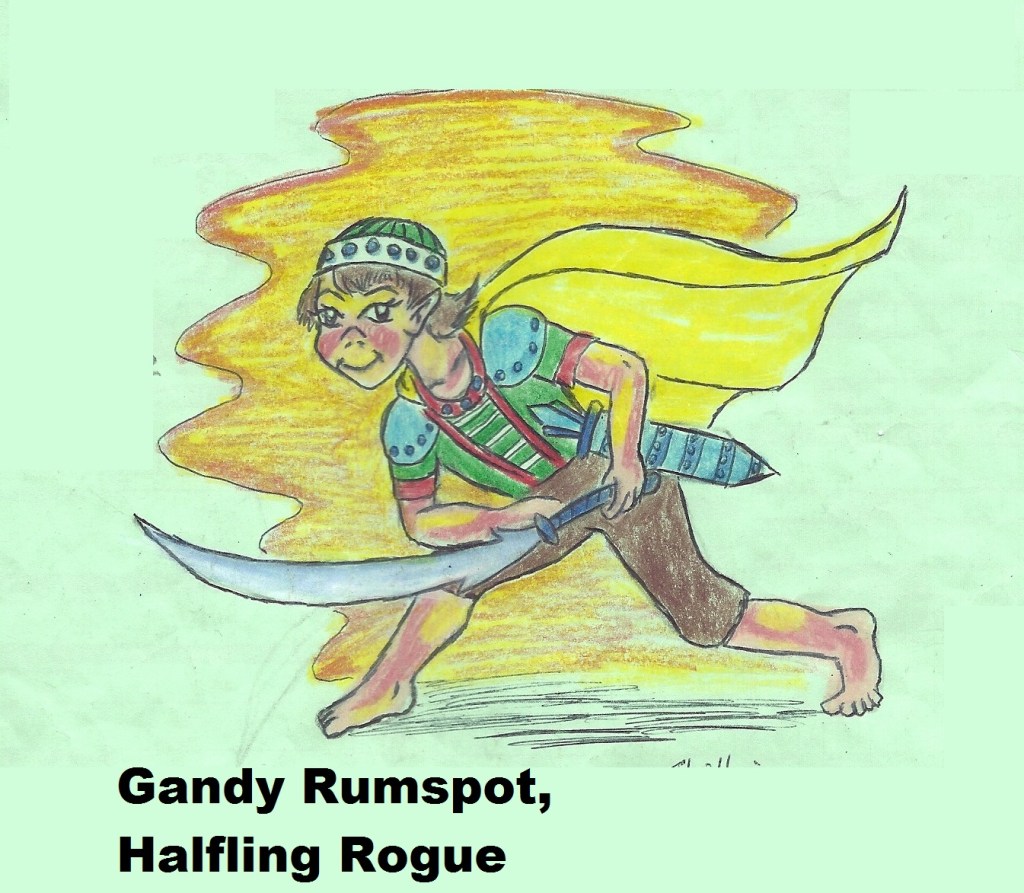
But Gandy befriended him and turned him from the evil side by feeding him and sparing him when it really counted. He became a massively powerful ax-whacker for good because Gandy got on his good side. And stupid creatures like Mervin possess simple loyalties. He helped the players escape the Dark Continent of Xendrick with their lives and is now relied upon heavily to help with combat. He was one of the leaders of the charge on the gate when the Players conquered the enthralled Castle Evernight.
Not every NPC is a whackable monster, however. In the early stages of the campaign the Players needed a magic-user who could read magic writing, use detection spells and shielding spells and magic missiles, and eventually lob fireballs on the bigger problems… like dragons.
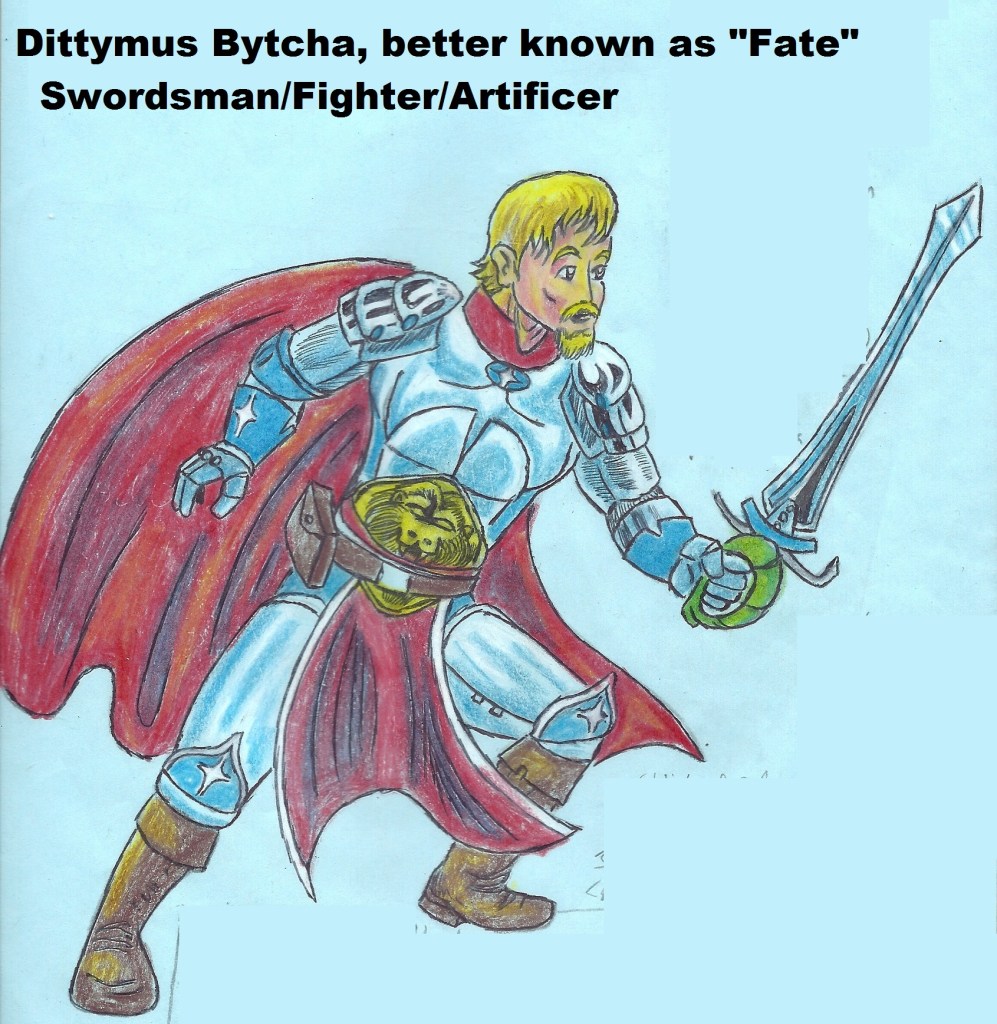
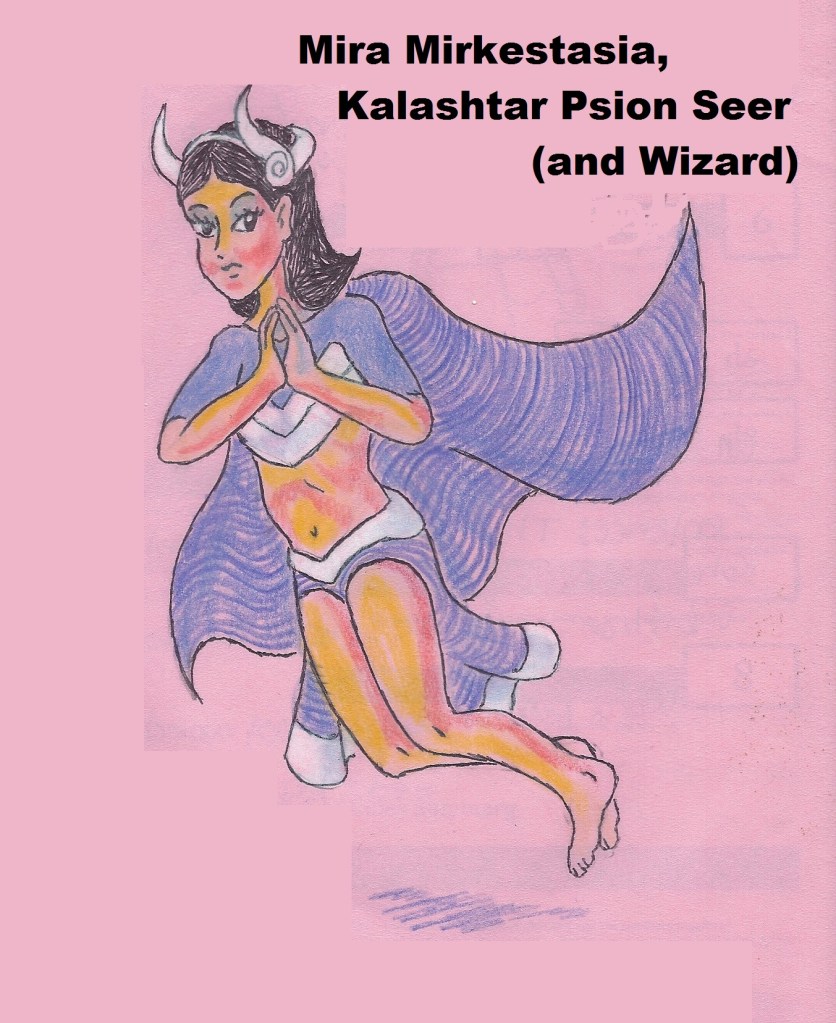
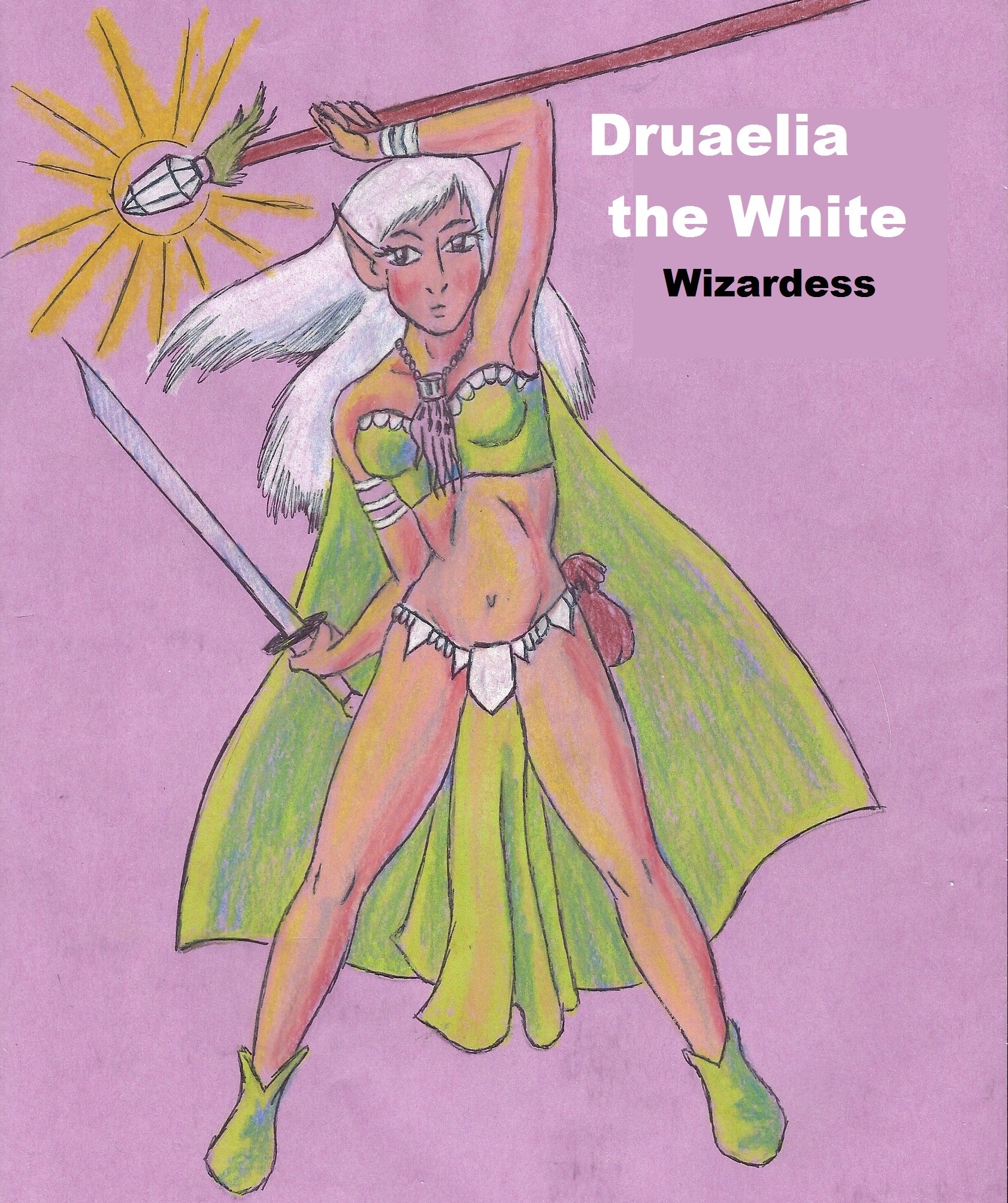
Druaelia was the wizard I chose to give the group of heroes to fulfill these magical tasks. Every D & D campaign requires wizarding somewhere along the way. And Dru was a complex character from the start. Her fire spells often went awry. When Fate used a magic flaming crossbow bolt to sink a ship he was defending, killing the good guys right along with the bad guys, it was with a magic crossbow bolt crafted by Druaelia. Her fire spells went nuclear-bad more than once. She had to learn along the way that her magical abilities tended more towards ice and snow than fire. She learned to become a powerful wielder of cold powers. And while she was comfortable in a bikini-like dress that drove the boys wild because she grew to love the cold, she didn’t particularly like the attentions of men and male creatures that went along with that. More than one random bandit or bad guy learned the hard way not leer at Dru. There are just certain parts of the anatomy you really don’t want frozen.
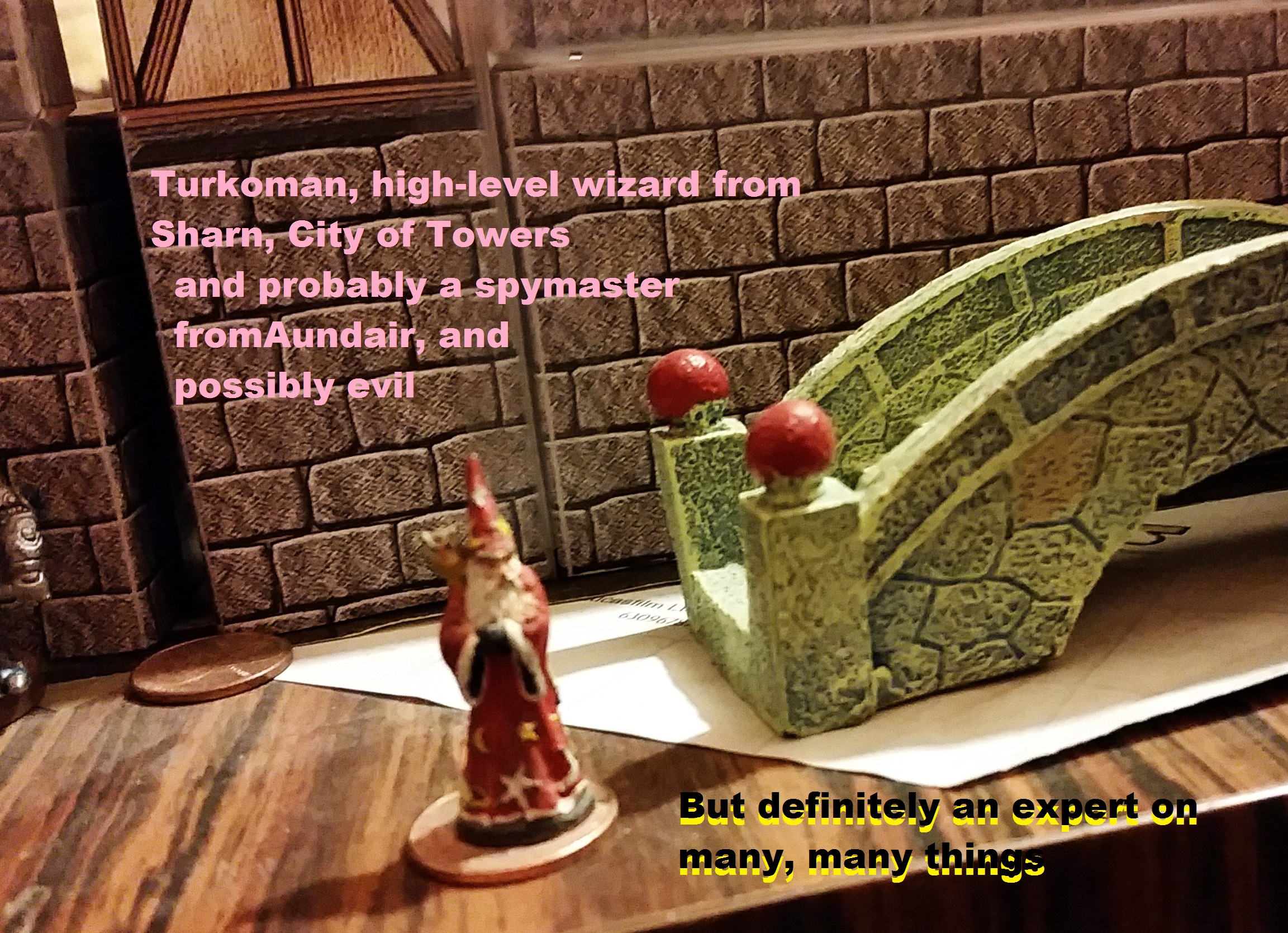
The Player Characters will need all sorts of help along the way, through travels and adventures and dangerous situations. They will meet and need to make use of many different people and creatures. And as Dungeon Master I try hard to make the stories lean more towards solving the problems of the story with means other than mere whacking with swords. Sometimes that need for help from others can even lead you into more trouble.
But as I am now nearing the 800 word mark on a 500 word essay, I will have to draw it all to a close. There is a lot more to say about NPC’s from our game. They are all me and probably are proof of impending insanity. But maybe I will tell you about that the next time we sit down together at the D & D table.
I was born in the 1950’s in Mason City, Iowa… the town that produced Meredith Wilson, the creator of the Broadway Musical, The Music Man. Yes, River City in The Music Man is Mason City. So I was born into a unique Midwestern farm-town heritage where swindlers came to town and saved the day with music and an eleventh-hour change of heart. I was born into the land of Chmielewski Fun Time on the black-and-white TV, Lawrence Welk champagne accordion music, and the Beer-Barrel Polka, courtesy of loads and loads of German ancestry. I am that unique crossbreed of Scandahoovian and sqare-headed Deutschmann known by the only slightly racist term of Iowegian.
Corn Country!
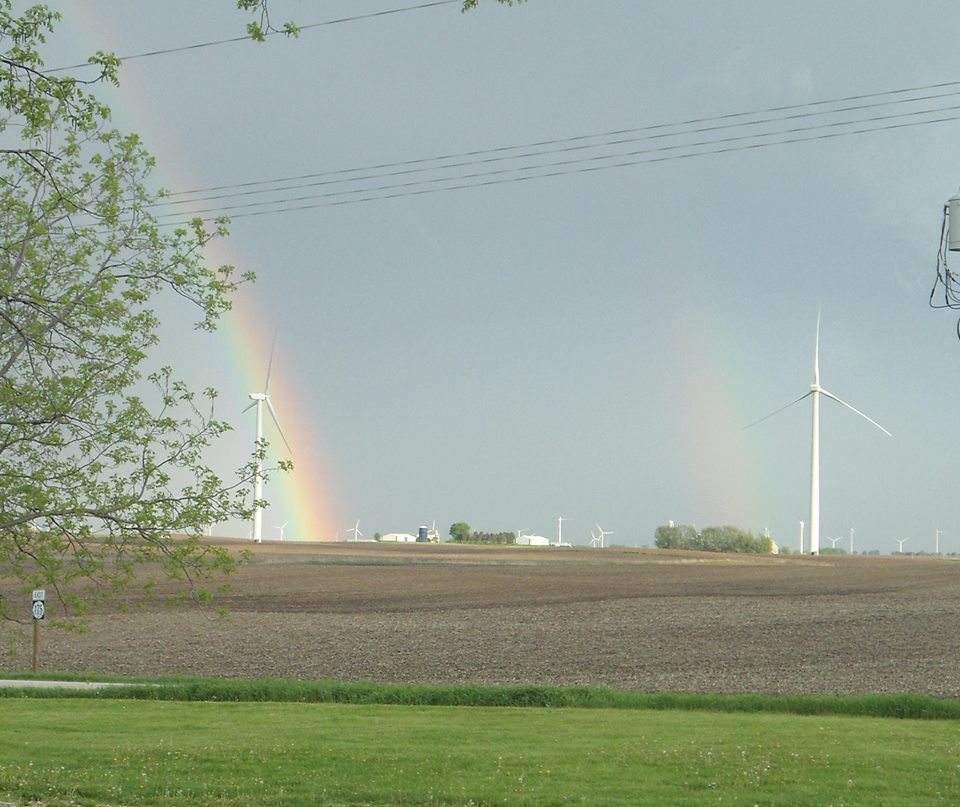
Land of Long Winter and the ice-storm breezin’ down the plains.
And if you ask an Iowegian if he loves Iowa, he will answer, “You bet!”
And if you ask a northern Iowegian the same thing, he will say “You betcha!”
Iowans talk funny, don’t you know…
There are still corner stores and farm supply stores, though they have gone to brand names now, like Casey’s, BP, and Tractor Supply Co. You can still find HyVee and Safeway grocery stores. There are still a precious few family farms that haven’t been swallowed whole by big corporations and agri-businesses. If you go to the county fairs, you will still find kids showing the cattle or pigs that they raised for 4-H projects, and if you go into the barns after the auction, they are still producing tearful kids hugging and kissing that calf that won a red ribbon and now has to be sold… and they will never see poor Barney or Moo-berry again…
It is the land of the lonely gravel road… the back-street cattle pen… the Saturday night tornado (nearly every Saturday in Spring)… The VFW and the Lion’s Club Fish Fry at Lake Cornelia….And it is a place where most everything reeks of the past and old ghosts and times long gone, soon to never be remembered because there’s no longer anybody around who is old enough to tell the stories that grandparents and aunts and uncles used to tell. I not only miss it desperately, but I feel deeply saddened by the loss. Would I like to go home again?
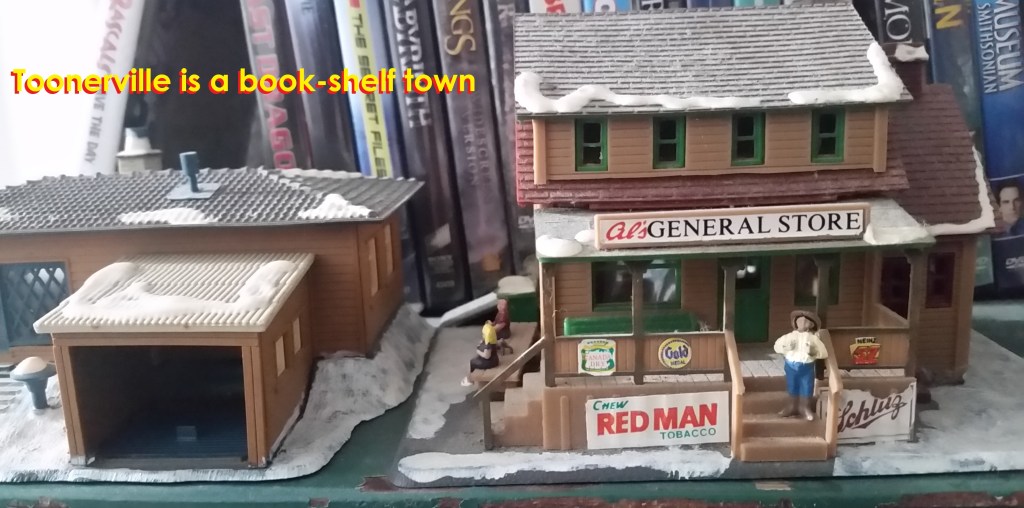
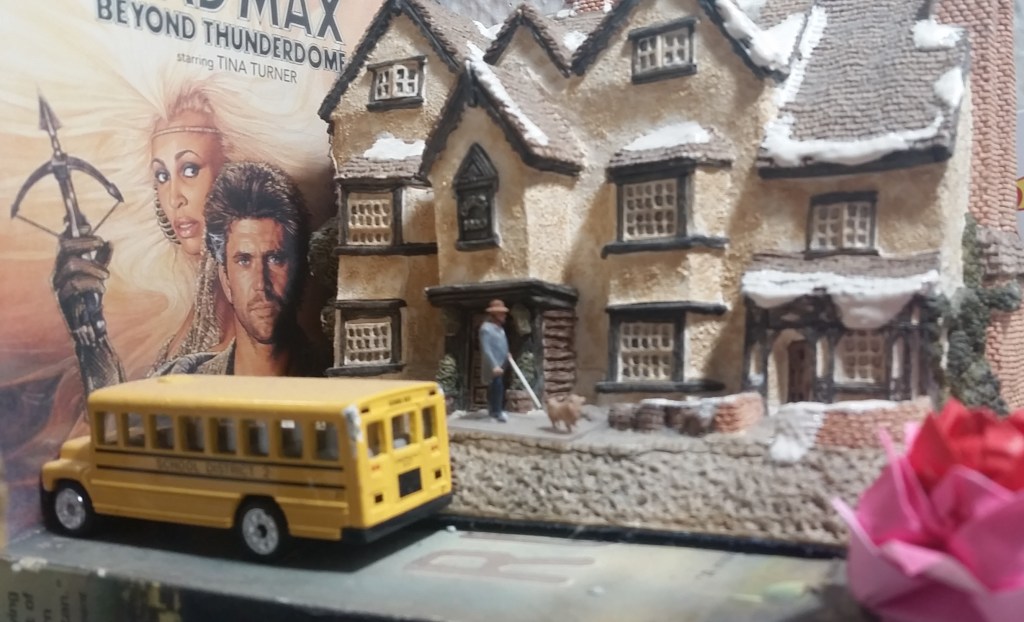
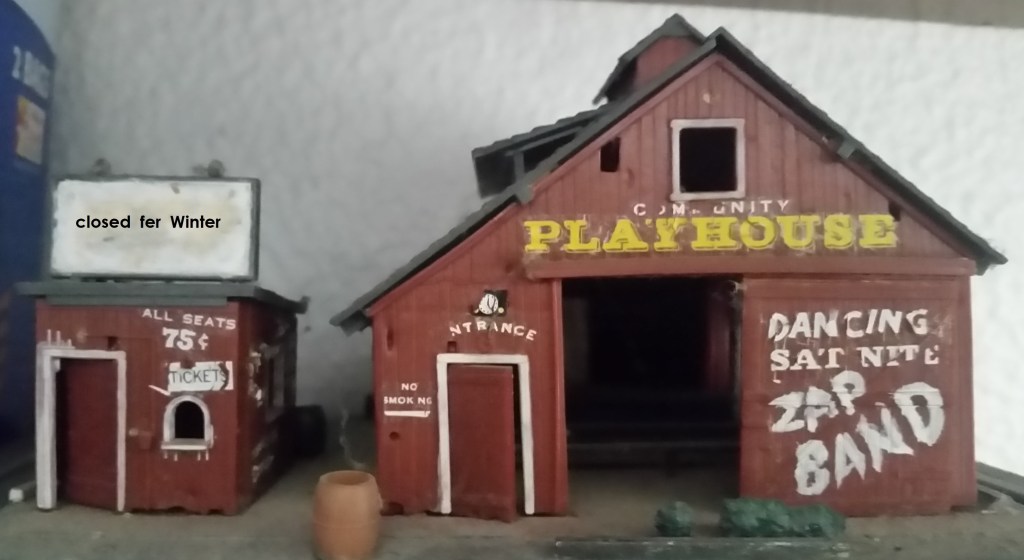
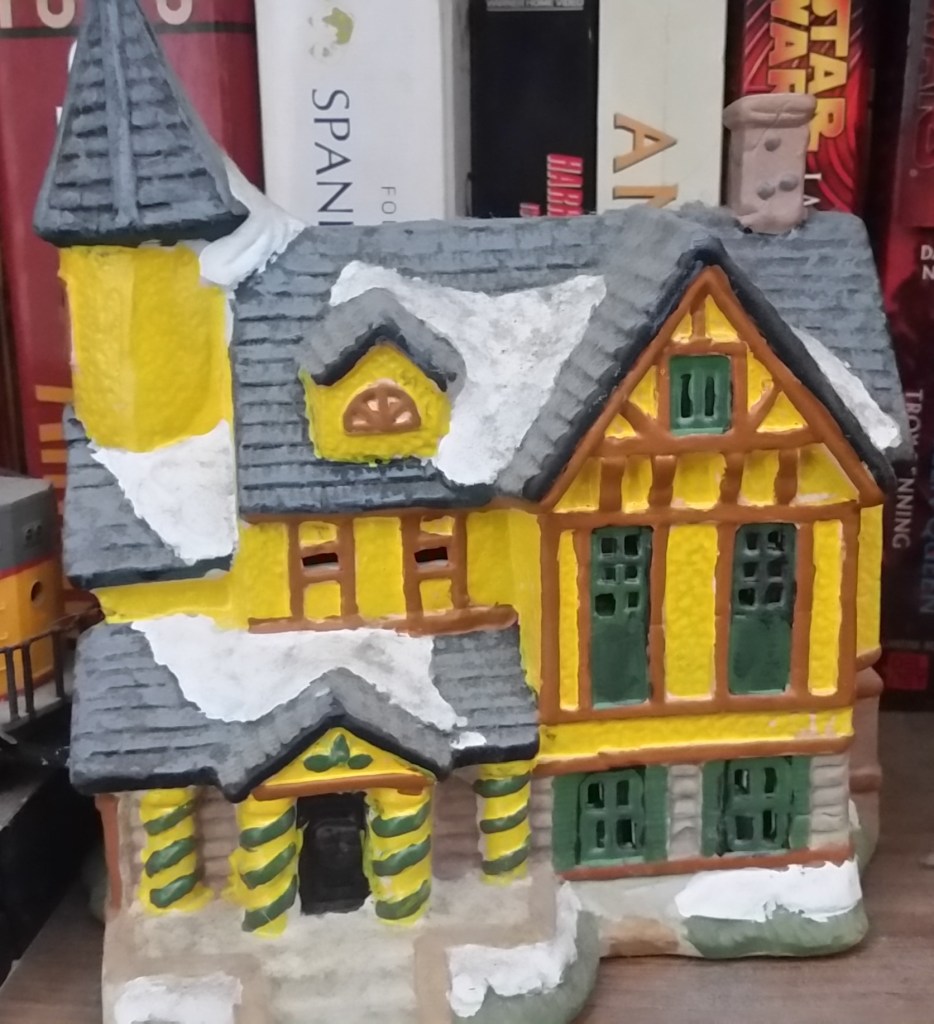
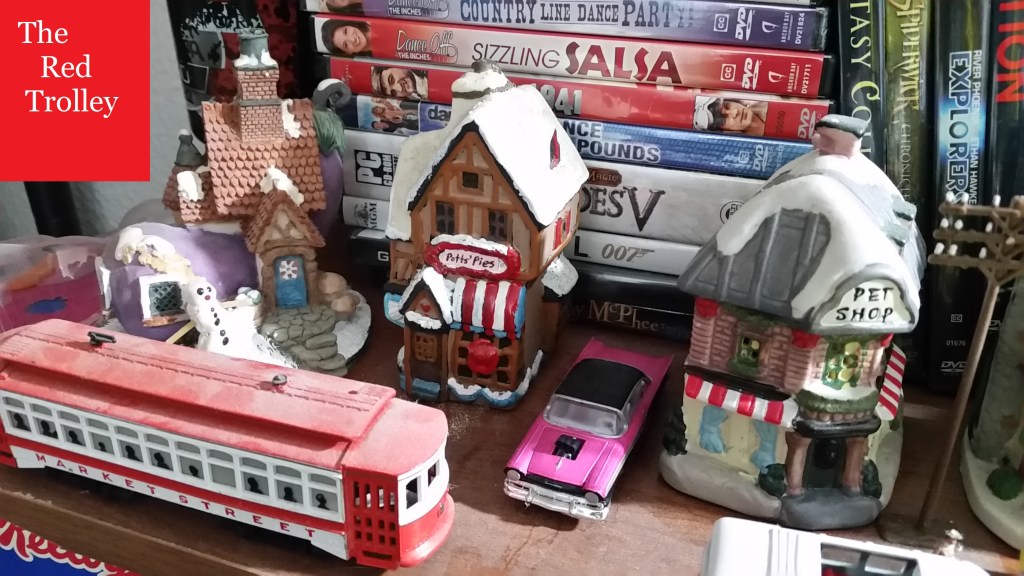
My model railroad layout used to feature a model town I called Toonerville. The town continues to exist as models I have built and/or painted sitting on book shelves and tables.The streets of Toonerville are narrow, but basically book-shelf straight.Some folks who live there are poor. The old woman who lives in a shoe is one of those.The residents of the big house on Mel Gibson Street are relatively rich.But all the residents of Toonerville are plastic people.The plastic people of Toonerville have a movie theater to go to, but The African Queen with Humphrey Bogart is the only movie that plays there. It hasn’t changed in 40 years.There’s also a theater in what used to be Chester Wizenut’s barn, but it is closed for winter and winter has lasted for twenty years in Toonerville.In downtown Toonerville, the clocks never move, and they aren’t even correct twice a day.The Congregational Church was moved downstairs for repairs.Grandma Wortle’s house, Lemon-Sucker Manor, is large and wealthy-looking, but the old lady who lives there is such a miser, she makes Scrooge look like Santa Claus.But Toonerville is a happy place with more than one trolley car, and it makes me smile to go there and chill for a while.
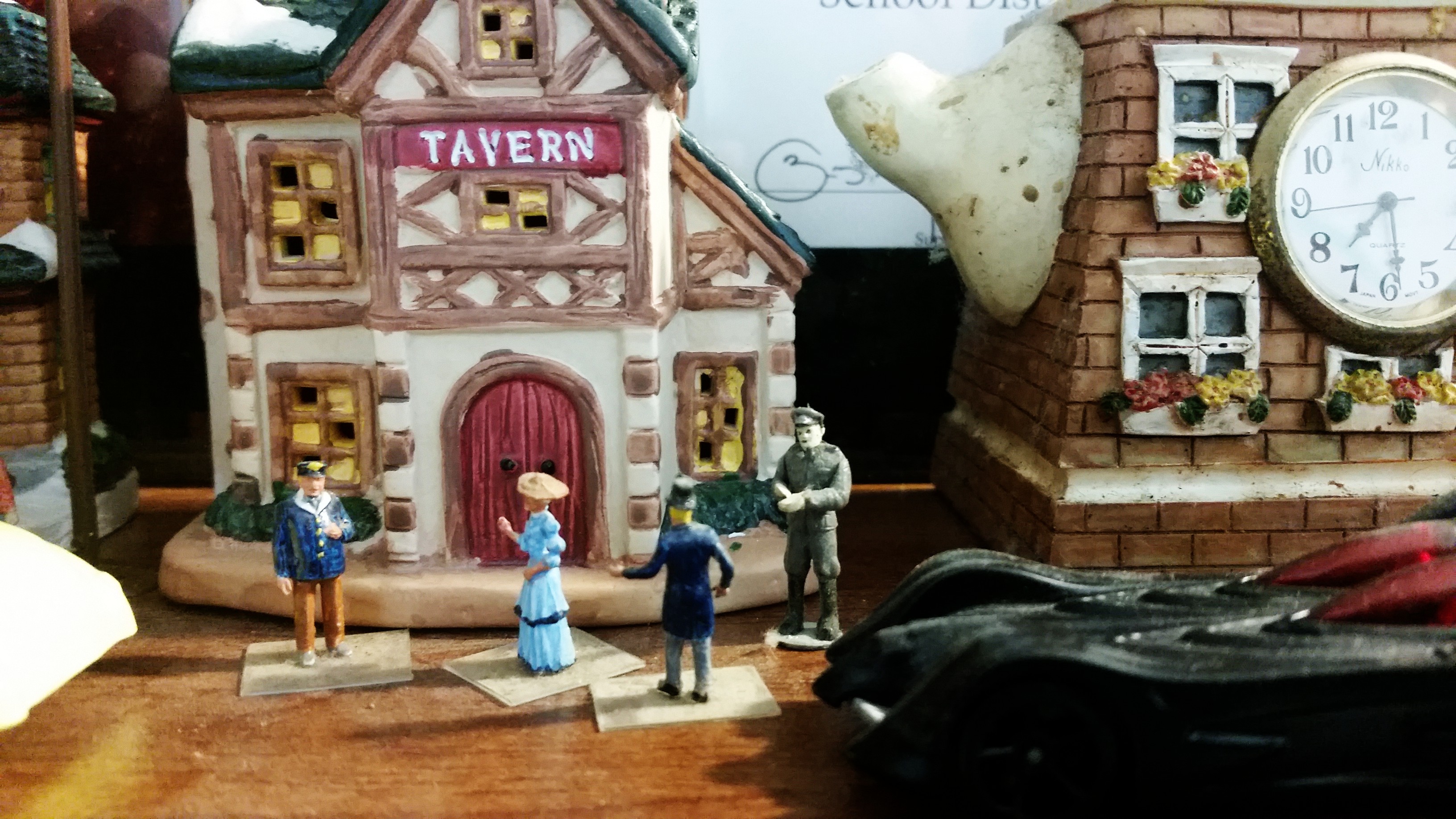
I had the good fortune recently to find some of my boxed-up HO train pieces that had been packed away since 2004 when we moved from South Texas to the Dallas area. Now, in these photos I took of Toonerville, not all of it was part of the uncovered treasure. But some of it most sincerely was. The people out in front of Mike Minskey’s Tavern are from a set of unpainted 1/78th scale German townfolk from the 1880’s. You see them posed here in front of the Batmobile parked in front of the Teapot Clockhouse.
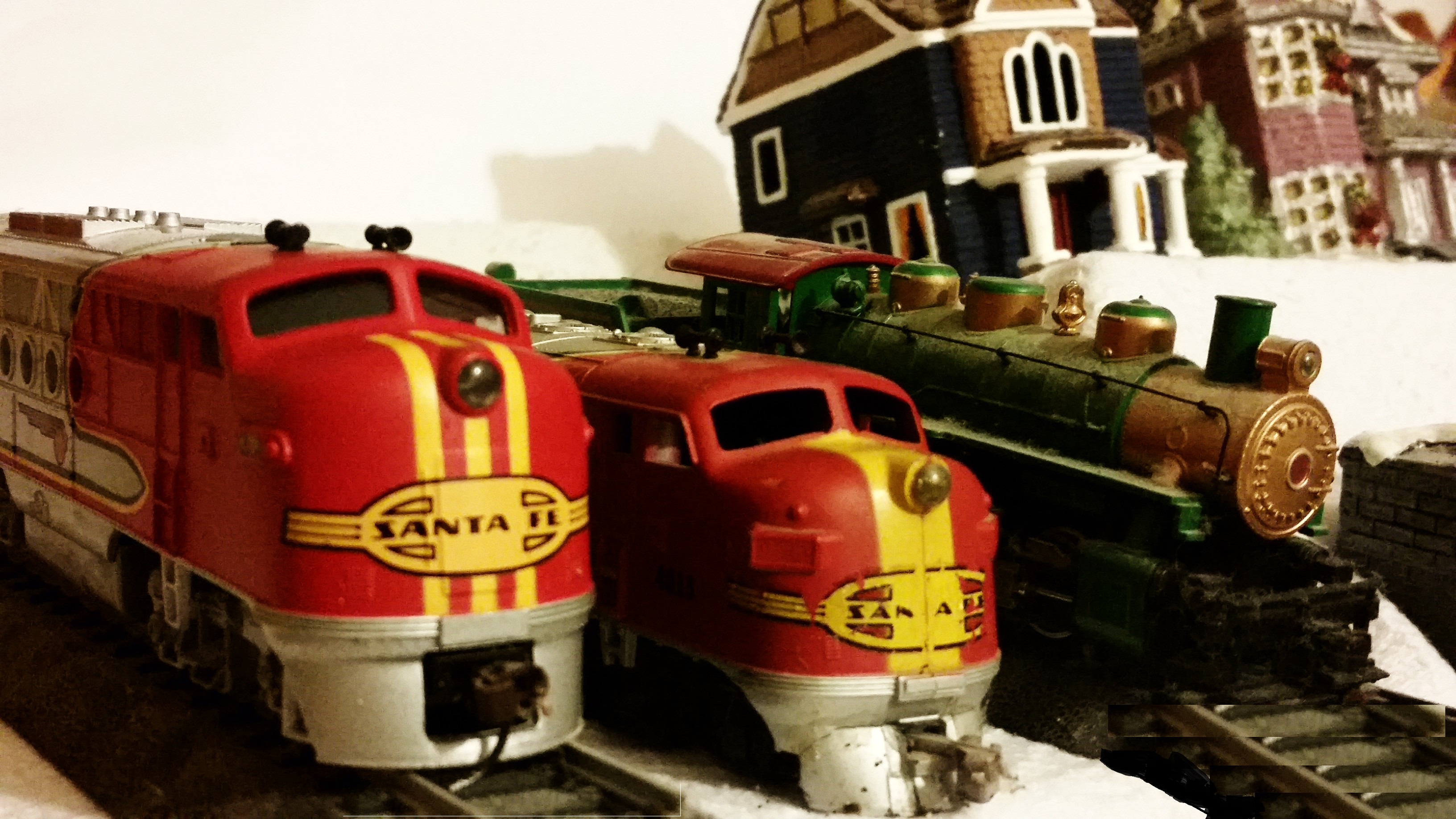
Here you can see the two F-9 Diesels from the SuperChief (I have a thing for Sante Fe Railroad engines and rolling stock). I parked them next to the Snowflake Express which you may have seen before, since I bought it in a garage sale after we moved here.
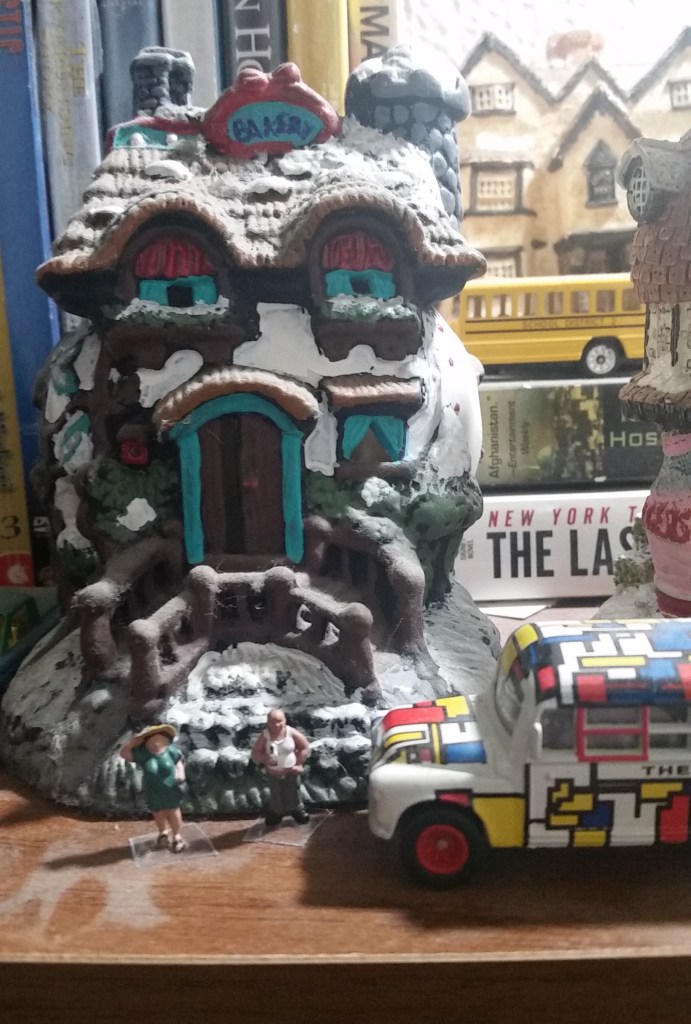
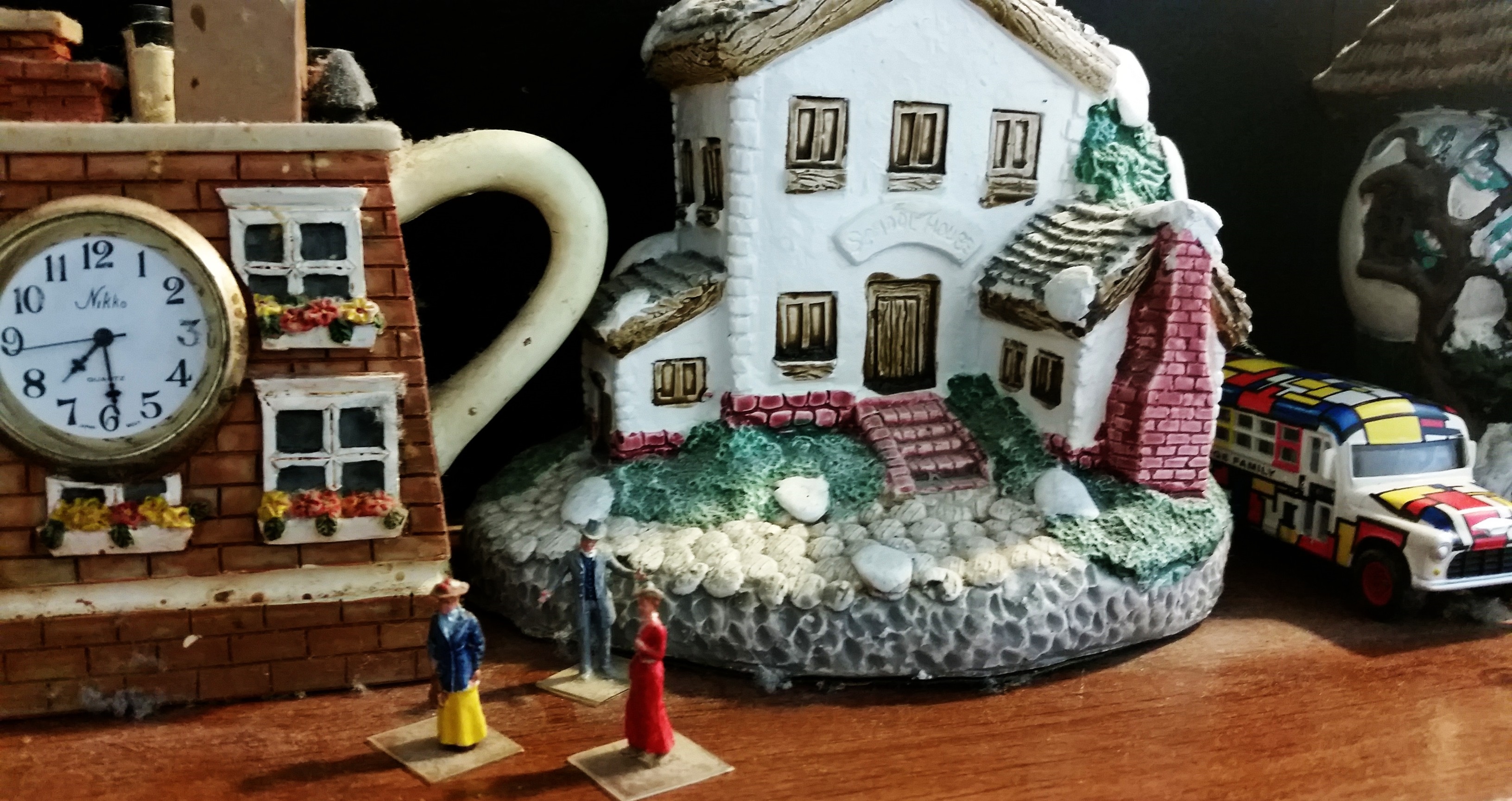
The multi-colored bus that you see behind the Miss Amy Wortle Boarding House is actually the Partridge Family tour bus from the TV show my sisters loved in the 1970’s.
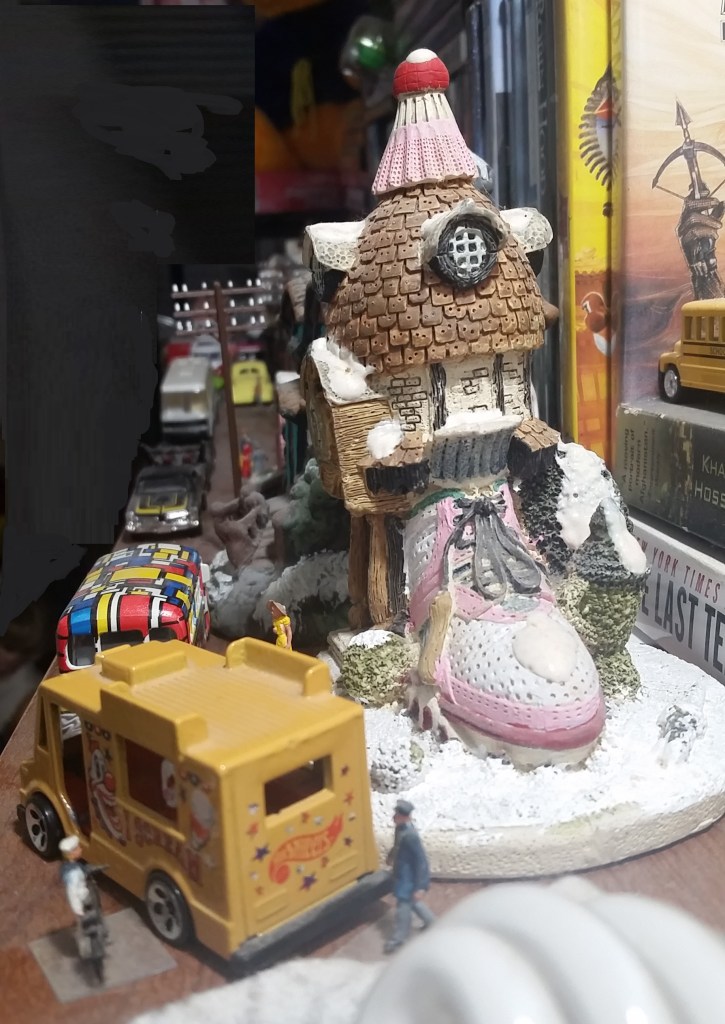
Here’s a view of the front of that same TV bus as it sits between Miss Wortle’s place and Eggbert Egghead’s Egg House. Dabney Egghead is the boy in the sailor suit showing off his brand new velocipede.
The old lady crossing in front of the Toonerville Trolley is Granny Wortle (who controls all the money in the family… I named a lot of the residents after people in Fontaine Fox’s comic strip of the 1930’s).
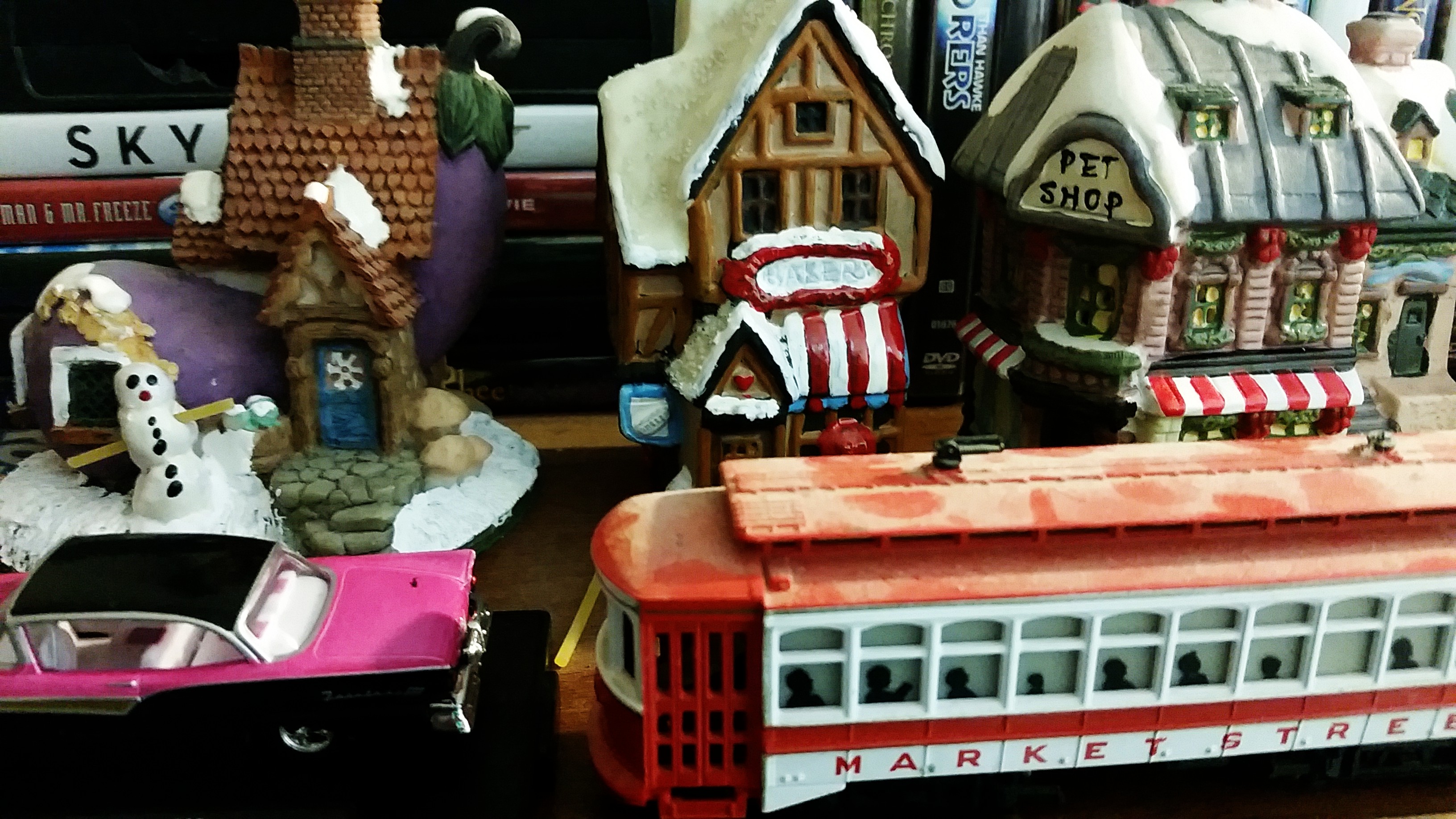
Here’s the back end of the trolley as it passes Digby Davies’ Pet Shop and the purple eggplant house where Gilbert Dornhoeffer and his seven vegetarian children live and build snowmen regularly.
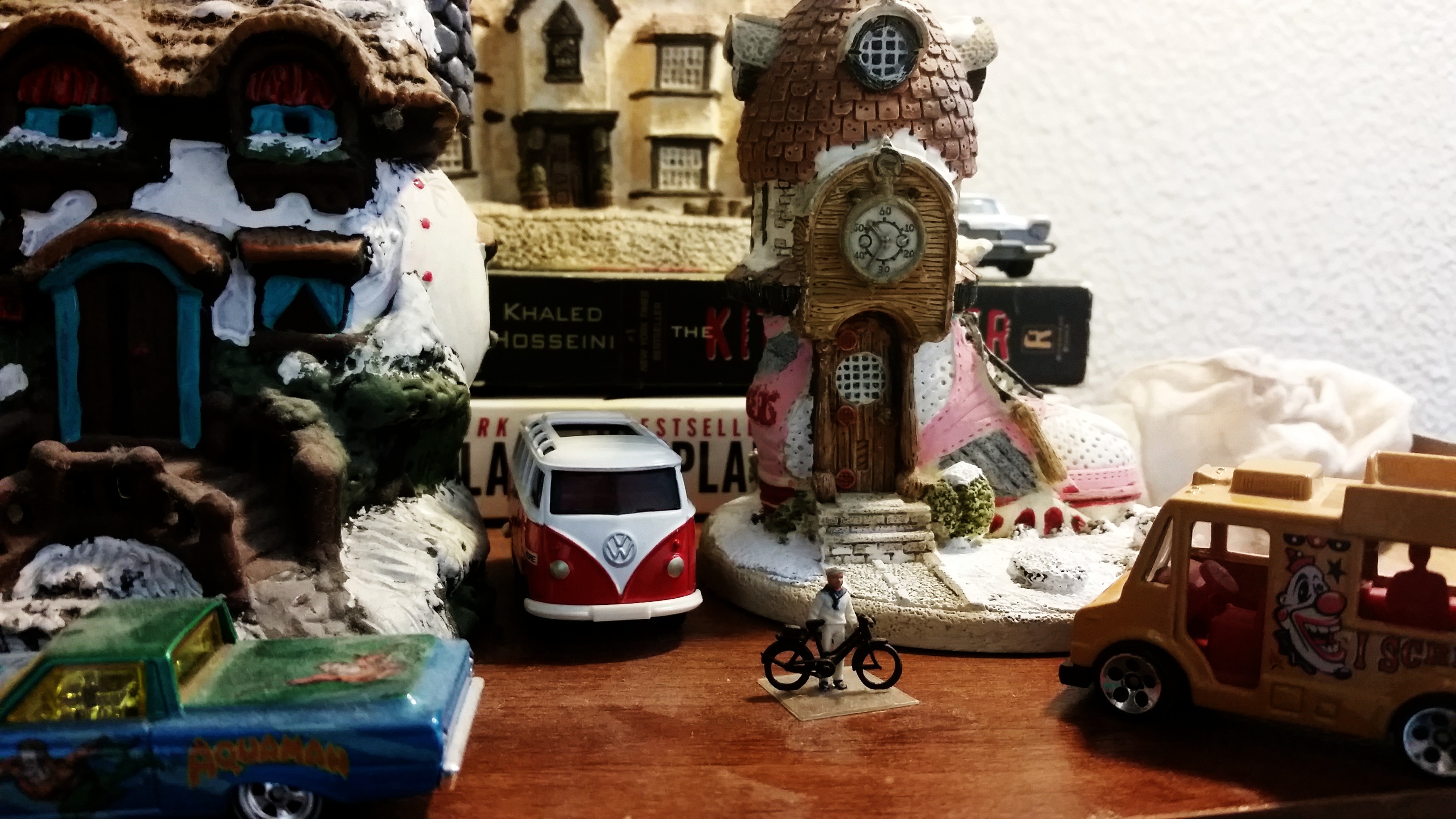
On the other side of Eggbert Egghead’s Egg House you can see Butch and Marcia Niland’s VW mini-bus next to the old shoe-woman’s house which she built from a gigantic pink-and-white high-topped sneaker. Digby moved his velocipede, either to get it in the picture once again, or to get closer to the Scary Clown’s Ice Cream Truck while they’re still serving Eskimo Pies in midwinter.
So now you can plainly see that Mickey finding old boxes of toys that he thought were lost is not a good thing for Toonerville traffic in general, and definitely not good for Toonerville rush hour.
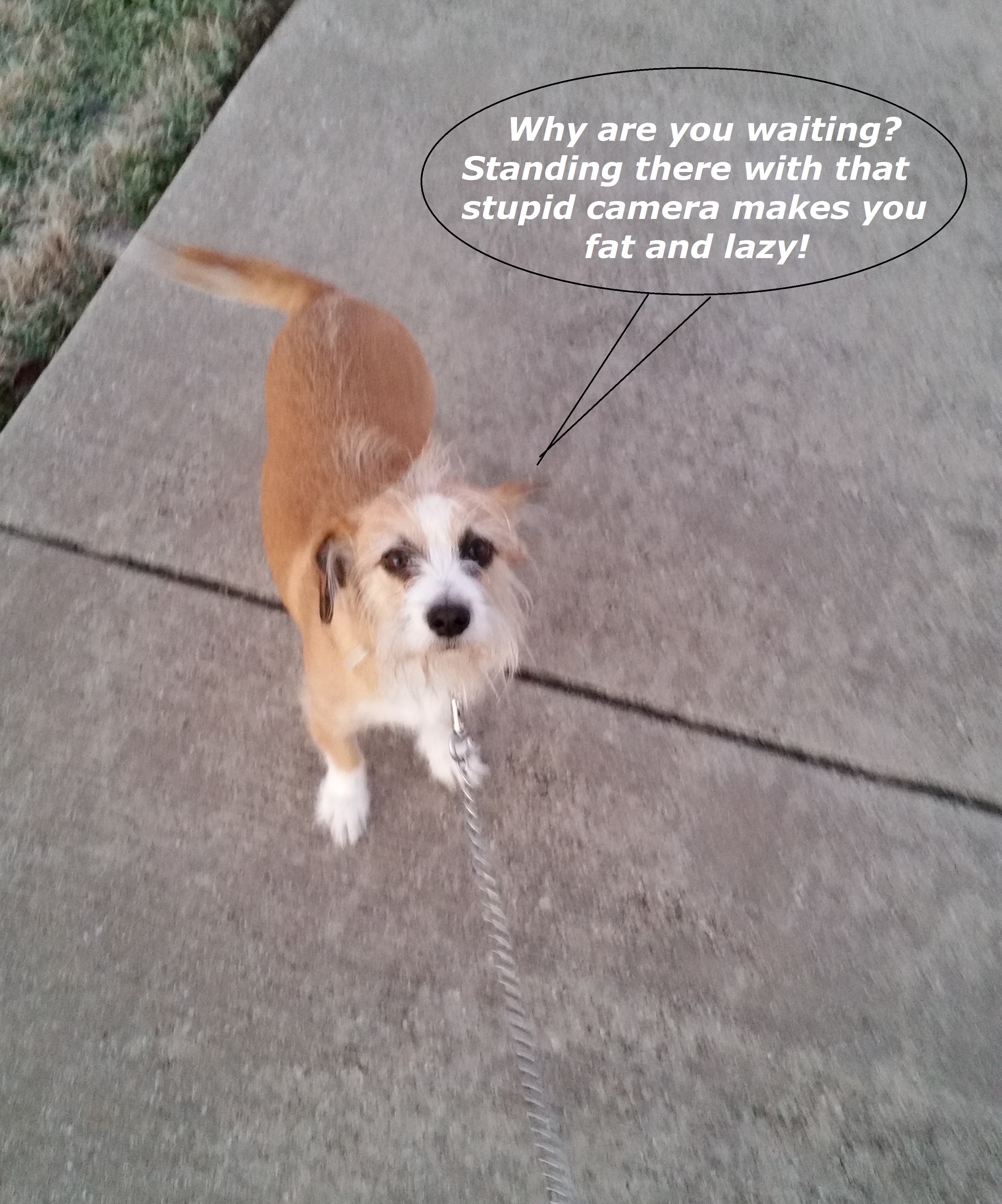
Yes, I will admit to walking the dog for all the wrong reasons… I take her to prevent more poop piling up in the house on the living room carpet, but that’s just the most obvious reason that my wife and kids truly believe is the only reason. The truth is more sinister. When life goes against me (like my recent trouble with anti-teacher policies in Texas and the scourge known as insurance pirates) I take the dog out for walks so I can stumble and grumble and swear at the dog.
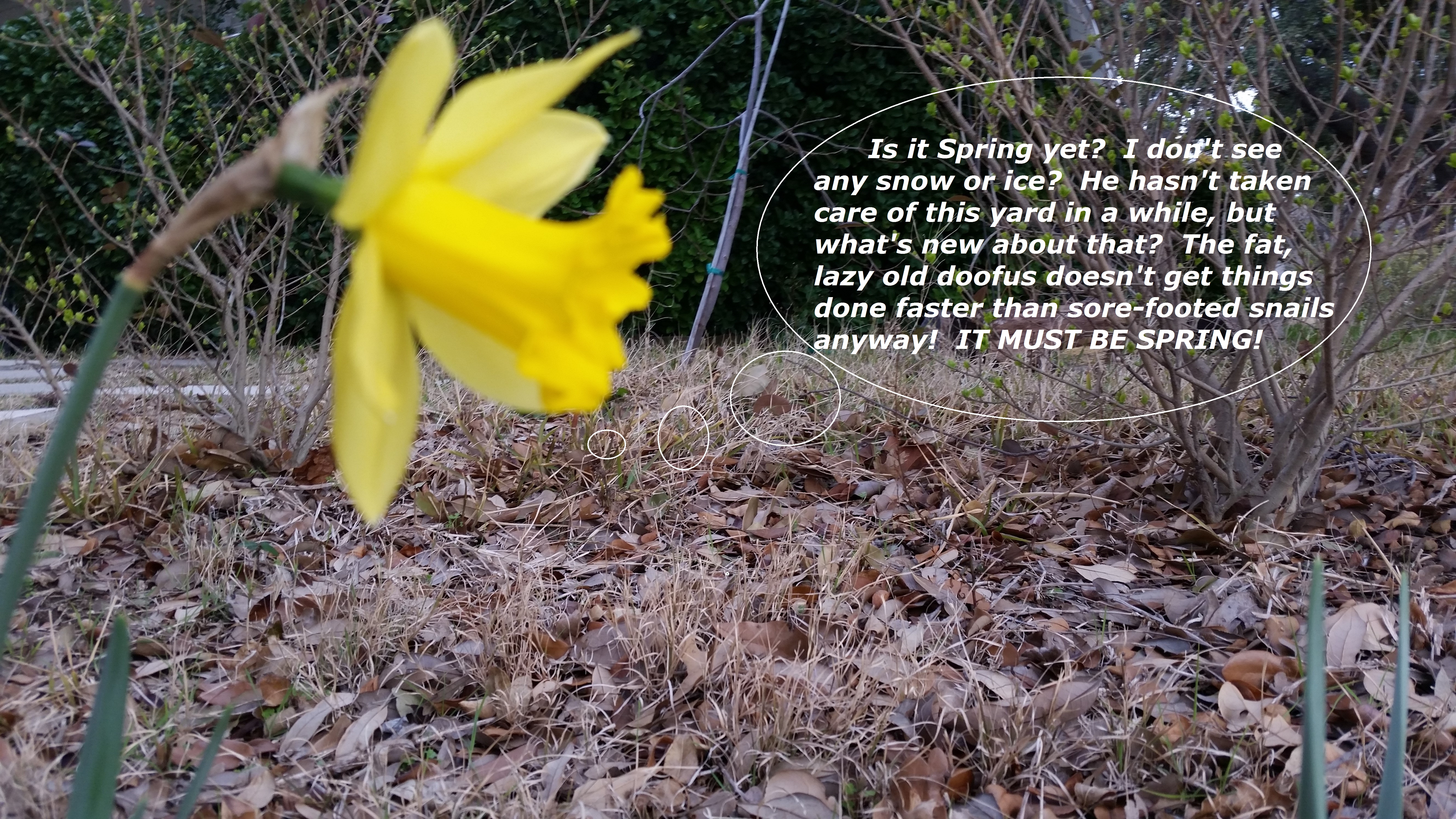
I took my camera along on this walk because I needed something to post for today even though I am all grumbly and rumbly and not ready to write. As we were taking off, I noticed my wife’s daffodils had sprung up to look around, confused by the warmer, wetter weather than we normally get during the time of year when Dallas is known for freezing Superbowls solid.
Daffodils, like most Texas residents, are a little naive and a little too ready to think only good things can happen to them because they are white and relatively wealthy and very Republican, living in the State at the center of the universe.
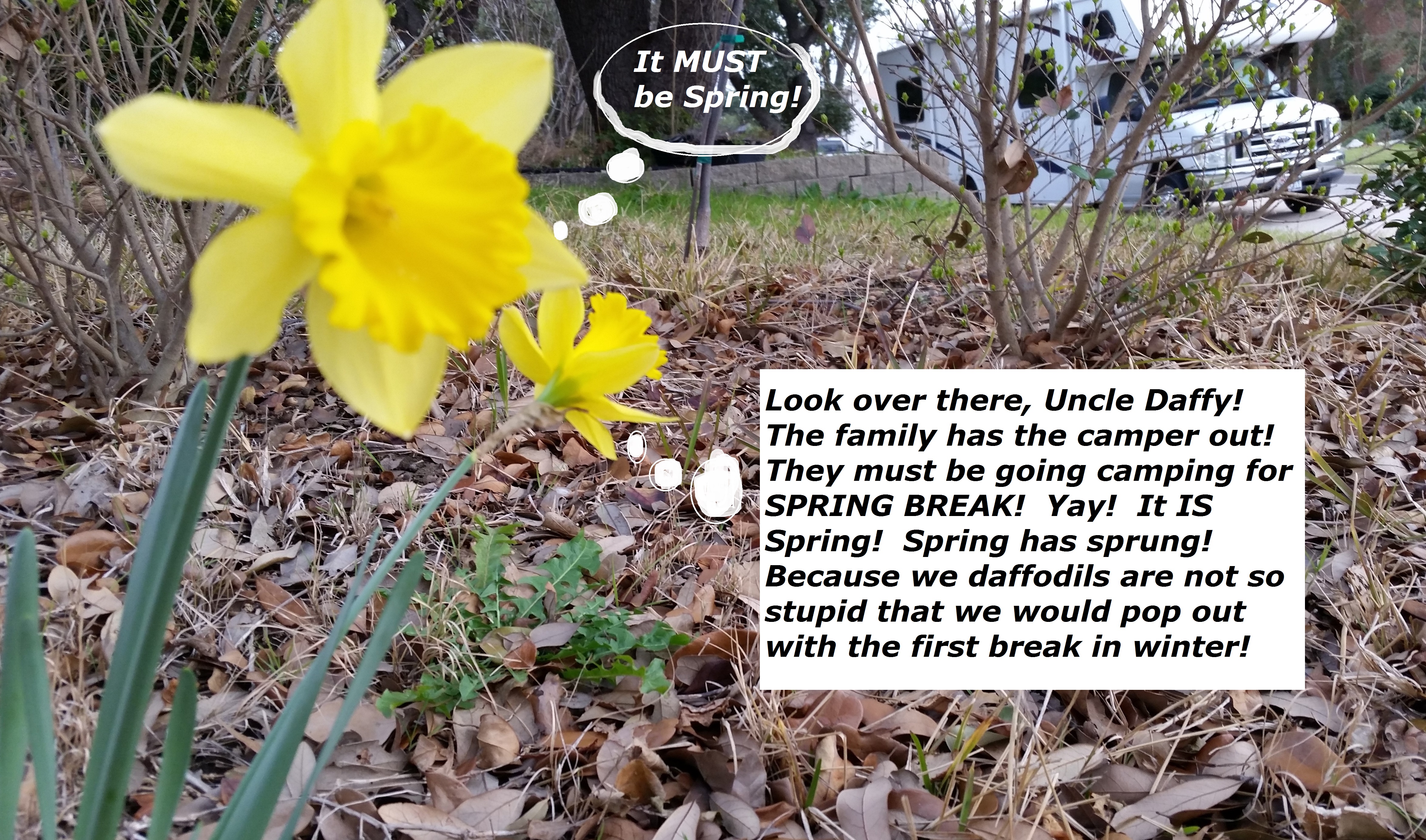
Then the second one pops out. Like any other Texans, two together make the average IQ in the room drop. Opinions get tossed back and forth to snowball into masses of prejudice against Mexicans crossing the border, too many black folks, too many people on food stamps eating up all the profits, and other massively bright blossoms of bigotry. Sometimes they watch Fox News together and get really dangerous. But fortunately, when two or more fear-charged brain-cells come in close proximity to each other (a feat that requires at least five Republicans) they begin to develop an electro-magnetic sixth sense and begin to perceive truth on the far perimeter.
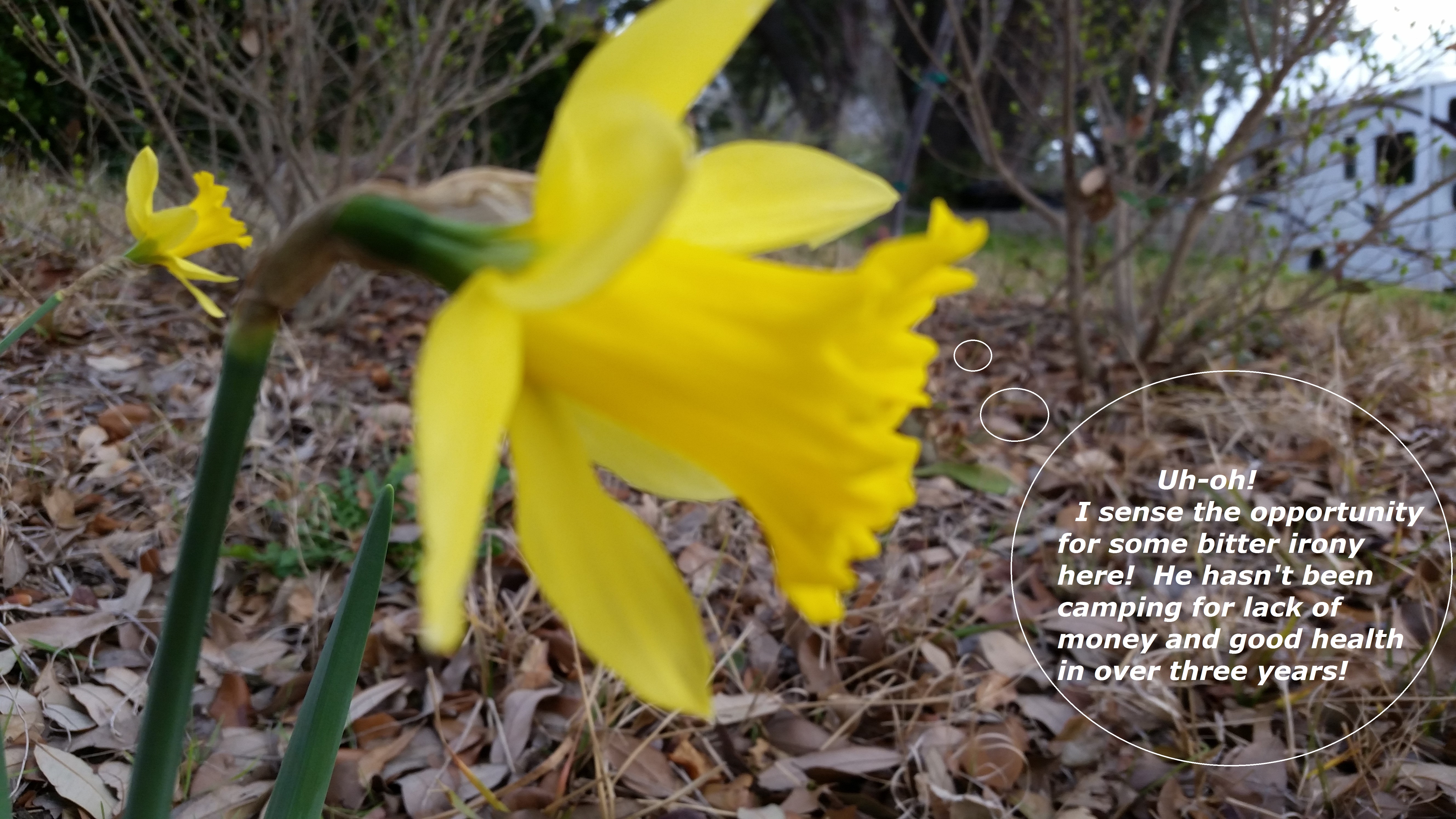
The forecast in North Texas for this coming week is for a strong chance of severe winter weather (for North Texas that is the code for a slight chance of snow). So, I got a good laugh at daffodil expense. But, I guess I don’t really hope they die an icy death. I’m just grumpy because sometimes my life just doesn’t progress very well.
Nobody who wants to be a writer gets by with just writing and never reading anything by anybody else. It is too easy to devolve into some kind of human mushroom that way, thinking only thoughts a mushroom could think, all fungus-like and having no chlorophyll of their own. You never learn to decode other people and other people’s thinking if you don’t read other people’s thoughts crystallized in writing.
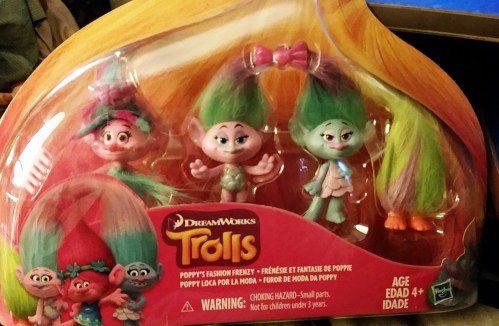
And not every other writer is Robert Frost. Or even Jack Frost who thinks he’s Gene Kelly. There has to be some interpretation, some digging for understanding. What did that writer mean when she said political correctness was like a tongue disease? And what does it mean when a commenting troll calls me a nekkid poofter? Is that how he spells “exceptional genius”? I think it is. Trolls are not smart.
I know people have to make an effort to understand me. When I write, I am writing under the delusion that I can produce literary quality off the top of my head. In fact, I can barely produce hair off the top of my head, and it is gray when I do it. See what I did there? It is the kind of joke a surrealist makes, pretending the idiomatic expression you use is to be taken literally when it doesn’t literally make sense. That kind of nonsense is what my readers have to put up with, and probably also the reason why most of them just look at the pictures. If you have to think too hard when you read, your brain could over-heat and your hair could catch fire. I like that kind of purple paisley prose that folds back in on itself and makes you think in curlicues. But most people don’t. Most people don’t have fire-proof hair like I do.
Of course, there is the opposite problem too. Some writers are not hard to understand at all. They only use simple sentences. They only use ideas that lots of other people have used before. You don’t have to think about what they write. You only need to react. They are the reasons that words like “trite”, “hackneyed”, “boring”, and “cliche” exist in English. But simple, boring writing isn’t written by stupid people. Hemingway is like that. Pared down to the basics. No frills. Yet able to yield complex thoughts, insights, and relationships.
Sometimes, it doesn’t even take a word to make the point. For instance, why, in the picture, is Fluttershy trying to drink out of the toilet in the dollhouse bathroom? For that matter, why does a doll house even need a bathroom? Applejack doesn’t even fit in that yellow bathtub. I know. I tried to stuff her in there for this picture. And, as you read this, doesn’t this paragraph tell you a lot about me that you probably didn’t even want to know?
When I am reading the writing of others, I am looking for a cornucopia of things. I want to not only understand their ideas, I want to detect the limping footprints across the murder scene of their paragraphs and come to know the deeper things about them as well. I spent years decoding and trying to understand the writing of preliterate kids in my middle school English classes in order to be able to teach them to write better. And I learned that no writer is a bad writer as long as they are using readable words. I also learned that very few writers are James Joyce or Marcel Proust. Thank God for that! And given enough time I can read anything by anybody and learn something from it. I read a lot. And it may not always make me a better writer to read it, but it always has value. It is always worth doing.















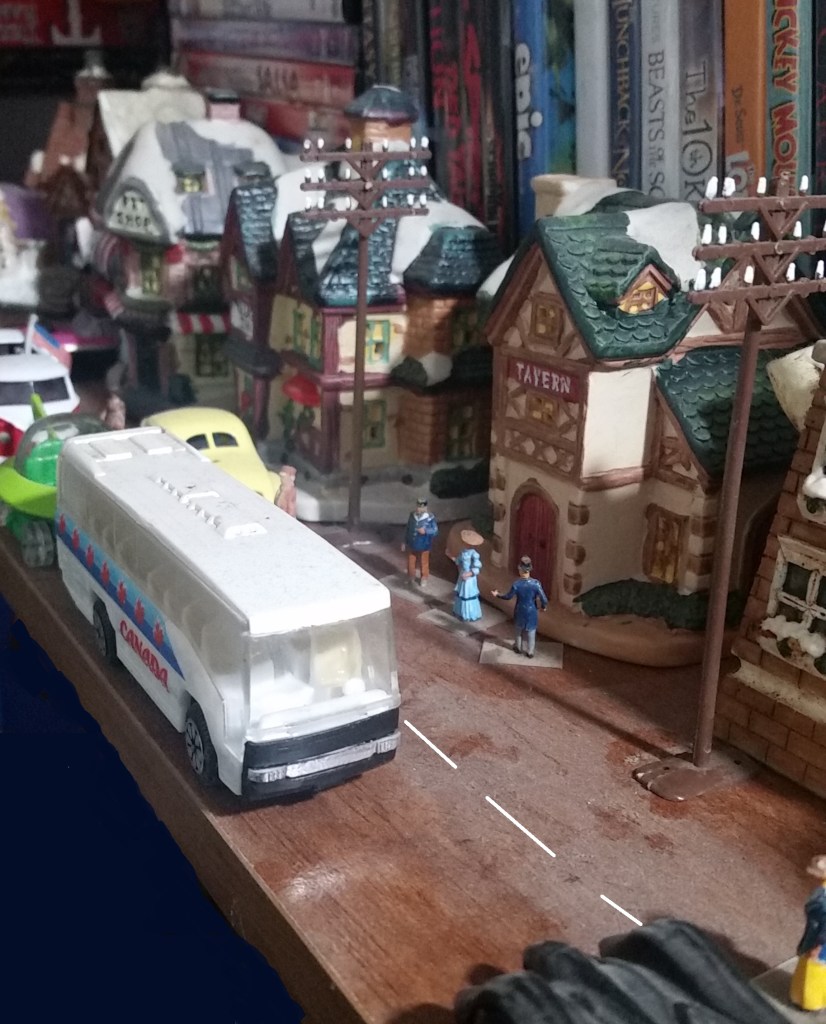
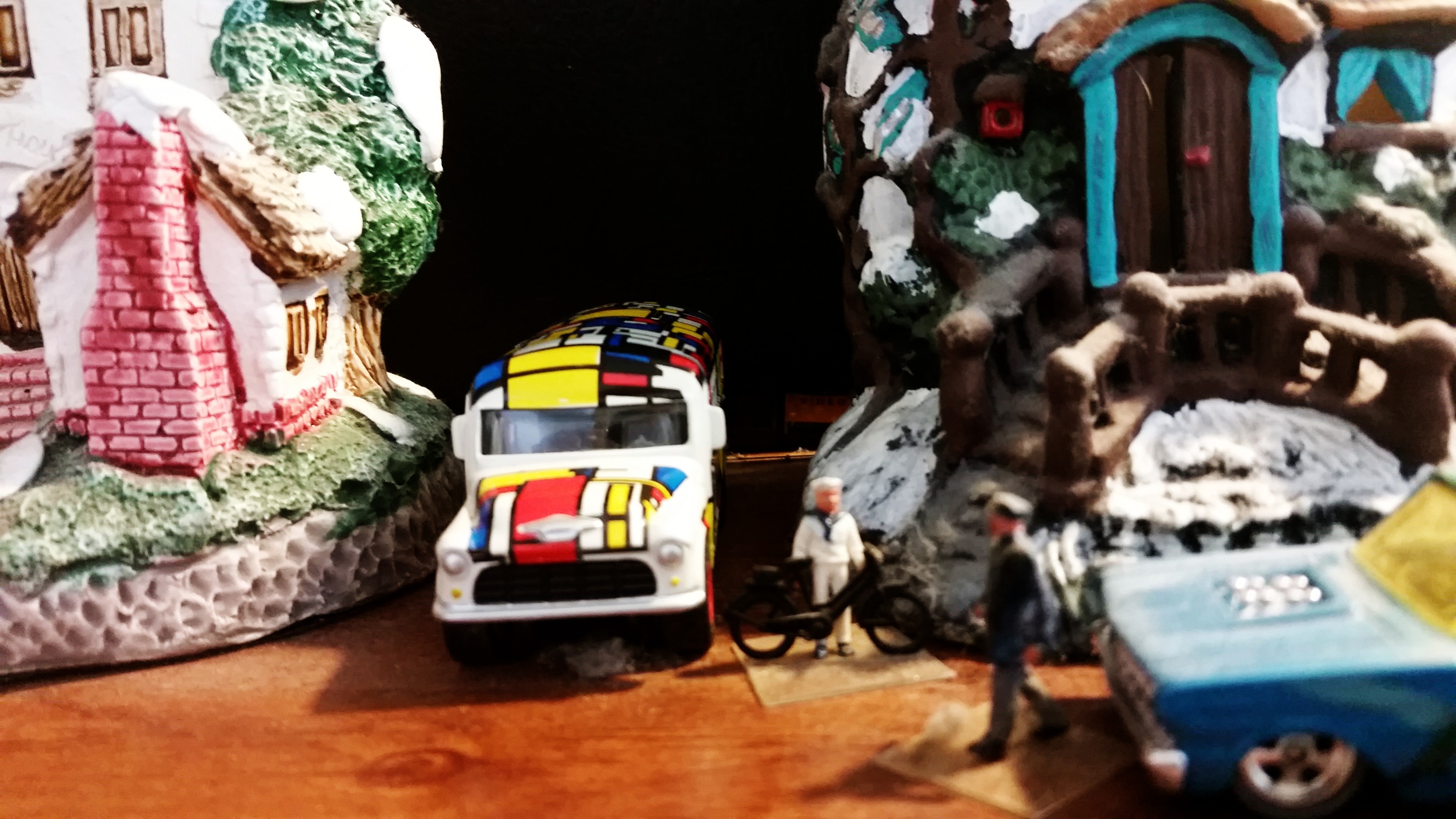 Here’s a view of the front of that same TV bus as it sits between Miss Wortle’s place and Eggbert Egghead’s Egg House. Dabney Egghead is the boy in the sailor suit showing off his brand new velocipede.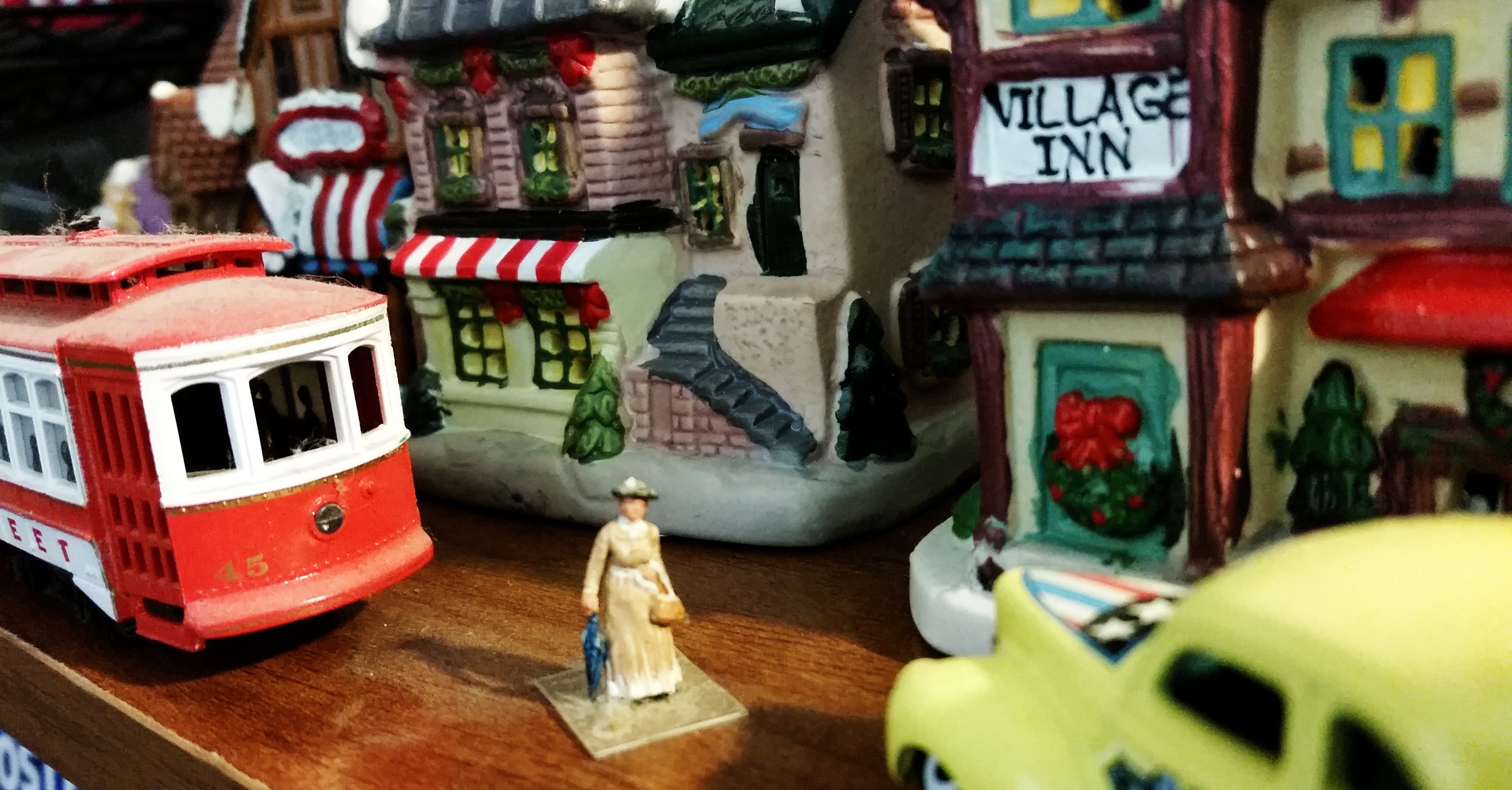


Reading Other Writers
Nobody who wants to be a writer gets by with just writing and never reading anything by anybody else. It is too easy to devolve into some kind of human mushroom that way, thinking only thoughts a mushroom could think, all fungus-like and having no chlorophyll of their own. You never learn to decode other people and other people’s thinking if you don’t read other people’s thoughts crystallized in writing.
And not every other writer is Robert Frost. Or even Jack Frost who thinks he’s Gene Kelly. There has to be some interpretation, some digging for understanding. What did that writer mean when she said political correctness was like a tongue disease? And what does it mean when a commenting troll calls me a nekkid poofter? Is that how he spells “exceptional genius”? I think it is. Trolls are not smart.
I know people have to make an effort to understand me. When I write, I am writing under the delusion that I can produce literary quality off the top of my head. In fact, I can barely produce hair off the top of my head, and it is gray when I do it. See what I did there? It is the kind of joke a surrealist makes, pretending the idiomatic expression you use is to be taken literally when it doesn’t literally make sense. That kind of nonsense is what my readers have to put up with, and probably also the reason why most of them just look at the pictures. If you have to think too hard when you read, your brain could over-heat and your hair could catch fire. I like that kind of purple paisley prose that folds back in on itself and makes you think in curlicues. But most people don’t. Most people don’t have fire-proof hair like I do.
Sometimes, it doesn’t even take a word to make the point. For instance, why, in the picture, is Fluttershy trying to drink out of the toilet in the dollhouse bathroom? For that matter, why does a doll house even need a bathroom? Applejack doesn’t even fit in that yellow bathtub. I know. I tried to stuff her in there for this picture. And, as you read this, doesn’t this paragraph tell you a lot about me that you probably didn’t even want to know?
When I am reading the writing of others, I am looking for a cornucopia of things. I want to not only understand their ideas, I want to detect the limping footprints across the murder scene of their paragraphs and come to know the deeper things about them as well. I spent years decoding and trying to understand the writing of preliterate kids in my middle school English classes in order to be able to teach them to write better. And I learned that no writer is a bad writer as long as they are using readable words. I also learned that very few writers are James Joyce or Marcel Proust. Thank God for that! And given enough time I can read anything by anybody and learn something from it. I read a lot. And it may not always make me a better writer to read it, but it always has value. It is always worth doing.
1 Comment
Filed under commentary, education, goofy thoughts, humor, irony, photo paffoonies, photos, reading, strange and wonderful ideas about life, surrealism, teaching, wordplay, writing, writing teacher
Tagged as creative-writing, reading for writing, writing, writing advice, writing-community, writing-tips