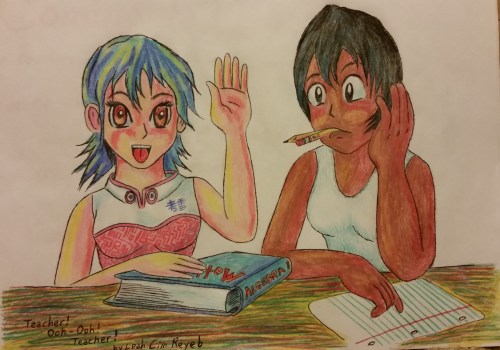
Life is making music. We hum, we sing to ourselves, movie music plays in our head as the soundtrack to our daily life. At least, it does if we stop for a moment and dare to listen. We make music in many different ways. Some play guitar. Some are piano players. And some of us are only player pianos. Some of us make music by writing a themed paragraph like this one. Others make an engine sing in the automotive shop. Still others plant gardens and make flowers or tomatoes grow. I chose teaching kids to read and write. The music still swells in my ears four years after retiring.
The 1995 movie, Mr. Holland’s Opus, is about a musician who thinks he is going to write a magnificent classical orchestra opus while teaching music at a public high school to bring in money and allow him time to compose and be with his young wife as they start a new family.
But teaching is not, of course, what he thought it was. He has to learn the hard way that it is not an easy thing to open up the closed little clam shells that are the minds of students and put music in. You have to learn who they are as people first. You have to learn to care about what goes on in their lives, and how the world around them makes them feel… and react to what you have to teach. Mr. Holland has to learn to pull them into music appreciation using rock and roll and music they like to listen to, teaching them to understand the sparkles and beats and elements that make it up and can be found in all music throughout their lives. They can even begin to find those things in classical music, and appreciate why it has taken hold of our attention for centuries.
And teaching is not easy. You have to make sacrifices. Big dreams, such as a magnum opus called “An American Symphony”, have to be put on the shelf until later. You have children, and you find that parenting isn’t easy either. Mr. Holland’s son is deaf and can never actually hear the music that his father writes from the center of his soul. And the issue of the importance of what you have to teach becomes something you have to fight for. Budget cuts and lack of funding cripples teachers in every field, especially if you teach the arts. Principals don’t often appreciate the value of the life lessons you have to give. Being in high school band doesn’t get you a high paying job later.
But in the end, at the climax of the movie, the students all come back to honor Mr. Holland. They provide a public performance of his magnum opus, his life’s work. And the movie ends with a feeling that it was all worth it, because what he built was eternal, and will be there long after the last note of his music is completely forgotten. It is in the lives and loves and memories of his students, and they will pass it on.
But this post isn’t a movie review. This post is about my movie, my music. I was a teacher in the same way Mr. Holland was. I learned the same lessons about being a teacher as he did. I had the same struggles to learn to reach kids. And my Mr. Holland moment wasn’t anywhere near as big and as loud as Mr. Holland’s. His was performed on a stage in front of the whole school and alumni. His won Richard Dreyfus an Academy Award for Best Actor. But his was only fictional.
Mine was real. It happened in a portable building on the Naaman Forest High School campus. The students and the teacher in the classroom next door threw a surprise party for me. They made a lot of food to share, almost all of which I couldn’t eat because of diabetes. And they told me how much they would miss me, and that they would never forget me. And I had promised myself I would never cry about having to retire. But I broke my promise. In fact, I am crying now ten years later. But they are not tears of sadness. My masterwork has now reached its last, bitter-sweet notes. The crescendos have all faded. But the music of our lives will still keep playing. And not even death can silence it completely.
This is an illustration that I did today of Mrs. Pennywhistle, the gardening old woman from my poem “Magic Flowers.” I placed that poem into my book of poetry which is my current work in progress. It makes a good start to my post for today that nobody will probably read. I rarely lure readers to my posts on the downhill days after a major holiday. That makes this another fill-time-and-space post meant only to keep my 124-day-post streak alive.
This is a digital artwork I created yesterday. The background is from a picture my daughter sent me from the campground near South Padre Island. The campground they went to without me because my health is too poor to survive it.
An Instagram portrait from a follower who I follow and is constantly dancing with her hands for frequent posts to Mexican music.
Either there are young female vampires on Instagram, or this singing portrait shows how I can get the inside-the-mouth perspective wrong.
Charles Dickens, William Shakespeare, Walt Disney, and Edgar Allen Poe (the four clowns depicted above) all probably had times in their writing life when they didn’t really have anything to write about. Charles Dickens couldn’t think of anything but his time in the boot-black factory and the misery he felt as a child raised in poverty. So, what did he do? He created Wilkins Micawber as a stand-in for his ne’er-do-well father who always believed, “Something will presently turn up.” And he wrote the semi-autobiographical novel David Copperfield.
William Shakespeare didn’t actually write anything with his grade-school education and limited knowledge of the world. But when the Earl of Oxford who used his name as a nom de plume could think of nothing, he thought of ending it all, and the “To-be-or-not-to-be…” play, Hamlet, poured out of his quill pen onto paper.
And when Walt Disney rode the train in defeat, having lost his best comic character for cartoons, Oswald the Rabbit, to his old boss, he doodled a mouse and named him Mickey, even providing Mickey’s falsetto voice for decades on the silver screen. Oh, and claiming the rights to any further characters his studios produced… to this day.
Poe looked at the bust over his chamber door… and saw a raven. Instantly, NEVERMORE.
Now it’s Mickey’s turn to write about nothing, and try to live up to the nothing-masters’ artistic masterpieces of yore. For instance, the boy in the picture. I drew him from a nude model in a black-and-white photo. Nobody in class, not even the one who brought the picture, ever told me his name. And the class was forty-four years ago now. So, assuming the picture wasn’t old back then, the boy is now older than fifty-four, and possibly significantly older than that now. So it is a picture of a nude nobody in front of an abandoned house in the snow however-many years ago in a place that is probably nowhere now. And I won’t even mention the imaginary puzzle pieces floating through the air for nobody to put together. What’s that? I just mentioned them? What did I mention? They are really just nothing.
So, there is a time and a place for writing about everything. Even if that everything includes nothing… and that nothing is nowhere… and is about nobody.
Don’t make the mistake of thinking I have any earthly idea where writing comes from or how it began. I am only talking personal history here, nothing grander or more meaningful. This post is only self-referential hoo-haw, which is a fancy way of interpreting “conceited crap”.
So, the truth is, I am writing about Charles Dickens because he is the author I most want to become. True, I rant on and on about Twain and his humor. And a good deal of my artwork owes everything to Disney, but everything I am good at in writing is based on Dickens.
The first actual Dickens novel that I read was accomplished during my extended illness as a high school sophomore. I read in bed, both at home and in the hospital, from my library copy of The Old Curiosity Shop. I was enthralled by the journey and subsequent tragedy of Little Nell. I thoroughly loathed the villain Daniel Quilp and was roundly thrilled by his well-deserved fatal comeuppance. It was my first encounter with the master of characters. I followed that reading with a biography of Dickens that revealed to me for the first time that his characters were based on real people. Mr. Micawber in David Copperfield was actually Dickens’ own father. Little Nell was the cousin he dearly loved who died in his arms. The crafty Fagin was a caricature of a well-known fence named Soloman, a Jew of infamous reputation, but not without his redeeming quality of caring for the orphaned poor. So it is that I have chosen to make my silly stories about real people in much the same way Dickens did. If you are now worried that since you know me, you may end up in my books, never fear. I change names and splice characters together. You will have to make an effort to recognize yourself. And, besides, nobody reads my books anyway.
I also like the way Dickens uses young characters and follows them over time as they grow and change. Oliver Twist was the first child protagonist in English literature. David Copperfield, Nicholas Nickleby, and Pip in Great Expectations are also like that. David Copperfield, in fact, is Chuck’s own fictionalized self. I fully intend to do the same. It is the reason my books fall into the Young Adult category. I also intend to employ the same kind of gentle, innocent humor that Dickens used. I mean to portray things that are funny in a disarming, absurdist way rather than resorting to attack humor and bad words.
There it is, then, my tribute to Charles Dickens, a writer who makes me be who I am and write what I write. I am not supposed to do Christmas posts because of my avowed religion, but you can consider this to be as close as I can come. The author of A Christmas Carol… it doesn’t get much more Christmassy than that.
I don’t know if you know this, but I am in reality older than Spiderman. I am also older than the Fantastic Four. All of the Avengers except for Captain America are younger than me. Well, you could argue that Thor and Hercules were around longer than me. And the Sub Mariner, And the original Human Torch, the one that Ultron would eventually turn into the Vision. But I am turning 67 this year, and only the Golden Age comic-book characters are actually older than me.
Superman, from the date of his actual creation, not his first publication, is turning 90 this year. Schuster and Seigal drew the first Superman strips in 1933.
At the beginning of June 2024, the Spirit will be 84 years old. Created by Will Eisner in 1940 the Spirit got an entire full-color page in more than 20 newspapers with a total circulation of more than 5 million copies nationwide. Denny Colt got his super crime-fighting powers by basically being a ghost, back from the dead to punish his killers and other criminals every Sunday until 1952.
,,,
…
…
…
…
Sheena, Queen of the Jungle is turning 86 this year, she was created in 1938 by Jerry Iger working with Will Eisner, among others. She looks pretty good for her age. But, consider this, she is based on the character Rima the Jungle Girl from William Henry Hudson’s 1904 novel Green Mansions. Rima, if she had become a comic book character too would be 119 this year.
…
…
…
…
The Shadow, too, is pretty damn old. He celebrates his 93rd birthday this year if you consider his pulp fiction origin in 1930. He was also the narrator of a radio show before actually becoming a comic book hero. The old man of this essay was a billionaire who could become invisible thanks to his mind-control powers. And he also had peerless martial arts prowess. He is an obvious inspiration for Bob Kane’s Batman.
…
…
…
…
…
Batman and Robin, as understudies to the Shadow are virtually the same age. Batman was created in 1939 in Detective Comics, and Robin would appear for the first time before the year was out. That makes them both 84 years old this year.
The first time they appeared in their own title was in 1940, so that makes the Joker, Alfred Pennyworth, and Catwoman 83 years old.
,,,
,,,
,,,
Alex Raymond’s imitation of Buck Rodgers’s comic, Flash Gordon, first appeared in newspapers in 1934. That makes Flash, Dale Arden, and Dr. Zarkov all celebrate their 89th birthday this year.
The Green Hornet is 87 years old.
Wonder Woman is 82 years old.
So, even though I am old and creaky, reading comics with the older superheroes in them makes me feel like a kid again. An old, creaky kid.
Yeah, I know… The title seems like a typo. But this pointlessly obtuse Mickian essay is actually about metacognition of the concept of having the “Christmas spirit.” In other words, I am writing about and analyzing how I think about Christmas. A nerdy thing to do done by a nerd who wants you to think he is smarter than he really is.
The Reason for the Season
Yes, I live in Texas, so I am constantly seeing the “Reason for the Season” signs in every Southern Baptist churchyard. So, what do I think is the reason? Yeah, you probably don’t want to know. I was a member of the Jehovah’s Witnesses for 20 years. Not that I believed in the evils of celebrating Christmas. I only stopped following Witness commands when they abandoned me in times of spiritual need, but I do retain the belief that if Jesus was a real human being, he was not born on December 25th. If the shepherds were watching their flocks by night, then the latest it could have been was in October. Shepherds don’t graze their flocks in winter. The celebration is what the Christian bigwigs decided they would use to co-opt the pagan Saturnalia. The date represents the rebirth of the Sun after the Winter Solstice on December 21st. The Sun, not the Son.
But unlike Jehovah’s Witnesses, I don’t see the Christmas holiday as a bad thing. People, Christian or not, are nicer to each other this time of year. They are much quicker to think of others and take pity on those who are suffering or are in serious need of help. And they think about giving gifts to others. particularly family. Growing up a Methodist Christian, I never noticed any parents at all giving their kids lumps of coal. Even the really bad kids got cool stuff as gifts from Mom and Dad, or Grandma or Grandpa, or whoever else was lucky enough to have to put up with them daily throughout the year.
People actually willingly spend time with their family this time of year. They hear the minister occasionally when he reads aloud the Bible verses about what Jesus commanded concerning widows and orphans, the homeless, and the poor. And Jesus never said that their reduced condition was their own fault for not working hard enough or not being a good-church-goer enough. And people who choose to reach out and spend time with each other during the season of good feelings generally find they actually like those fellow human beings they chose to spend some of their time with. All people are generally good when they are not being swayed by a way to make lots of money or enraged and vengeful for the real and imagined hurts that others have inflicted on them. I think it is absolutely vital that people have a celebration when they have survived another year of life in which not all of their family and friends are dead and they may even have a little money on hand to celebrate with. If Christmas didn’t already exist, we would desperately need to create something just like it.
Vincent Price’s Christmas Tree again
Vincent Price’s Christmas Tree Explained
The picture above, a surrealist picture-poem of how I feel about Christmas now that I am retired and no longer a Jehovah’s Witness, has never really been explained by me. Now that I am baring my soul as a Christian Existentialist Nudist Atheist who believes in God, I should elaborate on what it means.
The picture is named after the photo-shopped Christmas Tree in the back corner. I photo-shopped it from a photo of Vincent Price, the horror-movie actor, in a TV Christmas special in the 1960’s. I photo-shopped Vincent out of the picture, of course, just clipping and pasting the tree itself. I spent a good share of my youth, including all of my teen years, nursing a terrible secret. I was sexually assaulted at the age of ten. I believed I was a monster. But the Christmas I created the picture and photo-shopped Vincent out, I had successfully made peace with the monster in my past. My story is not a horror story. So, horror-movie-star Vincent had to leave this party.
And part of that is represented by the Cotulla Cowgirl basketball player. Vivi here represents all my 31 years as a public school teacher. By serving the children of South Texas, and later the ESL kids of North Texas, I managed to prove to myself that I was a good and worthy person. I know because of the many things they told me over the years, that my students would mostly agree with my self-assessment that I am not a bad man.
I put myself in the picture as a happy, confident nude boy. This is a thing that I wasn’t able to be after the age of ten. Doubt, fear, and depression clouded my world from 1966 to 1976. When I spent time trying to explain to the high school counselor what was wrong with me, he had to admit that he knew something was wrong, but he did not know what it was nor how to help. And I could not at that time admit what had happened, as I could not even allow myself to remember the actual trauma. So, becoming a nudist in 2017 and coming to terms with the scars and trauma, was a gift to myself. The mental chains are gone.
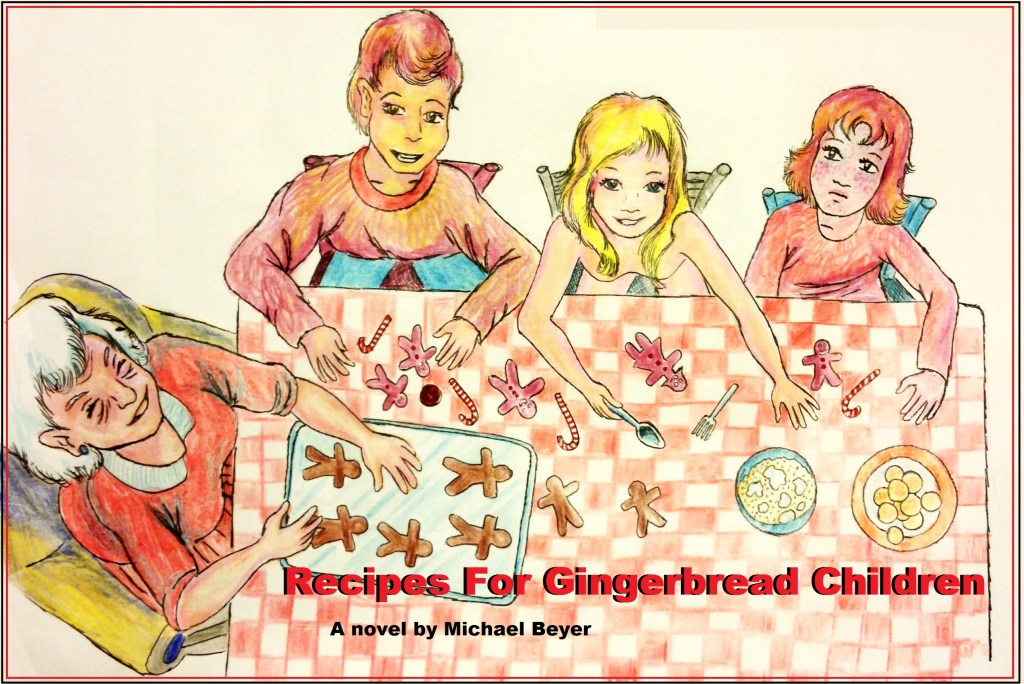
Anneliese, the gingerbread girl, represents my mental linking with the German-American world of Aunt Selma’s Christmas parties in the 1960’s. The gingerbread cookies, the candy, and the Christmas stories she told with a charming German accent led to the writing of my book Recipes for Gingerbread Children. Christmas is a day full of gingerbread men… and now, making gingerbread houses.
And Annette Funicello is in the picture because Christmas always used to have a Disney-movie, happy-endings sort of theme. I needed that happy ending to every year to keep me going. It was an emotionally essential thing I counted on every year to be able to face a brand new year.
I am an atheist. And an Existentialist. Oh, and a nudist. But I need Christmas. It matters to me. And I know I am not the only one.
Yesterday I posted one of my patented conspiracy-theory posts which was intended primarily to give my three kids more practice at using their Eye-fu skills. You know, that ancient Chinese martial art of using the dramatic eye-roll to combat the embarrassing way elderly parents have of saying what they actually think for the sole purpose of humiliating their much-more sensible offspring. So, today I need to humbly contemplate the many reasons I will not get any Christmas presents this year and begin to generate some holiday spirit to lighten the mood of what is likely to be a rather lonely Christmas season.
So, here’s a selfie from old Grumpy Klaus, wearing the aggravated countenance of the Jolly One looking at the Naughty List to determine who gets the bricks and who gets the lumps of coal… and who gets referred to Old Krampus.
Ho ho ho… kinda…
Having married a Jehovah’s Witness twenty-six years ago, I have gotten mostly out of the habit of celebrating Christmas. The Witnesses believe that holidays with pagan origins are from Satan, and bad for you. But it has been almost seven years now since they decided I was from Satan too, and so I stopped believing in knocking on doors and trying to get homeowners to reject their own form of Christianity because we are somehow more right than they are, and if they don’t swear off celebrating Christmas they are doomed. Among the many other things you have to swear off of for that religion. Like swearing.
Don’t get me wrong… Jehovah’s Witnesses are wonderful, loving people who care about others and whose religious teachings are more helpful than harmful over all… just like all other Christians who aren’t ISIS-level radicals. (The Westboro Baptists leap to mind for some reason.) If you really need religion, it is a good one to have. But even though my wife still needs to be one, I have begun to feel like I do not.
I personally cherish the holiday traditions I grew up with, and I really wish I could have shared those with my children. (This is another point for practicing Eye-fu right here.) I fear however. that like most devoutly religious parents, we managed to raise three devout agnostics and atheists. I have trained them in the last four years to like the tradition of making and eating gingerbread houses and gingerbread men. That’s probably of pagan origin too, but it’s too late now to save my sorry old soul from gingerbread.
Anyway, I am trying to look forward to the season of Peace on Earth once again. And though I will be celebrating mostly alone and ill and condemned by gingerbread, I do have pleasant memories. I can still reach my sisters and my mother by phone. They share some of those memories. And my kids will be around enough to eat the gingerbread castle I bought for this year.
A Mr. Holland Moment
Life is making music. We hum, we sing to ourselves, movie music plays in our head as the soundtrack to our daily life. At least, it does if we stop for a moment and dare to listen. We make music in many different ways. Some play guitar. Some are piano players. And some of us are only player pianos. Some of us make music by writing a themed paragraph like this one. Others make an engine sing in the automotive shop. Still others plant gardens and make flowers or tomatoes grow. I chose teaching kids to read and write. The music still swells in my ears four years after retiring.
The 1995 movie, Mr. Holland’s Opus, is about a musician who thinks he is going to write a magnificent classical orchestra opus while teaching music at a public high school to bring in money and allow him time to compose and be with his young wife as they start a new family.
But teaching is not, of course, what he thought it was. He has to learn the hard way that it is not an easy thing to open up the closed little clam shells that are the minds of students and put music in. You have to learn who they are as people first. You have to learn to care about what goes on in their lives, and how the world around them makes them feel… and react to what you have to teach. Mr. Holland has to learn to pull them into music appreciation using rock and roll and music they like to listen to, teaching them to understand the sparkles and beats and elements that make it up and can be found in all music throughout their lives. They can even begin to find those things in classical music, and appreciate why it has taken hold of our attention for centuries.
And teaching is not easy. You have to make sacrifices. Big dreams, such as a magnum opus called “An American Symphony”, have to be put on the shelf until later. You have children, and you find that parenting isn’t easy either. Mr. Holland’s son is deaf and can never actually hear the music that his father writes from the center of his soul. And the issue of the importance of what you have to teach becomes something you have to fight for. Budget cuts and lack of funding cripples teachers in every field, especially if you teach the arts. Principals don’t often appreciate the value of the life lessons you have to give. Being in high school band doesn’t get you a high paying job later.
But in the end, at the climax of the movie, the students all come back to honor Mr. Holland. They provide a public performance of his magnum opus, his life’s work. And the movie ends with a feeling that it was all worth it, because what he built was eternal, and will be there long after the last note of his music is completely forgotten. It is in the lives and loves and memories of his students, and they will pass it on.
But this post isn’t a movie review. This post is about my movie, my music. I was a teacher in the same way Mr. Holland was. I learned the same lessons about being a teacher as he did. I had the same struggles to learn to reach kids. And my Mr. Holland moment wasn’t anywhere near as big and as loud as Mr. Holland’s. His was performed on a stage in front of the whole school and alumni. His won Richard Dreyfus an Academy Award for Best Actor. But his was only fictional.
Mine was real. It happened in a portable building on the Naaman Forest High School campus. The students and the teacher in the classroom next door threw a surprise party for me. They made a lot of food to share, almost all of which I couldn’t eat because of diabetes. And they told me how much they would miss me, and that they would never forget me. And I had promised myself I would never cry about having to retire. But I broke my promise. In fact, I am crying now ten years later. But they are not tears of sadness. My masterwork has now reached its last, bitter-sweet notes. The crescendos have all faded. But the music of our lives will still keep playing. And not even death can silence it completely.
1 Comment
Filed under artwork, autobiography, commentary, happiness, insight, kids, movie review, teaching
Tagged as education, music, music-education, teachers, teaching