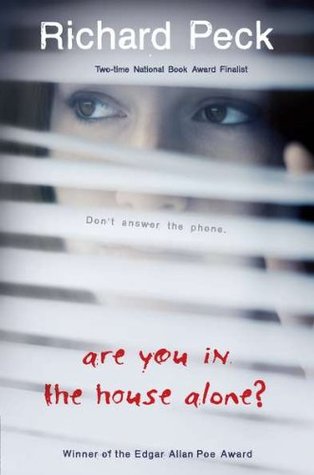
Yes, I read this book. Yes, it scared the poop out of me. Yes, it made me cry. This is a uniquely horrific horror story that is so realistic that you know that it has actually happened in real life somewhere, sometime. Only the names of the characters would be different.
I have a deep abiding respect for Richard Peck as a writer. He earned that with his books A Year Down Yonder and A Long Way from Chicago. Those books made me laugh so hard it blew chocolate milk out of my nose. And, yes, I was drinking chocolate milk at the time. They are so realistic because the people in those stories are real people. I know those people personally. Of course, they have different names in real life.
But Are You In the House Alone? is a very different book from those other two masterpieces. It tears your heart out and eats your liver because it is a first person narrative in the voice of a high school girl being stalked by a sexual predator. Everything that happens to Gail in the high school, at home, and at the house where she babysits is hyper-real with horror movie levels of attention to detail. I don’t wish to be a spoiler for this well-written book, but the narrator does not die in the book and it definitely does not have a happy ending. For anyone who has the amount of empathy I do, and in many ways becomes the narrator-character by reading, reading a book like this can physically hurt. A teacher like me has lived through horrible things like this happening to students before, it even happened to me as a boy, and it adds the slings and arrows of those things being re-lived as you read.
This is not the only book that has ever done this sort of damage to my heart strings. I remember the pain from the conclusion of Dickens’ The Old Curiosity Shop. You root for Little Nell and boo Daniel Quilp. But the bad guy wins. No happy ending can linger in the harp-strings of your memory-feeling song as long as a tragic outcome does. I was there with Scout in that ridiculous costume in the dark when Bob Ewell was attacking her brother Jem in Harper Lee’s To Kill a Mockingbird. That story was filled with wise and laughable things, but the stark horror of that climactic moment nearly wiped all the good feelings away, if not for the heroics of ghostly Boo Radley whose timely intervention brings it all back before the novel ends. It horrifies me to admit it, but I was there, too, in the moment when the boys all turn on Simon on the beach with their sharpened sticks in William Golding’s Lord of the Flies. They mistook him for the monster. I still haven’t fully recovered from that reading trauma.
The thing about books that hurt to read which makes it essential that I never try to avoid them, is that they can add more depth and resonance to your soul than any light and fluffy piece ever could. Life is much more like Lord of the Flies than it is Chitty Chitty Bang Bang. I am sadder but wiser for having read Are You In the House Alone? I am recommending it to other readers like me who don’t so much live to read as they read in order to live. Not because it is easy and good to read, but because it is hard and essential to read. It will hurt you. But it will leave you like it leaves its narrator, damaged, but both alive and purely resolved to carry on.


Winsor McCay
One work of comic strip art stands alone as having earned the artist, Winsor McCay, a full-fledged exhibition at the Metropolitan Museum of Art in New York City. Little Nemo in Slumberland is a one-of-a-kind achievement in fantasy art.
Winsor McCay lived from his birth in Michigan in 1869 to his finale in Brooklyn in 1934. In that time he created volumes full of his fine-art pages of full-page color newspaper cartoons, most in the four-color process.
As a boy, he pursued art from very early on, before he was twenty creating paintings turned into advertising and circus posters. He spent his early manhood doing amazingly detailed half-page political cartoons built around the editorials of Arthur Brisbane, He then became a staff artist for the Cincinnati Times Star Newspaper, illustrating fires, accidents, meetings, and notable events. He worked in the newspaper business with American artists like Winslow Homer and Frederick Remington who also developed their art skills through newspaper illustration. He moved into newspaper comics with numerous series strips that included Dreams of the Rarebit Fiend and Little Nemo in Slumberland. And he followed that massive amount of work up by becoming the “Father of the Animated Cartoon” with Gertie the Dinosaur, with whom he toured the US giving public performances as illustrated in the silent film below;
The truly amazing thing about his great volume of work was the intricate detail of every single panel and page. It represents a fantastic amount of work hours poured into the creation of art with an intense love of drawing. You can see in the many pages of Little Nemo how great he was as a draftsman, doing architectural renderings that rivaled any gifted architect. His fantasy artwork rendered the totally unbelievable and the creatively absurd in ways that made them completely believable.
I bought my copy of Nostalgia Press’s Little Nemo collection in the middle 70’s and have studied it more than the Bible in the intervening years. Winsor McCay taught me many art tricks and design flourishes that I still copy and steal to this very day.
No amount of negative criticism could ever change my faith in the talents of McCay. But since I have never seen a harsh word written against him, I have to think that problem will never come up.
My only regret is that the wonders of Winsor McCay, being over a hundred years old, will not be appreciated by a more modern generation to whom these glorious cartoon artworks are not generally available.
Leave a comment
Filed under art my Grandpa loved, artists I admire, artwork, book review, cartoon review, cartoons, comic strips, commentary
Tagged as Little Nemo in Slumberland, Winsor McCay