
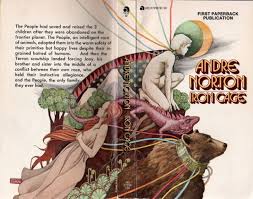
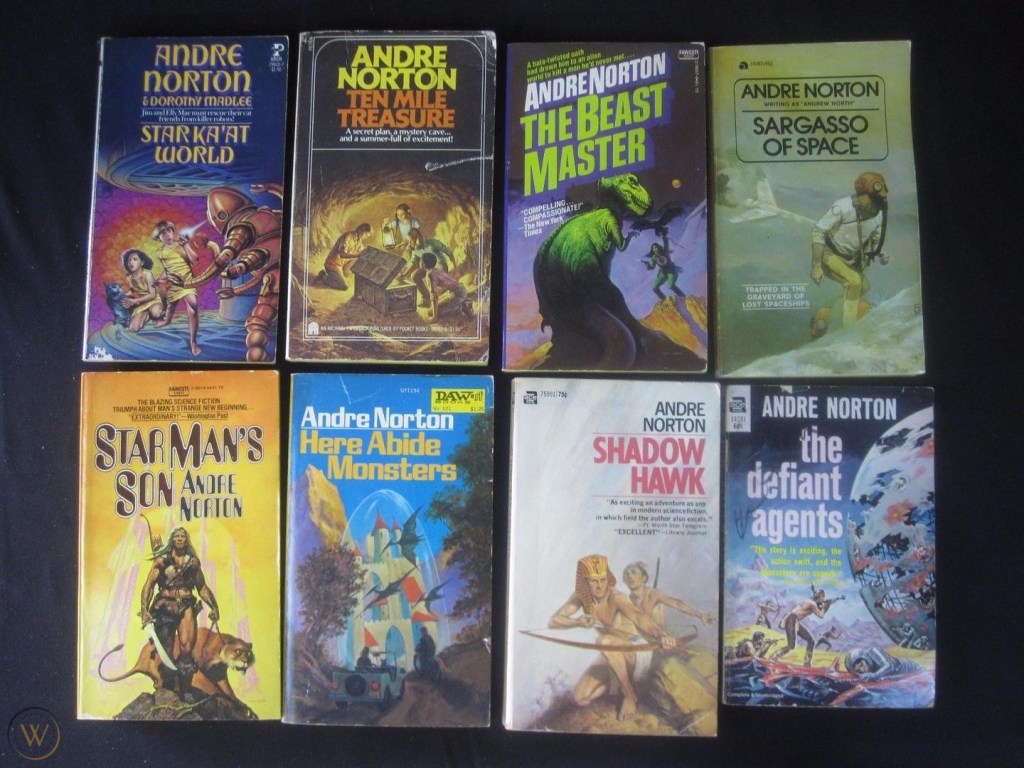
It began for me in 1977 with this wrap-around cover illustration. I knew there were a lot of this guy’s books on the shelves of the college bookstore along with works by Robert E. Howard, Roger Zelazney, and Theodore Sturgeon. And I knew this guy had also written paperback books under the name “Andrew North”, a name I had seen on the twenty-five cent novels in the drugstore where you could buy the really good pulp fiction novels only slightly used.
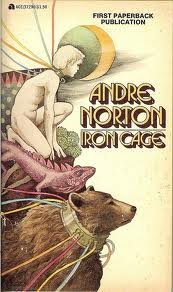
I had never before bought one of his books. And the book money I had for the fall quarter at Iowa State was supposed to all go towards the book-list given to me as a Junior-level English major. But the naked kid on the cover had a wired-up collar around his neck. And I had only recently recovered long-suppressed memories of being a victim of a sexual assault. I had to have it. I had to know what that illustration had to do with the story inside.
So, I bought a book that I judged by its cover.
And it was not the wrong thing to do.
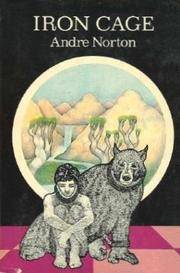
The main character was a boy named Jony, the naked boy on the cover of the book. He is taken by alien beings as a study specimen along with his mother, the pregnant woman on the back of the wrap-around illustration. The story starts with Jony in a cage, treated like an animal. His mother, also a study specimen has been mated to a Neanderthal-like humanoid specimen who cannot speak, and she has given birth to twins, a boy, and a girl. They are kept in separate cages by their inhuman captors.
Jony manages a mass escape, taking his mother and his younger siblings with him, and releasing as many of the other study specimens as he can. Luckily they escape onto a very earth-like planet. But unluckily, the mother is in very poor health and dies soon after escaping. Jony is then responsible for his little brother and sister in a wilderness that is not empty of others. Luckily, the others they first run afoul of are the bear-like ursine aliens who share their need to not be recaptured by the zoo-keeper aliens.
It was a perfect novel for me. I identified strongly with the main character, who had been violated in a very personal way by monsters. And then had to build a new life in a world full of potential other-monsters. Andre Norton shared my pain and helped me overcome it.
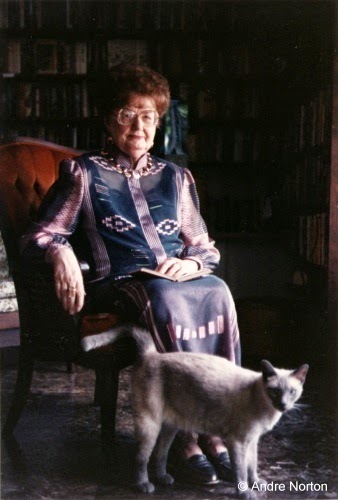
But she also fooled me big-time. She was not a he.
She was a librarian and editor of pulp fiction who wrote enough sci-fi and fantasy in the 50’s, 60’s, and 70’s to finally become a full-time author.
She was already on book number 29 when she retired from being a librarian to write full time.
And I would go on to own and read several of her other books, which were good, but never quite lived up to that first one I read. Of course, that may have been because of the timing and circumstance that led me to a book that I actually needed to read. That book set me on the road to recovery from my personal darkness. And it may have sparked in me the need to eventually become a nudist. And more important than that, it may have led me to a lifelong need to teach reading.
Andre Norton was a real writer. And she made me one too. Though I never knew who she really was until after I bought that book because of the picture on the cover. And I never got around to properly thanking her for all of that… Until this very moment.











Winsor McCay
One work of comic strip art stands alone as having earned the artist, Winsor McCay, a full-fledged exhibition at the Metropolitan Museum of Art in New York City. Little Nemo in Slumberland is a one-of-a-kind achievement in fantasy art.
Winsor McCay lived from his birth in Michigan in 1869 to his finale in Brooklyn in 1934. In that time he created volumes full of his fine-art pages of full-page color newspaper cartoons, most in the four-color process.
As a boy, he pursued art from very early on, before he was twenty creating paintings turned into advertising and circus posters. He spent his early manhood doing amazingly detailed half-page political cartoons built around the editorials of Arthur Brisbane, He then became a staff artist for the Cincinnati Times Star Newspaper, illustrating fires, accidents, meetings, and notable events. He worked in the newspaper business with American artists like Winslow Homer and Frederick Remington who also developed their art skills through newspaper illustration. He moved into newspaper comics with numerous series strips that included Dreams of the Rarebit Fiend and Little Nemo in Slumberland. And he followed that massive amount of work up by becoming the “Father of the Animated Cartoon” with Gertie the Dinosaur, with whom he toured the US giving public performances as illustrated in the silent film below;
The truly amazing thing about his great volume of work was the intricate detail of every single panel and page. It represents a fantastic amount of work hours poured into the creation of art with an intense love of drawing. You can see in the many pages of Little Nemo how great he was as a draftsman, doing architectural renderings that rivaled any gifted architect. His fantasy artwork rendered the totally unbelievable and the creatively absurd in ways that made them completely believable.
I bought my copy of Nostalgia Press’s Little Nemo collection in the middle 70’s and have studied it more than the Bible in the intervening years. Winsor McCay taught me many art tricks and design flourishes that I still copy and steal to this very day.
No amount of negative criticism could ever change my faith in the talents of McCay. But since I have never seen a harsh word written against him, I have to think that problem will never come up.
My only regret is that the wonders of Winsor McCay, being over a hundred years old, will not be appreciated by a more modern generation to whom these glorious cartoon artworks are not generally available.
Leave a comment
Filed under art my Grandpa loved, artists I admire, artwork, book review, cartoon review, cartoons, comic strips, commentary
Tagged as Little Nemo in Slumberland, Winsor McCay