Category Archives: book review

Holy Bagumba!

newbery2014

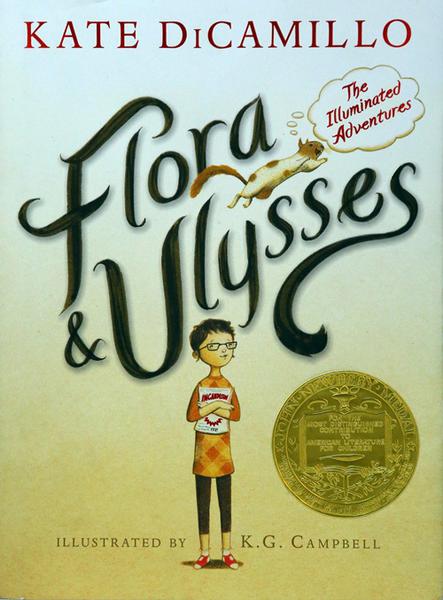
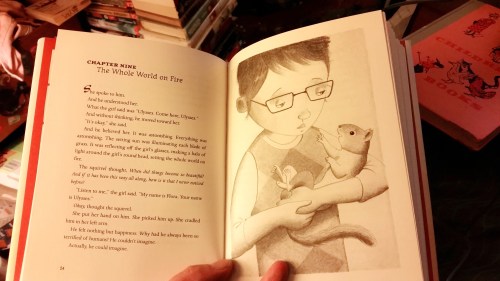
I have just finished reading a wonderful book.  It is a young adult novel bordering on being a children’s book.  It won the 2014 Newbery Medal for best work of children’s literature.  But it is a book of so many dimensions that it totally defies categories.  Librarians with butterfly nets who want to pin this book down on their library shelves will be pointlessly waving their nets at it like they believe it’s a butterfly, but it will soar away from them like an eagle.

c360_2016-11-06-09-59-56-962

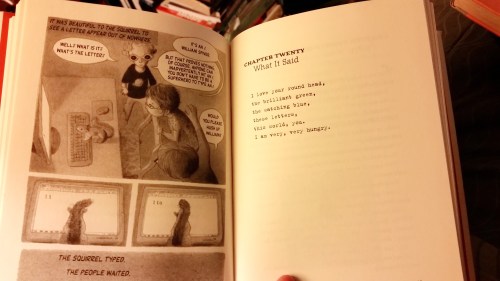
Flora & Ulysses (the Illuminated Adventures) is a combination book of many different things.  G. K. Cambell’s cartoony paffoonies add to and amplify the story to the point that sometimes it becomes a graphic novel.

Flora herself is a comic-book lover and follower of the adventures of a comic-book superhero named Incandesto.  Ulysses the squirrel is run over by a rogue vacuum cleaner and the accident graces him with super powers (the ability to fly and throw cats and write poetry).  And Flora rescues and befriends this newly minted superhero and sets him on a path that pits him against the only super-villain available, Flora’s own mother.

c360_2016-11-06-10-00-47-864

At certain points, through metaphor, elegance, and supreme focus, the story itself becomes poetry.  But, of course, when the poem ends with a line about the squirrel being hungry, it becomes humorous poetry, simply by the juxtaposition of the sublime with the ridiculous.

bk_all

As a writer, Kate DiCamillo is a master of everything I want to be.  She is as much a masterful story-teller as Mark Twain, Ernest Hemingway, or William Faulkner.  But many people will be put off by the fact that she is a children’s author.  They will ignore her stories because how could a children’s author affect their lives in any way?  But if you are a reader who can think and feel about things in a book, she will make you laugh and make you cry and make you not afraid to die… for love of a good book.

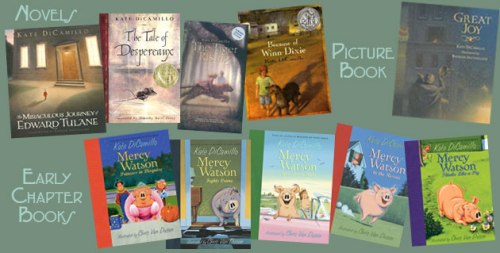
Let me also suggest a few of her other wonderful, wonderful books;

winn-dixie

Leave a comment

Filed under book reports, book review, commentary, good books, humor, metaphor, poetry, reading

Tom Sawyer Abroad (Book Review)

20161017_162015

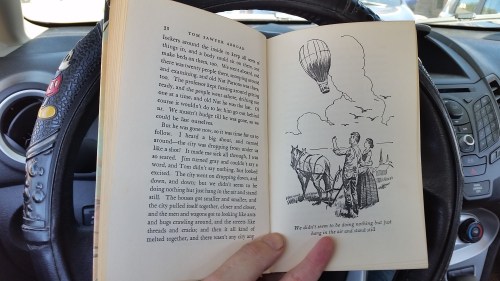
Yep, I read about being an “erronort” traveling in a balloon while sitting in a parking lot in my car.

Believe it or not, I read this entire 100+year-old book in my car while waiting for my daughter and my son in school parking lots.  What a perfectly ironic way to read a soaring imaginary adventure written by Mark Twain and mostly forgotten about by the American reading public.

c360_2016-10-30-10-26-22-635

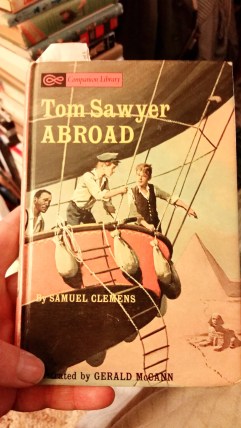
My copy of this old book is a 1965 edition published for school libraries of a book written in 1894.  It tells the story of how Tom and Huck and Jim steal a ride on a balloon at a town fair from a somewhat mentally unhinged professor of aeronautical science.  The balloon, which has space-age travel capabilities due to the professor’s insane genius, takes them on an accidental voyage to Africa.

Of course, the insane professor intends to kill them all, because that’s what insane geniuses do after they prove how genius-y they really are.  But as he tries to throw Tom into the Atlantic, he only manages to plunge himself through the sky and down to an unseen fate.  The result being a great adventure for the three friends in the sands of the Sahara.  They face man-eating lions, mummy-making sandstorms, and a chance to land on the head of the Sphinx.

The entire purpose of this book is to demonstrate Twain’s ability to be a satirical stretcher of the truth, telling jokes and lies through the unreliable narrator’s voice of Huck Finn.

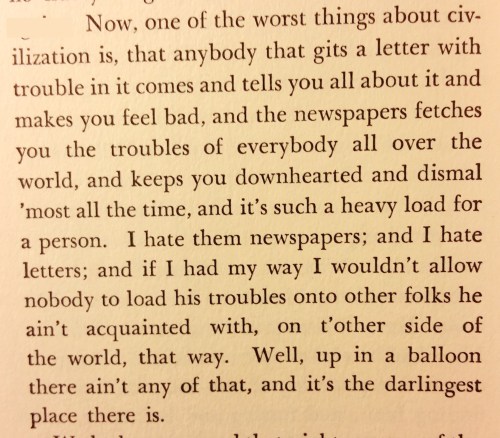
Here is a quoted passage from the book to fill up this review with words and maybe explain just a bit what Twain is really doing with this book;

c360_2016-10-30-10-48-45-630

Notice how I doubled my word count there without typing any of the words myself?  Isn’t the modern age wonderful?

But there you have it.  This book is about escaping every-day newspaper worries.  In a time of Presidential Candidate Donald Trump, global warming, and renewed threats of thermonuclear boo-boos with Russia, this proved to be the perfect book to float away with on an imaginary balloon to Africa.  And the book ends in a flash when Aunt Polly back in Hannibal wants Tom back in time for breakfast.  I really needed to read this book when I picked it up to read it.

2 Comments

Filed under book reports, book review, foolishness, good books, humor, imagination, Mark Twain, old books, strange and wonderful ideas about life

Reading Twain for a Lifetime

mark-twain

I wish to leave no doubt unturned like a stone that might have treasure hidden under it.  I love the works of Samuel L. Clemens, better known as Mark Twain.

I have read and studied his writing for a lifetime, starting with The Adventures of Tom Sawyer which I read for myself in the seventh grade, after seeing the musical movie Tom Sawyer starring Johnny Whittaker as Tom.  I caught a severe passion, more serious than a head-cold, for the wit and wisdom with which Twain crafted a story.  It took me a while to acquire and read more… but I most definitely did.  I took an American Literature course in college that featured Twain, and I read and analyzed The Adventures of Huckleberry Finn.  I also bought a copy of Pudd’nhead Wilson which I would later devour in the same thoroughly literate and pretentious manner as I had Huck Finn.  Copies of A Connecticut Yankee in King Arthur’s Court and The Mysterious Stranger were purchased at the same time, though I didn’t read them cover to cover until later during my years as a middle school English teacher.  I should point out, however, that I read and re-read both of those, Connecticut Yankee winning out by being read three times.  As a teacher, I taught Tom Sawyer as an in-class novel assignment in the time when other teachers thought I was more-or-less crazy for trying to teach a 100-year-old book to mostly Hispanic non-readers.  While the lunatic-inspired experiment was not a total success, it was not a total failure either.  Some kids actually liked having me read parts of it aloud to them, and some borrowed copies of the book to reread it for themselves after we finished as a class.

marktwaindvd2006During my middle-school teaching years I also bought and read copies of The Prince and the Pauper, Roughing It, and Life on the Mississippi.  I would later use a selection from Roughing It as part of a thematic unit on Mark Twain where I used Will Vinton’s glorious clay-mation movie, The Adventures of Mark Twain as a way to painlessly introduce my kids to the notion that Mark Twain was funny and complex and wise.

I have also read and used some of Twain’s most famous short fictions.  “The Celebrated Jumping Frog of Calaveras County” and “The Man Who Corrupted Hadleyburg” are both masterpieces of Twain’s keen insight into the human psyche and the goofy and comic corruptions he finds there.

And now, retired old me is reading Tom Sawyer Abroad.  And, though it is not one of his finest works, I still love it and am enthralled.  I will review it and share it with you when I am finished.  But I will never be through with Mark Twain.  Not only is there more of him to read, but he has truly been a life-long friend .

1 Comment

Filed under book reports, book review, goofy thoughts, happiness, heroes, old books, sharing, strange and wonderful ideas about life

Benjamin Franklin (a book review)

43363

I admit to loving dry old history books that most of my contemporaries would wrinkle their noses at and loudly proclaim, “It’s BORING!!!”  But I don’t think the fact that I really really loved this book automatically means that you will detest it.  So bear with me and let me tell you about a book about a historically important and thoroughly fascinating man.

Edmund Morgan is a scholar who believes in using primary source material, and Franklin, as a printer, writer, statesman, scientist, and very sociable letter-writing man left a vast wealth of primary source materials behind to help us understand what was in his mind as he performed some of the most essential services ever given to a country as the United States was being formed.

The book makes us very aware that if history had followed Franklin’s every desire for specific outcomes, we would still be part of the British Empire.  But Franklin was unique among the founding fathers.  He did not serve his own ambitions the way John Adams did.  He did not serve strictly ideological goals like Thomas Jefferson often did.  But his input and pragmatism were essential to helping those two men  create the Declaration of Independence.

He believed in public service as a higher goal.  He carried out not his own will, but the will of the people evident in the debates about where the country needed to go when the government of the British King and Parliament became increasingly unresponsive to the needs and issues of the American colonies.

This was akin to the way he approached science.  He was able to discover enough scientific facts through careful and clever experiments to create practical and life-saving inventions like the Franklin stove and lightning rods.  He led the field for a time in the investigation and understanding of electricity, and the old story of flying a kite in a thunderstorm is not a myth.  It was an actual experiment using what Franklin had discovered about electrical conductivity and insulation to prove that lightning was made up of electrical energy.  Edison and Tesla might never have started if Franklin had not come first.  He never defended, argued, or explained his scientific theories.  He believed in letting experimental evidence speak for itself.  Basically, he became a world-famous scientist by not seeking fame.

Franklin loved to be with people of all kinds, especially intelligent people and female people.  He was a good friend to many, and even maintained respectful friendships with some who chose to be on the other side of the American independence question.  His work on the Pennsylvania constitution, being ambassador to France, and his part in the peace treaty negotiations with England made him as essential to the American experiment as any of the founding fathers who would later take a turn at being president.

All I can really say about this excellent book is that it helps you get to know the man who was Ben Franklin.  And this is a man that most people are bound to love, and every man should know.

Leave a comment

Filed under book review, humor, philosophy

Like Herding the Wind (A Book Review)

25967846

This is a review I did on Goodreads of a book by an Indie author I met through PDMI Publishing.  It is the first book of hers that I have read, but I couldn’t help but try to promote it.  So here is what I wrote on Goodreads (hoping that I don’t make her beautiful story into an instant worst-seller);

Good science fiction is usually based on an engaging premise that makes you think about it long after the story is finished. Cindy Koepp’s book is like that. The Eshuvani race of aliens crash land their generation ship on the planet Earth in 1612, in the region of Saxony in the Holy Roman Empire. They encounter the human race with weapons drawn. But a brave and dedicated human cleric defuses the situation and convinces two peoples to learn about each other peacefully. The Eshuvani are converted to Christianity and with their superior technology, choose to try to peacefully share a planet rather than go to war as an alien invader.

But an even more fascinating thing about this book is that it doesn’t choose to be about that first-contact event. It is a hard-boiled police procedural novel set in 1965. Two police forces, one Eshuvani, and the other human, are faced with the problem of alien terrorists attacking the human police for reasons unknown. It leads to a story filled with suspense, murder, kidnapping, and racial tensions blooming into violence between two different races.

So this book is a murder mystery and a story of anti-terrorist police procedure at the same time as it is a form of science fiction known as alternate history. It leads you to want more stories set in the same alternate reality. And it is filled with engaging characters about whom you want to know more.

Amaya, the kiand or captain of the Eshuvani law enforcers, is an instantly likable character whom you can’t help but root for as she struggles with loss of her family and her former partner, the inexplicable difficulties and road-blocks put in her way by her own government, and the need to form a new functioning department out of young and untried Eshuvani officers… all while being hunted and attacked occasionally by the terrorists.

Ed Osborn is her human counterpart, and also her “urushalon”, her inter-species adopted child. He has the difficult task of trying to fight off the Eshuvani terrorists who seem to have his men in the center of the cross-hairs of their weapon-sights, while at the same time trying to teach his men about an alien race and culture that they are trying to work beside and integrate with.

This novel is definitely worth the read for science fiction lovers, and people who like to think deep thoughts about how we would react to an entire race of beings forcing us to share our planet, just as their journey was also interrupted with difficult choices forced upon them.

3 Comments

Filed under book review, science fiction

Mennyms (A Book Review)

20160611_100605

This is the book I have really read, though I intend to acquire the rest.

Sylvia Waugh is a British writer of children’s books who has a lot in common with me.  She spent her career as a teacher of grammar.  In her late fifties she became a published author.  Her book series of the Mennyma is a charming fantasy adventure about dolls so loved by their owner, they actually come to life… and survive her…. and then have to make their way in a world that would be horrified by them and might easily seek to destroy them.

20160609_155347

Hopefully none of my dolls come to life after I croak. After years of collecting, they nearly outnumber humanity.

But rest assured, the dolls in this sweet-natured children’s book series would never prove evil.  The books are more fantasy-comedy than horror story.  In fact, they are impossibly far away from horror.

51QZSMA6EKL._SX293_BO1,204,203,200_

The original book.

Joshua Mennym is the head of a family of life-size rag dolls.  He pretends to be a middle-aged man.  He generally keeps his distance from the general public, because, up close, his basic rag-doll-ness would stand revealed.  Rag dolls are not supposed to walk and talk, let alone have families and live in a home of their own.   His wife is Vinetta Mennym, also a rag doll.  Together they are parents to the ten-year old twins, Poopie, the boy, and Wimpey, the girl.

The teenage twins are Pilbeam and Soobie.  Pilbeam is the girl and constant companion of the elder teenage sister, Appleby.  Soobie is the boy and  blue.  Why their former owner, Kate Penshaw, made him with a blue head and blue feet and blue hands is a mystery both to the Mennyyms and to me.   It causes him to be the one most likely to cause exposure of the family secret because even at a distance he does not look like a “real people” person.

Baby Googles is the smallest of the family, constantly cared for by the nanny, Miss Quigley, who is also considered a Mennym because she is also a doll.

Grandpa Magnus Mennym lives in the attic with Grandma and takes care of the household bills.  He writes scholarly works on the English Civil War and publishes them for a modest income which comes through the mail.  Granny Tulip is also relied upon for her wisdom and experience whenever a problem with keeping the family secret comes up.

Each book in the series contains a different adventure revolving around the realistic comedy generated by impossible people trying so hard to be real.  I absolutely love the adventures, even the ones I haven’t read yet.  And I know that the only way you could possibly love these books too is if you share my loony love of the fantastically impossible that turns out to be real.  After reading these books, I fully intend to keep a very close eye on my own doll collection.

Leave a comment

Filed under artists I admire, book review, doll collecting, good books, humor, imagination, old books

Hogfather (a Book Review)

20160414_210029

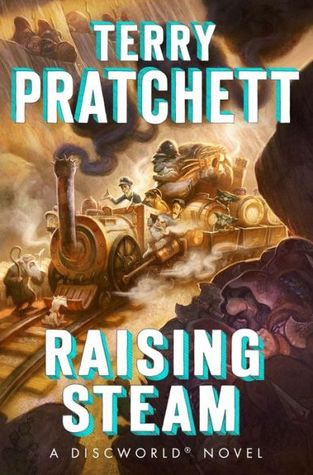
I finished reading the book Hogfather, by Terry Pratchett,  while sitting in the waiting room as the dentist worked on the wires of my son’s braces in a nearby dentist’s chamber of horrors.  The receptionist and secretary probably thought I was insane for incessantly chortling and making those other rude snorty noises you make when you don’t want to interrupt others with laughing, but can’t help it.  What better way to wait in the cold chambers of dental anxiety than to read a funny, funny book about an assassin named Mr. Teatime who meant to slay the Hogfather, Terry Pratchett’s version of Santa Claus, by stealing children’s teeth from the tooth fairy and using them to control young minds and make them stop believing in the Hogfather, that giver of gifts on the sacred and festive Hogswatch Eve?

Naamloos-11-1024x436

This story has an unusual hero.  Death, that skeletal reaper of souls and talker in ALL CAPITOL LETTERS.  Oh, and not just Death.  His granddaughter Susan is along for the adventure.  So Death puts on the red suit to make people believe in the Hogfather again while Susan tracks down the perpetrators of the tooth fairy plot.

Terry Pratchett’s Discworld novels are full of bizarre but highly developed characters who not only make you laugh, but make you think.  The books can be fairly thick and full of complex ideas, and yet, the pages melt away as you read.  And the people who can hear you laughing about the book will think you are absolutely crazy.

2 Comments

Filed under book reports, book review, humor

Catch a Falling Star – Book Review

mewall24

I finally got the book review from Serious Reading.  If you are actually interested, you can find it here;

Seriousreading.com Book Review

I have not been a very successful marketer of my own book.  But I have made attempts to get help with it.  This book review is an example of that.  I have chosen to reproduce the interview here as a way of ditching my responsibility for writing anything new in this post.

Interview with Michael Beyer, author of “Catch a Falling Star”

A common misconception entwined with authors is that they are socially inept, how true is that?

Quite true… the person who goes on to become a successful author is the sociopath who sits in the back of the classroom during his freshman year of high school watching everybody through pop-bottle-bottom glasses and taking notes on everything everyone else is doing or saying. But, the rub is that you cannot successfully write anything without learning how to talk to people first. This is why most of them take years to get their books successfully completed. It is also why some authors have closets full of manuscripts that no one has ever seen.

Do all authors have to be grammar Nazis?

Alle begrüßen die heiligen Worte! Yes, authors must pass through the grammar Nazi stage, even if they are to become grammar anarchists like Kurt Vonnegut or Terry Pratchett. You have to know the rules you are breaking before you can break them without simply being stupid.

If you could have been the original author of any book, what would it have been and why?

My own book. The good books that are out there are good only because you couldn’t rewrite it and make it any better than it already is. I also don’t want to waste my time re-writing a dumb book or an evil book or a goofy book… well, I might have to think twice about the goofy book.

What makes this particular genre you are involved in so special?

I was a public school English teacher for 31 years in Texas. I write YA novels because, not only are kids my main audience, but also my primary source material. All the best fantasy, science fiction, and humor ideas can be accidentally happened upon and written down somewhere in a middle school classroom. All the best characters and clowns too.

What works best for you: Typewriters, fountain pen, dictate, computer or longhand?

For twenty years I wrote everything out in longhand in spiral notebooks. It took considerable work to copy it all out on a typewriter. Then some nut invented that computer thing, and an even nuttier nut showed me how to use one. The world will live to regret those two big mistakes.

When did it dawn upon you that you wanted to be a writer?

I started writing things down in the back of the classroom when I was about twelve. Before that I told stories to everyone who would listen… or couldn’t escape listening. My sisters still blame me for recurring nightmares and my grade school best friend still reminds me that I am not actually a changeling left on Earth by Martians. I guess I haven’t actually made up my mind yet about becoming a writer.

How often do you write?

Are you asking how many times a day? Or how often I stop writing? The second one is easier to answer… never.

Do you have a set schedule for writing, or are you one of those who write only when they feel inspired?

I write whenever life doesn’t interfere. Now that I am retired from teaching I write every morning for at least an hour and at least 500 finished words. But I am writing in my head even when I am at Wal-Mart returning the sneakers my daughter begged me for because I wasn’t smart enough not to buy pink ones.

How hard was it to sit down and actually start writing something?

About as hard as it is to remember to breathe. As an English teacher I always made it my policy to write any writing assignment I ever assigned to my students. Other members of the faculty all knew that I was willing to write anything that needed writing, and the State of Texas requires teachers to write huge stacks of B.S. daily. So at least some of their lesson plans look suspiciously like mine.

Writers are often associated with loner tendencies; is there any truth to that?

I know a lot of other writers who are stressed by being around stupid people too much. But, as a former school teacher, I like people… especially kid people… even the stupid ones.

Do you think writers have a normal life like others?

No. I don’t have to explain that one, do I? The world does not have as many writers as there are normal people. There has to be a reason for that, don’t you think?

Do you set a plot or prefer going wherever an idea takes you?

I have in the past mapped out elaborate road-maps of plot and character motivation. I never followed a single one to the “X marks the spot”. You only find treasure if you learn to dig for treasure along the way.

What, according to you, is the hardest thing about writing?

Quitting for the session. I try always to leave something unwritten that I wanted to say to pick up next time… and it often brings me back to do some more well before I had planned to.

What would you say is the easiest aspect of writing?

Everything about writing is hard. I do it easily now only because I have worked at it since I was twelve. Years of practice and re-writing, trying new things and failing badly, trying again and failing again, ironing out the wrinkles and then putting them back in… It takes effort, just like building the Great Wall of China, one brick at a time… but isn’t it a danged big old wall now?

Have you ever experienced “Writer’s Block”? How long do they usually last?

Dang! How am I ever going to answer that? I have to really think about it. Maybe I can answer by next Tuesday.

Any tips you would like to share to overcome it?

Well, I guess that wasn’t really that hard after all. All I did was write something down as soon as it came into my head. If it turns out to be a stupid idea, computers make it easy to erase and replace. I told you that you were going to regret that particular invention, didn’t I?

Do you read much and if so who are your favorite authors?

Terry Pratchett, Michael Crichton, Louis L’Amour, R. A. Salvatore, William Faulkner, William Shakespeare, J.R.R. Tolkein, Madeleine L’Engle, Ernest Hemingway, Mark Twain… and these are just the authors I have read three or more books from (over ten from each of the first four) Reading allows me to live more than one life.

Over the years, what would you say has improved significantly in your writing?

My ability to finish a story to the point I don’t feel that it has to be totally re-written.

What is the most important thing about a book in your opinion?

Whether it makes you laugh or makes you cry or both, the most important thing is that one sweet-sad moment when you have to tell yourself, “Yes,this is true.”

If you had the choice to rewrite any of your books, which one would it be and why?

I am busy rewriting all of them now, except for the two I already have published, and I am busily thinking about at least one of those.

What is your take on the importance of a good cover and title?

Something about the title and cover has to entice the reader into making the mistake of picking the book up and looking inside. It is the essential booby trap that makes or breaks a book.

Have you ever designed your own book cover?

Yes. And so far publishers have ignored my wishes every time. I have found a small publisher called PDMI that may let me do the cover illustrations for the book they have foolishly agreed to publish.

Does a bad review affect your writing?

If I get a review that honestly defines the problem the reader had with my work, then of course I will try to fix the problem. Most bad reviews however are of the sort where very little thought went into it, and the only purpose was to vent and take something out on me as the author. It doesn’t always seem to be reflecting my writing… rather the prejudices that stand between the reader and my work.

Any advice you would like to give to your younger self?

Don’t worry about looking like an idiot, because you will, and you are, and the only thing you can do about it is write more and worry less.

What did you want to become when you were a kid?

I told my parents when I was five that I wanted to be a clown. When I was in junior high I decided I wanted to be a writer and a cartoonist. I said in high school that the last thing I would ever want to be is a teacher. So I went to college and learned to be a teacher, and along the way I got to be the other three things as well.

Do you recall the first ever book/novel you read?

The White Stag by Kate Seredy. I picked it off the classroom reading shelf in third grade because it had a plain red cover… the dust jacket was long lost. I believed that wonderful things were concealed by plain and ordinary appearances. I kept it for three months and read it at least four times. My teacher thought I was crazy. But by the end of fourth grade she asked for my help reading the book Ribsy by Beverly Cleary aloud to the whole class. I turned into a surprisingly good oral reader, and had from that first book onwards developed a lifelong love of reading.

Which book inspired you to begin writing?

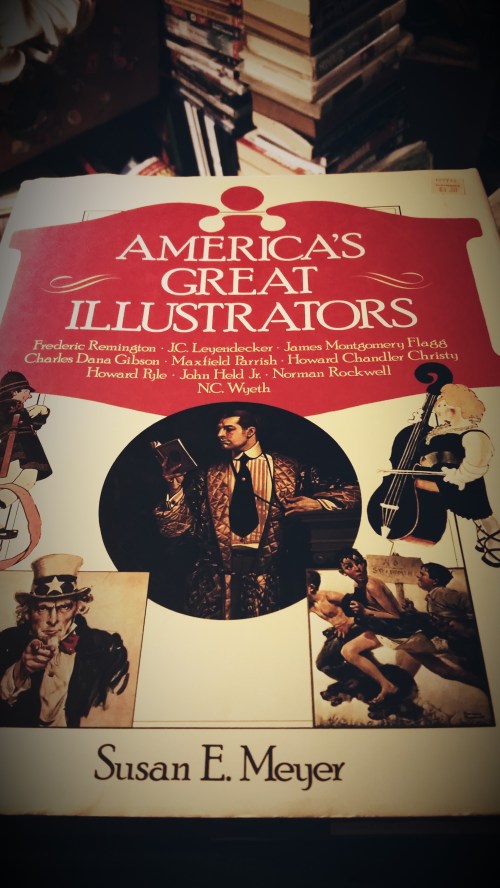
I suppose it was Robert Louis Stevenson’s Treasure Island which I read in the fourth grade. It colored all the stories I told my friends and cousins in our little Iowa town. I loved adventure. I loved N. C. Wyeth’s illustrations in the edition my Grandma had in her house. I knew from halfway through the first chapter that I had to be like young Jim Hawkins and tell a story like that.

Did you ever think you would be unable to finish your first novel?

Yes. For most of the twenty-two years it took me to finally reach the last page.

Do you read any of your own work?

How can I write anything without reading it? I like to go back regularly to re-read as much as I can, and every time I do that, I get to the point that I almost think I actually know that dumb old guy who wrote that nonsense.

Tell us about your writing style, how is it different from other writers?

I can’t say, really. When I am writing I hear the voices in my head not as my own voice, but as the characters in the story. The characters are all people I know, though every character has some part of me mixed in too. I try to write what makes me laugh and makes me cry and makes me feel good inside… and I leave it up to the reader to try to feel that too.

Do your novels carry a message?

Every novel has to be full of metaphor and meaning. If we can’t as readers jump inside the characters and walk around in their lives for a bit, then what was the point of even writing it? There is no one message. There is a multitude of messages. And readers should maybe read stuff backwards and upside down to look for clues. You never know what else might be in there. Maybe Elvis is really alive and ordering chili every day at a Wendy’s in Michigan and that can only be revealed by reading the paragraph on page 23 in reverse order.

How much of yourself do you put into your books?

Jeez! I have to work hard to keep some stuff out of my books and save it for myself. Otherwise there would soon be nothing left of me. I don’t have any secrets left in life that aren’t found in my writing somewhere. I keep my ears out of my writing, or else what would I hear with? I keep my fingers out too so I have something to draw pictures with. I use much more of me than I should.

Have you ever incorporated something that happened to you in real life into your novels?

Yes. My friend Robert remembers when the aliens tried and failed to invade my hometown when we were boys. That became the basis for Catch a Falling Star. Of course, I changed a few things, because if Robert realized which character in the book was him, he’d probably want to punch me in the nose. The characters in my stories are all students I have taught, kids I grew up with, and people I have known. Even the really weird ones were real once upon a time. Sorry, Robert, but it’s true.

How realistic are your books?

I write humorous books about science fiction subjects and fantasy adventures. They are filled with lies and exaggerations. So everything is photo realistic. You believe me, don’t you?

What books have influenced your life the most?

Tolkien’s Lord of the Rings trilogy, Douglas Adams’ Hitchhiker’s Guide to the Galaxy trilogy… er quadrilogy… or maybe five-ilogy… I don’t know…, and Frank Herbert’s Dune. I have a thing for realistic fiction.

Are there any books that you are currently reading and why?

I started reading Terry Pratchett’s Hogfather because it is the only Terry Pratchett book I own that I haven’t read yet, and I haven’t gotten hold of a copy of Hat Full of Sky already.

Have any new writers grasped your interest recently?

I love John Green’s books Paper Towns and The Fault in Our Stars.

Is there anything you are currently working on that may intrigue the interest of your readers?

I am trying to get published a novel called Snow Babies. It is a fantasy-comedy about freezing to death in a blizzard and it has snow ghosts and clowns in it. That is a rather fast and flippant summation about a book that I think will make you cry a little and laugh a lot, but it is also fairly accurate. I am hoping the publisher I signed the contract with stays in business long enough to publish it. They have also made the mistake of allowing me to submit a cover illustration.

Who are your books mostly dedicated to?

I dedicate what I write to the people I have known and used as characters. I dedicate my writing to former students, friends, family, and co-workers, because what other reason could I have for writing?

It is often believed that almost all writers have had their hearts broken at some point in time, does that remain true for you as well?

My heart breaks every time a child fails in the classroom. My heart breaks every time I see something incredibly beautiful that I know will not last much longer. I have fallen in love at least five times, and had my heart broken by that at least ten times, maybe more. The scars you carry on the inside either fester and kill you, or they turn over time into pearls, the same way oysters deal with irritants inside their shells, and they can also be called “books you have to write” once they become pearls.


Leave a comment

Filed under book review, humor, publishing, writing

Reading Old Books

My personal library is a final destination for a multitude of used and well-worn books.

20150815_121507

Half-Price Books employees used to know me by name.  They don’t now so much any more, because poor health has cut down on available funds, and they hire new people all the time.  But I have bought a number of books just cruising the Dollar-or-Less shelf.  A case in point is a recent purchase of an old book by one of my all-time favorite authors, Terry Pratchett.

20151208_091456

You can see why it was only worth about fifty cents.  It is all scuffed up and dog-eared from previous owners.  Of course, I know how to mistreat a book as well as the next guy, and some of the books I bought bookstore-new long ago look worse than this one does.  But that’s not what’s important.  The good part is on the inside.  You have to put in some effort to get at it.  It is an extremely funny and highly imaginative book.  Johnny is a kid living in Blackbury, England in 1996 (the present day of the story, though it is about time travel and drifts back to the early 1940’s).  He thinks he is just a stupid kid with more stupid-ness about him than he has pockets to keep it in, but he is blessed with an idiot’s ability to think outside of his own head (whatever the heck that means).  There just happens to be an old bag lady named Mrs. Tachyon who just happens to have a Tesco grocery shopping cart that just happens to be a time machine (or so Johnny and his stupid-kid friends just happen to believe).  Johnny and his stupid-kid friends, Bigmac, Wobbler, and Yo-less (don’t ask, okay) along with the girl Kirsty (who is definitely the opposite of a stupid kid), find Mrs. Tachyon lying in a bloody lump in an alley way, and sort of inherit the shopping cart when they get the old lady to a hospital.  And of course, the shopping cart is very unusual with its bags of mysterious wobbly stuff and its resident hyper-vicious cat named Guilty.  It soon accidentally transports the kids back to 1941 when German bombs (like the one in the title) are falling from the sky on Blackbury.  The very day, in fact, when the street they are standing in is supposed to be destroyed by a German bomb, according to history.

Of course, I can’t help but love any book by Terry Pratchett.  But this one is quirky-wonderful and full of surprises.  I really can’t even tell you more about it without spoiling something magical.  I won’t, however, recommend that you read this book.  After all, I had a lovely time reading it, and you certainly don’t need to share in that.  I can keep it all for myself.  No, don’t even think about trying to find a copy and read it!  I think it is out of print anyway.  Don’t you dare go to Half-Price Books!

I will continue to read and fall in love with old books.  I have a few in my library that haven’t actually gotten around to reading yet.  And I have a large number of books I want to read again.  Old books are the best books, and I will continue to say that… at least until I have a new book of my own coming out.

2 Comments

Filed under book review, good books, humor, Uncategorized

More Books to Make You Crazy

I have now written several goofy book reviews in which I explain some of the goofy books I have read that I blame for my current state of crazily unbalanced intellectualism.  If you decide you would like to be as goofy and crazy as me, for some totally inexplicable reason, you can read some of these oddball choices.

34504Michael Beyer‘s review

Sep 13, 15  
Read in September, 2015


Terry Pratchett wrote books of magical power and satirical alchemical wit, but not a single one of them tops Wyrd Sisters. I believe this is the best book he ever wrote from a collection of several of the best books ever written. The three witches, Granny Weatherwax, Nanny Ogg, and Magrat Garlick call up visions of the witches in MacBeth. But no Shakespearian special effect ever captured the searing ridicule of kings and kingly aspirations as this book about king-making, or king un-making, or witchly interference with the best laid plans of mice and would-be kings. Granny Weatherwax is a witch you never want to meet in real life, but this book portrays the practical-minded old witch so talented at headology with such clarity, that you realize that you have indeed met her in real life… probably more than once. And the book has as unlikely a plot as ever underwent loop-the-loops and barrel rolls in its flight through a book. I have now smeared loopy gushings of hyperbole and weird wordy praises all over this book, and hopefully you will take time out from feeling nauseous long enough to give it a look.
I am also guilty of having a great love for non-fiction books and learning.  So here is a singularly weird choice to obsess about.

Michael Beyer‘s review

Sep 13, 15  
461434by Dennis Craig Smith
Read in September, 2015


Back in the 1980’s, I had a girlfriend whose sister lived in a clothing-optional apartment complex in Austin, Texas. Visiting there was an exercise in absolute embarrassment and near apoplexy. But it made me curious as well. There were children as well as adults there. Family-oriented nudity? I needed to know more. So, on advice from friends I located a naturist society based in Florida and corresponded with them. I bought a copy of this book from them. It contains a fascinating study, told mostly through collections of anecdotal data, of the effects, and possible effects of living parts of your life completely naked. And the effects it could have on kids. Having grown up with considerable burdens of shame and trepidation about being seen naked, this book helped me to understand that being naked is not necessarily the bad thing I thought it was. I confess to becoming a closet nudist… er, if never letting anyone else see you naked qualifies as being a nudist. And I have met, over time, wonderful people who are totally nutty about being nude. I will never become one of them. But this book helped me to at least understand them better.
I basically got the notion that books make you insane from the next author, a favorite of mine for reasons I can’t begin to explain.

Michael Beyer‘s review

Sep 13, 15
Read in September, 2015


H.P. Lovecraft gives me real nightmares because he is such a master of the arcane arts of creating unease and worry. I have never read another author’s work where the atmosphere of the story leaks toxic chemicals of fear and loathing into your brain quite the way this story does. As you experience the rotting, festering, tainted town of Innsmouth through the eyes of the narrator, your entire being is slowly sauteed in a stew of creepy details, unsettling characters, and an architecture of decay. It is decay of both the actual seaport town, and the mouldering culture of a humanity that long ago yielded to the temptation of ultimate corruption. Frog people from the ocean’s depths could easily be humorous or simply bizarre. But Lovecraft’s slow, relentless reveal makes the unwinding plot absolutely horrifying. If you like a good scare, this book may be too much for you. If you love a bad scare that makes your very skeleton shiver, then this is the perfect book.
All of this book-review nonsense can be found on Goodreads, a critical website for readers and writers, and I have peppered this post with enough links to it that you probably can’t avoid accidentally ending up there.

Leave a comment

Filed under book review, humor