

Canto 142 – Night Thoughts
It was during that eight-hour period set aside for sleep that Ged awoke in a sweat. Dreams again! He couldn’t quite recall what he’d been dreaming, but it gave him the uneasy feeling that it was about his brother Ham, and that it was one of those dreams a Psion sometimes has that comes true. He was sandwiched in between two small, warm bodies. Junior was snuggled next to him on one side, snoring softly. Sarah was on the other side, her small body sheathed in her white body suit, looking like an angel and radiating angelic energies.
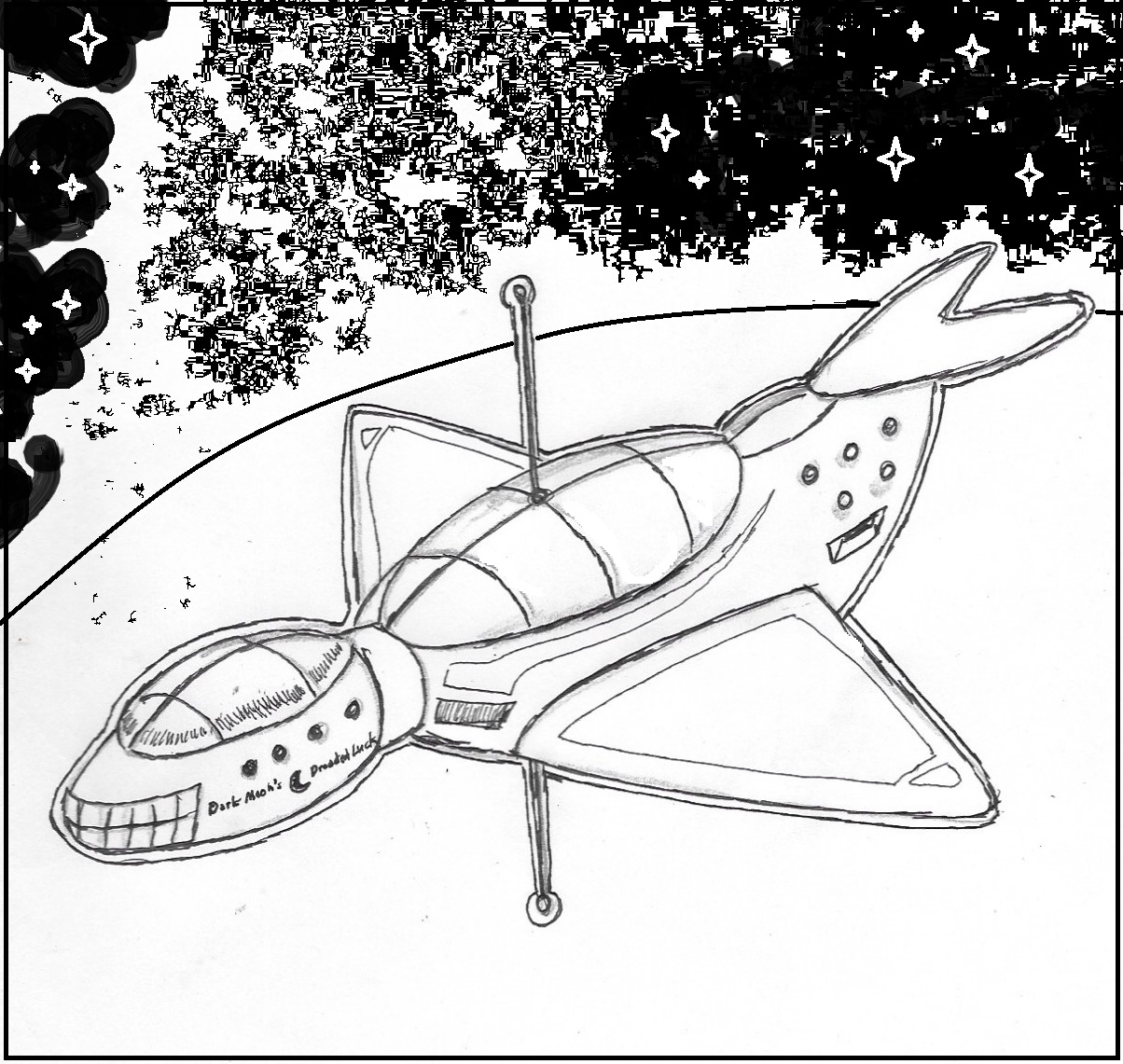
The spaceship, in the form of an Ancient Red Dragon, continued to purr with power as it flew through jump space.
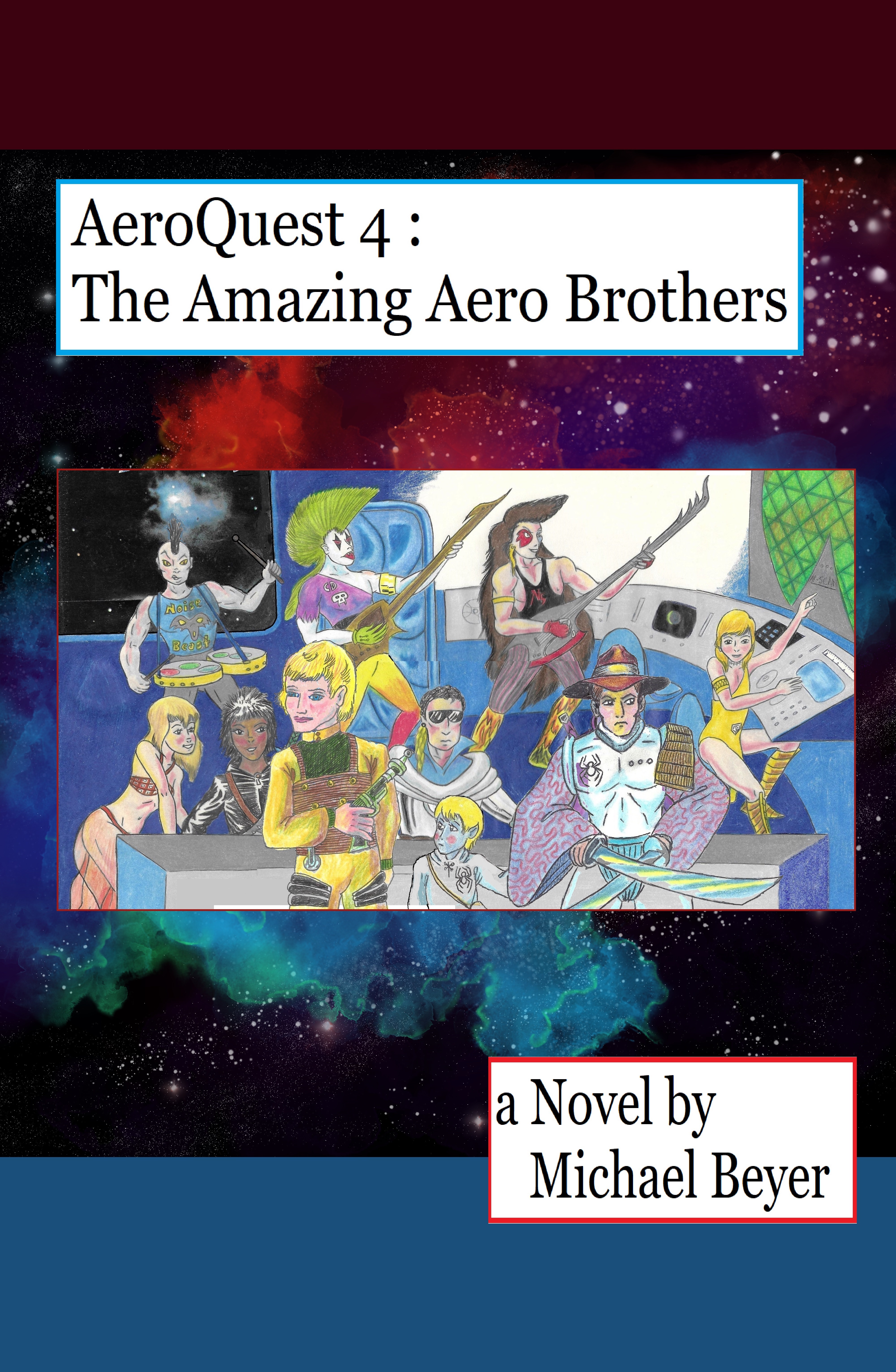
Ged knew sleep was highly unlikely for him now. Still, he didn’t turn on the lights or re-absorb the short brown fur that his Psion power generated every evening now to keep him warm. He looked at the two sleeping children. They had grown a lot while in his care.
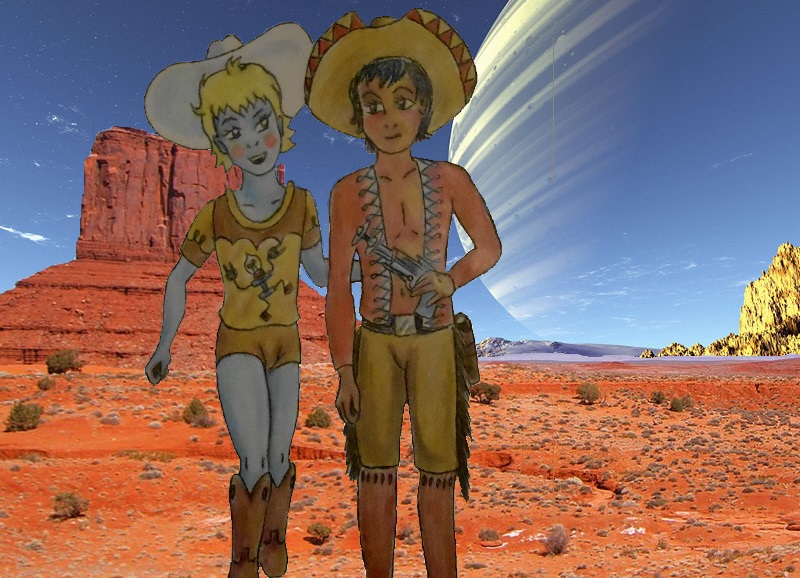
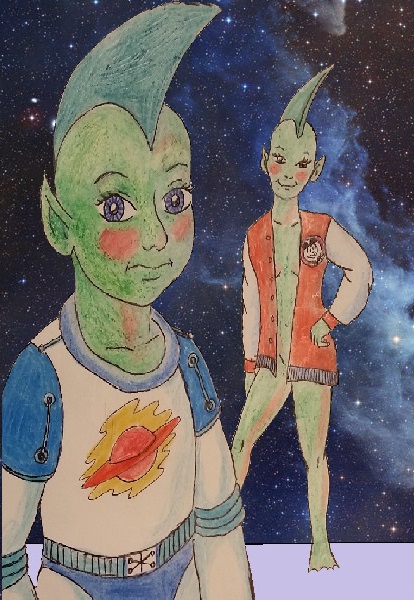
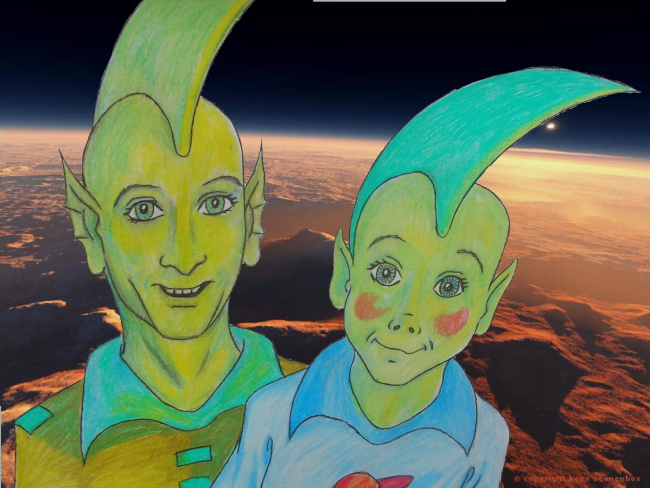
Junior reminded him of Ham as much as any blood relative would have. The blue face was totally different from the handsomer half of the Aero Brothers’ Space Safari Service, but the unruly blond hair was similar. And Ged couldn’t help but call to mind the boy’s wistful smile, so like the smile that made his brother Ham so engaging and heroic. With one furry hand, Ged reached over and stroked the boy’s yellow hair. This child was precious to him. So alien, yet now become an indispensable part of Ged’s life as a spacer.
Sarah, on the other side, was probably the most beautiful child he had ever encountered. As he looked at her intently, he couldn’t help but think it was far more than a physical beauty. Her father was one of a handful of so-called Forever Men in the galaxy. He was an immortal, capable of traveling in a straight line through a thousand years. He had gifted his daughter with more than a thousand years worth of human wisdom, culture, and literature. What was more, she was able to draw entire libraries full of learning directly from her father’s head via telepathy. At less than twelve years old, she was more learned than Ged would ever be.
What was he doing on this alien space craft in a bed between these two amazing children? How could he ever hope to be worthy of caring for them and protecting them? Worse, he was now taking them from the relative safety of the planet Gaijin, back into an Imperial Space full of war and violence, cruel pirates, and shambling hordes of rot warriors who were no more than animated skeletons with a computerized control system. Not just these two, either. He had a whole shipload of special children that he was now somehow responsible for. What was he doing here? How could a talented hunter and space traveler from Questor suddenly be a teacher and the only adult guiding these children toward a highly questionable future? The thought made him quiver in spite of the warm fur.
Maybe being a teacher wasn’t so bad, though. He was a natural with loving discipline. Except for Alec Songh, all of these children adored and looked up to him. It felt good to be addressed with respectful honorifics and awe. It seemed he did have something to teach them.
Shu Kwai had become a powerful telekinetic because of Ged’s success in describing for him the workings of the inner eye.
Ged’s own perceptive powers had grown exponentially as he continued to practice changing his own shape. He could transform now not just by taste and touch, but by scent and even by imagination. He could almost become the creatures of his dreams by placing them at the focus of his powerful inner eye.
Friashqazatla was gaining a lot in shape-change power from the instruction Ged gave him. So far, he could only take a humanoid shape with canine features or a small, black wolf with a human brain and voice, but the rest would surely come with time and practice.
Gyro, the other Nebulon boy besides Junior was learning practically everything Ged knew about starship repair and maintenance. He could find and pull the skills directly out of Ged’s memory. He seemed to have a really vast aptitude for anything mechanical or electronic. He was also a god of mathematics and space-travel equations. The need to find an astrogator was quickly becoming irrelevant.
Even the Phoenix and Rocket Rogers were learning from him. They had a power over fire that he did not comprehend at all. It was a Psion power completely un-like his own. Still, they learned to work together from Ged, in the way he had always done so naturally with his brother Ham. He taught the two boys the hunting language of hand signs and gestures that allowed non-telepaths to speak in silence. He taught them tracking skills and the interpreting of signs left by those who pass through a place.
But the question that bothered Ged most was, “What have I become?” He had taken pride in being a moral man, a servant of the true God. Now, he was the lover of two different women, one little more than a child herself. His love had caused them both pain and trouble. And the more he became a Psion and used his power, the more he felt degraded and sick. He had become a monster. And what about his brother Ham?
Still, as he lay there awake and troubled he couldn’t help but turn back to thoughts of Ham. They had escaped from Imperial Space. They had found paradise. Don’t Go Here was a source of potential wealth. He and Ham had liberated the population, revived the starport, and wove them into the great web of space. They owned the starport and had control over who came in.
Gaijin was even better. There he had found acceptance. They didn’t seem to care that he was different and tainted with Psion blood. They seemed to think it was a good thing. He and Ham could have a good life between those two planets. And now, it seemed, both of them were being drawn back into the dangerous realm that was the Imperium. Looming doom seemed to be beckoning to them both. Ged hunkered down again between the two sleeping children. He needed to get some sleep. Thoughts of the other children in his care, Billy Iowa, Jadalaqstbr, Mai Ling, Hassan Parker, Taffy King, and difficult Alec Songh, could be put off for the moment. Still, thinking about the future made his stomach churn and sleep remained a stranger.
In the hold, three decks below in the belly of the Ancient dragon starship, the malevolent Tesserah continued to percolate with sickly green and purple lights. Whatever evil thing the device was supposed to do, it was busy doing it.















Vonnegut
My experience of the works of Kurt Vonnegut is limited to the reading of three books; Cat’s Cradle, Breakfast of Champions, and Slaughterhouse Five. But it was enough to make me love him and use him as a shaper of my soul.
I deeply apologize for the fact that even though he only wrote 14 books and a bunch of short stories, I have not read everything I could get my hands on by Kurt. Three novels and one short story (Harrison Bergeron) is not really enough to compare to the many, many things that I have read by Mark Twain, Terry Pratchett, Louis L’Amour, and Michael Crichton. I can’t begin to count how many books of each of those four I have read and reread. But it is enough that I read those three novels and have a lifelong regret of never buying and reading Slapstick when I had the chance. Vonnegut writes black humor. The ideas are painful, and burn away flesh from your personal body of being. And at the same time, you cannot help but laugh at the pure, clean, horrifying truths his ridiculous stories reveal.
If, in the course of telling a story, you can put the sublime, the ridiculous, and the horrendous side by side, and make the reader see how they actually fit together, then you can write like Vonnegut.
Let me give you three quick and dirty book reports of the Vonnegut I have read in the order I have read them;
I read Cat’s Cradle in college. I was young and idealistic at the time, foolishly convinced I could be a great writer and cartoonist who could use my work to change mankind for the better.
In the book, Dr. Felix Hoenikker (a fictionalized co-creator of the atomic bomb) is obsessively re-stacking cannonballs in the town square in pursuit of a new way to align water molecules that will yield ice that does not melt at room temperature. Much as he did with the A-bomb, Hoenikker invents a world-ending science-thing without any thought for the possible consequences. The narrator of the novel is trying to write a humanizing biography of the scientist, and comes to observe the inevitable destruction of the whole world when the oceans freeze into Ice-9, the un-meltable ice crystal. Before the world ends, the narrator spends time on the fictional Carribean island of San Lorenzo where he learns the fictional religion known as Bokononism, and learns to make love to a beautiful woman by pressing bare feet together sole to sole. It is a nihilistic picture of what humans are really like more savagely bleak than any portrayal Monte Python’s Flying Circus ever did on TV.
Needless to say, my ideals were eventually shattered and my faith in the world shaken.
I read Breakfast of Champions after I had been teaching long enough to buy my own house, be newly married, and a father to one son. It was probably the worst time of life to be reading a book so cynical, yet true.
In this story, the author Kilgore Trout, much published but mostly unknown, is headed to Midland City to deliver a keynote address at an arts festival. Dwayne Hoover is a wealthy business man who owns a lot of Midland City real-estate. Trout gives Hoover a book (supposedly a message from the creator of the universe) to read that suggests that all people (except for the reader of the book… meaning Hoover) are machines with no free will. Hoover takes the message to heart and tries to set the machines free by breaking them, beating up his son, his lover, and nine other people before being taken into custody.
The book contains devastating themes of suicide, free will, and social and economic cruelty. It makes you sincerely reflect on your own cog-in-the-machine reality.
Slaughterhouse Five is a book I bought and read when I missed my chance to buy Slapstick and needed something to take home from HalfPrice Books to make me feel better about what I missed. (Of the five books I had intended to buy that day, none were still on the shelves in spite of the fact that they had been there the week before.) It was fortuitous. This proved to be the best novel I had ever read by Vonnegut.
Like most of his work, the story of Billy Pilgrim is a fractured mosaic of small story pieces not presented in chronological order. It details Billy’s safe, ordinary marriage to a wife who gives him two children, but it is ironically cluttered with death, accidents, being stalked by an assassin, and being kidnapped by aliens. It also details his experiences in World War II where he is captured by the Germans, held prisoner in Dresden, kept in an underground slaughterhouse, and ironically survives the fire-bombing of Dresden by the Allies. Further, it details his time as a zoo exhibit on the alien planet of Tralfamadore.
It explores the themes of depression, post-traumatic-stress disorder, and anti-war sentiment. Vonnegut himself was a prisoner of war in Dresden during the fire-bombing, so real-life experiences fill the book with gravitas that it might not otherwise possess. Whether the author was ever kidnapped by aliens or not, I cannot say.
But Kurt Vonnegut’s desire to be a writer and portray himself as a writer in the character of Kilgore Trout, and even as himself in his work, has an awful lot to do with my desire to be a writer myself. Dark, pithy wisdom is his thing. But that wisdom, having been wrung from the darkness is all the more brightly lit because of that wringing. It is hard to read, but not hard to love.
Leave a comment
Filed under aliens, book reports, commentary, humor, reading, writing humor
Tagged as Kurt Vonnegut