
Canto 83 – Star Nomads Revealed (The Silver Thread)
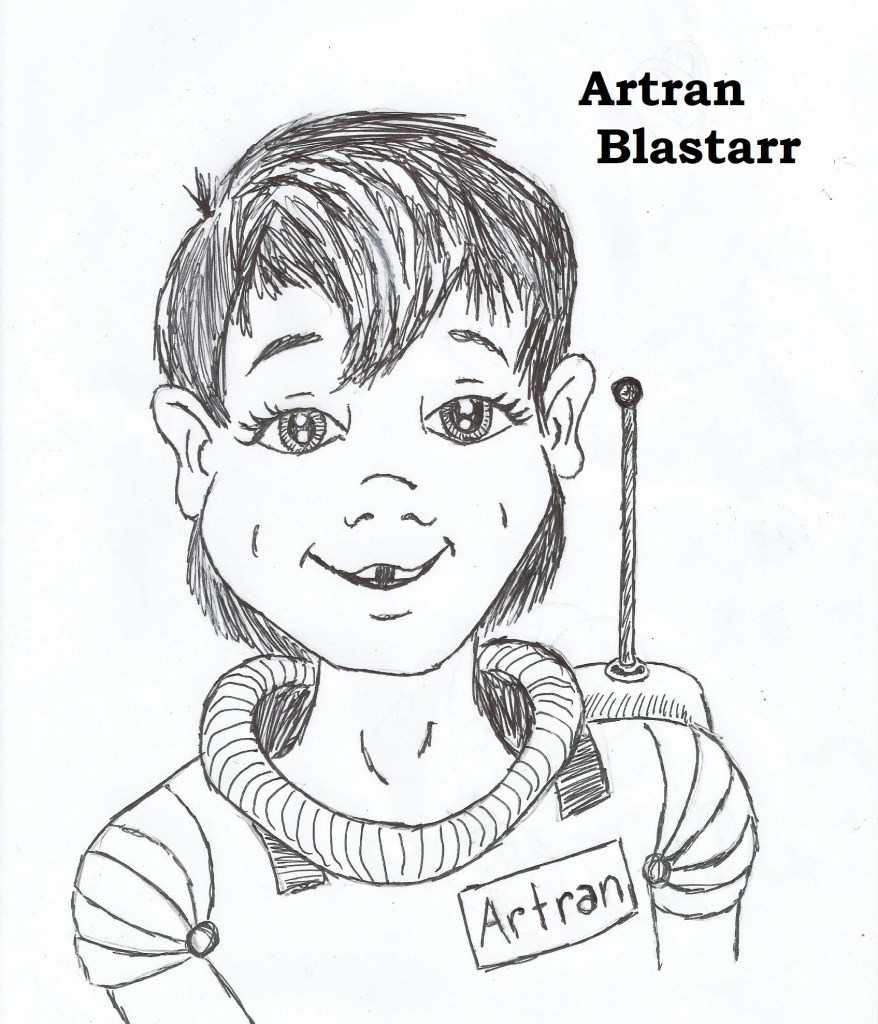
Artran Blastarr, the eight-year-old son of space pirates, and Tiki Astro, the robot-boy, stood holding hands on the docking bay floor next to the somewhat unreliable yet amazingly effective Bill the Postman (Scarpigo Snarcs in his current secret identity).
From the portal opposite, on the far side of the docking bay, three gigantic humanoid figures dressed in metallic armor of some kind emerged.
“Who… who are those?” gasped Artran.
“Those are Star Nomads. If I don’t miss my best guess, it is the Black Knight, the Dark Traveler, and the Magnificent Wanderer,” said Bill.
They slowly approached, each a massive figure in armor that completely covered their entire bodies, completely obscuring even their faces, no matter what race or configuration they actually represented. The Black Knight was all in gleaming black armor with a razor-edged hook for a crest on his faceless helmet. The Dark Traveler was all decked out in metallic green armor. And the Magnificent Wanderer, as Bill pointed out, was armored entirely in gleaming silver.
Drawing close enough to speak, the Magnificent Wanderer’s voice boomed out like a thunderclap on a rainy planet. “So, you have brought us the chosen one, Scarpigo Snarcs.”
“Yes, oh Magnificent One. But please refrain from using my real name in front of those who might not be stupid enough to misremember it.”
“I will never fully understand why demi-humans like this one insist on their comic prevarications the way this one does,” said the Dark Traveler.
“Indeed,” said the Wanderer. The Black Knight remained silent.
“Who is this chosen one?” asked Tiki Astro meekly.
“The human child born on the planet known as Outpost.” The Traveler nodded at Artran.
“Me?” squeaked Artran.
“Of course, you,” said the Wanderer. “We need an authentic discoverer of worlds for our purpose.”
“…And you know the boy thinks that’s the silliest thing he ever heard,” said Bill.
“Of course, he does. We pulled him out of the time stream well before he was ready to set foot on his first planet. Who better to use for the purpose, than the one fated to it?”
“Yes, you are right,” admitted Bill quickly. “You are always right.” Bill rolled his eyes when the Wanderer’s featureless face was turned away.
“So, Tiki and I are supposed to be here? This wasn’t just an accident?”
“The robotic child-construct is fated to be elsewhere. You alone are the chosen one, Artran Blastarr.” The Wanderer pointed his armored finger at Artran’s breastbone.
“No! I won’t go anywhere without my friend Tiki!” Artran began to leak emotion-induced wetness from his childish eyes. Of course, the Star Nomads would never give in to any such emotional nonsense.
“The Metaloid boy belongs to the White Spider,” said the Black Knight in what can only be described as a dark black voice. “He must be there when the critical time comes. The universe decrees it.”
“You can count on me,” said Bill, not actually adding, “because I must be some sort of human abacus.”
“You are not actually human,” said the Wanderer, apparently answering Scarpigo’s thoughts.
“What if I don’t agree to go to this White Spider?” asked Tiki.
“Then we invoke protocol alpha in your programming,” said the Wanderer.
“Oh. Sorry, Artran. I have to be going. It’s a robot thing.”
By this time Artran was beside himself with misery. “Bye, Tiki. I love you.”
The real boy and the robot boy briefly hugged before Bill (Scarpigo) the Postman led Tiki Astro back to the X-boat.
Artran looked up at the Wanderer with tear-filled eyes.
“So, are you gonna eat me now?” he said in a fully resigned voice.
“We no longer consume food of any sort. We will now take you to civilized planets that you will learn about and then give to the newly-formed alliance that is to become the New Star League.”
“Oh. Okay.”










 Catch a Falling Star
Sunday with Salvador
Today I am waxing on about the wonderful, mad, mad, mad genius of surrealist art, Salvador Dali. He was born in 1904 and died in 1989. And that’s really about all that I want to tell you about the physical parameters of his boundlessly creative life. He was alive in this world until I was already thirty-three. So, I got to see him on television and watch video biographies of him and his incredible artwork. Ones that included interviews. And if I get into his public persona, that will eat up the rest of his essay. Instead, I need to talk about his art, and how it modifies and magnifies what I am meant to be.
His most famous painting is the one that most clearly burned the image of melting clocks into our collective memory. He claimed, and others pretend to see it too, that it is a reaction to Einstein’s Theory of Relativity. But when I look at it with the melting mask of Dali himself in the center, I see the artist’s perception of time in the spaces within which creativity moves. Time melts and has no meaning when you are painting and writing from an endless roiling flow of new ideas and notions. Time becomes as irrelevant in that context as the ants on the pocket-watch or the dead tree from which one deflated clock-skin hangs, There is no past or future, only the creative now.
And in that creative now, the artist sees himself. But if you look too closely, the self vanishes into the picture, the currently considered, fascinating work of art.
You see the boy with the hoop and wearing a sailor suit? That symbol, he always claimed, was his lost brother, the one who died before he was born. The one whose death made his parents decide to have another child. Without that brother, Salvador would probably never have been existing at all.
And do you see the disappearing bust of Voltaire? Or when you look closely at the slave market in the background, is it simply no longer there? Things that disappear… things that become other things… tricks of perception, the fooling of the viewer’s eye… These are what the artist actually wants you to see. Not the well-portrayed physical reality, but the ghost of the shadow of an idea that’s hard to define.
And then there is the idea of war. Two world wars that took place in the prime-time of his painterly life.
Life does crazy things to the sensitive, suffering artist, and it shows in his work if not in his public personality.
And consider the artist’s notion of birth and life and death. Narcissus suffers for the sin of love of himself. He becomes petrified with age, a narcissus flower growing from his head, now an egg, the symbol of birth and rebirth.
And here is an exploded portrait of his beloved wife Gala.
All the elements float eternally in the air.
And you can see inside each thing.
Inside the home is the wife and mother.
Inside the mother is the child.
Inside the child is the loaf of bread that keeps him alive.
Does the bread, then, stand in for God himself?
Dali and his work is not simple. It is deeply, incongruously complex. But that is surrealism. That is how it works. Without getting into other complex symbols and such Dali-esque puzzles like burning giraffes, eggs, and Venus De Milo with bureau drawers in her torso, that is how Salvador spends his Sunday with me. An artist beyond time and space, long dead, but still speaking to me. And teaching me beautiful, untold things and stories of things.
3 Comments
Filed under art criticism, artists I admire, artwork, autobiography, commentary, surrealism
Tagged as Salvador Dali