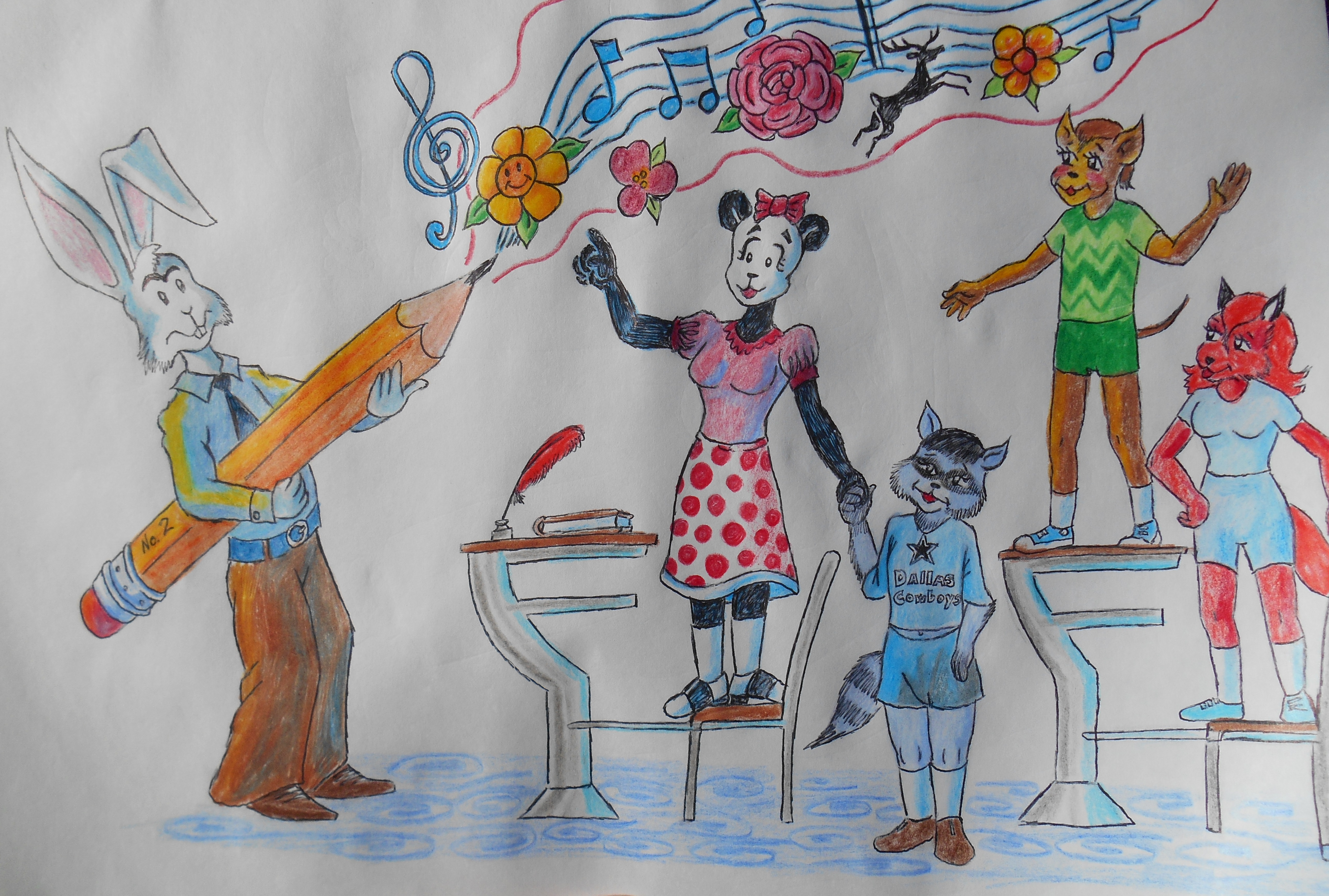
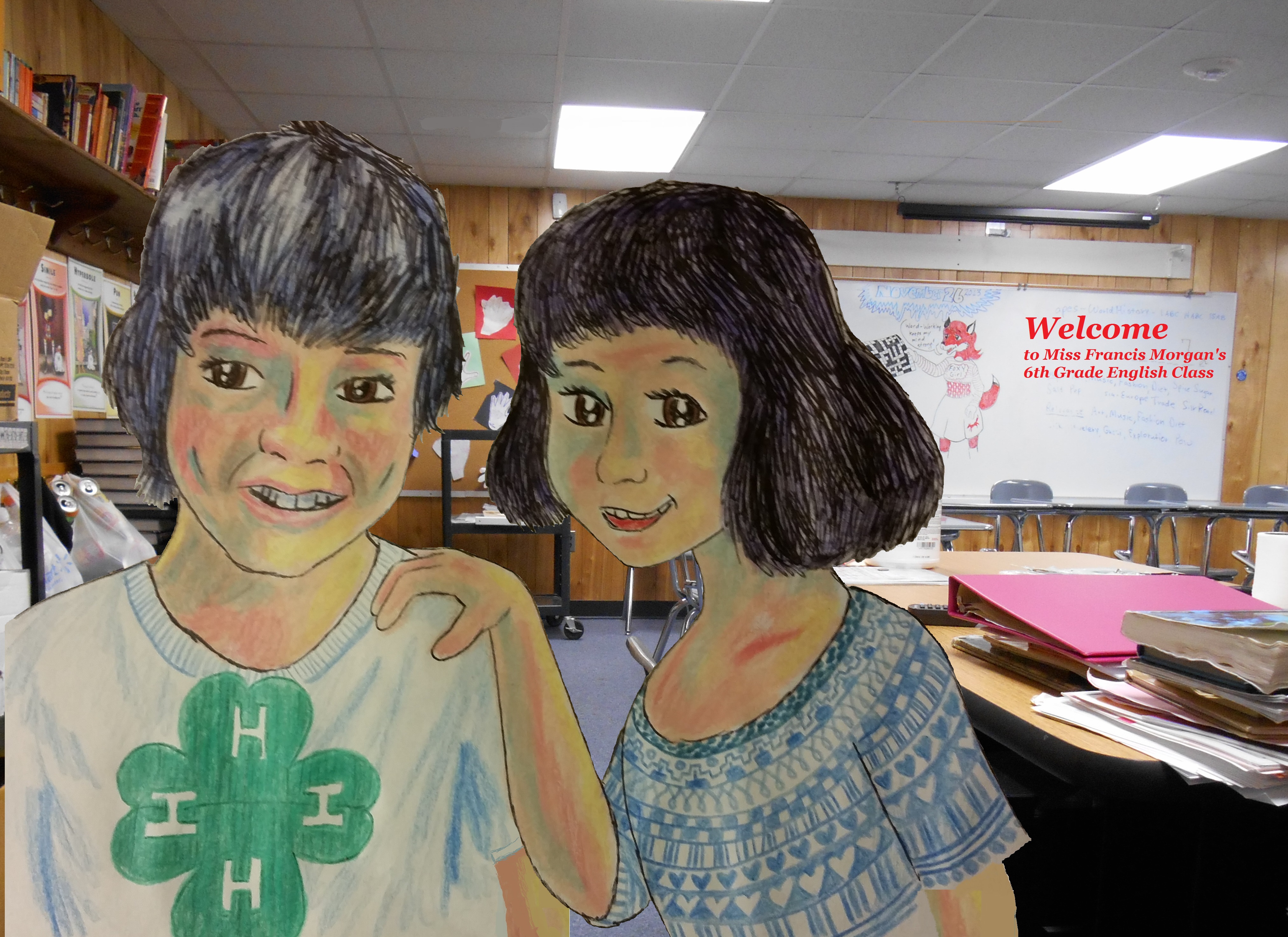
When you walk to the front of the classroom and take up the big pencil in front of a group of young teens and twelve-year-olds, there is a strong pressure to learn how to sing and dance. That, of course, is a metaphor. I was always too arthritic and clunky in my movements to literally dance. But I looked out over a sea of bored and malevolence-filled eyes, slack and sometimes drooling mouths attached to hormone-fueled and creatively evil minds. And I was being paid to put ideas in their heads. Specifically boring and difficult ideas that none of them really wanted in their own personal heads. So I felt the need to learn to dance, to teach in ways that were engaging like good dance tunes, and entertaining in ways that made them want to take action, to metaphorically get up and dance along with me.
I wanted them to enjoy learning the way I did.
But the music of the teacher is not always compatible with the dance style of the individual learner. The secret behind that is, there is absolutely no way to prompt them to dance along with you until you learn about the music already playing in their stupid little heads. (And you can’t, of course ever use the word “stupid” out loud, no matter how funny or true the word is,) You have to get to know a kid before you can teach them anything.
The discordant melodies and bizarre tunes you encounter when you talk to them is like dancing in a minefield blindfolded. Some don’t have enough to eat at home and have to survive off of the nutrition-less food they get in the school cafeteria’s free-and-reduced lunch program. Some of them have never heard a single positive thing from the adults at home, enduring only endless criticism, insults, and sometimes fists. Some of them fall in love you. Some due to hormones. Some due to the fact that you treat them like a real human being. Some because they just stupidly assume that everyone dances to the same tunes they hear in their own personal head.
Some of them automatically hate you because they know that if you hear their own secret music in their own self-loathing heads, you will never accept it. They hate you because you are a teacher and teachers always hate them. Some of them, deep down, are as loathsome as they think they are.
But, if you find the right music, you can get any of them, even all of them, to dance. It might be hard to find. It might be a nearly impossible task to learn to play that music once you find it. But it can be done.
And if you get them to dance to your music, to dance along with you, I can’t think of anything more rewarding, anything more life-fulfilling. Have you ever tried it for yourself? If you are not a teacher, how about with your own children or the children related to you? Everybody should learn to dance this dance I am talking about in metaphors. At least once in your life. It is addictive. You will want to dance more. So the next time the music starts and you get the chance… I hope you’ll dance!
If you have the bad habit of reading this particular blog more than once, then you are probably aware that I used to be a public school teacher. Even worse, I used to be a middle school English teacher. Aagh! Seventh graders! It explains a lot about how life has warped my intelligence, personality, and world view. It also explains somewhat where I found such a fountain-like source for some of the worst jokes you ever heard.
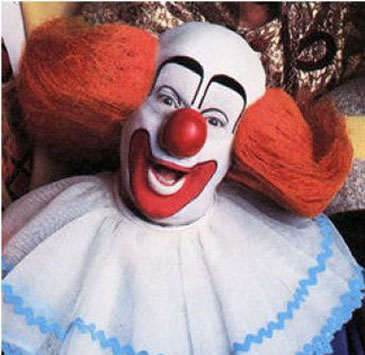
Now, as to the question of why I have chosen in my retirement early-onset senility to become a humor-blogger… well, that is simply not something I can answer in one post… or even a thousand. But kids are the source of my goofball clown-brain joking around.
Kid-humor, you see, is stunted and warped in weird ways by the time period you are talking about. The eighties, nineties, two thousands, and the tens are all very different. And those are the various sets of students that I attempted to learn moose bowling from by teaching them English.
Still, there are certain universal constants.
Potty humor really kills. If you want to make a thirteen-year-old crack up with laughter, roll around on the floor, and maybe wet his or her pants, then you only need to work the “poop” word, or the “nickname for Richard” word, or the “Biblical word for donkey” word into the conversation. Of course the actual words, even though we all know what they actually are, are magical words. If you actually say them to kids in school as their teacher, those words can actually make you magically and permanently disappear from the front of the classroom. All kids are big fans of George Carlin and his seven words, even though most of them have never heard of him.
And violent humor is popular with kids from all decades. The most common punch line in the boys’ bathroom is, “… and then he kicked him in the Biblical word for donkey!” followed closely in second place by, “… and then she kicked him in the Biblical word for donkey!” I am told (for I don’t actually go in such scary places myself) that in the girls’ bathroom the most popular punch line is, “…so I kicked him right in the soccer balls, and he deserved it!” Why girls are apparently obsessed with soccer, I don’t know… or particularly care.
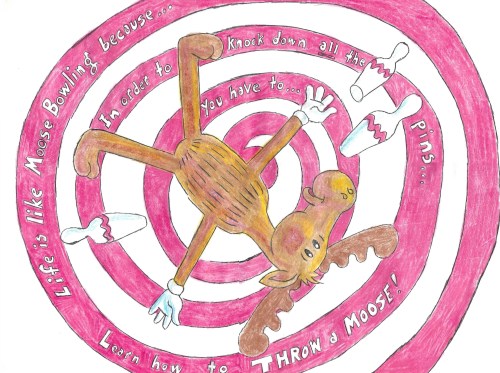
So my education in humor began with bad-word jokes, slapstick humor, put-downs, and rude noises coming from unfortunate places. Humor in the classroom is actually a metaphorical mine field laced with tiger traps, dead-falls that end with an anvil hitting you on the head, or being challenged to a life-or-death game of moose bowling. (Don’t know what moose bowling is? Moose bowling is a very difficult game that, in order to knock down all the pins and win, you have to learn to roll a moose down the alley.) Sounds like I spend too much time watching cartoons and playing video games, doesn’t it? Well, there’s more. And it gets worse from here. But I will spare you that until the next time I am foolish enough to try making excuses for my really bad jokes.
Back in the 1980’s I was given the gift of teaching the Chapter I program students in English. This was done because Mrs. Soulwhipple was not only a veteran English teacher, but also the superintendent’s wife. She was the one gifted with all the star kids, the A & B students, the ones that would be identified as the proper kids to put into our nascent Gifted and Talented Program. That meant that I would get all the kids that were C, D, & F in most of their classes, the losers, the Special Edwards, the learning disabled, the hyper rocketeers of classroom comedy, and the trouble makers. And I was given this gift because, not only was I not a principal’s or superintendent’s wife, but I actually learned how to do it and became good at it. How did I do that, you might ask? I cheated. I snooped into the Gifted and Talented teacher training, learned how to differentiate instruction for the super-nerd brain, and then used the stolen information to write curriculum and design activities for all my little deadheads (and they didn’t even know who the Grateful Dead were, so that’s obviously not what I meant). I treated the little buggers like they were all GT students. Voila! If you tell a kid they are talented, smart, and worthy of accelerated instruction… the little fools believe it, and that is what they become.
Even the goofy teacher is capable of believing the opposite of what is obvious and starts treating them like super-nerds because he actually believes it. I soon had kids that couldn’t read, but were proud of their abstract problem-solving skills. I had kids that could enhance the learning of others with their drawing skills, their singing ability, and their sense of what is right and what is wrong. I had them doing things that made them not only better students for me, but in all their classes. And I did not keep the methods to my madness a secret, either. I got so good at coercing other teachers to try new ideas and methods that I got roped into presenting some of the in-service training that all Texas teachers are required by law to do. And unlike so many other boring sessions we all sat through, I presented things I was doing in the actual classroom that other teachers could also use with success. The other teachers tried my activities and sometimes made them work better than I did.
Yes, I know this all sounds like bragging. And I guess it probably is. But it worked. My kids kept getting better on the standardized tests and the State tests that Texas education loves so much. And Mrs. Soulwhipple was still the superintendent’s wife, but she did not stay a teacher forever. She eventually went to a new school district with her husband. And guess who they started thinking of when the question of who would be the next teacher for the nerd classes was considered. That’s right, little ol’ Reluctant Rabbit… that goofy man who drew pictures on the board and made kids read like a reading-fiend… me.
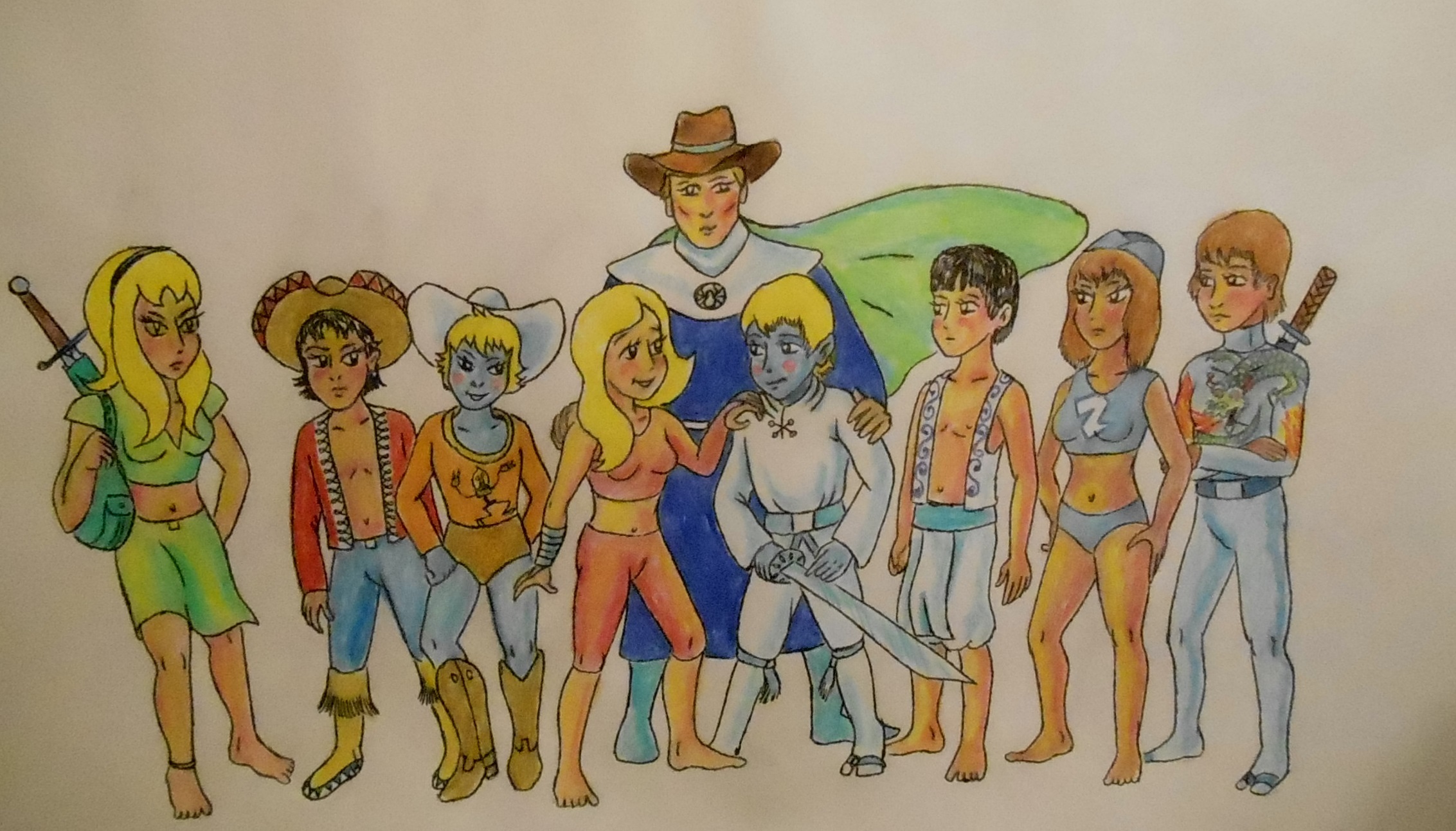
So, a new era began in Cotulla. In addition to still getting to teach all the deadheads (because they weren’t going to trust those precious children to anyone else, naturally), I began teaching at least one edition of Mr. B’s famous Nerd Class every school year. We actually assigned long novels and great pieces of literature for the kids to read and discuss and study in depth. Novels like To Kill a Mockingbird by Harper Lee and Across Five Aprils by Irene Hunt were read. We began talking about “big ideas”, “connections to the wider world”, and how “things always change”. We began taking on ideas like making our world better and how to help our community. Kids began to think they were learning things that were important. We did special units on Exploring Our Solar System, The World of Mark Twain, Finding the Titanic, and The Tragedy of Native American History. And we spent as much as a third of the year on each. I am myself cursed with a high IQ and a very disturbing amount of intelligence. I am the deepest living stockpile of useless facts and trivia that most of my students would ever meet in their lifetimes. And even I was challenged by some of the learning we took on. That’s the kind of thing that makes a teaching career fun. It kept me teaching and meeting new students and new challenges long after my health issues made it a little less than sensible to keep going. And if I manage to tell you a few Nerd Class stories in the near future, then at least you stand a chance of knowing a little bit about what-the-heck I am talking about. So be prepared for the worst. I am retired now, and have plenty of time for long-winded stories about being a teacher.
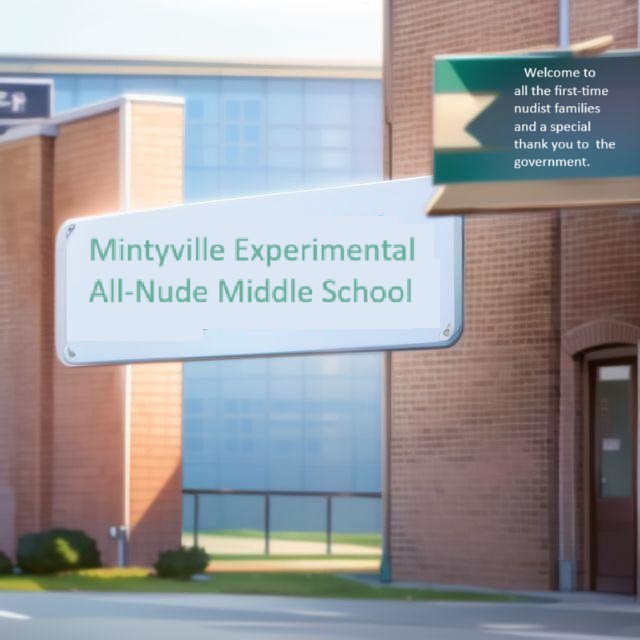
I have often described the typical middle school with the name “The Monkey House” due to the resemblance in the behavior of sixth graders to little monkeys like squirrel monkeys, capuchins, and rhesus monkeys, and the behavior of seventh graders to chattering chimpanzees, and the behavior of eighth graders to poop-throwing gorillas. All of these simian varieties in nature do not wear any clothes. So, it follows that in nature, middle school students would naturally be at least metaphorically naked. They do swing with their tails out of their seats at any excuse, chatter about personal things without realizing others might be listening, and fling metaphorical poop at everyone… literal poop in certain regrettable situations. But every human species of middle-school monkeys in the Monkey House could benefit from being as naked in school as actual monkeys are in the jungle. In this post, I will try to cover how that works in an imaginary all-nude school for each of as many monkey species as I can.
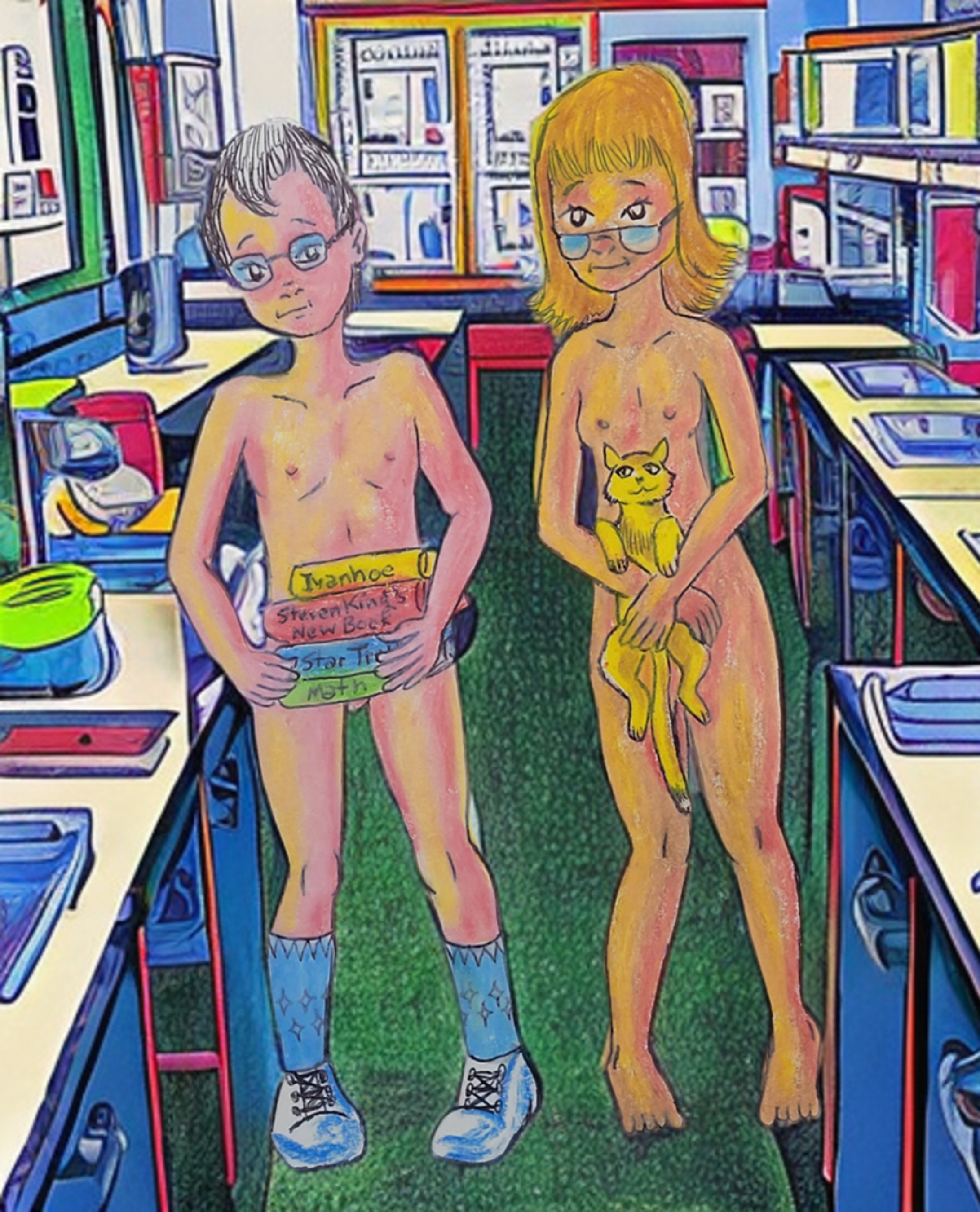
The Nude Nerds in the Science Class Lab, Milton Steinbum and Nancy Jane Smithers.
I am starting with the nude nerds because, had I been put in an all-nude experimental middle school myself, I would have been a member of this middle-school monkey species. I would have been like Milton, always carrying nearly every book from my locker so I would have something to hold in front of me, hiding my little weiner as well as I could. Nerds know a lot more about everything than the other monkeys. And as a result, they are more aware of everything. Especially aware of how genitals react to the sight of nude bodies of either or both sexes. They are subject to death by embarrassment loSnarkng after the other monkeys have become desensitized.
The shrinking violets, mostly of the female persuasion, would benefit a lot from being nudists in a school full of naked people. Shrinking violets are kids who would turn invisible if they could. But as the nudist experience goes on, they would soon discover you blend in more by just being comfortably naked than you would by folding yourself into basketball shapes and trying to get smaller. The last shrinking violets to remove their hands from in front of their private places would be laughed at the hardest by the first shrinking violets to realize they are less seen as a part of the crowd than they are as part of the strange little people tying themselves in knots to become invisible.
Snarks are equally distributed between the male and female varieties. They have mostly grown into their snarkiness, not being snarks as the littlest monkeys, but blossoming with total snarkification as they grow into the chimpanzee and then gorilla stages. A snark becomes snarky in the presence of the bullies or the criminals. It begins as a survival method, saying something witty but mean to redirect the bully or criminal’s attention to nude nerds, shrinking violets, Boy Scouts, or the plain normals when the bully or criminal turns their attention to them. Sometimes they turn from snark into bully, but only if they are not clever enough to achieve the title of Class Clown. A Class Clown is a snark who is actually funny and even makes the teacher laugh. That’s why they sometimes become standup comedians later in life. A naked snark must sharpen comedic skills in an all-nude school. Naked you lose the opportunity to joke about bulges in boy’s pants, peed-your-pants jokes, poop jokes, and funny-clothing jokes. Plus, your personal privacy is no longer in need of defense. Everyone can see if you are circumcised or have hair down there.
You can’t tell a snark until he or she talks. Then they’re easy to recognize.
Plain normals should be the majority of the students in any school, but the truth is, none of them are actually even remotely normal. They all have their own weird quirks, talents, phobias, and terrible secrets. But this category serves to prevent having to break things down into as many categories as you have students. Cheerleaders are either a group or an affliction. Girls who suffer from cheerleaderpepitis are easily turned into snarks, puppy mothers, or even bullies and criminals. Too much energy, sex appeal, and ambition are dangerous things to put in the hands (and bodies) of people who are not that far advanced from becoming fully potty-trained. Being fully nude brings noses down out of the air a little bit. Jocks are still jocks at a nudist school since the thing that names them is a vital form of protection in sports. Brainless bums, ugos, angels, and future supermodels could be a part of any group I have named so far. So, the thing that helps them all in a nudist middle school is the fact that nudity as a school uniform makes them all equal in one very visible way.
Boy Scouts, once known as future Republicans, and still known to be the first to volunteer, hall monitoring, teachers’ helpers, and honor students, are the group least affected by a change to an all-nude dress code. Theirs is a behavioral distinction. They are the students who crave first place in everything. And, of course, girls make excellent Boy Scouts, being cleaner than actual boys. You can’t just call them Girl Scouts because that is a uniform, not a behavior. Boy Scouts are also more adaptable than the other students and will be the first ones to embrace nudity on the first day of school.
Female athletes are a part of the jocks subgroup even though they don’t… you know.
The last monkeys I will discuss here are potentially gorillas in all ways that matter. The bullies and criminals inhabit the same corners of every school, and rare is the criminal who hasn’t been a bully first. They are either much bigger and stronger than the other kids or much smarter. Their morals are mostly skewed by things outside the school. So the main benefit of having them in school naked is that they can’t hide knives, guns, drugs, or other evil contraband on their own person. Nothing stops a bully from verbally intimidating others or using fists. But bruises on victims are more visible and it is harder for a naked kid to look dangerous when they are limited to their birthday suits.
As I pointed out previously, there are other definable types of monkeys in the monkey house, but how being in an experimental all-nude middle school would benefit and affect them is basically covered now as far as I can figure out. I am a rather old and stupid orangutan myself, now that I am retired from teaching for a decade. And I am now senile enough to write about stuff like doing middle-school education naked. So, there’s that.
So many people in this society seem to think they know better how to do what a teacher is supposed to do than those people they actually pay tiny amounts of money to for doing decades worth of the job of teaching. “Drill and practice!” “Teach them to pass the sacred State test!” “They need to diagram sentences!” “Endless practicing of math problems like long division!”
I need to be clear about this. Those people who have never stood in front of a class of thirty to thirty-five kids who are immensely stupid with a criterion-referenced State test hanging over their heads and no help with the cannibals and criminals embedded in every class need to shut up and hear this;
You need to know WHAT TO TEACH, WHY THEY NEED TO KNOW IT, AND HOW THEY WILL LEARN IT!
Was that said clearly and loud enough? I wrote the important parts in ALL CAPITAL LETTERS!
By the time they reach second grade, they should all be reading at the second-grade level. Memorization of the alphabet, addition, subtraction, and multiplication tables should be reinforced, but pretty well mastered by that time. So, mere memorization skills need to be firmly in place, ready to move on to higher-order thinking skills.
In the third grade, they should already be moving on to applying reading strategies, like rereading, looking for main ideas, and interpreting compound and complex sentences (like this one.) Also, they should use the application of simple formulas in math, (2+3) x 5 = 25, and apply the directions in a recipe to the successful baking of chocolate-chip muffins.
By fourth grade they should be moving on to being able to think more abstractly, using deduction, inference, prediction of outcomes, and synthesis of ideas.
In fifth and sixth grades they should already be moving from concrete and literal thinking to abstract and metaphorical thinking.
The emphasis should not be on creating semi-competent minimum-wage workers at McDonald’s and Walmart. It should be on teaching everyone to think critically and be capable of complex problem-solving. They need to be capable of telling fact from fiction and evaluating their own conclusions and solutions to problems. In other words, they need to be ready to form unions, demand higher wages at Walmart and Dollar Tree, and tend to their own interests in the business world, just like no corporate CEO ever wants them to do.
What makes a fact a fact is that it can be verified as either true or false in a consistently repeatable manner. Every fact needs to be tested and retested. Even proven facts need to be doubted, re-proven, and even nuanced when new evidence or random anomalies occur.
Again, I hope I am being clear and loud enough to get the point across. This is the whole basis of the Scientific Method which you need to understand before we proceed to WHY THEY NEED TO KNOW IT in Part Two. That follows logically because we just finished discussing WHAT THEY SHOULD BE LEARNING.
So, bear with me as I continue to pontificate and elucidate things all good teachers know about teaching even if they only know it by instinct. I am going to be preachy and unkind just as stupid people who think they know the teaching job better than I do tell me about it constantly, only with a strong wind blowing in the opposite direction. I taught middle school and high school English for 31 years, taught every subject except foreign languages as a substitute teacher for three and a half years, and was both the head of an English department and a Gifted and Talented program for a good portion of the thirty-one years. I was even an ESL teacher for well over a decade, teaching English to non-English speakers. I am probably not as dumb as you think I am, and certainly as certain that I am right than any of the people who argue with me have any ghost of a chance of being.
I was a school teacher for thirty-one years, and in spite of the immense amount of brain damage that builds up over time, especially as a middle-school teacher, I think I know what we’ve been doing wrong.
We need to take a look at an education system where things are working better than they are here.
Now, I know you probably didn’t click on the boring video about school. Heck, you probably aren’t even reading this sentence. But I can summarize it and put it in easy-to-understand words. Finland does not have to educate as many poor and disadvantaged kids as this country does. The video gives five ways that Finland does it better, but all of them boil down to the basic notion that the country is more homogeneous and uniformly middle-class than ours is. Still, we can learn things from them.
The first of the five ways that Finland does it better is a difference in government. While U.S. governmental safety-net programs blame people who need food stamps for being lazy (even though some of them work 40-hour work weeks in minimum-wage jobs), Finland gives a huge package to parents of everything they might need as soon as their child is born. As long as the child is in school, the government does many things to support the family’s efforts to educate them. Imagine what we could accomplish here if we invested some of the vast fortune we give to corporations in subsidies into educating poor black and Hispanic children instead. Children have a hard time learning in school when they come to school hungry. If we could only feed them better, the way the Fins do, we would revolutionize our classrooms.
The second point the video makes is the biggest suds-maker every time I get on my teacher’s soap box. They don’t give kids homework and they only give them one standardized test when they leave high school. I have recently covered this topic more thoroughly in a post in which I was able to ridicule Florida governor Rick “Skeletor” Scott. (Boy, did I enjoy doing that.) But I won’t go into all of that again here.
The third thing is respecting teachers. In Finland they treat teachers with the kind of respect that they give to doctors and lawyers. How cool is that? In Texas, calling someone a teacher is an epithet. If a teacher is liked or even loved by their students, administrators are encouraged to keep a closer eye on them to figure out what’s wrong. Students are supposed to hate their teachers and sit all day filling out mind-numbing test-preparation worksheets. Imagine what it could be like if teachers weren’t the scum of the earth. They might actually have students convinced that learning goes on in their classrooms.
The fourth point is that Finland does not try to cram more and more memorized details into young brains so they can spit it all back out on a test. They take students thoroughly into the subject of study, and at a slower, easier pace. They dive deep into the river of learning instead of wade through the wide and shallow parts. All questions get answered. And by that, I mean, student questions, not teacher questions. The learning is student-centered.
Finally, the video states that Finland simply has fewer social ills in their country to get in the way of good quality education. But even though the work is harder in this country, the potential is really there to go far beyond what Finland is capable of. We have a natural resource that is totally untapped in this nation. We don’t develop the minds of a majority of our children in any meaningful way. And I can tell you from having done it, you can teach a poor or disadvantaged child to think. You can give them the tools for academic, economic, and personal success. You can make them into valuable human beings. But you should never forget, they are already precious beyond measure. We just ignore and trash that inherent value. So, the information is out there about how to do a better job of educating our children. We need to follow through.
I have never been an attention-seeker. In the Elysian Fields of modern society, I have never really been the honeybee. I have always been the flower. I had a reputation in high school for being the quiet nerd who ends up surprising you immensely in speech class, at the science fair, or at the art show. I was the one they all turned to when everybody in the conversation had already had their chance to strut and pontificate and say dumb things, and they were finally ready to get the solution to the problem being discussed, or the best suggestion on where to begin to find it.
When I became the teacher of the class instead of the student, I had to make major changes. I had to go from being patient, quiet, and shy to being the fearless presenter, forceful, sharp as an imparter of knowledge, and able to be easily understood, even by the kids whom you couldn’t legally call stupid, but were less than smart, and not in a pleasant Forrest Gump sort of way.
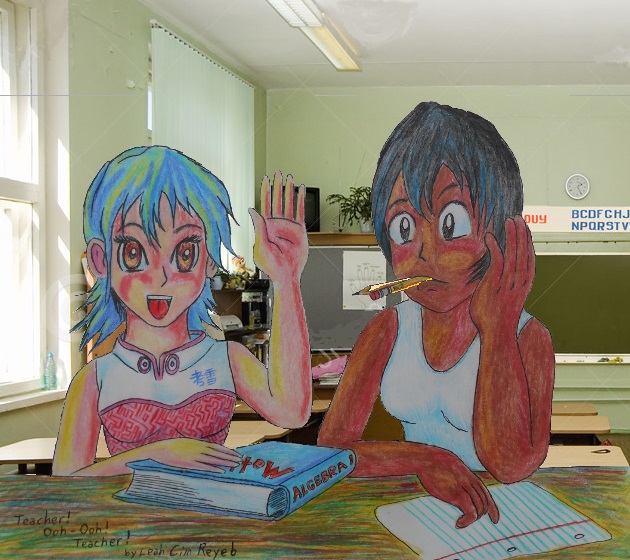
Shyness is only ever overcome by determination and practice. The standard advice given is to picture your audience naked so that you are not intimidated by them. But if your audience is seventh graders, you have to be extra careful about that. They are metaphorically naked all the time, ready at a moment’s notice to explode out of any metaphorical clothing they have learned to wear to cover the things that they wish to keep to themselves about themselves. And while you want them to open up and talk to you, you don’t want the emotional nakedness of having them sobbing in front of the entire class, or throwing things at you in the throes of a mega-tantrum over their love-life and the resulting soap operas of betrayal and revenge. And you definitely don’t want any literal nakedness in your classroom. (Please put your sweat pants back on, Keesha. Those shorts are not within the limits of the dress code.) Calling attention to yourself and what you have to say, because you are being paid to do so, is a critical, yet tricky thing to do. You want them looking at you, and actually thinking about what you are saying (preferably without imagining you naked, which they will do at any sort of unintentional slip or accidental prompting.) The ones who ignore you are a problem that has to be remedied individually and can eat up the majority of your teaching time.
I trained myself to be fairly good at commanding the attention of the room.
But now that I am retired, things have changed. I can still command attention in the room, which I proved to myself by being a successful substitute teacher last year. But I no longer have a captive audience that I can speak to five days a week in a classroom. Now my audience is whoever happens to see this blog and is intrigued enough by the title and pictures to read my words.
Now that I am retired and only speaking to the world at large through writing, I am ignored more than ever before. Being ignored is, perhaps, the only thing I do anymore. It is the new definition of Mickey. Mickey means, “He who must be ignored. Not partially, but wholly… and with malice.”
I put my blog posts on Facebook and Twitter where I know for a fact that there are people who know me and would read them and like them if they knew that they were there. But the malevolent algorithms on those social media sites guarantee that none of my dozens of cousins, old school friends, and former students will see them. Only the single ladies from Kazakhstan and members of the Butchers Union of Cleveland see my posts. Why is this? I do not know. Facebook and Twitter ignore me when I ask.
My books, though liked by everybody who has actually read and responded to them, are lost in a vast ocean of self-published books, most of which are not very good and give a black eye to self-published authors in general. I recently got another call from I-Universe/Penguin Books publishers about Catch a Falling Star, the one book I still have with them. They are concerned that my book, which is on their Editor’s Choice list, is not performing as well as their marketing people think it should. But to promote it, I would have to pay four hundred dollars towards the marketing campaign, even though they are already subsidizing it by fifty percent. They tell me they believe in my book. But apparently not enough to pay for 100% of the promotion.
I have decided to invest in a review service that will cost me about twenty dollars a month. But my confidence is not high. The last time I paid somebody to review a book, they reviewed a book with the same title as mine from a different author. That service still owes me money.
But the only reason it is a problem that I am being thoroughly ignored these days is that an author needs to be read to fulfill his purpose in life. Maybe pictures of pretty girls in this post will help. But, even if they don’t, well, I had their attention once upon a time. And since my purpose as a teacher is already fulfilled, perhaps that will be enough for one lifetime.
“School’s out for summer School’s out forever School’s been blown to pieces
No more pencils No more books No more teacher’s dirty looks
Well we got no class And we got no principles And we got no innocence We can’t even think of a word that rhymes”
-Alice Cooper
Once again it is that day that every kid prays for… The last day of school.
My daughter doesn’t really get it, though. She doesn’t really understand the sentiment of the poor misguided school girl named Alice Cooper. Kids are supposed to hate school. Their teachers are supposed to be witches and warlocks who live for creating misery in the lives of their students. My daughter should know that already, since her mother and I are both teachers. (I am retired now, actually… and I do miss making kids’ lives total misery.) She is actually going to miss her middle school and all her middle school teachers.
She was up late last night using air-dried clay to make dragon sculptures to give to each of her teachers. Her art teacher was recently telling me about how wonderful she is at art and how wonderful she is as a student during a recent scholastic awards dinner. In fact, most of her teachers only have good things to say about her work in middle school. And teachers are supposed to hate kids and hate teaching, right? They are supposed to only be in teaching for the paycheck, marking time until they retire, living lives full of bitterness and revengeful interactions with children.
O, I am guessing that I am actually the problem here. I never felt the way teachers are supposed to feel about kids. In fact, I… like kids. Oh, no! The secret is out. I miss being a teacher. I miss the kind of devotion you get from the kind of students who stay up late making clay dragons for you as a goodbye gift.
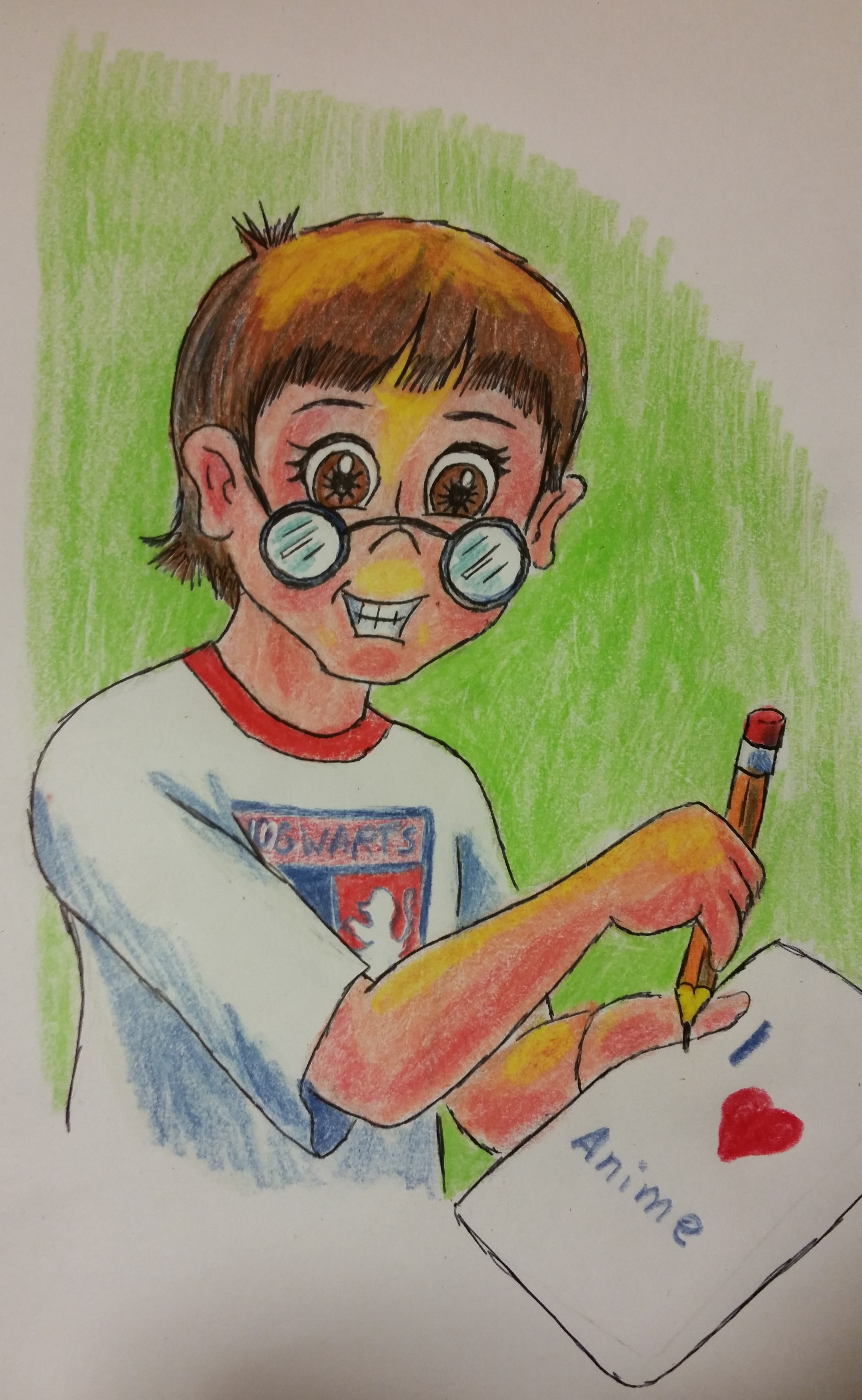
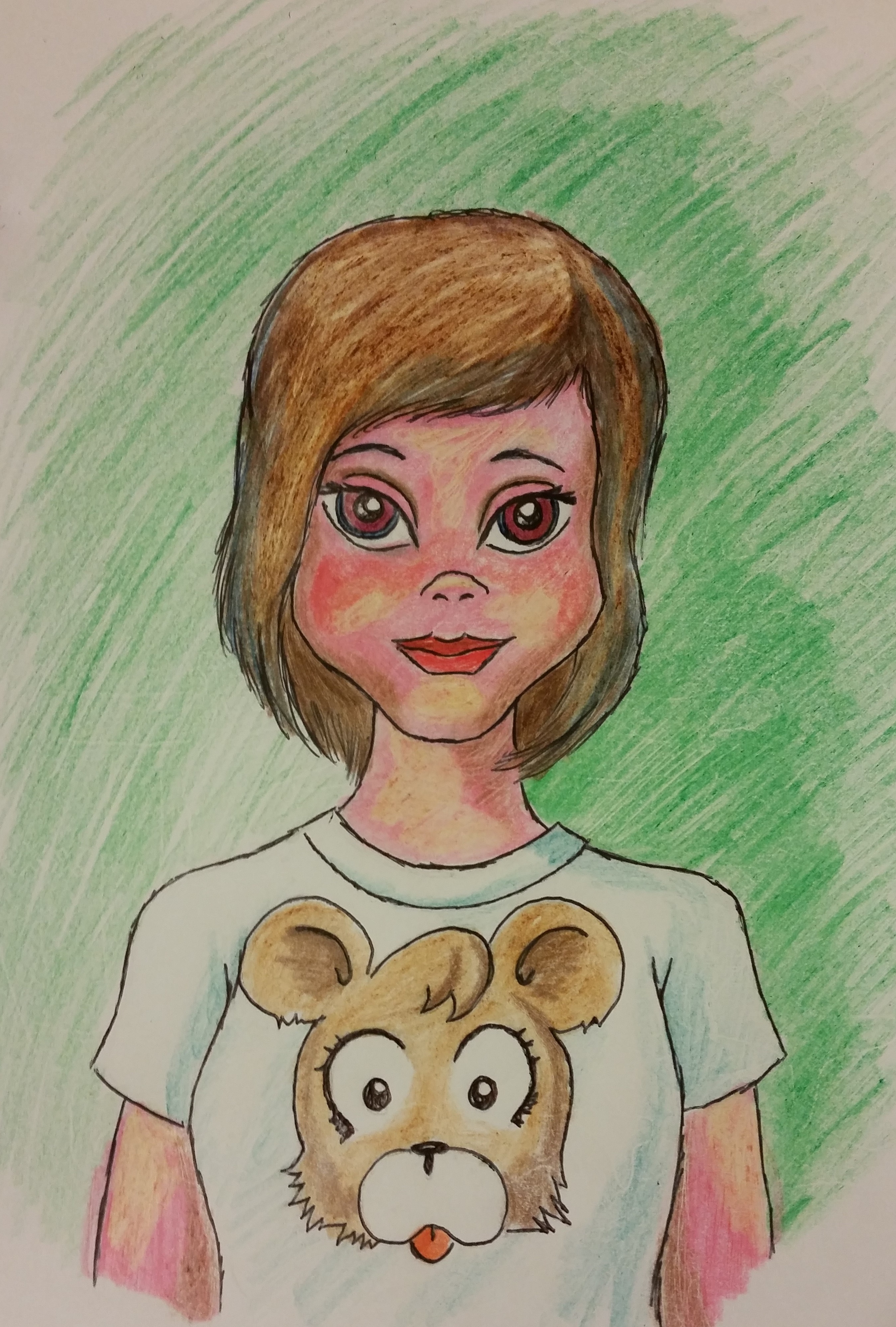
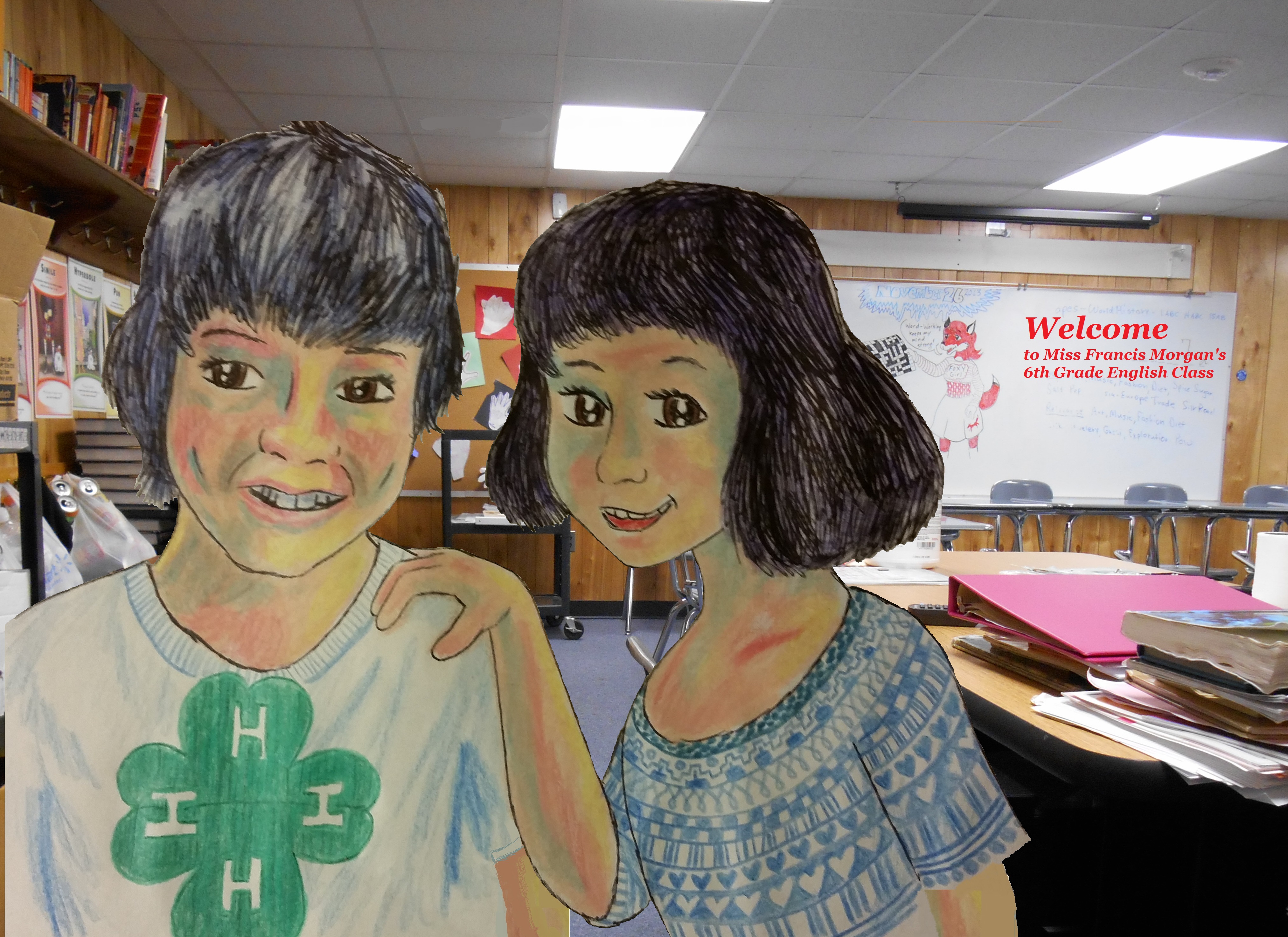
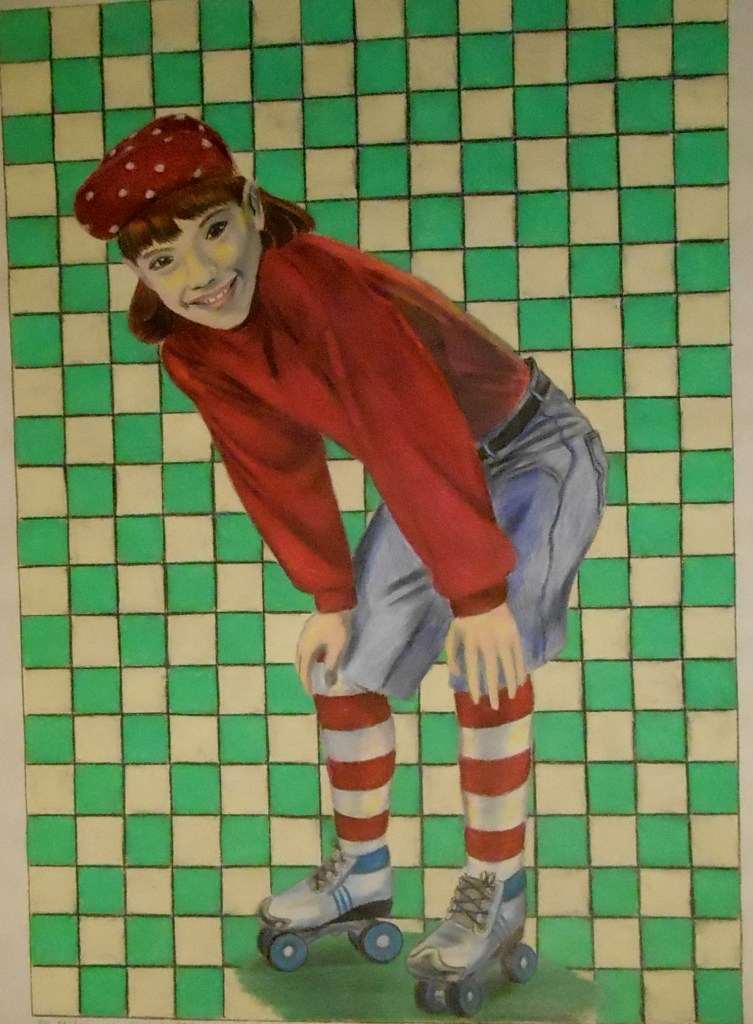
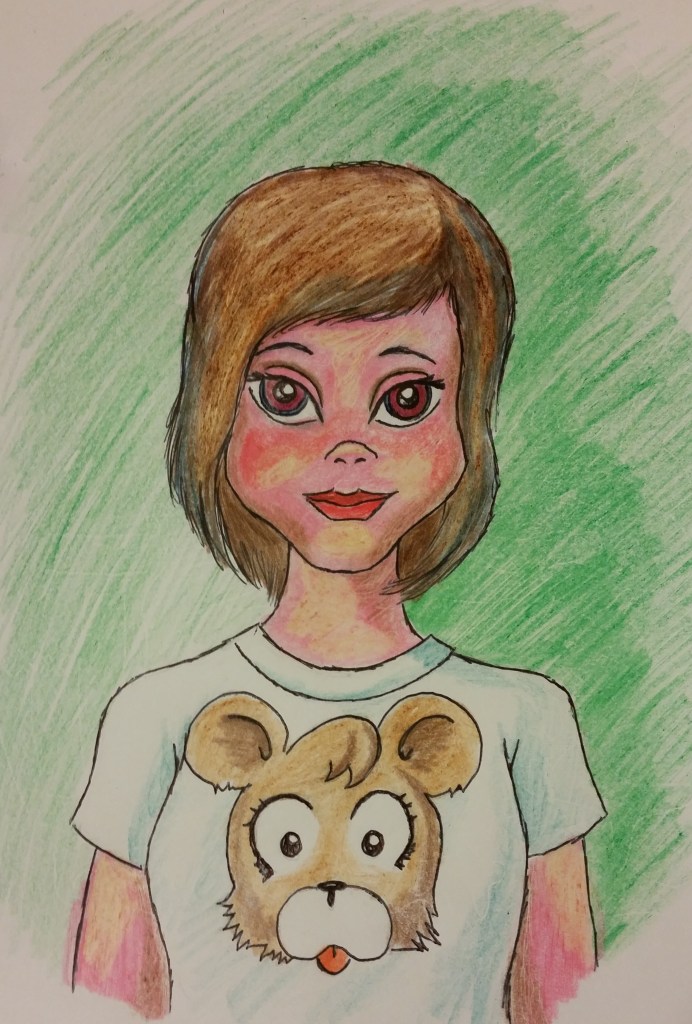
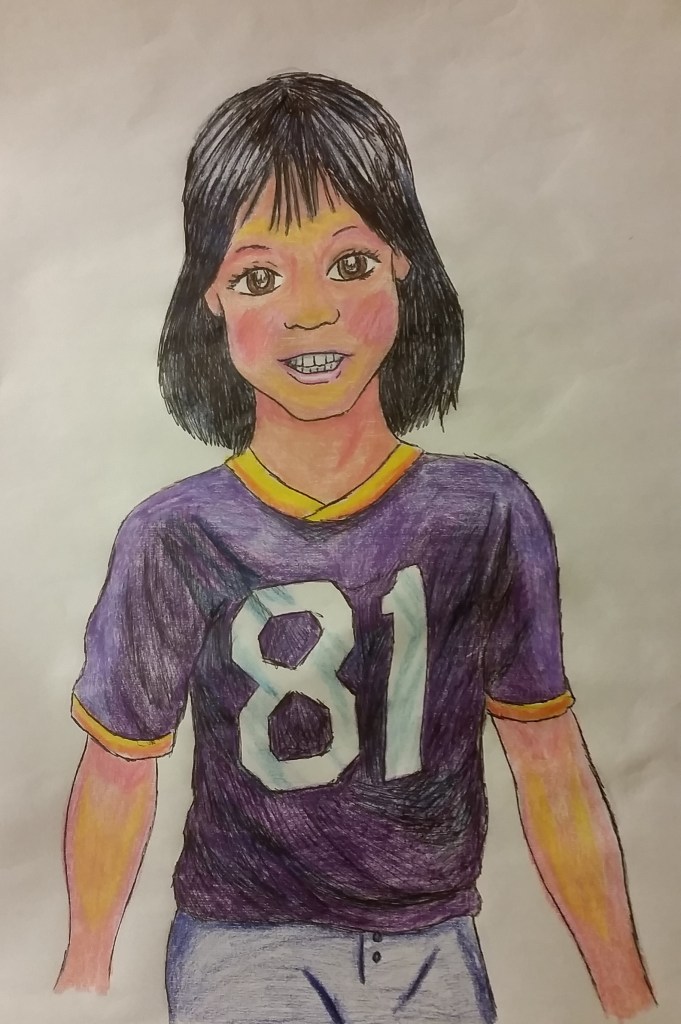
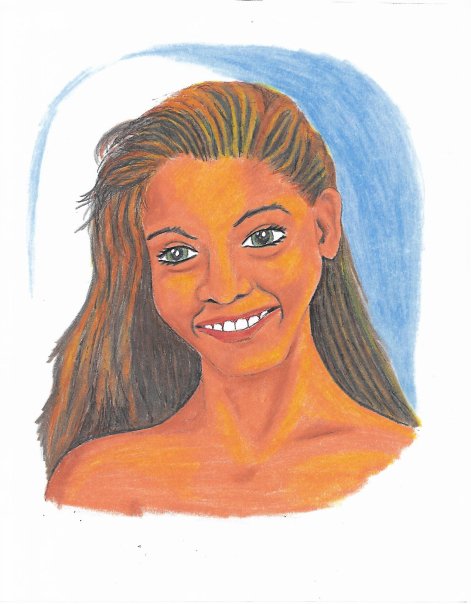
While I was a teacher, we were not allowed to be Facebook friends with students. Society frowns on teachers getting too close to students. But now that I will never teach again, or be in the same room with any of them again, I have been saying yes to students’ friend requests. So, I am now going to share with you pictures of former students that they have shared with me. Of course, I won’t tell you their names. I don’t want to embarrass them by revealing that they don’t hate all of their teachers the way they should.
So, there’s photographic proof that once I actually was a teacher. And I know that it probably also proves I didn’t do a very good job of making their lives miserable and making them hate me the way I should have done. But I miss it terribly. And I would work harder at being bitter and crabby if only I could go back and do it some more.
Yesterday I managed to make a ridiculous post about the dangers of using humor in the classroom. I managed to leave out one of the dangers that daily annoys every teacher of middle schoolers who has ever been even remotely dedicated to the notion that you must at least try to follow the school rules if you wish to remain employed and outside of the prison system. That tiger trap is the important societal rule against certain magic words. You know the ones. Those words that, if you dare to say them out loud in the classroom as a student, make you instantly disappear… and learn hard words like the word “consequences”, and “eternal detention”, and “Would you like fries with that?” And if you are a teacher, those words lead to other hard words like “special school board meeting” and “disciplinary action”, and though they take longer to work their magic, eventually also “Would you like fries with that?”
These magic words are a serious danger and roadblock to teaching young minds because they so easily begin flowing out of young mouths. When you become a teacher infamous for using humor in the classroom, those young minds who don’t really have the big word of “inhibitions” wired into their circuitry yet will think license to laugh in the classroom is the same as license for dropping the magic F-word, or the magic S-word, or the combo-magic M-F-word. And those words invariably make somebody disappear completely… sometimes even permanently.
Being a Texas teacher, I have experience with the ridiculously harsh notion of Zero Tolerance Policies. Yes, in Texas we give the death penalty for swearing at the teacher. Well, maybe only a trip to court in front of an unfriendly judge who will levy a fifty dollar fine for the sin and then forbid the parents to pay it, making the child choose between paying it himself or spending a night in jail. So it is definitely in the students’ best interests if the teacher navigates around magic words in the laughing classroom environment.
You do this primarily through modeling. I never use even remotely offensive words in conversations with students. I sometimes even correct myself out loud for using interjections when I am mad like “Oofahdoo!” or “Fabulous French Frick-a-see-see!” because, as I point out to them, we all know what magic words they are filling in for. Context can often say for us the word we are not supposed to say. I have also been known to fake getting mad at them for saying “Criminnittly!” or “Hang-dang it!” in imitation of me because the teacher getting mad over the use of certain words is an absolute guarantee that the word will come out of the student the next time he or she needs to express inappropriate sentiment in the classroom. A teacher’s job, then, becomes the putting of lipstick on the pig. Because we are burdened with rules that absolutely prevent the use of George Carlin words in the classroom, and when the powers that be see the lipstick on the pig, they will think “Marilyn Monroe”, and their absolutes will be satisfied. Of course, I am begging you… please don’t tell them that it is really still a pig.
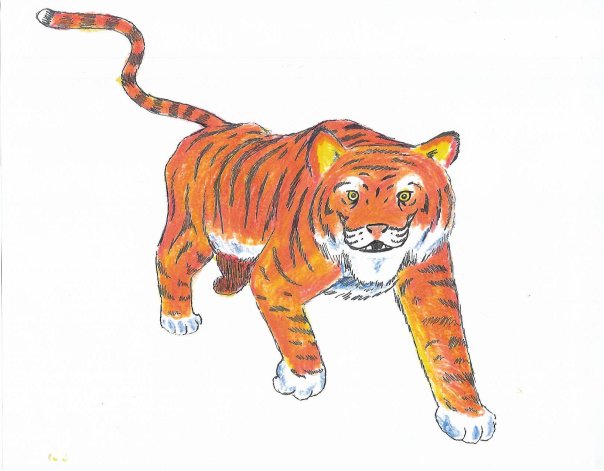
In point of fact, using humor in the classroom is one of the easiest ways I know to become a beloved and effective teacher. But it requires skill. It is like dancing barefoot in a mine field that is littered with pit traps for trapping tigers. See how I linked the title to my opening paragraph there? Kids in the classroom don’t… unless you make it funny. Sometimes they want you to fall in the tiger trap on purpose even though there are punji sticks at the bottom. They want to see what the consequences of the mistake really are so they are not surprised when they immediately make that same mistake.
So, let me tell you about a few of those tiger traps and how to navigate through them.
Poo-Poo Jokes
Yes, one of the unfortunate truths about humor in the classroom is that nothing is funnier to middle school and high school kids than references to sticky brown stuff. (If that last statement made you snicker, then you know that it even goes beyond school.) And it can be a devastating thing on fragile, fledgling egos in a school environment where boys will invariably stick a half-eaten chocolate bar in a back pocket on a hot day even though they are wearing khaki-colored jeans. Over-reacting to a sudden fragrance from one of a number of volatile digestive systems packed into the same small classroom can completely empty the room and imperil the teacher’s job. (Principals don’t appreciate unauthorized leaving of the classroom… so teachers need to quickly learn how to calm-and-continue in an unusually gassy environment.) Of course, the girl leading the lemming rush out of the classroom under gas attack is usually the one who dealt it. But you can’t point that out without crushing some young flower’s petals of self-image. It is necessary to lay down fences of regulation at the beginning of the school year to regulate exactly how brown and sticky a bathroom joke can actually be before it traps you in eternal detention.
Hurt-y Humor
There is the kind of humor that numerous comedians use as their fall-back style, that Don Rickles-esque “Your mama’s so fat that satellites can see her from space”sort of humor. It is also a highly tiger-trappy sort of humor to use in the classroom. Students don’t perform well after being the butt of slappy-face-style put-downs. You don’t want to remind the kid in the back row of how he mixed up the words “pied” and “peed” in last week’s read-aloud right before taking the State science test that will determine his educational future and your next evaluation. So how do you resist the urge to tell the snooty little cheerleader that just told you her mom is going to get you fired that she’s got a tail of toilet paper hanging down from the back of her skirt… when she actually does… and the football player she most idolizes is watching every move she makes with that big, tart and trippy tongue of hers? You take pity on them, and remember that if you break them down into tears in front of their peers you are doing the same thing to them that Bully Bob Beegshout did to you back in high school. Self-deprecating humor is far more effective at defusing a confrontation. You get them to laugh at themselves by making them see themselves in the story you just told on yourself. You can often make them laugh themselves right out of the bad behavior that way. (Oh, and I didn’t point out the toilet paper, but you can wait until someone else inevitably does and karma can balance the universe in that way.)
So, now that I have rolled well past the 500-word goal and still haven’t used up the whole list of tiger traps, I suppose it is time to reveal there will be a follow-up to this post.








 Catch a Falling Star
I Hope You Dance…
When you walk to the front of the classroom and take up the big pencil in front of a group of young teens and twelve-year-olds, there is a strong pressure to learn how to sing and dance. That, of course, is a metaphor. I was always too arthritic and clunky in my movements to literally dance. But I looked out over a sea of bored and malevolence-filled eyes, slack and sometimes drooling mouths attached to hormone-fueled and creatively evil minds. And I was being paid to put ideas in their heads. Specifically boring and difficult ideas that none of them really wanted in their own personal heads. So I felt the need to learn to dance, to teach in ways that were engaging like good dance tunes, and entertaining in ways that made them want to take action, to metaphorically get up and dance along with me.
I wanted them to enjoy learning the way I did.
But the music of the teacher is not always compatible with the dance style of the individual learner. The secret behind that is, there is absolutely no way to prompt them to dance along with you until you learn about the music already playing in their stupid little heads. (And you can’t, of course ever use the word “stupid” out loud, no matter how funny or true the word is,) You have to get to know a kid before you can teach them anything.
The discordant melodies and bizarre tunes you encounter when you talk to them is like dancing in a minefield blindfolded. Some don’t have enough to eat at home and have to survive off of the nutrition-less food they get in the school cafeteria’s free-and-reduced lunch program. Some of them have never heard a single positive thing from the adults at home, enduring only endless criticism, insults, and sometimes fists. Some of them fall in love you. Some due to hormones. Some due to the fact that you treat them like a real human being. Some because they just stupidly assume that everyone dances to the same tunes they hear in their own personal head.
Some of them automatically hate you because they know that if you hear their own secret music in their own self-loathing heads, you will never accept it. They hate you because you are a teacher and teachers always hate them. Some of them, deep down, are as loathsome as they think they are.
But, if you find the right music, you can get any of them, even all of them, to dance. It might be hard to find. It might be a nearly impossible task to learn to play that music once you find it. But it can be done.
And if you get them to dance to your music, to dance along with you, I can’t think of anything more rewarding, anything more life-fulfilling. Have you ever tried it for yourself? If you are not a teacher, how about with your own children or the children related to you? Everybody should learn to dance this dance I am talking about in metaphors. At least once in your life. It is addictive. You will want to dance more. So the next time the music starts and you get the chance… I hope you’ll dance!
Leave a comment
Filed under commentary, education, kids, metaphor, Paffooney, teaching
Tagged as being a teacher, dance, empathy, featured, features, News, recession, science, tea-party