Category Archives: philosophy

Why Do You Think That? (Part Two)

In my short, sweet sixty years of life, I have probably seen more than my share of movies.  I have seen classic movies, black-and-white movies, cartoon movies, Humphrey Bogart movies, epic movies, science fiction movies, PeeWee Herman movies, Disney movies, Oscar-winning movies, and endless box-office stinkers.  But in all of that, one of the most undeniable threads of all is that movies make me cry.  In fact they make me cry so often it is a miracle that even a drop of moisture remains in my body.   I should be a dried-out husk by now.

de la mano

I wept horribly during this scene.  Did you?

And the thing is, people make fun of you when you cry at movies.  Especially cartoon movies like Scooby Doo on Zombie Island.  (But I claim I was laughing so hard it brought tears to my eyes.  That’s the truth, dear sister.  So stop laughing at me.)  But I would like to put forth another “Why do you think that?” notion.  People who cry while watching a movie are stronger and more powerful than the people who laugh at them for crying.  A self-serving thesis if ever there was one.

open-uri20150422-12561-1plzyv7_a194ba80

Movies can make you cry if you have the ability to feel empathy.  We all know this.  Old Yeller is the story of a dog who endears himself to a prairie farm family, saves Travis’s life at one point, and then gets infected with rabies and has to be put down.  Dang! No dry eyes at the end of that one.  Because everyone has encountered a dog and loyal dog-love somewhere along the line.  And a ten-year-old dog is an old dog.  The dogs you knew as a child helped you deal with mortality because invariably, no matter how much you loved them, dogs demonstrate what it means to die.  Trixie and Scamper were both hit by cars.  Queenie, Grampa’s collie, died of old age.  Jiggs the Boston Terrier died of heat stroke one summer.  You remember the pain of loss, and the story brings it all back.

vign-le-bossu-de-notre-dame-6ur_x43

Only psychopaths don’t feel empathy to some degree.  Think about how you would feel if you were watching Old Yeller and somebody you were watching with started laughing when Travis pulls the trigger on the shotgun.  Now, there’s a Stephen King sort of character.

But I think I can defend having lots of empathy as a reason for crying a river of tears during Disney’s The Hunchback of Notre Dame.  You see, identifying with Quasimodo as the main character, hoping for what he hopes for, feeling like a monster and completely unloved, and fearing what he fears connect you to the story in ways that completely immerses you in the experience.  This is basically a monster movie.Original-Hunchback_of_Notre_Dame

But the film puts you inside the head of the malformed man, and you realize that he is not the monster.  Righteous Judge Frollo and the people who mistreat Quasimodo for his deformity of outward appearance are the real monsters.  If you don’t cry a river of tears because of this story, then you have not learned the essential truth of Quasimodo.  When we judge others harshly, we are really judging ourselves. In order to stop being monstrous, and be truly human, you must look inside the ugliness as Esmeralda does to see the heroic beauty inside others.  Sometimes the ideas themselves are so powerful they make me weep.  That’s when my sister and my wife look at me and shake their heads because tears are shooting out of me like a fountain, raining wetness two or three seats in every direction.  But I believe I am a wiser man, a more resolved man, and ultimately a better man because I was not afraid to let a movie make me cry.

The music also helps to tell the story in ways that move my very soul to tears.  Notice how the heroine walks the opposite way to the rest of the crowd.  As they sing of what they desire, what they ask God to grant, she asks for nothing for herself.  She shows empathy in every verse, asking only for help for others.  And she alone walks to the light from the stained glass window.  She alone is talking to God.

the-hunchback-of-notre-dame

Yes, I am not embarrassed by the fact that movies make me cry.   In fact, I should probably be proud that movies and stories and connections to other people, which they bring me, makes me feel it so deeply I cry.  Maybe I am a sissy and a wimp.  Maybe I deserved to be laughed at all those times for crying during the movie.  But, hey, I’ll take the laughter.  I am not above it.  I am trying to be a humorist after all.

4 Comments

Filed under cartoon review, commentary, compassion, Disney, humor, insight, inspiration, movie review, music, philosophy, strange and wonderful ideas about life

Pen and Ink in Progress

C360_2017-05-12-05-20-16-382

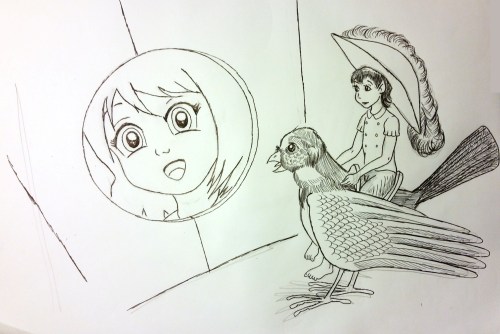
This drawing is not done.  I have plans.  But this pen and ink Paffooney is a good example of a doodle-point I probably need to make.  The plan does not occur before the ink hits the drawing pad.  No, this one started with a circle.  And for no good reason, I had to draw the girl’s face in the circle.  But what was the face doing inside a circle like that?  I next drew the bird.  But if she’s so surprised to see a bird inside a birdhouse…  Well, you get the idea.  The story comes after the scribbling.

And here comes the controversial conclusion.  This is exactly how life happens.  Stuff becomes… and the reason why only becomes clear later.  Curse me for a doodling philosopher!

Leave a comment

Filed under art editing, artwork, foolishness, goofy thoughts, humor, Paffooney, pen and ink, philosophy, strange and wonderful ideas about life

Classroom Clownery (Not to be confused with Sean Clownery… He’s James Blond)

16473244_1449448801783847_8086681324837506057_n

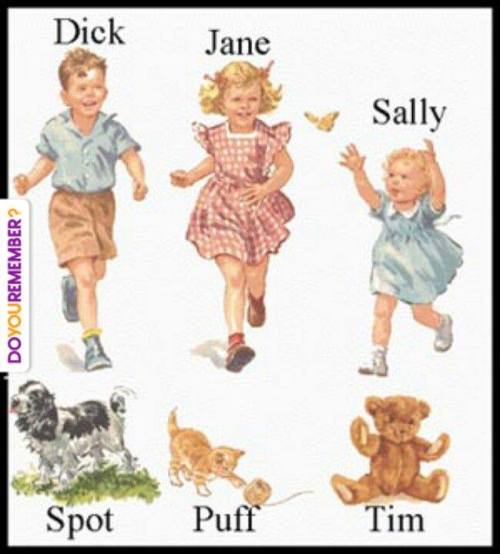
See Dick?

See Jane?

See Sally?

See Dick run?

See Jane run?

See Sally…?   Wait a minute!  Why don’t I remember Sally?

Did Dick forget to feed Spot and Spot was forced to kill and eat Sally?

No…  I had Dick and Jane books in Kiddy-garter and they did have Sally in them.  And Spot never killed anyone.  But with all the running she did, Sally did not do anything memorable.  If my teacher, Miss Ketchum, had told the Spot eats Sally story, I’m sure I would’ve remembered Sally better and learned to read faster.

This slideshow requires JavaScript.

But I actually did learn to read faster because there was a Cat in the Hat, and a Yertle the Turtle, and because Horton the elephant heard a Who, and a Grinch stole Christmas.  Yes, humor is what always did it for me in the classroom.  Dr. Seuss taught me to read.  Miss Mennenga taught me to read out loud.  And in seventh grade, Mr. Hickman taught me to appreciate really really terrible jokes.    And those are the people who twisted my arm… er, actually my brain… enough to make me be a teacher who taught by making things funny.  There were kids who really loved me, and principals who really hated me.  But I had students come back to me years later and say… “I don’t remember anything at all from my classes in junior high except when you read The Outsiders out loud and did all those voices, and played the Greek myth game where we had to kill the giants with magic arrows, and the stupid jokes you told.”  High praise indeed!

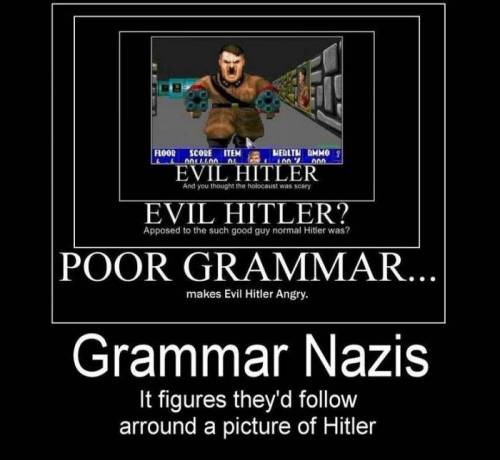
funny-pinoy-jokes-grammar-nazi-natzi-hitler-alert-2013

I think that teaching kids to laugh in the classroom was a big part of teaching them how to use the language and how to think critically.    You find what’s funny in what you learn, and you have accidentally examined it carefully… and probably etched it on the stone part of your brain more memorably than any other way you could do it.  And once it’s etched in stone, you’re not getting that out again any time soon.

dr_cat.jpg

12140070_10153033719407821_7711720876061693795_o

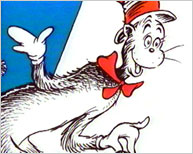
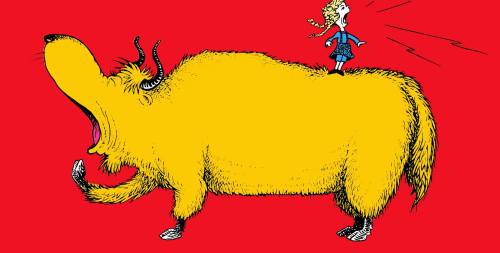
Humor makes you look at things from another point of view, if for no other reason, then simply because you are trying to make somebody laugh.  For instance, do you wonder like I do why the Cat in the Hat is trying to pluck the wig off of Yelling Yolanda who is perched on the back of yellow yawning yak?  I bet you can’t look at those two pictures positioned like that and not see what I am talking about.  Of course, I am not betting money on it.  I am simply talking Iowegian… a totally different post.

But the point is, humor and learning go hand in hand.  It takes intelligence to get the joke.  Joking makes you smarter.  And that is why the class clowns in the past… the good and funny ones… not the stupid and clueless ones… were always my favorite students.

Leave a comment

Filed under clowns, goofiness, high school, humor, irony, kids, philosophy, teaching, word games

Three Books at Once

No, this isn’t some kind of multiple-book book review.  This is an ungodly silly claim that I can actually read three books at once.  Silly, but true.

Now I don’t claim to be a three-armed mutant with six eyes or anything.  And I am relatively sure I only have one brain.  But, remember, I was a school teacher who could successfully maintain a lesson thread through discussions that were supposed to be about a story by Mark Twain, but ventured off to the left into whether or not donuts were really invented by a guy who piloted a ship and stuck his pastries on the handles of the ships’ wheel, thus making the first donut holes, and then got briefly lost in the woods of a discussion about whether or not there were pirates on the Mississippi River, and who Jean Lafitte really was, and why he was not the barefoot pirate who stole Cap’n Crunch’s cereal, but finally got to the point of what the story was really trying to say.  (How’s that for mastery of the compound sentence?)  (Oh, so you could better?  Really?  You were in my class once, weren’t you.)  I am quite capable of tracking more than one plot at the same time.  And I am not slavishly devoted to finishing one book before I pick up the next.

I like reading things the way I eat a Sunday dinner… a little meatloaf is followed by a fork-full of mashed potatoes, then back to meat, and some green peas after that…  until the whole plate is clean.

Treasure Island by Robert Louis Stevenson is the meatloaf.  I have read it before, just as I have probably had more meatloaf in my Iowegian/Texican  lifetime than any other meat dish.  It’s pretty much a middle-America thing.  And Treasure Island is the second book I ever read.  So you can understand how easy a re-read would be.  I am reading it mostly while I am sitting in the high school parking lot waiting to pick up the Princess after school is out.

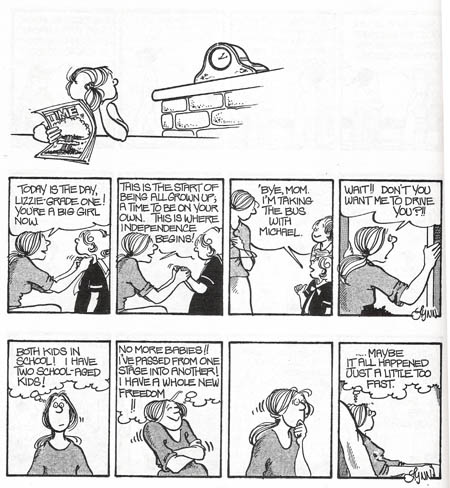
fbofw1Lynn Johnston’s For Better or Worse is also an old friend.  I used to read it in the newspaper practically every day.  I watched those kids grow up and have adventures almost as if they were members of my own family.  So the mashed potatoes part of the meal is easy to digest too.

51+ETSVSDJL

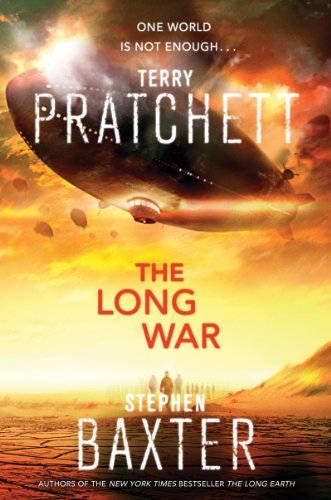
So that brings me to the green peas.  Green peas are good for you.  They are filled with niacin and folic acid and other green stuff that makes you healthier, even though when the green peas get mashed a bit and mix together with the potatoes, they look like boogers, and when you are a kid, you really can’t be sure.  Terry Pratchett and Stephen Baxter wrote this book The Long War together.  And while I love everything Terry Pratchett does, including the book he wrote with Neil Gaiman, I am having a hard time getting into this one.  Parts of it seem disjointed and hard to follow, at least at the beginning.  It takes work to choke down some of it.  Peas and potatoes and boogers, you know.

But this isn’t the first time I have ever read multiple books at the same time.  In fact, I don’t remember the last time I finished a book and the next one wasn’t at least halfway finished too.  So it can be done.  Even by sane people.

3 Comments

Filed under book review, comic strips, education, goofy thoughts, humor, old books, philosophy, reading

Shakespeare Knows Fools

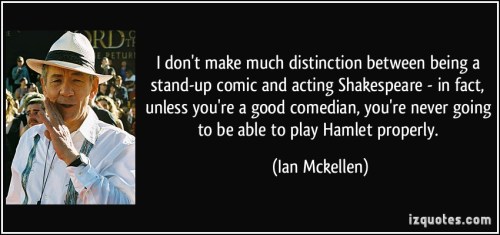
quote-i-don-t-make-much-distinction-between-being-a-stand-up-comic-and-acting-shakespeare-in-fact-ian-mckellen-124331

The fact that Shakespeare was a master of the art of creating and mocking fools does not really help decide the question of who Shakespeare really was.  A stage actor who owned a theater in Elizabethan times and apparently focused on being the bit player, the butler, the second man on the castle wall in the great plays, would certainly know enough of flim-flam, being a con man, or artfully throwing turds at kings and queens in ways that get rewarded rather than beheaded.  But a nobleman who has unpopular and unwelcome-but-probably-wise insights into the back-stabbing-goings-on of the royal court of England would equally be capable of putting the most memorable of critiques of humanity into the mouth of the fool or the clown in the great stage-play of life.  Even the most depressing and violent of the Shakespearean tragedies is enhanced and made pointed by the presence of the fool and the comic relief.  In some ways everything that Shakespeare wrote was a comedy.

sticker375x360-u2

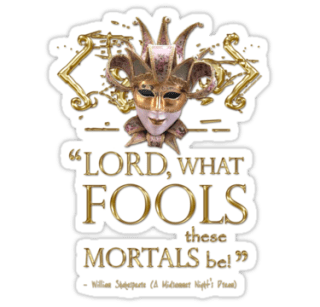
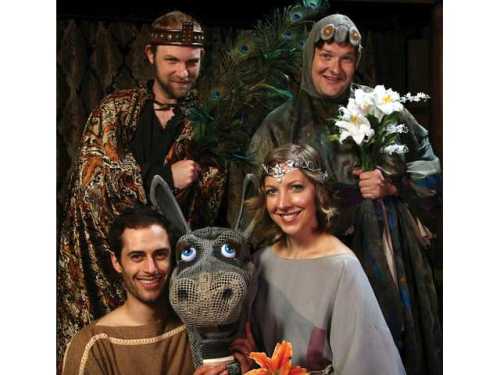
Whoever Shakespeare was, he shared Mark Twain’s overall assessment of “That damned human race” and often declared all men fools in the eyes of the playwright.  Puck’s observation on humanity is delivered about not only Bottom and the other poor players who carry on their vain attempts at performing Pyramus and Thisbe while Bottom magically wears the head of an ass, but also the easily fooled lovers who mistake their true loves for one another, and even the clueless mortal King Theseus of Athens.

0716-go-midsummer-dream_

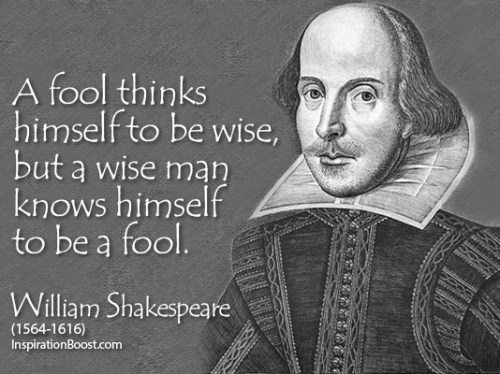
In the play within a play, Nick Bottom wants to be not only his own role, Pyramus the romantic lead, but argues that he should be Thisbe, the lion, and Pyramus all at once, making a satire of human nature and its overreaching ways that we could only pray Donald Trump will one day watch and magically understand.  In fact, Shakespeare’s entire body of work is an extended investigation of foolishness versus wisdom, and with Shakespeare, the verdict always goes to the fool.

a-fool-thinks-himself-to-be-wise-but-a-wise-man-know-himself-to-be-a-fool-william-shakespeare

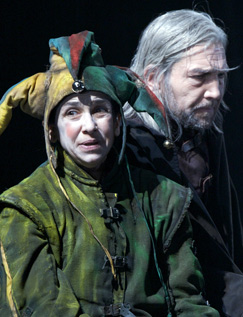
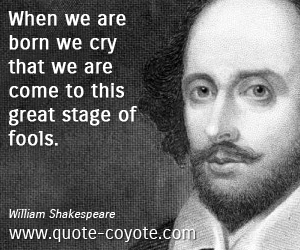
The plays of William Shakespeare are filled with fools doing foolish things… and fools being accidentally wise. (Think Jacques in As You Like It giving his famous “All the world’s a stage” soliloquy in which he elucidates the seven ages of man.)  There are fools too who prove to be wise.  (Think of the ironic advice given by the jester Touchstone in As You Like It, or the pithy commentary of King Lear’s fool).  The fools in Shakespeare’s work are not merely the comedy relief, but the main point that Shakespeare makes about humanity.

207a65d14f2a61bd4a4ef178e88609bb

Whoever the man was who wrote the plays of Shakespeare, he was someone who had a deep understanding of the basic irony underlying all of human life.  And someone with that vital sense of the bittersweet, a philosophy of life that encompasses the highest heights and lowest depths that a soul can reach, is someone who has suffered as well as known great joy, someone who has experienced loss as often as profit, and has known real love as well as real hatred.  It is the fool that Shakespeare shakes us by the neck with to make us recognize the fool in all of us which makes the plays resonate so deeply within us.  It is watching the path of the fool unfolding that makes us shake our head and say to ourselves, “Yes, that is what life is really like.”

when-we-are-born-we-cry-that-we-are-come-to-this-great-stage-of-fools-william-shakespeare

Leave a comment

Filed under clowns, comedians, conspiracy theory, foolishness, goofy thoughts, inspiration, philosophy, strange and wonderful ideas about life, William Shakespeare

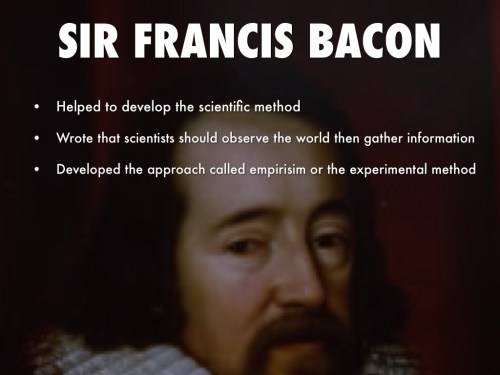
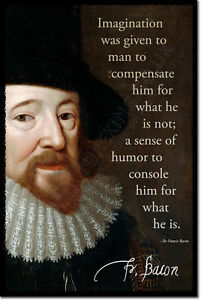
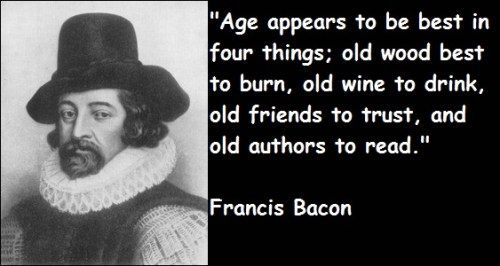
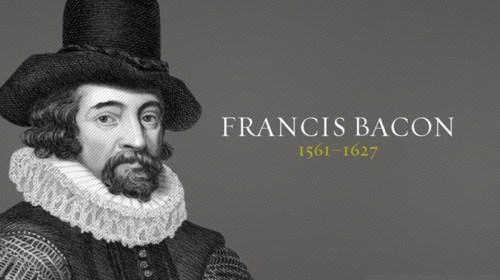
Shakespeare is NOT Bacon

3475b987-6c5d-4699-ba5d-e6008559028f

Yes, Sir Francis Bacon is at least as interesting and obscure as William Shakespeare.  But let me assure you, I can confidently state, “Shakespeare is NOT Bacon!”  He is not eggs either… or any other breakfast food.  Sir Francis Bacon was the breakfast, the first meal in the great Elizabethan banquet of literature, poetry, and culture.  And William Shakespeare is a more important main course, the royal dinner, as it were.  But it has to be acknowledged that Bacon was essential to the very existence of William Shakespeare.  Breakfast always comes before dinner.

t2ec16dhjgoffvtvhuebslhohksvg-60_35

In 1845 a female author by the name of Delia Bacon (nothing suspicious about that coincidence, by the way) put forward an idea that William Shakespeare’s plays were actually written by a group of men under the leadership of Sir Francis Bacon.  She thought the group intended to inculcate into English culture an advanced system of politics and philosophy which they themselves could not take credit for publicly.  She would later write a book in 1857 called The Philosophy of the Plays of Shakspere Unfolded which advanced the notion that the plays were written for Baconian purposes beyond mere theatrical entertainment.  Numerous people, including the American poet Ralph Waldo Emerson supported her in her quest to find proof, sending her to England to research the crazy conspiracy theories she founded by noting ciphers in the plays, and in the essays of Bacon, that led her to believe all she had to do was dig up the gravestone of Shaksper in the chapel at Stratford to find written proof in Bacon’s own hand that he was, in fact, the author or primary motivator of the plays of William Shakespeare.  She spent one cold and creepy night in the chapel, just her and her spade and her crow bar, along with the bones of the Stratford guy, trying to work up the courage to do a bit of grave-robbing… and failing.    It is a good story, but very poor archaeology.  She was denounced by the literary historians and establishment figures who supported the Stratford guy.  They said her scholarship was sloppy, her cipher analysis goofy and unfounded, and her conclusions more questionable than a pig in theatrical make-up.  (My words, not theirs.  English critic George Henry Townsend was entirely too stuffy and boring to simply be quoted here.)

francis-bacon-quotes-francis-bacon-quotes

Now, I, of course, strongly disagree with the Bacon lady.  As I said in the very title, “Shakespeare is NOT Bacon.”  But I do think there was merit in sniffing out old Frankie’s scent and fingerprints on the whole Shakespeare/Shaksper thing.  The Stratford guy was not Shakespeare either.  When he died in 1616 there was no public outcry at the loss of England’s most popular poet and playwright.  Even King James who was Shakespeare’s number one fan and constant audience member, didn’t mourn the passing of the actor/theater-owner/businessman from Stratford.

Francis Bacon, on the other hand, was a powerful intellect, educated in the ways of science, the law, and government in the Elizabethan age.  Bacon gathered other men of powerful intellect and accomplishment at Gray’s Inn to hold debates about things philosophical and things scientifical.  It is not unreasonable to imagine that the man who really wrote the plays attributed to Shakespeare sat at that table and participated in those debates.  And Sir Frankie had good reason to keep lots of this business a secret.  There exists evidence that though he was apparently happily married to a fourteen-year-old girl, he did a little bit of swaying toward the other gender too, a thing not too popular with the average Anglican Englishman.  He also dabbled a bit in the occult (think witches in Macbeth sort of thing).   And his essays indicate a strong correlation to the philosophies and ideals of the German Rosicrucian Movement.  In 1593 during a Roman Catholic plot against Queen Elizabeth, Frankie managed to take a position on the investigation that totally offended the old virgin queen.  He was on the outs with Liz for the rest of her difficult and anger-management-challenged life.  He did rise to prominence under her successor, James I, but never-the-less managed to die amidst total ruin and scandal.  There is a lot in Frankie’s life to indicate that he had a direct influence on the content of Shakespeare’s plays.  Some of the characters in the plays may actually be, at least in part, based on Frankie himself.  But  this guy never hung out with the Stratford guy that anyone knows of.

So, if Shakespeare is NOT Bacon, or eggs either… and the Stratford guy isn’t Shakespeare, then who is?  Come on!  You knew I had a lot more to say about this crazy conspiracy thing, right?

67489

4 Comments

Filed under conspiracy theory, education, foolishness, goofy thoughts, humor, philosophy, strange and wonderful ideas about life, William Shakespeare

Good Words We Never Use

20161015_104341

My attempt to draw “synesthesia”

Xanthophobia (from Greek xanthos, “yellow”) is fear of the color yellow. In China the color yellow was feared, specifically receiving the yellow scarf, which was an imperial order to commit suicide.

http://phobia.wikia.com/wiki/Xanthophobia

Yes, “xanthophobia” is a word I have never used in my life before now.  I have no doubt that I will never need that word again in my life.  You, dear reader, will probably never need that word either.  But the derfy space-ranger part of my brain thinks it is neat that I was able to correctly answer a trivia question about the meaning of “xanthophobia”simply because my background as an artist who has shopped for exotic oil colors in artist supply stores helped me to recognize that the “xantho” part of the word meant yellow.

Are there other totally useless words that my space-ranger brain thinks are cool to know?  Of course there are!  How can you ask such a silly question?

Ouzel may refer to:

hobbledehoy

noun hob·ble·de·hoy \ˈhä-bəl-di-ˌhȯi\
Popularity: Bottom 30% of words

Definition of hobbledehoy

  1. :  an awkward gawky youth

http://www.merriam-webster.com/dictionary/hobbledehoy

5485_596996630327662_1376077770_n

483610_600569093303749_752110762_n

So, what is the actual use of knowing so many words that you can never functionally use?  Besides as a topic of a goofy post like this?

They become like the pebbles and rocks at the bottom of the briskly rushing stream of my mind.  They are not moving with the water, but they are affecting the ripples and splashes on the surface above them.  They cause eddies and backwashes and undercurrents in the complex flow of my space-ranger brain.  They make life more interesting on the surface.

And besides, knowing useless words can make me sound smarter than the fool with a derfy space-ranger brain that I truly am.

a phrase that you can tell some one when they are being so perfect. since you don’t feel like using the whole word “perfect” you use this phrase.

can also describe a human being/inanimate object and can replace someone’s name.

i just ate a thousand candy bars.
omygod. that’s so perfy derfy.

hey looks it’s perfy derfy!
where?!?!
over there! by the perfy derfy mailbox.
wow. such a perfy derfy.

4 Comments

Filed under humor, Paffooney, philosophy, strange and wonderful ideas about life, wisdom, word games, wordplay

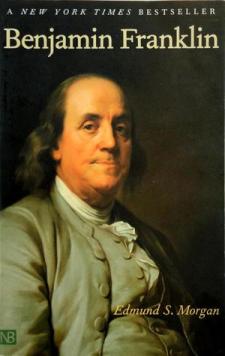
Benjamin Franklin (a book review)

43363

I admit to loving dry old history books that most of my contemporaries would wrinkle their noses at and loudly proclaim, “It’s BORING!!!”  But I don’t think the fact that I really really loved this book automatically means that you will detest it.  So bear with me and let me tell you about a book about a historically important and thoroughly fascinating man.

Edmund Morgan is a scholar who believes in using primary source material, and Franklin, as a printer, writer, statesman, scientist, and very sociable letter-writing man left a vast wealth of primary source materials behind to help us understand what was in his mind as he performed some of the most essential services ever given to a country as the United States was being formed.

The book makes us very aware that if history had followed Franklin’s every desire for specific outcomes, we would still be part of the British Empire.  But Franklin was unique among the founding fathers.  He did not serve his own ambitions the way John Adams did.  He did not serve strictly ideological goals like Thomas Jefferson often did.  But his input and pragmatism were essential to helping those two men  create the Declaration of Independence.

He believed in public service as a higher goal.  He carried out not his own will, but the will of the people evident in the debates about where the country needed to go when the government of the British King and Parliament became increasingly unresponsive to the needs and issues of the American colonies.

This was akin to the way he approached science.  He was able to discover enough scientific facts through careful and clever experiments to create practical and life-saving inventions like the Franklin stove and lightning rods.  He led the field for a time in the investigation and understanding of electricity, and the old story of flying a kite in a thunderstorm is not a myth.  It was an actual experiment using what Franklin had discovered about electrical conductivity and insulation to prove that lightning was made up of electrical energy.  Edison and Tesla might never have started if Franklin had not come first.  He never defended, argued, or explained his scientific theories.  He believed in letting experimental evidence speak for itself.  Basically, he became a world-famous scientist by not seeking fame.

Franklin loved to be with people of all kinds, especially intelligent people and female people.  He was a good friend to many, and even maintained respectful friendships with some who chose to be on the other side of the American independence question.  His work on the Pennsylvania constitution, being ambassador to France, and his part in the peace treaty negotiations with England made him as essential to the American experiment as any of the founding fathers who would later take a turn at being president.

All I can really say about this excellent book is that it helps you get to know the man who was Ben Franklin.  And this is a man that most people are bound to love, and every man should know.

Leave a comment

Filed under book review, humor, philosophy

Common Sense

Wally22

I have lived a lifetime with the words, “Well, you are smart, alright, but you don’t have common sense like me.”  When they meet me for the first time, other people always know that I am some sort of absent-minded-professor type who solves calculus  problems in his head but forgets to wear pants to school.  (Sorry, Darrin, for using you as an example of what they assume all geniuses are like.)  They always know that their two-plus-two-always-equals-four common sense makes them superior to me.  They don’t have to feel intimidated by my smartness because common sense is a universal equalizer.

Common-Sense yield

Bullies have loudly assured me of the truth of this right to my face.  Classroom wise-guys and know-it-alls (like the radioactive humanoid yam with a comb-over currently running for president) remind me that anybody can accurately remember sources for points brought up in an argument.  And since anybody can do it, if they just take the time to look stuff up, or actually learn it, then it isn’t such a big deal.  The guy who can pull the right answer out of the air, the answer that everybody else likes, is the one to listen to.  When that guy is a billionaire, then he can always hire someone like me to look stuff up for him.

The REAL Sarah

Notorious common sense advocate Sarah Palin has been campaigning in defense of common sense tea party candidates like Tim Heulskamp because she fears that absent-minded-professor types are going to undo his good work of blocking a path to citizenship for hardworking immigrants who have been here for many years and stand to be deported because their paperwork has expired while Heulscamp automatically votes “NO” on any and all immigration reform.  And it is common sense to not raise taxes on the millionaires and billionaires who create jobs even though it seems like a majority of those jobs are created overseas because, after all, workers who don’t demand high pay, or any pay at all, are better for profits.  And poor Timmy lost his seat in the House, even after the miracle that is the State of Kansas trickle-down economics experiment.  He lost it to a rival in the GOP primary.  A rival that will work with “ugh!” Democratic absent-minded professors to actually pass legislation that even Republican voters seem to want… despite common sense.  How can you work with people who tolerate smart people with no pants on?

common-sense-1024x682

So, what have I really learned from this rumination about common sense?  Nothing, of course, because I am merely smart.  I have no common sense.  At least, not in the sense that it is always used as a club against me.

But if I were pressed to come up with something, I might be persuaded to say, “Common sense is an oxymoron.  It is certainly not common any more.  And most of the people invoking it, don’t make very much sense.”  Let me just sit here for a while and think about that with no pants on.


4 Comments

Filed under angry rant, clowns, humor, insight, irony, Paffooney, pessimism, philosophy, politics, red States, satire, self pity

Penguin Proverbs

Penguins

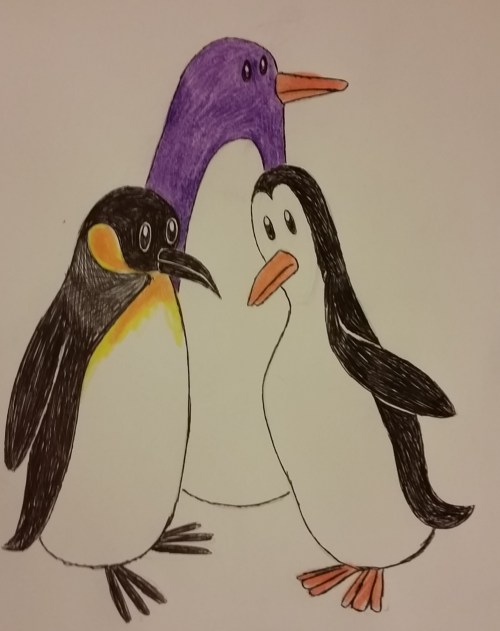
You know how creepy penguins in cartoons can be, right?  The Penguins of Madagascar are like a Mission-Impossible Team gone horribly wrong and transformed into penguins.  The penguin in Wallace and Gromit’s The Wrong Trousers disguised himself as a chicken to perform acts of pure evil.  Cartoonists all know that penguins are inherently creepy and evil.

I recently learned a hard lesson about penguins.  You know the joke, “What’s black and white and red all over?  A penguin with a sunburn.”  I told that joke one too many times.  Who knew the Dallas metroplex had so many loose penguins lurking around?  They are literally everywhere.  One of them overheard me.  And apparently they have vowed a sacred penguin vow that no penguin joke goes unpunished.

As I walked the dog this morning, I spotted creepy penguin eyes, about three pairs, looking at me from behind the bank of the creek bed in the park.  When I went to retrieve the empty recycle bins from the driveway, there they were again, looking at me over the top of the neighbor’s privacy fence.

“Penguins see the world in black and white,” said one of the Penguins.

“Except for purple ones,” added the purple one.

“Penguins can talk?” I tried unsuccessfully to ask.

“Penguins only talk in proverbs,” said one of the penguins.

“But the purple one gives the counterpoint,” said the purple one.

“The wisdom of penguins is always cold and harsh,” said one of the penguins.

“Except on days like this when it’s hot,” said the purple one.

“You should always listen to penguins,” said one of the penguins.

“Of course, people will think you are crazy if you do,” said the purple one.

“People who talk to penguins are headed for a nervous breakdown,” said one of the penguins.

“Unless you are a cartoonist.  Then it is probably normal behavior,” said the purple one.

“Is this all real?” I tried unsuccessfully to ask.

“Everyone knows that penguins are real,” said one of the penguins.

“But there are no purple penguins in nature,” said the purple one.

So, I sat down to write this post about penguins and their proverbs with a very disturbing thought in my little cartoonist’s head…  Why am I really writing about penguins today?  I really have nothing profound to say about penguin proverbs.  Especially profound penguin proverbs with a counterpoint by a purple penguin.  Maybe it is all merely a load of goofy silliness and a waste of my time.

“Writing about penguins is never a waste of time,” said one of the penguins.

“And if you believe that, I have some choice real estate in the Okefenokee Swamp I need to talk to you about,” added the purple one.

 

1 Comment

Filed under artwork, birds, cartoons, goofy thoughts, humor, Paffooney, philosophy, surrealism