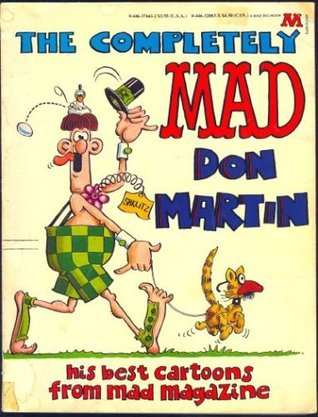
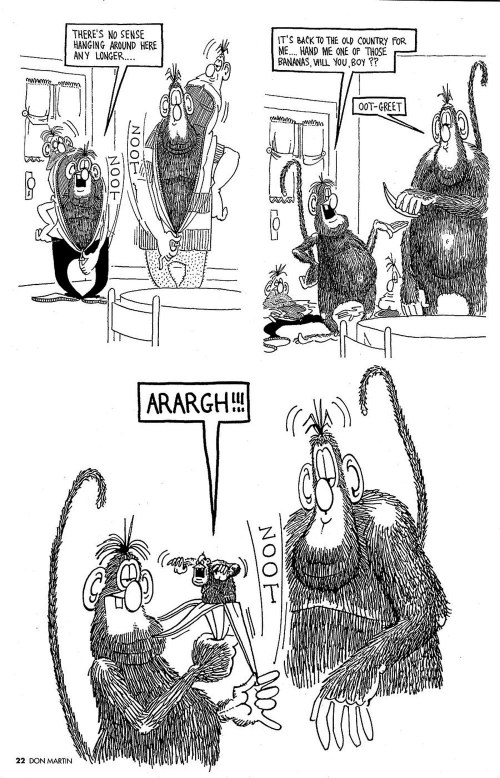
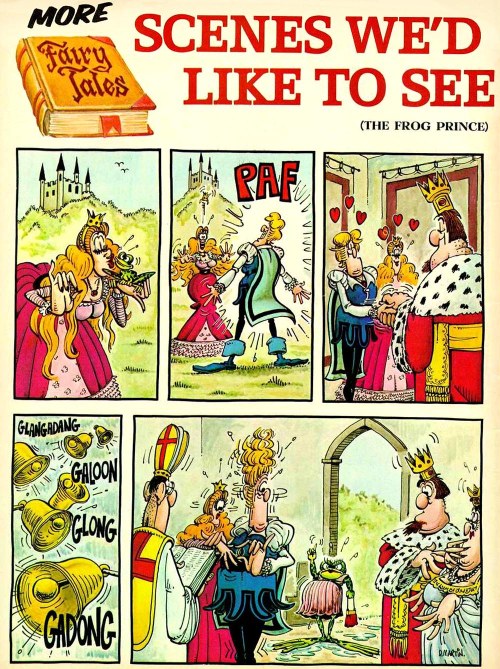
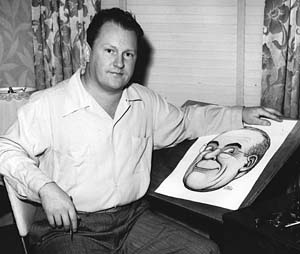
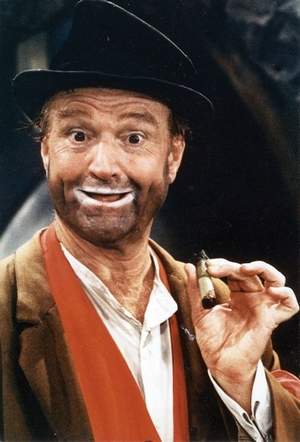
Born in 1931 and lasting in this crazy, mixed-up world until the year 2000, Don Martin was a mixy, crazed-up cartoonist for Mad Magazine who would come to be billed as “Mad Magazine’s Maddest Artist.” His greatest work was done during his Mad years, from 1956 (the year I was born… not a coincidence, I firmly believe) until his retirement in 1988. And I learned a lot from him by reading his trippy toons in Mad from my childhood until my early teacher-hood.
His style is uniquely recognizable and easily identifiable. Nobody cartoons a Foon-man like Don Martin.
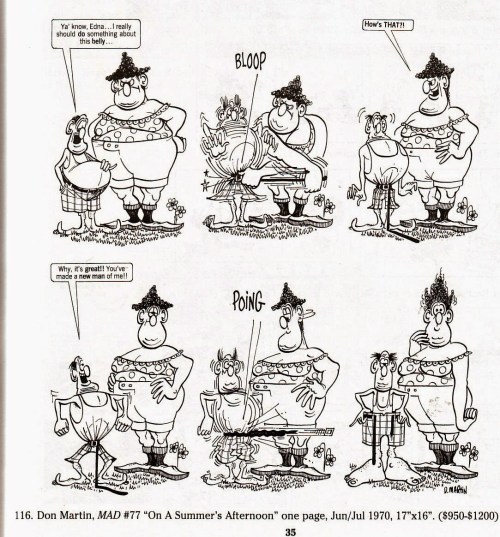
The googly eyes are always popped in surprise. The tongue is often out and twirling. Knees and elbows always have amazingly knobbly knobs. Feet have an extra hinge in them that God never thought of when he had Adam on the drawing board.
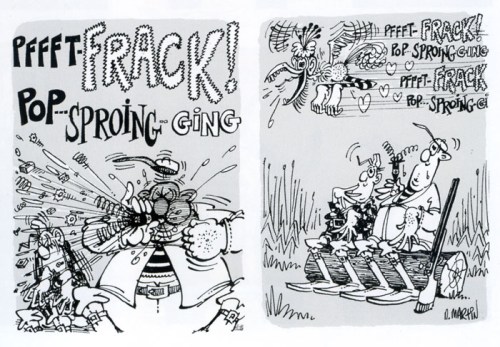
And then there is the way that Martin uses sound effects. Yes, cartoons in print don’t make literal sounds, but the incredible series of squeedonks and doinks that Martin uses create a cacophony of craziness in the mind’s ear.
And there is a certain musicality in the rhyming of the character names he uses. Fester Bestertester was a common foil for slapstick mayhem, and Fonebone would later stand revealed by his full name, Freenbeen I. Fonebone.
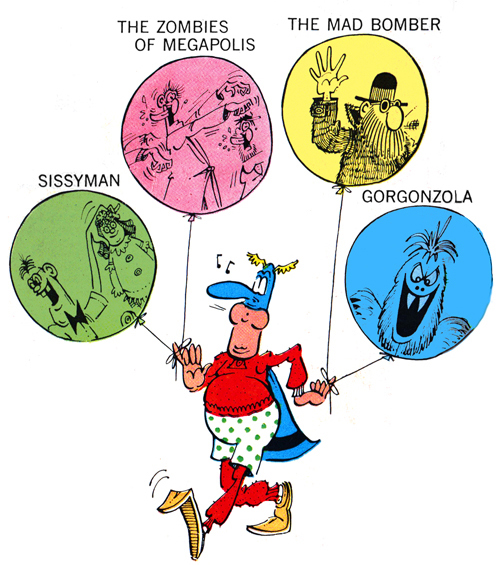
And, of course, one of his most amazingly adventurous ne’er-do-well slapstick characters was the immeasurable Captain Klutz!
Here, there, and everywhere… on the outside he wears his underwear… it’s the incredible, insteadable, and completely not edible… Captain Klutz!
If you cannot tell it from this tribute, I deeply love the comic genius who was Don Martin, Mad Magazine’s Maddest Artist. Like me he was obsessed with nudists and drawing anatomy. Like me he was not above making up words with ridiculous-sounding syllables. And like me he was also a purple-furred gorilla in a human suit… wait! No, he wasn’t, but he did invent Gorilla-Suit Day, where people in gorilla suits might randomly attack you as you go about your daily life, or gorillas in people suits, or… keep your eye on the banana in the following cartoon.
So, even though I told you about Bruce Timm and Wally Wood and other toon artists long before I got around to telling you about Don Martin, that doesn’t mean I love them more. Don Martin is wacky after my own heart, and the reason I spent so much time immersed in Mad Magazine back in the 60’s, 70’s, and 80’s.
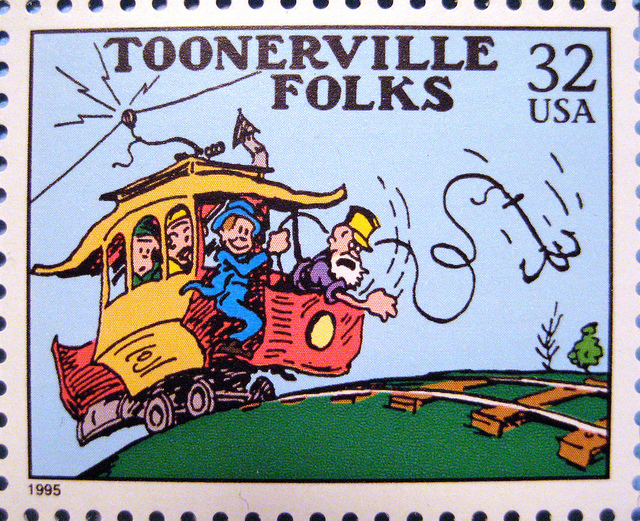
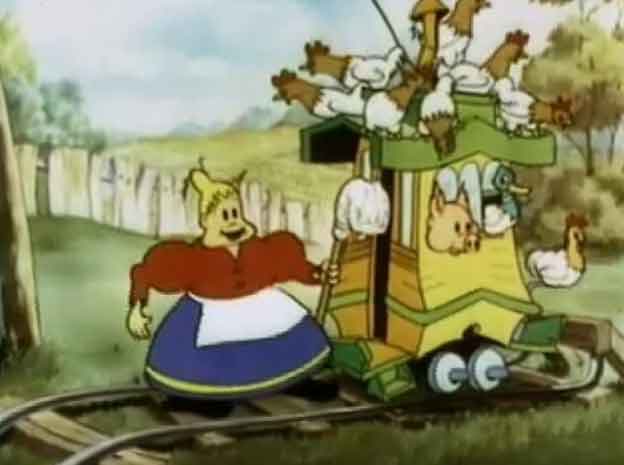
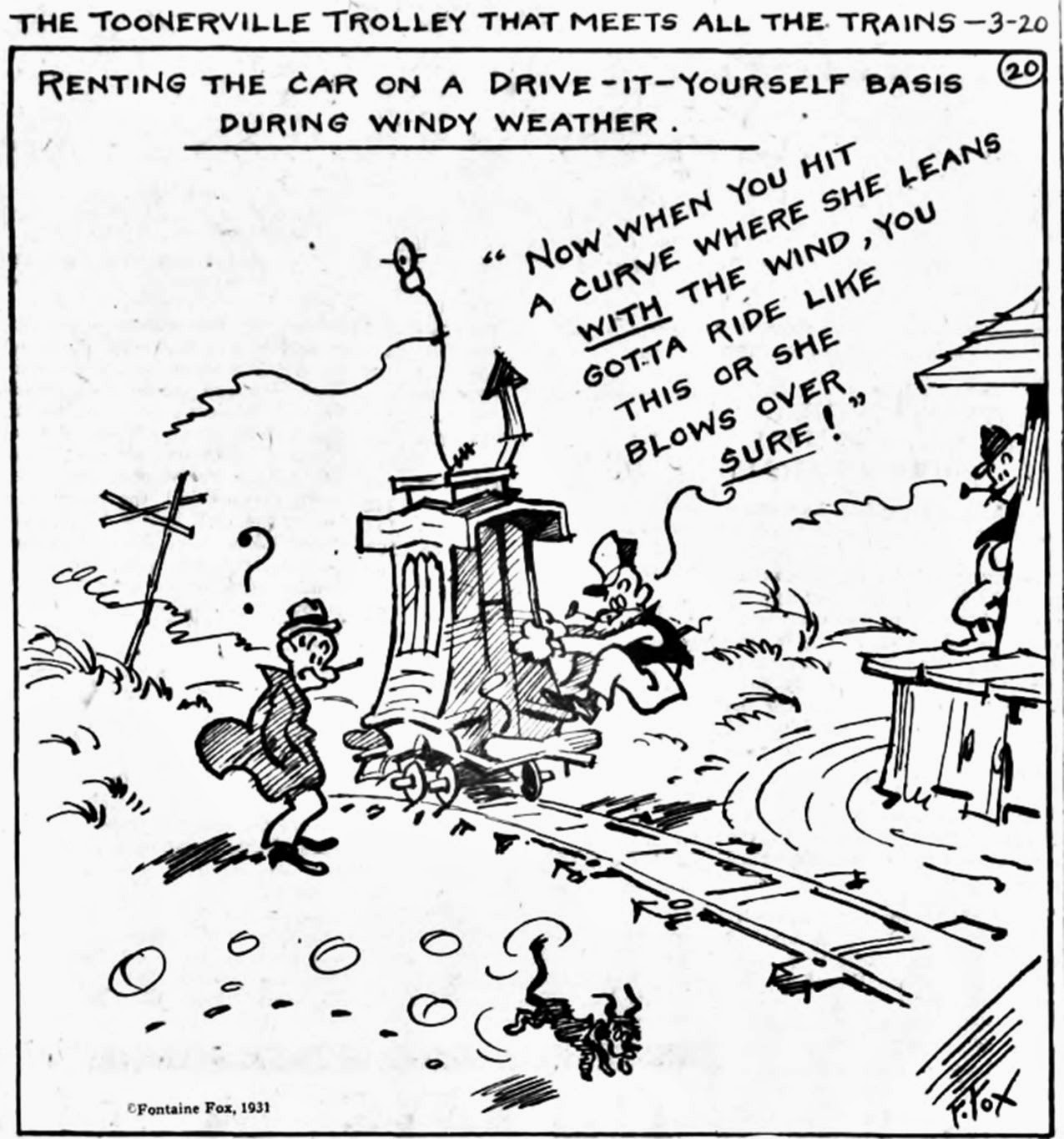
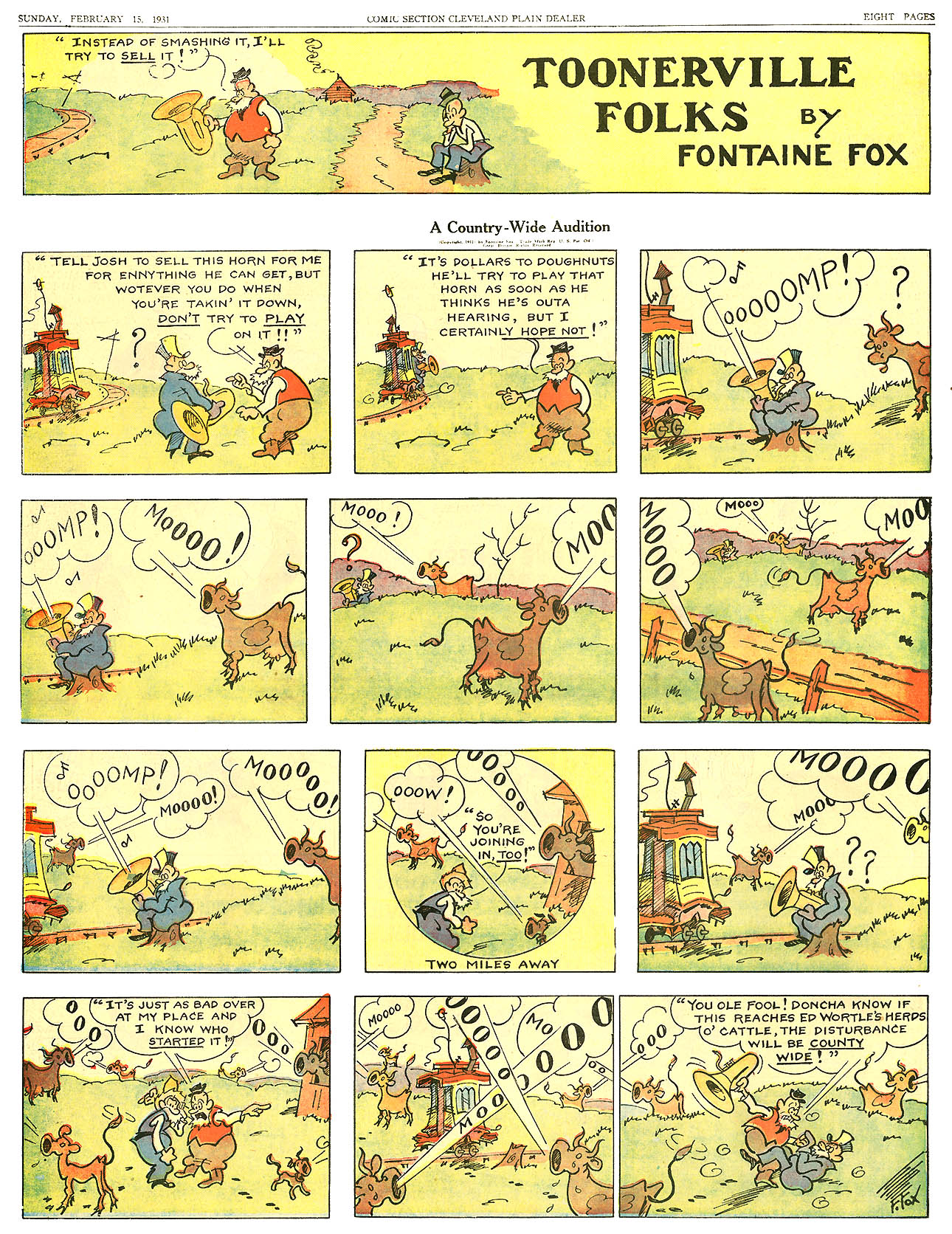
There is a place so like the place where my heart and mind were born that I feel as if I have always lived there. That place is a cartoon panel that ran in newspapers throughout the country from 1913 to 1955 (a year before I was born in Mason City, Iowa). It was called Toonerville Folks and was centered around the famous Toonerville Trolley.
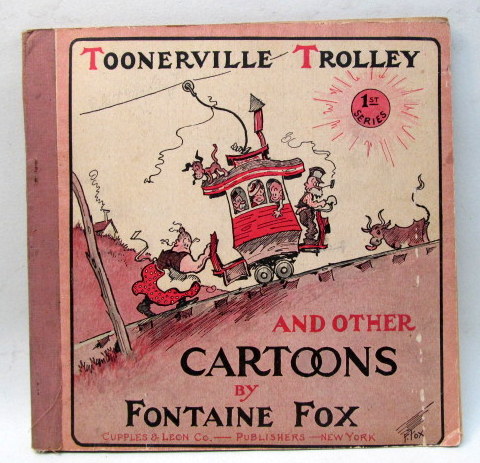
Fontaine Fox was born near Louisville Kentucky in 1884. Louisville, of course is one of the two cities that claims to be the inspiration for Toonerville. Apparently the old Brook Street Line Trolley in Louisville was always run-down, operating on balls of twine and bailing wire for repair parts. The people of Pelham, New York, however, point to a trolley ride Fox took in 1909 on Pelham’s rickety little trolley car with a highly enterprising and gossip-dealing old reprobate for a conductor. No matter which it was, Fox’s cartoon mastery took over and created Toonerville, where you find the famous trolley that “meets all trains”.
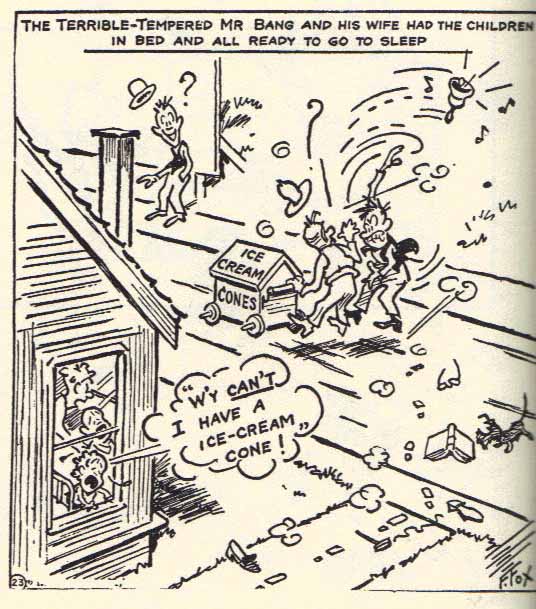
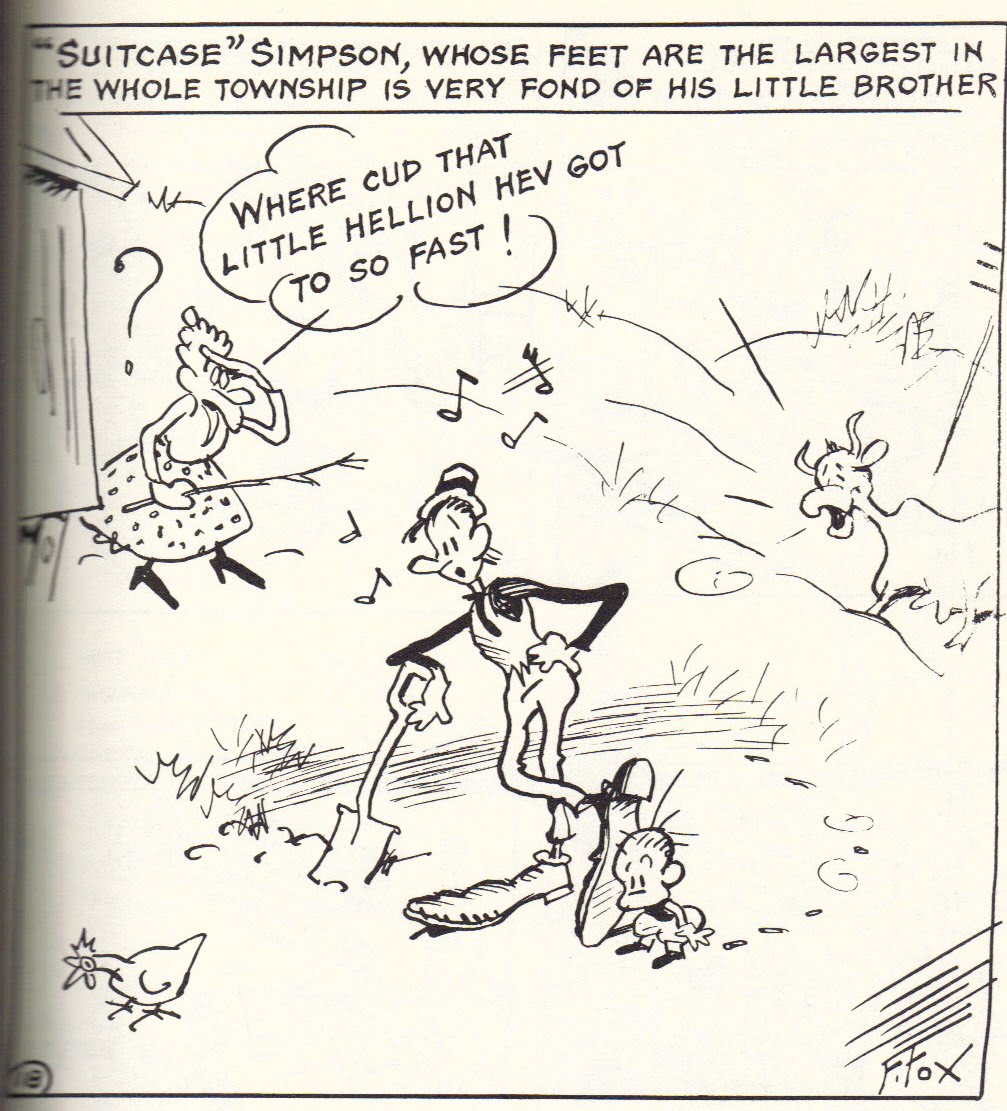
I didn’t learn of the comic strip’s existence until I was in college, but once I found it (yes, I am the type of idiot who researches old comics in university libraries), I couldn’t get enough of it. Characters like the Conductor, the Powerful (physically) Katrinka, and the terrible-tempered Mr. Bang can charm the neck hair off of any Midwestern farm-town boy who is too stupid to regret being born in the boring old rural Midwest.
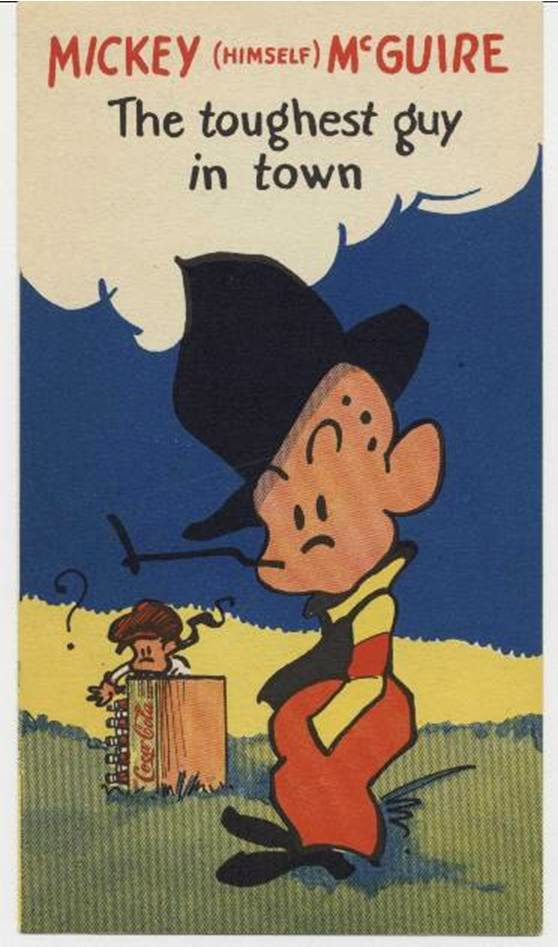
I fancied myself to be just like the infamous Mickey (himself) McGuire. After all, we have the same first name… and I always lick any bully or boob who wants to put up a fight (at least in my daydreams).
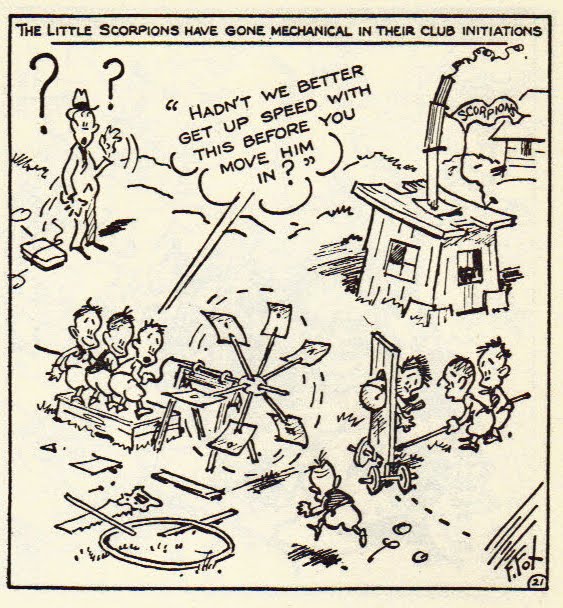
So, this is my tribute to the cartoonist who probably did more to warp my personality and make me funny (well, at least easy to laugh at! ) than any other influence. All of the cartoons in this post can be credited to Fontaine Fox. And all the people in them can be blamed on Toonerville, the town I used to live in, though I never really knew it until far too late.
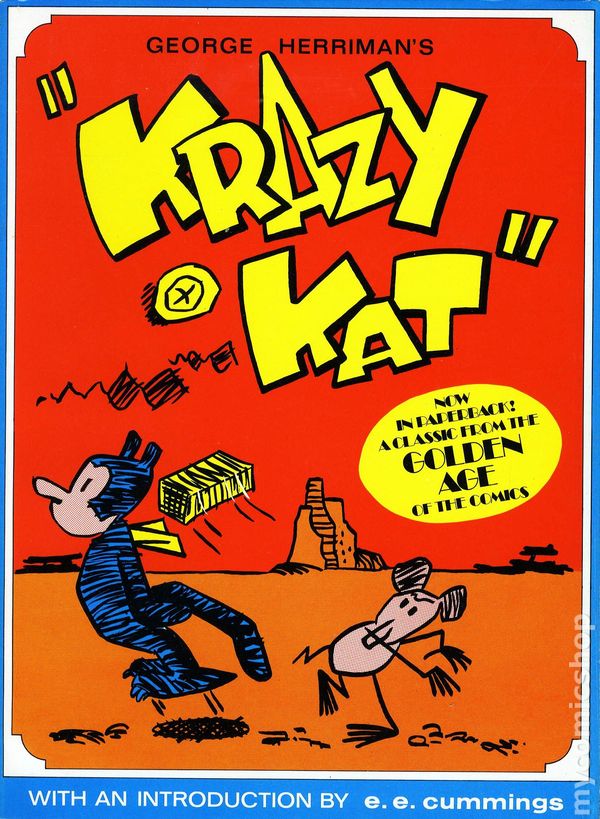
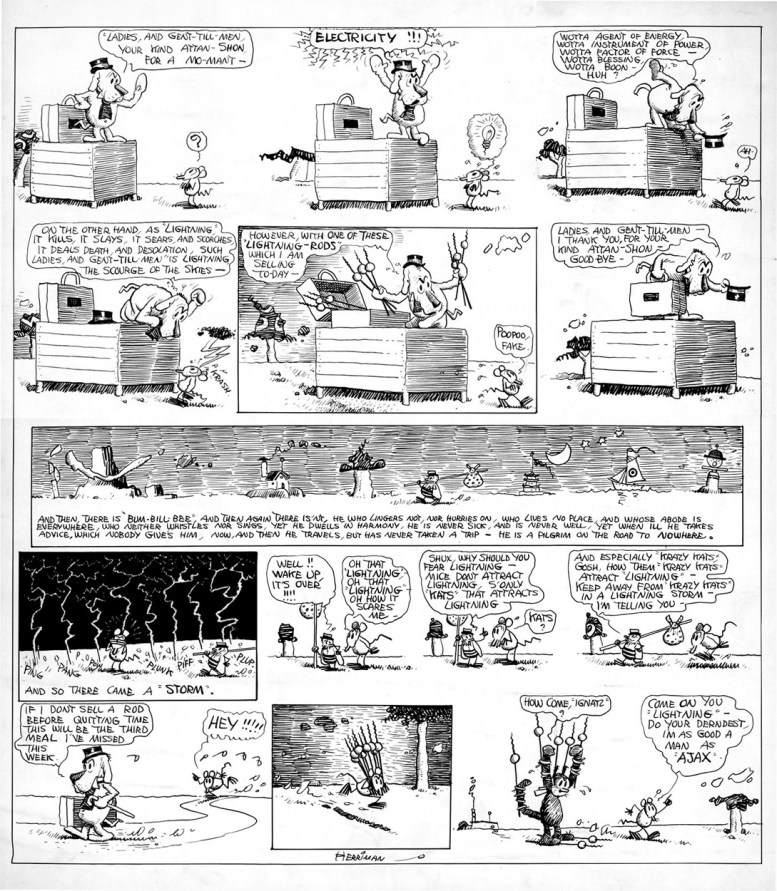
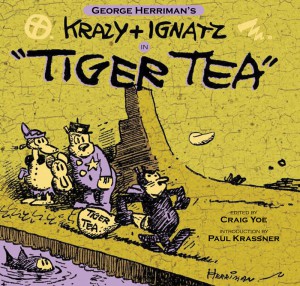
I told you before about a cartoonist from ancient ‘Toon Times named Fontaine Fox. He was a master, and I acknowledge him as one of my greatest inspirations. But he was not the original master mentor for my teenage ‘Toon Training. That honor goes to the inestimable George Herriman. He was the Krazy Kartoonist who died more than a decade before I was born, yet, through his Kreation, Krazy Kat, did more to warp my artistic bent into Krazy Kartooniana Mania than anybody else. I discovered him first. I found him through Komic books and the Kard Katalog at the local library. I own a copy of the book I pictured first in this post. It is the first Kartoon book I ever bought. I couldn’t post a picture of my actual book here because I have read it so often in the past forty years that the Kover has Kome off. It is now more of folder of loose pages than a book.
Krazy Kat is a newspaper Komic strip that ran all around the world from 1913 to 1944. Comics Journal would rate Krazy Kat as the greatest work of Komic art of the 20th Century. Art critics hailed it as serious art, and it fits snugly into the surrealist movement of Salvador Dali and others. It has been cited as a major influence on the work of other artists such as Will Eisner, Charles M. Schulz, Robert Crumb, Art Spiegelman, Bill Watterson, and Chris Ware.
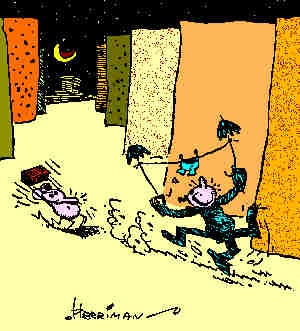
The centerpiece of the strip is a love triangle. Krazy Kat the Kharacter is a feline who may be female or may be male but is definitely deeply in love with Ignatz Mouse. The Krazed rodent hopped up on seriously stinky fromage (cheese to us non-French speakers), is Konstantly throwing bricks at Krazy’s head… obviously out of serious disdain, however, Krazy sees it as a confession of love. Offisa Pup, the police watchdog, wants to jail the malevolent mouse for battery and protect the precious Kat, whom he obviously loves with an unrequited love. Explanations are superfluous in the weird world of Krazy Kat. How can I explain the charm, the humor, the good-natured violence of a strip such as this? There are echoes of it in Tom and Jerry animated cartoons, but nothing like it really exists anywhere else. Krazy has her own unique language, a language that you naturally learn to interpret as you read the strip. Ignatz exhibits psychotic frustrations that he takes out on the world around him in our name, that we might experience hubris at his expense. And what’s with that mysterious sack of “Tiger Tea” that Krazy carries about and keeps a Klosely guarded “sekrit”?
I honestly hope you will give Krazy Kat a thorough “look-see”. Because if you like Kartoons at all… and it doesn’t have to be the Krazy Kooky love of a seriously overdosed addict like me… you will fall desperately in love with this one. It is a world of its own, a superbly superfluous abstract anachronism. It is a surrealist’s dream of fun with puns and tons of buns… or something like that. Simply put… read it and don’t like it… I dare you!
I think I know what you’re thinking. He’s just going to retell a bunch of Eddy Murphy, Richard Pryor, and Flip Wilson jokes from the 1970’s which his fuzzy old-coot memory will get wrong in slightly amusing ways. Or he’s got dementia now and has turned totally racist. Or both.
Well, maybe. I am old after all.
But, no. I am writing about that kind of humor where you laugh when someone in the story dies a horrible death in an unusually humorous way. Or most dead-baby jokes. Or the part of “The Producers” where “Springtime with Hitler” turns out to be a Broadway hit musical even though the two con men in charge were gambling on it being a failure.
Bad things can be funny, you know.
At least if you have a brain-damaged sense of humor like mine.
Kurt Vonnegut was a master of very dark black humor. In his novel, Cat’s Cradle, (Spoiler alert!) the world ends at the end of the novel because the mad scientist commits suicide by swallowing his invention, Ice Nine, freezing solid in a way that couldn’t be melted at room temperature or above, and then falling into the ocean, thus permanently freezing the entire planet Earth. Golly, what a laugh fest!
Black humor is, of course, highly dependent on dramatic irony and the fact that people smart enough to read and enjoy Vonnegut, usually are smart enough to realize if you read too much ironic humor you are not in danger of actually rusting from the brain outward.
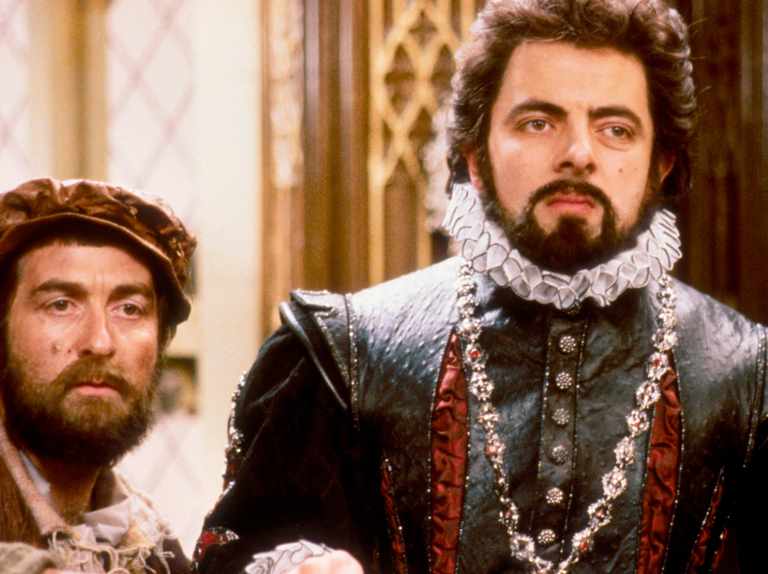
I, of course, am a black humor aficionado of sorts. I thoroughly enjoyed all the torture, death, and deadly mistakes of Rowan Atkinson’s Blackadder. Of course, I had a ridiculously hard time gaining access to the show which originally aired on the BBC and didn’t appear on American TV channels until our household gave up television to save money due to ever-rising cable costs.
Fortunately, during the yearlong imprisonment of the Covid pandemic, I discovered the entire series available on Hulu which is cheap enough to stream on my laptop. Only in excess of 500,000 people had to die for me to get the chance to binge on all the historical reiterations of this amazingly dark show full of humorous English demise and occasional accidental murder.
So, that is what black humor is to me. As defined by Professor Wilson at Iowa State when I was assigned to read a novel by Saul Bellow and ended up reading three, Henderson the Rain King, Herzog, and The Adventures of Augie March. Of course, I am not sure which novel was the assignment. They were all deadly hilarious. And I am, after all, old enough to probably be demented and a closet racist. Is Saul Bellow Jewish? I ask because I am also forgetful.
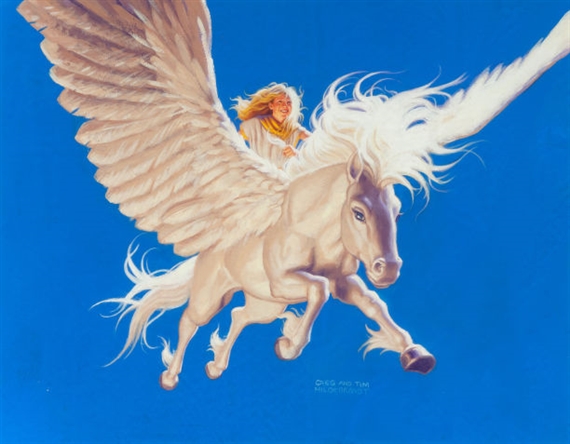
Born on January 23rd, 1939 Greg and Tim Hildebrandt were twin brothers who both had considerable painting skills. Much like Mickey claims to be, they originally wanted to be Disney animators, but, failing that, decided on a professional art career strongly influenced by Disney, Norman Rockwell, and Maxfield Parrish. They both turned pro in 1959 and began painting fantasy art in oil, working on projects together.
Their styles were very similar.
The picture above is done by Tim without help from Greg.This Lord of the Rings painting of Eowyn and the Nazgul was a solo effort by Greg.
This illustration for Terry Brooks’ Sword of Shannara series was a collaboration, showing how seamlessly the brothers worked together.
Their first truly big break came with the popularity in the 1970’s of their Lord of the Rings Calendars.
And then, of course, in 1977 they were asked by 20th Century Fox to rework the poster concept done by Tom Jung for the movie Star Wars. It was done on a very tight schedule with the brothers working in shifts to complete it in only 36 hours. It resulted in the well-known image that began this post.
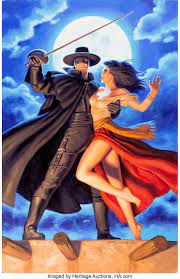
Here follows a few more of my favorite works of the Brothers Hildebrandt.
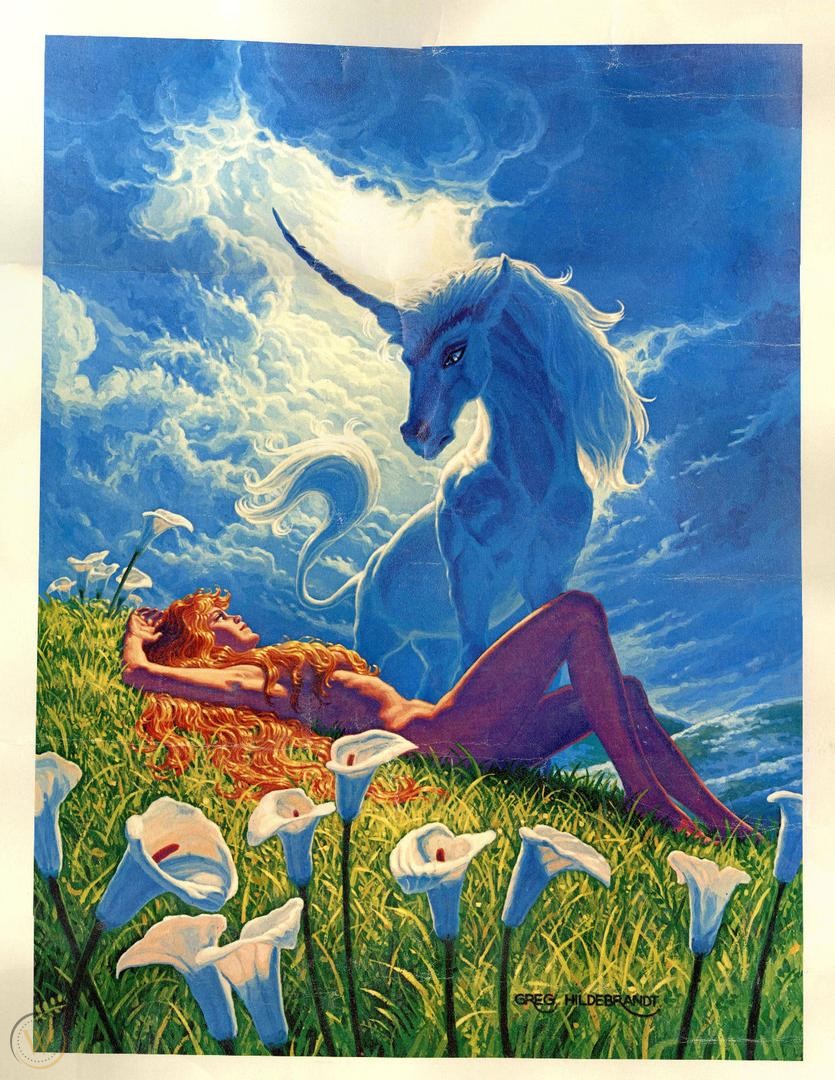
This one by Greg Hildebrandt was my favorite poster in college.
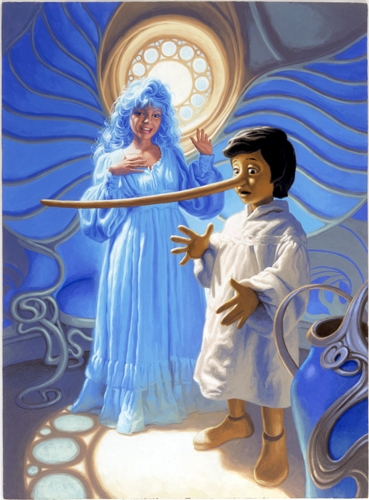
Pinocchio and the Blue Fairy
The Mad Tea Party in Alice in Wonderland
Islands in the Sky 1999
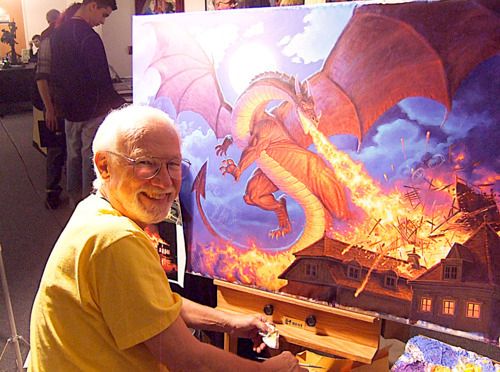
Sadly, Tim passed away in 2006 at the age of 67. But here you see Greg still painting at age 82,
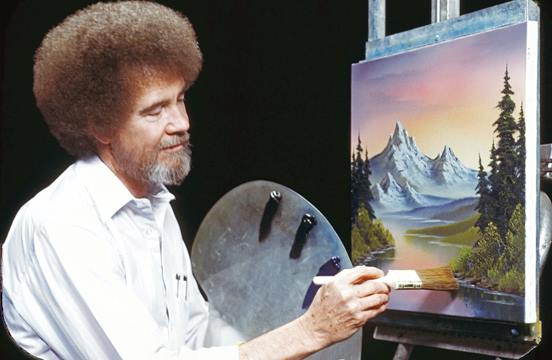
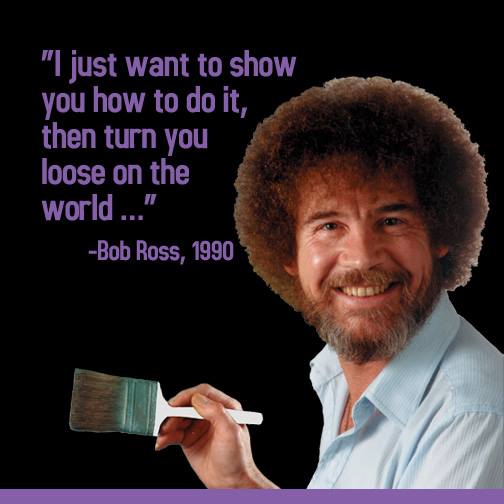
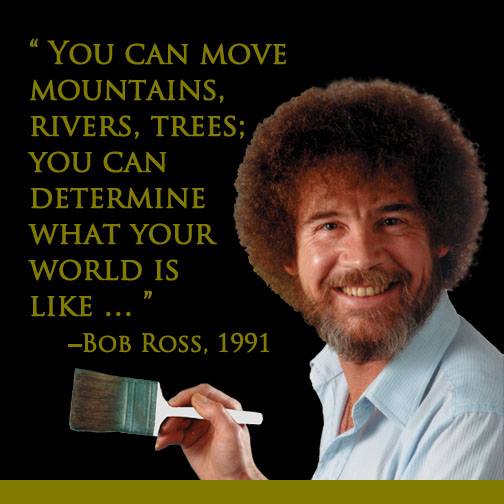
If there is a Church of Sacred Landscapes then Bob Ross is its Jesus Christ. That is not a sacrilegious statement of bizarre cult-mindedness. Painting is a religion that has its tenets. And Bob Ross explained to us the will of God on his painting show on PBS. All the illustrations used in this post come from the Facebook page Joy of Painting with Bob Ross. All the wisdom comes from things the Master said on the show.
Bob Ross was the prophet of the paintbrush. He would present us with a lightly prepared canvas at the beginning of the show and then proceed on camera to take his brush and palette knife, and all his paints, and create a piece of the world before our very eyes. And he was not Picasso or Van Gogh or even Norman Rockwell. He was not a talented artist, but rather a very practiced one who knew all the tricks and shortcuts to sofa painting, the art of knocking out scene after scene after scene. He could make his little piece of the world in only half an hour, and he made it obvious how we could do the same. His work was not gallery quality… but his teachings were Jesus-worthy.
His work was natural, flowing, and realistic in the random complexity it presented. He took standard paintbrush strokes and pallet knife tricks and made them dance across the canvas to make happy little trees.
His painting methods presented us with a philosophy of life and a method of dealing with whatever mistakes we might make.
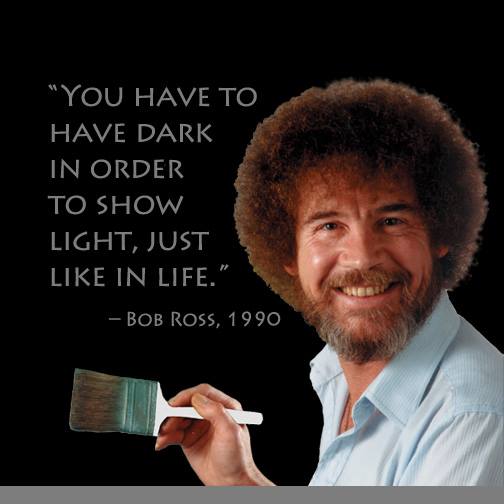
And of course, any good religion must take into account the existence of evil.
Bob Ross tells us that evil is necessary as a contrast to what is good and what is true. We need the dark. But we don’t have to embrace it. Bob’s paintings were never about the dark bits. He always gravitated towards the light.
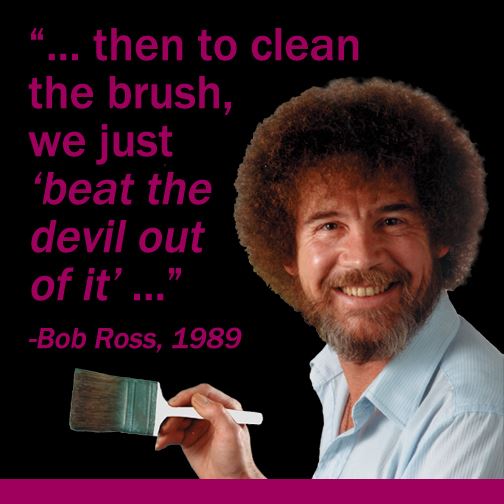
Of course, sometimes you have to beat back the darkness. A good artist takes care of his tools.
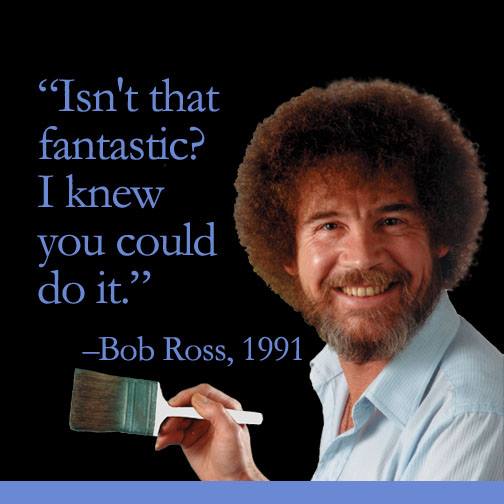
Bob Ross admonishes us to look and to learn and love what we see. The man radiated a calm, gentle nature that makes him a natural leader. His simple, countrified wisdom resonates because we need calm and pastoral peace in our lives. It is one of the main reasons mankind needs religion.
So I definitely think we ought to consider building a Bob-Rossian Church of the Sacred Landscapes. We have our prophet. The man has passed away, yet he is risen to paint again endlessly on YouTube.
And if you are willing to try… Bob Ross will smile upon you.
Yes, you heard right. (Well, you did if you read the title out loud.) Real writers are subject to madness. I decided this because I found the pattern in real writing that I actually value as good writing.
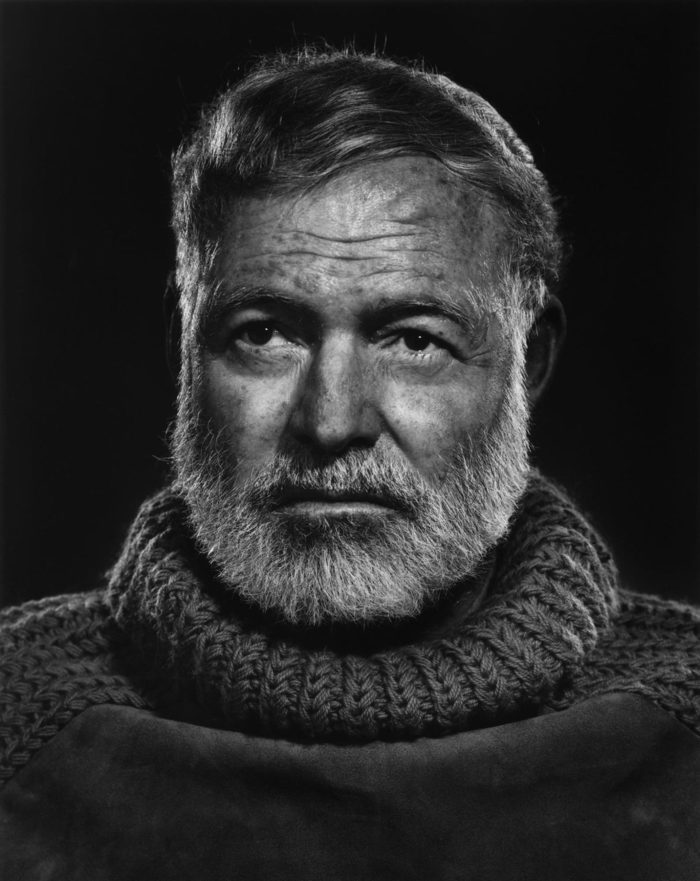
Case in Point; Ernest Hemingway
The first book of Hemingway that I read in high school was For Whom the Bell Tolls. It is a book about World War One, being an ambulance driver on the battle field, the transformations that combat experiences have on the soul, and trying to deal with the love of a woman, unsuccessfully, while the soul-sucking of recovery from battle is still taking place in your head. The story has a first-person narrator. It is told in a journalistic style that only presents the facts and doesn’t do any of the thinking and feeling for you. It makes the meaning of the story all happen in the reader’s head, as if the writer is not telling you what to think. But he actually is. And doing it masterfully. Of course, it captured me horribly because at the time I read it, the Viet Nam War was winding down, I had a draft number after turning 18 in 1974, and the Khmer Rouge attacked and took control of the SS Mayaguez in May of 1975, threatening to reignite the war and expand it into Cambodia. A wonderful book to read when you are faced with grim reality and the unfolding path to madness before you.
I also read The Sun Also Rises and The Old Man and the Sea while in college as an English Major. I defy you to read either of those books and not see the madness gnawing at the writer.
Ernest Hemingway went mad from the post traumatic struggles he underwent as a consequence of WWI. His life ended when he put a shotgun in his mouth and pulled the trigger. Deep depression is a form of madness.
Case in Point; Edgar Allen Poe
Of course, I chose the portraits of these authors on the basis of which ones are the most haunting I could find. Poe’s stare captured here reveals a pair of eyes that have seen the dark depths of his own soul, a horror you can’t compare to anyone else’s except through the words of a writer, because you can’t see into someone else’s soul in any other way. Your eyes weren’t built to do that.
And we all know the kind of stories and poems he wrote. My first encounter with Poe’s writing was either The Black Cat, The Tell-Tale Heart, or the poem, “The Bells“, all of which are deeply disturbing, and all of which I read in the Eighth Grade in Mrs. Erdman’s Class.
Poe became mad due to life-long grinding poverty brought about by foster parents who loved him and had money enough, but were too firmly devoted to the idea that helping someone out financially is a weakness not to be contemplated. His young wife died an early death from lack of funds for things like heat in the winter and food on a daily basis.
We don’t fully know why the madness caused his mysterious death. He may have had rabies when he died. Or it may have been a toxic reaction to large quantities of alcohol. Or he may have died from brain injuries due to an unexplained kidnapping and beating. But what we do know is that he loved certain people passionately and hated certain people passionately through his literary criticism of their writing. In fact, one of the authors he hated may have killed him as a murderous act of revenge.
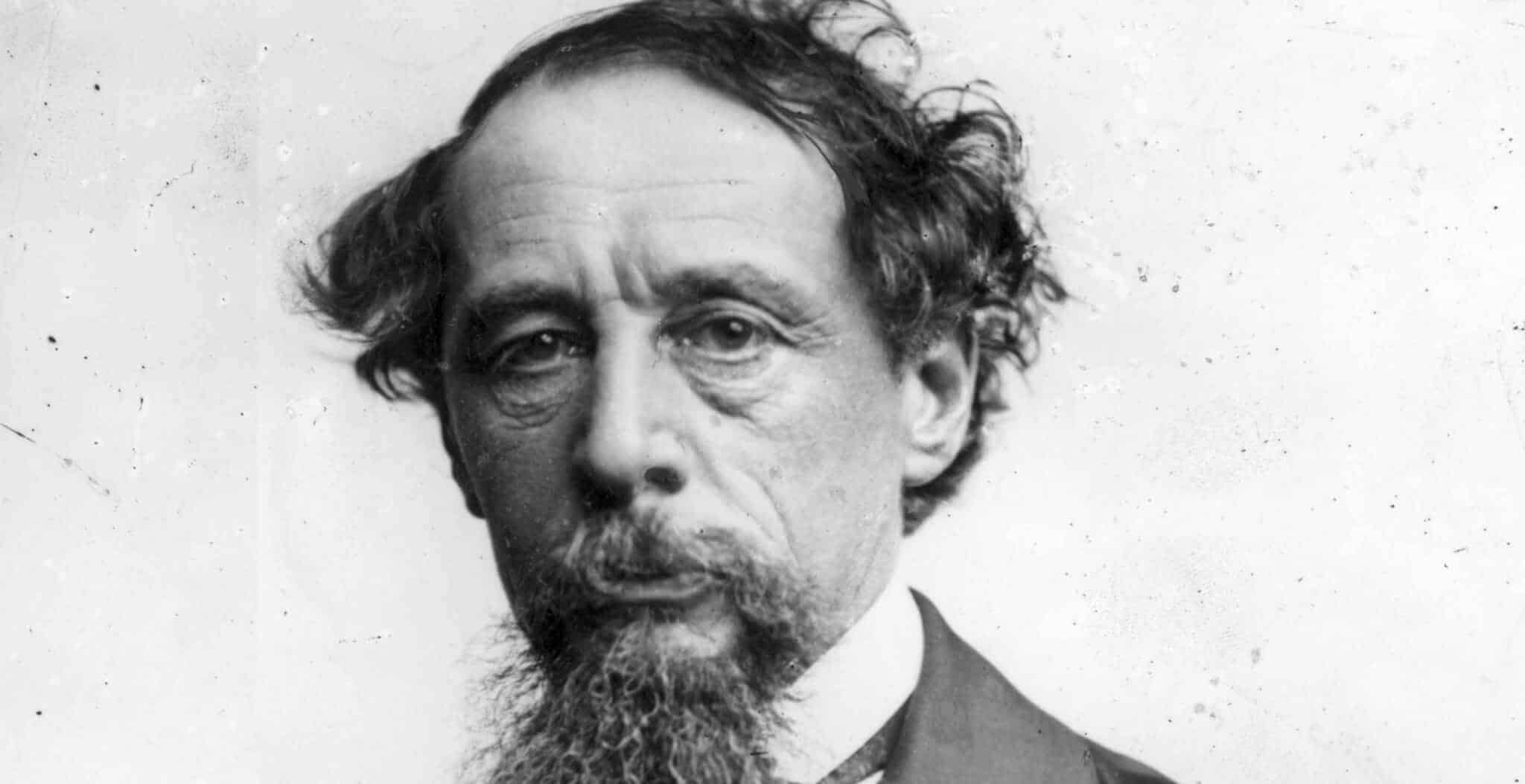
Case in Point; Charles Dickens
When one thinks of Charles Dickens as a writer, madness is rarely the thing that comes first to mind. He wrote socially-observant comedies that emphasized engaging characters and detailed understandings of the settings and the times. There are a large number of clowns and comic villains in his stories. And his works seem a bit overbalanced against the darkness of the soul.
And yet he has his dark moments. I first read Dickens in Seventh Grade through The Christmas Carol. But Marley’s ghost and his ilk, especially the spectral Ghost of Christmas Yet to Come chilled me to the bone. I wept at the death of Tiny Tim even though it meant the other boys in my class could see me crying and would make me pay a price outside of the classroom.
On my own I went on to read more Dickens, including The Old Curiosity Shop in high school, Nicholas Nickleby, A Tale of Two Cities,David Copperfield and Great Expectations in college. I further read Oliver Twist while teaching Eighth Grade English. I also read my first author-biography of Charles Dickens, shortly after reading The Old Curiosity Shop.
I soon realized how much of his stories were autobiographical. Wilkins Micawber is a portrait of his own father and his time in the poorhouse. Wackford Squeers and other unflattering depictions of education reflected his own time in British boys’ schools where the odds of being molested by upper classmen were high. And the fact that a beloved young female relative died in his arms when he was barely out of boyhood probably caused the infamous death of the character Little Nell in the final installment of The Old Curiosity Shop.
There is madness in Dickens too. I mean, how can your writing reach the very heights of the Himalayas if it has never experienced the deepest depths of the ocean?
Case in Point; J.D. Salinger
Yes, I read The Catcher in the Rye in high school. It was a right of passage in 1974. It was one of the three books that set me on my lifelong quest to find the best book ever written. (The Return of the Native by Thomas Hardy and the Little Prince by Saint-Exupéry are the other two.) It is a book that first captured me by the feelings in the brain with the central image alluded to in the title. Holden Caufield (Salinger later confessed that this narrator was really him) dreamed that he was in a field a rye where children are playing and romping with abandon. Behind Holden is a bottomless cliff. As children occasionally run towards him and the cliff behind him, heedless and not seeing the danger, he decides he must catch them and turn them back the other way. And this is what the book is, Holden’s adventures for the first time in the adult world, experiencing the possible dangers, and then turning the readers around, back into the field of rye.
I of course read Franny and Zooey and Raise High the Roof-Beam, Carpenters afterwards in college. Buddy Glass, who narrates the story of brother Seymour’s suicide, is also an admitted character-identity for Salinger himself.
Has Salinger, too, gone mad? You can ask that about a man who suddenly stopped writing at the height of his success, and then ran away to a small shed in the woods where he wrote mash notes to teenage girls for twenty years?
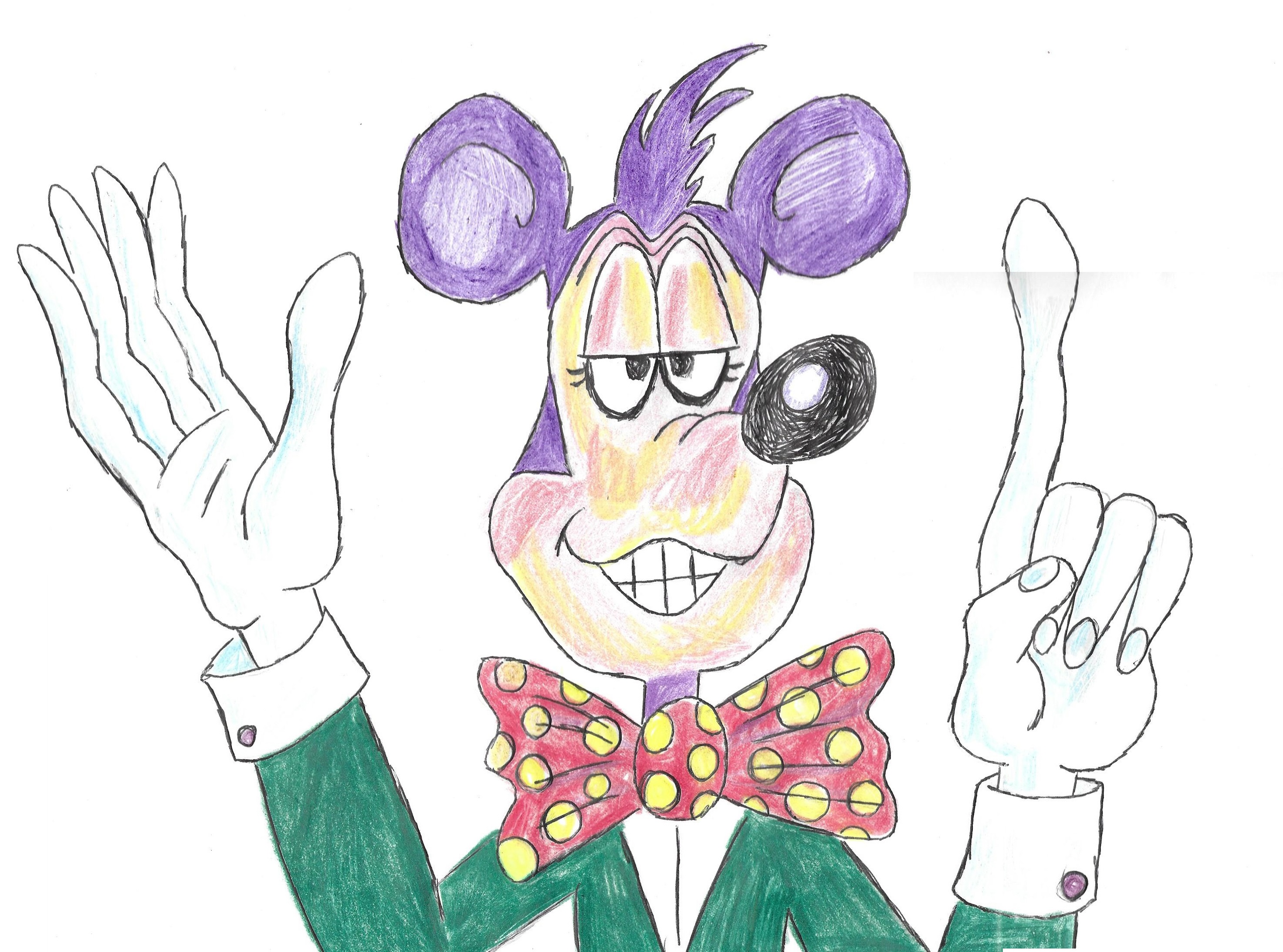
Final Case in Point; Mickey
And why would I ever think Mickey is mad?
Well… this list is long.
Mickey was sexually assaulted by an older boy at ten. You can see the effects of that in all of his writings, including this one.
He’s fool enough to think he might be a real writer.
When he is in his cartoonist’s head, he portrays himself as a purple mouse. When he’s in his teacher head, he’s Reluctant Rabbit.
He thinks he can recognize great writing when he reads it.
He understands the books of H.P. Lovecraft far too well.
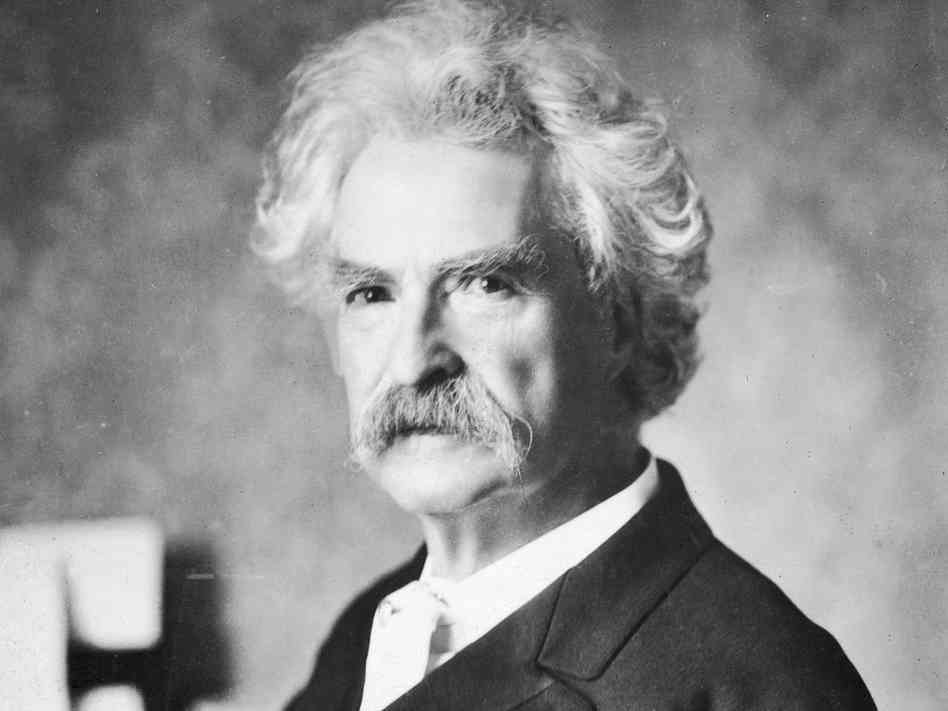
And he seems to recognize that same madness that can be found in Ernest Hemingway, Edgar Allan Poe, Charles Dickens, JD Salinger, Mark Twain, Stephen King, Terry Pratchett, and too many more that could also be named… in himself.
Lena the Hyena appeared in Al Capp’s comic strip Li’l Abner in 1946.
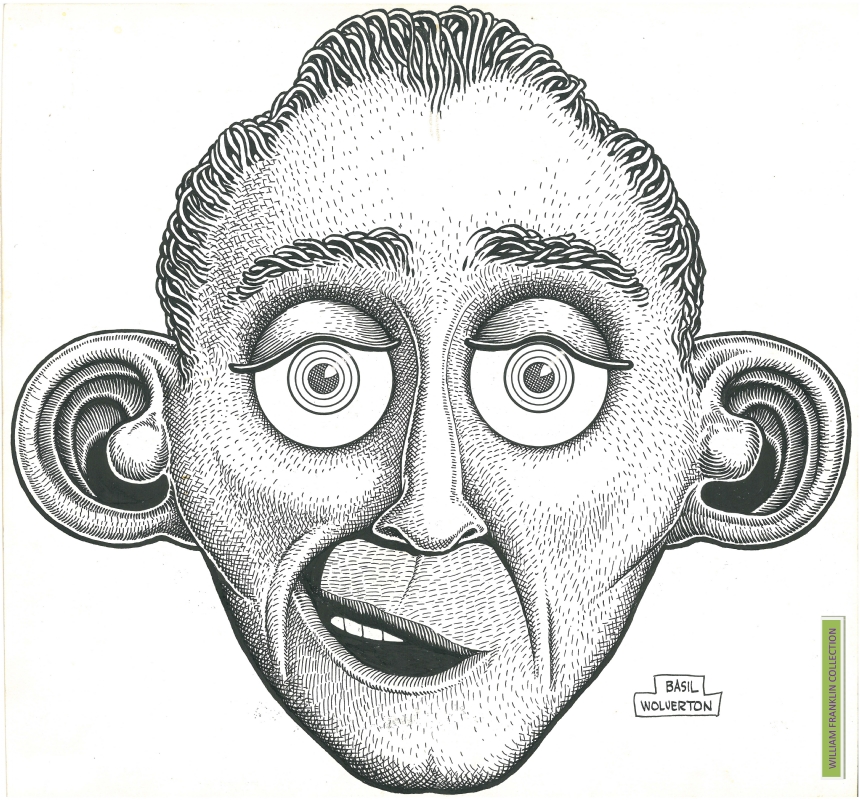
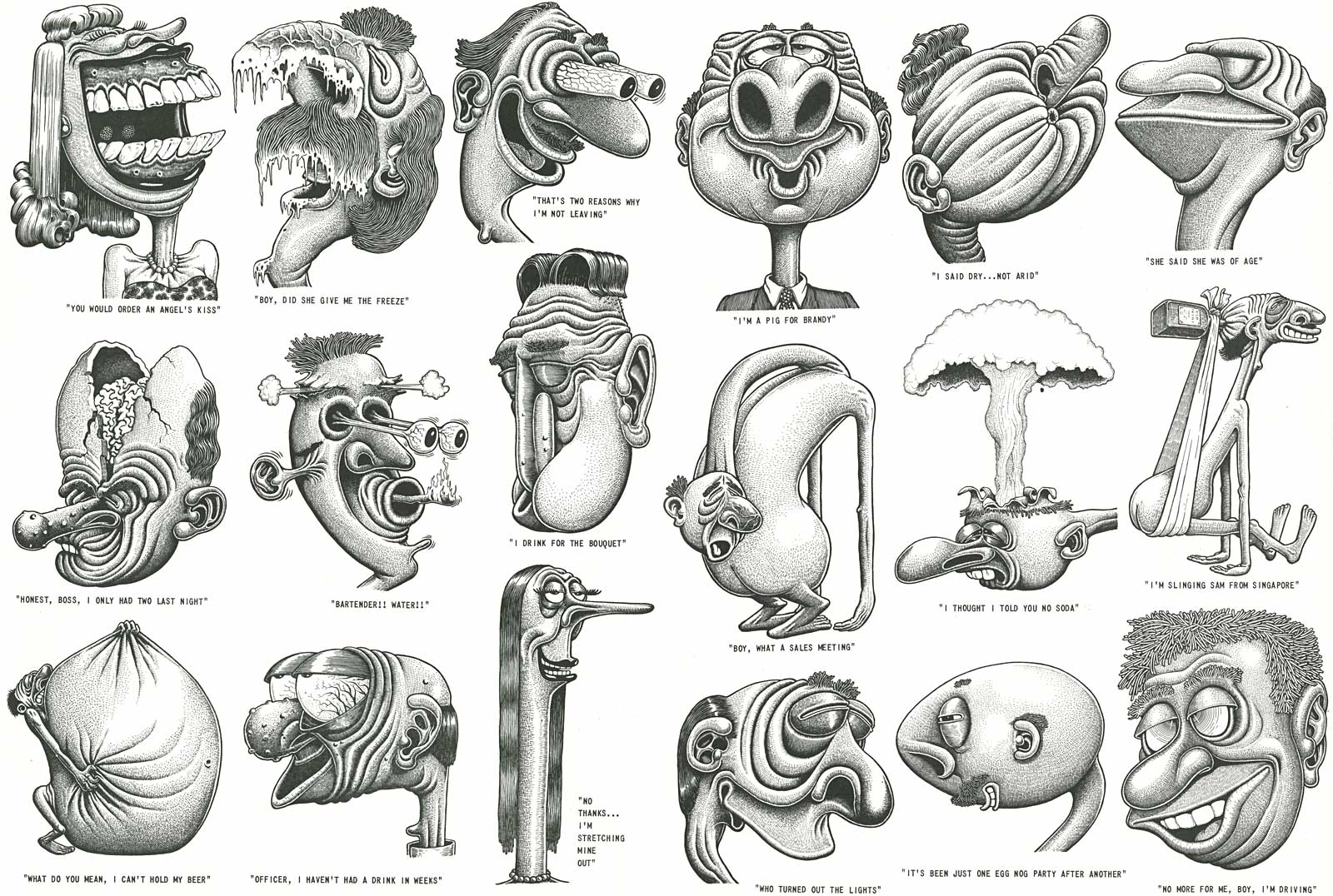
Basil Wolverton (1909 to 1978) became famous as a cartoonist by winning a contest. He submitted the picture of Lena to Al Capp’s newspaper strip to answer the question of what Lena, who had been appearing for weeks in Li’l Abner underneath a black square with an editor’s warning printed on it that she was just too ugly to be revealed, actually looked like. Capp ran the contest to depict Lena and selected Wolverton’s drawing from among 500,000 entries. I think Capp got it right when he chose this to be the world’s ugliest woman.
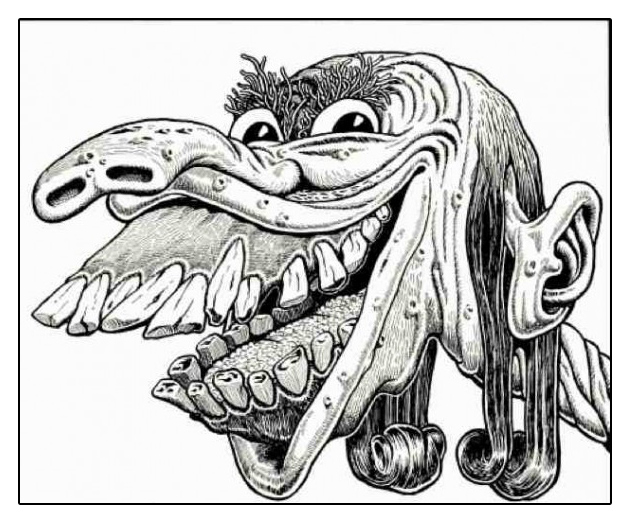
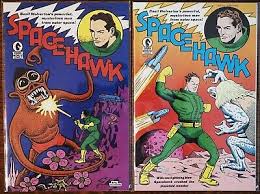
Wolverton had done comics before this one amazingly ugly picture. He did Spacehawk for Target Comics up to 1942, and he did a comic series called Powerhouse Pepper for Timely Comics (which is the company that became Marvel after the 1940’s.) But Lena not only brought him fame, it really started him down the path of his intensely detailed “spaghetti and meatballs” style of rather ugly comic art.
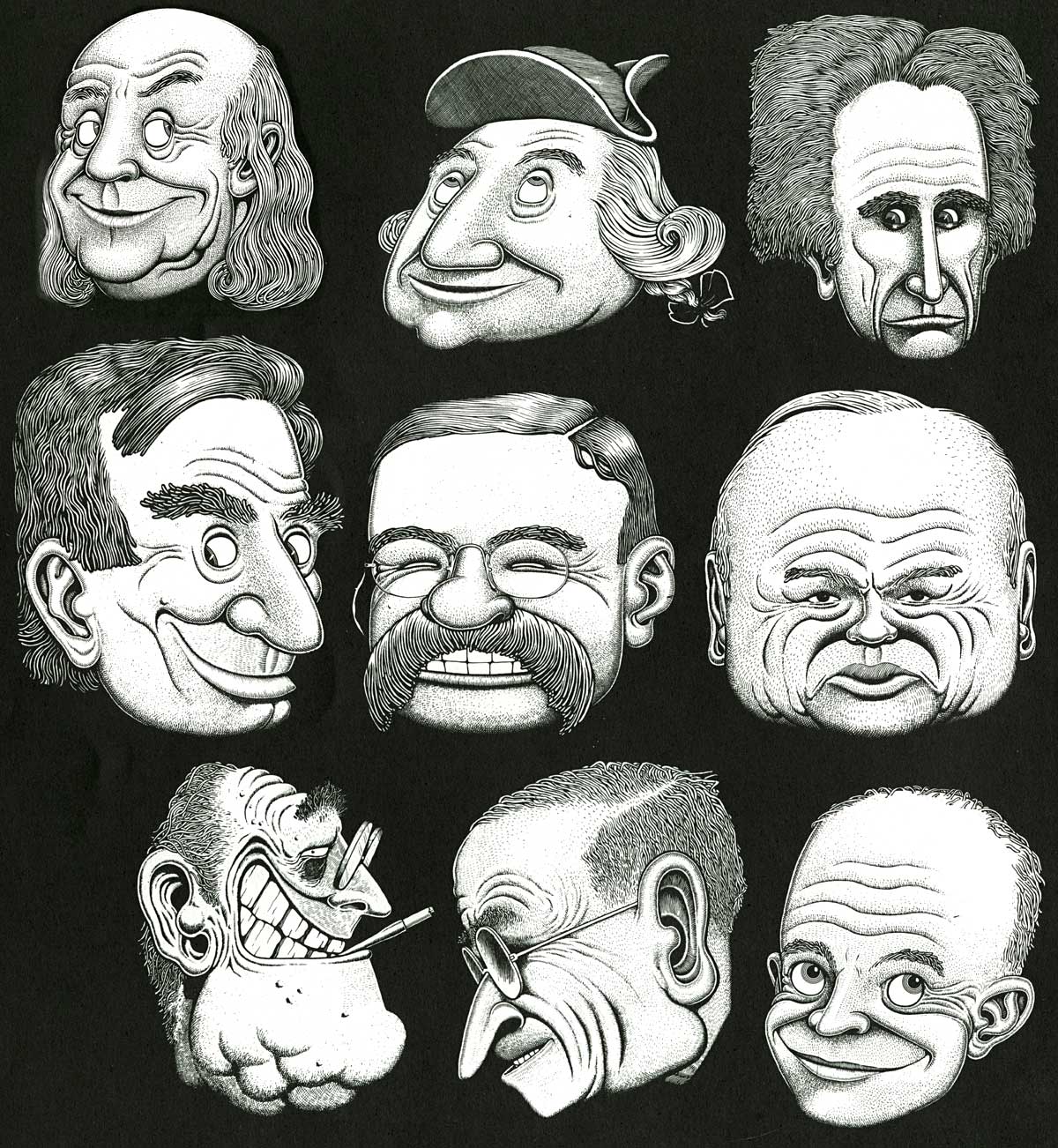
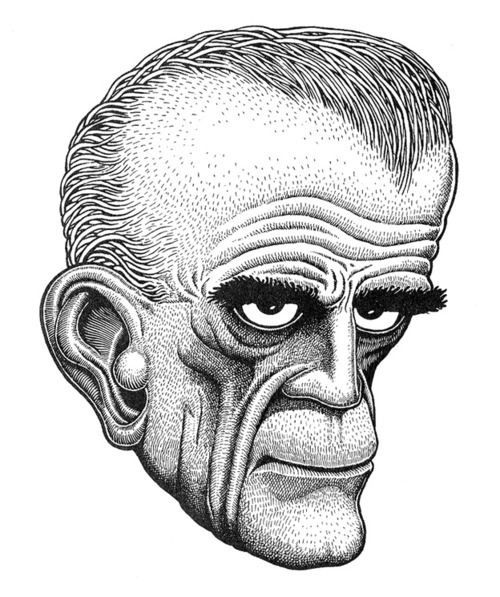
He used millions of little dots and lines to create art that would really soak up the printer’s ink supply and gave his artwork a uniquely “pointillistic” look.
Recognize these as portraits of Presidents and politicians?
Here’s Wolverton’s portrait of Bing Crosby.
And here’s monster movie monarch, Boris Karloff.
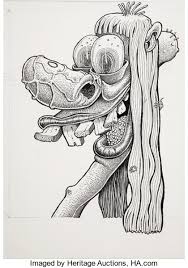
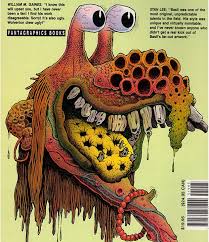
But what really made Wolverton’s unique artwork popular and lucrative was his uniquely twisted and downright ugly portraits.
ugh! wotta beauty!
Ain’t this one… um… unique?
He would go on to be featured in Mad Magazine, Cracked, Panic Magazine, and Topp’s trading card series of Ugly Posters. He managed to do work that reached amazing levels of monstrously ugly humorous mastery of pen and ink drawings.
For years Basil made me laugh. But there’s no denying it… Basil masterfully drew really, really ugly artwork.
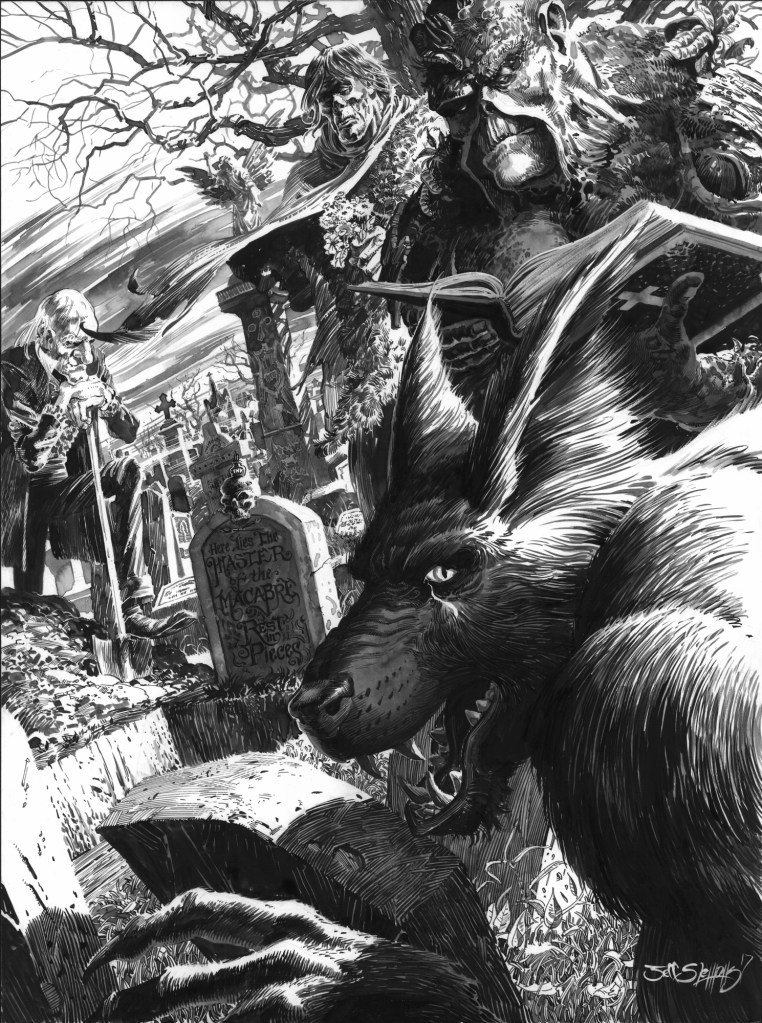
Bernie Wrightson in 1972, when I was a freshman and sophomore in high school, created for D.C. comics the character known as The Swamp Thing.
Of course,
being a stupid kid at the time, I totally ignored his genius with pen and ink, ink and brush, and fascinatingly dense forests of intricate detail.
I didn’t really get it until he joined The Studio with Jeffery C. Jones, Michael Kaluta, and Barry Windsor-Smith (whom I idolized for his work on Conan.)
And while in college, consuming everything available by The Studio that I could find and afford, I fell in love with his deeply dark and brooding illustration work for a new edition of Mary Shelley’s Frankenstein.
Frankenstein had 50 illustrations by Wrightson that firmly established the fact that by drawing with black ink you could show in startlingly real ways the qualities of white light. That appealed to me both literally as a way to make beautiful art and metaphorically, as that last thing was what I was doing with my own life, drawing the darkness to get to the beautiful light.
Most of his work
was drawing monsters; werewolves, zombies, the creatures of H.P. Lovecraft, and numerous things from nightmares.
But it has a definite beauty of its own. Darkness, evil, and corruption brings out the quality of what is light, righteous, and pure. There is truth in approaching reality from the dark side of the equation.
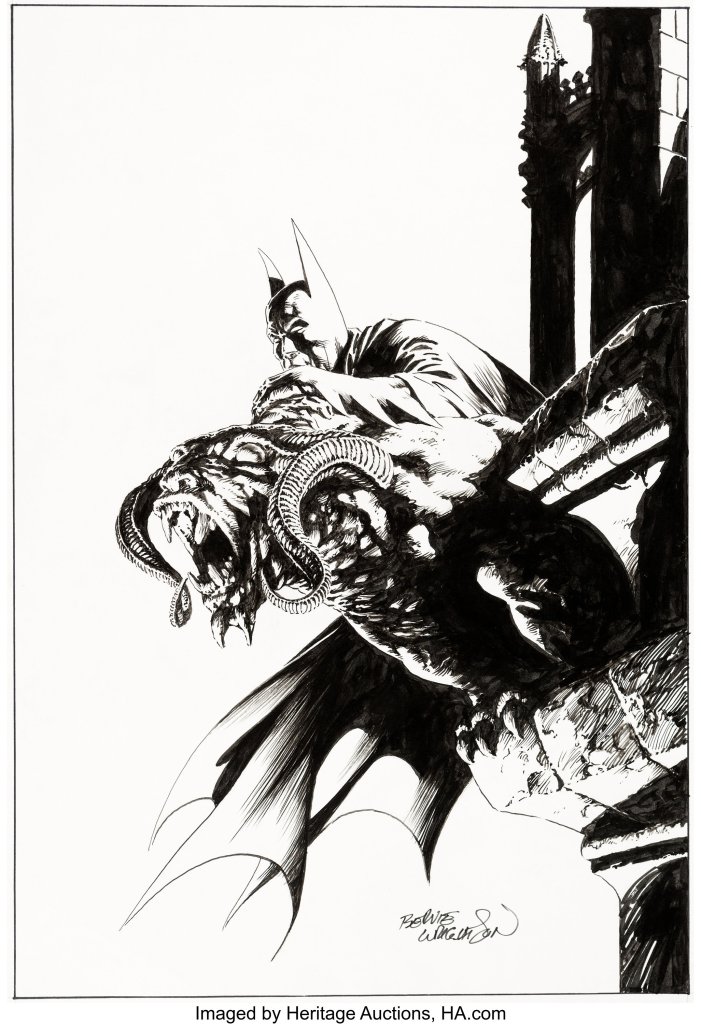
Of course, he would also do work on heroes like Batman, because the darkness breeds its own defenders of justice.
I am not so much a fan of monsters as I am a believer of taming the monsters who beset us as we try to make a worthy life for ourselves. But I can definitely see where Bernie Wrightson has been doing exactly that with his brilliant pen-and-ink artwork. Sadly, he will be doing no more of it since we lost him in 2017. But it is a legacy he left behind that will make his light continue to shine forth from dark places for a long time to come.
So, what if it is true that the future begins with the story-teller? Smart phones are obviously descendants of the communicators and tricorders and computers that Gene Roddenberry introduced to us in the original Star Trek series. George Orwell gave us timely predictions and warnings of the rise of fascism and authoritarianism in his novel, 1984.
If we truly wish to be a force for good, we have to take the evil bull by the horns and turn its momentum away from the future we seek to protect. Like Solzhenitsyn we may be gored in that bull-fight and end up spending time in the gulag. But those of us who choose to be writers, especially story-tellers, must take on that responsibility. What if ours is the story that changes the mind of a nation, like when the Adventures of Huckleberry Finn took on slavery and the unjust treatment of others who think that, because they are white, or have money, or are somehow smarter than everyone else, they have the right to abuse, take advantage, or even kill other people? What if ours is the story that turns the rich into selfish engines of greed as Atlas Shrugged obviously did?
It is a tremendous responsibility. It is a power we must not wield unwisely, even if our talent level is only that of the disastrously lazy Sorcerer’s Apprentice.
What sort of a story-teller will I be?
What sort will you be?
Where will I lead my readers (If indeed there ever are any)?
And where will you lead yours?
If any questions are important now during these days of self-reflection, isolation, and Coronavirus, it will surely be these. So, tell me what you think.