When I started this whole blogging-every-day thing, I decided the rule had to be 500 words written in a day. And I meant to hold myself to writing 500 words somewhere in the writing day, whether it was my blog post or the novel I was working on, or a combination of both. I followed that rule religiously through more than 1,500 blog posts and five first draft novels. I found it easier and easier to surpass 500 words on a daily basis. There are all sorts of bits of time available and I collect ideas faster than a rich kid generates empty candy wrappers. The more I call on the well of words for more words, the more words are available. Now, it seems, writing only 500 words is the trick.
I suppose I have become an Old Man of Words. I know both the rules and the exceptions.
Knowing that I can write more than 500 words easily, then the question becomes, why don’t I? Well, the cardinalrule is “Say it short. Say it simple. And say it sweet.” That rule can generate a lot of wonderful writing, full of juicy ideas that splash with flavor when you bite into them. Ernest Hemingway knew that rule. Every poet knows it. Readers generally prefer the easily accessible idea expressed with elegance.
Now, I also have to admit a guilty pleasure in perpetrating purple paisley prose. That is the style of writing in which I generally write convoluted sentences with complex ideas that fold back in on themselves and over-use alliteration to criminal degrees. Charles Dickens liked to do that with descriptive details. Paragraphs about the boarding schools of London, the streets filled with child chimney sweeps and flower girls, and dingy mind-dulling workhouses could take up two or three pages per paragraph. And two pages further on, he layers more details on the same setting. Piles and piles of words and wordplay fill the pages of William Faulkner, James Joyce, and Marcel Proust. And if you haven’t read at least something from each of those gentlemen, you will never know what you are missing. But you can prune your paragraphs like a greenhouse master florist with limited space will do to his orchids, and you can actually end up fitting great beauty and powerful content into something even more limited than a 500-word essay. In fact, if you take your ideas and distill them, and keep distilling them, over and over, you will eventually have pared the words down into poetry.
So, there you have it. The reason my essays are about 500 words. This one is four hundred and forty-one words.
I know the last thing you would ever consider doing is to take up writing essays like these. What kind of a moronic bingo-boingo clown wants to take everything he or she knows, put it in a high-speed blender and turn it all into idea milkshakes?
But I was a writing teacher for many years. And now, being retired and having no students to yell at when my blood pressure gets high, the urge to teach it again is overwhelming.
So, here goes…
Once you have picked the silly, pointless, or semi-obnoxious idea you want to shape the essay around, you have to write a lead. A lead is the attention-grabbing device or booby-trap for readers that will draw them into your essay. In a Mickian essay, whose purpose is to entertain, or possibly bore you in a mildly amusing manner, or cause you enough brain damage to make you want to send me money (this last possibility never seems to work, but I thought I’d throw it in there just in case), the lead is usually a “surpriser”, something so amazingly dumb or off-the-wall crazy that you just have to read, at least a little bit, to find out if this writer is really that insane or what. The rest of the intro paragraph that is not part of the lead may be used to draw things together to suggest the essay is not simply a chaotic mass of silly words in random order. It can point the reader down the jungle path that he or she can take to come out of the other end of the essay alive.
Once started on this insane quest to build an essay that will strangle the senses and mix up the mind of the reader, you have to carry out the plan in three or four body paragraphs. This is where you have to use those bricks of brainiac bull-puckie that you have saved up to be the concrete details in the framework of the main rooms of the little idea-house you are constructing. If you were to number or label these main rooms, this one you are reading now would, for example, be Room #2, or B, or “the second body paragraph”. And as you read this paragraph, you should be thinking in the voice of your favorite English teacher of all time. The three main rooms in this example idea house are beginning, middle, and end. You could also call them introduction, body, and conclusion. These are the rooms of your idea house that the reader will live in during his or her brief stay (assuming they don’t run out of the house screaming after seeing the clutter in the entryway).
The last thing you have to do is the concluding paragraph. (Of course, you have to realize that we are not actually there yet in this essay. This is Room C in the smelly chickenhouse of this essay, the third body paragraph.) The escape hatch on the essay that may potentially explode into fireworks of thoughts, daydreams, or plans for something better to do with your life than a read an essay written by an insane former middle school English teacher at any moment, is a necessary part of the whole process. This is where you have to remind them of what the essay is basically about, and leave them with the thought that you want to haunt them in their nightmares later. The last thing that you say in the essay is the thing they are the most likely to remember. So you need to save the best for last.
So, here, finally, is the exit door to this masterfully mixed-up Mickian Essay. It is a simple, and straightforward structure. The introduction containing the lead is followed by three or four body paragraphs that develop the idea and end in a conclusion that summarizes or simply restates the overall main idea. And now you know why all of my former students either know how to construct an essay, or have several years left in therapy sessions with a psychiatrist.
I had a lost crown on a molar that turned into a tooth crater that became infected. The dentist was happy. I took on almost two thousand dollars of medical debt to stop the pain. She extracted the molar and apparently, the infection is still there. After a week of antibiotics, it still hurts as if the infection is still there. Good opportunity for the Grim Reaper to use sepsis and a blood infection to do me in.
So, I am anticipating death in the near term, but hoping to avoid it. There are still several things I can do even if my dentist is a Sadist.
No matter what happens, my life is complete.
I was a teacher for 31 years. I managed to be an English department head, an ESL teacher, a teacher rated exemplary on evaluations many more times than the one time I was fired and treated like an incompetent. I made a difference for far more students than I failed. Many of them told me so later in life. I taught students whose parents I taught, and I almost lasted in one place long enough to teach a student whose grandparents were former students. I created an Odyssey of the Mind team for my Gifted and Talented students. I read to them. I even fed some of them on weekends.
I was married for thirty-plus years. I was a father of three, a band parent, a military parent, and a beloved parent.
I experienced life and art and music. I knew what beauty was. I know what wisdom is.
None of these things can the Grim Reaper or the Devil take away from me.
Any time the race actually ends, I am guaranteed to win. After all, I was only racing against myself.
Others may judge me as a fool, an egomaniac, or a buffoon. But I am okay with that. I learned early on to laugh at myself, even when others point at me and accuse me of my shortcomings. I wished to be a humorist after all. There is no one left behind me who has wronged me that I have not forgiven.
I am not ready to die, but Death cannot deprive me of anything.
It has been more than a semester now that I have not been a teacher. I am missing it mightily. I even miss the yelling and screaming, the name-calling and the crazy-eyed threats against life and limb. And that’s just me. I miss what the kids always did too. This was driven home to me as I tried to move my middle child from one school to another. We were hoping to get a bit of a break on his placement. He is a gifted child with a penchant for bizarre and long-lasting obsessions. He has a talent for building huge, monumental structures in Minecraft. He is very computer-nerd and history-wonk. (Yes, I know those are not pure predicate adjectives, but I am a retired English teacher and just don’t care any more.) I was hoping they could overlook his burnout/blowout eighth-grade brain meltdown from the previous year and give him the chance to be a ninth grader for at least half a year. No. Arbitrary rules must be obeyed. (That isn’t even how she said it. More like, arbitrary rules MUST be obeyed). That meant of course that he has to continue to repeat the mindless indoctrination of year number 9, (eight numbered grades plus K), (And Pre-K, come to think of it.) Make that year number 10. No high school yet, though he is more than mature enough, intelligent enough, motivated enough, and sweet-natured enough. We are not loving and forgiving people. We are strict and by-the-book people! Forgive me, Lord. I am writing my own book. (In more ways than one.)
This is what we are doing wrong in Education;
1. We are putting people in boxes. (Little people. Kids mostly. We are calling those boxes things like ADHD, Special Education, trouble-maker, learning disabled, emotionally disturbed, disobedient, truant, and “in need of alternative education”… here meaning kid-prison.)
2. We are sealing those boxes with heavy-duty red tape. (Read special or remedial classes as waste-baskets for keeping the rabble and the riff-raff out of the good teachers’ hair.)
3. We are routinely handing those boxes to the box-bangers and package manglers. (The semi-incompetent teachers who have discipline problems because in teacher college nobody tells you what to do with the kid who sits in the corner and sings to himself instead of paying attention, or the girl who gets out of her seat every time the teacher turns his back to go flitting around the room like a bumble bee going flower to flower (except that it is a more hormonal attraction and goes boy to boy); or the competent teacher like me who incurs the principal’s disfavor for having classes that always make noise and are given such classes in boxes as a punishment because that kind of principal is too limited in intelligence to understand that those kinds of boxes are not really a punishment if you merely take a moment to examine the treasures they contain.)
4. We keep the boxes air-tight so that no oxygen or light gets in. (To suffocate learners under piles of worksheets and endless drill and practice is murder. We are killing the precious learners with boring stuff and teaching them to be zombies who all act alike and hate learning because their brains are rotted masses of goo.)
This is what we must do instead;
1. Open the boxes up again and thoroughly mix the contents. (The rich suburban parents will resent the heck out of having their precious honors student sitting in class next to the poor black kid from the projects, but studies show that both kinds of learners do better when they are mixed together.)
2. Notice, we don’t need two any more, because learners are already distributed to different and diverse boxes based on what they individually need and want to learn about and have talent for. Groups should be more like the Shakespeare-loving group or the talkative-socializing group or the Tinker-toy builders group or the vampire-literature-writing group and less like groups of kids all the same color or all the same culture or all the same age.
3. All the teachers need to be trained to handle all the possible… no, make that probable problems that may come up in the classroom. Every classroom needs a proven veteran teacher and an enthusiastic young apprentice teacher. Neither one should have to face the evil hordes alone. And most important of all, any teacher who doesn’t love working with kids (and doesn’t love the kids in a way that will not lead to a prison term) needs be utilized in some way other than as a classroom teacher.
4. Every classroom is a laboratory and every teacher is a creative and daring mad-scientist-type intent on trying new things and only re-doing things that really work well. Forget this nonsense about standard curriculum goals and common core curriculum. Those are only buzz words for suffocating learners and being too lazy to think on your feet in the middle of the every-day classroom battle in the on-going War on Ignorance.
Now you see… I have all the answers and I know everything. The only mystery is… why don’t more people listen to me?
Life is making music. We hum, we sing to ourselves, movie music plays in our head as the soundtrack to our daily life. At least, it does if we stop for a moment and dare to listen. We make music in many different ways. Some play guitar. Some are piano players. And some of us are only player pianos. Some of us make music by writing a themed paragraph like this one. Others make an engine sing in the automotive shop. Still others plant gardens and make flowers or tomatoes grow. I chose teaching kids to read and write. The music still swells in my ears four years after retiring.
The 1995 movie, Mr. Holland’s Opus, is about a musician who thinks he is going to write a magnificent classical orchestra opus while teaching music at a public high school to bring in money and allow him time to compose and be with his young wife as they start a new family.
But teaching is not, of course, what he thought it was. He has to learn the hard way that it is not an easy thing to open up the closed little clam shells that are the minds of students and put music in. You have to learn who they are as people first. You have to learn to care about what goes on in their lives, and how the world around them makes them feel… and react to what you have to teach. Mr. Holland has to learn to pull them into music appreciation using rock and roll and music they like to listen to, teaching them to understand the sparkles and beats and elements that make it up and can be found in all music throughout their lives. They can even begin to find those things in classical music, and appreciate why it has taken hold of our attention for centuries.
And teaching is not easy. You have to make sacrifices. Big dreams, such as a magnum opus called “An American Symphony”, have to be put on the shelf until later. You have children, and you find that parenting isn’t easy either. Mr. Holland’s son is deaf and can never actually hear the music that his father writes from the center of his soul. And the issue of the importance of what you have to teach becomes something you have to fight for. Budget cuts and lack of funding cripples teachers in every field, especially if you teach the arts. Principals don’t often appreciate the value of the life lessons you have to give. Being in high school band doesn’t get you a high paying job later.
But in the end, at the climax of the movie, the students all come back to honor Mr. Holland. They provide a public performance of his magnum opus, his life’s work. And the movie ends with a feeling that it was all worth it, because what he built was eternal, and will be there long after the last note of his music is completely forgotten. It is in the lives and loves and memories of his students, and they will pass it on.
But this post isn’t a movie review. This post is about my movie, my music. I was a teacher in the same way Mr. Holland was. I learned the same lessons about being a teacher as he did. I had the same struggles to learn to reach kids. And my Mr. Holland moment wasn’t anywhere near as big and as loud as Mr. Holland’s. His was performed on a stage in front of the whole school and alumni. His won Richard Dreyfus an Academy Award for Best Actor. But his was only fictional.
Mine was real. It happened in a portable building on the Naaman Forest High School campus. The students and the teacher in the classroom next door threw a surprise party for me. They made a lot of food to share, almost all of which I couldn’t eat because of diabetes. And they told me how much they would miss me, and that they would never forget me. And I had promised myself I would never cry about having to retire. But I broke my promise. In fact, I am crying now ten years later. But they are not tears of sadness. My masterwork has now reached its last, bitter-sweet notes. The crescendos have all faded. But the music of our lives will still keep playing. And not even death can silence it completely.
I mean no disrespect to the bright spirit of Jane Austin by titling this thusly. But I do have an evil itch to confront these never-ending gremlins of public behavior. There is a need to regularly chastise the shoulder demons with the red suits, horns, and little red pitchforks. And if we listened more to the shoulder angels with the white robes, halos, and harps we would be talking these things out more carefully and logically with a view to how other people besides our bilious little little lizard-brains are affected.
Part One… Prejudice
Kim Fields from The Facts of Life
When I started teaching in the 1980s in South Texas, a popular TV show watched by many of my students was The Facts of Life. It was about a girls’ boarding school, specifically, one house mother and her charges. Not a very realistic depiction of schools in the 1980’s. But even though real house mothers would probably have at least 25 more girls to worry about and drive her insane than this TV version did, it did have a feature that gave me hope as a teacher. This show had a girl of color, something that kind of school, even in the North, would have less of than the 20% representation in this show. And, miraculously, through all the weekly girl dilemmas for a harried house mother to deal with, and the occasional social-issue shows, that one black girl was treated as just one of the girls. No more important nor any less important than any of the other girls. That was an ideal to strive for in the world of education.
The character of Tootie (Dorothy “Tootie” Ramsey played by Kim Fields) was a perky and positive character, sweet and charming, and possessing a high degree of emotional intelligence. I remember wishing I had more students like that. But I did have a number of girls exactly like that, though they were Hispanic and Anglo. We had no “black” families in Cotulla, Texas during the 80’s, and only two families and one teacher in the entire 23 years I taught there.
But prejudice is not about what color a kid is. Or what color any human being is. As a teacher, I learned early on that you have to try to love every kid you are given, no matter their personal details.
I remember teachers saying that, “Black kids are noisier than any other group, and more likely to be aggressive.” Or they also tried to convince me that, “Hispanic kids are too mature for their age and become sexually active sooner in life than they should.” Of course, there were usually examples they were talking about. But those examples weren’t proof that the prejudice is based on reality. They proved that generalizations based on race, first language, or culture are potentially hurtful. I could point to examples that might indicate that, “White kids are more likely to say racist things than non-white kids are.” That is also an unfounded conclusion that is easily disproven by a majority of examples.
The real problems a teacher has dealing with students don’t come from any prejudicial generalizations. They come from students having to endure things outside of the classroom including poverty, homelessness, physical and emotional abuse at home, malnutrition, or untreated mental or medical conditions. And sometimes the misbehavior is caused by the teacher forgetting or skipping the essential practices necessary to controlling the classroom environment.
Everybody has prejudices. My favorite color is red. I favor it almost always whenever I have a free choice among colors to use. But the problem with prejudices is how we act on them. If I burn down my neighbor’s house because he painted it green rather than red, then I have been morally reprehensible. Not racism, but still an evil act based on my prejudice.
The teenager who got away with hunting protesters and killing two white ones in Wisconsin with a “self-defense” verdict is guilty of acting on a prejudice that people who are protesting a racially motivated police shooting are properly and justifiably shot and killed for protesting in favor of their side of the controversy. He crossed a State line to a community he did not live in to be involved in that opportunity to kill someone he disagreed with using his illegally purchased AR-15 even though the victims were unarmed. Maybe you can’t prove racism. But how about prejudice against protesters who believe they shouldn’t be killed for their beliefs?
In Texas, the conservatives are using a hatred and an anti-Critical Race Theory law to exert their racism in Texas schools. The Southlake School District has fired a beloved principal because he had the poor judgement to be married to a white woman and speak his mind in an email about being against the killing of George Floyd. Apparently, he was guilty of promoting Critical Race Theory in the school even though Critical Race Theory is a law-school process for examining systemic racism in law enforcement. That, of course, is NOT taught in any Texas grade school, middle school, or high school. He was actually fired for having the opinion (while black) that George Floyd should not have been killed by policemen in Minnesota. They are transparently acting on their racism and proving the need for law schools to continue examining Critical Race Theory. Their excuse is that white kids are being taught to feel guilty of the atrocities their ancestors committed because of racism. So, apparently, how black kids feel about the same things don’t count.
Through prejudices, teachers will no longer be able to teach tolerance during Black History Month in February. The novel Beloved by Toni Morrison can no longer be taught in high schools. The book Ruby Bridges wrote about her experience with integrating the white grade school in Little Rock, Arkansas can no longer be taught in history classes.
Explain to me why this fundamentally racist prejudice is to be tolerated! But be warned, my personal prejudices are telling me to protest this crap. And you can’t fire me for having taught these things in the past since I am now retired from teaching. You’ll just have to get a teenager with an AR-15 to kill me.
Back in the 1980’s I was given the gift of teaching the Chapter I program students in English. This was done because Mrs. Soulwhipple was not only a veteran English teacher, but also the superintendent’s wife. She was the one gifted with all the star kids, the A & B students, the ones that would be identified as the proper kids to put into our nascent Gifted and Talented Program. That meant that I would get all the kids that were C, D, & F in most of their classes, the losers, the Special Edwards, the learning disabled, the hyper rocketeers of classroom comedy, and the trouble makers. And I was given this gift because, not only was I not a principal’s or superintendent’s wife, but I actually learned how to do it and became good at it. How did I do that, you might ask? I cheated. I snooped into the Gifted and Talented teacher training, learned how to differentiate instruction for the super-nerd brain, and then used the stolen information to write curriculum and design activities for all my little deadheads (and they didn’t even know who the Grateful Dead were, so that’s obviously not what I meant). I treated the little buggers like they were all GT students. Voila! If you tell a kid they are talented, smart, and worthy of accelerated instruction… the little fools believe it, and that is what they become.
Even the goofy teacher is capable of believing the opposite of what is obvious and starts treating them like super-nerds because he actually believes it. I soon had kids that couldn’t read, but were proud of their abstract problem-solving skills. I had kids that could enhance the learning of others with their drawing skills, their singing ability, and their sense of what is right and what is wrong. I had them doing things that made them not only better students for me, but in all their classes. And I did not keep the methods to my madness a secret, either. I got so good at coercing other teachers to try new ideas and methods that I got roped into presenting some of the in-service training that all Texas teachers are required by law to do. And unlike so many other boring sessions we all sat through, I presented things I was doing in the actual classroom that other teachers could also use with success. The other teachers tried my activities and sometimes made them work better than I did.
Yes, I know this all sounds like bragging. And I guess it probably is. But it worked. My kids kept getting better on the standardized tests and the State tests that Texas education loves so much. And Mrs. Soulwhipple was still the superintendent’s wife, but she did not stay a teacher forever. She eventually went to a new school district with her husband. And guess who they started thinking of when the question of who would be the next teacher for the nerd classes was considered. That’s right, little ol’ Reluctant Rabbit… that goofy man who drew pictures on the board and made kids read like a reading-fiend… me.
So, a new era began in Cotulla. In addition to still getting to teach all the deadheads (because they weren’t going to trust those precious children to anyone else, naturally), I began teaching at least one edition of Mr. B’s famous Nerd Class every school year. We actually assigned long novels and great pieces of literature for the kids to read and discuss and study in depth. Novels like To Kill a Mockingbird by Harper Lee and Across Five Aprils by Irene Hunt were read. We began talking about “big ideas”, “connections to the wider world”, and how “things always change”. We began taking on ideas like making our world better and how to help our community. Kids began to think they were learning things that were important. We did special units on Exploring Our Solar System, The World of Mark Twain, Finding the Titanic, and The Tragedy of Native American History. And we spent as much as a third of the year on each. I am myself cursed with a high IQ and a very disturbing amount of intelligence. I am the deepest living stockpile of useless facts and trivia that most of my students would ever meet in their lifetimes. And even I was challenged by some of the learning we took on. That’s the kind of thing that makes a teaching career fun. It kept me teaching and meeting new students and new challenges long after my health issues made it a little less than sensible to keep going. And if I manage to tell you a few Nerd Class stories in the near future, then at least you stand a chance of knowing a little bit about what-the-heck I am talking about. So be prepared for the worst. I am retired now, and have plenty of time for long-winded stories about being a teacher.
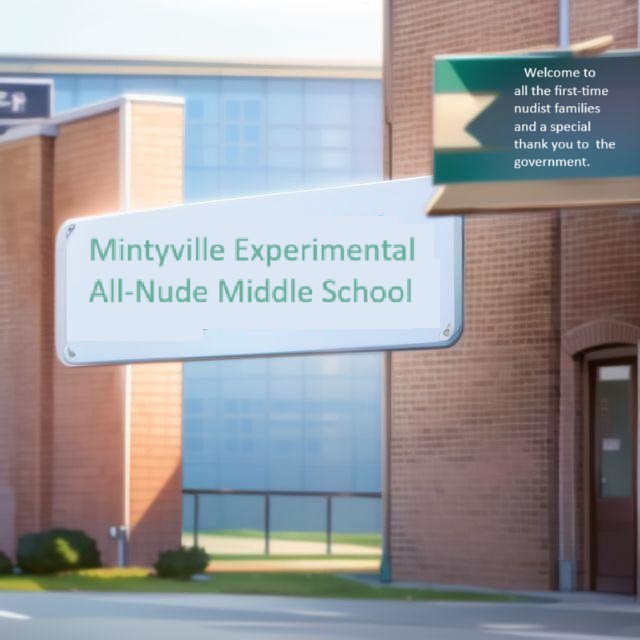
Yes, I survived all the Bible-belt monster hunters who came after me for writing my first naked middle school post. And I am no wiser for the experience. I mean to tell you why I would really like to do my whole teaching career over again in a middle school where mandatory nudity is the dress code. And if that makes me insane and somehow dangerous, remember, this is a humor blog, and we like to laugh at mentally warped individuals like me and their strange behavior.
Iris is an imaginary top student at Mintyville Experimental Middle School. History is her top subject, and she wants to be a lawyer or a political leader.
Although this essay’s argument is totally facetious and farcical, that doesn’t mean it lacks truth. Some things would obviously be easier for teachers if the school opted for a totally nude dress code. For instance, no gang colors could be worn in school. And Bloods, Crips, Ambros, Latin Kings, and future Skinheads would all be bare with their tattoos covered by the appropriate flesh-colored Band-Aids. Cell phones could be concealed in pockets only by students who had undergone painful plastic surgery to create kangaroo pouches in their thighs, and even then, they would be readily visible whenever the students stood up from desks. There would be no jealousy over expensive fashions for the rich kids or embarrassment for the poor kids with ratty clothes from Goodwill and smelly underwear that never gets washed in anything but quarter-hungry washeterias. School uniforms would be free unless you counted the expense of the original birthday suit. Textile coverings required by the outside world would remain in lockers all day along with all social media devices used for creating depression in others and suicidal thoughts in yourself. And AR-15s and pistols and other weapons would have to be left in parents’ cars for after-school Texas-style social interactions. All of these consternations and nightmares would no longer be things the teacher had to worry about.
Teachers would not have to worry about how they dress either. First, teachers would not necessarily be required to be nude. If you had an unmarried male teacher in a classroom by himself with lots of naked young ladies in all his classes, that could lead to things we hear too much about in the news already when the schools are full of textile-wearing people. If the teachers are dressed in the usual frumpy-dumpy suits and dresses from Walmart, they will not be the object of hormonal fantasies from students, as there are so many other naked targets to be fascinated by. And if the faculty decides that the only way to be fair to the students is to be nude in school too, perhaps that is an area where two teachers for every class is an optimal idea, one male and one female in every class to serve as a check on each other. Hence, both sexes have the appropriate adult role model. One English teacher and one Science/Math teacher to provide the learning guidance necessary for a truly intellectual, discovery-method curriculum where they would learn problem-solving in depth. Students would become accustomed to seeing their friends, enemies, and teachers nude and it wouldn’t take long for everyone to be desensitized to the sexual aspects of everybody being naked. Of course, there would have to be detailed “no-touching” rules enforced constantly by teachers, administrators, and fellow students. It is an opportunity to master behaviors that students don’t really get detailed instruction in during their real lives, either at home or in school.
So, what’s that red sash thingy that Sasha has in the library? Miss Shortwheeler suggested it’s the twirling ribbon she will use for the halftime performance in Tuesday’s basketball game.
In real-world middle schools where everybody wears clothes and conceals the truth and gets lots of practice at lies and prevarications, students are metaphorically naked all the time. They reveal inappropriate details about their lives at inappropriate times daily. And if the teacher tries to ignore it, they will reveal it much louder and with more inappropriate words.
Nude students, on the other hand, are more open to sharing intimate ideas and feelings in more positive discussions where everyone is equally vulnerable, and can be trained to be equally sensitive to the feelings and needs of others. It is the appropriate place to learn things like proper consent, permission, respect, safe spaces, personal spaces, and appropriate sharing of things that might’ve been too personal to consider discussing in a world hidden beneath clothing. Naked people are more vulnerable and therefore more aware of the world around them and their relationships to everyone and everything. So, I am actually saying literally naked kids are easier to teach than kids who are only metaphorically naked.
Again, naked schools are not a thing in the real world of public education. This essay is only foolish speculation and idea mangling. But I really do think that a nude school is worth studying experimentally. When you come to my house after midnight again spurred onward by the religious fervor of the Westboro Baptists, remember, I will be the one laughing loudly as I flee full speed for my very life.
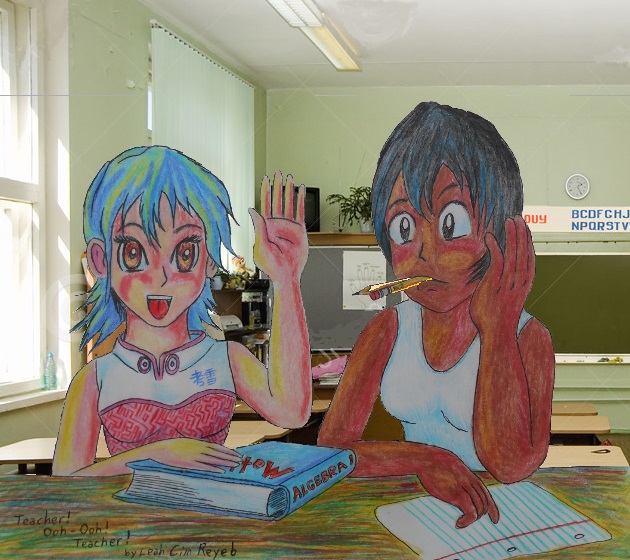
(colored pencil, pen, & ink – entitled “Math Monkey” – by Leah Cim Reyeb (my name backwards))
It has been said that if you have an infinite number of monkeys with an infinite number of typewriters, and unlimited time, they will reproduce all the works of William Shakespeare. Not only that, they will produce every other work of literature in every language on Earth that has ever been written… and that ever will be written, for all time. Not only that, but every version of Hamlet that has one misspelled word, two misspelled words, three misspelled words… and so on to infinity.
I was having an argument recently with a boy from Brazil who insisted there was no God and Creator. He claims to be an agnostic, but argues like an atheist. He was trying to “save” me from my erroneous belief that there is an underlying intelligence and purpose to all of creation. His intentions were good, but he failed to convince me before sailing off back to Sao Paulo. Alas, I am unrelentingly still convinced that I am not wrong, as he apparently believed all school teachers are by definition. Yes, it is written that way in the teenager’s guide to life, the universe, and everything. “Teachers are clueless and only teach you the wrong stuff” – page two hundred and three, in Chapter Twelve, Adults are Always Wrong. And, of course, I’m blaming it on the monkeys. It’s always those danged monkeys and their typewriters.
I tried to explain that the whole infinite-monkeys thing is based on flawed math. After all, math was invented by enraged Greeks who danced around naked in caves worshiping circles, squares, and right triangles. Pythagoras must’ve really hated school kids. He gave them all this froo-frah to learn about whole numbers, integers, algebra, and geometry and stuff, and then threw in theorems and equations to give them something to mind-numbingly practice at their desks in Math classes until they were no different from infinite-monkey typists.
If you take a pile of bricks up to the top of a mountain and then throw them off, even if you throw them an infinite number of times, how often will they actually land in the configuration of the Parthenon? …And the Parthenon with one brick out of place, and then two bricks, and …wasn’t the gol-danged Parthenon carved out of marble, not bricks? If you believe all of reality is based on random chance, then you obviously are figuring that out with infinite-monkey math. I’m not saying the Theory of Evolution is wrong. That is ordered and principled in ways that fit Occam’s Razor and is probably just as correct as the Theory of Gravity (which we don’t fully understand, either, yet we don’t go flying off into space with each rotation of the Earth).
“Wait a minute!” screams the head monkey. “Are you saying you believe in Evolution, or in Creation?” (I am constantly hearing nearly-infinite monkeys screaming that nowadays.)
Shoot, I think both things are true. You can’t deny what science offers proof for, fact or theory. Yet, God speaks to me and comforts me, even though he doesn’t actually answer prayers. The evidence of God is in all that he created, including the process of evolution, the monkeys, the typewriters (well… man-made is made by God too if he created man with inventive capabilities, right?), and even the voices in my silly head that I interpret as God talking. Am I guilty of Infinite-monkey math? I try not to be. But I also try not to argue with Brazilian teenage agnostics about the existence of God. Oh, well… can’t win ‘em all.
I have the privilege of being a public school teacher. Or maybe I should use the word “cursed”. It is no easy thing to be a teacher in the modern world. Regressive State governments like Texas mandate that teachers do more with less. We have to have bigger classes. We have to show higher gains on State tests. We have to do more for special populations based on race, disability, language-learner status, and socio-economic status. Of course, we give money to private schools to be “fair” to all, so a majority of the well-funded and advantaged students are removed from the public school system, even though studies show that their presence in classes benefits everyone. When the majority of students are low-income in a single classroom, even the gifted minority perform less well. When higher-income students are at least fifty per-cent of the class, then even the low-income and learning disabled make higher gains than the minority gifted in the first example class. So, there’s my triple-downer bummer for this post. You might think that I would agree with Republicans in this State that the lower classes are not worth investing in. Nothing could be further from the truth.
The fact is, my fondest memories from thirty-one years as a public school teacher come from the downtrodden masses, the poor, the oddballs, the disadvantaged, and even the truly weird.
Okay, so here’s the funny and heart-warming part. I have a Hispanic English Language Learner right now who looks at the beard I have grown and calls me, “my friend Jesus”. I have to constantly remind him that, “If I were the son of God, my son, then I would be using lightning bolts for discipline a little more often.” He grins at me and answers, “Yes, my Jesus.” He’s a sneaky sort, more dedicated to games and messages on his i-phone than learning. He is more into working with the girls in small groups so that he can come out appearing much smarter without putting out very much actual work.
I remember one particularly challenged boy who didn’t talk in class at all. He could make sounds, however. Constantly during classes with this student in them, there would be numerous “meows” and birdcalls. Grunts and groans and whistles would fill the air. Most of the noises came from him. The ones that didn’t, came from those who imitated him. It reached a point that I was having to teach a classroom full of Harpo Marxes . When asked about it, he claimed he had a sore throat all the time and just couldn’t talk. Many of his teachers thought he was merely sabotaging class so he wouldn’t have to do any work. But just like when you put a harp in front of Harpo, this boy had hidden talents, and just was not being engaged on his own level. He was really quite bright if you could learn to communicate with him in Harpo Marxian.
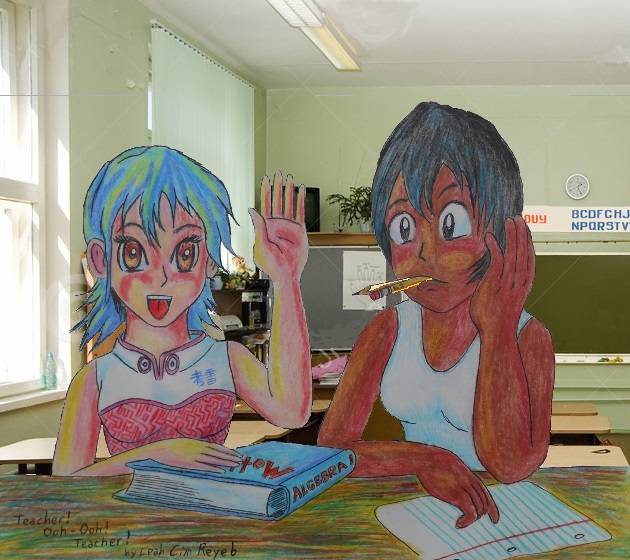
I had another student who read all the existing Harry Potter books forward and backwards, and inside out. He even looked like the actor who played Harry in the movies, glasses and all. He was treated like a radioactive being by his classmates, and although he was charming and funny and had a natural talent for manga-style drawings of people, nobody seemed to treat him like a friend. (The paffooney picture I drew for this post was inspired by him.) He was a jovial loner. I was able to tap into his natural abilities for the Odyssey of the Mind creativity contests we participated in during the early 2000’s. I helped him find nerd friends who also knew all the words to the Spongebob Squarepants theme.
I have a Chinese girl in class who shared the Spongebob boy’s fascination with manga-style art. She’s a different bird all together. She gets my jokes and thinks I am funny. But she never laughs. She never even cracks a smile. She is so careful and complete in every assignment that it is very nearly painful to watch. Grades are serious matters to her. If her grade drops from 100 to 98, she wants to audit the teacher’s grade book to find out why. She does everything in class in beautifully crafted Chinese writing, and then translates it all word-for-word into English.
I owe my teaching career to kids like these. When I started my career in 1981 for $11,000 per year, I was employed by a school that had total disciplinary meltdown the year before. I had to deal with hostility, impossible behavior-modification tasks, fire crackers in the classroom, student fights, bullying, and a language/cultural gap wider than the Grand Canyon. That first year, I was planning to resign at the end of the year and try to figure out what else I could do with my life when a small Hispanic boy with a Scottish family name came up beside me on the playground one March day and said, “Mr. Beyer, I hope you know you are my favorite teacher. You are the reason I liked school this year.”
I didn’t let him see that there were tears in my eyes. I told him something about him being my favorite student. And I gave up thoughts about giving up. I lived the next thirty years of my career for him.
















How To Write A Mickian Essay
I know the last thing you would ever consider doing is to take up writing essays like these. What kind of a moronic bingo-boingo clown wants to take everything he or she knows, put it in a high-speed blender and turn it all into idea milkshakes?
But I was a writing teacher for many years. And now, being retired and having no students to yell at when my blood pressure gets high, the urge to teach it again is overwhelming.
So, here goes…
Once you have picked the silly, pointless, or semi-obnoxious idea you want to shape the essay around, you have to write a lead. A lead is the attention-grabbing device or booby-trap for readers that will draw them into your essay. In a Mickian essay, whose purpose is to entertain, or possibly bore you in a mildly amusing manner, or cause you enough brain damage to make you want to send me money (this last possibility never seems to work, but I thought I’d throw it in there just in case), the lead is usually a “surpriser”, something so amazingly dumb or off-the-wall crazy that you just have to read, at least a little bit, to find out if this writer is really that insane or what. The rest of the intro paragraph that is not part of the lead may be used to draw things together to suggest the essay is not simply a chaotic mass of silly words in random order. It can point the reader down the jungle path that he or she can take to come out of the other end of the essay alive.
Once started on this insane quest to build an essay that will strangle the senses and mix up the mind of the reader, you have to carry out the plan in three or four body paragraphs. This is where you have to use those bricks of brainiac bull-puckie that you have saved up to be the concrete details in the framework of the main rooms of the little idea-house you are constructing. If you were to number or label these main rooms, this one you are reading now would, for example, be Room #2, or B, or “the second body paragraph”. And as you read this paragraph, you should be thinking in the voice of your favorite English teacher of all time. The three main rooms in this example idea house are beginning, middle, and end. You could also call them introduction, body, and conclusion. These are the rooms of your idea house that the reader will live in during his or her brief stay (assuming they don’t run out of the house screaming after seeing the clutter in the entryway).
The last thing you have to do is the concluding paragraph. (Of course, you have to realize that we are not actually there yet in this essay. This is Room C in the smelly chickenhouse of this essay, the third body paragraph.) The escape hatch on the essay that may potentially explode into fireworks of thoughts, daydreams, or plans for something better to do with your life than a read an essay written by an insane former middle school English teacher at any moment, is a necessary part of the whole process. This is where you have to remind them of what the essay is basically about, and leave them with the thought that you want to haunt them in their nightmares later. The last thing that you say in the essay is the thing they are the most likely to remember. So you need to save the best for last.
So, here, finally, is the exit door to this masterfully mixed-up Mickian Essay. It is a simple, and straightforward structure. The introduction containing the lead is followed by three or four body paragraphs that develop the idea and end in a conclusion that summarizes or simply restates the overall main idea. And now you know why all of my former students either know how to construct an essay, or have several years left in therapy sessions with a psychiatrist.
Leave a comment
Filed under commentary, education, humor, Paffooney, teaching, writing, writing teacher
Tagged as education, essay, essay writing, essays, foolish ideas, How to write an essay, humor, memoir, Mickian essays, teaching writing, teaching writing with humor, writing