
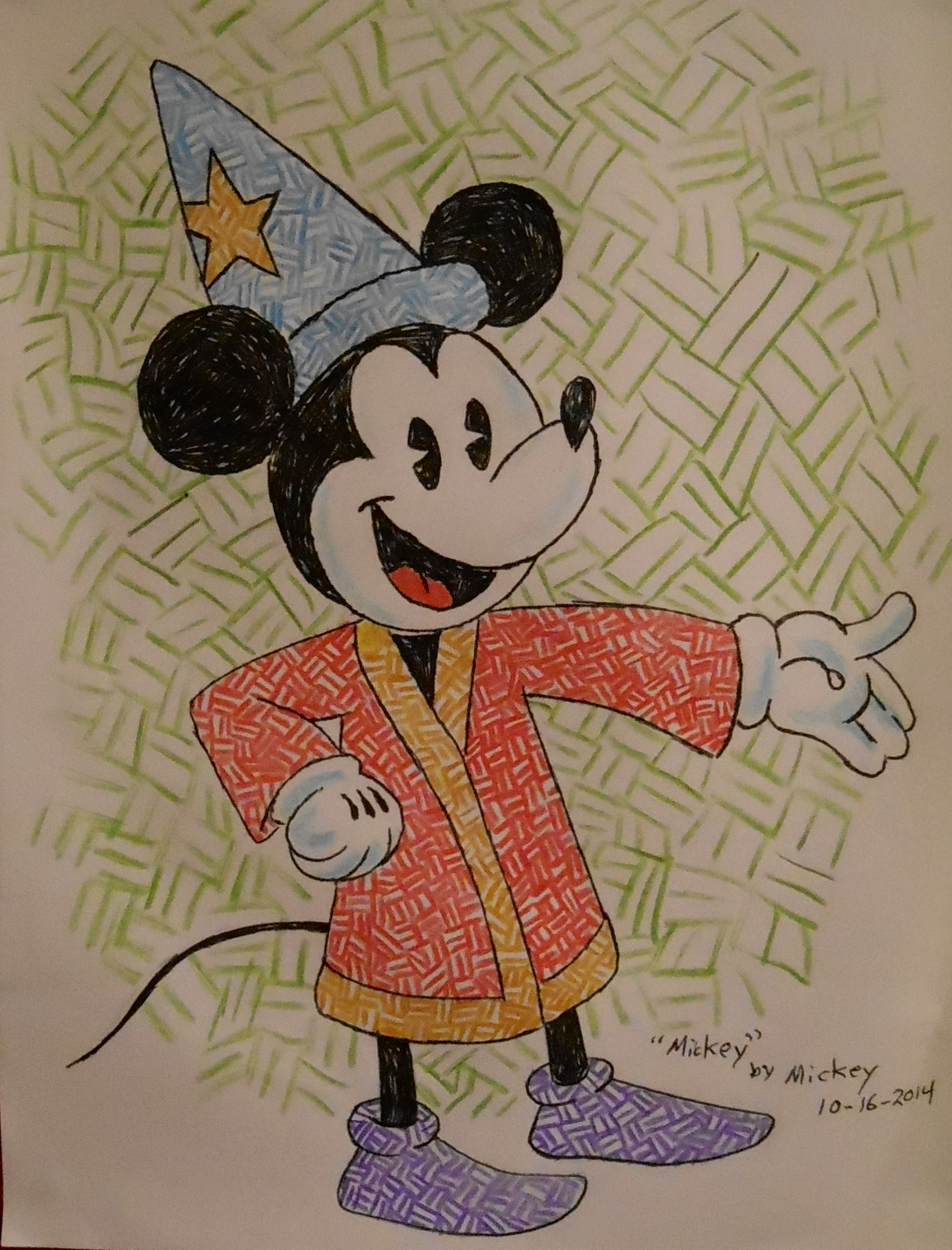
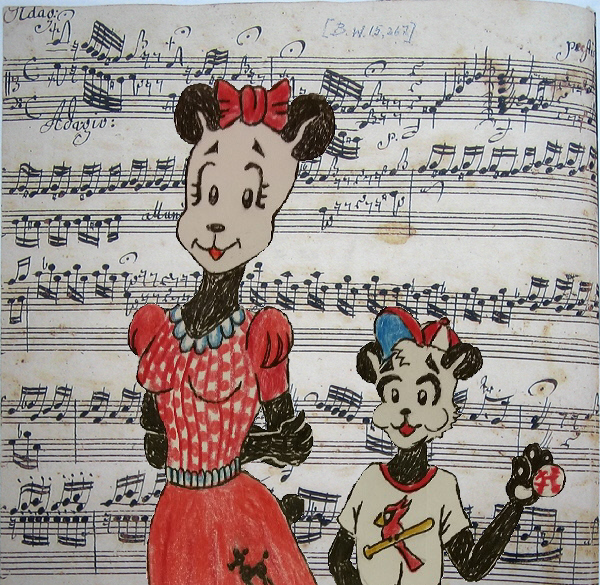
I learned a lot of what I know about cartooning by copying Disney characters. Now, I know that this post could potentially get me into trouble, because I am posting on a blog I use for marketing, an imitation Disney character, a very famous and very copyrighted character. Disney has been known to sue school districts for showing Disney movies in class without expressed written permission. They have become cruelly litigious since transforming from Uncle Walt’s Wonderful World of Color into an evil multi-national corporate media empire whose spokesperson is a mouse. So I beg you to pardon my transgressions due to love and debt I have to the work in the title of this piece. Consider this fan art, like the pictures I posted of the Phantom and Captain America (who is also now owned by Disney).
Fantasia is for me the Book of Life.
The movie starts with Bach’s masterpiece, Toccata and Fugue in D Minor. This amazing piece reminds me of earliest childhood memories. It begins with sound and the instruments that make it, becoming shapes and lines and movements and, eventually cloud forms. It is the beginning of perception, like modern art itself, the raw energy and emerging forms that I began to perceive as an infant, but could not define or distinguish clearly.
Next comes Nutcracker Suite by Pyotr Ilyich Tchaikovsky. This is the explorations of nature and the magic of existence as a mere child. It uses Tchaikovsky’s sugar-plum ballet music to depict hours of play and learning and investigation and wonder. In it I see myself as a young child, viewing all the color and beauty through wide eyes.
Then comes The Sorcerer’s Apprentice by Paul Dukas. In this piece, the child in me, like Mickey the apprentice, for the first time bites off more than I could chew. I overstep my protective boundaries and get myself into a serious fix that has to be undone by the parent stepping in at the end, and not only fixing it, but delivering the consequences to my ignorant behind with a broom. Of course, we all know I will do it again. Every child does. But next time I will get it right.
This is followed by Rite of Spring by Igor Stravinsky. Here the child is child no longer. I watch the amoeba become dinosaurs to harsh and dissonant music. I learn about the world, growing and evolving, finding out that life is full of hard lessons. Life and Death play out there struggle, and the learning concludes when you reached the parched and hopeless climax, the realization that everything, no matter how big or powerful, ends in death and failure. Dust returns to dust.
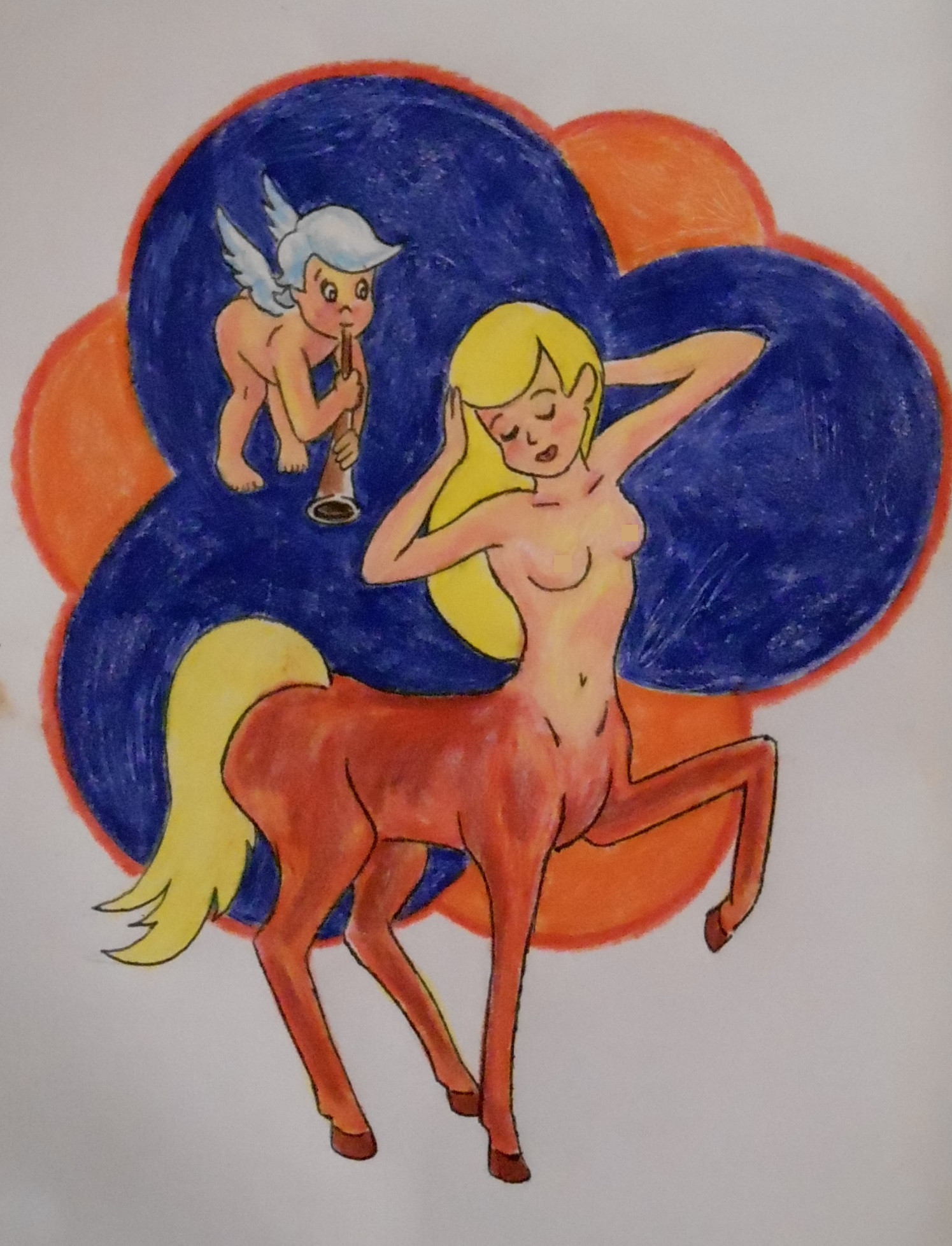
The film then blossoms into The Pastoral Symphony by Ludwig van Beethoven. This mythical landscape of cute cherubs and satyrs, bare-breasted centaurettes, and Greek Gods rendered in pastel hues represents the blooming of romance, lust, and love. There is celebration, complete with Dionysus and his invention, wine. There is courtship, attraction, and bonding. When the cherubs pull the curtain closed on the centaur couple, we also know what is happening behind the curtain even if it weren’t for the cherub whose butt becomes a red heart. And, of course, there is a great storm that comes along, both in the pastoral music and the action of the cartoon, representing the volatility and strife that occurs when we dare to love another. It does, however, subside for life to continue refreshed.
The next piece is Dance of the Hours by Amilcare Ponchielli. This comedy of ballerina ostriches and hippos, bubble-dancing elephants, and aggressively dancing gators, is the domestic, married life. It is a comedy of graceful awkwardness, beauty and humor rolled into the same cake and cooked with irony and wit. And, of course, just like real life, everything is eventually carried away by the wind… until the next dance.
And finally, Night on Bald Mountain by Modest Mussorgsky and Ave Maria by Franz Schubert is the end of life. First comes the pain and suffering of death, ruled over by Chernabog the Devil. He commands the torture and heartless ritual that I am subject to even now, in the twilight of life. The flesh and the bones yield to his trans-formative whims. We must all dance to his music until the striking of dawn. Then he is defeated and the spirit soars, free of body and definable form to the rousing strains of Ave Maria. We journey through the cathedral forest towards the everlasting light, and the movie, like my life, will be done. But I do not despair, because life, like the movie itself, can be endlessly replayed and is eternal.
I was not able to see this movie for the first time until college, attending a screening at Iowa State. When it came out on VHS in the 80’s, I bought two, one to keep and store safely, unopened, and one to watch until it fell apart. I also bought the DVD when it came out with Fantasia 2000. I cannot count how many times I have seen this movie. I even showed it to my classes as I was about to retire, and didn’t secure written permission. But it was only this week, feeling ill and terribly mortal again that I realized… Fantasia tells the story of my life.
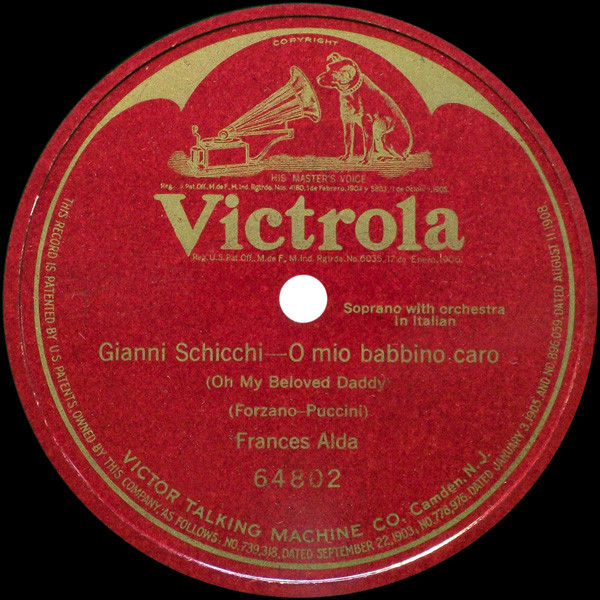





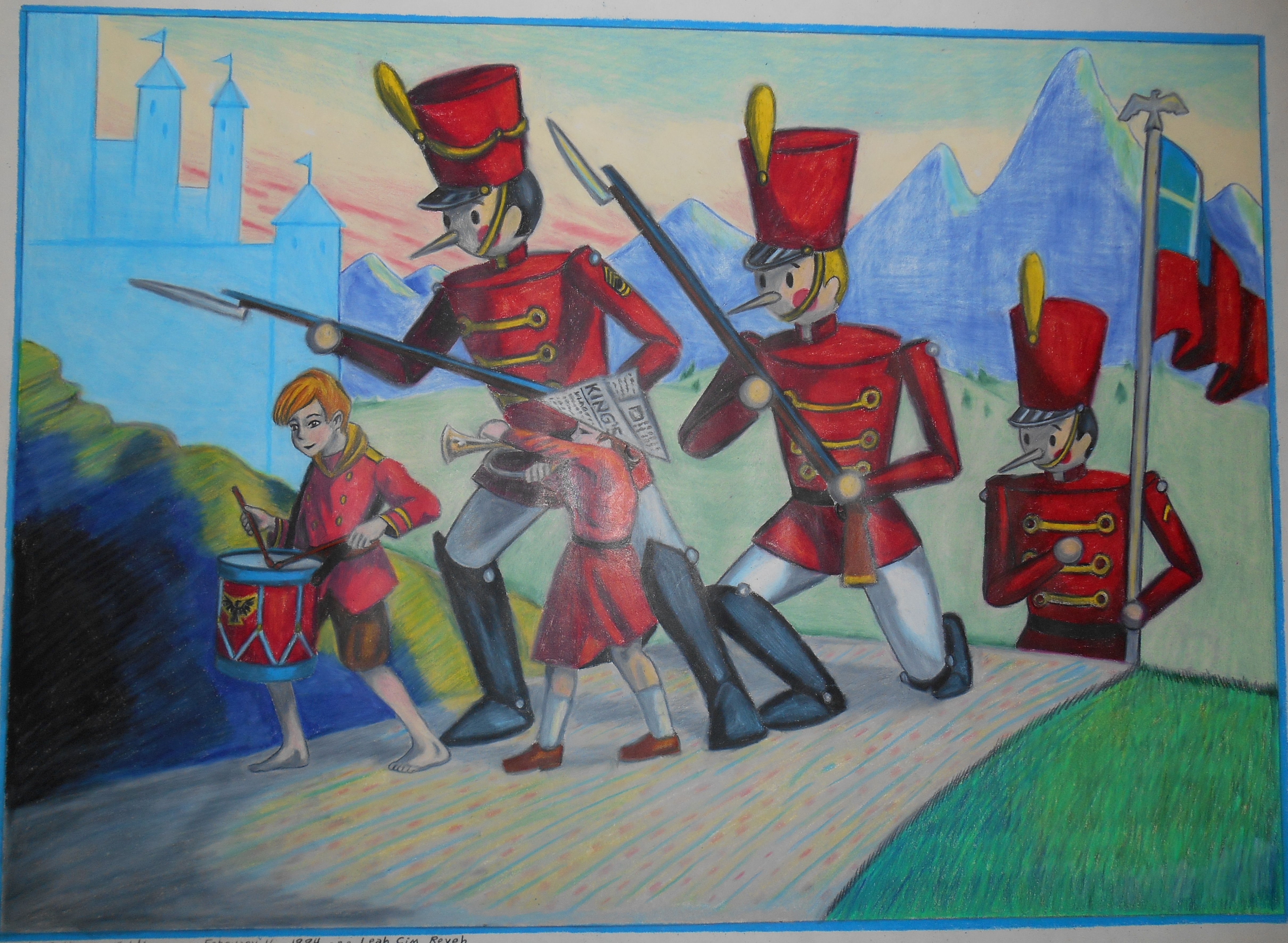


Eine Kleine Nachtmusik
It is, of course, one of the most powerful, masterful, and best-known pieces of music ever written.
Mozart completed the “little serenade” in Vienna in 1787, but it wasn’t published until 1827, long after Mozart’s untimely death.
The Serenade is incorrectly translated into English as “A Little Night Music”. But this is and always has been the way I prefer to think of it. A creation of Mozart written shortly before he hopped aboard the ferryman’s boat and rode off into the eternal night. It is the artifact that proves the art of the master who even has the word “art” as a part of his name. A little music to play on after the master is gone to prove his universal connection to the great silent symphony that is everything in the universe singing silently together.
It is basically what I myself am laboring now to do. I have been dancing along the edge of the abyss of poverty, suffering, and death since I left my teaching job in 2014. I will soon be taking my own trip into night aboard the ferryman’s dreaded boat. And I feel the need to put my own art out there in novel and cartoon form before that happens.
I am not saying that I am a master on the level of a Mozart. My name is not Mickart. But I do have a “key’ in the name Mickey. And it will hopefully unlock something worthwhile for my family and all those I loved and leave behind me. And hopefully, it will provide a little night music to help soothe the next in line behind me at the ferryman’s dock.
Leave a comment
Filed under artwork, cartoons, classical music, commentary, feeling sorry for myself, Hidden Kingdom, magic, metaphor, music, Paffooney
Tagged as amadeus, classical music, Eine Kleine Nachtmusik, Mozart, music, wolfgang-amadeus-mozart