

I have not been well. Six incurable diseases combined with colder, wetter weather will do that.
But Mickey has been busy. Yes, my goofy writer alter ego has been pecking away at a novel that pushes the boundaries of “strange” into a purple dimension where having a president that looks like a racist sour-lemon-flavored cookie dipped repeatedly in Orange Fanta with fingers covering the eye holes almost makes sense.


The novel is called Rezepte für Lebkuchen-Kinder which translates to Recipes for Gingerbread Children. The more I let Mickey work on it, the stranger it gets. It currently is about an old German lady who lives in a little Iowa town where she likes to bake gingerbread for children. But it is also a fairy tale where the fairies of Tellosia are still fighting their never-ending war against darkness. And in this story with a magical fairy war in it, there are gingerbread men who magically come to life. There are also teenage nudists, evil Nazis from the past, fairy tales that can solve life’s problems, and a lurking possibility of werewolves. (This is a companion novel to The Baby Werewolf and happens simultaneously to that story.) It has hit the 20,000 word mark. And you know how novel writing works. Too many words all put together into the same thing will magically merge and metastasize into book form. I know this is true, because I’ve seen Mickey do it before.

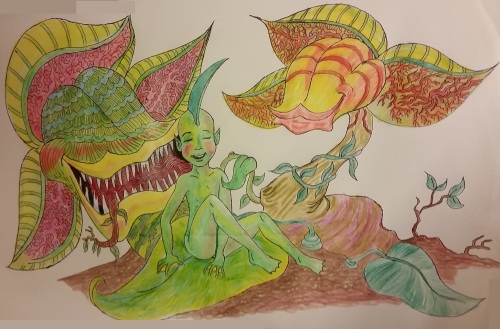
Grandma Gretel Stein talking with fairy General Tuffaney Swift.





Holy Bagumba!
I have just finished reading a wonderful book. It is a young adult novel bordering on being a children’s book. It won the 2014 Newbery Medal for best work of children’s literature. But it is a book of so many dimensions that it totally defies categories. Librarians with butterfly nets who want to pin this book down on their library shelves will be pointlessly waving their nets at it like they believe it’s a butterfly, but it will soar away from them like an eagle.
Flora & Ulysses (the Illuminated Adventures) is a combination book of many different things. G. K. Cambell’s cartoony paffoonies add to and amplify the story to the point that sometimes it becomes a graphic novel.
Flora herself is a comic-book lover and follower of the adventures of a comic-book superhero named Incandesto. Ulysses the squirrel is run over by a rogue vacuum cleaner and the accident graces him with super powers (the ability to fly and throw cats and write poetry). And Flora rescues and befriends this newly minted superhero and sets him on a path that pits him against the only super-villain available, Flora’s own mother.
At certain points, through metaphor, elegance, and supreme focus, the story itself becomes poetry. But, of course, when the poem ends with a line about the squirrel being hungry, it becomes humorous poetry, simply by the juxtaposition of the sublime with the ridiculous.
As a writer, Kate DiCamillo is a master of everything I want to be. She is as much a masterful story-teller as Mark Twain, Ernest Hemingway, or William Faulkner. But many people will be put off by the fact that she is a children’s author. They will ignore her stories because how could a children’s author affect their lives in any way? But if you are a reader who can think and feel about things in a book, she will make you laugh and make you cry and make you not afraid to die… for love of a good book.
Let me also suggest a few of her other wonderful, wonderful books;
Leave a comment
Filed under book reports, book review, commentary, good books, humor, metaphor, poetry, reading
Tagged as book review, Flora & Ulysses, Kate DiCamillo