It began in childhood with the Red Skelton Show. Every Wednesday night it was a refuge for me. And refuge was a critical idea for me. I was a child hiding a terrible secret from the entire world. At times I hated myself. Twice as a teen I came very close to choosing suicide over life. The person I most needed to hide from was myself. And humor helped. Red Skelton’s gentle humor helped me to not only escape from myself for a while, it taught me to laugh at my own foibles and not take things quite so seriously.
media.npr.org
In my college years I discovered humor in written form. Mark Twain swiftly earned my utter devotion as I read not only Huckleberry Finn and Tom Sawyer, but Roughing It, A Connecticut Yankee in King Arthur’s Court, Pudd’nhead Wilson, The Mysterious Stranger, and The Autobiography of Mark Twain. You know, there are a large number of things in Mark Twain’s humorous books that make you cry, that make you angry, and make you think deep thoughts. I basically discovered that humor is a way that smart people choose to think of things which helps to keep you sane and basically un-suicided.
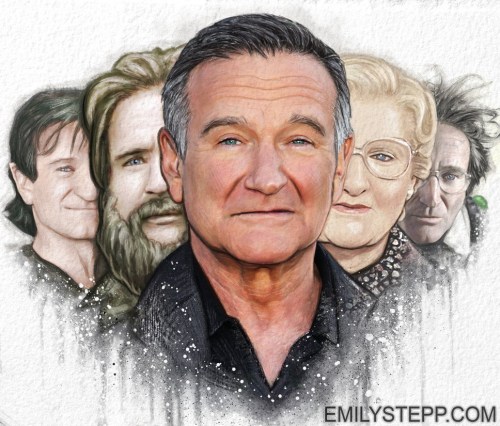
A beautiful portrait by artist Emily Stepp
It is obvious that some people become very skilled at humor because they have used it all their lives to fight the darkness . Robin Williams is only few years older than I am. In many ways his life has paralleled my own (obviously minus the wealth and fame in my case… but what would’ve happened if Robin had become a school teacher?) I have depended on Robin Williams’ movies to keep me going, giving me insights in how to talk to kids, how to be a parent, and how to empathize with others. Of course, I haven’t yet taken some of his movie advice. I never put on a mask and a dress to deceive my own children. But only time will tell.
I obsess about humor and how you create it. I gorge on things like the works of Dave Barry. Do you know who he is? Florida newspaper columnist who writes books about everyday life and the fools who live it? I have to do a post on Dave Barry, because he makes me laugh so hard that milk shoots out of my nose, sometimes when I am not even drinking milk… believe me, I don’t know how that works either.
A bust of Herman Munster
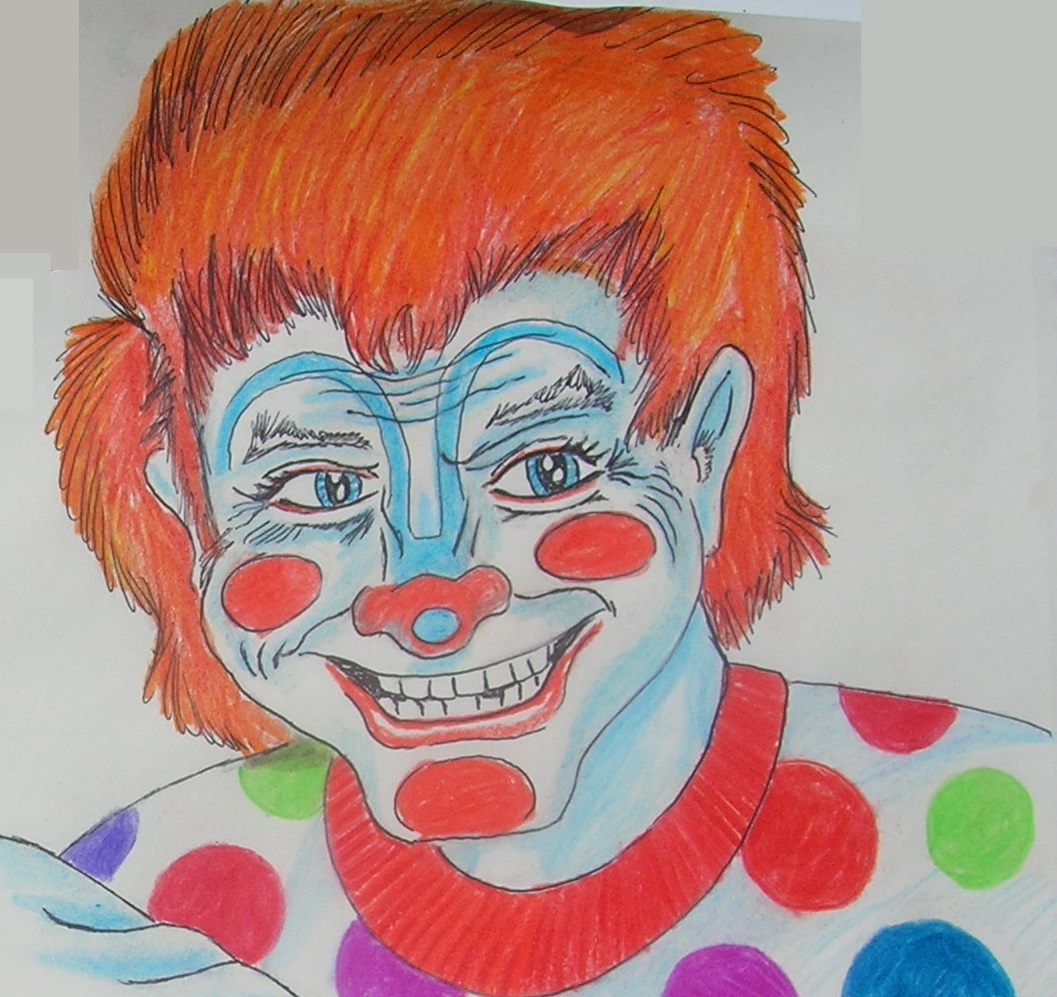
Doofy Fuddbugg here is an example of what a “Nolt” is.
I love to laugh. It makes the world right again. I have laughed an awful lot for almost an entire lifetime now. I treasure all the funny people I have known. And I need to continue to try to make people laugh up until the very end. Because the world is too often not a funny place. It can be full of badness and sadness and suffering. And as Mark Twain so aptly pointed out, “Against the assault of laughter… nothing can stand.”
The author without his make-up and after imbibing extra caffeine.
I am attempting to be a humor writer. There’s a statement that calls for more than a little rationalization. Why would anyone want to be funny? Especially why would a manic-depressive sick-old former school teacher want to be funny and write books for young people that tackle subjects like suicide, lying, nudity, sex, trans-genderism, death, suffering, religion, alien invasions, and getting old? (Well, okay, getting old is inherently funny… especially the noises you unintentionally make from orifices and joints whenever you try to sit, move, lift, eat, or breathe.) I ask myself this question only because I need to get to 500 words and stretch out the hoopti-doo to cover up the fact that I already know the answer and it is short and simple. Joking about the things that tear your life apart is the only way to handle things and not become a serial killer. (Make that cereal killer, especially Kellogg’s cereal of any and every description. I am a very loving and accepting fool at heart and could never kill even one person… probably even in self-defense.) I recently took a Who-do-you-write-like test that I found on another blog at All Things Chronic. Here is the link; https://painkills2.wordpress.com/2015/05/31/who-do-you-write-like/
That silly little analyzer took a bit of my purple paisley prose and churned out a horror-writer answer, H.P. Lovecraft. The Lord of the Old Mad Gods and Moonbeasts is a particular favorite of mine, one of several writers whose novels I have read everything I can get my hands on. I still sleep with the lights on at night because of The Dunwich Horror, and The Shadow Over Innsmouth. I am mad with admiration for his allusions to gibbering sounds and unholy terrors that taint and transfix our lives with fear to the very marrow of the bones. I have to admit, I like the idea of being compared to him, in spite of the fact that he tries to inspire fear and madness, while I aim for goofiness and gaiety. It is a delicious irony to try always to be Mark-Twain funny while writing with a horror writer’s convoluted and dictionary-intensive style.
And don’t get the idea from my mention of him in this self-reflecting ramble through jumbled ideas that I really believe I am as funny as Mark Twain. I am not deluded or mentally ill… well, not deluded, anyway. I am still learning to make people laugh with words. And I don’t mean to be mean about it. I don’t do George Carlin F**k-the-world-style humor. I don’t even do Don Rickles-style insults. I am more in favor of gentle humor. I am not looking to call anybody names or trying to make certain folks look like Biblical-word-for-donkeys. (Not even Republicans named Rick in yesterday’s post). I want to show fictional people undergoing some of the dark things that filled my life with hurt, and doing it with the grace and good humor that only comes from a heart full of self-sacrificing love. (Gee, no wonder I find comedy hard… I have chosen the most difficult and elusive kind of humor for my art. I’d do a lot better with poo-poo jokes.) (Oh, wait, I do poo-poo jokes, don’t I. This one counts too.)
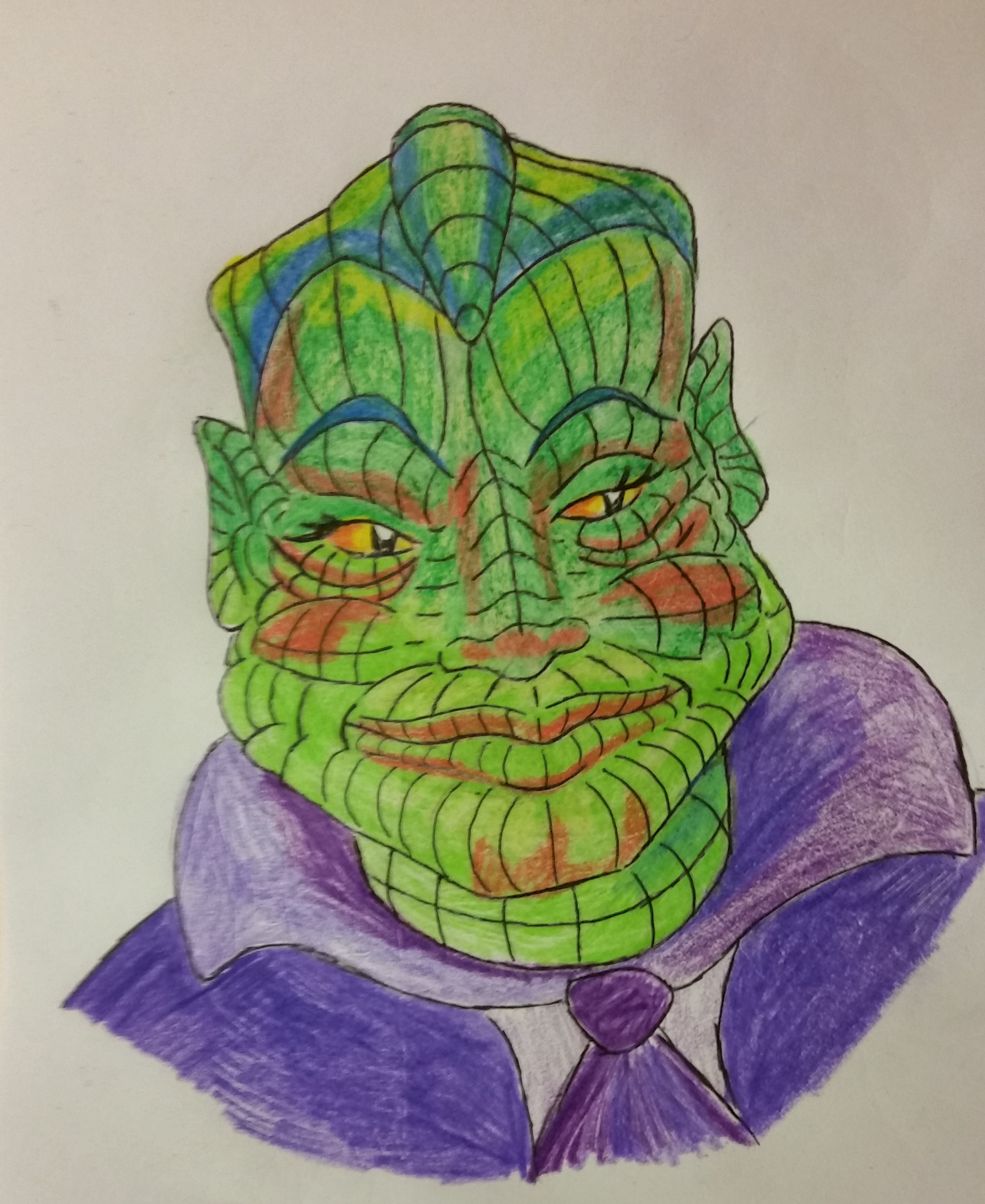
I wonder if I made a mistake yesterday in portraying Senator Ted Cruz as a lizard man from outer space. Was that a mean, name-calling sort of joke? Or was I painting him in broad, humorous strokes with my colored pencils? Once again, you can be the judge. Here’s the picture again. And you get to decide if anything I have ever said is funnier than it is just plain sad.
It began in childhood with the Red Skelton Show. Every Wednesday night it was a refuge for me. And refuge was a critical idea for me. I was a child hiding a terrible secret from the entire world. At times I hated myself. Twice as a teen I came very close to choosing suicide over life. The person I most needed to hide from was myself. And humor helped. Red Skelton’s gentle humor helped me to not only escape from myself for a while, it taught me to laugh at my own foibles and not take things quite so seriously.
media.npr.org
In my college years I discovered humor in written form. Mark Twain swiftly earned my utter devotion as I read not only Huckleberry Finn and Tom Sawyer, but Roughing It, A Connecticut Yankee in King Arthur’s Court, Pudd’nhead Wilson, The Mysterious Stranger, and The Autobiography of Mark Twain. You know, there are a large number of things in Mark Twain’s humorous books that make you cry, that make you angry, and make you think deep thoughts. I basically discovered that humor is a way that smart people choose to think of things which helps to keep you sane and basically un-suicided.
A beautiful portrait by artist Emily Stepp
It is obvious that some people become very skilled at humor because they have used it all their lives to fight the darkness . Robin Williams is only few years older than I am. In many ways his life has paralleled my own (obviously minus the wealth and fame in my case… but what would’ve happened if Robin had become a school teacher?) I have depended on Robin Williams’ movies to keep me going, giving me insights in how to talk to kids, how to be a parent, and how to empathize with others. Of course, I haven’t yet taken some of his movie advice. I never put on a mask and a dress to deceive my own children. But only time will tell.
I obsess about humor and how you create it. I gorge on things like the works of Dave Barry. Do you know who he is? Florida newspaper columnist who writes books about everyday life and the fools who live it? I have to do a post on Dave Barry, because he makes me laugh so hard that milk shoots out of my nose, sometimes when I am not even drinking milk… believe me, I don’t know how that works either.
A bust of Herman Munster
Doofy Fuddbugg here is an example of what a “Nolt” is.
I love to laugh. It makes the world right again. I have laughed an awful lot for almost an entire lifetime now. I treasure all the funny people I have known. And I need to continue to try to make people laugh up until the very end. Because the world is too often not a funny place. It can be full of badness and sadness and suffering. And as Mark Twain so aptly pointed out, “Against the assault of laughter… nothing can stand.”
My experience of the works of Kurt Vonnegut is limited to the reading of three books; Cat’s Cradle, Breakfast of Champions, and Slaughterhouse Five. But it was enough to make me love him and use him as a shaper of my soul.
I deeply apologize for the fact that even though he only wrote 14 books and a bunch of short stories, I have not read everything I could get my hands on by Kurt. Three novels and one short story (Harrison Bergeron) is not really enough to compare to the many, many things that I have read by Mark Twain, Terry Pratchett, Louis L’Amour, and Michael Crichton. I can’t begin to count how many books of each of those four I have read and reread. But it is enough that I read those three novels and have a lifelong regret of never buying and reading Slapstick when I had the chance. Vonnegut writes black humor. The ideas are painful, and burn away flesh from your personal body of being. And at the same time, you cannot help but laugh at the pure, clean, horrifying truths his ridiculous stories reveal.
If, in the course of telling a story, you can put the sublime, the ridiculous, and the horrendous side by side, and make the reader see how they actually fit together, then you can write like Vonnegut.
Let me give you three quick and dirty book reports of the Vonnegut I have read in the order I have read them;
I read Cat’s Cradle in college. I was young and idealistic at the time, foolishly convinced I could be a great writer and cartoonist who could use my work to change mankind for the better.
In the book, Dr. Felix Hoenikker (a fictionalized co-creator of the atomic bomb) is obsessively re-stacking cannonballs in the town square in pursuit of a new way to align water molecules that will yield ice that does not melt at room temperature. Much as he did with the A-bomb, Hoenikker invents a world-ending science-thing without any thought for the possible consequences. The narrator of the novel is trying to write a humanizing biography of the scientist, and comes to observe the inevitable destruction of the whole world when the oceans freeze into Ice-9, the un-meltable ice crystal. Before the world ends, the narrator spends time on the fictional Carribean island of San Lorenzo where he learns the fictional religion known as Bokononism, and learns to make love to a beautiful woman by pressing bare feet together sole to sole. It is a nihilistic picture of what humans are really like more savagely bleak than any portrayal Monte Python’s Flying Circus ever did on TV.
Needless to say, my ideals were eventually shattered and my faith in the world shaken.
I read Breakfast of Champions after I had been teaching long enough to buy my own house, be newly married, and a father to one son. It was probably the worst time of life to be reading a book so cynical, yet true.
In this story, the author Kilgore Trout, much published but mostly unknown, is headed to Midland City to deliver a keynote address at an arts festival. Dwayne Hoover is a wealthy business man who owns a lot of Midland City real-estate. Trout gives Hoover a book (supposedly a message from the creator of the universe) to read that suggests that all people (except for the reader of the book… meaning Hoover) are machines with no free will. Hoover takes the message to heart and tries to set the machines free by breaking them, beating up his son, his lover, and nine other people before being taken into custody.
The book contains devastating themes of suicide, free will, and social and economic cruelty. It makes you sincerely reflect on your own cog-in-the-machine reality.
Slaughterhouse Five is a book I bought and read when I missed my chance to buy Slapstick and needed something to take home from HalfPrice Books to make me feel better about what I missed. (Of the five books I had intended to buy that day, none were still on the shelves in spite of the fact that they had been there the week before.) It was fortuitous. This proved to be the best novel I had ever read by Vonnegut.
Like most of his work, the story of Billy Pilgrim is a fractured mosaic of small story pieces not presented in chronological order. It details Billy’s safe, ordinary marriage to a wife who gives him two children, but it is ironically cluttered with death, accidents, being stalked by an assassin, and being kidnapped by aliens. It also details his experiences in World War II where he is captured by the Germans, held prisoner in Dresden, kept in an underground slaughterhouse, and ironically survives the fire-bombing of Dresden by the Allies. Further, it details his time as a zoo exhibit on the alien planet of Tralfamadore.
It explores the themes of depression, post-traumatic-stress disorder, and anti-war sentiment. Vonnegut himself was a prisoner of war in Dresden during the fire-bombing, so real-life experiences fill the book with gravitas that it might not otherwise possess. Whether the author was ever kidnapped by aliens or not, I cannot say.
But Kurt Vonnegut’s desire to be a writer and portray himself as a writer in the character of Kilgore Trout, and even as himself in his work, has an awful lot to do with my desire to be a writer myself. Dark, pithy wisdom is his thing. But that wisdom, having been wrung from the darkness is all the more brightly lit because of that wringing. It is hard to read, but not hard to love.
I think a lot of thoroughly thoughtful thuggish thoughts that build and build and build up an idea, and then turn around and knock it all down. Let me demonstrate by knocking down that title right off the bat. Rene DesCartes in the early 1600’s said, “Cogito Ergo Sum”, and he thereby totally disrupted the world as we knew it. Didn’t get that? Let me translate. He said, “Je pense, donc je suis.” Still didn’t help? Okay, here’s the English, “I think, therefore I am.” In other words, the one thing that I know for sure is that I am thinking this particular thought at this particular time. If I am thinking, and I know I am, I must be here and I must be real. So there is one thing I know for certain. But do I know anything else for certain? Uh-oh. How do I know anything? I have to rely on my senses. And my senses lie to me all the time. I am partially color blind, so I don’t see the world the same way you do. I don’t see things in black and white, like Great Grandma Hinckley did in her 90’s, but the colors look different to my eyes than they do to yours and I will never know what things look like to you. Forget politicians and all other people who tell lies, my own eyes lie to me constantly. So can I know anything for sure? Of course not. All I have are firm beliefs based on imperfect senses and best guesses at what is true. So what I am actually talking about is a list of potential essay ideas that I am merely asserting as true based on my imperfect goofy thinking of thoughtful thuggish thoughts.
Idea #1 that I think is certainly possibly maybe true; My brain was taught and I was raised to adulthood by the movies I saw when I was young. I want to talk about this at length in another post. The video is by a guy who was a kid in the 80’s, and he has some really awesome movies to offer as a way to delineate his rise to adulthood.
My list includes the movies of my boyhood seen in the Belmond Theater and on our old black and white Motorola TV. My list of movies that raised me includes Chitty Chitty Bang Bang, The Sound of Music, Mary Poppins, and The Wizard of Oz.
Idea #2; Animals are people too.
This slideshow requires JavaScript.
I mean, as a writer for young adults, I know for a fact that animals are relevant as characters. They have a point of view, feelings, reactions, and complex lives that people rarely pay attention to. I have to write about this some time in the future too.
Idea #3; The worst things that happen to us in our lives, are also the best things that happen. Wow! What a difficult essay topic. But I not only think it, I can prove it… at least to myself. But can I write about it? Time will tell.
Idea #4; Silly thoughts and serious thoughts are two sides of the same coin. And this will be particularly difficult to think about if thoughts are literally coins. That would mean that my head is full of metal, and I know several people who would read that sentence and shout, “I knew it all along!” Fortunately they are all too sensible to read this far in one of my blog posts.
So, at 600 words I still have lots more to say. But people with metal in their heads often talk way too much, so my concluding sentence will be simply; “I promise to shut up for now.”
I have to because somebody has to control the words.
People are made of words. Their identity, their inner self, their reason for existence… all made of words. The very thoughts in their heads are… words.
If I want to control the words I am made of, then I must be the writer who writes his own story.
I don’t want anyone else to write the words that essentially become me. Do you?
Of course, authors create characters. Even autobiographers create characters. Carl Sandburg could no more make his words into Lincoln than a bird can make its tweets into a cat. Sandburg can, however, help us to understand Lincoln as Carl Sandburg understands the words that are Lincoln.
Lincoln probably did not have the words for “bikini girls” in his head when he wrote those words in the second quote. But somebody thought that the picture would help us understand the words. By all accounts, Lincoln was not a particularly happy man leading a particularly happy life. But he showed us the meaning of his words when he stood firm against the strong winds of harsh words and bad ideas in a terrible time. And he was as happy about it as he made up his mind to be.
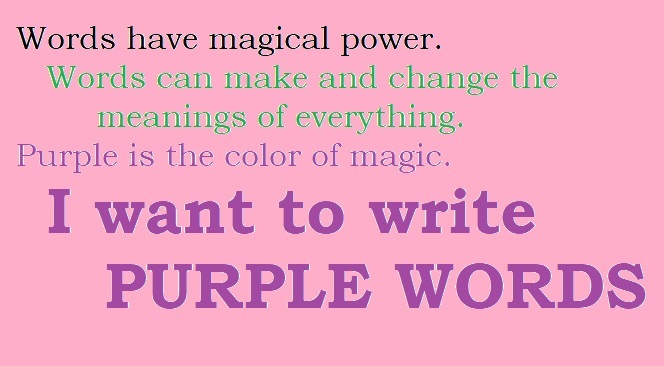
I, too, have not lived a particularly happy life. But I was always the “teacher with a sense of humor” in the classroom, and students loved me for it. Funny people are often not happy people. But they make themselves out of funny words because laughter heals pain, and jokes are effective medicine. And so I choose to write comedy novels. Novels that are funny even though they are about hard things like freezing to death, losing loved ones, being humiliated, being molested, and fear of death. Magical purple words can bring light to any darkness. I am the words I choose to write in my own story. The words not only reveal me, they make me who I am. And it is up to me to write those words. Other people might wish to do it for me. But they really can’t. The words are for me alone to write.
And so it is imperative that I write my words in the form of my novels, my essays, and this goofy blog post. I am writing myself to life, even if no one ever reads my writing.
This is an old re-purposed post from 2016 to kill some time so that this blog doesn’t kill me.
Life is hard here in the Kingdom of Paffoon where you labor hard at a labor of love and try to give birth to something eternal that ends up going nowhere… stacks of old writing litter my closets, and the prospects of being published grow dimmer and dimmer. My book Snow Babieshas a contract with a publisher, but, apparently they are not going to be able to publish it after all. I am at the very least going to have to find another publisher for the rest of my books, both finished manuscripts and works in progress.
I do intend to follow through and get published, though. I can no longer teach, but I feel a powerful force pushing me towards the sheer precipice of authordom. One way or another I am going to make it over the edge and plummet to the bottom of that cliff. I am compelled by the need to tell stories, and I have a captive audience every school day no longer.
I used to tell my classes that doing impossible things was like trying to pull chicken teeth with pliers. You know, impossible things like getting a book published or teaching a mostly Spanish-speaking student how to read in English… every-day-sort-of impossible things.
“But, Mr. B, chickens don’t have teeth,” some bright-eyed student would say after realizing that “chicken” was the English word for “pollo”.
“Exactly!” I would say. “That’s what makes it so challenging!”
And now I must put on my chicken-catching socks, find my tooth-pulling pliers, and get ready to make more novels happen. After a brief bout of consternation and depression, I actually feel a bit better about the whole fiasco. There are other publishers, and publishers seem to like my writing, even if they can’t publish it. And I have waited two years to get Snow Babies published, all apparently for nothing. It is time to stop wasting time. And maybe to stop repeating repetitions too.
I would like to here note that I now have 21 books published, all but one of which is self-published on Amazon and fully under my control. My other book, the award-winning novel from I-Universe, Catch a Falling Star, continues to be little-purchased and less read, though I discovered they pay all my royalties to my wife’s bank account. That was unexpected. Chicken teeth where they can’t be reached by me.
I have always contended that I don’t have writer’s block. But some days, especially if I am not feeling well, I have writer’s lethargy. I can be slow to come up with the next thing. Writing can become bogged down and I am easily distracted or lose focus and have to return to what I was trying to do previously.
There is evidence that I have often had that kind of problem frequently on this blog. One thing I do to overcome writer’s lethargy is suddenly start thinking about how you can overcome writer’s block. What are the strategies that help me overcome it?
I often resort to “kickstart statements.” These are surprising or deep-left-field items that give the old brain a shot of adrenaline. The picture of the girl with the message blackboard is that kind of kickstarter. I never could have used that thing in any kind of social-media post when I was still employed as a teacher. It has the potential to generate parent complaints and administrative thoughts about evaluations and contract cancellations. But there really are kids who have thoughts like that in your classroom, and I know because not only was I a kid like that myself, I used it as an optional journal topic for writing practice, and, boy! do they ever catch fire when they can write about something like that and they know only the teacher is ever going to read it. It is the way I learned how many of my students had ever been to a nude beach in Corpus Christi or Lake Travis (Hippy Hollow.)
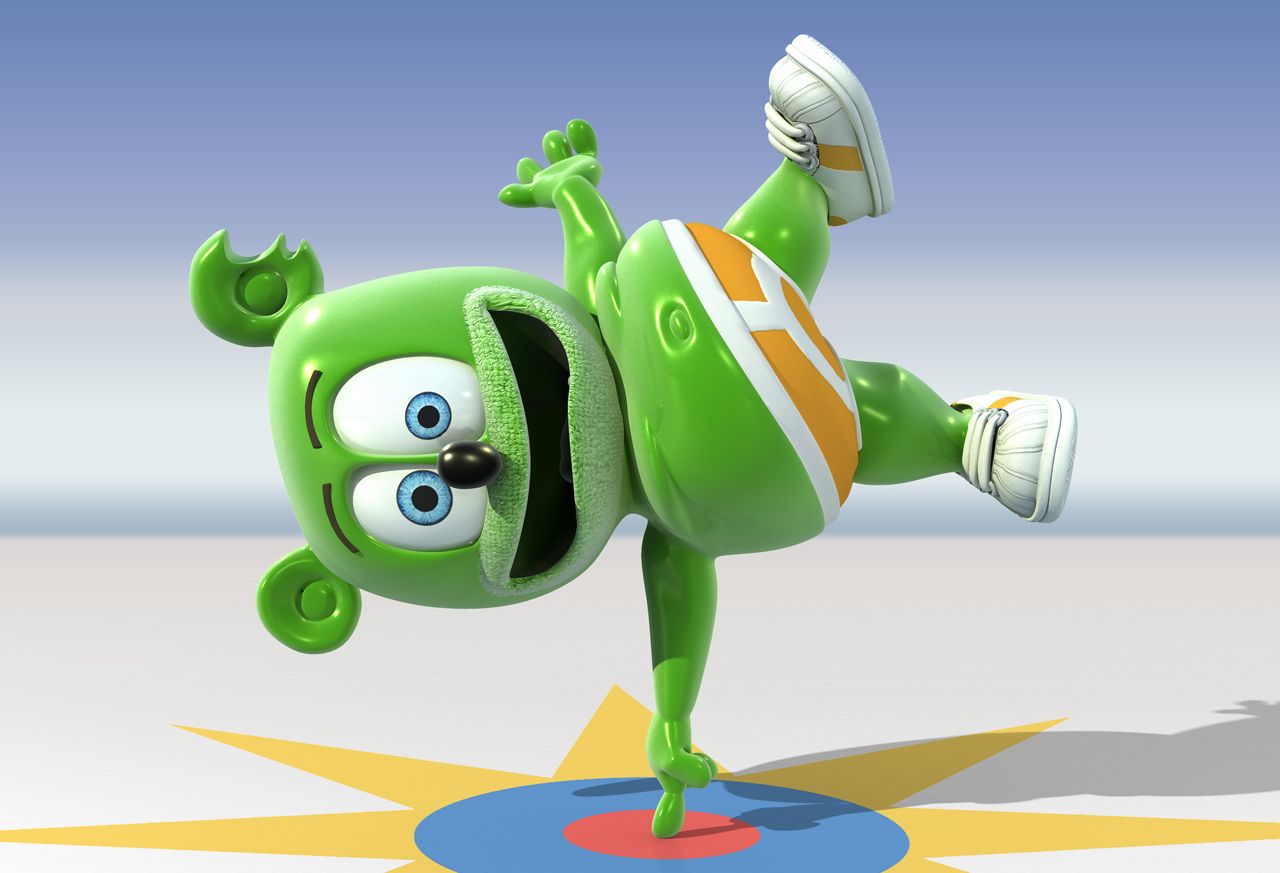
I can also look around the room, or scroll through my media library on WordPress and find an image or an item that generates ideas, responses, and even stories. I scrolled through to find this image of the Gummi Bear, who was a brief internet sensation on YouTube a few years ago coming from German CGI cartoons that illustrated earworm music with dancing green gummy bears. There’s a lot a goofy writer like me can run away with inspired by a nonsense thing like that.
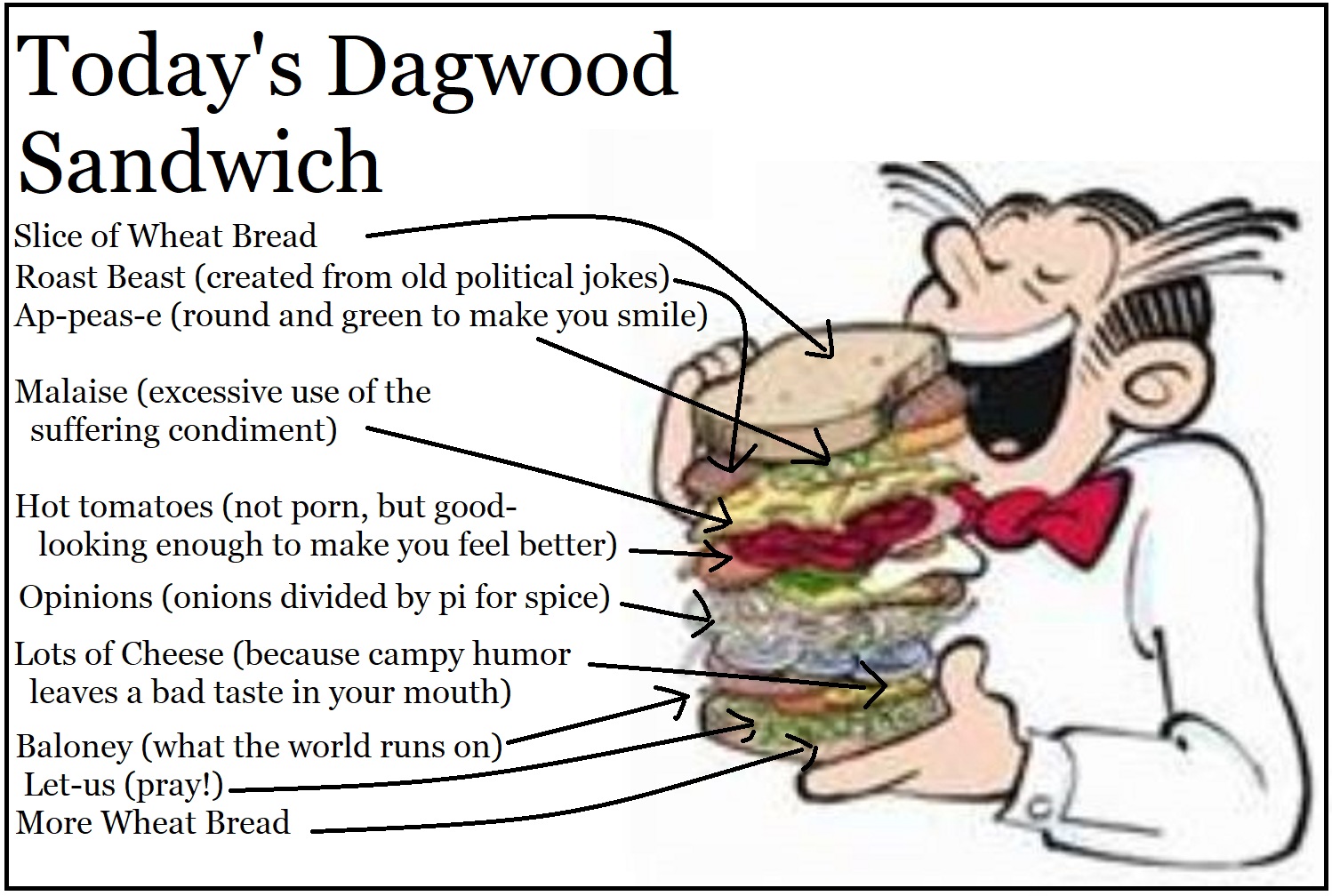
It is also possible to generate new ideas by deconstructing a metaphor in as humorous and convoluted a way as possible. This word-food thing is the result of writer’s lethargy of a while back.
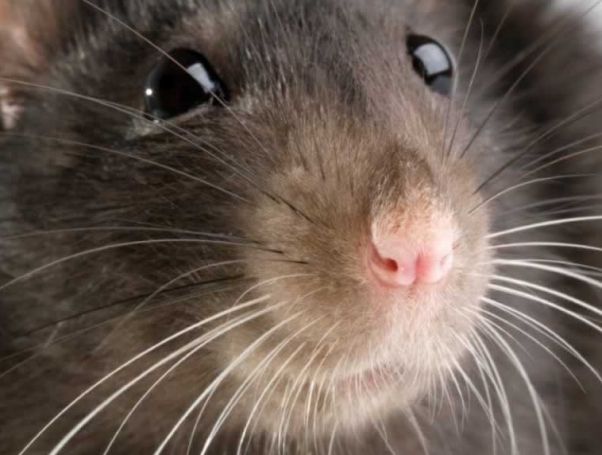
Of course, there is always the ranting factor. This, I think, is a go-to method used by stand-up comedians. They will pick something that is deeply bugging them, like the rats that inhabit my attic and walls during a winter that hasn’t yet completely gone. And they start listing all the ways they can make funny stories about the time the rat appeared on the bathroom floor tiles while my daughter was on the toilet, or the time the dog killed a rat that was in the trap already, but not dead enough not to bite back with the dog’s nose conveniently within the reach of rat teeth. And then they can rant onward about how disgusting rats are. And how can anyone look at a rat face and think they are cute? You look at that evil, beady-eyed face and you don’t think Mickey Mouse, you think plague, disease, the Black Death, and how much the Bank of America lawyer who sued you looks just like that.
So, you can see that generating ideas is easy. And you can write something interesting even on days when you can’t think of anything … quickly. When you have, not writer’s block, but writer’s lethargy.
I have just finished a novel project that I worked on for a year, from Spring of 2016 to Spring of 2017. And part of my personal project procedure involves using drawings to help me visualize the characters in the story and begin to view them as real people, even when they most certainly aren’t real. I even have this derfy Mickian idea that Paffoonies (those picture ideas that are inseparably fused to words) are essential to Mickian fiction. (Mickian fiction= another frighteningly goofy idea that needs to go unexplained.)
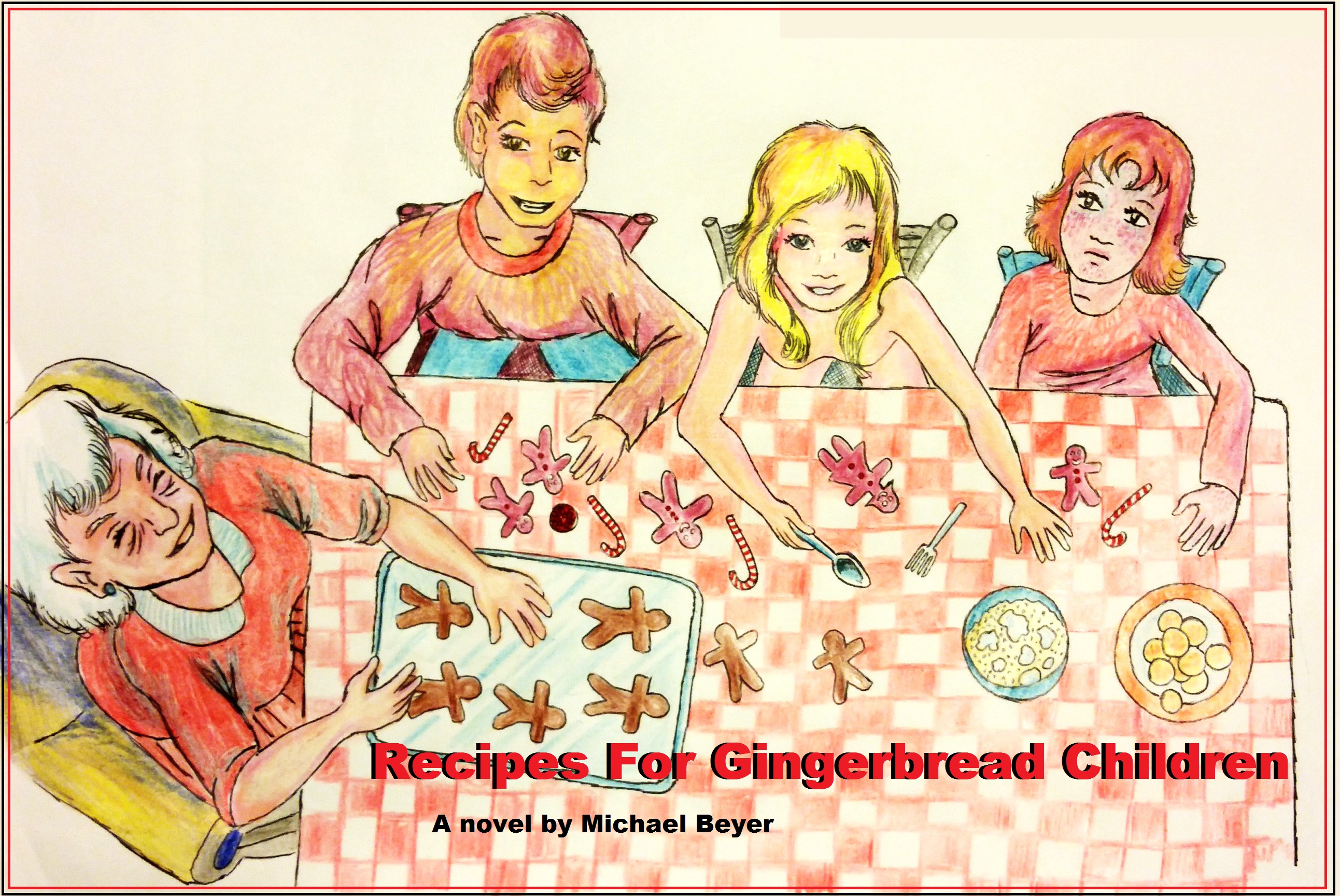
The book, Recipes for Gingerbread Children is about an old woman, a German immigrant and Holocaust survivor, who comes to a small Iowa town with a gift for story-telling and a gift for baking things, especially gingerbread cookies.
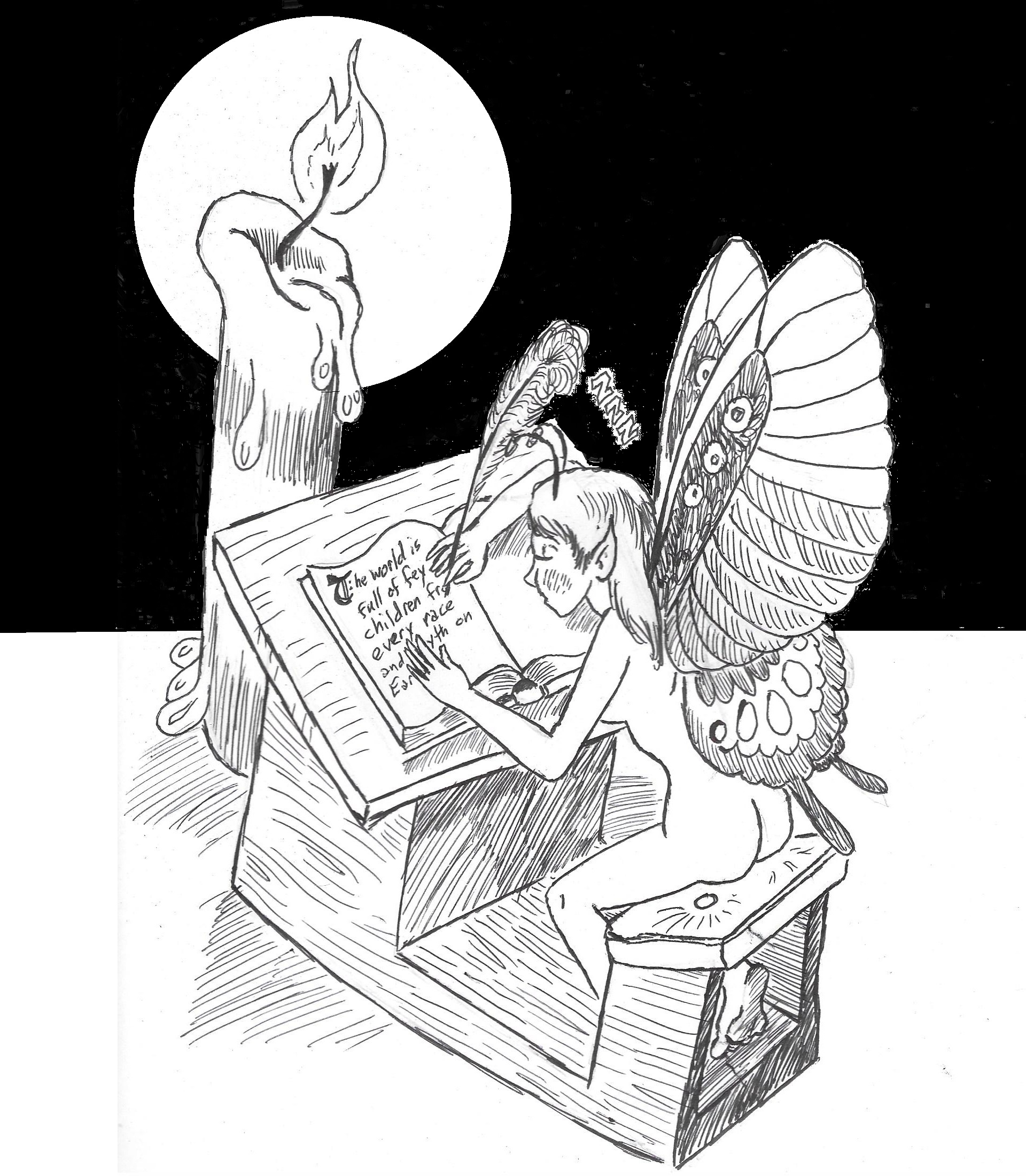
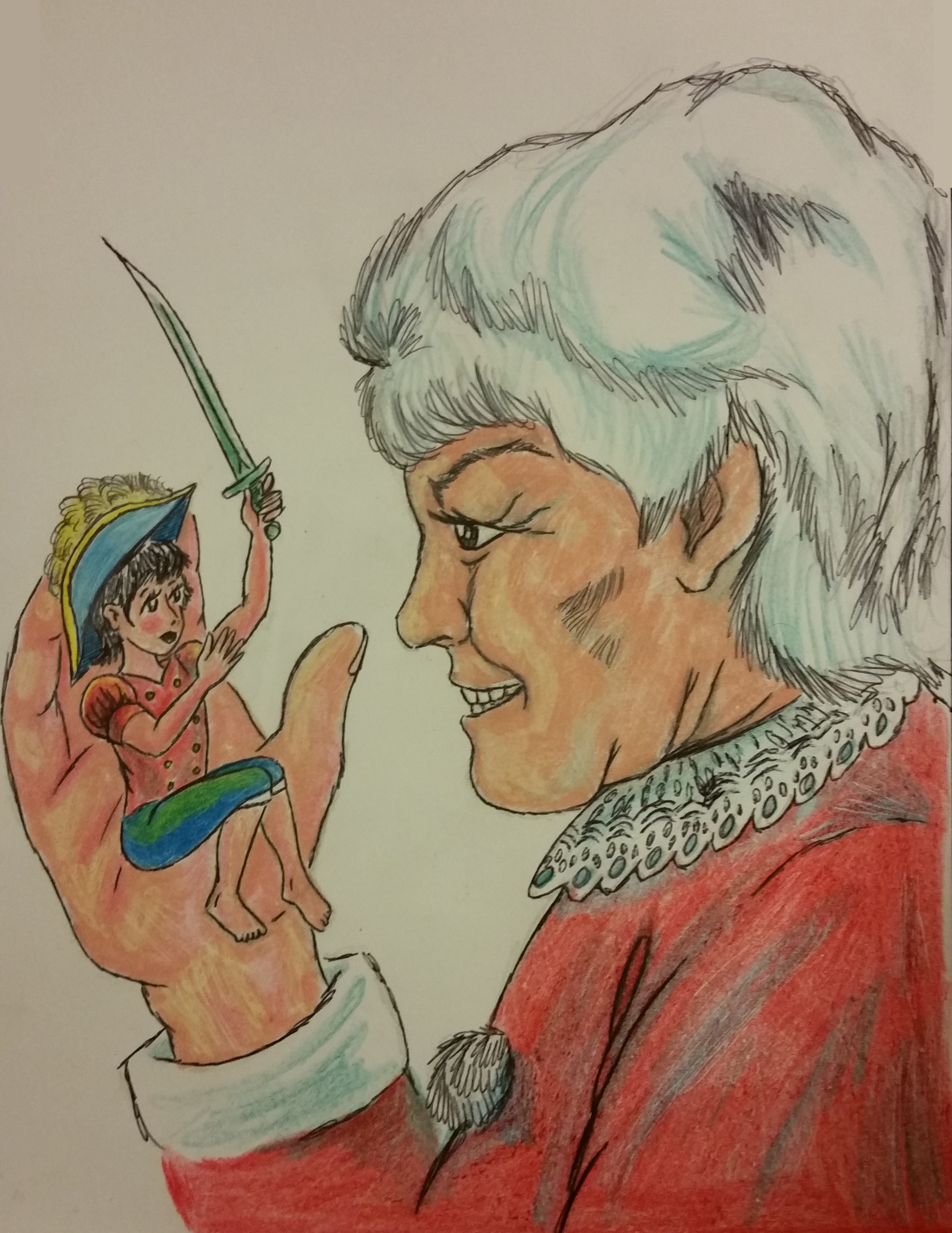
Grandma Gretel Stein, seen in the Paffooney on the left, is the main character of the story. She tells stories, mostly fairy tales, that have lessons about being true and faithful even in the face of great evil. The fairy in her hand is General Tuffaney Swift, an immortal Storybook fairy who leads the army of the local fairy kingdom called Tellosia. Gretel believes he is real Honestly, she gets so into story-telling that her fairy friends seem absolutely real to her. And who is to say that there aren’t little magical people living in a hidden kingdom among the cornfields in Iowa? Gretel convinced me that they were real. She even has a hand in making new fairies by the baking of gingerbread. She gets a magical recipe from the fairy Erlking, a wise and magical being, and uses it to create living gingerbread boys and gingerbread girls.
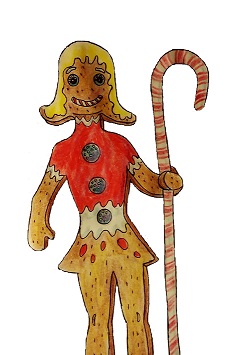
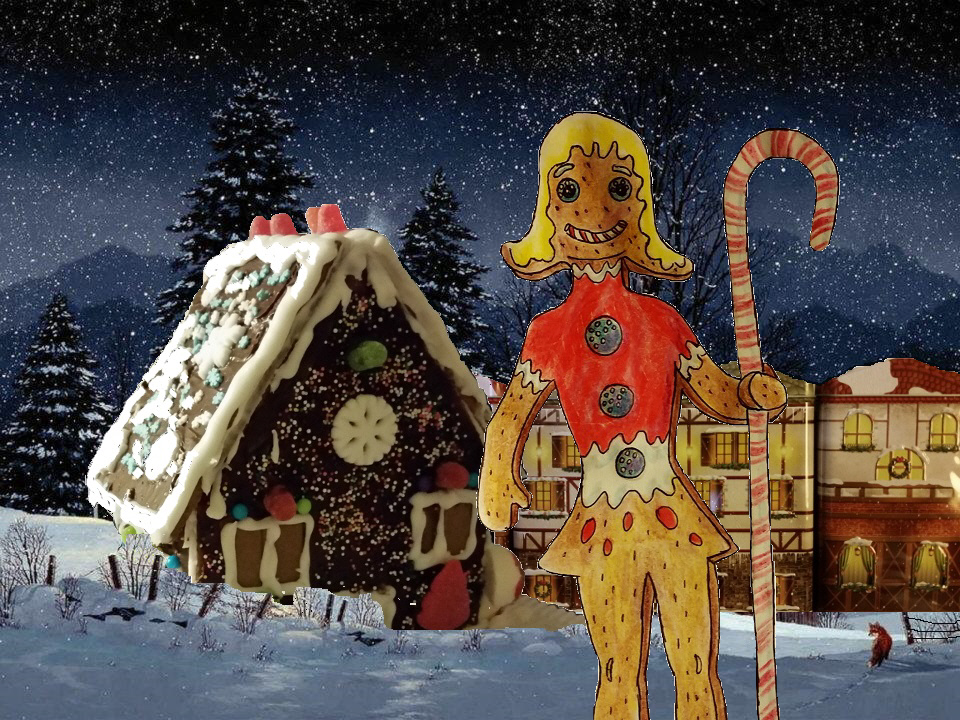
The gingerbread girl on the right is Anneliese, named after Gretel’s own daughter and decorated with frosting, food coloring, and gumdrops by the favorite story listener who constantly listens to Gretel’s stories and helps bake Gretel’s gingerbread, Sherry Cobble.
Sherry is a beautiful young eighth grade girl who reminds Gretel of her long-lost daughter. Sherry has a twin sister named Shelly and they are identical twins, but Sherry not only looks like Anneliese once did, she acts like her with the same confidence and enthusiasm for life that Anneliese once had before the war.
Sherry and Shelly are both part of the Cobble family, who have a reputation locally as wacky-pants loonies because they believe firmly in being nudists and engaging in nature completely naked while not actually wearing any wacky pants. I haven’t done any actual pictures of Sherry in the nude, but if you look carefully at the first picture of her above and see clothing, then you are seeing things that are not there. Yep, the girl bakes and decorates gingerbread men in the buff, wearing her pale pink birthday suit, even when the weather outside in Iowa makes that nonsensical.
So by now you can probably draw several conclusions about me as both a novelist and an illustrator. #1, There is definitely something a little bit off about me. #2, I haven’t said anything yet about this book having dead Nazis and a werewolf in it, even though I rarely talk about this book without throwing those things in somewhere. #3, Number 2 is actually taken care of in a backhanded way if you are reading this whole list carefully. #4, This story is probably about things that really aren’t just gingerbread recipes. #5, You should congratulate yourself if you read this far in this post. You have unusual amounts of patience and curiosity, and an extremely high tolerance for levels of goofy that put actual Goofy to shame.
I made a choice, long about 1980 or so. And I have not regretted that choice. I became a teacher instead of the writer/artist I thought I wanted to be. And the more I look back on it now, if I had gone the writer route back then, I could’ve eventually become an author like Terry Brooks who wrote the Shannarabooks. I might’ve even been as good as R.A. Salvatore whose fantasy adventure stories have reached the best seller list. Back then, in the 1980’s I could’ve eventually broke into the business and been successful. Even as late as when Frank McCourt broke onto the literary scene with his memoir, Angela’s Ashes in 1996, I might’ve been able to transition from teacher to writer the way he did. But I chose to keep going with a teaching career that enthralled me.
Publishing and the literary scene is changing now. And it is no longer possible for someone like me to break into the big time. I am an author who has come aboard a sinking ship.
But I have stories to tell. They have lived inside me for more than thirty years. And I am scrambling now to get them told before my crappy old body completely betrays me and makes the chance go away. I will get them told… even if no one ever listens.
And there are some advantages to doing it the way I have done it. It is, and always has been, about the people in my life. My wife, my children, my students, my co-workers, my cousins by the dozens, my little town in Iowa… they are the people in my stories. My stories are true to life, even if they have werewolves and fairies and living gingerbread men and nudists in them. I live in a cartoon world of metaphor and surrealism, after all. I would not have had the depth of character-understanding in my stories without my experiences as a teacher. And I really don’t have to worry about the whole marketing thing any more. I am not on that treadmill. I do not have to be aware of what the market is looking for. If my writing ever turns a profit, I won’t live long enough to see it anyway. And that has never been what it is all about.
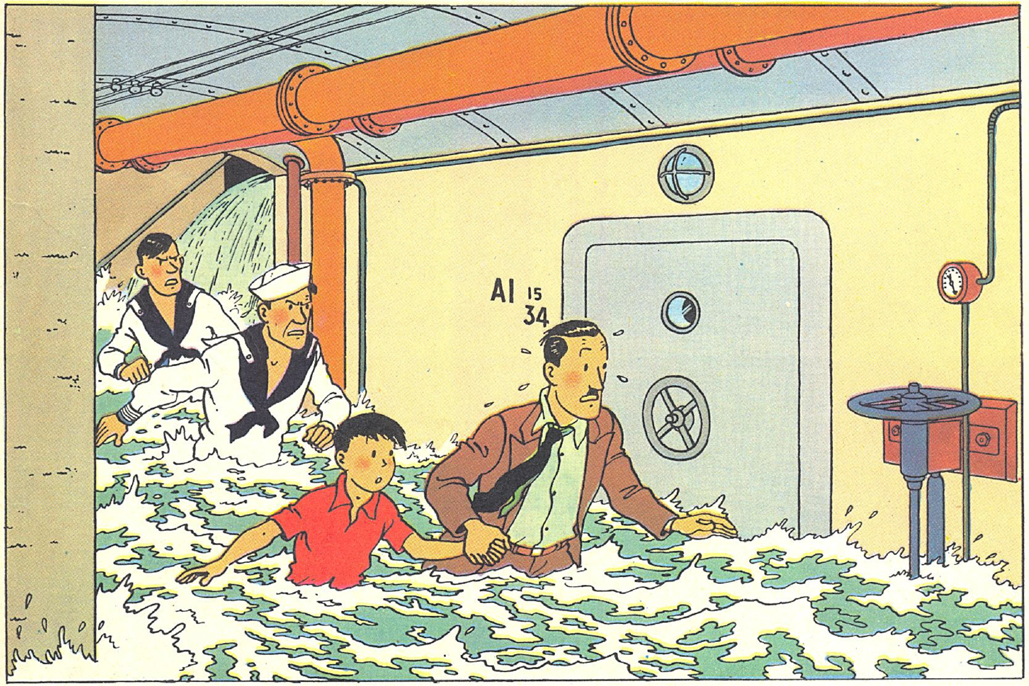
I can do anything I please with my stories. They belong to me. I do not owe the world anything. What I give you now in this blog and in my books, is given for love, not profit. I can even write a pointless blog post about Sunday blather and illustrate it with Tintin drawings by Herge. And you can’t stop me. And, hopefully… you don’t even want to.













Vonnegut
My experience of the works of Kurt Vonnegut is limited to the reading of three books; Cat’s Cradle, Breakfast of Champions, and Slaughterhouse Five. But it was enough to make me love him and use him as a shaper of my soul.
I deeply apologize for the fact that even though he only wrote 14 books and a bunch of short stories, I have not read everything I could get my hands on by Kurt. Three novels and one short story (Harrison Bergeron) is not really enough to compare to the many, many things that I have read by Mark Twain, Terry Pratchett, Louis L’Amour, and Michael Crichton. I can’t begin to count how many books of each of those four I have read and reread. But it is enough that I read those three novels and have a lifelong regret of never buying and reading Slapstick when I had the chance. Vonnegut writes black humor. The ideas are painful, and burn away flesh from your personal body of being. And at the same time, you cannot help but laugh at the pure, clean, horrifying truths his ridiculous stories reveal.
If, in the course of telling a story, you can put the sublime, the ridiculous, and the horrendous side by side, and make the reader see how they actually fit together, then you can write like Vonnegut.
Let me give you three quick and dirty book reports of the Vonnegut I have read in the order I have read them;
I read Cat’s Cradle in college. I was young and idealistic at the time, foolishly convinced I could be a great writer and cartoonist who could use my work to change mankind for the better.
In the book, Dr. Felix Hoenikker (a fictionalized co-creator of the atomic bomb) is obsessively re-stacking cannonballs in the town square in pursuit of a new way to align water molecules that will yield ice that does not melt at room temperature. Much as he did with the A-bomb, Hoenikker invents a world-ending science-thing without any thought for the possible consequences. The narrator of the novel is trying to write a humanizing biography of the scientist, and comes to observe the inevitable destruction of the whole world when the oceans freeze into Ice-9, the un-meltable ice crystal. Before the world ends, the narrator spends time on the fictional Carribean island of San Lorenzo where he learns the fictional religion known as Bokononism, and learns to make love to a beautiful woman by pressing bare feet together sole to sole. It is a nihilistic picture of what humans are really like more savagely bleak than any portrayal Monte Python’s Flying Circus ever did on TV.
Needless to say, my ideals were eventually shattered and my faith in the world shaken.
I read Breakfast of Champions after I had been teaching long enough to buy my own house, be newly married, and a father to one son. It was probably the worst time of life to be reading a book so cynical, yet true.
In this story, the author Kilgore Trout, much published but mostly unknown, is headed to Midland City to deliver a keynote address at an arts festival. Dwayne Hoover is a wealthy business man who owns a lot of Midland City real-estate. Trout gives Hoover a book (supposedly a message from the creator of the universe) to read that suggests that all people (except for the reader of the book… meaning Hoover) are machines with no free will. Hoover takes the message to heart and tries to set the machines free by breaking them, beating up his son, his lover, and nine other people before being taken into custody.
The book contains devastating themes of suicide, free will, and social and economic cruelty. It makes you sincerely reflect on your own cog-in-the-machine reality.
Slaughterhouse Five is a book I bought and read when I missed my chance to buy Slapstick and needed something to take home from HalfPrice Books to make me feel better about what I missed. (Of the five books I had intended to buy that day, none were still on the shelves in spite of the fact that they had been there the week before.) It was fortuitous. This proved to be the best novel I had ever read by Vonnegut.
Like most of his work, the story of Billy Pilgrim is a fractured mosaic of small story pieces not presented in chronological order. It details Billy’s safe, ordinary marriage to a wife who gives him two children, but it is ironically cluttered with death, accidents, being stalked by an assassin, and being kidnapped by aliens. It also details his experiences in World War II where he is captured by the Germans, held prisoner in Dresden, kept in an underground slaughterhouse, and ironically survives the fire-bombing of Dresden by the Allies. Further, it details his time as a zoo exhibit on the alien planet of Tralfamadore.
It explores the themes of depression, post-traumatic-stress disorder, and anti-war sentiment. Vonnegut himself was a prisoner of war in Dresden during the fire-bombing, so real-life experiences fill the book with gravitas that it might not otherwise possess. Whether the author was ever kidnapped by aliens or not, I cannot say.
But Kurt Vonnegut’s desire to be a writer and portray himself as a writer in the character of Kilgore Trout, and even as himself in his work, has an awful lot to do with my desire to be a writer myself. Dark, pithy wisdom is his thing. But that wisdom, having been wrung from the darkness is all the more brightly lit because of that wringing. It is hard to read, but not hard to love.
Leave a comment
Filed under aliens, book reports, commentary, humor, reading, writing humor
Tagged as Kurt Vonnegut