
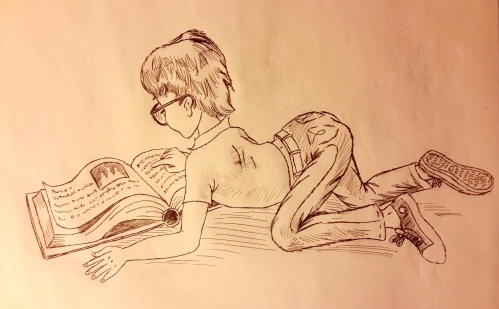
Yes, I know it looks awkwardly painful to read on the floor in a scroochy position like that, but that was me as a kid. I was the awkwardest nerd in Wright County, Iowa, when I was a boy. But Dr. Seuss taught me early on to read and enjoy the imaginary worlds that reading created in my stupid little head.


I don’t remember the first actual book I read, other than to firmly believe it was a Dr. Seuss book like Yertle the Turtle, or Horton Hears a Who! But I do remember the first chapter book, the first great adventure. It was The White Stag by Kate Seredy. It was the Newberry Medal winner published in 1937, and told the mythical journey of Hunor and Magyar, two brothers and leaders of two peoples who are on an epic quest to find the land where they belong by following a magical white stag.

I was nine when I read and fell in love with that book. I picked it off Miss Mennenga’s reading shelf because it was a simple red book with a plain red cover (the paper illustrated book cover had long since disintegrated in kids’ hands over time.) Red was my favorite color.
But I fell in love with the movie version that unfolded in my mind’s eye. It was when I learned to dive so deeply into a book that the characters became real to me.
The following year when I was ten the book was Treasure Island by Robert Louis Stevenson. Jim Hawkins was my best friend that year. That was followed by Rudyard Kipling’s First Jungle Book. I walked around the jungle with Mowgli and Bagheera the black panther for quite a while after that.
I think it is important to often look back on the beginnings of things. This is the story of how I became a reader for life. And it matters now that I am furiously trying to cram in more books of all sorts before the end. The journey nears completion, and it helps to focus on what goals and what loves I had at the outset. Will there be reading in Heaven? I hope so. Otherwise, truthfully, I may not go.


Holy Bagumba!
I have just finished reading a wonderful book. It is a young adult novel bordering on being a children’s book. It won the 2014 Newbery Medal for best work of children’s literature. But it is a book of so many dimensions that it totally defies categories. Librarians with butterfly nets who want to pin this book down on their library shelves will be pointlessly waving their nets at it like they believe it’s a butterfly, but it will soar away from them like an eagle.
Flora & Ulysses (the Illuminated Adventures) is a combination book of many different things. G. K. Cambell’s cartoony paffoonies add to and amplify the story to the point that sometimes it becomes a graphic novel.
Flora herself is a comic-book lover and follower of the adventures of a comic-book superhero named Incandesto. Ulysses the squirrel is run over by a rogue vacuum cleaner and the accident graces him with super powers (the ability to fly and throw cats and write poetry). And Flora rescues and befriends this newly minted superhero and sets him on a path that pits him against the only super-villain available, Flora’s own mother.
At certain points, through metaphor, elegance, and supreme focus, the story itself becomes poetry. But, of course, when the poem ends with a line about the squirrel being hungry, it becomes humorous poetry, simply by the juxtaposition of the sublime with the ridiculous.
As a writer, Kate DiCamillo is a master of everything I want to be. She is as much a masterful story-teller as Mark Twain, Ernest Hemingway, or William Faulkner. But many people will be put off by the fact that she is a children’s author. They will ignore her stories because how could a children’s author affect their lives in any way? But if you are a reader who can think and feel about things in a book, she will make you laugh and make you cry and make you not afraid to die… for love of a good book.
Let me also suggest a few of her other wonderful, wonderful books;
Leave a comment
Filed under book reports, book review, commentary, good books, humor, metaphor, poetry, reading
Tagged as book review, Flora & Ulysses, Kate DiCamillo