Life is making music. We hum, we sing to ourselves, movie music plays in our head as the soundtrack to our daily life. At least, it does if we stop for a moment and dare to listen. We make music in many different ways. Some play guitar. Some are piano players. And some of us are only player pianos. Some of us make music by writing a themed paragraph like this one. Others make an engine sing in the automotive shop. Still others plant gardens and make flowers or tomatoes grow. I chose teaching kids to read and write. The music still swells in my ears four years after retiring.
The 1995 movie, Mr. Holland’s Opus, is about a musician who thinks he is going to write a magnificent classical orchestra opus while teaching music at a public high school to bring in money and allow him time to compose and be with his young wife as they start a new family.
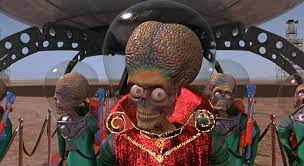
But teaching is not, of course, what he thought it was. He has to learn the hard way that it is not an easy thing to open up the closed little clam shells that are the minds of students and put music in. You have to learn who they are as people first. You have to learn to care about what goes on in their lives, and how the world around them makes them feel… and react to what you have to teach. Mr. Holland has to learn to pull them into music appreciation using rock and roll and music they like to listen to, teaching them to understand the sparkles and beats and elements that make it up and can be found in all music throughout their lives. They can even begin to find those things in classical music, and appreciate why it has taken hold of our attention for centuries.
And teaching is not easy. You have to make sacrifices. Big dreams, such as a magnum opus called “An American Symphony”, have to be put on the shelf until later. You have children, and you find that parenting isn’t easy either. Mr. Holland’s son is deaf and can never actually hear the music that his father writes from the center of his soul. And the issue of the importance of what you have to teach becomes something you have to fight for. Budget cuts and lack of funding cripples teachers in every field, especially if you teach the arts. Principals don’t often appreciate the value of the life lessons you have to give. Being in high school band doesn’t get you a high paying job later.
But in the end, at the climax of the movie, the students all come back to honor Mr. Holland. They provide a public performance of his magnum opus, his life’s work. And the movie ends with a feeling that it was all worth it, because what he built was eternal, and will be there long after the last note of his music is completely forgotten. It is in the lives and loves and memories of his students, and they will pass it on.
But this post isn’t a movie review. This post is about my movie, my music. I was a teacher in the same way Mr. Holland was. I learned the same lessons about being a teacher as he did. I had the same struggles to learn to reach kids. And my Mr. Holland moment wasn’t anywhere near as big and as loud as Mr. Holland’s. His was performed on a stage in front of the whole school and alumni. His won Richard Dreyfus an Academy Award for Best Actor. But his was only fictional.
Mine was real. It happened in a portable building on the Naaman Forest High School campus. The students and the teacher in the classroom next door threw a surprise party for me. They made a lot of food to share, almost all of which I couldn’t eat because of diabetes. And they told me how much they would miss me, and that they would never forget me. And I had promised myself I would never cry about having to retire. But I broke my promise. In fact, I am crying now four years later. But they are not tears of sadness. My masterwork has now reached its last, bitter-sweet notes. The crescendos have all faded. But the music of our lives will still keep playing. And not even death can silence it completely.
As Big MacIntosh welcomes more little ponies into my insanely large doll collection, I have been reading my published novel Snow Babies. The novel is written in third person viewpoint with a single focus character for each scene. But because the story is about a whole community surviving a blizzard with multiple story lines criss-crossing and converging only to diverge and dance away from each other again, the focus character varies from scene to scene.
Big MacIntosh finds himself to be the leader of a new group of My Little Ponies.
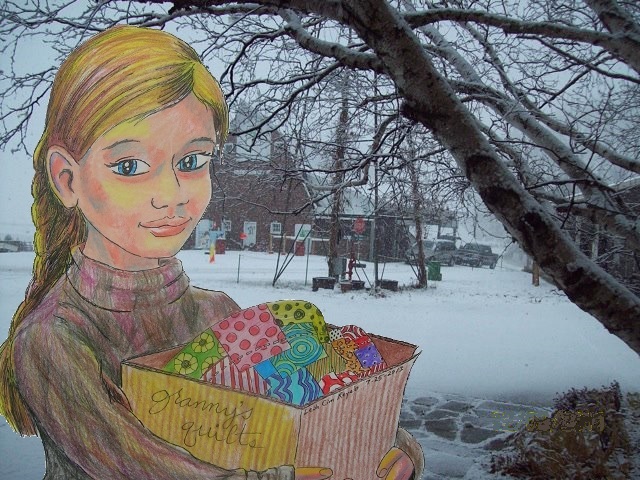
In Canto Two, Valerie Clarke, the central main character of the story, is the focus character. Any and all thoughts suggested by the narrative occur only in Valerie’s pretty little head. Canto Three is focused through the mind of Trailways bus driver Ed Grosland. Canto Four focuses on Sheriff’s Deputy Cliff Baily. And so, on it goes through a multitude of different heads, some heroic, some wise, some idiotic, and some mildly insane. Because it is a comedy about orphans freezing to death, some of the focus characters are even thinking at the reader through frozen brains.
The ponies decide to visit Minnie Mouse’s recycled Barbie Dreamhouse where Olaf the Snowman is the acting butler.
That kind of fractured character focus threatens to turn me schizophrenic. I enjoy thinking like varied characters and changing it up, but the more I write, the more the characters become like me, and the more I become them. How exactly do you manage a humorous narrative voice when you are constantly becoming someone else and morphing the way you talk to fit different people? Especially when some of your characters are stupid people with limited vocabularies and limited understanding?
The ponies are invited to live upstairs with the evil rabbit, Pokemon, and Minions.
I did an entire novel, Superchicken, in third person viewpoint with one focus character, Edward-Andrew Campbell, the Superchicken himself. That is considerably less schizophrenic than the other book. But it is still telling a story in my voice with my penchant for big words, metaphors, and exaggerations.
The novel I am working on in rough draft manuscript form right now, The Baby Werewolf, is done entirely in first person point of view. That is even more of an exercise of losing yourself inside the head of a character who is not you. One of the first person narrators is a girl, and one is a werewolf. So, I have really had to stretch my writing ability to make myself into someone else multiple times.
I assure you, I am working hard to find a proper voice with which to share my personal wit and wisdom with the world. But if the men in white coats come to lock me away in a loony bin somewhere, it won’t be because I am playing a lot with My Little Ponies.
My best novel is free to own in ebook form for today and tomorrow. Buy it now with the link above. The offer is good until the end of the day on 12/14/2021.
Teachers of serious writing will often tell you… or more correctly, give you the Word of God, “You want to be a good writer? You have to write every single day.” And having been a teacher of writing at the high school and middle school level, I am committed to passing that on to you also as the inviolable Word of God. You see, I have long been, well, not a serious writer exactly, more of a dedicated writer with warped notions of reality and a tendency towards goofiness. You can see by the view of my WordPress insights page that I have steadily, in five years’ time, been noticed and looked at by increasing amounts of thoroughly duped WordPress viewers.
10,373 visitors have viewed something on my blog 17,383 times in 2017. And I know that most are looking at the pictures and moving on. That’s how I get away with writing some of the stupid stuff I post on my blog. But there’s a secret to that too. I drew or painted a lot of the pictures I use on this blog myself. You would think that sooner or later some expert psychologist would trace violence in the streets back to my pictures as the ultimate cause, but that hasn’t happened yet. I am sure that is mostly because not even the psychologists can muck their way through my paragraphs of purple paisley prose. You see, I most often use my writing on this blog to commit atrocities of humor and wit. I only rarely dabble in things intended to be uplifting, spiritual, politically challenging, or sentimental. I complain on my blog a lot. It is also a place for expressing my inherent grumpiness and old-man dyspeptic irritations with life. But viewers tend to take my humor seriously and only laugh at the stuff I am most embarrassed about.
I was supposed to be doing this blog as way to promote my book, Catch a Falling Star, for I-Universe Publishing. They set it up for me. But, as they don’t pay me anything for the work I put into it, and it doesn’t really impact sales anyway, I use it now as writing practice. I have as a personal goal to write 500 words a day. The blog counts. So it means that some days, the 500 words I write in my blog are the only words I get written that day. Though, now that I am retired, 500 words of blog writing plus 500 words of novel writing can get me well past writing 1000 words in a day. It doesn’t take long at that rate to build up an awful lot of words. I shudder to think what would happen if the word dam were to suddenly give way, releasing a word-flood of monumental proportions. Half of the Dallas-Fort Worth metroplex would drown in Mickian words if that were to happen.
So, do I think that you should write every day? Do I think it makes you a better writer? Do I actually follow my own advice? Yes! To all three. And as I have passed the 500 word mark yet again, I can stop now.
I am falling apart. My health is poor and continuing to fail. My memory is suffering from an inability to remember the names of things. I find myself in the kitchen having gone in for a specific purpose, and not being able to remember what that purpose was. That is not to say I am not coping. I have quite a lot of adaptability and significant problem-solving skills. But that will eventually become a losing battle. Especially if I get the virus… any virus. So, what am I going to talk about with a dissolving brain and an hourglass of lifeforce swiftly running out? Fascination. I am fascinated by the details of the process. Like Mr. Spock, I find practically everything, “Fascinating!”
Birds and butterflies
My childhood fascinations turned into obsession first around natural things. When my mother would go to Vey Osier’s Beauty Salon, Vey had this fascinating parrot that was probably a hundred years old and knew how to swear really, really foully. I remember that being the only reason I was willing to go there and wait for Mom to get her hair fussed up (What my Grandpa Aldrich, her father, used to call it.)
I remember waiting for hours to hear that bird say the magic F-word or the horrible S-word. Or even the zillion other bad words I didn’t know anything about when I was seven. And, of course, I never did. The bird was mute the whole time during who-knows-how-many visits. But I did get to look endlessly at that green parrot’s amazing nutcracker bill that Vey always assured us would snap our fingers off like biting a salted pretzel if we got them anywhere close to the bill.
And when I was nine I was given as a present a plastic model kit of a Golden-Crowned Kinglet (the bird in that first picture). My relatives knew I was a burgeoning artist since my teachers constantly complained about all the skeletons, crocodiles, and monsters I drew in the margins of my school workbooks. So, I had a plastic bird to paint with all the necessary paints, but no idea what the bird looked like. We had to go all the way to Mason City to Grandma Beyer’s house because we called up there and checked, and, sure enough, there was a colored picture in the K volume of her Collier’s Encyclopedia. I painted it so accurately, the danged thing looked almost alive.
And if you have ever seen any of my butterfly posts, you know I became a butterfly hunter before ever entering junior high school, where Miss Rubelmacher, the rabid seventh-grade science teacher, made that obsession a hundred times worse. (She didn’t actually have rabies, just a reputation of requiring excessively hard-to-find life-science specimens like a nasturtium that bloomed in October in Iowa, or a Mourning Cloak butterfly.
I was able to find for her numerous Red-Spotted Purples like the one in the picture. I got them off the grill of Dad’s Ford, as well as in Grandpa Aldrich’s grove. And I eventually caught a pair of Mourning Cloaks as well on Grandpa Aldrich’s apple trees, though not until summer after seventh grade was over for me. I could tell you about my quest to catch a Tiger Swallowtail, too. But that’s an entirely different essay, written for an entirely different thematic reason.
Needless to say, my bird fascination led me to become an amateur bird-watcher with a great deal of useless naturalist information crammed into my juvenile bird-brain about birds. Especially Cardinals. And my fascination with butterflies opened my eyes to a previously invisible world of fascinating and ornately-decorated bugs. (Of course, I should’ve said “insects” instead of “bugs” since I absolutely did learn the difference.) And I still to this day know what a Hairstreak Butterfly looks like, what a Luna Moth is (Think Lunesta Commercials,) and how you have to look at the underside of the lower wings to correctly identify a Moonglow Fritillary Butterfly.
During my lifetime, my fascinations have become legion. I became obsessed with the comic books done by artist Wally Wood, especially Daredevil. I became obsessed with Disney movies, especially the animated ones like The Rescuers, The Jungle Book, Pinocchio, and Fantasia. I rode the bucking bronco of a fascination with the Roswell Crash (and the actual alien space ships I am almost certain the U.S. Army recovered there.) And so many other things that it would make this essay too long, and would probably bore you into a death-like coma. So, here’s what I have learned by being fascinated with my own fascinations;
You do not want to play me in a game of Trivial Pursuit for money, even now that my memory is like swiss cheese.
I have a real ability to problem-solve because I know so many useless details that can be combined in novel ways to come up with solutions to problems.
I can write interesting essays and engaging novels because I have such a plethora of concrete details and facts to supplement my sentences and paragraphs with.
It can be really, really boring to talk to me about any of my fascinations unless I happen to light the same color of fire in your imagination too. Or unless you arrived at that same fascination before I brought it up.
My second cousin in Iowa (daughter of my grandmother’s youngest brother and the oldest kid at the family Thanksgiving dinner in 1966 because she was two years older than me) is still in the hospital with the Delta Variant of Covid 19. She is apparently going to survive, but she is one of the many unvaccinated people causing the present surge in cases simply because she’s a loyal Republican Trumpkin who believes Fox News when it tells them that vaccinations violate their Constitutional rights and basic sacred Freedoms (as screamed by Senator Ted Cruz pretending to be William Wallace, but actually sounding more like comedian Wally Cox.)
I don’t believe that people have a Constitutional right to potentially infect people who can’t get vaccinated (like those who are severely immuno-compromised or those who are four-years-old and younger.)
That doesn’t mean I think my cousin deserves to die for her wrong beliefs. I pray that death isn’t the consequence for her poor choice of political beliefs. But increasingly, those on her side of the political fence (…or maybe the political castle wall, border wall, or deadly electrified fence) think that liberals like I have become are evil, communist, Satanist. Antifa, child-sex-trafficking cannibals and deserve to be killed with your sacred AR-15. (If I ate any white Christian babies for breakfast this morning, I was completely unaware of it. They tasted like regular pancakes and sausage.) The anger on their side is increasingly heated up and moved towards violence by their propaganda-wielding leaders. They will tell me to my face that if I support Biden’s political agenda, then I must be a communist, wanting to burn our country down and in favor of pedophilia. (And I don’t dare suggest that they might be prejudiced or even racist.)
“I basically loved every kid who ever walked into my classroom to be my student.”
“Really, Mickey? Even poor black kids who have challenging behaviors?”
“Some of my all-time favorite kids were black and had behavioral challenges. That’s why 2020 taught me to be on the side of Black Lives Matter.”
“That’s a radical thing. You should say All Lives Matter.”
“All lives do matter. But black lives have been under more threat than others. Can’t you say Black Lives Matter too?“
“I SAID ALL LIVES MATTER!!!”
“But why can’t you say Black Lives Matter too?”
And so the conversation ends.
They hate us. Because we don’t believe everything they believe. Especially the things that aren’t true. And it is only getting gradually worse.
And it’s frustrating. We are actually only a few feet apart. And think what a wonderfully beautiful ballet it would be if only we could synchronize our steps and dance the same dance.
There are definitely tendencies in those of us who are really atheists and non-believers in our heads to look back fondly at a time when God and religion filled our childish hearts every Sunday Morning. I have been told that idiots like me with a penchant for writing humor ought not to indulge in making fun of religion and politics. But I look at modern humorists making fun of both those things with impunity and too often end up admiring their success. Because, not only does the the subject of religion provide an easy target for satire and mockery, but we can’t really keep something sacred in our porcelain and breakable human hearts for very long without making sure it is fire-tested. That’s why I intend to take a flame-thrower to it in today’s Sunday Sermon. And I don’t mean I will only make fun of belief in God, but making fun of belief in atheism as well.
Here is a piece of music that gives your heart peace that you might need to play in the background if you really plan to read this purple-paisley-prose post. It is Pachelbel’s Canon in D Major, a very spiritual piece to play for peace of personhood and a pinch of paradise.
Now, of course, the first thing to acknowledge in this idiot’s Sunday sermon is the idea of God Himself.
Is there a God?
Remember, I pass the test for believing what atheists normally believe. That should disqualify me from making the following statement. But remember too, I also identified myself in this essay as an idiot. So, I will say it anyway.
There is a God, not in Heaven, but in us. There has to be. I talk to Him all the time, and He answers me. And I keep asking Him, “If you don’t exist, then how can you be answering me?”
“Well, Michael, you are an idiot. And things don’t have to make sense for you to believe them. But also, I am the part of you that never gives up on you even when you have given up on yourself.”
And I try to look as intelligent as I can as I say, “What…?”
“People, Mickey, my son, have a secret power inside of themselves that, when they are in troubled times and dire dangers, they can reach deep into their souls for it and pull it out to save themselves from the situation in the best way possible.”
“So, if people use this power correctly, say the right words and everything, they can save their lives in any situation and even live on after death?”
“I know you are an idiot, my child, but try not to be quite so idiotic all the time.”
“But people who are very religious believe in eternal life of some kind, don’t they?”
“You are not the only idiot out there, my beloved.”
“So, we don’t get eternal life for praying the right things and doing the right things and fulfilling all the elements of the Live Forever Spell?”
“There is no such thing as eternal life nor eternal torment. But you exist. And existence is eternal. There was no life before you are born, and there is no life after you die. But once you exist, you always exist, even outside of the time-frame of your mortal life.”
“That’s why I call myself a Christian Existentialist, right?”
“You are, indeed, that flavor of idiot, yes. But the Christian part means you have to adhere to Christian values. And not the ones Christian Fundamentalist idiots interpret from the Old Testament. The real ones based on choosing love over hate.”
“So, is that all I need to bring this sermon to an end?”
“Well, you should probably thank William Bouguereau for providing most of the internet images you illustrated this thing with. He died before you were born, but he still exists.”
“Thanks, Billy B. You paint lovely naked angels.”
“And you should recognize that this idiotic thing you have written is not a sermon, but, rather, a fantasy dialogue. And then stop adding more to it like a good little idiot.”
I start today with nothing in my head to write about. I guess I can say that with regularity most days of the writing week. Sundays in particular are filled with no useful ideas of any kind. But I have a certain talent for spinning. As Rumpelstiltskin had a talent for spinning straw into gold, I take the simple threads of ideas leaking out of my ears and spin them into yarns that become whole stories-full of something to say. And it is not something out of mere nothing. There is magic in spinning wheels. They take something ordinary and incomplete, and turn it into substantial threads useful for further weaving.
Of course the spinning wheel is just a metaphor here for the craft of writing. And it is a craft, requiring definable skills that go well beyond merely knowing some words and how to spell them.
My own original illustration.
The first skill is, of course, idea generation. You have to come up with the central notion to concoct the potion. In this case today, that is, of course, the metaphor of using the writing process as a spinning wheel for turning straw into gold. But once that is wound onto the spindle, you begin to spin yarn only if you follow the correct procedure. Structuring the essay or story is the next critical skill.
Since this is a didactic essay about the writing process I opened it with a strong lead that defined the purpose of the essay and explained the central metaphor. Then I proceeded to break down the basic skills for writing an essay with orderly explanations of them, laced with distracting images to keep you from dying of boredom while reading this, a very real danger that may actually have killed a large number of the students in my writing classes over the years (although they still appeared to be alive on the outside).
My mother’s spinning wheel, used to make threads for use in porcelain doll-making, and as a prop for displaying dolls.
As I proceed through the essay, I am stopping constantly to revise and edit, makeing sure to correct errors and grammar, as well as spending fifteen minutes searching for the picture of my mother’s spinning wheel used directly above. Notice, too, I deliberately left the spelling-error typo of “making” to emphasize the idea that revising and proof-reading are two different things that often occur at the same time, though they are very different skills.
And as I reach the conclusion, it may be obvious that my spinning wheel of thought today spun out some pure gold. Or, more likely, it may have spun out useless and boring drehk. Or boring average stuff. But I used the spinning wheel correctly regardless of your opinion of the sparkle of my gold.
In my short, sweet sixty years of life, I have probably seen more than my share of movies. I have seen classic movies, black-and-white movies, cartoon movies, Humphrey Bogart movies, epic movies, science fiction movies, PeeWee Herman movies, Disney movies, Oscar-winning movies, and endless box-office stinkers. But in all of that, one of the most undeniable threads of all is that movies make me cry. In fact they make me cry so often it is a miracle that even a drop of moisture remains in my body. I should be a dried-out husk by now.
I wept horribly during this scene. Did you?
And the thing is, people make fun of you when you cry at movies. Especially cartoon movies like Scooby Doo on Zombie Island. (But I claim I was laughing so hard it brought tears to my eyes. That’s the truth, dear sister. So stop laughing at me.) But I would like to put forth another “Why do you think that?” notion. People who cry while watching a movie are stronger and more powerful than the people who laugh at them for crying. A self-serving thesis if ever there was one.
Movies can make you cry if you have the ability to feel empathy. We all know this. Old Yelleris the story of a dog who endears himself to a prairie farm family, saves Travis’s life at one point, and then gets infected with rabies and has to be put down. Dang! No dry eyes at the end of that one. Because everyone has encountered a dog and loyal dog-love somewhere along the line. And a ten-year-old dog is an old dog. The dogs you knew as a child helped you deal with mortality because invariably, no matter how much you loved them, dogs demonstrate what it means to die. Trixie and Scamper were both hit by cars. Queenie, Grampa’s collie, died of old age. Jiggs the Boston Terrier died of heat stroke one summer. You remember the pain of loss, and the story brings it all back.
Only psychopaths don’t feel empathy to some degree. Think about how you would feel if you were watching Old Yeller and somebody you were watching with started laughing when Travis pulls the trigger on the shotgun. Now, there’s a Stephen King sort of character.
But I think I can defend having lots of empathy as a reason for crying a river of tears during Disney’s The Hunchback of Notre Dame. You see, identifying with Quasimodo as the main character, hoping for what he hopes for, feeling like a monster and completely unloved, and fearing what he fears connect you to the story in ways that completely immerses you in the experience. This is basically a monster movie.
But the film puts you inside the head of the malformed man, and you realize that he is not the monster. Righteous Judge Frollo and the people who mistreat Quasimodo for his deformity of outward appearance are the real monsters. If you don’t cry a river of tears because of this story, then you have not learned the essential truth of Quasimodo. When we judge others harshly, we are really judging ourselves. In order to stop being monstrous, and be truly human, you must look inside the ugliness as Esmeralda does to see the heroic beauty inside others. Sometimes the ideas themselves are so powerful they make me weep. That’s when my sister and my wife look at me and shake their heads because tears are shooting out of me like a fountain, raining wetness two or three seats in every direction. But I believe I am a wiser man, a more resolved man, and ultimately a better man because I was not afraid to let a movie make me cry.
The music also helps to tell the story in ways that move my very soul to tears. Notice how the heroine walks the opposite way to the rest of the crowd. As they sing of what they desire, what they ask God to grant, she asks for nothing for herself. She shows empathy in every verse, asking only for help for others. And she alone walks to the light from the stained glass window. She alone is talking to God.
Yes, I am not embarrassed by the fact that movies make me cry. In fact, I should probably be proud that movies and stories and connections to other people, which they bring me, makes me feel it so deeply I cry. Maybe I am a sissy and a wimp. Maybe I deserved to be laughed at all those times for crying during the movie. But, hey, I’ll take the laughter. I am not above it. I am trying to be a humorist after all.
If I am trying hard to get stuff done before the end of life, I have made some headway in 2021, I have published Twenty-One books in my lifetime all published with three different legitimate publishers and one criminal publisher. Oh, and all currently available on Amazon. Of the soon-to-bees listed above, I have published Cissy Moonskipper’s Travels along with an unlisted novella, Horatio T. Dogg, Super Slueth. AeroQuest 4 : The Amazing Aero Brothers is finished and undergoing final edits. And I have added a working rough draft of The Necromancer’s Apprentice, a satire I hope won’t be sued by Disney Corporation.
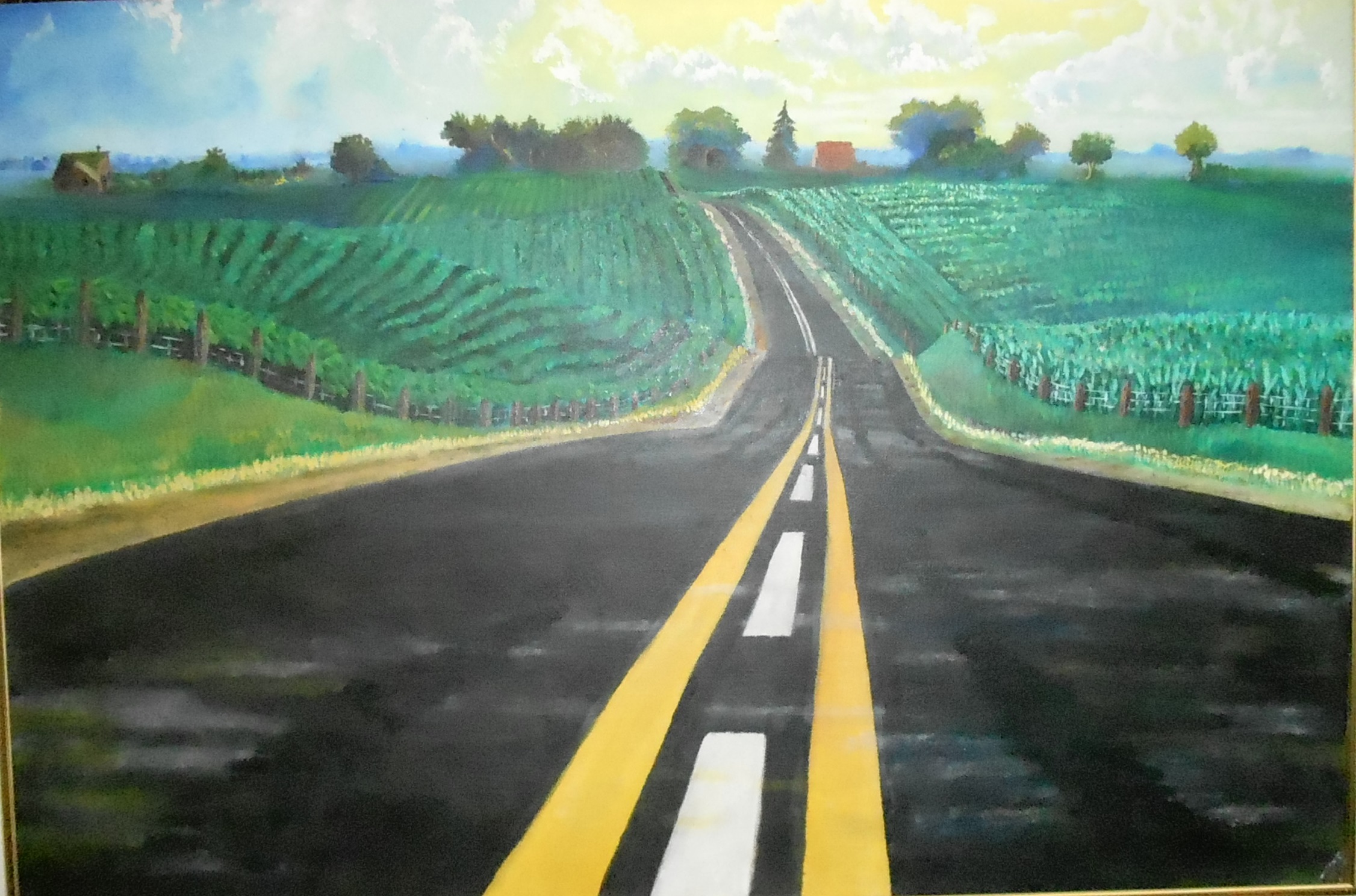
I now own a third of the farm you see in the foreground of this picture. The farm on the far side of the road is Uncle Harry’s farm that was sold when Uncle Harry passed away long ago.
In a sense, I have already had my say in the books I have written. The themes are my fundamental thinking, the horrid insults flung at me in my internal monologue by my inner critic, the rough nuggets of supposed wisdom that I have not only cut my writer’s teeth on. but, in some cases, chewed on relentlessly for decades until it comes out again as sweet as honey. Or, sometimes, as sour as the bile and vomit created by extended illness. Whatever its quality, the writings I will leave behind me are my fair say in an attempt to help the world evolve.
There is still a considerable record of having had my say in middle school and high school English classes. That say, that attempt to influence the future, has already been written in the memories of students that sat through my classes. They endured a lot, put up with a lot of mistakes by me, but also, hopefully learned some real lessons.
Here’s the current gist of what I have to say;
We are in a time when the environment is out of control and getting worse. It will probably kill us all, including all other life on Earth. But we are creative enough and smart enough to invent our way out of that problem. If only the stupid people and the greedy-evil people will let us.
We are also in a time when there is a definite threat that our leaders are going to embrace the easy and profitable path of being a Fascist. We have to hope there is enough empathy and morality left amongst our people to avoid this and find a fairer way for all.
And that is not all I have left to say. But it will do for now.
I have always had an inquiring mind. That is a curse instead of a plus if your main goal in life is to be happy and unbothered by anything. But it has proved to be of benefit to me as I have become an old coot who actually cares about what is true. Yes, I am willing to personally suffer to bring to light that which is actually true and that which must be disbelieved before it truly hurts us.
Don’t judge me yet based on this next question;
“Did you know that the Democratic party is funded by billionaires who want to use the “Deep State” to promote their Satanic rituals involving the murder and cannibalistic consumption of human children?”
I hope you know that I would never promote such a thing as being true. I am even careful of posting this pernicious lie in a question rather than a statement, because that’s one of the tactics the malign promoters of this religious belief use, not actually stating something that will be contradicted immediately, but taken merely as something to be considered and discussed simply because it is offered in question form.
So, how do you tackle such dangerous nonsense?
I prefer the scientific method which provides the structure for your thinking that will keep you on the most likely paths that lead you to what is true and what is not.
Facts should be confirmed by multiple verifiable sources.
We don’t talk much about cold fusion nowadays because when it was discovered in 1989 by a pair of electrochemists whose single experiment produced more heat than what should result from the energy put into the tabletop experiment, it quickly blossomed into the huge, major breakthrough story that it really would’ve been if only it had been verified. But, as is required by the entire scientific community, it couldn’t be reproduced in more repeats of the experiment than those that turned out negative. So, even though Pons and Fleischman did an experiment that answered the dreams of science-fiction nerds like me, they are mostly ignored by now. Cold fusion? Only one flawed source, studied in 1989 and proved still basically untrue in 2004 by a multitude of scientists who wanted it to be true.
Consider the source for Q-Anon conspiracies. One (or possibly more) anonymous government whistle-blowers whose credentials have never been presented or identities revealed, and mind-blowing statements appearing on places like 4-Chan, 8-Chan, and Parlor to be picked up and amplified on such reliable sources of scientifically proven knowledge as Twitter, Facebook, and Instagram. I hope you understand sarcasm after making that last statement.
Q-Anon is not the only conspiracy religion out there. My friend Giorgi (above) has a more benign, but no less ridiculous religion that chooses to replace God Jehovah, Zeus, Odin, Buddha, and other religious figures and deities with Ancient Aliens.
Here’s a second and third test offered by Carl Sagan to use against their ideas;
2. Encourage debate from knowledgeable people from all identifiable perspectives.
3. Do not accept arguments only from positions of authority.
Q-Anon arguments only have the authority of repetition because social media endlessly asks the same “questions” over and over. There is no debate from any recognizable “authority,” just a plethora of unsubstantiated statements and commandments.
In a way, the Ancient-Aliens crowd is guilty of the same thing. They never have skeptics and debunkers on their History-Channel show. You never see Michael Shermer, founder of the Skeptics Society, offering his opinions of their conclusions on that show. Neither do they allow Christian theologians or Buddhist scholars to offer their take on what probably really happened. They do employ physicists, engineers, and historians on their show, but never the ones that don’t agree with their radical theories and conclusions. Since there is no real debate on that show and no identifiable peer review, that show does not qualify as History, let alone Science.
4. Don’t get overly attached to your own ideas.
If you are going to investigate any conspiracy that holds thrall a number of “true believers,” approach everything with a truly open mind. I actually believe alien beings from “out there” have visited Earth. That is based on things, science, and testimony I haven’t even begun to go into here. But I reserve my right to be skeptical about everything, especially my own prejudices, theories, and beliefs. Otherwise I could too easily get trapped into believing in the truth of something that I otherwise would recognize as false. This is the factor that has pulled so many of my otherwise sensible Republican friends onto the flypaper of spurious Q-Anon claims.
5. Use numbers wherever possible. Math is quantifiable information that can “prove” the facts better than most ideas expressed in mere language. It is more precise, and reveals truth in verifiable ways that no poet ever could.
I am known to some in my family (here you could read wife and sisters) as the family conspiracy nut and generally crazy old coot.
But I am not so crazy that I don’t recognize the dangers inherent in some the ideas I am talking about here. As an English teacher I have learned some effective thinking skills that protect me and mine. I can honestly tell you that these thinking skills explained here will help you too. I learned them from a friend who pointed me to Carl Sagan as the source of these thinking skills.
And to any of my friends who might read this post and be offended, I apologize. But you were wrong about Pizzagate, and you are on the wrong side of this too. Aliens probably did NOT build the pyramids. But logic IS the primary structure of this essay.
A Mr. Holland Moment
Life is making music. We hum, we sing to ourselves, movie music plays in our head as the soundtrack to our daily life. At least, it does if we stop for a moment and dare to listen. We make music in many different ways. Some play guitar. Some are piano players. And some of us are only player pianos. Some of us make music by writing a themed paragraph like this one. Others make an engine sing in the automotive shop. Still others plant gardens and make flowers or tomatoes grow. I chose teaching kids to read and write. The music still swells in my ears four years after retiring.
The 1995 movie, Mr. Holland’s Opus, is about a musician who thinks he is going to write a magnificent classical orchestra opus while teaching music at a public high school to bring in money and allow him time to compose and be with his young wife as they start a new family.
But teaching is not, of course, what he thought it was. He has to learn the hard way that it is not an easy thing to open up the closed little clam shells that are the minds of students and put music in. You have to learn who they are as people first. You have to learn to care about what goes on in their lives, and how the world around them makes them feel… and react to what you have to teach. Mr. Holland has to learn to pull them into music appreciation using rock and roll and music they like to listen to, teaching them to understand the sparkles and beats and elements that make it up and can be found in all music throughout their lives. They can even begin to find those things in classical music, and appreciate why it has taken hold of our attention for centuries.
And teaching is not easy. You have to make sacrifices. Big dreams, such as a magnum opus called “An American Symphony”, have to be put on the shelf until later. You have children, and you find that parenting isn’t easy either. Mr. Holland’s son is deaf and can never actually hear the music that his father writes from the center of his soul. And the issue of the importance of what you have to teach becomes something you have to fight for. Budget cuts and lack of funding cripples teachers in every field, especially if you teach the arts. Principals don’t often appreciate the value of the life lessons you have to give. Being in high school band doesn’t get you a high paying job later.
But in the end, at the climax of the movie, the students all come back to honor Mr. Holland. They provide a public performance of his magnum opus, his life’s work. And the movie ends with a feeling that it was all worth it, because what he built was eternal, and will be there long after the last note of his music is completely forgotten. It is in the lives and loves and memories of his students, and they will pass it on.
But this post isn’t a movie review. This post is about my movie, my music. I was a teacher in the same way Mr. Holland was. I learned the same lessons about being a teacher as he did. I had the same struggles to learn to reach kids. And my Mr. Holland moment wasn’t anywhere near as big and as loud as Mr. Holland’s. His was performed on a stage in front of the whole school and alumni. His won Richard Dreyfus an Academy Award for Best Actor. But his was only fictional.
Mine was real. It happened in a portable building on the Naaman Forest High School campus. The students and the teacher in the classroom next door threw a surprise party for me. They made a lot of food to share, almost all of which I couldn’t eat because of diabetes. And they told me how much they would miss me, and that they would never forget me. And I had promised myself I would never cry about having to retire. But I broke my promise. In fact, I am crying now four years later. But they are not tears of sadness. My masterwork has now reached its last, bitter-sweet notes. The crescendos have all faded. But the music of our lives will still keep playing. And not even death can silence it completely.
2 Comments
Filed under artwork, autobiography, commentary, happiness, insight, kids, movie review, teaching