Category Archives: artists I admire

Kit Marlowe, Secret Agent

christopher_marlowe

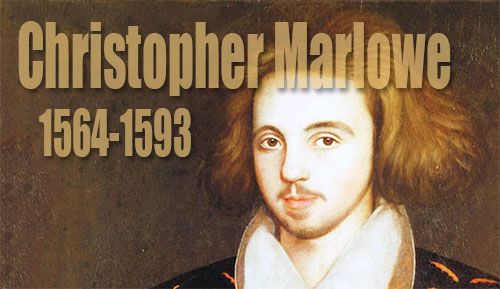
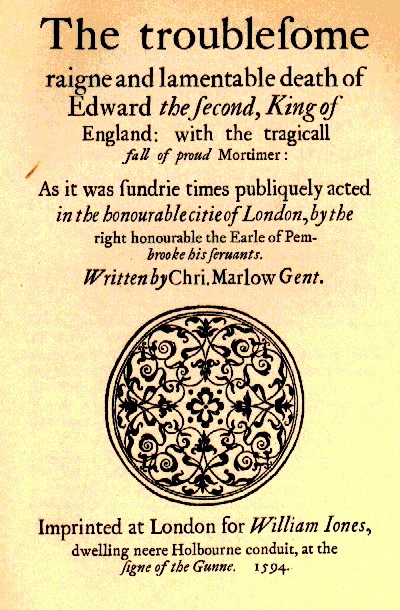
Christopher Marlowe is often sited as the real Shakespeare, a problematic assertion given that he would’ve been forced to write a number of plays after he was dead, giving new meaning to the term “ghost writer”.  But I would like to add to the assertion that “Marlowe is NOT Shakespeare!” that I also believe he did not die as they claim that he did.  Marlowe is a fascinating character of debauchery and misbehavior, intrigue and mystery, and undeniable genius.  As a writer, he was a maverick and risk-taker, having begun the ascendance of the theatrical play as one of the heights of Elizabethan literature with his play Tamburlaine the Great, about the historical figure who rose from shepherd boy to monarch.  This play, and its sequel, Tamburlaine the Great Part II, were among the very first English plays to be written in blank verse, meaning there is a very definite connection between the style of writing established by Marlowe and the later work of Shakespeare.  It is probable that for a few years, Kit Marlowe was a member of the Gray’s Inn group along with Sir Francis Bacon and several other suspicious literary luminaries like Sir Walter Raleigh and possibly Ben Jonson.  (I have to admit at this point that if I am wrong about the Stratford guy and he did write the plays, then he was a member of this group as well, because it was not closed to commoners, only to stupid people.  The Stratford guy was in no way stupid or a villain, no matter what you may believe about the authorship question.)  But here is where the link to Shakespeare’s plays and poetry both begins and ends.  Yes, Kit Marlowe was a capable enough author to have written such sublime plays.  He has all the individual skills to make up the whole.  But if you read his masterwork, The Tragicall History of the Life and Death of Doctor Faustus, you will see that the voice, the unique literary style of the work is simply not by the same author.  Although Shakespeare revisits some of the same themes that Marlowe used in his plays, his manner of development, handling of character, style of humor, and underlying conviction in the existence of God are all different and opposed to Marlowe’s.  Marlowe is NOT Shakespeare.  Shakespeare’s works have more in common with Bacon’s than Marlowe’s.  And I have already said that, “Shakespeare is NOT Bacon… or eggs either.”  And if I said it, it must be so.  (Don’t throw eggs and tomatoes at your computer screen when you read this.  Just call me stupid and vain in the comments like everybody else does.)
maxresdefault

And an even more compelling reason to those of you who don’t obsess over reading Shakespeare and Marlowe and Ben Jonson is that, at the time Shakespeare’s plays were probably written, Kit Marlowe was busy either being stone cold dead, or, having faked his death, was busy being a secret agent for Queen Elizabeth.


And why would a goofball like me think that Christopher Marlowe cunningly faked his own death and went into his own thrilling quest to be like James Bond more than 300 years before Ian Fleming?  Well, because I know how to read and am not generally bright enough not to believe what others have written about him and his connections to world of spying in Elizabethan times.

These authors have brought out the fact that Marlowe’s frequent absences from college and later public obligations coincide with things like the mysterious tutor called “Morley” who tutored Arbella, niece of Mary Queen of Scots, and a potential successor to Queen Elizabeth, in 1589.  He was also arrested in the Netherlands for allegedly counterfeiting coins related to the activities of seditious Catholics.  He was brought back to England to be dealt with by Lord Treasurer Burghley, the closest adviser to Queen Elizabeth, and was then not so much punished as let off the hook and even rewarded monetarily.  Still think he was not a spy?  Well, his demise probably came about through his relationship with Lord Francis Walsingham and his friendship with Walsingham’s son.  You see, Walsingham was Elizabeth’s “M”, leader of her spies and intelligence units.  After Walsingham died, there was deep concern that no one was still able to protect Marlowe from possible consequences of being both a homosexual and an atheist.  (Being gay was obviously not as serious a sin as atheism for which torture and death penalties lay in wait.)  It was possible that rival spies and nefarious forces could kidnap Marlowe and get information out of him that the Queen needed to be kept secret.

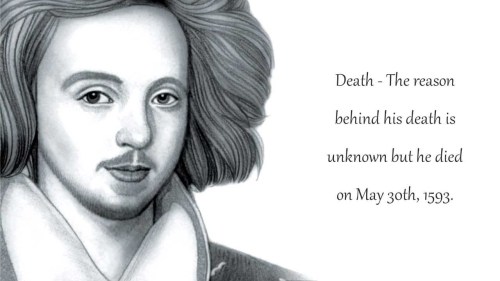
So, when Lord Burghley tortured Marlowe’s friend and sometime roommate, Thomas Kyd, into naming Marlowe a heretic and sending men out with a warrant to arrest Marlowe, Kit’s other friend, Thomas Walsingham probably warned Marlowe.  The bar fight that supposedly ended Marlowe’s life was witnessed by two friends of his, Nicholas Skeres and Robert Poley, both provably con men and professional liars.  The knife that stabbed him in the forehead above his right eye was wielded by Ingram Fizer, another of Marlowe’s disreputable friends, allegedly over an unpaid debt.  Fizer, of course, though he freely admitted killing Marlowe, was acquitted of the murder.  And the coroner’s report is suspect.  Rules of investigation were not followed, and the body was never independently identified by someone other than the three friends at the scene of the crime.  And the body was hastily buried before anyone else could get a close look at it.
edward2a

I am not only telling you that I believe Christopher “Kit” Marlowe was NOT Shakespeare… or eggs either (though that joke doesn’t really work here), but I believe he didn’t die the way it has been reported to us by history.  And why do I believe these things?  Because I think the story of Christopher Marlowe is a really great story, and it exists as a story whether it is historically true or not.
 

Leave a comment

Filed under angry rant, artists I admire, conspiracy theory, goofy thoughts, humor, poetry, satire, telling lies, William Shakespeare

Goodbye, Sweet Gene

gene-wilder-3

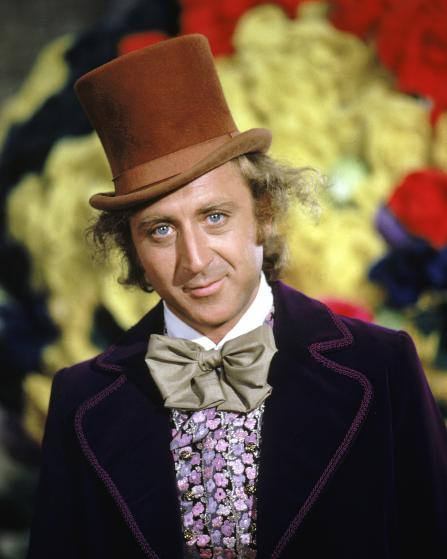
I’m going to miss him.  I’m really going to miss him.  I know he suffered from Alzheimer’s and hadn’t really done anything new and exciting in a while, but still, I always knew that he was still there.  He was still Gene Wilder.  Not only that, he was still Willy Wonka, still the Waco Kid from Blazing Saddles, still Dr. Frankenstein from Young Frankenstein, which he not only starred in, but wrote.

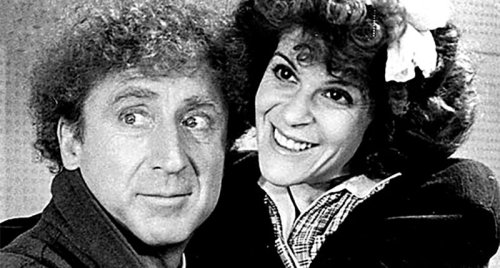
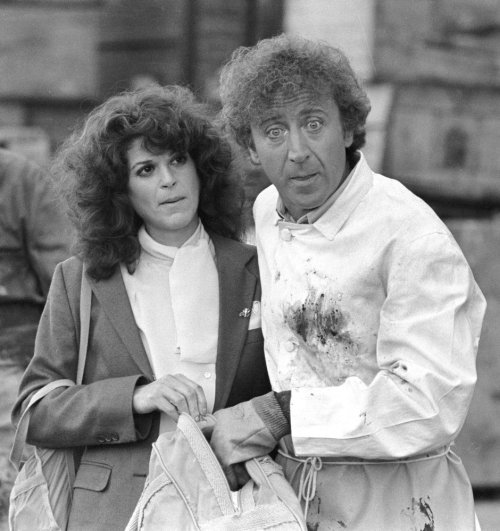
He was also Gilda Radner’s husband.  The great love of his life, gone too as a victim of cancer back in 1989.

Gene-Gilda-800x430

1035509_Obit-Gene-Wilder.JPEG-4b561

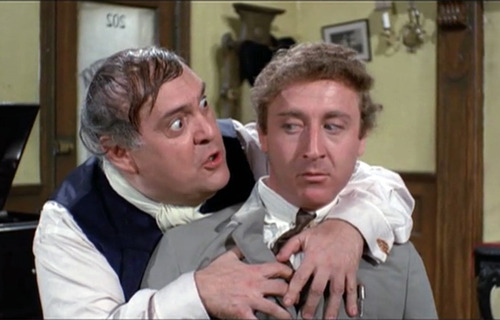
The first time I ever saw him on screen was in college, in film class.  We watched Mel Brooks’ The Producers on the classroom projector.

gene-wilder-producers

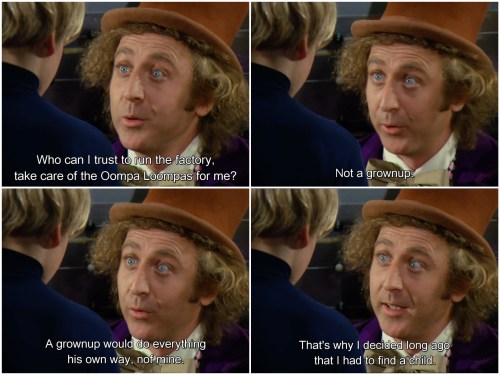
We studied the movie in class as evidence that comedy films are difficult to make, but have a potential to be truly great film achievements.  That same year, both Blazing Saddles and Young Frankenstein hit the big screens in Ames, Iowa.   I saw and loved them both.  Of course, I had watched the televised version of Willy Wonka and the Chocolate Factory on Grandma Beyer’s color TV sometime before that.

screen-shot-2015-02-26-at-4_fotor_collage

Gene Wilder helped me see that I could live in a world of pure imagination.  And that I could be whatever I truly wished to be.

I’m definitely going to miss that man.

3 Comments

Filed under art my Grandpa loved, artists I admire, feeling sorry for myself, finding love, humor, movie review

Sculpture Anatomy

Here is a collage that represents one of my hoarding-disorder collecting diseases enabled by the internet.  The rules for this collection are basically;

  1. Only photographs.
  2. Only human bodies, or people parts.
  3. Only artistically created people parts made of non-people stuff.
  4. Naked is not only allowed, but preferred.

    539637_414849215220540_1199730384_n

  5. 988544_991166777562976_6597368353492715309_n

  6. 10501970_991148260898161_1611444846896190024_n

    1. This is a porcelain doll, not a real girl… just so you know I didn’t break any rules.
  7. david_1

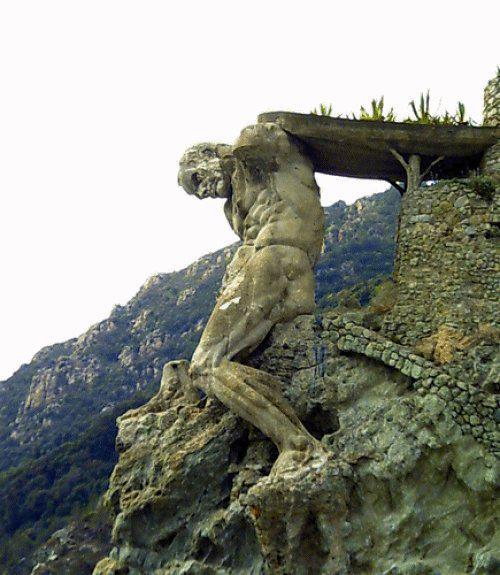
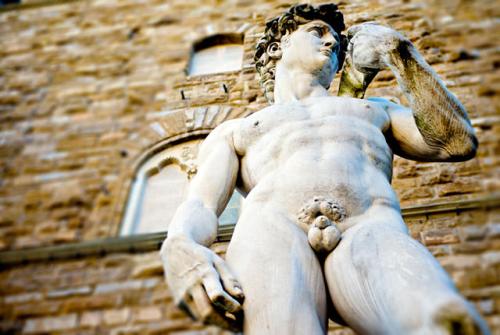
    The point is, art is a depiction of us.  No matter how you create it, what it visually portrays is a reflection, like the one in the bathroom mirror every morning.  Beautiful, grotesque, sexy, repulsive, adorable, or disturbing… it is who we are.  The point is also, it allows me to point, click, and save and create a collection that I don’t have to hide from my wife.  Because, well, you know… it’s art.

2 Comments

Filed under artists I admire, artwork, collage, humor, nudes, old art

Happy Belated Birthday, Lucille Ball

Iranian scientist Shahram Amiri speaks to journalists as he arrives at the Imam Khomini Airport in Tehran

On Lucy’s birthday the “Scary Lucy” statue of her in her hometown of Celeron, New York was finally replaced with one that actually looks like her.

Carolyn Palmer

In this Wednesday, July 20, 2016 photo, artist Carolyn Palmer prepares to apply a cold patina to her bronze statue of Lucille Ball in Saddle River, N.J. The sculptor was chosen to create a replacement statue for one dubbed “Scary Lucy,” in the late actress Ball’s hometown. The much-maligned statue of Ball will be replaced after it drew worldwide attention as “Scary Lucy,” according to the mayor of the western New York village where the 1950s sitcom actress and comedian grew up and her life-size bronze has stood since 2009. (AP Photo/Mel Evans)

On Saturday, August 6th, Lucille Ball turned 105.  While it is true that she has also been dead since 1989, we never-the-less must acknowledge the fact that this comedienne and her singular body of work have been influencing life on Earth for over a century.  Perhaps we could even use more like her.

i-love-lucy-tshirt-115b

She has been subtly guiding my own life since the days of black-and-white television and the genre-establishing sitcom, “I Love Lucy”, where she has been advocating for a woman’s right to work and have a career of her own by making us laugh at the situation over and over until it becomes a mirth-filled, easy-to-swallow fact-of-life.  She was the first female film producer to run her own production company, Desilu Productions.  She is the producer behind such television milestones as Star Trek and Mission: Impossible.  Being a child of the 60’s, raised by television almost as much as by my parents, she is a big part of who I am as a person.  To this day she still influences how I feel about things.  She is one of the primary reasons I can laugh at life’s troubles and, by laughing, overcome them.

So, I want to wish Lucy a happy 105th birthday.  And I find it amusing and ironic that “Scary Lucy”, the bronze golem of Celeron, New York, has finally been replaced on her birthday with a statue that pictures her more accurately.  We all need to see Lucy more accurately.  We all need to laugh more and love more and live better lives.  It was the “Golden Age” of television not because of the technology and the craft, but because of the essential goodness we can still get from it, that has stood the test of time for a century.

And I don’t think that I am merely looking at the whole thing through the colored lenses of my own affection for things in the past.  I think more modern and definitely younger people than I can benefit from getting to know Lucy too.  Lasting  105 years is a pretty big thing, even if you are dead when you do it.

love_lucy

7 Comments

Filed under artists I admire, clowns, comedians, goofy thoughts, humor, review of television, sharing from YouTube, TV as literature, TV review

Tim Burton Movies

a665d0b2de53d87feabd021230a17af8

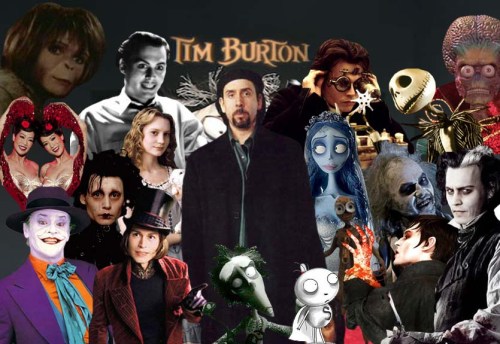
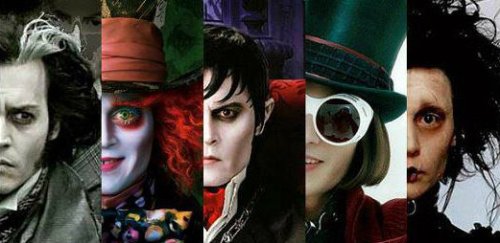
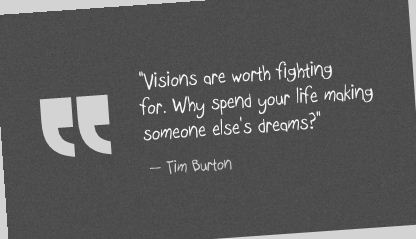
Last night the Princess and I went to see Alice, Through the Looking Glass, the latest Tim Burton movie.  Of course we loved it.  Burton is one of the most interesting story-tellers of our time.  Did you know he is two years younger than me?  And also, like me, he began as a cartoonist and is totally dedicated to the idea that every artist is a surrealist and must exaggerate, elucidate, equivocate, and numerous other things that start with the letter “e” and end with the suffix “ate” simply because that’s how surrealism starts.  You notice a little bit of weirdness in real life and blow it all out of proportion with lies and coloring of meaning and relentless “what-iffing?”  If you don’t see surrealism in those last two sentences of purple paisley prose… then maybe you can see it visually in Burton’s many masterpieces.

PeeWee

Tim Burton began his legacy as an apprentice Disney animator specializing in stop-motion animation.  But he was just another creative nobody like me until the launch of his small-budget monster hit, Pee-Wee’s Big Adventure.

Of course, any time you can pull in huge profits for little investments, you will have Hollywood executives ramming the heads of their unpaid interns like battering rams against your door so they can get in and throw money at you.

Hence, Batman.


Batman was the first time I actually took notice of Tim.  And not just as a director of a film… eventually two films.  He was gifted at assembling a cast.  And this would work to his advantage as several singular talents attached themselves to him and worked in his movie projects repeatedly.

20092482

56ba4d6705defa5b92592bcb3d5717b2

And his repeated collaboration with Danny Elfman and his music was easily as great a master-stroke of genius as John Williams with Spielberg and Lucas.

He has repeatedly used his movies to describe and rewrite his own life story as a misunderstood genius flubbing horribly in the quest to fit in with a world full of “regular people”.

562fefaf1c00002e00570bf0

Poster for the film ‘Edward Scissorhands’ (directed by Tim Burton), 1990. (Photo by Buyenlarge/Getty Images)

1000

505ad9e3-4113-438d-b10f-7727b9f4d7a8_560_420

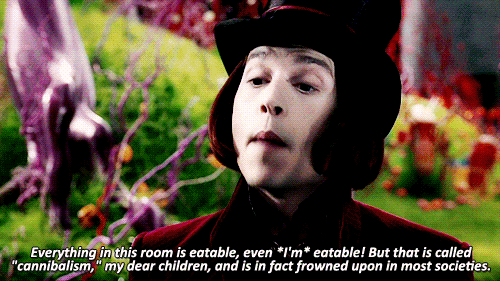
His sense of humor, of course, is distinctly and colorfully bizarre.

Dark Shadows

DSTF-0046r JOHNNY DEPP as Barnabas Collins in Warner Bros. Pictures’ and Village Roadshow Pictures’ “DARK SHADOWS,” a Warner Bros. Pictures release.

anigif_enhanced-buzz-1589-1390672243-0_preview

alice-au-pays-des-merveilles

Burton is, just like me, a child of the 70’s.  He references things like the old gothic soap opera, Dark Shadows, that were a part of his impressionable youth just as they were mine.  He picks stories about things he truly cares about, and that is also just like me.

582409894-Tim-Burton-Quote

gallery_movies-big-eyes-amy-adams-tim-burton

So, in a rather bizarre coincidence that is entirely appropriate to surrealists, I love any Tim Burton movie simply because it is a Tim Burton movie.  He is probably me in an alternate dimension.  And as such, I already know I will love his next movie, whatever the heck it is.

6 Comments

Filed under art criticism, artists I admire, humor, movie review, self portrait, strange and wonderful ideas about life

The BFG (a review by the Uncritical Critic)

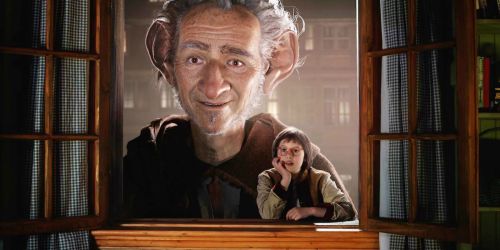
bfgmovie

I was predisposed to like this movie from the outset.  After all…  Spielbergh… Roald Dahl… a musical score by John Williams… almost Robin Williams as the BFG!  But I don’t like this movie after all.  I LOVE it!!!

I am easily stunned by gorgeous settings, CGI magic, and artistically done visuals.  I am easily captivated by cute and gifted young actresses like the one who plays Sophie, Ruby Barnhill.  And I am especially won over by the smiling face of the BFG himself.  He reminds me so clearly of my Great Grandpa Raymond (who was no less a magical being in my life than the BFG is in Sophie’s).

bfg-movie-2016-mark-rylance-ruby-barnhill

The fact that the BFG’s job in Giant Land is the capturing, bottling, mixing, and gifting of dreams is the most winning feature of all.  And he uses it in the epic plan to overcome the bestial, cannibalistic, (and possibly Trump supporters) other, bigger giants.  He is a metaphor for the story-teller himself… enduring hardships and harrowing adventures to capture, package, and deliver the stories that are so important to life and people’s ultimate happiness.  It is true for Roald Dahl, the darkly silly genius who wrote the story.  It is also true for Steven Spielberg, the craft-master and movie-maker who put it on film.  It is true also for the magician of movie music, John Williams.  I hope, someday, it will also be true for me.

bfgthe-bfg-tree

So many things about this movie are the epitome of the best movie-theater experiences.  I do not understand how it could’ve done so poorly in the box office.  I believe it will become one of those beloved and much-watched DVDs like Spielberg’s previous fairy-tale masterpiece, Hook, did.  I pray that it won’t simply become an overlooked asterisk in the history of cinema.  It is too good of a movie experience for that.


2 Comments

Filed under artists I admire, goofy thoughts, humor, movie review

Mennyms (A Book Review)

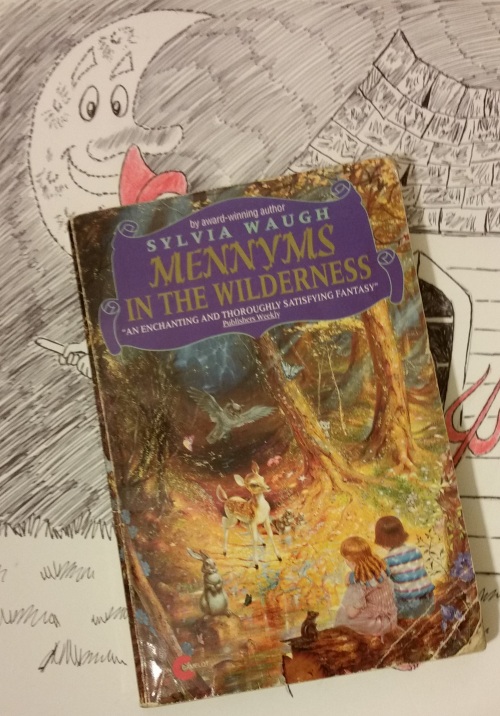
20160611_100605

This is the book I have really read, though I intend to acquire the rest.

Sylvia Waugh is a British writer of children’s books who has a lot in common with me.  She spent her career as a teacher of grammar.  In her late fifties she became a published author.  Her book series of the Mennyma is a charming fantasy adventure about dolls so loved by their owner, they actually come to life… and survive her…. and then have to make their way in a world that would be horrified by them and might easily seek to destroy them.

20160609_155347

Hopefully none of my dolls come to life after I croak. After years of collecting, they nearly outnumber humanity.

But rest assured, the dolls in this sweet-natured children’s book series would never prove evil.  The books are more fantasy-comedy than horror story.  In fact, they are impossibly far away from horror.

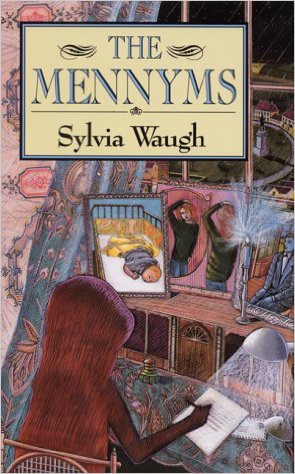
51QZSMA6EKL._SX293_BO1,204,203,200_

The original book.

Joshua Mennym is the head of a family of life-size rag dolls.  He pretends to be a middle-aged man.  He generally keeps his distance from the general public, because, up close, his basic rag-doll-ness would stand revealed.  Rag dolls are not supposed to walk and talk, let alone have families and live in a home of their own.   His wife is Vinetta Mennym, also a rag doll.  Together they are parents to the ten-year old twins, Poopie, the boy, and Wimpey, the girl.

The teenage twins are Pilbeam and Soobie.  Pilbeam is the girl and constant companion of the elder teenage sister, Appleby.  Soobie is the boy and  blue.  Why their former owner, Kate Penshaw, made him with a blue head and blue feet and blue hands is a mystery both to the Mennyyms and to me.   It causes him to be the one most likely to cause exposure of the family secret because even at a distance he does not look like a “real people” person.

Baby Googles is the smallest of the family, constantly cared for by the nanny, Miss Quigley, who is also considered a Mennym because she is also a doll.

Grandpa Magnus Mennym lives in the attic with Grandma and takes care of the household bills.  He writes scholarly works on the English Civil War and publishes them for a modest income which comes through the mail.  Granny Tulip is also relied upon for her wisdom and experience whenever a problem with keeping the family secret comes up.

Each book in the series contains a different adventure revolving around the realistic comedy generated by impossible people trying so hard to be real.  I absolutely love the adventures, even the ones I haven’t read yet.  And I know that the only way you could possibly love these books too is if you share my loony love of the fantastically impossible that turns out to be real.  After reading these books, I fully intend to keep a very close eye on my own doll collection.

Leave a comment

Filed under artists I admire, book review, doll collecting, good books, humor, imagination, old books

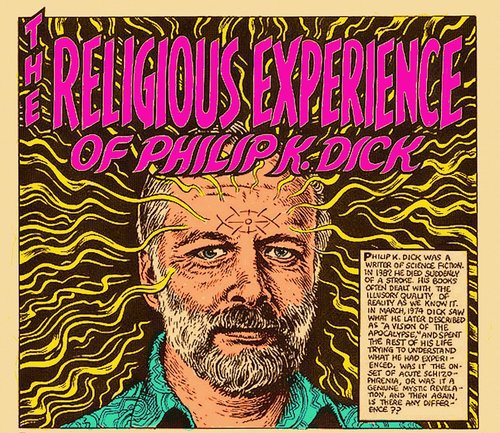
Philip K. Dick

18s42u32hlbmcjpg

There is a major drawback to being so smart that you can perceive the edges of infinity.  It makes you bedbug crazy.  I love the science fiction that populated the paperback shelves in the 50’s and 60’s when I was a boy.  I love the work of Philip K. Dick.  But it leads you to contemplate what is real… what is imaginary… and what is the nature of what will be.

image.related.articleLeadNarrow.300x0.201aa

the robot Philip K. Dick who appeared at Comic Con and answered questions

There are numerous ways to investigate life.  But it is in the nature of imaginary people to try to find ways to make themselves real.  When the replicants in Bladerunner try to make themselves into real people, they must try to create memories that didn’t exist.  They try to mirror human life to the extent that they can actually fool the bladerunner into letting them live.  Of course, it doesn’t work.  They are not real.  (Bladerunner is the movie name of Do Androids Dream of Electric Sheep).

blade-runner-dic

It is like that for me as well.  Being an imaginary person is difficult.  You have to constantly invent yourself and re-invent yourself.  By the time you finally get to know yourself, you have to change again so that the anti-android factions don’t destroy you.  Although, I think I may not actually be an android.

Does that sound a bit crazy?  Well Philip K. Dick’s life story may in fact have led him down the path to really crazy.  In 1971 he broke up with his wife, Nancy Hackett.  She moved out of his life, and an amphetamine-abuse bender moved in.  In 1972, ironically the year I began reading Dick’s work, he fell in love at the Vancouver Science Fiction Convention.  That was immediately followed by erratic behavior, a break-up, and an attempted suicide overdosing on the sedative potassium bromide.  This, of course, led directly to his 1977 novel A Scanner Darkly.

images (1)

The story is about a police detective who is corrupted by a dangerous addictive drug that takes him down the rabbit hole of paranoia, and being assaulted by the perception of multiple realities simultaneously.  His novel Ubik from 1969 is a story of psychics trying to battle groups of other psychics even after they are killed by a bomb.  The crazy seems to have been building for a while.

philip-k-dick-color

In 1974 he had a transcendental experience when a lady delivering medicine to his door wore a fish-shaped pendant which he said shot a pink beam into his head.   He came to believe the beam imparted wisdom and clairvoyance, and also believed it to be intelligent.  He would later admit to believing he had been reincarnated as the prophet Elijah.

la-réalité-cest-ce-qui-continue-dexister-lorsquon-a-cessé-dy-croire-1

Imagination has its dangers.  It is a powerful thing able to transform reality.  Science fiction writers often use their imagination to shape what the future will actually make come into being.  But it can also turn your mind inside out.  A great science fiction writer like Philip K. Dick can contemplate the nature of reality and turn his own reality inside out.  It is a lesson for me, a lesson for all of us.  Wait, is that a pink beam of light I see?  No, I just imagined it.


5 Comments

Filed under artists I admire, humor, imagination, science fiction, strange and wonderful ideas about life, surrealism

Wisdom From the Bob Ross Bible

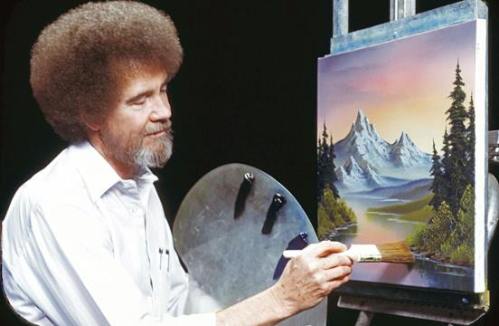
If there is a Church of Sacred Landscapes then Bob Ross is its Jesus Christ.  That is not a sacrilegious statement of bizarre cult-mindedness.  Painting is a religion that has its tenets.  And Bob Ross explained to us the will of God on his painting show on PBS.  All the illustrations used in this post come from the Facebook page Joy of Painting with Bob Ross. All the wisdom comes from things the Master said on the show.

11248809_987552237958159_3831451558245640641_n

1456530_1013333522046697_52665931274922281_n

Bob Ross was the prophet of the paintbrush.  He would present us with a lightly prepared canvas at the beginning of the show and then proceed on camera to take his brush and palette knife, and all his paints, and create a piece of the world before our very eyes.  And he was not Picasso or Van Gogh or even Norman Rockwell.  He was not a talented artist, but rather a very practiced one who knew all the tricks and shortcuts to sofa painting, the art of knocking out scene after scene after scene.  He could make his little piece of the world in only half an hour, and he made it obvious how we could do the same.  His work was not gallery quality… but his teachings were Jesus-worthy.1918971_1025737477472968_4026443126606690255_n

His work was natural, flowing, and realistic in the random complexity it presented.  He took standard paintbrush strokes and pallet knife tricks and made them dance across the canvas to make happy little trees.

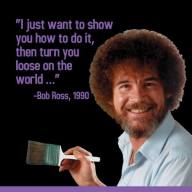
His painting methods presented us with a philosophy of life and a method of dealing with whatever mistakes we might make.

And of course, any good religion must take into account the existence of evil.

10584087_1017432258303490_1467733251578071673_n

Bob Ross tells us that evil is necessary as a contrast to what is good and what is true.  We need the dark.  But we don’t have to embrace it.  Bob’s paintings were never about the dark bits.  He always gravitated towards the light.

12791113_1051526088227440_5570911201164613149_n

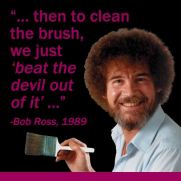
Of course, sometimes you have to beat back the darkness.  A good artist takes care of his tools.

Bob Ross admonishes us to look and to learn and love what we see.  The man radiated a calm, gentle nature that makes him a natural leader.  His simple, countrified wisdom resonates because we need calm and pastoral peace in our lives.  It is one of the main reasons mankind needs religion.

So I definitely think we ought to consider building a Bob-Rossian Church of the Sacred Landscapes.  We have our prophet.  The man has passed away, yet he is risen to paint again endlessly on YouTube.

And if you are willing to try… Bob Ross will smile upon you.

12540822_1021984657848250_2154441702706339203_n

17 Comments

Filed under artists I admire, artwork, humor, insight, inspiration, religion, sharing from YouTube, strange and wonderful ideas about life

Mr. Bean

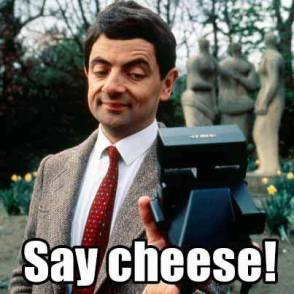
Rowan Atkinson is a genius comedian, and the character of Mr. Bean is the greatest work he has done, the best proof of his genius.  As someone who works at humor and tries to get it right, I have to analyze and carefully study the work of the master.  How does he do it?  What does it all mean?  And what can I learn from it?

a1b

Atkinson not only created the character, he co-wrote the entire television series and controls every aspect of the performance as the central character.  Mr. Bean is the bumbling every-man, going through horrific troubles because of the cascade effect of simple little errors.  We laugh at him because we have all been there.  Tasting the hot sauce leads to a meltdown that causes chaos and disaster for the entire store.  Overcoming fear of heights makes him the center of attention for the entire pool-house when can’t overcome the urge to use the diving board, and yet, can’t make himself jump off.  We have all lived the nightmare of being trapped naked in the hotel hallway, locked out of our room, just when the hallway becomes crowded.

There is a certain charm to Mr. Bean.  He is a childlike character, blissfully unaware of how much he doesn’t know about the complex society around him.  He has a teddy bear that sleeps with him and comforts him.  He lays out his supplies for the big exam, and he’s thought of practically everything he will possibly need, but basic physics fails him and makes the pencils keep rolling out of place.


Rowan Atkinson is a master of the art form because he has such tremendous control of his rubberized goofy face and manic body.  He can drive his goofy little yellow car from a sofa mounted on top.  He can change clothes while driving.  Just watching him shave with an electric razor is a total hoot.

1379883_546824888720851_2133355741_n

It is mostly physical comedy, almost slapstick, and yet it is not the broad unfeeling poke-in-the-eye you get with the Three Stooges.  Most of the real damage is done to himself, though pompous and deserving people are often near enough to get a helping of it smack in the face.  A lot of it is practically pantomime, with hardly any real dialogue.  Much of it, like the sword fight with the bumblebee using a butter knife, is simply silly.

a3b


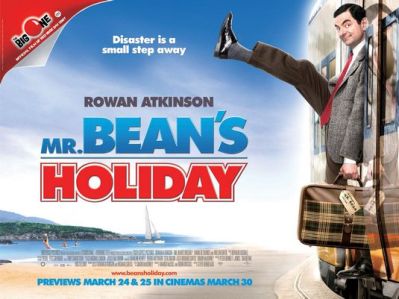
The movie, Mr. Bean’s Holiday, extends the character by making him actually interact with other characters, though in his own inimitable Mr. Bean way.  The limited dialogue thing is amplified by the fact that he is traveling in France and does not speak French.  Still, he interacts with the boy he accidentally kidnaps, the girl who wants to be a movie star whom he helps in her quest by an accident at the Cannes Film Festival, and the movie director whom he almost kills but ends up saving his career with a hit home movie.

Mr. Bean makes the ridiculous an art form by helping us to laugh at ourselves as we are beset by all the little troubles of life that Bean magically floats through.

So, now I have told you why I love Rowan Atkinson as a comedian.  He is a comedic genius.  Of course, you knew that already, right?


6 Comments

Filed under artists I admire, comedians, humor, review of television, sharing from YouTube