Tag Archives: metaphor

Fantasia

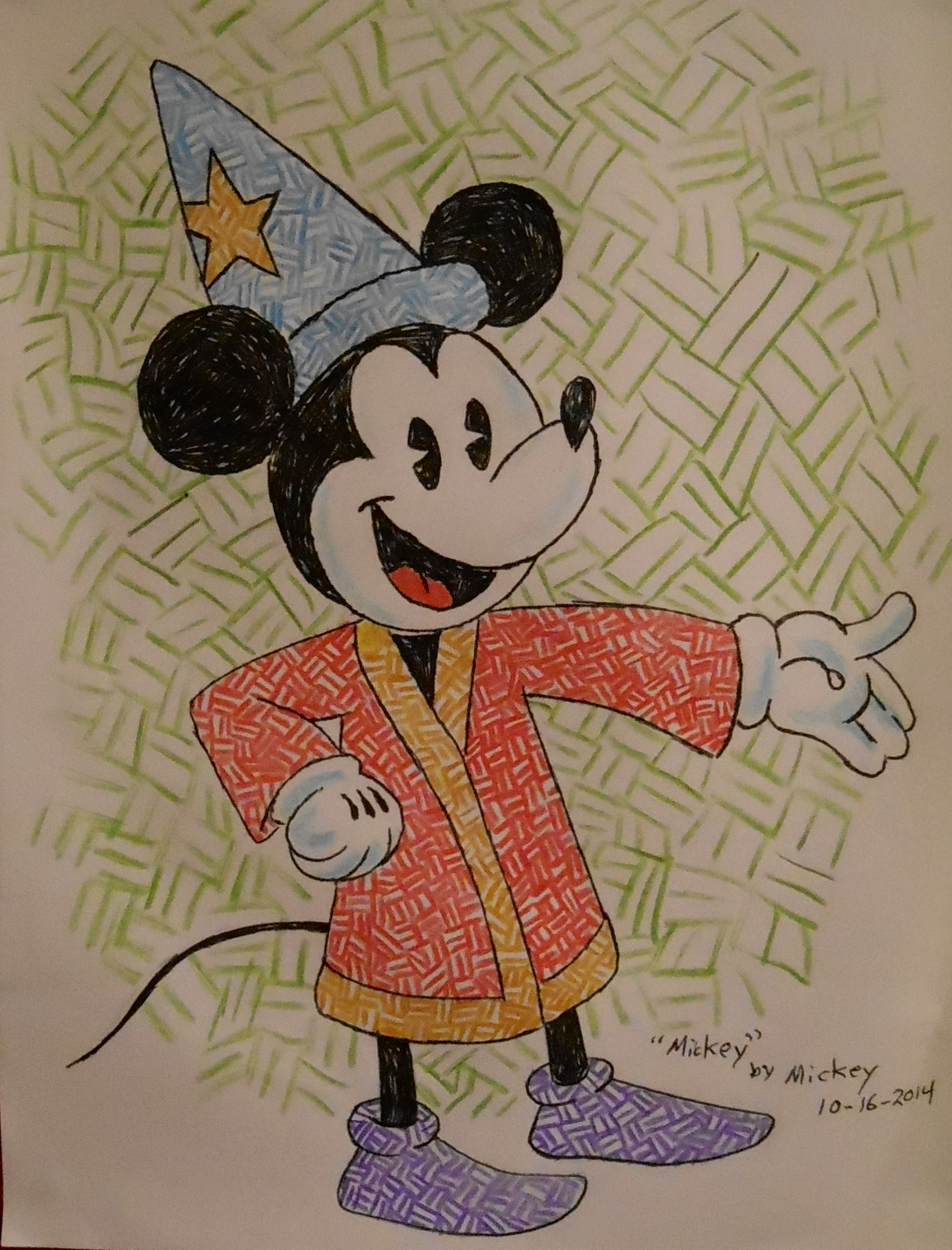
Mickey

I learned a lot of what I know about cartooning by copying Disney characters.  Now, I know that this post could potentially get me into trouble, because  I am posting on a blog I use for marketing, an imitation Disney character, a very famous and very copyrighted character.  Disney has been known to sue school districts for showing Disney movies in class without expressed written permission.  They have become cruelly litigious since transforming from Uncle Walt’s Wonderful World of Color into an evil multi-national corporate media empire whose spokesperson is a mouse.  So I beg you to pardon my transgressions due to love and debt I have to the work in the title of this piece.  Consider this fan art, like the pictures I posted of the Phantom and Captain America (who is also now owned by Disney).

Fantasia is for me the Book of Life.

The movie starts with Bach’s masterpiece, Toccata and Fugue in D Minor This amazing piece reminds me of earliest childhood memories.  It begins with sound and the instruments that make it, becoming shapes and lines and movements and, eventually cloud forms.  It is the beginning of perception, like modern art itself, the raw energy and emerging forms that I began to perceive as an infant, but could not define or distinguish clearly.

Next comes  Nutcracker Suite by Pyotr Ilyich Tchaikovsky.  This is the explorations of nature and the magic of existence as a mere child.  It uses Tchaikovsky’s sugar-plum ballet music to depict hours of play and learning and investigation and wonder.  In it I see myself as a young child, viewing all the color and beauty through wide eyes.

Then comes The Sorcerer’s Apprentice by Paul Dukas.  In this piece, the child in me, like Mickey the apprentice, for the first time bites off more than I could chew.  I overstep my protective boundaries and get myself into a serious fix that has to be undone by the parent stepping in at the end, and not only fixing it, but delivering the consequences to my ignorant behind with a broom.  Of course, we all know I will do it again.  Every child does.  But next time I will get it right.

This is followed by Rite of Spring by Igor Stravinsky.  Here the child is child no longer.  I watch the amoeba become dinosaurs to harsh and dissonant music.  I learn about the world, growing and evolving, finding out that life is full of hard lessons.  Life and Death play out there struggle, and the learning concludes when you reached the parched and hopeless climax, the realization that everything, no matter how big or powerful, ends in death and failure.  Dust returns to dust.

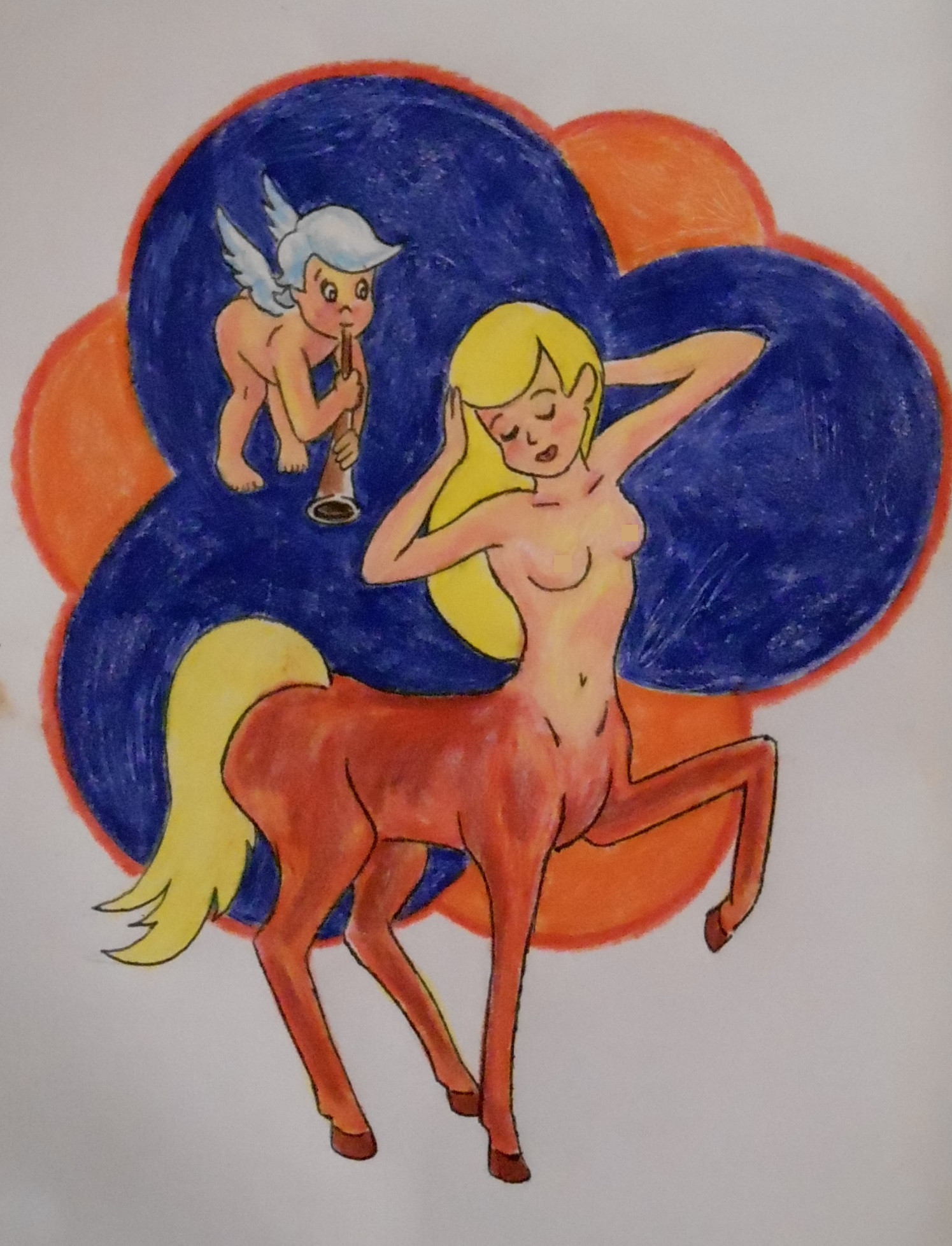
The film then blossoms into The Pastoral Symphony by Ludwig van Beethoven.  This mythical landscape of cute cherubs and satyrs, bare-breasted centaurettes, and Greek Gods rendered in pastel hues represents the blooming of romance, lust, and love.  There is celebration, complete with Dionysus and his invention, wine.  There is courtship, attraction, and bonding.  When the cherubs pull the curtain closed on the centaur couple, we also know what is happening behind the curtain even if it weren’t for the cherub whose butt becomes a red heart.  And, of course, there is a great storm that comes along, both in the pastoral music and the action of the cartoon, representing the volatility and strife that occurs when we dare to love another.  It does, however, subside for life to continue refreshed.
Disney centaur 2

The next piece is  Dance of the Hours by Amilcare Ponchielli.  This comedy of ballerina ostriches and hippos, bubble-dancing elephants, and aggressively dancing gators, is the domestic, married life.  It is a comedy of graceful awkwardness, beauty and humor rolled into the same cake and cooked with irony and wit.  And, of course, just like real life, everything is eventually carried away by the wind… until the next dance.

And finally, Night on Bald Mountain by Modest Mussorgsky and Ave Maria by Franz Schubert is the end of life.  First comes the pain and suffering of death, ruled over by Chernabog the Devil.  He commands the torture and heartless ritual that I am subject to even now, in the twilight of life.  The flesh and the bones yield to his trans-formative whims.  We must all dance to his music until the striking of dawn.  Then he is defeated and the spirit soars, free of body and definable form to the rousing strains of Ave Maria.  We journey through the cathedral forest towards the everlasting light, and the movie, like my life, will be done.  But I do not despair, because life, like the movie itself, can be endlessly replayed and is eternal.

I was not able to see this movie for the first time until college, attending a screening at Iowa State.  When it came out on VHS in the 80’s, I bought two, one to keep and store safely, unopened, and one to watch until it fell apart.  I also bought the DVD when it came out with Fantasia 2000.  I cannot count how many times I have seen this movie.  I even showed it to my classes as I was about to retire, and didn’t secure written permission.  But it was only this week, feeling ill and terribly mortal again that I realized… Fantasia tells the story of my life.
Leave a comment

Filed under Uncategorized

Mangled Metaphors and Purple Paisley Prose

Color boy

I have rather regularly been revising and editing old writing.  One thing I have discovered is that I am capable of the most gawd-awful convoluted sentences filled with mangled metaphors and ideas that can only be followed while doing mental back-flips or managing miracles of interpretation.    That last sentence is a perfect example of purple paisley prose.  Paisley, in case you didn’t know this, is a printed pattern on clothing or other cloth that makes an intricate design out of the basic twisted teardrop shape borrowed from Persian art.   The basic motif, the teardrop shape, is a leaf or vegetable design often referred to as the Persian pickle.  I write like that.  You can pick out the Persian pickles in this very paragraph.  Alliterations, mangled metaphors, rhyming words, sound patterns, the occasional literary allusion, personification, bungles, jungles, and junk.  “How can you actually write like that?” you ask.  Easy.  I think like that.

To make a point about mangled metaphors, let me visit a couple of recent scenes in novels I have been working on;

From The Bicycle Wheel Genius; page 189

Mike Murphy and Frosty Anderson sat at the kitchen table eating a batch of Orben’s pancakes, the twentieth try at pancakes, and nearly edible.  Mike could eat anything with maple syrup on it… well, maybe not dog poop, but these were slightly better than dog poop.


From The Magical Miss Morgan; page 7

Blue looked at Mike and grinned.  It was an impish and fully disarming grin.  It made Mike do whatever Blue said, even being willing to eat a lump of dog poop if she asked him to, though she would never ask him to.

So, here’s the thing.  Why is there a repetition of the dog-poop-eating metaphor?  In one case it is Mike Murphy expressing in metaphorical terms his love of maple syrup.  In the other, it is Mike Murphy expressing his love of Blueberry Bates’ dimpled grin.  He is a somewhat unique character, but why would anybody associate love with eating dog poop?  I don’t know.  I just wrote the dang things.

I like to take a convoluted plot and complicate it with complex sentences and numerous running gags, with a seasoned-sauce of mangled metaphors poured on top like gravy.  I will use sentences like this either to make you laugh, or give you a headache.  I’m almost sure it is one of those.  So if you have gotten this far in this post without a headache, then I guess it must be funny.


8 Comments

Filed under Uncategorized

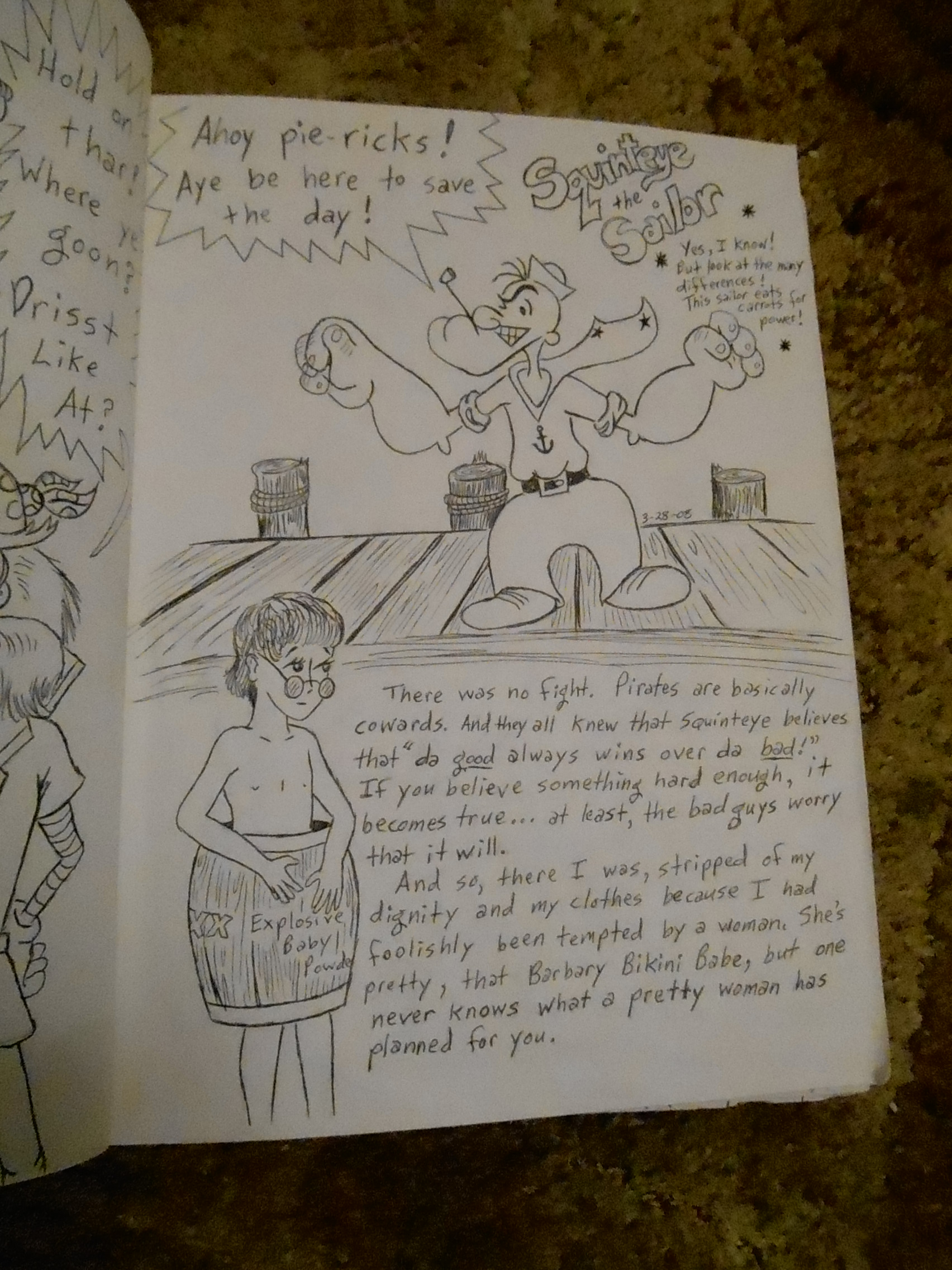
I am Popeye

Image


I am Popeye, I sez, because I just am…  Yeah, that’s right, I yam what I yam. 

First of all, I looks like Popeye.  I has that cleft in my chin, very little hair left on my ol’ head, and I gots the same squinky eye (what squinky eye?).  I has had that same squinky eye since I wuz a teenager and got kicked in the eye doin’ sandlot football (bettern’ sandlot high divin’, fer sure!).  I also has them same bulgy arms, the ones that bulge in the forearm and is incredibobble thin on the upper arms.

Second of all, I has Popeye Spinach-strength.  I look weak and scrawny, but I is a lot tuffer than I looks.  I go into classrooms full of wild, crazed high schoolers, and grabs their attention, tells ’em what’s what, and makes ’em woik.  (Woik is a voib, and that means I is woikin’ when I makes ’em do it.)  I kin stands ridicule and kids what will remarks on the hair in my ears and my squinky eye.  I tells ’em that the scar on my face was did by a bloke with a knife (which it were, cause I had skin cancer and the doctor used a knife to get it off).  I have taken all kinds of nasty punches from life (diabetes, blood-pressure problems, prostatitis, arthritis) and I still keeps comin’ back fer more.  In fact, I can winds up me arm and give that ol’ Devil a good Twisker Sock right in the kisser.

Third of all, I has a typical Popeye Sweet Patootie.  My Island Girl Wife is like Olive Oyl in very many ways.  She is always tellin’ me what to do.  She compares me to ol’ Bluto.  She panics and flails her arms when there’s a crisis.  And she expects me to always save the day and never says “thank you” after.

So, I mean it when I sez “I am Popeye”.  I yam what I yam and that’s all what I yam!

Leave a comment

Filed under Uncategorized

Metaphor and Meaning

Image


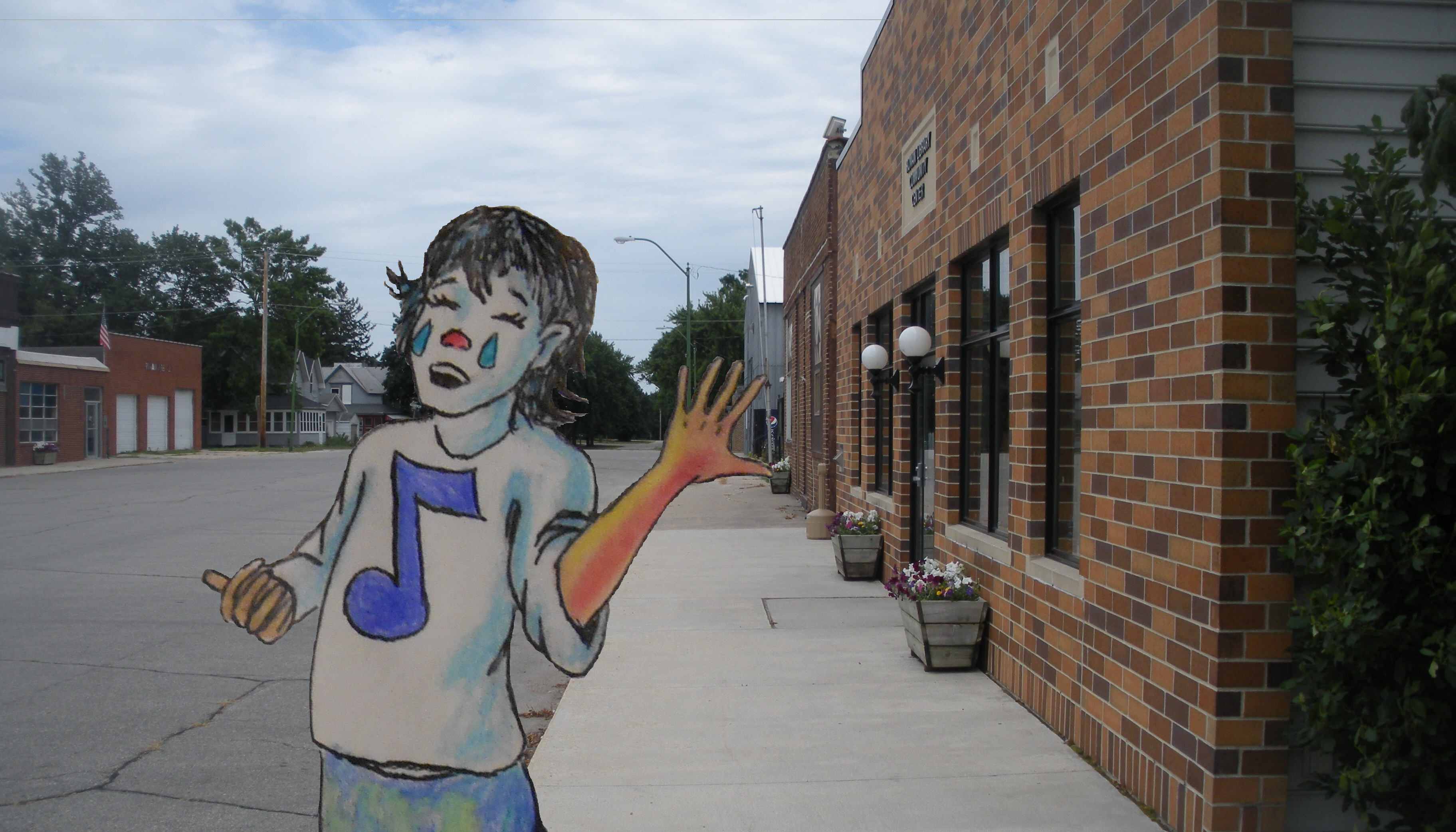
In this week’s Paffooney remix, I have pictured the little boy crooner Francois Martin on the main street of Norwall.  Why have I done such a foolish thing?  Why have I drawn a boy singing silently a song that only I can hear in my silly old head?  In fact, why do I label them Cantos instead of Chapters?  Of course, the answer to these rhetorical questions is metaphorical.  I look at my writing as being poetry, or, more accurately, as music rather than mere prose.  It is a metaphor central to my being, writing is putting the inner music of my mind down on paper.

Here is a secret to powerful writing.  Connect ideas with metaphors.  A metaphor is a direct comparison of two unlike things to create an analogy, an echo of an idea that gives resonance to a notion.  Sorry, I’m an English teacher.  It’s in my genes.  But metaphors can serve as the essential connections, as glue to put paragraphs and scenes together.

Let me show you a metaphor.  Here is a short poem, the natural environment where many metaphors live;

                                                The Cookie

Once I had a cookie… But every time I took a bite, It became smaller and smaller…

                With each bite I had less and less cookie left.

But when it was gone, the sweet taste of it…

                Lingered on… as memory.


The central metaphor of this poem is comparing the cookie to my life.  I am getting older.  I have six incurable diseases, some of them life threatening.  I have been thinking about mortality a lot lately.  So what is the point of the poem?  That even when the last bite is taken, and there is no more cookie… when I am dead, there is the memory of me.  Not my memory.  The memory of me in the minds of my family, my children, my students, and other people who have come to know me.  That memory makes whatever goodness that is in me worth living for.

Okay, a metaphor explained is kinda like a bug that’s been dissected for a science fair.  Its innards are revealed and labeled.  The beauty is gone.  It’s kinda icky.

What works better, is a metaphor that the readers can readily grasp on their own.  The beauty has to be discovered, not dissected and explained.  Let me try again;


                                                The Boy and the Boat

                The boy looked to the horizon where wild and wooly white-caps roiled upon the sea.

                “Lord help me,” he said, “the sea is so large, and my boat is so small…”


I can hear what you are thinking.  “That’s too simple and ordinary.  If it’s a metaphor, then it’s a really stupid one.”  Well, I heard someone thinking that, even if it was not you.

Let me add a bit of information to help you connect things as I do.  When I was ten years old, a fifteen-year-old neighbor boy sexually assaulted me.  I told no one.  I was so devasted by the event that I repressed the memory until I reached the age of twenty two.  In high school, my suicidal thoughts and darkest depressions were caused by this event even though I couldn’t even recall.  To this day I have not explained to mother and father what happened.  I can only bring myself to tell you now because my abuser died of heart failure last summer.  It was a life event of overwhelming darkness, pain, and soul scorching.  Now look at “The Boy and the Boat” again.  Has the meaning changed for you the way it does for me?

Now, I know that the last paragraph was a totally unfair use of harsh reality to make a point about metaphor and meaning.  So let me give you one last poem… a sillier one.  You can make of it whatever you will;


                                                The Grin

The wrinkly, bewhiskered old man

Had a smile like a plate of moldy spaghetti

In the afternoon sun.


3 Comments

Filed under Uncategorized