To be clear, I will have to write a post called Naked Experience to go with this post. It is a William Blake style of thing. You know, that English Romantic Poet guy who was into drawing naked people even more than me? The writer of Songs of Innocence and Experience? You know, this stuff;
Well, maybe you don’t know. But Blake gave the world the metaphor of the innocent lamb and the tyger of experience (tyger is his spelling, not mine, and it didn’t blow up the spell checker, even though it made the thing unhappy with me again). There is a certain something I have learned about nakedness that I mean to innocently convey. I learned it from anatomy drawing class and spending time with nudists. Naked is not evil. Naked is not pornography. Nakedness, itself, is a very good thing.
At this point the avid clothing-wearers among you are probably saying to yourself, “This guy is nuts! If God had wanted us to be nude, then we wouldn’t have been born with clothes on.” And I must admit, I cannot argue with logic like that.
But on a more serious note, I believe nudity is a fundamentally essential part of the nature of art. After all, pictures of naked people are a central part of what people have been drawing since they first started etching them with charcoal on cavern walls. And all art, including this blog, is about the human experience. What it means to be human. What it feels like to be alive on this Earth and able to feel.
And there is nothing sinister and immoral in drawing nudes to portray that fact. I am trying to show metaphorically the music of existence, the pace, the symmetry, the musical score… It isn’t focused on the private bits, what some call the naughty parts, even when those things are present in the picture. “How dare that naughty Mickey show the naked back end of that butterfly! It ought to have pants on at least!” Yes, I am making a mockery of that outrage itself. I am not a pornographer. These pictures were not created to engender any prurient interests. These pictures are part of Blake’s lamb. They will not bite you. Though blue-nosed people who wish to control what others think may very well bite me for daring to say so.
I have posted a lot of writing and artwork on this blog that I held for the longest time to be completely private and personal. I hardly ever showed any of it to anybody before I posted it here. But I am old. I no longer have secrets. I am capable of telling you everything even though I have never met most of you in real life. And I have no shame. I have become comfortable with emotional and intellectual nudity. And when I am dead, the body I have kept hidden from the world for so long will be no more. It’s just a thought. It’s a naked thought. And it is completely innocent.
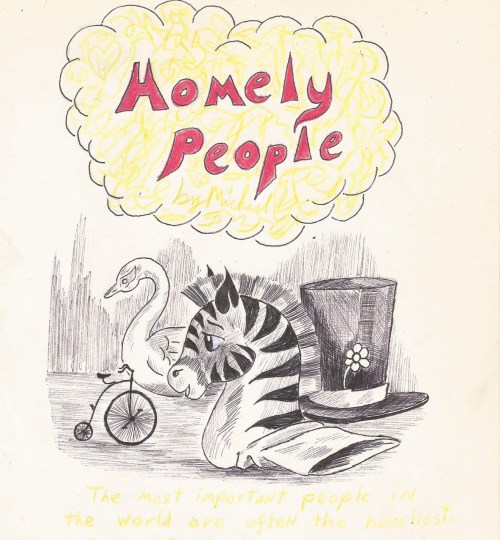
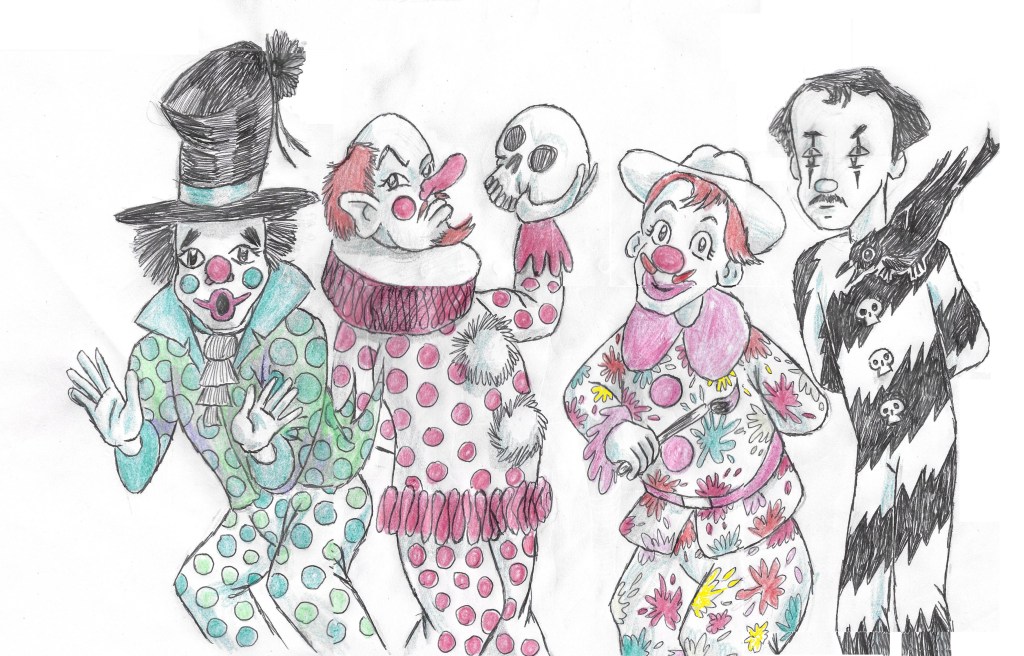
I prefer to write about, think about, and draw pictures of homely people. But don’t mistake me. I am not talking about ugly people. Our former President, the giant blood sausage with a bird’s nest on top that we have put in charge of making us all feel sick to our stomachs every day, demonstrates what ugly means. Ugly is not just weird and interesting to look at, it is also repellent behavior that makes physical flaws take a back seat… no, a rumble seat in the trailer behind by comparison.
I am talking about the ordinary people back home. The ones that may be sitting by your own fireplace on a cold day trying to warm their hands after throwing snowballs outside. And, of course, that snowball that hit Maggie Doozman in the side of the face and knocked her glasses off, made you laugh for an instant, until you realized she was crying, and Kirk Longhatter didn’t even apologize for throwing so hard, so you went over and picked her glasses up for her and handed them to her, and she smiled at you through the tears. That is the kind of homely I mean.
There is a lot that is beautiful in homely people. Sure, maybe not a classically beautiful Elizabeth Taylor face or a Gregory Peck lantern jaw. Maybe not even a shapely behind or a graceful step when walking across the street. But ordinary beauty. Kindness. Humility. Determination in the face of long odds. Good-natured jokery. A touch of childish silliness. A moon face that actually shines when a smile lights it up. That is beauty that can be found in homely people.
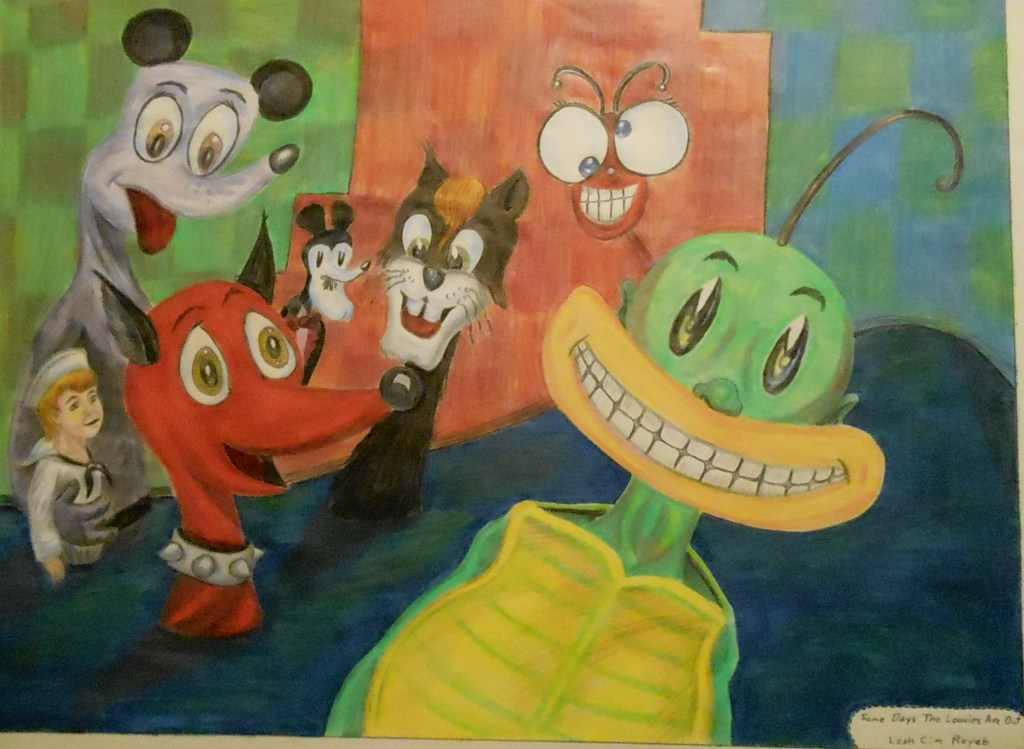
You’ve probably figured out by now that this post is just an excuse to show off some goofy old off-kilter portraits I did. But that doesn’t change the fact. I do love homely people.
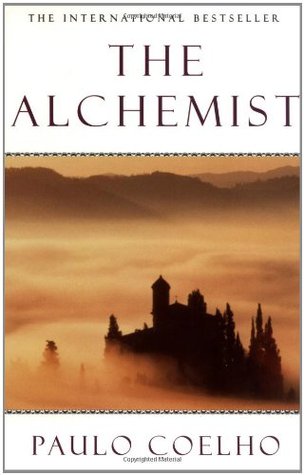
Some books come along telling a story that has to be taken seriously in ways that don’t make sense in any normal way. The Alchemist is one of those books.
What is an alchemist, after all?
An alchemist uses the medieval forms of the art of chemistry to transmute things, one thing becoming another thing.
Coelho in this book is himself an alchemist of ideas. He uses this book to transmute one idea into another until he digs deep enough into the pile of ideas to finally transmute words into wisdom.
There is a great deal of wisdom in this book, and I can actually share some of it here without spoiling the story.
Here are a few gemstones of wisdom from the Alchemist’s treasure chest;
“It’s the possibility of having a dream come true that makes life interesting…” (p.13)
“It’s the simple things in life that are the most extraordinary; only wise men are able to understand them.” (p.17)
“All things are one. And, when you want something, all the universe conspires in helping you to achieve it.” (p.24)
“And when he had gone only a short distance, he realized that, while they were erecting the stall, one of them had spoken Arabic and the other Spanish. And they had understood each other perfectly well. There must be a language that doesn’t depend on words, the boy thought.” (p.45)
All of these quotes from the book, as you can see, come from the first third of the book. There are many more treasures to be found in this book. I should not share them with you here. Just as the main character of the story learns, you have to do the work for yourself. But this book is not only an enjoyable read, but a map for how you can execute your own journey towards your “Personal Legend”. In fact, you may find that the book tells you not only how to go about making a dream come true, but, if you are already on that journey successfully, it tells you what things you are already doing right.
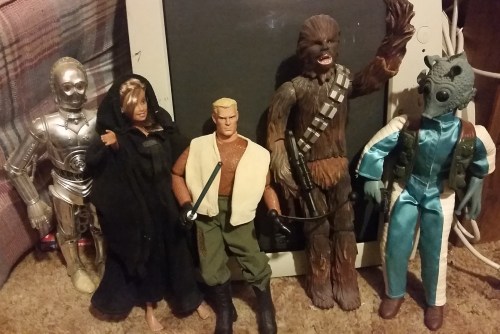
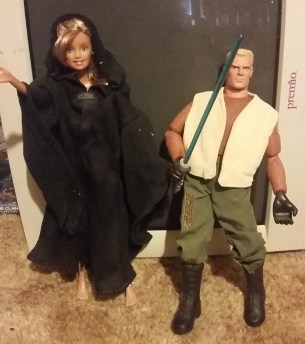
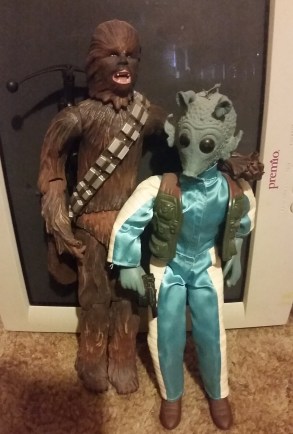
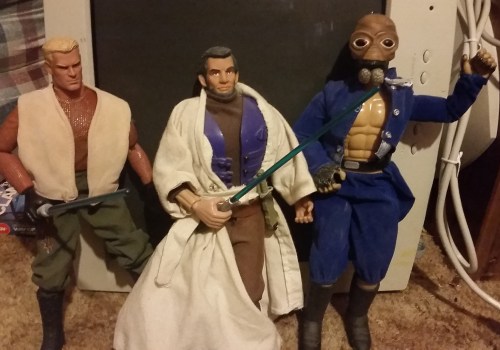
Traditionally, D&D-type role playing games are played with miniature figures to represent characters and npc’s on the battlefield. But when the kids were small and we started playing Star Wars RPG I didn’t have the proper figures. So. to visualize characters, we used what I did have plenty of, dolls… err, action figures.
I told you who the player characters were a couple of Saturdays ago, but let me remind you.
Princess Moreno, represented by the Barbie dressed in Emperor Palpatine’s robe was the leader of the adventuring group, and the player character of my niece, who was available back then because they lived in the Dallas area too.
Juba Jubajai, Jedi Guardian, was the muscle-brained power of the group. He was my oldest son’s player character.
The sidekicks and NPC’s that rounded out the group were Hrowwuhrr, the Princess’s loyal Wookie companion, and Keebo Kloohorn, the Rodian minstrel, quick of wit and poor at shooting.
Of course, there were numerous other people you run into in an adventure, like Jedi-trainer Master Link Conn (played by an Abraham Lincoln Presidential action figure) and Barrabas the space pirate. I customized some. Luke Skywalker and Han Solo played a lot of them. And others were only present in our imaginations. For a brief little while, it was a quaint and happy gaming experience to play Star Wars with dolls and dice.
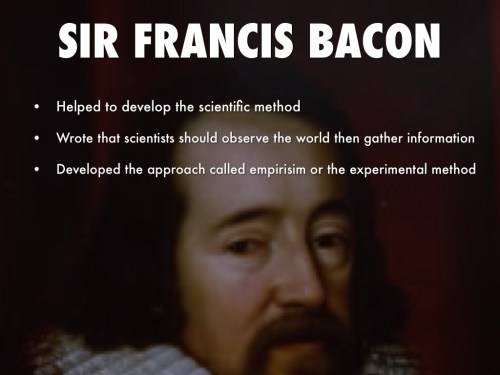
(The graphic above should say “Empiricism,” not “Empirism.” Ir is a typo.
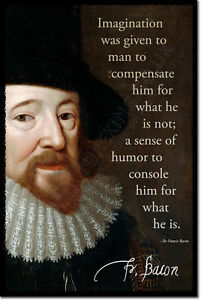
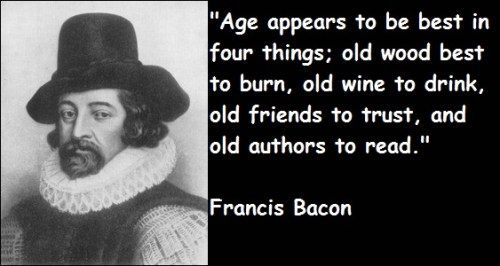
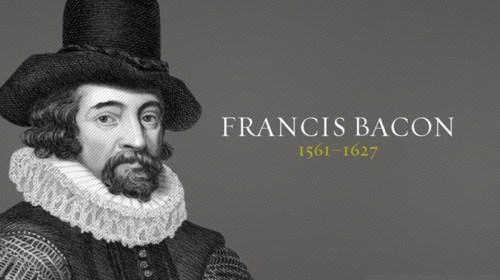
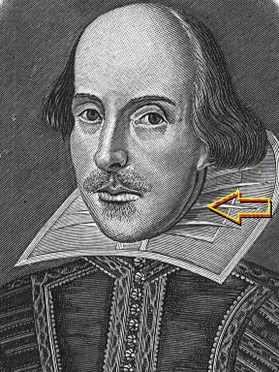
Yes, Sir Francis Bacon is at least as interesting and obscure as William Shakespeare. But let me assure you, I can confidently state, “Shakespeare is NOT Bacon!” He is not eggs either… or any other breakfast food. Sir Francis Bacon was the breakfast, the first meal in the great Elizabethan banquet of literature, poetry, and culture. And William Shakespeare is a more important main course, the royal dinner, as it were. But it has to be acknowledged that Bacon was essential to the very existence of William Shakespeare. Breakfast always comes before dinner.
In 1845 a female author by the name of Delia Bacon (nothing suspicious about that coincidence, by the way) put forward an idea that William Shakespeare’s plays were actually written by a group of men under the leadership of Sir Francis Bacon. She thought the group intended to inculcate into English culture an advanced system of politics and philosophy which they themselves could not take credit for publicly. She would later write a book in 1857 called The Philosophy of the Plays of Shakspere Unfolded which advanced the notion that the plays were written for Baconian purposes beyond mere theatrical entertainment. Numerous people, including the American poet Ralph Waldo Emerson supported her in her quest to find proof, sending her to England to research the crazy conspiracy theories she founded by noting ciphers in the plays, and in the essays of Bacon, that led her to believe all she had to do was dig up the gravestone of Shaksper in the chapel at Stratford to find written proof in Bacon’s own hand that he was, in fact, the author or primary motivator of the plays of William Shakespeare. She spent one cold and creepy night in the chapel, just her and her spade and her crow bar, along with the bones of the Stratford guy, trying to work up the courage to do a bit of grave-robbing… and failing. It is a good story, but very poor archaeology. She was denounced by the literary historians and establishment figures who supported the Stratford guy. They said her scholarship was sloppy, her cipher analysis goofy and unfounded, and her conclusions more questionable than a pig in theatrical make-up. (My words, not theirs. English critic George Henry Townsend was entirely too stuffy and boring to simply be quoted here.)
Now, I, of course, strongly disagree with the Bacon lady. As I said in the very title, “Shakespeare is NOT Bacon.” But I do think there was merit in sniffing out old Frankie’s scent and fingerprints on the whole Shakespeare/Shaksper thing. The Stratford guy was not Shakespeare either. When he died in 1616 there was no public outcry at the loss of England’s most popular poet and playwright. Even King James who was Shakespeare’s number one fan and constant audience member, didn’t mourn the passing of the actor/theater-owner/businessman from Stratford.
Francis Bacon, on the other hand, was a powerful intellect, educated in the ways of science, the law, and government in the Elizabethan age. Bacon gathered other men of powerful intellect and accomplishment at Gray’s Inn to hold debates about things philosophical and things scientifical. It is not unreasonable to imagine that the man who really wrote the plays attributed to Shakespeare sat at that table and participated in those debates. And Sir Frankie had good reason to keep lots of this business a secret. There exists evidence that though he was apparently happily married to a fourteen-year-old girl, he did a little bit of swaying toward the other gender too, a thing not too popular with the average Anglican Englishman. He also dabbled a bit in the occult (think witches in Macbeth sort of thing). And his essays indicate a strong correlation to the philosophies and ideals of the German Rosicrucian Movement. In 1593 during a Roman Catholic plot against Queen Elizabeth, Frankie managed to take a position on the investigation that totally offended the old virgin queen. He was on the outs with Liz for the rest of her difficult and anger-management-challenged life. He did rise to prominence under her successor, James I, but never-the-less managed to die amidst total ruin and scandal. There is a lot in Frankie’s life to indicate that he had a direct influence on the content of Shakespeare’s plays. Some of the characters in the plays may actually be, at least in part, based on Frankie himself. But this guy never hung out with the Stratford guy that anyone knows of.
So, if Shakespeare is NOT Bacon, or eggs either… and the Stratford guy isn’t Shakespeare, then who is? Come on! You knew I had a lot more to say about this crazy conspiracy thing, right?
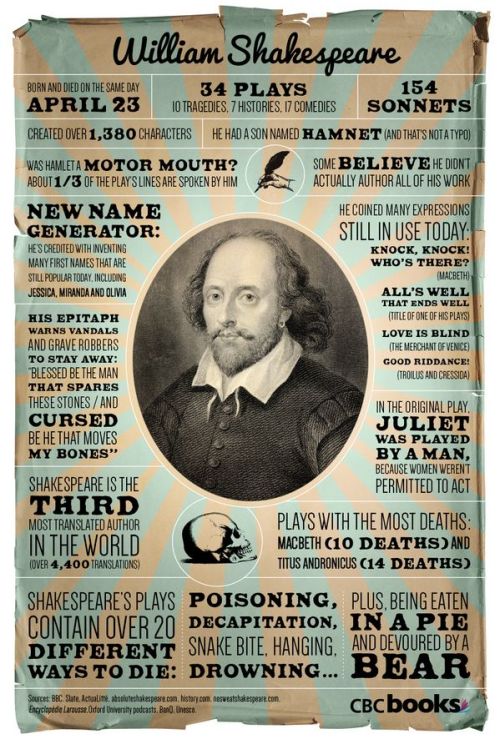
Despite my skepticism about the accepted wisdom in regard to the historical William Shakespeare, I do deeply love the body of work that is Shakespeare. My most favorite play is The Tempest, the final play in the canon. I also have read and loved As You Like It, Romeo and Juliet, Hamlet, A Midsummer Night’s Dream, The Merchant of Venice, Henry V, Richard III, Julius Caesar, Macbeth, Othello,and King Lear. I know that is not all of the plays, but that is probably more than most people have read. And of course, as an English major in college, and later as a teacher, I have actually analyzed, compared, studied, and taught some of these plays. So, the Shakespeare I know is the Shakespeare of the writer’s own mind, his communicated wit and wisdom, imagination and intellect.
And I do not have any disdain or disrespect to give the Stratford guy. To say that, in the Elizabethan world, the actor son of a tradesman with only a grammar school education could not have been the mind behind the literary masterworks is foolish. The Stratford guy owned and operated the Globe theater at a time when “the play was the thing”. All of London society, rich and poor, gloried in the theater, and Shakespeare did for Elizabethan plays what Babe Ruth did for baseball. He was a good enough business man to make himself a decent fortune. Although, apparently, this world-shaking author didn’t spend any of his money on owning books, which in my experience is extremely rare among writers. His life, bound up in an urban existence that never traveled outside of the country also somehow produced great works that were set in places in Europe, especially Italy, that described those settings in accurate detail. As a working actor, he also apparently had the time to study law and somehow learn the inner workings of the royal courts of more than one country. And the plots were not original. He took existing stories that already were a part of European literature and lore and wove them into rich tapestries of human striving, laughable foibles, and a deep understanding of basic human character. But I do have doubts that the businessman and actor from Stratford was the real writer of the plays.
I have already told you that I don’t believe Sir Francis Bacon was secretly Shakespeare. Christopher Marlowe wasn’t either. And I have unsuccessfully made a case against Shakspere, the Stratford guy. So who could possibly be the real William Shakespeare? Well, I am not going to be able to make a decent case for him in the 100 words that I have left to end this essay with. So there has to be more to come. (And stop screaming obscenities at the computer screen. I am going to reveal the name before the end of this essay. And I promise not to make my case for him in coming days too boring and horrible.) I have to show why I believe that the true heart of Shakespeare could only have beaten within the body of Edward deVere, the Earl of Oxford.
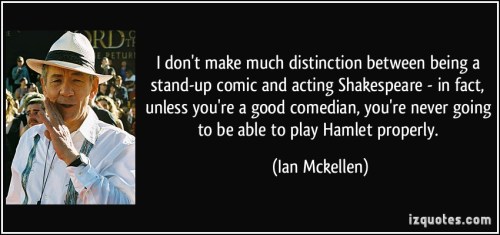
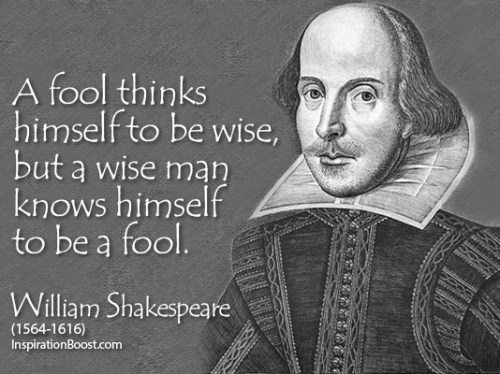
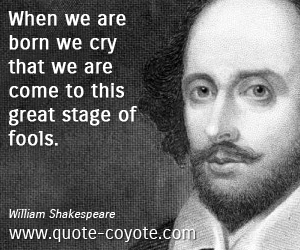
The fact that Shakespeare was a master of the art of creating and mocking fools does not really help decide the question of who Shakespeare really was. A stage actor who owned a theater in Elizabethan times and apparently focused on being the bit player, the butler, the second man on the castle wall in the great plays, would certainly know enough of flim-flam, being a con man, or artfully throwing turds at kings and queens in ways that get rewarded rather than beheaded. But a nobleman who has unpopular and unwelcome-but-probably-wise insights into the back-stabbing-goings-on of the royal court of England would equally be capable of putting the most memorable of critiques of humanity into the mouth of the fool or the clown in the great stage-play of life. Even the most depressing and violent of Shakespearean tragedies is enhanced and made pointed by the presence of the fool and the comic relief. In some ways, everything that Shakespeare wrote was a comedy.
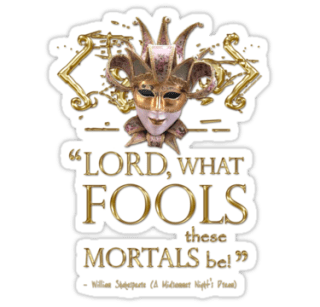
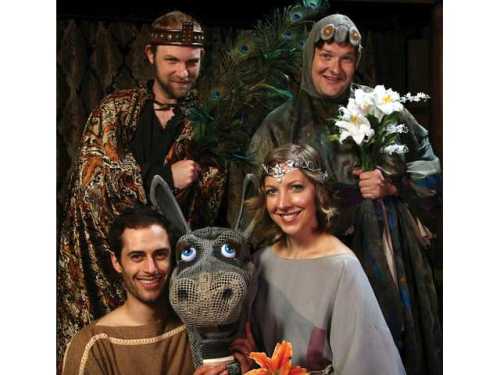
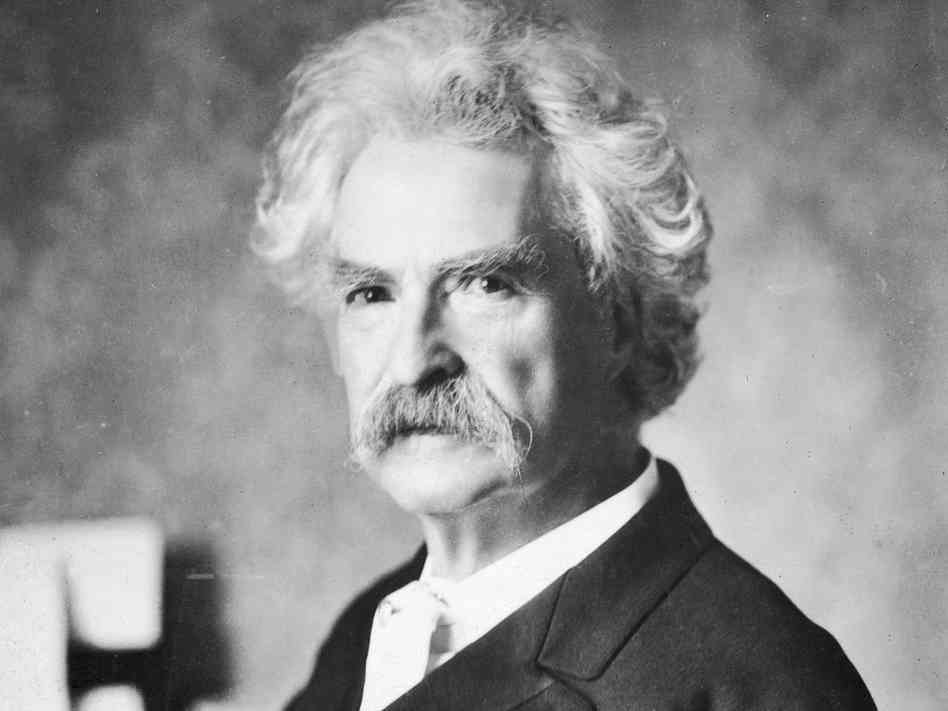
Whoever Shakespeare was, he shared Mark Twain’s overall assessment of “That damned human race” and often declared all men fools in the eyes of the playwright. Puck’s observation on humanity is delivered about not only Bottom and the other poor players who carry on their vain attempts at performing Pyramus and Thisbe while Bottom magically wears the head of an ass, but also the easily fooled lovers who mistake their true loves for one another, and even the clueless mortal King Theseus of Athens.
In the play within a play, Nick Bottom wants to be not only his own role, Pyramus the romantic lead, but argues that he should be Thisbe, the lion, and Pyramus all at once, making a satire of human nature and its overreaching ways that we could only pray Donald Trump will one day watch and magically understand. In fact, Shakespeare’s entire body of work is an extended investigation of foolishness versus wisdom, and with Shakespeare, the verdict always goes to the fool.
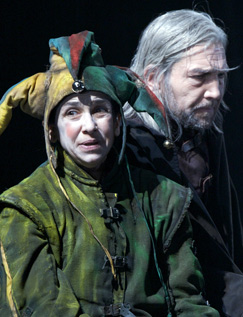
The plays of William Shakespeare are filled with fools doing foolish things… and fools being accidentally wise. (Think Jacques in As You Like It giving his famous “All the world’s a stage” soliloquy in which he elucidates the seven ages of man.) There are fools too who prove to be wise. (Think of the ironic advice given by the jester Touchstone in As You Like It, or the pithy commentary of King Lear’s fool). The fools in Shakespeare’s work are not merely the comedy relief, but the main point that Shakespeare makes about humanity.
Whoever the man was who wrote the plays of Shakespeare, he was someone who had a deep understanding of the basic irony underlying all of human life. And someone with that vital sense of the bittersweet, a philosophy of life that encompasses the highest heights and lowest depths that a soul can reach, is someone who has suffered as well as known great joy, someone who has experienced loss as often as profit, and has known real love as well as real hatred. It is the fool that Shakespeare shakes us by the neck with to make us recognize the fool in all of us which makes the plays resonate so deeply within us. It is watching the path of the fool unfolding that makes us shake our head and say to ourselves, “Yes, that is what life is really like.”
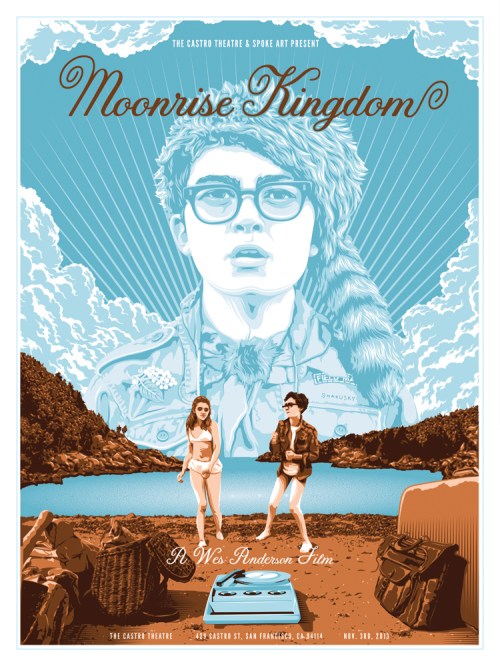
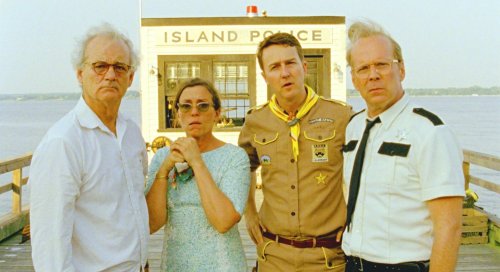
Yesterday was a weird day. If you looked carefully at the mental map I made of Mickey’s head the other day, you realize that Uncle Slappy’s Big Box of Weirdness occupies a key position in the top center. I had a traffic accident in the parking lot of Long Middle School yesterday morning, banging bumpers with a lady named Vilma. The sun was in my eyes, and she started to go, then suddenly stopped for no reason I could see. No damage was done to anything but my pride. My wife put her parents, Tatang and Inang, on an airplane yesterday bound for the Philippine Islands, going home for a visit. Afterwards, my wife was feeling mortal, betting me that she was going to die before me even though I have the head start of six incurable diseases and surviving cancer once already. There are no symptoms for her impending heart attack, so I will probably win that bet. But the point is, it was a weird time yesterday to stumble weirdly over a weird and wacky movie on Netflix called Moonrise Kingdom. It is a Romeo and Juliet sort of story about two twelve-year-olds who fall in love at first sight, and though their families try to keep them apart, they end up together. Thankfully it is not a Shakespearian Tragedy where everybody dies at the end, though Sam is struck by lightning and the big storm nearly drowns all the boy scouts. It is more like a Shakespearian Comedy where everybody gets married at the end, though the twelve-year-olds don’t get married at the end… rather, they are married by the middle.
Wes Anderson is the genius director behind movies like;
None of which I have seen, but now have to watch ALL of them sooner or later. Kinda like the mad quest to see every Tim Burton movie ever made. I am one of the few idiots out there who think Dark Shadows was a truly wonderful movie, and along with Edward Scissor-hands, one of the finest things Johnny Depp has ever done.
In Moonrise Kingdom Anderson uses tracking shots at the beginning that shift quickly from one room to the next in a way that invokes an old-time slide show. The story is set in 1965 in Maine, and is filled with all kinds of iconic references to things we 60’s kids all vividly recall.
The movie also tells the love story of Sam and Suzy with a painter’s sense of iconic pictures that focus you on important plot points and themes.
And there are numerous quotable bits that make the movie what we teachers refer to as a text-rich environment, complete with phony kids’ books and maps and notes.
The all-star cast is pretty good, too.
This is now one of my new favorite movies. It is a happy-ending-type fairy tale with no fairies in it. It is full of ineffectual and incompetent adults who have rules of behavior like grown-ups and motivations like goofy kids… just like real life. The plot is driven by the notion that anything you do in life is a mistake, and mistakes have consequences, but you have to do them anyway because, well… that’s life.
Am I telling you that you should watch this movie too? Well, you should… but, no. I am simply gushing about this quirky movie because I like it, and yesterday was a very weird day.
This holiday is going to be different. Different from the holiday I grew up with. Different than the celebrationless non-holiday I lived with for twenty years. And different from the new traditions we established, my kids and I, as we pulled away from my wife’s religion. The pandemic affects everything.
I was born into a family of Iowa Methodists living in North Central Iowa in a tiny farm town called Rowan.
I remember Christmas being the most magical time of year. I believed in Santa Claus. I felt like the Christmas magic that we saw in seasonal specials on TV in black and white were so real… the realest reality there could be…even if Andy Williams wasn’t the host of the program. Candy canes and Christmas trees and sitting on Santa’s lap being terrified of getting it wrong… and making him think I was asking for a talking Chatty Kathy doll even though I was a boy… FOR MY SISTER, SANTA! FOR MY SISTER… Oh, gawd, that really went wrong. And we had family gatherings where we ate pot-luck family meals with Swedish meatballs and turkey and mashed potatoes with brown gravy and casseroles of fifteen different kinds and nuts and candy…eating ourselves into a semi-stupor as we also did only three and a half weeks before at Thanksgiving.
And presents. Everybody gave presents. And Christmas Carols in Church.
But time goes on. You grow out of believing in Santa Claus. You even grow out of believing in Andy Williams. Perry Como was better. And it was getting so commercial. And Christmas shows we loved as kids seemed so simple and lame when watched again as young adults.
And then I married a Jehovah’s Witness. If you are not aware of it, Christmas originated as a pagan holiday, the Roman Saturnalia. It was a night of feasts and orgies and excess. And Jehovah’s Witnesses believe their beliefs are the only true beliefs, and celebrating Christmas is of Satan. I celebrated Christmas for the last time in 1994. I married in 1995.
For the next twenty years I did not celebrate Christmas. At least, not out loud where Brothers and Sisters in the Truth could hear. And the season became very austere and sanitized for me by the religious integrity of those around me in the faith.
But there were friends in the faith that lost their faith and left the congregation permanently. And the people around me changed. And I was beset by illnesses, mine and my family’s. And Jehovah’s Witnesses are very good at helping the sick. But, apparently only for others, not me and mine. They began turning away.
I am probably disfellowshipped now. They have turned away from me, and I am now isolated from all those who used to be friends and acquaintances. My wife is still a member of the congregation. And this is good because she desperately needs to believe. It is a good life for her and keeps her relatively well. But I know they disfellowshipped me, even though nobody told me so like they always do in such cases. My wife barely talks to me now. And this is probably because members of the congregation are supposed to shun the disfellowshipped, even if they are family.
But I bare no one ill will. That may be part of the problem. The Bible directive is to “Hate what is bad.” And blood transfusions and psychiatry are both bad things according to the Witnesses’ understanding of Bible commands.
I didn’t need any transfusions, and though I have significant stress and diabetic depression, I was never hospitalized for that. But I did kinda fake some disfellowshippable offenses so that I would be the one, and my wife would still be able to be a Witness. She needs it more than I do.
And, to be quite honest, I need to feel a little bit of Christmas now in my old age and infirmity. After all, it is a holiday all about making sacrifices in order to give gifts to others. I know that this post will make Jehovah’s Witnesses cringe. But now that they are shunning me, I guess they won’t be seeing this anyway. And I wish them a Merry Christmas in spite of it all.
I have claimed that I am a humorist and all my novels are comic novels, to some degree at least. But it is often pointed out to me that I write about things that make people cry. And I freely admit that I most certainly do.
But if you think about it carefully, analytically, or even emotionally, you have to admit, even a book like Mark Twain’s The Adventures of Huckleberry Finn has some weep-worthy moments in it. I have read the book more than once myself, and I never get past the scene where Huck looks down at the body of his young friend Buck Grangerford, killed in the Shepherdson/Grangerford feud about something nobody living even remembers, without shedding gushers and gushers of heart-busting tears.
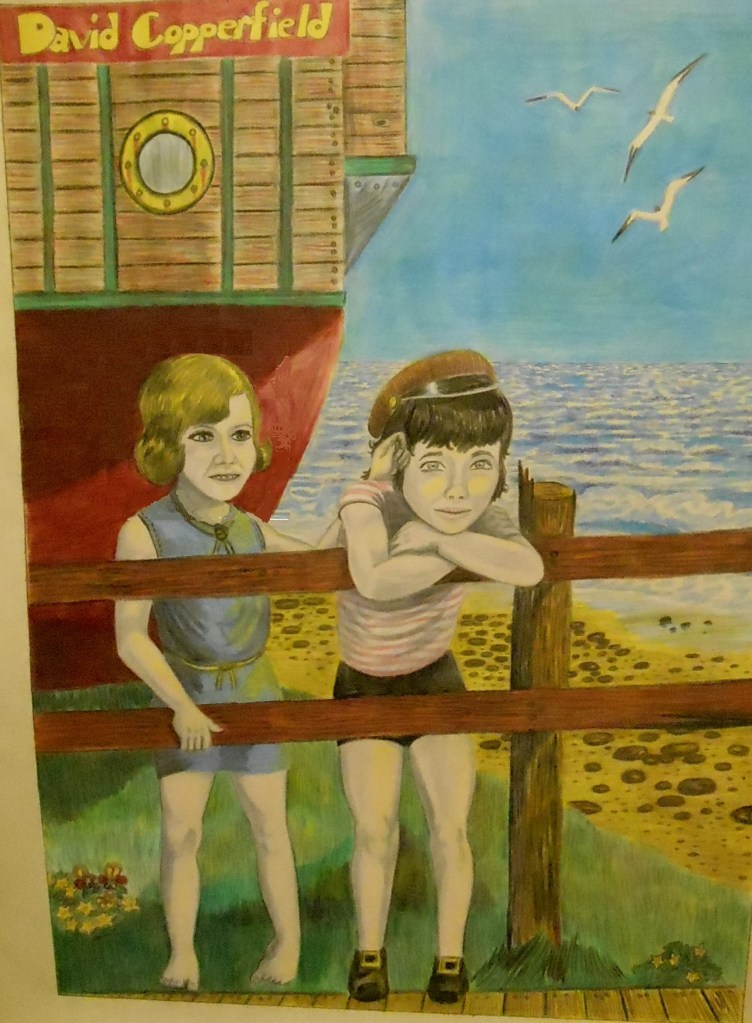
And in Charles Dickens’ David Copperfield, as much as I laugh and guffaw at the antics of quiet Mr. Dick and his kite, or the much deserved downfall of villainous Uriah Heep, it is the drowning of Little Emily on the boat with David’s school friend and idol Steerforth that leaves me surrounded by puddles… nay, lakes… that I have wept.
And I think that I may justify the sad parts in so many of my weary works with the fact that I am merely providing the necessary counterpoints to my merry-making and mirth.
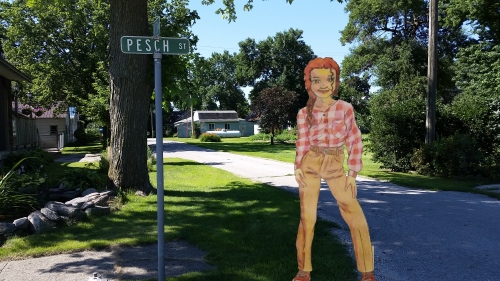
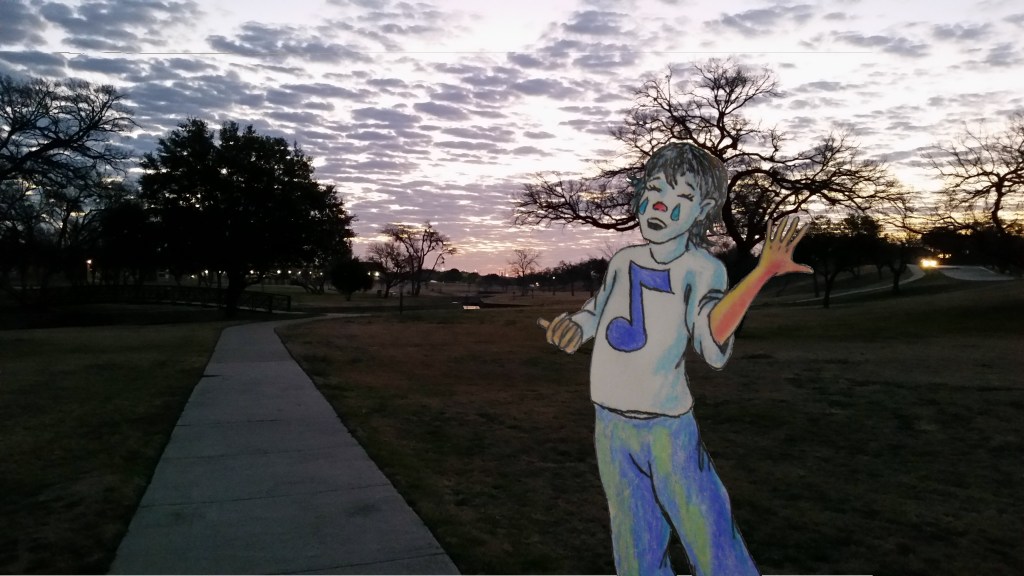
Francois is a character from Sing Sad Songs.
There has to be that necessary balance, that well-roundedness, to a story that makes it feel truly complete. And, of course, we know that even in a horror novel by Stephen King, you find humor used as a balance point to lighten the moments just before the monster delivers its liver-shaking, earth-tilting scare.
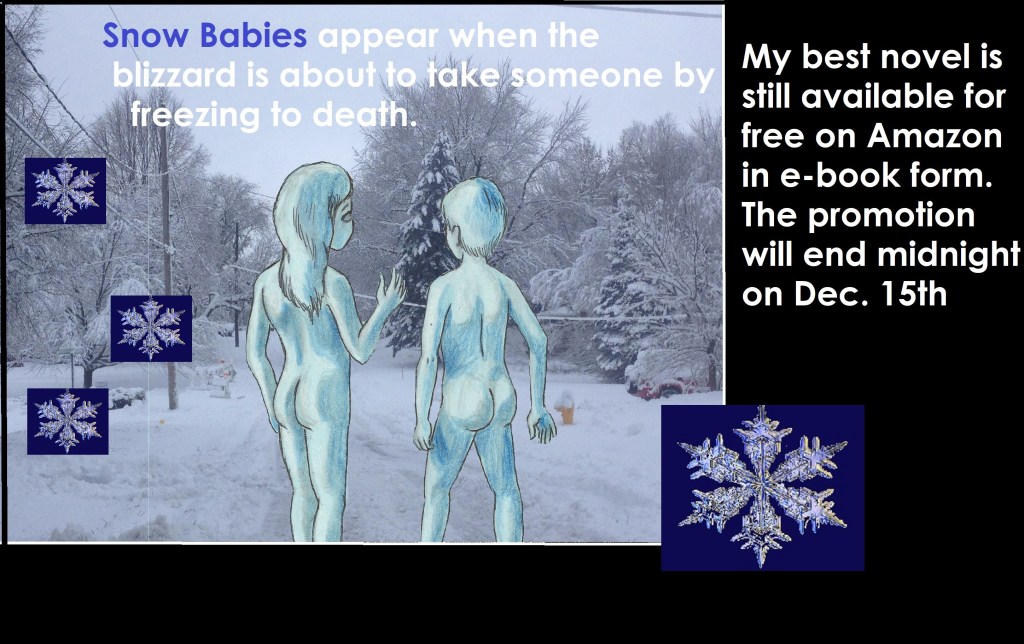
Snow Babies, among my published books, is a good example. It is a story that celebrates how a small Iowa town comes together to survive a deadly December blizzard. And while it tells funny stories of kooky characters battling the elements, and both surviving the blizzard and ’84 Reagan/Mondale political debates, as well as putting up Christmas trees, it is still also about death and loss of loved ones, finding and losing love, and just what sort of self-sacrifice or other accidental happening truly makes someone a hero. Or a bus driver… this book has more than one bus driver in it.
So, I think, in the end, that I have made a cogent case for the notion that in order to be a humorist, you have to manipulate many emotions, not just mirth, but sadness also. As well as fear, bitter irony, and pain. And that may well also be the underlying reason that comedy is harder to write than tragedy.















Naked Innocence
To be clear, I will have to write a post called Naked Experience to go with this post. It is a William Blake style of thing. You know, that English Romantic Poet guy who was into drawing naked people even more than me? The writer of Songs of Innocence and Experience? You know, this stuff;
Well, maybe you don’t know. But Blake gave the world the metaphor of the innocent lamb and the tyger of experience (tyger is his spelling, not mine, and it didn’t blow up the spell checker, even though it made the thing unhappy with me again). There is a certain something I have learned about nakedness that I mean to innocently convey. I learned it from anatomy drawing class and spending time with nudists. Naked is not evil. Naked is not pornography. Nakedness, itself, is a very good thing.
At this point the avid clothing-wearers among you are probably saying to yourself, “This guy is nuts! If God had wanted us to be nude, then we wouldn’t have been born with clothes on.” And I must admit, I cannot argue with logic like that.
But on a more serious note, I believe nudity is a fundamentally essential part of the nature of art. After all, pictures of naked people are a central part of what people have been drawing since they first started etching them with charcoal on cavern walls. And all art, including this blog, is about the human experience. What it means to be human. What it feels like to be alive on this Earth and able to feel.
And there is nothing sinister and immoral in drawing nudes to portray that fact. I am trying to show metaphorically the music of existence, the pace, the symmetry, the musical score… It isn’t focused on the private bits, what some call the naughty parts, even when those things are present in the picture. “How dare that naughty Mickey show the naked back end of that butterfly! It ought to have pants on at least!” Yes, I am making a mockery of that outrage itself. I am not a pornographer. These pictures were not created to engender any prurient interests. These pictures are part of Blake’s lamb. They will not bite you. Though blue-nosed people who wish to control what others think may very well bite me for daring to say so.
I have posted a lot of writing and artwork on this blog that I held for the longest time to be completely private and personal. I hardly ever showed any of it to anybody before I posted it here. But I am old. I no longer have secrets. I am capable of telling you everything even though I have never met most of you in real life. And I have no shame. I have become comfortable with emotional and intellectual nudity. And when I am dead, the body I have kept hidden from the world for so long will be no more. It’s just a thought. It’s a naked thought. And it is completely innocent.
Leave a comment
Filed under artists I admire, artwork, commentary, humor, nudes, Paffooney, strange and wonderful ideas about life
Tagged as art, literature, nudes, poetry, William Blake