

Canto 21 – Blue Boy
The entire group of adventurers went aboard the Leaping Shadowcat to work out their problems. The Hammer, an ancient device of incredible power, was now actually in their possession. Junior Aero had detected it hidden within the Synthezoid’s body cavity.
 “How was this boy able to read the robot’s mind?” Ged asked Tkriashav.
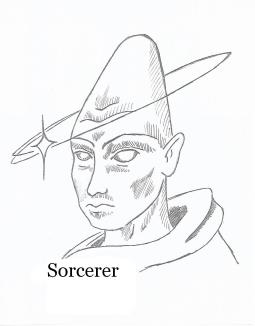
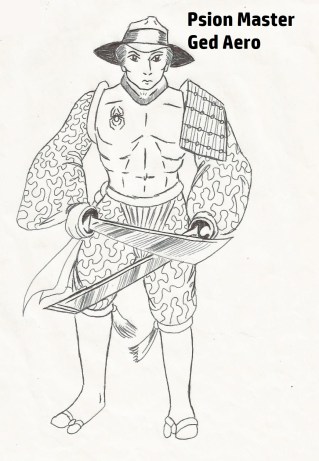
The almond-eyed Psion Master looked at Ged through narrowed eyes. “He has a Psionic power I’ve never encountered before. His mind reads as a telepath, but he can read artificial minds. He can manipulate computers and robots in the same way Tara and I can bend human minds.”
“Will you teach him to use this power?” Ham asked.
“No,” said Tkriashav, closing his eyes. “I believe he is meant to be Ged’s first student. I can’t touch his mind properly. Neither can Tara. He might prove dangerous to us.”
“But…” began Ged, “I don’t know how to teach! …Not Psion power!”

“You know more than you realize,” said Tkriashav. “You are a master of the inner eye. You do it so well. It is an instinct with you. From what we saw today, the child is nearly there himself. All he really needs from you is moral guidance, positive support, and, well… love.”
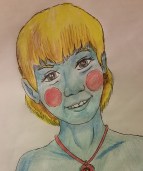
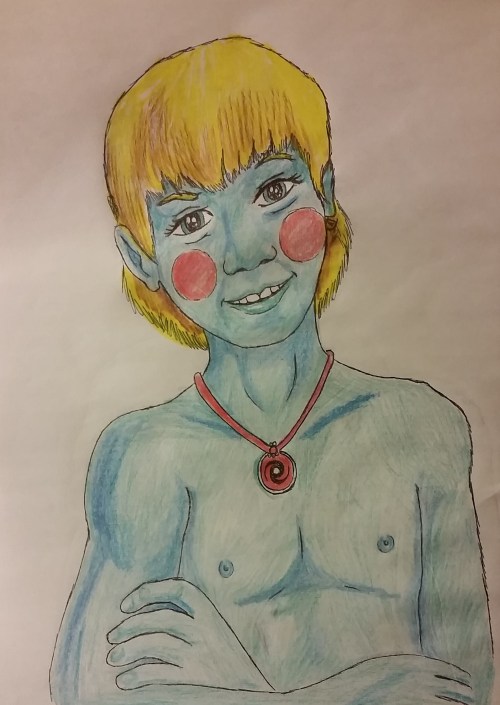
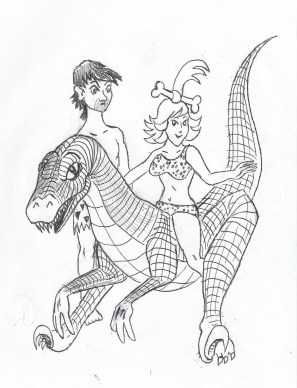
Ged looked at the blue-skinned boy. He hadn’t really paid much attention to him before. He looked like a blue version of Ham when he was young. He was small and thin. He hardly ever smiled, but he had dimples when he did smile. He was nine years old, but looked more the size of a six-year-old. It was his Nebulonin curse to be forever small and child-like. Ged nodded. He could learn to love this boy.

“Lend me a hand, Ged,” said Ham as he hoisted the inert body of the Synthezoid onto the game-skinning table. The Madonna had gone to the galley to cook. Tara and Sinbadh had gone to help. That left Bam-Bam, Ged, Tkriashav, and Ham to do the surgery on the Synthezoid.
Ged helped Ham stretch the body out on the table. They pierced the wrists and ankles with skinning hooks. The flesh oozed green juice as if it were blood, but there the similarity to human anatomy ended. There were layers of circuit-weave mesh under the skin and titanium bones at the bottom of it. On the outside, Sorcerer 4 was made like a human. He even had the naughty bits. But under the skin, he was all robot with fiber optic wires and blinking lights everywhere. Ham easily peeled away synthetic flesh to reveal the metal man underneath.
In the hollow of the Synthezoid’s chest cavity, they uncovered the device itself. Ged almost laughed at Junior’s big-eyed facial expression when the boy first saw the Hammer of God. Everyone had been pretty much expecting a Thor’s Hammer type of thing. What they got was an undecorated tube with two right-angled handles on one end. You would never know it was an ancient artifact without the eerie purple glow coming out the open end. It looked like an ordinary plumber’s tool.
“There are no buttons to use the dang thing!” swore Ham, disappointed.
“No,” said Junior in a small voice, “but the thing is telepathic.”
“He’s right,” confirmed Tkriashav. “I can sense that to use the device, you must be a telepath.”
“Oh, great!” moaned Ham.
“It’s workable,” said Ged. “We have to use these things carefully. We will ask Frieda about it, and we have telepaths that might be willing to help us.”
“You do,” confirmed Tkriashav. “I know I haven’t earned your trust yet, but from here on out, our destinies are all intertwined.”
“Even mine?” asked the little blue boy.
“Especially yours,” said Tkriashav.
Ged couldn’t help but be a little spooked by the Psion Master. He didn’t like knowing so many riddles about the future, and he was not comfortable around someone who did.
Tkriashav picked up the Hammer. “It makes things according to mental directions. It uses some kind of organizing power that can rearrange molecules and energy flows. It is light years beyond any technology on Don’t Go Here.”
“What will we use it for?” asked Bam-Bam.
“This planet,” said Ham. “We can bring space-travel technology here with the thingy. We’ll build downports and dry-docks and spacecraft. We can make this world high tech overnight.”
“Don’t be surprised if they insist on staying cave men,” warned Tkriashav.
“Yeah,” said Bam-Bam. “Most of us grew up in Fredsuits and riding dino-back.”
“If we’re going to make this world home, we need to dress it up a little bit,” sighed Ged.
“Yes,” said Tkriashav. “But this world may not turn out to be home in the long run.”
“Why would that be?” asked Ham.
“I see other places on both of your horizons.”
Ged shivered. “Don’t tell me that. I don’t want to know.”








 Catch a Falling Star
Only One Star?
There are certain books that simply have to exist in order for me to be me. I couldn’t be the person I am without The Lord of the Rings by Tolkien, Dandelion Wine by Ray Bradbury, The Little Prince by Antoine de Saint-Exupery, The Alchemist by Paulo Coelho, Der Zauberberg (The Magic Mountain) by Thomas Mann, and A Wrinkle in Time by Madeleine L’Engle. These are all books that have an allegorical element, a trans-formative effect, that shapes how you think and how you live after reading them. Some of these books have not been made into a movie. Some probably still can’t be. Others have not been made into an effective movie. But, then, Disney in 2018 makes a movie version of A Wrinkle in Time that makes me relive the primary experience of the book all over again.
I was disappointed to see the critics being harsh about the movie. I had high hopes before going to see it. Yet, you couldn’t miss the one star rating on the box office rating system of the ticket and show time site I was using. But my daughter and I went to see it yesterday anyway. It was far above my highest expectations.
You see, the novel itself is magical. The essential characters of Mrs. Whatsit, Mrs. Who, and Mrs. Which have to be witch-like, super-real incarnations of inter-dimensional beings. It is the view of them with open-minded childlike eyes that makes the complex relationships of this story to reality apparent to anyone who thinks clearly like a child. It is the reason why this book is a young adult novel, written primarily for children, even though the concept of a tesseract is wholly mind-bending in a Stephen Hawking sort of way. It is the wonder with which the director of this movie lensed the dimension-tessering time witches that makes this movie the best version. Not like that failed attempt in 2003. That was almost there, but not quite by half.
Critics don’t like some of the special effects and the color schemes of some scenes. Many things about the final battle with evil are seen by them as inexplicably bizarre. They don’t like the over-use of extreme close-ups on the faces of characters. And they think the performances of some of the child actors are too wooden and unreal to carry off the story.
I wholeheartedly disagree.
This is a story that takes place in the heads of the people involved, including the viewer of the movie. The extreme close-ups pull you into the personal feelings and struggles of the main characters. Particularly Storm Reid as Meg. The story is about her struggle as an adolescent to be at peace with her own flaws and self-image while at the same time being responsible for finding and saving her father, as he has completely lost his way on his quest to “shake hands with the universe”. Meg undergoes a challenge to her self image as she is cruelly bullied by another girl in school. She has to come to terms with loving her super-genius little brother Charles Wallace. And she has to weather the changes that occur when she encounters a potential first love in Calvin. It is a coming of age story that really smart kids can relate to directly from their own personal experience.
This one-star movie with only a 40% fresh rating on Rotten Tomatoes is a far better movie than the critics would have you believe. It is doing quite well at the box office. Kids seem to love it. And in my wacky opinion, it is the best movie version of the book to date. I love this movie.
Leave a comment
Filed under art criticism, commentary, magic, movie review, science fiction
Tagged as A Wrinkle in Time, Madeleine L'Engle, movie review