
No, this isn’t some kind of multiple-book book review. This is an ungodly silly claim that I can actually read three books at once. Silly, but true.


Now I don’t claim to be a three-armed mutant with six eyes or anything. And I am relatively sure I only have one brain. But, remember, I was a school teacher who could successfully maintain a lesson thread through discussions that were supposed to be about a story by Mark Twain, but ventured off to the left into whether or not donuts were really invented by a guy who piloted a ship and stuck his pastries on the handles of the ships’ wheel, thus making the first donut holes, and then got briefly lost in the woods of a discussion about whether or not there were pirates on the Mississippi River, and who Jean Lafitte really was, and why he was not the barefoot pirate who stole Cap’n Crunch’s cereal, but finally got to the point of what the story was really trying to say. (How’s that for mastery of the compound sentence?) (Oh, so you could better? Really? You were in my class once, weren’t you.) I am quite capable of tracking more than one plot at the same time. And I am not slavishly devoted to finishing one book before I pick up the next.
I like reading things the way I eat a Sunday dinner… a little meatloaf is followed by a fork-full of mashed potatoes, then back to meat, and some green peas after that… until the whole plate is clean.


Treasure Island by Robert Louis Stevenson is the meatloaf. I have read it before, just as I have probably had more meatloaf in my Iowegian/Texican lifetime than any other meat dish. It’s pretty much a middle-America thing. And Treasure Island is the second book I ever read. So you can understand how easy a re-read would be. I am reading it mostly while I am sitting in the high school parking lot waiting to pick up the Princess after school is out.
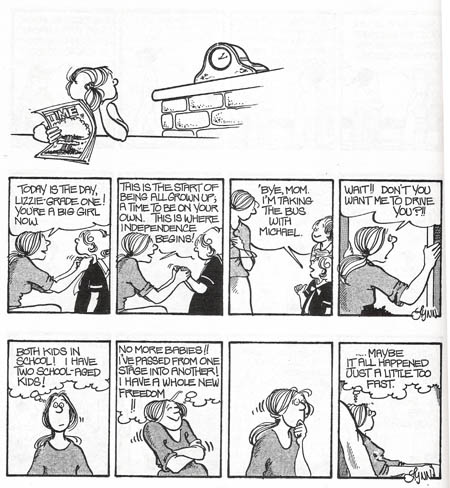 Lynn Johnston’s For Better or Worse is also an old friend. I used to read it in the newspaper practically every day. I watched those kids grow up and have adventures almost as if they were members of my own family. So the mashed potatoes part of the meal is easy to digest too.
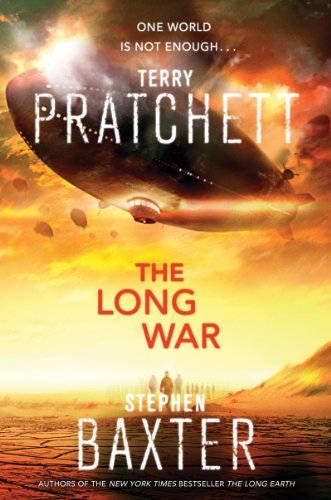
So that brings me to the green peas. Green peas are good for you. They are filled with niacin and folic acid and other green stuff that makes you healthier, even though when the green peas get mashed a bit and mix together with the potatoes, they look like boogers, and when you are a kid, you really can’t be sure. Terry Pratchett and Stephen Baxter wrote this book The Long War together. And while I love everything Terry Pratchett does, including the book he wrote with Neil Gaiman, I am having a hard time getting into this one. Parts of it seem disjointed and hard to follow, at least at the beginning. It takes work to choke down some of it. Peas and potatoes and boogers, you know.
But this isn’t the first time I have ever read multiple books at the same time. In fact, I don’t remember the last time I finished a book and the next one wasn’t at least halfway finished too. So it can be done. Even by sane people.









 Catch a Falling Star
Reading Other Writers
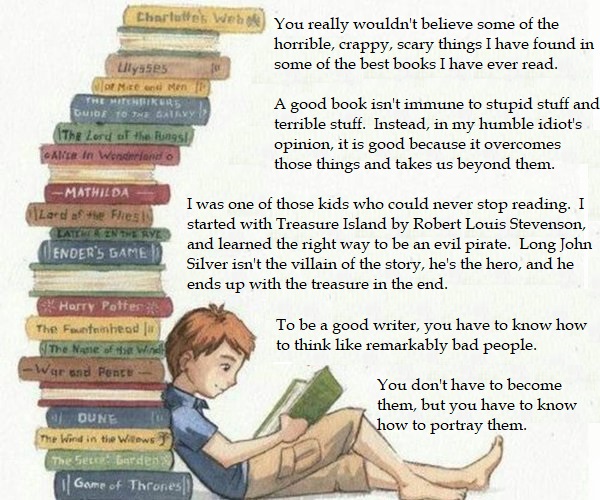
Nobody who wants to be a writer gets by with just writing and never reading anything by anybody else. It is too easy to devolve into some kind of human mushroom that way, thinking only thoughts a mushroom could think, all fungus-like and having no chlorophyll of their own. You never learn to decode other people and other people’s thinking if you don’t read other people’s thoughts crystallized in writing.
And not every other writer is Robert Frost. Or even Jack Frost who thinks he’s Gene Kelly. There has to be some interpretation, some digging for understanding. What did that writer mean when she said political correctness was like a tongue disease? And what does it mean when a commenting troll calls me a nekkid poofter? Is that how he spells “exceptional genius”? I think it is. Trolls are not smart.
I know people have to make an effort to understand me. When I write, I am writing under the delusion that I can produce literary quality off the top of my head. In fact, I can barely produce hair off the top of my head, and it is gray when I do it. See what I did there? It is the kind of joke a surrealist makes, pretending the idiomatic expression you use is to be taken literally when it doesn’t literally make sense. That kind of nonsense is what my readers have to put up with, and probably also the reason why most of them just look at the pictures. If you have to think too hard when you read, your brain could over-heat and your hair could catch fire. I like that kind of purple paisley prose that folds back in on itself and makes you think in curlicues. But most people don’t. Most people don’t have fire-proof hair like I do.
Sometimes, it doesn’t even take a word to make the point. For instance, why, in the picture, is Fluttershy trying to drink out of the toilet in the dollhouse bathroom? For that matter, why does a doll house even need a bathroom? Applejack doesn’t even fit in that yellow bathtub. I know. I tried to stuff her in there for this picture. And, as you read this, doesn’t this paragraph tell you a lot about me that you probably didn’t even want to know?
When I am reading the writing of others, I am looking for a cornucopia of things. I want to not only understand their ideas, I want to detect the limping footprints across the murder scene of their paragraphs and come to know the deeper things about them as well. I spent years decoding and trying to understand the writing of preliterate kids in my middle school English classes in order to be able to teach them to write better. And I learned that no writer is a bad writer as long as they are using readable words. I also learned that very few writers are James Joyce or Marcel Proust. Thank God for that! And given enough time I can read anything by anybody and learn something from it. I read a lot. And it may not always make me a better writer to read it, but it always has value. It is always worth doing.
1 Comment
Filed under commentary, education, goofy thoughts, humor, irony, photo paffoonies, photos, reading, strange and wonderful ideas about life, surrealism, teaching, wordplay, writing, writing teacher
Tagged as creative-writing, reading for writing, writing, writing advice, writing-community, writing-tips