This foolish essay about berries that mean love to me is only partly inspired by the Beatles song, “Strawberry Fields Forever.” That’s because, of course, their song was only about meditating. In the lyrics they take you to the “Strawberry Fields where nothing is real… but it’s nothing to get hung up about…” They are talking about a blissful place of no worries where we all need to go. And then staying there forever.
This, of course, I could never do. Worrying about the future is tattooed on my behavioral imperatives in the dark part of my stupid old brain. And while I often found that place of no worries, and lingered there for a bit, I found you could never really get anything done if you stayed in that state of strawberry fields forever.
But don’t get me wrong, strawberries are a critical part of every healthy mental diet.
You see, my meditations on strawberries when I was a child of eight, nine, and ten centered on the strawberry patch at Great Grandma Hinckley’s place.
She was, as I incorrectly recall, slightly older than Jesus when I was that age. By that I mean, though she seemed museum-quality ancient to me, I had derived wisdom about life, love, and laughter from her before Sunday School taught me any of those things said in Jesus’s words.
And I was given the task of mowing her lawn in the little plot of land surrounding her little, tiny house in the Northern part of Rowan where I also lived and grew and celebrated Christmas and Halloween and Easter and the 4th of July. And though I was doing it because she was so old, I never even once thought she was too old and frail to do it herself. Grandma Hinckley’s willpower was a force of nature that could even quell tornados… well, I thought so anyway when I was eight. And she gave me a dollar every time I did the lawnmowing.
But there were other things she wanted done, and other things she wanted to teach me. There was the garden out back with the strawberry patch next to it. She wanted me to help with keeping the weeds and the saw grass and the creeping Charlie from overrunning the strawberries and choking them to death. (Creeping Charlie wasn’t an evil neighbor, by the way. He was a little round-leafed weed that grew so profusely that it prevented other plants from getting any sunlight on their own leaves, causing a withering, yellowing death by sunlight deprivation. I took my trowel to them and treated them like murderers. I showed them no mercy.)
And Grandma always reminded me not to be selfish and eat the very berries I was tending in the garden. She taught me that eating green strawberries (which are actually more yellow than green, but you know what I mean) was bad because they could give you a belly ache, a fact that that I proved to myself more than once (because eight-year-olds are stupid and learn slowly.) She also taught me that it is better to wait until you have enough strawberries to make a pie, or better yet, strawberry shortcake with whipped cream. She taught me that delayed gratification was more rewarding in the long run than being greedy in the short run and spoiling everything for everybody.
She always gave me a few of the ripe strawberries every time I helped her with them, even if I had eaten a few in the garden without permission. Strawberries were the fruit of true love. I know this because it says so in the strawberry picture. Even though I probably never figured out what true love really means.
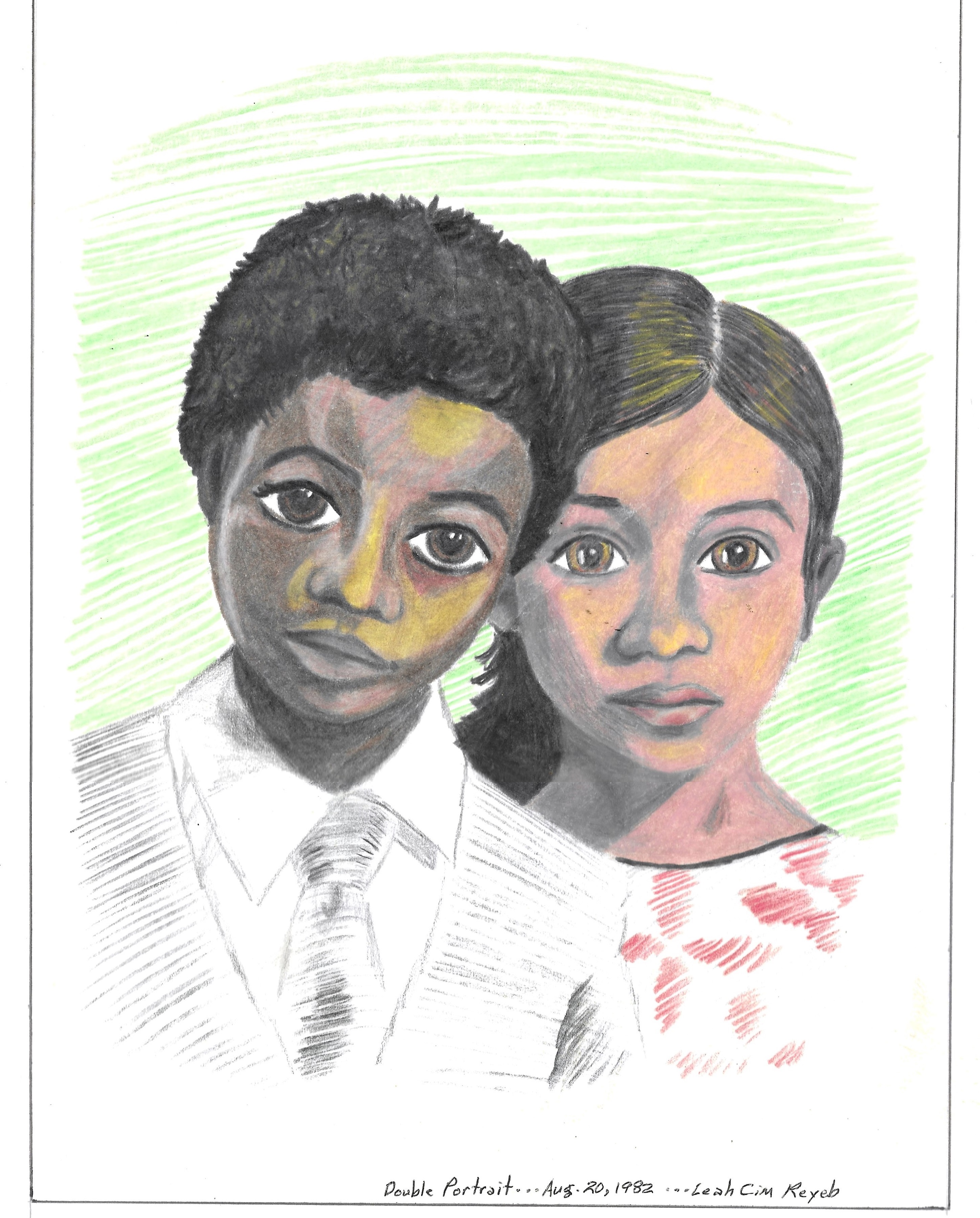
My Great Grandma Nellie Hinckley was the foundation stone that my mother’s side of the family was built on. She was the rock that held us steadily in place during the thunderstorms, and the matriarch of the entire clan of Hinckleys and Aldriches and Beyers and other cousins by the dozens and grandchildren and great grandchildren and even great great grandchildren. I painted the picture of her in 1980 when she passed away. I gave it to my Grandma Aldrich, her second-eldest daughter. It spent three decades in Grandma’s upstairs closet because looking at it made Grandma too sad to be so long without her. The great grandchild in the picture with her is now a grandmother herself (though no one who has seen this picture knows who it is supposed to be because I painted her solely from memory and got it all wrong.) But Grandma Hinckley taught me what true love means. And true love has everything to do with how you go about taking care of the strawberry patch.
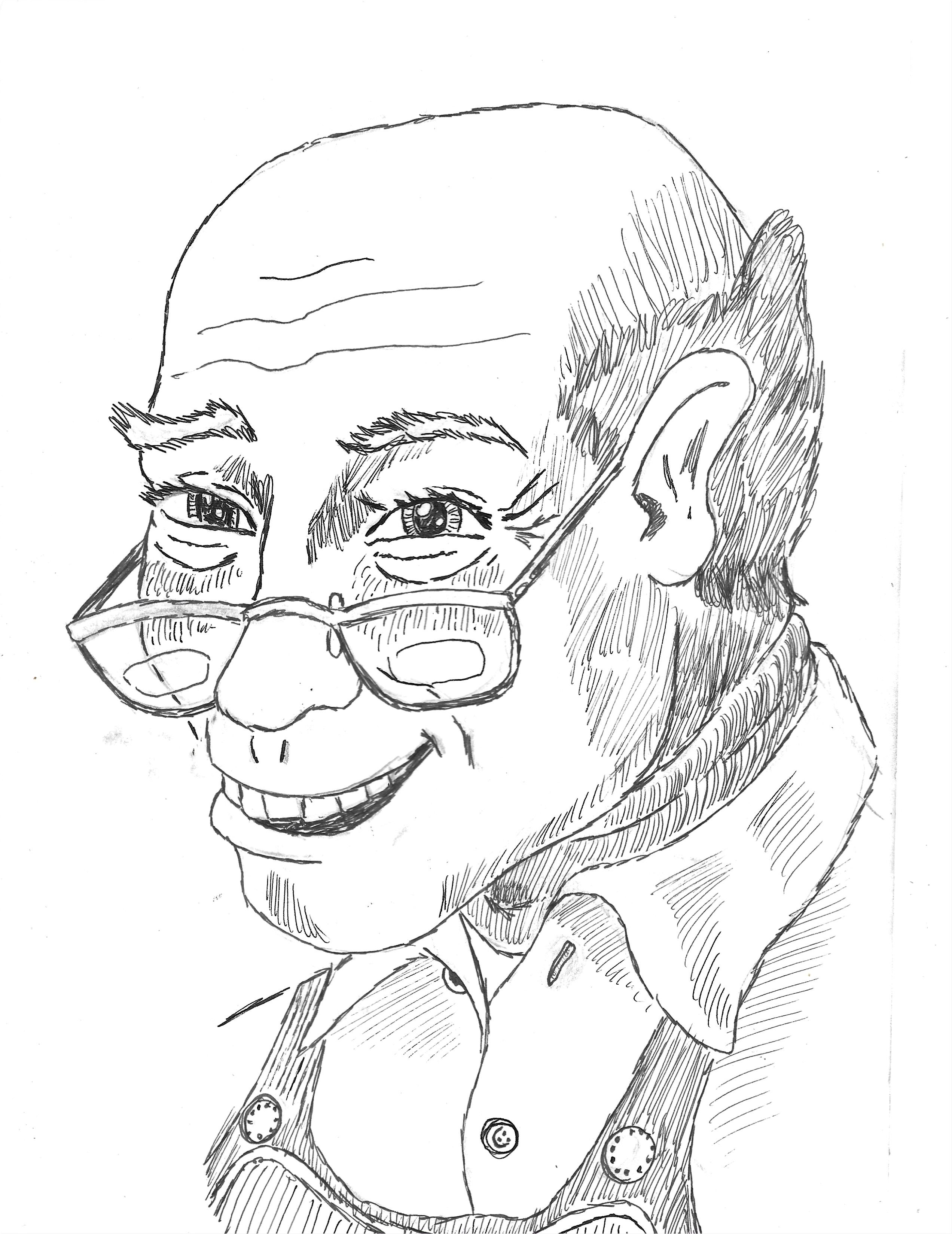
Yes, I am old. I am not merely feeling old as school teachers do at the end of a school day, I am retired, I am on Medicare, and I am literally an old man. I am even old enough and mature enough to know what the word “literally” actually means and use it correctly in a sentence.
I don’t hear things as well as I used to. I don’t see as well as I once did. Being partially red and green colorblind, I don’t see colors as vividly as I used to. I have learned why old goobers like me let their glasses ride low over their nose. You can look over your glasses at the things around you that you don’t really want to see.
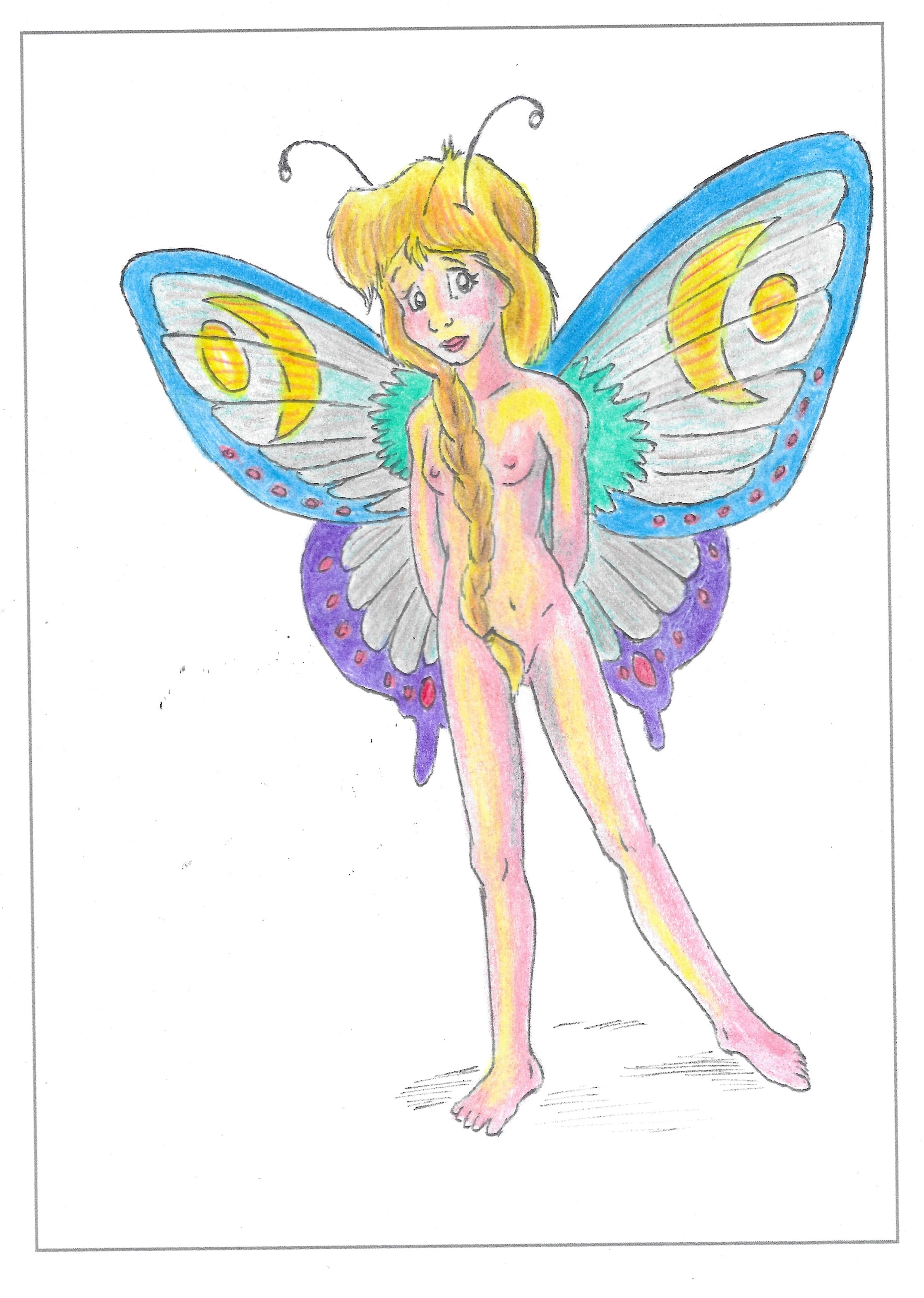
As an author of highly imaginative nonsense, I am really beginning to understand why “dirty old man” jokes are a thing. Writing a fairy story has led me to draw and write about a bunch of nude fairies. It isn’t really so much a sexual-perversion thing as it is a memory of and a longing for something that I no longer have in my life. It’s also the same sort of mental quirkiness as the “being a nudist” thing. I am not interested in the ugly pornographic sort of things, more the innocent, pristine, and long-gone things of youth.
And I see things that I know aren’t really there. Eyes staring at me from the bushes at night. Fairies flitting around the autumn leaves on bug wings. The back half of a ghost dog walking out the back door of the house even though the door isn’t open. I would doubt that I have ever seen a UFO if it weren’t for the fact that I was younger for the first two and my eldest son was with me and saw the third one too.
So, I admit that I have become a crazy old coot. But the best thing about being an old coot is the fact that I have earned it. I worked hard for a lifetime. I taught English competently for thirty-one years. I successfully raised three kids to adulthood. I have been a stable and useful part of society for more than forty years. So, I earned my crazy old cootishness. And I mean to enjoy it while I still have it.
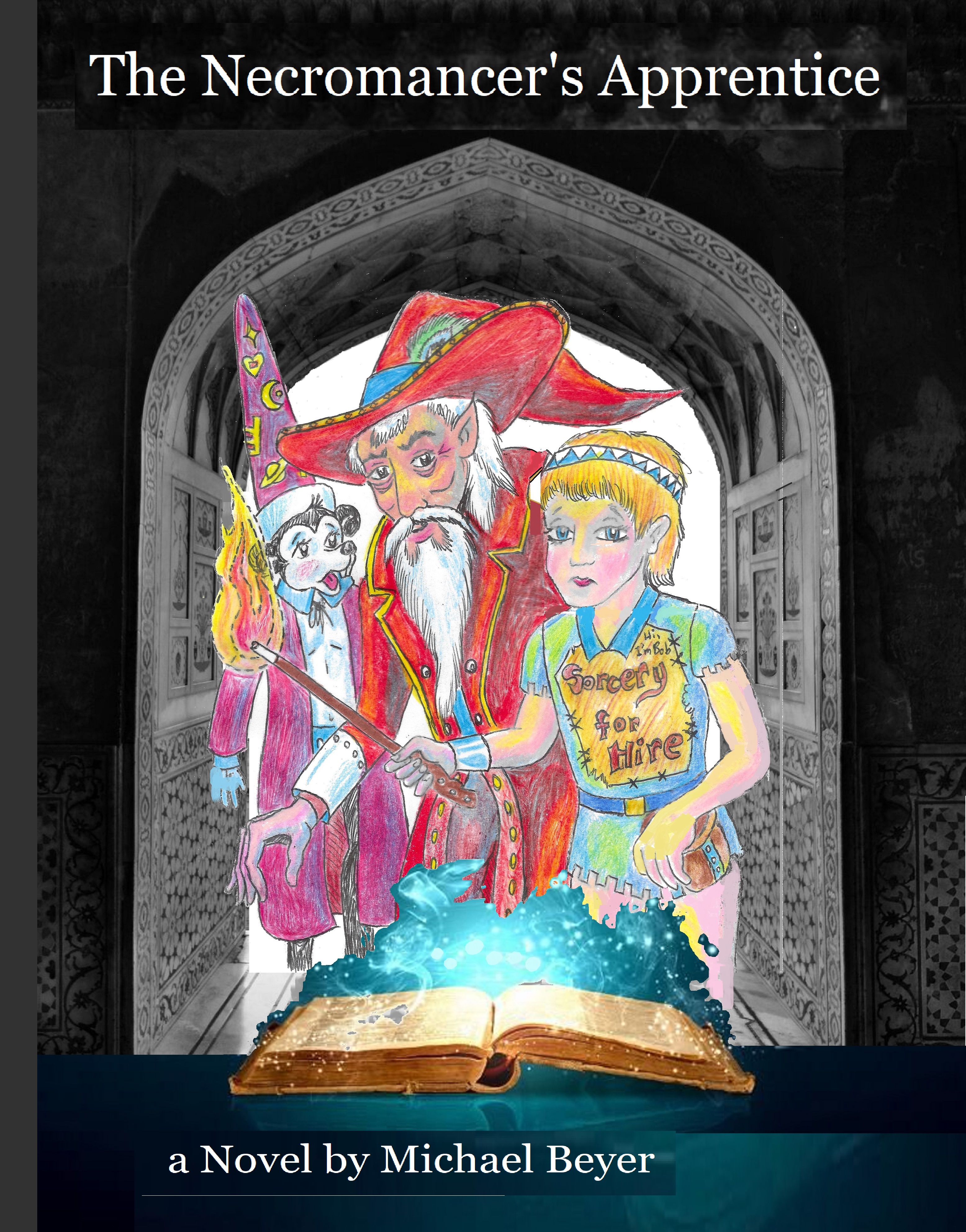
I could tell when Master Eli handed me the bottle imp that used to be my friend Kack, that Kack was no longer trapped in a severed head. He was now a free-floating intelligent smoke trapped in a bottle made of some Slow-One’s special substance. It was not real magic because it did not make my magic-sense tingle. It was some kind of trick with Slow-One chemicals.
“So, Miss Derfentwinkle, tell us about yourself. And keep in mind your “Horrible Poop” friend will now tell us instantly if you are telling a lie.” Master Eli was looking at me with one eye opened wider than the other.
“Yeah, um… I am Derfentwinkle. I am the servant of an evil necromancer.”
“Do you like working for a necromancer?” Bob, the quiet boy, said.
“I hate it. I hate Kronomarke. He’s cruel, and he sent me on a suicide mission to get me killed intentionally.”
I swirled Kack around in his bottle.
“That is perfectly true… every word,” said Kack.
“Do you like me?” asked the weird mouse-boy.
“I find you mildly disgusting, but it was entertaining when Bob knocked you out.”
The quiet boy chuckled softly when I said that. I am not sure, but I think Master Eli did too.
“Would you be willing to betray your former master?” Master Eli asked.
“I would do so quickly and efficiently and deeply enjoy it.”
Master Eli grinned at me at that answer.
“So, is that true too, Kackenfurchtbar?” asked Bob.
“Derfie almost never tells a lie, but, sadly… this is not entirely honest.”
“What? You won’t really betray him?”
“She can’t. People she loves have their lives in his evil hands. But her heart is set against the necromancer, and she would betray him happily if she could.”
“Ah, I expected as much from old Bluebottom,” said Master Eli.
“So, are you going to kill me, then?” I asked, feeling doomed.
“Oh, no. Of course not. But I am not going to let you go either. You belong to me now. I expect I will hang onto you for a few years now.”
“As a sex slave?” asked the mouse-boy with an ugly smirk on his mouse-face.
“No. She’s free to fall in love with you, Mickey. But she’s also allowed to hate you if that’s how she really feels.”
The mouse-boy hung his stupid mouse head in shame at that reproach.
“Tell me, young lady, do know any of the spells used by your former master?”
“I don’t think I have any magical skills, and I know I don’t know any spells.”
“Not completely true,” blurted Kack.
I gave the bottle a violent shake. His floating eyeballs bounced off each other in the smoke.
“You probably know a lot more than you realize,” said Master Eli. “I heard those two crows claim to be your familiars. Not fairy-sized birds, but normal-sized crows. That takes a lot more real magic than you should be capable of.” He was grinning at me even more now.
“Does your evil master know about the crow familiars?” asked quiet Bob.
“I just found out myself. I don’t think he knows. But I’m sure Kack will tell you I’m lying about that too.”
“She is not lying about any of that,” Kack said. So, I gave him another violent shake.
“Wait a minute,” said the mouse-boy. “Why does she get a familiar when you, me, and Bob don’t, Master Eli?”
“Well, Mickey, a wizard is different than a sorcerer.”
I immediately thought a lecture was coming on. Something about wizards, warlocks, and sorcerers makes them want to explain every little detail in one long-winded speech.
“Wizards, you see, are different than we are. They get their magic from books and scrolls and head-knowledge. They have to study to get their magic working. They have evolved the ability to have so much head-knowledge that they eventually need another head to put it in. Thus, their minds invade and meld with an animal familiar, usually a fairy cat, fairy bird, spider, or some other fsairy-sized creature. I have never known a fairy wizard to have a full-sized animal familiar that was bigger than they were.”
I totally nailed it about the lecture thing. This guy was just as boring as old Kronomarke. Except he wore bright red smart-guy robes which were much more interesting than Kronomarke’s usual black robes.
“So, why don’t sorcerers have familiars?” genius mouse-boy just had to ask.
“Because our magic is different. Our magic is not head-knowledge. It is more from the gut. Intuition over intelligence. We pull magic out of our passions, our feelings, our natural insights…”
“Our sexual abilities?” mouse-boy attempted to add.
“No, Mickey. And that kind of thinking can get you killed around a necromancer. Derfentwinkle’s magic comes from a wizarding-way that draws on life and death. She may know Succubus spells that can drain the lifeforce out of you and leave you a withered husk.”
Dang! There went any chance to use that trick! Mouse-boy might not get it, but Bob just learned what to look out for, and he didn’t seem to miss anything that was said.
“So, you still haven’t said why we don’t have no familiars?”
“Ah, Mickey. Such a stupid child. At least you were bright enough to put on pants this morning.”
“He is right, though, Master. You still haven’t explained why…” Bob said.
“Ah, yes. Although you would be smarter with pants on, Bob, you are right. Sorcerers don’t need familiars. They draw spell energy directly from the ether, and don’t pass it through the brain of any creature. Not even their own brain. They apply it directly to the target. That’s why we use wands and staves and such rather than saying a lot of spell words and wiggling our fingers.”
“Oh. Thank you master. That was a very useful lesson,” Bob said with a cute little smile.
“So, Derfentwinkle, has your master shown you any spells, or made you read any books?” Master Eli asked me.
“No. Of course not. All the magic he gave me was inside Kack’s stupid little demon head.”
“She’s not telling you the whole truth. She has seen the Evil Master cast spells and heard the words he used to do them. And she read some of the books over the Evil Master’s shoulder.”
“Thank you, Kack. I wanted them to know that, but I couldn’t tell them because of one of Kronomarke’s spells.”
“She is telling the truth about that.”
Master Eli’s face split with a huge grin. “Very good, then. I think it is about time I employed the Magic Hat.”
I had no idea what that meant. But I knew it might be dreadful.
Who is really qualified to judge people? The Bible says only God makes that judgement. But who tells us what God’s judgement actually is? Especially if Nietzsche is right about God being dead?
Prudes
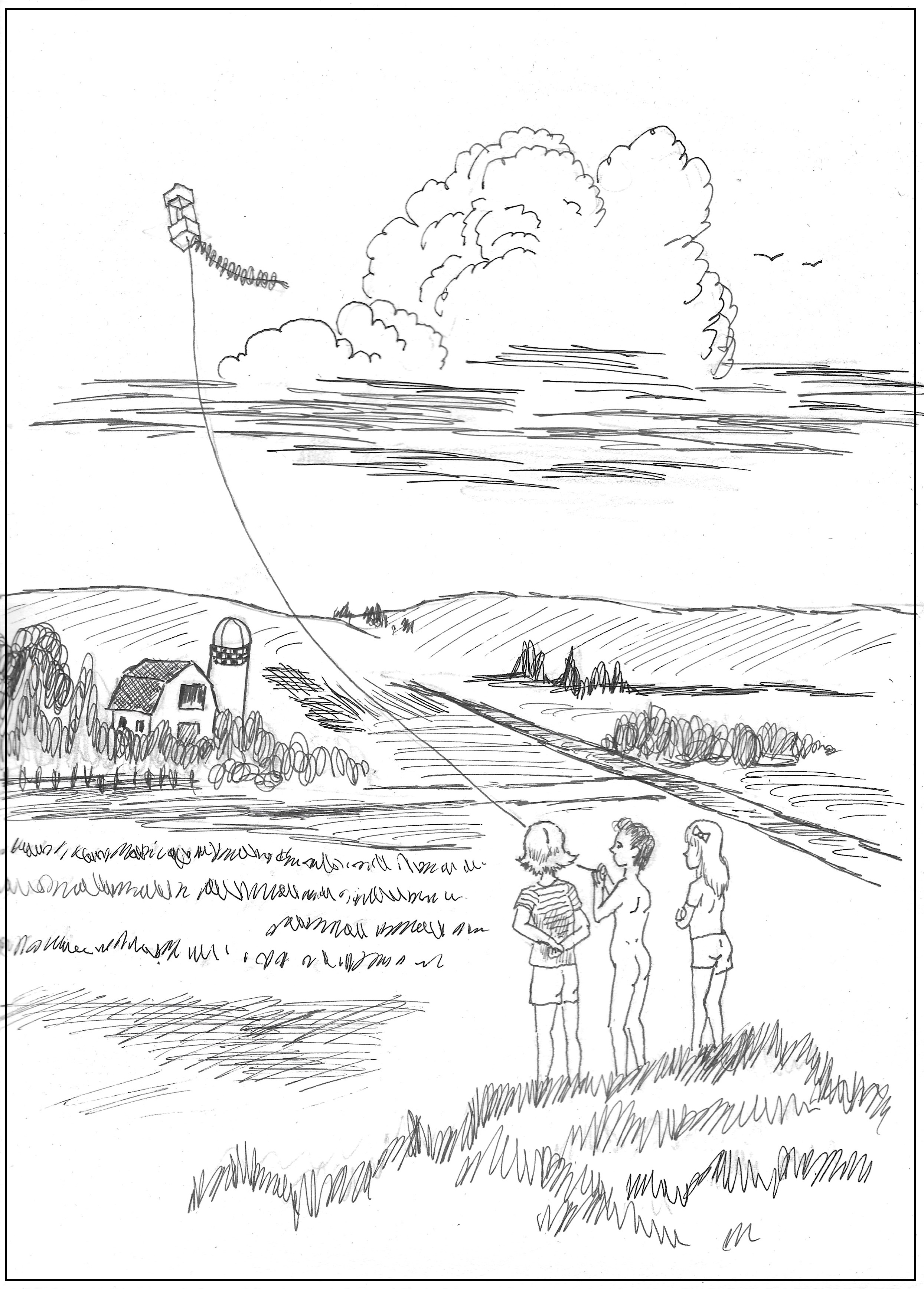
Not long ago I posted a short-short story about me wanting to see girls get naked while we were kite flying, and then, by verbal tricks backfiring, I ended up being the only one flying the kite while naked. I look back on that story now with laughter about my own personal foibles. But if I am completely honest, the church ladies with gray hair, wagging fingers, and tongues that are even waggier… Well, I am glad that the ones I knew as a boy are all now dead and can’t possibly read that story and shame me all over again.
And I know that I draw an awful lot of pictures and write an awful lot of stories that involve naked children. As a survivor of a traumatic sexual assault when I was ten (a thing that happened after the kite story was already in the past) there is a level of discomfort over recognizing that trend in myself. Not because I became a sexual predator of children. I clearly did not. I still am determined to prevent such things from happening in any way I can, though in retirement I no longer have access to children to talk with to find out about bad things that may be happening in their lives.
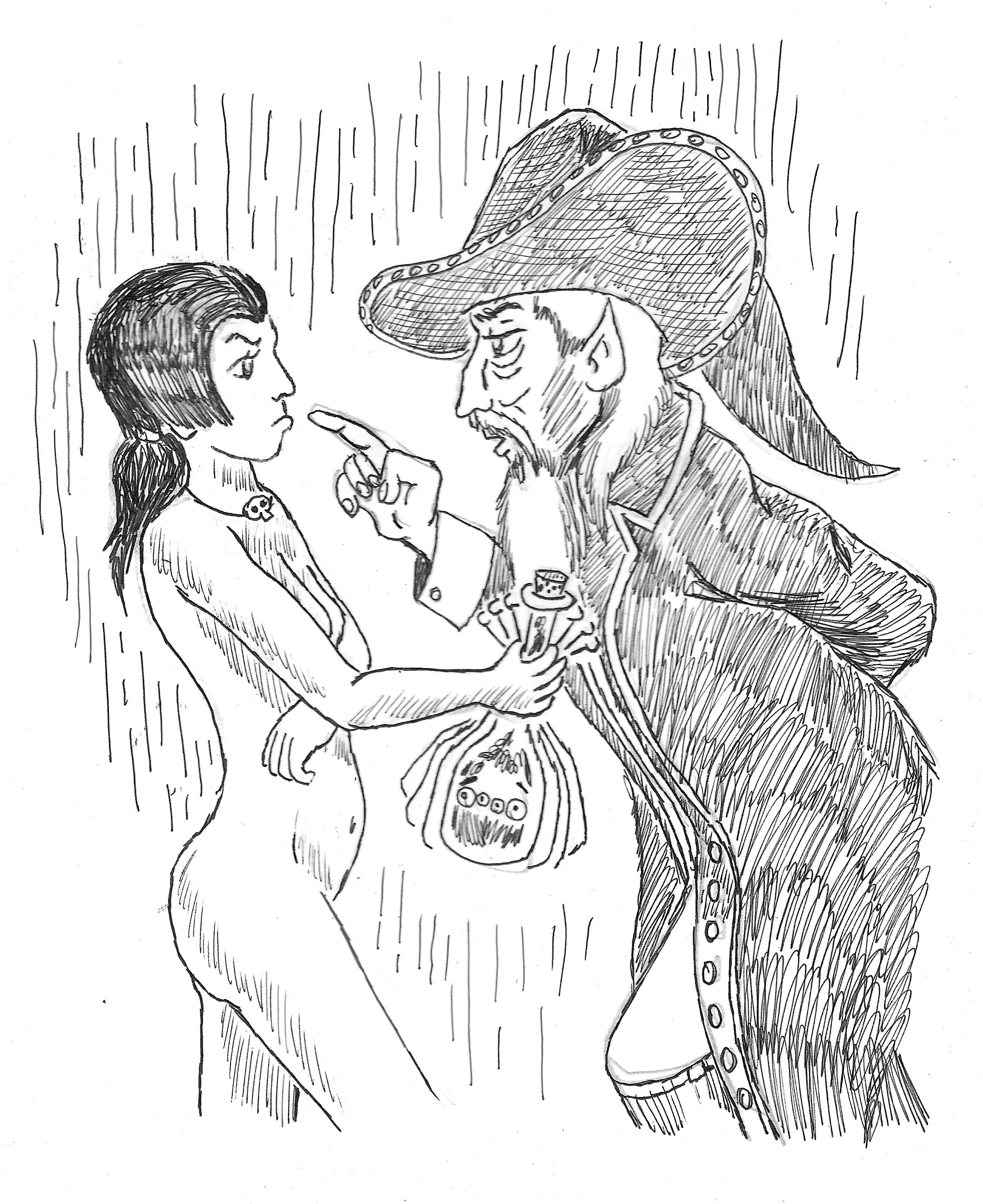
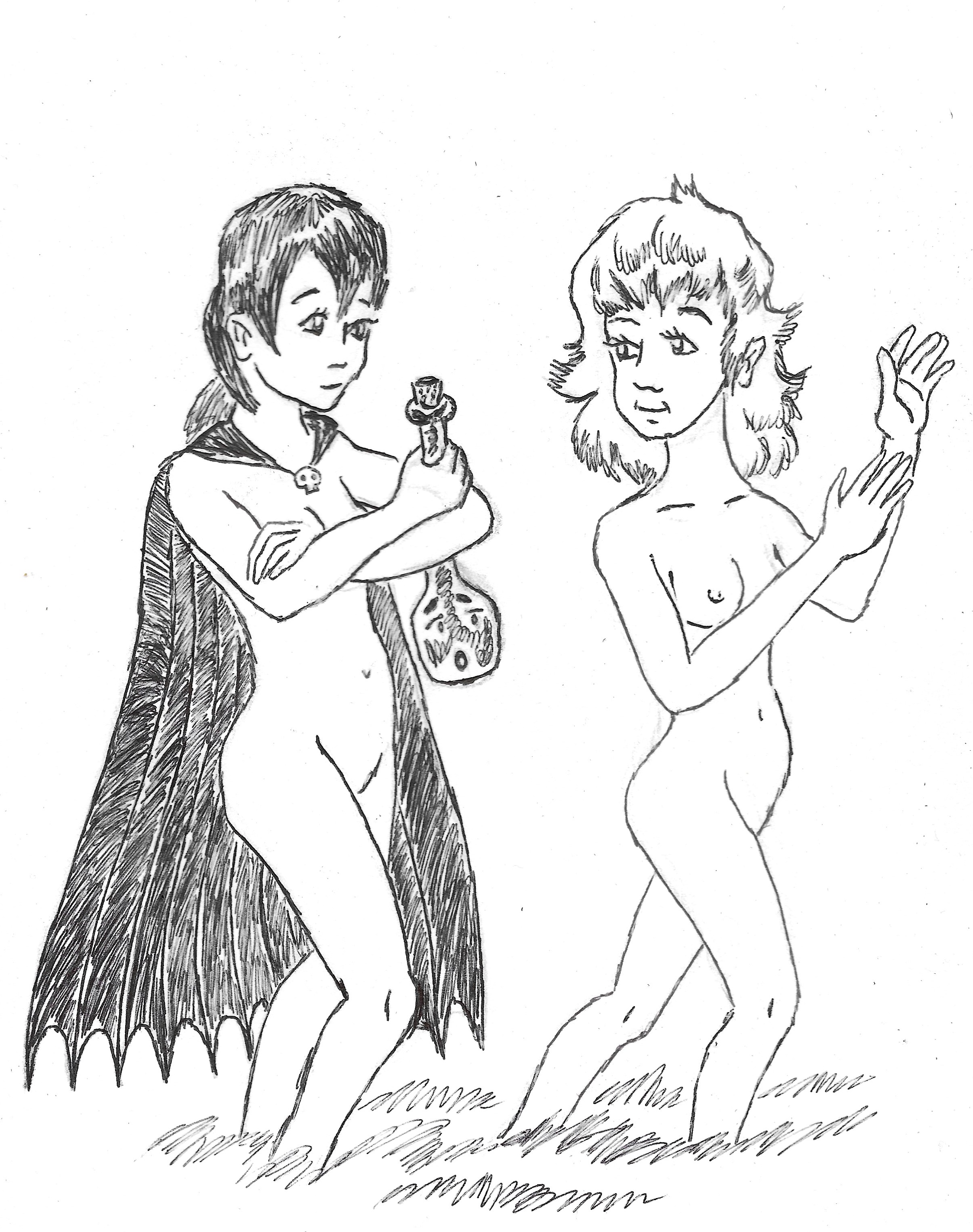
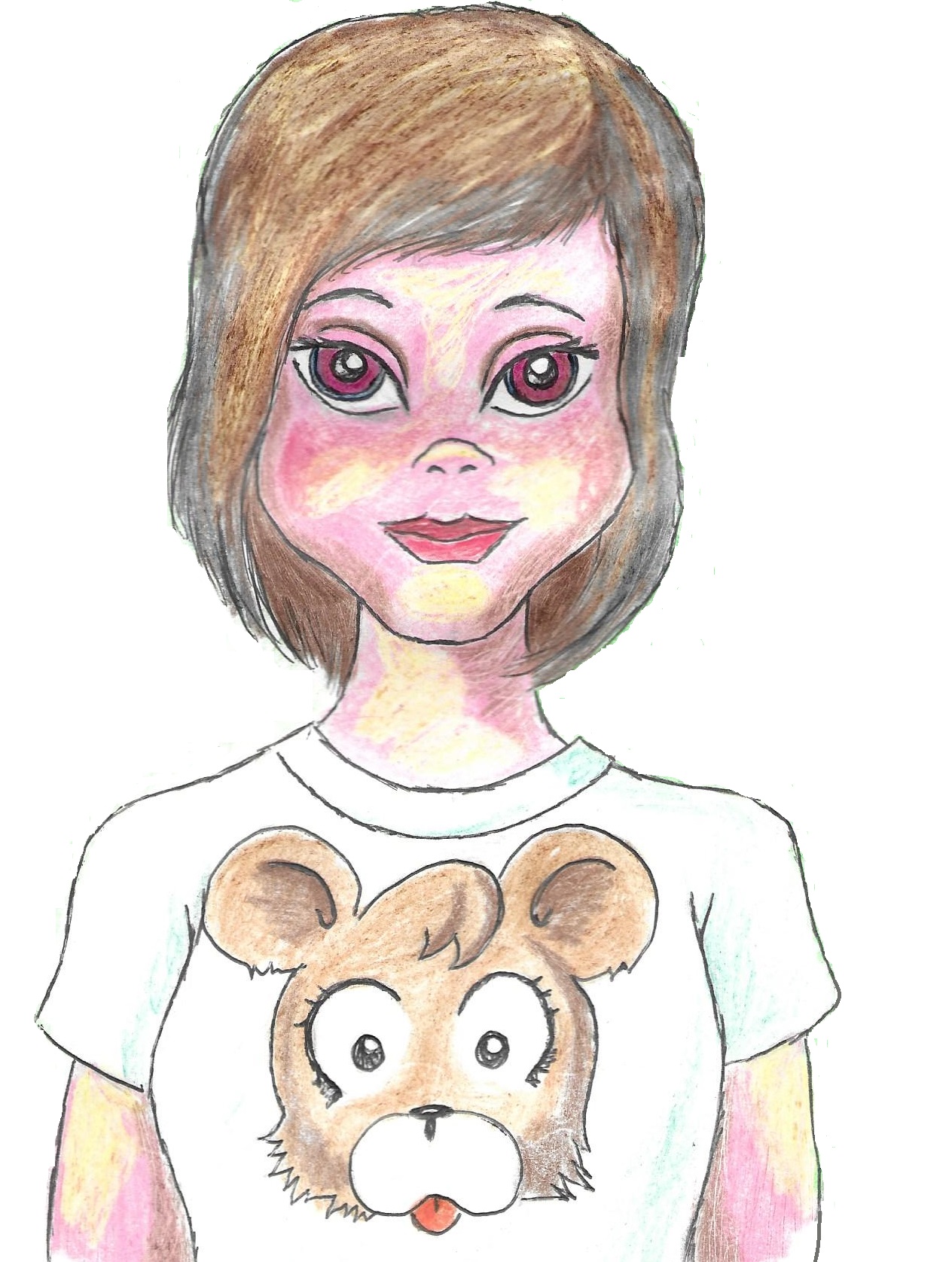
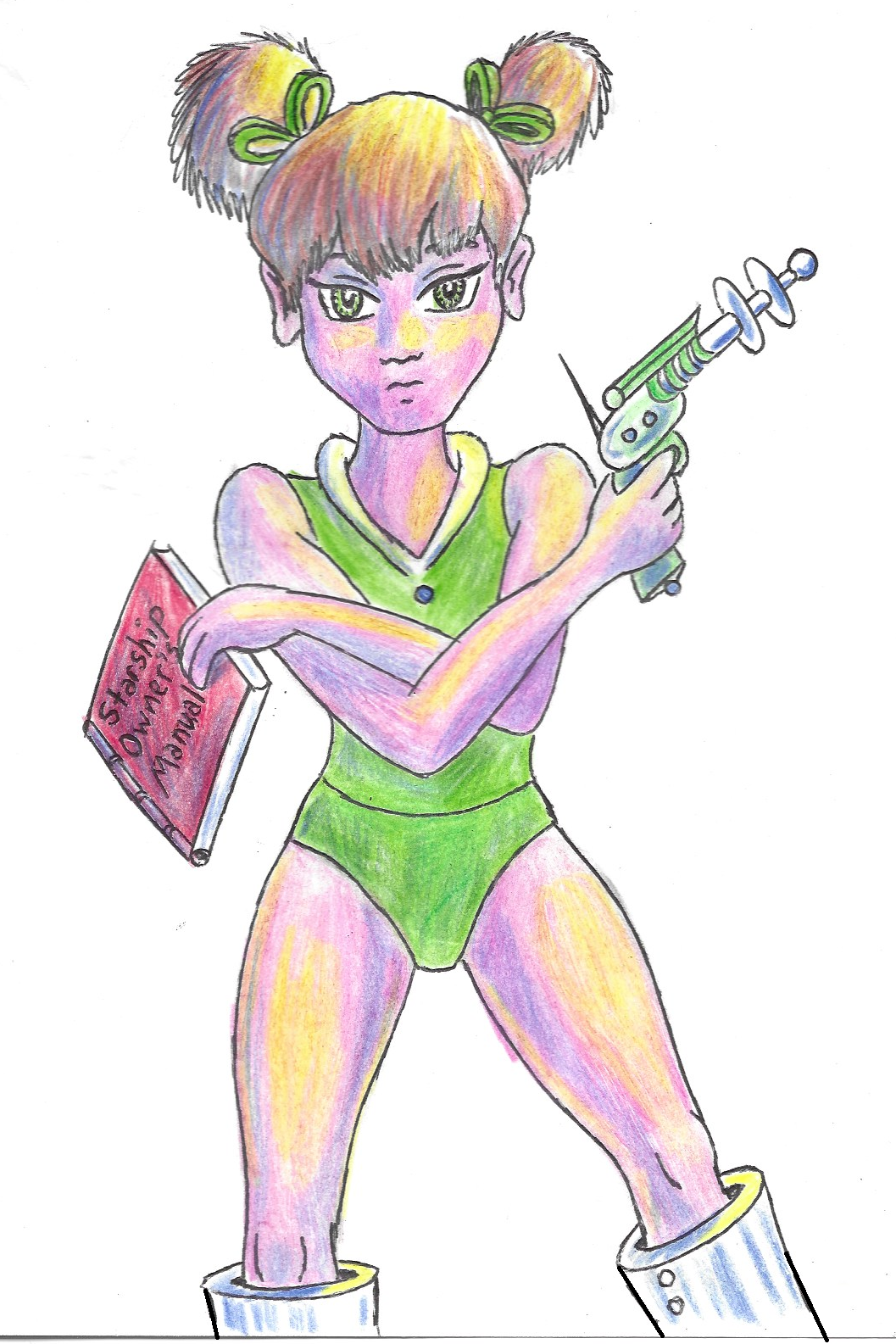
Derfentwinkle and Anneliese in my current work in progress, fairies both.
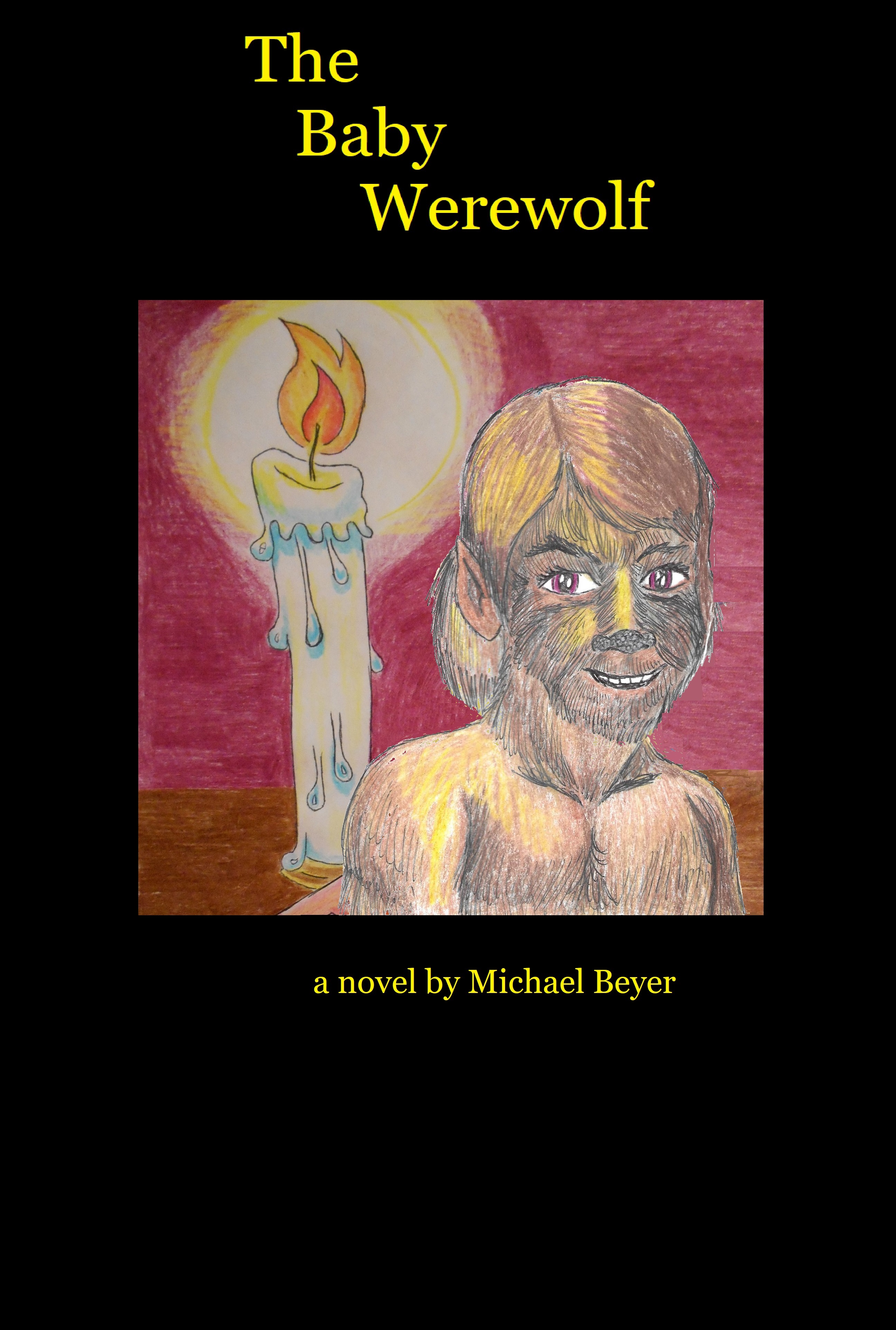
I write stories in which there are kid characters who are naked at times. Sometimes because of curiosity and developing sexuality, sometimes because of growing up in a nudist household, sometimes in their dreams, taking baths, and many other normal functions where clothing is optional. In The Baby Werewolf novel, I included a character who was trying to exploit a young nudist girl to make child pornography. He was the kind of predator I have always resolved to be against, and the book is intended to make readers aware of that kind of dangerous person and recognize where the opportunities to avoid such people lie.
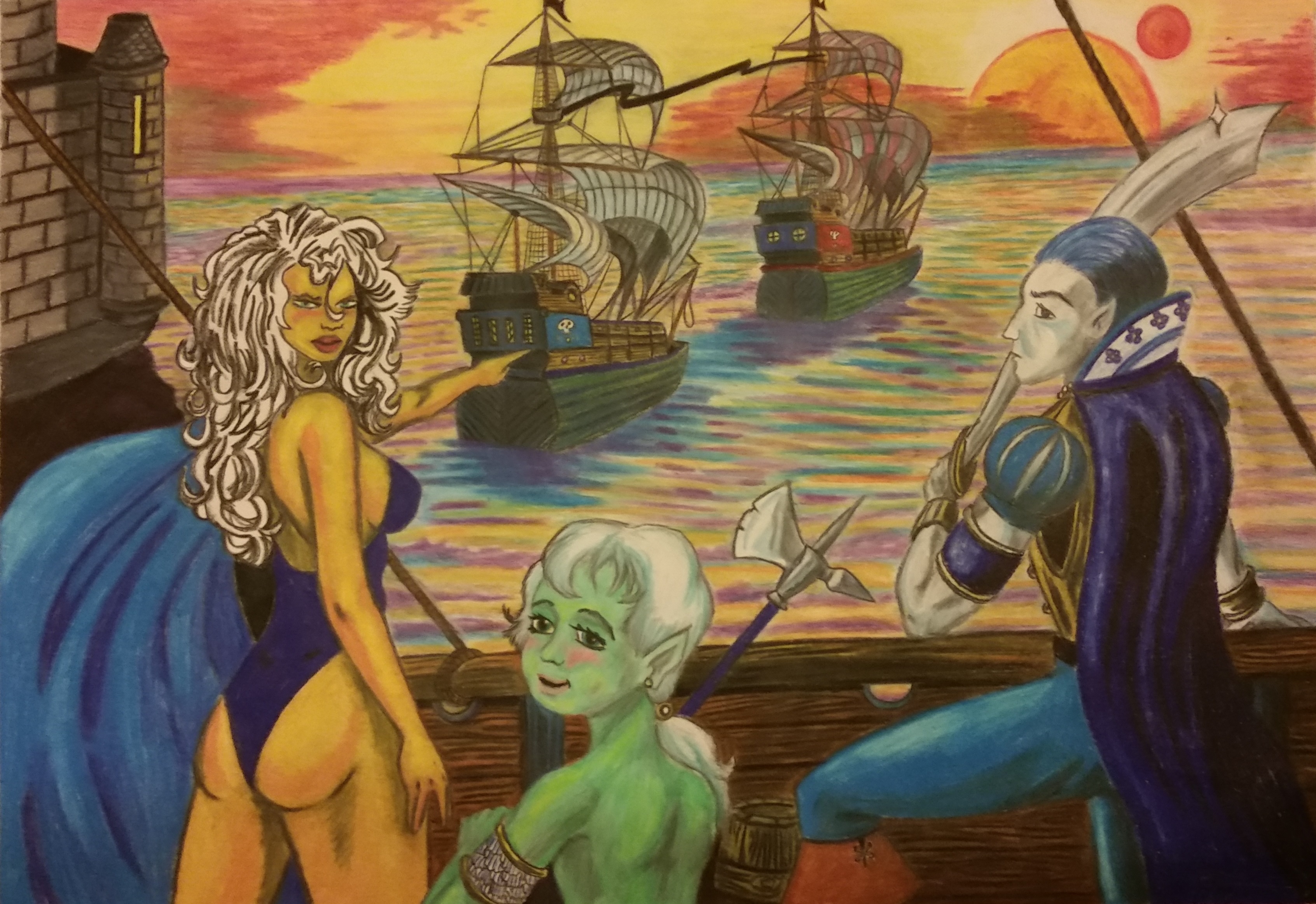
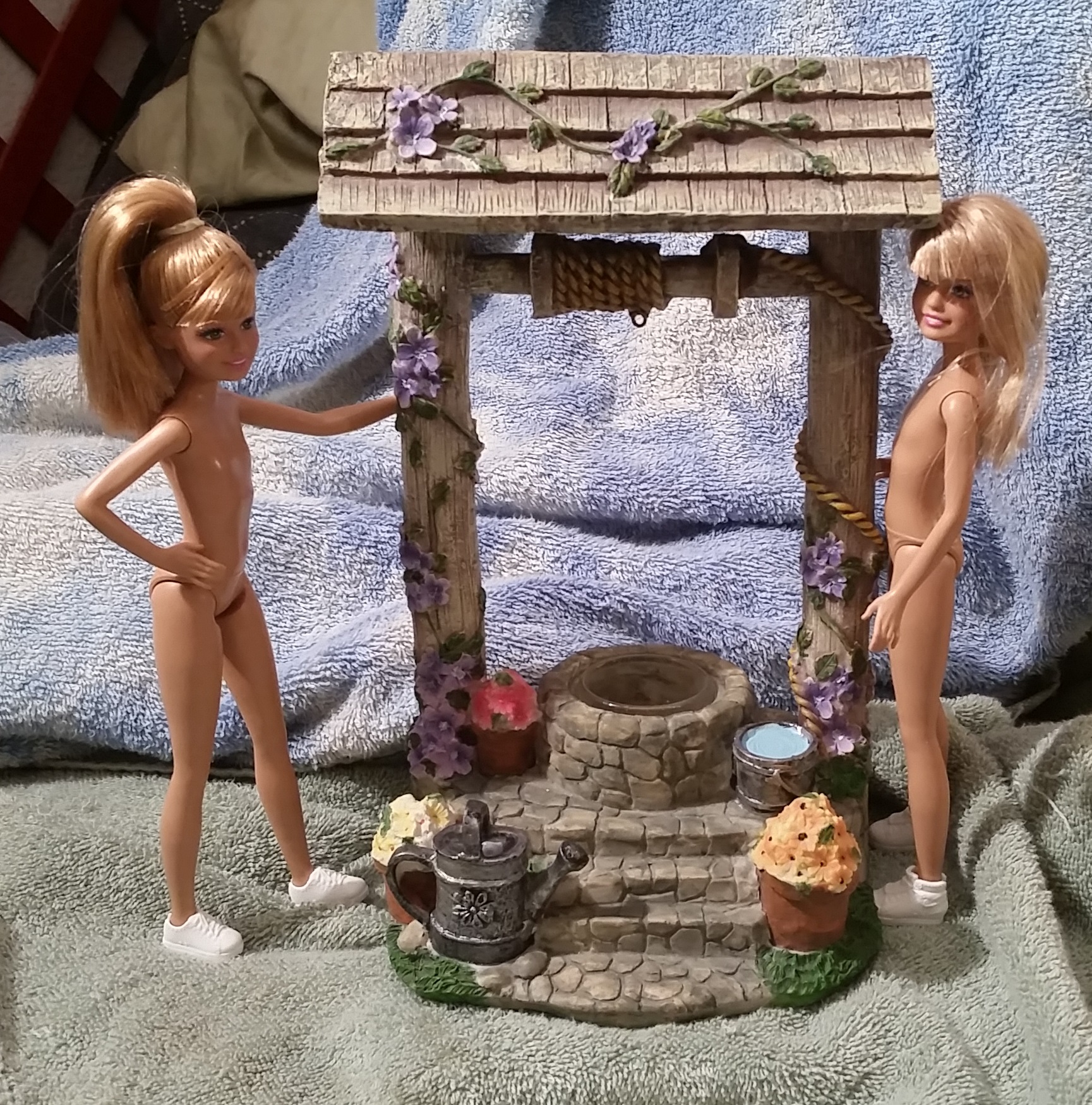
And some of the nude young characters I create like the two fairy girls depicted in the illustration from The Necromancer’s Apprentice merely represent the liberating feeling you can get from embracing your own nude self, a thing my attacker deprived me of during childhood through trauma and fear.
I, as an adult human being, fully accept readers’ rights to be critical of my work and make prudish judgements about my writing. I don’t like that one critic of The Baby Werewolf who said things about my work being creepy for the wrong reasons (it is a horror story after all) and suggesting that maybe I as the author am bad and villainous instead of feeling that way about the villain of the story. It was fiction, not my personal life story. The villain character is not me.
But prudes being prudish and judgmental can do more damage than just hurting an author’s feelings.
I have had two students that I know of who were transexual.
One was raised a boy because he was born with a penis, but in grade school was discovered to have a womb and ovaries. I didn’t know such a condition existed until I saw an episode of Marcus Welby MD in the 70’s about a young boy who had to transition because he was actually a girl. The child in my class was from a poor Hispanic family that didn’t understand the problem and couldn’t really afford to deal with it. The prudes, judgemental as always, were not kind. This he/she hermaphrodite was forced to grow up as a flamboyantly gay male even though he was capable of physically changing into a woman who could conceive a child. I followed his development for as long as I was able. I did spend one long and awkward evening talking to him/her about his/her crush on me. I could’ve gotten the prude finger-wag over that strange conference too, if anybody had bothered to care about that poor child. I certainly wasn’t going to kiss him, and I had to send him home at the end of that discussion because of what he/she wanted from me. I suspect there were other men who took advantage of him/her. But I wasn’t close enough to help him in any real way. And I lost touch soon after he/she left my class. Based on that bizarre discussion we had, I have no confidence at all that the poor child is still alive. Nobody seemed to care about this child That is the most tragic of things teachers sometimes have to deal with.
The other trans student I had in class for a year was a girl as far as she was concerned. It was not a question open for debate. She was quiet and a good student. She only had a couple of friends, but they were good friends and stood by her. At the time she was in my middle school class, she already had breasts thanks to hormone therapy. By now she has probably transitioned by surgical means. Her life was a lot easier than the boy with ovaries. But prudes in Texas abound and provide a lot of sour fruit.
I personally find it offensive that anyone would deny either of these two people the use of whatever restroom was comfortable for them.
What gives the typical prude the right to pass judgement on anyone else’s behavior? Prudes can cause repression of natural behaviors for the benefit for no one but themselves. I find prudishness to be reprehensible. But the rub is… being judgemental about that makes me a prude too.
I try never to be judgemental. I would much rather accept everyone for who they are, or who they think they are, than rely on what I think they are. And I do listen when others judge me. I have changed things in my books and drawings because of observations my others. And I take everything seriously… especially comedy.
When conservative cultural warriors, Twitter Trolls, or dyspeptic gasbags like Rush Limbaugh call you a “Special Snowflake”, I have discovered, to my chagrin, that they don’t mean it as a compliment. In their self-centered, egotistical world you have to be as emotionally tough and able to “take it” as they believe (somewhat erroneously to my way of thinking) they themselves are. They have no time for political correctness, safe spaces, or, apparently, manners polite enough not to get you killed on the mean streets where they never go. Being a retired school teacher who was once in charge of fragile young psyches trying to negotiate a cruel Darwinian world, I think I disagree with them.
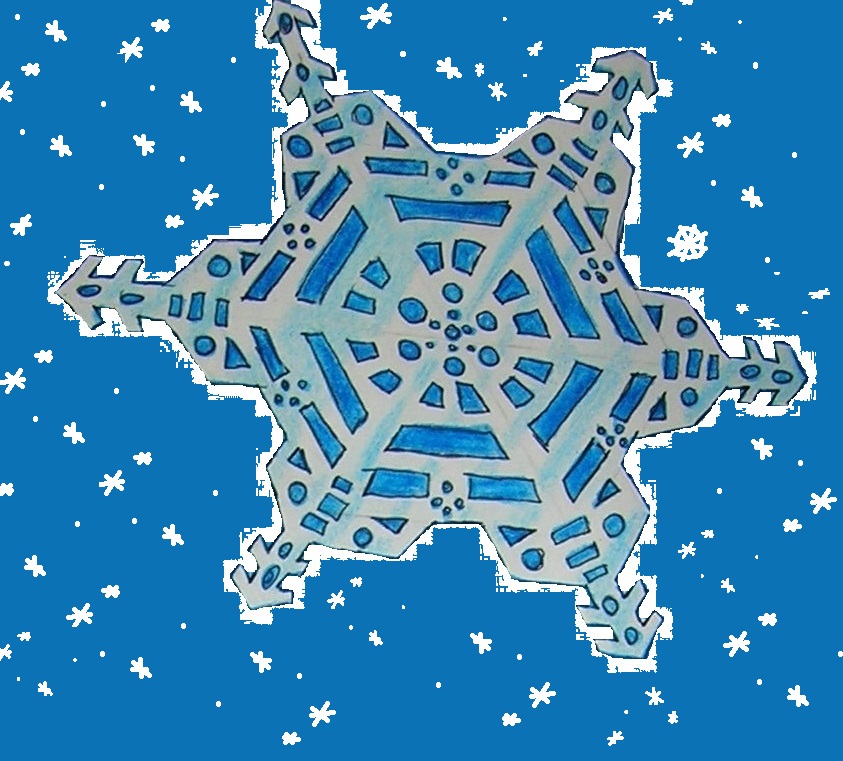
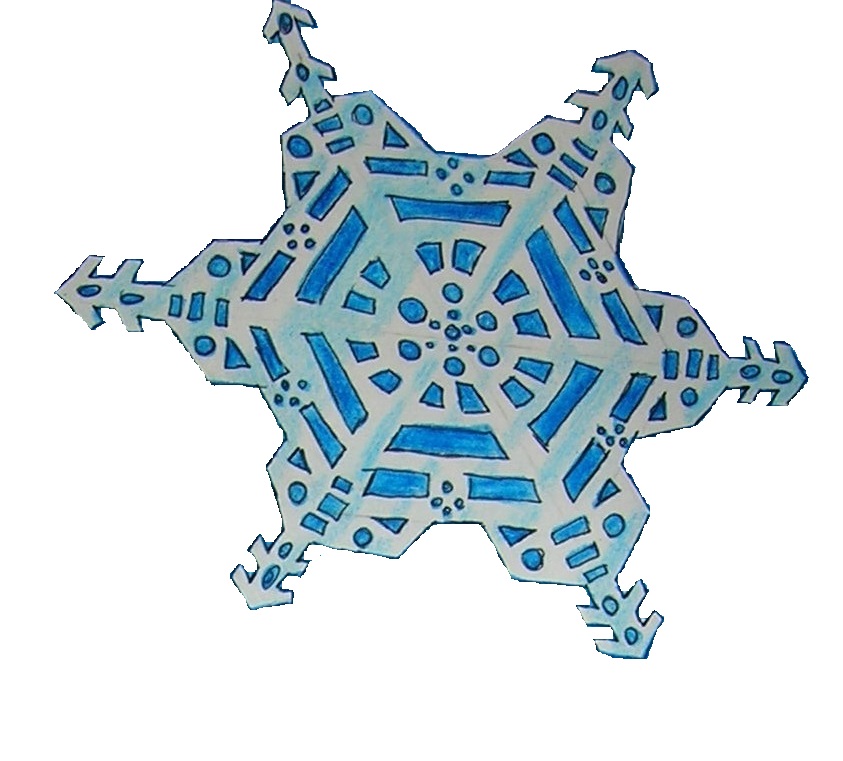
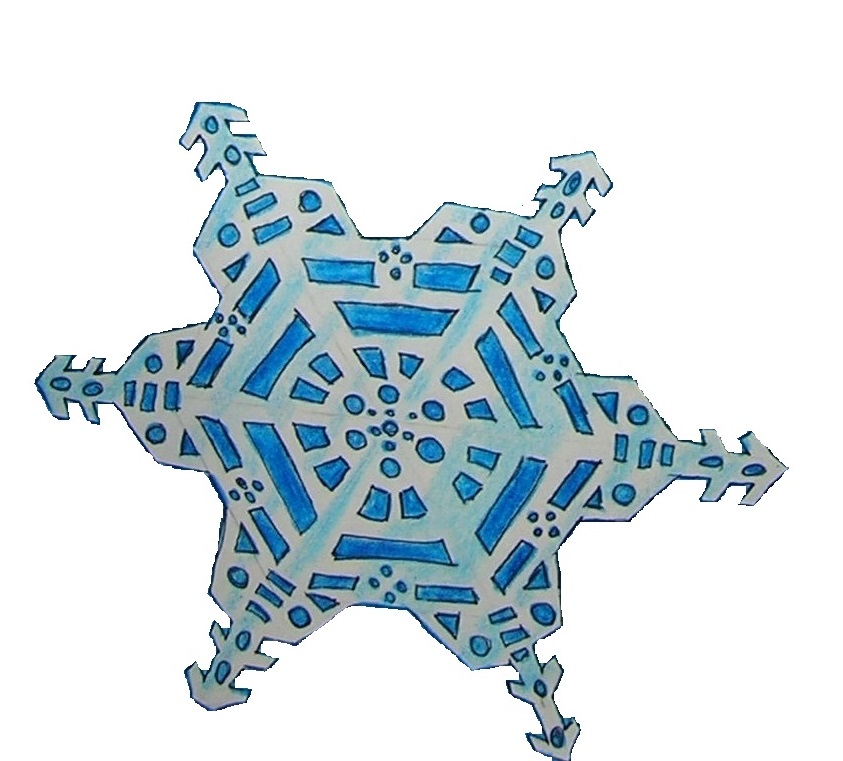
Have you ever tried to draw a snowflake? Believe me, it is difficult. Snowflakes are hexagonal star-shapes with enough lace and filigrees in them to make it a nightmare to draw it with painfully arthritic hands. The one above took me an hour with ruler and compass and colored pencils, and it still doesn’t look as good as a first grader can create with scissors and folded paper. Much better to use a computer program to spit them out with mathematical precision and fractal beauty. That’s how all the tiny ones in the background were created. But even a computer can’t recreate the fragile, complicated beauty of real snowflakes.
You see how the fragile crystalline structures will break in spots, melt in spots, attach to others, and get warped or misshapen? That is the reason no two snowflakes are alike, even though they all come from the same basic mathematically precise patterns generated by ice crystals. Life changes each one in a different way.
And that, of course, is the reason this essay is really about people rather than mere physical artifacts of cold weather. Our fragilities and frailties are earned, and they make us who we are. I have a squinky eye like Popeye from playing baseball and getting hit by a pitch. I have a big toe that won’t bend from playing football. They both represent mistakes that I learned from the hard way.
As a teacher, I learned that bipolar disorder and anxiety disorders are very real things. I lost a job once to one of those. And I spent a long night talking someone out of suicide one horrible December. Forgive me, I had to take fifteen minutes just there to cry again. I guess I am just a “special snowflake”. But the point is, those things are real. People really are destroyed by them sometimes. And they deserve any effort I can make to protect them or help them make it through the night.
But people are like snowflakes. They are all complex. They are all beautiful in some way. They are all different. No two are exactly the same.
And I really think boorish bastards have no right to insist that we need to take safe spaces and sanctuaries away from them. Every snowflake has worth. Winter snow leaves moisture for seedlings to get their start every spring. If you are a farmer, you should know this and appreciate snowflakes. And snowflakes can be fascinating. Even goofy ones like me.
I mean no disrespect to the bright spirit of Jane Austin by titling this thusly. But I do have an evil itch to confront these never-ending gremlins of public behavior. There is a need to regularly chastise the shoulder demons with the red suits, horns, and little red pitchforks. And if we listened more to the shoulder angels with the white robes, halos, and harps we would be talking these things out more carefully and logically with a view to how other people besides our bilious little little lizard-brains are affected.
Part One… Prejudice
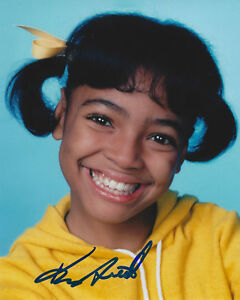
Kim Fields from The Facts of Life
When I started teaching in the 1980’s in South Texas, a popular TV show watched by many of my students was The Facts of Life. It was about a girls’ boarding school, specifically, one house mother and her charges. Not a very realistic depiction of the reality of schools in the 1980’s. But even though real house mothers would probably have at least 25 more girls to worry about and drive her insane than this TV version did, it did have a feature that gave me hope as a teacher. This show had a girl of color, something that kind of school, even in the north, would have less of than the 20% representation in this show. And, miraculously, through all the weekly girl-dilemmas for a harried house mouther to deal with, and the occasional social-issue shows, that one black girl was treated as just one of the girls. No more important nor any less important than any of the other girls. That was an ideal to strive for in the world of education.
The character of Tootie (Dorothy “Tootie” Ramsey played by Kim Fields) was a perky and positive character, sweet and charming, and possessing a high degree of emotional intelligence. I remember wishing I had more students like that. But I did have a number of girls exactly like that, though they were Hispanic and Anglo. We had no “black” families in Cotulla, Texas during the 80’s, and only two families and one teacher in the entire 23 years I taught there.
But prejudice is not about what color a kid is. Or what color any human being is. As a teacher, I learned early on that you have to try to love every kid you are given no matter what their personal details are.
I remember teachers saying that, “Black kids are noisier than any other group, and more likely to be aggressive.” Or they also tried to convince me that, “Hispanic kids are too mature for their age and become sexually active sooner in life than they should.” Of course, there were usually examples they were talking about. But those examples weren’t proof that the prejudice is based on reality. They were proof that generalizations based on race, first language, or culture are potentially hurtful. I could point to examples that might indicate that, “White kids are more likely to say racist things than non-white kids are.” That is also an unfounded conclusion that is easily disproven by a majority of examples.
The real problems a teacher has dealing with students don’t come from any prejudicial generalizations. They come from students having to endure things outside of the classroom including poverty, homelessness, physical and emotional abuse at home, malnutrition, or untreated mental or medical conditions. And sometimes the misbehavior is caused by the teacher forgetting or skipping the essential practices necessary to controlling the classroom environment.
Everybody has prejudices. My favorite color is red. I favor it almost always whenever I have a free choice among colors to use. But the problem with prejudices is how we act on them. If I burn down my neighbor’s house because he painted it green rather than red, then I have been morally reprehensible. Not racism, but still an evil act based on my prejudice.
The teenager who got away with hunting protesters and killing two white ones in Wisconsin with a “self-defense” verdict is guilty of acting on a prejudice that people who are protesting a racially motivated police shooting are properly and justifiably shot and killed for protesting in favor of their side of the controversy. He crossed a State line to a community he did not live in to be involved in that opportunity to kill someone he disagreed with using his illegally purchased AR-15 even though the victims were unarmed. Maybe you can’t prove racism. But how about prejudice against protesters who believe they shouldn’t be killed for their beliefs?
In Texas the conservatives are using a hatred and an anti-Critical Race Theory law to exert their racism in Texas schools. The Southlake School District has fired a beloved principal because he had the poor judgement to be married to a white woman and speak his mind in an email about being against the killing of George Floyd. Apparently he was guilty of promoting Critical Race Theory in the school even though Critical Race Theory is a law-school process for examining systemic racism in law enforcement. That, of course, is NOT taught in any Texas grade school, middle school, or high school. He was actually fired for having the opinion (while black) that George Floyd should not have been killed by policemen in Minnesota. They are transparently acting on their racism and proving the need for law schools to continue examining Critical Race Theory. Their excuse is that white kids are being taught to feel guilty of the atrocities their ancestors committed because of racism. So, apparently, how black kids feel about the same things don’t counr.
Through prejudices, teachers will no longer be able to teach tolerance during Black History Month in February. The novel Beloved by Toni Morrison can no longer be taught in high schools. The book Ruby Bridges wrote about her experience with integrating the white grade school in Little Rock, Arkansas can no longer be taught in history classes.
Explain to me why this fundamentally racist prejudice is to be tolerated! But be warned, my personal prejudices are telling me to protest this crap. And you can’t fire me for having taught these things in the past since I am now retired from teaching. You’ll just have to get a teenager with an AR-15 to kill me.
If I look for the essential action shots in my art to find pictures that illustrate “Adventure” I am frustrated to find that I am much more a maker of static portraits than comic book action scenes.
Again I go back to artwork done for Saturday role-playing games, a thing which I started doing in 1981. It filled my life for a time. And it also taught me to be a teacher. After all, the DM (Dungeon Master, or Game Master) has to be a story-teller and a master explainer… just like a school teacher.
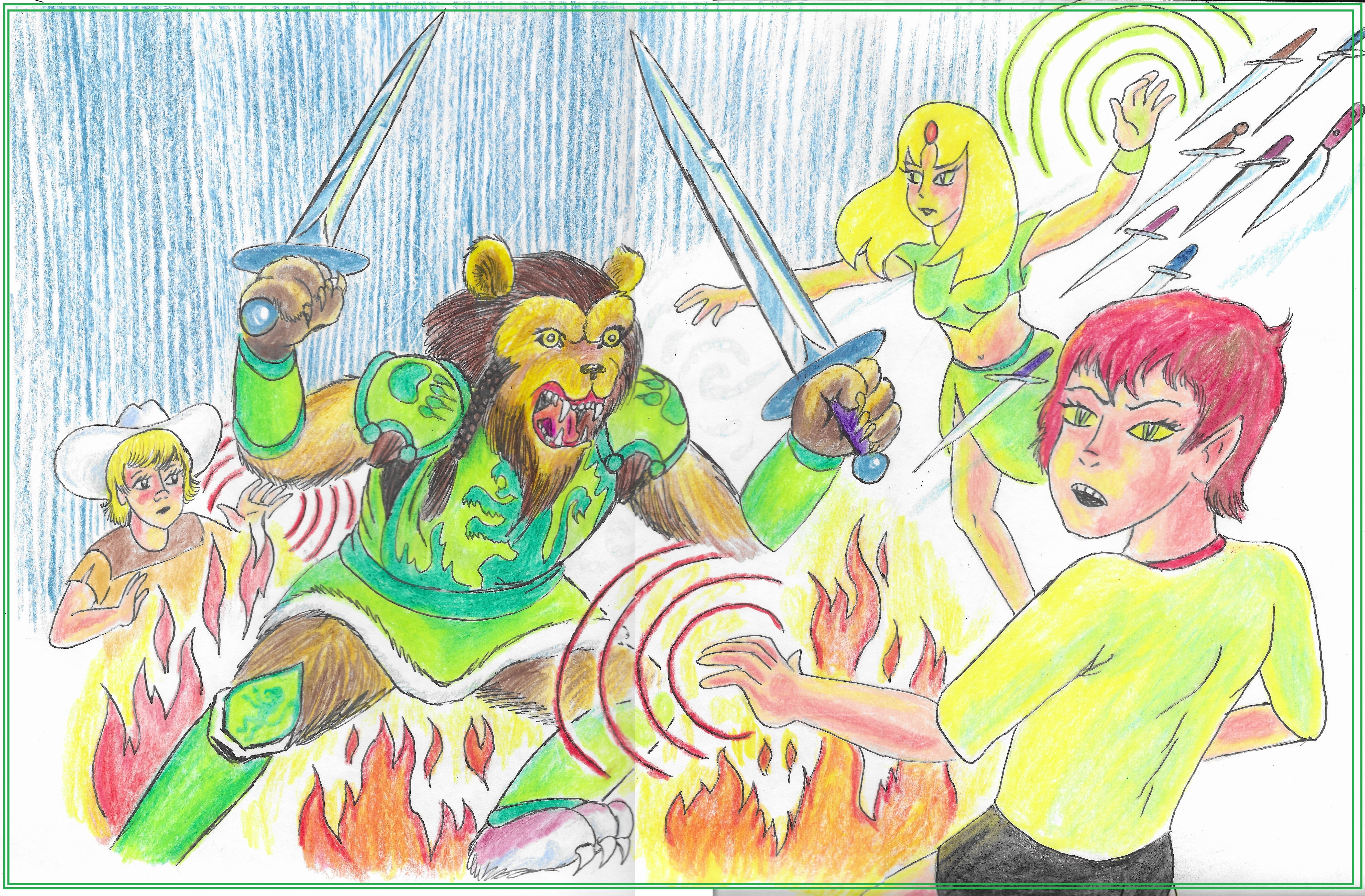
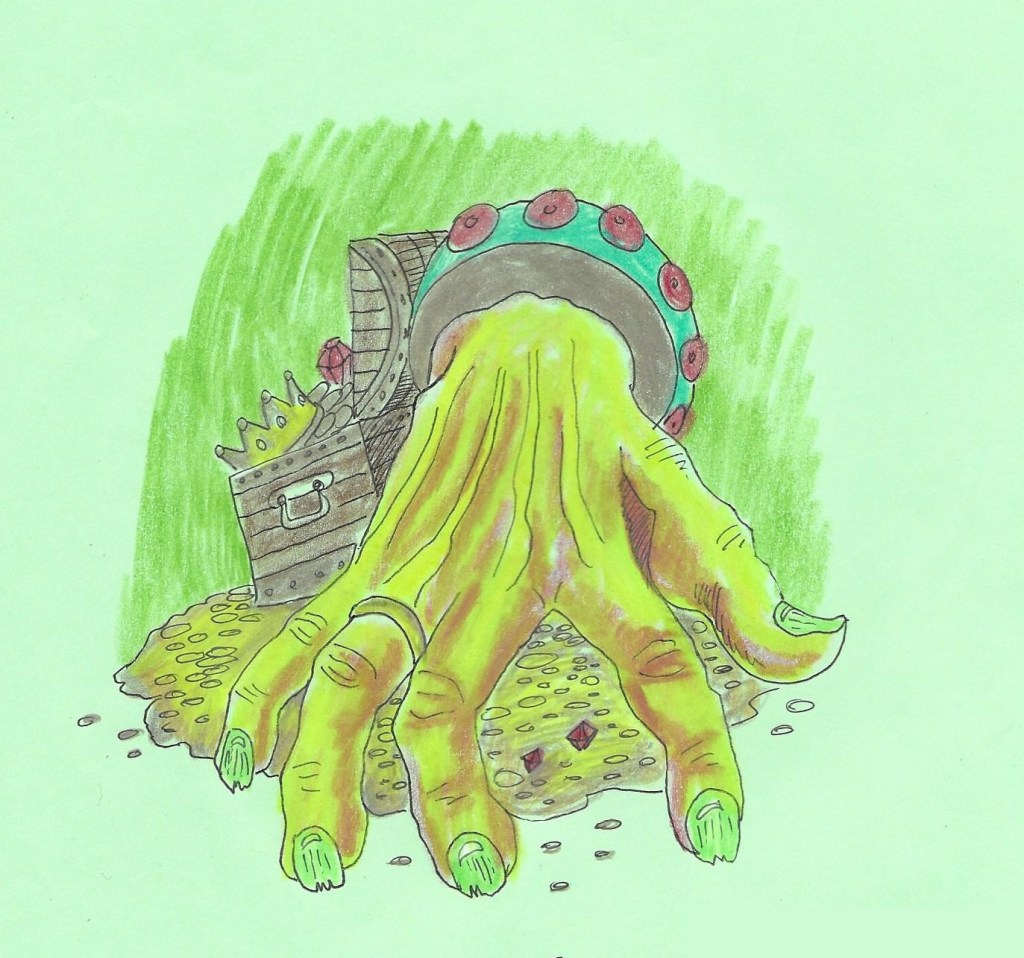
A Dungeons and Dragons picture from 1981. A Shaitan Rider, a villain from 1982.The Giant Sorcerer’s Hand, a monster from the 2011 family game.A heroine-ally and her pet werewolf.The father of mys son’s player character was found at the end of an adventure. He is apparently me with fewer legs.An enemy necromancerTwo versions of the same weretigerThis unused non-player character would become a novel character in 2019.Some characters are borrowed directly from TVSome characters are kept around as potential instant player characters.
“Mickey, why can’t you be more serious the way smart people are?”
“Well, now, my dear, I think I take humor very seriously.”
“How can you say that? You never seem to be serious for more than a few seconds in a row.”
“I can say it in a high, squeaky, falsetto voice so I sound like Mickey Mouse.”
“You know that’s not what I mean.”
“I can also burp it… well, maybe not so much since I was in junior high.”
“I distinctly remember getting in trouble in Mrs. Mennenga’s third grade class in school for pantomiming pulling my beating heart out of my chest and accidentally dropping it on the floor. She lectured me about being more studious. But I made Alicia sitting in the row beside me laugh. It was all worth it. And the teacher was right. I don’t remember anything from the lesson on adding fractions we were supposed to be doing. But I remember that laugh. It is one precious piece of the golden treasure I put in the treasure chest of memories I keep stored in my heart.”
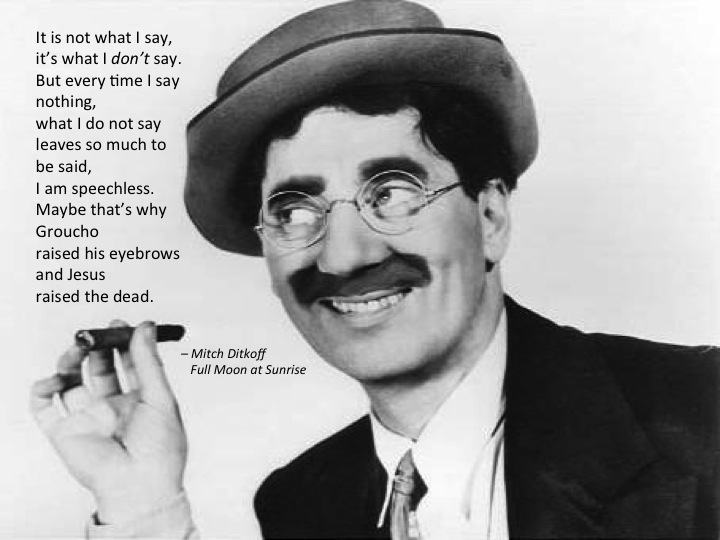
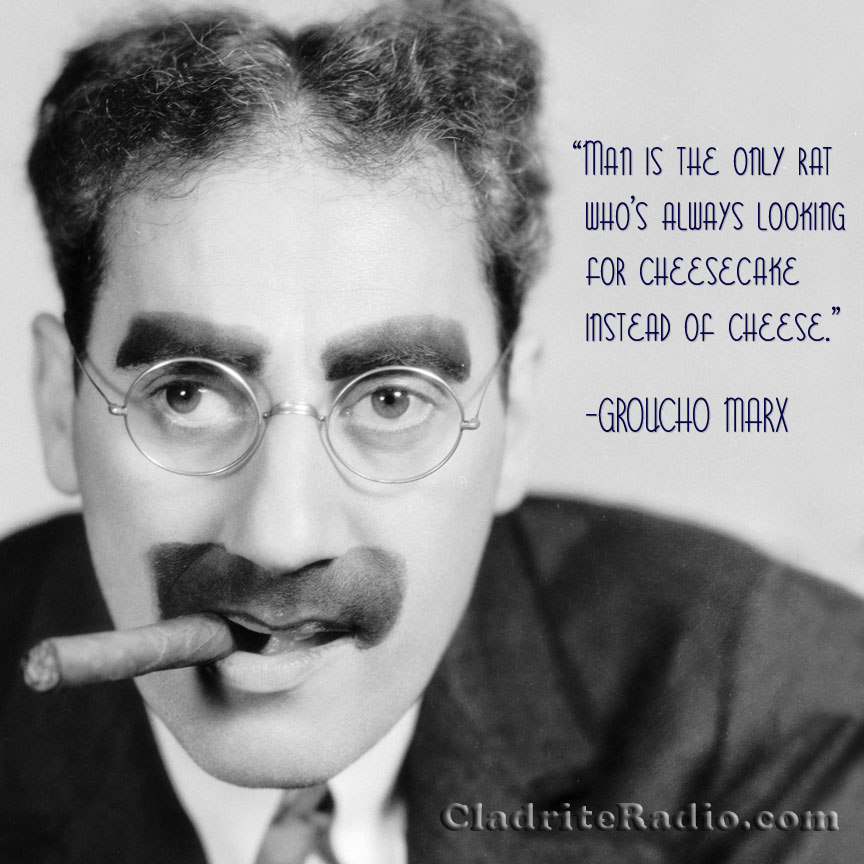
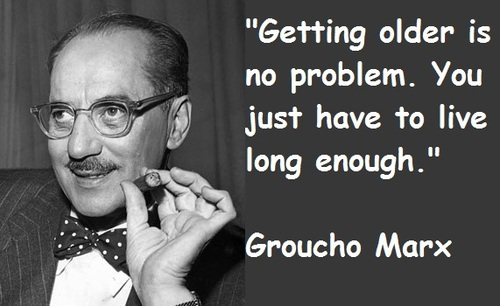
“I always listened to the words Groucho Marx was saying, even though he said them awfully fast and sneaky-like. I listened to the words. Other characters didn’t seem to listen to him. He didn’t seem to listen to them. Yet, how could he respond like he did if he really wasn’t listening? In his answers were always golden bits of wisdom. Other people laughed at his jokes when the laugh track told them to. I laughed when I understood the wisdom.”
“Laughing is a way of showing understanding. Laughing is a way of making yourself feel good. Laughing is good for your brain and your heart and your soul. So, I want to laugh more. I need to laugh more. I love to laugh.”
I have known nudists for a long time, since the 1980’s in fact. I have recently dabbled my toes in the cold waters of being a nudist myself. I did work on pool cracks this past summer while naked. I made one visit to a nudist park and actually got naked in front of strangers who were also naked. It is a certain kind of crazy connection to nature, my self, and the bare selves of others to be a nudist, even if it is for only a few hours. I used to think nudists were crazy people. But I have begun to understand in ways that are hard to understand. And being a novelist, that was bound to creep into the piles of supposedly wise understanding that goes into the creation of novels. I say “supposedly wise” because wisdom is simply the lipstick on the pig of ridiculous human experiences.
The Cobble family appeared first in my novel, Superchicken. It is a semi-autobiographical novel that uses some of my real life experiences and the real life experiences of boys I either grew up with or taught, mixed in with bizarre fantasy adventures that came from my perceptions of life as an adult. So the Cobble family really represent my encounters with nudism and the semi-sane people known as nudists. Particularly important to the story are the Cobble Sisters, twins Sherry and Shelly, who fully embrace the idea of being nudists and try to get other characters to not only approve of the behavior, but share in it. Sherry is the more forward of the two, more willing to be seen naked by the boys in her school and in her little Iowa farm town. Shelly is the quieter of the two, a bit more shy and a lot more focused on the love of one particular boy.
In fact, the Cobble Sisters are based on real life twin blond girls from my recollections of the past. The Cobble farm is out along the Iowa River and just north of Highway Three in Iowa. It is a real place where real twin girls lived when I was a boy. They were blond and pretty and outgoing. But they were not actually nudists. There was another pair of twin blond girls from my first two years of teaching who actually provided the somewhat aggressively sensual personalities of the Cobble Sisters. The real nudists I knew were mostly in Texas.
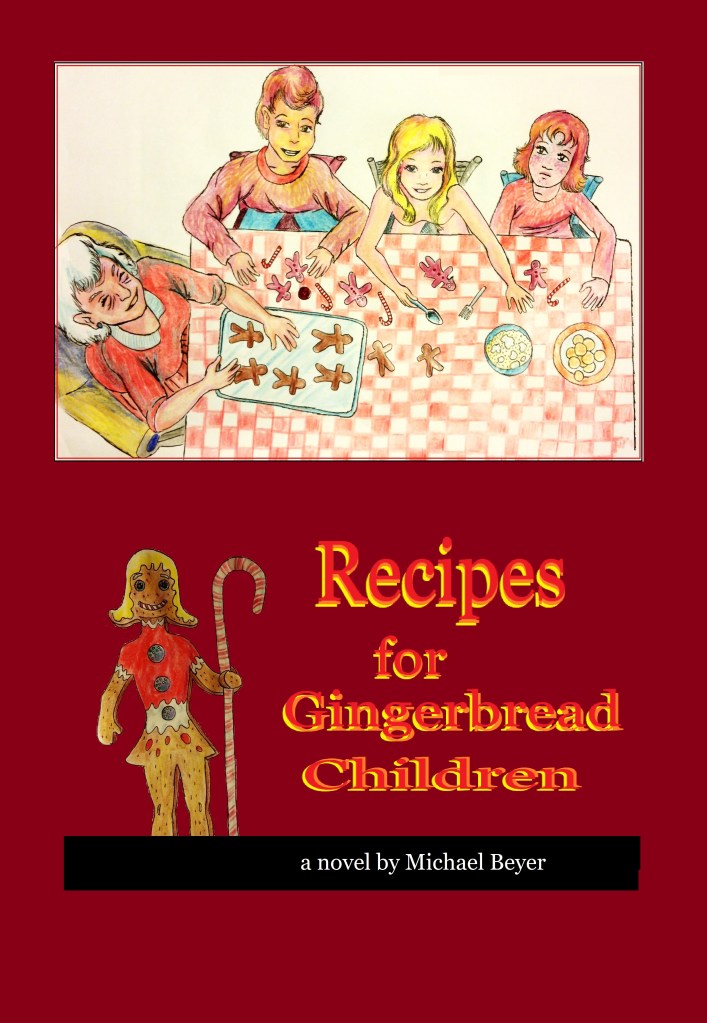
The sisters appear in more than one of the novels I have written or am in the process of writing. They appear for the second time in the novel Recipes for Gingerbread Children which I finished writing in 2016. They are also a part of the novel I am working on now, The Baby Werewolf. That last is probably the main reason they are on my mind this morning. Writing a humorous horror story about werewolves, nudists, pornographers, and real wolves is a lot more complex and difficult than it sounds. But it is hopefully doable. And my nudist characters are all basically representative of the idea that all honest and straight-forward people are metaphorically naked all the time. That’s the thing about those nudist twins. They don’t hide anything. Not their most private bits, and certainly not what they are thinking at any given time.
So as I continue to struggle with revealing myself as a writer… and possibly as a nudist as well, I will count on the Cobble Sisters to make certain important points about life and love and laughter… and how you can have all three while walking around naked.
Both novels discussed in this old post are now available from Amazon in self-published, finished form.











Strawberry Fields
This foolish essay about berries that mean love to me is only partly inspired by the Beatles song, “Strawberry Fields Forever.” That’s because, of course, their song was only about meditating. In the lyrics they take you to the “Strawberry Fields where nothing is real… but it’s nothing to get hung up about…” They are talking about a blissful place of no worries where we all need to go. And then staying there forever.
This, of course, I could never do. Worrying about the future is tattooed on my behavioral imperatives in the dark part of my stupid old brain. And while I often found that place of no worries, and lingered there for a bit, I found you could never really get anything done if you stayed in that state of strawberry fields forever.
But don’t get me wrong, strawberries are a critical part of every healthy mental diet.
You see, my meditations on strawberries when I was a child of eight, nine, and ten centered on the strawberry patch at Great Grandma Hinckley’s place.
She was, as I incorrectly recall, slightly older than Jesus when I was that age. By that I mean, though she seemed museum-quality ancient to me, I had derived wisdom about life, love, and laughter from her before Sunday School taught me any of those things said in Jesus’s words.
And I was given the task of mowing her lawn in the little plot of land surrounding her little, tiny house in the Northern part of Rowan where I also lived and grew and celebrated Christmas and Halloween and Easter and the 4th of July. And though I was doing it because she was so old, I never even once thought she was too old and frail to do it herself. Grandma Hinckley’s willpower was a force of nature that could even quell tornados… well, I thought so anyway when I was eight. And she gave me a dollar every time I did the lawnmowing.
But there were other things she wanted done, and other things she wanted to teach me. There was the garden out back with the strawberry patch next to it. She wanted me to help with keeping the weeds and the saw grass and the creeping Charlie from overrunning the strawberries and choking them to death. (Creeping Charlie wasn’t an evil neighbor, by the way. He was a little round-leafed weed that grew so profusely that it prevented other plants from getting any sunlight on their own leaves, causing a withering, yellowing death by sunlight deprivation. I took my trowel to them and treated them like murderers. I showed them no mercy.)
And Grandma always reminded me not to be selfish and eat the very berries I was tending in the garden. She taught me that eating green strawberries (which are actually more yellow than green, but you know what I mean) was bad because they could give you a belly ache, a fact that that I proved to myself more than once (because eight-year-olds are stupid and learn slowly.) She also taught me that it is better to wait until you have enough strawberries to make a pie, or better yet, strawberry shortcake with whipped cream. She taught me that delayed gratification was more rewarding in the long run than being greedy in the short run and spoiling everything for everybody.
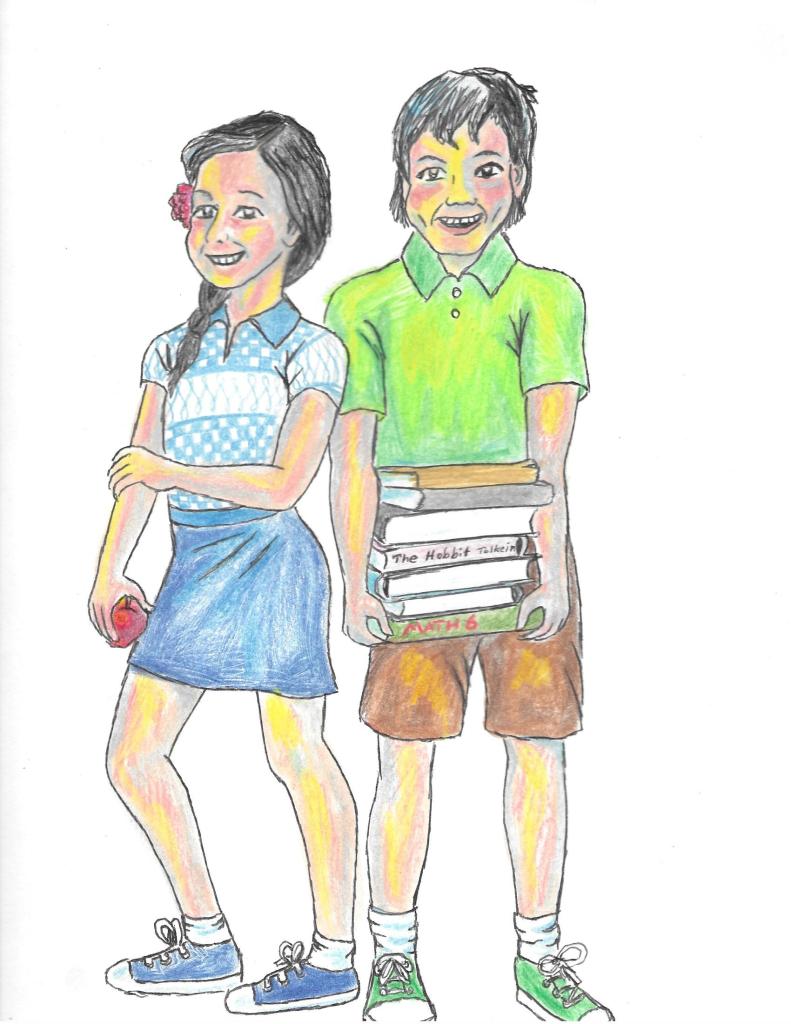
She always gave me a few of the ripe strawberries every time I helped her with them, even if I had eaten a few in the garden without permission. Strawberries were the fruit of true love. I know this because it says so in the strawberry picture. Even though I probably never figured out what true love really means.
My Great Grandma Nellie Hinckley was the foundation stone that my mother’s side of the family was built on. She was the rock that held us steadily in place during the thunderstorms, and the matriarch of the entire clan of Hinckleys and Aldriches and Beyers and other cousins by the dozens and grandchildren and great grandchildren and even great great grandchildren. I painted the picture of her in 1980 when she passed away. I gave it to my Grandma Aldrich, her second-eldest daughter. It spent three decades in Grandma’s upstairs closet because looking at it made Grandma too sad to be so long without her. The great grandchild in the picture with her is now a grandmother herself (though no one who has seen this picture knows who it is supposed to be because I painted her solely from memory and got it all wrong.) But Grandma Hinckley taught me what true love means. And true love has everything to do with how you go about taking care of the strawberry patch.
3 Comments
Filed under artwork, autobiography, commentary, family, health, humor, mental health, Paffooney, philosophy, strange and wonderful ideas about life