
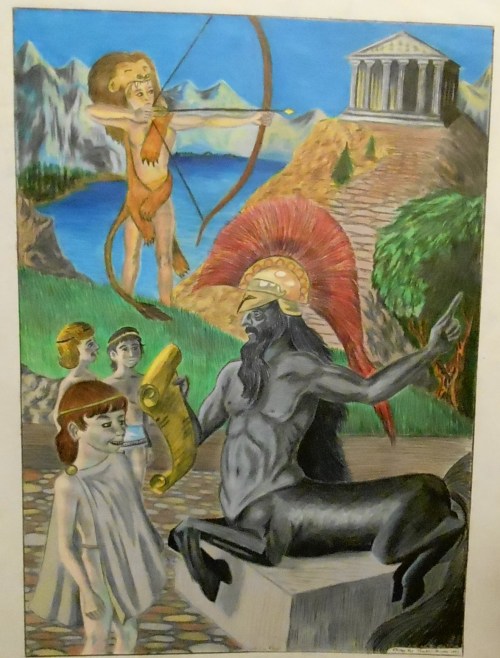
The centaur… Kentaur, Κένταυρος, Centaurus, Sagittary… human from the waist up,horse body from the waist down… I hate to break it to you, but the damned things are only imaginary. There are no real ones anywhere. Not even in Thessaly. The half-horse children of Ixion and Nephele are totally made up by goofy story-tellers in the distant past.


And yet, what they actually represent in poems, plays, stories, and myths is a very real part of what it means to be human and what it means to be alive.


There are many centaurs in literature, going all the way back to the Greeks. But my favorite depictions of the man-horses of literature occur in what are basically children’s books. In the Chronicles of Narnia C. S. Lewis portrays centaurs as wise and noble, gifted at star-gazing, prophecy, healing,and warfare. Aslan the Lion, the Christ-figure of the tales, relies on their steadfast faithfulness in his battles against evil and the White Witch. In the Harry Potter books of J.K. Rowling, the centaurs live in the Forbidden Forest just outside of the Hogwarts grounds, always in hiding from the human world and shy, at least until Firenze comes Chiron-like to join the faculty, aid in the teaching of magic, and help in the struggle against the evil of Voldemort. In the Percy Jackson series by Rick Riordan, Chiron himself of Greek myth teaches the young heroes, though the rest of the centaurs you meet in the stories are very Dionysian and basically a bunch of drunken party boys… err… party horses… err… horseboys.
So essentially the centaur has a dual nature. On the one hand they are cultured and learned and wise. On the other hand, they are directly connected to the earth and the natural world, liking the sensual half of the human experience. And it might be important to note… centaurs never wear pants… in fact, could never wear pants.
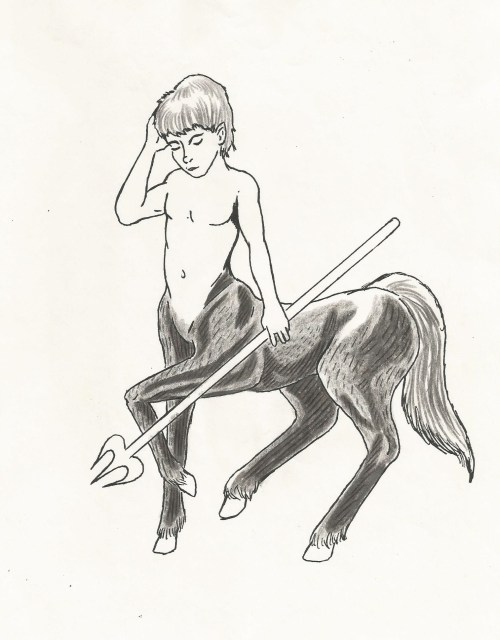
In Greek mythology, the Centauromachy, or war between the centaurs and the Lapiths, represents a central struggle in the human psyche. The centaurs are pictured as being as wild as untamed horses. They are sensual and willful and try to disrupt the wedding of Hippodamia to Pirithous, King of Lapithae by kidnapping Hippodamia and all the other Lapith women and girls. It turns out badly for the centaurs because they represent unbridled sensuality without rules while the Lapiths (who are directly related to the centaurs as cousins) represent rules and rationality. We all know how that is expected to play out in human society… so of course that is what happens in the myth. The rational always rules in the end.

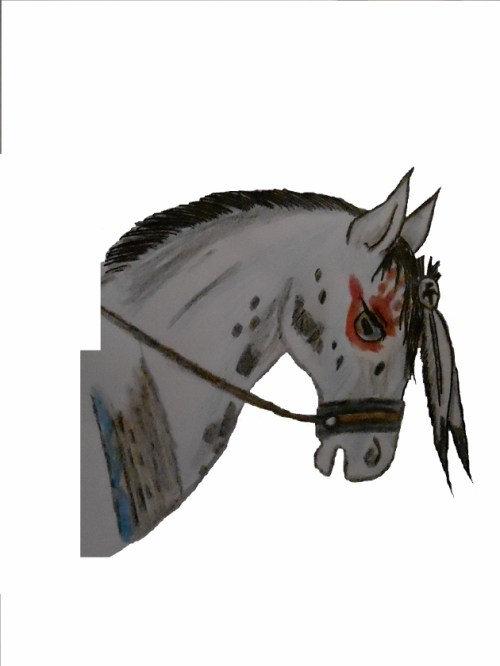
So I identify strongly with the idea of the centaur. The rational man-part guiding the sensual horse-part. The whole teacher-y Chiron thing… and getting to walk around naked… on four legs. The centaur is a thing to draw and a thing to tell stories with and a thing to invade your dreams. Part man, part horse, and totally unreal.



























 Catch a Falling Star
Love Stories With Clowns and Elephants
Yes, this essay is supposed to be a book review of Sara Gruen’s lovely, enthralling circus story Water for Elephants. But you know me. My writing gets overwhelmed and filigreed by my obsessive urge to dive into the ocean of things that excite me to purple paisley prose.
It is a fascinating love story involving a depression-era travelling train circus, a young man who suddenly finds himself a penniless orphan days before he can complete his degree in veterinary medicine, an elephant, a beautiful horse-riding show girl and circus star, and her cruel but charming ring master husband.
I don’t think I am spoiling anything by telling you that Jacob Jankowski, the main character of the tale falls in love with both the beautiful Marlena and an apparently untrainable elephant named Rosie. And I also shouldn’t actually be ruining the ending by telling you that the murderer who ends the story is revealed in the opening pages, but is still a surprise when masterful story-teller Sara Gruen re-reveals the murder at the end. This is a plot-driven novel that completely catches you up in a doomed relationship, a complicated romance, and an artfully re-created world of depression-era train circuses that ranks right up there with Cecil B. DeMille’s movie spectacular The Greatest Show on Earth.
Yes, I had to equate this book with an old 1950’s movie that I love because of the similarities of plot and spectacle. Both the movie and the book have a faithful clown friend who lives a tragic life. Both Buttons the clown, played by Jimmy Stewart in the movie, and Kinko the clown, the dwarf Walter in the book whose only friend is Queenie the dog before he gets involved in the main character’s problems, play a crucial role as a supporting character. There is a romantic triangle in each. Jacob, Marlena, and Marlena’s husband August in the book mirror the complex relationship between the circus runner Brad Braden, his girlfriend the trapeze star, Holly, and the circus’s newest trapeze star, the Great Sebastian in the movie. And in each story there is a huge disaster that threatens the existence of the circus. But I am in no way suggesting that one is merely a copy of the other. Each story is unique and enthralling in a thousand different ways. They are two entirely different stories told by two different master story-tellers that happen to be built on the same basic framework. And both of those things teach you a great wealth of carefully researched details about the magical world of real travelling circuses.
Oh, yes… And I forgot to mention, the book Water for Elephants was made into a movie in 2011.
Leave a comment
Filed under book review, clowns, commentary, finding love, humor, movie review
Tagged as book review, Cecil B DeMille, circus, Greatest Show on Earth, movies, Sara Gruen, Water for Elephants