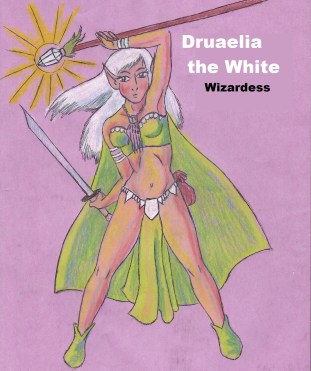
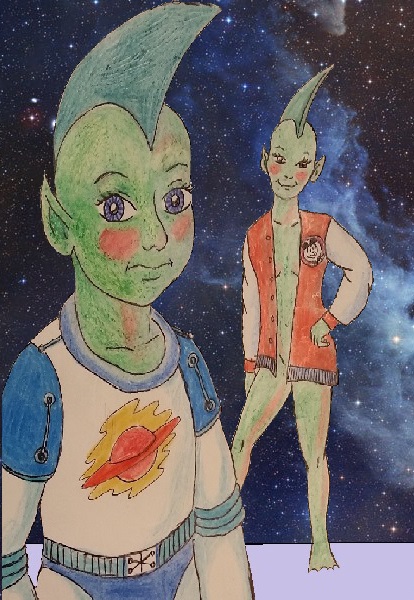
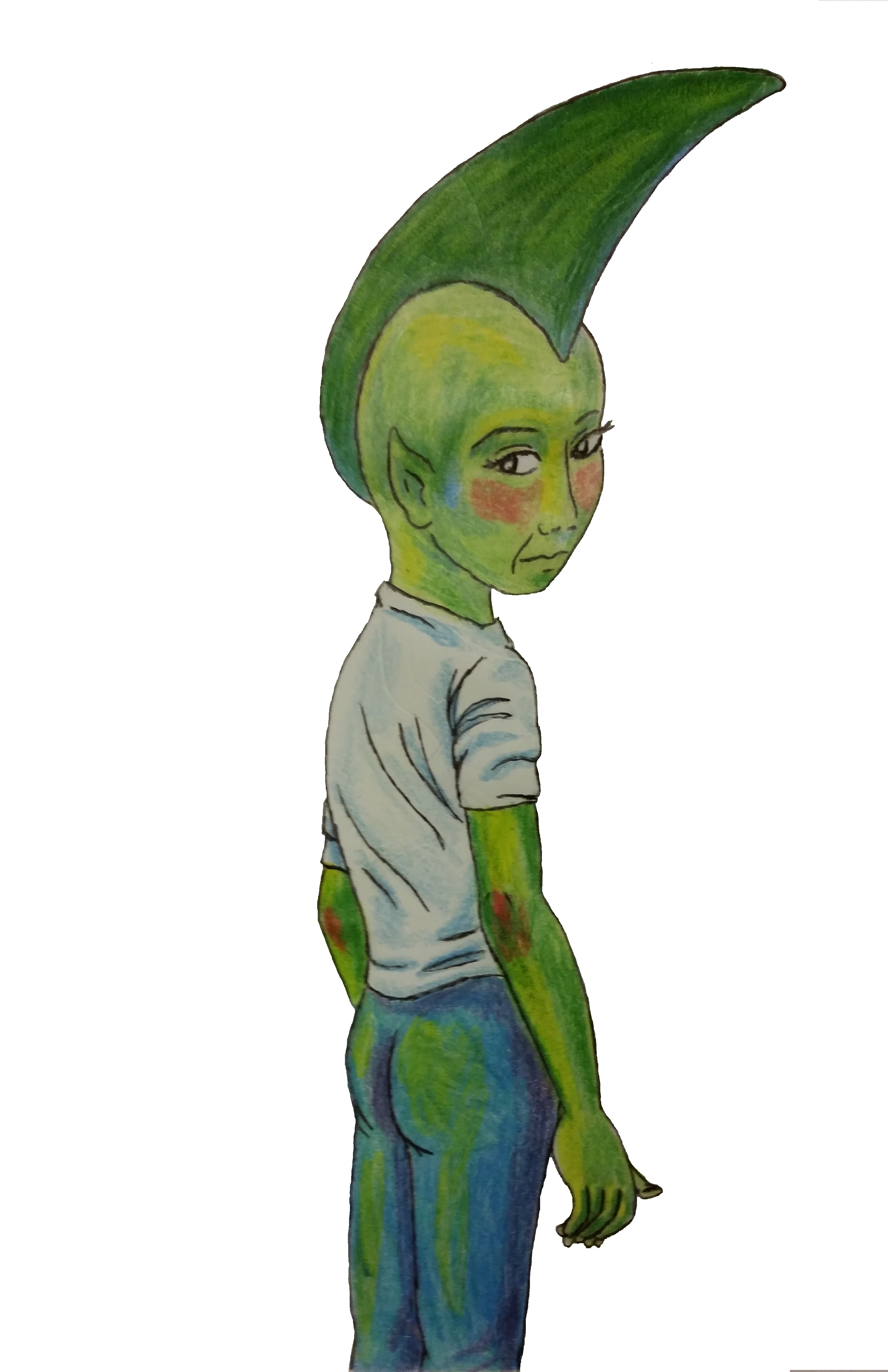
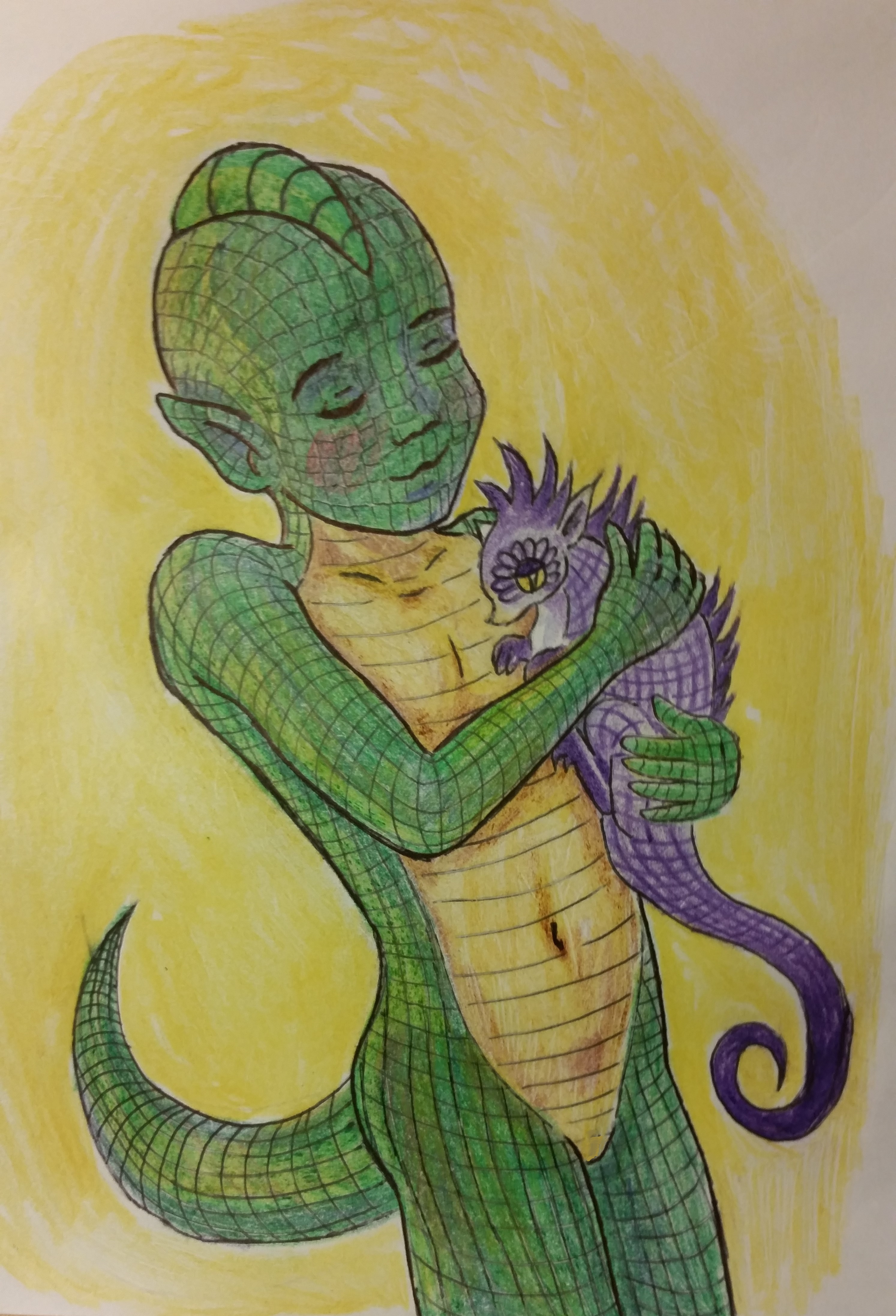
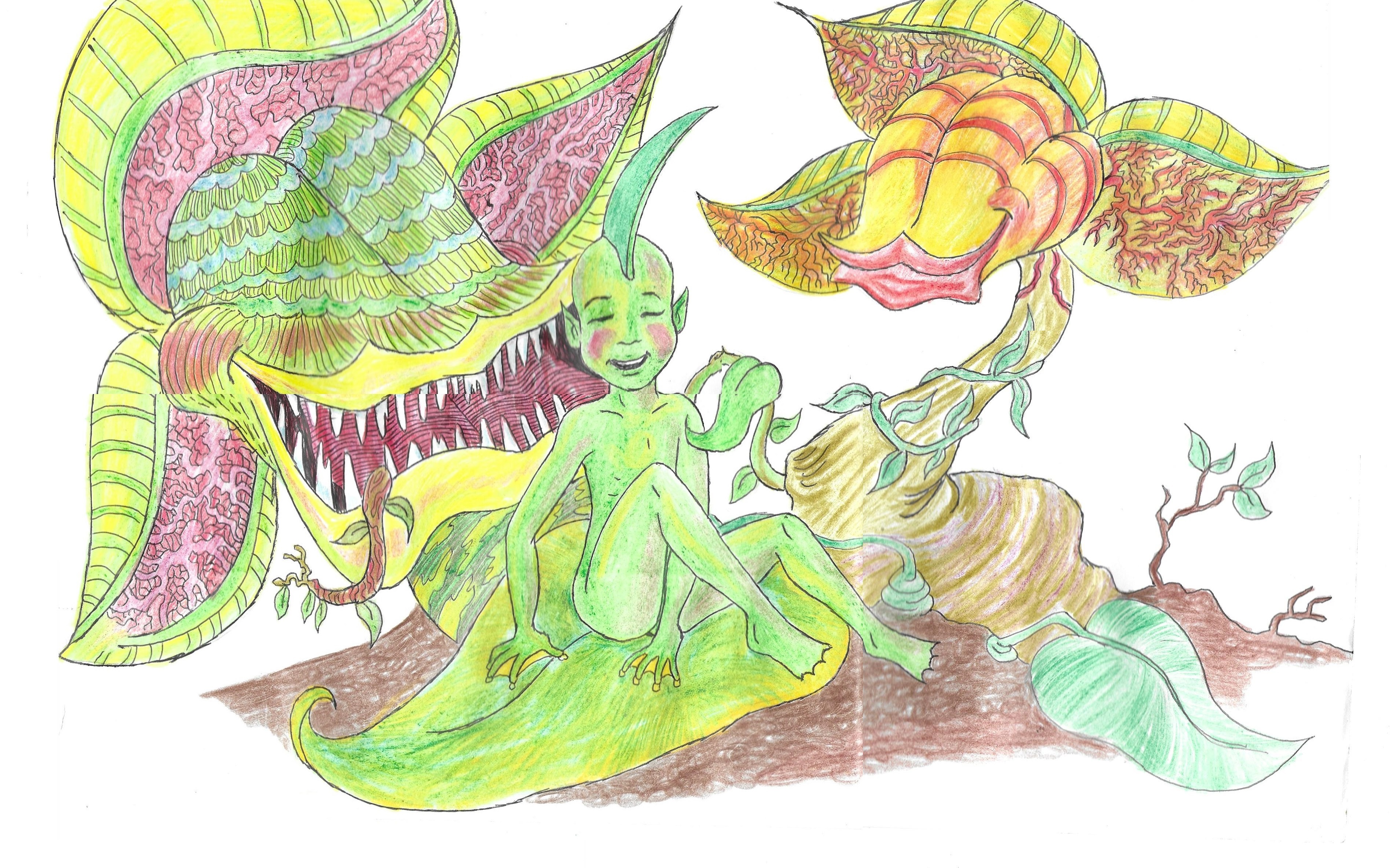
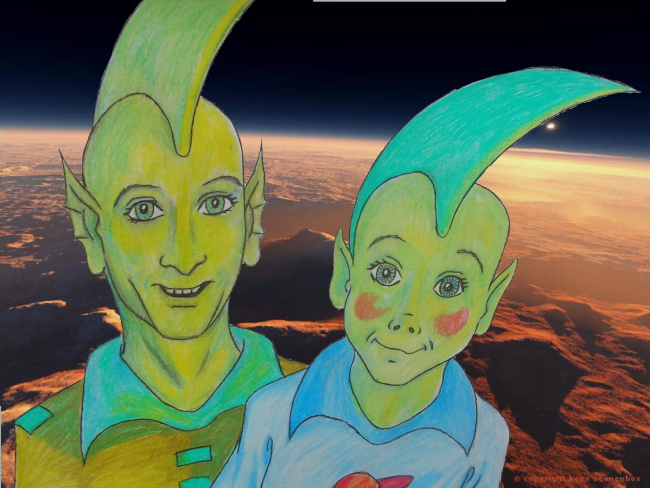
The word for it is Paffooney. I know that is not a real word. It is a Mickian word. Kinda like the word “Mickian”. It is entirely made up gibberish, made up by Mickey, and used to mean an artwork made by the hand of Mickey. So I can’t really explain it. I have to show you what it basically is.
This is a Paffooney. It is inspired by the incredibly unbelievable time in Mickey’s life when they let Mickey be a teacher in Texas. It has no other relationship to reality. Chinese girls in Texas generally do not have manga eyes and blue hair, and while Hispanic girls have been known to eat pencils, they never bring their own notebook paper to class. They always borrow. So there is the basic formula. Colored-pencil nonsense drawn by Mickey and attached somehow to a story.
This Paffooney has a self-explanatory story embedded in it. It is obvious this is the story of an average family car trip in Texas. Notice how they demonstrate the Texas State highway motto of, “Drive friendly”.
And this Paffooney is a Mickian recurring nightmare about a duck with teeth. Silly Mickey, ducks don’t have teeth in real life!
And moose bowling is a Paffooney that needs no explanation… or does it? Well, never mind. I have forgotten what it is for anyway.
And this oil-painting Paffooney speaks volumes about a philosophy of life. See the pilot giving the viewer a thumbs up? And that isn’t a parachute on his back. They didn’t have parachutes in World War I. It is a message pouch with German war plans in it. I even painted it with a bratwurst sandwich inside for the pilot’s lunch. Don’t I do great detail work? But he will have to eat it quickly before he reaches the ground.
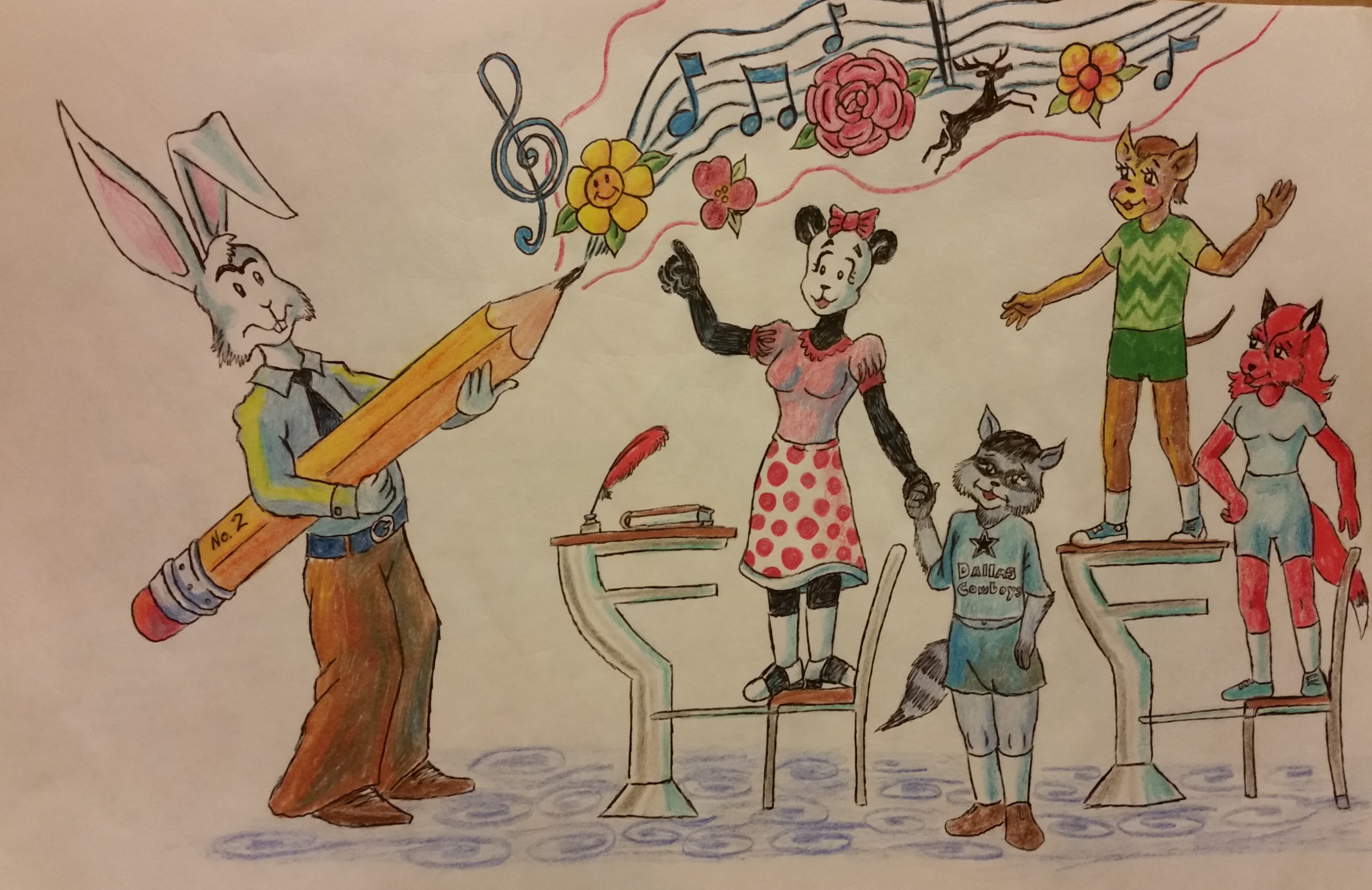
And this is me teaching an ESL class. When you teach English to non-English speakers in Texas, you get to hold the big pencil. And it helps to be a big white rabbit.
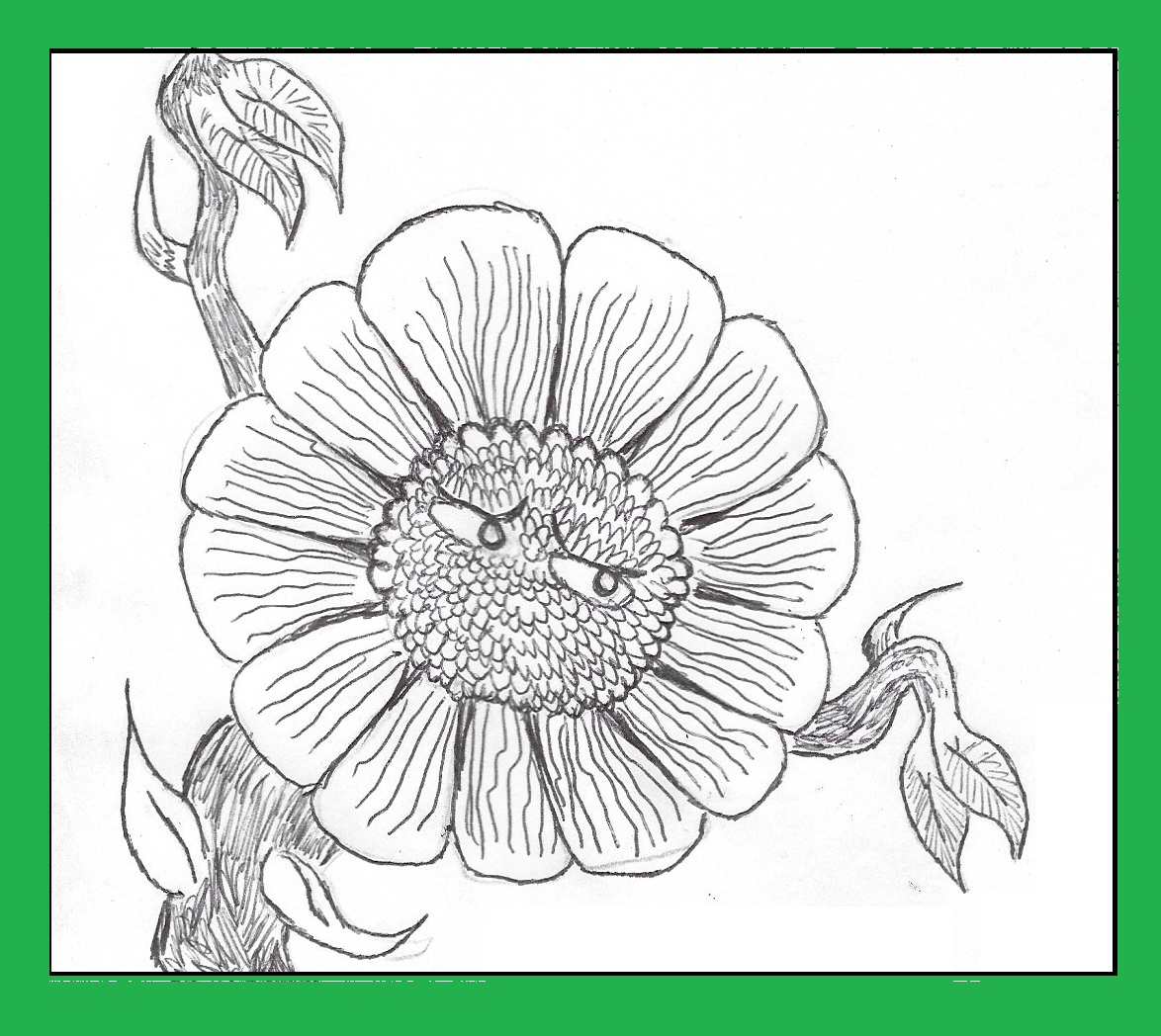
And this is a science fiction Paffooney, although the science is questionable. Don’t doubt that the flower-people of the planet Cornucopia are real, though. And Mai Ling, the psionic space ninja really can elongate her arm to get maximum thrust into her left-handed karate chops.
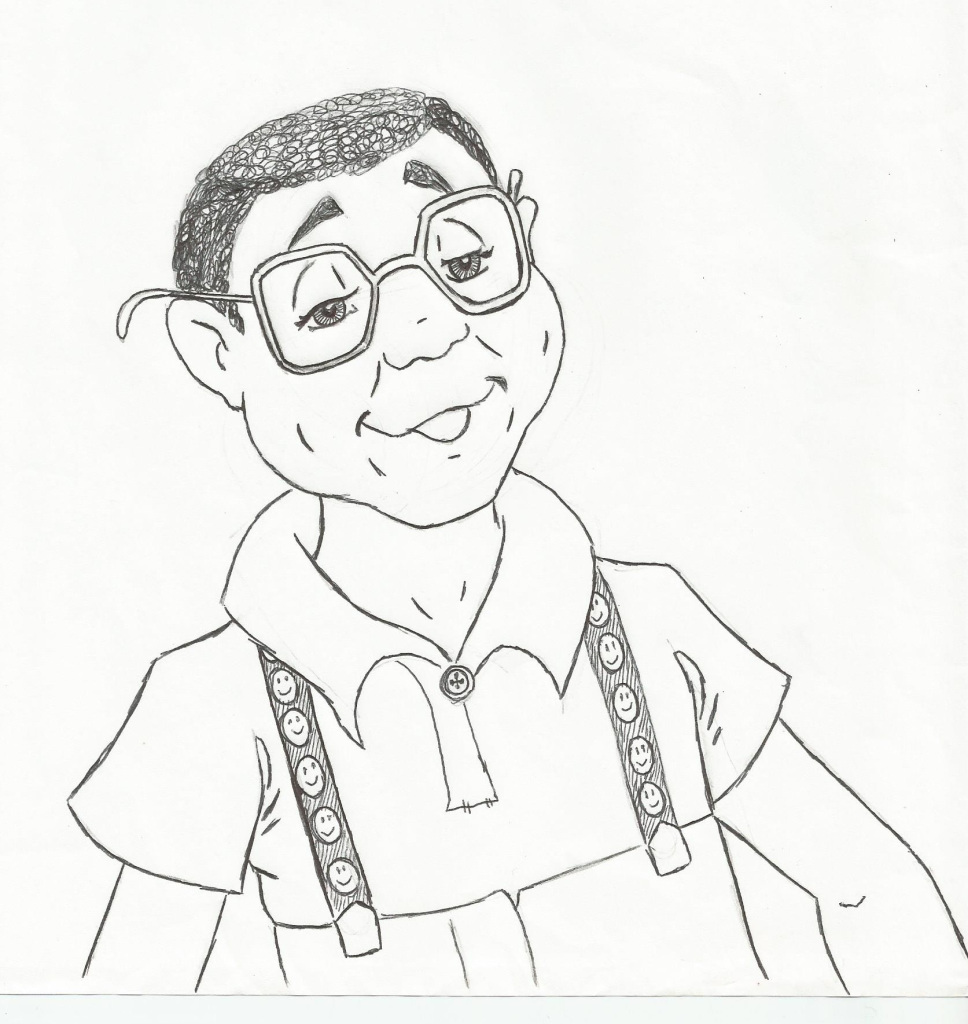
And we end for today with the Paffooney of a stupid boy. He’s not really me. Not really. And I don’t even know who gave him the black eye. So it can’t be me. So maybe he is not so stupid. You can’t say that about somebody you don’t know and is not even you.
So, now do you know what a Paffooney is? No? Me neither. But if you Google images with the words “Beyer Paffooney” you can see a lot more of them. Nobody else uses that word but little ol’ me.
The three of them walked all the way out to the oxbow pond on the Iowa River together, but Billy was really dragging his feet.
“Why so slow, Billy boy?” Ricky asked.
“Well, um… you know she’s gonna make us get naked out at the skinny-dipping pond, right?”
“Val? You haven’t forgotten about that by now? It’s damned cold, you know.” All three of them wore jackets as the October air turned chilly.
“I haven’t forgotten. We’ll do that eventually. Naked honesty, like in gazebo at Celephais. But not yet today.”
“I… I can’t do the naked thing, Valerie,” Billy complained.
“Yes, you can. You did it with Francois, Giselle, and I before Francoise died.”
“That dream stuff never really happened, you know. People can’t share dreams. Not really. We just remember talking about it with Francois. We just convinced ourselves we all had the same dreams.”
The three of them climbed through the barbed-wire fence around the pasture bordering the oxbow as Billy complained.
“It was real enough, no matter the actual truth of it. I remember it so vividly, it’s real now even if it wasn’t real then.”
They moved down to the flattened area of grass by the banks of the pond. They each selected a spot to sit where they could talk without making actual eye contact.
“Val, we heard about the dance. Billy, Terry, and me, we all decided we’d figure out some way to bring you out of your great sadness.”
“Yeah,” said Billy. “We know how dangerous depression is. And we don’t want you to miss another week of school.”
“Guys, what you’re doing about it here is enough. A place to talk… a place to say what’s true without any interference… That’s what I really need.”
“One thing that’s true is that I don’t want to take my clothes off while talking.”
“Shut up, Billy,” Ricky said. “When the time comes, I’ll strip you myself if I need to.”
Billy looked huffy and about to get mad, a rare thing for the skinny boy.
Valerie quickly interceded. “Nobody will make you do anything you don’t really want to do. Besides, I’ve already seen you naked, so there’s nothing to fret yourself about.”
“No, you haven’t! Celephais is not real. That was just in your dream.”
“Then how do I know your cute little thing was completely hairless back in the seventh grade?”
Billy swallowed audibly. “You’re just guessing.”
“Well, maybe so. But you don’t know for sure.”
It was quiet between the three of them for several long minutes.
“All I really need is someone to actually listen to me,” Valerie finally said. “You can both do that for me, can’t you?”
“Yeah,” they both said.
“In fact, I thought of something else that might help all three of us.” Ricky’s face was totally serious for a change.
“What’s that?” Val asked.
“Marahoochie cigarettes…” Ricky said.
“What?”
“Marijuana. You know, the goof sticks. We three can get high together. It’ll make us get more creative like John Lennon did.”
“No, you can’t!” Billy said.
“Why not?”
“It’s illegal. And your adopted dad is a cop. How will that look when Cliff has to put you in jail?”
“Ah, we don’t have to get caught. We’re smart enough to get away with it.”
“But it’s a gateway drug. We’ll end up on heroine, or maybe dead.”
“It’s not like that. Terry and I tried it. People don’t die from overdoses of marijuana. And it’s easy to control. It’s less addictive than regular cigarettes.”
“It’s my decision, isn’t it?” asked Valerie. “We’re here because of me, right?”
“Yeah.”
“But I don’t want to smoke anything.”
“We don’t have to smoke it. Terry and I can bake it into brownies.”
“Where are you gonna get it?” asked Billy. “You know any drug dealers around here?”
“Uncle Harker does.”
“Harker Dawes? Terry’s Uncle Harker?” Val was astounded.
“Yes.”
“How does Harker Dawes know a drug dealer?”
“Well… you see… Harker runs Kingman’s Grocery Store now, since he lost the hardware store. And he has trouble dealing with the usual suppliers. So, he tried this new guy. And this new guy sold him some new-fangled health foods, you see. And the Mexican carrot greens were really marijuana.”
“Harker bought actual marijuana?” Billy asked.
“He did. But, of course, he didn’t know it was marijuana. He thought they were actually Mexican carrot greens.”
“You are trying to say Harker Dawes is that dumb? Or the food supplier?”
“The supply guy was using code for selling the drug. He thought Harker knew what it really was. But you know Harker. He believes whatever he’s told, even if it is a criminal telling him.”
“But he knows it now?” asked Val.
“Well… no. Terry wanted to tell him, but he doesn’t know any sign for marijuana. And he only speaks sign language.”
“Why didn’t you tell him?”
“Um, yeah… that’s how I’m gonna hook you up with some good weed. I already tried to smoke it. But it really worked best when we got Ma Dawes to bake some brownies with it inside. We told her Mexican carrot greens make good spice for brownies. Everybody really loves her brownies now.”
Billy and Valerie both stared in amazement at Ricky’s sneakers. They knew enough about the Dawes family, the family that adopted Terry during the blizzard, to know the story was absolutely true. But they were both too stunned to laugh.
“You’ll bring some brownies here, then?” Valerie asked.
“Of course.”
Billy glared at the both of them. “You don’t expect me to break the law with you like that, do you?”
“Yes. And naked while you do it,” said Valerie.
“I could just report you both to Cliff and get you arrested.”
“But you won’t do that. You are too kind-hearted and too good of a friend,” said Valerie.
This is how computers actually work. I swear that it is true. I know, I know… I have on occasion stretched the truth just a bit… like down the block and around the corner where I tied it around a lamp post. But in my defense, I write fiction. This is not fiction. This is a narrative of actual experiences that I managed to live through and learn from.
You see, as I was working on my writing, I underwent a plethora of computer malfunctions that made me really, really mad. I took my rubber stress ball and threw it at the far wall. It bounced back directly into my left temple, making me see stars, and then, apparently, summoning a genii. He was standing there grinning at me.
“How can I be of service, master?” he said with magical sparkles in his white teeth.
“Oh, I just wish I could see inside the computer to know why it does these terrible things to me every time I press a key.”
“Your wish is my command, master.” He poofed me in a pink and blue cloud of genii magic, and suddenly I was tiny and digital, able to walk inside my computer and take a look.”
“What makes you the most mad, master?” the genii, whose name I learned was Computus, asked me.
“When it deletes stuff for no apparent reason…” I began.
“Ahh! You need to see the Desert of the Deletion Dervishes.”
So he took me to a digital field of file flowers, where all the files that contained my best saved work were growing peacefully. There were all the maniacal digital dervishes on digital horses, busy slashing the stems of my file flowers with their digital scimitars.
“Aagh! No!” I cried. “Why are they deleting my stuff?”
“Oh, do not worry. They are focusing on the files you use most and deleting only those. They are very efficient in carrying out their orders.”
“And who gives them these orders?”
“Why you do, sir. When you give the computer orders from a drop down menu, you are rarely clicking on the order you intended to. And “Save” is close enough to “Delete” to make our work simple.”
“And why do I keep having new windows opening up randomly where I don’t want them to?”
“Ah, the Public Pool of Pop-up Peris! Let us go see that too!”
So he poofed me into a pit of electrical fire filled with electrical fire beings who were busy crafting evil pop-up windows to plague me.
“So, these creatures are filling my screen with ads for hemorrhoid creams and Asian dating sites?”
“Yes, and surveys about why you love President Trump and thought Obama was terrible.”
“And why when I click on the X’s to get rid of them, do two more appear?”
“Oh that’s simple. They purposefully make the X’s so tiny and the surrounding area so sensitive that if you don’t hit the exact center of the X precisely, then it knows you want to see two more ads chosen specifically for you by the mind-reading genii.”
“But the ads are always the opposite of what I actually want to see!”
“Well, of course they are. Computer genii are the kind made entirely of fire. We call them Efrits, and they are the most powerful evil jinn we have available.”
So then I awoke with a painful knot on my forehead and a new understanding of why this post was so difficult to write. The computer treats me so evilly because that is precisely what it was designed to do.
The Central Timeline of my Hometown Novels picks up again in 1988-1990
My first good published novel, Catch a Falling Star, was published in 2013 by I-Universe, an imprint belonging to Penguin Books of Random House Publishing. This is one of those special imprints where the author is expected to hire the editors, proofreaders, and marketing experts out of their own pockets and, essentially, pay to publish. I had to have my manuscript read and approved. This was serious publishing, and my book did win a Publisher’s Choice Award and a Rising Star Award. But I had to pay for everything and the publisher insisted on pricing the book out of competitiveness. The book has earned me $16.00 so far that I am aware of in spite of about $3,000.00 invested in making it salable. So, the theme of this book should be, “Traditional publishers screw beginning authors out of money as gleefully as any publication scam does.” Of course, they would never do that to Stephen King or J.K. Rowling. But I am definitely not them. All the books I wrote and talked about in Parts 1, 2, & 3 (except for Superchicken) were completed after this book.
Catch a Falling Star
This is the cover idea I submitted for Catch a Falling Star, but it was, of course, rejected.
So, the main theme of this book is not about publishing and being cheated. It is about my small home town in Iowa being invaded by invisible aliens from outer space. But they are totally incompetent aliens who have in-bred almost all the intelligence out of their generational mother-ship, eat their own children to maintain their population, and have totally given up love, creativity, and empathy because of an over-reliance on their stolen technology. They are also descended from frog-like amphibians.
The aliens make a critical mistake in their sinister plan. They kidnap a young specimen to study for weakness, a member of the Norwall Pirates named Dorin Dobbs. And they accidentally lose one of their own tadpoles on Earth where he is adopted by a childless couple.
As each side learns about the other, the invasion is doomed and the alien children rebel against becoming dinner. The theme of this book is something like, “If only you get to know me, you cannot overcome me by force, especially not if you learn to love me.”
The Bicycle-Wheel Genius
The second novel of the 90’s is this one, which I call a prequel/equal/sequel because it begins prior to Catch a Falling Star, includes untold events during the previous book, as well as retold events from a different point of view, and subsequent events that occur after the alien invasion goes away leaving an invisible starship behind. It involves an inventor who lost his wife and son in a fire caused by his experiment, making him now suspicious of electronics and only willing to invent new ways to use bicycle parts. And this sad inventor/scientist has moved in next door to Tim Kellogg, leader of the Norwall Pirates. Tim has had his best friend and key partner in crime move away. And he needs a new best friend. So, you can probably guess what Tim has in mind.
You can probably see already that this book is going to have a Toy-Story-sort of theme, “Everybody needs a good friend to make their way through life.” (And if you don’t have one, you can always make one. But not out of bicycle wheels. This is another example of a long-winded parenthetic aside.)
Magical Miss Morgan
This is my teacher-story. Of course, Miss Morgan is not really me. I am not a woman. She is based on a gifted teacher I knew and worked with named Enedina Mendiola who gave her whole life to teaching, was naturally gifted with the power to teach kids and make them love her, and who died shortly after she was forced to retire from teaching for health reasons. She was an incredible human being, and I miss her mightily. But Miss Morgan teaches my subject, Language Arts, rather than the Science that Mother Mendiola taught.
The story is about how a gifted teacher with her own way of doing things deals with the ups and downs of the classroom, difficult students, even more difficult parents, and nearly impossible administrators. She goes through a tough period where she proves that good teaching is a subversive act. The theme is simple, “A good teacher has her own set of golden rules, and to be successful, she must continue to apply them consistently. Even if she has to give up teaching to do it.”
Given enough time, there are two more titles in this series of 90’s stories that I hope to write. Kingdoms Under the Earth and Music in the Forest.
So, now I have some good news and some bad news. The good news is I have more things to teach you about my struggle with themes. The bad news is… that means there will be a Part 5 to this essay.
There are a number of factors that work against me as an author of mostly Young Adult fiction. That can impact acceptable themes in a big way. First of all, I have been inundated with criticisms about portraying nude people and kids who are talking about both nudity and sex.
I suppose this comes about for two main reasons.
Number one, I portray real people I knew during my career as a school teacher. They are portrayed in a way that if they personally read my stories, they will never recognize themselves. I am careful about naming characters, describing characters physically, and portraying real events as they actually happened. All of those things are fictionalized and made unrecognizable through imagination’s magnifying glass.
But the emotional plots, character thoughts, and basic motivations behind real events are accurate assessments of things I was told, things I witnessed, the highs and lows that people really go through, and the discussions I have had about what people, and especially kids, really think about.
Some of the people who read and comment on and even review my books are taken aback at what I am saying kids actually think about and want to act upon. They are comparing kids to an unrealistic, idealized picture of what they believe kids should be. And they don’t want to accept them as they really are.
I write books for the twelve-year-old me.
The Young Adult category of books is written not for children, as many of my critics would have it, but for YOUNG ADULTS. I foolishly believe, then, that I am talking to an audience of teens and preteens who desperately want to read stories about people just like them, confused about the adults they are swiftly turning into. And not all the issues and secrets and desires they are contending with daily are simple, cute, and funny.
I myself was dealing with being a sexual assault victim when I was twelve, not having at that point been taught where babies actually come from, or accurately being told what sex factually was. Misinformation I had in abundance. And everything was colored by a self-hatred that made me burn myself on the heating grate every time I had any sort of sexual urges that I didn’t understand and believed would send me directly to Hell.
Nudity and Naturism are Natural to me
So, as a bookish boy, I really wanted to have a book, or even multiple books that spoke to me about the things that I feared and fed my manic-depressive behaviors.
My life was literally saved by the Methodist minister who was also the father of my best friend when I was twelve. He was the one that presented the facts of life to me and the members of my class who were between the ages of eleven and thirteen. He explained the facts about what sex was, how it worked, and how it could be a good and loving thing. And most importantly, he answered my question about whether thinking about sex would send you to Hell. Midwestern Methodists in the 1960’s were progressive about teaching kids the truth about sex.
I feel now an obligation to treat the subject the same way when it comes up as a theme in some of my stories.
Sex is a serious subject even for young teens.
I got a scathing review on Sing Sad Songs because, while talking about sex, young characters actually admitted to experimenting with sex. The reader was so offended she felt the need to tell everyone who reads Amazon reviews that I was practically a child pornographer. KDP scrutinized this and kinda punished me, lowering the number of stars given by reviewers on two different books, even though punishment is not what their policy indicates is appropriate. This, in spite of the fact that there was no graphic sex scene or concrete descriptions of sex acts in the text. I edited the offensive part out by changing a few words. But it was a thing that shouldn’t have been a thing. Other YA novels, even classic YA novels, do more explicit things than I talked about in the unedited version of the story. It was a prude having an overreaction. And I would’ve loved to have a story with what I wrote in it back when I was a child burning the skin on the back of my legs and lower back over the thought that having sexual thoughts made me a monster.
I am aware that in a book-banning climate currently, my books could be banned.
I am aware that having a transgender character and numerous nudist characters, including a book, A Field Guide to Fauns, set in a nudist park, opens me up to having my own stories become controversial and the subject of book-burning conversations. But this is a thing all authors have to deal with in any case. Popular authors, classic authors, hard-working mid-level authors and other mostly-ignored authors like me all deal with the same thing.
What I write about is not evil and not unprecedented. Others write about the same things I do, some of them better than me, some of them not.
Obviously I need to return to the Hometown Novel timeline to complete the 1990’s in Part 4 if this essay. So, you have been warned.
Born in 1931 and lasting in this crazy, mixed-up world until the year 2000, Don Martin was a mixy, crazed-up cartoonist for Mad Magazine who would come to be billed as “Mad Magazine’s Maddest Artist.” His greatest work was done during his Mad years, from 1956 (the year I was born… not a coincidence, I firmly believe) until his retirement in 1988. (*** I was reminded by Martin’s wife that he did not retire then. He just left Mad Magazine for places like Cracked where he was treated better.***) And I learned a lot from him by reading his trippy toons in Mad from my childhood until my early teacher-hood.
His style is uniquely recognizable and easily identifiable. Nobody cartoons a Foon-man like Don Martin.
The googly eyes are always popped in surprise. The tongue is often out and twirling. Knees and elbows always have amazingly knobbly knobs. Feet have an extra hinge in them that God never thought of when he had Adam on the drawing board.
And then there is the way that Martin uses sound effects. Yes, cartoons in print don’t make literal sounds, but the incredible series of squeedonks and doinks that Martin uses create a cacophony of craziness in the mind’s ear.
And there is a certain musicality in the rhyming of the character names he uses. Fester Bestertester was a common foil for slapstick mayhem, and Fonebone would later stand revealed by his full name, Freenbeen I. Fonebone.
And, of course, one of his most amazingly adventurous ne’er-do-well slapstick characters was the immeasurable Captain Klutz!
Here, there, and everywhere… on the outside he wears his underwear… it’s the incredible, insteadable, and completely not edible… Captain Klutz!
If you cannot tell it from this tribute, I deeply love the comic genius who was Don Martin, Mad Magazine’s Maddest Artist. Like me he was obsessed with nudists and drawing anatomy. Like me he was not above making up words with ridiculous-sounding syllables. And like me he was also a purple-furred gorilla in a human suit… wait! No, he wasn’t, but he did invent Gorilla-Suit Day, where people in gorilla suits might randomly attack you as you go about your daily life, or gorillas in people suits, or… keep your eye on the banana in the following cartoon.
So, even though I told you about Bruce Timm and Wally Wood and other toon artists long before I got around to telling you about Don Martin, that doesn’t mean I love them more. Don Martin is wacky after my own heart, and the reason I spent so much time immersed in Mad Magazine back in the 60’s, 70’s, and 80’s.
Surrealism is basically the putting together of things that don’t go together to realistically portray what is not real. And sometimes it can be done in ways that you don’t realize are, in fact, examples of surrealism, unless you look at it and think about it more carefully. So, can you tell me why “The Wizard of Edo” above is surrealism?
This one is obvious even though I used photographs to draw every single element.
Cartoons, especially bizarre cartoons, are all surrealistic, though not all of them lack subtlety as much as this one does.
Some surrealism is highly horrific unless you think of this as merely a portrait of Boris Karloff in make-up.
It is inherent in surrealism that the images are going to make you stop and think about what it means.
Surrealism is very much realized through the realistic details.
There was a time when relatives might have told me that this was a realistic picture of my two sons. However, they didn’t tell me that since I drew it sixteen years before my eldest son was born.
So, is there anything at all surreal about this picture? Besides the fact that Sherry Cobble couldn’t arrive at school naked, I mean?
No, this isn’t some kind of multiple-book book review. This is an ungodly silly claim that I can actually read three books at once. Silly, but true.
Now I don’t claim to be a three-armed mutant with six eyes or anything. And I am relatively sure I only have one brain. But, remember, I was a school teacher who could successfully maintain a lesson thread through discussions that were supposed to be about a story by Mark Twain, but ventured off to the left into whether or not donuts were really invented by a guy who piloted a ship and stuck his pastries on the handles of the ships’ wheel, thus making the first donut holes, and then got briefly lost in the woods of a discussion about whether or not there were pirates on the Mississippi River, and who Jean Lafitte really was, and why he was not the barefoot pirate who stole Cap’n Crunch’s cereal, but finally got to the point of what the story was really trying to say. (How’s that for mastery of the compound sentence?) (Oh, so you could better? Really? You were in my class once, weren’t you.) I am quite capable of tracking more than one plot at the same time. And I am not slavishly devoted to finishing one book before I pick up the next.
I like reading things the way I eat a Sunday dinner… a little meatloaf is followed by a fork-full of mashed potatoes, then back to meat, and some green peas after that… until the whole plate is clean.
Treasure Islandby Robert Louis Stevenson is the meatloaf. I have read it before, just as I have probably had more meatloaf in my Iowegian/Texican lifetime than any other meat dish. It’s pretty much a middle-America thing. And Treasure Island is the second book I ever read. So you can understand how easy a re-read would be. I am reading it mostly while I am sitting in the high school parking lot waiting to pick up the Princess after school is out.
Lynn Johnston’s For Better or Worse is also an old friend. I used to read it in the newspaper practically every day. I watched those kids grow up and have adventures almost as if they were members of my own family. So the mashed potatoes part of the meal is easy to digest too.
So that brings me to the green peas. Green peas are good for you. They are filled with niacin and folic acid and other green stuff that makes you healthier, even though when the green peas get mashed a bit and mix together with the potatoes, they look like boogers, and when you are a kid, you really can’t be sure. Terry Pratchett and Stephen Baxter wrote this book The Long War together. And while I love everything Terry Pratchett does, including the book he wrote with Neil Gaiman, I am having a hard time getting into this one. Parts of it seem disjointed and hard to follow, at least at the beginning. It takes work to choke down some of it. Peas and potatoes and boogers, you know.
But this isn’t the first time I have ever read multiple books at the same time. In fact, I don’t remember the last time I finished a book and the next one wasn’t at least halfway finished too. So it can be done. Even by sane people.
In Part 1 I set out to uncover the major theme of each of the books in my Hometown Series, the stories set in the imaginary version of my home town and filled with mixed-and-matched versions of the people I have known in my life. Unfortunately, I have been allowed to write and self-publish novels for long enough that I can’t do the entirety of that task in one go. So, last time was the analysis of the novels set in the 1970’s.
The Central Time-Line Picks Up Again in 1983.
Valerie Clarke is the most important character in the novels of the 1980’s. She is the combination of a girl who I grew up with and was in the same class at school with until we both graduated from high school in 1975, and a girl who was a favorite student of mine in the early 1990’s and impacted my classroom and my life during both the 7th and the 8th grades.
When the Captain Came Calling
The first book of these four novels is When the Captain Came Calling. Admittedly, this is not the best book I have ever written, and is closer to the worst. But it is necessary back-story for the books that come after. The story begins with the reformation of the Norwall Pirates (the original Pirates all having graduated from high school and gone their own ways) under the leadership of a strong-willed girl named Mary Philips, aided by her boyfriend and next-door neighbor. Valerie is recruited to be the second girl in the club full of boys. And then an old Norwall resident, Captain Noah Dettbarn, returns to Norwall after years of being a South Pacific captain of a merchant ship. But he is cursed with being invisible by an enraged voodoo priest whose daughter he fell in love with.
The theme of the book is how, “A band of friends can help each other overcome loss and trauma, even the invisible members of the group.” But it was a particularly difficult story to write because of the death by suicide of Valerie’s father, and the subsequent suicide of my cousin’s son during the writing of the novel.
The second book of the 80’s series is the best book I have ever written. Snow Babies is the story of how a blizzard unexpectedly traps the entire town of Norwall under a blanket of snow, snow flurries, white-out winds, snow-drifts, and the threat of freezing to death. In this story, Valerie takes in a hobo who wears a coat of many colors made out of crazy-quilt patches. And he turns out to be a father figure for the fatherless girl, and a little bit of everything else the town needs him to be to survive the blizzard.
The actual theme of the story, one of many, is that, “In times of crisis, everyone needs to come together and find enough love for one another to make survival possible.” There are a large number of characters that come together to make this theme work; the Trailways bus driver, four runaway orphans on his bus, the deputy marshal who finds and rescues the stranded bus, the members of the Norwall Pirates, the bumbling owner/operator of the hardware store, the many members of the Murphy clan, the social worker who lost her job by pursuing the orphans, the school-bus driver, and many more.
Sing Sad Songs
If this book isn’t the second-best thing I have ever written, it is at least in the top five. It is also the book that makes me cry the hardest every time I reread it. It is an emotional roller-coaster ride.
The story is told by three narrators in equal parts. Vicar Martin is the owner of Martin Brothers’ Bar and Grill. His business is failing and his family (a sister, a brother, and a nephew) is dysfunctional. Billy Martin, 13, is his nephew. And Valerie Clarke is the friend of Billy who made him part of the Norwall Pirates.
The main character is Francois Martin, the soul survivor of his family’s car accident in France. His father’s will sends him to live with his cousins, the Martins of Norwall, whom he has never met. Once brought to Iowa, he puts on sad-clown face paint and begins singing karaoke in Martins’ Bar. That, of course, is a surprising and unlooked-for success. Of course, there is a serial killer being hunted by the FBI. This story doesn’t have a happy ending.
But the theme is simple, “Love is the solution to most of life’s problems, and when you lose the ones you love, it is time to grieve and sing sad songs.”
Fools and Their Toys
The follow-up to the book Sing Sad Songs is a story narrated by a ventriloquist’s puppet. The Teddy Bear Killer, murderer of young boys, has been caught. And yet, the wrong person is being held for trial in the case. And the only one who can reveal the truth is a talking zebra puppet who has gone missing.
This is the most complicated story I have written because the narrator is not only a ventriloquist’s puppet, but he is given voice by mumbling Murray Dawes. And Murray is in a place on the autism spectrum where he not only can’t talk without the puppet, but he can’t remember things in time order. And a further complication, he not only isn’t the real killer, he is a traumatized former victim who survived his encounter. And while the puppet is lost, he can only talk to his adopted brother, Terry Houston, who is deaf and communicates only in sign language.
The theme is, “Communicating with others is one of the most important things in life, but not everyone has equal gifts in this area.”
This book has been the least read and commented on of all my books. That is understandable. It is hard to read in more than one way. The story is not in time order. It is also about a sado-masochistic serial killer. It is the one book in this part of the series where Valerie does not appear.
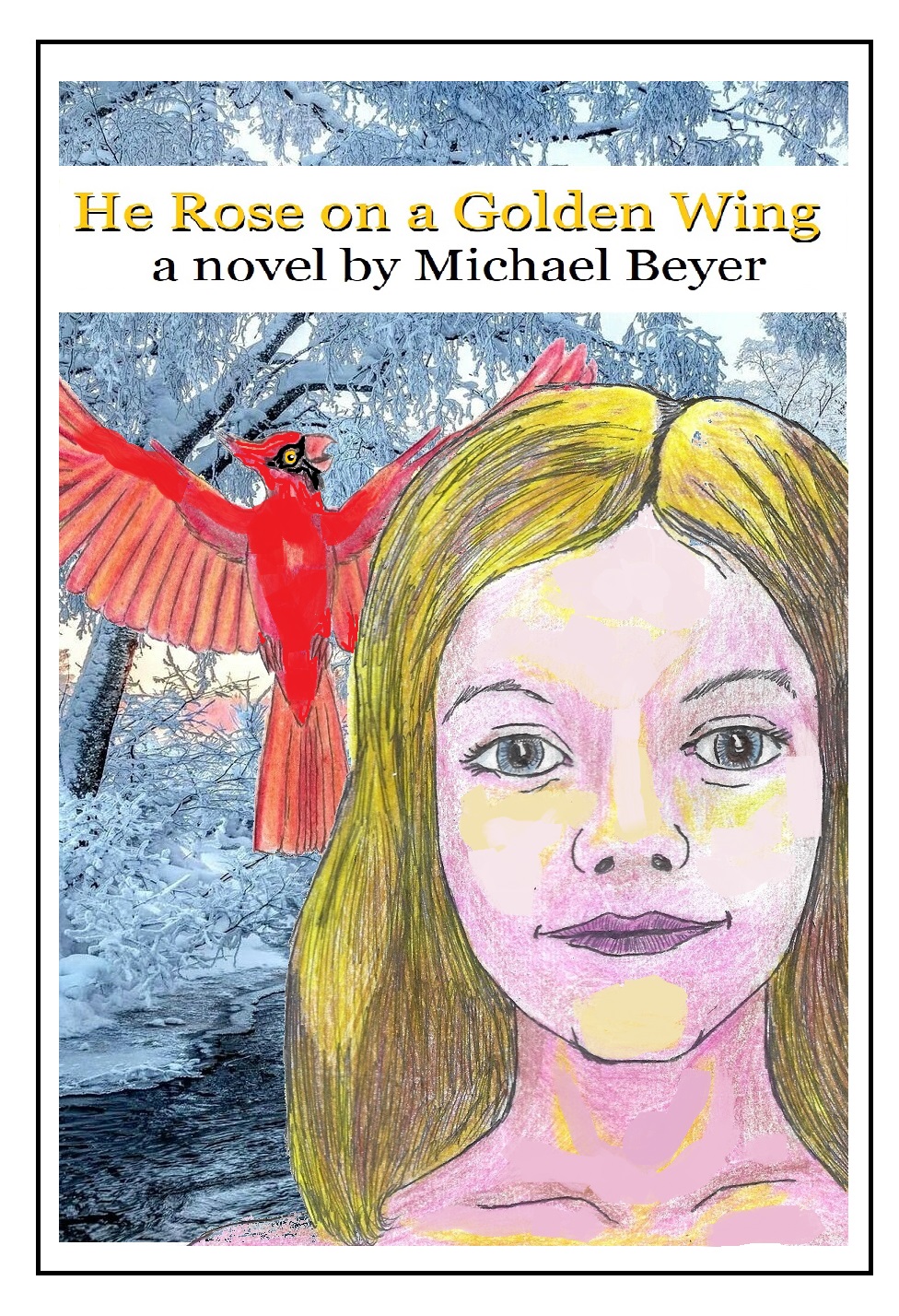
He Rose on a Golden Wing
The intended last book in this part overlaps with the next part occurring in the 1990’s. I am writing it now. You can follow it chapter by chapter on Tuesdays. I reserve the right to explain its theme until I have actually gotten it down on paper.
You have probably realized by this point in the essay that there will be one more part to come (at the very least.)
Collecting dolls and action figures can overwhelm someone like me with hoarding disorder (and a Grandmother and Great Aunt who hardly had room to walk around their homes because of piles of collected stuff that they simply could not part with). There have to be rules and limits to save me from myself. I try hard to keep Disney Princesses from flooding my home and drowning me in a sea of plastic. The toymakers are constantly updating and modifying their designs to entice fools like me to keep buying.
A round of new designs with glittered-up clothes and new faces. Can I resist buying them all? Well, not the first four times.
I have to stop and take stock of where I’m at. I rounded up all the Disney dolls I have that are not mint in boxes for collecting purposes and potential resale in the collectibles market. Here they are;
There are several ways that I can go about trying to limit and prune this massive obsession. First and foremost, I can break this gigantic feeding frenzy up into smaller bites and pick and choose how long I chew. This part of my collection, is based on the Tinkerbell movies and is limited to only one edition of these dolls. It took over a year to buy all four;
There are just four dolls in this set. I chose only the size consistent with the 12-inch figures I always choose. No little ones. No second editions. No doll costing more than $20.
Some of the dolls are rescue dolls, either bought naked at Goodwill or another thrift store, taken home to be cleaned, repaired, restored, and dressed (like the Ariel doll I posted first in this post). These are probably my most valuable acquisitions, because they are previously loved and played with. (The Jasmine doll in the middle belonged to my daughter, who had a tendency to mangle and experiment on dolls as well as strip them permanently naked. This doll’s survival is a minor miracle.)
The rescued dolls include two Snow Whites, a Jasmine that belonged to my daughter, and Mulan… mostly dressed in Barbie clothes.
The remainder of these collected dolls are recent edition Disney Princesses that I waited for some time to acquire so that they would come down in price. A couple of these, like Tiana and Repunzel, and all the Frozen Dolls are not also represented in my collection by mint in box dolls. I do have Belle and Aurora and even Tarzan’s Jane, but boxed only, so they are not pictured here.
So you can see what a trippy-type trial it has become to keep a collection like this from taking over the house. I have to impose limits on myself so I don’t become a weird old man living in cardboard box under a bridge with hundreds of dolls and action figures.