
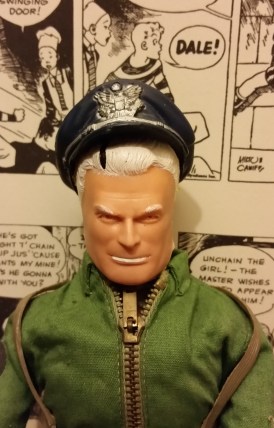
My 1967 Captain Action Steve Canyon action figure.
I have always been a deeply devoted fan of the Sunday funnies. And one of the reasons I read the comics religiously was the work of Milt Caniff. His comic strips, Terry and the Pirates, Male Call, and Steve Canyon set a standard for the age of action comics and adventure strips.
I read his comics in the 1960’s and 1970’s and always it was Steve Canyon. But this, of course, was not his first strip. I would discover in my college years the wonders of Terry and the Pirates. When Caniff started the strip before World War II, he set it in China, but actually knew nothing about China. So he did research. He learned about people who became oriental hereditary pirate families and organizations. He learned to draw authentic Chinese settings. His comedy relief characters, Connie and the Big Stoop, were rather racist parodies of Chinamen and were among the reasons that the original strip had to mature into his later work in Steve Canyon. But perhaps the most enduring character from the strip was the mysterious pirate leader known as the Dragon Lady.


Steve Canyon is a fascinating study in the comic arts. When he left the Terry and the Pirates strip in 1946, it went on without him. It was owned by the Chicago Tribune-New York Daily News distribution syndicate, not Caniff himself. Steve Canyon would change that. He created it and owned it himself, making Caniff one of only two or three comics artists who actually owned their own creations. Canyon started out as a civilian pilot, but enlisted in the Air Force for the Korean War and would remain in the Air Force for the remainder of the strip. Some of the characters in the strip were based on real people. His long-time friend Charlie Russhon, a former photographer and Lieutenant in the Air Force who went on to be a technical adviser for James Bond films was the model for the character Charlie Vanilla, the man with the ice cream cone. Madame Lynx was based on the femme fatale spy character played by Illona Massey in the 1949 Marx Brothers’ movie Love Happy. Caniff designed Pipper the Piper after John Kennedy and Miss Mizzou after Marilyn Monroe.


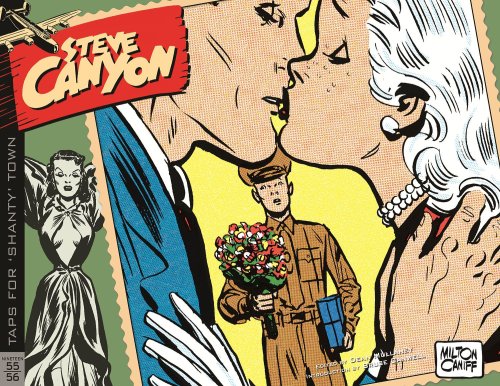
I am not the only cartoonist who was taken with the work of Milt Caniff. The effects of his ground-breaking work can be seen to influence the works of comic artists like Jack Kirby, Bob Kane, John Romita Sr., and Doug Wildey. If you are anything like the comic book nut I am, than you are impressed by that list, even more so if I listed everyone he influenced. Milt Caniff was a cartoonists’ cartoonist. He was one of the founders of the National Cartoonists’ Society and served two terms as its president in 1948 and 1949. He is also a member of the Will Eisner Comic Book Hall of Fame.
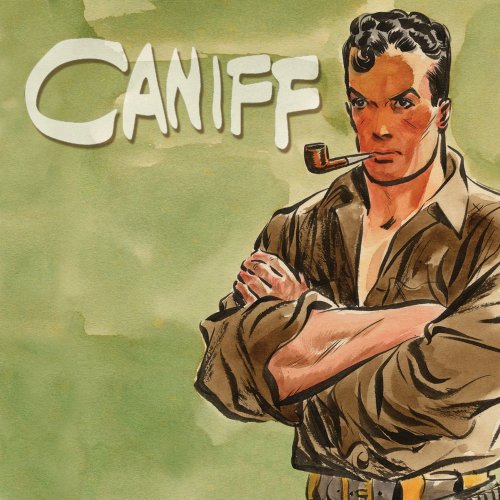








Gray Morrow
Comic book artwork grabs me constantly and makes me wonder about the lives behind the pen and ink. Artists basically draw themselves. Whether you are drawing Tarzan, Buck Rogers, or Flash Gordon… when you draw them, you are drawing yourself. My first encounter with Gray Morrow was when he drew Orion in Heavy Metal Magazine (the English version of the French Metal Hurlant).
He was capable of drawing both the grotesque and the beautiful. Violent action juxtaposed with soft and romantic moments filled with subtle colors and complex emotion. I began thinking that Gray Morrow must be a complex and interesting human being. I was soon to discover his other selves. He was the artist behind the Buck Rogers strip starting in 1979. He and Marvel writer Roy Thomas co-created the muck monster Man-Thing.
He also worked on Tarzan, Flash Gordon, and The Illustrated Roger Zelazny. Unfortunately he died in 2001 at age 67. Luckily an artist puts himself into his work, and for that reason we still have Gray Morrow with us. It is a kind of immortality.
This cover from Monsters Unleashed gives you an idea of how well Gray Morrow could draw.
3 Comments
Filed under artwork, comic strips, commentary
Tagged as Buck Rogers, comic art, Flash Gordon, Gray Morrow, Tarzan