
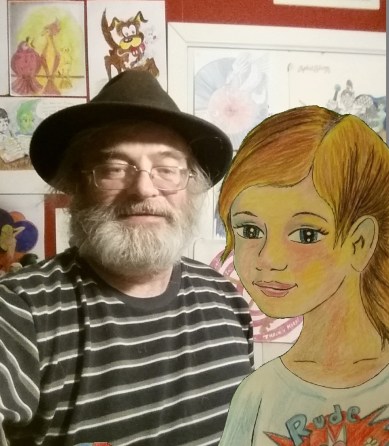
I finally got the book review from Serious Reading. If you are actually interested, you can find it here;
Seriousreading.com Book Review
I have not been a very successful marketer of my own book. But I have made attempts to get help with it. This book review is an example of that. I have chosen to reproduce the interview here as a way of ditching my responsibility for writing anything new in this post.
Interview with Michael Beyer, author of “Catch a Falling Star”
A common misconception entwined with authors is that they are socially inept, how true is that?
Quite true… the person who goes on to become a successful author is the sociopath who sits in the back of the classroom during his freshman year of high school watching everybody through pop-bottle-bottom glasses and taking notes on everything everyone else is doing or saying. But, the rub is that you cannot successfully write anything without learning how to talk to people first. This is why most of them take years to get their books successfully completed. It is also why some authors have closets full of manuscripts that no one has ever seen.
Do all authors have to be grammar Nazis?
Alle begrüßen die heiligen Worte! Yes, authors must pass through the grammar Nazi stage, even if they are to become grammar anarchists like Kurt Vonnegut or Terry Pratchett. You have to know the rules you are breaking before you can break them without simply being stupid.
If you could have been the original author of any book, what would it have been and why?
My own book. The good books that are out there are good only because you couldn’t rewrite it and make it any better than it already is. I also don’t want to waste my time re-writing a dumb book or an evil book or a goofy book… well, I might have to think twice about the goofy book.
What makes this particular genre you are involved in so special?
I was a public school English teacher for 31 years in Texas. I write YA novels because, not only are kids my main audience, but also my primary source material. All the best fantasy, science fiction, and humor ideas can be accidentally happened upon and written down somewhere in a middle school classroom. All the best characters and clowns too.
What works best for you: Typewriters, fountain pen, dictate, computer or longhand?
For twenty years I wrote everything out in longhand in spiral notebooks. It took considerable work to copy it all out on a typewriter. Then some nut invented that computer thing, and an even nuttier nut showed me how to use one. The world will live to regret those two big mistakes.
When did it dawn upon you that you wanted to be a writer?
I started writing things down in the back of the classroom when I was about twelve. Before that I told stories to everyone who would listen… or couldn’t escape listening. My sisters still blame me for recurring nightmares and my grade school best friend still reminds me that I am not actually a changeling left on Earth by Martians. I guess I haven’t actually made up my mind yet about becoming a writer.
How often do you write?
Are you asking how many times a day? Or how often I stop writing? The second one is easier to answer… never.
Do you have a set schedule for writing, or are you one of those who write only when they feel inspired?
I write whenever life doesn’t interfere. Now that I am retired from teaching I write every morning for at least an hour and at least 500 finished words. But I am writing in my head even when I am at Wal-Mart returning the sneakers my daughter begged me for because I wasn’t smart enough not to buy pink ones.
How hard was it to sit down and actually start writing something?
About as hard as it is to remember to breathe. As an English teacher I always made it my policy to write any writing assignment I ever assigned to my students. Other members of the faculty all knew that I was willing to write anything that needed writing, and the State of Texas requires teachers to write huge stacks of B.S. daily. So at least some of their lesson plans look suspiciously like mine.
Writers are often associated with loner tendencies; is there any truth to that?
I know a lot of other writers who are stressed by being around stupid people too much. But, as a former school teacher, I like people… especially kid people… even the stupid ones.
Do you think writers have a normal life like others?
No. I don’t have to explain that one, do I? The world does not have as many writers as there are normal people. There has to be a reason for that, don’t you think?
Do you set a plot or prefer going wherever an idea takes you?
I have in the past mapped out elaborate road-maps of plot and character motivation. I never followed a single one to the “X marks the spot”. You only find treasure if you learn to dig for treasure along the way.
What, according to you, is the hardest thing about writing?
Quitting for the session. I try always to leave something unwritten that I wanted to say to pick up next time… and it often brings me back to do some more well before I had planned to.
What would you say is the easiest aspect of writing?
Everything about writing is hard. I do it easily now only because I have worked at it since I was twelve. Years of practice and re-writing, trying new things and failing badly, trying again and failing again, ironing out the wrinkles and then putting them back in… It takes effort, just like building the Great Wall of China, one brick at a time… but isn’t it a danged big old wall now?
Have you ever experienced “Writer’s Block”? How long do they usually last?
Dang! How am I ever going to answer that? I have to really think about it. Maybe I can answer by next Tuesday.
Any tips you would like to share to overcome it?
Well, I guess that wasn’t really that hard after all. All I did was write something down as soon as it came into my head. If it turns out to be a stupid idea, computers make it easy to erase and replace. I told you that you were going to regret that particular invention, didn’t I?
Do you read much and if so who are your favorite authors?
Terry Pratchett, Michael Crichton, Louis L’Amour, R. A. Salvatore, William Faulkner, William Shakespeare, J.R.R. Tolkein, Madeleine L’Engle, Ernest Hemingway, Mark Twain… and these are just the authors I have read three or more books from (over ten from each of the first four) Reading allows me to live more than one life.
Over the years, what would you say has improved significantly in your writing?
My ability to finish a story to the point I don’t feel that it has to be totally re-written.
What is the most important thing about a book in your opinion?
Whether it makes you laugh or makes you cry or both, the most important thing is that one sweet-sad moment when you have to tell yourself, “Yes,this is true.”
If you had the choice to rewrite any of your books, which one would it be and why?
I am busy rewriting all of them now, except for the two I already have published, and I am busily thinking about at least one of those.
What is your take on the importance of a good cover and title?
Something about the title and cover has to entice the reader into making the mistake of picking the book up and looking inside. It is the essential booby trap that makes or breaks a book.
Have you ever designed your own book cover?
Yes. And so far publishers have ignored my wishes every time. I have found a small publisher called PDMI that may let me do the cover illustrations for the book they have foolishly agreed to publish.
Does a bad review affect your writing?
If I get a review that honestly defines the problem the reader had with my work, then of course I will try to fix the problem. Most bad reviews however are of the sort where very little thought went into it, and the only purpose was to vent and take something out on me as the author. It doesn’t always seem to be reflecting my writing… rather the prejudices that stand between the reader and my work.
Any advice you would like to give to your younger self?
Don’t worry about looking like an idiot, because you will, and you are, and the only thing you can do about it is write more and worry less.
What did you want to become when you were a kid?
I told my parents when I was five that I wanted to be a clown. When I was in junior high I decided I wanted to be a writer and a cartoonist. I said in high school that the last thing I would ever want to be is a teacher. So I went to college and learned to be a teacher, and along the way I got to be the other three things as well.
Do you recall the first ever book/novel you read?
The White Stag by Kate Seredy. I picked it off the classroom reading shelf in third grade because it had a plain red cover… the dust jacket was long lost. I believed that wonderful things were concealed by plain and ordinary appearances. I kept it for three months and read it at least four times. My teacher thought I was crazy. But by the end of fourth grade she asked for my help reading the book Ribsy by Beverly Cleary aloud to the whole class. I turned into a surprisingly good oral reader, and had from that first book onwards developed a lifelong love of reading.
Which book inspired you to begin writing?
I suppose it was Robert Louis Stevenson’s Treasure Island which I read in the fourth grade. It colored all the stories I told my friends and cousins in our little Iowa town. I loved adventure. I loved N. C. Wyeth’s illustrations in the edition my Grandma had in her house. I knew from halfway through the first chapter that I had to be like young Jim Hawkins and tell a story like that.
Did you ever think you would be unable to finish your first novel?
Yes. For most of the twenty-two years it took me to finally reach the last page.
Do you read any of your own work?
How can I write anything without reading it? I like to go back regularly to re-read as much as I can, and every time I do that, I get to the point that I almost think I actually know that dumb old guy who wrote that nonsense.
Tell us about your writing style, how is it different from other writers?
I can’t say, really. When I am writing I hear the voices in my head not as my own voice, but as the characters in the story. The characters are all people I know, though every character has some part of me mixed in too. I try to write what makes me laugh and makes me cry and makes me feel good inside… and I leave it up to the reader to try to feel that too.
Do your novels carry a message?
Every novel has to be full of metaphor and meaning. If we can’t as readers jump inside the characters and walk around in their lives for a bit, then what was the point of even writing it? There is no one message. There is a multitude of messages. And readers should maybe read stuff backwards and upside down to look for clues. You never know what else might be in there. Maybe Elvis is really alive and ordering chili every day at a Wendy’s in Michigan and that can only be revealed by reading the paragraph on page 23 in reverse order.
How much of yourself do you put into your books?
Jeez! I have to work hard to keep some stuff out of my books and save it for myself. Otherwise there would soon be nothing left of me. I don’t have any secrets left in life that aren’t found in my writing somewhere. I keep my ears out of my writing, or else what would I hear with? I keep my fingers out too so I have something to draw pictures with. I use much more of me than I should.
Have you ever incorporated something that happened to you in real life into your novels?
Yes. My friend Robert remembers when the aliens tried and failed to invade my hometown when we were boys. That became the basis for Catch a Falling Star. Of course, I changed a few things, because if Robert realized which character in the book was him, he’d probably want to punch me in the nose. The characters in my stories are all students I have taught, kids I grew up with, and people I have known. Even the really weird ones were real once upon a time. Sorry, Robert, but it’s true.
How realistic are your books?
I write humorous books about science fiction subjects and fantasy adventures. They are filled with lies and exaggerations. So everything is photo realistic. You believe me, don’t you?
What books have influenced your life the most?
Tolkien’s Lord of the Rings trilogy, Douglas Adams’ Hitchhiker’s Guide to the Galaxy trilogy… er quadrilogy… or maybe five-ilogy… I don’t know…, and Frank Herbert’s Dune. I have a thing for realistic fiction.
Are there any books that you are currently reading and why?
I started reading Terry Pratchett’s Hogfather because it is the only Terry Pratchett book I own that I haven’t read yet, and I haven’t gotten hold of a copy of Hat Full of Sky already.
Have any new writers grasped your interest recently?
I love John Green’s books Paper Towns and The Fault in Our Stars.
Is there anything you are currently working on that may intrigue the interest of your readers?
I am trying to get published a novel called Snow Babies. It is a fantasy-comedy about freezing to death in a blizzard and it has snow ghosts and clowns in it. That is a rather fast and flippant summation about a book that I think will make you cry a little and laugh a lot, but it is also fairly accurate. I am hoping the publisher I signed the contract with stays in business long enough to publish it. They have also made the mistake of allowing me to submit a cover illustration.
Who are your books mostly dedicated to?
I dedicate what I write to the people I have known and used as characters. I dedicate my writing to former students, friends, family, and co-workers, because what other reason could I have for writing?
It is often believed that almost all writers have had their hearts broken at some point in time, does that remain true for you as well?
My heart breaks every time a child fails in the classroom. My heart breaks every time I see something incredibly beautiful that I know will not last much longer. I have fallen in love at least five times, and had my heart broken by that at least ten times, maybe more. The scars you carry on the inside either fester and kill you, or they turn over time into pearls, the same way oysters deal with irritants inside their shells, and they can also be called “books you have to write” once they become pearls.
 Catch a Falling Star