Tag Archives: teaching writing

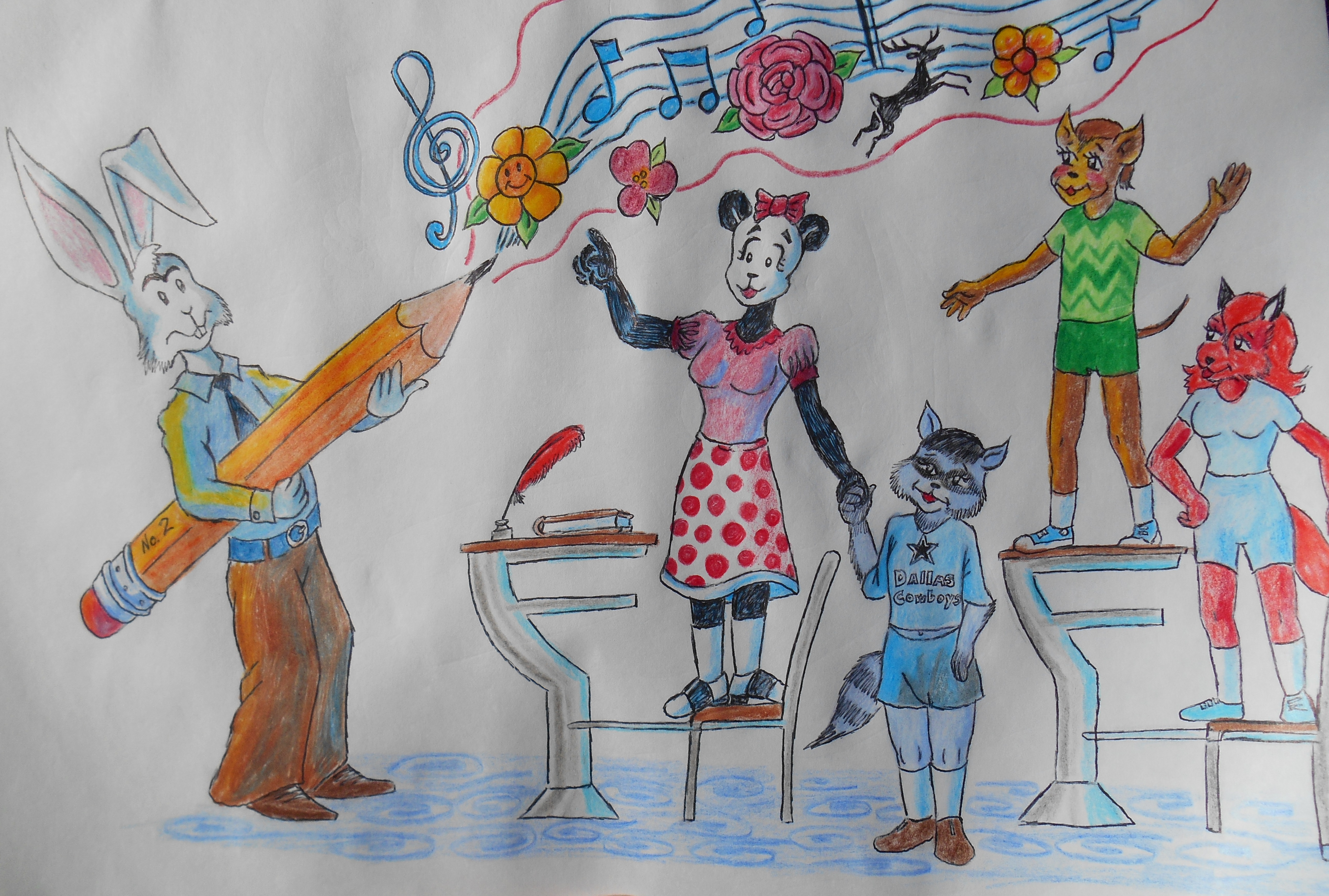
How To Write A Mickian Essay

mickeynose

I know the last thing you would ever consider doing is to take up writing essays like these.  What kind of a moronic bingo-boingo clown wants to take everything he or she knows, put it in a high-speed blender and turn it all into idea milkshakes?

But I was a writing teacher for many years.  And now, being retired and having no students to yell at when my blood pressure gets high, the urge to teach it again is overwhelming.

So, here goes…

c360_2017-01-02-10-17-06-058

Once you have picked the silly, pointless, or semi-obnoxious idea you want to shape the essay around, you have to write a lead.  A lead is the attention-grabbing device or booby-trap for readers that will draw them into your essay.  In a Mickian essay, whose purpose is to entertain, or possibly bore you in a mildly amusing manner, or cause you enough brain damage to make you want to send me money (this last possibility never seems to work, but I thought I’d throw it in there just in case), the lead is usually a  “surpriser”, something so amazingly dumb or off-the-wall crazy that you just have to read, at least a little bit, to find out if this writer is really that insane or what.  The rest of the intro paragraph that is not part of the lead may be used to draw things together to suggest the essay is not simply a chaotic mass of silly words in random order.  It can point the reader down the jungle path that he or she can take to come out of the other end of the essay alive.

Once started on this insane quest to build an essay that will strangle the senses and mix up the mind of the reader, you have to carry out the plan in three or four body paragraphs.  This is where you have to use those bricks of brainiac bull-puckie that you have saved up to be the concrete details in the framework of the main rooms of the little idea-house you are constructing.  If you were to number or label these main rooms, this one you are reading now would, for example, be Room #2, or B, or “the second body paragraph”.  And as you read this paragraph, you should be thinking in the voice of your favorite English teacher of all time.  The three main rooms in this example idea house are beginning, middle, and end.  You could also call them introduction, body, and conclusion.  These are the rooms of your idea house that the reader will live in during his or her brief stay (assuming they don’t run out of the house screaming after seeing the clutter in the entryway).

Teacher

The last thing you have to do is the concluding paragraph.  (Of course, you have to realize that we are not actually there yet in this essay.  This is Room C in the smelly chickenhouse of this essay, the third body paragraph.)  The escape hatch on the essay that may potentially explode into fireworks of thoughts, daydreams, or plans for something better to do with your life than a read an essay written by an insane former middle school English teacher at any moment, is a necessary part of the whole process.  This is where you have to remind them of what the essay is basically about, and leave them with the thought that you want to haunt them in their nightmares later.  The last thing that you say in the essay is the thing they are the most likely to remember.  So you need to save the best for last.

So, here, finally, is the exit door to this masterfully mixed-up Mickian Essay.  It is a simple, and straightforward structure.  The introduction containing the lead is followed by three or four body paragraphs that develop the idea and end in a conclusion that summarizes or simply restates the overall main idea.  And now you know why all of my former students either know how to construct an essay, or have several years left in therapy sessions with a psychiatrist.

Leave a comment

Filed under commentary, education, humor, Paffooney, teaching, writing, writing teacher

Writing Every Day

c360_2016-11-20-09-17-22-486

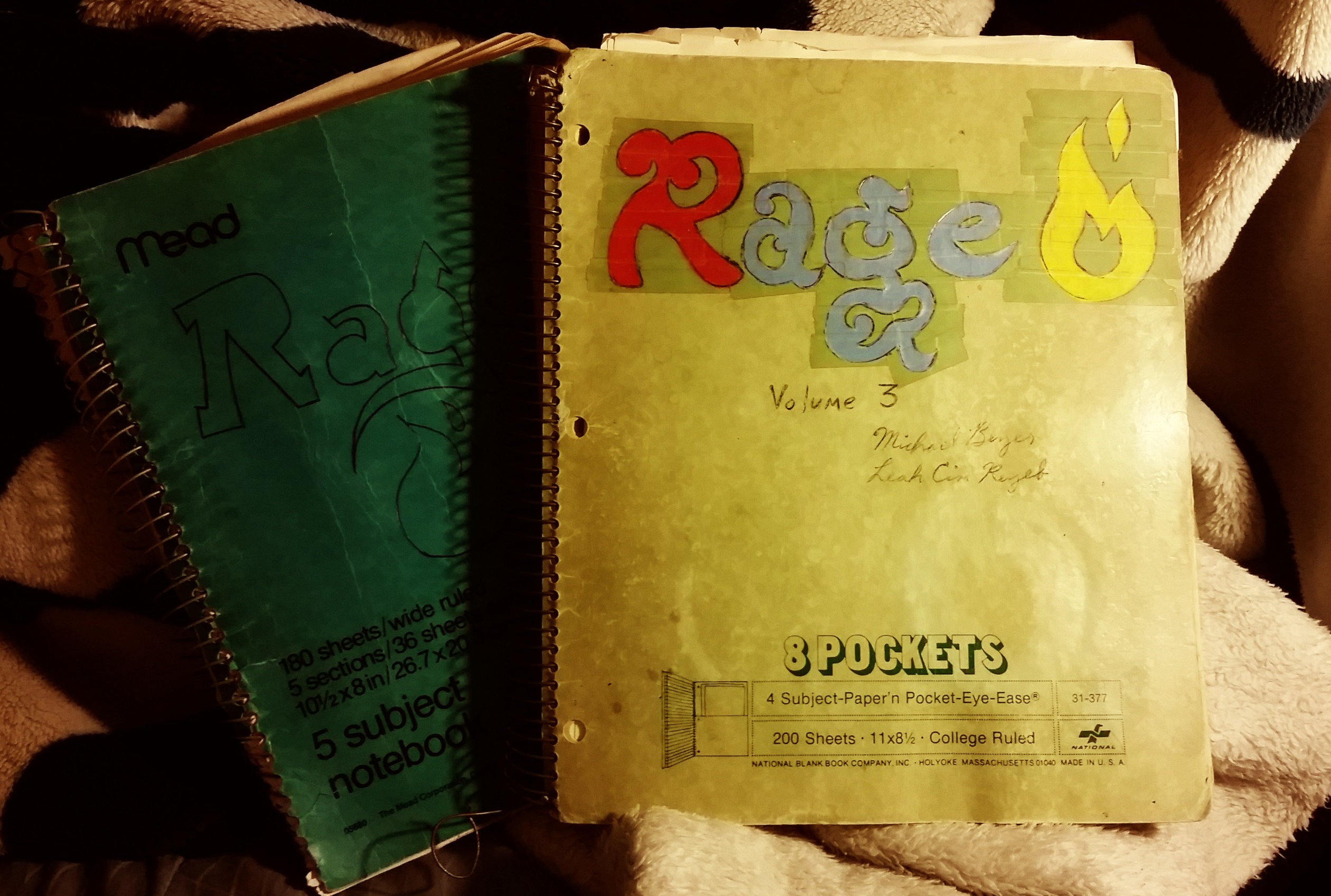
These are volumes 3 & 4 of my daily journal that I have kept since the 1980s.

Writing every single day is something I have been doing since 1975, my senior year in high school.  It is why I claim to be a writer, even though I have never made enough money at it to even begin to think of myself as a professional writer.  I kept a journal/diary/series of notebooks that I filled with junk I wrote and doodles in the margins up until the mid-90s when I began to put all my noodling into computer files instead of notebooks.  I have millions of words piled in piles of notebooks and filling my hard drive to the point of “insufficient memory” errors on my laptop.  I am now 69 years old and have been writing every day for 51  years.
c360_2016-11-20-09-19-02-147

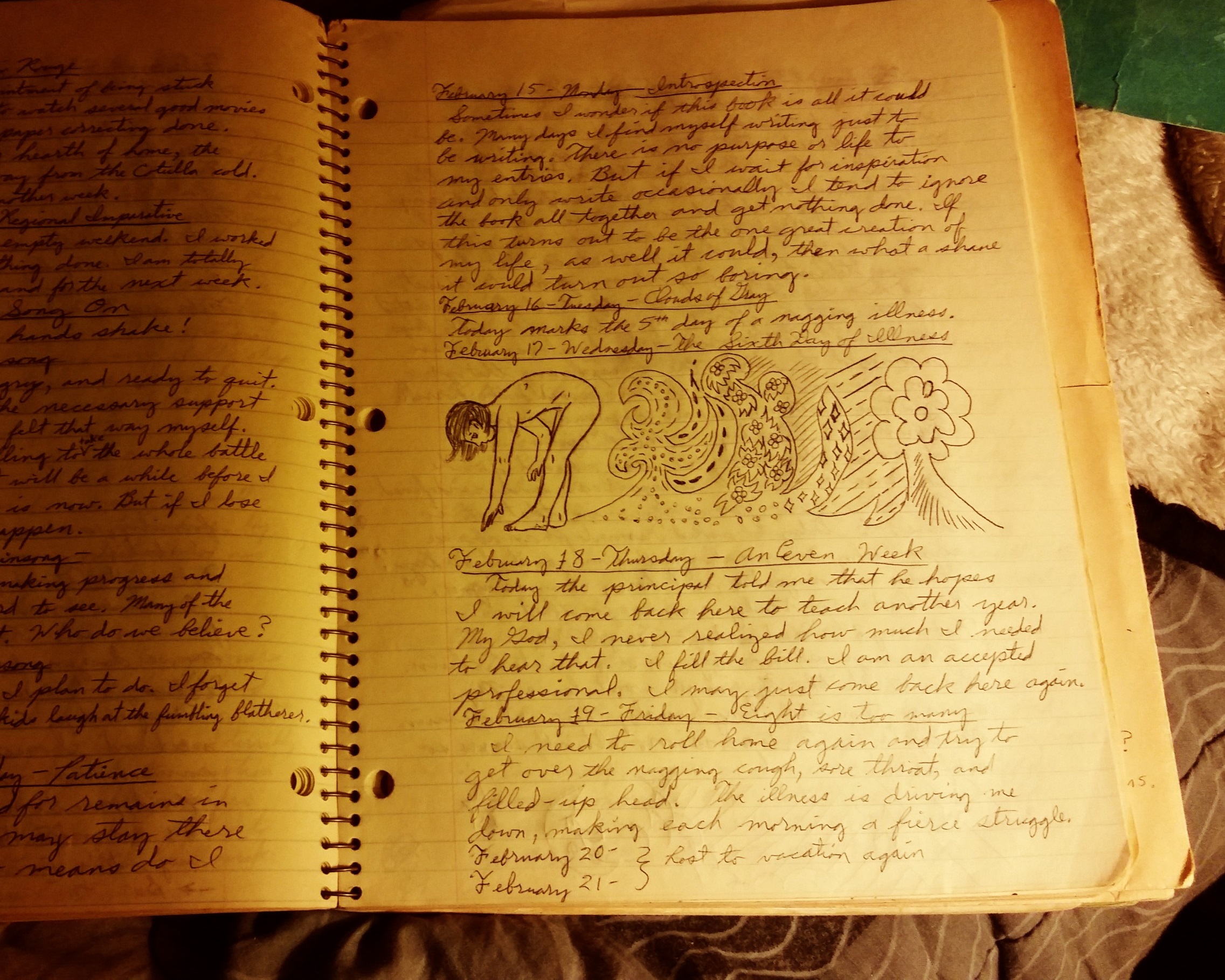
There are days in the past where I only wrote a word, or a sentence or two.  But there were a lot of words besides the words in my journal.  I started my first novel in college.  I completed it the summer before my first teaching job in 1981.  I put it the closet, never to be thought of again, except when I needed a good cringe and cry at how terrible a writer I once was.  I have been starting, stopping, percolating, piecing together, and eventually completing novel projects ever since… each one goofier and more wit-wacky than the last.  So I have a closet full of those too.
c360_2016-11-20-09-31-40-461

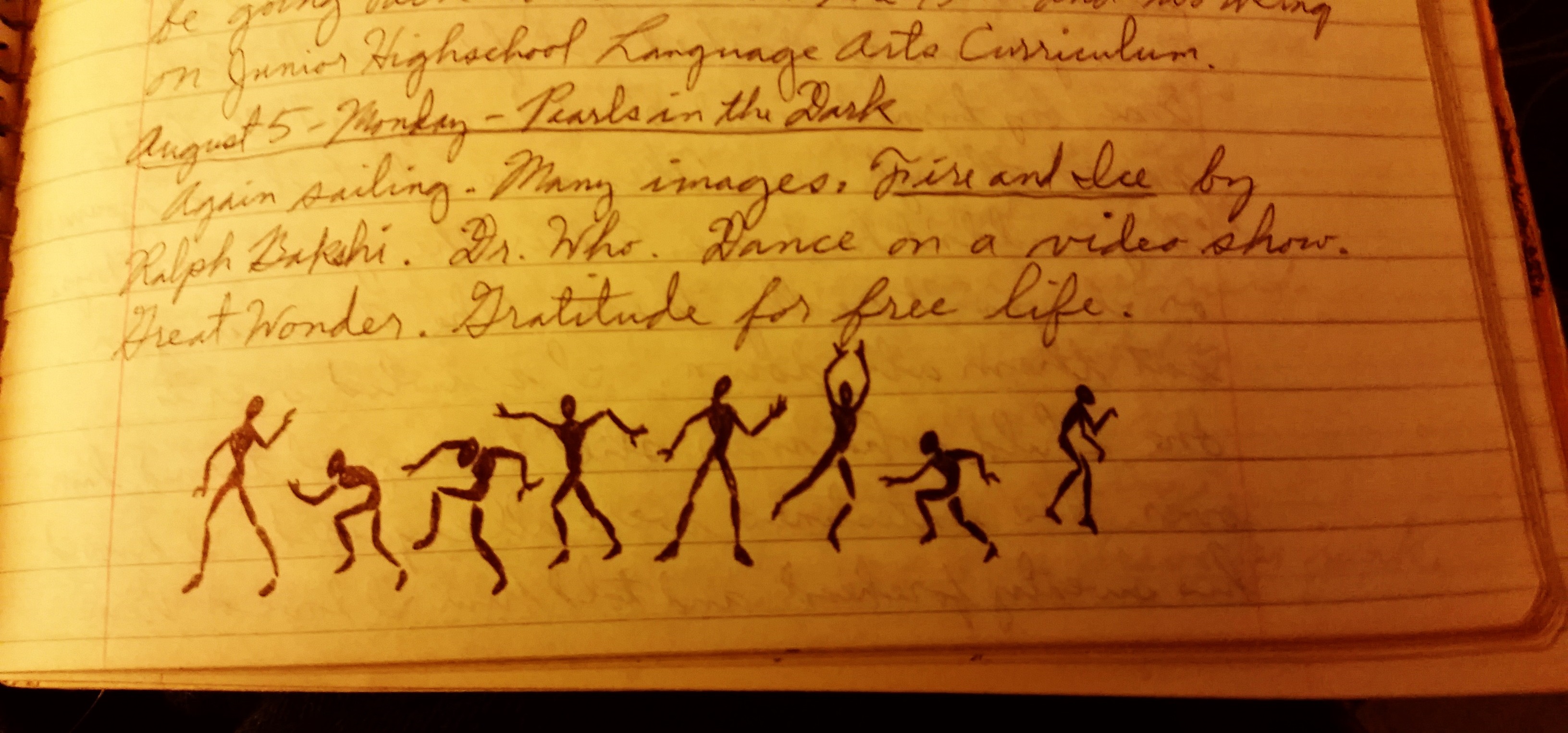
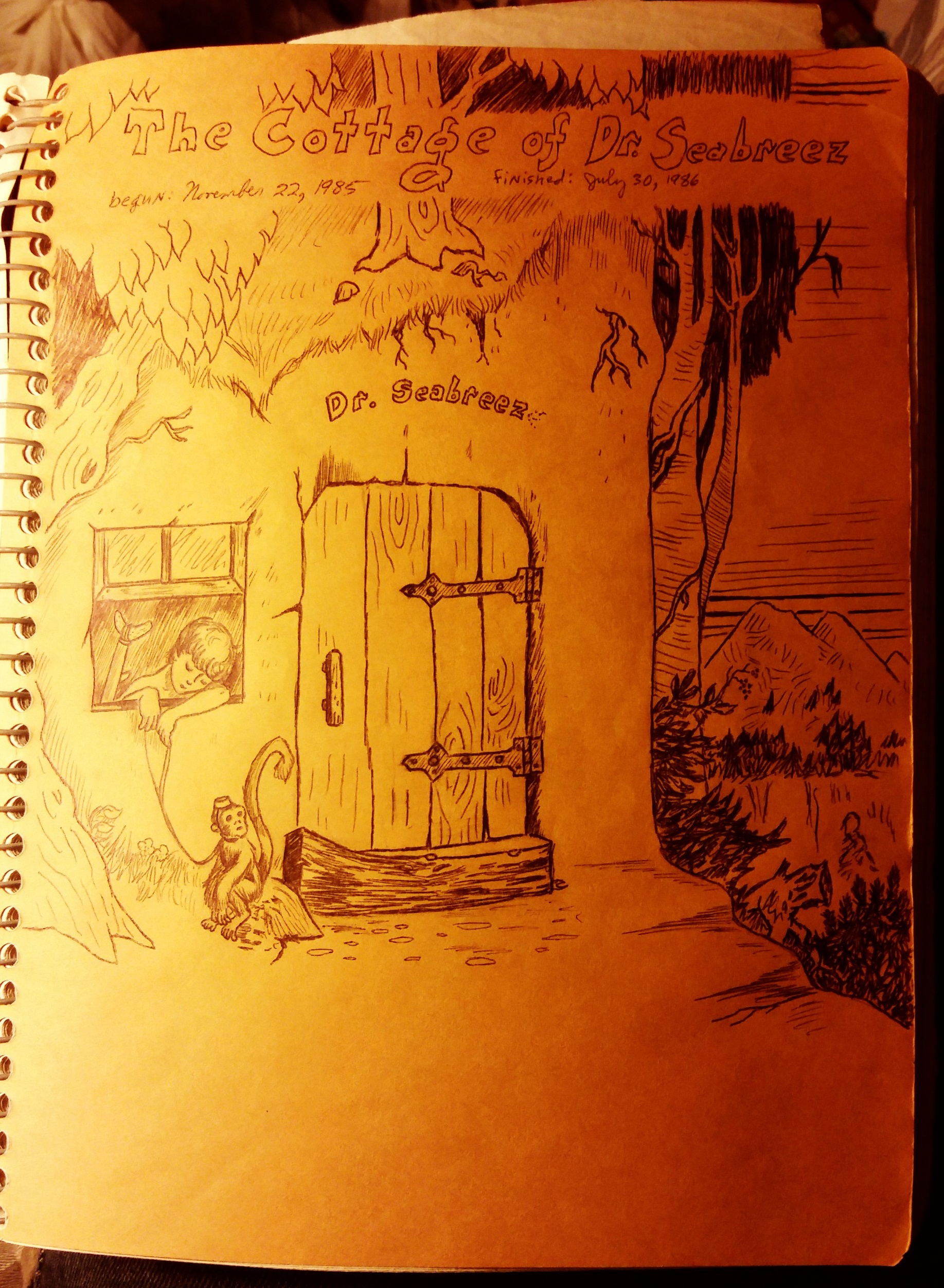
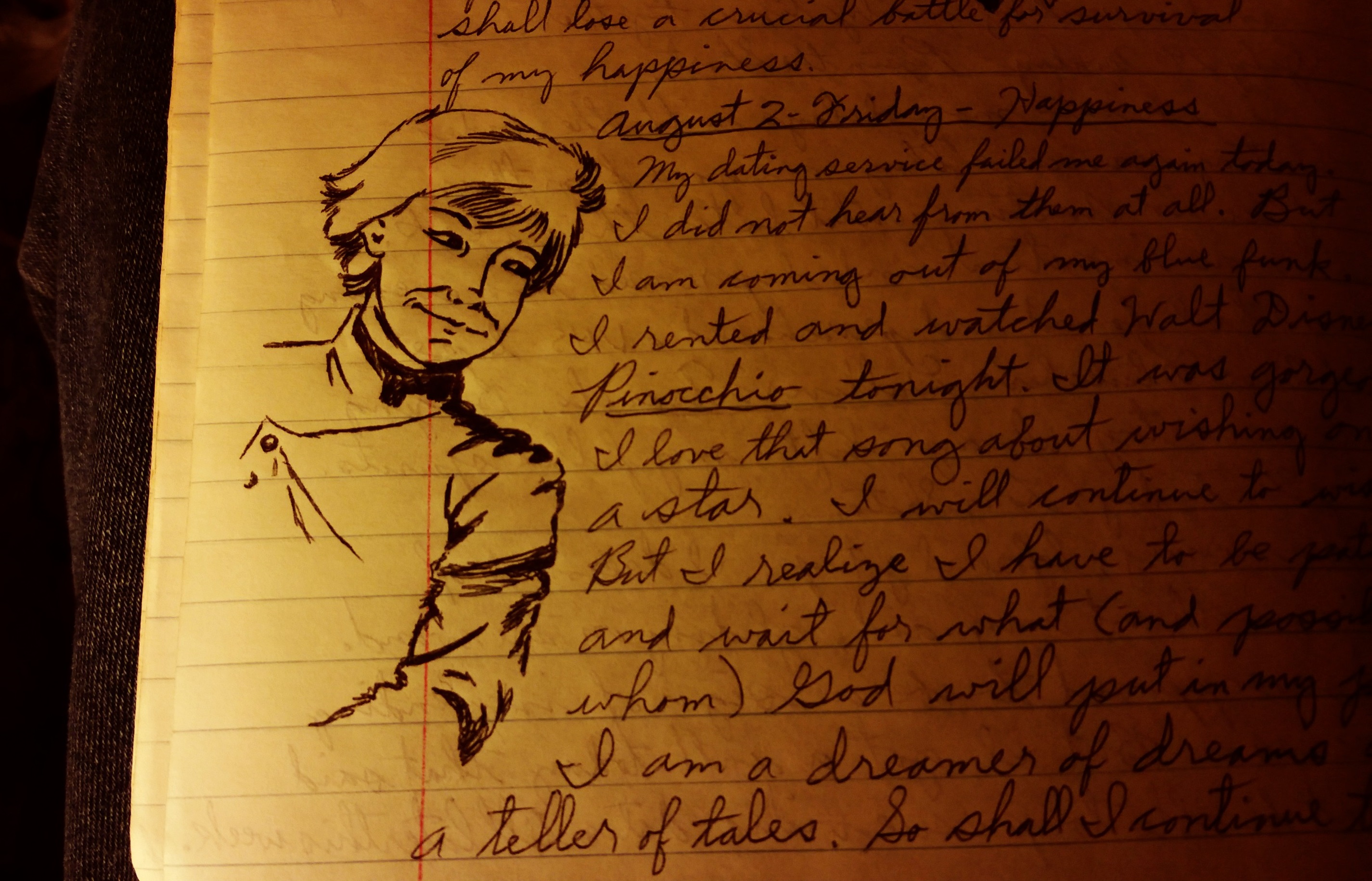
It would be wrong of me to suggest that my journals are only for words.  As a cartoon-boy-wannabee I doodle everywhere in margins and corners and parts of pages.  Sometimes the doodle is an afterthought.  Sometimes it precedes the paragraph.  Sometimes it is directly connected to the words and their meaning.

Sometimes the work of art is the main thing itself.
c360_2016-11-20-09-30-45-596

But always, the habit of writing down words and ideas every single day takes precedence over every other part of my day.  That’s the main reason I am stupid enough to think of myself as a writer even though I don’t make a living by writing.
c360_2016-11-20-09-31-59-738

But I did put my words into my profession too.  As a teacher of writing, I wrote with and to my students.  I did that for 31 years as a classroom teacher, and two years as a substitute.  I required them each to keep a daily journal (though they only got graded for the ones they wrote in class, and then only for reaching the amount of words assigned).  We shared the writing aloud in class, making only positive comments.  I wrote every assignment I gave them, including the journal entries.  They got to see and hear what I could write, and it often inspired them or gave them a structure to hang their own ideas upon.  And often they liked what I wrote and were surprised by it almost as much as I liked and was surprised by theirs.   Being a writer was never a total waste of time and effort.

So am I telling you that if you want to be writer you have to write every day too?  If I have to tell you that… you have totally missed the point.
Leave a comment

Filed under autobiography, blog posting, humor, insight, strange and wonderful ideas about life, teaching, writing, writing teacher

The Lyrical Imperative

Creativity

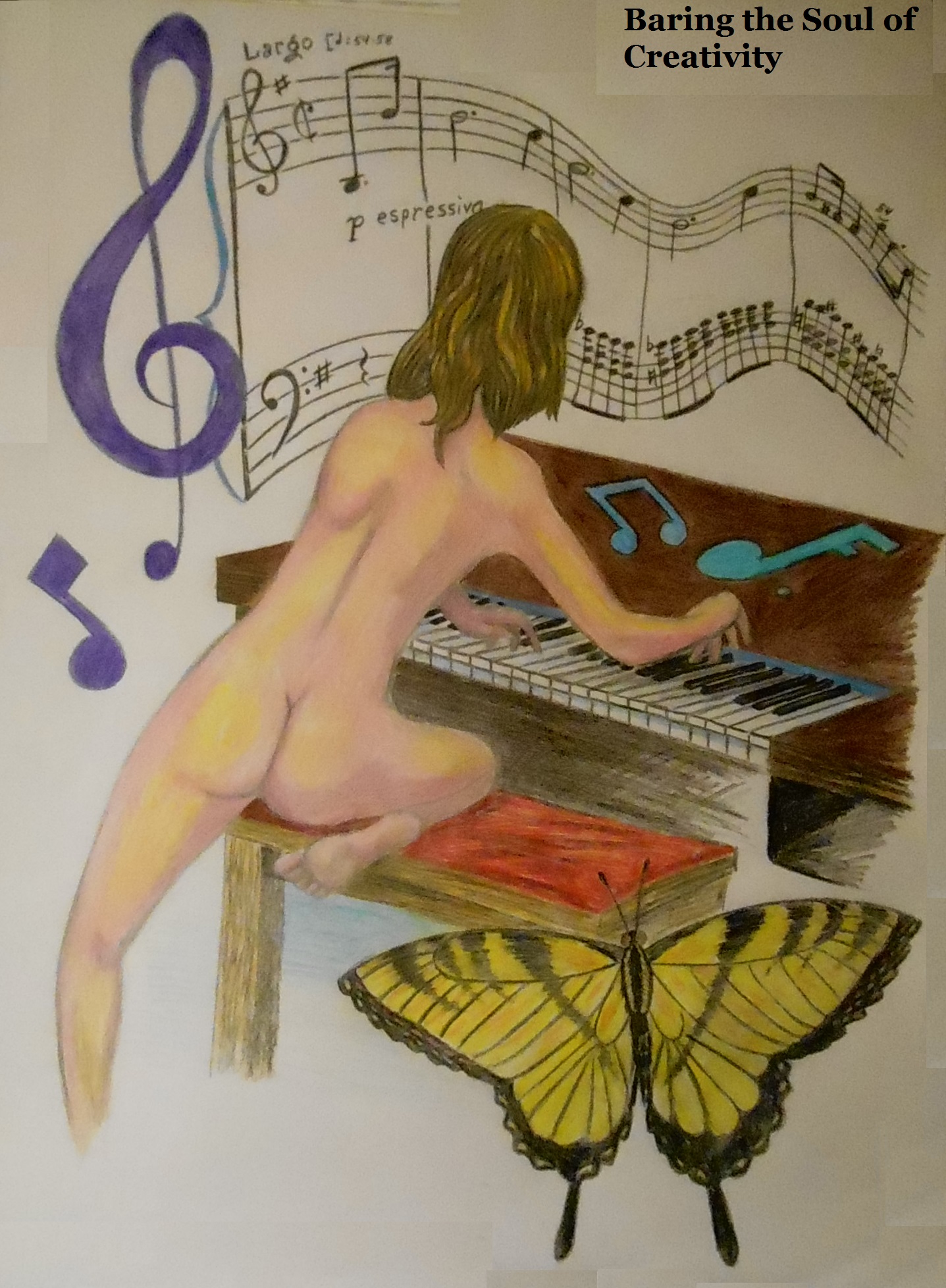
I am always amazed by the fact that things which are inherently silent in nature make music in your mind.  Writing is like that for me.  Drawing is like that.  And so is photography.  That is an actual musical score from Chopin in the background.  My son recognized it from a book of piano pieces I bought for him because he reads music and can turn those squiggle-bugs on the fence into the right plinkety-plunks on a keyboard.  But there is more music in that picture besides.  The nude young girl at the keyboard softly rendered in velvety colored pencil tones is also musical in nature, for more than just the fact of fingers on a silent colored pencil keyboard.  The lyrical loops of black and yellow in the wings of the tiger swallowtail butterfly also make music in my head, sprightly piano music like Chopin’s, or possibly Vivaldi’s violins.

Did you listen to the music?  I don’t mean Vivaldi’s, although if you haven’t heard it, you certainly should.  I mean the music in the words.  The music has to be there for me for the writing to be good.  That’s why I consider Ray Bradbury and Walt Whitman to be masters and Stephenie Meyer and E. L. James to be unreadable hacks.  The beat and the flow of the words need to be patterned and patient and wily.   Do you not hear it in that last sentence? The alliteration of the first two adjectives set off by the counterpoint of the stressed-unstressed beats of the third?  How can I explain this?

Iambic pentameter is the true genius of Shakespeare’s plays.  What the heck is iambic pentameter, you ask?  Well, I realize you have probably never needed to teach poetry to seventh graders, a truly impossible but infinitely rewarding task.  So let me tell you.  Units of stress called iambs consist of an unstressed syllable followed by a stressed syllable.  So naturally, if iambs are put into pentameter, then there must be five of them in a line of iambic pentameter poetry.  It is a simple, rhythmic way to say something profound and interesting.  The classic example is the first line of Shakespeare’s Sonnet 18;

Shall I compare thee to a summer’s day?

Translating that into X’s and O’s where X=stressed and O=unstressed;

O X O X O X O X O X

It’s simple, five oxes, all in a line.  Except that last one about oxes is actually O X O X X O O O O X, a less simple pattern, yet still organized on the beat.  Two iambs, a dactyl and an anapest.  Okay, now I am talking like a poetry geek, and I have to stop it before I hurt someone.

The whole point is, words should be musical, even when they are not the words to a song.  And now I must close on the verge of starting a ten-thousand word thesis.  I shall shut up now.  Here endeth the lesson.

Leave a comment

Filed under colored pencil, education, foolishness, goofy thoughts, humor, metaphor, music, Paffooney, poetry, strange and wonderful ideas about life

How To Write A Mickian Essay

mickeynose

I know the last thing you would ever consider doing is to take up writing essays like these.  What kind of a moronic bingo-boingo clown wants to take everything he or she knows, put it in a high-speed blender and turn it all into idea milkshakes?

But I was a writing teacher for many years.  And now, being retired and having no students to yell at when my blood pressure gets high, the urge to teach it again is overwhelming.

So, here goes…

c360_2017-01-02-10-17-06-058

Once you have picked the silly, pointless, or semi-obnoxious idea you want to shape the essay around, you have to write a lead.  A lead is the attention-grabbing device or booby-trap for readers that will draw them into your essay.  In a Mickian essay, whose purpose is to entertain, or possibly bore you in a mildly amusing manner, or cause you enough brain damage to make you want to send me money (this last possibility never seems to work, but I thought I’d throw it in there just in case), the lead is usually a  “surpriser”, something so amazingly dumb or off-the-wall crazy that you just have to read, at least a little bit, to find out if this writer is really that insane or what.  The rest of the intro paragraph that is not part of the lead may be used to draw things together to suggest the essay is not simply a chaotic mass of silly words in random order.  It can point the reader down the jungle path that he or she can take to come out of the other end of the essay alive.

Once started on this insane quest to build an essay that will strangle the senses and mix up the mind of the reader, you have to carry out the plan in three or four body paragraphs.  This is where you have to use those bricks of brainiac bull-puckie that you have saved up to be the concrete details in the framework of the main rooms of the little idea-house you are constructing.  If you were to number or label these main rooms, this one you are reading now would, for example, be Room #2, or B, or “the second body paragraph”.  And as you read this paragraph, you should be thinking in the voice of your favorite English teacher of all time.  The three main rooms in this example idea house are beginning, middle, and end.  You could also call them introduction, body, and conclusion.  These are the rooms of your idea house that the reader will live in during his or her brief stay (assuming they don’t run out of the house screaming after seeing the clutter in the entryway).

Teacher

The last thing you have to do is the concluding paragraph.  (Of course, you have to realize that we are not actually there yet in this essay.  This is Room C in the smelly chickenhouse of this essay, the third body paragraph.)  The escape hatch on the essay that may potentially explode into fireworks of thoughts, daydreams, or plans for something better to do with your life than a read an essay written by an insane former middle school English teacher at any moment, is a necessary part of the whole process.  This is where you have to remind them of what the essay is basically about, and leave them with the thought that you want to haunt them in their nightmares later.  The last thing that you say in the essay is the thing they are the most likely to remember.  So you need to save the best for last.

So, here, finally, is the exit door to this masterfully mixed-up Mickian Essay.  It is a simple, and straightforward structure.  The introduction containing the lead is followed by three or four body paragraphs that develop the idea and end in a conclusion that summarizes or simply restates the overall main idea.  And now you know why all of my former students either know how to construct an essay, or have several years left in therapy sessions with a psychiatrist.

Leave a comment

Filed under commentary, education, humor, Paffooney, teaching, writing, writing teacher

How To Write A Mickian Essay

mickeynose

I know the last thing you would ever consider doing is to take up writing essays like these.  What kind of a moronic bingo-boingo clown wants to take everything he or she knows, put it in a high-speed blender and turn it all into idea milkshakes?

But I was a writing teacher for many years.  And now, being retired and having no students to yell at when my blood pressure gets high, the urge to teach it again is overwhelming.

So, here goes…

c360_2017-01-02-10-17-06-058

Once you have picked the silly, pointless, or semi-obnoxious idea you want to shape the essay around, you have to write a lead.  A lead is the attention-grabbing device or booby-trap for readers that will draw them into your essay.  In a Mickian essay, whose purpose is to entertain, or possibly bore you in a mildly amusing manner, or cause you enough brain damage to make you want to send me money (this last possibility never seems to work, but I thought I’d throw it in there just in case), the lead is usually a  “surpriser”, something so amazingly dumb or off-the-wall crazy that you just have to read, at least a little bit, to find out if this writer is really that insane or what.  The rest of the intro paragraph that is not part of the lead may be used to draw things together to suggest the essay is not simply a chaotic mass of silly words in random order.  It can point the reader down the jungle path that he or she can take to come out of the other end of the essay alive.

Once started on this insane quest to build an essay that will strangle the senses and mix up the mind of the reader, you have to carry out the plan in three or four body paragraphs.  This is where you have to use those bricks of brainiac bull-puckie that you have saved up to be the concrete details in the framework of the main rooms of the little idea-house you are constructing.  If you were to number or label these main rooms, this one you are reading now would, for example, be Room #2, or B, or “the second body paragraph”.  And as you read this paragraph, you should be thinking in the voice of your favorite English teacher of all time.  The three main rooms in this example idea house are beginning, middle, and end.  You could also call them introduction, body, and conclusion.  These are the rooms of your idea house that the reader will live in during his or her brief stay (assuming they don’t run out of the house screaming after seeing the clutter in the entryway).

Teacher

The last thing you have to do is the concluding paragraph.  (Of course, you have to realize that we are not actually there yet in this essay.  This is Room C in the smelly chickenhouse of this essay, the third body paragraph.)  The escape hatch on the essay that may potentially explode into fireworks of thoughts, daydreams, or plans for something better to do with your life than a read an essay written by an insane former middle school English teacher at any moment, is a necessary part of the whole process.  This is where you have to remind them of what the essay is basically about, and leave them with the thought that you want to haunt them in their nightmares later.  The last thing that you say in the essay is the thing they are the most likely to remember.  So you need to save the best for last.

So, here, finally, is the exit door to this masterfully mixed-up Mickian Essay.  It is a simple, and straightforward structure.  The introduction containing the lead is followed by three or four body paragraphs that develop the idea and end in a conclusion that summarizes or simply restates the overall main idea.  And now you know why all of my former students either know how to construct an essay, or have several years left in therapy sessions with a psychiatrist.

Leave a comment

Filed under commentary, education, humor, Paffooney, teaching, writing, writing teacher

Writing Every Day

c360_2016-11-20-09-17-22-486

These are volumes 3&4 of my daily journal that I have kept since the 1980’s.

Writing every single day is something I have been doing since 1975, my senior year in high school.  It is why I claim to be a writer, even though I have never made enough money at it to even begin to think of myself as a professional writer.  I kept a journal/diary/series of notebooks that I filled with junk I wrote and doodles in the margins up until the middle 90’s when I began to put all my noodling into computer files instead of notebooks.  I have literally millions of words piled in piles of notebooks and filling my hard drive to the point of “insufficient memory” errors on my laptop.  I am now 66 years old and have been writing every day for 48 years.

c360_2016-11-20-09-19-02-147

There are days in the past where I only wrote a word, or a sentence or two.  But there were a lot of words besides the words in my journal.  I started my first novel in college.  I completed it the summer before my first teaching job in 1981.  I put it the closet, never to be thought of again, except when I needed a good cringe and cry at how terrible a writer I once was.  I have been starting, stopping, percolating, piecing together, and eventually completing novel projects ever since… each one goofier and more wit-wacky than the last.  So I have a closet full of those too.

c360_2016-11-20-09-31-40-461

It would be wrong of me to suggest that my journals are only for words.  As a cartoon-boy-wannabee I doodle everywhere in margins and corners and parts of pages.  Sometimes the doodle is an afterthought.  Sometimes it precedes the paragraph.  Sometimes it is directly connected to the words and their meaning.

Sometimes the work of art is the main thing itself.

c360_2016-11-20-09-30-45-596

But always, the habit of writing down words and ideas every single day takes precedence over every other part of my day.  That’s the main reason I am stupid enough to think of myself as a writer even though I don’t make a living by writing.

c360_2016-11-20-09-31-59-738

But I did put my words into my profession too.  As a teacher of writing, I wrote with and to my students.  I did that for 31 years as a classroom teacher, and two years as a substitute.  I required them each to keep a daily journal (though they only got graded for the ones they wrote in class, and then only for reaching the amount of words assigned).  We shared the writing aloud in class, making only positive comments.  I wrote every assignment I gave them, including the journal entries.  They got to see and hear what I could write, and it often inspired them or gave them a structure to hang their own ideas upon.  And often they liked what I wrote and were surprised by it almost as much as I liked and was surprised by theirs.   Being a writer was never a total waste of time and effort.

So am I telling you that if you want to be writer you have to write every day too?  If I have to tell you that… you have totally missed the point.

2 Comments

Filed under autobiography, blog posting, humor, insight, strange and wonderful ideas about life, teaching, writing, writing teacher

How To Write A Mickian Essay

mickeynose

I know the last thing you would ever consider doing is to take up writing essays like these.  What kind of a moronic bingo-boingo clown wants to take everything he or she knows, put it in a high-speed blender and turn it all into idea milkshakes?

But I was a writing teacher for many years.  And now, being retired and having no students to yell at when my blood pressure gets high, the urge to teach it again is overwhelming.

So, here goes…

c360_2017-01-02-10-17-06-058

Once you have picked the silly, pointless, or semi-obnoxious idea you want to shape the essay around, you have to write a lead.  A lead is the attention-grabbing device or booby-trap for readers that will draw them into your essay.  In a Mickian essay, whose purpose is to entertain, or possibly bore you in a mildly amusing manner, or cause you enough brain damage to make you want to send me money (this last possibility never seems to work, but I thought I’d throw it in there just in case), the lead is usually a  “surpriser”, something so amazingly dumb or off-the-wall crazy that you just have to read, at least a little bit, to find out if this writer is really that insane or what.  The rest of the intro paragraph that is not part of the lead may be used to draw things together to suggest the essay is not simply a chaotic mass of silly words in random order.  It can point the reader down the jungle path that he or she can take to come out of the other end of the essay alive.

Once started on this insane quest to build an essay that will strangle the senses and mix up the mind of the reader, you have to carry out the plan in three or four body paragraphs.  This is where you have to use those bricks of brainiac bull-puckie that you have saved up to be the concrete details in the framework of the main rooms of the little idea-house you are constructing.  If you were to number or label these main rooms, this one you are reading now would, for example, be Room #2, or B, or “the second body paragraph”.  And as you read this paragraph, you should be thinking in the voice of your favorite English teacher of all time.  The three main rooms in this example idea house are beginning, middle, and end.  You could also call them introduction, body, and conclusion.  These are the rooms of your idea house that the reader will live in during his or her brief stay (assuming they don’t run out of the house screaming after seeing the clutter in the entryway).

Teacher

The last thing you have to do is the concluding paragraph.  (Of course, you have to realize that we are not actually there yet in this essay.  This is Room C in the smelly chickenhouse of this essay, the third body paragraph.)  The escape hatch on the essay that may potentially explode into fireworks of thoughts, daydreams, or plans for something better to do with your life than a read an essay written by an insane former middle school English teacher at any moment, is a necessary part of the whole process.  This is where you have to remind them of what the essay is basically about, and leave them with the thought that you want to haunt them in their nightmares later.  The last thing that you say in the essay is the thing they are the most likely to remember.  So you need to save the best for last.

So, here, finally, is the exit door to this masterfully mixed-up Mickian Essay.  It is a simple, and straightforward structure.  The introduction containing the lead is followed by three or four body paragraphs that develop the idea and end in a conclusion that summarizes or simply restates the overall main idea.  And now you know why all of my former students either know how to construct an essay, or have several years left in therapy sessions with a psychiatrist.

Leave a comment

Filed under commentary, education, humor, Paffooney, teaching, writing, writing teacher

The Lyrical Imperative

Creativity

I am always amazed by the fact that things which are inherently silent in nature make music in your mind.  Writing is like that for me.  Drawing is like that.  And so is photography.  That is an actual musical score from Chopin in the background.  My son recognized it from a book of piano pieces I bought for him because he reads music and can turn those squiggle-bugs on the fence into the right plinkety-plunks on a keyboard.  But there is more music in that picture besides.  The nude young girl at the keyboard softly rendered in velvety colored pencil tones is also musical in nature, for more than just the fact of fingers on a silent colored pencil keyboard.  The lyrical loops of black and yellow in the wings of the tiger swallowtail butterfly also make music in my head, sprightly piano music like Chopin’s, or possibly Vivaldi’s violins.

Did you listen to the music?  I don’t mean Vivaldi’s, although if you haven’t heard it, you certainly should.  I mean the music in the words.  The music has to be there for me for the writing to be good.  That’s why I consider Ray Bradbury and Walt Whitman to be masters and Stephenie Meyer and E. L. James to be unreadable hacks.  The beat and the flow of the words need to be patterned and patient and wily.   Do you not hear it in that last sentence? The alliteration of the first two adjectives set off by the counterpoint of the stressed-unstressed beats of the third?  How can I explain this?

Iambic pentameter is the true genius of Shakespeare’s plays.  What the heck is iambic pentameter, you ask?  Well, I realize you have probably never needed to teach poetry to seventh graders, a truly impossible but infinitely rewarding task.  So let me tell you.  Units of stress called iambs consist of an unstressed syllable followed by a stressed syllable.  So naturally, if iambs are put into pentameter, then there must be five of them in a line of iambic pentameter poetry.  It is a simple, rhythmic way to say something profound and interesting.  The classic example is the first line of Shakespeare’s Sonnet 18;

Shall I compare thee to a summer’s day?

Translating that into X’s and O’s where X=stressed and O=unstressed;

O X O X O X O X O X

It’s simple, five oxes, all in a line.  Except that last one about oxes is actually O X O X X O O O O X, a less simple pattern, yet still organized on the beat.  Two iambs, a dactyl and an anapest.  Okay, now I am talking like a poetry geek, and I have to stop it before I hurt someone.

The whole point is, words should be musical, even when they are not the words to a song.  And now I must close on the verge of starting a ten-thousand word thesis.  I shall shut up now.  Here endeth the lesson.


Leave a comment

Filed under colored pencil, education, foolishness, goofy thoughts, humor, metaphor, music, Paffooney, poetry, strange and wonderful ideas about life

How To Write A Mickian Essay

mickeynose

I know the last thing you would ever consider doing is to take up writing essays like these.  What kind of a moronic bingo-boingo clown wants to take everything he or she knows, put it in a high-speed blender and turn it all into idea milkshakes?

But I was a writing teacher for many years.  And now, being retired and having no students to yell at when my blood pressure gets high, the urge to teach it again is overwhelming.

So, here goes…

c360_2017-01-02-10-17-06-058

Once you have picked the silly, pointless, or semi-obnoxious idea you want to shape the essay around, you have to write a lead.  A lead is the attention-grabbing device or booby-trap for readers that will draw them into your essay.  In a Mickian essay, whose purpose is to entertain, or possibly bore you in a mildly amusing manner, or cause you enough brain damage to make you want to send me money (this last possibility never seems to work, but I thought I’d throw it in there just in case), the lead is usually a  “surpriser”, something so amazingly dumb or off-the-wall crazy that you just have to read, at least a little bit, to find out if this writer is really that insane or what.  The rest of the intro paragraph that is not part of the lead may be used to draw things together to suggest the essay is not simply a chaotic mass of silly words in random order.  It can point the reader down the jungle path that he or she can take to come out of the other end of the essay alive.

Once started on this insane quest to build an essay that will strangle the senses and mix up the mind of the reader, you have to carry out the plan in three or four body paragraphs.  This is where you have to use those bricks of brainiac bull-puckie that you have saved up to be the concrete details in the framework of the main rooms of the little idea-house you are constructing.  If you were to number or label these main rooms, this one you are reading now would, for example, be Room #2, or B, or “the second body paragraph”.  And as you read this paragraph, you should be thinking in the voice of your favorite English teacher of all time.  The three main rooms in this example idea house are beginning, middle, and end.  You could also call them introduction, body, and conclusion.  These are the rooms of your idea house that the reader will live in during his or her brief stay (assuming they don’t run out of the house screaming after seeing the clutter in the entryway).

Teacher

The last thing you have to do is the concluding paragraph.  (Of course, you have to realize that we are not actually there yet in this essay.  This is Room C in the smelly chickenhouse of this essay, the third body paragraph.)  The escape hatch on the essay that may potentially explode into fireworks of thoughts, daydreams, or plans for something better to do with your life than a read an essay written by an insane former middle school English teacher at any moment, is a necessary part of the whole process.  This is where you have to remind them of what the essay is basically about, and leave them with the thought that you want to haunt them in their nightmares later.  The last thing that you say in the essay is the thing they are the most likely to remember.  So you need to save the best for last.

So, here, finally, is the exit door to this masterfully mixed-up Mickian Essay.  It is a simple, and straightforward structure.  The introduction containing the lead is followed by three or four body paragraphs that develop the idea and end in a conclusion that summarizes or simply restates the overall main idea.  And now you know why all of my former students either know how to construct an essay, or have several years left in therapy sessions with a psychiatrist.

Leave a comment

Filed under commentary, education, humor, Paffooney, teaching, writing, writing teacher

Writing Every Day

c360_2016-11-20-09-17-22-486

These are volumes 3&4 of my daily journal that I have kept since the 1980’s.

Writing every single day is something I have been doing since 1975, my senior year in high school.  It is why I claim to be a writer, even though I have never made enough money at it to even begin to think of myself as a professional writer.  I kept a journal/diary/series of notebooks that I filled with junk I wrote and doodles in the margins up until the middle 90’s when I began to put all my noodling into computer files instead of notebooks.  I have literally millions of words piled in piles of notebooks and filling my hard drive to the point of “insufficient memory” errors on my laptop.  I am now 60 years old and have been writing every day for 42 years.

c360_2016-11-20-09-19-02-147

There are days in the past where I only wrote a word, or a sentence or two.  But there were a lot of words besides the words in my journal.  I started my first novel in college.  I completed it the summer before my first teaching job in 1981.  I put it the closet, never to be thought of again, except when I needed a good cringe and cry at how terrible a writer I once was.  I have been starting, stopping, percolating, piecing together, and eventually completing novel projects ever since… each one goofier and more wit-wacky than the last.  So I have a closet full of those too.

c360_2016-11-20-09-31-40-461

It would be wrong of me to suggest that my journals are only for words.  As a cartoon-boy-wannabee I doodle everywhere in margins and corners and parts of pages.  Sometimes the doodle is an afterthought.  Sometimes it precedes the paragraph.  Sometimes it is directly connected to the words and their meaning.

Sometimes the work of art is the main thing itself.

c360_2016-11-20-09-30-45-596

But always, the habit of writing down words and ideas every single day takes precedence over every other part of my day.  That’s the main reason I am stupid enough to think of myself as a writer even though I don’t make a living by writing.

c360_2016-11-20-09-31-59-738

But I did put my words into my profession too.  As a teacher of writing, I wrote with and to my students.  I did that for 31 years as a classroom teacher, and two years as a substitute.  I required them each to keep a daily journal (though they only got graded for the ones they wrote in class, and then only for reaching the amount of words assigned).  We shared the writing aloud in class, making only positive comments.  I wrote every assignment I gave them, including the journal entries.  They got to see and hear what I could write, and it often inspired them or gave them a structure to hang their own ideas upon.  And often they liked what I wrote and were surprised by it almost as much as I liked and was surprised by theirs.   Being a writer was never a total waste of time and effort.

So am I telling you that if you want to be writer you have to write every day too?  If I have to tell you that… you have totally missed the point.
1 Comment

Filed under autobiography, blog posting, humor, insight, strange and wonderful ideas about life, teaching, writing, writing teacher