
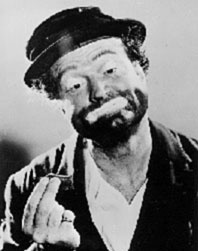
The homeless man wandered onto center stage just as the spotlight went on. He shaded his old eyes against the brightness and looked outward into the dark theater. It was probably some kind of mistake.
“Oh, so now it’s my turn to talk, eh?”
There was no response.
“Well, if you’re expecting something funny to come out of my mouth, good luck with that. More than half of what I say that makes people laugh is the result of depression, ill health, and just plain ignorant stupidity. And the other half of it is not meant to be funny, but is because I don’t always understand what I am saying.”

There was an embarrassed chuckle somewhere in the darkness.
“I mean, you can’t expect too much from me. I’m a bum. I have no money. I have no job. Not having any work to be bothered with is kinda good. But the other thing kinda sucks.
And all the great comedians that used to stand on this stage and try to save the world through humor are dead now. It’s true. Robin Williams died recently. George Carlin, Bill Hicks, Richard Pryor, and Bill Cosby are all long gone.”
There was some nervous laughter in the theater.
“Oh, I know, Cosby only thinks he’s dead. But he kinda killed the character delivering the wisdom in the form of observational comedy, didn’t he.”
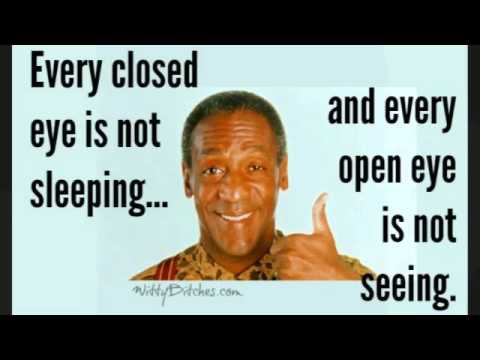
“But most of them old boys tried to come up here and tell you the truth. And the truth was so absolutely unexpectedly wacky and way out of bounds that you just had to laugh. And the more wicked the humor, the more you just laughed. You didn’t do anything about the problems they talked about. But you sure did laugh.”
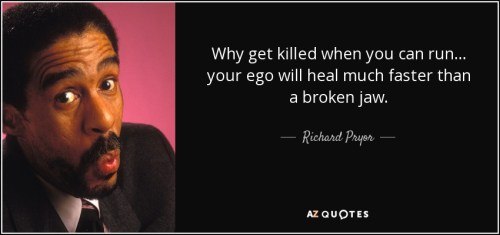
“It seems like the more they told you the truth and the more you just laughed about it, the more old and bitter they got. Sardonic? You know that word? Not sardines, fools, but sardonic. Bitterly humorous and sadly funny. Seems like a lot of them old boys got more and more bitter, more and more depressed up to the end. More and more sardonic.”

“I mean, Carlin was calling you stupid right to your face at the end. And you just laughed it off.”
The theater had grown eerily silent.
“But it ain’t all bad, is it? I mean, at least you all can still laugh. Only smart people get the jokes. The ones Carlin moaned about were laughing because everybody else was laughing. Those weren’t the ones we were talking to. There’s still life out there somewhere. Maybe intelligent life. Maybe aliens ain’t located any intelligent life on Earth yet, but they’re still trying, ain’t they?”
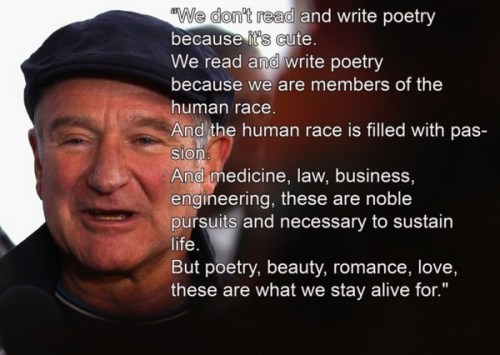
“You shoulda listened more carefully to what they were saying. Life and love and laughter were bound up in their words.”

“So I guess what I’m really saying is… just because I happened to get a rare chance to say it to you all… learn to listen better. The voices are quiet now. But the words are still there. And laughing at them is still a good thing. But remember, you need to hear them too.”
The theater suddenly filled with the roar of a standing ovation. The old man bowed. And this was ironic because… the theater had always been empty. No one at all was there now.





















Do Not Crush the Butterfly…
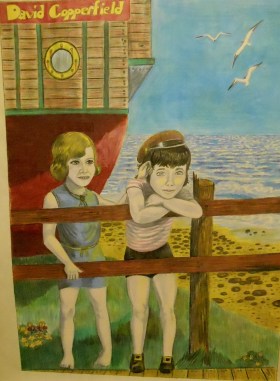
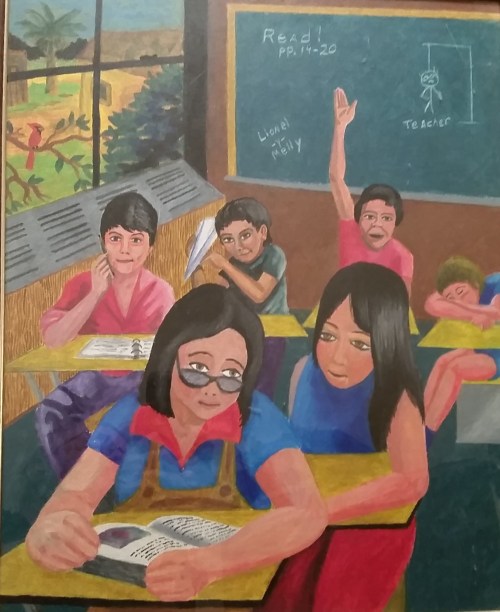
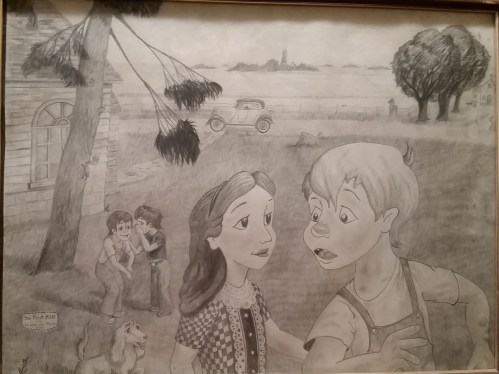
Art on the bedroom wall, with Christmas lights being used as a night light.
Talking to a school administrator the other day about the challenges my children and I have been facing in the last year, I had one of those experiences where you get a look at your own life through someone else’s eyes. “Wow, you have really been on a difficult journey,” he said. I just nodded in response. Financial difficulties, health problems, dealing with depression… life has been tough. But you get through things like that by being centered. Meditation tricks. Things you can do to smooth out the wrinkles and keep moving forward.
I always return in the theater of my mind to a moment in childhood where I learned a critical lesson. My life has been one of learning how to build rather than destroy. It has been about creating, not criticizing.
Electric lights have come to Toonerville, helping to light the darkness.
When I was a boy, I was a serious butterfly hunter. It started when Uncle Don gave me a dead cecropia moth that he had found in the Rowan grain elevator. It was big and beautiful and perfectly preserved. Shortly thereafter, I located another cecropia in the garage behind the house, a building that had once been a wagon shed complete with horse stalls and a hay loft. I tried to catch it with my bare hands. And by the time I had hold of it, the powder on its wings was mostly gone. The wings were broken in a couple of places, and the poor bug was ruined in terms of starting a butterfly collection.
A cecropia moth
Undeterred by tragedy, I got books about butterfly collecting at the Rowan Public Library and began teaching myself how to bug hunt. I learned where to find them, and how to net them, and how to kill and mount them.
I discovered that my grandfather’s horse pasture had thistle patches which were natural feeding grounds for red admiral butterflies (pictured top left) and painted lady butterflies (top right). But if you wanted to catch the rarer mourning cloak butterfly (bottom picture), you had to stake out apple trees, particularly at apple blossom time, though I caught one on the ripening apples too.
The tiger swallowtail was the butterfly that completed my collection, and it was finished when one of my cousins caught one and gave it to me because she knew I collected them.
But then, one day, while I was sitting on a blanket under a maple tree in the back yard with my notebooks open, writing something that I no longer even recall what I wrote, the backyard tiger swallowtail visited me again. In fact, he landed on the back of my hand. I dropped the pencil I was writing with, and slowly, carefully, I turned my hand over underneath him so that he was sitting on my palm.
I could’ve easily closed my hand upon him and captured him. But I learned the lesson long before from the cecropia that catching a butterfly by hand would destroy its delicate beauty. I would knock all the yellow and black powder off his exquisite wings. I could not catch him. But I could close my hand and crush him. I would be victorious after a summer-long losing battle.
But that moment brought an end to my butterfly hunting. I let him flutter away with the August breeze. I did not crush the butterfly. It was then that I realized what beauty there was in the world, and how fragile that beauty could be. I could not keep it alive forever. But it lasted a little big longer because I chose to let it.
So, here is the lesson that keeps me whole. Even though I had the power, I did not crush the butterfly.
2 Comments
Filed under commentary, compassion, feeling sorry for myself, healing, humor, insight, inspiration, wisdom
Tagged as bug hunting, butterflies, wisdom