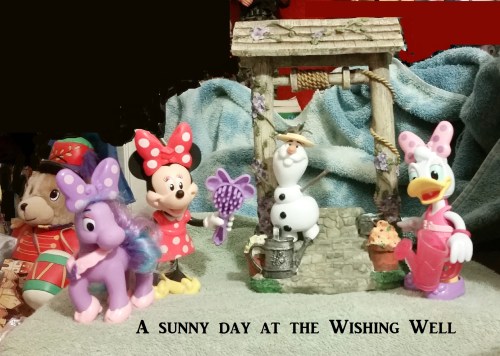
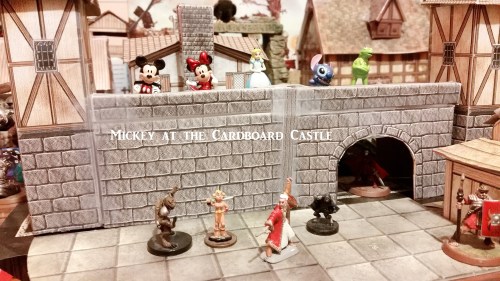
I believe I gave you fair warning that I would be telling the story of how, in our family D & D game, we conquered a castle that was occupied by the forces of evil. Well, this is it. It happened in the castle I described as an adventure setting last week.
The heroes, led by the halfling Gandy Rumspot (number two son’s character) and Mira the Kalashtar (daughter the Princess’s character) were asked by the Kingdom of Breland to investigate what happened to their ally, the Duke of Passage, Dane Evernight, in the Kingdom of Aundair.

So they loaded up their trusty airship and flew to Passage. Where they immediately learned of two mysterious boys made completely of stone and, yet, still living.

They found the two in the city square north of the castle.
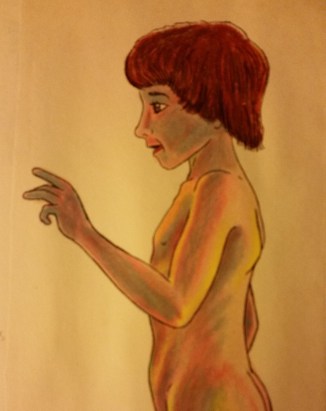
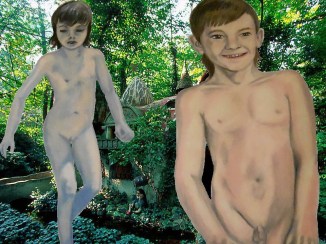
Druealia the wizardess; You two boys are golems? Living statues?
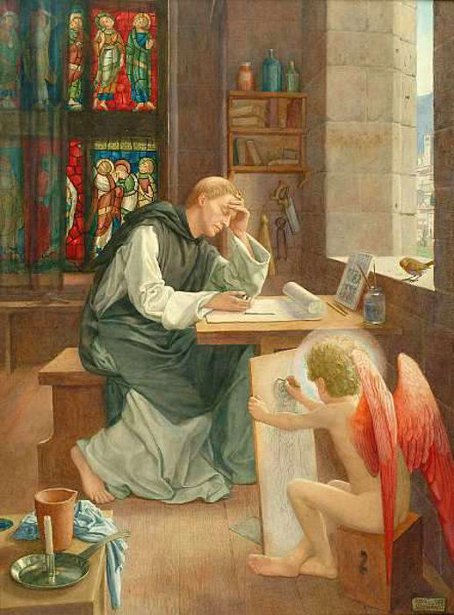
Angel statue; We weren’t before Dr. Zorgo took us into the lab. We were castle pages to the Duke of Passage.
Gandy the rogue; He changed you? Who is this Dr. Zorgo?
Faun statue; Zorgo was the Duke’s court physician. When we woke up in the castle, everybody had been turned into some sort of golem. Stone golems, rag golems, animated statues… even the Duke himself. None of us remember much about our lives before our minds were put in these new bodies.
Mira the Kalashtar; We have to get inside the castle and put things right!

So, the question became, “How do we get into the castle without this Doctor Zorgo finding out and turning us into golems too?”
The answer came from a visiting professor from Morgrave University in Sharn. Professor Hootigan was a sentient giant owl. Not only could he warn them about the dangers of facing a mindflayer, a psionic monster who can read your thoughts and attack your mind, which Zorgo actually was, but he could fly the two lightest members of the adventuring party up to the summit of the castle, bypassing all the many traps and defenses that Zorgo had most likely laid. And it didn’t hurt that both Hootigan and Mira were psionically able to protect the group from Zorgo’s mind attacks.

So up they went. Hootigan’s flying skill roll was high enough to not only get them inside, but get them in quietly enough not to awaken the sleeping stone gargoyles who guarded the heights.
They were protected from Dr. Zorgo’s routine mind probes of the castle by Mira’s mind-shielding powers.
Once they were past Zorgo’s lab, they soon discovered two different things. Zorgo hadn’t yet changed the Duke’s daughter, Sien, into a golem yet. She was still imprisoned in the castle’s dark pit, called an “oubliette”.
They also discovered that fighting golems was extremely difficult. They discovered this in a fight with three golems they dubbed Moe, Curly, and Larry for some mysterious reason.

After a very frustrating slap-fight in which they discovered that you can’t kill or wound a rag golem with weapons, they finally won the day when they discovered all they had to do was stop the Larry golem from playing “Pop Goes the Weasel” on his fiddle. That took away their will to fight. And they were even helpful as former faithful servants of the Duke. They revealed that all the golems in the castle were controlled by one golem-control wand wielded by Dr. Zorgo himself.

First they sneaked down to the oubliette and rescued Duchess Sien. Then they had to steal back her magical armor and swords. Many more golem guards and gargoyles were in the way of achieving their goals, but they used a bit of trickery to turn the odds in their favor.
They tricked Major Jak Pumpkinhead into thinking that the castle was being assaulted from the front. When all the castle defenders rushed to the front towers, Gandy closed the inner gates on them, locking them all inside their very own defensive positions.

Finally they confronted Dr. Zorgo himself. This time Mira’s defensive mind shields were not so successful. Zorgo incapacitated Sien Evernight and Gandy Rumspot with mind attacks because they did not have their own psionic defenses (and because Mira rolled a 4 when she needed at least a 10 on the 20-sided dice). Dr. Zorgo set the golden golem that had once been Duke Dane Evernight on a course to killing Mira. At the last possible moment, Mira threw her magic dagger at Zorgo’s golem wand, rolled an 18, and destroyed it. The gold golem, realizing he was now free, exacted his revenge. He grabbed Dr. Zorgo and plunged off the balcony of the castle’s summit with him to a jarring destruction at the bottom of the 300-foot tower and cliff.

It was a mostly “happy ever after” event. The player characters now owned a castle, provided that Fate agreed to marry Duchess Sien and become the new Duke of Passage.
The numerous golem servants, having nowhere else to go, and no longer being human, elf, dwarf, or whatever they had been previously, stayed on to be castle servants. Duke Evernight’s golden head was retrieved from the bottom of the cliff and, still able to talk, was to be the useful adviser of the new Duke.
That is pretty much typical of our D & D adventures. Full of slapstick humor and mindless destruction, it was a whee of a time that made us laugh and enjoy time spent together playing weird imagination games with various toys, props, and dice.
Why Do You Think That? (Part Two)
In my short, sweet sixty years of life, I have probably seen more than my share of movies. I have seen classic movies, black-and-white movies, cartoon movies, Humphrey Bogart movies, epic movies, science fiction movies, PeeWee Herman movies, Disney movies, Oscar-winning movies, and endless box-office stinkers. But in all of that, one of the most undeniable threads of all is that movies make me cry. In fact they make me cry so often it is a miracle that even a drop of moisture remains in my body. I should be a dried-out husk by now.
I wept horribly during this scene. Did you?
And the thing is, people make fun of you when you cry at movies. Especially cartoon movies like Scooby Doo on Zombie Island. (But I claim I was laughing so hard it brought tears to my eyes. That’s the truth, dear sister. So stop laughing at me.) But I would like to put forth another “Why do you think that?” notion. People who cry while watching a movie are stronger and more powerful than the people who laugh at them for crying. A self-serving thesis if ever there was one.
Movies can make you cry if you have the ability to feel empathy. We all know this. Old Yeller is the story of a dog who endears himself to a prairie farm family, saves Travis’s life at one point, and then gets infected with rabies and has to be put down. Dang! No dry eyes at the end of that one. Because everyone has encountered a dog and loyal dog-love somewhere along the line. And a ten-year-old dog is an old dog. The dogs you knew as a child helped you deal with mortality because invariably, no matter how much you loved them, dogs demonstrate what it means to die. Trixie and Scamper were both hit by cars. Queenie, Grampa’s collie, died of old age. Jiggs the Boston Terrier died of heat stroke one summer. You remember the pain of loss, and the story brings it all back.
Only psychopaths don’t feel empathy to some degree. Think about how you would feel if you were watching Old Yeller and somebody you were watching with started laughing when Travis pulls the trigger on the shotgun. Now, there’s a Stephen King sort of character.
But I think I can defend having lots of empathy as a reason for crying a river of tears during Disney’s The Hunchback of Notre Dame. You see, identifying with Quasimodo as the main character, hoping for what he hopes for, feeling like a monster and completely unloved, and fearing what he fears connect you to the story in ways that completely immerses you in the experience. This is basically a monster movie.
But the film puts you inside the head of the malformed man, and you realize that he is not the monster. Righteous Judge Frollo and the people who mistreat Quasimodo for his deformity of outward appearance are the real monsters. If you don’t cry a river of tears because of this story, then you have not learned the essential truth of Quasimodo. When we judge others harshly, we are really judging ourselves. In order to stop being monstrous, and be truly human, you must look inside the ugliness as Esmeralda does to see the heroic beauty inside others. Sometimes the ideas themselves are so powerful they make me weep. That’s when my sister and my wife look at me and shake their heads because tears are shooting out of me like a fountain, raining wetness two or three seats in every direction. But I believe I am a wiser man, a more resolved man, and ultimately a better man because I was not afraid to let a movie make me cry.
The music also helps to tell the story in ways that move my very soul to tears. Notice how the heroine walks the opposite way to the rest of the crowd. As they sing of what they desire, what they ask God to grant, she asks for nothing for herself. She shows empathy in every verse, asking only for help for others. And she alone walks to the light from the stained glass window. She alone is talking to God.
Yes, I am not embarrassed by the fact that movies make me cry. In fact, I should probably be proud that movies and stories and connections to other people, which they bring me, makes me feel it so deeply I cry. Maybe I am a sissy and a wimp. Maybe I deserved to be laughed at all those times for crying during the movie. But, hey, I’ll take the laughter. I am not above it. I am trying to be a humorist after all.
4 Comments
Filed under cartoon review, commentary, compassion, Disney, humor, insight, inspiration, movie review, music, philosophy, strange and wonderful ideas about life
Tagged as empathy, movies that make me cry, Old Yeller, The Hunchback of Notre Dame, Toy Story 3